LAMBETH PALACE.
Reading edition
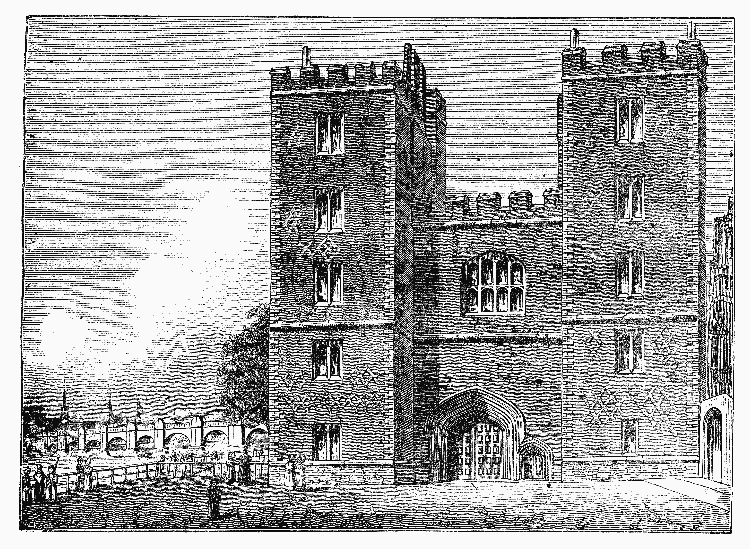
[Gate-house of Lambeth Palace.]
Lambeth Palace, which stands on the right bank of the Thames, within half a mile of Westminster Bridge, has been for many centuries the principal residence of the Archbishops of Canterbury. The manor belonged originally to the see of Rochester, to which it had been granted, before the Norman Conquest, by a sister of Edward the Confessor; and it was obtained in exchange for some other lands, by Baldwin, Archbishop of Canterbury, in the year 1189. There is reason to believe, however, that the Archbishops had a house here for at least a century before this time. The ancient possession of Lambeth by the see of Rochester is still commemorated by the payment to the latter, in two half-yearly sums, of five marks of silver, in consideration of the lodging, fire-wood, forage, and other accommodations which the Bishops of Rochester had been accustomed to receive here whenever they visited London. When the Archbishops of Canterbury first obtained possession of the place, the buildings on it appear to have been old and mean. With the exception of the Chapel, the whole of the present structure has certainly been erected since the middle of the thirteenth century.
The Palace, as it now appears, is an irregular but very extensive pile, exhibiting specimens of almost every style of architecture that has prevailed during the last seven hundred years. The oldest part of it, as we have just said, is the Chapel, which is supposed to have been built towards the close of the twelfth century. It consists of two apartments, divided by a richly-ornamented screen, and measuring together 72 feet in length by 25 in breadth. The height of the Chapel is 30 feet. Under it is another apartment of smaller dimensions, formed by a series of arches, supported by pillars, and now used as a cellar, though in ancient times it may not improbably have served as a place of worship. Another of the most remarkable portions of the edifice, the Great Hall, was originally erected by Archbishop Chicheley in the beginning of the reign of Henry VI.; but after the Palace had been sold by the Parliament in the time of the Commonwealth, this magnificent apartment was pulled down. It was rebuilt, however, on the old site, and in close imitation of the former hall, after the Restoration, by Archbishop Juxon, at an expense of £10,500. It stands on the right of the principal courtyard, and is built of fine red brick, the walls being supported by stone buttresses, and also coped with stone, and surmounted by large balls or orbs. The length of this noble room is 93 feet, its breadth 38, and its height 50. The roof, which is of oak and elaborately carved, is particularly splendid and imposing. The Gate-house, which forms the principal entry to the Palace, was erected by Cardinal Morton, about the year 1490, and is a very beautiful and magnificent structure. It consists of two lofty towers, from the summits of which is one of the finest views in the neighbourhood of the metropolis. In front of this gate the ancient archiepiscopal dole, or alms, is still distributed every Sunday, Tuesday, and Thursday, to thirty poor parishioners of Lambeth. Ten are served each day, among whom are divided three stone of beef, ten pitchers of broth, thickened with oatmeal, five quartern loaves, and twenty-pence in copper.
One of the most interesting portions of Lambeth Palace is the stone building called the Lollard’s Tower. It was erected by Archbishop Chicheley, in the early part of the fifteenth century, as a place of confinement for the unhappy heretics from whom it derives its name. Under the tower is an apartment of somewhat singular appearance, called the post room, from a large post in the middle of it by which its flat roof is partly supported. The prison in which the poor Lollards were confined is at the top of the tower, and is reached by a very narrow winding staircase. Its single doorway, which is so narrow as only to admit one person at a time, is strongly barricaded by both an outer and an inner door 261of oak, each three inches and a half thick, and thickly studded with iron. The dimensions of the apartment within are 12 feet in length, by 9 in width, and 8 in height; and it is lighted by two windows, which are only 28 inches high, by 14 inches wide on the inside, and about half as high and half as wide on the outside. Both the walls and roof of the chamber are lined with oaken planks an inch and a half thick; and eight large iron rings still remain fastened to the wood, the melancholy memorials of the barbarous tyranny whose victims formerly pined in this dismal prison-house. Many names, and fragments of sentences, are rudely cut out on various parts of the walls.
Among the other principal apartments are the Library, containing a very extensive and valuable collection of books and manuscripts, founded by Archbishop Bancroft in 1610: and the Long Gallery, generally supposed to have been the work of Cardinal Pole, who possessed the see from the death of Archbishop Cranmer in 1556 till 1558. This noble room contains many portraits, of which several are in the highest degree interesting as works of art, or on account of the individuals whom they represent.
Besides these apartments, the palace contains many others well deserving of notice, but which we cannot here attempt to describe. We may merely mention the Guardroom, an ancient and venerable chamber, 56 feet in length, and adorned by a splendid timber roof; the Presence Chamber, also of considerable antiquity: the great Dining-room, which contains a series of portraits of all the Archbishops, from Laud to Cornwallis inclusive; the old and new Drawing-rooms, the latter a fine room measuring 33 feet by 22, built by Archbishop Cornwallis; and the Steward’s Parlour, probably built by Archbishop Cranmer. In a future number we shall describe the extensive additions to Lambeth Palace which have been made by his Grace the present Archbishop. The palace is surrounded by a park and gardens, very tastefully laid out, and occupying in all about eighteen acres. Among the ornaments of the grounds are particularly deserving of notice two Marseilles fig-trees, of great size, and still bearing an abundance of delicious fruit, which tradition asserts to have been planted by Cardinal Pole.
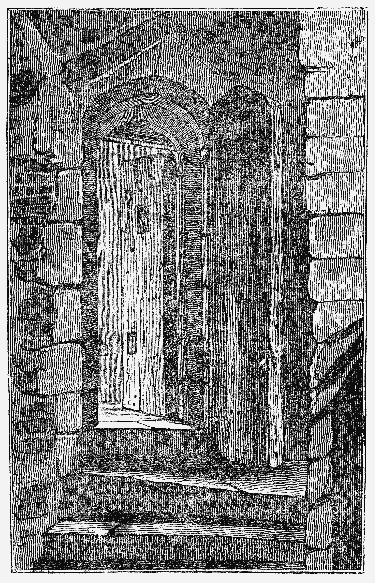
[Doorway in Lollard’s Tower.]