Front matter (continued 4)
Reading edition
"Let's try it," she said, and leading the way, she began scrambling up the rocky cliff.
Monica followed suit, and Amethyst, determined not to be thought cowardly again, tried her very hardest to keep up with them. But, partly on account of her being smaller and a little more nervous than the others, and also because they had thoughtlessly rather than intentionally left her to carry the bundle of shells, she made very slow progress.
Thus it came to pass that she had got a very little way up the steep incline, when a cry of fear, and a quantity of loose sand, and small rocky stones, falling about her, made her look up in alarm. Monica and Olive had managed, by hook or by crook, to get within fifteen or twenty feet of the top of the cliff, but a false footing had caused Olive to slip; a projection which she had imagined to be firm hard rock, and to which she had trusted her whole weight, having crumbled away beneath her, and she had gone slipping down with it!
"Oh!" Amethyst's eyes grew round with terror, and she felt rooted to the spot; suppose Olive should go on falling all the way down. How dreadful it would be, and no one near to help do anything!
Monica, separated from her friend by several feet of crumbling cliff, tried her hardest not to lose her nerve, but an irresistible feeling came over her that, if once she looked back, she must fall, too.
"Are you hurt, Ollie?" she called out, while she clung to a tuft of grass which happened to be near, and tried to steady herself. But no answer came, and fearing she knew not what she looked down the cliff.
"Oh! Ollie, have you hurt yourself?" she cried again, in an agony of fear, for Olive looked so white and strange, half-standing, half-lying on a sloping bit of rock.
"I--don't--know." The answer came back, slowly, this time, in tones so unnatural that Monica shuddered and grew cold. What had happened to Olive that she should speak and look like that? Supposing she should faint, then all chance of getting her either up or down would be at an end. Monica did not know that her friend was simply paralysed with fear, and for the time being could neither speak nor move.
"Try to hold on, Ollie dear, and I'll come down to you," said the elder girl bravely, although she well knew that it was certain danger to attempt to descend that shifting, crumbling portion of cliff. "Amethyst," she called out to the shivering child below, "try to get down, and run as hard as ever you can to the bottom of the cliff, where the others are, and shout to them to come."
Slipping and sliding, Amethyst reached terra firma once more, and set off running as fast as her trembling legs would carry her; and Monica began her perilous task.
"O God," she whispered, aloud, in her dire extremity, "do help me now! Do keep Olive safely, and let me reach her, and oh, please send some one to help us quickly!"
She did not know what made her pray, but some unseen power impelled her to utter those few short words in her agony of helplessness and fear; and even as the words died on her lips she felt a peculiar sensation of calm stealing over her, and her hands and feet seemed to be guided to just the places which would hold.
A few moments, and she had reached Olive's side, and steadying herself upon a small, but firm piece of rock, she put her arm tenderly round her companion's waist, and begged her to tell her if anything serious was the matter.
"Oh, Monica!" Olive murmured, with a convulsive shudder which nearly caused them both to lose their foothold, "I am so frightened! I looked down as I fell, and it seemed as if I must go rolling all the way down to the bottom, and if I had.... Oh, Monica, I should have been killed, I know I should!" And Olive burst into tears.
"Don't cry, dear," said Monica, soothingly; "if we can manage to hold on until help comes, we shall be all right. I--have asked--God to let us both be saved, Ollie," she added, in a lower tone, "and--I believe He will."
"Oh, Monica," wailed Olive, as she clung to her friend, "I tried so hard to pray when I felt myself falling, but I couldn't! And then I remembered all I said last Sunday morning, and it seemed as if God was punishing me for my wickedness, by giving me no more chance."
"I don't think He is like that," said Monica. "I think He loves us too much. I am sure I have heard something about Him not wanting anybody to perish. I am going to try to serve Him after this, Olive, so don't persuade me not to, any more."
"Oh, I won't! I am so miserable. I would rather be good, too, but I can't!" cried the unhappy girl, who had caught a glimpse of her real self during those moments of agonised suspense.
"I will try to help you, dear, but I shan't know quite what to do myself," said Monica; "but if God hears our prayers, and lets us get rescued, it would be mean not to try to please Him after that."
"He may hear your prayers," was Olive's desponding reply, "but I can't pray."
"Try, dear," whispered Monica, closing her own eyes, and asking once again that help might be speedily forthcoming, for she did not feel as if she could hold on much longer. But, even as she prayed, a voice calling both their names came floating over the cliff, and Elsa's face, white and strained, but with hope written all over it, looked down at them.
"Hold tight, Monica and Olive, just for a minute more. Mr. Herschel is coming down to help you."
And in a moment more, the young clergyman, his body encircled by a stout rope, which was secured at the other end to the stump of a tree on the cliff path above, climbed carefully but quickly down to them.
"Thank God, we were near at hand!" he said, as he realised the spent condition both girls were in; "but you will soon be safe now."
"Please take Olive first," urged Monica, and Leslie, filled with admiration for the pluck and unselfishness the girl displayed, made his way cautiously to the summit, half-leading, half-carrying the almost helpless Olive, the rope which was slowly pulled up as he neared the top, affording him a sense of security.
It was the work of a very few moments to lay his burden down upon the short heather, to be tenderly cared for by Elsa, and to return for her companion. Marcus eagerly suggested that he should take a turn, but Leslie waved him back, saying: "No, no, Drury; you do the holding, that's the hardest, really," and was scrambling down again before he could be gainsaid.
"Your friend is safe," he said, as he reached Monica's side, and at his words a tinge of colour appeared in her face, which was white even to the lips, but quite calm. "You're not afraid to trust yourself to me?" he added, more as an assertion than a question, for he had observed, with satisfaction, that Monica had heaved a little sigh of content as she felt herself supported by his strong arm.
"No, oh! no," she whispered, and a smile, pathetic in its wanness, illumined the girlish features, causing the young clergyman's heart to beat strangely, in a fashion hitherto unknown to him. Then she nerved herself for the necessary climb, which was accomplished in silence, and neither of the couple was sorry when the brow of the cliff was eventually reached in safety, and Marcus cried: "Bravo!"
"I can never, never thank you enough, Mr. Herschel," Monica murmured, as Leslie gently pushed her to a heather-covered mound, and, bidding her rest a bit, threw himself on the grass beside her.
"Please say no more," he entreated earnestly, "it was a mere nothing; I have always been a climber. But I am afraid this afternoon's mishap will cause you to have unpleasant recollections of Gullane Head."
A happy little smile played about Monica's lips. "No, indeed, I shall always be glad----" she began, earnestly; but before she could finish her sentence, Elsa, whose whole attention had been taken up by Olive, came to express her delight at the happy ending to what had seemed an almost unavoidable accident.
"How is Olive? I must go to her," said Monica, rising, vexed with herself for having forgotten her friend, even for a moment.
"She is feeling more herself now," replied Elsa, "but I don't believe she can walk a step, her legs tremble so, she says. And I don't know how we shall get back to Mrs. Drury," and Elsa looked troubled.
"We'll manage that," said Marcus, cheerfully. "Come on, Herschel, let's make a bandy chair, as the youngsters call it, and carry her between us."
Olive demurred feebly, but it was very palpable when she tried to stand that she was far too exhausted to walk, so without more ado the two young men bore her off, Monica and Elsa bringing up the rear.
The former was glad to slip her arm in Elsa's, for she felt surprisingly shaky, and as they walked along the heather-grown cliff path, Monica learned how it was that Elsa had procured help; a question she had been longing to ask.
It was soon explained--Elsa, going in search of the belated trio, had met Marcus and his friend leisurely strolling along the cliff, but not near enough to the edge to see what was happening. Fearing she knew not what, but instinctively feeling that they were in danger of some kind, Elsa told her fears to the young fellows, who at once proceeded to help in the search.
With long strides they made for the cliff-side, in order to scan the shore, and were horrified to see the perilous position the two girls were in, less than twenty-five feet below them. A fisherman's little shanty, presumably used in connection with lobster catching, close at hand, was hastily ransacked, and a stout coil of rope produced with intense satisfaction; and while young Herschel fastened on the rope, Elsa had encouraged the girls with words of hope.
"What will Mrs. Drury be thinking?" queried Monica, as they neared the Gullane Caves, following closely in the wake of the young men, who were still carrying their burden. "Oh, dear, what a lot of anxiety I do give people!"
"I don't think you must blame yourself specially, Monica dear," said Elsa gently; "you all seem to have agreed to attempt the climb together."
"It didn't really look difficult; not anything like so bad as the steps would have been to get up; and we should have reached the top all right if Olive hadn't slipped and lost all her nerve. Oh, there are Mr. and Mrs. Drury. They are looking so worried," added Monica; "and Amethyst has actually got up to them. How did she do it?"
It was some little time before everybody knew just what had happened to everybody else; but eventually all was explained, and expressions of thankfulness were heard that the results were no worse than they were.
"I was getting dreadfully frightened about you all," said Mrs. Drury, whose face still bore traces of the anxiety she had passed through, "especially when Elsa had been gone some time. I was thankful to find Mr. Drury close at hand; but I had no sooner told him what had been happening during his absence, than we heard shouts, and descried Amethyst down on the sands below, trying to tell us something, but what it was we could not hear, on account of the wind. However, in a very few moments Mr. Drury had gone down the steps and helped her up, and just as she had made us realise the danger you girls were in, we were immensely relieved to see the cavalcade approaching. It has been a merciful escape." And Mrs. Drury shuddered as she thought of what the result of their foolhardiness might have been, but for God's providential care.
"Now, what shall we do for this girlie?" she enquired tenderly, as she endeavoured to improve Olive's dishevelled appearance, without much success, for both she and Monica were covered with sand, which no amount of rubbing would remove from their clothes. "Shall we drive to the coastguard station and get some tea; or will you have some lemonade and cake that was left from lunch, and get off home as quickly as we can? The waggonette is here."
All were unanimously of opinion that the second proposal was most to their taste, and in a very short time the party set off homewards, the horse, well knowing he had his head turned towards his stable, going at a brisk trot.
Olive, whom they made as comfortable as they could with cloaks and a large rug, seemed powerless to talk or exert herself in any way; indeed, her lethargic attitude somewhat alarmed Mrs. Drury, who felt she would be glad when Sandyshore was reached. But the motion of driving seemed to have a soporific effect upon the exhausted girl, and with her head on Elsa's shoulder she fell asleep, and did not awaken until the waggonette pulled up at Rocklands.
"Are you very angry with me, Mrs. Drury?" Monica asked penitently, during the homeward drive, for that lady had been very silent, and Monica could not but feel that she was displeased with their rashness, as indeed she was.
"Not more with you than the others, my dear," was the somewhat grave reply.
"If you will forgive me this time, Mrs. Drury, I hope I shall not go on being quite so troublesome to every one after this." Monica spoke with a quiet decision and earnestness unusual to her.
Mrs. Drury, who, of course, knew nothing of the new and unwonted thoughts passing through the mind of the girl beside her, was touched by her remark, but thought it would be a good place to say a word of caution.
"I daresay you do feel, now, as if you would not willingly cause trouble and anxiety to your friends by your thoughtlessness, just as present. But it is not enough to mean well, Monica; we always fail to keep our resolutions if we make them in our own strength."
Her eyes sought those of the girl who sat beside her, and something that she read in them told her what had happened, even before Monica diffidently whispered the good news.
The vicar's wife bent and kissed the earnest face, with glad tears in her eyes, as she murmured: "May God bless and keep you always, my child."
Amethyst, turning round from her seat on the box, where she had been amusing the old coachman with her chatter, was amazed at what she saw, and looked curiously at Monica. But her mother, merely saying quietly: "Monica has some news to tell you another time," turned the conversation into a fresh channel.
Elsa, who had caught a word or two now and then, as she sat silently supporting her sleeping sister, flashed a radiant look at Monica, which was acknowledged by a loving little smile; and the young girl's heart was almost overwhelmed with joy at this fresh answer to prayer.
CHAPTER XVIII.
"I EXPECT IT WILL BE RATHER SLOW AND--POKEY!"
Olive, whose nervous system had received a severe shock, did not regain her usual strength for some days, and in accordance with the doctor's advice (for Mrs. Beauchamp had hastily sent for a medical man) was compelled to take things very quietly during the remainder of their stay at Sandyshore.
It was quite a new experience for the high-spirited, romping girl to be cut off from the pursuits that they had all been accustomed to, and a not altogether pleasant one. But at first she felt totally unable to join Monica and Elsa at their bathing or tennis, and was only too glad to lie in a deck chair on the sands, and watch the others engaged in active exercise which she seemed to have lost the courage to enter into.
It was a very quiet Olive who was Mrs. Beauchamp's companion during those days, and but for the doctor's assurance that she would soon recover her usual robust health, both the old lady and Mrs. Drury would have been very anxious about her. As it was, they all strove to cheer and amuse her, as much as possible, and Monica and Elsa were untiring in their devotion. They never alluded to the episode on Gullane Cliffs in her hearing, as any reference to it seemed to revive the old, nervous fear which had seized her at the time; but they often found her looking with a sort of fascinated, and yet awestruck intentness, at the white cliffs in the distance, which closely resembled those beyond the lighthouse.
One day Olive broke through the reserve herself. Monica, who had been bathing, was sitting beside her, her hair hanging dank and loose about her shoulders, in order that the sun might dry it.
"Monica," she said, "you none of you ever say a word about that day, but I am always thinking of it.
"Then I should begin to forget it at once," was the brusque reply. "It is all over and done with, and there is no need for you to remember 'that day,' as you call it, any more. As for me, I do not wish ever to forget it." And a happy smile overspread Monica's sunburnt face.
"Oh, I know," interposed Olive hastily, who was afraid her friend would open up the subject which she dreaded. "But even when I sleep, I always seem to feel myself slipping down, down, down; and I only stop when I wake. Oh, it is an awful feeling!" And the girl shuddered convulsively.
"I am sure you could forget it if you made an effort to," was Monica's apparently unfeeling reply. But she had overheard the doctor saying something similar, and, to her strong-minded nature, Olive's fancy seemed ridiculous. "You will never be well until you do."
Whether Monica's sensible advice had any effect upon Olive, or whether she really was on the mend already, it would be difficult to say, but, at any rate, it was noticeable that from about that time the improvement in her was very marked indeed, and by the time their return to Osmington drew near, she had become practically herself again. Mrs. Beauchamp was extremely glad, as she would have been very sorry for either of her charges to have gone home the worse, rather than the better, for the holiday.
"Oh, dear!" sighed Amethyst dolefully, as the quartette ensconced themselves for the last time in one of their favourite nooks, on a grassy slope overlooking the bay--"oh, dear! I am sorry to be going home."
"So am I!" echoed the others, and Elsa added, "Except that it will be just lovely to see mamma again."
"If it weren't for all of them at home," put in Olive, "I should like to stay until school begins."
"We should find it rather dull," said Monica; "there would be no one left but us, for the Drurys would be gone. I miss the Herschels already, although they only went yesterday."
"You got so awfully friendly with them after the picnic," retorted Olive.
"We all liked them," interposed Elsa, for she saw a little flush upon Monica's cheek. "I think Miss Herschel was a dear; but, of course, she would naturally be most friendly with Monica, because she is the eldest of us!"
A grateful little squeeze told Elsa that Monica was pleased with her for championing her cause, as she said softly, with far-seeing eyes, "I shall always be thankful that I have known the Herschels, even if I never see them again. They have helped me a great deal."
Olive, fearful lest the conversation should drift in a direction she would fain shun, interrupted the silence that had fallen upon them, by saying hurriedly, and with apparent enthusiasm: "I say, girls, what about that missionary meeting we are invited to? When is it?"
"To-morrow afternoon."
"Shall we go? I expect it will be rather slow and--pokey."
"Why should it?" queried Monica, who was continually finding herself differing from her friend, now-a-days.
"Oh, I don't know why, I'm sure; but missionary meetings are always dull affairs. They read long reports, you know, and tell silly little tales about goody-goody children, who would a hundred times rather put the one, and only, penny they possess in a missionary box, than spend it on themselves." And the girl laughed satirically.
"Oh, Olive!" expostulated Elsa, while Amethyst opened her eyes to their widest proportions.
"Well, I am going, anyhow," said Monica decisively, for whom, since she had been influenced by Leslie Herschel, every thing of a missionary nature had great attractions. "It will be my first experience of a missionary meeting, so I am going to find out what it's like."
"So am I," echoed Elsa and Amethyst, and Olive was obliged to fall in with the general opinion, as she did not care about being left out.
The meeting, to which the quartette, as well as many other girls among the visitors, had been invited a few days previously, had been kindly arranged by a lady living in Sandyshore, and was to be held on her beautiful lawn the next afternoon. Only girls, of all ages, had received invitations, and no grown-up people were expected to be present.
When the appointed time came, the hostess, a dear old lady of seventy or more, whose heart, home, and purse were devoted to the cause of spreading the gospel news, welcomed her young guests as they arrived, and three, at any rate, of our party felt their hearts go out to her as her kindly smile and gentle words greeted them. Olive, who felt belligerent, prided herself on not being so easily won.
They found quite a number of girls, most of whom they knew well by sight, from continual meetings on the sands or tennis-courts, already seated on the chairs which had been carefully placed in a shady portion of the lawn, and slipping into some empty places, they waited for further developments.
Two ladies, standing under a pretty rose-covered verandah, were engaged in conversation near a little table strewn with various books and pamphlets; another had just taken her seat before a small harmonium, while yet a fourth was handing round hymn-sheets.
"Which do you suppose is the speaker?" whispered Monica to Elsa, who was next to her, "the lady in the nurse's uniform, or the one in black?"
"I can't tell, they both look so nice. The tall, dark one in mourning looks clever; but I almost hope it will be the other, she looks so sweetly pretty." And both girls looked admiringly at the fair, healthy, girlish face framed in its dark blue bonnet.
Soon a hymn was given out, in which the twenty-five or thirty girls joined somewhat shyly at first; this sort of meeting was an unusual experience for the majority of them. But the easily caught-up tune, sung so heartily by the lady helpers, inspired them, and by the time the last verse was reached quite a volume of sound rose from the youthful audience.
After a short, informal prayer, by the elder of the two ladies, which was a revelation to Monica, who had never heard a woman's voice uplifted in extempore prayer before, the girls sang another hymn; and then, after a few explanatory words from the same lady, who they discovered was a daughter of their hostess, the nurse stepped forward, and began to speak in clear, ringing tones, which could be heard all over the lawn, and which secured the attention of all.
"I was so very pleased," she began, "when Mrs. Murray asked me if I would have a little 'talk' with some girl-friends of hers one afternoon while I was staying with her for a few days in this delightful place. And I will tell you why. First, because I love English girls; second, because I love Chinese girls; and third, because I long to get the former to become interested in their sisters with a pig-tail, in that far-off land, behind the Great Wall.
"So now, while we are all here together, I want you to listen while I tell you something of my work for the last five years in China, and then I will try to show you what you can do, if you will, to help make the lives of Chinese girls brighter and happier. First and foremost, I must start by saying that girls are thought little or nothing of in China; they are not wanted. And, although it is not really allowed, in one way or another nearly one-half of all the baby girls who are born in China are either drowned, or murdered, or what is even worse, buried alive directly they are born! And when I tell you that out of every three people in the whole world one is born in China, you can guess something of how many there are. It made my heart ache, often and often, to be in the midst of such dreadful cruelty; and yet we must not altogether blame the Chinese, for they do not know that our Heavenly Father values girls just as much as He does boys, and is grieved when they are ill-treated.
"But though it is sad to think of the little babies dying, they are really better off than many of the little girls who are left to grow up. For there is a cruel custom in China of squeezing the feet of little girls up tight, by means of a bandage--so"--and Hope Daverel picked up a strip of calico, and deftly bound up her left hand to illustrate her words--"until it hurts most dreadfully. Of course, the little girl cries with the pain, but no one pities her, and in a few days it is unbound, and done up tighter still. Sometimes a mother will take a big stick to bed with her, in order to beat the child if she screams with the awful pain. I wonder how you would like that?"
The young missionary paused a moment, and looked down enquiringly into the young faces before her, which expressed horror at the recital of China's woes.
"Well, the poor feet have to go on being squeezed smaller and smaller, until after about two years they are considered small enough to be pretty! Oh! girls, you who love pretty things, think of it an ugly lump, without any shape, tiny enough to totter about in shoes like this," and Miss Daverel held up a wee Chinese shoe. "This is a full-sized shoe for a lady, and it only measures two inches and a half! This pair has been actually worn by a woman belonging to one of my classes, and she gave them to me on purpose to bring home and show to you. A girl's chances of getting married depend entirely upon the smallness of her feet: they do not trouble at all about whether she is clever, or handsome or good. And she is married, often, as young as six months old! and is taken away from her own mother, to go and live with the mother of the little boy, or lad, who is her husband. It is difficult for you English girls to imagine such a state of affairs; but unless you know something about them, you cannot do much towards helping your Chinese sisters. Once they are married, the poor girls have a very, very dull life, if they are fortunate enough to escape ill-treatment from their husbands. One of the first questions asked by the Chinese ladies whom I go to visit, in their dim, cheerless rooms at the back of the house, is 'Does your husband beat you?' and when I shake my head and say I am not married, they look astounded, and say: 'So old, and no husband!'
"But sad as their lives are, their fear of what comes after death is far more sad. The women are taught that there is no heaven for them, and all that the very best of them can look forward to is that, after numbers of future lives spent in torment, they may be born again into this world as a little boy! And they are so afraid of evil spirits, who they think are constantly on the look-out to do them untold harm: they even call the boys by girls' names, so that they may not be thought worth harming! and when the poor creatures die, as the funeral procession goes along the road, imitation money made in paper like this" (and the speaker held up samples) "is scattered about, to propitiate any evil spirits that may be near; while clothes, money, and various other things, all made in paper, are burned at the grave side, in order that the dead person may have them to use in the other world. And that sort of thing is continually being done before what they call ancestral tablets, or at the graves of relations who have died, lest the spirits of the departed should come back to earth and trouble those that are living. Millions of pounds are spent every year, in that way alone.
"Is it not all terribly sad? I am sure that you agree with me that it is, and are wishing that you knew of some way to help. Well, I will tell you; there are many things you might do. I suppose that most of you elder girls go to school; when you meet your school-friends again, you can pass on to them what I have told you this afternoon; and perhaps you could gather some of them together to dress dolls, or make little presents such as we missionaries love to be able to give to the children and girls who attend our schools, or come to us for medicine. A little gift from England is such a treasure; it would repay you for any self-denial it may cost, if you could only see the delight on the poor, little, dull faces, when they catch sight of the doll, or the pair of bright knitted cuffs, or the little cotton-box, that the guniong, as they call us, is going to give them. And besides that, you can give some of your pocket-money: those pence and shillings which it is so easy to fritter away on mere nothings, and things which do not last. Oh! girls, which do you think you will value most in the great day of reckoning which is coming, the sweets you have eaten, the grand collection of picture post-cards you were so eager to get, or the Master's 'Well done!' which will surely be spoken to those who have denied themselves for His sake?
"But working and giving are not everything--there is praying. And if, as I do hope, there are some here who have found a precious Friend in Jesus for themselves, will you not pray that your Chinese sisters may find Him too? There are millions of them who have never heard His name, even once, yet; and they are dying so fast, without God, and without hope. So I am praying that He will touch some of the girls' hearts here this afternoon, and fill them with an intense longing to go and bear His message, in the years to come, to the women and girls in far-off China.
"Now shall we sing a hymn, so simple that even the smallest can understand it, and will you try to mean every word?" And soon, girlish voices were singing, with real earnestness,
The fields are all white,
And the reapers are few;
We children are willing,
But what can we do
To work for our Lord in His harvest?
Our hands are so small,
And our words are so weak,
We cannot teach others;
How then shall we seek
To work for our Lord in His harvest?
We'll work by our prayers,
By the gifts we can bring,
By small self-denials;
The least little thing
May work for our Lord in His harvest.
Until, by-and-by,
As the years pass, at length
We, too, may be reapers,
And go forth in strength
To work for our Lord in His harvest.
Just a few solemn words of prayer followed, in which Miss Daverel asked that her young hearers might realise the need of the heathen, and with God's help seek to do their part towards satisfying it; and then the meeting ended.
While tea was being handed round by Mrs. Murray's maids, Miss Daverel, who had noted Monica's rapt attention, drew her aside, and after a few whispered words, she and a little maiden of not much over six accompanied the missionary indoors, to reappear in a few minutes in Chinese costume.
"Oh!" cried the girls, as first one and then another discovered what appeared to be a Chinese lady and her little girl coming across the lawn towards them, and they all crowded round, while Hope Daverel showed them the beautifully embroidered red satin coat and kilted skirt, such as the wife of a mandarin or high official would wear, and which Monica's tall figure showed off to advantage. They all laughed merrily at the quaint little object in mauve and yellow jacket and trousers, who, they were told, looked just like a little Chinese girl, with the exception of her hair and feet.
Tea over, all the girls were given magazines or little booklets about missionary work, and Miss Daverel showed them samples of all sorts of nice easy things that are valued so much as gifts, not only in China, but in all parts of the mission field; and she gladly promised to send all particulars (and a missionary box!) to any or every girl who would write to her, and tell her that she had found some others to help her, and they wanted to start working.
"I say, girls, we'll make some things, won't we, when we get back?" said Monica, as the quartette wended their way homewards.
"Oh, yes!" cried Amethyst and Elsa, simultaneously; and if Olive said nothing, her voice was not missed. "And we'll get a lot of the High School girls to join us."
"I wish Miss Daverel lived at Osmington," said Elsa wistfully; "she would show us just what to do."
"Oh, she is wanted in China," was Monica's decisive reply; "she can't possibly be spared from there. I daresay we shall be able to make the things by her directions, and we'll send them to her to give away."
"Mother will help, I'm sure," said Amethyst.
"And Lois, too," added Elsa; "she cuts out splendidly, and makes the stuff go ever so far, because she fits everything in so well."
"It is evident we must begin to save up our pocket-money," said Monica, "because there will be a lot of things to buy, and we want to give it all ourselves, don't we, girls?"
And again, in the eager assent that Monica's words called forth, if one voice was silent, it passed unnoticed.
CHAPTER XIX.
"YOU TELL THEM, LOIS; I COULDN'T."
"There is not likely to be any letter for us, this morning, as we are going home to-morrow," said Elsa, the next morning, as the girls stood in the bay window, watching the postman delivering his missives at practically every house in the steep road which led up to Rocklands. They usually filled up the few minutes before breakfast, while waiting for Mrs. Beauchamp's appearance, in this way.
"I hardly expect there will be one for any of us," said Monica, "unless there should be one from dad forwarded on."
"He's coming in our gate," said Olive; and a few seconds later a maid entered, with one solitary letter on a salver.
"For Mrs. Beauchamp, miss."
"Very well, Ada;" and the girl withdrew, as Mrs. Beauchamp entered.
"Only one letter for you, grannie." Somehow, Monica had slipped into the way of calling her grandmother thus, lately, and the shortened form was by no means unpleasant to Mrs. Beauchamp.
"Just cut it open for me, Elsa, my dear," said the old lady to her "little right hand," as she called her; "while I pour out the coffee."
And Elsa, preparing to do as she was asked, picked up the letter. But as she did so, she observed the writing, and with wonder in her tones, she exclaimed: "I think it must be from Lois!" and she cut it open hastily, a nameless fear taking possession of her.
"Thank you, my dear, I will see what it says," said Mrs. Beauchamp, as she adjusted her pince-nez; "possibly it is some arrangement about your return home." She spoke quietly, but she felt otherwise, for she, too, had a presentiment of impending trouble. With eyes which seemed ready to devour her, Elsa watched Mrs. Beauchamp's face, while she hastily scanned the short letter, and something in its expression made her heart beat with great thumps.
"Mamma!" she faltered, with trembling lips, and even Olive and Monica held their breath while they waited for Mrs. Beauchamp's answer.
"Don't be frightened, dear," she said kindly; "it certainly is about your mother, who is not quite so well. But your father thinks there is nothing to be alarmed at, and hopes she will be as well as usual by the time you reach home to-morrow."
"Are you sure that is quite all?" Elsa whispered, in a voice hoarse with emotion; she loved her mother so intensely that she could not bear the thought of her being worse than her usual invalid condition.
"Quite, my dear; you may read it, both of you," and the twins found nothing different in the few sentences the letter contained.
"I wish we were going home to-day," murmured Elsa wistfully, while tears trembled on her long, dark lashes.
"Nonsense, Elsa!" said Olive, a touch of impatience in her voice; really a sign that she was troubled, too. "I don't suppose that mamma is very much worse than usual, only Lois croaks so."
But Elsa, although she said no more, did not feel comforted; and Mrs. Beauchamp and Monica stole furtive glances at the sad, downcast face of the gentle, loving girl, who had endeared herself to both of them.
Breakfast was a quiet meal, and all were glad when it was ended, although the bright sunshine seemed suddenly clouded over, and the girls' interest in the various amusements they had planned for their last day at Sandyshore had vanished.
They were in their bedrooms, getting ready for a morning on the sands, when a double knock was heard upon the open front door, and poor Elsa grew white as death.
"Oh, Olive, perhaps it's a telegram!" she gasped.
"What a grizzler you are, Elsa!" said Olive, not really unkindly, for she was very fond of her mother, too, though in a totally different fashion from Elsa; "probably it's only the butcher or greengrocer."
But Barnes, with alarm on her face, came to summon the twins, and Elsa knew that her foreboding was true, even before she saw the fateful pink paper in Mrs. Beauchamp's trembling fingers.
"Oh, don't say she's--dead!" wailed Elsa, as she crossed the room; and Olive shuddered convulsively.
"No, no, my dears," said the old lady; "no, no, not that; only very ill, and your father wants you home at once."
"Oh, my dear mamma, my darling mamma!" sobbed Elsa pitifully, as she clung to Mrs. Beauchamp; while Olive, with horror-stricken face and dry eyes, read the few words of the telegram, which ran thus--
"Mother very ill: girls to come home with all possible speed."
"Oh, I wish I'd never left her! I don't believe I'll ever see her again," wailed Elsa, in such heart-broken, pitiful tones, that Monica begged her to try not to cry so, and whispered words of comfort.
"How soon could we go, Mrs. Beauchamp?" Olive said, in a strained, unnatural voice.
"There is a train at eleven," said Monica, who had been studying the time-table, "a very quick one, which arrives at Osmington by one-thirty. The Drurys go home to-day," she added, "but not until the three-fifteen train."
"Oh, Barnes shall go with them," interposed Mrs. Beauchamp, "and return here this evening. We would all go to-day, but the packing could not be done in time for the eleven o'clock train. There is less than an hour, now; so, Monica, you help Olive and Elsa to get their things together, and Barnes shall pack their boxes at once. Cheer up, my dears," she added, to the poor twins, who were already collecting their books and needlework, which were lying about on the different tables; "let us hope for the best; and, very likely, you will find a change for the better has taken place when you reach home."
"Elsa, darling, do let Jesus comfort you," whispered Monica, a few minutes later, when they were alone in the girl's bedroom, "I am asking Him to. And He can make dear Mrs. Franklyn better, you know, if it is His will." Monica spoke shyly; she was unaccustomed to giving Elsa advice--Elsa, who had always appeared almost perfect to hasty, impetuous Monica, who had, by no means, found it easy work to follow in the footsteps of the meek and lowly Saviour.
"Oh, Monica, I have been asking Him to help me bear it!" said Elsa, "and I don't want to grieve Him by fretting. But, oh, you can't think what it would be like to lose my precious mamma!" And the tears rained down the poor child's face.
"No," said Monica, with unconscious pathos, "I can hardly remember how I felt when I lost mine. It is so long ago now, I have nearly forgotten it."
"Monica, will you go on praying, all day, that God will make her better, but if He sees--the other--would be best--for her--that He will help us bear it?"
The words, so hard to utter, came falteringly, and the elder girl, with wet eyes, gathered Elsa into her strong, young arms, and while she pressed a kiss upon the downcast brow, she murmured: "Yes, Elsa, darling, and we know He will."
A hasty scramble to get all packed, a short drive to the station crowded with visitors now making their way homewards at the close of their holiday, and then a few last words were said, after the twins, accompanied by Barnes, had ensconced themselves in one of the fast-filling compartments.
Mrs. Beauchamp, at Elsa's request, had not accompanied them, so only Monica--her sunburnt face, usually so bright, now wearing a sad expression--stood on the platform waiting to bid them farewell.
"The Drurys, Monica," said Olive, as she leant out of the window just as the train began to move, "they won't know. Tell them."
"Yes, I will," replied Monica; "they'll be sure to see you to-night, and I shall come to-morrow. Good-bye, good-bye," and with a would-be cheerful smile she waved to both of them, but her eyes sought Elsa's, who, poor child, was making a brave effort not to give way, and make a scene before a compartment full of people. It was a good thing, in one way, that they had not the luxury of one to themselves.
Very few words were said during the long, long two hours and a half which dragged wearily by. About half-way, Barnes produced a basket of lunch, which she had brought with kindly forethought, and pressed the girls to eat something. Olive managed a couple of sandwiches, but Elsa, who tried to swallow one, felt as if it would choke her, and gave it up after toying with it for a few minutes.
"Have this lovely pear, now do, Miss Elsa," urged Barnes, with whom the kind, thoughtful girl was a great favourite.
And with a pathetic smile, Elsa thanked her, and felt refreshed after eating the juicy fruit.
The twins whispered a sentence or two now and again, but for the most part the journey was accomplished in silence. Elsa lay back with closed eyes as if asleep, except that sometimes her lips moved unconsciously, showing that she was taking her sorrow where alone she would find real comfort.
Olive gazed through the window with unseeing eyes at the country through which they were passing, but her mind was in a turmoil. Could this terrible and unexpected blow be sent by God as a punishment to her for all her wilful neglect of Him? Did He think that by taking her mother away He would drive her to become His child? Then nothing should induce her to become one! These and countless other thoughts passed through the unhappy girl's mind, and her heart grew more rebellious than ever. She did not want to become "goody-goody" she told herself, but it was too bad of Monica to have left her in the lurch. And then, she, Olive Franklyn, tried to make a bargain with God! If He would avert the threatened sorrow which overhung her home, and restore her mother to her usual degree of health again, then she would serve Him; but if not----
At length the train began to draw near Osmington, and the girls dreaded and yet longed to see a familiar face on the platform, and to hear the latest bulletin.
They had expected Kathleen, or perhaps only one of the servants, so that they were astonished to see Roger striding up the platform as the train pulled up.
"Oh, Roger!" and the twins each seized a hand and clung to him, "how is she?" whispered Olive, for Elsa was trembling too much to speak; from Roger's sad face she feared the worst.
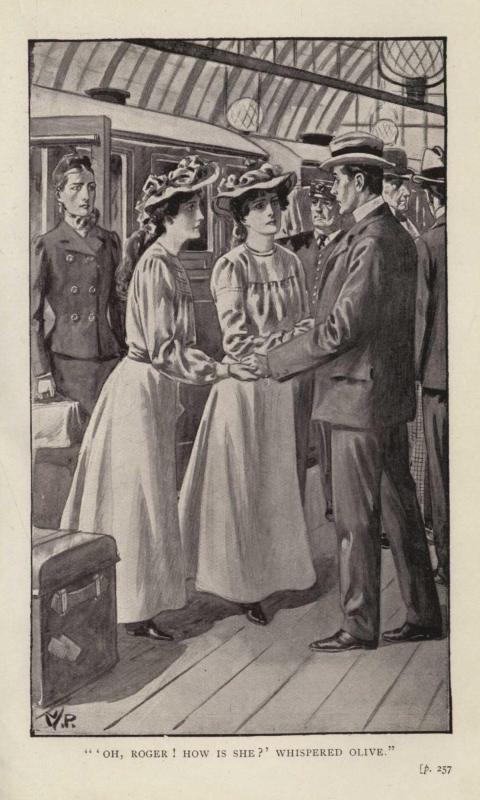
"'OH, ROGER! HOW IS SHE?' WHISPERED OLIVE."
"She is very, very ill," was all he said gravely; "I am glad you have come, she has been asking for you both."
Barnes, who had been standing near, now came forward, and, for the first time, Roger realised that his sisters were not alone. With a word of thanks he spoke gratefully of Mrs. Beauchamp's kindness in sending the girls home under her care, and enquired as to her plans.
"Oh, I return by the next train, sir, thank you, which leaves just after two. I'll just have time to get a cup of tea before I start. Mrs. Beauchamp wished me to offer her sincere sympathy, sir, if I saw any of the family, and she would like to know the latest report."
"Please thank her," said Roger. "My mother has been most grateful for all her kindness to my sisters."
"And how is Mrs. Franklyn now, sir?" she asked.
Roger turned away from the girls, who for the moment were collecting various small packages they had brought with them, and with something suspiciously like a sob in his throat, he replied, "She is sinking rapidly; she cannot live many hours."
"Dear, dear. I am sorry to hear that, sir!" said the woman, with real concern. "Poor, dear Miss Elsa."
"Hush! Don't let them hear. I have not said so much to them."
And with a word of farewell to the maid, he bade the twins come with him. Stopping only to give a porter instructions about the luggage, he strode on, and the girls had as much as they could do to keep up with him.
Fortunately, it was only a matter of a very few minutes' walk to their home, so that they were soon there. As they entered the gate, Roger glanced furtively at the windows, for he knew his mother's life was only just trembling in the balance, and even during the fifteen or twenty minutes that he had been absent, the call might have come. But the blinds were up, and he breathed freely. In silence they entered the old side door, and quietly, oh! so quietly, Lois came downstairs to meet them.
What a different home-coming was this from the one they had been anticipating. No bright welcome, no merry words, no gay laughter. Instead of all that, there was an awful hush and unnatural quiet reigning in the busy, bustling household, and it was all owing to the fact that their mother was lying so very, very ill in the well-known room, beyond the baize-covered doors, upstairs.
"I am glad you have come, dears," said Lois, gently, as she bent and kissed the twins, and Elsa saw that her face bore traces of recent tears.
"Oh, Lois!"
"Hush, darlings, hush!" she whispered, as she gently pushed them into the deserted dining-room; "we must not make any noise, it worries her so."
"But she will get better? Oh, Lois, say she will!" cried Olive.
Lois looked enquiringly at Roger; but muttering: "You tell them, Lois; I couldn't," in hoarse tones, he strode by her, and went out, shutting the door gently behind him.
And, with am arm round each of them, Lois told them, in tender words, that God was calling their mother to Himself, and that very, very soon they must give her up. For a few minutes she let them weep on unrestrainedly, knowing well that it was best so. And then, with words of comfort, the elder sister, who in future would have to act a mother's part, bade them think of the peace, and rest, and freedom from all pain that their loved one would soon be enjoying in the presence of her Saviour.
As Lois talked thus, Elsa seemed not to think so much of her own sorrows, as of the gain that would be her mother's, and her sobs grew less as she remembered the blessedness of those who die in Christ Jesus.
But Olive, over whose turbulent young heart a perfect hurricane of doubt was sweeping, refused to be comforted, and wept on unrestrainedly. God was cruel, cruel to take their mother away, and nothing Lois or Elsa said would persuade her otherwise.
A hasty opening of the door startled them, and Dr. Franklyn, looking ten years older than when the twins left home, entered the room.
"I hear that Olive and Elsa have come," he said. "Let them get undressed and go to their mother at once. Remember, girls, no scenes," he added severely, and was gone without another word.
After hastily removing their hats, and vainly endeavouring by sponging their faces with cold water to obliterate the traces of emotion, the twins entered their mother's room. If they had expected to see a vast difference in her, they were disappointed for only a very practised eye could tell that Mary Franklyn was nearing the gates of death. To the twins she looked much as usual, the bright flush upon her poor, thin face was so deceptive. She was quite conscious and free from pain, and lay with one hand in her husband's watching for them.
"My girlies," she murmured, and she feebly stroked their sunburnt faces, as they bent over her, and kissed her passionately. "I am so glad--you had--a nice holiday--before--this trouble--came. Don't cry--my darlings--Jesus is--very precious--and He--will bring--all my dear ones--to me--some day." And then she stopped, for her breath was coming in quick, short pantings, and the pulse, upon which Dr. Franklyn had his finger, was only feebly fluttering.
"Don't exert yourself too much, my dear," he said tenderly, with anguish in his eyes.
A radiant smile passed over the dying woman's worn features, and she lay back, exhausted. "I will--rest--a little," she whispered. For she hoped to recover sufficient strength to speak a last word to these two of her children and Dick, who could not arrive for some hours.
But it was not to be. The gentle sleep into which she presently fell, and which seemed as if it must be doing her good, deepened into that last, long, slumber that knows no awakening in this life, and Mary Franklyn passed into the presence of the King.
The sorrow and sadness in that household during the days that followed can be more easily imagined than described. Lois, Kathleen, and Roger endeavoured to be brave and forgetful of self, as they strove to comfort their father and the younger ones.
Dick, who arrived home a couple of hours after his mother had breathed her last, was inconsolable. He had adored his gentle, fragile mother, and it was heart-breaking to see the erstwhile merry whistler wandering listlessly and silently about the house; or to come upon him, unawares, in some quiet spot whither he had fled in order to indulge his grief unseen. Roger, who had always been his chum in a way that brothers seldom are, now became his comforter; and it was during those sad, sorrowful days, when the younger lad's heart was rendered impressionable by grief, that he began to seek the Saviour whom Roger had lately found, and whom their mother had loved so dearly.
Elsa bore up bravely, after the first terrible outburst, and was very helpful in looking after Joan and Paddy, who fretted for their mother a great deal. But Olive seemed turned to stone. She realised that in the bargain she had sought to make with God she had been worsted! He might have spared her mother; He might have heard her cry: and she would have kept her promise if He had! But He was cruel, oh! so cruel, to snatch her mother away without giving her a chance even to whisper that she was sorry for all the anxiety she had caused her, and that she would be a better girl, in future, if her mother would only say she forgave her. Both Lois and Kathleen sought to break down the stoical reserve, behind which Olive hid her real feelings, but she always repulsed them, and they could only hope that, in time, God would answer their mother's many prayers for her wilful little daughter.
CHAPTER XX.
"KEEP IT UP, IT ANSWERS VERY WELL."
A few days after Mrs. Franklyn's funeral, Monica Beauchamp, looking very fresh and dainty in a pretty linen frock and straw hat was walking up the shady road leading from the town to The Cedars, Mr. Howell's residence.
She had never yet paid the visit she had promised on the day she sprained her ankle, so Monica had coaxed her grandmother into dropping her in the town, that afternoon, while she drove on to pay a call at a little distance in the country. For some time a plan had been forming in the girl's mind, and a visit to Mrs. Howell was necessary before it could be put into execution.
"I hope Mrs. Howell will be in," she said to herself, as she entered the white gates, and walled up the beautifully kept drive, "and I almost hope that Lily will be out," she added; for upon the only occasion she and Lily had met since the unhappy affair at school, the latter had passed Monica with no attempt at recognition, beyond an ugly scowl. At the time (it was before she went to Sandyshore) Monica had felt very much inclined to return the scowl with interest, except that she considered Lily utterly beneath contempt. But lately she had had very different feelings towards her would-be injurer, and it was chiefly on her account that she was so anxious to pay her mother a visit.
Mrs. Howell being at home, Monica was ushered into a huge and magnificently furnished drawing-room, decorated lavishly with plush hangings, of decidedly gay hues, and was warmly welcomed by her hostess, who was delighted to see her.
A quarter of an hour passed pleasantly in chatting over the sprained ankle, long since well, and the holiday she had enjoyed so much, and then Monica broached the subject uppermost in her mind.
"Mrs. Howell," she began diffidently, for she was not quite sure how her proposal would be received, "did Lily tell you all about the examination affair?"
"Well, my dear, by degrees we got to know the rights of it, though she would not tell us till her pa threatened to punish her, if she didn't speak out. He was in a great taking when the notice came that she wasn't to go back no more, and he packed her off to stay with his step-sister, a very strict woman, and poor Lily has had a very rough time of it. She only came back yesterday, and wouldn't have done then, only for her aunt being took ill; for it was her pa's intention to let her bide there some months. Now he talks of sendin' her to boardin'-school, but where to he hasn't no idea. All our plans for her schoolin' was upset-like, you see, my dear, by that notice, and her pa was terrible annoyed to think it all came about through her trying to do you a bad turn. For, to tell the truth, my dear," Mrs. Howell rambled on garrulously, "he thinks a sight of you, does Bob. He would have wrote to apologise, but he couldn't get Lily to say she was sorry, nohow. Oh! dear me, what trouble that girl has caused us, and 'twill be far worse when she comes 'ome from boardin'-school." And the poor woman whimpered distressingly.
"Don't cry, dear Mrs. Howell," said Monica gently; "perhaps she won't have to go away to school at all. Would you like her to go back to the High School if she could? Do you think she would go?"
"Oh, my dear, there's no chance!" was the dismal reply, as Mrs. Howell wiped her florid face with a tiny muslin handkerchief; "they wouldn't take her back now. I only wish they would. I know Lily would be delighted really, although she's said times and times that she'd rather die than ever go there again."
"Well, don't tell her, please, in case it falls through, but grandmother thinks I might write to Miss Buckingham, and perhaps she would overlook it this once and let Lily go back." Monica spoke earnestly, and there was no hint of pride in her tones, neither did she say that it had taken a good deal of persuasion to get Mrs. Beauchamp to consent to let her write on her school-fellow's behalf.
"Oh, Miss Beauchamp, my dear, if you only would!" ejaculated Mrs. Howell, delight and incredulity struggling for the mastery in both tones and countenance. "But it does seem strange that you that's been injured should be the one to do us a good turn. I can't think why you should!" And she looked searchingly into the flushed face opposite her, as if she would find the motive written upon it.
Monica was sorely tempted to make just a mere commonplace reply, but she summoned up all the courage she could, and gave Mrs. Howell the real reason, realising that this was an opportunity afforded her of witnessing to her new Master.
"I don't know whether you know Him, dear Mrs. Howell," she said, a trifle nervously, but with intense earnestness, "but while I was away I accepted the Lord Jesus Christ as my Saviour, and He has forgiven me so much, that I can't help forgiving everybody else. And I think He told me to show Lily how I feel, by trying to do this. Oh, I do hope Miss Buckingham will make it right! I almost think she will."
"Oh, my dear, my dear!" said Mrs. Howell, tremulously, in her eagerness clutching hold of Monica's hands; "you've found some One I've been wanting for years! My heart's just breaking for want of peace."
And in very simple fashion, for it was all such new and unaccustomed work to her, Monica tried to feed this hungry, longing soul with the Bread of Life. She felt so helpless, but trusting to the Holy Spirit's guidance, she repeated a great deal of the sermon which she would never forget; and Mrs. Howell seemed to literally drink it all in.
"God bless you, my dear," she murmured, as Monica at length rose in haste, having discovered that the time arranged for her to meet the carriage was already past--"God bless and reward you for all you've done. I've been a sinful woman, all my life, but please God this shall be the beginning of better things."
Monica hurried down the hill, a song of thanksgiving in her heart, and a happy smile flickering about her lips. How delightful this new life was! Not for anything would she go back now to the careless, thoughtless days of the past, when she had given others such endless trouble, and been so discontented and miserable herself. She felt as if she loved everybody, that beautiful September day, and as if it would be impossible ever to displease any one again.
But, alas! a rude stare, without a trace of recognition in it, from the object of her solicitude, with whom she came suddenly face to face as she turned a corner, and upon whom she bestowed a radiant smile, and cordial "How do you do, Lily?" sent her on the rest of her way with a small cloud in her hitherto cloudless sky, and a nasty little feeling of wounded pride endeavoured to make itself felt. However, she consoled herself with the thought that Lily would soon have cause to think differently of her, and hastened to the place where she had promised to wait for the carriage.
But, unfortunately, it was just the other way round! The carriage, with Mrs. Beauchamp in it, had been waiting some time for Monica, and her grandmother greeted her with words of displeasure.
"I am very much annoyed, Monica; you are fifteen or twenty minutes behind time," she said severely. "Richards has been driving up and down, up and down, all that time, lest the horses should take cold; they were so very warm. It was very thoughtless indeed of you, to keep me waiting like this."
"I am very sorry, grannie," was all Monica said, as she seated herself beside her grandmother in the landau; and it spoke volumes for her that her voice was gentle, and her look penitent. Monica of old would not have answered thus, and Mrs. Beauchamp knew it, and thoroughly appreciated the change, although she said nothing. Indeed, silence reigned during the drive, and it was not until they were in the drawing-room after dinner that Mrs. Beauchamp enquired the result of Monica's visit.
"You might as well write to Miss Buckingham this evening, if you are still anxious to do so," she said, when she had heard what Mrs. Howell said; "there is no time to spare, as the letter will have to be forwarded to wherever she is spending her holidays."
And Monica gladly fetched her writing-case, and began to write what proved to be a very difficult epistle. Her pen had to be nibbled thoughtfully many times before the letter was accomplished, and then the result was not all that the writer could wish. She was rather afraid that Mrs. Beauchamp would ask to see it before it went; but, fortunately, just as Monica had signed her name, in school-girl calligraphy, at the end of perhaps the most tidy letter she had ever written, the old lady roused up from the little doze in which she had been indulging, and bade Monica hasten, or she would lose the post.
"I have just finished, grannie," and as Monica laid down her pen, Harriet came to say that Richards was waiting for the letters.
"Have you any to send to-night, grannie? No? Then there is only this one, Harriet," and Monica breathed a sigh of relief as she shut up her writing-case and prepared to read to her grandmother.
Not the most agreeable of tasks was this; for Mrs. Beauchamp considered that it was "improving" for her granddaughter to read aloud for at least half an hour every evening. Monica was not a very fluent reader, so that she was continually being pulled up for leaving out commas, or for emphasising quite the wrong word. The interruptions would have been very trying if the book had been even the least bit interesting, but as it really seemed to have been chosen for its dryness and dullness, Monica did not mind. However, she tried her hardest, nowadays, to read carefully, and with a fair amount of expression, and she was far less often interrupted than she used to be. She did want to be what Marcus Drury called a "whatsoever" Christian.
"You really begin to read quite nicely, Monica," her grandmother said approvingly, as she finished a chapter, and was told that would do for that evening. "Your father would be greatly pleased with the improvement there has been in you lately."
Tears of joy sprang to Monica's eyes, as she put the book away, and then stooped and gave the old lady a "good-night" kiss.
"What has made the difference in you, Monica?"
And for the second time that day the young girl answered radiantly, but humbly, "The Lord Jesus Christ."
"Little Elsa said that was what it was," muttered Mrs. Beauchamp under her breath, as she toyed nervously with her eye-glasses. "Well, child, keep it up, it answers very well," she added, in a louder tone.
"It would be no use for me to try to keep myself, grannie dear," was the stammering reply, "for I should do something wrong directly, but when I let Jesus hold me tight, then it is all right."
Mrs. Beauchamp made no answer, and, after waiting a moment or two, Monica slipped off, fearful lest she had offended her grandmother.
But the old lady sat thinking deeply for a long, long time--thinking of the past when she was a girl of Monica's age, and with as headstrong a nature as hers--thinking of her married life, when her whole time and thought had been given to the things of this world--thinking of the unrestful, unsatisfying present, and of the dark, dark future stretching out beyond.
"Little Elsa told me, once, that she prayed God every day to bless me," she murmured, while a tear trickled slowly down her cheek. "God bless the child ... and me, too!"
A week elapsed before any reply came to Monica's letter, and she began to be afraid that Miss Buckingham would not make known her decision before it was too late, for the school reopened in another few days. However, one morning, the long-looked-for letter arrived, and the girl's heart was overjoyed when she found that her request had been granted, and that Lily Howell would be allowed to re-attend the school if she wrote an apology for her past conduct, and sent it to the head-mistress without delay. Miss Buckingham added that it had been a matter of regret with her, that one of her scholars should have had to leave the school under such circumstances, so that if Lily were really penitent, the past should be overlooked; more especially as the girl she had endeavoured to injure had taken upon herself the task of interceding for her.
"I wish she hadn't put that last bit in," mused Monica, "because that will very likely offend Lily more than ever, because she will hate to think she owes anything to me. However, I can't help that; I have done what seemed right, and I must just leave the result, and I am dreadfully afraid she won't apologise. Well, I'll do as grannie suggests--just send Miss Buckingham's letter to Mrs. Howell, and then wait to see what happens."
A little note, badly expressed and ill-spelt, but breathing gratitude in every line, from Mrs. Howell, was all that Monica received, and in it there was only a hope expressed that Lily would send the apology, but no certainty. So she had to be patient, and wait a little longer.
Meanwhile, she kept the matter quite secret, not even breathing a word of it to Olive, for she thought, and very wisely, that if the whole affair fell through, it would be much better for no one to have known anything of it. But Monica was not very clever at keeping a secret, and if she had seen much of the Franklyns the probability is, that in a moment of forgetfulness she would have divulged it. However, the girls met but seldom during the days that elapsed between Mrs. Franklyn's funeral and the school reopening.
Once, when Monica was in Osmington, she ran up against Amethyst Drury, and, as they were talking, Mr. Howell's motor car passed them, reminding the younger girl of his daughter.
"I saw Lily the other day, Monica, and she wouldn't look at me. She walked by just as proud as Lucifer. The idea! As if we were all to blame, and she was innocent! I'm awfully glad she won't be at school any more."
"I daresay we should feel pretty much as she does, Thistle, if we were in her place," was Monica's reply; "she can't enjoy herself much."
"Quite as much as she deserves," said Amethyst, with decision; "horrid cheat!"
"Oh, Thistle!" Monica's tone was reproachful.
"Well, I ought not to have said that, I know," said Amethyst penitently, "but I don't like her; do you, Monica?"
"I am afraid I can't say I really like her," Monica confessed honestly; "but still she may be sorry inside, you know, and, perhaps, if we had been kinder to her at first, she would have been nicer to us now. I mean she would feel that we did not think the very worst of her," added Monica, a trifle lamely. She knew what she meant herself, but had difficulty in expressing it.
"I am afraid the worst is about right," was Amethyst's sententious answer, as they parted. And Monica could not help wondering just what the girls, as a whole, would say, if Lily should reappear at the High School again.
CHAPTER XXI.
"I GUESS I'LL JUST WATCH YOU A BIT."
"Monica!"
"Yes, grannie?"
"I want to talk to you for a few minutes."
And Monica, without so much as a frown, although she had just reached a most interesting part of her story, laid her book down, and prepared to give all her attention to her grandmother. She had no idea that Mrs. Beauchamp was covertly watching her, as she frequently did, to see whether she would exhibit any irritation or temper at the interruption; but if she had been aware of it, she could not have smiled more brightly, or been more ready to give up her own wishes to please her grandmother. Truly the Monica Beauchamp of the present was a totally different being from the one of bygone days.
The old lady noted her expression with an approving smile, and could not help acknowledging to herself that this grandchild of hers was fast becoming very dear to her, and well deserved the pleasure that was in store for her.
"I wanted to have a little talk about your birthday, Monica; it will soon be here now."
"Yes, grannie," replied the girl, with sparkling eyes. "Next Tuesday, the 27th."
"And you will be sixteen. Dear me, how time flies, to be sure! I well remember the day your dear father was the same age," Mrs. Beauchamp said musingly, and her thoughts went back to past days for a few moments. But they soon returned to the present, and she went on: "I wonder what you would choose if I said you might have what you liked for a birthday present, Monica?" And she smiled into the eager, upturned face.
"Oh, grannie, I don't know, I'm sure, what I should choose; there are so many nice things!" And Monica turned over in her mind various things she had been wishing she possessed. Most people would have thought that she already had everything that she could possibly want, but even the best supplied of mortals can always do with "more." A nice writing-case, some books, a new brooch--any or all of these would be nice, and Monica was about to mention them, when a sudden thought flashed through her brain; here was the very opportunity she had been wanting! If only Mrs. Beauchamp would give her money this birthday to spend as she liked!
"Well, Monica, how long are you going to be choosing? Remember, I did not say I would give you what you chose!"
"Oh, grannie dear, I do hope you will!" coaxed Monica, in persuasive tones. "I would rather have it than anything else."
"Well, what is it? Perhaps if it is anything in reason, you might have it, but I warn you not to ask for a bicycle." Mrs. Beauchamp looked quite stern, as if the mere mention of the article brought the past vividly before her, but there was a suspicious twinkle in her eyes, which Monica did not notice.
"No, grannie, I will never ask you for that," was Monica's subdued reply, although her active young limbs literally ached sometimes, when she saw other girls jumping on their bicycles and spinning off along the country roads. But she had long since given up expecting ever to do the same, for she knew how her grandmother objected to women cyclists. "But I do wish you would give me money instead of any other present, this year, grannie, because I want some very particularly."
"What for?" asked the old lady curiously. "Surely you haven't exceeded your pocket-money, and got into debt like boys do; have you, Monica?"
"Oh! dear, no, grannie," and Monica's laugh rang merrily out, "it isn't anything of that kind! But if I tell you what I want it for, you won't say 'no,' will you, grannie dear? It's nothing wrong." And the clear grey eyes sought the old lady's earnestly.
"Very well; now, tell me."
"Oh, you are a dear grannie!" said Monica enthusiastically. "I'll tell you all about it. You know when we girls all went to the missionary meeting at Sandyshore, Miss Daverel, the lady who spoke, said there were lots of ways girls could help; and we four made up our minds to see what we could do." Monica paused, and looked a trifle diffidently at Mrs. Beauchamp; she was not quite sure what sort of reception her words would get, for, as far as she knew, her grandmother had no more interest in foreign missions than old Richards, the coachman, had.
But the old lady nodded, and seemed in no wise annoyed, so Monica took courage, and proceeded with her story. "We want to have a sort of working-party, just amongst us girls, with perhaps Mrs. Drury and Miss Franklyn to help, and make all sorts of things to send out to China, for the poor little girls and the women who are so sad and unhappy, Miss Daverel says. She has promised to send us patterns and directions, and we want to begin very soon; but you see, grannie, we must have some money to buy dolls and print, and wool, and all sorts of things with. And I thought, grannie dear, if you would give me money instead of anything else, it would help us start, at any rate."
"H'm." Mrs. Beauchamp said nothing in favour of the proposal, but then she did not say anything against it, which was fairly encouraging. Monica tried to read her thoughts by scanning the face which was slightly turned away from her, but could make nothing of it. "Why should this undertaking be started with your money, Monica? Surely it is as much the others' affair as yours?"
"Oh, yes, we all want to do it; but you see, grannie, none of the others have much to spend, and I---- Oh, I do want to give something that I shall miss, if it is only a little!" And Monica's girlish face glowed with enthusiasm.
"Well, I had intended giving you something that I believe you would have liked very much, Monica; but if you would really rather have money to spend as you propose, you may count upon having a five-pound note on your birthday instead. I was going to give you a bicycle."
"Oh, grannie!" Amazement, consternation, hesitation, these, and countless other emotions played upon the young girl's heart. First, utter astonishment that her grandmother should ever have dreamt of revoking her decision about cycling; then a great desire for the long-coveted, and now possible machine took possession of her, and something within her said: "Here is the chance, at last, that you have been longing for. It is a pity you mentioned 'sacrifice,' but still, it does not matter, you have your choice, and your grandmother feels sure you will choose the bicycle, that is why she urges you to consider." Oh, how subtle was the temptation! Only those similarly constituted can imagine what a battle was being fought in Monica's heart. The bicycle--or the five-pound note: an endless amount of pleasure for herself--or the means to provide joy for others. How hard it was! Monica felt that no other choice that she might ever be called upon to make could possibly equal this; for it was just the one thing she did want, and yet----
"Don't decide hastily, Monica," said her grandmother, seeing that she hesitated; "think it well over, and tell me to-morrow which you have chosen."
Monica was glad that it was nearly bedtime, for she longed to get away to her own room and think. Once there, she determined to fight the matter out, and a very sharp battle it proved, this first real denial of self. For some time, it seemed as if she must choose the bicycle, and satisfy her conscience by scraping together all the pocket-money she could muster (only a few shillings) and giving that to the missionary cause. She had not promised the girls a large amount, they knew nothing of the offer of the five pounds, and never need know. Her grandmother quite expected her to choose the bicycle, yes--she would decide upon that, and perhaps her father or some one else would give her a present of money, and if so, that should be added to the sum in her purse, and would provide quite a nice start for the working-party.
Monica began to feel quite self-sacrificing, and having, as she thought, made a final decision, she proceeded to prepare for bed, her mind full of the joy and pleasure that the possession of (and permission to use) a bicycle of her own would afford.
Her thoughts were still running in the same direction when she opened her little Bible and began to read a few verses, as she had done lately. She did not read according to any plan, she had never heard of such a thing as a Union for Bible Reading, so that she was just reading straight on through the gospels, and finding out many wonderful truths. She had read as far as Matt. xvi. 20 last time, and the little ribbon marker was laid between the pages. Her brain was still very full of the bicycle, and soon she found that she had read some few verses without having taken in the sense of them at all! So with an effort she sought to fix her wandering thoughts on the printed page, and as she did so, the words of the next verse seemed to stand out from it as if the letters were made of fire; at any rate they burnt right into her very soul.
"Then said Jesus unto His disciples, If any man will come after Me, let him deny himself."
Oh, how that one short sentence, straight from the lips of the Saviour, accused Monica! How guilty she felt! How small must be her love for Him, if she could, even for one short hour, think more of her own personal pleasure and gratification, than the needs of great, dark, heathen China! She fell on her knees beside the pretty white bed, and burying her face in her hands, she sobbed out her sorrow and humiliation into the ear of Him who never fails to hear His children's cry for pardon. And as she prayed, a deep, sweet peace filled her heart, and she knew that she was forgiven. Thus Monica Beauchamp was enabled to triumph over self, and the first real sacrifice she had been called upon to make, since becoming a Christian, was willingly, nay, gladly made.
The next day, Mrs. Beauchamp, not without some misgiving (for she did not want Monica to fall short of her expectations, though she would hardly confess so much, even to herself), asked for her decision.
"I would like the five pounds best, please, grannie dear," was the bright reply, while a little flush rose to the young girl's face.
The old lady's heart thrilled with pleasure, but she evinced no sign of it.
"Very well, Monica," was all she said; and if her granddaughter had expected to be asked for her reasons, she would have been disappointed; but Monica was glad that no more was said. The experience of the night before was too real, too solemn, for her to talk it over, and she was too honest to have given any but her real reason.
With a glad heart, and a bright song often upon her lips, she prepared for school next day, and Mrs. Beauchamp, catching snatches of the refrain every now and then, marvelled at the total change that had taken place in her grandchild. "It is simply wonderful," she murmured, "wonderful! She used to be such an anxiety, and now she is just the reverse. I am glad for Conrad's sake; he will find a treasure when he returns, if this condition of things lasts." And the old lady sighed a wee bit doubtfully; but then she had no experimental knowledge of the Saviour who is "able to keep from falling," as well as "able to save."
The little governess cart was brought round from the stables punctually at nine o'clock the next morning, and Monica jumped into it, closely followed by Jack.
"No, no, poor Jack, you can't go with me to-day," she said, as she tried in vain to get him out of the trap; "I'm going to school, my doggie, and you can't go there."
Tom, the little stable-boy, who had been holding Cæsar's head, and grinning with delight at Jack's persistence, volunteered to carry him back and fasten him up in the yard.
"Poor old fellow," said his mistress, as Richards gathered up the reins, and the pony trotted briskly down the drive, for Jack's whines and short, yapping barks of disappointment could be heard for some distance.
"Pony's a bit fresh this morning, miss," remarked the old coachman, who had all his work cut out to hold him in, for the road to Osmington was a downhill one. "Steady there, steady," he said, as Cæsar tossed his dark-brown mane, resentful of some little flicks of the whip.
"A nasty-tempered h'animal 'e is sometimes; look how he bit your 'and, miss."
"Oh, that was all my own fault, Richards," replied Monica; "I deserved that."
"Well, he didn't ought to have snapped out at you like that," continued the old man. "Belle and Beauty wouldn't have done such a thing, never," and he shook his grey head decisively, for "the pair" constituted the joy and pride of his heart, and he had never forgiven the introduction of the pony.
"They are always so quiet and gentle," agreed Monica, and the old coachman, having subdued Cæsar into going at a steady trot, rambled on about the merits of "the pair" until the short drive was over.
"I do wonder if Lily Howell will turn up," thought Monica to herself, as she entered the school door, greeting one and another as she passed them on her way to the cloak-room. There she found Amethyst Drury, who informed her that several of the girls had been moved up, but the quartette was still intact.
"And oh, Monica," she added, in an excited whisper, "Lily Howell must have come back! There is that pink and green hat of hers; no other girl would have one exactly like it, would she?"
Monica, glancing at the pegs, and seeing what was unmistakably one of Lily's well-known, gaudy hats, was not as astonished or disconcerted as Amethyst could have wished.
"I think there is no doubt about it, Thistle," she said quietly. "I shall be glad to find Lily has come back."
"Whatever for?" enquired the younger girl, in a puzzled tone. Monica had been incomprehensible to her lately.
But Monica was entering the hall by the swing-door, and only smiled her answer, for talking was forbidden. With one swift glance she saw that Lily, looking certainly less defiant than usual, was in her old place, and with a glad feeling in her heart, Monica slipped into her usual position at Olive's side, persistently ignoring the telegraphic messages that Olive's dark eyes were continually dispatching, until the head-mistress's bell announced the commencement of prayers.
Every one of the girls was more or less excited that first morning at school after the long holidays, but the air of the Fourth Form seemed charged with electricity. No one, except Monica and Lily, knew how it had come about that the latter was again amongst them; and even those two were wondering just what would happen, when Miss Buckingham appeared in the doorway.
"Good morning, girls. I am glad to meet you all once again," she said in the energetic, crisp fashion peculiar to her. "I hope you have all thoroughly enjoyed your holidays, and have now come back prepared to work hard. Some of you may be surprised to see one of your number here again, after what occurred last term; but when I tell you that she has apologised, and I have entirely consented to overlook what took place then, I am sure I may depend upon you, one and all, to do your share in helping to blot out the memory of the past, and by your kindness and consideration, strive to emulate the Spirit of Him who said: 'Whatsoever ye would that men should do to you, do ye even so to them.' I am not afraid that this unaccustomed leniency will be taken a mean advantage of, or I should warn you not to count upon a repetition of it. Instead of that, I advise you, one and all, to throw all your energies into this term's work, particularly those among you who will be candidates for the Junior Cambridge Examination at its close, and I shall look forward to seeing the majority of your names in the 'Honours' List."
The excitement caused by Miss Buckingham's words soon subsided, and beyond being the object of a good deal of staring, Lily Howell was not interfered with; and as the morning wore on, she began to feel less uncomfortable. It had been a hard tussle to get her to write the apology, and, but for her father threatening to send her to live indefinitely, with her strict aunt if she did not, she would have absolutely refused. But now that it was over, and the head-mistress had spoken so kindly, as even Lily could not help feeling, the girl began to see how despicable her conduct had been, and she was seized with a sudden desire to prove to the whole form that she could be as nice a girl as any of them, if she liked.
Fortunately, Maggie Masters, her former ally, was no longer at school, having left the neighbourhood, so that Lily had every opportunity of making a fresh start, and she took advantage of it. As the days passed, the change in her was very noticeable--even those who had always felt an aversion for her could no longer find any complaint to make; she was painstaking and persevering, and being by no means wanting in ability, she bade fair to rival the most clever in the class. But she kept aloof from the girls; she felt, instinctively, that in spite of Miss Buckingham's expressed wish, they were not willing to let bygones be bygones. They did not twit her, or indeed make any allusion to the past, but they simply let her alone.
All but Monica Beauchamp and Elsa Franklyn, who from the very first day of the term had tried their best to be friendly. But she repulsed them, feeling convinced that they were only patronising her; it was an impossibility for a nature like Lily Howell's to realise that both those girls were actuated by the same principle, that of "loving one another."
"I can't think what you did it for," she remarked to Monica, referring to the letter of intercession the latter had written on her behalf, "unless it was to make Miss Buckingham think a lot of you. Weren't you mad when she never even mentioned your name?" And the girl looked curiously at Monica, who was a complete enigma to her.
"Oh, Lily! I never once thought of such a thing," she replied, in a pained tone.
"Well, what was it for, then?" persisted Lily.
"I don't think you would understand if I told you," was the reply.
"Why not, pray? Ma said it was because you had turned religious lately. Is that why?" And Lily's light blue eyes scanned the other's face inquisitively.
"I have not turned 'religious' as you call it, Lily," said Monica gently, although a flush rose to her cheek; "I have only given myself to Jesus Christ, and I am trying to follow Him. I do wish you would, too, Lily," she added earnestly.
"My gracious goodness!" ejaculated Lily, inelegantly, for she was completely taken aback. "I guess I'll just watch you a bit, and see the effect before I go in for it."
Monica had to bite her lip hard to keep back the tears that would spring to her eyes, for she was tremendously in earnest, and Lily's mocking words jarred cruelly. "I am afraid you will see more failures than anything else," she said, in a low tone; "but you must not judge of Jesus Christ by me. He is the One to copy, He never fails or makes mistakes."
"Pa always says Christian people are far more often 'libels' than 'Bibles,' and that's why he doesn't believe in them," said Lily, to herself, as Monica and she separated; "but if I'm not mistaken, Miss Monica will prove an exception to that rule. All I know is, I wouldn't have done for her, what she did for me! So there must be something in it!"
CHAPTER XXII.
"I CANNOT SPARE YOU, MONICA."
Tuesday, September 27th, dawned bright and fair, as all birthdays should, and Monica, girl-like, was full of curiosity as to what presents she would have, beyond the one already promised.
Several inviting-looking packages were laid beside her plate on the breakfast table, and also some letters. Monica made a dash at them, hoping, not without a good deal of misgiving, that there would be one from her father.
"There is!" she exclaimed aloud, in her delight, just as Mrs. Beauchamp entered the dining-room, and greeted her with the old-time wish of "many happy returns," and bestowed upon her one of her rare kisses.
"What is there?" she queried, as she slipped a sealed envelope among the other presents, and took her seat at the head of the table.
"Why, actually a letter from dad, grannie, come on the very day," she explained, in glee, as she held it up. "And here is one from Miss Herschel, too, but she does not know when my birthday is, so that has only come by chance. Isn't that odd?"
"Very," agreed Mrs. Beauchamp, as she began to pour out the coffee. "Now eat your breakfast, and then you can look at your packages."
Either Monica's usually keen appetite was very small, or her digestion very good, on that particular morning, for in a very few minutes she expressed herself as "quite finished," and then began undoing strings and paper with eager fingers.
A dear little pocket Bible "with love from Amethyst and her mother"; a crudely drawn, but wonderfully life-like portrait of Jack, nicely framed, from Olive; a beautifully-worked nightdress-case from Elsa: both inexpensive gifts, for the twins had very little pocket-money. Then there was a very handsome collar for Jack, the united gift of the servants.
"I can't think who this is from," said Monica, taking up the last parcel and hastily cutting the string. "Oh, grannie, do look!" she cried, holding up a plain leather frame containing the photograph of Robina Herschel and her brother, taken together. In the frame was slipped a scrap of paper, bearing the words: "In memory of happy days at Sandyshore."
"Oh, I am glad to have that!" said Monica, as she gazed upon the pictured features of the two she admired so much, the fair, fragile girl presenting such a contrast to her firm, resolute brother. "I suppose it is in return for the snapshot which Marcus took, that I gave them. But how could they--I mean who could have told them when my birthday was?"
"Probably the letter will explain," suggested Mrs. Beauchamp, who was not quite sure that she approved of a double photograph. But a hasty glance at Monica's innocent face disarmed all suspicion.
It soon transpired that Elsa had been the little bird who had been only too ready to tell Miss Herschel when Monica's birthday was; and thus the mystery was quickly cleared up. Robina only wrote a short letter, as they were all very busy getting her brother's things ready for his voyage to Africa. He was to be dismissed, among other missionaries, at a public meeting in London in the course of a few days, and would start for the Soudan almost immediately after. "He sends you his best wishes, not only for your birthday, but for always," the letter concluded, "and says that you will find his good-bye message in Colossians i. 9, 10. We shall miss him terribly, mother and I, but we are quite, quite willing. Perhaps Mrs. Beauchamp would spare you to pay us a little visit after Christmas, while your holidays were on. Tell her, mother says we would take the greatest care of you!"
Monica read the last two sentences aloud, before she folded up the letter and put it in its envelope.
"It would be nice, grannie, wouldn't it? I hardly remember going away on a visit to any one."
"We must see," remarked Mrs. Beauchamp, in not very gushing tones. Strangely enough, the mere thought of parting with this granddaughter of hers, even for a week or two, filled her with dismay; she had grown to be dependent upon her for company, and the bright, cheery, girlish presence would be sadly missed at Carson Rise now.
And yet, Monica must go out into the world, and make friends and see many phases of life, of which she was utterly ignorant now. So she stifled a sigh, and added: "It is very kind of Mrs. Herschel to invite you, and it would make a nice little change for you, during the winter."