Front matter (continued 3)
Reading edition
An hour or so later a peculiar scratching noise along the corridor outside made Monica listen intently, and a second after there came a hesitating knock at the door.
"Come in," cried Monica, who was all excitement; and the door opened to admit Tom, the little stable-boy, who was leading the cutest looking wire-haired terrier imaginable, and was closely followed by Barnes.
"Oh, you darling!" cried Monica, who was infatuated with the dog at first sight; "do bring him close, Tom."
"Yes, miss," said Tom, with alacrity, pulling his forelock, and grinning all over his bright little face, as he clutched hold of the bit of strap that did duty for a collar, and dragged the terrier up to Monica's couch. "I hope you're better, miss," he ventured to say shyly, for Barnes, of whom he stood greatly in awe, was looking severely at him, and he had been bidden "to mind his behaviour."
"Oh, yes," said Monica, carelessly; she had no thoughts to spare on herself just then. "What's his name, Tom? Do put him up beside me."
"Be careful, now," said Barnes, a trifle sharply; she was not best pleased at this introduction into the household. "Remember your leg, Miss Monica."
"All right, Barnes, don't fidget! See, he's as quiet as possible. Good boy, dear old fellow!" and Monica stroked the ginger coloured head, and looked into the liquid brown eyes which had a wistful expression in them. He pricked up his ears at the tones of endearment, and licked her hands in response.
"'E 'ave took to you, an' no mistake, miss," said Tom, with huge delight. "Jack 'e 'ave been called, miss," he added, in answer to Monica's query, "but you'll find 'im a grander name, miss, now."
"No, I think Jack will do very well," said Monica, and the little dog, who knew by her fondling that he was being loved and made much of, gave a little grunt of satisfaction, and curled himself round on the couch beside his new mistress.
"Isn't he sweet, Barnes?"
"Oh, he's a nice enough little dog, as dogs go, Miss Monica, but I have no particular fancy for them," was the maid's somewhat grudging reply. And then she added: "Now then, my boy, you'd better be off to your work again."
"Yes'm. Good mornin', miss," stammered Tom, in confusion, for Barnes' repelling tones made him feel as if he had done something wrong.
"Oh, good-bye, Tom. I'm awfully glad to have Jack," said Monica, with a bright smile, which made the little lad feel at ease again, and remained in his memory for many a day. "I shall be coming out on the lawn in a few days' time, and then you must come round and see him."
The little newcomer proved an endless source of pleasure and amusement to Monica; he had such quaint ways, and made himself thoroughly happy and contented in his new home. Even Mrs. Beauchamp was obliged to confess that he was no trouble; he spent hours curled up on the rug which was thrown over Monica's knees, as if he had been accustomed to an invalid mistress all his life.
"You wait until this tiresome sprain is well," Monica would often say to him, "and then you shall have a very different existence, Jack."
The old doctor made great friends with him when he came to see his patient the next morning, and went off chuckling with pleasure over the result of his plain-speaking to Mrs. Beauchamp, a few days before.
"She'll get on fast enough now," he said to himself, as he trotted down the drive; "young folk want young things about them, and up there," with a suggestive glance backward at the stately residence he had just left, "they are all as old as Methuselah. She looked a totally different being this morning, from the sulky, discontented girl I saw last time. But I don't deny she's a handful--takes after her mother, I suppose. Conrad was as nice a fellow as ever breathed, but I never had much of a fancy for his wife, poor thing; she was too much of a woman of the world for old Henry Marley. But there, he isn't, by any means, all he ought to be." And the dear old doctor sighed as he realised how far short he was of being a true copy of the Great Example.
The doctor had not long left, when a footman called at Carson Rise, with a basket containing some magnificent peaches and hot-house flowers, "with Mrs. Howell's compliments, and she would be glad to know how the young lady was."
Mrs. Beauchamp was out for a drive, so the parlourmaid came up to Monica for a message.
"Oh, Harriet, how lovely!" cried the girl; "do take them out carefully while I write a little note to send back. How very kind of Mrs. Howell."
"The same lady has sent every day to enquire for you, miss," said the maid, who was very much impressed by the grandeur of the Howell livery, and the importance of the individual who wore it.
"Has she really? No one has mentioned it before," said Monica; "I ought to have been told." And there was a suggestion of displeasure in her tones.
"Mrs. Beauchamp knew, miss, of course, and so did Barnes," Harriet hastened to say, in defence of herself.
"Very well, Harriet, it was not your fault," said Monica, and she busied herself in writing a little girlish note of thanks, which brought tears of pleasure and gratification to the eyes of the good-natured, motherly woman who received it, and then slipped it into her pocket for fear her tyrannical young daughter should come across it, and make fun of it. For Lily Howell had not yet grown reconciled to the idea of "that Monica Beauchamp" getting into her home, and prying into everything, and then going off to make fun of all the mistakes she knew her mother must have made.
There had been a great scene upon her return home, on the Monday evening, and she had exclaimed long and loudly against the fate which had allowed such an unfortunate thing to come to pass.
Mrs. Howell, instead of severely reprimanding her daughter for being so insulting and rude, had wept feebly, and bowed beneath the angry girl's storm of words; but in her heart she treasured the remembrance of the kind words and very real gratitude of a daughter of the aristocracy to a poor, common-place woman, such as she was allowed no opportunity of forgetting that she, Caroline Howell, was.
CHAPTER XII.
"A HUNGRY FEELING IN MY BRAIN."
"What do you think of this?" said Monica, that same Saturday afternoon, as she pointed to Jack, who was lying curled up on her rug.
And Olive was astounded, as her friend knew she would be, at such an unexpected sight.
"Oh! isn't he a dear fellow?" she cried, rapturously, patting his head, and playing with his well-shaped ears, as Jack first sniffed enquiringly at the boots and dress of his young mistress's friend, and then, with a wag of his stumpy bit of tail, sat down on the floor at her feet, and rested his head against her knees. "He is going to like me at once."
"Of course, he is," said Monica; "it will be Jack's business to like all my friends and hate all my enemies."
"Oh, Monica, I don't think you've got any enemies!"
"Haven't I?" enquired Monica quizzically; "what about Lily Howell?"
"Oh, I forgot her," replied the other merrily; "and yet I ought not to have, for she's been in such a temper all the week. She's tried every way she can to get Elsa and me into trouble, and when she finds she can't manage it, she's in a worse tantrum than ever. I can't think why she's in such a mood," continued Olive, meditatively, "unless it is----"
"Oh, I expect she's huffy because Mr. Howell took me into his house," interrupted Monica, "and she wasn't at home to see all that went on. But I don't care a straw for her, or what she thinks; she's too common and vulgar to think about. Now her mother is the dearest old creature," she went on, in quite a different tone; "she was as kind and nice as possible. And Harriet tells me she's sent every day to ask how I am, and it was she who sent those lovely peaches and flowers. Do have a peach, Olive; they're awfully nice."
And Monica, taking one herself, pushed the plate containing them nearer to her friend.
"How nice of her!" said Olive, taking a bite of the luscious fruit, while Jack looked up to ascertain whether she was eating anything that he could share. "No, you won't like this, old boy," she said, with a merry laugh.
"He can beg beautifully," said Monica. "When we've eaten these, I'll put him through all his tricks."
A merry quarter of an hour passed in watching Jack beg, and "trust for it," and "die," and "give three cheers for the king." Then, when he was tired, and lay curled up asleep on Monica's couch again, the two girls had a thorough good chat about everything dear to their school-girl hearts, until a clock striking the hour of four warned Olive that she must be going.
Monica begged her to stay to tea with her, saying: "Grandmother quite expects you to."
But, much as Olive would have liked it, she was obliged to refuse, as she had promised her mother to meet Kathleen and the children at a quarter past, at a certain place, so as to walk home together.
"Oh, there's heaps more I wanted to ask," said Monica. "I never dreamt but that you would stay to tea. What did Fräulein say to my being away yesterday? There will be no chance now of my coming out top in German, and that's the only thing I had a shadow of a chance about." And Monica looked rueful.
"Oh, she was very sorry about your ankle. She had heard from the other mistresses, I expect, for when I tried to explain she said: 'No, yes, but that is ver' sad!' in her broken English. You know how she says it; I can't imitate her properly," said Olive. "But, I say, Monica, you won't be away long, will you? Surely not three weeks?" And Olive's bright face assumed a dismal expression at the thought of being so long without her friend.
"Dr. Marley said this morning it might be better before then, but not fit for school. It is a bore; I wish that old bicycle was further." And the girl groaned.
"So do I," acquiesced Olive sympathetically; neither of them apparently taking into consideration that the bicycle was quite the least guilty of everything and everybody concerned.
"Well, I must go now, but I'll come over as often as I can next week."
"Not to-morrow?"
"Why, that's Sunday!" said Olive, in astonishment.
"What of that?" queried Monica.
"Why, there's no time on Sundays: we go to church twice, and to Miss Grant's class in the afternoon. Besides, mother doesn't let us go for walks on Sundays."
"What a funny idea! I never go, because there's nothing to go for; but I don't think grandmother would mind. She dozes all the afternoon, and I read. Oh, that reminds me: here is the book I promised to lend you, Olive," and she drew it from under her cushions.
"'A Cruel Fate';" Olive read the title aloud, and glanced at the closely printed pages. "It doesn't look very interesting, Monica."
"Oh, it is, awfully. You can't think how it fascinated me."
"I'm sure mother would not think it was a nice book," she said doubtfully.
"Oh, fiddlesticks!" was Monica's rather rude reply. "You take it home and read it on the quiet, and if you don't want to borrow some more next time you come, I shall be very much mistaken. Your mother can't expect to keep you tied to her apron-strings always." And there was again that suggestion of a sneer underlying the words which Olive could not stand.
A girl with higher principles would have said: "No, thank you, Monica; I would rather not have anything to do with it." And if Olive Franklyn had had the courage to refuse the evil that afternoon, she would have saved herself much sorrow. But she weakly gave in, and slipped the book into her string-bag, well knowing that she was flatly disobeying her mother's commands.
Poor Olive! She carried more away with her from Carson Rise than the novel; already the poison was beginning its deadly work. How could she manage so that not even Elsa should know she had it in her possession? She was very differently situated from Monica: in their large family they had no secret drawers or private hiding-places, everything was common property, and she could depend on nowhere being absolutely safe.
She was so deep in thought about it, that she almost ran into Kathleen and the children before she knew they were approaching her, and she was so preoccupied during the walk home that Kathleen teased her about having left her tongue at Carson Rise. She pulled herself together then, but alas! the same complaint became an habitual one, as time went on and Olive Franklyn, careless, light-hearted, and fun-loving, but hitherto always open and frank, became moody, abstracted, peevish, and discontented.
That first book was but the forerunner of many more; she became absolutely possessed by an insatiable thirst for novel-reading. Indeed, the girl became so engrossed in them that ordinary, everyday life had no attraction for her, the distorted views of life which the novels gave her totally unfitting her for both school and home associations.
Lois and Kathleen noticed the change in their young sister and puzzled over it, but their mother put it down to Monica being laid up.
"See how anxious she is to go over to see her friend as often as possible," said Mrs. Franklyn; "it is evident that they are very fond of one another, and she misses her companionship. It will be all right when Monica gets back to school; Olive will be her usual happy, contented self again then."
And as they had no inkling of the land of unrealities in which the girl was living, her sisters accepted the mother's verdict, and good-naturedly made it possible for Olive to go over to Carson Rise quite frequently, little dreaming that, each time she went, fresh fuel was added to the flame.
Monica, who, at first, had smiled with satisfaction when she found her prediction come true, began to be a little alarmed as time went on and Olive kept continually asking for a fresh book. She was rather a slow reader herself, but Olive seemed literally to devour them.
"How do you manage to find time to read such a lot?" she said incredulously one Monday afternoon, when they were sitting in a rustic summer-house, in a shady corner of the sheltered garden, and Olive had admitted that she had already finished a three-volume novel that she had taken home only the Saturday before. "I can't think how you do it!"
"I can't leave off," said Olive. "As it happens, Elsa is grinding hard for her music exam., so she spends hours in the drawing-room practising, and that leaves me the 'den' pretty much to myself. But if she weren't, I should just have to make opportunities somehow, for I am perfectly wretched when I can't have a read."
"But I thought your people objected to novel-reading. Do none of them ever catch you at it? and how do you manage to do your home-work?" said Monica, still incredulous.
"No, they haven't yet; but I live in dread of discovery every day," confessed her friend. "As to lessons, I manage to scrape along somehow."
"Well, I'm almost sorry I ever lent you a book," said Monica, who could detect a subtle difference in Olive, and felt uneasy.
"Oh, Monica, how often and often I've wished that I'd never borrowed that first one!" said the poor infatuated girl; "and, sometimes, I think I'll never touch a novel again. But I always have to; I can't seem to live without reading them now. There's a hungry feeling in my brain. I can't explain what I mean, but it feels quite empty, somehow, until I have a good read, and then I feel better. Don't you ever get sensations like that?" and the poor child looked pitifully at her companion.
"No, I can't say I do," admitted Monica; "and I hope I never shall. I like reading, certainly, and there is more excitement in a regular novel than there is in ordinary little goody-goody books. But I'm not so keen on them as I was; they're rather horrid sometimes. But I think you'd better give them up, Olive."
"Oh, I can't, Monica!"
"Well, I really don't think I shall lend you any more."
But Olive pleaded so pitifully for just one, that Monica reluctantly gave in, saying: "That's the only one I've got that you haven't had, so you must make the most of it. I'm not sure that I'm going to have any more."
"Oh, Monica, do, to please me!" pleaded Olive. "I'm not at all sure. By the way, did, you bring back those you've finished, because they must go to the library."
"No, I couldn't; they would have made rather a large parcel, and I had no way of hiding it, especially as Elsa and Paddy came half-way with me."
"Well, take good care no one spies them," cautioned Monica. "I don't want to have the credit of leading you astray."
And Olive promised to be careful, as indeed she always was. As a matter of fact, not the least of the sins to be laid at the door of her novel-reading on the sly was the deceit she had to practise in order to hide the books.
Three weeks had already sped since the half-term holiday, and still Monica could scarcely bear to stand on her ankle, so severe had been the sprain. There was little likelihood of her being back at school for quite another week or ten days; indeed, Mrs. Beauchamp had hinted that it seemed hardly worth while for her to go again that term, at all. But the kindly old doctor, seeing that Monica's heart was set upon it, had said: "Oh, yes, it will do her good to rub up against the other girls for a week or two. The holidays will be quite long enough, seven weeks or more." And so it was settled that, as soon as the ankle was really to be depended upon, Monica should go back to finish out the term.
She was thinking of it a few days later, as she kept her grandmother company in the drawing-room after tea. The old lady had seemed much less stiff lately, and Monica had begun to think that she might grow fond of her in time. She was so kind, too, about Jack, who was allowed to be wherever his mistress was, even in the drawing-room; certainly he was a particularly good dog. He was lying on the hearth-rug now, fast asleep, while Mrs. Beauchamp was knitting some fleecy wool into a wrap; and Monica, who was no longer compelled to keep her leg up, so long as she did not walk on it much, was lazily, and by no means elegantly, lounging in the depths of an easy chair.
Suddenly Jack pricked up his ears, and gave a short, sharp little bark, there was the sound of the front door opening and shutting, and the next minute "Miss Franklyn" was announced.
Mrs. Beauchamp greeted the visitor cordially. She had met Lois once before and had been prepossessed by the gentle tones and ladylike bearing of the doctor's eldest daughter.
Monica jumped up hastily, with a pleased exclamation, but she soon saw that something was wrong. There was a stern expression about Lois' lips which was not habitual to her, and she had brought a parcel, which Monica could see only too well contained books.
She scarcely responded to Monica's, "How do you do, Miss Franklyn?" but turned to Mrs. Beauchamp and began to explain her errand without delay.
"I am very sorry to have to draw your attention to these books, Mrs. Beauchamp," she said, laying a three-volume novel and another library book on an octagonal table beside her. "It seems that for some weeks--all the time your granddaughter has been laid up, at any rate--she has been lending Olive books of this description. I do not know whether Monica has your permission to read them, but it has been one of my dear mother's strictest rules that none of us should read any novel, except standard works, until we had left school; then we might do so if we wished. As it happens, neither my sister Kathleen, nor myself, has the slightest inclination for literature of that kind," and here Lois glanced contemptuously at the books, "but Olive seems to have been thoroughly infatuated with them. We have all noticed a great change in her lately, but could not account for it, until, by mere accident this afternoon, three of these books were found by one of the children, carefully hidden in an old doll's house which is rarely used. Seeing that it was useless to deny it, Olive has confessed to my mother the unhappy deceit that she has been practising, and produced the remaining book from her bedroom. She says she has been most miserable all the time, but was evidently frightfully fascinated, or she could never have been so wicked as to deceive our mother, who is very grieved and upset about it all. However, Olive has at length promised solemnly not to read any more of this kind of book, and I believe she will keep her word, unless she is tempted. That is why I have come to ask you to forbid Monica lending any more to Olive, if she is allowed to read them herself."
Lois paused, and Mrs. Beauchamp, after a glance at the title-pages of the books, looked severely at Monica, who had sat perfectly still, with her eyes fixed on Lois, during the recital of Olive's wrong-doing.
"How came you to get books of this description from the library, Monica?"
"You never forbade me to, grandmother," murmured the girl, more to gain time than anything else, for she had resolved to make a clean breast of it.
"More I did," admitted Mrs. Beauchamp ruefully. "I am afraid I never realised that you would choose this style of literature; I have thought of you as a mere child, still. Oh, dear me, what a terrible responsibility girls are!" And the old lady sighed feebly, and looked at Lois for assistance.
"Perhaps Monica will ask your advice in future," was all Lois could say, for she felt she was in a somewhat difficult position. "At any rate, for my mother's sake, I am sure she will promise not to help Olive to disobey her again."
The kind tone was too much for Monica, and she said impulsively: "Oh, Miss Franklyn, I am so awfully sorry! Olive never would have read one if I hadn't persuaded her to; she knew she ought not. I would give anything, now, not to have lent them to her. Indeed, last time she was here I told her so, and said I was half-inclined not to read any more myself."
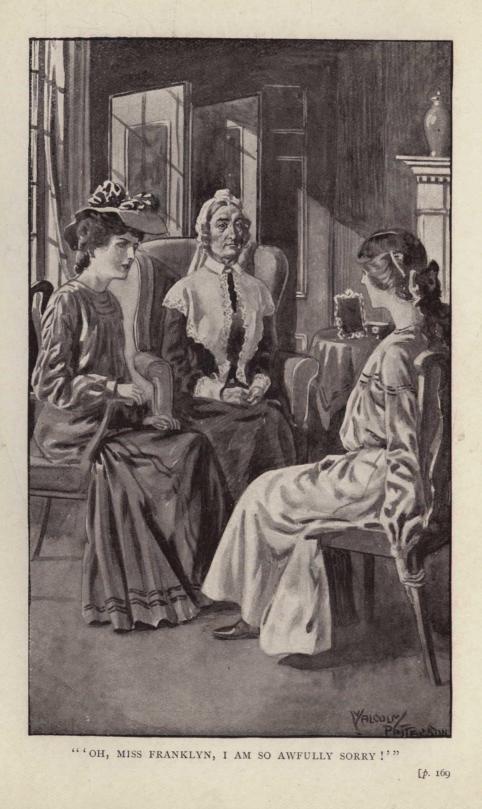
"'OH, MISS FRANKLYN, I AM SO AWFULLY SORRY!'"
"I don't know what Mrs. Beauchamp's opinion may be," said Lois, to whose face Monica's honest avowal had brought a pleased expression, "but if you took my advice, Monica, you would make up your mind to be quite inclined to let them severely alone, for the next few years, at all events."
"I will," Monica replied, without hesitation; the reality in her tones betokening steadfastness of purpose.
"I am very glad," said Lois, and there was distinct approval in the expressive glance her grey eyes flashed on Monica, as she rose. "I will tell Olive of your resolve, and it will help her to be true to her promise."
Mrs. Beauchamp, looking alternately from one to the other, as the conversation seemed to be carried on without her help, suddenly realised that the question was settled, and she had no battle to fight with Monica. She could not help thinking how differently she would have gone to work, and how unsuccessful she would, in all probability, have been.
"I am sure, Miss Franklyn, I hope that your mother will accept my apologies for all this trouble. There seems no end to the anxiety my granddaughter causes every one!"
"It was an anxiety to her, I must confess," said Lois, "but now that Olive has told her everything, she feels easier about it. She has such an abhorrence of anything approaching deceit."
"Of course," murmured Mrs. Beauchamp.
"Can Olive come to tea to-morrow, grandmother?" Monica's face was pleading.
"I really don't know, I'm sure. I hardly think you deserve----" began the old lady hesitatingly.
"May I interrupt?" said Lois, quickly. "I was to tell you that my mother felt that the most suitable punishment she could inflict upon Olive was to forbid her to see Monica again until she returns to school, whenever that may be."
And although Monica said, "Oh!" and looked disconsolate, she could not but admit that the punishment was a just one.
CHAPTER XIII.
"A NICE SCRAPE SHE'LL GET INTO!"
"Monica Beauchamp is back at school."
The news soon spread, until all the Fourth Form girls were aware of the fact, and, for the most part, it was received with acclamation, for the bright, high-spirited girl had been missed during the month she had been away.
There was only one little clique who regretted her return, and that was Lily Howell and her votaries who, knowing she had a rooted objection to the new-comer, took their cue from their leader, and looked upon Monica as an interloper; but it must be confessed that, personally, they had no fault to find with her, except that the absolute indifference with which she treated them annoyed them terribly.
During recreation, when Olive would fain have had Monica all to herself, several of the girls, in other forms besides her own, gathered round her, and made quite a fuss of her. This of course did not escape Lily's notice, who, remembering one occasion when she had returned to school after a slight illness, and no one had expressed any pleasure at seeing her back again, was frightfully jealous of Monica.
But the chief reason why she was sorry to see Monica at school once more was because she knew that, with Monica in the arithmetic class, her own chance of coming out first in the examination was decidedly lessened. There were only two studies which Monica had any real interest in, and those were German and arithmetic; the former because she had a very fair idea of the language, and the latter she thoroughly enjoyed and consequently took pains with.
Up to the half-term, Monica had kept her place steadily, much to Lily's mortification, who had always been praised for her neatly worked examples, until Monica appeared upon the scene, with her less tidy, but far more quick and correct work. But the month she had been away provided Lily with a grand opportunity of getting ahead; and she had worked with a zeal, worthy of a better cause, to endeavour to supplant Monica.
Great was her chagrin, then, to find upon a new rule being explained by Miss Churchill, that Monica was well acquainted with it, and had worked out a given example, and got the right answer, before the problem had thoroughly penetrated Lily's brain. She did not know that Monica had spent many hours amusing herself with her Hamblin Smith while she had been laid up at home, and so had got far ahead of what the Fourth Form was still doing.
"Very good indeed, Monica! You have worked that out well," commended Miss Churchill, as she looked at the sum; and Monica flushed with pleasure at words of praise such as she seldom had received before.
During that last fortnight of the summer term, she tried her very hardest to have a neat exercise book, as well as correct answers, but it was uphill work for Monica, whose home-lessons were invariably blotted and smudged, and the lines anything but straightly ruled. However, Miss Churchill, quick to notice and commend real effort, encouraged her several times with a word of praise. None of these escaped Lily Howell's ears, and she felt more convinced than ever that Monica was deliberately aiming at supplanting her in the forthcoming examination. No such idea had entered Monica's head; she was merely actuated by a desire to please Miss Churchill, and arithmetic was the only subject (of those taught by her) for which Monica had any liking. In English subjects and science she was a terrible pupil, and she was continually getting into trouble on account of carelessly written, or insufficiently learnt, work; but as it was just at the end of the term, and she had been away so long, she was let off more easily than she really deserved.
At length the examination week dawned, and those girls who were keen about their place in the class list spent all their spare time in cramming. Amethyst Drury, whose talents lay in the direction of English history and geography, was continually on the look out for some one to hear her say her "dates," and ask her questions about Africa, the country they were to be examined upon that term. Elsa, who, among others, was what their teacher called an "all-round girl," knew it was hopeless to try to look up everything, so she depended upon the knowledge she had gained during the term; by far the wisest plan. Olive, who seldom did well in any subject, on account of carelessness and inattention, expected to "get along somehow"; the only distinction she ever obtained was for drawing, and as she certainly had a real gift in that direction she was universally acknowledged to be the artist of the class.
It would be impossible, as well as unnecessary, to describe in detail the varied experiences of the examination week. Suffice it to say that the questions, according to the girls' opinions, were "harder than ever," and the candidates were none too hopeful when they gave up their papers, after a couple of hours' work upon each subject; somehow just the questions they had made sure Miss So-and-So would set had not been included, and the very things they had fondly hoped would not be required had been given a prominent place! But that is an experience common to all time, and by no means peculiar to the girls of that Fourth Form.
The arithmetic examination was almost the last on the list. And most of the girls who had expended their energies on previous subjects looked with dismay at the long list of difficult examples. Olive glanced at the others to see what they thought of it, but Elsa was beginning to write steadily, and Monica, catching her eye, gave her a reassuring smile; it seemed rather a nice paper to her. Amethyst, who was no mathematician, was biting the end of her penholder and looking frantic.
Olive was just going to dip her pen in the ink and begin to inscribe her name elaborately on the top sheet of the ruled paper before her, when something made her look in Lily Howell's direction just in time to see an ugly expression of malignant jealousy sweep over her face, as she observed Monica steadily applying herself to answer the questions which appalled her rival.
"There'll be awful ructions in that quarter, if Monica comes out top, as I do hope she will," soliloquised Olive, and then a reproving glance from Miss Churchill warned her to get on with her work.
For an hour no sound was heard but the scratching of pens and the rustling of paper, except now and then when a long-drawn sigh escaped the lips of one or other of the girls, as she realised her inability to solve a difficult problem.
By that time Olive had come to the end of her resources and could do no more, so she fastened her papers together and then began to look about at the other girls with a view to seeing how they were getting on. Her desk was in one corner of the room, and Monica (who long since had had to be moved to a distance from Olive, on account of whispering) was in the centre of the second row quite near the front. Lily Howell and her ally, Maggie Masters, were next to each other in the opposite corner from Olive's.
A glance at Monica showed her to be still hard at work over her paper, so Olive turned her attention elsewhere. As she looked across at Lily, their eyes met, and Olive turned away quickly, for she did not want to get into trouble with Miss Churchill, who might think they were communicating with each other in some way; but a peculiar expression she had seen in Lily's light grey orbs impelled her to look again a few seconds later, and then what she saw horrified her, and her eyes seemed rooted to the spot! For Lily was positively making copious use of the contents of some little note-book or paper, (Olive could not detect which) that was cleverly hidden, on the desk, by Maggie's pencil-box, from Miss Churchill's view.
"The horrid, mean, hateful sneak!" Olive, in her anger and contempt could not find enough opprobrious epithets. "She's got all her tables, and a whole lot of hints copied out, I do believe, and of course, now she'll go and beat Monica; but I'll be even with her! A nice scrape she'll get into!" And Olive chuckled to herself at the thought of what was in store. "Perhaps she'll be expelled, and a good job, too. I'd better nudge Gipsy, and make her see, in case the sneak goes and declares she didn't cheat."
Olive glanced over into the other corner again, but--nothing wrong was to be seen! All trace of the notes had vanished, and Lily was neatly ruling her manuscript paper as if no such thing as cheating had ever entered her head!
"Oh, you wretch!" And Olive felt as if she could have done anything to her, so exasperated was she to think that she had been "done"; for not once again, during the time that remained for the arithmetic paper, did she catch a glimpse of the missing paper. At length the gong sounded, and whether completed or not, the girls had to fasten their sheets together and hand the papers in to Miss Churchill.
They were glad enough to stretch their cramped limbs, and let their tongues loose during the recreation that followed, in discussing the questions and comparing their answers. Olive, of course, told Monica what she had seen Lily doing, and how vexed she was to think she could not prove it to Miss Churchill, if she were to tell her.
"Oh, let it be," said Monica, who loathed telling tales; "she'll be so mad if you tell, and she'll be sure to declare it wasn't a crib."
"I shall tell if she comes out top."
And Monica could not persuade her otherwise.
"We shall know to-morrow," said Olive as they entered the school door.
But in less than five minutes after the words had escaped her lips, part of the truth had come to light, and it happened in this way.
Lily (who was under the impression that her neat little scheme for aiding her memory had been quite unobserved by any one except Maggie, who had benefited by it, too), already, in imagination, saw her own name at the head of the list. But she thought it would be just as well to make assurance doubly sure, by securing Monica's downfall, if it were possible, in case she should be perilously near. So, as she passed up to the desk with her paper, taking care to be the last girl who filed out, she very quietly dropped her little paper of tables, etc., on the floor of Monica's desk, in such a manner as to make it appear as if it had slipped off Monica's lap, when she rose to go out.
"Now we shall be quits!" was her amiable thought, as she went with the rest into the playground. She bound Maggie, with promises of many good things, to absolute secrecy, and returned to the classroom to await developments.
The girls had no sooner taken their places than they became aware that something was wrong! The head-mistress Miss Buckingham came in with a very stern expression on her face, and Miss Churchill seemed on the verge of tears.
"I am grieved to tell you that there is a cheat--yes, a cheat," and Miss Buckingham repeated the words with scornful emphasis, "amongst you girls of the Fourth Form. Miss Churchill found this paper, containing arithmetical tables and various other information, under one of the desks when you had left the classroom. I desire that girl, who has sought to secure a good place in the examination list by such despicable means to stand up in her place."
A furtive glance from Lily, who was as white as a ghost, revealed the fact that the head-mistress was looking straight at Monica, and the real culprit breathed freely, and the colour came back to her cheeks. She did not know that Olive's gaze was riveted on her, or she would not have felt so easy in her mind as she did!
"Come, stand up," repeated Miss Buckingham, and Monica began to feel uncomfortable. Why did the head-mistress look so persistently at her, when it was Lily Howell who was the culprit.
"Well, I am sorry she will not confess it herself," said the calm, cold voice of the head of the school; "but Monica Beauchamp is the cheat!"
"I'm not!"
"She isn't!"
The two disclaimers burst simultaneously from the lips of Monica and Olive, who were aghast at this fresh piece of trickery, and could not imagine how it had come to pass.
"Olive Franklyn, sit down. Now, Monica, what have you to say in defence of yourself?"
"I know nothing whatever about it; I would scorn such a mean trick. Miss Churchill knows I would," and Monica looked reproachfully at the little mistress, who had been a sad and silent spectator, so far.
"I cannot believe you would cheat, Monica, but----" and she paused significantly.
Meanwhile, Olive had been frantically trying to make Monica see her, but failing to do so, she asked permission to speak, and told what she had seen on Lily's desk.
But both Lily and Maggie stoutly denied having had anything of the kind in their possession, and, as no other girl seemed to have observed it, Miss Churchill was reluctantly compelled to think that Olive, in championing her friend's cause, was drawing on her imagination. The figures and words on the paper were all in printing hand, so that no one's writing was recognisable.
No more light being thrown on the matter by further questioning, Miss Buckingham left the classroom, saying: "I shall not decide upon the punishment to be given until to-morrow morning, by which time I sincerely hope that the girl, whose conscience must be accusing her, will be ready to make confession."
In her own mind, Miss Buckingham was of opinion that Monica Beauchamp was entirely innocent; and she could not but feel that suspicion strongly rested upon Lily Howell, although the latter had feigned entire ignorance of the matter; for her changing colour belied her words.
The truth was arrived at in a singular and indisputable way after all.
When correcting the arithmetic papers, late that afternoon, in the teacher's room, Miss Churchill found some most astonishing blunders in Lily Howell's calculations. For some time she was mystified, and then it dawned upon her what had happened.
"Why, the girl's cubic measure is all wrong. No less than three times she has put down 1278 cubic inches instead of 1728, when reckoning a cubic foot. It is curious how she came to transpose the numbers? I wonder----"
She hastened across the hall to Miss Buckingham's room, and upon looking at the "crib," she saw, with a curious sense of satisfaction (for she felt sure Monica was innocent) that underneath "Solid or Cubic Measure" the first line, was
1278 cub. in. = 1 cub. ft.
"Found out!" she murmured, and recrossing the hall, she told two of the other teachers, who were also correcting papers, what she had discovered, and bade them look at the paper, and compare it with Lily's sums.
They both agreed it was a very clear case, and when, upon examination, Monica was found to have calculated her cubic inches rightly each time, no further proof of Lily Howell's guilt was needed.
Little did that individual dream of what awaited her on the morrow, when she retired to rest that night, rather well satisfied with the success which she thought she had achieved.
The girls waited breathlessly next morning for Miss Buckingham's verdict; many had been the conversations about it, and very varied were the punishments suggested. Every one was sure that, somehow, Lily would be proved guilty, most of them thinking that she would voluntarily confess.
Monica, knowing she was quite innocent, felt no real fear, although she was not at all sure that she would escape punishment, for she was under the impression that Miss Buckingham had believed her to be the culprit.
Every one was amazed when they heard the conclusion of the matter. In a few terse words the head-mistress explained how the truth had been brought to light; and no one felt that undue punishment was being meted out to Lily Howell when she was informed that after that term she would not be allowed to return to the Osmington High School.
"Not only for the using of unfair and forbidden means in order to secure a good place in the examination list, but far more on account of the wicked intention to bring discredit and punishment upon an innocent fellow-schoolgirl."
Miss Buckingham's words were stern and uncompromising, and poor unhappy Lily Howell cowered beneath her glance.
It was an unfortunate ending to the term, and the girls who came off victorious in the examinations did not feel the same satisfaction as they would have done if nothing of the kind had occurred. Monica, of course, was first in arithmetic; Amethyst secured a similar place in English history, and although she was beaten in geography, she did not mind so very much, as the honours fell to her friend Elsa.
A few days more, and the huge pile of buildings which constituted the Osmington High School was left in the charge of caretakers, for governesses and pupils alike had scattered in every direction to enjoy the long, summer vacation.
CHAPTER XIV.
"SUNDAY AGAIN ALREADY!"
"Oh, isn't it simply glorious?"
"How beautiful the sea looks!"
Sundry exclamations such as these escaped the lips of most of the passengers in the heavily laden train bound for Sandyshore, as it emerged from a tunnel with a shrill whistle, and rounded the last corner prior to slowing down. A beautiful panorama stretched out before them; in the foreground lay the quaint old town, beyond that an expanse of deep, blue sea, and in the distance the white, rocky peaks of some promontory seemed almost dazzling in the brilliance of an August sun.
Two out of three young people in a reserved second-class compartment were in ecstasies of delight; and the third was contemplating a month at Sandyshore, with very different feelings from those she had expressed a couple of months ago. For Monica had obtained her wish, and she would have Olive as her companion and friend during all that holiday month.
It had not been quite easy to gain Mrs. Franklyn's consent to let Olive accompany the Beauchamp party; especially after the trouble about the novel-reading, but eventually she had consented, upon both Monica and Olive promising her faithfully not to cause her distress in that way again. And when Mrs. Beauchamp insisted upon Elsa going with them too, she and the doctor very gladly availed themselves of the kindness and generosity which would enable their twin-daughters to have such a thorough holiday and change, free of expense.
Monica had, at first, demurred a little over having Elsa, saying "two's company, and three's none," but her grandmother was firm. For one thing, Mrs. Beauchamp thought it would be just as well to have Elsa, on account of her trustworthiness, and the old lady was a trifle afraid of Olive getting into mischief without her more sensible sister being near by. Also she had a desire to know more of the gentle-mannered girl, and quite looked forward to enjoying her bright young society, when the other two girls were bent on following their own devices. So Monica had, perforce, to fall in with her grandmother's wishes, and when it was known that Mr. Drury was acting as locum-tenens of the quaint old church of St. Mary, Sandyshore, everything seemed to fit in splendidly.
As it happened, the Drurys preceded their friends by a couple of days. So Amethyst was at the station to meet the girls when they arrived. She had never been to Sandyshore before, and was captivated with the dear little old-fashioned town, as all its summer visitors were. Her merry tongue rattled away about all its charms and wonders while Barnes counted up the huge dress-baskets, trunks, and other articles of luggage belonging to the party, and engaged a couple of cabs to convey them to their destination.
At length, all was satisfactorily accomplished, and, with arrangements for an early meeting, Amethyst saw them drive off into the town, and then ran home to the quaint, rambling old vicarage, next to the church, which the Drurys were occupying.
Meanwhile, after a few minutes' drive through the narrow-streeted town, and up a very steep hill, "Mrs. Beauchamp and party" (according to the "Sandyshore Visitors' List") arrived at "Rocklands," a large house, standing in its own grounds, overlooking the entire bay.
Mrs. Beauchamp always engaged rooms at that particular house, owing to the magnificent view which she could enjoy, simply by sitting comfortably ensconced in one or other of the bay windows; for, in one direction, Rocklands overlooked the pier, to and from which pleasure steamers were continually passing; and when one tired of these, the sands, thickly sprinkled with bathing machines and private tents, amused and interested the onlooker with their varied phases of holiday life.
Comfort being of more importance than expense to Mrs. Beauchamp, she had made every arrangement for convenience during their month's stay at Rocklands by engaging a whole suite of rooms. Thus Elsa and Olive were charmed to find themselves the proud possessors of a delightful bedroom, while Monica occupied the one next to theirs. Seldom were their doors shut; it was such a new experience for Monica to have young companions to live with. Then the dining-room in which they had all their meals was entirely at the girls' disposal, between times, when they could do just as they pleased, and "need not be so much on their best behaviour," as Monica termed it, as in the drawing-room. But the weather was so delightful, and so seldom did it rain, that the trio were not often to be found indoors except in the evenings.
The next morning, the whole party were early on the small strip of shore, which extended for fully half a mile round the bay, and on which the visitors made themselves thoroughly at home. The short season was at its height, and at first sight there seemed no chance of securing a comfortable position; but as they walked along the Shore Road, looking down upon the gay throng of holiday-makers, Elsa descried a well-known figure, and saw Amethyst frantically signalling to them.
"There seems room there, Mrs. Beauchamp," she suggested, "where the Drurys are. Shall we go down?"
And in a few minutes, after mutual greetings, Mrs. Beauchamp was comfortably settled in her deck chair, while the girls, spreading a rug on the sand, threw themselves down upon it in careless attitudes.
That first morning was but a sample of most of those which followed.
Mrs. Beauchamp read, or chatted with Mr. and Mrs. Drury, while the young people enjoyed themselves in every way. A tent, next to the one used by the Drurys, was hired, and the girls had great fun over bathing. Mrs. Beauchamp wished Monica to learn to swim, so an old bathing-machine proprietor, one of the chief features of Sandyshore, used to give her and Olive a lesson every morning. Elsa was too timid to really enjoy more of the sea than could be had where the water was comparatively shallow, and Amethyst and she were quite content to look on at the more daring exploits of the other two girls.
Such fun and merriment did they all have that first week at Sandyshore, that it did not seem possible that they could enjoy themselves more, although Amethyst's one cry was: "Won't it be just too perfectly lovely when Marcus comes?"
Marcus Drury, Amethyst's brother and senior by four or five years, had only recently gone up to Cambridge upon leaving Trent College. He had been spending a few weeks of the Long Vacation with another undergraduate at the latter's home in Scotland, but now he was expected to arrive at Sandyshore any day, and his devoted and admiring little sister was on the tiptoe of excitement about his coming. Of course, he was well known to the Franklyn girls, with whose brothers he had been friendly since the Drurys had lived at Osmington, but Monica felt a good deal of interest in the young fellow of whom she had heard so much.
Therefore, one morning, some ten days after their arrival at Sandyshore, when Amethyst came flying along the Shore Road to meet them with the words, "Marcus has come, and you'll never guess who is with him!" all three girls were quite as mystified as she wished them to be.
"No one I know," said Monica, with decision.
"No, you don't; but the others do." And Amethyst bubbled over with excitement. "Do be quick and guess: I can't keep it much longer."
"Not Dick?" hazarded Elsa, more to please her friend than because she expected to be right.
"No, not Dick," said Amethyst merrily. "Try again."
"Roger, then," said Olive.
"Yes, yes, yes! Isn't it splendid? He wanted to surprise you, and he's got a week's holiday from St. Adrian's, and Marcus met him in the Strand, or somewhere, and persuaded him to pack up and come down here with him."
"Oh, how lovely!" cried the twins simultaneously; "do let us see him. Where is he?"
"There," and Amethyst triumphantly pointed out a couple of young fellows not very far away, who had evidently been enjoying, from a distance, the surprise the news had caused.
Monica, feeling somewhat out of it, followed the others rather more slowly, and thus secured a good look at the newcomers while they were engaged in greeting Olive and Elsa.
There was no doubt as to which was which: the elder, of medium height, slightly built, dark, with brown eyes, was a Franklyn all over; while his companion, a tall, broad-shouldered youth, with merry blue eyes and curly hair, although he was not in the least like his sister, bore an unmistakable resemblance to Mr. Drury.
Raising his panama hat, round which his college colours were twisted, he came forward with outstretched hand, and Monica thought she had never liked any one so well, at first sight, as this debonair undergraduate. She had previously somewhat sneered at Amethyst's praises of her paragon brother, but she could understand her feelings now that she had met Marcus Drury.
She almost forgot his companion, until a quiet, manly voice, so different from the other's boyish tones, said, "How do you do, Miss Beauchamp? I am very glad to meet my sister's friend." And she found herself shaking hands with Olive's eldest brother.
A very short time sufficed to put them all at their ease, and then, as the tide was fast going out, they went in different directions for their bathe. But an hour later found the young people all together again, and the girls were charmed with the proposal that they should go for a row, there being just an hour left before dinner.
Mr. and Mrs. Drury, who had undertaken to keep Mrs. Beauchamp company until their return, watched the boatful with interest, until Roger's and Marcus' even strokes had rowed it so far as to be scarcely more than a speck.
"Dear boy," murmured Mrs. Drury, as she took up the knitting she had neglected; and her husband smiled as he said, quizzically: "Do you mean Roger?"
"I meant Marcus, of course," replied his wife, with a smile, "but Roger is a dear boy, too. I only wish----"
"What do you wish, Nora?" queried her husband, in a lower tone, as he tilted his black straw hat over his eyes, to protect them from the glare of the midday sun.
"Why, the same as I know you wish, Herbert," was the reply, "that in choosing the medical profession Roger had been actuated by the one desire to follow in the steps of the Good Physician."
"Yes, I would that he had, but I fear it was not so. But, Nora, motives and hearts, too, can be changed. Why should not Roger Franklyn go back to St. Adrian's 'transformed'?"
"Ah! why not?" And little Mrs. Drury's eyes grew earnest, as she looked out at the tiny black speck dancing on the ocean in the distance, and she prayed that God would answer that other mother's prayers, and give to Roger a new purpose, a new ideal in life.
The days flew swiftly by, what with picnics, tennis, bathing, boating, and many other amusements and enjoyments, and Sunday dawned.
Monica and Olive, it must be confessed, did not appreciate that one day in the week as much as they should, inasmuch as they were compelled, of necessity, to forego during its sacred hours all the secular amusements with which they filled up every moment of the week, from Monday morning until Saturday evening. They awoke that brilliant August morning to the unwelcome remembrance that it was "Sunday again already!"
But Elsa, whose happiest hours were spent in God's house, with a tender little smile hovering round her lips, drew up the blinds, and looked out upon the calm blue sea, and lifted her heart in thanksgiving to her Heavenly Father for making such a beautiful world. Even Olive's ceaseless chatter, as they dressed, did not disturb her; and when her sister had gone into Monica's room, as she invariably did, Elsa gently shut the door, and taking her little Bible, she knelt by the open window and prayed long and earnestly. She did not know how to pray properly, she only knew how to talk to her dearest Friend, and she was accustomed to tell Him everything, and ask with the simplicity and directness of a little child for what she needed.
That morning, after praying for help and strength for herself, to enable her to be a faithful follower of her Master, she remembered her darling mother (whom it had been a very real sorrow to leave) and all those at home; and then her heart seemed overwhelmed with the thought of those about her, who, as yet, did not know and serve her Saviour. "Oh! Lord," she prayed, "do speak to-day, somehow, to Monica and Olive. I can't bear to think of them going on living without Thee. And kind Mrs. Beauchamp wants something to satisfy her. O Lord, she wants Thee! and Roger needs Thee, too. Lord, show Thyself to them all to-day, and show them they will never be happy until they have come to Thee."
Thus, in all earnestness, but with childish simplicity, Elsa poured out her heart unto the Lord, and "the Lord hearkened and heard."
The dear old-fashioned church, taxed to its utmost to provide accommodation for the throngs of fashionably attired people who poured ceaselessly up the aisles, as the five-minute bell gave warning that service would soon commence, was eventually crammed with a huge congregation, made up of many types. Perhaps it would be safe to say that the majority of the people assembled within the sacred edifice had gone there because "it was the proper thing to do"; they neither expected nor desired any spiritual help.
Among this class were several of our acquaintances. In one pew, a prominent one, because the verger had an eye to a substantial sum for the offertory from such an imposing looking personage as Mrs. Beauchamp, in her trailing gown of black satin, and a Parisian bonnet, were seated the two Franklyn girls, Monica and her grandmother; Elsa being next to the old lady.
At a little distance, and at right angles to them, at the end of the vicarage pew in the south transept, Marcus' tall form towered above those in the vicinity, and made his neighbour, Roger Franklyn, look quite insignificant; also Mrs. Drury and Amethyst. It is to be feared that some of the occupants of the two pews were a trifle disposed to look at each other, at first; but a glance from her mother subdued Amethyst, and she soon forgot the others in paying attention to the service.
Marcus, who had a tenor voice, which promised to be of unusual quality, sang all the chants and hymns; but Roger, a slightly cynical expression disfiguring his clear-cut features, took no part in the service. With arms folded, and head erect, he stood looking straight before him, his eyes wandering, occasionally, to the pew in which his sisters sat; but he did not look at them so much as at their friend.
Monica, her softly rounded cheeks already tanned by exposure to sun and sea, was looking really handsome that morning. Her hair, arranged in a new and becoming fashion, was tied back with a large cream bow, which matched her flop hat and daintily made dress. The only scrap of colour about her was a couple of dark crimson roses, tucked carelessly into her waistband; and altogether she made a very pretty picture, standing, as she did, erect and tall, between the twins, who wore simple delaine frocks of a pale greenish hue.
Mr. Drury conducted the service, and a young clergyman, apparently a curate, read the lessons. Elsa, with a sinking heart, saw the latter ascend the pulpit stairs; for it must be confessed she had hoped her favourite, Mr. Drury, would be the preacher. But she need not have feared; God had given Leslie Herschel a message to deliver to the congregation assembled at St. Mary's Church that August Sunday morning, and as the young man looked down upon the throbbing mass of never-dying souls, his heart went up to God that many there that morning might be led to make the one great choice.
CHAPTER XV.
"OH, MONICA, DON'T!"
"My text you will find in the First Book of Chronicles, the twenty-ninth chapter and the fifth verse. 'Who then is willing to consecrate his service this day unto the Lord'?"
The young preacher, for he had been barely two years in orders, read the verse once, and yet again, feelingly, and as if he would impress every word of it upon his hearers, and then he closed his Bible, and began his sermon.
It was not a very long one; indeed there were a few who wished it had been half as long again. It was not by any means a brilliant peroration, but yet there were points about it which made it the most remarkable sermon to which many of his hearers had ever listened. And that last word gives the key to the whole thing; they had to listen! Whether they liked it or not (and many, very many, did not at all appreciate the home-truths which they heard), some unseen and uncontrollable impulse forced them to listen, even against their will. The earnest, ringing tones of the young preacher, his dark eyes, which seemed to penetrate their very motives and thoughts, stirred the apathetic indifference of that nominally Christian congregation; and they realised, some of them for the first time, that the service of God was a very real and tangible thing, and that they had, so far, had no part or lot in the matter.
Leslie Herschel dwelt first upon the Master, then upon the service itself, and finally upon those who were called to serve, and when and how that service should be rendered.
"My friends," he said, in conclusion, "I claim your service, whole-hearted, faithful, loyal service, to-day, for my Master. He will force none, coerce no one into rendering unloving obedience, but He pleads with you to-day to come with willing hearts and offer Him your best. And what does He promise in return? Peace, joy, hope, satisfaction in this life, and eternal life in the world to come. I ask you, are you content to do without Him? Is this world, pleasant and attractive though it be, so satisfying that you need nothing more than the gaiety, the success, the honour, aye, and the gold which it offers to some, but by no means all of its devotees? But supposing you are satisfied now (and I very much doubt if there exists a single individual who is absolutely satisfied), will you be satisfied, think you, when you come to stand, all unprepared, in the presence of your Judge? Will this world stand you in good stead then?" And the preacher leaned over the pulpit, while with searching glance his eyes seemed to scan every one of the disturbed faces before him. "The Bible tells me that 'this world passeth away.' What will it advantage you, then, whether you have moved in a select circle, or not? Whether you have acquired fame and distinction, or not? Whether you have been known among men as almost a millionaire, or not? Oh! my friends, I beseech you, with all earnestness, that you will this day choose the Lord Christ for your Master.
"It is an old, but true, saying, that 'To-morrow never comes'; we are only sure of to-day, therefore 'Choose ye this day whom ye will serve,' and say: 'Behold, Thy servants are ready to do whatsoever my Lord the King shall appoint.'
"I do not, I dare not, promise you a path of ease and luxury, but I can say, for I have proved it, that the life which has Christ as its Alpha and Omega is the only truly happy one, the only life worth living. And that word 'whatsoever,' if you really mean what you say, may entail the giving up of many a cherished plan, many a life-long project. It may mean going to China or Africa as a medical missionary for one; to face the misery and horrors of life among the denizens of the East End for another; to live a Christlike life in a worldly and uncongenial atmosphere for a third.
"But in it all, and through it all, Christ's never-failing arm will guide and uphold you, and His voice will be heard, saying: 'Behold, I come quickly, and My reward is with Me, to give every man according as his work shall be.' 'Who, then, is willing to consecrate his service this day unto the Lord?' May God in His mercy grant that from many a heart in this church this morning the cry may go up to Him, 'O Lord ... I am willing.'"
The strains of the organ, on which the opening bars of that beautiful consecration hymn:
Take my life, and let it be
Consecrated, Lord, to Thee,
were being exquisitely played by the organist, accentuated rather than disturbed the hush of solemnity which had fallen upon the congregation, as the young preacher concluded his earnest appeal for personal dedication; and there were undoubtedly several that morning who, realising the claim which Christ had upon them, willingly surrendered all to Him.
The Beauchamp and Drury parties met in the quaint old churchyard, and the two elder ladies walked slowly on, while the young people waited about for Mr. Drury.
"A wonderful sermon, was it not?" said Mrs. Drury.
"Ye--es; but rather too dictatorial in style for such a young preacher." Mrs. Beauchamp's tones expressed dissatisfaction.
"Did you think it dictatorial?" enquired the vicar's wife pleasantly; "it did not strike me in that way. I thought it was a grand opportunity, splendidly seized. With such a varied congregation, coming as we do from all parts of England, no one but God can foresee the results that may accrue, with His blessing, from the faithful message this morning."
"Perhaps so," was Mrs. Beauchamp's somewhat absent reply; and she turned back as if to wait for the girls.
Amethyst and Elsa were close at hand, and quickly joined them, but Monica and Olive were some distance behind, walking slowly, and apparently deep in conversation. Mrs. Drury, who had not been unobservant of the effect of the sermon upon Monica, as she sat listening, listlessly at first, and then was roused into paying startled attention to the (to her) unusual discourse, tactfully drew her own child and Elsa into conversation, as they walked on. For she was sure, from the expressions on the faces of the girls behind, that they were discussing what they had been hearing.
As a matter of fact, after a few commonplaces with Marcus and Roger, the girls left them, and slowly following the others, had been silent companions for a few moments.
Then Olive, shaking off the unwelcome feelings which had taken possession of her, said gaily: "A penny for your thoughts, Monica!"
"You can have them without the penny," was her friend's rather sad reply, as she slipped her arm into Olive's. "I'm half inclined to do what he said, Ollie."
Olive raised a startled face to Monica's, and read quite a new expression upon it, in which there was a certain amount of determination. "What do you mean?" she queried; but in her own heart she knew full well what Monica meant.
"Why, to say I am willing," said Monica, with some confusion, for she felt diffident about expressing what she meant even to her greatest friend.
"Oh, Monica, don't! We'll never have any more good times together," said Olive, and it must have been her bad angel who prompted her words; "if you do you'll have to leave me behind, for I'm not going to give in."
"I wish I could live like he said," and Monica's face looked wistful. "Sometimes I----"
"Well?"
"Sometimes I long to be able to write and tell dad that it is all settled. He would be so glad."
"Well, I don't see much in it," said Olive obstinately. Her better feelings were aroused by Monica's words, but she deliberately crushed them down.
"Oh, yes, there is; there's everything in it! You've only to look at that young clergyman, and your mother, and even Elsa, to see what a difference there is. Oh, Olive, if I had your mother to help me I would, really, say to God what we sang just now,
Take myself, and I will be
Ever, only, all for Thee"--
and Monica's young face glowed with feeling.
"No, you wouldn't," was Olive's moody reply, "any more than I do. Of course, I mean to be a Christian some day, but not while I'm only a girl; I want some pleasure first."
"Oh, Olive, Olive, you little know the dark cloud that even now is beginning to gather over your head!"
With a sigh, Monica turned away, and, with one consent, they hurried after the others, and no more was said. But the elder girl's heart had been roused and awakened, and never again would she drift into her former state of indifference.
The two young fellows, waiting about in the churchyard for Mr. Drury, at length received a message to the effect that he would be detained still longer, and they had better not wait for him. So they, too, strolled down to the Shore Road, where they knew they would eventually come across their friends.
"I'm almost sorry I'm not in your shoes, old man," said Marcus, as he adapted his long, swinging strides to his friend's shorter steps.
"It's a very good thing that you are a little undecided about it," was Roger's somewhat enigmatical reply. "But tell me what you mean?"
"Why, I felt this morning as if I would give anything to go in for medicine, with a view to going abroad; but I know father has set his heart on my taking orders."
"If I remember rightly, the preacher distinctly observed that the service was not to be one of picking and choosing but a case of 'whatsoever.'"
Something unusual about the tone in which Roger made this remark, and a total absence of his usual cynicism, made his friend glance curiously at him, and he realised that a change, undefinable at present, but nevertheless unmistakable, had taken place in Roger Franklyn.
"I say, old chap, I wish with all my heart you would be a 'Whatsoever Christian,'" he said impulsively.
"With God's help I mean to be," was the unexpected reply, as Roger lifted his hat, and glanced upward, as if registering a vow.
"Thank God!" was Marcus' low but fervent response, as he gripped his friend's hand with such force as to make him wince.
"I knew you would be glad," was the quiet reply, "and so will my dearest mother; she has been praying a long time for her eldest boy, and he has been very obstinate. But I shall need all your prayers, now, for already I foresee trouble and disappointment looming in the distance. The pater is expecting me to follow in his footsteps when I leave St. Adrian's, but I--oh! Drury, I am sure those words were meant for me this morning. There was probably not another medical student in the church, and I felt called to offer myself to Him for foreign service, if He will accept me."
"You need not doubt His acceptance, old fellow. When we give what God asks for, you may be very sure He takes it. How glad Herschel will be!"
"Who is Herschel?" ask Roger quickly.
"Why, this morning's preacher. Did not you hear father talking about him last night? No? Oh, then I must tell you. He is staying down here with his mother and a sister, I believe, and father met him yesterday, some time. Leslie Herschel's father (the late Dean of Balmore) and he were great friends, so he was awfully glad to come across him, and asked him, straight off, to preach this morning. He has had a curacy in some huge mining town, but he is going out to the Soudan this autumn."
"It's marvellous how God makes things fit in," remarked young Franklyn, with rather an embarrassed laugh; it was such a new thing for him to be talking in that strain. "I suppose, humanly speaking, Mr. Drury might have preached a hundred sermons and they would never have touched me; but just this one, from an utter stranger, did. And if he had been here either last Sunday, or next, instead of to-day, I should not have heard it!"
"There is a little chorus we undergrads sing sometimes, before we begin our Open-Airs, in Cambridge," said Marcus, "which runs thus--
'I believe God answers prayer.
I am sure God answers prayer.
I have proved God answers prayer.
Glory to His name.'"
"He certainly answered prayer for me this morning, and I'll trust Him for all the future."
Thus, Roger Franklyn, medical student, was "transformed"; and, in the course of a few days, he returned to his work at St. Adrian's, filled with a new purpose, governed by one desire, and one only, namely, to consecrate his service henceforth unto the Lord.
Mr. and Mrs. Drury's hearts were filled with thanksgiving when they heard of his conversion, and a smile irradiated Leslie Herschel's face when he was told of one result, at any rate, of his claim for service.
And Elsa: who can describe Elsa's joy, when, late that Sunday evening as her brother bade her "good-night" at Rocklands gate, he bent down and whispered his news in her ear? He knew well enough which of his twin sisters would be the one to rejoice with him, for Elsa's brave efforts to live a consistent Christian life in her own home had not been unobserved by her eldest brother.
"Oh, Roger, darling, how splendid!" and she clung tenderly to him. "How glad mamma will be when she hears; she has been praying for you so long. And I have, too," she added shyly.
"Dear little sister," he murmured, as he stooped and kissed her forehead. "Go on praying, Elsa, not only for me, but for Dick, and Olive, and the others."
Monica was strangely subdued all that Sunday. Twice Mrs. Beauchamp enquired if she were not well, but she replied that nothing ailed her. Elsa, who felt sure that she had been, in some way, influenced by the sermon, tried to muster sufficient courage to speak to her about it; but no opportunity occurred. Olive seemed determined never to leave Monica's side for a moment. So persistent was she, that even Monica grew cross once, and said pettishly, "Do be quiet for a bit, Olive, I want to read." But if any one had taken the trouble to watch her movements, they would have seen that she rarely turned a page, although she appeared to be absorbed in her story.
In reality, Monica was thinking; good and evil were striving for the mastery within her, and she did not seem able to come to any decision. She longed to become a Christian, in her inmost heart, but something seemed to bar the way. At first, she could not think what the obstacle could be; but before she had lain down to rest that night, she knew that it was her friend, Olive, who was hindering her from taking the decisive step. Olive had said, "Oh, Monica, don't!" and although she knew that she was acting worse than foolishly, Monica decided not to make the great choice just then!
CHAPTER XVI.
"DO BE CAREFUL, GIRLS."
"Hurrah! Three cheers for mumsie!" cried Amethyst excitedly, one morning.
"What's up now?" enquired her brother, in a provokingly calm tone.
"Why, we're all going for a picnic to Gullane Head, father as well, for the whole day. Isn't it scrumptious?" And she danced about him in great glee.
"Very," he agreed, "but whom do you mean by 'all'? Four people scarcely constitute a picnic."
"Silly boy!" she retorted; "of course Monica and the Franklyns are coming. Mumsie arranged it all with Mrs. Beauchamp yesterday, only she would not say a word until this morning, in case it should not be fine. But there's no fear of rain to-day," and she glanced up at the deep blue sky, in which no speck of cloud was visible, with great satisfaction.
"How do you propose to get there?"
"Oh, father and you are to bicycle, and mother and we four girls are going in a waggonette."
"Is Mrs. Beauchamp going to bicycle, also?" asked Marcus, gravely. He was terribly fond of teasing his young sister.
"Oh, you dreadful boy! Of course not! She isn't going at all; it's too much of a real picnic for her to enjoy."
"I'm sorry Roger has gone," mused Marcus, as he began putting his Kodak in order, with a view to some snap-shotting. "I wonder if Herschel would care to come."
He was soon striding up the quaint old street to the lodgings occupied by the Herschels. The town was very full, and rooms were at a premium, so that the Herschels had been glad to secure even such rooms as they had, in a very old-fashioned house, where the front door opened into the sitting-room, and when one sat in the low bay window, one seemed absolutely in the street.
Marcus, whistling a merry tune, paused a moment at the door, and then went by it, and tapped at the window. All the visitors acted in a very free-and-easy fashion at Sandyshore!
He was invited to "come in," and without more ado he walked into the sitting-room, where the remains of breakfast were still upon the table.
With apologies for intruding so early, Marcus shook hands with a sweet-looking widow lady, the depth of whose mourning betokened recent loss, and a tall slender girl, whose clear, grey eyes seemed too large for the fragile little face surrounded with an aureole of fair hair.
"I came to see if Herschel had any plans for to-day. If not, we are having a picnic at Gullane Head, about seven miles from here, and I wondered whether he would bicycle over with father and me."
"Do, Leslie; it will do you good," said his mother, as the young clergyman hesitated, and demurred about leaving them for a whole day, when his time with them was getting so short. "Robina and I have plenty to amuse ourselves with."
"Would you both join us?" asked Marcus. "Mother and the girls are going in a waggonette."
"Thank you very much, but I am afraid you must excuse us. Robina is not very strong, and it suits us best to have a lazy time by the sea." Mrs. Herschel smiled lovingly at her daughter, whose fair face flushed at the allusion to her health, for it was a sore trial to Robina Herschel that she had always to be taken care of, and shielded from every ill wind. But she bore her cross bravely, and no word of murmuring escaped her lips, although she was denied much that goes to make a girl's life happy.
"What time do you start, Drury?"
"Oh, 10.30, I believe; but come round to the vicarage directly you are ready, won't you?" and, excusing himself on the plea of having to pump up his tyres, Marcus hurried away.
It was a merry party that finally left the Vicarage, after various delays, that morning. For some time the three cyclists kept level with the waggonette, and Marcus teased Amethyst and the girls most unmercifully about ill-treating the poor horse by making him drag such heavy weights as they were, etc., etc.
"It isn't us, it's all the lunch we had to bring for you," cried Amethyst.
"Oh, indeed! You hear, mother? Be sure not to give my small sister so much as a crumb, because, upon her own confession, it's all been brought for me."
"Oh! isn't he tiresome, mumsie?" said his sister, with a little pout. She did not care to be made a laughing-stock of, and the others were all smiling.
"He's only teasing you, girlie; I wouldn't mind," said Mrs. Drury.
"Dick always goes on like that," put in Olive. "Brothers are an awful nuisance, but they 'keep a body alive,' as our old cook says."
"I wish I had one," said Monica wistfully, her glance following the merry young fellow who was now cycling along at a good rate, in order to pick up the two clerics, who were well ahead.
"I don't know what Mrs. Beauchamp would say to a troublesome grandson as well as a troublesome granddaughter," said Olive mischievously. But the words were scarcely out of her mouth before she wished she had not said them.
For Monica, drawing herself up, with one of her haughty airs, said sarcastically: "I am much obliged for your opinion of me, I am sure; especially as no one asked you for it."
"Oh, I only said it for fun," and Olive looked repentantly at her friend. But Monica chose to consider herself injured, and for some little time all the occupants of the waggonette felt a trifle uncomfortable.
But a halt was proclaimed soon after, and all the party dismounted, in order to go over a lighthouse which was situated about two-thirds of the way between Sandyshore and Gullane Head, and in the general interest resulting from an inspection of the wonderful mechanism, which the lighthouse keeper proudly explained to them, the little cloud blew over, and by the time their destination was reached, Olive and Monica were as good friends as ever.
Gullane Head, as the promontory which projected from the mainland was called, was an ideal place for picnics. There were several old caves, said to have been used as hiding-places for contraband goods years before; and the huge boulders which had evidently fallen at some time or other from the cavernous roofs made rough-and-ready chairs and tables, provided one was not too particular.
It was universally decided that it would be the best plan to have lunch first, as they were all hungry, and then devote a long afternoon to exploring the neighbourhood. So a particularly nice spot was chosen, and amid much laughter an impromptu lunch was quickly laid upon one of the flattest boulders, and the party seated themselves, as best they could, around it.
"I'm glad we've got it all to ourselves," said Amethyst, with a deep sigh of enjoyment, as she passed a plate containing half a pork-pie to Marcus; between whom and herself a truce had been declared.
"I can't understand it," added the vicar. "I should have thought half Sandyshore would come to such a charming spot." And he leaned over and looked down at the dark blue sea, dashing up against the base of the rocks, some sixty or seventy feet below.
"It is rather an expensive drive, for one thing," said his wife, who was engaged in pouring lemonade syrup into glasses, to which Elsa added water.
"By the way, where is our coachee?" enquired Marcus. "Isn't he to have something to eat?"
"He has driven on to the Coastguard station, to put up his horse," replied his father. "Some relations of his live there, he says. He will turn up again at four."
"Are you enjoying your holiday, Miss Beauchamp?"
Monica started at the sound of a voice near her elbow, and looked up to see that the young clergyman, of whom she was frightfully shy, and whom she had done her utmost to avoid so far, had found a seat near her own, which was rather a high lump of rock where she had perched herself in order to get a good view of the undercliff.
"Yes, thank you, very much," she faltered; and then she pulled herself together, for it was an unusual thing for Monica Beauchamp to be at a loss for words.
"Sandyshore, and indeed all the coast in this neighbourhood, is very lovely," said Leslie Herschel, his eyes sweeping the panorama that stretched out before them.
"I couldn't bear staying here last year," admitted Monica, "and when I knew my grandmother was coming again, I was vexed at first; but I should have been very sorry not to have come, now."
"How is that? May I ask what has made the difference?" And there was eager questioning in his voice, also in the dark eyes which met Monica's.
"Why, I have had my special friend, Olive Franklyn, with me, this year, and that has made all the difference," was Monica's reply.
Leslie heaved an involuntary sigh, for he had observed the young girl's startled attention on the previous Sunday morning, and he had hoped to have heard that it was the presence of a new-found Heavenly Friend that had made things different. He looked earnestly at Monica, who was occupied with balancing her plate, safely, upon one knee, and wondered whether the present was a good opportunity for speaking a word for his Master, or whether a better one might occur later on.
He had just decided that there is no better time than "now," when Monica looked up with a merry word about the difficulty she was experiencing with her plate, and in a moment more the article in question had slipped out of her grasp, and was lying in fragments on the ground, some six or seven feet below.
All hope of a further tête-à-tête was prevented by the contretemps; and when peace reigned again, Monica was to be found seated amongst the others, in case, next time, she should let herself fall, instead of her plate!
"What were you talking about up there, Monica?" whispered Olive, who had been extremely curious to know what the young clergyman had been saying.
"You!" was the very unexpected reply; and that was all the information she could get, whereat she was all the more puzzled. She had noticed Mr. Herschel glance at her, while Monica was speaking; surely she had never told him of their conversation after the sermon! If so, perhaps he would be trying to get a talk with her; and Olive was filled with alarm at the idea, for her conscience had been accusing her very loudly. However, she determined not to give him an opportunity of speaking to her alone, by never leaving Monica for an instant, and, by that means, she congratulated herself she prevented any more conversation between him and her friend.
But Olive need not have been quite so scheming, for after the whole party had explored the caves, Mr. Drury and the two young men went off on a tour of inspection, leaving Mrs. Drury and the girls to amuse themselves close home.
Mrs. Drury's suggestion that they should all sit still for a little while and enjoy the beautiful view and delicious breeze after the darkness and dampness of the caves, was received with acclamation, Amethyst stipulating that she should tell them a story.
Her mother, who was accustomed to a request of that nature, demurred at first, but finally consented, and they were delighted with her racy account of a journey she had taken in her girlhood's days, when a terrific snowstorm had kept all the passengers imprisoned in the train, several miles from a station, for more than twenty-four hours.
Monica followed next, with some particulars of her early days in Burmah, culled rather from what she had been told than from what she actually remembered. And then Olive protested that she was tired of sitting still, and proposed a search for some way of reaching a piece of sand which could be seen at a little distance along the coast.
Amethyst and Monica were ready enough to go with her, but Elsa, who was no climber, decided to keep Mrs. Drury company; so the trio set off on their voyage of discovery.
"Do be careful, girls," pleaded Mrs. Drury, who was rather anxious, well knowing their zeal was apt to run away with their discretion; "and unless you succeed in finding either some steps, or a proper path leading down to the shore, you are on no account to go. I can trust you, Amethyst?"
"Oh, yes, mumsie! We'll promise to be awfully careful," the shrill treble voice called back, and a few minutes later the sight of a handkerchief waving in the breeze proclaimed the fact that a beaten track had been found; and the two who were left behind settled down to a cosy half-hour.
Elsa, who loved Mrs. Drury only next to her own mother, squeezed up close to her, and the vicar's wife put a protecting arm round the girlish figure, for she had a very warm corner in her heart for quiet, gentle Elsa. Then they had what was a delightful, helpful chat to the young girl, who confided all her hopes and fears about Monica and Olive to Mrs. Drury, and was encouraged to pray on, and look out for opportunity of service. The latter remark reminded Elsa of the young clergyman's text, and Roger's decision, and, from her own difficulties and anxious thoughts about her twin sister, she went on to speak of the future that now stretched out before her favourite brother.
"I think it is so splendid of him to want to be a missionary," and Elsa's face glowed with animation; "but I am afraid it will disappoint father a good deal, and poor mamma will be very sad at the thought of his going so far away, but she will not let him know it, because she will be so glad for him to go, really. I suppose, if all is arranged, that he would not start for a year or two, would he, Mrs. Drury?"
"No, dear, I expect not."
"That will give mamma a nice long time to get used to it," replied Elsa contentedly. She was singularly childish in some things, and correspondingly sensible about others.
Mrs. Drury cast a shrewd glance at the bright young face, which was turned seawards, and sighed. She realised what even the elder Franklyns either could not, or would not, dream of, that the gentle, patient, invalid mother was fading slowly, but surely, away; and she knew that the happenings of even a year hence would have no power to bring either gladness or sorrow to Mrs. Franklyn, who by then would be in the presence of the King. But the twins had no idea of it, and as Mrs. Drury sat silently looking at Elsa, who was all unconscious of the terrible sorrow in store for them all, she wondered if she were wise in leaving the girl in ignorance, for she could imagine what the shock would be like, when the blow fell. She had talked the matter over with Mrs. Franklyn, who well knew upon what a slender thread her life hung, and had urged her to let her children be prepared for the inevitable; but their mother had pleaded their youth, and said it would be time enough later on to break the news to them, and Mrs. Drury had no choice but to be silent, although she did not agree with her friend.
Elsa, who had been indulging in the pleasantest daydreams, roused herself to find her companion beginning to look anxiously in the direction in which the girls had gone, for time was getting on, and they ought to have been returning by then.
"It is half-past three, Elsa," she said, and there was a ring of real concern in her voice; "it is careless of them to have been so long, for we must soon think about preparing for home. Can you see any signs of them? Your eyes are younger than mine."
But Elsa was obliged to confess that she could not, even though she mounted with some trepidation to the top of a huge boulder in order to get a more extended view.
"We would go and look for them," went on the vicar's wife, "only it is hardly safe to leave the bicycles, and all our things. I am vexed with them for staying away so long."
"Shall I run along the cliff and see if I can find them?" suggested Elsa, who was not without anxiety about the missing trio herself. "I could go very quickly, if you would not mind staying here with our belongings."
"Perhaps you would be able to see them, Elsa, and then call to them to return at once. But don't go far, dear," said Mrs. Drury, now really worried about the absentees.
"If you would go on packing up, we will all try to be back by the time you are ready," said Elsa, with a cheeriness she was far from feeling, as she hurried off.
CHAPTER XVII.
"DON'T PERSUADE ME NOT TO, ANY MORE."
Meanwhile, how had the missing trio been spending their time?
With delight, after walking about a quarter of a mile along the cliff, they found some old, uneven steps leading down to its base. They were very unsafe-looking, as several were missing at intervals; but, neither of the three girls being troubled with nerves, they proceeded to descend cautiously. Amethyst was the last to climb down, and it was her white handkerchief, fluttering in the breeze, which Mrs. Drury and Elsa had seen.
"I say, girls, mind how you get down here," cried Monica, who was leader. "It's an awful stretch." And she dropped a distance of several feet, to gain a foothold on a lower step.
"It's a good thing we have a gymnasium at school," said Olive, who had lost a considerable amount of breath over her scrambling; "that kind of practice helps one in experiences of this sort."
"Oh, Olive, I can't possibly get down there, my legs won't reach!" And Amethyst looked hopelessly at the long distance between the step she was on and the next one below.
"Drop down, you'll be all right," said both the girls encouragingly.
"Oh, I couldn't, I should fall!" cried the smaller girl, a spice of fear in the shrill tones.
"Oh, come along! Don't be a coward, Thistle!" said Olive contemptuously. "Here, I'll give you a hand."
Either the hand or the sneer had the desired effect, for Amethyst was a plucky little girl really; and in another moment she was landed safely on the lower step.
That proved to be the worst difficulty, and eventually, the shore was reached without further trouble.
"I wish Jack was here; he would like a race along this sand, poor old chap," said Monica, whose one sorrow had been the leaving of her devoted dog behind.
"Yes, isn't it jolly down here, and not a soul to be seen," cried Olive. "I wonder if there are any shells about?"
A search was instituted, and a collection of various kinds quickly gathered together, and tied up in a handkerchief. Then paddling was proposed, and a merry time ensued of splashing about, off and on the large flat rocks with which the sand was thickly studded at that particular spot.
"What's the time, Monica?" Amethyst enquired at length.
"Why, past three already," was the horrified reply; "how quickly the time has flown! We must give this up, girls, and get our shoes and stockings on."
The drying process was accomplished as satisfactorily as was compatible with only two very minute handkerchiefs, and seizing the bundle of shells, the girls reluctantly bade farewell to the charming and secluded little cove.
"I vote we find some other way up the cliff," suggested Monica; and the idea was received with acclamation by Olive, on account of variety, also by Amethyst, who thought any other means would be preferable to the last.
"There's no other way nearer the caves," said Olive, as her glance swept the dangerous-looking rocky cliffs, which seemed to be almost perpendicular. "But perhaps if we go a little further on we shall find some better steps."
They walked along the sands some little distance, eagerly scanning the cliffs, but alas! no other steps were to be seen anywhere. However, the cliff seemed to be more sloping, and not quite so forbidding-looking, and Olive declared that she could see what looked like a pathway, running zig-zag upwards.