Front matter (continued 2)
Reading edition
"Oh, horrors!" ejaculated Monica, "there will be a row!" and she endeavoured to mop up the cream with her serviette, and tried what she could do with the jug.
"I suppose I must ring for Harriet," she muttered, in despair, as the carpet seemed to get worse under her treatment and the jug certainly no better!
Her hasty ring brought the parlourmaid quickly on the scene, and that worthy held up her hands in horror at the dreadful state of the carpet.
"Oh! Miss Monica," she gasped, "whatever will your grandma say? The carpet will be ruined, you may depend. There'll be a nasty looking stain, however much we get it out. That's the worst of these felts," and she hastened away, to return in a moment with cloths and hot water and various remedies for the mishap.
Harriet went down on her knees and applied them vigorously, but an ugly dark patch remained, and, as she seemed to take great pleasure in reminding poor Monica, "it always would." She turned her attention to the cream jug next, but, of course, could do nothing to remove the dent, or straighten the twisted handle.
"Oh, my!" she said; "your grandma will be vexed, Miss Monica, so partikler as she always is about the silver things, on account of their anticwitty, as she calls it. Well, well!"
Poor Monica! How she ached to box the ears of this Job's comforter; and it is to be feared the only motive that she had in refraining from doing so, was that she considered it infra dig. of a lady to strike a menial! She had not learnt the lesson "that he that ruleth his spirit is better than he that taketh a city." So, merely shrugging her shoulders, she said not one syllable to the retreating parlourmaid, as she departed with her cloths, and the final remark "that it was unfortunate, the missis laid up, and all."
Monica finished her interrupted meal in gloomy silence, meditating upon the scene that would be enacted later on, when her grandmother was made aware of the mishap.
Having made a bad start, unfortunately Monica thought it didn't much matter now if she got into more trouble. So after lounging about in the schoolroom for half an hour, and finding nothing to amuse herself with, she decided upon a visit to the stables.
She knew very well that in going there she was acting in defiance of her grandmother's expressed wish; but the spirit of insubordination had seized hold of Monica, and she felt absolutely reckless. Old Richards was nowhere to be seen, so she proceeded to enjoy herself thoroughly, by visiting "Belle" and "Beauty," the handsome pair of greys in their loose boxes, and then passed on to inspect the new pony "Cæsar," who was fastened in his stall.
She had just leaned over the door, the upper half of which was open, when she espied Tom, the stable-boy, in the harness-room beyond, busy over polishing the harness, and humming a tune.
"Mornin', miss," he grinned, as he touched his ragged cap with delight, and went on with his work with extra briskness. He was a bright little chap of fourteen, only recently introduced into the Carson Rise stables, and he appreciated to the full the magnificent opportunity of "getting on" that the situation afforded.
For Tom White meant to "get on" to the very best of his ability; and even Richards, who was rather grudging of praise, could find no fault in the little lad, who was as willing as willing could be, and took the greatest possible pains over all his jobs.
"Is the new pony all right, Tom?" queried Monica, as she stood looking admiringly at Cæsar, as he pawed the ground impatiently, and tossed his silky brown mane. "Will he let me pat him?"
"Better not, miss," suggested Tom, with an elderly air, which sat comically upon his young shoulders. "Mr. Richards, he said this mornin' that he thought he were a bit of a tartar, miss." And Tom put down a piece of harness with evident pride in the high state of polish which his efforts had produced. He was just going to attack another vigorously, when Monica bade him come and unfasten the pony, so that she could see his head better.
"Please, miss, I'd rather not." And Tom came slowly out of the harness-room, but made no effort to do as Monica said.
"Why not, pray? You surely aren't afraid he'll bite you?" said Monica sharply. She had an intense scorn for those who were afraid. "You'll never be any good for a coachman if you're afraid of a pony." And her proud young face expressed disgust.
"Please, miss, 'tisn't that a bit," said the boy, his big grey eyes upraised to hers pleadingly; for he was devoted to Miss Monica. "I ain't a mite afraid of 'im, but Mr. Richards 'e said, said 'e: 'Now, Tom, you leave that there pony alone,' says 'e. 'If 'e don't bite, if 'e gits a chance, my name ain't Richards. You may depend,' says 'e, ''e weren't called "Seize-'er" for nothin'.'"
"Nonsense!" said Monica, scornfully, although she was tickled with the man's unconscious pun. "You wouldn't bite me, would you, old boy?" she added to the little chestnut, who eyed her rather maliciously as she entered the stall, and put out her hand to rub his soft brown nose.
"Oh, don't, miss, please don't!" cried the little stable-boy, as he tried to snatch her hand away. But even as he spoke the pony made a grab at the girlish fingers, and Monica realised too late that she would have been wiser to pay attention to the boy's warning, for her hand ached terribly, and there were ugly tooth marks on the palm and one or two fingers.
"You little wretch! You horrid little vixen!" she cried, in pain and anger, as she bound her hand, fortunately the left one, in her handkerchief, and tried to still the throbbing.
The pony, quiet enough now, appeared to take no notice of the epithets she poured out upon him, and Tom stood helplessly by, his very soul in his liquid grey eyes, wishing with all his heart, poor little chap, that it had happened to him instead of to his adored young lady.
"Please, miss," he suggested timidly, "'adn't you better go indoors, and get something to do your 'and good. Shall I run round to the kitchen and tell 'em?"
Monica blessed the warm-hearted little lad for his evident desire to make matters a little easier for her indoors, and gladly assented to his plan.
She was thankful when she reached the house that she was saved the effort of telling what had happened, for she felt a curious sensation all over her, and was seized with a desire to fall into the first chair she came to. Surely she was not going to faint? Monica Beauchamp had never been known to have nerves before!
"Mercy on us, Miss Monica, you do look bad!" cried the kindly old cook, as she called to one of the maids for a glass of water, and sent another for the vinegar bottle. "La, what a nasty grip the little beast give you!" she added, as the handkerchief fell off, and revealed the extent of the damage. "Get a bowl of warm water, Mary Ann, quick!" And in another minute she was gently bathing the injured hand in the water, to which she had added a little Condy's fluid.
"Is that better, miss?" she asked, with kindly sympathy, glad to notice that the colour was returning to Monica's cheeks. She was, perhaps, the only one of all the servants who had any affection for the girl whose coming had upset the even tenor of the quiet household, and whose pranks gave them so much extra trouble.
"Oh! yes, thanks, cook, it doesn't ache quite so horribly now," she said, with a sigh of relief, as the woman bound the hand up in some soft old linen, and Monica prepared to leave the kitchen regions. But when she let her hand fall for a moment, a stifled groan escaped her lips, and she raised it quickly.
"Let me make a sling of this old scarf, Miss Monica," said cook, suiting the action to the word, and hastily improvising a sling from a black and white check tie, which she produced from one of the huge dresser drawers. "It's a mercy the skin ain't broke."
"Thanks," was all Monica could manage to say, for it required all her self-control to keep her lips firmly clenched, the aching was so intense.
"Perhaps Barnes could find some soothin' stuff to put on it, miss," she called after the girl, as she slowly ascended the kitchen stairs.
Monica managed to reach the schoolroom door, where she came face to face with Barnes, who had been in search of her; and she had to tell the maid what had befallen her.
"Dear, dear, Miss Monica," said Barnes, "'tis nothing but a chapter of accidents this morning; the missis so poorly, too. But there, 'tis one consolation the doctor will be here in a few minutes to see her (for she told me I'd better send for him), and he'll soon put your hand to rights."
She spoke more cheerfully than she felt, for Monica looked very unlike her usual self, and she feared she was going to be ill. "Just you have a bit of rest in this easy chair, miss," she said, pushing forward a cosy basket chair, and Monica sank among the cushions with relief. "Why, there's the doctor's gig, I do declare," added the maid, with satisfaction, as wheels sounded on the carriage drive.
The fatherly old doctor, who knew Monica very well, although she had seldom required any of his physic, paid her a visit after he had attended to her grandmother. He examined the bite carefully, and commiserated with her on the unfortunate mishap, but said it was not at all a serious matter. He promised to send some lotion, and told her to keep her hand in a sling, and he hoped in a day or two there would be little more than bruises left.
"But you mustn't go and put your hand into the pony's mouth again, my dear child," said he with a smile, "or you might not get off so easily again. I can't quite understand how it happened yet."
"Oh! it was all my own fault," admitted Monica, frankly. "I was warned that the pony might bite, but, of course, I didn't think he would! In fact, I ought not to have gone into the stables at all." And she looked up saucily into the kind old face bending over her. But the expression in the keen eyes which looked searchingly at her made her lower her own, while something akin to shame filled her heart.
"I suspect the colonel would say that obedience was one of the first duties of a recruit," he said, slowly; "at any rate, it is one of the hardest lessons that a soldier of the King of kings has to learn. My lassie," he added, tenderly, but solemnly, as he smoothed her ruffled hair with a fatherly touch, "how much longer are you going on fighting against Him? Why don't you surrender arms, and begin to fight for Him, and with Him? You see, I know that I am talking to a soldier's daughter. Won't you think about what I have said?" And he took up his hat and gloves, preparatory to departing.
Monica, remembering her father's last letter, thought how strange it was that the old doctor should speak in the same strain, but she was too shy to mention it, and Dr. Marley feeling that, at any rate, the seed had been sown in the rebellious young heart, forbore to say more. But as he drove on to his next patient he prayed that it might take root; for the old doctor had known Colonel Beauchamp since he was a little lad, and he took a warm interest in his only child.
Monica passed a bad five minutes in her grandmother's room after the doctor had gone, but the influence of his words remained with her, and she refrained from being saucy or off-hand. Indeed, Mrs. Beauchamp began to fear that the accident had made her really ill, so wonderfully subdued and penitent was she.
Considering that she would have to bear the pain and inconvenience of her injured hand for some little time, the old lady excused Monica from further punishment, on condition that she did not disobey again. Fully intending at the moment to keep her promise, Monica said she would remember her grandmother's wishes in future, and the latter dismissed her, feeling more hopeful about her grandchild than she had done for a long time.
As she did not feel up to any great exertion, Monica spent the greater part of the afternoon and evening in writing a long letter to her father, telling him, in detail, all about her new school, and, above all, about her new-found friend. She also described the happenings of that unfortunate morning, taking care not to spare herself in the least; but she felt too shy to say much in reply to his letter, the only remark she made being: "I have been thinking about what you wrote, dad dear, and I mean to try and learn the hard lesson, but I haven't found a teacher yet." And when the father read the girlish, blotted, and rather badly spelt letter, some weeks later, in far off Simla, the tears rose to his eyes, while he bowed his head and prayed that God would send some one to guide his little daughter into the only safe path.
While Monica was engaged in writing her letter, Amethyst Drury was busy playing hostess to the two Franklyns. It was such a lovely sunny afternoon that Mrs. Drury had given permission for the trio to have tea in the little rustic summer-house overlooking the pretty, but by no means large, lawn.
"Isn't it fun having tea out here?" remarked Amethyst, as the three girls sat lazily in the garden chairs, having done ample justice to the cocoanut cake and raspberry jam sandwiches, which had been provided for the feast by kind Mrs. Drury.
"Awfully nice," admitted Olive, "but I must say I wish Monica could have been here too."
"Oh! Ollie," said Elsa, hastily, with an apologetic glance at Amethyst, for she feared she would think her sister rude.
Amethyst's eyes flashed, and she burst out indignantly: "I can't bear that girl! She's going to spoil everything, and we had such lovely times together before she came." And her lips trembled, and in a minute more there would have been an April shower. But Elsa the peacemaker interposed.
Putting her arm lovingly round the little hostess, she said, soothingly: "Olive didn't mean anything unkind, dear, I am sure. And I don't think Monica will make much difference, because, you see, she lives so far away. And besides, if Olive and Monica become great friends, that leaves me out in the cold; and I want you, Thistle."
"Of course," added Olive. "You two are cut out for each other, and I always feel like a fish out of water amongst you. But let's have a game now, shall we?"
And in the intricacies of playing croquet-golf, as best they could, all against all, the little unpleasantness blew over.
CHAPTER VII.
"THIS IS MONICA BEAUCHAMP, MOTHER."
But Amethyst remembered it again, later on, as she was preparing to get into her little white bed, after the Saturday night bathing operations were over. Mrs. Drury was with her, brushing out the soft fair hair, and plaiting it up into a smooth pigtail.
"Mumsie," she said suddenly, twisting herself round, so that the bow Mrs. Drury was tying nearly slipped out of her hand, and she bade the child keep still a moment longer.
"Now, what is it, girlie?"
"Oh, mumsie, I do wish Monica Beauchamp had never been born!" Amethyst brought out the words with such vehemence, that for the moment her mother was too astonished to reply.
"I do, mumsie," repeated the child vehemently.
"Amethyst, I am ashamed of you," said her mother sternly. "I cannot understand what you mean. I don't think you quite know what you are saying."
"I do mean it, really, mumsie, but I daresay it's wicked of me. Only I know she's going to spoil everything, and Olive doesn't care a bit about me now; all she wants is Monica." And Amethyst repeated what Olive had said that afternoon. But if she expected her mother to take her part, she was disappointed.
"I am afraid my girlie is jealous of this new rival," she said, gently, as she drew the little night-gowned figure on to her knee. "You must not expect to be first always, Amethyst. You have had very happy times with the Franklyns, and I have been very pleased for them to make up a little of what you miss by having no sisters. But Olive, especially, seems older than you, and I do not at all wonder at her making this new friend, and I only hope that they will help each other to be good girls. And, surely, Amethyst, if you have Elsa left, you ought to be content. I do not know a nicer, dearer girl than Elsa, anywhere. I am really very glad that it is she who is left to you. It might be very sad if she forsook you for some one else, but I don't think Elsa Franklyn would do that."
"No, I'm sure she wouldn't, mumsie," cried the warm-hearted little girl; "she is a dear old darling, and, as you say, so long as I have her it doesn't matter so much about Olive. All the same, I wish that Monica had never come to our school."
"I am afraid you have already forgotten the passage you have been learning this evening, for your Sunday class to-morrow," said her mother, somewhat sadly.
And Amethyst hung her head in confusion, for the verses she had been saying over and over, not an hour before, were those of that beautiful chapter in the first epistle to the Corinthians, where the Apostle says: "Without charity, I am nothing."
"I forgot, mumsie," she murmured.
"Yes, dear; alas! we all forget so soon. Shall we kneel down together now, darling, and ask our loving Heavenly Father to root up this little weed of jealousy, and sow instead the seed of unselfish love; not only for those we have a natural affection for, but love even for our enemy if we had one."
Amethyst Drury often looked back to that Saturday night, and her mother's prayer, in the days and weeks that followed; and the memory of it helped her to overcome her feeling of aversion towards the girl who had, to a large extent, usurped her place.
Monica's hand was sufficiently better by the following Monday to allow of her going to school; but the sling which the doctor insisted upon her using excited so many remarks that she wished she had not gone. She put off the girls, as long as she could, but at last, in sheer desperation, she told them exactly what had happened.
Her explanation was received in varied ways. One or two of the well-behaved girls looked askance at such insubordination, and lost interest in the result of pure disobedience; but several of the more reckless-minded, Olive among the number, exclaimed at the severity of old Mrs. Beauchamp in forbidding her to go in the stable-yard.
"Catch me keeping that rule," cried one.
"Or me either," said another. "Why, I should just like to see my father trying to stop me visiting the dog-kennels, and petting our old grey pony."
"I suppose my grandmother has a perfect right to do as she likes in her own house?" said Monica haughtily, and the girls muttered, "Oh, yes, of course," in confusion, scarcely knowing what to make of this very peculiar girl.
The days passed swiftly on, without much incident to mark them, until another Saturday drew near, and Monica, happy in her grandmother's permission to be as friendly as occasion necessitated with the Franklyns, realised that on that afternoon she was going to have her first peep into the home life of a big houseful of young people.
A nicely worded note from Olive's mother asking Mrs. Beauchamp to allow her granddaughter to spend from three to seven with her girls had been graciously answered in the affirmative by the old lady, who, though she thought it right to be very stern with Monica, was really anxious for the girl to mix with other young people. So she arranged to drive in the direction of Osmington that afternoon, and drop Monica at the Franklyns' door.
Monica, who was tremendously excited at what was really a great event in her life, tried her utmost to pay attention to the old lady's advice, as they bowled along in the handsome victoria.
"Very well, grandmother, I will be sure to remember," she replied dutifully, to some injunction of Mrs. Beauchamp's, and she looked so good and well-behaved that the old lady's heart quite warmed towards this troublesome, but wonderfully taking, granddaughter of hers.
For Monica looked extremely well in a new coat and skirt of the darkest shade of blue, which, being unfastened, showed a pretty delaine blouse, with a suggestion of pink among its colourings; while the French sailor hat, simply trimmed with a huge rosette of dark blue, exactly suited her bright young face. It was very seldom that the girl troubled about her personal appearance: her usual cry being that "it was too much fag" to make herself look nice, but on this occasion she had been quite ready to fall in with her grandmother's wish that she should dress herself suitably.
"Here we are, grandmamma," said Monica, as the victoria pulled up at the iron gates over which the regulation doctor's lamp was swinging, and in a moment more she was on the pavement.
"Now, Monica, remember, you are on no account to be late in getting ready to come home. Richards will be here punctually at seven, and you must be sure not to keep the pony standing."
"Very well, grandmother." Monica could see a well-known face at one of the windows, so she was eager to be off, and promised readily. Her hand was on the iron gate, when her grandmother's voice recalled her.
"Oh! and, Monica----"
Very reluctantly she turned back, and the face under the upturned hat-brim did not look quite so fascinating, with the expression of vexation it had assumed at the delay.
"Please to remember that you are my granddaughter, and behave yourself as such."
Fortunately, the horses grew restive and made a jerk forward, before Monica's pettish exclamation, "I never get a chance to forget it!" reached Mrs. Beauchamp's ears, or that lady would have had her return drive disturbed by the thought of her grandchild's ingratitude.
The little cloud soon disappeared from Monica's brow, and her face was all smiles again as she received a boisterous welcome from her "chum."
"It is jolly to have you, Monica!"
"It's ever so much more jolly to come, then!"
And the two girls laughed gaily, in their buoyancy of spirit.
"Come up and take your things off first, and then you shall investigate our 'den' and all its treasures," suggested Olive, as the two girls ascended the staircase, arm-in-arm. As they went up, Olive pointed out the various rooms, lowering her voice as they passed her mother's closed door.
"Mother wants to see you ever so much, Monica, but she always has to rest in the afternoon, so I am to take you to her room later on. This is our room--Elsa's and mine," she continued, as they crossed the wide landing, and entered a half-open door. "It's not very big, so we keep most of our property upstairs."
If Monica thought she had never been in such a small, poorly furnished room before, she made no outward sign. Two small beds, a simple wash-stand, and chest of drawers (which also did duty as toilet table), a couple of chairs, and an impromptu wardrobe made by a shelf and some cretonne curtains, was all the furniture the room contained. How vastly different was it from the elegant apartment she called her own at Carson Rise!
Her hat and coat were off in a moment, and then the two friends climbed another flight of stairs, and the "den" was reached.
"Now, isn't it a dear old place?" cried Olive, enthusiastically, as she showed her friend into every nook and corner of the queer L-shaped room, and Monica warmly agreed with her.
"What do you use it for, and who does it belong to?"
"Oh! it really used to be shared by the whole family, and when the boys lived at home, and went to Osmington College, we had gay old times up here, between us. But now they are away, and as Lois has so much to do about the house, and Kath looks after mother, it pretty well belongs to Elsa and me."
"Oh! by the way, where is Elsa?" asked the visitor, suddenly remembering her existence.
"She took the two little ones out for a walk. Funny of her not to want to be in when you were coming, wasn't it?"
And Olive flung her arm round her friend, and hugged her impetuously.
It never so much as entered Olive's head that her twin sister had unselfishly absented herself on purpose, so that she might have the satisfaction and pleasure of having her friend all to herself for a little while. It had not been exactly easy for Elsa, either, to suggest that she should take the little ones with her, and go on an errand that needed to be done, for she, too, was very much attracted by the winsomeness of this new schoolfellow, although Monica's many faults repelled her at times; in fact, a year before, Elsa Franklyn would not have troubled a bit about it, she would have sought to please herself first, whatever the circumstances might be. But now, she was wont to ask herself on occasions like these: "What would Jesus do if He were in my place just now?" and the answer coming back, very distinctly, she sought by His help to act as she felt convinced He would.
Olive, self-seeking, self-loving Olive, often wondered at various little sacrifices, quietly and unostentatiously made, but accepted them without demur, stifling her conscience, which accused her very plainly, by persuading herself that Elsa was such a "mouse" she really didn't care about things a bit, so it was no sacrifice to her.
The two girls perched themselves on the high window seat whence they could see the river gliding swiftly by the bottom of the large, old-fashioned garden, and indulged in a long, long "confab," as Olive termed it, after the newly painted things (which had caused such disaster to Olive's dress) had been admired among many other things.
At length, when each had confided to the other all that was in her heart, a sound of youthful voices was heard in the hall below, and in a few moments more, Elsa appeared on the scene.
"Where are Joan and Pat?" said Olive, as Monica and Elsa greeted each other with the school-girl's typical "How d'you do?"
"They went to Nanny."
"Because Monica wants to see Paddy. Go and fetch him up, Elsa, there's a good girl."
"Mayn't Joan come, too?" pleaded Elsa; "she wants to, ever so much."
"Oh, yes!" said Olive, with good-humoured benignity; "let her come if she likes. But Monica doesn't care for small girls."
"I really don't know anything about children," said Monica, as Elsa went off at Olive's request.
"Well, I think, myself, that they are a perfect nuisance," admitted her friend; "they are always in the way, or getting into mischief, but Paddy is such a jolly little chap, everybody takes a fancy to him."
And as soon as Monica saw him, she added yet another to the number of those whom Master Pat, the Pickle, had slain with the sword of his fascinations. He came peeping in the door, demurely twisting his clean holland overall in restless little fingers, as he looked shyly out of his lovely blue eyes at the tall girl who had not the least idea of what to say to "small fry."
"Come here, little man," she ventured somewhat stiffly at length, holding out a hand to him.
"Don't fink I will, big girl," was the unexpected reply, which sent them off into roars of laughter. Paddy, perceiving he had said something comical, laughed gleefully, and added, drolly: "Aren't I a pickle?" which, of course, amused them all the more.
The laugh set them all at their ease, and a happy half-hour was spent over one thing and another; Joan sitting quietly looking on, while her little brother received most of the attention. Monica had to be told of some of Paddy's escapades--how once he had got hold of the garden hose, and hiding behind some shrubs, had squirted the water all over Nanny, who was searching everywhere for him. And how another time father had come in one evening to find a stream of water running out at the front door, and they found the mischievous little boy had turned the bathroom tap on, and left it, and the bath overflowing; the water, of course, was running like a river down the stairs and through the hall!
"Paddy was whipped that night," interpolated Joan solemnly, and Pat added innocently, "Yes, naughty Paddy; but you can't 'spect no better of a 'pickle.'"
The tea-bell rang before they could have imagined it was time for that meal, and Monica, who was really somewhat shy of strangers, had to make the acquaintance of the twins' elder sisters. But Lois' kindly courtesy and Kathleen's merry chatter soon made her feel quite at home amongst them. The doctor, too, came in just as they had begun tea, the result of Olive's persistent pleading that he would be sure to be early so as to see her "dear Monica," and as he exerted himself to help entertain the young guest a sigh of regret rose to the latter's lips when the happy, homely meal was over.
A stroll round the old-fashioned garden with Olive and Elsa included a visit to the rabbit-hutch and dovecot, and ended with a splendid swing; the twins, who were by no means novices at swinging, being really frightened at the height to which Monica worked herself up. But she knew no fear, and rather enjoyed seeing the anxiety which Elsa evinced every time the ropes creaked uneasily.
"Oh, do go lower, Monica!" she pleaded; but the wayward girl only laughed. Even Olive tried to dissuade her from going so recklessly high, but Monica showed no sign of lessening her speed, and would doubtless have eventually overbalanced herself, had not little Joan run out to say that her mother was ready to see Monica now.
With a merry laugh the girl slowed down, and finally dropped from the seat and catching hold of Olive, said mischievously: "Were you afraid you would have to pick up a bundle of broken bones? I am sure Dr. Franklyn would have liked mending them up again!"
"Oh, don't, Monica!" was all Olive said, but her silence and Elsa's still scared-looking face, made Monica realise that she had gone a little too far, and she felt somewhat subdued as they retraced their steps to the house.
Kathleen came out of her mother's room as the girls tapped at the door.
"Mother is very anxious to see your friend, Olive," she said, with a bright little smile; "she is feeling fairly well to-day."
Monica was seized with a sudden fit of intense shyness, and would gladly have escaped the ordeal, but Olive, never dreaming that her haughty young friend was troubled with any such thing as nervousness, pushed her forward as the door closed after Kathleen's retreating figure, saying: "This is Monica Beauchamp, mother."
And Monica looking straight before her, saw a pale, gentle face, with large luminous eyes, and heard a sweet, soft voice murmuring words of welcome, while the thin white hands clasped her strong young ones, and drew her proud young head down low enough for the invalid to print a loving motherly kiss upon the frank, open brow.
"You do not mind, dear?" said Mrs. Franklyn gently, as she scanned the face of Olive's new friend with eager intensity. "If you are Olive's friend, you must be mine, too."
And Monica murmured something to the effect that she would like to be.
A few minutes were spent in pleasant chatter, about the school, and one thing and another, and Mrs. Franklyn, reading between the lines, got a very good insight into the character of Olive's friend. "A girl with wonderful possibilities before her," she thought to herself, "but----" The unfinished sentence ended in a sigh, for she was thinking of this stranger's influence over her little girl.
Meanwhile Olive was showing the photographs of all the brothers and sisters, which made quite a picture gallery of the mantelpiece; but remembering yet another of her two brothers, taken together, which was in the drawing-room, she ran off to get it, saying: "Monica must see that one, mother; take care of each other until I come back."
The door had no sooner closed after Olive than Mrs. Franklyn, turning to the girl who was sitting beside her couch, said, in the tenderest of tones, "My child, are you a Christian?"
Monica started with astonishment, for she had no idea the Franklyns were what she called "religious," and scarcely knew what to answer, but the kind, motherly eyes seemed to read her very thoughts, and she felt constrained to reply as she did.
"No,--I am not. But my father wants me to be."
"Then, oh! my child, why don't you?"
"I don't think I want to be one," said Monica, slowly; "at least, not yet."
"Don't put it off, childie; life is very short. If you know the way----"
"But I don't," interrupted Monica; "that's just what I don't know. Perhaps if I knew how to set about it I might be one."
"The Lord Jesus----" began Mrs. Franklyn.
But, alas! Olive came bursting into the room, and the precious opportunity had gone. The invalid could only whisper: "Read the 3rd chapter of St. John, and ask God to show you the way, dear child," when, a few moments later, Monica bent over her to say, "Good-bye."
And Monica said she would. But, alas! she put the thought aside that night, thinking Sunday afternoon would be a good opportunity for reading the chapter; and when the next day came she was deep in the pages of a fascinating book, and had completely forgotten her promise to Mrs. Franklyn.
CHAPTER VIII.
"MIND YOU ARE NOT LATE!"
The days and weeks passed quickly at school, once the new term's work was well begun, and the half-term holiday was drawing near.
Monica had never forgotten Lily Howell's trick to get her into trouble, but she felt above paying her out, so she left her severely alone. As it happened, that was perhaps the most trying punishment she could have devised for a girl of Lily's disposition, who ardently longed to be "taken up" by people such as the Beauchamps, whom her father called "The Quality"; and Monica's absolute indifference to her piqued her terribly.
Lily was telling her mother about it one day, and complaining of being sent to Coventry by "that Monica Beauchamp, who gives herself such airs, just for all the world as if she was a duchess!"
Mrs. Howell, a kindly creature of ample proportions, who always felt impelled to address her magnificent housekeeper as "ma'am," and who never ceased to wish for the happy olden days when first she had married Bob Howell, and kept house on little less than a pound a week, sighed feebly as she looked helplessly at her young daughter, who tyrannised frightfully over her "Ma," as she called her.
"Well, I'm sure, my dear," she ventured, "you might be content with havin' such nice young ladies as the Miss Masters to make friends of, without 'ankerin' after the gentry."
"I do wish you wouldn't leave out all your 'g's,' ma," cried Lily, pettishly; "it's dreadful the way you talk. And as for the Masters, they're only butchers, and I detest being mixed up with shop people." And the girl stamped her foot in disgust.
Mrs. Howell, who was shedding a quiet tear or two over her child's unkindness, sniffed loudly, and said: "I'm sure shop people is plenty good enough for girls as behaves to their poor ma like you do, and I don't wonder as this Miss Beauchamp don't take up with you. I wish to goodness your pa had never made a fortune, that I do; for it's a worry from mornin' to night, a-mindin' my manners here, and a-shuttin' up my mouth there!" And the poor, lonely woman, surrounded with every luxury and elegance that money could buy, but who felt less free than a canary in its cage, wept silently.
For a minute, Lily regarded her with some sort of compunction, but she was afraid of giving way to her better nature, so merely saying: "Well, I'm sure, ma, there's nothing to cry about," turned on her heel, and left the room.
And the poor mother, who had strained every nerve, in her younger days, to make her only child's life one of cloudless happiness, realised that she and her husband had made a bitter mistake in educating Lily "as a lady," for it was only too evident that she now considered herself immensely superior to her parents; and as for affection for them she had little or none.
There was little talked of at the High School that second week in June but the approaching half-term holiday, and various ways of spending it. Some of the girls, whose homes were at a distance, but who either lived or boarded with friends in Osmington, so as to attend the High School, were looking forward to a week-end at home; while others were going to stay from the Friday to Monday night with relations.
Monica and Olive had discussed several plans for spending the long-looked-forward-to holiday, each of which was delightful in its own way. But eventually, with Mrs. Beauchamp's consent, it was decided that the first part of the day should be spent picnic-fashion, the girls returning to a substantial tea at Carson Rise.
Monica would have preferred having Olive only to spend a long day with her, but Mrs. Beauchamp, who had made the acquaintance of the Franklyn twins, and had taken a great fancy to quiet, nicely behaved Elsa, stipulated that if one sister came, both did; so as Monica said: "To make it all square, let's have Amethyst Drury as well."
Accordingly, on the most perfect of sunny June mornings the quartette having met at a given spot at eleven o'clock made their way to a favourite place in Disbrowe woods, and prepared to enjoy themselves to the full.
The same river which ran past the bottom of the Franklyns' garden, a mile away, flowed through the pretty little copse which enjoyed the above grand cognomen, because it was included in the Disbrowe estate, and the few acres of cherished copse seemed like "woods" in that suburban neighbourhood. It was in this copse that the Osmington people gathered their spring flowers, for the ground was carpeted with primroses during the month of April; and here, too, the boys and girls went nutting in the autumn.
But in June there was nothing to gather, so the girls who had brought well-filled lunch baskets and books with which to while away the time, gave themselves up to what Olive called "a thorough laze."
Seating themselves in characteristic fashion, Monica and Olive up amongst the low-spreading branches of an old oak, while Amethyst and Elsa chose the grassy hillocks caused by its roots, the quartette soon opened their baskets, and the contents disappeared with startling rapidity. As Monica said, "the river smelt quite sea-i-fied," and gave them an extra good appetite; indeed, if it had not been for Elsa, poor Hero, the collie, who Mrs. Beauchamp had suggested should accompany the girls for protection's sake, would have fared badly.
However, he managed to make a very good meal, and was lying down fast asleep in the shade, while the girls, whose tongues had grown tired with talking, were either reading, or lying curled up half asleep on the grassy slope, gazing dreamily at the river, as it flowed smoothly and silently on, when they were all aroused by a short sharp bark, followed by a low growl, and Hero had bounded up the slope to a path which ran along at the top, and which was one of the least frequented paths in the wood.
"Whatever can he see?" cried Monica; "a rabbit, I expect."
"Oh, call him back, Monica, do! Perhaps he will do some mischief," said Elsa.
"Nonsense! He's only chasing a rabbit or a bird."
But even as she spoke there came the sound of feeble crying, as of some one in trouble, and all four girls dropped their books, and ran swiftly up the incline. Arrived there they found Hero, who was still growling at intervals, sniffing suspiciously at a large bundle, done up in a red cotton handkerchief, which was lying on the path: and a few steps away, a poor old body, in a quaint poke bonnet and black shawl, was holding herself up with one hand on the limb of an ash tree, while her other, all knotted with rheumatism, was grasping a stout walking-stick.
Her gown bore traces of Hero's paws, and it was evident from her panting and half-sobbing breath that she had been very much upset.
As the girls drew near she raised her stick and shook it at the dog, crying, "Oh, the beast, the beast, the wicked beast!" while Monica caught hold of Hero by his collar and dragged him away from the bundle which had great attractions for him.
The situation was not without its comical side, and Olive and Monica, seeing no tragedy in it, both began to titter quite audibly.
"Ah, you may laugh; mebbe 'tis nothin' but sport to young leddies like you," cried the little old woman, as she glanced angrily at them. "But 'tis a sorry thing for me; I'm fair shattered wi' fright."
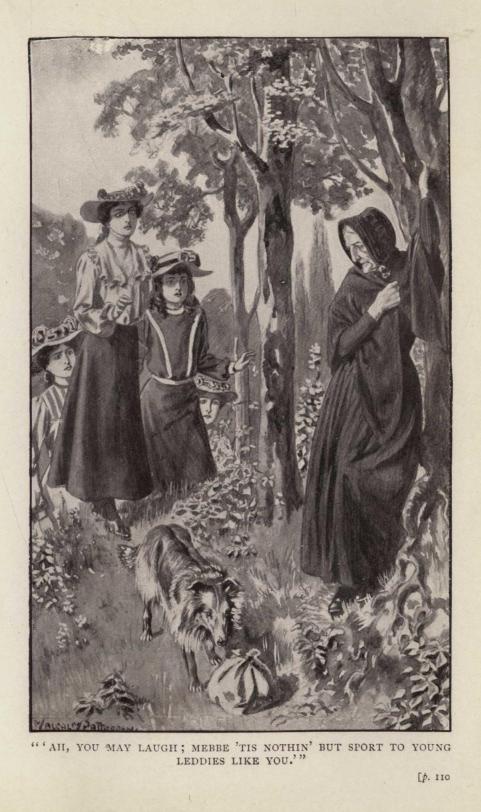
"'AH, YOU MAY LAUGH; MEBBE 'TIS NOTHIN' BUT SPORT TO YOUNG LEDDIES LIKE YOU.'"
"Poor old thing!" whispered Amethyst to Elsa; "see how she is shuddering still. I should have been afraid of Hero myself, if he had suddenly bounced upon me."
"Yes," was all Elsa said, and the next moment she had slipped up to the old woman, and with a pitiful look in her eyes had taken one of the knotted, wrinkled hands in her own, while she said gently: "We are very sorry, really we are. We wouldn't have let Hero frighten you for anything, if we had known you were here. But people hardly ever come along this path."
"Ah! little lady, you've got a kind heart, I can see," said the old granny, as she looked up into the bright, young face, which evinced real sympathy for her; "not like them two yonder, a-makin' sport o' an old body like me. They'll be rewarded one of these days, though."
She clutched her stick tightly and prepared to pick up her bundle; but Amethyst stooped for her and gave it to her with a smile.
"Thank you, my pretty dear. God bless you both for helpin' me. And now I'll get on a bit, if that there beast 'll let me." But even as she spoke, she tottered and would have fallen, but for a helping-hand from Elsa.
"'Tis the rheumatizzy, missy; it ketches me all of a heap like, nows and thens."
"Let us go a little way with her, Thistle," suggested Elsa, and Amethyst agreed readily, although their companions tried to persuade them not to go.
"Whereabouts are you going?" asked Elsa.
"To my darter's, missy; Joe Hodges' wife she be as lives over agin Disbrowe House."
"Oh! I know Mrs. Hodges, Elsa," cried Amethyst; "she comes to the mothers' meeting. Her husband works for Sir Tudor Disbrowe."
"So he do, missy, and they has a cottage on the estate, so they've a-told me. But I be a stranger to these parts, and I must have mistook my way a-crossin' the copse. I tried to foller the 'rections they gave me at the station, but I made sure I'd took a wrong turn just as that there animal a-bounced at me."
"It's more than a mile from here to Mrs. Hodges' cottage," said Amethyst, somewhat dubiously. She was not quite sure that her good nature was equal to traversing all that distance with the comical old woman.
"Can you walk so far as that, if we help you, do you think?" asked Elsa.
"Oh, my dear young lady," expostulated Granny Wood (as she was generally called), "I don't like to let you do it. I really don't."
"Oh, we don't mind, do we, Elsa?" said Amethyst, a little grandiloquently. "Just look after our baskets and books till we come back, you girls." This she called out to Monica and Olive, who had retreated to a little distance and were watching the proceedings with amusement and contempt.
"You won't find us here when you get back, you needn't fear," retorted Olive. "It's likely to be a lengthy affair! If you're both determined to go, you'd better take your things with you and meet us at the white gate in West Lane. What is the time now, Monica?"
"Two o'clock," replied the only owner of a watch among the quartette.
"Well, we'll meet you about three o'clock, and mind you are not late."
"All right," called back Amethyst, as the queer little party set off, the old woman supported by Elsa's strong, young arm on one side and her stick in her right hand, while Amethyst carried the handkerchief bundle.
"We shan't wait after half-past three, whatever happens," shouted Monica, "so if you're later than that, go straight to Carson Rise."
"Oh, we shall be there in time," returned Amethyst, and the trio disappeared round a turn in the pathway.
"What a fuss about nothing," said Olive, as the girls returned to their seat by the river, and Monica fastened Hero to the trunk of a tree.
"Yes, perfect twaddle I call it," returned her friend; "but there, if they like to do it, it doesn't matter to us." And she took up the book she had flung down in her hurry, and hunted about for her place. "Babyish sort of story this," she added, as she turned over the pages, "nothing at all exciting in it. How do you like yours, Olive?"
"Oh, pretty fair; it's rather childish, too, but mother is very particular about what we read; she won't let us girls look at a novel."
"Grandmother never troubles about what I read," said Monica. "I've got some jolly books at home, I'll show them to you after tea. I am reading one now that I wanted to bring out with me, but that little Amethyst's eyes are as sharp as needles, and she might have picked it up. I must lend it to you when I've done. It's an awfully jolly story called A Cruel Fate."
"It sounds nice," said Olive, "but if it's a novel, mother won't let me read it."
"Surely you don't have to show her everything you read?" cried Monica, and there was a suggestion of scorn in her tone, which touched a weak spot in Olive's nature; she could not bear being sneered at.
"Of course not," she replied hastily.
"Well, you shall have it later on."
And then the conversation dropped, and they went on reading.
Meanwhile, the progress that the old granny and and her two young companions made was very slow. The sudden, unexpected appearance of the big dog had really upset her, and she was very shaky and nervous still. By the time half a mile had been traversed, her feeble steps began to flag, and it was only by dint of resting very often, and leaning very heavily upon one or other of the girls, that at length the daughter's cottage was reached.
Elsa and Amethyst were by no means sorry when their task was over. They had not thought it would be such a tedious journey, and they were very glad when they had left the old woman safely ensconced in an armchair by Mrs. Hodges' fireside, while that worthy followed them to the gate, overwhelming them with thanks for their very great kindness to her old mother.
"I'm sure, miss, we never can thank you both enough," she repeated again and again, as she held the little green gate open for them to go through.
"Please don't say any more," replied Elsa, earnestly; "we were very glad to do what we could to help your mother."
And as the two girls hastened off, the words the grateful old woman had repeated reverently, as they bade her "good-bye," rang in Elsa's ears like a benediction: "Inasmuch as ye have done it unto the least of these ... ye have done it unto ME."
But Amethyst's thoughts were in quite another direction.
"It must be awfully late, Elsa," she said, as they hurried along the quiet road which skirted the copse, and which would bring them eventually to West Lane, where they had arranged to meet the others. "We were ages getting there."
"Yes, I suppose it is," replied Elsa, coming back to the present moment with a start; "why, now I remember it, the grandfather's clock in Mrs. Hodges' room was nearly three o'clock."
"Good gracious!" cried Amethyst. "I never noticed it; let's hope it was fast. But, anyhow, we shall have a business to reach the white gate in time;" and they quickened their footsteps into a run.
At length the trysting place was reached, and they were glad to find that they were the first on the spot.
"Now we can have a rest and get back our breath," said Amethyst, as they perched themselves on the white gate, and fanned their flushed faces with their straw hats. "Oh, I say, how hot and tired I am!"
"I do wish we knew what the time was," said Elsa, who looked rather worried.
"Yes, it's a great bother not having a watch, but I'm to have one next Christmas, so there's not very much longer to wait;" and Amethyst heaved a little sigh of satisfaction. Then she jumped off the gate and ran into the road, as she heard footsteps approaching, expecting it to be the other two girls, but it was only a nurse pushing a baby in a mail cart.
"Do you think she'd know the time, Elsa?" she said, as she ran back to the gate.
"You might ask her," replied the elder girl.
The next moment Amethyst returned with a look of incredulous horror on her little flushed face.
"It's actually four o'clock, Elsa! What shall we do?"
With a spring, Elsa was on the ground beside her, and the two girls gazed at each other in consternation.
"Why, they said they would not wait after half-past three, and they must have gone long before we came, and here we have been waiting ever so long for them. Oh, it is too bad!" cried Amethyst, nearly in tears.
"That clock must have been dreadfully slow," said Elsa. "Perhaps it was not even going. But cheer up, Thistle, we can get to Carson Rise in less than half an hour from here, and we shall be in time for tea. It wasn't our fault, dear; we couldn't help it, if we are late."
"I don't half like going by ourselves," said Amethyst, as they hurried along the hot, dusty road towards Mydenham; "you see, I've never been there yet."
"Oh! it will be all right," returned Elsa consolingly. "Mrs. Beauchamp is very kind, really, although Monica thinks she is strict. She will understand when we explain. I daresay the other two had only just left when we arrived."
CHAPTER IX.
"HAVE A RIDE, MONICA?"
"Oh, dear me!" yawned Monica, as she stretched herself lazily, and shut up her book. "I feel awfully sleepy."
"Have a snooze, then," returned Olive, who was deep in the intricacies of her story; "only just tell me the time first."
"Good gracious!" cried her friend, as she twisted her wristlet round, so as to see the hands of the watch it enclosed; "it's just upon three."
"How the time has flown," said Olive, shutting up her book somewhat reluctantly; "we must be going at once. I expect the other two are at the white gate already."
"Not they," ejaculated Monica, as she unfastened Hero, and put her book in her empty lunch basket. And when, five minutes later, they reached the appointed meeting-place, and no trace of the others was to be seen, she said: "I told you so."
"Well, I suppose we must wait about a bit for them," said Olive, "they can't be many minutes. Let's perch on the gate posts and read a bit." She had only a few pages left, and was anxious to see what became of her heroine. But Monica's story was ended, so she looked about her for some other amusement.
In less than a minute the gay chatter of girls sounded on the still, summer air, and Olive, looking up from her book, said: "There they are."
But Monica, who had gone to reconnoitre, said: "No, it's only some of the High School girls--Gipsy Monroe and her little sisters, with a bicycle."
"Hullo!" they said, as they came up, "what are you up to?"
"Waiting for Elsa Franklyn and Thistle Drury," was Monica's reply. "Seen anything of them?"
"No," replied the dark-haired, dark-eyed girl, rightly nicknamed "Gipsy," instead of the plainer appellation of Emily which she had been given. She was holding a younger girl on the bicycle, who jumped off as she brought it to a stand-still. "Have a ride, Monica?"
Now Monica knew that her grandmother had a great abhorrence of girls riding bicycles, and, indeed, she had expressly forbidden her granddaughter to attempt to mount one. But Monica, in this, as in most things, entirely disagreed with her grandmother, and felt with the boundless self-confidence of youth that her own opinion was far the best. So without a qualm of conscience, she readily accepted the offer.
"I can't balance myself a bit," she said, as she mounted the machine, while Gipsy held it steady. "I have tried once or twice, but I always wobble frightfully." And her movements proved she was right.
"Oh, I say, how heavy you are!" cried Gipsy, in dismay, as Monica and the bicycle rolled first one way and then the other. "Come and hold her up, Olive."
Things went better then, with two to steady the uncertain rider, and they had gone some little distance along the road, when the Monroe children, who were a little behind, called out: "Look out, here's a motor!" And in another second the car whizzed by them.
They never knew just how it happened; whether Monica overbalanced, or whether she steered purposely into the hedge, so as to avoid the motor, but the next instant the bicycle overturned, and Monica lay all huddled up underneath it.
"Oh! Monica, are you hurt?" cried both girls simultaneously, as they lifted up the bicycle, and stood it against the hedge. But Monica neither moved nor spoke.
"Oh, she's dead!" cried the younger children, as they looked at the inanimate form, lying so still on the dusty road.
"Nonsense!" said a loud, cheery voice beside them, and looking up, startled, the girls saw that the motor had been brought to a standstill not many yards off, and its occupant had come back to see what was the matter. "Not a bit of it! The lass has only twisted her foot a bit, by the look of it, and I expect she's either stunned or fainted. I'll lift her up," and suiting the action to the word, the stranger, whom the girls had recognised as Lily Howell's father, raised Monica gently in his strong arms.
The movement roused Monica, and she opened her eyes, saying with a shudder, "Oh, my foot, my foot!"
"Oh, Monica, Monica!" cried Olive, who was nearly beside herself with fright, and who was terrified when she thought of Mrs. Beauchamp.
"There, that'll do, missy!" interposed Mr. Howell, in his bluff, hearty voice; "just you let me carry her to the car there, and we'll have this foot attended to in a jiffy."
And in another moment Monica was half-lying, half-sitting in the car, supported by Mr. Howell and Olive, whom he had bade get up as well, when he understood they were together; the Monroes following on foot with the bicycle, which had been the innocent cause of the calamity.
"Drive on home, Cobb," said Mr. Howell to his chauffeur; while he added to Olive, "It's the nearest place, and we shall soon see how much damage is done."
"Oh, she's fainted again!" cried poor Olive, as Monica's head fell helplessly against the broad shoulder which was supporting it.
"By Jove! she has," ejaculated the man under his breath, and he noticed with relief that another minute would see them at his door.
It was the work of a very few moments to carry the injured girl into the house, and lay her gently on a huge couch, which was placed under an open window in one of the expensively furnished rooms. The next thing was to remove the shoe from the fast-swelling foot, to find Mrs. Howell, and send for the doctor.
"Franklyn is nearest," said the plutocrat to a smartly liveried footman, who waited for orders. "Get him to come at once, or if he's out, bring any one you can find."
"Oh, I hope father will come!" said Olive pitifully, as she rubbed Monica's cold hands and tried to rouse her.
"Are you one of Franklyn's girls, then?" asked Mr. Howell; "and who is this young lady?"
"Monica Beauchamp. Her grandmother lives at Carson Rise, Mydenham."
"Oh, I've heard of her from my girl," and Lily's father had a good look at the object of his child's envious dislike. "We'll send a message to her grandma as soon as the doctor's been."
The door opened, and Mrs. Howell appeared on the scene, followed by a maid bringing water, smelling-salts, and various other remedies. Her plain, homely face wore an expression of anxiety, and she had evidently hurried so much in response to her husband's imperative summons, that she was short of breath.
"Here, Caroline, you'll know best what to do," said Mr. Howell; "see if you can pull her round. I'll be on the look out for the doctor," and he left the room as he spoke.
"Bless me!" was all Mrs. Howell could find breath enough to say, but she busied herself with trying the various restoratives the elderly servant handed to her, and in a few moments Monica opened her eyes.
"Where am I?" she murmured, seeing strange faces bent over her, and Mrs. Howell nudged Olive to speak to her friend.
"You're at Mrs. Howell's, Monica; you hurt your foot, you know. But don't try to talk now. Father will be here directly." She spoke with a confidence she was far from feeling, for it was quite possible that Dr. Franklyn was some distance away.
A spasm of pain passed over Monica's white face. "Oh, my ankle, how it does hurt!" she said, as she tried to alter the position of the injured limb, but could not bear the agony the movement caused.
"Bathe it again, Martha," said Mrs. Howell, to the maid who was standing by. Then she stroked Monica's rumpled hair, kindly, but somewhat hesitatingly, while she murmured, "Poor dear."
The motherly woman would have liked to have said much more, to show this young stranger within her gates how sorry she was for her; but she had heard how haughty she was from Lily, and she was afraid of saying anything for fear of giving offence. For one thing she was very thankful: and that was that Lily had gone to some friends at a distance to spend the half-term holiday, so there was no fear of her turning up to make a fuss.
Every one breathed a sigh of relief when Dr. Franklyn was announced.
"Oh, father, I am glad you were in!" said Olive, as she caught impetuously at his arm.
"I hope you had no hand in this, Olive," he said, as he began, with professional touch, to examine the swollen ankle.
"No, father, no; indeed I didn't; it was no one's fault, but quite an accident," she assured him, so earnestly, that he was fain to believe that his careless, heedless child was not to blame in this instance.
"Well, well," he said, "it might have been much worse. There are no bones broken, but it is a nasty sprain; you won't do much walking for a little while, young lady." And he looked with compassion at the girl, who he knew was so full of energy.
"How long?" was all Monica's quivering lips could articulate. Her ankle was suffering so acutely from the doctor's handling, gentle as it had been, that it took all her courage to keep the tears back.
"Oh, two or three weeks, perhaps," was the reply, kindly but truthfully given. It was never his way to tell his patients half-truths, and buoy them up with hopes that had not a shadow of a chance of being realised. "It will all depend upon whether you obey orders or not, how soon it will get better."
At the word "obey," a pang of remorse seized Monica; how she had failed in obedience, and how bitterly she was suffering the penalty for a very little act of disobedience (as she thought) even now. A sob rose in her throat, but she gulped it down, and turned her face slightly away.
"Now, Olive, my child, if Mrs. Howell will excuse you, come home with me," said Dr. Franklyn, as, having done all he could to relieve the sprained ankle, he prepared to depart. "Mr. Howell has sent to Mrs. Beauchamp, and your friend will be able to go home in her grandmother's carriage when it arrives, and your mother will be anxious about you. By the way, I can't imagine where Elsa is," he added as they reached the hall door; and for the first time Olive remembered the other two girls.
"Oh, father, suppose they have been waiting all this time for us? What a dreadful afternoon this has been!" And she felt ready to cry.
"Cheer up, Olive," said her father kindly, pitying her unhappiness; "we'll send some one to the white gate in case they should be there; but I expect they gave you up long since, and we shall hear that they went on to Carson Rise as you arranged."
Meanwhile, how had Elsa and Amethyst been faring?
In spite of her reassuring words to Amethyst, Elsa felt a considerable amount of trepidation as she and her companion mounted the flight of wide, stone steps, and rang the bell at the front door of Mrs. Beauchamp's residence. She was mentally deciding what it would be best to say, when the door opened, and the trim parlourmaid appeared. Elsa had half hoped that Monica would have been on the look-out, and have opened the door herself, so as to make the late-comers feel more comfortable. So she was astounded when the maid replied, in answer to her diffident enquiry, that the other young ladies had not arrived yet.
Elsa and Amethyst looked askance at each other, one thought uppermost in both their minds. "Suppose they should be waiting for us at the white gate!"
"My mistress is rather put about to think Miss Monica should be so late coming back; would you please to walk in and explain, miss?" suggested the maid to Elsa, who seemed to be spokeswoman.
"Oh, yes, of course, we will tell all we know," said Elsa, and she and Amethyst silently followed the maid to the drawing-room, where Mrs. Beauchamp was sitting by one of the open French windows, which overlooked part of the prettily laid-out gardens.
"Well, my dear, how are you?" she said, as Elsa approached, and held out a timid hand; "and is this your little friend?" And the old lady looked approvingly at the pretty, childish face and simple attire of the vicar's little daughter. "But how is it you have arrived alone? Where are Monica and your sister?"
"Oh, Mrs. Beauchamp, we can't think what they are doing!" And Elsa told the whole story of what had occurred that afternoon, at least, as far as the present state of affairs was concerned; finishing up by saying, "We wouldn't have been so long, indeed we wouldn't, if we had known how late it was. I am almost sorry, now, that we went all the way with the old woman, but we thought it was right at the time." And Elsa's eyes filled with tears.
"You did quite right, children, no one could blame you," said Mrs. Beauchamp, more kindly than Monica ever heard her speak. "I am only sorry that my granddaughter did not wish to act as you did." And the old lady sighed as she thought of the difference between self-pleasing, self-willed Monica, and this nice-speaking, unselfish girl; and the advantage was all on Elsa's side. "The thing to be considered is, where are they now?"
"Do you think they might still be waiting for us?" queried Amethyst, who had been a silent spectator so far. "Shall we go back and see?"
Mrs. Beauchamp smiled. "I think we can manage better than that," she said. "I will send a messenger to the gate in West Lane, in case they should be there, and we will have some tea, for I am sure you must be thirsty after hurrying so, on this hot day. I quite expect that before very long they will come rushing in."
The two girls were very glad to wash their hands and smooth their dishevelled hair; and Amethyst was delighted to see Monica's room (where Barnes had taken them) for the first time.
Then they went into the dining-room, where a sumptuous repast had been spread for the quartette, Mrs. Beauchamp knowing something, from experience, of young people's appetites. If it had not been for the suspense about the other girls, Elsa and Amethyst would have enjoyed themselves immensely.
Mrs. Beauchamp was so very kind, and made herself quite agreeable to these two well-behaved girls; indeed Amethyst, who was light-hearted by nature, almost forgot the unfortunate ending to their picnic, but Elsa was unable to banish the thought from her mind that something must have happened to them to cause such delay, and she could see that Mrs. Beauchamp was very much worried, although she strove to entertain her little guests cheerfully.
"You are not making much of a tea, my dear. Try one of these," and Mrs. Beauchamp held a plate of delicious looking macaroons toward Elsa.
"No, thank you, I don't feel as if I could eat another mouthful." And Elsa's tears, which had been very near the surface for some time, rained down her cheeks, while a sob choked her voice.
"Don't fret, my dear," said Mrs. Beauchamp, soothingly, albeit her own voice shook.
"I am so afraid something has happened," sobbed Elsa, and she hid her face in her hands.
"Let us hope not; they may have been hindered in some way," replied Mrs. Beauchamp; but even as she spoke, a maid entered the room with an expression of alarm on her face.
"If you please, ma'am----" she began.
"What is it, Harriet? Tell me at once?" And Mrs. Beauchamp clutched the back of her chair for support, while her face assumed an ashen hue, and poor Elsa felt inclined to scream.
"A man's come from Osmington, from Mr. Howell's place, ma'am, to say as there's been an accident, ma'am, and Miss Monica's leg is hurt. It were something to do with one of these motors, ma'am, but he says he was told to say it weren't by no means serious."
A tinge of colour came into Mrs. Beauchamp's cheeks, as the servant reached the end of her sentence; she had dreaded she knew not what.
"Is the man here, Harriet? Have him taken to the morning-room, and I will see him," she faltered.
"Oh! please may we hear too?" asked Elsa, with quivering lips.
And the old lady, reading the alarm in the girl's tense young face, said: "Of course, my dear."
By dint of much questioning they got some idea of what had occurred; and, relieved to a certain extent by having definite news of her grandchild, Mrs. Beauchamp made speedy arrangements for her conveyance home.
In a very few minutes the brougham was at the door, and into it stepped Mrs. Beauchamp and the two girls, followed by the reliable Barnes, who was always to be depended upon in an emergency.
Elsa and Amethyst would dearly have liked to go as far as the Howells', so as to know exactly how Monica was, but when Mrs. Beauchamp ordered the coachman to put them down at Dr. Franklyn's, on his way through the town, they did not dare to make the suggestion.
CHAPTER X.
"I LIKE FUSSIN' OVER PEOPLE!"
With a sigh of relief Monica heard the front door shut, and saw the retreating figures of the doctor and Olive passing down the drive, from her post of vantage in the great bay window. She wanted to think; at least, she was not sure that she wanted to, but ideas suggested themselves to her brain and insisted upon being thought out.
How could she, who never before had been actually laid up with any ailment, endure the thought of being for three weeks, at least, chained like a log to a sofa? And, just as likely as not, it would end in being a month, or even more. Oh, it was unendurable! No school--no fun--no daily meeting with all the girls, and Olive, of course, in particular: and Monica realised how wonderfully attached she had become to school-life and doings, even in seven short weeks. No pleasant German lessons with kind little Fräulein Wespe, which she so much enjoyed. Nothing but day after day in one or other of the dull, lonely rooms at Carson Rise, waited on by Barnes, and visited periodically by her grandmother, who she was sure, from experience, would gladly seize every available opportunity of improving the occasion by telling her she had only herself to thank for the position in which she found herself!
How heartily Monica wished now that she had never seen the wretched bicycle, as she styled it, much less have been persuaded into attempting to ride it. In her vexation she blamed the bicycle, its owner, Elsa and Amethyst for being late, and even poor, unfortunate old Granny Wood, for being the primary cause of the mishap. It is a wonder that she did not go one step farther, and credit Hero with originating the whole chapter of accidents, for it certainly was his bark that started the ball rolling. If Monica had heard any one else saying what she was thinking, she would have been exceedingly amused, for it sounded like a modern version of the "House that Jack built." But she saw no fun in anything just then, all was disappointment, discomfort, and pain; and yet in her heart of hearts, Monica knew that it all arose from disobedience.
Not for worlds would she have owned it even to herself, but as she lay on that couch, looking out into the sunlit garden and thinking, her better nature craved after a nobler, higher life, where disobedience and its results would have no place. She thought of her father and his words to her in that almost forgotten letter, and unwonted tears rose to her eyes, as she realised that instead of becoming what he wanted her to be, she seemed lately to have grown less and less like the ideal she had even set up for herself in those days.
Monica's ruminations were brought to an abrupt termination at this moment by the door opening, and a pleasant rattle of teacups sounded on her ears as the footman appeared with the tea equipage. Mrs. Howell followed him in, and busied herself in pouring out a cup of the fragrant beverage, and placing it on a little table at Monica's elbow, saying in her uncultured but kindly tones: "There's nothin' so comfortin' as a cup of tea, to my mind; have a good drink, do 'ee now, my----"
The good soul paused, in confusion, at the words which had so nearly slipped out. What would this haughty young maiden have said if she had called her "my dear?" So she made a nervous little cough, and added, in an apologetic voice, "Miss Beauchamp."
"Thanks, you're very kind," replied Monica, in her off-hand way. "I'm sure I'm awfully sorry to give you such a lot of trouble."
"It's no trouble at all, my dear," said her hostess warmly, quite forgetting to watch her words this time; but Monica did not appear to mind the appellation, it seemed natural to be called "my dear" by a person of Mrs. Howell's description. "I like fussin' over people." And the good woman looked a wee bit wistful, for Lily hated above all things to be "fussed over by ma."
"I don't think I should care about it always," said Monica candidly, with a little laugh; "but just now it feels rather nice to be waited on," and she smiled up into the homely face, surmounted by the magnificent, but too lavishly trimmed cap, which was bending over her.
Mrs. Howell's heart went out to this girl, who seemed so different from what Lily had declared her to be; and Monica, realising the motherliness which underlay all the oddities and vulgarities, felt strangely drawn towards her commonplace hostess. They were becoming quite at home with each other, when carriage wheels were heard, and "Mrs. Beauchamp" was announced.
A hasty glance at the visitor's aristocratic appearance, and the sound of her well-modulated voice, made poor Mrs. Howell realise her many deficiencies once again, and she relapsed into monosyllabic replies to Mrs. Beauchamp's many enquiries. So Monica had perforce to be chief spokeswoman.
"Well, I am glad that it is no worse than it is," said her grandmother stiffly. "The anxiety your non-appearance caused me was intense; and all this trouble and inconvenience to everybody would have been avoided, if you had not disobeyed my commands." And she shook her head severely at the culprit, who showed no sign of contrition for her misdeeds. "Well, you will have plenty of time to reflect, so we will say no more now," added the old lady, "but with Mrs. Howell's permission Barnes shall help you out to the carriage, and we will not trespass further on her kindness."
"Oh, I can hobble out by myself, somehow," said Monica, and she tried to get up off the couch, but fell back among the cushions with a stifled groan.
"Let me help you, my dear," whispered Mrs. Howell, so low that no one but Monica heard her, and with a supreme effort the girl managed just to stand, by holding tight to the velvet-covered arm which was offered for her to lean on. But to walk was absolutely impossible, the mere movement of the injured ankle (the pain had been tolerably easy while it had been laid up) was so excruciating, that even strong-willed Monica could not summon up courage to put it to the ground.
"I'm afraid I can't walk," she was obliged to confess, with white, quivering lips, just as Mr. Howell appeared upon the scene.
"How now, young lady?" he said, in his bluff way; "not trying to walk, surely? You don't look any too fit."
"Couldn't me an' you help her out to the carriage, Bob?" his wife said, in a somewhat loud aside. "Her grandma wants to be off."
"If the young lady will allow me, I think the best plan will be for me to pick her up and carry her out," he said, with a grandiloquent bow.
"Really, I cannot----" began Mrs. Beauchamp, in horrified tones.
And Monica said: "Oh! no, please."
But without more ado, the big burly man lifted her gently in his strong arms, saying, with a twinkle of amusement in his eyes: "It won't be the first time to-day, missy," and before Mrs. Beauchamp had had time to summon Barnes, Monica was comfortably settled in the brougham, with her injured ankle resting on a board, and some cushions, which Barnes' forethought had provided.
"Thank you ever so much, Mr. Howell," said Monica gratefully, "and Mrs. Howell too."
"Tut, tut, missy! T'was a pleasure to her to have some one to coddle."
"I should like to come and see her some day, when my ankle is well again, if I may."
"She'd be very glad if you would," was Mr. Howell's reply, as he handed Mrs. Beauchamp into the carriage, and shut the door after Barnes had squeezed herself into the tiny bit of space that was left.
"I am sure we are very much indebted to you for all your kindness," said Mrs. Beauchamp, in her freezingly polite way, as he stood, hat in hand, waiting to see the carriage off.
"Pray don't mention it, madam," was all he said, as he bowed in response to her formal "good evening"; the smile that overspread his rugged, good-tempered face was for the girl who nodded a bright farewell, albeit her face was white and drawn with pain.
"A noble lass, that," was Mr. Howell's comment, as he sauntered round the beautifully laid-out garden with his worthy spouse; "but a vixen of a grandmother, to judge from looks."
Mrs. Howell, who had not been very prepossessed herself, felt it her duty to remonstrate with him for judging hastily.
"The gentry always has such airs," she said; "I daresay the old lady means well enough. But I must say I did take to the girl."
"And she to you, apparently." And her husband repeated what Monica had said about coming again.
"Bless her!" ejaculated warm-hearted Mrs. Howell; and then she added wistfully, "I wish, Bob----"
"What, old girl?"
"That our Lily was a bit more like her."
"Tut, tut!" he said. "This Miss Beauchamp is a lady, born and bred; and our girl ain't got a drop of blue blood in her veins."
"Our Lily don't seem to have got no heart, somehow," sighed her mother. "She's all for clothes, an' pleasure, an' pleasin' herself."
"It's the brass that's to blame for that," said the man who had amassed a fortune of over a quarter of a million. "I'm almost sorry I had such a streak of luck. We were happier in the old days, Caroline, when we lived in the little house at Bermondsey, and went out marketing together Saturday nights, guess the old proverb that 'money's the root of all evil' is about right. It's all very well, but it don't buy happiness."
"That ain't a proverb, Bob," said his wife, reprovingly, "it's in the Bible, and it says it's the love of money that makes all the mischief. I sometimes think, Bob," she added, a trifle hesitatingly, for she was treading on tender ground, "that if we were a bit religious, we should be happier like."
"Time enough for religion when you get notice to quit," he replied with a hard laugh, which had no mirth in it. "'Do as you would be done by' is a good enough creed for me; and if everybody acted up to it the world would be a better place than it is, with all its parsons and church-going."
"That ain't enough to take you to heaven, Bob," said Mrs. Howell, sadly, but as she knew no better way to suggest she said no more, and the subject dropped. But in the plain, homely woman's breast there was a deep, unsatisfied longing after a peace which she had never found, amid all the luxuries and splendour of her surroundings.
While the above conversation was taking place, and Monica was being driven slowly home, the story of that disastrous day was being eagerly detailed by the other three girls at the Franklyns', whither Amethyst had accompanied Elsa, and where to her great delight she found her mother sitting with Mrs. Franklyn.
Fortunately for the invalid, no rumour of the accident had reached her room, Mr. Howell's messenger having met the doctor after he had left home a few minutes; so that she and Mrs. Drury had been enjoying a little confidential chat about their children over a cup of tea; never dreaming but that they were all having a splendid time at Carson Rise, until Olive, who was followed by the other two girls before there had been time to become anxious about them, told how differently they had been placed.
Olive and Amethyst both talked together, and there was such a confused jargon going on, that for some time neither of the ladies could get a very clear idea of what had happened; but eventually Elsa was appealed to for her version of the affair, and then they understood better.
"Dear me, I am sorry for Monica," said Mrs. Drury sympathetically; "it will be a long business, I am afraid."
"Poor child!" murmured the invalid; "how will she bear it?"
"It's awfully hard lines on her," cried Olive vehemently, "shut up in that great, dull house for weeks. And I shall miss her just dreadfully."
"I'm glad it isn't me," said Amethyst; "not that I should mind being laid up if mumsie nursed me," with an affectionate press of her mother's hand, at whose feet she had thrown herself. "But you get so low in class if you are away from school long."
"There are lessons to be learnt on a sofa, my child, that are more important than all the school ones," said the invalid gently; "and by learning them properly a higher place can be gained than any that the High School can bestow."
"I don't think I understand, Mrs. Franklyn," said Amethyst, in a puzzled tone, while Elsa crept nearer to her mother, and kissed her thin, white hand, a little comprehensive smile flickering about her mouth. Olive looked on, a trifle superciliously; if it had not been for Mrs. Drury's presence, she would have said: "For goodness' sake, don't preach, mamma!"
"I mean the lessons in God's school, dearie, the difficult things we are so slow to learn. It is only when 'He teaches us of His ways' that we can 'walk in His paths.' I was thinking perhaps God had allowed this accident to happen to Monica, so that she might have time to think of these things."
"Monica is good enough as she is," cried Olive tempestuously; "we don't all want to be goody-goodies like some people I know. There would never be a bit of fun left then." And she stood up defiantly.
With a significant glance at Mrs. Franklyn, whose pale face wore a grieved, sad expression, Mrs. Drury took the matter into her own hands.
"I am sorry, Olive, that you should feel like that," she said calmly, while she looked searchingly into the defiant face of the young girl, who was picking a tea-rose to pieces with thoughtless fingers. "But it is a good thing, sometimes, to say what one feels. You must have been unfortunate in your acquaintance with Christians if you find them dull and gloomy. They are not all so, I can assure you. Indeed there is no one so light-hearted, no life so sunshiny, as that of a true follower of the Lord Jesus Christ. It is just because we are so happy with Him as our Friend, as well as Teacher, that we want all those whom we know, and love, to become learners in His school. For we remember that the Examination Day is coming, and unless we have Him as our helper, we shall certainly 'fail,' instead of 'pass.' You know yourself from school experience that there are only the two positions to be in; and it rests with each one of us to decide, now, which state shall be ours hereafter."
As Mrs. Drury ended her sentence, she lowered her voice, until it was scarcely more than a whisper, but the silence which had fallen upon the little group was so intense that every word was distinctly audible. Amethyst looked up into her mother's face, and said, with real earnestness: "I do want to pass that examination, mumsie," and Mrs. Drury bent down and kissed the upturned face with clinging tenderness, for she knew that her little daughter's real desire was to please her Saviour, although she very often failed to do so.
But just at that moment her heart went out with a great longing towards that other mother's girl, who seemed so unwilling to put first things first. Her eyes sought Olive's, so that she might, if possible, read in them something of her thoughts, but Olive kept her head persistently turned away, and so she could not gauge what was passing in her mind.
So, with a prayer in her heart (oft repeated as time passed) that God would show Olive her need of a Saviour, she bade the invalid a tender farewell, with a whispered word of hope, and after good-byes had been exchanged, Mrs. Drury and Amethyst took their departure.
The little girl chattered volubly of all the incidents of the afternoon, as they walked home in the pleasant coolness which had succeeded the heat of that June day, but Mrs. Drury was a trifle abstracted. She was thinking of the friend she had left, who appeared to her to be losing, rather than gaining strength, of the sorrow that the indecision of some of her children, with regard to spiritual things, caused the patient invalid. For a moment, a subtle temptation presented itself: why did not a gracious Father answer His children's prayers for their loved ones more speedily. But she thrust the thought from her, knowing well that God both could, and would, do all things well, in His own good time.
"Father will be astonished when we tell him, won't he?" piped Amethyst, in her childish treble, and Mrs. Drury's eyes lost their far-away look as she smiled into the animated little face, which only reached to her shoulder.
"Yes, very," she replied, "but you won't see him to-night, dearie, for he has gone to a big meeting at Alwinton and he will not be home until quite late."
"Oh!" Amethyst's face fell somewhat; she rather liked telling her own news, and the events of that day had been quite exciting ones to her. "Well, you will have to tell him then, mumsie, I suppose. But couldn't you only say just enough, and leave the rest for me to tell at breakfast?"
And her mother promised she would.
CHAPTER XI.
"A NICE ENOUGH LITTLE DOG, AS DOGS GO."
"Is there anything else you're wanting, Miss Monica?"
And Mary Ann, who had been for the last half-hour engaged in arranging everything for the comfort and convenience of her young mistress, paused as she reached the door of the apartment, half-schoolroom, half-boudoir, which Monica called her "prison-house," and looked towards the occupant of a low couch that had been drawn up to the open window.
"Oh, yes, you might put those books where I can reach them," and Monica indicated a pile of library books which were lying on a low bookcase in a corner of the room. The maid obeyed, and placed them on a table by Monica's side, on which she kept the various things with which she vainly endeavoured to while away the tedium of the long, long days.
"Are you sure there's nothing else, miss?"
"I don't think there is, thanks." And the housemaid was just departing, when she was recalled by the sound of her name.
"Oh, Mary Ann!"
"Yes, miss?"
"Which is your evening out?"
"Fridays, Miss Monica," said the girl, astonishment expressed in both face and voice. Whatever could be coming to their young lady? Never before had she taken the slightest interest in the outings of her grandmother's domestics!
"Let me see, to-day is Friday," mused Monica, "could you do an errand for me while you are out this evening, Mary Ann?"
"Well, miss, it all depends," replied the under-housemaid, cautiously. "Where would it be, miss?"
"Oh, it's only to take back these books and get me some fresh ones from Bell's Library," said Monica. "Are you fond of reading, Mary Ann?"
"La, yes, miss," admitted the girl with a giggle. "Cook says I get right down wropt up in my book, and they have to shake me sometimes, when I'm sittin' readin' in the kitchen of a evening, for I never 'ears no one a-speakin' when I'm deep in my story."
"Well, I daresay I could lend you a book, now and again," said Monica graciously. "And you think you could go to Bell's this evening?"
"Why, yes, Miss Monica, I'll go with pleasure," said the girl, delighted at the prospect of the loan of some books. "Me and Jim (that's my young man, miss," she explained with a simper and a blush) "we generally strolls down High Street, and I can easy pop in and get 'em."
"Well, here is a list of half a dozen," said Monica, handing her a paper. "Ask them to give you any three that are in, and tell them who they're for."
"Very good, Miss Monica," and Mary Ann finally departed.
Left to herself, Monica began to wonder how she should pass the weary hours of that hot June day.
"I wish Olive hadn't been yesterday, now," she mused; "because there is not the faintest chance of her coming over again to-day; she said she would come to-morrow if she could. Oh, dear! I do think some of the girls might come. I'd rather have Elsa, or even that little Amethyst Drury, than nothing but my own company all day long. I do wish I could have a dog, it would not be so sickeningly dull then." And she heaved a weary sigh of discontent. "What a nuisance this horrid sprain is! You simply can't do anything but read, when you can't move your leg, and I hate needlework. I'm glad I thought of getting Mary Ann to go for some fresh books. Heigho! I wish I hadn't hurried so over the last one yesterday, I should have had some left to read now, but it was so fascinating I couldn't leave off once I began."
At that moment a footfall was heard on the richly carpeted stairway, and Mrs. Beauchamp opened the door. Monica looked up in astonishment; it was quite an hour earlier than her grandmother usually paid her morning visit.
"Good morning, Monica," she said, as she bent and just touched the girl's forehead with cold, undemonstrative lips, "I hope your ankle is going on well."
"Oh, I suppose it is, but I wish it had never been ill," replied Monica with grim humour. "I'm sick of lying here."
"You have only yourself to blame," was the old lady's unconsoling reply; "if you had not been disobedient, all this would have been avoided." And she waved her slender white hand expressively towards Monica's injured limb.
With a pout, Monica looked out of the window, muttering something about "the same old tale."
Her grandmother, who was slightly deaf, did not catch the words, but she saw the gesture, and drew her own conclusions. With a sigh, Mrs. Beauchamp wished, for the hundredth time, that she had never undertaken the charge of this troublesome granddaughter; her coming into the prim household had made an end of all its restful quiet, and she never seemed free from anxiety about her. And yet--Conrad had intreated her so earnestly to have his only and much-loved child, and at the time she had seemed tractable enough. But oh! how greatly Monica had altered in eighteen short months; perhaps she had had mistaken ideas about her upbringing; perhaps, if she had been a little less strict in minor matters, things might have gone more smoothly; perhaps old Dr. Marley was right when he said: "It is easier to lead than to drive young people."
With these thoughts in her mind, the old lady made a proposition that nearly took Monica's breath away; so unexpected was it.
"I have been thinking that perhaps you might have a small dog of some kind, Monica; it would be company for you while you are laid up."
"Oh, grandmother!" was all the girl could find to say; but the look of intense pleasure which irradiated her whole face, entirely transforming it, was sufficient reward to Mrs. Beauchamp for the very real concession she was making; for, of all things, a mischievous, gambolling dog indoors, who would be sure to bark or whine just when she was having a little nap, was one that she objected to most.
"Of course, it must be a very nice quiet one, Monica, small and well-trained. Perhaps Richards might hear of one somewhere."
"Oh! grandmother, do you remember that day you decided I was to go to school?" Monica questioned, eagerly; "because Tom had just been telling me about a jolly little wire-haired terrier his father wanted a home for, when you sent for me."
"I do remember something of the sort, Monica," said the old lady, "but even if the dog were still to be had, it might not be just what we want."
"Well, I do wish you would send round to the stables and ask, grandmother," said Monica, coaxingly "because we could have him at once, I expect. We might have to wait ever so long before Richards came across one, he is so dreadfully slow. And it is so dull up here, all alone."
"Well, I will see what can be done."
And the old lady departed, a comfortable feeling of having given pleasure warming her cold, reserved heart; while Monica reiterated again and again, in words which jarred terribly on her aristocratic nerves: "It's most awfully kind of you, grandmother! It will be jolly to have a dog of my own."
To say that Monica waited patiently for results would be untrue. She was far too excited and eager about the matter to do that; but as she was alone, except for a flying visit from Barnes, who brought her some lunch, and as she could not move her leg, her impatience had a salutary amount of check. She could not think how it was her grandmother had ever brought her mind to think of such a thing, knowing well how keenly she objected to animals indoors; it puzzled her a good deal, especially after her disobedience earlier in the week. And Monica grew quite repentant for her misdeeds, as she considered the unexpected favour she was being granted.