Introductory material
Reading edition
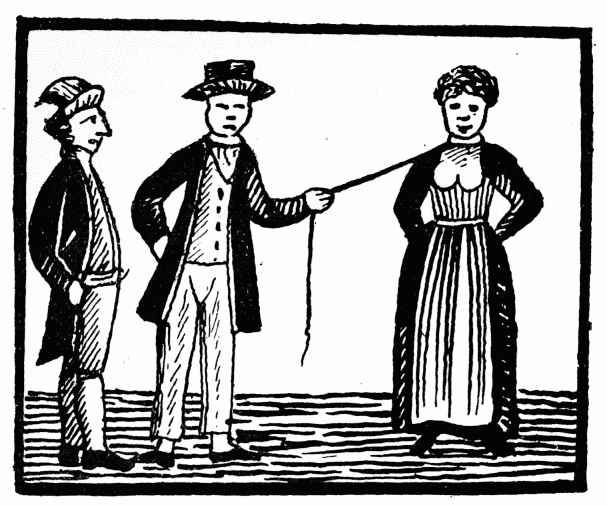
SALE OF A WIFE.
Whenever a foreigner used to write that Englishmen sold their wives in open market, with halters round their necks, they were not believed in England; but it was nevertheless a fact, and even as lately as last year a man sold his wife. In two of my books (“Old Times” and “The Dawn of the Nineteenth Century”) I have given numerous instances. The halter round the neck was used when the wife was sold at market, it being considered that, being thus accoutred, she was on a level with the cattle, and thus could legally be sold.
Attend to my ditty, you frolicsome folk, I’ll tell you a story—a comical joke; ’Tis a positive fact, what I’m going to unfold, Concerning a woman, who by auction was sold.
Chorus.
Then long may he flourish, and prosper through life, The Sailor that purchased the Carpenter’s wife. A carpenter lived not a mile off from here, Being a little, or rather too, fond of his beer; Being hard up for brass—it is true, on my life, For ten shillings, by auction, he sold off his wife. The husband and wife they could never agree, For he was too fond of going out on the spree; They settled the matter, without more delay, So, tied in a halter, he took her away. He sent round the bellman announcing the sale, All in the hay-market, and that without fail; The auctioneer came, with his hammer, so smart, And the Carpenter’s wife stood up in a Cart. Now she was put up without grumble or frown, The first bid was a tailor, that bid half a crown; Says he, I will make her a lady so spruce, And fatten her well upon Cabbage and goose.[2] Five and sixpence three farthings, a butcher then said, Six and ten said a barber, with his curly head; Then up jump’d a cobbler, said he, in three cracks, I’ll give you nine shillings, and two balls of wax. Just look at her beauty, the auctioneer cries, She’s mighty good-tempered, and sober likewise; Damme, said a sailor, she’s three out of four, Ten shillings I bid for her, not a screw more. Thank you, sir, thank you, said the bold auctioneer, Going for ten—is there nobody here Will bid any more? Is not this a bad job? Going! Going! I say—she is gone for ten bob. The hammer was struck—that concluded the sale, The sailor he paid down the brass on the nail; He shook hands with Betsy, and gave her a smack, And she jump’d straddle-legs on to his back. The people all relished the joke, it appears, And gave the young Sailor three hearty good cheers; He never cried stop, with his darling so sweet, Until he was landed in Denison Street. They sent for a fiddler, and piper to play, They danced and they sung, untill the break of day, Then Jack to his hammock with Betsy did go, While the fiddler and the piper played “Rosin, the beau.” * * * * * *
Wives at the market did not fetch good prices; the highest I know of, is recorded in The Times, September 19, 1797: “An hostler’s wife, in the country, lately fetched twenty-five guineas.” But this was extravagance, as, with the exception of a man who exchanged his wife for an ox, which he sold for six guineas, the next highest quotation is three and a half guineas; but this rapidly dwindled down to shillings, and even pence. In 1881, a wife was sold at Sheffield for a quart of beer; in 1862, another was purchased at Selby Market Cross for a pint; and the South Wales Daily News, May 2, 1882, tells us that one was parted with for a glass of ale. Sometimes they were unsaleable, as we learn by the following ballad:—
JOHN HOBBS.
A jolly shoemaker, John Hobbs, John Hobbs; A jolly shoemaker, John Hobbs! He married Jane Carter, No damsel look’d smarter; But he caught a tartar, John Hobbs, John Hobbs; Yes, he caught a tartar, John Hobbs. He tied a rope to her, John Hobbs, John Hobbs; He tied a rope to her, John Hobbs! To ’scape from hot water, To Smithfield he brought her; But nobody bought her, Jane Hobbs, Jane Hobbs, They all were afraid of Jane Hobbs. Oh, who’ll buy a wife? says Hobbs, John Hobbs; A sweet pretty wife, says Hobbs. But, somehow, they tell us The wife-dealing fellows Were all of them sellers, John Hobbs, John Hobbs. And none of them wanted Jane Hobbs. The rope it was ready, John Hobbs, John Hobbs. Come, give me the rope, says Hobbs; I won’t stand to wrangle, Myself I will strangle, And hang dingle dangle, John Hobbs, John Hobbs; He hung dingle dangle, John Hobbs. But down his wife cut him, John Hobbs, John Hobbs; But down his wife cut him, John Hobbs; With a few hubble-bubbles, They settled their troubles, Like most married couples, John Hobbs, John Hobbs, Oh, happy shoemaker, John Hobbs!
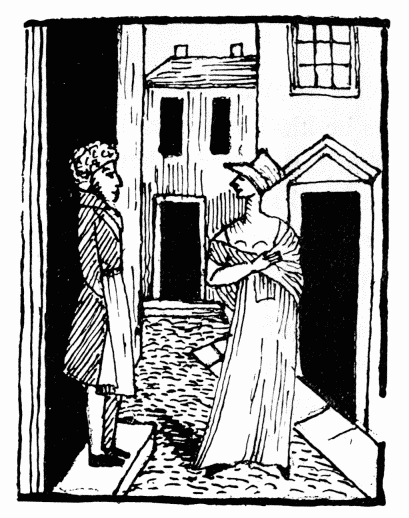
A WOMAN NEVER KNOWS WHEN HER DAY’S WORK’S DONE.
Now just attend to me, Married men of all degree, While I tell you the vicissitudes of life, There’s nothing, understand, Half so pleasing to a man, As a good temper’d, kind, and loving wife. She is always at her work, Tho’ sometimes used like a Turk; Here and everywhere compelled she has to run; While a man can banish care, Drown sorrow and dull care, A woman never knows when her day’s work’s done.
Chorus.
Then just attend to me, To your wives be kind and free, And never mind the clatter of her tongue, If you the truth will speak, You know the live-long week, A woman never knows when her day’s work’s done. That man must be a fool, Who will strive his wife to rule, Or drive her, like an elephant, about, You will find ’ere you begin, You may knock nine devils in, But never can you knock one devil out. We nothing ought to hear, But “my darling” and “my dear,” And to please his wife a man should miles run, Her all indulgence give, Then happy will he live, For a woman never knows when her day’s work’s done. Every married man should know They now have made a law, That if any man should dare ill-use his wife, Six months he will bewail In a dark and dismal jail, With heavy irons on him day and night. Men, be advised by me, Use the women tenderly, And to please her you must always cheerful run, For you all must know full well, If the truth you will but tell, That a woman never knows when her day’s work’s done. Married women take advice, Get you every thing that’s nice, A little drop of brandy, rum, or gin, And if your husband should complain, Give the compliment again, And whack him with the wooden rolling-pin. When some women well behaves, They’re oft used worse than slaves, And must not dare to use their pretty tongue, Let the world say what it will, I will say, and prove it still, That a woman never knows when her day’s work’s done. They must wash and iron on, They must mangle, starch, and blue, They must get your victuals ready in a crack, They must get you tea and toast, They must frizzle, fry, and roast, And wash the dirty shirt upon your back. They must clean the quilt and rugs, They must hunt the fleas and bugs, They must nurse your little daughter and your son, And, like a poor goose, Get nothing but abuse, A woman never knows when her day’s work’s done.
Chorus.
Men, to your wives be kind, Thus pleasure you will find, And happy through the world you will run, You must surely tell a lie, If this statement you deny, A woman never knows when her day’s work’s done.
THE TREATS OF LONDON.[3]
Good folks I will try at a song, So I hope you will make no wry faces, Believe me, I’ll not keep you long, With my budget of public places: To what I’m about to rehearse, If you’ll but please to attend, You will learn from my play-bill in verse, Where to go, if you’ve money to spend. Covent Garden Garden of O.P.[4] renown, The contest you all may remember; Old Drury that was burnt down, And Bartlemy Fair in September. With the Tower of London so grand, Where a huge pocket-pistol you see, And Salmon’s Wax Work in the Strand, With the Sans Pareil after your tea. There’s the Opera House at the West, A Chalk Farm and a famous Jew’s Harp, Where, pay well, you may feed on the best, Then walk in the Regency Park. A Lord’s Cricket Ground that is new, With a Tottenham Playhouse so gay, Hyde Park and the Serpentine too, For Men Milliners on a Sunday. There’s Wigley’s promenade too, I ween, And Bond Street parade in addition, With Kensington Gardens when clean, And the Somerset House Exhibition. There’s the Wells, and Grimaldi so rum, Sirs, With Westminster Abbey to range, A walk in the Temple for Lawyers, And “All alive in Exeter ’Change.” The British Museum’s a treat, Vauxhall with its fireworks pretty, Where belles and their sparks you will meet, And “the Royalty” too, in the City. A Surrey Theatre there’s too, Sirs, Where the bow-wow performers so grand, Played with eclat, and where you may view, The fine bridge ’twixt Bankside and the Strand. A forum there is for debate, A Fives Court for milling in fun, Sirs, A Parliament House for the great, With a cock-pit for cruelty’s sport, Sirs, With balls, concerts, and masquerades, And spouting rooms, too, half a score, With prime song-clubs in the “Shades,” Knock ’em down with a Bravo! Encore! Gas lights too flare in your eyes, Indian Jugglers deceive in Pall Mall, Guildhall for a lottery prize, Astley’s horses, too, still bear the bell. The Monument, too, a tall post, And also, without any raillery, The Londoners’ principal boast, St. Paul’s and its Whispering Gallery.
THE INCOME TAX.
Oh! poor old Johnny Bull has his Cup of sorrow full, And what with underfeeding him, and leeching him, and bleeding him, Though over-drained before, he must lose a little more, He’ll now be bled again by the Income Tax. And Peel[5] the state physician, has studied his condition, And daily, and hourly his own brain racks, He’s come to the conclusion, that John Bull’s constitution Is only to be saved by the Income tax.
Chorus.
Sevenpence in the pound, is the sum that must be found, Useless is our grumbling, our grizzling, or mumbling, Still, had we to our aid, our former roaring trade, We’d laugh at Bobby Peel and his Income Tax. The manufacturers say that they ought not to pay, Assert ’tis not a fib, but they really can’t contribute. The manufacturing bands are discharging all their hands, ’Tis the farmers that should, and ought to pay the Income Tax. The farmers all declare, that for them to pay be’ant fair, The cesses, rates, and tithes nearly breaks their backs. While all the parsons say, their business is to pray, So, pray, why should they pay the Income Tax? The Lawyers all declare it really is unfair, The Law’s great alteration has brought them ruination, And if they make compliance, they all must rob their Clients, By swelling Bills of Costs for the Income Tax. The Doctors, full of ills, must increase their price of pills, They are already ruined by Infirmaries and Quacks, So they’ll all adopt Peel’s plan, of bleeding all they can, Their patients, (when they get ’em) for the Income Tax. The shopkeeper, once gay, who kept his one horse shay, To drive out on a Sunday, and sometimes on a Monday, Must now his shay put down, and stick to trade and town, Because he must so pay to the Income Tax. His daughters and his wife, obliged to hear his strife, Stay at home and snivel, and in snarls go snacks, Their bonnets—those old blue ones—instead of having new ones, Are turned—and ’tis all through the Income Tax. Those folk of middling rank, who have money in the Bank, And make by pocket’s clearance, a respectable appearance, And managing complete, to just make both ends meet, Must cut a bit off one end for the Income Tax. Oh, then, without a doubt, was their washing all put out, Now, laundresses are ruined—and these are facts— For, wherever you may roam, all the washing’s done at home, So our wives are always cross through the Income Tax. The Bishops, rich and great, and the Ministers of State, The gayest, the demurest, the Placeman, Sinecurist, And grumblers, or not, they must all pay their shot, In their rota, as their quota, of the Income Tax. And, as a tip-top sample, our Queen’s a high example, Her Majesty,[6] I wish of rupees had lacs. The Collector he sallies, to great Buckingham Palace, Your Majesty, I’ve come for the Income Tax. The Lords, and all their train, must do without Champagne, The Squires—will they bear it? must give up Hock and Claret— Tradesmen, no longer merry, think not of or port sherry, They all are out of spirits through the Income Tax. So, all ranks through the Nation, must put up with privation, One foregoes his Brandy—another his Max[7] The porter can’t regale, he’s obliged to leave off Ale, And a Teetotaller turn through the Income Tax. Just like the tale of old, of the soldier we were told, Who, while the drummer[8] flogg’d him, writh’d about and jogg’d him, With torment all on fire, he cried aloud, “Strike higher,” Sir Robert Peel’s the drummer, with his Income Tax. The Tax with its fine tales, is like the cat o’ nine tails, It lashes our bodies—cuts into our backs.— Sir Robert Peel he strikes, and cuts us where he likes, Nobody likes the cuts of the Income Tax.
In every civilized society there is an antagonism between employer and employed, between capital and labour. The men do not often take thought of the losses their employers have sustained, in order to keep their factories going and their hands employed; they do not think that England has to compete with the whole world, and that, on the Continent, wages are cheaper, and the men are more contented with their lot, so that when a depression in trade occurs, it is only fair that they should bear a portion of the burden. There are plenty of demagogues, who, for pay, will fan the flame of discontent, and the result is a strike, injurious to all parties. On the other hand, a man has a right to sell his labour as dearly as he can, or to refuse to sell it at all, if he so pleases, and a strike is very often the means of his getting an advance of wages which might not have been otherwise conceded, or at all events tardily granted.
Naturally there are many street ballads on this vital subject to the ballad-singer’s listeners, but I have only selected one, which appears to me to be fairly typical. As an antidote to the discontent and privation consequent on bad trade, Henry Russell wrote, “There’s a good time coming, boys,” which enjoyed immense popularity, and did much to banish the black spirit of discontent.
STRIKING TIMES.
Cheer up, cheer up, you sons of toil, and listen to my song, While I try to amuse you, and I will not take you long. The working men of England, at length begin to see, They’ve made a bold strike for their rights in 1853.
Chorus.
It’s high time that working men should have it their own way, And for a fair day’s labour, receive a fair day’s pay. This is the time for striking, at least, it strikes me so, Monopoly has had some knocks, but this must be the blow, The working men, by thousands, complain their fate is hard, May order mark their conduct, and success be their reward. Some of our London Printers, this glorious work begun, And surely they’ve done something, for they’ve upset the Sun. Employers must be made to see they can’t do what they like, It is the master’s greediness causes the men to strike. The labouring men of London, on both sides of the Thames, They made a strike last Monday, which adds much to their names. Their masters did not relish it, but they made them, understand, Before the next day’s sun had set, they gave them their demand. The unflinching men of Stockport, with Kidderminster in their train, Three hundred honest weavers have struck, their ends to gain. Though the masters find they lose a deal, the tide must soon be turning, They find the men won’t, quietly, be robbed of half their earning. Our London Weavers mean to show their masters, and the trade, That they will either cease to work, or else be better paid. In Spitalfields the Weavers worked with joy, in former ages, But they’re tired out of asking for a better scale of wages. The monied men have had their way, large fortunes they have made, For things could not be otherwise, with labour badly paid; They roll along in splendour, and with a saucy tone, As Cobbett says, they eat the meat, the workman gnaws the bone. In Liverpool the Postmen struck, and sent word to their betters, Begging them to recollect that they were men of letters, They asked for three bob more a week, and got it in a crack, And though each man has got his bag, they have not got the sack. The Cabmen, and their masters, made up their minds last week, To stop the Cabs from running, now is not that a treat, The Hackney Carriage Act[9] has proved a very bitter pill, It’s no use to call out, Cab, Cab,[10] drive off and show your skill. The Coopers and the Dockyard Men are all a going to strike. And soon there’ll be the devil to pay, without a little Mike, The farming men of Suffolk have lately called a go, And swear they’ll have their wages rose, before they reap or sow.
We are all familiar with the carefully got up mendicants who infest the streets of London, with their mournful howls—how that they are “Frozen-out gardeners,” or “Have got no work to do,” etc., etc.; and in the early part of the century they were more numerous than now, as the police were not so efficient. One sample of this style of ballad must suffice.
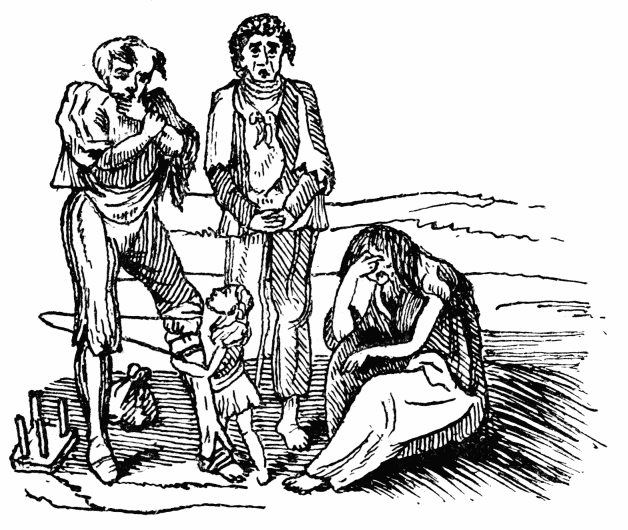
THE MECHANIC’S APPEAL TO THE PUBLIC.
Give attention awhile to my rhymes, Good people of every degree, I assure you these critical times Have reduced me to great poverty. I’m a tradesman reduced to distress, Dame Fortune on me long has frown’d, And that is the cause, I confess, Which compels me to roam up and down.
Chorus.
Then good people attend to my rhymes, And pity a tradesman reduced; For appealing to you in these times, I submissively hope you’ll excuse. I once did in happiness dwell, With my family around me, at home; And little, (the truth I will tell) Did I think I’d have cause for to roam. But misfortune, she owed me a grudge, And entered in my Cottage door, And caused me in sorrow to mourn, And my misery long to deplore. Mechanics are now at a stand, And trade, in all quarters, is bad, They’re complaining all over the land, And their children are hungry and sad. Travel Britain wherever you will, You may behold everything dead, The tradesmen are all standing still, And their children are crying for bread. My family now weep in distress, With cold and with hunger they cry, Which grieves me to see, I confess, No food, nor employment have I. The Weather is cold and severe, And I do in sorrow lament; I have no food for my Children dear, And my goods are all taken for rent. For a tradesman reduced, heave a sigh, Who in sorrow and agony grieve, And, good Christians, as you pass him by, With a little, pray, do him relieve. A little you never will miss, To one who in sorrow complain, And our heavenly Father above, The same will repay you again. Oh, you that distress never knew, May your breast such affliction ne’er feel, The sufferings that I do endure, I cannot to you half reveal. For subsistence my clothes I have sold, I wander to look for a friend, So now my sad troubles are told, And my tale I am going to end.
There is a great deal of superstition, and folk-lore, contained in
WOMEN’S SAYINGS.
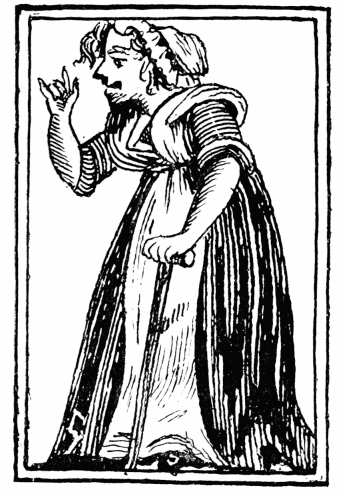
Draw near, and give attention, And you shall hear my rhyme, The old women’s sayings, in the olden times High and low, rich and poor, By daylight or dark, Are sure to make Some curious remark; With some foolish idea Your brains they will bother, For some believe one thing, And some believe another.
Chorus.
These are odds and ends Of superstitious ways, The signs and the tokens, Of my grandmother’s days. The first thing you will see, At the house of rich or poor, To keep the witches out, A horse shoe’s o’er the door. Bellows on the table, Cause a row both day and night, If there’s two knives across, You are sure to have a fight. There’s a stranger[11] in the grate, Or, if the cat should sneeze, Or lay before the fire, It will rain or freeze. A cinder with a hole In the middle is a purse, But a long one, from the fire, Is a coffin, which is worse: A spider, ticking in the wall, Is the death watch at night, A spark in a candle, Is a letter sure as life. If your right eye itches, You’ll cry till out of breath, A winding sheet in the candle Is a sure sign of death. If your left eye itches, You will laugh outright, But the left or the right, Is very good at night, If your elbow itch, A strange bed fellow found, If the bottom of your foot itch, You’ll tread on fresh ground: If your knee itch, you’ll kneel. In a church, that’s a good’un, And if your belly itch, You’ll get a lot of pudden. If your back should itch, I do declare, Butter will be cheap, When the grass grows there: If the dog howl at night, Or mournfully cry, Or if the cock should crow, Some one will die. If you stumble upstairs, Indeed, I’m no railer, You’ll be married to a snob, Or else to a tailor. A speck on your finger nail, Is a gift that’s funny, If your hand itch in the middle, You will get some money. Spilling of the salt Is anger outright, You’ll see a ghost, if the door Should rattle in the night. If your sweetheart Dreams of bacon and eggs, She’ll have a little boy That has got three legs. The cat washing her face, The wind will blow, If the cat licks her foot It is sure for to snow. Put your gown, or your jacket On inside out, You will change your luck, And be put to the rout. If your nose itches, You’ll get vexed till you jump; If your great toe itches, You’ll get kicked on the rump. If a girl snaps one finger, She’ll have a child it deems, And if she snaps two, She’s sure to have twins; And if she snaps eight, Nine, ten, or eleven, It’s a chance if she don’t Have twenty and seven. If you lay with your head Underneath the clothes, You’ll have an ugly old man, What has got no nose. If you see a star shoot, You’ll get what you wish, If a hair get’s in your mouth, You’ll get as drunk as a fish. If your little toe itch, You’ll be lost in a wave, If you shiver, there’s somebody Going over your grave. If you go under a ladder, You’ll have bad luck and fall, And some say that bad luck Is better than none at all. So to please all outright, I have told you in rhyme, The great superstitions Of the olden time.
Ballads exemplifying the first half of the present Century would be incomplete without some mention of coaching. It was essentially a horsey age, for railways were not, at least during the first quarter, the first (Stockton and Darlington) being opened September 27, 1825, so that people were obliged to rely on horses for their means of locomotion to any distance. Great improvement had been made in the construction of the stagecoaches, and they were very well horsed; in fact, with the exception of their being larger, they were very much like those which now run to Brighton, Guildford, etc.
Bob Logic, who is supposed to have written the subjoined ballad, was the companion of Corinthian Tom and Jerry Hawthorn, whose pranks were so graphically described by Pierce Egan in his “Life in London.” The George Shillibeer who is sung in the last verse was a large coach proprietor, even letting out hearses and mourning-coaches.—Nay, almost everything on wheels. To him is due the introduction of the Omnibus, the first of which ran from the Yorkshire Stingo, Marylebone Road, to the Bank of England, on July 4, 1829.
BOB LOGIC’S DESCRIPTION OF THE NEW BRIGHTON DILIGENCE FOR INSIDE PASSENGERS ONLY.
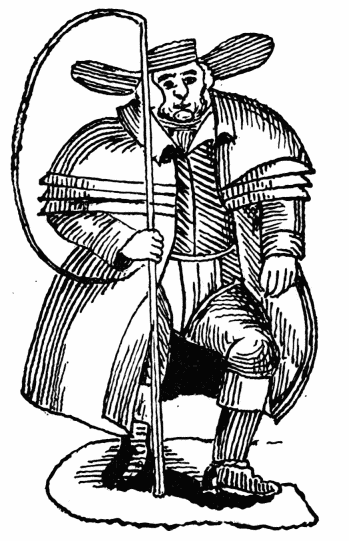
Bob Logic’s my name, to Brighton I’ve been, I don’t mean to tell you of all I have seen, But the New Diligence is so much to my mind, That to sing in its praise I am fully inclined. Tippy Jack, whom we all knew, a trump in his day, Once set off to Brighton, to figure away, But his gig was upset, so let persons of sense, Book for Brighton their place in the New Diligence. There’s nothing so sure, as that pleasure they’ll find, Secure at all seasons from weather and wind, And each Goodman will see, when the blasts bitter blow, The passengers all are secured from the Snow. For they’re all inside places—no drenching with wet, In safety and comfort the company set; As in six hours time they at Brighton arrive, I am sure that no pleasure can equal the drive. The Coupé the first in description must be, This, in English, means Chariot, and will just hold three; Here a lord, with his lady, and daughter may ride, As in their own carriage, in splendour and pride. The next is the Coach, this is fitted for six, And here is the place where Bob Logic would fix. In company such as he wishes to be, Obliging and civil, good-natured and free. And then comes the Omnibus, four on each side, Hold you secure in all weathers they ride, And if it were possible once to upset, I cannot imagine what harm they could get. How different the time, when on the outside, You held fast by the rail, if you went for a ride, And the loss of a lynch pin, or crack of a spoke, Was the too certain signal to have your neck broke. As economy now is the rage of the day, One Guinea a seat is the price of Coupé, Sixteen shillings the fare in the Coach large and fine, And the price in the Omni, twelve namesakes of mine. ’Tis my fate to suggest, so I’ll just give a hint, As I mean that my song should be put into print, The new diligence—Constitution to name, And King, Lords, and Commons each part of the same. Should their majesties then wish to come up to town, In prime style they’d be at St. James’s set down, If they take the Coupé, and Lords take the coach, With the Commons I would in the Omni approach.
PAPER’D-UP HAIR.
Of all the gay fashions that are come in vogue, Since wearing the mantle, or bonny red brogue, There’s none so praiseworthy—you’ll find—I declare, As the elegant fashion of papering the hair. The modern dames, both abroad and at home, Have got such a fashion of wearing the comb; To church or to market, they cannot repair, But must take an hour to paper their hair. When in the evening they chance for to walk, To see their sweethearts, and with them to talk, An hour or two they must certainly spare, To fit in their combs, and to paper their hair. From walking at evening these ladies retire, They draw up their seats, and chat by the fire, The tongs then to warm, they ready prepare, To squeeze up the papers quite tight in their hair. And when that these ladies give over their talk, Then up to the looking-glass straight they will walk, They’ll dance, and they’ll caper, their arms they will square, To see if the papers look tight in their hair. It’s the cheapest of curling that ever was found, You may do it with pipes, white, black, or brown; For colour of hair, I suppose they don’t care, For they tear up the Bible to paper their hair. All you young lads that are frisky and trig, Pray shun the old females that wear a false wig; To toy with a young one, still make it your care, Whose delight is to trim up, and paper her hair. Should you meet with a female, whose hair is cut short, Among other fair ones she is but a sport; She looks very shabby and out of repair, When she’s wanting the comb, and the paper’d-up hair. But when they are married, it’s just the reverse, The paper and combs they quickly disperse; For nursing and cooking is then their whole care, They may then bid adieu to the paper’d-up hair.
I LIKES A DROP OF GOOD BEER.
Come one and all, both great and small, With voices loud and clear, And let us sing, bless Billy the King, Who bated the tax upon beer.
Chorus.
For I likes a drop of good beer, I does, I’se pertickler fond of my beer, I is, And —— his eyes, whoever he tries To rob a poor man of his beer. Let Ministers shape the Duty on Cape, And cause Port wine to be dear, So that they keep, the bread and meat cheap, And gie us a drop of good beer. In drinking of rum, the maggots will come, And soon bald pates will appear; I never goes out, but I carries about, My little pint noggin of beer. My wife and I, feel always dry, At market on Saturday night, Then a noggin of beer, I never need fear, For my wife always says it is right. In harvest field, there’s nothing can yield, The labouring man such good cheer, To reap and sow, and make barley grow, And to give them a skinfull of beer. The farmer’s board will plenty afford, Let it come from far, or from near, And at harvest home, the jug will foam, If he gives his men plenty of beer. Long may Queen Victoria reign, And be to her subjects dear, And we’ll wallop her foes, wherever we goes, Only give us a skinfull of beer.
THE SNOB AND THE BOTTLE.
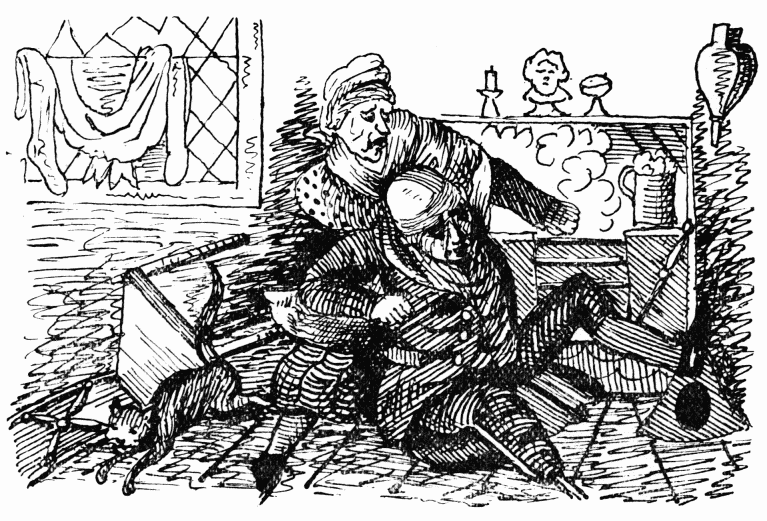
Good people, attend to my song, And listen to something that’s witty, It is not too short, or too long, But concerning town, country and city. Advice to all tradesmen I give, Snips, bakers, snobs, grocers and tanners, I’m a lady possessed of three outs,[12] I’ve neither wit, money, nor manners, So pray of the bottle beware. My old man is a ranting old snob, He looks in the face like a monkey, All night like a goose he does sob, And he’s just as much sense as a donkey. He sold all the old shoes in the shop, And poured the contents down his throttle, All day he sits hugging the pot, And singing success to the bottle. He has but one shirt to his back, And that is all rent into stitches; He has never a crown to his hat, He has worn out the seat of his breeches. An old sack for an apron he wears, And his nose is as big as a pottle, Last night he fell over the stairs, Singing joy and success to the bottle. Our bed clothes are all up the spout, And jigs to the lapstone may whistle, He the chairs and the tables took out, His leather, awl, lapstone and bristles. He sold all the lot for a bob, And sent the proceeds down his throttle, Bad luck to the drunken old snob, May the devil take him and the bottle. My gown the old rogue sold for rags, Though with him I had a good tussle, My nightcap he sold for a mag, And three halfpence my bonnet and bustle. There’s a hump growing out of his back, Just nine times as large as a wattle,[13] Last night he woke up in a fright, And killed the poor cat with the bottle. There’s the landlord calls three times a day, And the butcher and baker, by jingo, And if the old rogue doesn’t pay, They’ll shove him for twelve months in limbo, But they may as well talk to a post, For the money all goes down his throttle, Bad luck to the ugly old ghost, May the devil fetch him and the bottle. He says unto me, I am poor, And call me his dear loving doxey, And when he gets out of the door, The boys holloa out after him, “Waxey.” Enough for to drown a bull, Every morning he pours down his throttle, Don’t you think that I’ve got a good pull, With the ranting old snob and the bottle. The bottle has quite ruined me, Though quiet and easy I take it; The bottle has robbed me of tea, And left me both hungry and naked. The bottle has robbed the old snob, And burnt all his tripes and his throttle And, at length, what an excellent job! Old Nick fetch’d the snob and the bottle.
RORY O MORE TURNED TEETOTAL.
Young Rory O More who to London had been, The fashions to see, and make love to the Queen, Oft swore by the soul of the shamrock so dear, That he’d bate the young prince, if his father stood near. By the powers, if he once in his clutches should come, He’d give him what Paddy bestowed on his drum: For Rory had leathered his rivals before, Och! a broth of a boy was bold Rory O More. Bad cess to the Queen and the Jarmins says he, I’ve a nice little sheelah across the salt sea, Her looks beam so brightly on Erin’s green shore, I’ll go to sweet Kathleen, cried Rory O More. Then he took little Shiel, and old Dan by the hand, And wish’d them good bye as he sailed from the land, He twirl’d round his blackthorn when clean out of sight, And knock’d down the captain for fun and delight. But a squall coming on, and a terrible breeze, The sailors cried, Rory, go down on your knees; Cried Rory, I’m safe if the ship should go down, For I paid my Insurance before I left town. Then pull away, haul away, do as you please, Blow rough, or blow smooth, I will sit at my ease, And drink to my friends on the shamrock shore, Success to old Ireland, cried Rory O More. Being landed once more at the land of his birth, The land of shilalieghs, of whiskey, and mirth, He met Denis Grimes with a face pale and wan, Och Murther! cried Rory, what’s ailing the man? Is it temperance you’re being, och! leave off that same, Come over and take a sly drop of the crame. Arrah! what do I see? sure my eyes are not clear, The sign is removed, and there’s Coffee sold here. Father Mathew[14] himself was passing that way, And unto bold Rory these words he did say, For the sake of Hibernia be tipsy no more, I’ll try my best, father, cried Rory O More. Of the hurlings and fightings, no more’s to be seen, But the daughters of Erin trip light o’er the green; The gaols are all empty, the judges look blue, The lawyers are starving with nothing to do, And Rory O More, and his beautiful Kate, Wear temperance medals, so dasent and nate. As he looks on his Kathleen, he says with a smile, That she shall be Queen of the Emerald Isle. And the shores of Hibernia with gladness shall sound, And the green hills of Erin once more shall resound, And this is the cry that shall sound from the shore, “God bless the Teetotal,” cried Rory O More.
HURRAH FOR FATHER MATHEW’S MILL.
Two jolly old topers once sat at an inn, Discussing the merits of brandy and gin, Said one to the other, I’ll tell you what, Bill, I’ve been hearing, to day, of Father Mathew’s Mill. You must know that this comical Mill has been built, Of old broken casks, when the liquor’s been spilt, You go up the steps, and when at the door sill, You’ve a paper to sign at Father Mathew’s Mill. You promise, by signing the paper (I think), That ale, wine and spirits, you never will drink, You’ll give up, as they call it, such rascally swill, And then you go into Father Mathew’s Mill. There’s a wheel in this Mill that they call “self denial,” They turn it a bit, just to give you a trial; Old clothes are made new ones, and if you’ve been ill, You’re very soon cured in Father Mathew’s Mill. Bill listened, and wondered, at length he cried out— “Why, Tom, if it’s true what you’re telling about, What fools we must be, to be here sitting still, Let us go and look in at Father Mathew’s Mill.” They gazed with amazement, for up came a man, With disease and excesses, his visage was wan, He mounted the steps—signed the pledge with good will, And went for a turn in Father Mathew’s Mill. He quickly came out quite the picture of health, And walked briskly on in the highway of wealth, And, as onward he pressed, he shouted out still, Success to the wheel of Father Mathew’s Mill! The next that went in were a man and his wife, For many long years they’d been living in strife, He had beat and abused her, and swore he would kill, But his heart took a turn in Father Mathew’s Mill. And when he came out, oh how altered was he! His conduct was changed; and how happy was she! They no more contended—no, you shan’t—yes, I will, But together they’re blessing Father Mathew’s Mill. Then next came a fellow as grim as a Turk, To curse and to swear seemed his principal work, He swore that that morning, his skin he would fill, And, drunk as he was, he reeled into the Mill. But what he saw there, sure I never could tell, But his Conduct was changed, and his language as well, I saw, when he turned round the brow of the hill, That he knelt and thanked God for Father Mathew’s Mill. The poor were made rich, the rich were made strong, The shot[15] was made short, and the purse was made long, These miracles puzzled both Thomas and Bill, At length they went in for Father Mathew’s Mill. A little time after, I heard a great shout, I turned round to see what the noise was about, And a crowd, among which were both Thomas and Bill, Were shouting hurrah for Father Mathew’s Mill.
HOW FIVE AND TWENTY SHILLINGS WERE EXPENDED IN A WEEK.
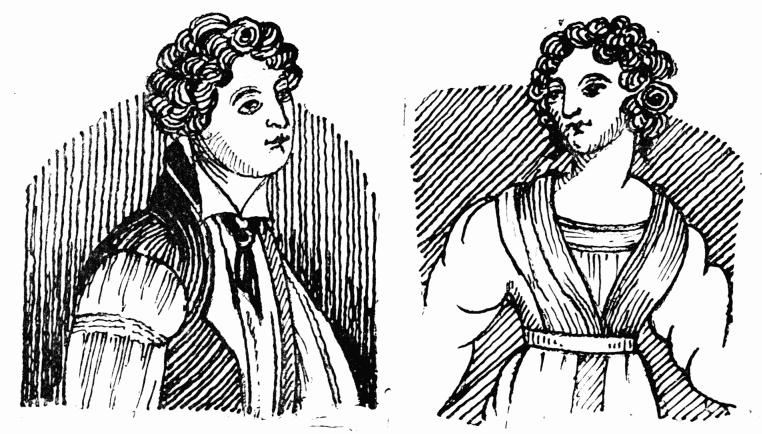
It’s of a tradesman and his wife, I heard the other day, Who did kick up a glorious row; they live across the way; The husband proved himself a fool, when his money all was spent, He asked his wife, upon her life, to say which way it went.
Chorus.
So she reckon’d up, and told him, and showed him quite complete, How five and twenty shillings were expended in a week. He says my wages are all gone, and it does me perplex, Indeed, said she, then list to me, my bonny cock of wax. Continually you make a noise, and fill the house with strife, I’ll tell you where your money goes; I will upon my life. There’s three and twopence house rent; now attend to me she said, There’s four shillings goes for meat, and three and ninepence, bread, To wash your nasty dirty shirt, there’s half a pound of soap, There’s eightpence goes for Coals, old boy, and sixpence wood and Coke. There’s fourpence for milk and cream, and one and fourpence malt, Three halfpence goes for vinegar, one halfpenny for salt; A penny goes for mustard, a halfpenny for thread, And you gave threepence the other night, for a piece of pig’s head. A red herring every morning is sevenpence a week, Sometimes you send me out for fish, you say you can’t eat meat, Last Monday night you got so drunk, amongst your dirty crew, It cost two pence next morning for a basin of hot stew. There’s a penny goes for pepper too, as you shall understand, Twopence soda, starch and blue, and a halfpenny for sand, Sevenpence for Candles, a halfpenny for matches, And a penny worth of Corduroy, I bought to mend your breeches. A shilling potatoes and greens, with tenpence butter, you see, Sixpence Coffee, ninepence Sugar, and sevenpence for tea, There’s a penny goes for this thing, and twopence that and t’other, Last week you broke a water jug, and I had to buy another. There’s sixpence for tobacco, and a halfpenny for pipes, Seven farthings goes for snuff, and twopence halfpenny swipes; A penny you owed for shaving, over at the Barber’s shop, And you know last Sunday morning, you’d a bottle of ginger pop. There’s a penny goes for blacking, and eight pence halfpenny cheese, A three farthing rushlight every night, to catch the bugs and fleas; And when you go to the public house, and sit to drink and sing, I pop into the liquor vaults, to have a drop of gin.
The only reason why the subjoined is given, is to show the numerous small industries by which people could manage to eke out a living in the first half of the century.
THE WAY TO LIVE.
Chorus.
A man and a woman got married one day, And thus unto each other did say, As we the world must now begin, We will deal in every following thing. She. We will deal in apples, plums and pears, He. We will mend old bellows and bottom old chairs, She. We will buy old metal, rope and bags, He. Yes, and I’ll go out a gathering rags. She. We will sell red herrings and ginger pop, He. Hot baked sheep’s head and taters hot, She. We’ll keep a school of high degree, He. And learn the children A. B. C, She. We’ll salt fat bacon, butter and lard, He. And great long songs for a penny a yard, She. I’ll sell potash, starch and blues, He. And I’ll go sweeping the chimney flues. She. I’ll make bustles and lady’s frills, He. And I’ll sell mussels and pickled eels, She. We’ll deal in razors, strops and hones, He. And I’ll go out a picking up bones, She. We’ll deal in paper, take in the news, He. And I’ll go a cobbling ladies’ shoes, Both. {And we’ll learn the ladies all complete, {To dance the Polka at threepence a week. She. We’ll deal in lollipops, sugar and figs, He. We’ll buy a donkey, ducks hens and pigs, She. We’ll have a mangle, and buy old clothes, He. And I’ll make salve for the ladies’ toes. She. We’ll deal in pickled cabbage and eggs, He. And make tin dishes and wooden legs. She. We’ll deal in sausages, tripe and lard, He. And if we can’t live, ’twill be devilish hard. She. We’ll deal in Oils, sperm, train and neat, He. And I’ll make stockings for children’s feet, She. We will sell hot muffins and home baked bread, He. Pins and needles, cotton and thread. She. We’ll grind old razors, scissors and knives, He. And keep lodgings for single men and their wives, She. We’ll deal in lobsters, shrimps and sprats, He. And I’ll sell meat for the ladies’ cats. She. We’ll deal in fish, fresh, boiled, and fried, He. And let out donkeys a penny a ride, She. I will the ladies fortune tell, He. And I’ll cry, Old umbrellas to sell, She. We will take in the blooming ladies bright, He. And sleep in the garret at threepence a night, She. I’ll sing, Come buy my Crockery ware, He. And I’ll go dressing the ladies hair. She. We’ll sell ripe Cherries, pea soup and milk, He. Oranges, lemons and pickled wilks, She. Wooden rolling-pins at the Royal Exchange, He. And if we can’t get on we may think it strange, (The chorus make up the last four lines of this verse.)
THE CRIES OF LONDON.
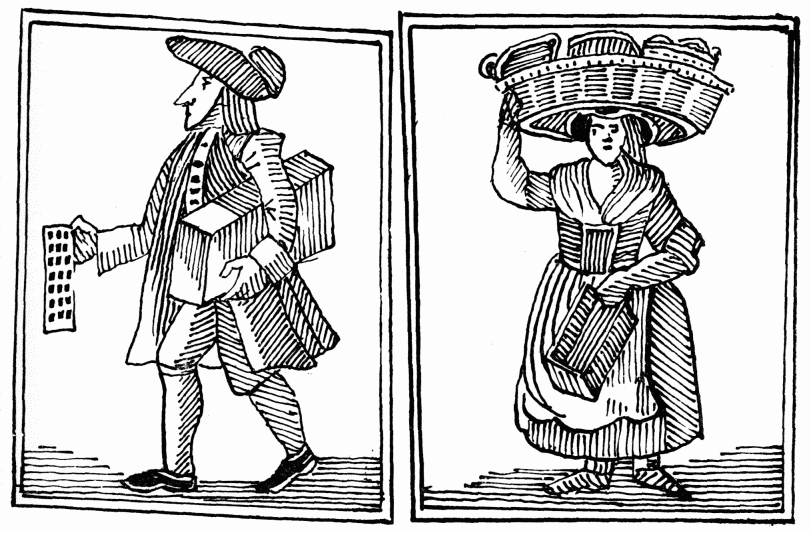
Oh! what fun is to be seen in town every day, There is something to pass dull care away, Some sort of a cry you are sure for to meet, In winter and summer as the time of year flies, You will find in London a melody of cries.[16]
Chorus.
It’s fun for to hear, as you walk up and down, The fashionable cries of great London town. A strong deal table to be sold to night, Penny a lot oysters, come run, fetch a light, Here’s good eating apples, a penny the lot, Now who’ll buy a cap or a bonnet box; Clothes pegs, or lines, buy a clothes prop, Here’s fine Cauliflowers, who’ll buy a Mop? Live fleas with a gold chain round their neck, Here’s fine young peas sixpence a peck, Songs three yards a penny, Oh! what a lie! For half of them are not there, what they do cry. Fine pickled salmon, warranted sound, And good salt cod, a penny a pound. Here’s the last dying speech, I forgot to tell, Fine Cabbage plants, young lambs to sell, Do you want any matches, ma’m, to day, Buy a pit ticket, or a bill of the play, Good strong laces, a halfpenny each, Two bunches a penny, spring watercress. Clothes, sale clothes the Jews do cry, Mutton, Apple, Beef, all hot, toss or buy, Dust O, dust, and sweep soot O, Fine pickled eels feet, now here’s a go, Buy a bird cage, fine summer cabbage, Walk up now, and see the Indian savage. Here’s lily white mussels, a penny a quart, Fine ripe plums, now the blooming sort, Penny a head celery, a good woman’s cap, Buy a brush, a hair broom, or a door mat, Here are mild red herrings, a halfpenny each, Come move on there, says the New Police. Wood three bundles a penny, all dry deal, Now who’ll buy a good flint and steel, Buy a walking stick, a good ash stump, Hearth stones, pretty maids, a penny a lump, Fine mackerel, penny a plateful, sprats, Dog’s meat, ma’am, for to feed your cats. Twelve a penny walnuts, crack and try em, Fine barcelonies, now who’ll buy em? Here are good mealy potatoes from Paddy’s land, Good burning turf and lily white sand, I think, good friends, I have kept you too long, The next cry is, now who’ll buy my song.
The Modern Police is the outcome of the old Watch, which, always inefficient, had become so much so, as to necessitate its abolition, and, under the auspices of Sir Robert Peel[17] the “New Police,” as they were called, were formed, and they commenced their duties on September 29, 1829. Until a very recent time they wore swallow-tailed coats and tall hats, and were the subjects of good-humoured witticisms from all. There is no doubt but that the change of costume to the tunic and helmet has induced a better class of men to join the force, and has raised its standard of efficiency immensely. Whitaker for 1888 gives the number of the Metropolitan Police as 13,855.
THE HONEST POLICEMAN OF MITCHAM.
Some Policemen are right honest men, And some we know are gluttons, Some cookey darling courting goes, To taste her roasted mutton: Some can twirl the rolling-pin If girls should them draw nigh, sir, Some are fond of rabbit skins, And some of rabbit pie, sir. A house the Sergeant had to keep, At least for to look after, He was a guardian of the peace, And had a wife and daughter. The Sergeant in the parlour lived, And his lady in the kitchen, And such a game they carried on, Good lack a day, at Mitcham. Such a lot of property was there, Belonging to Captain Higging, And so it seems the Sergeant and His lady went a prigging. They took the sofas and the beds, The blankets and the cradles, The silver plate, the chamber mug, Chairs and mahogany tables. Two hundred sovereigns worth of goods, Pianoforte and shawls, sir, And then for safety placed them in The hands of Uncle Balls, Sir. The neighbours say they had as much As they could well desire, And then to hide the wicked deed, They set the place on fire. The Captain of his rights, They did so nicely fleece him, But great suspicion fell upon The Sergeant of Policemen. The Sergeant thought to cut his stick, And bolt across the water, But Justice the Policeman caught, His honest wife and daughter. Alas! poor Bob has gone to quod, And that I know won’t suit him, They know him well at Mitcham, and In Merton, and in Tooting. For soon he will his trial take, And hard bull beef be munching, He’ll lose his lantern, coat and cape, And curse his wooden truncheon. To steal another’s goods his hands, And fingers were a itching And he will run and look so blue, About the job at Mitcham. Poor Sergeant Bob has gone to quod A place that does not suit him, They know him well at Merton round, In Mitcham and in Tooting.
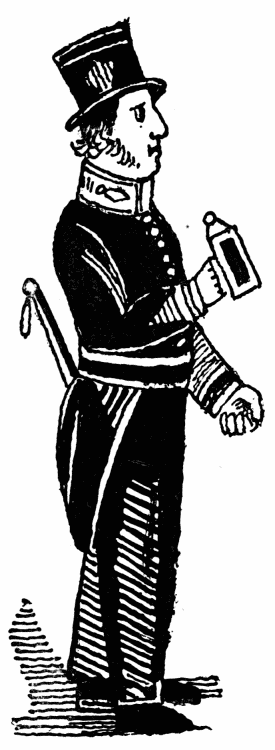
When the present Police force was first organized it was composed of men decidedly inferior in physique, intelligence, and education, to those constables whose protection we now enjoy. They were made the butt of every kind of coarse witticism, and were generally addressed by some slang name. Above all they were chaffed for their supposed partiality for the society of Cooks, and I reproduce one ballad bearing on this subject, a parody of the song of “Katty Darling.”
COOKEY DARLING.
I’m waiting at the airey, Cookey, darling, Your fire brims brightly, I can see: Then hasten to your peeler, Cookey, darling, For you know, my love, I’m waiting for thee.[18] You know that ’twas last night you gave me Only half a leg of mutton and a goose, Then hasten to your peeler, Cookey darling, Or on Sunday I shan’t be of any use. Cookey, stunning Cookey! I’m waiting at the airey, Cookey, darling, Then bring me up something good to eat, Some lush for my stomach to be warming, And the grub I’ll put away on my beat. I can see wine, too, on the table, Sent down because it was not bright, To drink it, Cookey, you know I am able, My love, you know, to put it out of sight. Cookey, stunning Cookey! I can see pies and puddings, Cookey darling, Veal, ham, and every thing so nice, I’m sure I shall go mad, Cookey darling, If off that beef I haven’t a two pound slice. But I hear the sergeant coming, Full well I know his power, Then get the grub ready, Cookey darling, And I’ll be back in half an hour. Cookey, stunning Cookey!
I SHOULD LIKE TO BE A POLICEMAN.
Some folks may talk about a trade, And the joys that from it spring, Sirs, And after you my words have weighed, You’ll say it’s no such thing, Sirs. Though at me you may jeer and laugh, My joys think to decrease, man, But I mean to say, (and I do not chaff,) I should like to be a policeman.
Chorus.
Taking up and knocking down, Your noise and bother cease, man, O, won’t I come it jolly brown, When I’m a new Policeman. Of the boys, I’d be the terror, mind, The fruit stalls, too, I’d sell ’em, And disturbance of every kind, I with my staff would quell ’em, A “charge” would be as good as pelf, My pleasures ’twould increase, man, For I’d make the “charges” up myself, When I’m a new Policeman. To the kitchen maids like wax I’d stick, And tho’ I’m not a glutton, (The thoughts on’t makes me my chops lick) Oh, I likes a bit of mutton. When in my toggery I’m arrayed, From me there’s no release, man, The boldest of men would be afraid, If I was a new Policeman. A drunken man’s a chance I’d hail, It would my ear delight, Sir, To search him well I would not fail, For right is naught to might, Sir. I’d turn his pockets inside out, And quickly would him flay, man, And who would dare to harbour doubt, Against a new Policeman. The cracksmen too, should tip to me, Or else I would soon lag ’em, But if they did, I should not see, That is I should not “stag” ’em. And, if amusement I should lack, Tho’ I’m one that likes the peace, man, A pate or two, I’d surely crack, I should like to be a Policeman. The prospect does me much delight, I mount on wings of joy, Sir, It does to wealth and fame invite, And pleasure without alloy, Sir, When I’m established in the force, I’ll have a bob a piece, man, From lushy swells, or I’ll lock ’em up, I should like to be a Policeman.
This was a famous fight between these two redoubtable heroes, famous even in the bad old times of the Ring. Caunt was a man of gigantic height who kept a somewhat disreputable public-house in St. Martin’s Lane, into which, in my young days, it was hardly safe to enter. A fire occurred there, and some of his children were burnt. William Thompson, alias Bendigo, was a native of Nottingham, and was a professional pugilist from his twenty-first year of age.
BENDIGO, CHAMPION OF ENGLAND.
(A New Song on the Great Fight between Bendigo and Caunt, for the Belt and £400, which took place at Witchwood, on Tuesday September 9th 1845.)
Ye ranting lads, and sporting blades, come listen to my song, I’m sure that it will please you well, and will not keep you long. Concerning the great milling match that lately has been fought, Between great Caunt and Bendigo, two lads of the right sort.
Chorus.
So we’ll drink success to Bendigo, who showed such gallant play, For by his skill, he won the mill, and bore the prize away. On the ninth day of September, eighteen hundred, forty five, To Witchwood for to see the fight, the sporting coves did drive, While some did laugh, and some did chaff, and of their man did vaunt, Some bet their ten on Bendigo, and some on giant Caunt. And when the ground was ready, both those champions quickly peeled, Two braver men on England’s ground did never take the field, The fancy swore they were top mark,—an honour to the ring, Two stouter hearts had never met, since Langan and Tom Spring. Both men shook hands, and the prize belt, it straightway was brought in, There let it hang says Bendigo, till the best man does win, That won’t be little Bendigo, then Caunt he did reply, For I’ll belt your hide till you’re satisfied, then at him he did fly. Is that the way? says Bendigo, here, take it back again, He made a job of poor Caunt’s nob, and hammered it amain. This furious work soon drew the cork of Caunt’s poor claret bottle, While Caunt returned the compliment, made Bendi’s ribs to rattle. Twenty four rounds these heroes fought, none could tell which was the best, But Bendigo in the next round, struck Caunt on the left breast. Which made him stagger round the ring, and fall upon the ground, Says Bendigo, I’ll have the belt, and the four hundred pound. But Caunt did boldly come again, and showed some gallant play, Yet Bendigo would strike a blow, and quickly get away. Until in round the eighty fourth, he gave some ugly blows, Which left his mark on the staring part, and fairly spoilt Caunt’s nose. Eighty eight rounds were fought, when Caunt he could not rise, And all declared the Bendy cock had fairly won the prize. The Tipton Slasher now may come, but soon he’ll get to know, That he was not quite big enough to wollop Bendigo.
This fight scarcely comes within the scope of this work, but I introduce it, because it was supposed to be the last of Prizefighting. Unfortunately, the brutal sport has been revived, but it can never attain the dimensions and importance it enjoyed during the latter part of the reign of George III. and the whole of that of George IV. Gully was page to that monarch and M.P. for Pontefract, and Jackson was a gentleman, after his kind.
Sayers was of Irish extraction, though born at Brighton. Heenan’s parents were also Irish, although America was the place of his birth. The fight between these two took place on April 17, 1860, near Farnborough. They fought thirty-seven rounds in two hours and twenty minutes. Sayers was all but helpless, and Heenan, although full of fight—indeed, he ran amuck of every body at last—was blind, when the police and spectators broke into the ring, and a more disgraceful scene was never witnessed, even at a prize-fight. Many noblemen and Members of Parliament attended this fight; in fact, many of the latter made a subscription in Sayers’ behalf, as also did the Members of Lloyd’s, the Stock Exchange, and the brokers in Mark Lane—clogged, however, with the condition that he should fight no more. Altogether over three thousand pounds were subscribed and invested for the benefit of his children, he receiving the interest for life. He became partner and afterwards proprietor of Howe’s and Cushing’s Circus—at which he lost all the money he had. He drank fearfully, and shortly afterwards died of consumption, aged thirty-nine. His tomb may be seen in Highgate Cemetery.
THE BOLD IRISH YANKEY BENICIA BOY.
Attend, you sons of Erin, and listen with delight, To a ditty, ’tis concerning the great and glorious fight, On the seventeenth of April, when thousands went with joy, To see the English champion, and the bold Benicia boy.
Chorus.
He is young, bold and powerful, no care does him annoy, He can boldly stand ’gainst any man, and fib away with joy; And he’ll beat the English champion, will the bold Benicia boy. His father, an Irishman, from the King’s County came, His son is a bold Benicia boy, young Heenan is his name, The British ring, he did step in, and came up to the scratch, When Sayers, the English champion, found that he’d got his match. It was early in the morning, before the cock did crow, Unto the scene of action these gallant lads did go. Both men did fight most manfully, to win each one did try, But they both appeared determined to conquer or to die. At seven in the morning both men were on the ground, Heenan floored the gallant champion in nearly every round, The claret flew in torrents,—each other they did fib, There’s never been such a battle since the days of old Tom Cribb. They two hours and six minutes fought—each proved himself a man, And neither of them would give in while he’d a leg to stand, But the fight was all in favour of the brave Benicia boy, When the bobbies bolted in the ring, and did his hopes destroy. Tom Sayers said he soon would lick the Yankee doodle doo, But Tom found out at Farnborough, he’d have his work to do. I’ll bet a pound to half a crown, and stake it all myself, If they fight again, the Yankee boy, will carry off the belt. When Heenan was in Derbyshire, preparing for the fight, They hunted him, like bloodhounds, in the middle of the night. But he was nothing daunted, but to the ring did fly, Determined that he’d conquer, gain the victory, or die. There never were two better men, and none could be more game, They are both two gallant heroes of honour and of fame. Then fill a flowing bumper, and jovially drink their health, May the best man win and conquer, and carry off the belt. When Heenan came to England, far from a distant land, They said he was a fool to come, to face an Englishman, But they were all mistaken when they saw the glorious battle, Heenan cooked the champion’s bacon, and made his daylights rattle.
Of course, it was only in the nature and fitness of things that Henry Russell’s extremely popular song, “I’m Afloat,” should be parodied, and of all that I remember, I think the following was most sung in the streets. The present Cad, or ’Arry, is bad enough in all conscience, but the Gent of those days was worse. How Albert Smith did scarify him!
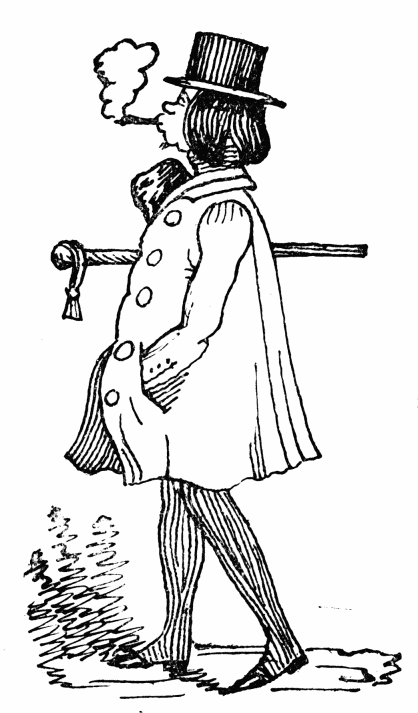
I’M A GENT.
I’m a Gent, I’m a Gent, I’m a Gent ready made, I roam through the Quadrant and Lowther Arcade, I’m a registered swell from my head to my toe, I wear a moustache, and a light paletot. I’ve a cane in my hand, and a glass in my eye, And I wink at the girls, demme! as they go by, Then lor! how they giggle to win my regards, And I hear them all say—He’s a gent in the Guards. I’m a Gent, I’m a Gent, in the Regent Street style, Examine my wesket, and look at my tile, There are gents, I dare say, who are handsomer far, But none who can puff with such ease, a cigar. I can sing a flash song, I can play on the horn, I like Sherry Cobblers, I’m fond of Cremorne, I love the Cellarius,[19] the Polka[20] I dance, And I’m rather attached to a party from France. This gal I adore is a creature divine, Though devilishly partial to lobsters and wine, She was struck with my figure—and caught—with a hook, For I took her to visit my uncle the duke.
Louis Antoine Jullien was born at Sisteron, Basses Alpes, April 23, 1812. His father was a band-master, hence probably his love of music. He knew well how to cater for a popular taste, and to him we owe not only the Promenade Concerts, which have brought good music into the amusements of the people, but a vast improvement in the English orchestra. His band was the best of its time; indeed, he spared no expense to procure the very best instrumental and vocal performers. He died March 14, 1860. As a composer, dance music was his great forte, and he was the first to seize on the Polka, which was introduced into England about 1844. This dance became an absolute furore. Everything was Polka—Polka jackets, bonnets, cigars, etc. In fact, as one popular song ran—
“Don’t you dance the Polka? Won’t you dance the Polka? Joys of earth are little worth, If you don’t dance the Polka.”
JULLIEN’S GRAND POLKA.
Oh! sure the world is all run mad, The lean, the fat, the gay, the sad,— All swear such pleasure they never had, Till they did learn the Polka.
Chorus.
First cock up your right leg so, Balance on your left great toe, Stamp your heels and off you go, To the original Polka. Oh! There’s Mrs. Tibbs the tailor’s wife, With Mother Briggs is sore at strife, As if the first and last of life, Was but to learn the Polka. Quadrilles and Waltzes all give way, For Jullien’s Polkas bear the sway, The chimney sweeps, on the first of May, Do in London dance the Polka. If a pretty girl you chance to meet, With sparkling eyes and rosy cheek, She’ll say, young man we’ll have a treat, If you can dance the Polka. A lady who lives in this town, Went and bought a Polka gown, And for the same she gave five pound All for to dance the Polka. But going to the ball one night, On the way she got a dreadful fright, She tumbled down, and ruined quite, The gown to dance the Polka. A Frenchman he has arrived from France To teach the English how to dance, And fill his pocket,—“what a chance”— By gammoning the Polka. Professors swarm in every street, ’Tis ground on barrel organs sweet, And every friend you chance to meet, Asks if you dance the Polka. Then over Fanny Ellsler came, Brilliant with trans-Atlantic fame, Says she I’m German by my name, So best I know the Polka. And the row de dow she danced, And in short clothes and red heels pranced, And, as she skipped, her red heels glanced In the Bohemian Polka. But now my song is near its close, A secret, now, I will disclose, Don’t tell, for it’s beneath the rose, A humbug is the Polka. Then heigh for humbug France or Spain, Who brings back our old steps again, Which John Bull will applaud amain Just as he does the Polka.
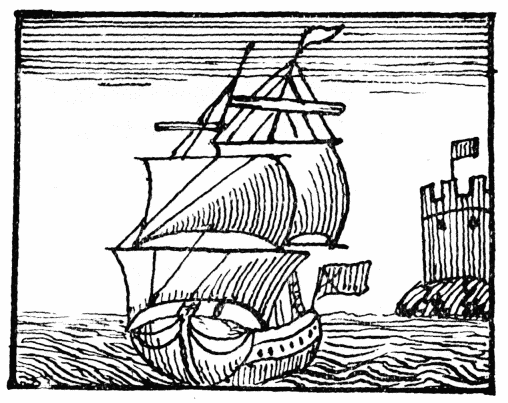
A “Hoy” was a one-masted vessel, sometimes with a boom to the mainsail, and sometimes not; rigged very much like a cutter. They are said to have taken their name from being hailed (“Ahoy”) to stop to take in passengers. The good people of that date were rather given to stay at home, or not go farther seawards than Gravesend. Ramsgate and Margate were long voyages, and in truth they were so sometimes; in rough weather they were sometimes two days or more making the passage. But there were other dangers, vide Drakard’s Paper, October 3, 1813:—“The British Queen, Margate Hoy, detained full of passengers, for having accidentally had communication with a vessel performing quarantine, has been since released by orders from the Admiralty. The distresses of the passengers partook of the serio-comic: at first provisions were very scanty, and they had no prospect but seven weeks of durance. This to the trippers to the seaside for a week would have been a serious affair.”
MARGATE HOY.
Now’s the season for laughing and jollity, Crowding together, all nations and quality, Margate, a hoi, as I halloa cry, All come on board while the sea breezes blow.[21] Swift as an arrow from bow flies to target, Or packet from dear little Dublin to Parkgate, I’ll waft you all safe from London to Margate, And whistle a wind as we cheerily go. Bucks who hunt fashion like quick scented mousers, Leave town, it exhibits no sport for ye now, sirs, So pull off your boots, and put on your trousers, To join the gay throng where the sea breezes blow. Pretty men milliners, fresh water sailors, Smart, ’prentices, aldermen, actors, and tailors, Let me and old ocean a while be your jailors, I’ll sing, as he rocks, while you cheerily go. Now’s the season, etc.
CRYSTAL PALACE.
Britannia’s sons an attentive ear One moment lend to me, Whether tillers of our fruitful soil, Or lords of high degree. Mechanic too and artizan, Old England’s pride and boast, Whose wondrous skill has spread around Far, far from Britain’s coast.
Chorus.
For the great world’s Exhibition, Let’s shout with loud huzza, All Nations never can forget The glorious First of May. From every quarter of the Globe They come across the sea, And to the Crystal Palace The wonders for to see; Raised by the handwork of men Born on British ground A Challenge to the universe It’s equal to be found. Each friendly nation in the world, Have their assistance lent, And to this Exhibition Have their productions sent; And with honest zeal and ardour, With pleasure do repair, With hands outstretched and gait erect, To the world’s great National Fair. The sons of England and France, And America likewise, With other nations to contend To bear away the prize. With pride depicted in their eyes, View the offspring of their hand, Oh, surely England’s greatest wealth Is an honest working man. It is a glorious sight to see So many thousands meet, Not heeding creed or country, Each other friendly greet. Like Children of one mighty Sire May that sacred tie ne’er cease May the blood-stained sword of war give way To the olive branch of peace. But—hark—the trumpets flourish, Victoria does approach, That she may be long spared to us Shall be our reigning toast. I trust each heart it will respond, To what I now propose. Good will and plenty to her friends, And confusion to her foes. Great praise is due to Albert, For the good that he has done, May others follow in his steps The work he has begun, Then let us all with one accord, His name give with three cheers, Shout Huzza for the Crystal Palace, And the World’s Great National Fair.
SHEEP’S EYES FOR EVER.[22]
Said Hodge, one day, to his son Ned, “Good news for Neddy,— I think it’s time that thou should’st wed;” “Woat’s coming now?” thought Neddy. “Old age, thou see’st, creeps on apace, Old Time has led me a pretty long chace, And thou should’st wed to keep up our race.” “We’ll au’ll do what au con,” says Neddy. “There’s farmer Giles’s daughter, Sue,”— “Au knows her reet weel,” says Neddy, “Well, her, my lad, I’d have you woo,”— “She’s but so so,” thought Neddy. “But tell me feythur, when au goa to woo, Whot au mun say, aun what au mun do, For if au knowe, au’m a Turk or a Jew, But au’ll do whot au con,” says Neddy. Says farmer Hodge “Come, listen, my son,” Straight pricked up his ears, did Neddy, “And I’ll tell thee the way thy mother I won,” “Now for some fun,” thought Neddy. “I wink’d, and I blink’d, and I look’d mighty shy, At her, askance I threw a sheep’s eye, Till she no longer my suit could deny;” “Au’ll do it, by Gour,” says Neddy. So, early next day, to a butcher he went, Right full of glee was Neddy, And three or four shillings in sheep’s eyes he spent, On the wings of love flew Neddy. And when to the damsel he came to woo, Out of his pocket some sheep’s eyes drew, Which one by one at the damsel he threw, “Au have hur, cock-sure,” says Neddy. The delicate damsel stood with surprise, Still firing away kept Neddy, “What the deuce do you mean by these nasty sheep’s eyes?” “Ask my feythur abewt it,” says Neddy. The joke was so good, she could not withstand, And said, “My purse and money are at your command,” And dropt him a curtsey, and gave him her hand, “Sheep’s eyes for ever!” cried Neddy.
CAB, CAB, CAB.[23]
I goes out a cab driving, And oft the long day through, In spite of all contriving, I scarcely make a do. A Hansom Cab I’ve got, A handsome horse to trot, Cab, Cab, Cab, your honour, Cab, I’ll take you like a shot. Now, If you’ll hear my ditty, I’ll tell how I was done, By a fat man in the City, Of two and twenty stone. I plied at Holborn Hill, Says he, to Pentonville, Cab, Cab, Cab, I want a Cab, Drive fast and show your skill. My horse’s eyes I kivered, While he got in; you know If he’d see’d his weight he’d differed And perhaps refused to go. To Pentonville I went, When to me says this here gent, Cab, Cab, Cab, here’s some mistake, ’Tis Pimlico I meant. To Pimlico I took him, My horse as you’d suppose, This job did nearly cook him, When again the check string goes. He says to me, Hallo! Hold hard a bit, go slow, Cab, Cab, Cab, you’re wrong again, Turn back and drive to Bow. I didn’t like to grumble, But mounted it once more, All the way to Bow did trundle, Where he stopped me as before. Says he, when there he’d rode, This isn’t my abode, Cab, Cab, Cab, I think you’re drunk, This ain’t the Edgware Road! Of course I felt vexatious, But I my temper kept, To Edgware Road, good gracious, I took him every step. My horse was quite done brown, And I began to frown, Cab, Cab, Cab, what are you at? I live at Horseleydown. To Horseleydown I drive him, When my horse lay down—don’t grin— But shelter none would give him, Think’s I, he’s got no tin! Where shall I now repair? To the devil—I don’t care— Not there, I guess, says I, unless You give me my back fare!
THE RUSH LIGHT.[24]
Sir Solomon Simons when he did wed, Blush’d black as a crow, his fair lady did blush light, The clock struck twelve, they were both tuck’d in bed, In the chimney a Rush light, A little farthing Rush light, Fal, lal, lal, lal, la, A little Farthing Rush light. Sir Solomon gave his Lady a nudge, Cries he, Lady Simons there’s vastly too much light, Then, Sir Solomon, says she, to get up you can’t grudge, And blow out the Rush light The little Farthing Rush light, Fal, lal, lal, lal, la, The little Farthing Rush light, Sir Solomon then out of bed pops his toes, And vastly he swore, and very much did curse light, And then to the Chimney, Sir Solomon he goes, And he puff’d at the Rush light, The little Farthing Rush light, Fal, lal, lal, lal, la, The little Farthing Rush light. Lady Simons gets out in her night-cap so neat, And over the carpet my lady did brush light, And there Sir Solomon she found in a heat, Puffing at the Rush light. Then she puff’d at the Rush light, But neither of them both, Could blow out the Rush light. Sir Solomon and lady, their breath quite gone, Rang the bells in a rage, determined to crush light, Half asleep in his shirt then up came John, And he puff’d at the Rush light, The little Farthing Rush light, But neither of the three Could blow out the Rush light. Cook, Coachee, men and maids, very near all in buff, Came, and swore, in their lives they never met with such light, And each of the family by turns had a puff, At the little Farthing Rush light, The curst Farthing Rush light, But none of the family Could blow out the Rush light. The Watchman at last went by, crying One, Here, Watchman, come up, than you we might on worse light, Then up came the Watchman, the Bus’ness was done, For he turn’d down the Rush light, The little Farthing Rush light, Fal, lal, lal, lal, la, So he put out the Rush light.
IF I HAD A DONKEY WOT WOULDN’T GO.
If I had a donkey wot wouldn’t go, D’ye think I’d wallop him? no, no, no! But gentle means I’d try, d’ye see, Because I hate all cruelty; If all had been like me, in fact, There’d have been no occasion for Martin’s[25] Act, Dumb animals to prevent being crack’d, On the head.
Chorus.
If I had a donkey wot wouldn’t go, I never would wollop him, no, no, no! I’d give him some hay, and cry Gee! who! And come up, Neddy. What makes me mention this, the more, I see’d that cruel chap, Bill Bore, Whilst he was a crying out his greens, His donkey wollop with all his means. He hit him over the head and thighs, He brought the tears into my eyes, At last my blood began to rise, And I said, etc. Bill turned to me and said, “Then perhaps, You’re one of these Mr. Martin’s chaps, Wot’s now a seeking for occasion, All for to lie an information.” Though this I stoutly did deny, Bill up and gave me a blow in the eye, And I replied, as I let fly At his head, etc. As Bill and I did break the peace, To us came up the New Police, And hiked us off, as sure as fate, Afore the sitting Magistrate; I told his worship all the spree, And, for to prove my veracity, I wish’d he would the animal see, For I said, etc. Bill’s donkey was ordered into Court, In which he caus’d a deal of sport, He cock’d his ears, and op’d his jaws, As if he wish’d to plead his cause. I prov’d I’d been uncommonly kind, The ass got a verdict—Bill got fin’d; For his worship and me was of one mind, And he said, etc.
SHOVEL AND BROOM.
Though I’m but a Chimney Sweep I took a ticket To go on one evening to Dusty Tom’s room, Who dancing now teaches—he knows how to kick it, For which he has quitted the shovel and broom, For bow and the fiddle, pouchette down the middle, He’s quitted for ever the shovel and broom. The shovel and broom, the shovel and broom, He has quitted for ever the shovel and broom. I got for my partner, Paulina, the daughter, Of Master Mount saddle, the Angel Inn groom, Her red lips and plump figure made my mouth water, And I fell in love, as ve valtzed round the room. O, sich a creatur! my eye, vot a creatur! A partner so fit for a knight of the broom, The shovel and broom, a knight of the broom, A partner so fit for a knight of the broom. The whole of next morning I thought of her beauties, And I, my employment could hardly resume, Neglected, in fact, my professional duties, And valtzed in the streets, as I’d valtzed in the room. Till Jack Cragg the Carter, cried, Vot are you arter? There twisting about with your shovel and broom, Your shovel and broom, your shovel and broom, For I valtzed in the mud with my shovel and broom. Soon after, her father called me from the Cellar, To a job at his lodging, a first floor back room, As Pauline was alone there, I ventured to tell her My love—but she vondered how I could presume, In the sphere I was moving, to talk about loving, And she turned up her nose at my shovel and broom. My shovel and broom, my shovel and broom, She turned up her nose at my shovel and broom. To implore her I fell on my knees, but by Gemini, She spurned me and quitted the room in a fume, So bewildered was I, when my boy left the chimney, I called him Pauline, as he stood with his broom, Then ’cos the young beggar did grin like a nigger, I battered his head with my shovel and broom. My shovel and broom, my shovel and broom, I battered his head with my shovel and broom. O, this was my first love, and thus I was cross’d, Ah, scorned by Paulina, how hard is my doom, I grow moloncolly, this vorld I am lost in, No more I’ll go valtzing in Dusty Tom’s room. But think of her scorning, crying sveep of a morning— And veep as I vorks vith my shovel and broom. My shovel and broom, my shovel and broom, I’ll veep as I vorks with my shovel and broom.
This ballad was, during its run, as popular as any street song I remember. It had been forgotten, when Robson, that prince of genuine comic actors, introduced it into the farce of “The Wandering Minstrel,” and it fairly took the town by storm.
VILIKINS AND HIS DINAH.
Oh! ’tis of a rich merchant, In London did dwell, He had but one daughter, An uncommon nice young gal! Her name it was Dinah, Scarce sixteen years old, She had a large fortune In silver and gold. Singing Too-ral-loo, etc. As Dinah was valking In the garden vun day,
Spoken—(It was the front garden, not the back garden.)
Her papa came up to her, And thus he did say, Go, dress yourself, Dinah, In gor-ge-ous array And I’ll get you a husband, Both val-ly-ant and gay. Singing Too-ral-loo, etc.
Spoken—This is what the infant progeny said to the author of her being.
Oh, papa! oh, papa! I’ve not made up my mind, To marry just yet I do not feel inclined, And all my large fortune, I’ll freely give o’er, If you’ll let me stay single A year or two more. Singing Too-ral-loo, etc.
This is what the indignant parient replied—I represent the father.
Then go, boldest daughter, The parient replied, If you don’t consent to be This here young man’s bride, I’ll leave your large fortune To the nearest of kin, And you shan’t have the benefit Of one single pin. Singing Too-ral-loo, etc.
Now comes the epiflabbergastrinum of the lovier.
As Vilikins vas valking The garden around—
(The aforesaid front garden,)
He spied his dear Dinah Lying dead on the ground, A cup of cold pison It laid by her side, And a billy dux stating By pison she died.
Taken inwardly, Singing Too-ral-loo, etc. This is what the lovier did.
Then he kissed her cold corpus A thousand times o’er, He called her his Dinah— Though she was no more! He swallowed the pison Like a true lovier brave, And Vilikins and his Dinah Lie a-buried in one grave.
Both on ’em Singing Too-ral-loo, etc.
Moral.
Now all you young vimmen, Take a warning by her, And never by any means Disobey the guv’ner: And all you young fellers, Mind who you clap eyes on, Think on Vilikins and Dinah And the cup of cold pison.
Else you’ll be singing Too-ral-loo, etc.
THE EXCISEMAN OUTWITTED.
To a village that skirted the sea, An Exciseman, one midsummer, came, But prudence, between you and me, Forbids me to mention his name. Soon Michael he chanced to espy, A cask on his shoulder he wore, With six gallons of brandy, or nigh, And where is the man can bear more? Says th’ Exciseman, let’s see your Permit, Says Mike, ’Tain’t convenient to show it, T’other cried, Sir, I’m not to be bit, For you’ve smuggled that stuff, and you know it. Your hogs to a fine market you’ve brought, For seeing you’ve paid no excise, As Custom has settled you ought, I seize on your tub, as my prize. Now, do not be hard, said poor Mike, The Exciseman was deaf to complaint, Why then, take it, said Mike, if you like, For I’ve borne it till ready to faint. For miles in hot sunshine they trudg’d, Till on them, they scarce had a dry rag, Th’ Exciseman his labour ne’er grudged, But carefully carried his cag. To the Custom House, in the next town, ’Twas yet some three furlongs or more, Then says Michael, pray set your load down, For this here, Sir, is my Cottage door. ’Tother answered, I thank you, friend, No, My burden, just yet, I shan’t quit, Then, says Michael, before you do go I’ll get you to read my permit. Your Permit! Why not show it before? Because it came into my nob, By your watching for me on the shore, That your worship was wanting a job. Now, I’d need of a porter, d’ye see, For that load made my bones for to crack, And so, Sir, I thank you for me, And wish you a pleasant walk back.
GILES SCROGGINS GHOST.
Giles Scroggin courted Molly Brown, Fol de riddle lol, de riddle lido, The fairest wench in all the town, Fol de riddle, etc. He bought her a ring with a posy true, If you loves I, as I loves you, No knife can cut our loves in two. Fol de riddle, etc. But Scissars cut, as well as knives, Fol de riddle, etc. And quite unsartain’s all our lives, Fol de riddle, etc. The day they were to have been wed, Fate’s scissars cut poor Giles’s thread, So they could not be mar-ri-ed. Fol de riddle, etc. Poor Molly laid her down to weep, Fol de riddle, etc. And cried herself quite fast asleep, Fol de riddle, etc. When standing fast by her bed-post, A figure tall, her sight engross’d, And it cried, I be Giles Scroggin’s ghost. Fol de riddle, etc. The ghost it said all solemnly, Fol de riddle, etc. Oh! Molly, you must go with me, Fol de riddle, etc. All to the grave your love to cool, Says she, I am not dead, you fool, Says the ghost, says he, vy, that’s no rule. Fol de riddle, etc. The ghost then seiz’d her all so grim, Fol de riddle, etc. All for to go along with him, Fol de riddle, etc. Come, come, said he, e’er morning beam, I von’t, said she, and scream’d a scream, Then she woke, and found she’d dream’d a dream. Fol de riddle, etc.
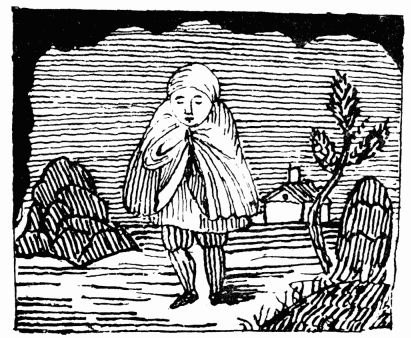
THE STRANGE MAN.
There was a man, tho’ it’s not very common, And as people say he was born of a woman; And, if it be true, as I have been told, He was once a mere infant, but age made him old. Derry down. His face was the oddest that ever was seen, His mouth stood across ’twixt his nose and his chin; Whenever he spoke it was then with his voice, And in talking he always made some sort of noise. Derry down. He’d an arm on each side to work when he pleased, But he never worked hard when he lived at his ease, Two legs he had got to make him complete, And what is more odd, at each end were his feet. Derry down. His legs, as folks say, he could move at his will, And when he was walking he never stood still, If you were to see him, you’d laugh till you burst, For one leg or the other would always be first. Derry down. And, as people say, if you gave him some meat, Why, if he was hungry, he surely would eat, And when he is dry, if you give him the pot, The liquor most commonly runs down his throat. Derry down. If this whimsical fellow had a river to cross, If he could not get over, he staid where he was, He seldom or ever got off the dry ground, So great was his luck, that he never was drowned. Derry down. Another misfortune befel this poor yeoman, For when he was married his wife was a woman, And if you’ll believe me tho’ he was revil’d, You may truly aver he was never with child. Derry down. And if it be true, as I have heard tell, When he was sick, he was not very well, He gave a large gasp, open’d his mouth so wide, And, by some means or other, this poor fellow died. Derry down. But the reason he died, and the cause of his death, Was owing, poor soul, to the want of more breath, And now he is left in the grave for to moulder, Had he lived a day longer, he’d have been a day older. Derry down.
A SIGHT FOR A FATHER.
What a pleasure it is to have a good wife, One that is steady and willing, To help and to comfort a man through his life, One who knows how to eke out a shilling. With my own little wife I can’t grumble at all, But my family’s a rummy lot, rather, Thirteen boys and girls I can count, great and small Now there’s a fine sight for a father! There’s Anna Maria, a young woman grown, How often I wish she would marry! She goes out every night (I can’t keep her at home) With a young chap who calls himself Harry. Out of doors, once, I bolted her tight, And on the door I put a bar there, But she said “Let me in, or I’ll stop out all night.” Now there was a sight for a father! Our Tom was so proud, he vowed he would be Either a Squire or a Knight, Sir, So to better his fortune he bolted from me, And for many years kept out of sight, sir. I stept in a shop to get shaved t’other day, And my face was covered with lather, When I found it was Tom who was scraping away, Now here was a sight for a father! On going home once, there was the devil to pay, My wife she was calling for water, From the neighbours I learnt some man ran away With Amelia, my good-looking daughter. My youngest girl Nance, on the very same day, Wrote a letter, which made me mad rather, To say she was in a particular way. Now here was a sight for a father! I’ve three great hulking boys, who in service won’t stop, They’re too lazy to earn their own victuals, They only seem happy when in the gin-shop, And I’m told they’re all sharpers at skittles. I get up every night to let in the dears, But as soon as they spy their mamma there, They jump into my bed, and I sleep on the chairs. Now there’s a fine sight for a father! There’s my last daughter Bet, the worst of them yet, Her heart must be hard as the path stones, For she’s run away with a queer-looking chap, Who goes about selling of hearth stones. With a bag on her back I met her once plump, (I couldn’t help wishing her farther) Crying out, “Hearth stones, a penny a lump.” Now here was a sight for a father! Now all married men, pray take my advice, And if you would keep your honest right, Sirs, Don’t let your daughters dress up over nice, Nor ramble out late of a night, Sirs. Keep your girls at their needles, your boys at their pens, I’ve bought my experience dear, rather, But be sure keep your girls away from the men, Or, there’ll be a fine sight for a father!
HUMOURS OF BARTLEMY FAIR.
Come bustle, neighbour Sprig, clap on your hat and wig, In our Sunday clothes so gaily, let us strut up the Old Bailey, O the devil take the rain, we may never go again, See the shows have begun, O rare O! Remember, Mr. Snip, to take care of Mrs. Snip, There’s a little boy from Flanders, and that ’ere’s Master Glanders, Stand aside, and we’ll have a stare, O! How full’s the fair, Lord Mayor, All is flurry, hurry, skurry, Girls squalling, showmen bawling, Cats throwing, trumpets blowing, Rattles springing, monkeys grinning, Rope dancing, horses prancing, Sausage frying, children crying, Dogs of knowledge, come from College, Slack wire, eating fire, Learned pigs of pigmy size, Funny clowns, ups and downs, Round about, all out, What a throng, all along, Politi’s show, all the go, Just in time, that is prime, To enjoy all the fun of the fair, O!
(Spoken) Vaulk up, ladies and gentlemen, here’s the vonderful birds and beastesses, just arrived from Bengal in the Vest Indies. Vhy, look marm, at this here beautiful hanimal; no less than two hundred spots on his belly, but no two alike and every vone different; it’s out of the power of any body to describe him. Well, positively, I never saw such a beautiful creature in my life. Did you, Sir? A very fine looking animal, ’pon my soul, mem. Master Showman, how long do you suppose he measures? Vhy! fifteen feet from the snout to the tail, and only twelve feet from the tail to the snout. He lives to the advanced age of one hundred years, grows a inch and a ’arf every hannual year, and never comes to his full growth. Stir him up with the long pole, keeper—only hear how he growls.
Here—here—the only booth in the fair for the greatest curiosity in all the known world,—the wonderful and surprising Hottentot Venus is here, who measures three yards and three quarters round her.
When the fair is at the full, in gallops a mad bull, Puts the rabble to the rout; lets all the lions out; Down falls Mrs. Snip, with a monkey on her hip, We shall all be swallowed up, I declare, O! Roaring boys, gilded toys, Lolloypps shilling hops, Tumble in, just begin, Cups and balls, wooden walls, Gin and bitters, apple fritters. Pudding nice, penny a slice; Shins of beef, stop thief! A bang up swing, just the thing, A dead dog, amongst the mob, Lost hats, squalling brats, Lost shoes, kangaroos, O, Polly, where’s Molly? Bow-wow, what a row Is kicked up in Bartlemy fair, O!
(Spoken) Here, here, show ’em up here, show ’em up here. Now’s your time, Ladies and Gentlemen—only twopence each, to see that surprising Conjuror, the emperor of all conjurors, who will forfeit the enormous sum of one hundred pounds to any one who shall perform the said wonders. Yes, ladies and gentlemen, I am no common sleight of hand man. The common sleight of hand man, they turn the things up their sleeves, and make you believe their fingers deceive your eyes. Now, Sir, you shall draw one card, two cards, three cards, four cards, half a dozen cards: you look on the card this side, you look on the card that side, and I say blow, by the abominable-ba-be-bo-fe-jacko-crack-oh-feltho-swiftly begone-quick-presto-passo-largo-mento-hi-coccolorum, the card is flown. Where is it gone to? that is the question. Be so kind, Sir, as to stop that there young woman from getting out of the crowd; I suppose she has got it under her garter. Come, come, young woman, bring it forward, bring it forward, and let me hold it up, that all the company may have a squint at it.
Now the beasts with angry tooth all attack the booth, Away affrighted run, birds and eagles of the sun, Down tumbled trot legg’d Molly, who tips him the hue hollow, Poor Card is in the mud, O, rare, O.
(Spoken) Here, here, vaulk up, ladies and gentlemen, here’s the wonderful Kangaroo, just arrived from Bottomless Bay. Here is the wonderful large baboon, that danced a padolo, and played at leap-frog with the celebrated Master Barintar. Here is the wonderful leopard-spotted tom cat, of the male species, which can as well see in the dark as without light. Here is the wonderful little marmoza monkey, just arrived from the Isle of Liliput: hold him up to the company, master keeper. O dear me, what a little beauty, to be sure, do let me stroke the dear little creature—la! la! how prodigious tame he is. Yes, marm, he’s always very tame to the ladies.