Miscellanea Curiosa. (continued 6)
Reading edition
Some think to illustrate this Descent of Heavy Bodies, by comparing it with the Vertue of the Loadstone; but setting aside the difference there is in the manner of their Attractions, the Loadstone drawing only in and about its Poles, and the Earth near equally in all Parts of its Surface, this Comparison avails no more than to explain ignotum per æque ignotum.
Others assign a certain Sympæthetical Attraction between the Earth and its Parts, whereby they have, as it were, a desire to be united, to be the Cause we enquire after: But this is so far from explaining the Modus, that it is little more, than to tell us in other Terms, that Heavy Bodies descend, because they descend.
This, I say, not that I can pretend to substitute any Solution of this Important Philosophical Problem, that shall more happily explicate the Appearances of Gravity; only it may be serviceable to those with whom the Credit of great Authors sways much, and who too readily assent in Verba Magistri, to let them see that their Books are not always infallible: Besides, the detection of Errors is the first and surest Step towards the discovery of Truth.
Though the efficient Cause of Gravity be so obscure, yet the final Cause thereof is clear enough; for it is by this single Principle, that the Earth and all the Cœlestial Bodies are kept from Dissolution; the least of their Particles not being suffer'd to recede far from their Surfaces, without being immediately brought down again by Virtue of this Natural Tendency; which, for their Preservation, the Infinite Wisdom of their Creator has ordained to be towards each of their Centers; nor can the Globes of the Sun and Planets otherwise be destroy'd, but by taking from them this Power of keeping their Parts united.
The Affections or Properties of Gravity, and its manner of acting upon Bodies falling, have been in a great measure discovered, and most of them made out by Mathematical Demonstration in this our Century, by the accurate diligence of Galilæus, Torricellius, Hugenius, and others, and now lately by our worthy Countryman, Mr. Isaac Newton, which Properties it may be very material here to enumerate, that they may serve for a Foundation to all those that shall be willing to spend their Thoughts in search of the true Cause of this Descent of Bodies.
The first Property is, That by this Principle of Gravitation, all Bodies do descend towards a Point, which either is, or else is very near to the Center of Magnitude of the Earth and Sea, about which the Sea forms it self exactly into a Spherical Surface, and the Prominences of the Land, considering the Bulk of the whole, differ but insensibly therefrom.
Secondly, That this Point or Center of Gravitation, is fix'd within the Earth, or at least has been so, ever since we have any Authentick History: For a Consequence of its Change, though never so little, would be the over-flowing of the low Lands on that side of the Globe towards which it approached, and the leaving new Islands bare on the opposite side, from which it receded; but for this Two Thousand Years it appears, that the low Islands of the Mediterranean Sea (near to which the ancientest Writers liv'd) have continued much at the same height above the Water, as they now are found; and no Inundations or Recesses of the Sea arguing any such Change, are recorded in History; excepting the Universal Deluge, which can no better way be accounted for, than by supposing this Center of Gravitation removed for a time, towards the middle of the then inhabited Parts of the World; and a change of its Place, but the Two Thousandth Part of the Radius of this Globe, were sufficient to bury the Tops of the highest Hills under Water.
Thirdly, That in all Parts of the Surface of the Earth, or rather in all Points equidistant from its Center, the Force of Gravity is nearly equal; so that the length of the Pendulum vibrating Seconds of Time, is found in all Parts of the World to be very near the same. 'Tis true at St. Helena, in the Latitude of 16 Degrees South, I found that the Pendulum of my Clock, which vibrated Seconds, needed to be made shorter than it had been in England, by a very sensible Space (but which at that time I neglected to observe accurately) before it would keep time; and since the like Observations have been made by the French Observers, near the Æquinoctial: Yet I dare not affirm, that in mine it proceeded from any other Cause, than the great Height of my Place of Observation above the Surface of the Sea, whereby the Gravity being diminished, the length of the Pendulum vibrating Seconds, is proportionably short'ned.
Fourthly, That Gravity does equally affect all Bodies, without regard either to their Matter, Bulk, or Figure; so that the Impediment of the Medium being removed, the most compact and most loose, the greatest and smallest Bodies would descend the same Spaces in equal Times; the Truth thereof will appear from the Experiment I before-cited. In these two last Particulars, is shewn the great difference between Gravity and Magnetism, the one affecting only Iron, and that towards its Poles, the other all Bodies alike in every part. As a Corollary, from hence it will follow, that there is no such thing as positive Levity, those things that appear light, being only comparatively so; and whereas several things rise and swim in Fluids, 'tis because, Bulk for Bulk, they are not so heavy as those Fluids; nor is there any Reason why Cork, for Instance, should be said to be light, because it swims on Water, any more than Iron, because it swims on Mercury.
Fifthly, That this Power increases as you descend, and decreases as you ascend from the Center, and that in the Proportion of the Squares of the Distances therefrom reciprocally, so as at a double Distance to have but a quarter of the Force; this Property is the Principle on which Mr. Newton has made out all the Phænomena of the Cœlestial Motions, so easily and naturally, that its Truth is past Dispute. Besides that, it is highly rational, that the attractive or gravitating Power should exert it self more vigorously in a small Sphere, and weaker in a greater, in proportion as it is contracted or expanded; and if so, seeing that the Surfaces of Spheres are as the Squares of their Radii, this Power, at several Distances, will be as the Squares of those Distances reciprocally; and then its whole Action upon each Spherical Surface, be it great or small, will be always equal. And this is evidently the Rule of Gravitation towards the Centers of the Sun, Jupiter, Saturn and the Earth, and thence is reasonably inferred, to be the general Principle observed by Nature, in all the rest of the Cœlestial Bodies.
These are the principal Affections of Gravity, from which the Rules of the Fall of Bodies, and the Motion of Projects are Mathematically deducible. Mr. Isaac Newton has shew'd how to define the Spaces of the Descent of a Body, let fall from any given height, down to the Center, supposing the Gravitation to increase, as in the fifth Property; but considering the smallness of heighth, to which any Project can be made ascend, and over how little an Arch of the Globe it can be cast by any of our Engines, we may well enough suppose the Gravity equal throughout, and the Descents of Projects in parallel Lines, which in Truth are towards the Center, the difference being so small as by no means to be discovered in Practice. The Opposition of the Air, 'tis true, is considerable against all light Bodies moving through it, as likewise against small ones (of which more hereafter) but in great and ponderous Shot, this Impediment is found by Experience but very small, and may safely be neglected.
Propositions concerning the Descent of Heavy Bodies, and the Motion of Projects.
Prop. I. The Velocities of Falling Bodies, are proportionate to the Times from the beginning of their Falls.
This follows, for that the Action of Gravity being continual, in every Space of Time, the falling Body receives a new Impulse, equal to what it had before, in the same Space of Time, received from the same Power: For Instance, in the first Second of Time, the falling Body has acquired a Velocity, which in that time would carry it to a certain Distance, suppose 32 Foot, and were there no new Force, would descend at that rate with an equable Motion: But in the next Second of Time, the same Power of Gravity continually acting thereon, superadds a new Velocity equal to the former; so that at the end of two Seconds, the Velocity is double to what it was at the end of the first, and after the same manner may it be proved to be triple, at the end of the third Second, and so on. Wherefore the Velocities of falling Bodies, are proportionate to the Time of their Falls, Q. E. D.
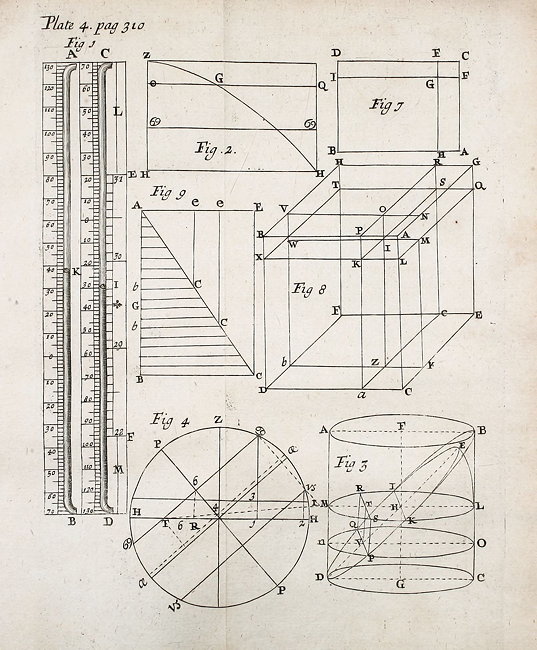
Plate 4. pag. 310.
Prop. II. The Spaces described by the Fall of a Body, are as the Squares of the Times, from the beginning of the Fall.
Demonstration. Let AB (Fig. 9. Tab. 4.) represent the Time of the Fall of a Body, BC perpendicular to AB, the Velocity acquired at the end of the Fall, and draw the Line AC; then divide the Line AB representing the Time, into as many equal Parts as you please, as b, b, b, b, &c. and through these Points draw the Lines bc, bc, bc, bc, &c. parallel to BC, 'tis manifest that the several Lines, bc, represent the several Velocities of the falling Body, in such Parts of the Time as Ab is of AB, by the former Proposition. It is evident likewise, that the Area ABC is the Sum of all the Lines bc being taken, according to the Method of Indivisibles, infinitely many; so that the Area ABC represents the Sum of all the Velocities, between none and BC supposed infinitely many; which Sum is as the Space descended in the Time represented by AB. And by the same Reason the Areas Abc, will represent the Spaces descended in the Times Ab; so then the Spaces descended in the Times AB, Ab, are as the Areas of the Triangles ABC, Abc, which by the 20th of the 6 of Euclid, are as the Squares of their Homologous Sides AB, Ab, that is to say, of the Times: Wherefore the Descents of falling Bodies, are as the Squares of the Times of their Fall, Q. E. D.
Prop. III. The Velocity which a falling Body acquires in any Space of time, is double to that, wherewith it would have moved the Space, descended by an equable Motion, in the same time.
Demonstration. Draw the Line EC parallel to AB, and AE parallel to BC in the same Fig. 9. and compleat the Parallelogram ABCE, it is evident that the Area thereof may represent the Space, a Body moved equably with the Velocity BC would describe in the Time AB, and the Triangle ABC represents the Space describ'd by the Fall of a Body, in the same Time AB, by the second Proposition. Now the Triangle ABC is half of the Parallelogram ABCE, and consequently the Space described by the Fall, is half what would have been described by an equable Motion with the Velocity BC, in the same Time; wherefore the Velocity BC at the end of the Fall, is double to that Velocity, which in the Time AB, would have described the Space fallen, represented by the Triangle ABC with an equable Motion, Q. E. D.
Prop. IV. All Bodies on or near the Surface of the Earth, in their Fall, descend so, as at the end of the first Second of Time, they have described 16 Feet, 1 Inch, London Measure, and acquired the Velocity of 32 Feet, 2 Inches, in a Second.
This is made out from the 25th Proposition of the second Part of that excellent Treatise of Mr. Hugenius de Horologio Oscillatorio; wherein he demonstrates the time of the least Vibrations of a Pendulum, to be to the Time of the Fall of a Body, from the heighth of half the length of the Pendulum, as the Circumference of a Circle to its Diameter; whence, as a Corollary, it follows, That as the Square of the Diameter to the Square of the Circumference, so half the length of the Pendulum vibrating Seconds, to the Space described by the Fall of a Body in a Second of Time: And the Length of the Pendulum vibrating Seconds, being found 39, 125, or ⅛ Inches, the Descent in a Second will be found by the aforesaid Analogy 16 Foot and 1 Inch; and, by the third Proposition, the Velocity will be double thereto; and near to this it hath been found by several Experiments, which by reason of the swiftness of the Fall, cannot so exactly determine its Quantity. The Demonstration of Hugenius being the Conclusion of a long Train of Consequences, I shall for brevity sake omit; and refer you to his Book, where these things are more amply treated of.
From these Four Propositions, all Questions concerning the Perpendicular Fall of Bodies, are easily solved, and either Time, Height, or Velocity being assign'd, one may readily find the other two. From them likewise is the Doctrine of Projects deducible, assuming the two following Axioms; viz. That a Body set a moving, will move on continually in a right Line with an equable Motion, unless some other Force or Impediment intervene, whereby it is accelerated, or retarded, or deflected.
Secondly, That a Body being agitated by two Motions at a time, does by their compounded Forces pass through the same Points, as it would do, were the two Motions divided and acted successively. As for Instance, Suppose a Body moved in the Line GF, (Fig. 1. Tab. 5.) from G to R, and there stopping, by another Impulse, suppose it moved in a Space of Time equal to the former, from R towards K, to V. I say, the Body shall pass through the Point to V, though these two several Forces acted both in the same time.
Prop. V. The Motion of all Projects is in the Curve of a Parabola: Let the Line GRF (in Fig. 1.) be the Line in which the Project is directed, and in which by the first Axiom it would move equal Spaces in equal Times, were it not deflected downwards by the Force of Gravity. Let GB be the Horizontal Line, and GC a Perpendicular thereto. Then the Line GRF being divided into equal Parts, answering to equal Spaces of Time, let the Descents of the Project be laid down in Lines parallel to GC, proportioned as the Squares of the Lines GS, GR, GL, GF, or as the Squares of the Times, from S to T, from R to V, from L to X, and from F to B, and draw the Lines TH, VD, XY, BC parallel to GF; I say, the Points T, V, X, B, are Points in the Curve described by the Project, and that that Curve is a Parabola. By the second Axiom, they are Points in the Curve; and the Parts of the Descent GH, GD, GY, GC, = to ST, RV, LX, FB, being as the Squares of the Times (by the Second Proposition) that is, as the Squares of the Ordinates, HT, DU, YX, BC, equal to GS, GR, GL, GF, the Spaces measured in those Times; and there being no other Curve but the Parabola, whose Parts of the Diameter are as the Squares of the Ordinates, it follows that the Curve describ'd by a Project, can be no other than a Parabola: And saying, as RU the Descent in any time, to GR or UD the direct Motion in the same time, so is UD to a third proportional; that third will be the Line call'd by all Writers of Conicks, the Parameter of the Parabola to the Diameter GC, which is always the same in Projects cast with the same Velocity: And the Velocity being defined by the Number of Feet moved in a Second of Time, the Parameter will be found by dividing the Square of the Velocity, by 16 Feet, 1 Inch, the Fall of a Body in the same Time.
Lemma.
The Sine of the double of any Arch, is equal to twice the Sine of that Arch into its Co-sine, divided by Radius; and the versed Sine of the double of any Arch is equal to twice the Square of the Sine thereof divided by Radius.
Let the Arch BC (in Fig. 2. Tab. 5.) be double the Arch BF, and A the Center; draw the Radii AB, AF, AC, and the Chord BDC, and let fall BE perpendicular to AC, and the Angle EBC, will be equal to the Angle ABD, and the Triangle BCE, will be like to the Triangle BDA; wherefore it will be as AB to AD, so BC or twice BD, to BE; that is, as Radius to Co-sine, so twice Sine to Sine of the double Arch. And as AB to BD, so twice BD or BC to EC, that is, as Radius to Sine, so twice that Sine, to the Versed Sine of the double Arch; which two Analogies resolved into Equations, are the Propositions contained in the Lemma to be proved.
Prop. VI. The Horizontal Distances of Projections made with the same Velocity, at several Elevations of the Line of Direction, are as the Sines of the doubled Angles of Elevation.
Let GB (Fig. 1) the Horizontal Distance be = z, the Sine of the Angle of Elevation, FGB, be = s, its Co-sine = c, Radius = r, and the Parameter = p. It will be as c to s; so z to sz⁄c = FB = GC, and by reason of the Parabola psz⁄c = to the Square of CB, or GF; Now as c to r, so is z to zr⁄c = GF, and its Square zzrr⁄cc will be therefore = to psz⁄c: Which Equation reduced will be psc⁄rr = z. But by the former Lemma 2sc⁄r is equal to the Sine of the double Angle, whereof s is the Sine: Wherefore 'twill be as Radius to Sine of double the Angle FGB, so is half the Parameter, to the Horizontal Range or Distance sought; and at the several Elevations, the Ranges are as the Sines of the double Angles of Elevation, Q. E. D.
Corollary.
Hence it follows, that half the Parameter is the greatest Randon, and that that happens at the Elevation of 45 Degrees, the Sine of whose double is Radius. Likewise that the Ranges equally distant above and below 45 are equal, as are the Sines of all double Arches, to the Sines of their doubled Complements.
Prop. VII. The Altitudes of Projections made with the same Velocity, at several Elevations, are as the versed Sines of the doubled Angles of Elevation: As c is to s; so is psc⁄rr = GB to pss⁄rr = BF: and UK = RU = BF/4, the Altitude of the Projection = psc⁄4rr. Now by the foregoing Lemma 2ss⁄r = to the versed Sine of the double Angle, and therefore it will be as Radius, to versed Sine of double the Angle FGB, so an 8th of the Parameter to the height of the Projection VK; and so these heights at several Elevations, are as the said versed Sines, Q. E. D.
Corollary.
From hence it is plain, that the greatest Altitude of the perpendicular Projection is a 4th of Parameter, or half the greatest Horizontal Range; the versed Sine of 180 Degrees being = 2r.
Prop. VIII. The Lines GF, or Times of the Flight of a Project cast with the same Degree of Velocity at different Elevations, are as the Sines of the Elevations.
As c is to r; so is psc⁄rr = GB by the 6 Prop. to ps⁄r GF; that is, as Radius to Sine of Elevation, so the Parameter to the Line GF; so the Lines GF are as the Sines of Elevation, and the Times are proportional to those Lines; wherefore the Times are as the Sines of Elevation: Ergo constat propositio.
Prop. IX. Problem. A Projection being made as you please, having the Distance and Altitude, or Descent, of an Object, through which the Project passes, together with the Angle of Elevation of the Line of Direction; to find the Parameter and Velocity, that is (in Fig. 1.) having the Angle FGB, GM, and MX.
Solution. As Radius to Secant of FGB, so GM the Distance given to GL; and as Radius to Tangent of FGB, so GM to LM. Then LM - MX in Heights, or + MX in Descents; or else MX - ML, if the Direction be below the Horizontal Line, is the Fall in the Time that the direct Impulse given in G would have carried the Project from G to L = LX = GY; then by Reason of the Parabola, as LX or GY, is to GL or YX, so is GL to the Parameter sought. To find the Velocity of the Impulse: by Prop. 2, and 4, find the Time in Seconds that a Body would fall the Space LX; and by that dividing the Line GL, the Quote will be the Velocity, or Space moved in a Second sought, which is always a mean Proportional between the Parameter, and 16 Feet, 1 Inch.
Prop. X. Problem 2. Having the Parameter, Horizontal Distance, and Height or Descent of an Object, to find the Elevations of the Line of Direction necessary to hit the given Object; that is, having GM, MX, and the greatest Randon equal to half the Parameter; to find the Angles FGB.
Let the Tangent of the Angle sought be = t, the Horizontal Distance GM = b, the Altitude of the Object MX = h, the Parameter = p, and Radius = r, and it will be,
As r to t, so b to tb⁄r = ML and tb⁄r ∓ h { in ascents } | {in descents} = LX, and
ptb⁄r ∓ ph = GL quad. = XY quad. ratione Parabolæ; but
bb ∓ ttbb⁄rr = GL quad. 47. 1. Euclid. Wherefore
ptb⁄r ∓ ph = bb ∓ ttbb⁄rr which Equation transposed, is
ttbb⁄rr = ptb⁄r ∓ ph - bb, divided by bb is tt⁄rr = pt⁄br ∓ ph⁄bb - 1.
this Equation shews the Question to have 2 Answers, and the Roots thereof are t⁄r = p⁄2b ∓ √ pp ∓ 4ph / 4bb - 1; from which I derive the following Rule.
Divide half the Parameter by the Horizontal distance, and keep the Quote; viz. p⁄2b then say, as square of the distance given to the half Parameter, so half Parameter ∓ double height | descent to the square of a Secant = pp ∓ 4ph / 4bb. The Tangent answering to that Secant, will be √ pp ∓ 4ph / 4bb - 1 or Square of Radius, so then the sum and difference of the afore-found Quote, and this Tangent will be the Roots of the Equation, and the Tangents of the Elevations sought.
Note here, that in Descents, if the Tangent exceed the Quote, as it does when ph is more than bb, the direction of the lower Elevation will be below the Horizon, and if ph = bb, it must be directed Horizontal, and the Tangent of the upper Elevation will be pr⁄b: Note likewise, that if 4bb + 4ph in Ascents, or 4bb - 4ph in Descents, be equal to pp, there is but one Elevation that can hit the Object, and its Tangent is pr⁄2b. And if 4bb + 4ph in Ascents, or 4bb - 4ph in descents, do exceed pp, the Object is without the reach of a Project cast with that Velocity, and so the thing impossible.
From this Equation 4bb ∓ 4ph = pp are determined the utmost limits of the reach of any Project, and the Figure assigned, wherein are all the heights upon each Horizontal distance beyond which it cannot pass; for by reduction of that Equation, h will be found = ¼p - bb⁄p in heights, and bb⁄p - ¼p in descents; from whence it follows, that all the Points h are in the Curve of the Parabola, whose Focus is the Point from whence the Project is cast, and whose Latus rectum, or Parameter ad Axem is = p. Likewise from the same Equation may the least Parameter or Velocity be found capable to reach the Object proposed; for bb = ¼pp ∓ ph being reduced, ½p will be = √ bb + hh ± h { in ascents } | {in descents} which is the Horizontal Range at 45 degrees, of a Project cast with the least Velocity that would just reach the Object, and the Elevation requisite will be easily had; for dividing the so found Semi-parameter by the Horizontal distance given b, the Quote into Radius will be the Tangent of the Elevation sought. This Rule may be of good use to all Bombardiers and Gunners, not only that they may use no more Powder than is necessary, to cast their Bombs into the place assigned, but that they may shoot with much more certainty, for that a small Error committed in the Elevation of the Piece, will produce no sensible Difference in the fall of the Shot: For which Reasons the French Engineers in their late Sieges have used Mortar-pieces inclin'd constantly to the Elevation of 45, proportioning their Charge of Pouder according to the distance of the Object they intend to strike on the Horizon.
And this is all that need to be said concerning this Problem of shooting upon Heights and Descents. But if a Geometrical Construction thereof be required; I think I have one that is as easy as can be expected, which I deduce from the foregoing Analytical Solution, viz. t⁄r = p⁄2b ± √ ¼pp ± ph - bb / bb , and 'tis this, having made the right Angle GDF, (Tab. 5. Fig. 3.) make DF = ½p, or greatest Range, and GD = b the Horizontal Distance, and DB = h the perpendicular heighth of the Object; to be laid upwards from D, if the Object be above the Horizon, or downwards if below it. Parallel to GD draw FA, and make it equal to GB the Hypothenusal Distance of the Object; and with the Center A and Radius FB = ½p ± h, sweep an Arch, which shall if the thing be possible, intersect the indeterminate Perpendicular DF in two Points K and L, to which draw the Lines, GL, GK; I say, the Angles DGK, DGL, are the Elevations requisite to strike the Object B.
Demonstration. The Square of FK or FL, is equal to FBq - GBq: or (½p ± h)2 - bb - hh or ¼pp ± ph - bb, and therefore √ ¼pp ± ph - bb is = FK = FL, and by Consequence DK, DL = ½p ± √ ½pp ± ph - bb . And as DG: DK and DL :: Radius: Tangents sought, which coincides with our Algebraical Expression thereof.
Prop. XI. To determine the Force or Velocity of a Project, in every Point of the Curve it describes.
To do this we need no other Præcognita, but only the third Proposition, viz. That the Velocity of falling Bodies, is double to that which in the same time, would have described the Space fallen by an equable Motion: For the Velocity of a Project, is compounded of the constant equal Velocity of the impressed Motion, and the Velocity of the Fall, under a given Angle, viz. the Complement of the Elevation: For Instance, in Fig. 2. in the time wherein a Project would move from G to L, it descends from L to X, and by the third Proposition has acquired a Velocity, which in that time would have carried it by an equable Motion from L to Z, or twice the Descent LX; and drawing the Line GZ, I say, the Velocity in the Point X, compounded of the Velocities GL and LZ under the Angle GLZ, is to the Velocity impress'd in the Point G, as GZ is to GL; this follows from our second Axiom, and by the 20 and 21 Prop. lib. 1. conic. Midorgii, XO parallel and equal to GZ shall touch the Parabola in the Point X. So that the Velocities in the several Points, are as the lengths of the Tangents to the Parabola in those Points, intercepted between any two Diameters: And these again are as the Secants of the Angles, which those Tangents continued make with the Horizontal Line GB. From what is here laid down, may the comparative Force of a Shot in any two Points of the Curve, be either Geometrically or Arithmetically discover'd.
Corollary.
From hence it follows, that the force of a Shot is always least at U, or the Vertex of the Parabola, and that at equal distances therefrom, as at T and X, G and B its force is always equal, and that the least force in U is to that in G and B, as Radius to the Secant of the Angle of Elevation FGB.
These Propositions considered, there is no question relating to Projects, which, by the help of them, may not easily be Solved; and tho' it be true that most of them are to be met withal, in Galileus, Torricellius and others, who have taken them from those Authors, yet their Books being Foreign, and not easy to come by, and their Demonstrations long and difficult, I thought it not amiss to give the whole Doctrine here in English, with such short Analytical Proof of my own, as might be sufficient to evince their Truth.
The Tenth Proposition contains a Problem, untouch'd by Torricellius, which is of the greatest use in Gunnery, and for the sake of which this Discourse was principally intended: It was first Solved by Mr. Anderson, in his Book of the Genuine Use and Effects of the Gun, Printed in the Year 1674; but his Solution required so much Calculation, that it put me upon search, whether it might not be done more easily, and thereupon in the Year 1678 I found out the Rule I now Publish, and from it the Geometrical Construction: Since which time there has a large Treatise of this Subject, Intituled, L'Art dejetter les Bombes, been Published by Monsieur Blondel, wherein he gives the Solutions of this Problem by Messieurs Buot, Romer and de la Hire: But none of them being the same with Mine, or, in my Opinion, more easy, and most of them more Operose, and besides mine finding the Tangent, which generally determines the Angle better than its Sine, I thought my self obliged to Print it for the use of all such, as desire to be informed in the Mathematical part of the Art of Gunnery.
Now these Rules were rigidly true, were it not, as I said before, for the Opposition of the Medium, whereby not only the direct imprest Motion is continually retarded, but likewise the increase of the Velocity of the Fall, so that the Spaces described thereby, are not exactly as the Squares of the Times: But what this Opposition of the Air is, against several Velocities, Bulks, and Weights, is not so easie to determine. 'Tis certain that the weight of Air to that of Water, is nearly as 1 to 800, whence the weight thereof, to that of any Project is given; 'tis very likely, that to the same Velocity and Magnitude, but of different Matter, the Opposition should be reciprocally as the weights of the Shot; as likewise that to Shot of the same Velocity and Matter, but of different Sizes, it should be as the Diameters reciprocally: Whence generally the Opposition to Shot with the same Velocity, but of differing Diameters, and Materials, should be as their Specifick Gravities into their Diameters reciprocally; but whether the Opposition, to differing Velocities of the same Shot, be as the Squares of those Velocities, or as the Velocities themselves, or otherwise, is yet a harder Question. However it be, 'tis certain, that in large Shot of Metal, whose weight many Thousand times surpasses that of the Air, and whose force is very great, in proportion to the Surface wherewith they press thereon; this Opposition is scarce discernable; For by several Experiments made with all Care and Circumspection with a Mortarpiece, Extraordinary well fix'd to the Earth on purpose, which carried a solid Brass Shot of four Inches and a half Diameter, and of about fourteen Pound Weight, the Ranges above and below forty five Degrees were found nearly equal; if there were any difference, the under Ranges went rather the farthest, but those differences were usually less than the Errors committed in ordinary Practice, by the unequal Goodness and Dryness of the same sort of Powder, by the Unfitness of the Shot to the Bore, and by the Loosness of the Carriage.
In a smaller Brass-Shot of about an Inch and half Diameter, cast by a Cross-Bow which ranged it, at most about four Hundred Foot, the Force being much more equal than in the Mortarpiece, this difference was found more Curiously: and Constantly and most Evidently, the under Ranges out-went the upper. From which Trials I conclude, that although in small and light Shot, the Opposition of the Air, ought and must be accounted for; yet in Shooting of great and weighty Bombs, there need be very little or no allowance made; and so these Rules may be put in practice to all Intents and Purposes, as if this Impediment were absolutely remov'd.
A Proposition of general Use in the Art of Gunnery, shewing the Rule of laying a Mortar to pass, in order to strike an Object above or below the Horizon.
It was formerly the Opinion of those concerned in Artillery, that there was a certain requisite of Powder for each Gun, and that in Mortars, where the distance was to be varied, it must be done by giving a greater or lesser Elevation to the Piece. But now our later Experience has taught us that the same thing may be more certainly and readily performed by increasing and diminishing the quantity of Powder, whether regard be had to the Execution to be done, or to the Charge of doing it. For when Bombs are discharged with great Elevations of the Mortar, they fall too Perpendicular, and bury themselves too deep in the Ground, to do all that damage they might, if they came more Oblique, and broke upon or near the Surface of the Earth; which is a thing acknowledg'd by the Besieged in all Towns, who unpave their Streets, to let the Bombs bury themselves, and thereby stifle the force of their Splinters. A Second Convenience is, that at the extream Elevation, the Gunner is not obliged to be so curious in the direction of his Piece, but it will suffice to be within a Degree or two of the Truth; whereas in the other Method of Shooting he ought to be very curious. But a Third, and no less considerable Advantage is, in the saving the Prince's Powder, which in so great and so numerous Discharges, as we have lately seen, must needs amount to a considerable Value. And for Sea-Mortars, it is scarce practicable otherwise to use them, where the agitation of the Sea continually changes the Direction of the Mortar, and would render the Shot very uncertain, were it not that they are placed about 45 Degrees Elevation, where several Degrees above or under, make very little difference in the Effect.
In the precedent Discourse, I considered all the Propositions relating to the Motion of Projectiles, and gave a Solution to this Problem; viz. To hit an Object above or below the Horizontal Line with the greatest Certainty and least Force. That is, that the Horizontal distance of the Object being put = b, and the Perpendicular Heighth = b, the Charge requisite to strike the Object with the greatest Advantage, was that which with an Elevation of 45° would cast the Shot on the Horizontal Line, to the distance of √ bb +hh , when the Object was above the Horizon; or if it were below it, the Charge must be lesser, so as to reach on the Horizon, at 45° Elevation, no greater a Distance than √ bb + hh - h; that is, in the one Case, the Sum of the Hypothenusal Distance of the Object from the Gun, and the Perpendicular Heighth thereof above the Gun; and in the other Case, when the Object is below the Horizon, the difference of the same per 47. I Eucl. And I then shew'd how to find the Elevation proper for the Gun so charged, viz. As the Horizontal Distance of the Object, to the Sum or Difference of the Hypothenusal Distance and Perpendicular Height: So Radius to the Tangent of the Elevation sought. But I was not at that time aware that the aforesaid Elevation did constantly bisect the Angle between the Perpendicular and the Object, as is demonstrated from the Difference and Sum of the Tangent and Secant of any Arch being always equal to the Tangent and Cotangent of the half Complement thereof to a Quadrant. Having discovered this, I think nothing can be more compendious, or bids fairer to compleat the Art of Gunnery, it being as easie to shoot with a Mortar at any Object on demand, as if it were on the Level; neither is there need of any Computation, but only simply laying the Gun to pass, in the middle Line between the Zenith and the Object, and giving it its due Charge. Nor is there any great need of Instruments for this purpose: For if the Muzzle of the Mortar be turned truly Square to the Bore of the Piece, as it usually is or ought to be, a piece of Looking-glass Plate applied parallel to the Muzzle, will by its Reflection give the true Position of the Piece, the Bombardeer having no more to do, but to look perpendicularly down on the Looking-glass, along a small Thread with a Plumbet, and to raise or depress the Elevation of the Piece, till the Object appear reflected on the same Point of the Speculum, on which the Plumbet falls; for the Angle of Incidence and Reflection being equal, in this Case a Line at Right Angles to the Speculum, as is the Axis of the Chase of the Piece, will bisect the Angle between the Perpendicular and the Object, according as our Proposition requires. So that it only remains by good and valid Experiments to be assured of the Force of Gunpowder, how to make and conserve it equal, and to know the Effect thereof in each Piece; that is, how far differing Charges will cast the same Shot out of it; which may most conveniently be engraven on the outside thereof, as a standing Direction to all Gunners, who shall from thence forward have occasion to use that Piece: And were this Matter well ascertained, it might be worth the while to make all Mortars of the like Diameter as near as may he, alike in length of Chase, Weight, Chamber, and all other Circumstances.
This Discovery that the utmost Range on an inclined Plane, is, when the Axis of the Piece makes equal Angles with the Perpendicular and the Object; compared with what I have demonstrated of the same Problem in the aforesaid Discourse does lead to and discover two very ready Theorems; the one, to find the greatest Horizontal Range at 45° Elevation, by any Shot made upon any inclined Plane, with any Elevation of the Piece whatsoever: And the other to find the Elevations proper to strike a given Object, with any Force greater than what suffices to reach it with the aforesaid middle Elevation. Both which being performed by one single Proportion, may be very serviceable to such as are concerned in the Practice of Gunnery, but are unwilling to trouble themselves with tedious and difficult Rules. The two Propositions are these.
PROP. I.
A Shot being made on an inclined Plane, having the Horizontal Distance of the Object it strikes, with the Elevation of the Piece, and the Angle at the Gun between the Object and the Perpendicular; to find the greatest Horizontal Range of that Piece, laden with the same Charge; that is, half the Latus rectum of all the Parabolæ made with the same Impetus.
RULE.
Take half the Distance of the Object from the Nadir, and take the Difference of the given Elevation from that half; the Versed Sine of twice that Difference subtract from the Versed Sine of the Distance of the Object from the Zenith: Then shall the Difference of those Versed Sines be to the Sine of the Distance of the Object from the Zenith, as the Horizontal Distance of the Object strook, to the greatest Horizontal Range at 45°.
PROP. II.
Having the greatest Horizontal Range of a Gun, the Horizontal Distance and Angle of Inclination of an Object to the Perpendicular, to find the two Elevations necessary to strike that Object.
RULE.
Halve the Distance of the Object from the Nadir; this half is always equal to the half Sum of the two Elevations we seek. Then say, As the greatest Horizontal Range is to the Horizontal Distance of the Object: So is the Sine of the Angle of Inclination or Distance of the Object from the Perpendicular, to a fourth Proportional; which fourth being subtracted from the Versed Sine of the Distance of the Object from the Zenith, leaves the Versed Sine of the Difference of the Elevations sought; which Elevations are therefore had by adding and subtracting the half Difference to and from the aforesaid half Sum.
I shall not need to speak of the Facility of these Solutions, I shall only observe that they are both General, without Exception or Caution, and derived from the Knowledge that these two Elevations are equidistant above and below the Line, bisecting the Angle between the Object and the Zenith.
A Discourse concerning the Measure of the Airs Resistance to Bodies moved in it. By the Learned John Wallis, S. T. D. and R. S. S.
THAT the Air (and the like of any other Medium) doth considerably give Resistance to Bodies moved in it; and doth thereby abate their Celerity and Force; is generally admitted. And Experience doth attest it: For otherwise, a Cannon Bullet projected Horizontally, should (supposing the Celerity and Force undiminished) strike as hard against a Perpendicular Wall, erected at a great distance, as near at hand; which we find it doth not.
2. But at what Rate, or in what Proportion, such Resistance is; and (consequently, at what Rate the Celerity and Force is continually diminished) seems not to have been so well examined. Whence it is, that the Motion of a Project (secluding this Consideration) is commonly reputed to describe a Parabolick Line; as arising from an Uniform or equal Celerity in the Line of Projection, and a Celerity uniformly accelerated in the Line of Descent; which two so compounded, do create a Parabola.
3. In order to the Computation hereof, I first premise this Lemma, (as the most rational that doth occur for my first footing,) That (supposing other things equal) the Resistance is proportional to the Celerity. For in a double Celerity, there is to be removed (in the same time) twice as much Air, (which is a double Impediment) in a treble, thrice as much; and so in other Proportions.
4. Suppose we then the Force impressed (and consequently the Celerity, if there were no Resistance) as 1; the Resistance as r. (which must be less than the Force, or else the Force would not prevail over the Impediment, to create a Motion.) And therefore the effective Force at a first Moment, is to be reputed as 1 - r: That is, so much as the Force impressed, is more than the Impediment or Resistance.
5. Be it as 1 - r to 1; so one to m. (which m is therefore greater than 1.)
6. And therefore the effective Force (and consequently the Celerity) as to a first Moment, is to be 1⁄m of what it would be, had there been no Resistance.
7. This 1⁄m is also the remaining Force after such first Moment; and this remaining Force is (for the same Reason) to be proportionally abated as to a second Moment; that is, we are to take 1⁄m thereof, that is 1⁄mm of the impressed Force. And for a third Moment (at equal distance of time) 1⁄mmm; for a fourth 1⁄m4; and so onward infinitely.
8. Because the length dispatched (in equal times) is proportional to the Celerities; the Lines of Motion (answering to those equal Times) are to be as 1⁄m, 1⁄m2, 1⁄m3, 1⁄m4, &c. of what they would have been, in the same Times, had there been no Resistance.
9. This therefore is a Geometrical Progression; and (because of m greater than 1) continually decreasing.
10. This decreasing Progression infinitely continued (determining in the same Point of Rest, where the Motion is supposed to expire) is yet of a finite Magnitude; and equal to 1 / m - 1, of what it would have been in so much Time, if there had been no Resistance. As is demonstrated in my Algebra, Chap. 95. Prop. 8. For (as I have elsewhere demonstrated) the Sum or Aggregate of a Geometrical Progression is VR - A / R - 1 (supposing V the greatest Term, A the least, and R the common Multiplier.) That is VR / R - 1 - A / R - 1. Now in the present Case, (supposing the Progression infinitely continued) the least Term A, becomes infinitely small, or = 0. And consequently A / R - 1 doth also vanish, and thereby the Aggregate becomes = VR / R - 1. That is (as will appear by dividing VR by R - 1;) V + V⁄R + V⁄RR + V⁄R3 + &c. = VR / R - 1[14]; (supposing the Progression to begin at V = 1.) That is (dividing all by R, that so the Progression may begin at V⁄R = 1⁄m:) V / R - 1 = V⁄R + V⁄RR + V⁄R3 + &c., That is, in our present Case (because of V = 1, & R = m:) 1⁄m + 1⁄mm + 1⁄m3 &c. = 1 / m - 1. That is, (putting n = m - 1) 1⁄n of what it would have been if there had been no Resistance.
11. This infinite Progression is fitly expressed by an Ordinate in the Exterior Hyperbola, parallel to one of the Asymptotes; and the several Members of that, by the several Members of this, cut in continual Proportion. As is there demonstrated at Prop. 15. For let SH, (vid. Fig. 4. Tab. 5.) be an Hyperbola between the Asymptotes AB, AF: And let the Ordinate DH (in the Exterior Hyperbola, parallel to AF,) represent the impressed Force undiminished; or the Line to be described in such time, by a Celerity answerable to such undiminished Force. And let BS (a like Ordinate) be 1⁄m thereof; which therefore, being less than DH (as being equal to a Part of it) will be farther than it from AF. In AB (which I put = 1) let Bd be such a Part thereof, as is BS of DH. Now because (as is, well known) all the inscribed Parallelograms, in the Exterior Hyperbola, AS, AH, &c. are equal; and therefore their sides reciprocal: Therefore as Ad = 1 - 1⁄m (supposing Bd to be taken, from B towards A,) to AB = 1, or as m - 1 to m: so is BS = 1⁄mDH, to dh, which is therefore equal to 1 / m - 1 of DH; that is (as will appear by dividing 1, by m - 1,) to 1⁄m + 1⁄mm + 1⁄m3, &c. of DH.[15]
Or if Bd be taken beyond B; then as Ad = 1 + 1⁄m to AB = 1, or as m + 1 to m, so is 1⁄m DH to dh, which is therefore equal to 1 / m + 1DH; that is (as will appear by like dividing of 1 by m + 1;) = to 1⁄m - 1⁄mm + 1⁄m3 - &c. of DH.
12. Let such ordinate dh, or (equal to it in the Asymptote) AF, be so divided in L, M, N, &c. (by Perpendiculars cutting the Hyperbola in l, m, n, &c.) as that FL, LM, MN, be as 1⁄m, 1⁄mm, 1⁄m3, &c. That is, so continually decreasing as that each Antecedent be to its Consequent, as 1 to 1⁄m, or as m to 1. See Fig. 5. Tab. 5.
13. This is done by taking AF, AL, AN, &c. in such proportion. For, of continual Proportionals, the Differences are also continually proportional, and in the same proportion. For let A, B, C, D, &c. be such Proportionals, and their Differences a, b, c, &c. That is, A - B = a, B - C = b, C - D = c, &c.
Then, because A, B, C, D, &c. are in continual proportion,
That is, A. B :: B. C :: C. D :: &c.
And dividing (A - B). B :: (B - C). C :: (C - D). D :: &c.
That is, a. B :: b. C :: d. D :: &c.
And alternly a. b. c. &c. :: B. C. D. &c. :: A. B. C. &c.
That is, in continual proportion as A to B, or as m to 1.
14. This being done; the Hyperbolick Spaces Fl, Lm, Mn, &c. are equal. As is demonstrated by Gregory San-Vincent; and as such is commonly admitted.
15. So that Fl, Lm, Mn, &c. may fitly represent equal Times, in which are dispatched unequal Lengths, represented by FL, LM, MN, &c.
16. And because they are in Number infinite (though equal to a finite Magnitude) the Duration is infinite: And consequently the impressed Force, and Motion thence arising, never to be wholly extinguished (without some further Impediment) but perpetually approaching to A, in the Nature of Asymptotes.
17. The Spaces Fl, Fm, Fn, &c. are therefore as Logarithms (in Arithmetical Progression increasing) answering to the Lines AF, AL, AM, &c. or to FL, LM, MN, &c. in Geometrical Progression decreasing.
18. Because FL, LM, MN, &c. are as 1⁄m, 1⁄mm, 1⁄m3, &c. (infinitely) terminated at A; therefore (by ¶ 10) their Aggregate FA or dh, is to DH, (so much Length as would have been dispatched, in the same time, by such impressed Force undiminished) as 1 to m - 1 = n.
19. If therefore we take, as 1 to n, so AF to DH; this will represent the Length to be dispatched, in the same time, by such undiminished Force.
20. And if such DH be supposed to be divided into equal Parts innumerable (and therefore infinitely small;) these answer to those (as many) Parts unequal in FA, or hd.
21. But, what is the Proportion of r to 1, or (which depends on it) of 1 - r to 1, or 1 to m; remains to be inquired by Experiment?
22. If the Progression be not infinitely continued; but end (suppose) at N, and its least Term be A = MN; then, out of V / R - 1 = 1⁄m + 1⁄mm + 1⁄m3, &c. is to be subducted A / R - 1 (as at ¶ 10.) that is (as by Division will appear) A⁄R + A⁄R2 + A⁄R3 &c. That is (in our present Case) a⁄m + a⁄mm + a⁄m3 &c. And so the Aggregate will be 1-a / m + 1-a / mm + 1-a / mmm &c. = 1-a / n.
And thus as to the Line of Projection, in which (secluding the Resistance) the Motion is reputed uniform; dispatching equal Lengths in equal Times. Consider we next the Line of Descent.
23. In the Descent of Heavy Bodies, it is supposed that to each Moment of Time, there is superadded a new Impulse of Gravity to what was before: And each of these, secluding the Consideration of the Air's Resistance, to proceed equally (from their several beginnings) through the succeeding Moments. As (in the erect Lines) 1 1 1 1, &c. 1 1 1, &c. 1 1, &c. 1, &c. and so continually, as in the Line of Projection.[16]
24. Hence ariseth (in the transverse Lines) for the first Moment 1, for the second 1 + 1, for the third 1 + 1 + 1, and so forth, in Arithmetical Progression: As are the Ordinates in a Triangle, at equal distance.
25. And such are the continual Increments of the Diameter, or of the Ordinates in the exterior Parabola, answering to the interior Ordinates, or Segments of the Tangent, equally increasing; as is known, and commonly admitted.
26. If we take in the Consideration of the Air's Resistance; we are then, for each of these equal Progressions, to substitute a decreasing Progression Geometrical; in like manner (and for the same Reasons) as in the Line of Projection.
27. Hence ariseth, for the first Moment 1⁄m; for the second 1⁄m + 1⁄m2; for the third 1⁄m + 1⁄m2 + 1⁄m3, &c.[17] And such is therefore the Descent of a heavy Body falling by its own weight. The several Impulses of Gravity being supposed equal.
28. That is (in the Figure of ¶ 12) as FL, FM, FN, &c. in the Line of Descent, answering to FL, LM, MN, &c. in the Line of Projection.
29. But though the Progressions for the Line of Projection, are like to each of those many in the Line of Descent; it is not to be thence inferred, that therefore 1⁄m in the one, is equal to 1⁄m in the other: But in the Line of Projection (suppose) 1⁄m f (such a Part of the Force impressed, and a Celerity answerable:) in the Line of Descent, 1⁄m g such a Part of the Impulse of Gravity.
30. Those for the Line of Descent (of the some Body) are all equal, each to other: Because g (the new Impulse of Gravity) in each Moment is supposed to be the same.
31. But what is the Proportion of f to g (that of the Force impressed, to the Impulse of Gravity in each Body) remains to be inquired by Experiment.
32. This Proportion being found as to one known Force; the same is thence known as to any other Force (whose Proportion to this is given) in the same uniform Medium.
33. And this being known, as to one Medium; the same is thence known as to any other Medium, the Proportion of whose Resistance to that of this is known.
34. If a heavy Body be projected downward in a perpendicular Line; it descends therefore at the Rate 1⁄m, 1⁄mm, 1⁄m3, &c. of f, (the impressed Force) increased by 1⁄m, 1⁄m + 1⁄m2, 1⁄m + 1⁄m2 + 1⁄m3, &c. of g the impulse of Gravity, (by ¶ 7, and ¶ 27) Because both Forces are here united.
35. If in a perpendicular Projection upwards; it ascends in the rate of the former, abated by that of the latter. Because here the impulse of Gravity is contrary to the Force impressed.
36. When therefore this latter (continually increasing) becomes equal to that former (continually decreasing) it then ceaseth to ascend; and doth thenceforth descend at the rate wherein the latter continually exceeds the former.
37. In an Horizontal, or Oblique Projection: If to a Tangent, whose Increments are as FL, LM, MN, &c. that is as 1⁄m f, &c. be fitted Ordinates (at a given Angle) whose Increments are as FL, FM, FN, &c. that is, as 1⁄m g, &c. The Curve answering to the Compound of these Motions, is that wherein the Project is to move.
38. This Curve (being hitherto without a Name) may be call'd Linea Projectorum; the Line of Projects, or things projected; which resembles a Parabola deform'd.
39. The Celerity and Tendency, as to each Point of this Line, is determined by a Tangent at that Point.
40. And that against which it makes the greatest Stroke or Percussion, is that which (at that Point) is at right Angles to that Tangent.
41. If the Projection (at ¶ 27) be not infinitely continued, but terminate (suppose) at N, so that the last Term in the first Column or Series erect be a; and consequently in the second, ma; in the third, mma, &c. (each Series having one Term fewer than that before it:) Then (for the same Reasons, as at ¶ 22) the Aggregates of the several Columns (or erect Series) will be 1-a / n, 1-ma / n, 1-mma / n, and so forth, till (the Multiple of a becoming = 1) the Progression expire.
42. Now all the Abatements here, a, ma, mma, &c. are the same with the Terms of the first Column taken backward. For a is the last, ma the next before it; and so of the rest.
43. And the Aggregate of all the Numerators is so many times 1, as is the Number of Terms (suppose t,) wanting the first Column; that is t - 1-a / n, or nt - 1 + a / n; and this again divided by the common Denominator n, becomes nt - 1 + a / nn. And therefore nt - 1 + a / nn g, is the Line of Descent by its own Gravity.
44. If therefore this be added to a projecting Force downward in a Perpendicular; or subducted from such projecting Force upward; that is, to or from 1-a / n f: The Descent in the first Case will be 1-a / n f + nt - 1 + a / nn g; and the Ascent in the other Case 1-a / n f - nt - 1 + a / nn g. And in this latter Case, when the ablative Part becomes equal to the positive Part, the Ascent is at the highest; and thenceforth (the ablative Part exceeding the positive) will descend.
45. In an Horizontal or Oblique Projection, having taken 1-a / n f, in the Line of Projection, and thence (at the Angle given) nt - 1 + a / nn g, in the Line of Descent; the Point in the Curve answering to these, is the Place of the Project answering to that Moment.
46. I am aware of some Objections to be made, whether to some Points of the Process, or to some of the Suppositions. But I saw not well how to wave it, without making the Computation much more perplex'd. And in a Matter so nice, and which must depend upon Physical Observations, 'twill be hard to attain such Accuracy, as not to stand in need of some Allowances.
47. Somewhat might have been farther added to direct the Experiments suggested at ¶ 21, and 31. But that may be done at leisure, after deliberation had, which way to attempt the Experiment.
48. The like is to be said of the different resistance which different Bodies may meet with in the same Medium, according to their different Gravities (extensively or intensively consider'd) and their different Figures and Positions in Motion. Whereof we have hitherto taken no account; but supposed them, as to all these, to be alike and equal.
POSTSCRIPT.
49. The Computation in ¶ 41, 42, 43, may (if that be also desired) be thus represented by Lines and Spaces. The Ablatives a, ma, mma, &c. (being the same with the first Column taken backward) are fitly represented by the Segments of NF (beginning at N) in Figure 5 and 6, and therefore by Parallelograms on these Bases, assuming the common height of Fh, or NQ; the Aggregate of which is Nh, or FQ. And, so many times 1, by so many equal Spaces, on the same Bases, between the same Parallels, terminated at the Hyperbola: The Aggregate of which is hFNQn. From whence if we subduct the Aggregate of Ablatives FY; the remaining Trilinear hQn, represents the Descent.
50. If to this of Gravity, be joined a projecting Force; which is to the Impulse of Gravity as hK to hF (be it greater, less, or equal) taken in the same Line; the same Parallels determine proportional Parallelograms, whose Aggregate is KQ.
51. And therefore if this be a perpendicular Projection downwards; then hKkn (the Sum of this with the former) represents the Descent.
52. If it be a Perpendicular upwards; then the difference of these two represents the Motion; which so long as KQ is the greater, is Ascendent; but Descendent, when hQn becomes greater; and it is then at the highest when they be equal.
53. If the Projection be not in the same Perpendicular, (but Horizontal, or Oblique) then KQ represents the Tangent of the Curve; and hQn the Ordinates to that Tangent, at the given Angle.
54. But the Computation before given, I take to be of better use than this Representation in Figure. Because in such Mathematical Enquiries, I choose to separate (as much as may be) what purely concerns Proportions; and consider it abstractly from Lines, or other Matter wherewith it is incumbred.
As to the Question proposed; whether the resistance of the Medium do not always take off such a proportional part of the Force moving through it, as is the specifick Gravity of the Medium to that of the Body moved in it: (For, if so, it will save us the trouble of Observation.)
I think this can by no means be admitted. For there be many other things of Consideration herein, beside the intensive Gravity (or, as some call it, the specifick Gravity) of the Medium.
A viscous Medium shall more resist, than one more fluid, though of like intensive Gravity.
And a sharp Arrow shall bore his way more easily through the Medium, than a blunt-headed Bolt, though of equal Weight, and like intensive Gravity.
And the same Pyramid with the Point, than with the Base forward.
And many other like Varieties, intended in my ¶ 48.
But this I think may be admitted, namely, That different Mediums, equally liquid, (and other Circumstances alike,) do in such proportion resist, as is their intensive Gravity. Because there is, in such proportion, a heavier Object to be removed, by the same Force. Which is one of the things to which ¶ 33 refers.
And again: The heavier Project once in Motion, (being equally swift, and all other Circumstances alike) moves through the same Medium in such proportion more strongly, as is its intensive Gravity. For now the Force is in such proportion greater, for the removal of the same resistance. And this Part of what my ¶ 32, insinuates.
But where there is a Complication of these Considerations one with another, and with many other Circumstances, whereof each is severally to be considered; there must be respect had to all of them.
An Instance of the Excellence of the Modern Algebra, in the Resolution of the Problem of finding the Foci of Optick Glasses Universally. By E. Halley, S. R. S.
THE Excellence of the Modern Geometry is in nothing more evident, than in those full and adequate Solutions it gives to Problems; representing all the possible Cases at one view, and in one general Theorem, many times comprehending whole Sciences; which deduced at length into Propositions, and demonstrated after the manner of the Ancients, might well become the Subjects of large Treatises: For whatsoever Theorem solves the most complicated Problem of the kind, does with a due Reduction reach all the subordinate Cases. Of this I now design to give a notable Instance in the Doctrine of Dioptricks.
This Dioptrick Problem is that of finding the Focus of any sort of Lens, exposed either to converging, diverging, or parallel Rays of Light, proceeding from, or tending to a given Point in the Axis of the Lens, be the Ratio of Refraction what it will, according to the Nature of the transparent Material whereof the Lens is formed, and also with allowance for the thickness of the Lens between the Vertices of the two Spherical Segments. This Problem being solved in one Case, mutatis mutandis, will exhibit Theorems for all the possible Cases, whether the Lens be Double-Convex or Double-Concave, Plano-Convex, or Plano-Concave, or Convexo-Concave, which sort are usually call'd Menisci. But this only to be understood of those Beams which are nearest to the Axis of the Lens, so as to occasion no sensible difference by their Inclination thereto; and the Focus here formed, is by Dioptrick Writers commonly call'd the principal Focus, being that of use in Telescopes and Microscopes.
Let then (in Fig. 7. Tab. 5.) BEβ be a double Convex Lens, C the Center of the Segment EB, and K the Center of the Segment Eβ, Bβ the thickness of the Lens, D a Point in the Axis of the Lens; and it is required to find the Point F, at which the Beams proceeding from the Point D, are collected therein, the Ratio of Refraction being as m to n. Let the distance of the Object DB = DA = d (the Point A being supposed the same with B, but taken at a distance therefrom, to prevent the coincidence of so many Lines) the Radius of the Segment towards the Object CB or CA = r, and the Radius of the Segment from the Object Kβ or K = ρ; and let Bβ the thickness of the Lens be = t, and then let the Sine of the Angle of Incidence DAG be to the Sine of the refracted Angle HAG or CAφ as m to n: And in very small Angles, the Angles themselves will be in the same proportion; whence it will follow that,
As d to r, so the Angle at C to the Angle at D, and d + r will be as the Angle of Incidence GAD; and again as m to n, so d + r to dn + rn / m, which will be as the Angle GAH = CAφ; This being taken from ACD which is as d, will leave m - nd - nr / m analogous to the Angle AφD; and the Sides being in this Case proportional to the Angles they subtend, it will follow, that as the Angle AφD is to the Angle ADφ, so is the Side AD or BD to Aφ or Bφ: That is, Bφ will be = mdr / m - nd - nr, which shews in what Point the Beams proceeding from D, would be collected by means of the first Refraction; but if nr cannot be subtracted from m - nd, it follows that the Beams after Refraction do still pass on diverging, and the Point φ is on the same side of the Lens beyond D. But if nr be equal to m - nd, then they proceed parallel to the Axis, and the Point φ is infinitely distant.
The Point φ being found as before, and Bφ - Bβ being given, which we will call δ, it follows by a Process like the former, that βF, or the focal Distance sought, is equal to δρn / m - δ + mρ = f. And in the room of δ substituting Bφ - Bβ = mdr / m - nd - nr - t, putting p for n / m - n, after due Reduction this following Equation will arise, mpdrρ - ndρt + nprρt / mdr + mdρ - mprρ - m - ndt + nrt = f. Which Theorem, however it may seem operose, is not so, considering the great Number of Data that enter the Question; and that one half of the Terms arise from our taking in the thickness of the Lens, which in most Cases can produce no great Effect; however it was necessary to consider it, to make our Rule perfect. If therefore the Lens consist of Glass, whose Refraction is as 3 to 2 'twill be 6drρ - 2dρt + 4rρt / 3dr + 3dρ - 6rρ - dt + 2rt = f. If of Water, whose Refraction is as 4 to 3, the Theorem will stand thus 12drρ - 3dρt + 9rρt / 4dr + 4dρ - 12rρ - dt + 3rt = f. If it could be made of Diamant, whose Refraction is as 5 to 2, it would be 10⁄3drρ - 2dρt + 4⁄3rρt / 5dr + 5dρ - 10⁄3rρ - 3dt + 2rt = f. And this is the universal Rule for the Foci of double Convex Glasses exposed to diverging Rays. But if the thickness of the Lens be rejected, as not sensible, the Rule will be much shorter, viz. pdrρ / dr + dρ - prt = f, or in Glass 2drρ / dr + dρ - 2rρ = f, all the Terms wherein t is found being omitted, as equal to nothing. In this Case, if d be so small, as that 2rρ exceed dr + dρ, then will it be - f, or the Focus will be Negative, which shews that the Beams after both Refractions still proceed diverging.
To bring this to the other Cases, as of converging Beams, or of Concave Glasses, the Rule is ever composed of the same Terms, only changing the Signs of + and -; for the distance of the Point of Concourse of converging Beams, from the Point B, or the first Surface of the Lens, I call a negative Distance or - d; and the Radius of a Concave Lens I call a negative Radius, or - r if it be the first Surface, and - ρ if it be the second Surface. Let then converging Beams fall on a double Convex of Glass, and the Theorem will stand thus - 2drρ / - dr - dρ - 2rt = + f, which shews that in this Case the Focus is always affirmative.
If the Lens were a Meniscus of Glass, exposed to diverging Beams, the Rule is - 2drρ / - dr + dρ + 2rρ = f, which is affirmative when 2rρ is less than dr - dρ otherwise negative: But in the Case of converging Beams falling on the same Meniscus, 'twill be + 2drρ / + dr - dρ + 2rp = f, and it will be + f, whilst dρ - dr is less than 2rρ; but if it be greater than 2rρ, it will always be found negative or - f. If the Lens be double Concave, the Focus of converging Beams is negative, where it was affirmative in the Case of diverging Beams on a double Convex, viz. - 2drρ / + dr + dρ - 2rρ = f, which is affirmative only when 2rρ exceeds dr + dρ: But diverging Beams passing a double Concave, have always a negative Focus, viz. - 2drρ / + dr + dρ + 2rρ = - f.
The Theorems for converging Beams, are principally of use to determine the Focus resulting from any sort of Lens placed in a Telescope, between the Focus of the Object-Glass and the Glass it self; the distance between the said Focus of the Object-Glass, and the interposed Lens being made = - d.
I here suppose my Reader acquainted with the Rules of Analytical Multiplication and Division, as that + multiplied by + makes the Product +, + by - makes -, and - by - makes +; so dividing + by + makes the Quote +, + by - makes -, and - by - makes +; which will be necessary to be understood in the preceding Examples.
In case the Beams are parallel, as coming from an infinite distance, (which is supposed in the Case of Telescopes) then will d be supposed Infinite, and in the Theorem pdρr / dr + dρ - prρ the Term prρ vanishes, as being finite, which is no part of the other infinite Terms; and dividing the Remainder by the infinite Part d, the Theorem will stand thus pρr / r + ρ = f, or in Glass, 2rρ / r + ρ = f.
In case the Lens were Plano-Convex exposed to diverging Beams, instead of pdρr / dr + dρ - prρ, r being infinite, it will be pdρ / d - pρ = f, or 2dρ / d - 2ρ if the Lens be Glass.
If the Lens be Double-Convex, and r be equal to ρ, as being formed of Segments of equal Spheres, then will pdρr / dr + dρ - prρ be reduced to pdr / 2d - pr f; and in case d be infinite, then it will yet be farther contracted to ½pr, and p being = n / m - n, the focal distance in Glass will be = r, in Water 1½r, but in Diamant ⅓r.
I am sensible that these Examples are too much for the compleat Analyst, though I fear too little for the less Skilful; it being very hard, if possible, in such Matters, so to write, as to give satisfaction to both; or to please the one, and instruct the other. But this may suffice to shew the extent of our Theorem, and how easie a Reduction adapts any one case to all the rest.
Nor is this only useful to discover the Focus from the other proposed data, but from the Focus given, we may thereby determine the distance of the Object; or from the Focus and Distance given, we may find of what Sphere it is requisite to take another Segment, to make any given Segment of another Sphere cast the Beams from the distance d to the Focus f. As likewise from the Lens, Focus, and Distance given, to find the Ratio of Refraction, or of m to n, requisite to answer those Data. All which it is obvious, are fully determined from the Equation we have hitherto used, viz. pdρr = drf + dρf - prρf, for to find d the Theorem is prρf / rf + ρf - pρr = d, the distance of the Object.
For ρ the Rule is drf / pdr + df + prf = ρ.
But for p will be drf + dρf / dρr + fρr = p, which latter determines the Ratio of Refraction, m being to n, as 1 + p to p.
I shall not expatiate on these Particulars, but leave them for the Exercise of those that are desirous to be informed in Optical Matters, which I am bold to say are comprehended in these three Rules, as fully as the most Inquisitive can desire them, and in all possible Cases; regard being had to the Signs + and -, as in the former Cases of finding the Focus. I shall only shew two considerable Uses of them; the one to find the distance whereat an Object being plac'd, shall by a given Lens be represented in a Species as large as the Object it self, which may be of singular Use in drawing Faces and other things in their true Magnitude, by transmitting the Species by a Glass into a dark Room, which will not only give the true Figure and Shades, but even the Colours themselves, almost as vivid as the Life. In this Case d is equal to f, and substituting d for f in the Equation, we shall have pdrρ = ddr + ddρ - dpρr, and dividing all by dprρ = dr + dρ - prρ, that is, 2prρ / r + ρ = d; but if the two Convexities be of the same Sphere so as r = ρ, then will the distance be = pr; that is, if the Lens be Glass = 2r, so that if an Object be placed at the Diameter of the Sphere distant, in this Case the Focus will be as far within as the Object is without, and the Species represented thereby will be as big as the Life; but if it were a Plano-Convex, the same distance will be = 2pr, or in Glass to four times the Radius of the Convexity; but of this Method I may entertain the Curious at some other Time, and shew how to magnifie or diminish an Object in any proportion assign'd, (which yet will be obvious enough from what is here deliver'd) as likewise how to erect the Object which in this Method is represented inverted.
A Second Use is to find what Convexity or Concavity is required, to make a vastly distant Object be represented at a given Focus, after the one Surface of the Lens is formed; which is but a Corollary of our Theorem for finding ρ, having p, d, r and f given; for d being infinite, that Rule becomes rf / pr - f = ρ, that is in Glass rf / 2r - f = ρ, whence if f be greater than 2r, ρ becomes Negative, and rf / f - 2r is the Radius of the Concave sought.
Those that are wholly to begin with this Dioptrical Science, cannot do better than to read with Attention a late Treatise of Dioptricks, published by W. Molineux, Esq, R. S. S. who has at large shewn the Nature of Optick Glasses, and the Construction and Use of Microscopes and Telescopes; and though some nicely Critical have endeavour'd to spy Faults, and to traduce the Book; yet having long since examin'd it with Care, I affirm, that if I can judge, it hath but two things that with any Colour may be call'd Faults; the one, an over-careful acknowledgment of every Trifle the Author had receiv'd from others; and the other that he labours to make easie this curious Subject, so little understood by most, in a manner perhaps too familiar for the Learned Critick, and which demonstrates that it was writ cum animo docendi, both which require but very little Friendship or good Nature in the Reader, to pass for Vertues in an Author.
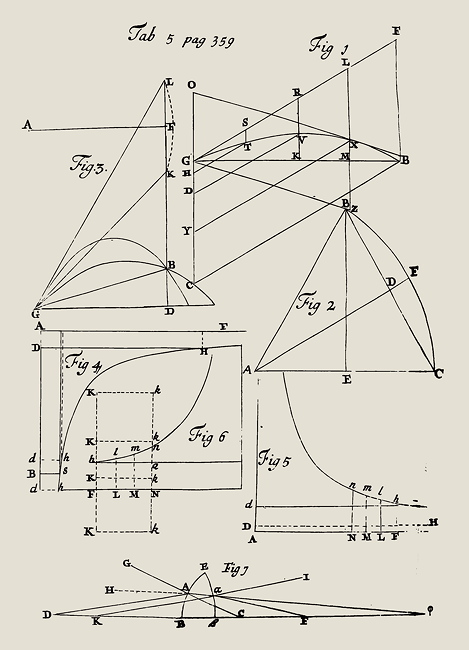
Tab. 5. pag. 359
But to return to our first Theorem, which accounting for the thickness of the Lens, we will here again resume, viz. mpdrρ - ndρt + nprρt / mdr + mdρ - mprρ - m - ndt + nrt = f.
And let it be required to find the Focus where a whole Sphere will collect the Beams proceeding from an Object at the distance d: Here t is equal to 2r, and r equal to ρ. And after due Reduction, the Theorem will stand thus, mpdr - 2ndr + 2nprr / 2nd + 2nr - mpr = f; but if d be Infinite, it is contracted to mpr / 2n - r = 2n - m / 2m - 2n r = f, wherefore a Sphere of Glass collects the Sun-Beams at half the Semi-diameter of the Sphere without it, and a Sphere of Water at a whole Semi-diameter. But if the Ratio of Refraction m to n be as 2 to 1, the Focus falls on the opposite Surface of the Sphere; but if it be of greater Inequality it falls within.
Another Example shall be when a Hemisphere is exposed to parallel Rays, that is, d and ρ being infinite, and t = r, and after due Reduction the Theorem results nn / mm - mn r = f. That is, in Glass it is at 4⁄3r, in Water at 9⁄4r; but if the Hemisphere were Diamant, it would collect the Beams at 14⁄15 of the Radius beyond the Center.
Lastly, As to the Effect of turning the two sides of a Lens towards an Object; it is evident, that if the thickness of the Lens be very small, so as that you neglect it, or account t = 0; then in all Cases the Focus of the same Lens, to whatsoever Beams, will be the same, without any difference upon the turning the Lens: But if you are so curious as to consider the thickness, (which is seldom worth accounting for) in the Case of parallel Rays falling on a Plano-Convex of Glass, if the plain side be towards the Object, t does occasion no difference, but the focal distance f = 2r. But when the Convex-side is towards the Object, it is contracted to 2r - ⅔t, so that the Focus is nearer by ⅔t. If the Lens be double Convex, the difference is less; if a Meniscus, greater. If the Convexity on both sides be equal, the focal length is about ⅙t shorter than when t = 0. In a Meniscus the Concave-side towards the Object increases the focal Length, but the Convex towards the Object diminishes it. A General Rule for the difference arising on turning the Lens, where the Focus is Affirmative, is this 2rt - 2ρt / 3r + 3ρ - t, for double Convexes of differing Spheres. But for Menisci the same difference becomes 2rt + 2ρt / 3r - 3ρ + t; of which I need give no other Demonstration, but that by a due Reduction it will so follow from what is premised, as will the Theorems for all sorts of Problems relating to the Foci of Optick-Glasses.