Miscellanea Curiosa. (continued 2)
Reading edition
Since this was written, a Discovery I have made in the Cœlestial Motions, seems to render a farther Account of the Use of the Cavity of the Earth, viz. To diminish the Specifick Gravity thereof, in respect of the Moon; for I think I can demonstrate that the Opposition of the Æther to the Motions of the Planets in long time becomes sensible; and consequently the greater Body must receive a less Opposition than the smaller, unless the Specifick Gravity of the smaller do proportionably exceed that of the greater, in which case only they can move together; so that the Cavity I assign in the Earth, may well serve to adjust its weight to that of the Moon, for otherwise the Earth would leave the Moon behind it, and she become another Primary Planet.
An Historical Account of the Trade Winds and Monsoons, observable in the Seas between and near the Tropicks, with an attempt to assign the Physical Cause of the said Winds, by Mr. Ed. Halley.
AN exact Relation of the constant and periodical Winds, observable in several Tracts of the Ocean, is a part of Natural History not less desireable and useful, than it is difficult to obtain, and its Phænomena hard to explicate: I am not ignorant that several Writers have undertaken this Subject, and although Varenius (Lib. 1. Chap. 21. Geo. Gen.) seems to have endeavour'd after the best information from Voyagers, yet cannot his Accounts be admitted for accurate, by those that shall attentively consider and compare them together, and some of them are most evident Mistakes; which, as near as I can, I shall attempt to rectify, having had the opportunity of conversing with Navigators, acquainted with all parts of India, and having liv'd a considerable time between the Tropicks, and there made my own Remarks.
The Substance of what I have collected is briefly as follows.
The Universal Ocean may most properly be divided into three Parts, viz. 1. The Atlantick and Æthiopick-Sea. 2. The Indian Ocean. 3. The Great South Sea, or the Pacifick Ocean; and though these Seas do all communicate by the South, yet as to our present purpose of the Trade Winds, they are sufficiently separated by the interposition of great Tracts of Land; the first lying between Africa and America, the second between Africa and the Indian Islands, and Hollandia Nova; and the last between the Phillipine Isles, China, Japan and Hollandia Nova on the West, and the Coast of America on the East. Now following this natural division of the Seas, so will we divide our History into three parts in the same order.
I. In the Atlantick and Æthiopick Seas between the Tropicks, there is a general Easterly Wind all the Year long, without any considerable Variation, excepting that it is subject to be deflected therefrom, some few Points of the Compass towards the North or South, according to the Position of the place. The Observations which have been made of these Deflections, are the following.
1. That near the Coast of Africa, as soon as you have pass'd the Canary Isles, you are sure to meet a fresh Gale of North East Wind, about the Latitude of 28 Degrees North, which seldom comes to the Eastwards of the East North-East, or passes the North North-East. This Wind accompanies those bound to the Southward, to the Latitude of ten North, and about a hundred Leagues from the Guinea Coast, where, till the fourth Degree of North Latitude, they fall into the Calms and Tornadoes; of which more hereafter.
2. That those bound to the Caribbee Isles, find, as they approach the American side, that the aforesaid North-East Wind becomes still more and more Easterly, so as sometimes to be East, sometimes East by South, but yet most commonly to the Northward of the East a Point or two, seldom more. 'Tis likewise observ'd, that the strength of these Winds does gradually decrease, as you sail to the Westwards.
3. That the limits of the Trade and variable Winds, in this Ocean, are farther extended on the American side than the African; for whereas you meet not with this certain Wind till after you have pass'd the Latitude of twenty eight Degrees on this side; on the American side it commonly holds to thirty, thirty one, or thirty two Degrees of Latitude; and this is verified likewise to the Southwards of the Æquinoctial, for near the Cape of Good-Hope the limits of the Trade Winds, are three or four Degrees nearer the Line, than on the Coast of Brazile.
4. That from the Latitude of four Degrees North, to the aforesaid Limits on the South of the Æquator, the Winds are generally and perpetually between the South and East, and most commonly between the South-East and East, observing always this Rule, That on the African side they are more Southerly, on the Brazilian more Easterly, so as to become almost due East, the little deflection they have being still to the Southwards. In this part of the Ocean it has been my fortune to pass a full Year, in an Employment that oblig'd me to regard more than ordinary the Weather, and I found the Winds constantly about the South-East, the most usual Point S E b E; when it was Easterly, it generally blew hard, and was gloomy, dark, and sometimes rainy Weather; if it came to the Southwards it was generally Serene, and a small Gale next to a Calm, but this not very common. But I never saw it to the Westwards of the South, or Northwards of the East.
5. That the Season of the Year has some small effect on these Trade Winds, for that when the Sun is considerable to the Northwards of the Æquator, the South-East Winds, especially in the Straight of this Ocean (if I may so call it) between Brazile and the Coast of Guinea, do vary a Point or two to the Southwards, and the North-East become more Easterly; and on the contrary, when the Sun is towards the Tropick of Capricorn the South-Easterly Winds become more Easterly, and the North-Easterly Winds on this side the Line veere more to the Northwards.
6. That as there is no general Rule that admits not of some Exception, so there is in this Ocean a Tract of Sea wherein the Southerly and South-West Winds are perpetual, viz. all along the Coast of Guinea, for above five hundred Leagues together, from Sierra Leona to the Isle of St. Thomas; for the South-East Trade Wind having pass'd the Line, and approaching the Coast of Guinea within eighty or 100 Leagues, inclines towards the Shore, and becomes S. S. E. and by Degrees, as you come nearer, it veeres about to South, S. S. W. and in with the Land South-West, and sometimes West South-West; which Variation is better express'd in the Mapp hereto annexed, (Vide Plate 2) than it can well be in Words. These are the Winds which are observ'd on this Coast when it blows true, but there are frequent Calms, violent sudden Gusts call'd Tornado's, from all Points of the Compass, and sometimes unwholsome foggy Easterly Winds, call'd Hermitaa by the Natives, which too often infest the Navigation of these parts.
7. That to the Northwards of the Line, between four and ten Degrees of Latitude, and between the Meridians of Cape Virde, and of the Eastermost Islands that bear that Name, there is a Tract of Sea wherein it were improper to say there is any Trade Wind, or yet a Variable; for it seems condemn'd to perpetual Calms, attended with terrible Thunder and Lightning, and Rains so frequent, that our Navigators from thence call this part of the Sea the Rains; the little Winds that are, be only some sudden uncertain Gusts, of very little Continuance and less Extent; so that sometimes each Hour you shall have a different Gale, which dies away into a Calm before another succeed, and in a Fleet of Ships in sight of one another, each shall have the Wind from a several Point of the Compass; with these weak Breezes Ships are oblig'd to make the best of their way to the Southward through the aforesaid six Degrees, wherein 'tis reported some have been detain'd whole Months for want of Wind.
From the three last Observables is shewn the Reason of two notable Occurents in the East-India and Guinea Navigations: The one is, why, notwithstanding the narrowest part of the Sea between Guinea and Brazile be about five hundred Leagues over, yet Ships bound to the Southward, sometimes, especially in the Months of July and August, find a great difficulty to pass it. This happens because of the South-East Winds, at that time of the Year commonly extending some Degrees beyond the ordinary limit of four Degrees North Latitude, and withal they come so much Southerly, as to be sometimes South, sometimes a Point or two to the West; there remains then only to ply to Windward, and if on the one side they stand away W. S. W. they gain the Wind still more and more Easterly; but there is danger of not weathering the Brazilian Shoar, or at least the Shoals upon that Coast. But if upon the other Tack they go away E. S. E. they fall into the Neighbourhood of the Coast of Guinea, from which there is no departing without running Easterly, as far as the Isle of St. Thomas, which is the constant practice of all the Guinea Ships, and which may seem very strange, without the consideration of the sixth Remark, which shews the Reason of it: For being in with the Coast, the Wind blows generally at S. W. and W. S. W. with which Winds they cannot go to the Northward for the Land; and on the other Tack they can lie no nearer the Wind than S. S. E. or South; with these Courses they run off the Shoar, but in so doing they always find the Winds more and more contrary; so that when near the Shoar they could lie South, at a greater distance they can make their way no better than S. E. and afterwards E. S. E. with which Courses they fetch commonly the Isle of St. Thomas and Cape Lopez, where finding the Winds to the Eastward of the South, they keep them favourable, by running away to the Westward in the South Latitude, of three or four Degrees, where the S. E. Winds are perpetual.
For the sake of these general Winds, all those that use the West-Indian Trade, even those bound to Virginia, count it their best Course to get as soon as they can to the Southwards, that so they may be certain of a fair and fresh Gale to run before it to the Westwards; and for the same Reason those homewards bound from America, endeavour to gain the Latitude of thirty Degrees, as soon as possible, where they first find the Winds begin to be variable; tho' the most ordinary Winds in the Northern part of the Atlantick Ocean come from between the South and West.
As to those furious Storms call'd Hurricanes, which are, as it were, peculiar to the Caribbee Isles; and which so dreadfully afflict them in the Month of August, or not much before or after, they do not so properly belong to this place, both by Reason of their small continuance and extent, as likewise because they are not Anniversary, some Years having more than one, and sometimes for several Years together there being none at all. But their Violence is so unconceivable, and their other Phænomena so surprising, that they merit well to be consider'd apart.
What is here said, is to be understood of the Sea Winds at some distance from the Land; for upon and near the Shoars, the Land and Sea Breezes are almost every where sensible; and the great Variety which happens in their Periods, Force and Direction, from the situation of the Mountains, Vallies and Woods, and from the various Texture of the Soil, more or less capable of retaining and reflecting Heat, and of exhaling or condensing Vapours, is such, that it were an endless task, to endeavour to account for them.
II. In the Indian Ocean, the Winds are partly general, as in the Æthiopick Ocean, partly Periodical; that is, half the Year they blow one way, and the other half near upon the opposite Points; and these Points and Times of shifting are different in different parts of this Ocean; the limits of each Tract of Sea, subject to the same Change or Monsoon, are certainly very hard to determine, but the diligence I have used to be rightly inform'd, and the care I have taken therein, has, in a great measure, surmounted that Difficulty; and I am perswaded that the following Particulars may be relied upon.
1. That between the Latitudes of ten Degrees and thirty Degrees South, between Madagascar and Hollandia Nova, the general Trade Wind about the S. E. by E. is found to blow all the Year long, to all Intents and Purposes after the same manner as in the same Latitudes in the Æthiopick Ocean, as it is describ'd in the fourth Remark aforegoing.
2. That the aforesaid S. E. Winds extend to within two Degrees of the Æquator, during the Months of June, July, August, &c. to November; at which time between the South Latitudes of three and ten Degrees, being near the Meridian of the North end of Madagascar, and between two and twelve South Latitude, being near Sumatra and Java, the contrary Winds from the N. W. or between the North and West, set in and blow for half the Year, viz. from the beginning of December till May; and this Monsoon is observ'd as far as the Molucca Isles, of which more anon.
3. That to the Northward of three Degrees South Latitude, over the whole Arabian or Indian-Sea and Gulph of Bengall, from Sumatra to the Coast of Africa, there is another Monsoon, blowing from October to April upon the North East Points; but in the other half Year, from April to October, upon the opposite Points of S. W. and W. S. W. and that with rather more force than the other, accompanied with dark rainy Weather, whereas the N. E. blows clear; 'tis likewise to be noted, that the Winds are not so constant, either in strength or point in the Gulph of Bengall, as they are in the Indian-Sea, where a certain and steady Gale scarce ever fails. 'Tis also remarkable, that the S. W. Winds in these Seas are generally more Southerly on the African side, more Westerly on the Indian.
4. That as an Appendix to the last describ'd Monsoon, there is a Tract of Sea to the Southwards of the Æquator, subject to the same Changes of the Winds, viz. near the African Coast, between it and the Island Madagascar or St. Lawrence, and from thence Northwards as far as the Line; wherein from April to October there is found a constant fresh S. S. W. Wind, which, as you go more Northerly, becomes still more and more Westerly, so as to fall in with the W. S. W. Winds, mention'd before, in those Months of the Year to be certain to the Northward of the Æquator: What Winds blow in these Seas, for the other half Year, from October to April, I have not yet been able to obtain to my full satisfaction, for that our Navigators always return from India without Madagascar, and so are little acquainted in this Matter; the Account that has been given me is only this, that the Winds are much Easterly hereabouts, and as often to the North of the true East as to the Southwards thereof.
5. That to the Eastward of Sumatra and Malacca, to the Northwards of the Line, and along the Coast of Cambodia and China, the Monsoons blow North and South, that is to say, the N. E. Winds are much Northerly, and the S. W. much Southerly: This Constitution reaches to the Eastwards of the Philippine Isles, and as far Northerly as Japan. The Northern Monsoon setting in, in these Seas, in October or November, and the Southern in May, blowing all the Summer Months: Here it is to be noted, That the Points of the Compass, from whence the Wind comes in these Parts of the World, are not so fixt as in those lately describ'd; for the Southerly will frequently pass a Point or two to the Eastwards of the South, and the Northerly as much to the Westwards of the North, which seems occasion'd by the great quantity of Land, which is interspers'd in these Seas.
6. That in the same Meridians, but to the Southwards of the Æquator, being that Tract lying between Sumatra and Java to the West, and New Guinea to the East, the same Northerly Monsoons are observ'd, but with this difference, that the inclination of the Northerly is towards the N. West, and of the Southerly towards the S. E. but the plagæ venti are not more constant here than in the former, viz. variable five or six Points; besides the times of the Change of these Winds, are not the same as in the Chinese Seas, but about a Month or six Weeks later.
7. That these contrary Winds do not shift all at once, but in some places the time of the Change is attended with Calms, in others with variable Winds; and it is particularly remarkable, that the end of the Westerly Monsoon on the Coast of Coromandel, and the two last Months of the Southerly Monsoon in the Seas of China, are very subject to be tempestuous: The violence of these Storms is such, that they seem to be of the Nature of the West-India Hurricanes, and render the Navigation of these parts very unsafe about that time of the Year. These Tempests are by our Seamen usually term'd, The breaking up of the Monsoons.
By reason of the shifting of these Winds, all those that sail in these Seas, are oblig'd to observe the Seasons proper for their Voyages, and so doing they fail not of a fair Wind and speedy Passage; but if so be they chance to out-stay their time, till the contrary Monsoon sets in, as it frequently happens, they are forc'd to give over the hopes of accomplishing their intended Voyages, and either return to the Port from whence they came, or else put in to some other Harbour, there to spend the time till the Winds shall come favourable.
III. The third Ocean call'd Mare Pacificum, whose Extent is equal to that of the other two (it being from the West Coast of America to the Philippine Islands, not less than 150 Degrees of Longitude) is that which is least known to our own or the Neighbour Nations; that Navigation that there is on it, is by the Spaniards, who go Yearly from the Coast of New Spain to the Manilha's, but that but by one beaten track; so that I cannot be so particular here as in the other two. What the Spanish Authors say of the Winds they find in their Courses, and what is confirm'd by the old Accounts of Drake and Cavendish; and since by Schooten, who sail'd the whole breadth of this Sea in the Southern Latitude of fifteen or sixteen Degrees, is, that there is a great conformity between the Winds of this Sea, and those of the Atlantick and Æthiopick; that is to say, that to the Northwards of the Æquator, the predominant Wind is between the East and North-East; and to the Southwards thereof there is a constant steady Gale between the East and South-East, and that on both sides the Line with so much constancy, that they scarce ever need to attend the Sails, and Strength, that it is rare to fail of crossing this vast Ocean in ten Weeks time, which is about 130 Miles per diem; besides, 'tis said that Storms and Tempests are never known in these parts: So that here is the very best of Sailing; no want of a fresh fair Wind, and yet no danger of having too much: Wherefore some have thought it might be as short a Voyage to Japan and China, to go by the Streights of Magellan, as by the Cape of Good Hope.
The Limits of these general Winds are also much the same as in the Atlantick Sea, viz. about the thirtieth Degree of Latitude on both sides; for the Spaniards homewards bound from the Manilha's, always take the advantage of the Southerly Monsoon, blowing there in the Summer Months, and run up to the Northwards of that Latitude, as high as Japan, before they meet with variable Winds, to shape their Course to the Eastwards. And Schooten and others that have gone about by the Magellan Streights, have found the Limits of S. E. Winds, much about the same Latitude to the Southwards; besides a farther Analogy between the Winds of this Ocean, and the Æthiopick, appears in that, upon the Coast of Peru, they are always much Southerly, like as they are found near the Shoars of Angola.
Thus far Matter of Fact, wherein if the information I have receiv'd be not in all parts Accurate, it has not been for want of inquiry from those I conceiv'd best able to instruct me; and I shall take it for a very great Kindness if any Master of a Ship, or other Person, well inform'd of the Nature of the Winds, in any of the aforemention'd parts of the World, shall please to communicate their Observations thereupon; so that what I have here Collected may be either confirm'd or amended, or by the addition of some material Circumstances enlarg'd. It is not the work of one, nor of few, but of a multitude of Observers, to bring together the Experience requisite to compose a perfect and compleat History of these Winds; however I am not much doubtful that I have err'd in, or omitted any of the principal Observables, whatever lesser Particulars may have escaped my Knowledge.
To help the Conception of the Reader in a manner of so much difficulty, I believ'd it necessary to adjoin a Scheme, (Plate 2.) shewing at one view all the various Tracts and Courses of these Winds; whereby 'tis possible the thing may be better understood, than by any verbal Description whatsoever.
The Limits of these several Tracts are design'd every where by prickt Lines, as well in the Atlantick and Æthiopick, where they are the boundaries of the Trade and variable Winds, as in the Indian Ocean, where they also shew the Extent of the several Monsoons. I could think of no better way to design the Course of the Winds on the Map, than by drawing rows of stroaks in the same Line that a Ship would move going always before it; the sharp end of each little stroak pointing out that part of the Horizon, from whence the Wind continually comes; and where there are Monsoons, the rows of the stroaks run alternately backwards and forwards, by which means they are thicker there than elsewhere. As to the great South Sea, considering its vast Extent, and the little Variety there is in its Winds, and the great Analogy between them, and those of the Atlantick and Æthiopick Oceans; besides, that the greatest part thereof is wholly unknown to us; I thought it unnecessary to lengthen the Map therewith.
In the foregoing History are contained several Problems, that merit well the Consideration of our acutest Naturalists, both by reason of the constancy of the Effect, and of the immense Extent thereof; near half the Surface of the Globe being concerned. The chief of these Problems are, 1. Why these Winds are perpetually from the East in the Atlantic and Æthiopick; as likewise in the Pacifick Ocean, between the Latitudes of 30 North and South? 2. Why the said Winds extend no farther with constancy than to the Latitude of 30 Degrees? 3. Why there should be a constant South-Westerly Wind upon and near the Coast of Guinea? 4. Why in the North part of the Indian Ocean, the Winds, which for one half Year do agree with those of the other two Oceans, should change in other half Year, and blow from the opposite Points; whilst the Southern part of that Ocean follows the General Rule, and has perpetual Winds about S. E? 5. Why in these General Trade-Winds it should be always true, that to the Northward of the Æquator it is inclin'd to the Northwards of the East; and in South Latitudes, to the Southward thereof? 6. Why in these Seas of China there should be so great an Inclination from the East to the North, more than elsewhere? with many more, which it would be much easier to propose than answer.
But lest I should seem to propose to others, Difficulties which I have not thought worth my own Time and Pains, take here the result of an earnest Endeavour after the true reason of the aforesaid Phænomena; wherein if I am not able to account for all Particulars, yet 'tis hoped the Thoughts I have spent thereon, will not be judged wholly lost, by the Curious in Natural Enquiries.
Wind is most properly defined to be the Stream or Current of the Air, and where such a Current is perpetual and fixt in its Course, 'tis necessary that it proceed from a permanent un-intermitting Cause. Wherefore some have been inclin'd to propose the diurnal Rotation of the Earth upon its Axis, by which, as the Globe turns Eastwards, the loose and fluid Particles of the Air, being so exceeding light as they be, are left behind, so that in respect of the Earths Surface they move Westwards, and become a constant Easterly Wind. This Opinion seems confirm'd, for that these Winds are found only near the Æquinoctial, in those Parallels of Latitude where the diurnal Motion is swiftest; and I should readily assent to it, if the constant Calms in the Atlantick Sea, near the Æquator, the Westerly Winds near the Coast of Guinea; and the Periodical Westerly Monsoons under the Æquator in the Indian Seas, did not declare the insufficency of that Hypothesis. Besides the Air being kept to the Earth by the Principle of Gravity, would acquire the same degree of Velocity that the Earths Surface moves with, as well in respect of the diurnal Rotation, as of the Annual about the Sun, which is about thirty times swifter.
It remains therefore to substitute some other Cause, capable of producing a like constant Effect, not liable to the same Objections, but agreeable to the known Properties of the Elements of Air and Water, and the Laws of the Motion of fluid Bodies. Such an one is, I conceive, the Action of the Sun Beams upon the Air and Water, as he passes every Day over the Oceans, consider'd together with the Nature of the Soil, and Situation of the adjoining Continents: I say therefore, first, that according to the Laws of Staticks, the Air which is less rarified or expanded by heat, and consequently more ponderous, must have a Motion towards those parts thereof, which are more rarified, and less ponderous, to bring it to an Æquilibrium; and secondly, That the Presence of the Sun continually shifting to the Westwards, that part towards which the Air tends, by reason of the Rarifaction made by his greatest Meridian Heat, is with him carried Westward, and consequently the tendency of the whole Body of the lower Air is that way.
Thus a general Easterly Wind is formed, which being impressed upon all the Air of a vast Ocean, the Parts impel one the other, and so keep moving till the next return of the Sun, whereby so much of the Motion as was lost, is again restored, and thus the Westerly Wind is made perpetual.
From the same Principle it follows, that this Easterly Wind should on the North side of the Æquator, be to the Northwards of the East, and in South Latitudes to the Southwards thereof; for near the Line, the Air is much more rarified, than at a greater distance from it; because of the Sun twice in a Year Vertical, and at no time distant above 23 Degr. and a half; at which distance the Heat, being as the Sine of the Angle of Incidence, is but little short of that of the perpendicular Ray. Whereas under the Tropicks, though the Sun stay long Vertical, yet he is as long 47 Degr. off; which is a kind of Winter, wherein the Air so cools, as that the Summer-heat cannot warm it to the same degree with that under the Æquator. Wherefore the Air to the Northwards and Southwards, being less rarified than that in the middle, it follows, that from both sides it ought to tend towards the Æquator: This Motion compounded with the former Easterly Wind, answers all the Phænomena of the general Trade-winds; which, if the whole Surface of the Globe were Sea, would undoubtedly blow all round the World, as they are found to do in the Atlantick, and Æthiopick Oceans.
But seeing that so great Continents do interpose, and break the continuity of the Oceans, regard must be had to the Nature of the Soil, and the Position of the high Mountains, which I suppose the two principal Causes of the several Variations of the Winds, from the former general Rule: For if a Country lying near the Sun, prove to be flat, sandy, low Land, such as the Desarts of Lybia are usually reported to be, the Heat occasion'd by the Reflection of the Suns Beams, and the retention thereof in the Sand, is incredible to those that have not felt it; whereby the Air being exceedingly rarified, it is necessary that the cooler and more dense Air should run thitherwards to restore the Æquilibrium: This I take to be the cause, why near the Coast of Guinea the Wind always sets in upon the Land, blowing Westerly instead of Easterly, there being sufficient Reason to believe, that the Inland Parts of Africa are prodigiously hot, since the Northern Borders thereof were so intemperate, as to give the Ancients cause to conclude, that all beyond the Tropick, was made uninhabitable by excess of Heat: From the same Cause it happens, that there are so constant Calms in that part of the Ocean, called the Rains, (described in the 7th Remark on the Atlantick Sea) for this Tract being placed in the middle, between the Westerly Winds blowing on the Coast of Guinea, and the Easterly Trade-winds, blowing to the Westwards thereof, the tendency of the Air here, is indifferent to either, and so stands in Æquilibrio between both; and the weight of the incumbent Atmosphere being diminished by the continual contrary Winds blowing from hence, is the reason that the Air here holds not the copious Vapour it receives, but lets it fall into frequent Rains.
But as the cool and dense Air, by reason of its greater Gravity, presses upon the hot and rarified, 'tis demonstrative that this latter must ascend in a continued Stream as fast it rarifies; and that being ascended, it must disperse it self to preserve the Æquilibrium: that is, by a contrary Current, the upper Air must move from those Parts where the greatest Heat is: So by a kind of Circulation, the North-East Trade-Wind below, will be attended with a South-Westerly above, and the South-Easterly with a North-West Wind above; that this is more than a bare Conjecture, the almost instantaneous Change of the Wind to the opposite Point, which is frequently found in passing the limits of the Trade-winds, seems to assure us; but that which above all confirms this Hypothesis is the Phænomenon of the Monsoons, by this means most easily solved, and without it hardly explicable.
Supposing therefore such a Circulation, as above, 'tis to be considered that to the Northward of the Indian Ocean there is every where Land within the usual limit of the Latitude of 30, viz. Arabia, Persia, India, &c. which for the same reason as the Mediterranean Parts of Africa, are subject to unsufferable Heats when the Sun is to the North, passing nearly Vertical; but yet are temperate enough when the Sun is removed towards the other Tropick; because of a ridge of Mountains at some distance within the Land, said to be frequently in Winter cover'd with Snow, over which the Air, as it passes, must needs be much chill'd. Hence it comes to pass, that the Air coming according to the general Rule, out of the N. E. in the Indian Seas, is sometimes hotter, sometimes colder, than that which by this Circulation is return'd out of the S. W. and by consequence, sometimes the under Current or Wind, is from the N. E. sometimes from the S. W.
That this has no other Cause, is clear from the times wherein these Winds set in, viz. in April, when the Sun begins to warm those Countries to the North, the S. W. Monsoon begins, and blows during the Heats till October; when the Sun being retir'd, and all things growing cooler Northward, and the Heat increasing to the South, the North-East Winds enter and blow all the Winter till April again. And it is undoubtedly from the same Principle that to the Southwards of the Æquator, in part of the Indian Ocean, the North-West Winds succeed to the South-East, when the Sun draws near the Tropick of Capricorn; but I must confess, that in this latter occurs a difficulty, not well to be accounted for, which is, why this Change of the Monsoons should be any more in this Ocean, than in the same Latitudes in the Æthopick, where there is nothing more certain than a S. E. Wind all the Year.
'Tis likewise very hard to conceive why the limits of the Trade-wind should be fixt, about the thirtieth Degree of Latitude all round the Globe; and that they should so seldom transgress or fall short of those bounds; as also that in the Indian Sea, only the Northern Part should be subject to the changeable Monsoons, and in the Southern there be a constant S. E.
These are Particulars that merit to be consider'd more at large, and furnish a sufficient Subject for a just Volume, which will be a very commendable Task for such, who being us'd to Philosophick Contemplation, shall have leisure to apply their serious Thoughts about it.
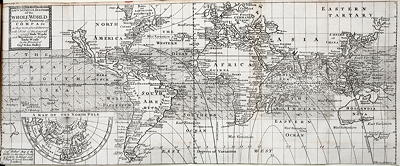
Plate 2 pag. 80
A new & Correct Sea chart of the whole World Shewing the Variations of ye COMPASS as they were found Año 1700 with a View of the Generall and Coasting Trade Winds and Monsoons or shifting Trade Winds by the Direction of Capt. Edm. Halley.
A Discourse of the Rule of the Decrease of the height of the Mercury in the Barometer, according as Places are elevated above the Surface of the Earth; with an Attempt to discover the true Reason of the Rising and Falling of the Mercury, upon Change of Weather. By Edm. Halley.
THE Elastick Property of the Air has been long since made out, by Experiments before the Royal Society, and elsewhere; and the Resistance of its Spring is found to be nearly equal to the Weight or Force that compresses it; as also, that the Spaces the same Air occupies, under differing Pressures, are reciprocally as those Pressures: It has been shewn likewise by undoubted Experiment, that the specifick Gravity of the Air, near the Earth's Surface to that of Water, was once as 1 to 840; again as 1 to 852; and a third time, in a very large Vessel holding 10 Gallons, as 1 to 860; all which, considering the Difficulty of the Experiment, agree well enough, the Mercury standing at all those times about 29 Inches ¾: But by Reason 'twas Summer-weather, and consequently the Air rarified, when all these were tried, we may without sensible Error say in round numbers, that the Barometer standing at 30 Inches, and in a mean State of Heat and Cold, the specifick Gravity of the Air to Water, is as 1 to 800. By the like Trials the weight of Mercury to Water, is as 13½ to 1, or very near it; so that the weight of Mercury to Air, is as 10800 to 1; and a Cylinder of Air of 10800 Inches or 900 Feet, is equal to an Inch of Mercury; and were the Air of an equal density like Water, the whole Atmosphere would be no more than 5,1 Miles high, and in the Ascent of every 900 Feet the Barometer would sink an Inch. But the Expansion of the Air increasing in the same proportion as the incumbent weight of the Atmosphere decreases; that is, as the Mercury in the Barometer sinks; the upper Parts of the Air are much more rarified than the lower, and each Space answering to an Inch of Quicksilver, grows greater and greater; so that the Atmosphere must be extended to a much greater height. Now, upon these Principles, to determine the height of the Mercury at any assigned height in the Air; and è contra, having the height of the Mercury given, to find the height of the Place where the Barometer stands, are Problems not more difficult than curious; and which I thus resolve.
The Expansions of the Air being reciprocally as the heights of the Mercury, it is evident, that by the help of the Curve of the Hyperbola and its Asymptotes, the said Expansions may be expounded to any given height of the Mercury: For by the 65th Prop. lib. 2. Conic. Mydorgii, the Rectangles, ABCE, AKGE, ALDE, &c. (in Plate 1. Fig. 4.) are always equal, and consequently the sides, CB, GK, LD, &c. are reciprocally as the sides AB, AK, AL, &c. If then the Lines AB, AK, AL, be supposed equal to the heights of the Mercury, or the pressures of the Atmosphere, the Lines CB, GK, LD, answering thereto, will be as the Expansions of the Air under those Pressures, or the Bulks that the same quantity of Air will occupy; which Expansions being taken infinitely many, and infinitely little, (according to the Method of Indivisibles) their Summ will give the Spaces of Air between the several heights of the Barometer; that is to say, the Summ of all the Lines between CB and KG, or the Area CBKG, will be proportioned to the Distance or Space intercepted between the Levels of two Places in the Air, where the Mercury would stand at the heights represented by the Lines AB, AK; so then the Spaces of Air answering to equal Parts of Mercury in the Barometer, are as the Area's CBKG, GKLD, DLFM, &c. These Area's again are, by the Demonstration of Gregory of St. Vincent, proportionate to the Logarithms of the Numbers expressing the Rationes of AK to AB, of AL to AK, of AM to AL, &c. So then by the common Table of Logarithms, the height of any Place in the Atmosphere, having any assign'd height of the Mercury, may most easily be found: For the Line CB in the Hyperbola, whereof the Area's design the Tabular Logarithms, being 0,0144765; 'twill be, as 0,0144765, to the difference of the Logarithms of 30, or any other lesser Number, for 900 Feet, or the Space answering to an Inch of Mercury, if the Air were equally prest with 30 Inches of Mercury, and every where alike, to the height of the Barometer in the Air, where it will stand at that lesser number of Inches: And by the Converse of this Proportion may the height of the Mercury be found, having the Altitude of the Place given. From these Rules I deriv'd the following Tables.
A Table shewing the Altitude, to given heights of the Mercury.
Inch. Feet.
30 0
29 915
28 1862
27 2844
26 3863
25 10947
15 18715
10 29662
5 48378
1 91831
0.5 110547
0.25 129262
0.1 29 m. or 154000
0.01 41 m. or 216169
0.001 53 m. or 278338
A Table shewing the heights of the Mercury, at given Altitudes.
Feet. Inch.
0 30 00
1000 28 91
2000 27 86
3000 26 85
4000 35 87
5000 feet 24 93
1 mile 24 67
2 20 29
3 16 68
4 13 72
5 11 28
10 4 24
15 1 60
20 0 95
25 0 23
30 0 08
40 0 012
UPON these Suppositions it appears, that at the height of 41 Miles the Air is so rarified, as to take up 3000 times the Space it occupies here, and at 53 Miles high it would be expanded above 30000 times; but it's probable that the utmost Power of its Spring cannot exert it self, to so great an Extension, and that no part of the Atmosphere reaches above 45 Miles from the Surface of the Earth.
This seems confirm'd from the Observations of the Crepusculum, which is observ'd commonly to begin and end when the Sun is about 18 Degrees below the Horizon; for supposing the Air to reflect light from its most rarified Parts, and that as long as the Sun illuminates any of its Atoms, they are visible to an Eye not intercepted by the Curvity of the Earth, it will follow from Fig. 5. Plate 1. that the proportion of the height of the whole Air, to the Semi-diameter of the Earth, is much about, as 1 to 90, or as the excess of the Secant of about 8½ Degrees to the Radius. For if E be the Eye of the Observer, S a Place where the Sun sets at the end of Twilight in E, and the Arch ECS, or TCA, be found 18 Degrees, the excess of the Secant of half thereof ECH, would be the height of the Air, viz. GH: But the Beam of the Sun ASH, and the Visual Ray EH, do each of them suffer a Refraction of about 32 or 33 Minutes, whereby being bent inwards from H towards G, the height of the Air need not be so great as if they went streight; and having from the Angle ECS taken the double Refraction of the Horizontal Ray, the half of the Remainder will be 8½ Degrees circiter, whose Secant being 10,111, it follows, that as 10000 to 111, so the Semi-diameter of the Earth supposed 4000 Miles, to 44,4 Miles; which will be the height of the whole Air, if the Places E, S, whose visible Portions of the Atmosphere ERZH, and SHKB, just touch one the other, be 18 Degrees asunder.
At this height the Air is expanded into above 3000 times the space it occupies here, and we have seen the Experience of condensing it into the 60th part of the same Space, so that it should seem, that the Air is a Substance capable of being compressed into the 180000th part of the Space it would naturally take up, when free from pressure. Now what Texture or Composition of Parts shall be capable of this great Expansion and Contraction, seems a very hard Question; and which, I suppose, is scarce sufficiently accounted for, by comparing it to Wool, Cotten, and the like springy Bodies.
Hitherto I have only consider'd the Air and Atmosphere, as one unalter'd Body, as having constantly at the Earth's Surface the 800th part of the weight of Water, and being capable of Rarifaction and Condensation in infinitum; neither of which Hypotheses are rigidly true: For here in England it is notoriously known, that the weight of the whole Atmosphere is various, being counterpoised sometimes by 28½ Inches of Mercury, and at other times by no less than 30½; so that the under parts being pressed by about a 15th part, less weight, the specifick Gravity of the Air upon that score will sometimes be a 15th part lighter than another; besides Heat and Cold, does very considerably dilate and contract the Air, and consequently alter its Gravity; to which add the mixture of Effluvia, or steams arising from almost all Bodies, which assimulating into the Form of Air, are kept suspended therein, as Salts dissolv'd in Liquors, or Metals in corroding Menstrua; which Bodies being all of them very much heavier than Air, their Particles by their Admixture must needs encrease the weight of that Air they lie incorporated withal, after the same manner as melted Salts do augment the specifick Gravity of Water. The other Consideration is, that the Rarifaction and Condensation of the Air is not precisely according to the proportion here laid down; for the Experiment very nearly agrees thereto, as may be seen in the 58th Chapter of Mr. Hook's Micrography; yet are the Condensations not possible beyond certain degrees: For being compressed into an 800th part of the Space it takes up here, its consistence would be equally dense with that of Water; which yields not to any force whatsoever, as hath been found by several Experiments tried here, and at Florence, by the Academia del Cimento. Nor can the Rarifaction proceed in infinitum; for supposing the Spring whereby it dilates it self, occasion'd by what Texture of Parts you please, yet must there be a determinate Magnitude of the natural State of each Particle, as we see it is in Wool, and the like, whose Bodies being compressable into a very small Space, have yet a determinate bulk which they cannot exceed, when free'd from all manner of Pressure.
These Objections being true, do disturb the Geometrical Accuracy of these Conclusions, drawn from the specifick Gravity of the Air observ'd at any time; but the Method here shewn will compute by a like Calculation, the heights of the Quick-silver, and the Rarifactions of the Air from any assign'd height of the Barometer at the Earth's Surface, and any specifick Gravity given. As to the Condensation and Rarifaction by Heat and Cold, and the various mixture of Aqueous and other Vapours, these two Objections seem generally to compensate each other; for when the Air is rarified by Heat, they are raised most copiously; so that though the Air properly so call'd, be expanded, and consequently lighter, yet the Interstices thereof being crouded full of Vapours of much heavier Matters, bulk for bulk, the weight of the Compositum may continue much the same, at least a most curious Experiment made by the Ingenious Mr. John Caswell, of Oxford, upon the top of Snowdon Hill, in Carnarvanshire, seems to prove, that the first Inches of Mercury have their Portions of Air near enough to what I now determine: For the height of the Hill being 1240 Yards, or very near it, he found the Mercury to have subsided to 25,6 Inches, or 4 inches below the mean Altitude thereof at the Level of the Sea, (which is a greater difference than has been found in any of our former Experiments,) and the Space answering to 4 Inches, by my Calculation, should be 1288 Yards; and it agrees as well with the Observations in the Appendix to Mr. Pascall's Book, del Equilibre des Liqueurs, made on the high Hill in Auvergne, call'd le puy de Domme. So that the Rarifaction and Vapours seem not to have alter'd considerably, the Gravity of the under Parts of the Air; and much above the height where these Experiments were made, do few Vapours ascend, and the Cold is such that the Snow lies continually, so that for the more elevated Parts of the Sphere of Air, there is much less Reason to doubt.
But now we have had occasion to mention the difference there is between the height of the Mercury at one time, from the height thereof at another, it may not be unacceptable to offer at some Reasons for the said difference; which, at least to my self, seem to have some appearance of Truth. First, Then it's undoubtedly demonstrable, that the height of the Cylinder of Mercury is equal to the weight of the whole incumbent Air, and consequently that that whole is sometimes a fifteenth more than at other times; which cannot otherwise be, but by the access of new Matter when 'tis heavy, and its diminution when 'tis light; that Hypothesis therefore that shews how the Air shall be encreased or diminished, in any particular place, will give a Reason for the greater and lesser height of the Mercury in the Baroscope: But to direct us in the choice of the several Causes, which may be assign'd for the Increase and Decrease of the Air, 'twill not be unnecessary to enumerate some of the principal Observations made upon the Barometer, most whereof are sufficiently known already to all those that are curious in these Matters.
The First is, That in calm Weather, when the Air is inclin'd to Rain, the Mercury is commonly low.
2. That in serene good settled Weather, the Mercury is generally high.
3. That upon very great Winds, though they be not accompanied with Rain, the Mercury sinks lowest of all, with relation to the Point of the Compass the Wind blows upon.
4. That cæteris paribus the greatest heights of the Mercury are found upon Easterly and North-Easterly Winds.
5. That in calm frosty Weather the Mercury generally stands high.
6. That after very great Storms of Wind, when the Quicksilver has been low, it generally rises again very fast.
7. That the more Northerly places have greater Alterations of the Baroscope, than the more Southerly.
8. That within the Tropicks and near them, those Accounts I have had from others, and my own Observation at St. Helena, make very little or no Variation of the height of the Mercury in all Weathers.
Now that Theory that can well account for all these appearances, will, in all probability, approach nearer the true cause of the Barometers Variations, than any thing hitherto afforded; and such an one I am bound to believe, is that which I here lay down with submission to better Judgments.
I conceive that the principal Cause of the rise and fall of the Mercury, is from the variable Winds, which are found in the Temperate Zones, and whose great unconstancy here in England is most notorious. I shall not at present inquire into the Cause of its uncertainty, but the Matter of Fact being most undoubted, the Legitimate Consequences thereof must be allow'd me, let it proceed from what it will.
A second Cause is the uncertain Exhalation and Præcipitation of the Vapours lodging in the Air, whereby it comes to be at one time much more crowded than at another, and consequently heavier; but this latter in a great measure depends upon the former. Now from these Principles I shall endeavour to explicate the several Phænomena of the Barometer, taking them in the same order I laid them down.
1. Why in calm Weather the Air being inclin'd to Rain, the Mercury is commonly low? I Answer, That the Mercury's being low, inclines it to Rain; for the Air being light, the Vapours are no longer supported thereby, being become specifically heavier than the Medium wherein they floated; so that they descend towards the Earth, and in their fall meeting with other aqueous Particles, they incorporate together, and form little drops of Rain; but the Mercury's being at one time lower than another, is the effect of two contrary Winds blowing from the place whence the Barometer stands; whereby the Air of that place is carried both ways from it, and consequently the incumbent Cylinder of Air is diminished, and accordingly the Mercury sinks; as for Instance, if in the German Ocean it should blow a Gale of Westerly Wind, and at the same time an Easterly Wind in the Irish Sea; or if in France it should blow a Southerly Wind, and in Scotland a Northern; it must be granted me, that That part of the Atmosphere impendent over England, would thereby be exhausted and attenuated, and the Mercury would subside, and the Vapours which before floated in those parts of the Air of equal Gravity with themselves, would sink to the Earth.
2. Why in serene good settled weather the Mercury is generally high? To this I Answer, That the greater height of the Barometer, is occasion'd by two contrary Winds blowing towards the place of Observation, whereby the Air of other places is brought thither and accumulated; so that the incumbent Cylinder of Air being encreas'd both in height and weight, the Mercury press'd thereby must needs rise and stand high, as long as the Winds continue so to blow; and then the Air being specifically heavier, the Vapours are better kept suspended, so that they have no inclination to Præcipitate and fall down in Drops, which is the reason of the serene good Weather, which attends the greater heights of the Mercury.
3. Why upon very great Winds or Storms, tho' accompanied with no Rain, the Mercury sinks lowest of all, with relation to the Point of the Compass upon which the Wind blows? This is caus'd by the very rapid Motion of the Air in these Storms; for the Tract or Region of the Earths Surface, wherein these Winds rage, not extending all round the Globe, that stagnant Air which is left behind, as likewise that on the sides, cannot come in so fast as to supply the Evacuation made by so swift a Current; so that the Air must necessarily be attenuated, when and where the said Winds continue to blow, and that more or less, according to their Violence; add to which, that the Horizontal Motion of the Air being so quick as it is, may in all probability take off some part of the perpendicular pressure thereof; and the great Agitation of its Particles, is the Reason why the Vapours are dissipated, and do not condense into Drops, so as to form Rain, otherwise the natural Consequence of the Airs Rarifaction.
4. Why cæteris paribus the Mercury stands highest upon an Easterly or North-Easterly Wind? This happens because that in the great Atlantick Ocean, on this side the thirty fifth Degree of North Latitude, the Westerly and South-Westerly Trade-Winds blow almost always; so that whenever here the Wind comes up at East and North-East, 'tis sure to be checked by a contrary Gale, as soon as it reaches the Ocean; wherefore, according to what is made out in our second Remark, the Air must needs be heaped over this Island; and consequently the Mercury must stand high, as often as these Winds blow. This holds true in this Country, but is not a general Rule for others, where the Winds are under different Circumstances; and I have sometimes seen the Mercury here as low as twenty nine Inches, upon an Easterly Wind, but then it blows exceeding hard, and so comes to be accounted for by what was observ'd upon the third Remark.
5. Why in calm Weather the Mercury generally stands high? The cause hereof is, as I conceive, that it seldom freezes but when the Winds come out of the Northern and North-Eastern Quarters, or at least unless those Winds blow at no great distance off; for the Northern Parts of Germany, Denmark, Sweden, Norway, and all that Tract from whence North-Eastern Winds come, are subject to almost continual Frost all the Winter; and thereby the lower Air is very much condens'd, and in that State is brought hitherwards by these Winds, and being accumulated by the opposition of the Westerly Wind blowing in the Ocean, the Mercury must needs be prest to a more than ordinary height, and as a concurring Cause, the shrinking of the lower parts of the Air into lesser room by cold, must needs cause a descent of the upper parts of the Atmosphere, to reduce the Cavity made by this contraction to an Æquilibrium.
6. Why after very great Storms of Wind, when the Mercury has been very low, it generally rises again very fast? This I have frequently observed, and once found it risen an Inch and a half in less than six Hours, after a long continu'd Storm of South-West Wind. This seems to be occasion'd by the sudden Accession of new Air to supply the great Evacuation which such continu'd Storms make thereof, in those places whence they happen (as in the third Remark) and by the Recoile of the Air, after the force ceases that impelled it; and the Reason why the Mercury rises so fast, is because the Air being very much rarify'd beyond its mean density, the Neighbouring Air runs in the more swiftly to bring it to an Æquilibration, as we see Water runs the faster for having a great declivity.
7. Why in more Northerly places the Variations of the Baroscope are greater than in the Southerly? The truth of the Matter of Fact is prov'd from Observations made at Clermont and Paris, compar'd with others, made at Stockholm, as may be seen in the Appendix to Mr. Pascal's Book before-cited. The Reason I conjecture to be, that the more Northerly Parts have usually greater Storms of Wind than the more Southerly, whereby the Mercury should sink lower in that Extream; and then the Northerly Winds bringing the condens'd and ponderous Air from the Neighbourhood of the Pole, and that again being check'd by a Southerly Wind, at no great distance, and so heaped, must of necessity make the Mercury in such case stand higher in the other Extream.
8. And Lastly, Why near the Æquinoctial, as at Barbadoes and St. Helena, there is very little or no Variation of the height of the Barometer? This Remark, above all others, confirms the Hypothesis of the variable Winds, being the cause of these Variations of the height of the Mercury; for in the Places above-named, there is always an easie Gale of Wind blowing nearly upon the same Point, viz. E. N. E. at Barbadoes, and E. S. E. at St. Helena; so that there being no contrary Currents of the Air, to exhaust or accumulate it, the Atmosphere continues much in the same State. However, upon Hurricanes, the most violent of Storms, the Mercury has been observ'd very low, but this is but for once in two or three Years, and it soon recovers its settled state of about 29½ Inches. I doubt not but the same thing is in the East Coast of Africa, and in India, where the Monsoons or Trade-Winds are for half the Year one way, and half the Year another; only it's probable, that there may something worth noting happen, about the times of the change or shifting of the Winds, which might be obtain'd, if any Body had the Curiosity to keep the Barometer at our Factories in India.
I doubt not but this Doctrine will find some Opposers, and that one principal Objection will be, that I suppose the Air sometimes to move from those Parts where it is already evacuated below the Æquilibrium, and sometimes again towards those parts, where it is condens'd and crouded above the mean State, which may be thought contradictory to the Laws of Staticks and the Rules of the Æquilibrium of Fluids. But those that shall consider how, when once an impetus is given to a Fluid Body, it is capable of mounting above its Level, and checking others that have a contrary tendency to descent by their own Gravity, will no longer regard this as a material Obstacle, but will rather conclude, that the great Analogy there is between the rising and falling of the Water upon the Flux and Reflux of the Sea, and this of the accumulating and extenuating the Air, is a great Argument for the Truth of this Hypothesis: For as the Sea over against the Coast of Essex, rises and swells by the meeting of the two contrary Tides of Flood, (whereof the one comes from the S. W. along the Channel of England, and the other from the North); and on the contrary sinks below its Level upon the retreat of the Water both ways in the Tide of Ebb; so it is very probable that the Air may Ebb and Flow, after the same manner; but by reason of the diversity of Causes, whereby the Air may be set in moving, the times of these Fluxes and Refluxes thereof, are purely Casual, and not reducible to any Rule, as are the Motions of the Sea, depending wholly upon the regular Course of the Moon.
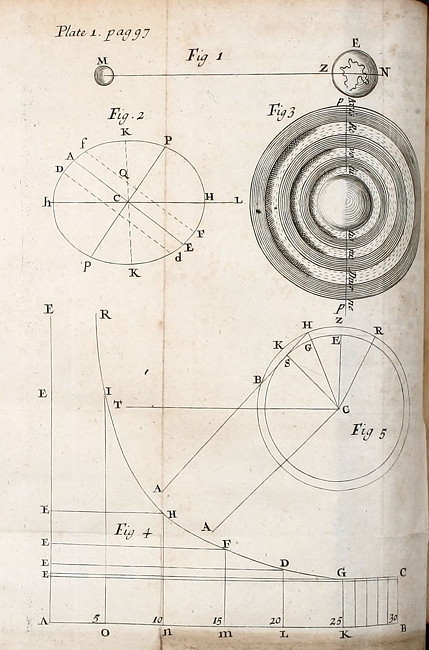
Plate 1. pag. 97
A Letter of Mr. Isaac Newton, Professor of the Mathematicks in the University of Cambridge; containing his New Theory about Light and Colours: Sent by the Author to the Publisher from Cambridge, Feb. 6. 1671/2; in order to be communicated to the Royal Society.
SIR,
TO perform my late promise to you, I shall without further Ceremony acquaint you, That in the beginning of the Year 1666 (at which time I apply'd my self to the grinding of Optick-glasses of other Figures than Spherical,) I procur'd me a Triangular Glass-Prism, to try therewith the celebrated Phænomena of Colours. And in order thereto, having darken'd my Chamber, and made a small hole in my Window-shuts, to let in a convenient quantity of the Sun's Light, I plac'd my Prism at his entrance, that it might be thereby refracted to the opposite Wall. It was at first a very pleasing Divertisement, to view the vivid and intense Colours produced thereby; but after a while applying my self to consider them more circumspectly, I became surpriz'd to see them in an oblong Form; which, according to the received Laws of Rarefraction, I expected should have been Circular.
They were terminated at the sides with streight Lines, but at the ends, the decay of Light was so gradual, that it was difficult to determine justly, what was their Figure; yet they seem'd Semicircular.
Comparing the length of this colour'd Spectrum with its breadth, I found it about five times greater; a disproportion so extravagant, that it excited me to a more than ordinary Curiosity of examining, from whence it might proceed. I could scarce think, that the various thickness of the Glass, or the termination with shadow or darkness, could have any Influence on Light to produce such an effect; yet I thought it not amiss, first to examine those Circumstances, and so try'd what would happen by transmitting Light through parts of the Glass of divers thicknesses, or through holes in the Window of divers bignesses, or by setting the Prism without, so that the Light might pass through it, and be refracted before it was terminated by the hole: But I found none of those Circumstances material. The fashion of the Colours was, in all these Cases, the same.
Then I suspected, whether by any unevenness in the Glass, or other contingent Irregularity, these Colours might be thus dilated. And to try this, I took another Prism like the former, and so plac'd it, that the Light passing through them both, might be refracted contrary ways, and so by the latter return'd into that Course, from which the former had diverted it. For, by this means, I thought the regular effects of the first Prism would be destroy'd by the second Prism, but the irregular ones more augmented by the multiplicity of Refractions. The Event was, that the Light, which by the first Prism was diffused into an oblong Form, was, by the second, reduc'd into an orbicular one, with as much regularity, as when it did not at all pass through them. So that whatever was the cause of that length, 'twas not any contingent Irregularity.
I then proceeded to examine more critically, what might be effected by the difference of the incidence of Rays coming from divers parts of the Sun; and to that end, measur'd the several Lines and Angles belonging to the Image. Its distance from the Hole or Prism was twenty two Foot; its utmost length 13¼ Inches; its breadth 2⅝; the Diameter of the Hole ¼ of an Inch; the Angle, with the Rays, tending towards the middle of the Image, made with those Lines, in which they would have proceeded without Refraction, was 44° 56'. And the Vertical Angle of the Prism, 63° 12'. Also the Refractions on both sides the Prism, that is, of the Incident, and Emergent Rays, were as near, as I could make them, equal, and consequently about 54° 4'. And the Rays fell perpendicularly upon the Wall. Now subducting the Diameter of the Hole from the length and breadth of the Image, there remains 13 Inches the length, and 2⅜ the breadth, comprehended by those Rays, which passed thro' the Center of the said Hole, and consequently the Angle of the Hole, which that breadth subtended, was about 31', answerable to the Sun's Diameter; but the Angle, which its length subtended, was more than five such Diameters, namely 2° 49'.
Having made these Observations, I first computed from them the refractive Power of that Glass, and found it measur'd by the ratio of the Sines, twenty to thirty one. And then, by that ratio, I computed the Refractions of two Rays flowing from opposite parts of the Sun's discus, so as to differ 31' in their obliquity of Incidence, and found that the emergent Rays should have comprehended an Angle of about 31', as they did, before they were incident.
But because this Computation was founded on the Hypothesis of the proportionality of the Sines of Incidence and Refraction, which, tho' by my own Experience I could not imagine to be so erroneous as to make that Angle but 31', which in reality was 2° 49'; yet my Curiosity caus'd me again to take my Prism. And having plac'd it at my Window, as before, I observ'd, that by turning it a little about its Axis to and fro, so as to vary its obliquity to the light, more than an Angle of four or five Degrees, the Colours were not thereby sensibly translated from their place on the Wall, and consequently by that Variation of Incidence, the quantity of Refraction was not sensibly varied. By this Experiment therefore, as well as by the former Computation, it was evident, that the difference of the Incidence of Rays, flowing from divers parts of the Sun could not make them, after decussation, diverge at a sensibly greater Angle, than that at which they before converged; which being, at most, but about thirty one or thirty two Minutes, there still remain'd some other cause to be found out, from whence it could be two Deg. 49 Min.
Then I began to suspect, whether the Rays, after their Trajection through the Prism, did not move in curve Lines, and according to their more or less Curvity, tend to divers parts of the Wall. And it increas'd my suspicion, when I remember'd that I had often seen a Tennis-Ball, struck with an oblique Racket, describe such a curve Line. For a Circular as well as a Progressive Motion being communicated to it by that stroak, its parts on that side, where the Motions conspire, must press and beat the contiguous Air more violently than on the other, and there excite a Reluctancy and Reaction of the Air proportionably greater. And for the same Reason, if the Rays of Light should possibly be globular Bodies, and by their oblique Passage out of one Medium into another, acquire a circulating Motion, they ought to feel the greater resistance from the ambient Æther, on that side, where this Motion conspires, and thence be continually bowed to the other. But notwithstanding this plausible ground of suspicion, when I came to examine it, I could observe no such Curvity in them. And besides (which was enough for my purpose) I observ'd, that the difference 'twixt the length of the Image, and Diameter of the Hole, through which the Light was transmitted, was proportionable to their distance.
The gradual removal of these suspicions, at length led me to the Experimentum Crucis, which was this; I took two Boards, and plac'd one of them close behind the Prism at the Window, so that the light might pass through a small hole, made in it for the purpose, and fall on the other Board, which I plac'd at about twelve Feet distance, having first made a small hole in it also, for some of that incident Light to pass through. Then I plac'd another Prism behind this second Board, so that the Light, trajected through both the Boards, might pass thro' that also, and be again refracted before it arrived at the Wall. This done, I took the first Prism in my Hand, and turn'd it to and fro slowly about its Axis, so much as to make the several parts of the Image, cast on the second Board, successively pass through the hole in it, that I might observe to what places on the Wall the second Prism would refract them. And I saw by the Variation of those places, that the Light, tending to that end of the Image, towards which the Refraction of the first Prism was made, did, in the second Prism, suffer a Refraction considerably greater than the Light tending to the other end. And so the true cause of the length of that Image was detected to be no other, than that Light consists of Rays differently refrangible, which, without any respect to a difference in their incidence, were, according to their degrees of Refrangibility, transmitted towards divers parts of the Wall.
When I understood this, I left off my aforesaid Glass Works; for I saw, that the perfection of Telescopes was hitherto limited, not so much for want of Glasses truly figur'd, according to the prescriptions of Optick Authors (which all Men have hitherto imagin'd), as because that Light it self is a Heterogeneous mixture of differently refrangible Rays. So that, were a Glass so exactly figur'd, so as to collect any one sort of Rays into one Point, it could not collect those also into the same Point, which having the same Incidence upon the same Medium, are apt to suffer a different Refraction. Nay, I wonder'd, that seeing the difference of Refrangibility was so great, as I found it, Telescopes should arrive to that perfection they are now at. For, measuring the Refractions in one of my Prisms, I found, that, supposing the common Sine of Incidence upon one of its plains, was forty four Parts, the Sine of Refraction of the utmost Rays on the red end of the Colours, made out of the Glass into the Air, would be sixty eight parts, and the Sine of Refraction of the utmost Rays on the other end, sixty nine parts; so that the difference is about a twenty fourth or twenty fifth part of the whole Refraction. And consequently the Object glass of any Telescope cannot collect all the Rays, which come from one point of an Object, so as to make them convene at its Focus in less room than in a Circular space, whose Diameter is the fiftieth part of the Diameter of its Aperture; which is an irregularity, some hundred of times greater, than a circularly figur'd Lens, of so small a section as the Object-glasses of long Telescopes are, would cause by the unfitness of its Figure, were Light uniform.
This made me take Reflections into Consideration, and finding them regular, so that the Angle of Reflection of all sorts of Rays was equal to their Angle of Incidence; I understood, that by their mediation, Optick Instruments might be brought to any degree of Perfection imaginable, provided a Reflecting Substance could be found, which would polish as finely as Glass, and reflect as much Light as Glass transmits; and the art of communicating to it a Parabolick Figure be also attain'd. But there seem'd very great Difficulties, and I have almost thought them insuperable, when I further consider'd, that every Irregularity in a reflecting Superficies makes the Rays stray five or six times more out of their due course, than the like Irregularities in a refracting one; So that a much greater Curiosity would be here requisite, than in Figuring Glasses for Refraction.
Amidst these Thoughts I was forc'd from Cambridge by the Intervening Plague, and it was more than two Years before I proceeded further. But then having thought on a tender way of polishing, proper for Metal, whereby, as I imagin'd, the Figure also would be corrected to the last; I began to try what might be effected in this kind, and by degrees so far perfected an Instrument (in the essential parts of it like that I sent to London,) by which I could discern Jupiter's four Concomitants, and shew'd them divers times to two others of my Acquaintance. I could also discern the Moon-like Phase of Venus, but not very distinctly, nor without some niceness in disposing the Instrument.
From that time I was interrupted, till this last Autumn, when I made the other. And as that was sensibly better than the first (especially for Day-Objects,) so I doubt not but they will be still brought to a much greater perfection by their Endeavours, who, as you inform me, are taking care about it at London.
I have sometimes thought to make a Microscope, which in like manner should have, instead of an Object-glass, a reflecting piece of Metal. And this I hope they will also take into Consideration: For those Instruments seem as capable of improvement as Telescopes, and perhaps more, because but one reflective piece of Metal is requisite in them, as you may perceive in Plate 3. Fig. 1. where AB representeth the Object Metal, CD the Eye-glass, F their common Focus, and O the other Focus of the Metal, in which the Object is placed.
But to return from this digression, I told you, that Light is not similar, or homogeneal, but consists of difform Rays, some of which are more refrangible than others: So that of those, which are alike incident on the same Medium, some shall be more refracted than others, and that not by any virtue of the Glass, or other external Cause, but from a predisposition, which every particular Ray hath to suffer a particular degree of Refraction.
I shall now proceed to acquaint you with another more notable deformity in its Rays, wherein the Origin of Colours is unfolded: Concerning which I shall lay down the Doctrine first, and then, for its Examination, give you an Instance or two of the Experiments, as a Specimen of the rest.
The Doctrine you will find comprehended and illustrated in the following Propositions.
1. As the Rays of Light differ in degrees of Refrangibility, so they also differ in their disposition to exhibit this or that particular Colour. Colours are not Qualifications of Light, derived from Refractions, or Reflections of natural Bodies, (as 'tis generally believed) but Original and connate Properties, which in divers Rays are divers. Some Rays are disposed to exhibit a red Colour and no other; some a yellow and no other, some a green and no other, and so of the rest. Nor are there only Rays proper and particular to the more eminent Colours, but even to all their intermediate Gradations.
2. To the same degree of Refrangibility ever belongs the same Colour, and to the same Colour ever belongs the same degree of Refrangibility. The least Refrangible Rays are all disposed to exhibit a Red Colour, and contrarily those Rays, which are disposed to exhibit a Red Colour, are all the least Refrangible: So the most Refrangible Rays are all disposed to exhibit a deep Violet Colour, and contrarily those which are apt to exhibit such a Violet Colour, are all the most Refrangible. And so to all the intermediate Colours in a continued Series belong intermediate degrees of Refrangibility. And this Analogy 'twixt Colours, and Refrangibility, is very precise and strict; the Rays always either exactly agreeing in both, or proportionally disagreeing in both.
3. The Species of Colour, and Degree of Refrangibility proper to any particular sort of Rays, is not mutable by Refraction, nor by Reflection from Natural Bodies, nor by any other Cause, that I could yet observe. When any one sort of Rays hath been well parted from those of other kinds, it hath afterwards obstinately retain'd its Colour, notwithstanding my utmost Endeavours to change it. I have refracted it with Prisms, and reflected it with Bodies, which in Day-light were of other Colours; I have intercepted it with the colour'd Film of Air interceding two compressed Plates of Glass; transmitted it through colour'd Mediums, and through Mediums irradiated with other sorts of Rays, and diversly terminated it, and yet could never produce any new Colour out of it. It would by contracting and dilating become more brisk, or faint, and by the loss of many Rays in some Cases very obscure and dark; but I could never see it chang'd in specie.
4. Yet seeming Transmutations of Colours may be made, where there is any mixture of divers sorts of Rays. For in such mixtures, the component Colours appear not, but by their mutual allaying each other, constitute a midling Colour. And therefore, if by Refraction, or any other of the aforesaid Causes, the difform Rays, latent in such a mixture, be separated, there shall emerge Colours different from the colour of the Composition. Which Colours are not new generated, but only made apparent by being parted; for if they be again intirely mix'd and blended together, they will again compose that Colour, which they did before separation. And for the same reason, Transmutations made by the convening of divers Colours are not real; for when the difform Rays are again severed, they will exhibit the very same Colours, which they did before they entered the Composition; as you see, Blue and Yellow Powders, when finely mixed, appear to the naked Eye Green, and yet the Colours of the component Corpuscles are not thereby really transmuted, but only blended. For, when viewed with a good Microscope, they still appear Blue and Yellow interspersedly.
5. There are therefore two sorts of Colours. The one Original and Simple, the other compounded of these. The Original or Primary Colours are, Red, Yellow, Green, Blue, and a Violet-purple, together with Orange, Indico, and an indefinite variety of intermediate Gradations.
6. The same Colours in Specie with these primary Ones, may be also produced by Composition: For, a mixture of Yellow and Blue makes Green; of Red and Yellow, makes Orange; of Orange and Yellowish Green, makes Yellow. And in general, if any two Colours be mix'd, which in the Series of those, generated by the Prism, are not too far distant one from another, they by their mutual Alloy compound that Colour, which in the said Series appeareth in the mid-way between them. But those, which are situated at too great a distance, do not so. Orange and Indico produce not the intermediate Green, nor Scarlet and Green the intermediate Yellow.
7. But the most surprizing and wonderful Composition was that of Whiteness. There is no one sort of Rays which alone can exhibit this. 'Tis ever compounded, and to its Composition are requisite all the aforesaid primary Colours, mix'd in a due proportion. I have often with admiration beheld, that all the Colours of the Prism being made to converge, and thereby to be again mixed as they were in the light before it was incident upon the Prism, reproduced light, intirely and perfectly white, and not at all sensibly differing from a direct light of the Sun, unless when the Glasses, I used, were not sufficiently clear; for then they would a little incline it to their Colour.
8. Hence therefore it comes to pass, that Whiteness is the usual Colour of Light; for Light is a confused aggregate of Rays, indued with all sorts of Colours, as they are promiscuously darted from the various parts of luminous Bodies. And of such a confused aggregate, as I said, is generated Whiteness, if there be a due proportion of the Ingredients; but if any one predominate, the Light must incline to that Colour; as it happens in the blue Flame of Brimstone, the yellow Flame of a Candle, and the various Colours of the fixed Stars.
9. These things consider'd, the manner, how Colours are produced by the Prism, is evident. For, of the Rays, constituting the incident Light, since those which differ in Colour proportionally differ in Refrangibility, they by their unequal Refractions must be severed and dispersed into an oblong Form, in an orderly succession, from the least refracted Scarlet to the most refracted Violet. And for the same reason it is, that Objects, when look'd upon through a Prism, appear coloured. For the difform Rays, by their unequal Refractions, are made to diverge towards several parts of the Retina, and there express the Images of things coloured, as in the former case they did the Sun's Image upon a Wall. And by this inequality of Refractions, they become not only coloured, but also very confused and indistinct.
10. Why the Colours of the Rainbow appear in falling drops of Rain, is also from hence evident. For those drops, which refract the Rays, disposed to appear Purple, in greatest quantity to the Spectator's Eye, refract the Rays of other sorts so much less, as to make them pass beside it; and such are the drops on the inside of the Primary Bow, and on the outside of the Secondary or Exteriour one. So those drops, which refract in greatest plenty the Rays, apt to appear red, toward the Spectator's Eye, refract those of other sorts so much more, as to make them pass beside it; and such are the drops on the Exteriour part of the Primary, and Interiour part of the Secondary Bow.
11. The odd Phænomena of an infusion of Lignum Nephriticum, Leaf-gold, Fragments of colour'd Glass, and some other transparently coloured Bodies, appearing in one Position of one Colour, and of another in another, are on these grounds no longer Riddles. For those are Substances apt to reflect one sort of Light, and transmit another; as may be seen in a dark Room, by illuminating them with similar or uncompounded Light. For then they appear of that Colour only, with which they are illuminated; but yet in one Position more vivid and luminous than in another, accordingly as they are disposed more or less to reflect or transmit the incident Colour.
12. From hence also is manifest the reason of an unexpected Experiment, which Mr. Hook, somewhere in his Micrography, relates to have made with two wedge-like transparent Vessels fill'd, the one with a red, the other with a blue Liquor; namely, that though they were severally transparent enough, yet both together became opake: For, if one transmitted only red, and the other only blue, no Rays could pass through both.
13. I might add more Instances of this Nature; but I shall conclude with this general one, that the Colours of all natural Bodies have no other Origin than this, that they are variously qualified to reflect one sort of Light in greater plenty than another. And this I have experimented in a dark Room, by illuminating those Bodies with uncompounded Light of divers Colours. For by that means any body may be made to appear of any Colour. They have there no appropriate Colour, but ever appear of the Colour of the Light cast upon them; but yet with this difference, that they are most brisk and vivid in the Light of their own day-light-colour. Minium appeareth there of any Colour indifferently, with which 'tis illustrated, but yet most luminous in red; and so Bise appeareth indifferently of any Colour with which 'tis illustrated, but yet most luminous in blue. And therefore Minium reflecteth Rays of any Colour, but most copiously those endu'd with red, and consequently when illustrated with day-light, that is, with all sorts of Rays promiscuously blended, those qualified with red, shall abound most in the reflected Light, and by their prevalence cause it to appear of that Colour. And for the same reason Bise, reflecting blue most copiously, shall appear blue by the excess of those Rays in its reflected Light; and the like of other Bodies. And that this is the intire and adequate cause of their Colours, is manifest, because they have no power to change or alter the Colours of any sort of Rays incident apart, but put on all Colours indifferently, with which they are enlightned.
These things being so, it can be no longer disputed, whether there be Colours in the dark, nor whether they be the Qualities of the Objects we see, no nor perhaps, whether Light be a Body. For, since Colours are the Qualities of Light, having its Rays for their intire and immediate Subject, how can we think those Rays Qualities also, unless one Quality may be the Subject of and sustain another; which in effect is to call it Substance? We should not know Bodies for Substances, were it not for their sensible Qualities; and the principal of those being now found due to something else, we have as good reason to believe that to be a Substance also.
Besides, whoever thought any Quality to be a heterogeneous Aggregate, such as Light is discovered to be? But to determine more absolutely, what Light is, after what manner refracted, and by what Modes or Actions it produceth in our Minds the Phantasms of Colours, is not so easie. And I shall not mingle Conjectures with Certainties.
Reviewing what I have written, I see the Discourse it self will lead to divers Experiments sufficient for its Examination; and therefore I shall not trouble you farther, than to describe one of those, which I have already insinuated.
In a darkned Room, make a hole in the shut of a Window, whose Diameter may conveniently be about a third part of an Inch, to admit a convenient quantity of the Sun's Light. And there place a clear and colourless Prism, to refract the entring Light towards the farther part of the Room; which, as I said, will thereby be diffused into an oblong coloured Image. Then place a Lens of about three Foot Radius (suppose a broad Object-glass of a three Foot Telescope,) at the distance of about four or five Foot from thence, through which all those Colours may at once be transmitted, and made by its Refraction to convene at a farther distance of about ten or twelve Feet. If at that distance you intercept this Light with a Sheet of white Paper, you will see the Colours converted into whiteness again by being mingled. But it is requisite, that the Prism and Lens be placed steady, and that the Paper, on which the Colours are cast, be moved to and fro; for, by such motion, you will not only find at what distance the whiteness is most perfect, but also see how the Colours gradually convene, and vanish into whiteness; and afterwards, having crossed one another in that place where they compound whiteness, are again dissipated and severed, and in an inverted order retain the same Colours, which they had before they entred the Composition. You may also see, that, if any of the Colours at the Lens be intercepted, the whiteness will be changed into the other Colours. And therefore, that the Composition of whiteness be perfect, care must be taken that none of the Colours fall besides the Lens.
In the annexed Design, Tab. 3. Fig. 2. of this Experiment, ABC expresseth the Prism set end-wise to sight, close by the hole F of the Window EG. Its vertical Angle ABC may conveniently be about 60 Degrees: MN designeth the Lens. Its breadth 2½ or 3 Inches. SF one of the streight Lines, in which difform Rays may be conceived to flow successively from the Sun. FP, and FR two of those Rays unequally refracted, which the Lens makes to converge towards Q, and after decussation to diverge again. And HI the Paper, at divers distances, on which the Colours are projected, which in Q constitute Whiteness, but are Red and Yellow in R, r, and ρ, and Blue and Purple in P, p, and π.
If you proceed further to try the impossibility of changing any uncompounded Colour (which I have asserted in the third and thirteenth Propositions,) 'tis requisite that the Room may be very dark, lest any scattering light, mixing with the Colour, disturb and allay it, and render it compound, contrary to the design of the Experiment. 'Tis also requisite, that there be a perfecter separation of the Colours, than, after the manner above described, can be made by the Refraction of one single Prism; and how to make such farther separations, will scarce be difficult to them, that consider the discovered Laws of Refractions. But if trial shall be made with Colours not throughly separated, there must be allowed changes proportionable to the mixture. Thus if compound Yellow Light fall upon blue Bise, the Bise will not appear perfectly yellow, but rather green, because there are in the yellow mixture many Rays indued with green, and green being less remote from the usual blue Colour of Bise than yellow, is the more copiously reflected by it.
In like manner, if any one of the Prismatick Colours, suppose red, be intercepted, on design to try the asserted impossibility of reproducing that Colour out of the others which are pretermitted; 'tis necessary, either that the Colours be very well parted before the red be intercepted; or that, together with the red, the neighbouring Colours, into which any red is secretly dispersed, (that is, the yellow, and perhaps green too) be intercepted; or else, that allowance be made for the emerging of so much red out of the yellow green, as may possibly have been diffused, and scatteringly blended in those Colours. And if these things be observed, the new Production of red, or any intercepted Colour, will be found impossible.
This, I conceive, is enough for an Introduction to Experiments of this kind; which if any of the Royal Society shall be so curious as to prosecute, I should be very glad to be informed with what success: That, if any thing seem to be defective, or to thwart this Relation, I may have an opportunity of giving farther Direction about it, or of acknowledging my Errors, if I have committed any.
Since the Publication of this Theory, some Misunderstandings happening between a French Philosopher at Paris and Mr. Newton, he has endeavour'd to explain himself a little further in these Things, according to the following Method.
A farther Explanation of the same Theory.
DEFINITIONS.
1. I call that Light Homogeneal, Similar, or Uniform, whose Rays are equally refrangible.
2. And that Heterogeneal, whose Rays are unequally refrangible.
Note, There are but three Affections of Light in which I have observ'd its Rays to differ; viz. Refrangibility, Reflexibility, and Colour; and those Rays which agree in Refrangibility, agree also in the other two, and therefore may well be defined Homogeneal; especially since Men usually call those things Homogeneal, which are so in all Qualities that come under their Knowledge, tho' in other Qualities, that their Knowledge extends not to, there may possibly be some Heterogeneity.
3. Those Colours I call Simple or Homogeneal, which are exhibited by Homogeneal Light.
4. And those Compound or Heterogeneal, which are exhibited by Heterogeneal Light.
5. Different Colours, I call, not only the more eminent Species, Red, Yellow, Green, Blue, Purple, but all other the minutest Gradations; much after the same manner, that not only the more eminent Degrees in Musick, but all the lead Gradations, are esteem'd different Sounds.
PROPOSITIONS.
1. The Sun's Light consists of Rays differing by indefinite Degrees of Refrangibility.
2. Rays which differ in Refrangibility, when parted from one another, do proportionally differ in the Colours which they exhibit. These Two Propositions are Matter of Fact.
3. There are as many Simple or Homogeneal Colours, as Degrees of Refrangibility. For to every Degree of Refrangibility belongs a different Colour, by Prop. 2. and that Colour is Simple, by Def. 1, and 3.
4. Whiteness, in all respects like that of the Sun's immediate Light, and of all the usual Objects of our Senses, cannot be compounded of two Simple Colours alone. For such a Composition must be made by Rays that have only two Degrees of Refrangibility, by Def. 1 and 3. and therefore it cannot be like that of the Sun's Light. by Prop. 1. nor, for the same Reason, like that of ordinary white Objects.
5. Whiteness, in all respects, like that of the Sun's immediate Light, cannot be compounded of Simple Colours without an indefinite Variety of them. For to such a Composition, there are requisite Rays endu'd with all the indefinite Degrees of Refrangibility, by Prop. 1. And those infer as many Simple Colours, by Def. 1 and 3. and Prop. 2 and 3.
To make these a little plainer, I have added also the Propositions that follow.
6. The Rays of Light do not act on one another, in passing through the same Medium.
7. The Rays of Light suffer not any change of their Qualities from Refraction.
8. Nor afterwards from the adjacent quiet Medium: These two Propositions are manifest de Facto in Homogeneal Light, whose Colour and Refrangibility is not at all changeable, either by Refraction, or by the Contermination of a quiet Medium. And as for Heterogeneal Light, it is but an Aggregate of several sorts of Homogeneal Light, no one sort of which suffers any more alteration than if it were alone; because the Rays act not on one another, by Prop. 6. and therefore the Aggregate can suffer none. These two Propositions also might be further proved apart, by Experiments too long to be here described.
9. There can no Homogeneal Colours be reduced out of Light by Refraction, which were not commixt in it before. Because by Prop. 7. and 8. Refraction changeth not the Qualities of the Rays, but only separates those which have divers Qualities, by means of their different Refrangibility.
10. The Sun's Light is an Aggregate of an indefinite variety of Homogeneal Colours, by Prop. 1, 3, and 9. And hence it is, that I call Homogeneal Colours also Primitive or Original. And thus much concerning Colours.
For a further Illustration of this Doctrine, Mr. Newton, in his Book of Opticks lately published, has by undeniable Experiments explained most of the Principal Phænomena of Light and Colours: To which we refer the Reader.
A Demonstration concerning the Motion of Light, communicated from Paris.
PHilosophers have been labouring for many Years to decide by some Experiment, whether the Action of Light be conveyed in an instant to distant Places, or whether it requireth time. M. Romer, of the Royal Academy of Sciences, hath devised a way taken from the Observations of the first Satellit of Jupiter, by which he demonstrates, that for the distance of about 3000 Leagues, such as is very near the bigness of the Diameter of the Earth, Light needs not one Second of Time.