Miscellanea Curiosa. (continued 5)
Reading edition
That the Concourse of Heat in this Work is really necessary, appears, not only from the Experiments before us, but from all Nature; from our Fields and Forests, our Gardens and our Orchards. We see in Autumn, as the Sun's Power grows gradually less and less, so its Effects on Plants is remitted, and their Vegetation slackens by little and little. Its Failure is first discernible in Trees. These are raised highest above the Earth; and require a more intense Heat to elevate the Water, charged with their Nourishment, to the Tops and Extremities of them. So that for want of fresh Support and Nutriment, they shed their Leaves, unless secur'd by a very firm and hardy Constitution indeed, as our ever-Greens are. Next the Shrubs part with theirs; and then the Herbs and lower Tribes; the Heat being at length not sufficient to supply even these, though so near the Earth, the Fund of their Nourishment. As the Heat returns the succeeding Spring, they all recruit again; and are furnish'd with fresh Supplies and Verdure: But first, those which are lowest and nearest the Earth, Herbs, and they that require a lesser degree of Heat to raise the Water with its Earthy Charge into them: Then the Shrubs and higher Vegetables in their Turns; and lastly, the Trees. As the Heat increases, it grows too powerful, and hurries the Matter with too great Rapidity thorough the finer and more tender Plants: These therefore go off, and decay; and others that are more hardy and vigorous, and require a greater share of Heat, succeed in their Order. By which Mechanism, provident Nature furnishes us with a very various and differing Entertainment; and what is best suited to each Season, all the Year round.
As the Heat of the several Seasons affords us a different Face of Things; so the several distant Climates shew different Scenes of Nature, and Productions of the Earth[12]. The Hotter Countries yield ordinarily the largest and tallest Trees; and those in too much greater variety than the colder ever do. Even those Plants which are common to both, attain to a much greater Bulk in the Southern than in the Northern Climes. Nay, there are some Regions so bleak and chill, that they raise no Vegetables at all to any considerable Size. This we learn from Greenland, from Iseland, and other Places of like cold Site and Condition. In these no Tree ever appears; and the very Shrubs they afford, are few, little, and low.
Again, in the warmer Climates, and such as do furnish forth Trees and the larger Vegetables, if there happen a remission or diminution of the usual Heat, their Productions will be impeded and diminished in proportion. Our late Colder Summers have given us proof enough of this. For though the Heat we have had, was sufficient to raise the Vegetative Matter into the lower Plants, into our Corns, our Wheat, Barley, Pease and the like; and we have had plenty of Straw-berries, Ras-berries, Currans, Goosberries, and the Fruits of such other Vegetables as are low and near the Earth: Yea, and a moderate store of Cherries, Mulberries, Plumbs, Filberts, and some others that grow somewhat at a greater Height; yet our Apples, our Pears, Walnuts, and the Productions of the taller[13] Trees have been fewer, and those not so kindly, so thoroughly ripen'd, and brought to that Perfection they were in the former more benign and their warm Seasons. Nay, even the lower Fruits and Grains have had some share in the common Calamity; and fallen short both in Number and Goodness of what the hotter and kinder Seasons were wont to shew us. As to our Grapes, Abricots, Peaches, Nectarens, and Figs, being transplanted hither out of hotter Climes, 'tis the less wonder we have of late had so general a Failure of them.
Nor is it the Sun, or the ordinary emission of the Subterranean Heat only, that promotes Vegetation; but any other indifferently, according to its Power and Degree: This we are taught by our Stoves, hot Beds, and the like. All Heat is of like kind; and where-ever is the same Cause, there will be constantly the same Effect. There's a Procedure in every part of Nature, that is perfectly regular and geometrical, if we can but find it out; and the further our Searches carry us, the more shall we have occasion to admire this, and the better 'twill compensate our Industry.
An Account of the Measure of the thickness of Gold upon Gilt Wire; together with Demonstration of the exceeding Minuteness of the Atoms or constituent Particles of Gold; as it was read before the Royal Society, by E. Halley.
WHAT are the constituent Parts of Matter, and how there comes to be so great a diversity in the weight of Bodies, to all appearance equally solid and dense, such as are Gold and Glass, (whose specifick Gravities are nearly as 7 to 1) seems a very hard Question to those that shall rightly consider it: For from undoubted Experiment, Gravity is in all Bodies proportionable to the Quantity of Matter in each; and there is no such thing as a Propension of some more, others less, towards the Earth's Center; since the Impediment of the Air being removed, all Bodies descend, be they never so loose or compact in Texture, with equal Velocity. It follows therefore, That there is 7 times as much Matter in Gold, as in a piece of Glass of the same Magnitude; and consequently, that at least six parts of seven in the Bulk of Glass, must be Pore or Vacuity: This some Favourers of the Atomical Philosophy have endeavoured to solve, by supposing the primary or constituent Atoms of Gold to be much larger than those of other Bodies, and consequently the Pores fewer; whereas in other Bodies, the great multitude of the interspersed Vacuities does diminish their Weights.
Being desirous to examine this Notion of the Magnitude of Atoms of Gold, I bethought my self of the extreme Ductility of that Metal, which is seen in the beating of it into Leaf, and above all in the drawing fine Gilt-wire, by means whereof, I believed I might most exactly obtain the true thickness of the Coat of Gold, that appears, even with the Microscope, so well to represent Gold it self, that not the least point of Silver appears through it. In order to this, I inform'd my self among the Wire-drawers, what Gold they us'd to their Silver; and they told me, That the very best double Gilt Wire was made out of Cylindrick Ingots, 4 Inches in Circumference, and 28 Inches long, which weigh 16 Pounds Troy; on these they bestow 4 Ounces of Gold, that is, to every 48 Ounces of Silver one of Gold; and that two Yards of the super-fine Wire weighs a Grain. Hence at first sight it appear'd, that the length of 98 Yards is in weight 49 Grains, and that a single Grain of Gold covers the said 98 Yards, and that the 10000th part of a Grain is above ⅓ of an Inch long; which yet may be actually divided into 10, and so the 100000th part of a Grain of Gold be visible without a Microscope. But being desirous to compute the thickness of the Skin of Gold, by means of the specifick Gravities of the Metals, viz. Silver 10⅓, and Gold 18⅔, I found the Diameter of such Wire the 1⁄386 part of an Inch, and its Circumference the 1⁄123 part; but the Gold in thickness not to exceed the 1⁄134500 part of an Inch; whence it may be concluded, that the Cube of the hundredth part of an Inch would contain above 2433000000, (or the Cube of 1345) of such Atoms. And it may likewise be marvelled at, that Gold being stretcht to so great a degree, as is here demonstrated, should yet shew it self of so even and united a Texture, as not to let the white Colour of the Silver under it appear through any the least Pores; which argues, that even in this exceeding thinness very many of those Atoms may still lie one over the other: Which is a Consideration may merit the Thoughts of this Honourable Society, as tending to examine that renowned Atomical Doctrine, which has of late much obtain'd among the Learned.
An Account of the several Species of Infinite Quantity, and of the Proportions they bear one to the other; as it was read before the Royal Society, by E. Halley.
THAT all Magnitudes infinitely great, or such as exceed any assignable Quantity, are equal among themselves, though it be vulgarly received for a Maxim, is not yet so common as it is erroneous; and the Reason of the mistake seems to be, That the Mind of Man, coming to contemplate the Extensions of what exceeds the bounds of its Capacity, and of which the very Idea does include a Negation of Limits; it comes to pass that we acquiesce generally, and it suffices to say such a Quantity is infinite.
But if we come more nearly to examine this Notion, we shall find, that there are really besides infinite Length and infinite Area, no less than three several sorts of infinite Solidity; all of which are Quantitates sui generis, having no more relation or proportion the one to the other, than a Line to a Plane, or a Plane to a Solid, or a Finite to an Infinite. But that among themselves, each of those Species of Infinites are in given Proportions, is what I now intend to make plain, if possible.
But first, infinite Length, or a Line infinitely long, is to be considered either as beginning at a Point, and so infinitely extended one way, or else both ways from the same Point; in which case the one, which is a beginning infinity, is the one half of the whole, which is the Summ of the beginning and ceasing Infinity; or, as I may say, of Infinity, à parte ante, and à parte post: Which is analogous to Eternity in Time or Duration, in which there is always as much to follow as is past, from any point or moment of Time: Nor doth the Addition or Subduction of finite Length or Space of time alter the case either in Infinity or Eternity, since both the one or the other cannot be any part of the whole.
As to infinite Surface or Area, any right Line, infinitely extended both ways on an infinite Plane, does divide that infinite Plane into equal Parts; the one to the right, and the other to the left of the said Line: But if from any Point in such a Plane, two right Lines be infinitely extended, so as to make an Angle, the infinite Area, intercepted between those infinite right Lines, is to the whole infinite Plane, as the Arch of a Circle, on the Point of Concourse of those Lines, as a Centre, intercepted between the said Lines, is to the Circumference of the Circle; or as the Degrees of the Angle to the 360 Degrees of a Circle. For Example, two right Lines meeting at a right Angle do include, on an infinite Plane, a quarter part of the whole infinite Area of such a Plane.
But if so be, two parallel infinite Lines be supposed drawn on such an infinite Plane, the Area intercepted between them will be likewise infinite; but at the same time will be infinitely less, than that Space which is intercepted between two infinite Lines that are inclined, though with never so small an Angle; for that in the one Case, the given finite distance of the parallel Lines diminishes the Infinity in one Degree of Dimension; whereas in a Sector, there is Infinity in both Dimensions; and consequently, the Quantities are the one infinitely greater than the other, and there is no proportion between them.
From the same Consideration arise the Three several Species of infinite Space or Solidity, as has been said; for a Parallelepipede, or a Cylinder, infinitely long, is greater than any finite Magnitude how great soever; and all such Solids, supposed to be formed on given Bases, are as those Bases, in proportion to one another. But if two of these three Dimensions are wanting, as in the Space intercepted between two parallel Planes infinitely extended, and at a finite distance; or with infinite Length and Breadth, with a finite Thickness; All such Solids shall be as the given finite distances one to another: But these Quantities, though infinitely greater than the other, are yet infinitely less than any of those, wherein all the three Dimensions are infinite. Such are the Spaces intercepted between two inclined Planes infinitely extended; the Space intercepted by the Surface of a Cone, or the sides of a Pyramid likewise infinitely continued, &c. of all which notwithstanding, the Proportions one to another, and to the τὸ πᾶν, or vast Abyss of infinite Space (wherein is the Locus of all things that are or can be; or to the Solid of infinite Length, Breadth, and Thickness, taken all manner of ways) are easily assignable. For the Space between two Planes, is to the whole, as the Angle of those Planes to the 360 Degrees of the Circle. As for Cones and Pyramids, they are as the Spherical Surface, intercepted by them, is to the Surface of the Sphere; and therefore Cones are as the versed Sines of half their Angles, to the Diameter of the Circle: These three sorts of infinite Quantity are analogous to a Line, Surface and Solid, and after the same manner cannot be compared, or have any proportion the one to the other.
Besides these, there are several other Species of infinite Quantity, arising from the Contemplation of Curves, and their Asymptotes; which, by reason of the difficulty of the Subject, cannot be made so plain to most Readers: But what has been already said, may be sufficient to evince what we undertook to explain.
An Account of Dr. Robert Hook's Invention of the Marine Barometer, with its Description and Uses; published by order of the Royal Society, by E. Halley, R. S. S.
SInce it was found that the Torricellian Tube, commonly call'd the Mercurial Barometer, by the rising and falling of the Quick-silver therein, doth presage the Changes of the Air, in relation to fair and foul Weather; upon several Years Observation of it, it has been proved and adjusted for that purpose by Dr. Robert Hook; and there have been by him many attempts to improve the Instrument, and render the Minute Divisions on the Scale thereof more sensible. He also judging that it might be of great use at Sea, contrived several ways to make it serviceable on Board of Ship; one of which he explain'd to the Royal Society at their Weekly Meeting in Gresham College, January 2. 1667/8. Since which time he hath further cultivated the Invention, and some Years ago produced before the said Society, the Instrument I am now to describe, which for its subtilty and usefulness, seemeth to surpass all other performances of the like Nature.
'Till such time as the Author's present Indisposition will give him leave to bestow freely his Thoughts on this Subject upon the Publick, it is the Opinion of the Society, that such an Account be given of this Contrivance, as may render it known, and recommend it to the Mariners use, for which it was principally intended.
The Mercurial Barometer requiring a perpendicular Posture, and the Quick-silver vibrating therein with great Violence upon any Agitation, is therefore uncapable of being used at Sea (tho' it hath lately been contrived to be made portable), so it remain'd to find out some other Principle, wherein the Position of the Instrument was not so indispensably necessary: For this, all those that use the Sea are obliged to the great facility Dr. Hook has always shewn, in applying Philosophical Experiments to their proper uses.
It is about forty Years since, that the Thermometers of Robert de Fluctibus, depending on the Dilatation and Contraction of included Air by Heat and Cold, have been disused, upon discovery that the Airs pressure is unequal; that inequality mixing it self with the Effects of the warmth of the Air in that Instrument. And instead thereof was substituted the seal'd Thermometer, including Spirit of Wine (first brought into England, out of Italy, by Sir Robert Southwell) as a proper Standard of the temper of the Air, in relation to Heat and Cold; that Ætherial Spirit being of all the known Liquors the most susceptible of Dilatation and Contraction, especially with a moderate degree of either Heat or Cold. Now this being allow'd as a Standard, and the other Thermometer that includes Air, being graduated with the same Divisions, so as at the time when the Air was included, to agree with the Spirit-Thermometer in all the degrees of Heat and Cold, noting at the same time the precise height of the Mercury in the common Barometers: It will readily be understood, that whensoever these two Thermometers shall agree, the pressure of the Air is the same it was, when the Air was included, and the Instrument graduated: That if in the Air-Thermometer the Liquor stand higher than the Division marked thereon, corresponding with that on the Spirit-glass, it is an indication that there is a greater pressure of the Air at that time, than when the Instrument was graduated. And the contrary is to be concluded, when the Air-glass stands lower than the Spirit, viz. that then the Air is so much lighter, and the Quick silver, in the ordinary Barometer lower than at the said time of Graduation.
And the Spaces answering to an Inch of Mercury, will be more or less, according to the quantity of Air so included, and the smallness of the Glass Cane, in which the Liquor rises and falls, and may be augmented almost in any proportion, under that of the Specifick Gravity of the Liquor of the Thermometer to Mercury. So as to have a Foot or more for an Inch of Mercury, which is another great convenience.
It has been observed by some, that in long keeping this Instrument, the Air included either finds a means to escape, or deposites some Vapours mixt with it, or else for some other cause becomes less Elastick, whereby, in process of time, it gives the height of the Mercury somewhat greater than it ought; but this, if it should happen in some of them, hinders not the usefulness thereof, for that it may at any time very easily be corrected by Experiment, and the rising and falling thereof are the things chiefly remarkable in it, the just height being barely a Curiosity.
In these Parts of the World, long Experience has told us, that the rising of the Mercury forebodes fair Weather after foul, and an Easterly or Northerly Wind; and that the falling thereof, on the contrary, signifies Southerly or Westerly Winds, with Rain, or stormy Winds, or both; which latter it is of much more consequence to provide against at Sea than at Land; and in a Storm, the Mercury beginning to rise is a sure sign that it begins to abate, as has been experienced in high Latitudes, both to the Northwards and Southwards of the Æquator.
The Form of this Instrument is shown in the Cut, by Tab. 4. Fig. 1. wherein,
AB represents the Spirit-Thermometer, graduated from 0, or the freezing Point, through all the possible degrees of the Heat or Cold of the Air, at least in these Climates.
CD, is the Air-Thermometer, graduated after the same manner with the like Degrees.
EF, is a Plate applied to the side of the Thermometer CD, graduated into Spaces answering to Inches and parts of an Inch of Mercury, in the common Barometers.
G, a Hand standing on the Plate at the height of the Mercury thereon, as it was when the Instrument was graduated, as suppose here at 29½ Inches.
LM, a Wire on which the Plate EF, slips up and down, parallel to the Cane of the Thermometer CD.
K, any Point at which the Spirit stands at the time of Observation; suppose at 38 on the Spirit-Thermometer; Slide the Plate EF till the Hand G stand at 38 on the Air-Thermometer, and if the Liquor therein stand at 38 likewise, then is the pressure of the Air the same as at the time of Graduation, viz. 29,5; but if it stand higher, as at 30, at I; then is the pressure of the Air greater; and the division on the sliding Plate against the Liquor, shews the present height of the Mercury to be twenty nine Inches seven Tenths. And this may suffice as to the manner of using it.
I had one of these Barometers with me in my late Southern Voyage, and it never failed to prognostick and give early notice of all the bad Weather we had, so that I depended thereon, and made provision accordingly; and from my own Experience I conclude that a more useful Contrivance hath not for this long time been offer for the benefit of Navigation.
These Instruments are made according to the Direction of Dr. Hook, by Mr. Henry Hunt, Operator to the Royal Society, who will furnish any Gentlemen with them, and give them Directions how to use them.
A Discourse concerning the Proportional Heat of the Sun in all Latitudes, with the Method of collecting the same; as it was read before the Royal Society, in one of their late Meetings. By E. Halley.
THere having lately arisen some Discourse about that part of the Heat of Weather, simply produced by the Action of the Sun; and I having affirmed, that if that were considered, as the only Cause of the Heat of the Weather, I saw no Reason, but that under the Pole the solstitical Day ought to be as hot as it is under the Æquinoctial, when the Sun comes vertical, or over the Zenith: For this Reason, that for all the 24 Hours of that Day under the Pole, the Sun's Beams are inclined to the Horizon, with an Angle of 23½ Degrees; and under the Æquinoctial, though he come vertical, yet he shines no more than 12 Hours, and is again 12 Hours absent; and that for 3 Hours 8 Minutes of that 12 Hours, he is not so much elevated as under the Pole; so that he is not 9 of the whole 24, higher than 'tis there, and is 15 Hours lower. Now the simple Action of the Sun is, as all other Impulses or Stroaks, more or less forceable, according to the Sinus of the Angle of Incidence, or to the Perpendicular let fall on the Plain, whence the vertical Ray (being that of the greatest Heat,) being put Radius, the force of the Sun on the Horizontal Surface of the Earth will be to that, as the Sinus of the Sun's Altitude at any other time. This being allow'd for true, it will then follow, that the time of the continuance of the Sun's shining being taken for a Basis, and the Sines of the Sun's Altitudes erected thereon as Perpendiculars, and a Curve drawn through the Extremities of those Perpendiculars, the Area comprehended shall be proportionate to the Collection of the Heat of all the Beams of the Sun in that space of time. Hence it will follow, that under the Pole the Collection of all the Heat of a tropical Day, is proportionate to a Rectangle of the Sine of 23½ gr. into 24 Hours, or the Circumference of a Circle; that is, the Sine of 23½ gr. being nearly 4 Tenths of Radius; as 3⁄10 into 12 Hours. Or the Polar Heat is equal to that of the Sun containing 12 Hours above the Horizon, at 53 gr. height, than which the Sun is not 5 Hours more elevated under the Æquinoctial.
But that this Matter may the better be understood, I have exemplified it by a Scheme, (Tab. 4. Fig. 2) wherein the Area ZGHH, is equal to the Area of all the Sines of the Sun's Altitude under the Æquinoctial, erected on the respective Hours from Sun-rise to the Zenith; and the Area ♋HH♋ is in the same proportion to the Heat of the same 6 Hours under the Pole on the Topical Day; and ⨀HHQ, is proportional to the collected Heat of 12 Hours, or half a Day under the Pole, which space ⨀HHQ, is visibly greater than the other Area HZGH, by as much as the Area HGQ is greater than the Area ZG⨀; which, that it is so, is visible to sight, by a great excess; and so much in proportion does the Heat of the 24 Hours Sun-shine under the Pole, exceed that of the 12 Hours under the Æquinoctial: Whence, Cæteris paribus, it is reasonable to conclude, that were the Sun perpetually under the Tropick, the Pole would be at least as warm, as it is now under the Line it self.
But whereas the Nature of Heat is to remain in the Subject, after the Cause that heated is removed, and particularly in the Air; under the Æquinoctial, the 12 Hours absence of the Sun does very little still the Motion impressed by the part Action of his Rays, wherein Heat consists, before he arise again: But under the Pole the long absence of the Sun for 6 Months, wherein the extremity of Cold does obtain, has so chill'd the Air, that it is as it were frozen, and cannot, before the Sun has got far towards it, be any way sensible of his presence, his Beams being obstructed by thick Clouds, and perpetual Fogs and Mists, and by that Atmosphere of Cold, as the late Honourable Mr. Boyle was pleased to term it, proceeding from the everlasting Ice, which in immense Quantities does chill the Neighbouring Air, and which the too soon retreat of the Sun leaves unthawed, to encrease again, during the long Winter that follows this short interval of Summer. But the differing Degrees of Heat and Cold, in differing Places, depend in great measure upon the Accidents of the Neighbourhood of high Mountains, whose height exceedingly chills the Air brought by the Winds over them; and of the Nature of the Soil, which variously retains the Heat, particularly the Sandy, which in Africa, Arabia, and generally where such Sandy Desarts are found, do make the Heat of the Summer incredible to those that have not felt it.
In the prosecution of this first Thought, I have solved the Problem generally, viz. to give the proportional Degree of Heat, or the Sum of all the Sines of the Sun's Altitude, while he is above the Horizon in any oblique Sphere, by reducing it to the finding of the Curve Surface of a Cylindrick Hoof, or of a given part thereof.
Now this Problem is not of that difficulty as appears at first sight, for in Tab. 4. Fig. 3. let the Cylinder ABCD be cut obliquely with the Ellipse BKDI, and by the Center thereof H, describe the Circle IKLM; I say, the Curve Surface IKLB is equal to the Rectangle of IK and BL, or of HK and 2 BL or BC: And if there be supposed another Circle, as NQPO, cutting the said Ellipse in the Points P, Q; draw PS, QR, parallel to the Cylinders Axe, till they meet with the aforesaid Circle IKLM in the Points R, S, and draw the Lines RTS, QVP bisected in T and V. I say again, that the Curve Surface RMSQDP is equal to the Rectangle of BL or MD and RS, or of 2 BL or AD and ST or VP; and the Curve Surface QNPD is equal to RS × MD----the Arch RMS × SP, or the Arch MS × 2 SP: Or it is equal to the Surface RMSQDP, substracting the Surface RMSQNP. So likewise the Curve Surface QBPO is equal to the Sum of the Surface RMSQDP, or RS × MD, and of the Surface RLSQOP, or the Arch LS × 2 SP.
This is the most easily demonstrated from the Consideration, That the Cylindrick Surface IKLB is to the inscrib'd Spherical Surface IKLE, either in the whole, or in its Analogous Parts, as the tangent BL is to the Arch EL, and from the Demonstrations of Archimedes de Sphæra & Cylindro, Lib. I. Prop. XXX, and XXXVII, XXXIIX. which I shall not repeat here, but leave the Reader the pleasure of examining it himself; nor will it be amiss to consult Dr. Barrow's Learned Lectures on that Book, Publish'd at London, Anno 1684, viz. Probl. IX. and the Corollaries thereof.
Now to reduce our Case of the Sum of all the Sines of the Sun's Altitude in a given Declination and Latitude to the aforesaid Problem, let us consider (Tab. 4. Fig. 4.) which is the Analemma projected on the Plain of the Meridian, Z the Zenith, P the Pole, HH the Horizon, ææ the Æquinoctial, ♋♋, ♑♑ the two Tropicks, ♋1 the Sine of the Meridian Altitude in ♋; and equal thereto, but perpendicular to the Tropick, erect ♋I, and draw the Line TI intersecting the Horizon in T, and the Hour Circle of 6, in the Point 4, and 64 shall be equal to 6R, or to the Sine of the Altitude at 6: And the like for any other Point in the Tropick, erecting a Perpendicular thereat, terminated by the Line T I: Through the Point 4 draw the Line 4, 5, 7 parallel to the Tropick, and representing a Circle equal thereto; then shall the Tropick ♋♋ in Fig. 4. answer to the Circle NOPQ, in Fig. 3. the Circle 457 shall answer the Circle IKLM, T4I shall answer to the Elliptick Segment QIBKP, 6R or 64 shall answer to SP, and 5I to BL, and the Arch ♋T, to the Arch LS, being the semidiurnal Arch in that Latitude and Declination; the Sine whereof, tho' not expressible in Fig. 4. must be conceived as Analogous to the Line TS or UP in Fig. 3.
The Relation between these two Figures being well understood, it will follow from what precedes, That, the sum of the Sines of the Meridian Altitudes of the Sun in the two Tropicks, (and the like for any two opposite Parallels) being multiplied by the Sine of the semidiurnal Arch, will give an Area Analogous to the Curve Surface RIMSQDP; and thereto adding in Summer, or substracting in Winter, the Product of the length of the semidiurnal Arch, (taken according to Van Ceulen's Numbers) into the difference of the above-said Sines of the Meridian Altitude: The sum in one case, and difference in another, shall be as the Aggregate of all the Sines of the Sun's Altitude, during his appearance above the Horizon; and consequently of all his Heat and Action on the Plain of the Horizon in the proposed Day. And this may also be extended to the parts of the same Day; for if the aforesaid Sum of the Sines of the Meridian Altitudes, be multiplied by half the Sum of the Sines of the Sun's Horary distance from Noon, when the Times are before and after Noon; or by half their difference, when both are on the same side of the Meridian; and thereto in Summer, or therefrom in Winter, be added or substracted the Product of half the Arch answerable to the proposed interval of Time, into the difference of the Sines of Meridian Altitudes, the Sum in one case and Difference in the other, shall be proportional to all the Action of the Sun during that space of time.
I fore-see it will be Objected, that I take the Radius of my Circle on which I erect my Perpendiculars always the same, whereas the Parallels of Declination are unequal; but to this I answer, That our said Circular Bases ought not to be Analogous to the Parallels, but to the Times of Revolution, which are equal in all of them.
It may perhaps be useful to give an Example of the Computation of this Rule, which may seem difficult to some. Let the Solstitical Heat in ♋ and ♑ be required at London, Lat. 51° 32'.
380- 2'28 Co-Lat
23-30 Decl. ⨀
61-58 Sinus = ,8826 4
14-58 Sinus = ,258257
Summa 1,140931
Diff. ,624417
Diff. Ascen. 3300-1'1.
Arch. Semid. æstiv. 123-11.
Ar. Sem. hyb. 56-49. S. 638923
Arch. æstiv. mensura 2,149955
Arc. hyb. mensura 991683
Then 1,140931 in ,836923 + 624417 in 2,149955 = 2,29734. And 1,140931 in 836929 - ,624417 in ,991638 = 33895.
So that 2,29734 will be as the Tropical Summers Day Heat, and 0,33895 as the Action of the Sun in the Day of the Winter Solstice.
After this manner I computed the following Table for every tenth Degree of Latitude, to the Æquinoctial and Tropical Sun, by which an Estimate may be made of the intermediate Degrees.
Lat. Sun in ♈ ♎ Sun in ♋ Sun in ♑
0 20000 18341 18341
10 19696 20290 15834
20 18794 21737 13166
30 17321 22651 10124
40 15321 23048 6944
50 12855 22991 3798
60 10000 22773 1075
70 6840 23543 000
80 3473 24673 000
90 0000 25055 000
Those that desire more of the Nature of this Problem, as to the Geometry thereof, would do well to compare the XIII. Prop. Cap. V. of the Learned Treatise, De Calculo Centri Gravitatis, by the Reverend Dr. Wallis, Published Anno 1670.
From this Rule there follow several Corollaries worth Note: As I. That the Æquinoctial Heat, when the Sun comes Vertical, is as twice the Square of Radius, which may be proposed as a Standard to compare with, in all other Cases. II. That under the Æquinoctial, the Heat is as the Sine of the Sun's Declination. III. That in the Frigid Zones when the Sun sets not, the Heat is as the Circumference of a Circle into the Sine of the Altitude at 6. And consequently, that in the same Latitude these Aggregates of Warmth, are as the Sines of the Sun's Declinations; and in the same Declination of Sol, they are as the Sines of the Latitude, and generally they are as the Sines of the Latitude into the Sines of Declination. IV. That the Æquinoctial Days Heat is every where as the Co-sine of the Latitude. V. In all places where the Sun sets, the difference between the Summer and Winter Heats, when the Declinations are contrary, is equal to a Circle into the Sine of the Altitude at six in the Summer Parallel, and consequently those differences are as the Sines of Latitude into, or multiplied by the Sines of Declination. VI. From the Table I have added, it appears, that the Tropical Sun under the Æquinoctial, has, of all others, the least Force. Under the Pole it is greater than any other Days Heat whatsoever, being to that of the Æquinoctial as 5 to 4.
From the Table and these Corollaries may a general Idea be conceived of the Sum of all the Actions of the Sun in the whole Year, and that part of the Heat that arises simply from the Presence of the Sun be brought to a Geometrical Certainty: And if the like could be performed for Cold; which is something else than the bare Absence of the Sun, as appears by many Instances, we might hope to bring what relates to this part of Meteorology to a perfect Theory.
Concerning the Distance of the Fix'd Stars. By the Honourable Francis Roberts, Esq; S. R. S.
THE Ancient Astronomers, who had no other way of computing the Distances of the Heavenly Bodies, but by their Parallax to the Semi-diameter of the Earth; and being never able to discover any in the fix'd Stars, did from thence rightly enough infer, that their Distance was very great, and much exceeding that of the Planets, but could go no farther otherwise than by uncertain guess.
Since the Pythagorean System of the World has been reviv'd by Copernicus, (and now by all Mathematicians accepted for the true one) there seem'd Ground to imagine that the Diameter of the Earth's Annual Course (which, according to our best Astronomers, is at least 40000 times bigger than the Semi-diameter of the Earth) might give a sensible Parallax to the fix'd Stars, though the other could not, and thereby determine their Distance more precisely.
But though we have a Foundation to build on so vastly exceeding that of the Ancients, there are some Considerations may make us suspect that even this is not large enough for our purpose.
Monsieur Hugens (who is very exact in his Astronomical Observations) tells us, he could never discover any visible Magnitude in the fix'd Stars, though he used Glasses which magnified the apparent Diameter above 100 times.
Now, since in all likelyhood the fix'd Stars are Suns, (perhaps of a different Magnitude) we may as a reasonable Medium presume they are generally about the bigness of the Sun.
Let us then (for Example) suppose the Dog-Star to be so. The Distance from us to the Sun being about 100 times the Sun's Diameter (as is demonstrable from the Sun's Diameter being 32 Minutes) it is evident, that the Angle under which the Dog-Star is seen in Mr. Hugens's Telescope, must be near the same with the Angle of its Parallax to the Sun's Distance, or Semi-diameter of the Earth's Annual Course; so that the Parallax to the whole Diameter, can be but double such a quantity, as even to Mr. Hugens's nice Observation is altogether insensible.
The Distance therefore of the fix'd Stars seems hardly within the reach of any of our Methods to determine; but from what has been laid down, we may draw some Conclusions that will much illustrate the prodigious vastness of it.
1. That the Diameter of the Earth's Annual Orb (which contains at least 160 Millions of Miles) is but as a Point in comparison of it; at least it must be above 6000 times the Distance of the Sun. For if a Star should appear thro' the aforesaid Telescope half a Minute broad (which is a pretty sensible Magnitude) the true apparent Diameter would not exceed 18 3d Minutes, which is less than the 6000th part of the apparent Diameter of the Sun, and consequently the Sun's Distance not the 6000th part of the Distance of the Star.
2. That could we advance towards the Stars 99 Parts of the whole Distance, and have only 1⁄100 Part remaining, the Stars would appear little bigger to us than they do here; for they would shew no otherwise than they do through a Telescope, which magnifies an Hundred-fold.
3. That at least Nine Parts in Ten of the Space between us and the fix'd Stars, can receive no greater Light from the Sun, or any of the Stars, than what we have from the Stars in a clear Night.
4. That Light takes up more time in travelling from the Stars to us, than we in making a West-India Voyage (which is ordinarily perform'd in six Weeks.) That a Sound would not arrive to us from thence in 50000 Years, nor a Cannon-bullet in a much longer time. This is easily computed, by allowing (according to Mr. Newton) Ten Minutes for the Journey of Light from the Sun hither, and that a Sound moves about 1300 Foot in a Second.
The Famous Mr. Isaac Newton's Theory of the Moon.
THIS Theory which hath been long expected by all the true Lovers of Astronomy, was communicated from Mr. Newton to Dr. Gregory, Astronomy Professor at Oxford, and by him published in his Astron. Elem. Philos. and Geomet. p. 336. From whence, as it was lately translated into English, I thought fit to insert it here.
By this Theory, what by all Astronomers was thought most difficult and almost impossible to be done, the Excellent Mr. Newton hath now effected; viz. to determine the Moon's Place even in her Quadratures, and all other Parts of her Orbit, besides the Syzygys, so accurately by Calculation, that the Difference between that and her true Place in the Heavens, shall scarce be above two minutes in her Syzygys, or above three in her Quadratures, and is usually so small, that it may well enough be reckon'd only as a Defect in the Observation. And this Mr. Newton experienced, by comparing it with very many Places of the Moon, observ'd by Mr. Flamsteed, and communicated to him.
The Royal Observatory at Greenwich, is to the West of the Meridian of Paris, 2 degrees, 19 minutes. Of Uraniburgh, 12 degrees, 51 minutes, 30 seconds. And of Gedanum, 18 degrees, 48 minutes.
The mean Motions of the Sun and Moon, accounted from the Vernal Æquinox at the Meridian of Greenwich, I make to be as followeth.
The last Day of December 1680, at Noon (Old Stile) the mean Motion of the Sun was 9 Signs, 20 degrees, 34 minutes, 46 seconds. Of the Sun's Apogæum, was 3 S. 7 deg. 23 min. 30 seconds.
That the mean Motion of the Moon at that time, was 6 S. 1 degree, 45 minutes, 45 seconds. And of her Apogee, 8 S. 4 degrees, 28 minutes, 5 seconds. Of the ascending Node of the Moon's Orbit, 5 S. 24 deg. 14 min. 35 seconds, &c.
And on the last Day of December, 1700, at Noon, the mean Motion of the Sun was 9 S. 20 degrees, 43 minutes, 50 seconds. Of the Sun's Apogee, 3 S. 7 degrees, 44 minutes, 30 seconds. The mean Motion of the Moon was 10 S. 15 degrees, 19 minutes, 50 seconds. Of the Moon's Apogee, 11 S. 8 degrees, 18 minutes, 20 seconds. And of her ascending Node, 4 S. 27 degrees, 24 minutes, 20 seconds. For in 20 Julian Years, or 7305 Days, the Sun's Motion is 20 Revol. 0 S. 0 degrees, 9 minutes, 4 seconds. And the Motion of the Sun's Apogee, 21 minutes, 0 seconds.
The Motion of the Moon in the same time, is 267 Revol. 4 S. 13 degrees, 34 minutes, 5 seconds. And the Motion of the Lunar Apogee, is 2 Revol. 3 S. 3 degrees, 50 minutes, 15 seconds. And the Motion of her Node, 1 Revol. 0 S, 26 degrees, 50 minutes, 15 seconds.
All which Motions are accounted from the Vernal Æquinox: Wherefore if from them there be subtracted the Recession or Motion of the Æquinoctial Point, in Antecedentia, during that space, which is 16 minutes, 40 seconds, there will remain the Motions in reference to the fix'd Stars in 20 Julian Years; viz. the Sun's 19 Revol. 11 S. 29 degrees, 52 minutes, 24 seconds. Of his Apogee, 4 minutes, 20 seconds. And the Moon's 267 Revol. 4 S. 13 degrees, 17 minutes, 25 seconds. Of her Apogee, 2 Revol. 3 S. 3 degrees, 33 minutes, 35 seconds. And of the Node of the Moon, 1 Revol. 0 S. 27 degrees, 6 minutes, 55 seconds.
According to this Computation, the Tropical Year is 365 Days, 5 Hours, 48 Minutes, 57 Seconds. And the Sydereal Year is 365 Days, 6 Hours, 9 Minutes, 14 Seconds.
These mean Motions of the Luminaries are affected with various Inequalities: Of which,
1. There are the Annual Equations of the aforesaid mean Motions of the Sun and Moon, and of the Apogee and Node of the Moon.
The Annual Equation of the mean Motion of the Sun, depends on the Eccentricity of the Earth's Orbit round the Sun, which is 1611⁄12 of such Parts, as that the Earth's mean Distance from the Sun shall be 1000: Whence 'tis call'd the Equation of the Centre; and is, when greatest, 1 degree, 56 minutes, 20 seconds.
The greatest Annual Equation of the Moon's mean Motion, is 11 degrees, 49 seconds; of her Apogee, 20 minutes, and of her Node, 9 minutes, 30 seconds.
And these four Annual Equations are always mutually proportional one to another: Wherefore when any of them is at the greatest, the other three will also be greatest; and when any one lessens, the other three will also be diminished in the same Ratio.
The Annual Equation of the Sun's Centre being given, the three other corresponding Annual Equations will be also given; and therefore a Table of that will serve for all. For if the Annual Equation of the Sun's Centre be taken from thence, for any Time, and be call'd P, and let ⅒P = Q, Q + 1⁄60Q = R, ⅙P = D, D + 1⁄30D = E, and D - 1⁄50D = 2F; then shall the Annual Equation of the Moon's mean Motion for that time be R, that of the Apogee of the Moon will be E, and that of the Node F.
Only observe here, That if the Equation of the Sun's Centre be required to be added; then the Equation of the Moon's mean Motion must be subtracted, that of her Apogee must be added, and that of the Node subducted, And on the contrary, if the Equation of the Sun's Centre were to be subducted, the Moon's Equation must be added, the Equation of her Apogee subducted, and that of her Node added.
There is also an Equation of the Moon's mean Motion, depending on the situation of her Apogee, in respect of the Sun; which is greatest when the Moon's Apogee is in an Octant with the Sun, and is nothing at all when it is in the Quadratures or Syzygys. This Equation, when greatest, and the Sun in Perigæo, is 3 Minutes, 56 Seconds. But if the Sun be in Apogæo, it will never be above 3 Minutes, 34 Seconds. At other Distances of the Sun from the Earth, this Equation, when greatest, is reciprocally as the Cube of such Distance. But when the Moon's Apogee is any where but in the Octants, this Equation grows less, and is mostly at the same distance between the Earth and Sun, as the Sine of the double Distance of the Moon's Apogee, from the next Quadrature or Syzygy, to the Radius.
This is to be added to the Moon's Motion, while her Apogee passes from a Quadrature with the Sun to a Syzygy; but this is to be subtracted from it, while the Apogee moves from the Syzygy to the Quadrature.
There is moreover another Equation of the Moon's Motion, which depends on the Aspect of the Nodes of the Moon's Orbit with the Sun: And this is greatest, when her Nodes are in Octants to the Sun, and vanishes quite, when they come to their Quadratures or Syzygys. This Equation is proportional to the Sine of the double Distance of the Node from the next Syzygy, or Quadrature; and at greatest, is but 47 seconds. This must be added to the Moon's mean Motion, while the Nodes are passing from their Syzygys with the Sun, to their Quadratures with him; but subtracted while they pass from the Quadratures to the Syzygys.
From the Sun's true Place, take the equated mean Motion of the Lunar Apogee, as was above shew'd, the Remainder will be the Annual Argument of the said Apogee. From whence the Eccentricity of the Moon, and the second Equation of her Apogee may be computed after the manner of the following (which takes place also in the Computation of any other intermediate Equations).
Tab. 3. Fig. 6. Let T represent the Earth, TS, a Right Line joining the Earth and Sun, TACB, a Right Line drawn from the Earth to the middle or mean Place of the Moon's Apogee, equated, as above: Let the Angle STA be the Annual Argument of the aforesaid Apogee, TA the least Eccentricity of the Moon's Orbit, TB the greatest. Bissect AB in G; and on the Centre C, with the Distance AC describe a Circle AFB, and make the Angle BCF = to the double of the Annual Argument. Draw the Right Line TF, that shall be the Eccentricity of the Moon's Orbit; and the Angle BTF, is the second Equation of the Moon's Apogee required.
In order to whose Determination, let the mean Distance of the Earth from the Moon, or the Semi-diameter of the Moon's Orbit, be 100000; then shall its greatest Eccentricity TB be 66782 such Parts; and the least TA, 43319. So that the greatest Equation of the Orbit, viz. when the Apogee is in the Syzygys, will be 7 degrees, 39 minutes, 30 seconds, or perhaps 7 degrees, 40 minutes, (for I suspect there will be some Alteration, according to the Position of the Apogee in Cancer and Capricorn.) But when it is Quadrate to the Sun, the greatest Equation aforesaid will be 4 degrees, 57 minutes, 56 seconds; and the greatest Equation of the Apogee, 12 degrees, 15 minutes, 4 seconds.
Having from these Principles made a Table of the Equation of the Moon's Apogee, and of the Eccentricities of her Orbit to each degree of the Annual Argument, from whence the Eccentricity TF, and the Angle BTF (viz. the second and the principal Equation of the Apogee) may easily be had for any Time required; let the Equation thus found be added to the first Equated Place of the Moon's Apogee, if the Annual Argument be less than 90 degrees, or greater than 180 degrees, and less than 270; otherwise it must be subducted from it; and the Sum or Difference shall be the Place of the Lunar Apogee secondarily equated; which being taken from the Moon's Place equated a third time, shall leave the mean Anomaly of the Moon corresponding to any given Time. Moreover, from this mean Anomaly of the Moon, and the before-found Eccentricity of her Orbit, may be found (by means of a Table of Equations of the Moon's Centre made to every degree of the mean Anomaly, and some Eccentricities, viz. 45000, 50000, 55000, 60000, and 65000) the Prostaphæresis, or Equation of the Moon's Centre, as in the common way: And this being taken from the former Semi-circle of the middle Anomaly, and added in the latter to the Moon's Place thus thrice equated, will produce the Place of the Moon a fourth time equated.
The greatest Variation of the Moon (viz. that which happens when the Moon is in an Octant with the Sun) is nearly, reciprocally as the Cube of the Distance of the Sun from the Earth. Let that be taken 37 minutes, 25 seconds, when the Sun is in Perigæo, and 33 minutes, 40 seconds, when he is in Apogæo: And let the Differences of this Variation in the Octants be made reciprocally, as the Cubes of the Distances of the Sun from the Earth; and so let a Table be made of the aforesaid Variation of the Moon in her Octants (or its Logarithms) to every Tenth, Sixth, or Fifth Degree of the mean Anomaly: And for the Variation out of the Octants, make, as Radius to the Sine of the double Distance of the Moon from the next Syzygy, or Quadrature :: so let the afore-found Variation in the Octant be to the Variation congruous to any other Aspect; and this added to the Moon's Place before found in the first and third Quadrant (accounting from the Sun) or subducted from it in the second and fourth, will give the Moon's Place equated a fifth time.
Again, as Radius to the Sine of the Summ of the Distances of the Moon from the Sun, and of her Apogee from the Sun's Apogee (or the Sine of the Excess of that Summ above 360 degrees,) :: so is 2 minutes, 10 seconds, to a sixth Equation of the Moon's Place, which must be subtracted, if the aforesaid Summ or Excess be less than a Semi-circle; but added, if it be greater. Let it be made also, as Radius to the Sine of the Moon's distance from the Sun :: so 2 degrees, 20 secants, to a seventh Equation; which when the Moon's Light is increasing, add; but when decreasing, subtract; and the Moon's Place will be equated a seventh time, and this is her Place in her proper Orbit.
Note here, the Equation thus produced by the mean Quantity 2 degrees, 20 seconds, is not always of the same magnitude; but is increased and diminished, according to the Position of the Lunar Apogee. For if the Moon's Apogee be in Conjunction with the Sun's, the aforesaid Equation is about 54 seconds greater: But when the Apogees are in Opposition, 'tis about as much less; and it librates between its greatest Quantity 3 minutes, 14 seconds, and its least, 1 minute, 26 seconds. And this is, when the Lunar Apogee is in Conjunction, or Opposition with the Sun's: But in the Quadratures, the aforesaid Equation is to be lessen'd about 50 seconds, or 1 minute, when the Apogees of the Sun and Moon are in Conjunction; but if they are in Opposition, for want of a sufficient number of Observations, I cannot determine, whether it is to be lessen'd or increas'd. And even as to the Argument or Decrement of the Equation, 2 minutes, 20 seconds, above mentioned, I dare determine nothing certain, for the same Reason, viz. the want of Observations accurately made.
If the sixth and seventh Equations are augmented or diminished in a reciprocal Ratio of the distance of the Moon from the Earth; i. e. in a direct Ratio of the Moon's Horizontal Parallax, they will become more accurate: And this may be readily done, if Tables are first made to each minute of the said Parallax, and to every sixth or fifth degree of the Argument of the sixth Equation for the Sixth, as of the distance of the Moon from the Sun, for the Seventh Equation.
From the Sun's Place, take the mean motion of the Moon's ascending Node, equated as above; the Remainder shall be the Annual Argument of the Node, whence its second Equation may be computed after the following manner in the preceding Figure.
Let T, as before, represent the Earth; TS a Right Line, conjoining the Earth and Sun: Let also the Line TACB, be drawn to the Place of the ascending Node of the Moon, as above equated; and let STA be the Annual Argument of the Node. Take TA from a Scale, and let it be to AB :: as 56 to 3, or as 11⅔ to 1. Then bissect BA in C, and on C as a Centre, with the Distance CA, describe a Circle, as AFB, and make the Angle BCF, equal to double the Annual Argument of the Node before-found: So shall the Angle BTF, be the second Equation of the ascending Node; which must be added, when the Node is passing from the Quadrature to a Syzygy with the Sun; and subducted, when the Node moves from a Syzygy towards a Quadrature. By which means, the true Place of the Node of the Lunar Orbit will be gained: Whence from Tables made after the common way, the Moon's Latitude, and the Reduction of her Orbit to the Ecliptick, may be computed, supposing the Inclination of the Moon's Orbit to the Ecliptick, to be 4 degrees, 59 minutes, 35 seconds, when the Nodes are in Quadrature with the Sun; and 5 degrees, 17 minutes, 20 seconds, when they are in the Syzygys.
And from the Longitude and Latitude thus found, and the given Obliquity of the Ecliptick, 23 degrees, 29 minutes, the Right Ascension and Declination of the Moon will be found.
The Horizontal Parallax of the Moon, when she is in the Syzygys, at a mean distance from the Earth, I make to be 57 minutes, 30 seconds; and her Horary Motion, 33 minutes, 32 seconds, 32 thirds; and her apparent Diameter 31 minutes, 30 seconds. But in her Quadratures at a mean Distance from the Earth, I make the Horizontal Parallax of the Moon to be 59 minutes, 40 seconds, her Horary Motion 32 minutes, 12 seconds, 2 thirds, and her apparent Diameter, 31 minutes, 3 seconds. The Moon in an Octant to the Sun, and at a mean distance, hath her Centre distant from the Centre of the Earth about 602⁄9 of the Earth's Semi-diameters.
The Sun's Horizontal Parallax I make to be 10 seconds, and its apparent Diameter at a mean distance from the Earth, I make 32 minutes, 15 seconds.
The Atmosphere of the Earth, by dispersing and refracting the Sun's Light, casts a Shadow, as if it were an Opake Body, at least to the height of 40 or 50 Geographical Miles (by a Geographical Mile, I mean the sixtieth part of a Degree of a great Circle, on the Earth's Surface.) This Shadow falling upon the Moon in a Lunar Eclipse, makes the Earth's Shadow be the larger or broader. And to each Mile of the Earth's Atmosphere, is correspondent a Second in the Moon's Disk, so that the Semi-diameter of the Earth's shadow projected upon the Disk of the Moon, is to be increased about 50 seconds: Or, which is all one, in a Lunar Eclipse, the Horizontal Parallax of the Moon is to be increased in the Ratio of about 70 to 69.
Thus far the Theory of this Incomparable Mathematician. And if we had many Places of the Moon accurately observ'd, especially about her Quadratures, and these well compar'd with her Places, at the same time calculated according to this Theory; it would then appear, whether there yet remain any other sensible Equations; which when accounted for, might serve to improve and enlarge this Theory.
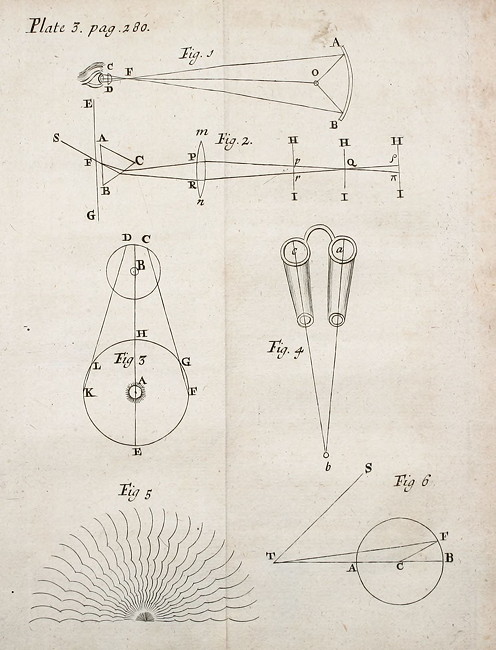
Plate 3. pag. 280.
An Estimate of the Degrees of the Mortality of Mankind, drawn from curious Tables of the Births and Funerals at the City of Breslaw; with an Attempt to ascertain the Price of Annuities upon Lives. By Mr. E. Halley, R. S. S.
THE Contemplation of the Mortality of Mankind, has besides the Moral, its Physical and Political Uses, both which have been some Years since most judiciously consider'd by the Curious Sir William Petty, in his Natural and Political Observations on the Bills of Mortality of London, own'd by Captain John Graunt: And since in a like Treatise on the Bills of Mortality of Dublin. But the Deduction from those Bills of Mortality seemed even to their Authors to be defective: First, In that the Number of the People was wanting. Secondly, That the Ages of the People dying was not to be had. And Lastly, That both London and Dublin, by reason of the great and casual Accession of Strangers who die therein, (as appeared in both, by the great Excess of the Funerals above the Births) rendred them incapable of being Standards for this purpose; which requires, if it were possible, that the People we treat of, should not at all be changed, but die where they were born, without any adventitious Increase from Abroad, or Decay by Migration elsewhere.
This Defect seems in a great measure to be satisfied by the late curious Tables of the Bills of Mortality at the City of Breslaw, lately communicated to this Honourable Society by Mr. Justell, wherein both the Ages and Sexes of all that die, are Monthly delivered, and compared with the number of the Births, for Five Years last past, viz. 1687, 88, 89, 90, 91, seeming to be done with all the Exactness and Sincerity possible.
This City of Breslaw is the Capital City of the Province of Silesia; or, as the Germans call it, Schlesia, and is situated on the Western Bank of the River Oder, anciently call'd Viadrus, near the Confines of Germany and Poland, and very nigh the Latitude of London. It is very far from the Sea, and as much a Mediterranean Place as can be desired, whence the Confluence of Strangers is but small, and the Manufacture of Linnen employs chiefly the poor People of the Place, as well as of the Country round about; whence comes that sort of Linnen we usually call your Sclesiæ Linnen; which is the chief, if not the only Merchandize of the Place. For these Reasons, the People of this City seem most proper for a Standard; and the rather, for that the Births do a small matter exceed the Funerals. The only thing wanting, is the Number of the whole People, which in some measure I have endeavour'd to supply, by the comparison of the Mortality of the People of all Ages, which I shall from the said Bills trace out with all the Accuracy possible.
It appears that in the Five Years mentioned, viz. from 87 to 91 inclusive, there were born 6193 Persons, and buried 5869; that is, born per Annum 1238, and buried 1174; whence an Increase of the People may be argued of 64 per Annum, or of about a 20th part, which may perhaps be balanc'd by the Levies for the Emperor's Service in his Wars. But this being contingent, and the Births certain, I will suppose the People of Breslaw to be increased by 1238 Births annually. Of these it appears by the same Tables, that 348 do die yearly in the first Year of their Age, and that but 890 do arrive at a full Year's Age; and likewise, that 198 do die in the Five Years between 1 and 6 compleat, taken at a Medium; so that but 692 of the Persons born do survive Six whole Years. From this Age the Infants being arrived at some degree of Firmness, grow less and less Mortal; and it appears, that of the whole People of Breslaw there die yearly, as in the following Table, wherein the upper Line shews the Age, and the next under it, the Number of Persons of that Age dying yearly.
7 8 9 14 18 21 27 28 35
11 11 6 5½ 2 3½ 5 6 4½ 6½ 9 8 7 7
36 42 45 49 54 55 56 63 70
8 9½ 8 9 7 7 10 11 9 9 10 12 9½ 14
71 72 77 81 84 90 91 98 99 100
9 11 9½ 6 7 3 4 2 1 1 1 0 ⅕ ⅗
And where no Figure is placed over, it is to be understood of those that die between the Ages of the precedent and consequent Column.
From this Table it is evident, that from the Age of 9 to about 25, there does not die above 6 per Annum of each Age, which is much about 1 per Cent. of those that are of those Ages: And whereas in the 14, 15, 16, 17 Years, there appear to die much fewer, as 2 and 3½; yet that seems rather to be attributed to Chance, as are the other Irregularities in the Series of Ages, which would rectifie themselves, were the number of Years much more considerable, as 20 instead of 5. And by our own Experience in Christ-Church Hospital, I am inform'd there die of the Young Lads, much about 1 per Cent. per Annum, they being of the aforesaid Ages. From 25 to 50, there seem to die from 7 to 8 and 9 per Annum of each Age; and after that to 70, they growing more crasie, though the number be much diminished, yet the Mortality increases, and there are found to die 10 or 11 of each Age per Annum: From thence the number of the Living being grown very small, they gradually decline till there be none left to die; as may be seen at one View in the Table.
From these Considerations I have form'd the adjoined Table, whose Uses are manifold, and give a more just Idea of the State and Condition of Mankind, than any thing yet extant that I know of. It exhibits the Number of People in the City of Breslaw of all Ages, from the Birth to extreme Old Age, and thereby shews the Chances of Mortality at all Ages, and likewise how to make a certain Estimate of the Value of Annuities for Lives, which hitherto has been only done by an imaginary Valuation: Also the Chances that there are that a Person of any Age proposed does live to any other Age given; with many more, as I shall hereafter shew. This Table does shew the Number of Persons that are living in the Age current annexed thereto, as follows:
Age. Curt. Persons. Age. Curt. Persons. Age. Curt. Persons. Age. Curt. Persons.
1 1000 8 680 15 628 22 586
2 855 9 670 16 622 23 579
3 798 10 661 17 616 24 573
4 760 11 653 18 610 25 567
5 732 12 646 19 604 26 560
6 710 13 640 20 598 27 553
7 692 14 634 21 592 28 546
29 539 36 481 43 417 50 346
30 531 37 472 44 407 51 335
31 523 38 463 45 397 52 324
32 515 39 454 46 387 53 313
33 507 40 445 47 377 54 302
34 499 41 436 48 367 55 292
35 490 42 427 49 357 56 282
57 272 64 202 71 131 78 58
58 262 65 192 72 120 79 49
59 252 66 182 73 109 80 41
60 242 67 172 74 98 81 34
61 232 68 162 75 88 82 28
62 222 69 152 76 78 83 23
63 212 79 142 77 68 84 20
Age. Persons.
7 5547
14 4584
21 4270
28 3964
35 3604
42 3708
49 2709
56 2194
63 1694
70 1204
77 692
84 253
100 107
34000
Sum Total.
Thus it appears, that the whole People of Breslaw does consist of 34000 Souls, being the Sum Total of the Persons of all Ages in the Table: The first use hereof is to shew the Proportion of Men able to bear Arms in any Multitude, which are those between 18 and 56, rather than 16 and 60; the one being generally too weak to bear the Fatigues of War, and the Weight of Arms; and the other too crasie and infirm from Age, notwithstanding particular Instances to the contrary. Under 18 from the Table, are found in this City 11997 Persons, 3950 above 56, which together make 15947, so that the Residue to 34000 being 18053, are Persons between those Ages. At least one half thereof are Males, or 9027: So that the whole Force this City can raise of Fencible Men, as the Scotch call them, is about 9000, or 9⁄34, or somewhat more than a quarter of the Number of Souls; which may parhaps pass for a Rule for all other places.
The Second Use of this Table, is, to shew the differing degrees of Mortality, or rather Vitality, in all Ages; for if the Number of Persons of any Age remaining after one Year, be divided by the difference between that and the number of the Age proposed, it shews the Odds that there is, that a Person of that Age does not die in a Year. As for Instance, a Person of 25 Years of Age has the Odds of 560 to 7, or 80 to 1, that he does not die in a Year: Because that of 567, living of 25 Years of Age, there do die no more than 7 in a Year, leaving 560 of 26 Years old.
So likewise for the Odds, that any Person does not die before he attain any proposed Age: Take the number of the remaining Persons of the Age proposed, and divide it by the difference between it and the number of those of the Age of the Party proposed; and that shews the Odds there is between the Chances of the Party's living or dying. As for Instance; What is the Odds that a Man of 40 lives 7 Years: Take the number of Persons of 47 Years, which in the Table is 377, and subtract it from the number of Persons of 40 Years, which is 445, and the difference is 68: Which shews that the Persons dying in that 7 Years, are 68, and that it is 377 to 68, or 5½ to 1, that a Man of 40 does live 7 Years. And the like for any other number of Years.
Use III. But if it be enquired at what number of Years, it is an even Lay that a Person of any Age shall die, this Table readily performs it; For if the number of Persons living of the Age proposed, be halfed, it will be found by the Table at what Year the said Number is reduced to half by Mortality; and that is the Age, to which it is an even Wager, that a Person of the Age proposed shall arrive before he die. As for Instance; A Person of 30 Years of Age is proposed, the number of that Age is 531, the half thereof is 265, which number I find to be between 57 and 58 Years; so that a Man of 30 may reasonably expect to live between 27 and 28 Years.
Use IV. By what has been said, the Price of Insurance upon Lives ought to be regulated, and the difference is discovered between the Price of insuring the Life of a Man of 20 and 50. For Example; It being 100 to 1, that a Man of 20 dies not in a Year, and but 38 to 1, for a Man of 50 Years of Age.
Use V. On this depends the Valuation of Annuities upon Lives; for it is plain, that the Purchaser ought to pay for only such a part of the Value of the Annuity, as he has Chances that he is living; and this ought to be computed yearly, and the Sum of all those yearly Values being added together, will amount to the Value of the Annuity for the Life of the Person proposed. Now the present Value of Money payable after a Term of Years, at any given Rate of Interest, either may be had from Tables already computed; or almost as compendiously, by the Table of Logarithms: For the Arithmetical Complement of the Logarithm of Unity, and its yearly Interest, (that is, of 1,06 for Six per Cent. being 9,974694.) being multiplied by the number of Years proposed, gives the present Value of One Pound payable after the end of so many Years. Then by the foregoing Proposition, it will be as the number of Persons living after that Term of Years, to the number dead; so are the Odds that any one Person is alive or dead. And by consequence, as the Sum of both, or the number of Persons living of the Age first proposed, to the number remaining after so many Years, (both given by the Table) so the present Value of the yearly Sum payable after the Term proposed, to the Sum which ought to be paid for the Chance the Person has to enjoy such an Annuity after so many Years. And this being repeated for every Year of the Person's Life, the Sum of all the present Values of those Chances is the true Value of the Annuity. This will without doubt appear to be a most laborious Calculation; but it being one of the principal Uses of this Speculation, and having found some Compendia for the Work, I took the pains to compute the following Table, being the short Result of a not ordinary number of Arithmetical Operations: It shews the Value of Annuities for every Fifth Year of Age, to the Seventieth, as follows.
Age. Years Pur. Age. Years Pur. Age. Years Pur.
1 10,28 25 12,27 50 9,21
5 13,40 30 11,72 55 8,51
10 13,44 35 11,12 60 7,60
15 13,33 40 10,57 65 6,54
20 12,78 45 9,91 70 5,32
This shews the great Advantage of putting Money into the present Fund lately granted to Their Majesties, giving 14 per Cent. per Annum, or at the Rate of 7 Years Purchase for a Life; when young Lives, at the usual Rate of Interest, are worth above 13 Years Purchase. It shews likewise the Advantage of young Lives over those in Years; a Life of Ten Years being almost worth 13½ Years Purchase, whereas one of 36 is worth but 11.
Use VI. Two Lives are likewise valuable by the same Rule; for the number of Chances of each single Life, found in the Table, being multiplied together, become the Chances of the Two Lives. And after any certain Term of Years, the Product of the two remaining Sums is the Chances that both the Persons are living. The Product of the two Differences, being the numbers of the Dead of both Ages, are the Chances that both the Persons are dead. And the two Products of the remaining Sums of the one Age multiplied by those dead of the other, shew the Chances that there are, that each Party survives the other: Whence is derived the Rule to estimate the Value of the Remainder of one Life after another. Now as the Product of the Two Numbers in the Table for the Two Ages proposed, is to the difference between that Product, and the Product of the two numbers of Persons deceased in any space of time; so is the Value of a Sum of Money to be paid after so much time, to the Value thereof under the Contingency of Mortality. And as the aforesaid Product of the two Numbers answering to the Ages proposed, to the Product of the Deceased of one Age multiplied by those remaining alive of the other; so the Value of a Sum of Money to be paid after any time proposed, to the Value of the Chances, that the one Party has that he survives the other, whose number of Deceased you made use of, in the second Term of the Proportion. This perhaps may be better understood, by putting N for the number of the younger Age, and n for that of the Elder; Y, y the Deceased of both Ages respectively, and R, r for the Remainders; and R + Y = N, and r + y = n. Then shall Nn be the whole Number of Chances; Nn - Yy be the Chances that one of the two Persons is living, Yy the Chances that they are both dead; Ry the Chances that the elder Person is dead, and the younger living; and rY the Chances, that the elder is living, and the younger dead. Thus two Persons of 18 and 35 are proposed, and after 8 Years these Chances are required. The Numbers for 18 and 35, are 610 and 490; and there are 50 of the First Age dead in 8 Years, and 73 of the Elder Age. There are in all 610 × 490, or 298900 Chances; of these there are 50 × 73, or 3650, that they are both dead. And as 298900, to 298900 - 3650, or 295250: So is the present Value of a Sum of Money to be paid after 8 Years, to the present Value of a Sum to be paid, if either of the two live. And as 560 × 73, so are the Chances that the Elder is dead, leaving the Younger; and as 417 × 50, so are the Chances that the Younger is dead, leaving the Elder. Wherefore as 610 × 490 to 560 × 73, so is the present Value of a Sum to be paid at 8 Years end, to the Sum to be paid for the Chance of the Younger's Survivance; and as 610 × 490 to 417 × 50, so is the same present Value to the Sum to be paid for the Chance of the Elder's Survivance.
This possibly may be yet better explained, by expounding these Products by Rectangular Parallelograms, as in Fig. 7. wherein AB or CD represents the number of Persons of the younger Age, and DE, BH those remaining alive after a certain Term of Years; whence CE will answer the number of those dead in that time: So AC, BD may represent the number of the elder Age; AF, BI the Survivors after the same Term; and CF, DI, those of that Age that are dead at that time. Then shall the whole Parallelogram ABCD be Nn, or the Product of the two Numbers of Persons, representing such a number of Persons of the two Ages given; and by what was said before, after the Term proposed, the Rectangle HD shall be as the number of Persons of the younger Age that survive, and the Rectangle AE as the number of those that die. So likewise the Rectangles AI, FD shall be as the Numbers, living and dead, of the other Age. Hence the Rectangle HI shall be as an equal number of both Ages surviving. The Rectangle FE being the Product of the Deceased, or Yy, an equal number of both dead. The Rectangle GD or Ry, a number living of the younger Age, and dead of the elder: And the Rectangle AG or rY a number living of the elder Age, but dead of the younger. This being understood, it is obvious, that as the whole Rectangle AD or Nn is to the Gnomon FABDEG or Nn - Yy, so is the whole number of Persons or Chances, to the number of Chances that one of the two Persons is living: And as AD or Nn is to FE or Yy, so are all the Chances, to the Chances that both are dead; whereby may be computed the Value of the Reversion after both Lives. And as AD to GD or Ry, so the whole number of Chances, to the Chances that the younger is living, and the other dead; whereby may be cast up what Value ought to be paid for the Reversion of one Life after another, as in the Case of providing for Clergy-men's Widows, and others, by such Reversions. And as AD to AG, or rY, so are all the Chances, to those that the elder survives the younger. I have been the more particular, and perhaps tedious, in this Matter, because it is the Key to the Case of Three Lives, which of it self would not have been so easie to comprehend.
VII. If Three Lives are proposed, to find the Value of an Annuity during the continuance of any of those three Lives; the Rule is, As the Product of the continual Multiplication of the Three Numbers, in the Table, answering to the Ages proposed, is to the difference of that Product, and of the Product of the Three Numbers of the Deceased of those Ages, in any given Term of Years: So is the present Value of a Sum of Money, to be paid certainly after so many Years, to the present Value of the same Sum to be paid, provided one of those Three Persons be living at the Expiration of that Term. Which Proportion being yearly repeated, the Sum of all those present Values will be the Value of an Annuity granted for three such Lives. But to explain this, together with all the Cases of Survivance in Three Lives: Let N be the Number in the Table for the younger Age, n for the second, and ν for the elder Age; let Y be those dead of the younger Age in the Term proposed, y those dead of the second Age, and υ those of the elder Age; and let R be the Remainder of the younger Age, r that of the middle Age, and ρ the Remainder of the elder Age. Then shall R + Y be equal to N, r + y to n, and ρ + υ to ν, and the continual Product of the three Numbers N, n, ν, shall be equal to the continual Product of R + Y × r + y × ρ + υ, which being the whole Number of Chances for three Lives, is compounded of the eight Products following. (1) Rrρ, which is the Number of Chances that all three of the Persons are living. (2) rρY, which is the Number of Chances that the two elder Persons are living, and the younger dead. (3) Rρy the Number of Chances that the middle Age is dead, and the younger and elder living. (4) Rrυ being the Chances that the two younger are living, and the elder dead. (5) ρYy the Chances that the two younger are dead, and the elder living. (6) rYυ the Chances that the younger and elder are dead, and the middle Age living. (7) Ryυ, which are the Chances that the younger is living, and the two other dead. And Lastly and Eighthly, Yyυ, which are the Chances that all three are dead. Which latter subtracted from the whole Number of Chances Nnν, leaves Nnν - Yyυ the Sum of all the other seven Products; in all of which one or more of the three Persons are surviving.
To make this yet more evident, I have added Fig. 8. wherein these eight several Products are at one view exhibited. Let the rectangled Parallelepipedon ABCDEFGH be constituted of the sides AB, GH, &c. proportional to N the Number of the younger Age; AC, BD, &c. proportional to n; and AG, CE, &c. proportional to the Number of the elder, or ν. And the whole Parallelepipedon shall be as the Product Nnν, or our whole Number of Chances. Let BP be as R, and AP as Y; let CL be as r, and Ln as y; and GN as ρ, and NA as υ; and let the Plain PRea be made parallel to the Plain ACGE; the Plain NVbY parallel to ABCD; and the Plain LXTQ parallel to the Plain ABGH. And our first Product Rrρ shall be as the Solid STWIFZeb. The Second, or rρY will be as the Solid EYZeQSMI. The Third, Rρy, as the Solid RHOVWIST. And the Fourth, Rrυ, as the Solid ZabDWXIK. Fifthly, ρYy, as the Solid GQRSIMNO. Sixthly, rYυ, as IKLMGYZA. Seventhly, Ryυ, as the Solid IKPOBXVW. And Lastly, AIKLMNOP will be as the Product of the 3 Numbers of Persons dead, or Yyυ. I shall not apply this in all the Cases thereof, for brevity sake; only to shew in one how all the rest may be performed, let it be demanded what is the Value of the Reversion of the younger Life after the two elder proposed. The proportion is as the whole Number of Chances, or Nnν to the Product Ryυ; so is the certain present Value of the Sum payable after any Term proposed, to the Value due to such Chances as the younger Person has to bury both the elder, by the Term proposed; which therefore he is to pay for. Here it is to be noted, that the first Term of all these Proportions is the same throughout, viz. Nnν. The second changing yearly according to the Decrease of R, r, ρ, and Increase of Y, y, υ. And the third are successively the present Values of Money payable after one, two, three, &c. years, according to the Rate of Interest agreed on. These Numbers, which are in all Cases of Annuities of necessary Use, I have put into the following Table, they being Decimal Values of one Pound payable after the Number of Years in the Margent, at the Rate of 6 per Cent.
Years. Pres. Value of 1 l. Years. Pres. Value of 1 l. Years. Pres. Value of 1 l.
1 0,9434 19 0,3305 37 0,1158
2 0,8900 20 0,3118 38 0,1092
3 0,8396 21 0,2941 39 0,1031
4 0,7921 22 0,2775 40 0,0972
5 0,7473 23 0,2618 45 0,0726
6 0,7050 24 0,2470 50 0,0543
7 0,6650 25 0,2330 55 0,0406
8 0,6274 26 0,2198 60 0,0303
9 0,5919 27 0,2074 65 0,0227
10 0,5584 28 0,1956 70 0,0169
11 0,5268 29 0,1845 75 0,0126
12 0,4970 30 0,1741 80 0,0094
13 0,4688 31 0,1643 85 0,0071
14 0,4423 32 0,1550 90 0,0053
15 0,4173 33 0,1462 95 0,0039
16 0,3936 34 0,1379 100 0,0029
17 0,3714 35 0,1301
18 0,3503 36 0,1227
It were needless to advertise, that the great trouble of working so many Proportions will be very much alleviated by using Logarithms; and that instead of using Nnν - Yyυ for the second Term of the Proportion in finding the Value of Three Lives, it may suffice to use only Yyυ, and then deducting the fourth Term so found out of the third, the Remainder shall be the present Value sought; or all these fourth Terms being added together, and deducted out of the Value of the certain Annuity for so many Years, will leave the Value of the contingent Annuity upon the Chance of Mortality of all those Three Lives. For Example; Let there be Three Lives of 10, 30, and 40 Years of Age proposed, and the Proportions will be thus;
As 661 in 531 in 445 or 156190995, or Nnν to 8 in 8 in 9, or 576, or Yyυ for the first Year, so 0,9434. to 0,00000348.
To 15 in 16 in 18, or 4320, for the second Year, so 0,8900. to 0,00002462.
To 21 in 24 in 28, or 14112 for the third Year, so 0,8396. to 0,00008128.
To 27 in 32 in 38, for the fourth Year, so 0,7921. to 0,00016650.
To 33 in 41 in 48, for the fifth Year, so 0,7473. to 0,00031071.
To 39 in 50 in 58, for the sixth Year, so 0,7050. to 0,00051051.
And so forth to the 60th Year, when we suppose the elder Life of Forty certainly to be expired; from whence till Seventy we must compute for the First and Second only, and from thence to Ninety for the single youngest Life. Then the Sum Total of all these Fourth Proportionals being taken out of the Value of a certain Annuity for 90 Years, being 16,58 Years Purchase, shall leave the just Value to be paid for an Annuity during the whole Term of the Lives of Three Persons of the Ages proposed. And note, that it will not be necessary to compute for every Year singly; but that in most Cases every 4th or 5th Year may suffice, interpoling for the intermediate Years seceundum artem.
It may be objected, that the different Salubrity of Places does hinder this Proposal from being universal; nor can it be denied. But by the Number that die, being 1174. per Annum in 34000, it does appear that about a 30th part die yearly, as Sir William Petty has computed for London; and the Number that die in Infancy, is a good Argument that the Air is but indifferently salubrious. So that by what I can learn, there cannot perhaps be one better Place proposed for a Standard. At least 'tis desired, that in Imitation hereof the Curious in other Cities would attempt something of the same Nature, than which nothing perhaps can be more useful.
Were this Calculus founded on the Experience of a very great number of Years, it would be very well worth the while to think of Methods for facilitating the Computation of the Value of two, three, or more Lives; which, as proposed in my former, seems (as I am inform'd) a Work of too much Difficulty for the ordinary Arithmetician to undertake.
I have sought, If it were possible, to find a Theorem that might be more concise than the Rules there laid down, but in vain; for all that can be done to expedite it, is, by Tables of Logarithms ready computed, to exhibit the Rationes of N to Y in each single Life, for every third, fourth, or fifth Year of Age, as occasion shall require; and these Logarithms being added to the Logarithms of the present Value of Money payable after so many Years, will give a Series of Numbers, the Sum of which will shew the Value of the Annuity sought. However, for each Number of this Series, two Logarithms for a single Life, three for two Lives, and four for three Lives, must necessarily be added together. If you think the Matter, under the Uncertainties I have mentioned, to deserve it, I shall shortly give you such a Table of Logarithms, as I speak of, and an Example or two of the use thereof: But by Vulgar Arithmetick, the Labour of these Numbers were immense; and nothing will more recommend the useful Invention of Logarithms to all Lovers of Numbers, than the advantage of Dispatch in this and such like Computations.
Besides the Uses mentioned, it may perhaps not be an unacceptable thing to infer from the same Tables, how unjustly we repine at the shortness of our Lives, and think our selves wronged if we attain not old Age; whereas it appears hereby, that the one half of those that are born are dead in Seventeen Years time, 1238 being in that time reduced to 616. So that instead of murmuring at what we call an untimely Death, we ought with Patience and Unconcern to submit to that Dissolution which is the necessary Condition of our perishable Materials, and of our nice and frail Structure and Composition: And to account it as a Blessing that we have survived, perhaps by many Years, that Period of Life, whereat the one half of the whole Race of Mankind does not arrive.
A second Observation I make upon the said Table, is that the Growth and Increase of Mankind is not so much stinted by any thing in the Nature of the Species, as it is from the cautious difficulty most People make to adventure on the State of Marriage, from the Prospect of the Trouble and Charge of providing for a Family. Nor are the poorer sort of People herein to be blamed, since their difficulty of subsisting is occasion'd by the unequal Distribution of Possessions, all being necessarily fed from the Earth, of which yet so few are Masters. So that besides themselves and Families, they are yet to work for those who own the Ground that feeds them: And of such does by very much the greater part of Mankind consist; otherwise it is plain, that there might well be four times as many Births as we now find. For by Computation from the Table, I find that there are nearly 15000 Persons above 16, and under 45, of which at least 7000 are Women capable to bear Children. Of these notwithstanding there are but 1238 born yearly, which is but little more than a sixth part: So that about one in six of these Women do breed yearly; whereas were they all married, it would not appear strange or unlikely, that four of six should bring a Child every Year. The Political Consequences hereof I shall not insist on; only the Strength and Glory of a King being in the multitude of his Subjects, I shall only hint, that above all things, Celibacy ought to be discouraged, as, by extraordinary Taxing and Military Service: And those who have numerous Families of Children to be countenanced and encouraged by such Laws as the Jus trium Liberorum among the Romans. But especially, by an effectual Care to provide for the Subsistence of the Poor, by finding them Employments, whereby they may earn their Bread, without being chargeable to the Publick.
A Discourse concerning Gravity, and its Properties, wherein the Descent of Heavy Bodies, and the Motion of Projects is briefly, but fully handled: Together with the Solution of a Problem of great Use in Gunnery. By E. Halley.
NATURE, amidst the great Variety of Problems, wherewith She exercises the Wits of Philosophical Men, scarce affords any one wherein the Effect is more visible, and the Cause more concealed, than in those of the Phænomena of Gravity. Before we can go alone, we must learn to defend our selves from the Violence of its Impulse, by not trusting the Center of Gravity of our Bodies beyond our reach; and yet the acutest Philosophers, and the subtilest Enquirers into the Original of this Motion, have been so far from satisfying their Readers, that they themselves seem little to have understood the Consequences of their own Hypotheses.
Des Cartes his Notion, I must needs confess to be to me incomprehensible, while he will have the Particles of his Cœlestial Matter, by being reflected on the Surface of the Earth, and so ascending therefrom, to drive down into their Places those Terrestrial Bodies they find above them: This is, as near as I can gather, the Scope of the 20, 21, 22, and 23 Sections of the last Book of his Principia Philosophiæ; yet neither he, nor any of his Followers, can shew how a Body suspended in Libero Æthere, shall be carried downwards by a continual Impulse tending upwards, and acting upon all its Parts equally: And besides the Obscurity wherewith he expresses himself, particularly, Sect. 23. does sufficiently argue according to his own Rules, the confused Idea he had of the thing he wrote.
Others, and among them Dr. Vossius, assert the Cause of the Descent of heavy Bodies, to be the Diurnal Rotation of the Earth upon its Axis, without considering, that according to the Doctrine of Motion fortified with Demonstration, all Bodies moved in Circulo, would recede from the Center of their Motion; whereby the contrary to Gravity would follow, and all loose Bodies would be cast into the Air in a Tangent to the Parallel of Latitude, without the intervention of some other Principle to keep them fast, such as is that of Gravity. Besides, the Effect of this Principle is throughout the whole Surface of the Globe found nearly equal; and certain Experiments have proved it rather less near the Æquinoctial, than towards the Poles; which could not be by any means, if the Diurnal Rotation of the Earth upon its Axis were the Cause of Gravity; for where the Motion was swiftest, the Effect would be most considerable.
Others assign the Pressure of the Atmosphere, to be the Cause of this Tendency towards the Center of the Earth; but unhappily they have mistaken the Cause for the Effect; it being from undoubted Principles plain, that the Atmosphere has no other Pressure but what it derives from its Gravity; and that the Weight of the upper Parts of the Air, pressing on the lower Parts thereof, do so far bend the Springs of that Elastick Body, as to give it a Force equal to the Weight that compress'd it, having of it self no force at all: And supposing it had, it will be very hard to explain the Modus, how that Pressure should occasion the Descent of a Body circumscribed by it, and pressed equally above and below, without some other Force to draw, or thrust it downwards. But to demonstrate the contrary of this Opinion, an Experiment was long since shewn before the Royal Society, whereby it appeared, that the Atmosphere was so far from being the Cause of Gravity, that the Effects thereof were much more vigorous, where the Pressure of the Atmosphere was taken off; for a long Glass-Receiver having a light Down-feather included, being evacuated of Air, the Feather, which in the Air would hardly sink, did in vacuo descend with nearly the same Velocity, as if it had been a Stone.