Chapter VII
Reading edition
THE CASE OF PAPILIO POLYTES
The third form of female is again very distinct from the other two. The fore wings are dark but are broken by an irregular white band running across the middle (Pl. V, fig. 4), and there is also an irregular white patch nearer the tips of the wing. The hind wings, on the other hand, are characterised by having only red markings. The yellowish-white band of the male is much reduced and is entirely red, while the red lunules are much larger than in the A form. The under surface (Pl. V, fig. 4 a) corresponds closely with the upper. The body remains black as in all the other forms. This type of female bears a resemblance to Papilio hector (Pl. V, fig. 6), and for that reason we shall speak of it as the H form. It should be added that these three forms of female are quite indistinguishable in the larval and chrysalis stages.
The suggestion of mimicry in this case is supported by the fact that there is a general correspondence between the areas of distribution of model and mimic. P. hector is not found outside India and Ceylon, and the H female of P. polytes is also confined to this area. P. aristolochiae, on the other hand, has a much wider range, almost as wide indeed as that of P. polytes itself. Generally speaking the A female accompanies P. aristolochiae wherever the latter species is found. Beyond the range of P. aristolochiae, in northern China, the M female alone is said to occur. On the other hand, as the matter comes to be more closely studied exceptions are beginning to turn up. The H female, for instance, is found on the lower slopes of the Himalayas, far north of the range of P. hector, and there are indications that a careful study of the distribution in China and Japan may prove of importance.
It may, however, be argued that it is not when at rest but during flight that the mimetic resemblance protects the mimic from attack. Actually this can hardly be true, for the mode of flight constitutes one of the most striking differences between model and mimic. P. hector and P. aristolochiae fly much in the same way. They give one the impression of flying mainly with their fore wings, which vibrate rapidly, so that the course of the insect, though not swift, is on the whole sustained and even. The flight of all the different forms of polytes is similar and quite distinct from that of the models. It is a strong but rather heavy and lumbering up-and-down flight. One gets the impression that all the wing surface is being used instead of principally the fore wings as appears in P. hector and P. aristolochiae. The difference is difficult to put into words, but owing to these peculiarities of flight the eye has no difficulty in distinguishing between model and mimic even at a distance of 40 to 50 yards. Moreover, colour need not enter into the matter at all. It is even easier to distinguish model from mimic when flying against a bright background, as for instance when the insect is between the observer and a sunlit sky, than it is to do so by reflected light. I have myself spent many days in doing little else but chasing polytes at Trincomalee where it was flying in company with P. hector, but I was never once lured into chasing the model in mistake for the mimic. My experience was that whether at rest or flying the species are perfectly distinct, and I find it difficult to imagine that a bird whose living depended in part upon its ability to discriminate between the different forms would be likely to be misled. Certainly it would not be if its powers of discrimination were equal to those of an ordinary civilised man. If the bird were unable to distinguish between say the A form of female and P. aristolochiae I think that it would be still less likely to distinguish between the same A form and the male or the M form of female. For my experience was that at a little distance one could easily confuse the A form of polytes with the male. Except when one was quite close the red on the A form was apt to be lost, the white markings on the hind wing were readily confused with those of the male, and one had to depend entirely on the lighter fore wing. Unless the bird were keener sighted than the man the A form would be more likely to be taken in mistake for its unprotected relative than avoided for its resemblance to the presumably unpalatable model. On the other hand, if the bird were sufficiently keen sighted never to confuse the A female with the male form its sight would be too keen to be imposed upon by such resemblance as exists between the A female and P. aristolochiae.
(α) The M form may give either:— (1) M only. (2) M and mimetics in about equal numbers. (3) Mimetics only. (β) The A form may give either:— (1) M and mimetics in about equal numbers. (2) M and mimetics in the ratio of about 1:3. (3) Mimetics only. (γ) The H form may give either:— (1) M and mimetics in about equal numbers. (2) M and mimetics in the ratio of about 1:3. (3) Mimetics only.
The males are in all cases alike to look at but it must nevertheless be supposed that they differ in their transmitting powers. In fact the evidence all points to there being three different kinds of male corresponding to the three different kinds of female. But they cannot shew any difference outwardly because there is always present in the male a factor which inhibits the production of the mimetic pattern even though the factor for that pattern be present.
Returning now to the records of the females it will be noticed that although the M form may breed true the mimetics never give the M form alone. Where they give the M form among their progeny they produce mimetics and non-mimetics either in the ratio 1:1 or of 3:1. This at once suggests that the non-mimetic is recessive to the mimetic forms—that the mimetics contain a factor which does not occur in the non-mimetics. If this factor, which may be called X, be added to the constitution of a non-mimetic female it turns it into a mimetic. If X be added to a male such an individual, though incapable of itself exhibiting the mimetic pattern owing to the inhibitory factor always present in that sex, becomes capable of transmitting the mimetic factor to its offspring. Expressed in the usual Mendelian way the formulae for these different butterflies are as follows:—
M♀ = or iixx Iixx = ♂ (1)
Mimetic = or iiXX IiXX = ♂ (2)
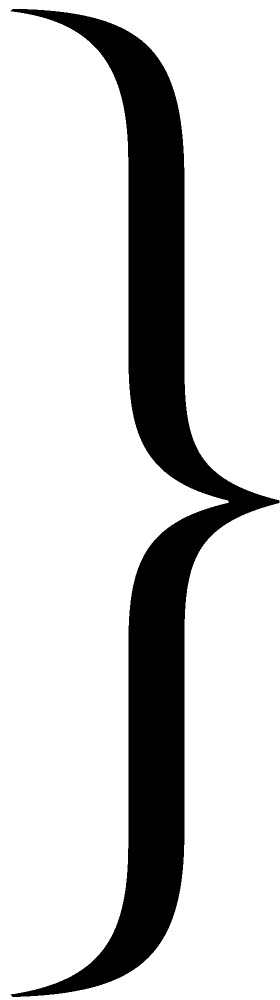
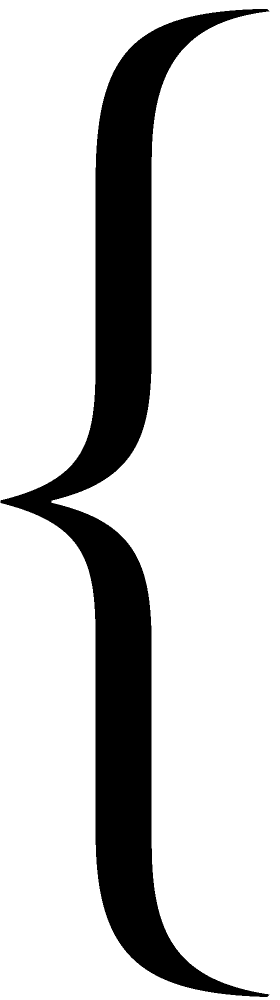
♀♀ or iiXx IiXx = ♂ (3)
where X stands for the mimetic factor and I for the factor which inhibits the action of X. All males are heterozygous for I, but during the segregation of characters at some stage in the formation of the families only the male-producing sperms come to contain the factor I. It is lacking in all the female-producing sperms formed by the male.
♂ (1) does not contain the factor for the mimetic condition and gives only daughters of the M form when mated with an M♀. ♂ (2) on the other hand is homozygous for the factor X, and consequently all of his germ cells contain it. This is the male that gives nothing but mimetic daughters with whatever form of female he is bred. ♂ (3) is heterozygous for X; that is to say, one half of his germ cells contain it, the other half not. With the M♀ he must give equal numbers of offspring with and without X, i.e. half of his daughters will be mimetic and the other half non-mimetic. With a heterozygous mimetic female (iiXx), which is also producing germ cells with and without X in equal numbers, he may be expected to give the usual result, viz. dominants and recessives in the ratio 3:1; or in other words mimetic and non-mimetic females in the ratio 3:1.
One of Fryer's experiments may be given here in illustration of the nature of the evidence upon which the above hypothesis depends.
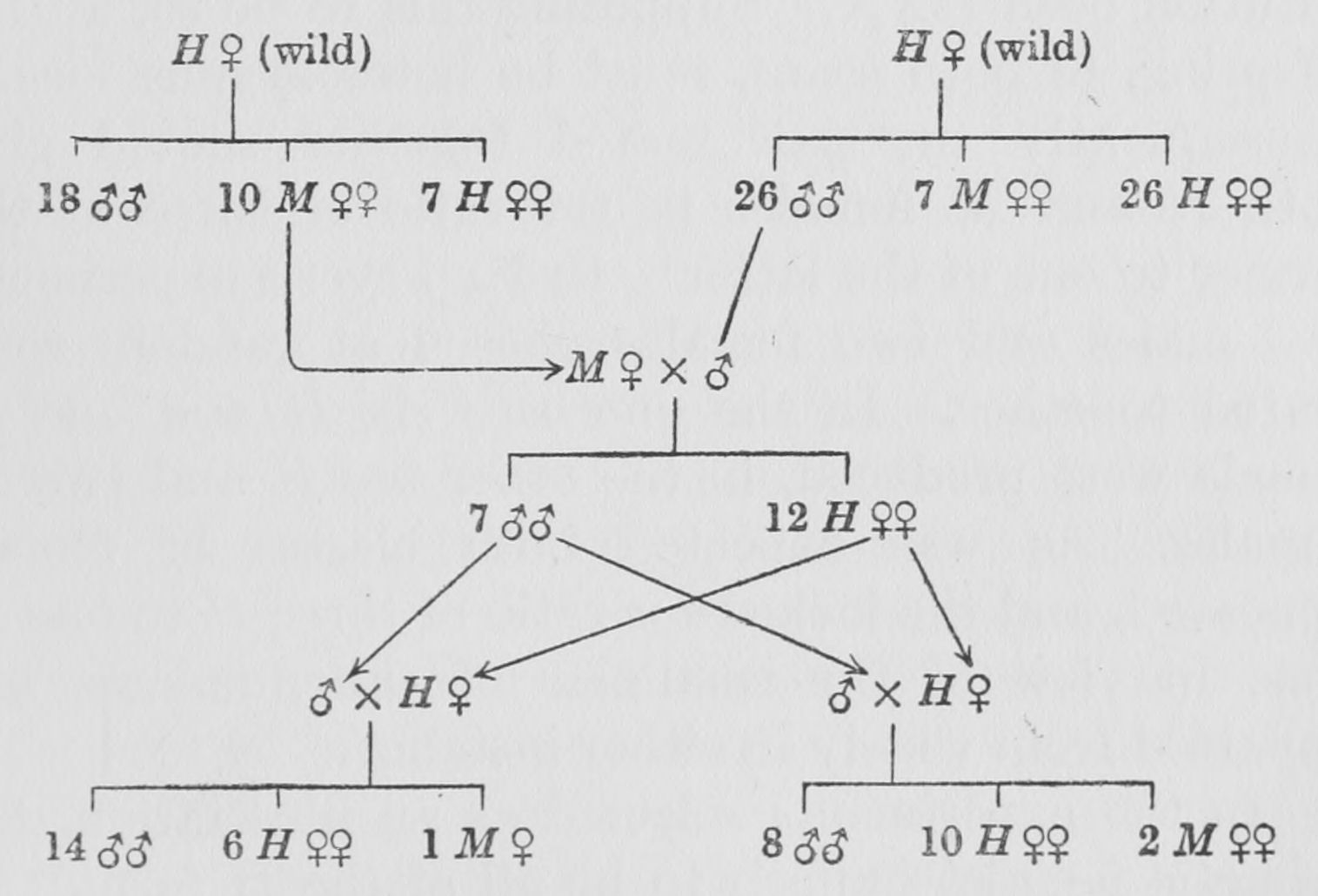
Families were reared from the two wild H females of whom nothing was known either as to ancestry or husband. The first family contained 10 M and 7 H females. Hence the original wild mother was probably iiXx and had mated with a male of the constitution Iixx. The family from the second wild H female contained 26 H and 7 M females; i.e. the ratio in which these two forms appeared was not far from 3:1. Hence the wild female was probably iiXx and her husband IiXx. If this were so some of the 26 ♂♂ should receive the X factor from both parents and consequently be IiXX in constitution. This was almost certainly so in the case of the single male in this brood tested by mating with an M female from the other brood. All of his 12 daughters were of the H form, as should have been the case had his constitution been IiXX. Supposing this to be so, all his offspring, of both sexes, must be heterozygous for X. Consequently any pair mated together should give both H and M females in the ratio of three of the former to one of the latter. In Mr Fryer's experiment two males and two females chosen at random were mated together. In the one case six H and one M female were produced, in the other ten H and two M females. As was expected both classes of female appeared, and the looked-for ratio of three H to one M was, in view of the smallness of the numbers, not departed from widely in either instance.
In the experiments selected as an illustration, the mimetic females happen to be all of the H form. In other experiments, however, both the H form and the A form occurred. As the result of his experiments Mr Fryer came to the conclusion that here again the difference is one of a single hereditary factor. All mimetic females contain the X factor, but the H females contain in addition a factor which we may call Y. The function of the Y factor is to carry the change made by the X factor a step further, and to turn the A form of female into the H form. Y is a modifier of X, but unless X is present Y can produce no effect. All the different individuals which are to be found among P. polytes in Ceylon may be represented as follows:—
♂♂ M♀♀ A♀♀ H♀♀
IixxYY iixxYY — —
IixxYy iixxYy — —
Iixxyy iixxyy — —
IiXxYY — — iiXxYY
IiXxYy — — iiXxYy
IiXxyy — iiXxyy —
IiXXYY — — iiXXYY
IiXXYy — — iiXXYy
IiXXyy — iiXXyy —
In this way is offered a simple explanation in terms of three Mendelian factors which serves at once to explain the various results of the breeding experiments, and the fact that intermediates between the different forms of female are not found.
And now we may consider briefly the bearing of these experiments on the theory of mimicry. Throughout the work no individuals intermediate between the three well-marked forms of polytes were met with. There is no difference in appearance between the heterozygous and the homozygous mimetic insects, whether they belong to the A or to the H form. The factor X, whether inherited from both parents, or from one only, produces its full effect, and the same is also true of the action of the factor Y. Now the most generally accepted hypothesis as to the formation of these mimetic resemblances supposes that they have been brought about through the gradual operation of natural selection accumulating slight variations. Professor Poulton, for example, a prominent exponent of this school, considers that the A form of female was first evolved gradually from the M form, and later on the H form came by degrees from the A form. If this be true we ought, by mingling the M germ plasm with the H germ plasm and by subsequently breeding from the insects produced, to get back our series of hypothetical intermediates, or at any rate some of them. We ought as it were to reverse the process by which the evolution of the different forms has taken place. But as is shewn by the experiment of Mr Fryer, which was quoted above, nothing of the sort happens.
From experiments with cultivated plants such as primulas and sweet peas, we have learnt that this discontinuous form of inheritance which occurs in P. polytes is the regular thing. Moreover, we have plenty of historical evidence that the new character which behaves in this way is one that has arisen suddenly without the formation of intermediate steps. The dwarf "Cupid" form of sweet pea, for instance, behaves in heredity towards the normal form as though the difference between them were a difference of a single factor. It is quite certain that the "Cupid" arose as a sudden sport from the normal without the intervention of anything in the way of intermediates. And there is every reason to suppose that the same is true for plenty of other characters involving colour and pattern as well as structure, both in the sweet pea, the primula, and other species. Since the forms of polytes female behave in breeding like the various forms of sweet pea and primula there is every reason to suppose that they arose in the same way, that is to say, as sudden sports or mutations and not by the gradual accumulation of slight differences.
But if we take this view, which is certainly most consonant with the evidence before us, we must assign to natural selection a different rôle from that which is generally ascribed to it. We cannot suppose that natural selection has played any part in the formation of a mimetic likeness. The likeness turned up suddenly as a sport quite independently of natural selection. But although natural selection may have had nothing to do with its production, it may nevertheless have come into play in connection with the conservation of the new form. If the new form possesses some advantage over the pre-existing one from which it sprang, is it not conceivable that natural selection will come into operation to render it the predominant form? To this question we shall try to find an answer in the next chapter.