Chapter III
Reading edition
OLD-WORLD MIMICS
The earlier naturalists who studied butterflies made use of colour and pattern very largely in arranging and classifying their specimens. Insects shewing the same features in these respects were generally placed together without further question, especially if they were known to come from the same locality. In looking through old collections of butterflies from the tropics it is not infrequent to find that the collector was deceived by a mimetic likeness into placing model and mimic together. During the last century, however, more attention was paid to the anatomy of butterflies, with the result that their classification was placed upon a basis of structure. As in all work of the sort certain features are selected, partly owing to their constancy and partly for their convenience, the insects being arranged according as to whether they present these features or not. Everybody knows that the butterflies as a group are separated from the moths on the ground that their antennae are club shaped at the end, while those of the moth are generally filamentary and taper to a fine point.
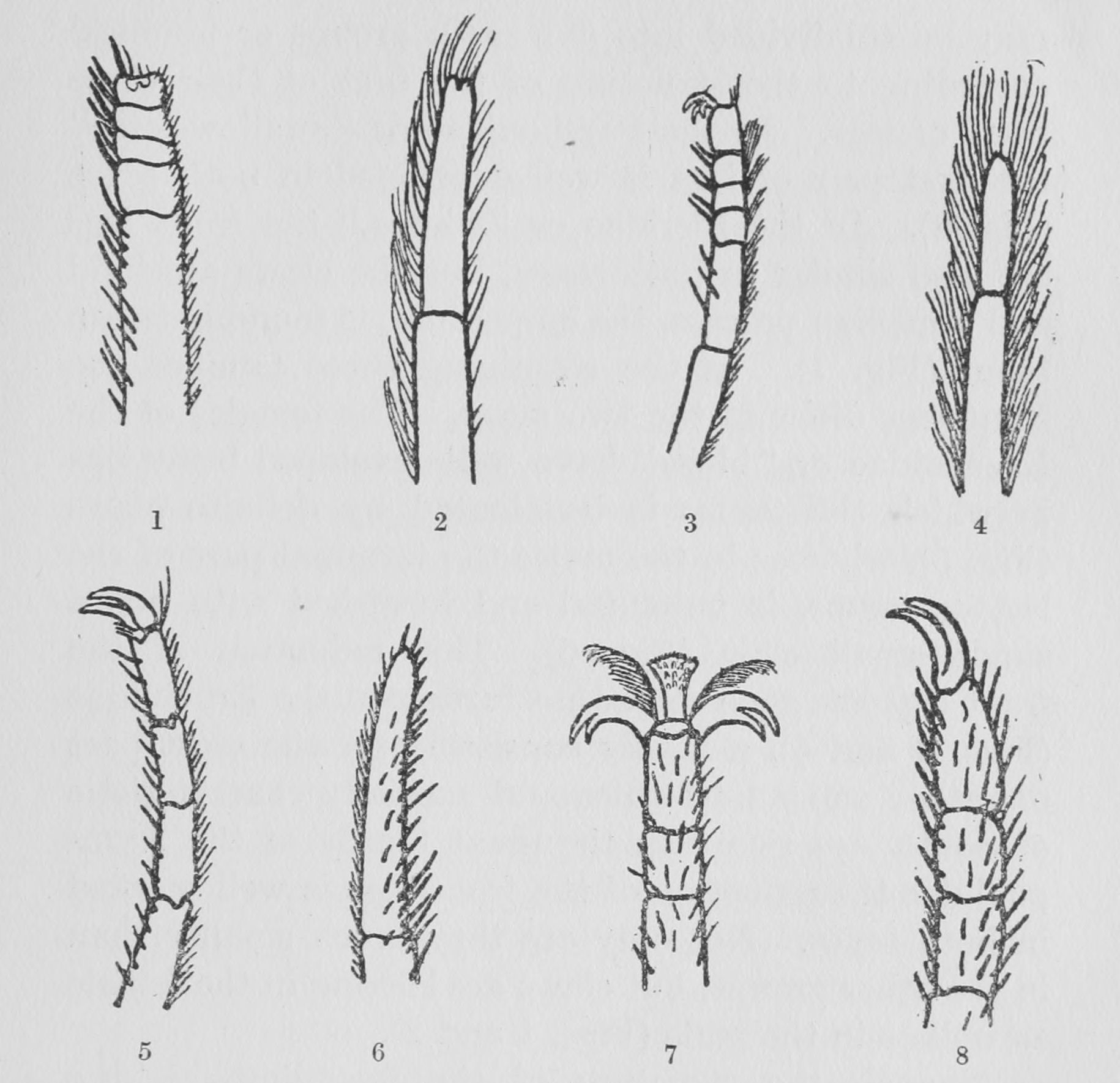
Figs. 1-8. Terminal portion of front legs of butterflies belonging to different families. (After Eltringham.)
1. Hypolimnas misippus, ♀ (Nymphalidae).
2. Hypo"imnas mis" ♂ (Nymp"alidae).
3. Abisara savitri, ♀ (Erycinidae).
4. Abi"ara sav" ♂ (Eryci"idae).
5. Lycaena icarus, ♀ (Lycaenidae).
6. Cupido zoë, ♂ (Lyca"nidae).
7. Ganoris rapae, ♂ (Pieridae).
8. Papilio echerioides, ♀ (Papilionidae).
Though the structure of the fore limbs is the character specially chosen for separating these different families from one another, it is of course understood that they differ from one another in various other distinctive features. The chrysalis of the Nymphalidae for example hangs head downwards suspended by the tail, whereas in the Pieridae and Papilionidae metamorphosis takes place with the chrysalis attached by the tail but supported also by a fine girdle of silk round the middle so that the head is uppermost. The larvae also afford characters by which some of the families may be distinguished—those of the Papilionidae for example having a process on the back which can be extruded or retracted.
Simple mimicry, explicable, at any rate in theory, on the lines laid down by Bates, is a phenomenon of not infrequent occurrence in tropical countries, though rare in more temperate lands. In each of the three great divisions of the tropical world we find certain groups of butterflies serving as models, and being mimicked by butterflies belonging as a rule to quite different groups. Speaking generally the models of any given region are confined to a few groups, while the mimics are drawn from a greater number. In Asia the principal models belong to the Danaines, the Euploeines, and to a group of swallow-tails which from the fact that their larvae feed on the poisonous Aristolochia plant are generally distinguished as the "Poison-eaters," or Pharmacophagus group. Of these the Danaines and Euploeines are closely related and have much in common. They are usually butterflies of medium size, of rather flimsy build and with a somewhat slow and flaunting flight. In spite, however, of their slight build they are toughly made and very tenacious of life. Most butterflies are easily killed by simply nipping the thorax. There is a slight crack and the fly never recovers. But the collector who treats a Danaid in a way that would easily kill most butterflies is as likely as not many hours after to find it still alive in his collecting box or in the paper to which it may have been transferred when caught. They give one the impression of being tougher and more "rubbery" in consistence than the majority of Lepidoptera. Moreover, the juices of their bodies seem to be more oily and less easily dried up. In general colour scheme they vary a great deal. Some, such as Danais chrysippus (Pl. IV, fig. 1), are conspicuous with their bright fulvous-brown ground colour and the sharp white markings on the black tips of their fore wings. Others again such as Danais septentrionis (Pl. I, fig. 3), with a dark network of lines on a pale greenish ground, are not nearly so conspicuous. Of the Euploeines some have a beautiful deep blue metallic lustre (cf. Pl. II, fig. 4), though many are of a plain sombre brown relieved only by an inconspicuous border of lighter markings (cf. Pl. I, fig. 10).
Both Danaines and Euploeines serve as models for a great variety of species belonging to different groups. Danais septentrionis (Pl. I, fig. 3) is a very abundant species in India and Ceylon, and in the same region there are several other very similar species. Flying with them in Northern India are two species of Papilio, P. macareus and P. xenocles (Pl. I, fig. 4), which resemble these Danaids fairly closely. In Southern India and Ceylon one of the two forms of Papilio clytia (Pl. I, fig. 7) is also regarded as a mimic of these Danaids. In the same part of the world there is a Pierine of the genus Pareronia, whose female is very like these Danaines on the upper surface (Pl. I, fig. 1). The male of this Pierine is quite distinct from the female (Pl. I, fig. 2).
The common Danais chrysippus (Pl. IV, fig. 1), found in this region, has been described as probably the most abundant butterfly in the world, and serves as a model for several species belonging to different groups. It and its mimics will, however, be described in more detail later on. Mention must also be made of the striking case of the Danaid, Caduga tytia and its Papilionine mimic P. agestor from Sikkim (Pl. II, figs. 2 and 3). In both species the fore wings are pale blue broken by black; while the hind wings are pale with a deep outer border of rusty red. Not only in colour but also in shape the swallow-tail bears a remarkable resemblance to the Danaid. C. tytia is also mimicked by a rare Nymphaline Neptis imitans, which exhibits the same striking colour scheme so very different from that of most of its allies.
No less remarkable are some of the cases in which the Euploeines serve as models. E. rhadamanthus, for example, is mimicked by the scarce Papilio mendax, and a glance at Figs. 8 and 9 on Plate II shews how well this butterfly deserves its name. Euploea rhadamanthus also serves as a model for one of the several forms of female of the Nymphaline species Euripus halitherses. In some Euploeines the sexes are different in appearance—a somewhat unusual thing among butterflies serving as models in cases of mimetic resemblance. Such a difference is found in Euploea mulciber, the male being predominantly brown with a beautiful deep blue suffusion, while the female is a rather lighter insect with less of the blue suffusion and with hind wings streaked with lighter markings (Pl. II, figs. 4 and 5). It is interesting to find that Elymnias malelas, a Satyrid which mimics this species, shews a similar difference in the two sexes (Pl. II, figs. 6 and 7).
It is remarkable that similar sexual difference is also shewn by the rare Papilio paradoxus, the two sexes here again mimicking respectively the two sexes of Euploea mulciber.
Many of the Euploeines, more especially those from Southern India and Ceylon, lack the blue suffusion, and are sombre brown insects somewhat relieved by lighter markings along the hinder border of the hind wings. Euploea core (Pl. I, fig. 10), a very common insect, is typical of this group. A similar coloration is found in one of the forms of Papilio clytia (Pl. I, fig. 8) from the same region as well as in the female of the Nymphaline species Hypolimnas bolina (Pl. I, fig. 6). The male of this last species (Pl. I, fig. 5) is quite unlike its female, but is not unlike the male of the allied species, H. misippus, which it resembles in the very dark wings each with a white patch in the centre, the junction of light and dark being in each case marked by a beautiful purple-blue suffusion. There is also a species of Elymnias (E. singhala) in this part of the world which in general colour scheme is not widely dissimilar from these brown Euploeas (Pl. I, fig. 9).
The third main group of models characteristic of this region belongs to the Papilionidae. It was pointed out by Haase some 20 years ago that this great family falls into three definite sections, separable on anatomical grounds (see Appendix II). One of these sections he termed the Pharmacophagus or "poison-eating" group owing to the fact that the larvae feed on the poisonous climbing plants of the genus Aristolochia. It is from this group that all Papilios which serve as models are drawn. No mimics of other unpalatable groups such as Danaines are to be found among the Oriental Poison-eaters. In the other two sections of the genus mimics are not infrequent (cf. Appendix II), though probably none of them serve as models. To the Pharmacophagus group belong the most gorgeous insects of Indo-Malaya—the magnificent Ornithoptera, largest and most splendid of butterflies. It is not a large proportion of the members of the group which serve as models, and these on the whole are among the smaller and less conspicuous forms. In all cases the mimic, when a butterfly, belongs to the Papilio section of the three sections into which Haase divided the family (cf. Appendix II). Papilio aristolochiae (Pl. V, fig. 5), for example, is mimicked by a female form of Papilio polytes, and the geographical varieties of this widely spread model are generally closely paralleled by those of the equally wide spread mimic. For both forms range from Western India across to Eastern China. Another poison-eater, P. coon, provides a model for one of the females of the common P. memnon. It is curious that in those species of the poison-eaters which serve as models the sexes are practically identical in pattern, and are mimicked by certain females only of the other two Papilio groups, whereas in the Ornithoptera, which also belong to the poison-eaters, the difference between the sexes is exceedingly striking.
Though the Pharmacophagus Papilios are mimicked only by other Papilios among butterflies they may serve occasionally as models for certain of the larger day-flying moths. Papilio polyxenus, for example, is mimicked not only by the unprotected P. bootes but also by the moth Epicopeia polydora (Pl. III, figs. 5 and 6). Like the butterfly the Epicopeia, which is comparatively rare, has the white patch and the outer border of red marginal spots on the hind wing. Though it is apparently unable to provide itself with an orthodox tail it nevertheless makes a creditable attempt at one. There are several other cases of mimetic resemblance between day-flying moths and Pharmacophagus swallow-tails—the latter in each case serving as the model. Rarely it may happen that the rôle of butterfly and moth is reversed, and the butterfly becomes the mimic. A very remarkable instance of this is found in New Guinea where the rare Papilio laglaizei mimics the common day-flying moth Alcidis agathyrsus. Viewed from above the resemblance is sufficiently striking (Pl. III, figs. 1 and 2), but the most wonderful feature concerns the underneath. The ventral half of the moth's abdomen is coloured brilliant orange. When the wings are folded back they cover and hide from sight only the dorsal part of the abdomen, so that in this position the orange neutral surface is conspicuous. When, however, the wings of the butterfly are folded they conceal the whole of the abdomen. But the butterfly has developed on each hind wing itself a bright orange patch in such a position that when the wings are folded back the orange patch lies over the sides of the abdomen. In this way is simulated the brilliant abdomen of the moth by a butterfly, in which, as in its relations, this part is of a dark and sombre hue.
Danaine butterflies with the dark interlacing fines on a pale greenish-blue ground, so characteristic of the Oriental region, are represented in Africa by the species Danais petiverana (Pl. VI, fig. 1) ranging across the continent from Sierra Leone to British East Africa. A common Papilio, P. leonidas (Pl. VI, fig. 2) has a similar extensive range, and has been regarded as a mimic of the Danaine. In S. Africa P. leonidas is represented by the variety brasidas in which the white spots are reduced and the blue-green ground is lacking. Brasidas bears a strong resemblance to the tropical Danaine Amauris hyalites (Pl. VI, fig. 3) of which it has been regarded as a mimic. It must however be added that it is only over a small part of their respective ranges, viz. in Angola, that the two species are to be met with together.
From this long series of facts it is concluded that the male of P. dardanus represents the original form of both sexes. On the islands of Comoro and Madagascar this state of things still survives. But it is supposed that on the African continent existed enemies which persecuted the species more than on the islands and encouraged the development of mimetic forms in the female. The original female still lingers in Abyssinia though it is now accompanied by the two mimetic forms niavioides and ruspina. Over the rest of the area occupied by dardanus the females are always tailless and, with the exception of trimeni and dionysus, wonderfully close mimics. Trimeni, the intermediate form, provides the clue to the way in which the mimetic females have been derived from the male, viz. by the prolongation across the fore wing of the dark costal bar already found in the females of the Madagascar and Abyssinian races, by the deepening of the dark edging to the wings, and by the loss of the tail. Through the gradual accumulation of small variations trimeni came from the male-like female, and by further gradual accumulation of small favourable variations the mimetic forms came from trimeni. South of the equator the male-like form and the intermediate trimeni have disappeared owing to the stringency of selection being greater. Moreover the likeness of mimic to model is closer than in the north, a further proof of the greater stringency of natural selection in these parts. Such in brief is the explanation in terms of mimicry of the remarkable and complex case of dardanus.
In the genus Planema the spots are as a rule fewer and clustered near the body, while on both fore and hind wings there is a tendency to develop clear wide band-like areas of orange or white (cf. Pl. VII).
Like the Acraeas the Planemas are principally mimicked by species of Pseudacraea and of Papilio. Some of the cases of resemblance between Planema and Pseudacraea are among the most striking known. Planema macarista is one of those comparatively rare instances in which a model shews a marked difference in the pattern of the two sexes. The clear area on the fore wing of the male is deep orange, whereas in the female it is somewhat different in shape, and, like the area on the hind wing, is white (cf. Pl. VII, figs. 1 and 2). Pseudacraea eurytus hobleyi (Pl. VII, figs. 6 and 7) shews a similar difference in the sexes, the male and female of this species mimicking respectively the male and female of Planema macarista. The case is made even more remarkable by the fact that both of the sexual forms of Planema macarista are mimicked by the Satyrine Elymnias phegea (Pl. VII, fig. 9), though in this species either the black and white, or the black, white, and orange form may occur in either sex. Among the best Papilionine mimics of the Planemas is Papilio cynorta whose female is extraordinarily like the common Planema epaea (Pl. VII, figs. 5 and 10). The resemblance of the planemoides female of P. dardanus to P. poggei has already been noticed.
A striking feature of the African continent is the frequency with which mimetic forms are found among the Lycaenidae. As a rule the "blues" rarely exhibit mimetic analogies, but in Africa there are several species, especially those of the genus Mimacraea, which closely resemble Acraeines. Others again bear a marked resemblance to certain small Pierines, Citronophila similis from S. Nigeria for example being extraordinarily like the common Terias brigitta, a small bright yellow Pierine with black-edged wings.
A remarkable feature of the African continent is the absence of the Pharmacophagus Swallow-tails. Of such Papilios as exhibit mimicry, and as compared with the total number of the group present the proportion is large, the majority resemble one or other of the characteristic Danaines, while a few such as P. ridleyanus and P. cynorta resemble either an Acraeoid or a Planemoid model.
As in the Oriental region the African Pierines do not offer many instances of mimetic analogies. The genus Mylothris, in which certain species are characterised by orange patches at the bases of the undersurfaces of the fore wings, is regarded by some authors as providing models for allied genera such as Belenois and Phrissura. But as neither models nor mimics offer a marked divergence in appearance from the ordinary Pierine facies it is doubtful whether much stress can be laid on these cases.