Mechanical Stages.
Reading edition
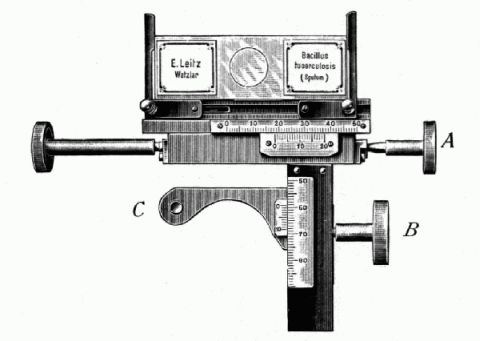
Mechanical stage No. 98.
No. 98. Mechanical stage adapted to Stands I, Ia and Ib. The stage is readily attached to the microscope by means of a small screw, C, which screws into a thread in the microscope just behind its stage, and binds the mechanical stage firmly in position and always in the same position. It may be again removed by simply unscrewing this set screw. The movements of the stage are at right angles to one another, are accomplished by carefully constructed rack and pinion adjustments and the exact position of each adjustment is indicated by vernier scales. The extent of the lateral movement is 50 mm; that of the other 30 mm. This stage permits the careful and systematic examination of large specimens and its construction is so perfect that by means of the vernier scales the most minute objects may be readily replaced in the field of vision, even after removal and readjustment of the stage, provided only that their location when in the field of vision as indicated by the scales had been noted $28.—
No. 99. Large mechanical stage for stand, A, adapted for slides 50×100 mm; both movements by rack and pinion adjustments $32.—
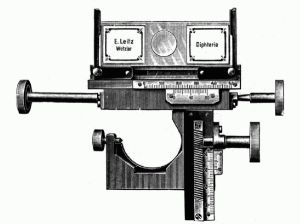
Mechanical stage No. 100.
No. 100. Mechanical Stage No. 100. When a mechanical stage is ordered subsequently to a microscope outfit and under such circumstances that its correct adjustment to the stand by a skillful mechanic is impossible we advise the purchase of this more readily adjusted mechanical stage, which may readily be attached to Stands I, Ia, Ib, IIa and IIb by means of a thumb-screw. It is as carefully constructed as Mechanical Stage No. 98 and serves the same purpose in every particular $28.—
No. 100a. New Mechanical stage, simplified form $20.—
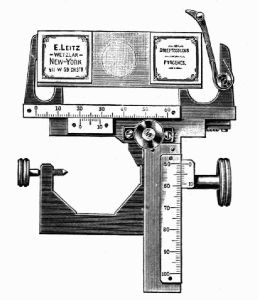
Mechanical stage No. 100a.
No. 101. Warm stage after Schultze. This consists of a metal stage to which long lateral arms are attached, through which the heat from one or more small lamps is conducted to the central part of the stage and the object. The apparatus is also provided with a condenser, which affords illumination sufficient for the use of high power objectives, and with a thermometer indicating the exact temperature of the centre of the stage, which may be carried as high as 100° C. $12.—
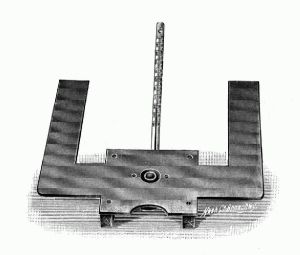
Schultze's Warm Stage No. 101.
No. 102. Warm stage after Pfeiffer. It consists of a glass chamber through which warm water may be made to flow. A small cell is ground in its surface thus permitting its use as a moist chamber $6.—
No. 103. Warm stage after Stricker. This stage consists of a metal chamber, through which warm water is made to flow when in use, and is provided also with a condenser and thermometer. It may be screwed firmly to any of the square microscope stages $14.—
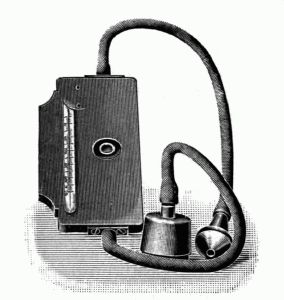
Stricker's Warm stage No. 103.
No. 104. Warm stage after Errera, permitting rapid changes from low to high temperature and vice-versa. It includes 2 vessels for cold and hot water, mounted on tripods, with rubber-tubing etc. $24.—