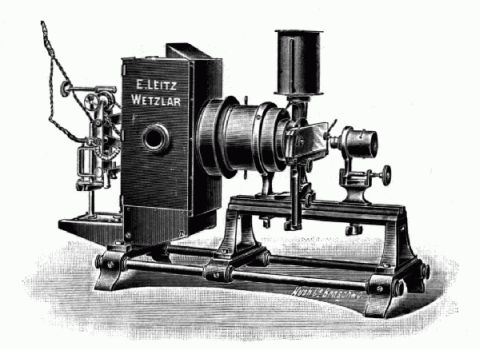
Large Projection Apparatus.
Reading edition
In this projection apparatus an electric projection lamp is made use of, the lamp being available for electric currents of 20 Ampères and about 48 Volts. To regulate the current a rheostat is necessary. When using constant current the carbons should stand at an angle in order to utilize to best advantage the stronger light of the positive (upper) carbon. For spectroscopic projections the carbons of the lamp have to be in vertical position.
Connected with the lamp is a triple condenser of 150 mm aperture. The latter should be protected from the heat-rays by a large mica-plate which is furnished with the apparatus.
Various devices permit very accurate adjustment of the lamp and condenser. For example, two thumb-screws control the position of the carbons of the lamp so that the luminous point may be readily brought into the exact optical axis of the condenser. Again, the two inner lenses of the condenser are moveable and are controlled by two knobs conveniently situated as shown in the illustration.
By this adjustment of the lenses of the condenser it is possible to do away with disturbing chromatic aberration. The rays of light leave the condenser in moderate convergence.
For direct projection from the preparation the apparatus consists of the optical bench upon which are mounted the various accessories in proper succession (Fig. p. 88):
1. A large cooling cell, which is to be filled with water or alum solution.
2. The bellows with tube. This is connected with the cooling cell by means of a metal ring which slips over the end of the cell and is held in place by a screw. The metal ring is attached to one end of the bellows, while the other end carries a large tube.
3. The microscope condensers and diaphragm holder. A larger tube fits over the tube of the bellows and carries on a revolving arm the cylinder diaphragm and the two condensers. For low power objectives Nos. 1-3, the cylinder diaphragm and the condenser of longer focus have to be used. The latter at the same time serves as the objective for lantern slide projection.
The other condenser is especially needed when high powers are employed (Objectives 4 to 6). A small rack and pinion arrangement serves for the adjustment of condenser and diaphragm.
4. The object stage and small cooler. The stage has connected with it a second cooling cell on which the preparation rests. This arrangement permits prolonged use of the condenser and the greatest intensity of light without burning the most delicate specimens. The adjustment of the object is accomplished by means of an arrangement which permits any particular point to be brought accurately into the field.
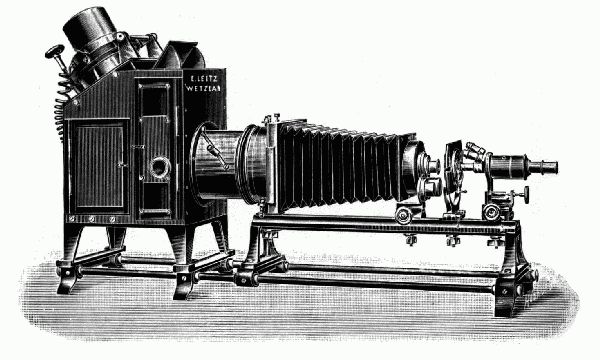
5. The objective carrier is provided with a nose-piece for three objectives, with a broad projection tube, having an Iris diaphragm for the purpose of narrowing the aperture, and with a narrow tube which screws into the broad one, in case it is desired to use oculars in making the projection. The adjustments of the objectives are accomplished by rack and pinion and by micrometer screw.
In order to change readily from microscopic to lantern-slide projection, the parts 4 and 5 have been provided with hinges, by means of which they can be thrown to one side after loosening a lever (see illustration below).
6. Wooden cover with cloth curtain which fits over the diaphragm carrier, the stage and the objectives, to shut off any light which may escape at the sides.
For the projection of large preparations of from 8-35 mm diameter our photographic objectives of 24, 35, 42 and 64 mm focal distance are best adapted (p. 86). In connection with these low powers the large tube only should be used.
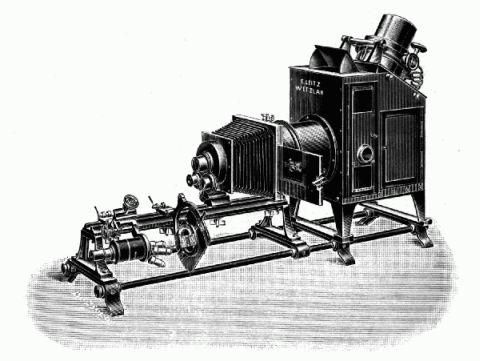
With this projection apparatus the powers of microscope objectives till number 6 may be well employed.
The picture, even when the highest powers are made use of, and the screen is at a distance of twelve feet from the apparatus, is of sufficient clearness and brightness to be available for demonstration to a large audience.
For the projection of lantern slides or of large section of tissue following parts of the apparatus are required: Lamp, condenser, cooler and bellows are the same as in the above described apparatus.
The stage and objective carrier are swung to one side.
The special-projection lens of 300 mm focal distance is to be used.
A slide carrier slips into the frame of the bellows, which is sufficiently large to accommodate lantern slides 9×10 and 9×12 cm in size. The slide carrier has a stop at both ends which facilitates its adjustment in the axis of the instrument, and is arranged for the simultaneous reception of two slides, so that while one is being projected it may be charged with a second which may then without delay be pushed into the optical axis as the first is removed. In this way series of pictures may be thrown on the screen without interruption.
When so arranged the projection can be made upon a screen 30 feet from the apparatus, over the heads of an audience.
Prices:
No. 117. Projection-lamp for current of 20 Ampères, with centering arrangement $92.—
Fixed rheostat $30.—
(The same, adjustable $45.—.)
Lamp and rheostat are furnished at factory prices. In ordering it is well to state the strength of the available electric current, also whether it is constant or alternating.
Outfit for projection of lantern slides:
Metal-base with optical bench, triple collecting lens (adjustable) of 150 mm aperture; large cooling cell; slide carrier with bellows; triple revolving arm, with rack and pinion adjustment $108.—
Projection objective of 300 mm focal length $20.—
(A second objective of same focal length may be slipped over the former, the two combined represent an objective of 150 mm focus. Additional price $20.—.)
Outfit for microscopical projections:
Cylinder-diaphragm and condenser; objectstage and small cooler with moveable slide-holder. Objective carrier with triple nose-piece: rack and pinion adjustment and micrometer-screw. Broad tube with Iris-diaphragm into which the smaller draw-tube fits. Two projection eye-pieces. Object-stage and objective carrier are provided with hinges. Wooden cover with cloth curtain $84.—
Transport $250.—
———
Complete outfit $334.—
No. 118. Megascope, apparatus for the projection of opaque objects; special offers will be made on application.
No. 119. Attachment for spectroscopic examinations, to be used on the optical bench and in connection with the lamp of the projection apparatus No. 117. Slit mechanism, large triple prism, object-stage $80.—
No. 120. Large projection apparatus, of special design with latest improvements, for lantern slides size 13×18 cm, for micro-projection, and megascope attachment. Special offers for this apparatus will be made on application. (In ordering it is necessary to state the voltage of the available electric current, also whether it is direct or alternating.)
No. 121. Trichinoscope. Simple electric lamp (hand feed) of 20 Ampère, mounted on adjustable stand, encased in Russian iron box, double collecting lens (adjustable) of 120 mm Aperture, with condensing lens. Mechanical stage for glass compressors, with movements at right angles to each other, cooling cell for the preparation with a continual flow of cold water. Objective carrier with micrometer screw, wide tube with Iris diaphragm $120.—
Projection objective of 35 mm focus, aperture f:3,5, with Iris diaphragm $18.—
———
$138.—