Dissecting Microscopes and Hand Lenses.
Reading edition
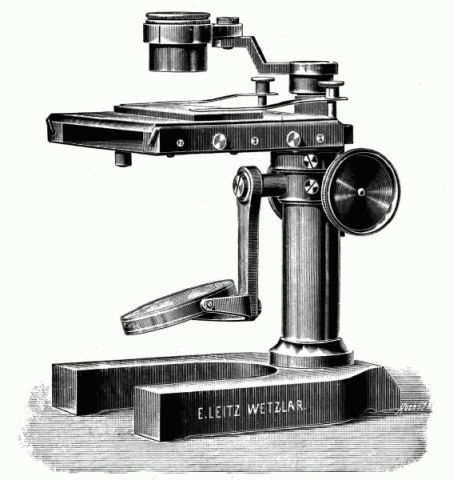
Large Dissecting Microscope No. 41.
No. 41. Large Dissecting Microscope. Stand on heavy horse-shoe base, large stage with glass plate, adjustment by rack and pinion. The lens-carrier is movable for examining large plates. Illumination by movable plane mirror and white glass plate. Metal hand-rests covered with leather may be attached to the sides of the stage. They fit inside the mahogany case. A black metal plate with wheel-diaphragm or a milk-glass-plate can be inserted below the stage, serving as dark or white back-ground respectively. Stand without lenses in mahogany case $16.—
No. 42. The same with three aplanatic lenses after Steinheil, magnifying 8, 16 and 20 diameters $28.—
No. 43. The same with these lenses and Abbe's drawing apparatus $40.—
No. 44. The same stand with prism-tube No. 49 for erected image. Objectives 1*, 2, 3, magnifying 18, 40 and 80 diam. $47.25
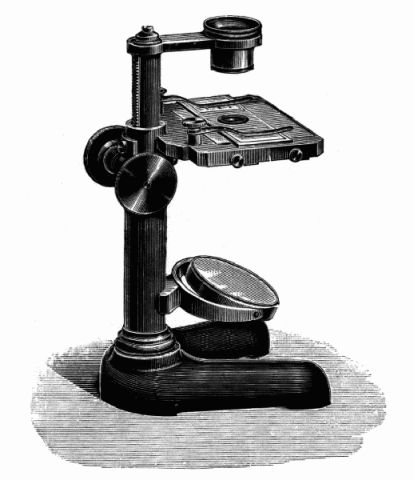
Simple Dissecting Microscope No. 45.
No. 45. Simple Dissecting Microscope, with adjustment by rack and pinion, movable plane mirror and white glass plate, glass stage in metal frame. Metal hand-rests covered with leather fit inside the case. Stand without lenses $8.—
No. 46. The same with two aplanatic lenses after Steinheil, Magnification 10 and 20 diam. $16.—
No. 47. The same stand with prism-tube No. 49, for erected image; with objectives 2 and 3, magnifying 40 and 80 diam. $36.—
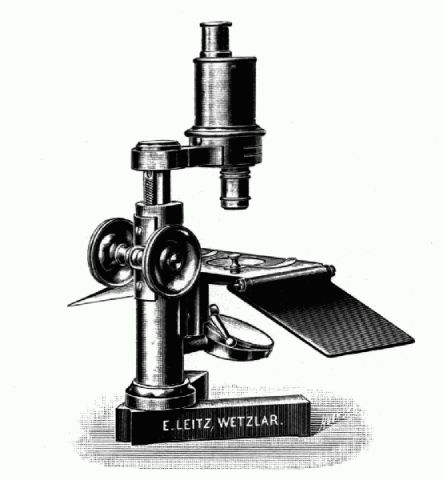
Dissecting microscope with erected image after R. Pfeiffer.
The Dissecting microscope with erected image according to Prof. R. Pfeiffer has been constructed in such a way that all parts extending on both sides can be folded or turned, so that the instrument fits in a very small case.
The base consists of two parts which may be folded. The stage can be brought in a position vertical to the optical axis and the metal hand rests laid on top of the stage. They are connected with the latter by joints. The mirror can also be turned and put parallel to the pillar.
A round glassplate is set in the stage, below which is an iris diaphragm to properly regulate the illumination.
The adjustment is by rack and pinion.
Two rightangle prisms are mounted inside the tube in such a manner that the image obtained by the objective is reflected into the eye-piece and appears erected.
The eye-piece is of the Ramsden form. Three objectives of different magnifying power with specially long working-distances have been constructed Nos. 1, 2, 3.
The following table shows the magnification of the objectives in connection with the eye-piece.
Objective 1 2 3
Magnification 18 40 80 diam.
Working distance 58 mm 18 mm 6 mm
Prices:
No. 48. Folding dissecting microscope, stand only $24.—
No. 49. Upper part of the microscope, consisting of tube with prisms, and one eye-piece $16.—
No. 50. Objectives 1, 2, 3, a $ 6,00 $18.—
———
No. 51. Stand with complete outfit $58.—
The instrument is furnished in a mahogany case with nickelplated handle, lock and key.
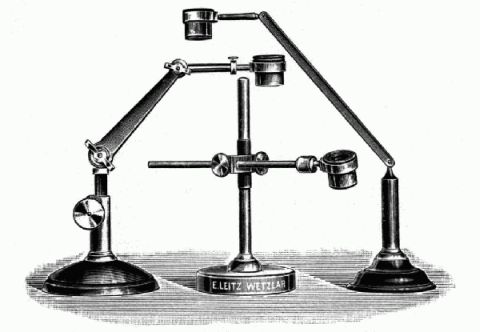
No. 52. No. 53. No. 54. Lens-holders.
No. 52. Lens-holder on iron foot with moveable arms, the joints of which may be fixed by thumb-screws, rack and pinion adjustment—without lens $7.20
No. 53. Lens-holder, nickel-plated stand with attachment of the collar holding the lens by ball and socket joint $4.—
No. 54. Lens-holder on heavy iron foot, ball and socket joints, adjustable to any position—without lens $3.25
No. 55. Pocket microscope. The size of an eye-piece, in box $3.25
No. 56. Lens for examining Algae $1.25
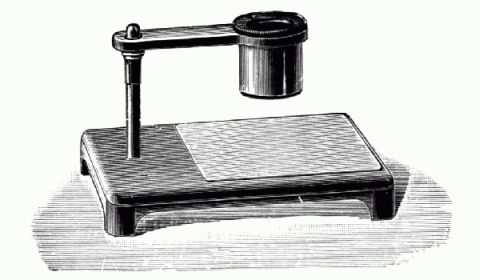
Dissecting Stage No. 57. With Lens No. 71.
No. 57. Dissecting Stage with white glass plate and moveable lens-holder—without lens $2.—
No. 58. The same with lens No. 71 $3.25
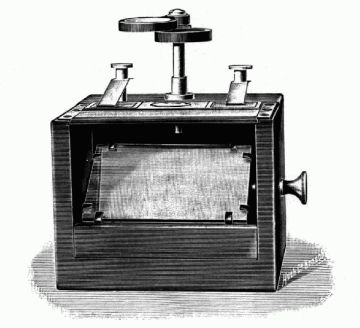
Simple Dissecting Microscope No. 58a.
No. 58a. Simple Dissecting Microscope, consisting of a wood case with plate glass stage, movable plane mirror, two simple lenses of 4 and 8 times magnification. Price $2.—
No. 58b. The same with metal hand rests, moveable lens-holder and doublet magnifier No. 71, Price $3.50
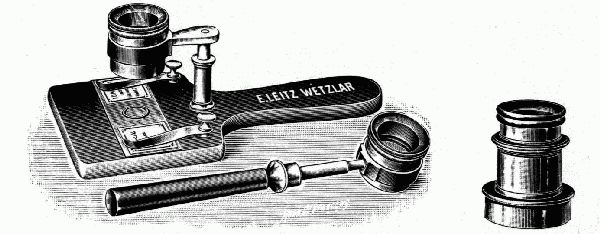
Demonstration lens-holder No. 59. Focussing-lens No. 60. Handle No. 61.
No. 59. Demonstration lens-holder, consisting of a hardrubber stage with handle, clamps for holding the preparation in position, and with a moveable lens-holder. Without lens $2.40
No. 60. Focussing lens for photographic camera. Lens in spring-sleeve with clamping ring $4.75
No. 61. Handle with ring for holding lens $1.25
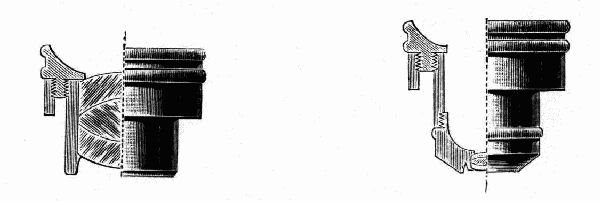
Steinheil lens No. 63. Steinheil lens No. 66.
The aplanatic triplets after Steinheil are remarkable for their large, flat field and excellent definition, free from chromatic aberration.
Diameter Visual field Magnification
No. 62. 24 mm 20 mm 8 diam. $4.—
No. 63. 15 " 15 " 10 " $4.—
No. 64. 12 " 12 " 12 " $4.—
No. 65. 10 " 10 " 16 " $4.—
No. 66. 6 " 3,5 " 20 " $4.—
No. 67. 5 " 2 " 30 " $4.—
No. 68. 3 " 1 " 40 " $4.—
The achromatic doublets have a very large, clear and flat field.
No. 69. 30 mm 35 mm 5 diam. $4.—
No. 70. 23 " 20 " 8 " $3.25
Doublet magnifier, consisting of two double convex lenses.
No. 71. 23 mm 25 mm 6 diam. $1.25
The doublet No. 69 can only be used as a hand lens. The mounting of all the other lenses is such that they fit any of the dissecting stands or lens holders. Aplanatic triplets 64-68 can only be used on stands with rack and pinion adjustment.
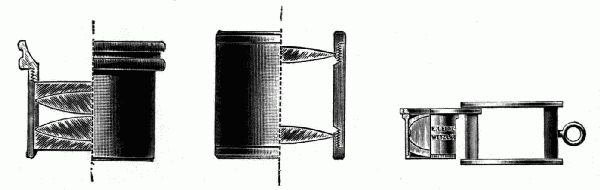
Doublet No. 70. No. 71. Pocket lens No. 72.
No. 72. The aplanatic lenses Nos. 62-66 are also to be had with a moveable cover and ring adapting them for use as pocket lenses. Price, when thus mounted $4.75
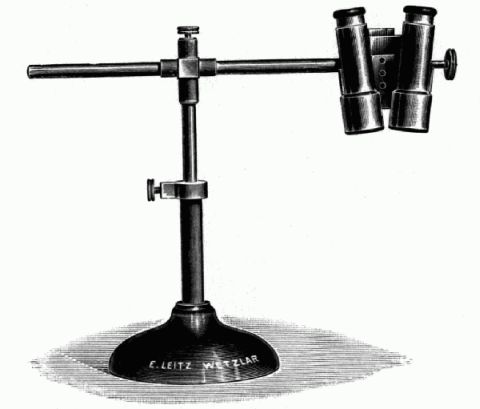
Binocular Preparation Microscope.
No. 73. The Binocular Preparation Microscope, after the model of Eilhard Schulze permits the convenient use of both eyes in dissecting small anatomical and botanical preparations. It consists of two Brücke lenses, adjusted to an accurate focus. Both tubes are moveable on a joint and are adjustable to various distances between the observers eyes. The distance of the eye from the preparation is about 250 millimetres; the field of vision is large and flat; the magnification, four diameters; lenses are adjustable to either vertical or horizontal position and may be raised and lowered on the vertical support, thumb-screws fixing them in the desired position. A rack and pinion serves as fine adjustment $24.—
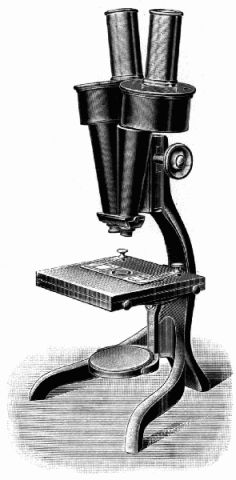
Greenough's Binocular Microscope.
No. 74. Greenough's Stereoscopic Binocular Microscope. Two microscope tubes are so arranged as to bring the same object into focus in the axis of each tube, the tubes being set at an angle to each other for this purpose. The stand is provided with rack and pinion adjustment and both draw-tubes are also regulated by a rack and pinion arrangement, so that they may be adapted to the correct distance of the observers eyes. By interposition of prisms the image is rendered erect. Magnification, 20 diam. Price $80.—
No. 74a. Corneal-Microscope, is designed for the examination of the interior of the eye. Prismtube No. 49 with eye-piece $16.—
Objective of low power permitting 2 degrees of magnification $6.—
Stand on heavy base, with rack and pinion adjustment etc. $8.—
———
$30.—