ROBERT A. WILSON. (continued 6)
Reading edition
MORMONISM AND MOHAMMEDANISM.
There is a rising cloud that is gathering blackness in the northwest, and must sooner or later precipitate itself and with the force of a tempest sweep away—to use the words of General Tornel—in one mighty flood "the religion, language, and national existence of the Mexicans." This is Mormonism. I have watched this delusion from its rise, near my own residence in Western New York, and followed its advancing progress, until, from a little rill, it has become a mighty torrent—a political element so potent that its existence in the United States is now scarcely tolerable. Where can it go except it precipitate itself upon the territories of imbecile Mexico? To such a sect of fanatics Mexico can present no opposition. It must surrender to Brigham Young and to his followers their wealth, their images, their wives and their daughters, as the Aztecs surrendered all to Cortéz.
I have often traced the close analogy between the rise of Mormonism and that of Mohammedanism, as well as the striking similarity that exists between these two systems of false religion. Each one is founded, after a fashion, on the Bible, to which each has supplemented a volume of miserable fables, the one called the Book of Mormon, and the other the Koran. Each has a spurious prophet, who is exalted above the prophets of Scripture. Both systems permit polygamy, and both are most ultra-Protestant in relation to the forms and ceremonies, images and pictures of the Oriental and Latin churches. And as God sent the great Mohammedan imposture to punish the corrupt Christianity of a former age, so in like manner He may soon commission Mormonism to wipe out of existence the corrupt Christianity of Mexico. Mormonism has not yet developed a military character, because it would be madness to raise an arm against the United States. But when it shall have once passed the frontier and entered the dominions of a feeble state, then we shall see how keen an edge fanaticism can give to the sword in the hands of men naturally courageous, when the double motive is held out of a new supply of wives, and the inexhaustible treasures of the churches to stimulate their fanaticism.
CHAPTER XXVI.
The Plaza of the Inquisition.—The two Modes of human Sacrifice, the Aztec and the Spanish.—Threefold Power of the Inquisition.—Visit to the House of the Inquisition.—The Prison and Place of Torture.—The Story of William Lamport.—The little and the big Auto da Fe.—The Inquisition the real Government—Ruin of Spanish Nationality.—The political Uses of the Inquisition.—Political Causes of the Bigotry of Philip II.—His eldest Son dies mysteriously.—The Dominion of Priests continues till the French Invasion.
AN AUTO DA FE.
The Plazuelo or Plazuelito, the "Little Plaza" of the Inquisition, is now, as it ever has been, a market-place—the Smithfield of Mexico. On Sundays and all other market-days, there is here an abundant supply of flowers, meats, and vegetables. On great holidays, in the times of the vice-kings, the scene was changed. Fruits and vegetables were, for the time, placed in the background, and an act of "faith" (auto da fe), or burning of heretics, was offered as a public spectacle. The grandest of all the bull-fights of Mexico was nothing in comparison with this vice-regal exhibition. As among the Aztecs and the pagan Romans, the sacrificial victims were kept in reserve for important occasions, and for occasions when a bull-fight would have been a most inadequate exhibition. The consecration of a new archbishop, or the arrival of a new Vice-king from Spain, or the marriage of a member of the royal family, or some similar important political or religious event, could only call forth this extraordinary show of roasting men alive.
If we are to believe the statements of Cortéz and Bernal Diaz,[57] the Aztecs were accustomed to offer human sacrifices on festival days upon a large circular stone still preserved. With an obsidian knife, life was instantly extinguished by opening the heart-case and taking out the heart, which was offered to their god of war. This horrid worship, if indeed it ever existed, was suppressed, and one more horrid and cold-blooded in its atrocities substituted. There was seldom wanting a victim on those great occasions, for prisoners who would otherwise have been let off with confiscation of estates and a long imprisonment were now doomed to the flames, to accomplish the double purpose of a spectacle and strike terror into the ranks of the higher classes, who too often furnished the victims. But the higher classes were all present. Suspicion might attach to their absence. And he that dared not breathe aloud in his own bed-chamber, or tell the whole truth at the confessional, from apprehension of an inquisitorial spy, took good heed that no act or look of his on the day of the great fiesta should betray him to this secret, but every where present tribunal, lest he himself should be the sacrificial victim at the next entertainment.
The roasting of a human victim at the auto da fe was a purely democratic institution. The leperos, who were beneath the jurisdiction of the Inquisition, felt none of the terrors that haunted the rich even in night visions. Without the least apprehension, they enjoyed the magnificence of the spectacle, and their hatred toward the high-born was gratified by the sight of one, and sometimes many, respectable persons burned in the fire for their entertainment. They were always ready to manifest their gratitude to the holy office by assailing and perhaps murdering any one who had incurred the displeasure of the priests, but whom it was not politic to arrest. Thus, by a threefold power, did the Inquisition enforce the discipline of the Church: by the authority of the king and the law, the dread which it inspired; the sympathies of a rabble, whom it was their interest to keep brutalized; and the religious sentiment of the nation, so far as there was any. But this last was a very uncertain reliance, for the same law which makes heresy a crime, legalizes hypocrisy, and the inquisitor cared very little for the thoughts of men so long as they remain unuttered; and as no two men think alike, the crime of heresy appears to consist in expressing too frankly the logical deductions of the understanding upon the all-important subject of religion. To speak disrespectfully of the holy office, the Inquisition, was the worst of heresy.
THE HALLS OF THE INQUISITION.
The north front of the Plazuelo of the Inquisition, now generally called the Plaza of the Dominicans, is occupied by the great yard of the Dominican convent, which is separated by a high wall from the Plaza, and by a street from the buildings of the Inquisition. Within this yard there is a large flagstone, with a hole in its centre, which stone, on days of the auto da fe, used to be brought out into the Plaza, and, with iron post, neck-ring, and chain attached, constituted the simple apparatus for the human sacrifice. The Dominican fathers have carefully laid aside the iron post, with its ring and chain, and perhaps, with them, the most valuable of the instruments of torture, which were removed from the Inquisition building. As there are two classes of bull-fights, the ordinary and the grand bull-fight, so there was the ordinary auto da fe, performed in this Little Plaza, and the grand act of faith, auto da fe general, which ordinarily ought to come off in the Grand Plaza of the city, in front of the vice-regal palace.
Seeing the great door open as I was passing, I ventured to enter the central court of the Inquisition, from which the halls of the different tribunals and the chambers of the inquisitors and officials were entered and lighted. All had now been thoroughly whitewashed and renovated, and bore no marks of the fearful scenes that had been here enacted. When I stood in the hall where its judgments used to be delivered, I had to tax my memory of books to draw a picture of events that here daily transpired in times past. I saw no Bridge of Sighs, yet the whole institution was founded upon the sighs, and groans, and riven hearts of its victims, of many of whom the world was not worthy. The rich were the most profitable game, but a beautiful woman was the most acceptable spectacle to a populace debased from infancy by attendance on bull-fights. A foreigner that had been by special grace licensed to visit Mexico, was considered a fortunate prize, for to offer a foreigner as a human sacrifice was in accordance with the ancient custom of the Aztecs. There was only one foreigner who amassed great wealth, and that was Laborde the miner, who bought his peace by building the Cathedral of Toluca.
There was nothing to interest a stranger in the empty halls where once these legalized murderers had held their nightly meetings, and I wandered away toward the prison and the place of torture, where, inch by inch, the life had been torn from the victims of priestly vengeance. I shuddered as I entered the prison door-way, though fifty years had passed since the last and most distinguished of its victims had entered here, the Vice-king Iturrigaray. Here, too, the hand of the white-washer had been busy, and the cells were now made comfortable rooms for the soldiery. The instruments of torture were all carefully removed from the place of torture, and the room bore no marks of the shocking scenes which had here so often transpired. Here poor Ramé, the Frenchman, had dragged out his long imprisonment, and here William Lamport, the unfortunate Irish victim, prepared himself for death. But Lamport's story is worth giving in full, to illustrate the scenes.
STORY OF WILLIAM LAMPORT.
William Lamport was an Irishman by birth, and must have been a Roman Catholic, or he could not have obtained a license to visit Mexico. He was probably one of that large class of Irish Catholics who emigrated to Spain in order to enjoy their religion more freely than they could at home, under English oppression. It was probably two intercepted letters that cost this Irishman his life. His accusation sets forth that he was the author of two writings, in one of which "things were said against the Holy Office, its erection, style, mode of process, &c., in such a manner that, in the whole of it, not a word was to be found that was not deserving of reprehension, not only as being injurious, but also insulting to our holy Catholic faith." The Prosecuting Attorney (fiscal) says of the other writing "that it contained detestable bitterness of language, and contumelies so filled with poison as to manifest the heretical spirit of the author, and his bitter hatred against the Holy Office." Let his fate be a warning to all traveling letter-writers who are disposed to criticise too severely "the erection and style" of a very awkward-looking building, and the mode of process therein used in condemning men to the flames. Probably, before he got through with his intercourse with the Inquisition, he many times wished himself back under the liberal government of the Anglo-Saxon oppressors of his country!
It was a delightful day in the year 1569, when the most splendid auto da fe that ever took place in Mexico was celebrated upon the occasion of the burning of Lamport. A throne had been placed for the Vice-king, and conspicuous seats were prepared for the audiencia. All the officials of the city and of the department were present to add importance to the grand performance ("funcion"). Not less brilliant was the display which the whole body of the priesthood made upon the occasion. The Archbishop, as spiritual Vice-king, displayed a bearing that dazzled the populace, while his attendant clergy, with the whole body of the monastic orders, added immensely to the grand spectacle. The procession, headed by the Grand Inquisitor and his subordinates, was followed by the officials and familiars, while the poor Irishman walked with his eyes raised to Heaven, for the purpose, said the priests, "of seeing if the devil, his familiar, would come to his assistance."[58] The sermon and the ordinary exercises, including the oath administered to all the dignitaries present to support the Holy Office, were spun out to an unusual length, so that it proved to be a protracted meeting, as well as the greatest festival the Mexicans ever witnessed since the time that Montezuma offered human sacrifices. But in the midst of the preliminary exercises Lamport escaped burning alive, for when his neck had been placed in the ring, he let himself fall and broke his neck, so that the crowd were compelled indignantly to put up with burning of the dead body of a heretic. The unbeliever cheated them out of half their expected sport.
THE INQUISITION IN SPAIN.
It may look like wandering from the main topic of discussion to devote a chapter to an institution which has ceased to exist for forty years. But no one can fully comprehend the social and political character of the diverse and conflicting nationalities and discordant elements that for three hundred years constituted the Spanish empire without fully understanding the character and workings of the Inquisition, which, from "the Council of the Supreme" in Spain, extended, with its complicated ramifications, through all the provinces, and penetrated every social organization in Europe and America,[59] and even to the most distant East India possessions, binding all the several parts together as the nervous system does the parts of the human body; or rather by external folds, as the anaconda does its victim. The Inquisition was emphatically the nervous system of the Spanish monarchy. From the time of Philip II. to the last of her kings, Spain had but one monarch that could have escaped a lunatic asylum on a commission ad inquirendo, and not a single royal family in all that time that had not at least one judicially declared idiot in the household; and more than once it was the regular successor to the throne. And yet this ingeniously contrived craft of priests held all most firmly together, and made it capable of resisting every outside pressure until the French imperial armies entered Madrid.
When French gunpowder was applied to the Holy Office, the Spanish empire lost its nationality, and its different parts fell to pieces like a rope of sand, and revealed to the world the sad truth that the Spanish race, whether in the Peninsula or in the colonies, was now incapable of self-government. The Inquisition had consumed its powers of vitality. So long accustomed to submit to and lean upon despotic authority, its various nationalities had lost the power of self-support. Spain, from the earliest historical periods, had ever been the victim of foreign colonial despotisms or imported tyrants until Philip II., under whom the Inquisition becoming firmly established, it thenceforward continued a Catholic province of the Roman Church, until Rome and the Papal Spanish empire fell together by the hands of Napoleon. From that time onward, Spain and all her former provinces have continued the sport of military insurgents—a melancholy evidence of the mental, physical, and moral ruin that overtakes a country abandoned to the despotism of priests.
Though the origin of the Inquisition of Spain is familiar to all, yet few are accustomed to look upon it in its political bearings. The "pious" Isabella, or, as she is called by the descendants of the Moriscoes, "Isabella the Accursed," is conceded to have been the founder of the modern Inquisition, and yet her great piety did not prevent her from giving a death-blow to the Fuero of Castile, the most liberal government of Europe except that of Aragon. The popularity which she acquired by the conquest of Granada, the religious furor excited by that successful war, and the union with Aragon, enabled her to establish the Inquisition. By means of her priests associated in its gloomy tribunals she was able to suppress popular rights. A shadow of the Fueros of Catalonia, Valencia, and Aragon still remained, but she had sapped the foundation on which they rested by the establishment of the Holy Office. Charles V. was sufficiently powerful to disregard such humble instrumentalities in carrying out any purpose he deemed to be of advantage to his states. He was not a bigot by education, and we have to look to disappointed ambition as the cause of the virulence with which he persecuted the least indication of heresy. He had been thwarted in his ambitious schemes; this he attributed to the Reformation, which he himself had fostered at its beginning, in order to sow discord among the princes of Germany. He had hoped that upon their mutual jealousy he might establish despotic authority; but the treason of Maurice of Saxony had subverted his darling scheme at the moment of its apparent success, and in disgust he retired from public life to spend the remainder of his days in recruiting his health and cursing the heretics.
PHILIP II. AND THE INQUISITION.
The Inquisition burned with renewed flames under Philip II. from precisely the same cause that had made it tolerable to his father. To the troubles caused by the Reformation he attributed the election of his uncle Maximilian "King of the Romans," and his own consequent loss of the Germanic empire. But, as a compensation for this loss, he had substantially acquired England by his marriage with Queen Mary, and had the satisfaction of having his soldiers mingled with those of England in his war against France, and of seeing his own Archbishop of Toledo preside in the tribunal that condemned to the flames the Protestant bishops of England. The autos da fe of Smithfield were weeding out heresy and liberty from England, which he already began to look upon as a province of his empire, when his wife died, and the avowed heresy of Elizabeth blasted his hopes in that quarter. The heretic Prince of Nassau had raised insurrection in the Netherlands, which deprived him of Holland. When the French Catholic League, which he had so long subsidized, was about to declare him, or at least his daughter, sovereign of France, the relapsed heretic, Henry IV., blasted this hope by laying siege to Paris. On the side of the Catholic states of Europe his affairs went on most prosperously. He had acquired Portugal, with all her American and East India provinces. But in these new acquisitions he was not safe from the assaults of the heretics. The Dutch robbed him of Brazil, and of the Cape of Good Hope, and of the islands of Ceylon and Java in the East Indies. When his missionary emissaries had excited an insurrection by which he might have acquired Japan in a religious war, the Dutch were there with their ships, and, laying them alongside the rebel camp, they cannonaded it, while the imperial army on the land side utterly destroyed together emissary priests and rebels, and forever excluded Spain and her emissaries from the islands, and even England after the negotiation of a Spanish marriage. Nor were his treasure-ships safe from these audacious Dutch, who prowled about the West Indies and seized his galleons. The ships from Goa, laden with the treasures of the East, had to take a circuitous route to avoid the Dutch, who were continually on the look-out at the Cape of Good Hope. As if this was not enough, the failure of his great armada sent against England, and the ravaging of his own coasts by Essex, increased his hatred against the heretics to something like a mania.
These are sufficient reasons for accounting for the zeal of Philip II. on the subject of religion, and his blindness to the consequences of thus abandoning his empire and his people as common plunder to a merciless horde of plunderers, who bound his empire most firmly together, but it was in the bands of national ruin. This, too, may account for his often-repeated remark that he would not shield his own son if he should incur the censure of the Inquisition. When his eldest son and heir openly avowed his hatred to the Inquisition, we find him dying a mysterious death. It has already been remarked that there can be no such thing as reliance upon historical truth in a country where the Inquisition is in full authority. But it does not follow from this that we ought to adopt the popular surmise that Philip was privy to the murder of his son, or even that he was actually murdered. It may have been a murder, as the inquisitorial assassins were numerous, or it may have been a natural death, as represented in books that have been published by permission of the censors. All that we know is, that his death happened advantageously for the continuance of the Holy Office.
FATE OF THE INQUISITION.
Philip III. can hardly be considered an accountable being. The same may be said of his son and of his son's sons, to say nothing of those heirs to the Spanish crown that were legally adjudged idiots. The nominal father of Charles III., though he was King of Spain, must be considered as not merely bordering on idiocy, but as actually a man of unsound mind. Charles III., though he had courage to drive from his dominions the Jesuits, dared not undertake a reform of the clergy. We may conclude this chapter by saying that the Inquisition had its origin in political considerations, or in the revengeful feelings of really great sovereigns of Spain, and that its continuance was owing to the weakness or impotency of their successors; and though it was the terror of all classes above the street rabble, it was too powerful to be suppressed before the emancipation of the people which followed the French invasion. Such is the fate of a race over whom priests have once acquired dominion.
CHAPTER XXVII.
Miracles and Earthquakes.—The Saints in Times of Ignorance.—The Eruption of Jorullo.—The Curse of the Capuchins.—The Consequences of the Curse.—The unfulfilled Curse.—The Population of the Republic.—Depopulation from 1810 to 1840.—The Mixture of Whites and Indians not prolific.—The pure Indians.—The Meztizos.—The White Population.—Negroes and Zambos.—The Jew and the Law of Generation.—The same Law applies to Cattle.—It governs the Generation of Plants.—Intemperance and Generation.—Meztizo Plants short-lived.—Mexico can not be resuscitated.—She can not recover her Northern Provinces.
Earthquakes are, and ever have been, very frequent through the whole of Mexico. Yet they have never been very severe, particularly at the city, as is demonstrated by the very existence of a city upon such a mass of soft earth as I have shown in a former chapter constitutes the foundation of Mexico. A reasonable amount of hard shaking would dislocate its muddy basis and engulf the city. Now and then some unusually frail structure is toppled down, and the church steeples are swayed a little this way or that, but the cement that sustains them has heretofore proved sufficiently cohesive to save them from being shaken to pieces or tumbled down.[60] Some ten years ago, the convent church, in which was the miraculous image of our Saviour, was thrown down, and the image that had annually poured forth its precious blood for the healing of the spiritual and temporal maladies of all pious believers was buried under the ruins. But this calamity was only a precursor of a greater miracle; for, on removing the rubbish, the sacred image was found intact, and as ready as ever to bleed again to order for ready pay. The spiritual interpretation of this astounding phenomenon was, that the devil, in his malice, had attempted, as of old, to crush the miraculous power of the Saviour; and now, again, as upon the high mountain, he was foiled, and the flow of blood was not intermitted.
IGNORANCE AND MIRACLES.
Miracles have ever been the most fruitful source of profit that the Church enjoys, for at the annunciation of every new miracle the faithful are quickened to devotion and to contributions, which, above all things, is to be desired by the "impoverished Church" of Mexico.[61] An earthquake is always a windfall or a godsend to the priesthood. An outsider is often surprised at the number of miracles that, in old times, were connected with earthquakes. But rarely do we hear of modern miracles. The spirit of miracles works only in times of most profound ignorance; and experience has convinced the Church that the only prospect of the continuation of miraculous visitations of the holy Apostles and of the Virgin in Mexico, depends upon the continuation of the people in the most profound ignorance, and in childlike obedience to their spiritual superiors. So long as this state of things continued, the holy Virgin was ever present among them, performing the most astounding cures, and even, upon one occasion, causing the ground to open and swallow up the surplus waters of the valley, to the relief of the "most devout people of Mexico," besides performing other astounding miracles, that have been duly attested by Pope, prelates, and the Council of Rites. But now, since the education of the common people has been attempted, although on a very limited scale, and men are allowed to speak openly, the most holy Virgin of Guadalupe has withdrawn her wonder-working power from an unbelieving people, while the blind, the halt, the lame, the palsied, and the diseased crowd around her shrine, not to obtain her healing mercy, but to solicit charity. The saints, also, have ceased to stir up the elements, so that volcanic fires have ceased throughout the whole limits of the republic, and earthquakes have almost forgotten to perform their annual duty of shaking the earth.
The last volcanic eruption in Mexico was one of the most astounding of which the record has come down to us, whether in Mexico or in any other country. Fortunately, we have reliable evidence in relation to this event, for Humboldt not only surveyed the volcano as it appeared in his day, but, from eye-witnesses of the first eruption, learned the incidents that fill out the history, and also the miraculous cause which is assigned for this mighty convulsion of nature. His story I shall follow in preference to the popular tradition of the awful consequences that succeeded the curse pronounced by two Capuchin friars upon the estate of Jorullo.
Just one hundred years ago, which was fifty years before the time of the visit of Humboldt, two Capuchin friars came to preach at the estate which occupied the beautiful valley of Jorullo. This valley was situated between two basaltic ridges, and was watered by two small streams of limpid water, the San Pedro and the Cuitamba. These small parallel rivers furnished an abundant supply of water, which was well employed in irrigating flourishing sugar and indigo plantations. These Capuchins, not having met with a favorable reception at the estate of San Pedro, poured out the most horrible imprecations against the beautiful and fertile plains, foretelling that, as the first consequences of their curse, the plantation would be swallowed up by flames rising out of the earth, and that afterward the neighboring mountains would forever remain covered with snow and ice. After denouncing the curse, the two holy men went on their way.
ERUPTION OF JORULLO.
On the night of the 28th and 29th of September, 1759, horrible subterraneous noises were heard, which had been preceded by slight shocks of an earthquake since the June preceding. The affrighted Indians fled to the Aquasareo, and soon thereafter a tract of land twelve miles square, which now goes by the name of the "evil land" (mal pais), rose up in the form of a bladder, and boiled, and seethed, and bubbled like a caldron of pudding, shooting up columns of fire from ten thousand orifices. Sometimes a number of orifices would unite into one vast crater, and vomit forth such a column of fire as was never before seen by human eyes since the time when "the smoke of the country went up as the smoke of a furnace."
Intelligent witnesses assured Humboldt that flames were seen to issue forth, which, from a surface of more than a mile square, cast up fragments of burning rock to a prodigious height. The two small rivers were swallowed up, and their decomposed waters added fuel to the flames, which burned for many months with a fierceness that is indescribable.
Such is the origin of the volcano of Jorullo, in the State of Michoican, and such is the pretended consequence of a curse pronounced by Capuchin monks upon one of the most beautiful estates in the country; and for generations since, the dread of incurring the displeasure of strolling vagabond monks has rested like a blight upon the common people; and yet this is but one of the thousand ways by which the Mexican priesthood play upon the credulity of the ignorant in a country where convulsions of nature are matters of almost ordinary occurrence. Every extraordinary event in nature is ascribed to the exercise of supernatural power on the part of the clergy or the most holy images of the Church.
The fires of Jorullo have ceased to burn for half a century. The central crater that was eventually formed, and the numerous little orifices of fire, have long since become cold, and all the evidences of an active fire have passed away. But to this day the Indians watch the progress of the cooling process; as they anticipate that, before many years have passed, the unfulfilled portion of the curse will be realized, and that those now live who will see the surrounding mountains covered by perpetual snow—an evil which the half-clad Indians of the tropics appear to dread more than perpetual fire.
The last and only enumeration of the inhabitants of Mexico or New Spain was made in 1794, by that distinguished Vice-king to whom I have so often referred, Ravillagigedo. This enumeration gave as the actual population 3,865,529, besides the departments of Vera Cruz, Guanajuato, and Cohahuila, which were estimated to contain 518,000 more, making a sum total of 4,412,529. Since that time there has been a great deal of extensive guessing, until by this simple process the population was brought up to 7,661,520, in 1853.[62] The process by which this increase is effected is to add one sixth for supposed omissions in the census, and a like number for supposed increase in the subsequent fifteen years till the breaking out of war, and taking for granted that the population has not retrograded during forty-five years of intermittent war. Such conclusions are made in violation of all the laws of population.
POPULATION OF MEXICO.
It may not be uninteresting to my readers to run over the laws which regulate the decrease of population, although it is too much our custom to look only at the other side of the picture. The social and civil wars of Mexico have been of such a character, as we have seen, as to warrant the belief that from this cause alone population must have constantly diminished, from their very commencement in 1810 until 1840, when matters were comparatively resuscitated. The employment for labor during the time that the large estates were neglected, and while the canals of irrigation and the silver mines were in ruins, was of the most limited character; and the very indigent circumstances to which it reduced the majority of those who ranked above the leperos must also have diminished the population of the republic much below that of the vice-kingdom under Ravillagigedo.
Since 1840, notwithstanding the frequent wars, Mexico, in favored localities, may have slightly increased in population; but this increase is more than balanced by the Indian wars of the northern departments, which have depopulated large tracts of country, sometimes extending across one tier of states even into the heart of Durango and Guanajuato; so that I hazard nothing in affirming that the population of the whole country must be less to-day than it was in 1794, notwithstanding that Humboldt sets down an estimate of 5,800,000 for the year 1803, and 6,500,000 for the year 1808. I might go farther, and affirm that the constant insecurity of life and property in all but the central parts of the republic is such as to keep down the natural increase of a population never prolific, being made up of a combination of uncongenial races—whites and Indians, whose intermixture leads to sterility.
The census shows two fifths of the population to be pure Indians, mostly laborers: this class would have been the one most likely to have increased since the Revolution, had there remained the same amount of employment and wages as formerly. In consequence of the abolition of monopolies, the articles necessary for the comforts of life became much cheaper and more easy of attainment to the laboring classes, which would tend to increase the number of this class. These Indians, moreover, had remained to a great extent free from the deleterious intermixture of white blood. But the pure Indian, compared with the pure Caucasian, is a race, under the most favorable circumstances, of slow increase. The diseases hereditary among the Indians are aggravated by promiscuous marriages, so that in California the missionaries used to inquire diligently after a man's family connections, and compel a convert to marry into his own clan, or not marry at all.
The Meztizos, or mixed races, constitute another two fifths of the population. This is a less vigorous race than the pure Indian. They are all the children of sin, mostly the offspring of illicit intercourse, and are for this cause a feebler race than the offspring of the same mixture where the man was only blessed with a single wife. As all marriage of whites with Indians in New Spain was unlawful, these Meztizos bore the same relation to the law in New Spain which the mulattoes do in our Southern States.
RACES IN MEXICO.
The whites were set down at one million, or about one fifth of the whole population, at the most prosperous period of the vice-kingdom. I doubt if they now amount to half or even a quarter of that number, and of this population there is a very vigorous French immigration, now amounting to five or six thousand, and about as many Germans, a handful of English, and still less Americans. The native white population does not possess the physical energy requisite for rapid increase. They form no portion of the laboring people; they live in effeminacy, and their children are not nursed at the healthy breasts of athletic negresses, as are the children of our Southern planters, but are suckled by a more enervated race than themselves, viz., the Meztizos. The emigration from Spain was never an emigration of laboring men. It consisted almost entirely of priests, stewards, clerks, and taskmasters, to whom labor was considered as degrading. When the Spaniards lost a monopoly of these employments, and sank to the level of the native races, their numbers rapidly declined. The slight foreign immigration above mentioned is not one of laborers, for labor is considered an unbecoming employment at Mexico for white men, but an immigration of tradesmen and shop-keepers, who add nothing to the material wealth of the country.
Of the Mexican Negro race I never knew but two, and one of them held the post of captain in the army, and the other was the naked alcalde, mentioned in a former chapter, who was discharging the functions of "Judge of First Instance." The reasons assigned for the disappearance of this race from Mexico after so large an importation of slaves as that which took place in the last century is the incongeniality of the climate of Mexico, particularly of the table-lands, to the negro constitution. At the breaking out of the Mexican revolution, almost the only negro slaves in the country were in the department of Vera Cruz. The sugar-planters of the hot country of the interior, finding it impossible to carry on their estates by the use of negro slaves, attempted to reduce the mortality among their working people by raising up a race of those disgusting-looking beings called Zambos, a cross of negroes and Indians; but it was attended with the usual ill success that has followed every attempt to cross or intermingle different and distinct races of men, animals, or even plants.
INTERMIXTURE OF RACES.
The advantages arising from transplanting the human race, as well as vegetables and plants, are manifestly great. But transplanting should never be confounded with intermixing races, whether they be human, or of the lower animals, or of plants. When God, in his infinite wisdom, saw fit to choose out a family that he destined to continue for thousands of years, He transplanted it into a new soil and climate, and subjected it to divers migrations. First it went down into Egypt, and then, "with a high hand and an outstretched arm," He brought it up out of Egypt, and after a sojourn of forty years in the wilderness, He re-established it in the land of Canaan. This is the origin of the most perfectly developed race of the present time. Whether in the tropics or in the most northern latitudes, the Jew is the same intellectual and physical man, and carries about with him the indelible marks of a descendant of those patriarchs who were commanded not to intermarry with the people among whom they dwelt. The Jew may wander and sojourn in strange lands, but he cherishes with national pride the blood of Abraham, which he insists still flows in his veins, and he is most careful, of all things, to transmit it pure to his children. Though Canaan abounded with fragments of nationalities, his boast is that his blood is not intermixed with any of them. To the history of the Jews we might add the experience of the Franciscan missionaries of California, that for a healthy offspring a man must marry among his own clan.
The constant complaints we hear of the deterioration of imported animals of choice breeds is the result of a disregard of this law of propagation. The importations of Merino sheep, and afterward of the Saxon, proved a failure chiefly from this cause. Those engaged in the importation of English cattle begin already to make the same complaint, which they would not have done had they taken the precaution to import their foreign stock in families. The Mulatto is an apparent, not a real exception to the rule. He is superior to the Negro, often superior to his white father; but it is a superiority for a generation only, and carries with it the seeds of its own dissolution. The mule is superior to the donkey, but lasts only for a generation. The Oregon ox, a cross between the Spanish and American breeds, is superior to either of the pure breeds. But it is the concentration in one animal of what might be the material of divers generations.
I once asked a Dutchess county farmer the cause of the great superiority of his crops of wheat over those of his neighbors, and his reply was that he always brought his seed from a distance, changed it often, and took good care not to let it intermix with the wheat of that region. The same, or, rather, greater results have attended the transportation of American seeds and plants to California, where a new soil and a new climate has produced upon all the staples of agriculture such an improvement as to astonish men who have made this branch of industry a study. It is the result of the migration of plants where there are no plants of the same character to intermix, and so deteriorate the race by crossing the breed. In trees the same law holds unchangeably. We produce fine fruit by inoculation and by grafting; but experience has taught us never to inoculate upon a grafted stem, but always upon a natural branch. As the Conquistadors selected the best-looking Indian women for the mothers of the Meztizos, so the fruit-raiser selects the best natural stems to inoculate with his artificial varieties of fruit. In this way we get better fruit by exhausting the root, and a whole race of plants are sometimes worn out by mixture from too close a proximity of the different families of the same genus. In the laws which Moses gave to the children of Israel, we find a provision against the evils of intermixtures in the precept: "Thy cattle shall not gender with diverse kind." "Thou shalt not sow the field with, divers seeds." In these precepts God has taken care to guard the wholesome generation of plants as well as of animals.
The successful intermingling of the Protestant Anglo-Saxon immigration with our own people in the second and third generations is not an exception to the law of generation, as both are but branches of the same stock, and are successfully planted together. Nor is the mortality which follows the Catholic immigration an exception to the beneficial law of migration, for habits of intemperance account for the short lives of these immigrants; and though their offspring is abundant, yet it is all tainted with an inheritance of disease, and too many of the children suffer the ruinous consequences of having drawn "still slops" from a mother's breast in infancy. For physically, and in the chain of generation, most truly are the sins of the fathers visited upon the children to the third and fourth generation.
Our collection of material for an argument will be complete when I have added that the trees most prolific of artificial fruit die the earliest, and suffer most from running sores; that the vines cultivated artificially to produce the choicest wines suffer most from the mildew, and the potatoes of the most artificial varieties are the ones that have suffered most from the rot. When the cholera first visited Mexico, its passage through the country was like the ravages of the Angel of Death among the Meztizos and the fragments of decaying races. And this progress toward depopulation can not be stayed by the infusion of a vigorous stock. The law of sexuality in plants leads to the intermarriage of the vigorous with the decaying and the intermixture of blossoms; nor can human plants long vegetate together without intermarriages, which ingraft the vigorous constitutions with the virus of the old and decaying.
PROSPECTS OF MEXICO.
If, then, I have correctly enunciated the law of migration of men, animals, and plants, and if the law of intermixture of distinct races, or distinct species of the race, has been truly stated, the important argument to be drawn from it, which interests all Americans inquiring into the future of Mexico, is, that the present incongruous fragments of population which the internal disorders of Spain have set loose in Mexico can never be transformed into a homogeneous nationality, nor can sufficiently permanent elements of strength be found in this political chaos to constitute a permanent government. The degraded condition to which labor is reduced forbids the idea of an immigration of foreign laborers, while the miserable scale of wages—a quarter of a dollar a day upon the estates, payable out of the plantation store, or three shillings in the towns—holds out no inducement for poor men of a healthy race to abandon their own country and migrate to Mexico in sufficient numbers to form a substratum of society which ultimately might rise into a nationality.
A still more important question is disposed of by the facts stated in this chapter, viz., that there is no possibility of the present inhabitants of Mexico ever successfully driving back the Apaches and reconquering the northern provinces. Her title to the wild regions of the north, which rests on discovery and colonization, is lost by her utter inability to subdue the Indians and to colonize, after a probation of three hundred years. At this day the whole of the northern provinces lie, like waifs, open to any civilized people to take possession who require an additional territory. But nothing is so absurd as the American process of acquisition by treaty of territories which already are, or soon will be, covered all over by immense land-claims, in districts subjugated by the Indians, instead of acknowledging the title of the Apaches to the lands they have conquered from Mexico, and long held in possession, and purchasing of those who are the real sovereigns of Northern Mexico.
CHAPTER XXVIII.
The Church of Mexico.—Its present Condition and Power.—The Number of the "Religios."—The Wealth of the Church.—The Money-power of the Church.—The Power of Assassination.—Educating the People robs the Priest.—Making and adoring Images.—The Progress downward.
The Catholic Church of Mexico is a peculiar institution. Its historical antecedents have been considered in previous chapters in connection with other subjects. Men no longer whisper their unbelief with trembling, nor have they any longer to dread inquisitorial fires if they refuse to pay tithes to the bishop, or if they neglect to bestow rich gifts upon the priests. Still the Church survives the losses of this important engine of piety, and continues unmodified by passing events. In the midst of revolutions it stands unchanged, a relic of the last century. It stands like a great showman's wagon from which the horses have been detached, and children, great and small, are collected around to look at its images. Unfortunately, there is an abundance of full-grown children in a country where, for centuries, a combination of spiritual and temporal despotisms have dwarfed the intellects of men down to the standard of a toy-shop religion, which had long rejoiced in crushing the human intellect, while it disdained to enlighten the humblest understanding.
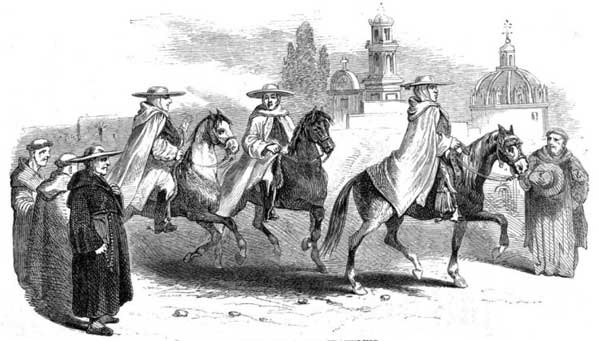
MEXICAN PRIESTS TRAVELING.
Mexico is the only Catholic country in which the Church has remained unchanged during all the revolutions of the last half century. The French infidel armies, and the wars and revolutions that followed the French invasions, overturned the Church of Spain and Italy, so that the Church organization that now exists in those peninsulas is a new creation. Not so in Mexico. Its revolution was for the purpose of saving the privileges of the Church from the too sweeping reforms of the Cortes of Spain. And there it now stands, with all the properties and annuities which it enjoyed in the time of the idiot kings. The Inquisition no longer enforces with fire the censures of the Church, and men are no longer compelled by legal process to pay tithes. But for these losses the Church has received a heavy compensation. The priests and inquisitors who ruled the childish court of Spain would allow no independence to the Mexican Church, but supplied, by royal appointment, all the candidates for vacant bishoprics and chapters, while the Vice-king was allowed to fill the inferior offices of the Church.
By the partial separation of Church and state which took place in 1833, the Church of Mexico became independent of the state. The chapters acquired the right of electing their own bishops; the bishops, by virtue of their spiritual authority, appointing the priests and exercising control over all Church property as quasi corporations-sole, at least over all property not vested in religious communities, if practically there could be said to be any real exception. What that newly-acquired power of the Mexican bishops amounts to, we in the United States, from our own experience of the same authority, can judge.
STATISTICS OF THE CHURCH.
That the reader may know how extensive is this money-power of the bishops, I subjoin an extract from a statistical chart[63] published by Señor Lerdo de Tejado, First Official de Ministerio de Fomento, the following synopsis of the clergy and their incomes:
"There is one archbishop, the Archbishop of Mexico, and eleven bishops, and one to be created at Vera Cruz. There are 184 prebends and 1229 parishes. The total number of ecclesiastics is 3223.[64] There are 146 convents of monks and 59 convents of nuns, and 8 colleges for propagating the faith. The convents of monks are inhabited by 1139 persons, and there are 1541 nuns in convents, and with them 740 young girls and 870 servants. There are 238 persons in the colleges for propagating the faith." This is less than half the number of the religios under the vice-kings, while the riches of the Church have immensely increased, as we shall presently see.
REVENUE OF THE CHURCH.
I translate from the same author, in a note, statistics upon the much-agitated question of the wealth of the Church of Mexico,[65] from which it will be seen that the total amount consumed in the maintenance of these 3223 persons, is annually $20,000,000, besides the very large sums expended in the repairs and ornaments of an enormous number of churches, and in gifts at the shrines of the different images, which can not be appropriated to the maintenance of the clergy. This sum of $20,000,000, if fairly divided among them, would yield an abundant support, though not an extravagant living; but, unfortunately, the greatest portion of this immense sum is absorbed by the bishops, while the priests of the villages contrive to exist by the contributions they wring out of the peons. At the time of the census, 1793, the twelve bishops had $539,000[66] appropriated to their support; but now their revenues are so mixed up with the revenues of the Church, that it is impossible to say how much these twelve successors of the apostles appropriate to their own support.
MONEY-POWER OF THE CHURCH.
In place of the Inquisition which the reformed Spanish government took away from the Church of Mexico, the Church now wields the power of wealth, almost fabulous in amount, which is practically in the hands of a close corporation-sole. The influence of the Archbishop, as the substantial owner of half the property in the city of Mexico, gives him a power over his tenants unknown under our system of laws. Besides this, a large portion of the Church property is in money, and the Archbishop is the great loan and trust company of Mexico. Nor is this power by any means an insignificant one. A bankrupt government is overawed by it. Men of intellect are crushed into silence; and no opposition can successfully stand against the influence of this Church lord, who carries in his hands the treasures of heaven, and in his money-bags the material that moves the world. To understand the full force of his power of money, it must be borne in mind that Mexico is a country proverbial for recklessness in all conditions of life; for extravagant living and extravagant equipages; a country where a man's position in society is determined by the state he maintains; a country, the basis of whose wealth is the mines of precious metal; where princely fortunes are quickly acquired and suddenly lost, and where hired labor has hardly a cash value. In such a country, the power and influence of money has a meaning beyond any idea that we can form. Look at a prominent man making an ostentatious display of his devotion: his example is of advantage to the Church, and the Church may be of advantage to him, for it has an abundance of money at 6 per cent. per annum, while the outside money-lenders charge him 2 per cent. per month. The Church, too, may have a mortgage upon his house over-due; and woe betide him if he should undertake a crusade against the Church. This is a string that the Church can pull upon which is strong enough to overawe government itself.
This money-power of the Church yet lacks completeness and concentration to make it even a tolerable substitute for the power lost by the abolition of the Inquisition, as this wealth is distributed among 12 independent bishops. But, having succeeded in establishing the temporal power of her bishops in Mexico more firmly than in the United States, the Papal court made another step in advance. In 1852, Mexico was electrified with delight at the condescension of the Holy Father in sending a nuncio to that city. For two full years this representative of the Holy See was fêted and toasted on all hands, as little less than the Pope himself, whom he represented. But last year all these happy feelings were dashed with gall and wormwood by an announcement that as the bishops controlled all this immense property by virtue of their spiritual authority, there was a resulting trust in his favor, or at least in favor of the Pope, whom he represented with full powers. It was Pandora's box opened in the midst of "a happy family." There was no disputing the nuncio's law; but to render to him an account of their receipts and disbursements, or to deliver over the bonds and mortgages to this agent of the Pope, was most unpleasant. The old Archbishop keeps fast hold of the money-bags, which, so far, the keys of Saint Peter have been unable to unlock. The battle waxes loud and fierce between the parties and their partisans, and Santa Anna stands looking on, dreaming of the happy time when, through the internal dissensions of the Church, these accumulations of 300 years of robbery and false pretenses will fall into the public treasury, and the people as well as the government will obtain their enfranchisement.
The money-power of the Church has proved sufficiently strong to save it from the hungry maw of a famishing government, and to stand unaffected by the revolutions that surround it; and now and then, when too bitterly assailed by some political reformer, it finds relief in the assassination of the assailant, as in the case of the eloquent member of the last Congress, who, after a violent philippic against the corruptions of the priests, was found murdered in his chamber. And, as in case of the inquisitorial assassinations, the crime was proved to have been connected with a robbery. The power to overawe courts of justice, proverbially corrupt, and the facilities with which assassinations are procured, are now the most dreaded weapons of the Church, and may account for the nominal conformity of the intelligent classes.
The unbelievers in Mexico, though considerable in numbers, are not organized with a positive creed. Theirs is only a negative existence—unbelief; and they are generally found conforming outwardly, as a more convenient and prudent course than running a tilt with the well-organized forces of the Church.
There is nothing peculiar in the spiritual powers of the Church of Mexico, as these powers are common to all Catholic countries, and vary only with the ignorance and brutality of the people; the more degraded the people, the greater is the power of the priest and bishop. The intelligent Catholic, educated among Protestants, looks upon his priest as a religious instructor, and interprets the ego te absolvo as rather a matter of form, meaning little more than that he will intercede for him. He has caught and is applying a Protestant idea unwittingly. But with the gross multitude who constitute the mass of the Spanish-American population, the priest is the God of the people; his giving or withholding absolution is a matter of life or death; and, however corrupt and debauched he may be, he still holds jurisdiction over the pains of hell and the bliss of heaven. For a reasonable consideration in money, he will shut up the one and open the other. The offering in the mass of the bloodless sacrifice of Jesus Christ, as it is called, is not sufficient for the Catholic in a Protestant country, but the priest must also preach a sermon every Sabbath, like a Protestant minister, though he still holds to the efficacy of the mass in conferring blessings on the living and the believing dead. The preaching of the priest is a rare thing in an exclusively Catholic country. The mass is his livelihood, and if he be the head of a community, or a popular priest, he often makes a profit in taking in masses to say, and letting out the job at a discount. The whole matter may be summed up by saying that the more profoundly ignorant the people are, the more devotional do they become, so that the priest has always a pecuniary interest in the ignorance of the people, and if he makes any effort toward their enlightenment, it is an effort made directly against his own pecuniary interests and the income of his office.
WORSHIP OF IMAGES.
The most ancient anti-Catholic, I might with propriety say, Protestant sect, whose form of synagogue worship is congregational, and who are republican at heart, though too often submitting to a despotism, are the Jews. Between these two, the Jew and the Catholic, there exists an unmitigated hostility. The Catholic reviles the Jew with a sin of which, most likely, his own ancestors were not guilty,[67] and the Jew curses the Nazarene for the idolatry of his worshipers. He will make no allowances for the nice distinction between adoration and worship, and insists that the making the likeness of any thing to be set up in a place of worship is idolatry, and that the image of the cross is as much an image as the image of Him who hung thereon. And in all this the Jew is right, if we are to obey the commandment of God. Yet the Jew forgets that a thousand years of trial were requisite to cure his ancestors of their proneness to idols. After their first mission, accomplished in the birth of Christ, God has preserved them a perpetual witness against paganism. But so subtle is this sin, that we find ourselves setting up sensuous representations, while we point the finger of scorn at the Catholic, who ascribes miraculous power to an image of the Virgin. And what is the difference, the Almighty himself being judge, between setting up a cross in a place of worship or ascribing miraculous power to an image, or, as is the fashion to say, some spirit acting through the image? Are they not different stages of the same disease, and each equally calculated to provoke the Almighty to jealousy.
SUMMARY OF EVILS.
Image worship has another curious aspect. It is a very tolerable thermometer by which to measure the downward progress of nations. Pagan Rome, in times of comparative purity, had her laws against idolatry; but as her higher classes advanced in refinement and sensuality, and the plebeians became debased and brutalized, the whole religious ideas of the nation degenerated into idolatry, associated with a despotic miracle-working priesthood, and soon followed by a political despotism. It is curious to witness how exactly it takes on the same form in different countries in traveling this downward road. The Buddhist of China, who has reached a thousand-fold lower level than the Catholic, has his unmarried priesthood, his monks, and nuns, and self-imposed penances, and tortures, and holy water, and a ritual in an unknown tongue (Sanscrit), so strikingly resembling the Catholic as to suggest the idea of a common origin, if such an idea were not impossible. Yet in the moral standard they seem to have reached the point of total depravity. Hence we might sum up the cause that have produced the Mexican of the present day by enumerating the absence of the scriptural idea of family relation; the despotism exercised by the priesthood with the aid of an Inquisition, and the unnumbered toll-gates they have placed on the road to heaven; the effeminacy of the higher classes and debasement of the peasantry; the absorption of half the revenues of the country in superstitious and idolatrous purposes, and the uncleanly habits superinduced by mental and physical degradation for generations, so that the word leper is used to designate a poor man in the city where that loathsome disease has its victims.
CHAPTER XXIX.
Causes that have diminished the Religios.—The Provincials and Superiors of Convents.—The perfect Organization.—The Monks.—San Franciscans.—Dominicans.—Carmelites.—The well-reputed Orders.—The Jesuits.—The Nuns.—How Novices are procured.—Contrasted with a Quaker Prison.—The poor deluded Nun.—A good old Quaker Woman not a Saint.—Protestantism felt in Mexico.
THE RELIGIOUS ORDERS.
The monkish orders of Mexico have remained unchanged from the time of their first establishment. We have seen that they have fallen off immensely in numbers, but have increased immensely in efficiency, by the termination of those internal controversies between the Spanish-born and Creoles, and by enfranchisement from state control. Not only are they now all native-born, but the Meztizos seem to be the predominant race in the priesthood. The priesthood is not now so inviting an employment as it was before the suppression of the Inquisition. Miracles have ceased to be a profitable speculation, while the revenue once paid to the monks has been followed by ill-suppressed contempt. The employment once monopolized by the Spaniards being now thrown open to general competition, there is less willingness to submit to the despotism which ever reigns in religious houses than there was in the times of the vice-kings. Hard fare, cruel treatment, and public contempt have diminished the candidates for monastic orders, until the old proverb—"He that can not do better, let him turn monk"—is not unknown at Mexico. With the increase of liberty the number of nuns has diminished, as violence can no longer be used in getting a girl into a convent. For all these reasons the number of the religios has rapidly diminished, while the wealth and efficiency of the Church has increased.
Having spoken of the bishops, the lords spiritual of Mexico, and the controlling influence they exercise over a feeble government, we come next to the second class of spiritual masters of the country—the heads of orders, the provincials, and the heads of religious houses. These two classes of dignitaries are usually elected for their known severity of discipline, either by the procurement of the bishop, or through fanaticism of the monks or nuns, who, having voluntarily made themselves convicts and prisoners for life, now undertake to add to their self-afflicted mortification by choosing for their head a superior the most hateful of their number. The novice is taught that the greatest favor with Heaven is to be obtained by implicit obedience under most trying circumstances, and the more cruel the despotism they unmurmuringly submit to, the greater will be the accumulation of good works. But cursed to the lowest depths of Purgatory is that recluse who dares to murmur even in his inmost thoughts; and if he so far forgets his duty as to murmur aloud, then all the powers of the Church are brought to crush his insubordination.
We have thus followed spiritual despotism through its various stages, from the Pope to the bishops; from the bishops to the provincials of religious orders; and then down to superiors of a community of half a dozen monks or nuns, by whom immorality is pardonable, but who regard disobedience or insubordination in the slightest particular "like the sin of witchcraft and idolatry." Such is the perfect organization of the papacy in all its parts, which, acting as one great secret, political, social, and religious association, labors continually to concentrate the riches of the nations at Rome as a common centre.
There is a peculiar feature in the Catholic Church in Mexico unknown in other Catholic countries: it is the preponderance of the regular clergy (monks) over the secular clergy. This is owing to Cortéz, who wrote to the Emperor Charles V. to send him regulars, for the conversion of the Indians, instead of seculars, assigning as a reason for this request "that the latter display extravagant luxury, leave great wealth to their natural children, and give great scandal to the newly-converted Indians." Hence more than one half of the Mexican clergy are monks, and wear the cowl; for at the time of the census of 1793, as we have seen, there were in the city of Mexico 1646 monks, besides lay brothers, against 550 secular priests, while in the fifteen convents for nuns there were 923 of these female monks.
CHARACTER OF THE DIFFERENT ORDERS.
The reader has already become quite familiar with the Franciscan fathers and their vows of poverty and self-mortification, and their skill at playing for gold ounces. They have pretty well maintained that reputation since the time of Friar Thomas Gage. But there are some honorable exceptions to this rule, though few and far between. We have already noticed how they were favored by Cortéz, and the result has been that they are the richest fraternity in the republic. These holy men of the Angelic Order of Saint Francis have lately discovered a new source of wealth in renting their large central court to a Frenchman, who occupies it with the best garden of plants in Mexico; and as the convent occupies nearly a whole square in the central part of the city, they have pierced the convent walls, and rented out shops upon the business streets, while the soldiers of Santa Anna occupy the vacant cloisters of the convent. In this "happy family," with all the immense wealth of the establishment, the donados, and those monks who are so poor as to have no friends, find but a miserable subsistence.
Of the Dominicans I have already spoken in connection with the Inquisition. In their yard is the flag-stone which was used by them in offering human sacrifice before the Revolution. There it is kept as a relic and symbol of the power once enjoyed by the Church. There is yet a lingering hope that there may be restored to these brethren the power of roasting alive human beings. In speaking of depravity of morals, it is hard to say which of the fraternities has reached the lowest level, though common consent concedes the palm to the Dominicans.
The name of the Carmelites carries us back to the time of the Crusades; but they are better known in Mexico as the former proprietors of the Desierto, which Thomas Gage so touchingly describes. Their habitual practice of self-denial and mortification, in appearance, while rioting on the luxuries that devotees lavished upon them, has not been forgotten. These holy brothers had a hand in the Inquisition as well as the Dominicans. They were a set of scamps set to watch the purity of other men's lives, while they themselves lived a life of habitual profligacy. The ruins of their old convent, the Desierto, is still one of the most attractive spots about the city. As the traveler wanders among its ruined walls, he will find in the subterraneous cells ring-bolts fastened in the walls, where poor prisoners for their faith endured something more than self-mortification.
The monks of Santiago, San Augustin, and the Capuchins have all fine convents, and are rich; but the monks of Saint James are the most inveterate beggars.
The monks of San Fernando enjoy an enviable reputation compared with the spotted sheep I have just been considering. They are late comers, and have not learned all the ways of wickedness of the older orders. Next come the "Brethren of the Profession," of whom it is pleasant to speak, after saying so many hard things of their neighbors. They stand so high as men of character and learning, that I am tempted to tell their story on hearsay, for want of better authority. They were once Jesuits, but when the royal cebula of Carlos III. came for their expulsion, these fathers had sustained so good a character for charity and usefulness that they were allowed to return, on condition of renouncing the name and peculiarities of that order. I am inclined to believe this strange story to be substantially true, for clearly they are of the Jesuits, and yet they are not Jesuits. The reputation which they enjoyed in 1767 they still retain, and not only command the respect of all classes of society in Mexico, but their chapel is the fashionable church of the city, where genteel people resort to say their prayers.
"The Brethren of the Holy Places of Jerusalem"—the Hieronomite monks, are not numerous, and are known in the markets as lenders of money, with the interest of which they support themselves and "the poor saints of Jerusalem;" that is, a portion of those lazy, greasy, fighting Latin monks at Jerusalem, that have been one of the causes of the present war in Europe.
"The Hospitalers of Saint John" (Juanos) are better known for their exploits in the time of the Crusaders than for any thing they have done in Mexico.
It would be a thrice-told tale to repeat the story of the Jesuits; the world knows that too well already. The details of their proceedings in Mexico till the time of their expulsion have been too often written by their enemies. Their great prosperity and their great wealth made them the envy of the other orders, as corrupt and depraved as themselves, but not so dangerous, because they had reached that point at which depravity ceases to contaminate. Dirty, greasy monks could not endure an order that wore the garb of gentlemen, and were in favor with the aristocracy, while they themselves were despised.
This envy was all-powerful with them, and led, for a time, to the laying aside of their own private bickerings, and uniting in the crusade against the common enemy, the Jesuits, and acting in harmony with the political power.
NUNNERIES.
The Church has always made much of the nuns. It has ever been the custom of the priesthood to endeavor to throw a veil of romance over the very unromantic way of life followed by females who have shut themselves up for life in a place hardly equal to a second-class state-prison. Woman has an important place which God has assigned her in the world; but when she separates herself from the family circle, and elbows her way to the rostrum, where, with a semi-masculine attire, and with a voice not intended for oratory, she harangues a tittering crowd upon the rights of women to perform the duties of men; or goes to the opposite extreme, and shuts herself up within high stone walls to avoid the society of the other sex, she equally sins against her own nature, and not only brings misery upon herself, but inflicts upon society the evils of a pernicious example, and furnishes a theme for all kinds of scandal.
Proud families who have portionless daughters; relatives who desire to get rid of heirs to coveted estates; convents in want of funds and endowments,[68] or a pretty victim for the public entertainment on taking the veil; friends who have unmarriageable women on their hands; and romantic young misses, ambitious of playing the queen for a day at the cost of being a prisoner for life, have all contributed to populate the fifteen nunneries of the city of Mexico. In the flourishing times of the Inquisition, this business of inveigling choice victims into convents was more profitable, for then murmuring could be crushed into silence, and parents dreaded to oppose the wretched pimps of superstition who came to inveigle their daughters into convents.
NUNNERIES AND PRISONS.
The Quaker prison of Philadelphia is a paradise compared with such a place as this. If the reader has ever placed his eye at the keeper's eye-hole in that prison, he must have seen in many a cell a cheerful face, and the appearance of as much comfort as is compatible with an imprisoned condition; for ministering angels have been there—mothers in Israel, who have torn themselves from their domestic duties for a little time to minister consolation to the very criminals in prison; and, now that the prison-door has separated the poor wretch forever from society, whose laws have been outraged, she, by her kindness and teaching, has led the convict to look to Heaven with a hope of forgiveness, and daily to pray for those he has injured, while he reads in the holy book which she gave him, that a repenting thief accompanied the Son of God to Paradise.
Let us turn from such an unpoetical scene as this, which that cheerful prison presents, to the convent of Santa Teresa, the most celebrated of all the ten or fifteen nunneries now in operation about the city of Mexico. In a cold, damp, comfortless cell, kneeling upon the pavement, we may see a delicate woman mechanically repeating her daily-imposed penance of Latin prayers, before the image of a favorite saint and a basin of holy water. This self-regulating, automaton praying machine, as she counts off the number of allotted prayers by the number of beads upon her rosary, beats into her bosom the sharp edge of an iron cross that rests within her shirt of sacking-cloth, until, nature and her task exhausted, she throws herself down upon a wooden bed, so ingeniously arranged as to make sleep intolerable.[69] This poor victim of self-inflicted daily torture, half crazed from insufficient food, and sleep, and clothing, has endured all this misery to accumulate a stock of good works for the use of less meritorious sinners, besides the amount necessary to carry herself to heaven; for penance, and not repentance, is this poor pagan's password for salvation.
The old Quakeress is not a fashionable saint, for she never dreamed of this huxter business in spiritual affairs. Out of the overflowing goodness of her heart, she had tried to lighten the miseries of life in her own humble and quiet way, and found her happiness in seeing all about her made comfortable. The money that others expended in buying masses for the repose of their own souls and those of their relatives after death, she expended in ministering to soul and body in this world, leaving to God above the affairs of departed spirits, to deal with them according to His mercy. She never presumed to add to the torments of this life, or undertook to lighten the torments of the departed. Her duties lay all in this world, and when her labors were ended, she quietly lay down in death, leaving her future condition to God. She never would pierce her bosom with an iron cross, though it had often been pierced by the trials of life. She has seen enough of real poverty and mortification, but never dreamed of such a thing as poverty and mortification self-imposed, by wearing upon her flesh a garment of sacking-cloth, or the ingenious invention of a bed so contrived as to deprive herself of wholesome sleep. Images and holy water occupy no place in her creed, though soap and water are almost too prominent. She did her good deeds from a sense of duty which she owed to her kind, and from the pleasure that it gave her to relieve misery while discharging the ordinary duties of life, and never dreamed of the sweet odor her good works left behind her—an odor which followed her to heaven—an odor more acceptable to the Almighty than all the endowments she might have left to pay for masses for the repose of her soul.
SELF-CASTIGATION.
There is so much that is monotonous in talking over the details of affairs of the different orders of these female monks, from the Sister of Guadalupe to the Sisterhood of Mercy, that it is as well to consider them as one, as divers households of single women, who, to win extraordinary favor of God, had separated themselves from their families, and devoted their lives, some to repeating prayers and acts of self-mortification, some to attending at the hospitals on the sick or the blind, the idiotic, the deformed, the deaf and the dumb, others to educating young ladies according to their peculiar notions of education, others again consecrating themselves to pauperism, and living upon charity; and when the daily supply of alms has failed, these self-made poor sisters collect together, and there wait and pray, and ring their bell, until some benevolent individual shall chance to hear the well-known signal, and come and relieve them.
Such is the system of religion of all countries which bear the Christian name, but where freedom does not exist, and where liberty can not thrive. There is a trifling difference in its phases as exhibited in the Greek and the Latin Churches, but the difference is too slight for us outsiders to notice. In Mexico it exists in its most unadulterated state, less contaminated than elsewhere with Protestantism or other foreign substances.
PENANCES.
The old farce of self-castigation is here still enacted, as it has been for three hundred years, but in the dark, of course; and blood, or some substitute for it, is heard to fall upon the floor by the few selected witnesses;[70] but a party of boys, report says, being somewhat skeptical about the quality of this blood, concealed themselves in the church, and when the pious farce began, took so active a part in the sport upon the naked backs of the fathers, as to inflict bodily injury, and break up the bloody entertainment. Still Protestantism has been felt in Mexico, if not embraced, and the common people look back to the happy time when the soldiers of their Protestant conquerors made money plenty among them, and when even-handed justice was dealt out alike to rich and poor, high and low. Though the foreigners laughed at the fables of the priests and ridiculed the monks, they yet were honest in their dealings with the people instead of taking by violence. As there are no people so besotted that they do not admire courage and honesty, so the Paisano looks upon the heretic as a man of a superior race to himself.
CHAPTER XXX.
The Necessity of large Capitals in Mexico.—The Finances and Revenue.—The impoverished Creditors of the State.—Princely Wealth of Individuals.
Having spoken of the Church, the great power which overawes the government, it is also proper to mention the secondary powers: the men of colossal fortune. In a country like Mexico, whose wealth arises from mines of silver, these immense private fortunes are requisite to the successful development of its resources. Large capitals must be constantly hazarded on the single chance of striking a bonanza, in an adventure as uncertain as a game of monté. The abandoned mine often turns out to be the treasury of an untold fortune to the man who was laughed at for attempting its restoration, while the most promising adventure proves a total failure. The temptations to these adventures are dazzling in the extreme. The ambitious man forgets the shame and irretrievable ruin that follows a failure, and looks only to the chances of winning a title of nobility and "a house full of silver." Men who shun the gambling-table will adventure all on a mine, and in a year or two they have passed from the memory of men, for they have become poor. Again, a man of slender means has become rich in the Mexican sense, which means a man of millions, and then he is at once elevated by his admirers into that brilliant constellation which is the "great bear" of the Mexican firmament.
STATE CREDITORS.
Still, these powerful private individuals prevent the consolidation of any government, whether republican or dictatorial, and put far off that necessary evil, the confiscation of the estates of the Church. If there is a Congress in session, its members are influenced as our own are influenced. They are swayed this way and that by private interests. When Congress is not in session, they are constantly operating upon the treasury, or, rather, the minister of the treasury is diving about among them to raise the means to keep afloat from day to day. They will not submit to their full share of taxation. When they advance money on the pledge of some income, it is on the most onerous terms, so that at least one quarter of the revenue of Mexico is used up in interest or usury. Long experience has reduced the business of shaving the revenue to a system. The most common way to do this is to buy up some claim at twelve and a half cents on a dollar, and then couple it at par with a loan of money on the assignment of some rent. Every thing is farmed out, until at last, two years ago, Escandon proposed to farm the whole foreign duties.
Many a time have I sat down in the large ante-room of the treasury to look upon and study the characters of those who have come there to be disappointed, when promises will no longer satisfy hunger. One poor woman had got a new promise in 1851, and three months' interest, on money deposited with the Consolado of Vera Cruz, and invested in 1810 in building the great road of Perote. Santa Anna, on his return, gave her a new order, and she presented it to the minister with bright hopes, when he gave her fifteen dollars—all he had in the treasury. The best way to collect a debt at Mexico is to convert it into a foreign debt, if possible, and then, if there is a resident that stands high with his minister, the matter meets with prompt attention. He that can buy a foreign embassador at Mexico has made a fortune.
MEXICAN MILLIONAIRES.
I have spoken of two rich men of Mexico, the first Count of Regla, and one who has succeeded to his mine. As I was standing on the Paséo, a lad passed driving a fine span of mules. "That is the Count de Galvez," said my companion, "the son of the late Count Perez Galvez, the lucky proprietor of the bonanza in the mine of La Suz at Guanajuato."
"But that bonanza has given out," said I.
"No matter; this boy's inheritance is sometimes estimated at $9,000,000." A snug capital with which to begin the world!
Laborde, the Frenchman who projected and established the magnificent garden at Cuarnavaca, and also built, from his private fortune, the great Cathedral of Toluca, made and spent two princely fortunes in successful mining, and at last ended his checkered career in poverty. The Countess Ruhl, the mother of young Galvez, and her brother the Count Ruhl, are also fortunate miners. The latter is now interested in the Real del Monte. But the rich man of the Republic is the Marquis de Jaral, in the small but rich mining department of Guanajuato. This man's wealth surpasses that of all the three patriarchs put together. A few years ago, the whole amount of his live-stock was set down by his administrador (overseer) at three million head. He then sent thirty thousand sheep[71] to market, which yielded him from $2.50 to $3 a head, or from $75,000 to $90,000 annually. The goats slaughtered on the estate amounted to about the same number, and yielded about the same amount of revenue. Besides all this, there is his annual product of horses and cattle, and corn and grain fields many miles in extent. Truly this Marquis of Jaral is a large farmer. But as I said of mining, so I may also say that large capitals are necessary to carry on agriculture successfully in the vast elevated plains of the northern, or, rather, interior departments, for the whole value of the valley of Jaral consists in an artificial lake, which an ancestor of the present proprietor constructed before the Revolution for the purpose of irrigation; for, without irrigation, his little kingdom would be without value. I might speak of many other landed proprietors whose estates are princely, but none are equal to Jaral. Indeed, all men of wealth possess landed estates. It is the favorite investment for successful miners to purchase a few plantations, each of a dozen leagues or so, under cultivation.
CHAPTER XXXI.
Visit to Pachuca and Real del Monte.—Otumba and Tulanzingo.—The grand Canal of Huehuetoca.—The Silver Mines of Pachuca.—Hakal Silver Mines.—Real del Monte Mines.—The Anglo-Mexican Mining Fever.—My Equipment to descend a Mine.—The great Steam-pump.—Descending the great Shaft.—Galleries and Veins of Ore.—Among the Miners one thousand Feet under Ground.—The Barrel Process of refining Silver.—Another refining Establishment.
An opposition line of stages upon the road that extends sixty miles from the city of Mexico to the northern extremity of the valley has brought down the fare to $3. It is a hard road to travel in the wet season, and not a very interesting one at any time. Three miles of causeway across the salt marsh brought us to the church and village of our Lady of Guadalupe Hidalgo. From this place we passed for several leagues along the barren tract that lies between the two salt-ponds of San Cristobal and Tezcuco, and soon arrived at Tulanzingo, where the great battle of the Free-masons was fought, and where eight poor fellows lost their lives in the bloody encounter. This, and the horrible battle of Otumba, which Cortéz fought a little way east of this spot, are memorable events in the history of Mexico—more memorable than they deserve to have been.
As we rode along the eastern rim of the valley, the sun was shining brightly on the western hill that inclosed it. The opening made by the canal of Huehuetoca was plain in sight. To read about this canal and to derive an idea of it from books is to get an impression that here, at least, the Spaniards did a wonderful work. But to look at it is to dissipate all such complimentary notions. The engineer who planned it may have been a skillful man, but the government that fettered his movements, like all Spanish governments of those times, consisted of a cross between fools and priests. Even those pious gamblers, the Franciscans, had a finger in the business. After absorbing, for near a hundred years, the revenue appropriated to completing the work, they abandoned it to the merchants of Mexico, who finally finished it. The pond that was to be drained by it, the Zumpango, was certainly an insignificant affair. There was nothing farther of interest until we arrived at Pachuca.
Pachuca is the oldest mining district in Mexico. In its immediate vicinity are the most interesting silver mines of the republic. These mines were the first that were worked in the country, and immediately after the Conquest they were very productive. They were worked for generations, and then abandoned; again resumed after lying idle for nearly a century, and worked for almost another hundred years; and then once more abandoned, and resumed again while I was in Mexico. They now produce that princely revenue to Escandon and Company of which I have already spoken.
THE HAKAL MINE.
The Hakal (Haxal) mine in part belonged to the number of those which the English Real del Monte Company worked on shares, with poor success, for twenty-five years. It lies about three fourths of a mile from the village of Pachuca. That company devoted their chief attention to the mines upon the top of the mountain, at an elevation of 9057 feet, and seven miles distant from this place, and these mines were comparatively neglected. The new company, immediately upon taking possession, devoted particular attention to the Hakal, which resulted in their striking a bonanza,[72] in the Rosario shaft, which was yielding, from a single small shaft, about $80,000 a month, if I recollect rightly.[73] The ore of this mine is of a peculiar quality, and its silver is best separated from the scoria by the smelting process, of which I shall treat more fully when I come to speak of the mines of Regla. The Guadalupe shaft, close by the Rosario, was doing but little when I was there, as it does not belong to the same proprietors. On the night of my arrival they had just completed the work of pumping the water out of the San Nicholas shaft, famous for the immense amount of silver taken from it in the early period of the mining history of Mexico.
Mounted on a good horse, and followed by a lackey, I rode up the zigzag carriage-road which the English company constructed a quarter of a century since in order to convey their immense steam machinery to the top of the mountain, some seven miles distant. This road is still kept in a good state of repair, and forms a romantic drive for those who keep carriages in the mountains. The sun was shining upon the cultivated hills and rolling lands far below us as we jogged along our winding way up the mountain. At every turn in the road new beauties presented themselves. But it was getting too chilly for moralizing, and both lackey and I were pleased when we reached the village upon the top of the mountain, which bears the name of Real del Monte. The house of entertainment here is kept by an English woman, who seems to be a part of the mining establishment. While in her domicile, I found no occasion to regret that I was again elevated into a cold latitude.
THE MINING MANIA.
More than thirty years have passed since that second South Sea delusion, the Anglo-Spanish American mining fever, broke out in England. It surpassed a thousand-fold the wildest of all the New York and California mining and quartz mining organizations of the last five years. Prudent financiers in London ran stark mad in calculating the dividends they must unavoidably realize upon investments in a business to be carried on in a distant country, and managed and controlled by a debating society or board of directors in London. Money was advanced with almost incredible recklessness, and agents were posted off with all secrecy to be first to secure from the owner of some abandoned mine the right to work it before the agent of some other company should arrive on the ground. No mine was to be looked at that was not named in the volumes of Humboldt, and any mine therein named was valued above all price. In the end, some $50,000,000 of English capital ran out, and was used up in Mexico. It was one of those periodical manias that regularly seize a commercial people once in ten years, and for which there is no accounting, and no remedy but to let it have its way and work out its own cure in the ruin of thousands. It is the same in our own country.[74]
DESCENT INTO A MINE.
After a hearty breakfast at the tavern, I called at the office, or, as it is here called, "the Grand House" (Casa Grande), and was introduced by Mr. Auld, the director, to the foreman, who took me to the dressing-room, where I was stripped, and clad in the garb of a miner except the boots, which were all too short for my feet. My rig was an odd one; a skull-cap formed like a fireman's, a miner's coat and pants, and my own calf-skin boots. But in California I had got used to uncouth attire, and now thought nothing of such small matters. We therefore walked on without comments to the house built over the great shaft, where my good-natured English companion, the foreman, stopped me to complete my equipment, which consisted of a lighted tallow candle stuck in a candlestick of soft mud, and pressed till it adhered to the front of my miner's hat. Having fixed a similar appendage to his own hat and to the hat of the servant that was to follow us, we were considered fully equipped for descending the mine.
While standing at the top of the shaft, I was astonished at the size and perfect finish of a steam-pump that had been imported from England by the late English mining company. With the assistance of balancing weights, the immense arms of the engine lifted, with mathematical precision, two square timbers, the one spliced out to the length of a thousand, the other twelve hundred feet, which fell back again by their own weight: these were the pumping-rods, which lifted the water four hundred feet to the mouth of a tunnel, or adit, which carried it a mile and a quarter through the mountain, and discharged it in the creek above the stamping-mill. There is a smaller pump, which works occasionally, when the volume of water in the mines is too great for the power of a single pump.
A trap-door being lifted, we began to descend by small ladders that reached from floor to floor in the shaft, or, rather, in the half of the shaft. The whole shaft was perhaps fifteen or twenty feet square, with sides formed of solid masonry, where the rock happened to be soft, while in other parts it consisted of natural porphyry rock cut smooth. Half of this shaft was divided off by a partition, which extended the whole distance from the top to the bottom of the mine. Through this the materials used in the work were let down, and the ore drawn up in large sacks, consisting each of the skin of an ox. The other half of the shaft contained the two pumping timbers, and numerous floorings at short distances; from one to another of these ran ladders, by which men were continually ascending and descending, at the risk of falling only a few feet at the utmost. The descent from platform to platform was an easy one, while the little walk upon the platform relieved the muscles exhausted by climbing down. With no great fatigue I got down a thousand feet, where our farther progress was stopped by the water that filled the lower galleries.
Galleries are passages running off horizontally from the shaft, either cut through the solid porphyry to intersect some vein, or else the space which a vein once occupied is fitted up for a gallery by receiving a wooden floor and a brick arch over head. They are the passages that lead to others, and to transverse galleries and veins, which, in so old a mine as this, are very numerous. When a vein sufficiently rich to warrant working is struck, it is followed through all its meanderings as long as it pays for digging. The opening made in following it is, of course, as irregular in form and shape as the vein itself. The loose earth and rubbish taken out in following it is thrown into some abandoned opening or gallery, so that nothing is lifted to the surface but the ore. Sometimes several gangs of hands will be working upon the same vein, a board and timber floor only separating one set from another. When I have added to this description that this business of digging out veins has continued here for near three hundred years, it can well be conceived that this mountain ridge has become a sort of honey-comb.
THE MINERS.
When our party had reached the limit of descent, we turned aside into a gallery, and made our way among gangs of workmen, silently pursuing their daily labor in galleries and chambers reeking with moisture, while the water trickled down on every side on its way to the common receptacle at the bottom. Here we saw English carpenters dressing timbers for flooring by the light of tallow candles that burned in soft mud candlesticks adhering to the rocky walls of the chamber. Men were industriously digging upon the vein, others disposing of the rubbish, while convicts were trudging along under heavy burdens of ore, which they supported on their backs by a broad strap across their foreheads. As we passed among these well-behaved gangs of men, I was a little startled by the foreman remarking that one of those carriers had been convicted of killing ten men, and was under sentence of hard labor for life. Far from there being any thing forbidding in the appearance of these murderers, now that they were beyond the reach of intoxicating drink, they bore the ordinary subdued expression of the Meztizo. According to custom, they lashed me to a stanchion as an intruder; but, upon the foreman informing them that I would pay the usual forfeit of cigaritos on arriving at the station-house, they good-naturedly relieved me. Then we journeyed on and on, until my powers of endurance could sustain no more. We sat down to rest, and to gather strength for a still longer journey. At length we set out again, sometimes climbing up, sometimes climbing down; now stopping to examine different specimens of ores that reflected back the glare of our lights with dazzling brilliancy, and to look at the endless varieties in the appearance of the rock that filled the spaces in the porphyry matrix. Then we walked for a long way on the top of the aqueduct of the adit, until we at last reached a vacant shaft, through which we were drawn up and landed in the prison-house, from whence we walked to the station-house, where we were dressed in our own clothes again.