ROBERT A. WILSON. (continued 4)
Reading edition
THE ANCIENT LAKES.
The valley of the city of Mexico, which lies to the south of these hills, is also of an oval shape, but is not more than twenty miles in extent. The surface-water with which it is saturated is in part fresh, and in other parts tequisquite; that is, where the waters have a current, they are fresh; but where they remain from year to year discharging their volume only by evaporation, then they become infused with the saline properties of the soil,[31] and all about them is marked with barrenness. If the process of evaporation was less intense than it is,[32] all vegetation would die from the extreme humidity of the soil; as the gardener's phrase is, it would rot. Even in the city of Mexico itself, a couple of feet of digging in its alluvial foundation brings you to the water-level in the dry season, and seventy or eighty yards of boring does not carry you beyond the perceptible influence of tequisquite.[33] The effects of this law of evaporation puzzled the Aztecs, who were, of course, ignorant of all philosophical principles, and could only account for the disappearance of the immense mass of water that fell in the valley in the wet season, upon the hypothesis that the Tezcuco had a leaky bottom, or that there was a hole in the lake—an idea that thousands in Mexico credit to the present day. This was the origin of that absurd story which Cortéz repeats in his letters, that this lake communicated with the sea, and had its daily tides.
There could not have been a much greater volume of water in this marshy valley in the time of Cortéz than at present, if the whole accumulations of each year were to be carried off by evaporation alone from so small a surface as is here presented for the sun to act upon. But as the volume of water is the turning-point in the history or fable of the conquest, I must adduce the proofs and arguments that are at hand to establish this statement. The level of the water could not have been higher, it is clear, for in that case neither Mexico, Mexicalzingo, or Iztapalapan could have been inhabited.
Cortéz's account of deep waters has often been made plausible by adding the hypothesis that the accumulating mud of centuries has filled up the lakes, so that they now are only shallow ponds. But this by no means removes the difficulty, for then, as now, the waters of the southern laguna flowed into Tezcuco, conveying with them the infinitesimal infusion of tequisquite that had instilled itself into the Chalco. Had the volume of Chalco and Xochimulco been increased several feet, then the slight Indian barriers and the long grass would no longer have been able to retard the progress of the water till evaporation had diminished its quantity, but, precipitating itself in a mass into the Tezcuco, it would have overwhelmed the town of Tezcuco and all other villages upon the shores, and established an equilibrium of surface in the two ponds.
All the lagunas, canals, and ditches that have been described are navigated by small scows that draw but a few inches of water, which are the medium of an extensive internal commerce. Through the lagunas and canal of Chalco come from Cuatla all the supplies of the products of the hot country for the city and surrounding region. This commerce exceeds the whole foreign trade of the republic.[34] This kind of boat was probably introduced by Cortéz, and in this convenient form his thirteen brigantines were probably made; for, had his brigantines been of a larger draught of water, they could not have navigated canals intended only for Indian canoes. One of these vessels, when supplied with a sail, a cannon, and a movable keel or side-board, would be a formidable auxiliary in an assault upon the city at the present day. And if one such scow was placed in the ditch on each side of the southern causeway, as Cortéz alleges, it would enable an assailing enemy to present just so much more front as the additional width of two boats would give him.
THE CAUSEWAYS AND CANALS.
Writers have expressed their surprise at the existence of two navigable canals to each causeway, one on either side, as an immense expenditure of unnecessary labor. The explanation of this is found in the fact that in the construction of a pathway (for Cortéz says that it was only 30 feet in width) through wet and marshy ground, a broad ditch is ordinarily made on either side to obtain earth for the embankment, and to keep the water-level permanently below the top of the pathway. So it is, and so it must always have been at Mexico, in order to keep these foot-paths in traveling condition. In the dry season, which is the winter, these broad ditches are covered with floating islands of green "scum;" but in the rainy season, which is the summer, they may be navigated by the shallow Mexican scows. A pathway of earth thirty feet in width could not endure the winds and waves of a navigable lake, or the wear and "swash" of a canal twelve feet deep on either side; and the fact that Cortéz navigated the ditches in the rainy season establishes the insignificant size of his famous brigantines.
As the level of the surface of the land and the surface of the water at Mexicalzingo, at Mexico, and at the village Tezcuco, does not materially vary now from what it was in the time of Cortéz, if we can take for data the foundations of the church built by the Conquistadors at these several places, we shall have to look to another quarter for a supply of water for the city canals, which were sufficiently capacious for canoe navigation. This supply we readily obtain by allowing the waters of the canals Tacubaya and Chalco to pass through the streets of the city in ditches sufficiently large for canoes, instead of passing along the south and east fronts outside. By this hypothesis we obtain a current, a prerequisite to the very idea of a canal, particularly in the streets of a city.
The savans of Europe have shown their profound ignorance of the first principles of canal navigation in taking it for granted that the canals of Mexico were filled with stagnant water, that had "set back" from the stagnant pond of Tezcuco; and that the level of the pond must at all times have been so high as to fill the canals, thus keeping the city in constant danger from any sudden rise in the laguna. But, aside from the rules of canal construction, there is an important sanitary question involved. The present ditches in the middle of the streets, though they have a perceptible current, and a slight infusion of tequisquite, are an intolerable nuisance, and have a deleterious effect upon the public health. How much more so must they have been when, from the uncleanly habits of the Indians, they were the common receptacle of all kinds of filth, and were constantly stirred up to their very bottoms by the setting-poles of the navigators? The system of canalling is a system of slack-water navigation, but abhors stagnant water.
We come next to the question of the dimensions of these street canals. We know that they were intended only for the navigation of Indian canoes; that two of them, which intersected the causeway of the night retreat, Cortéz crossed with his army, all of them climbing down into the canal, wading across, and then climbing up on the other side while loaded with their armor, and fighting all the time against a superior force of the Aztecs; and that Alvarado actually leaped across one of the openings, shows conclusively that the canals could not have more than equaled in breadth the present canal of Chalco. On the hypothesis that Cortéz used scows that drew no more water than the scows that at present navigate the canals, his story becomes credible, so far, at least, as the possibility of making the circuit of the city in large boats in a season of rains.
TRUTH AGAINST FICTION.
It is an ungracious task to sift truth from fables. One man is displeased at seeing held up as a fiction a narrative which he has been accustomed to read with pleasure, and to take for truth, because it was elegantly written; and he requires an accumulation of proofs and arguments before he will abandon a belief which he has adopted without evidence. Another man, who deals only in matters of fact, is easily convinced, and is annoyed at an accumulation of proofs and arguments where one is sufficient. The superstitious man can not, of course, be convinced, for his belief does not rest upon evidence; and he is indignant that an attempt should be made to detract from the glory obtained by the Virgin Mary and the Church in this victory over the infidels. Had I attempted to prove that the feather which is now preserved with so much care in the Church of San Juan de Lateran at Rome did not fall from the wing of the angel Gabriel when he came to announce to Mary her conception, and that the whole history of that feather was a fable, notwithstanding it has received the attestations of so many of the Holy Fathers, I should be cursed for my impiety no more than I shall be for raising the question of the authenticity of the histories of the Conquest. With all these difficulties before me, I will venture to add one or two more reasons that have induced me to doubt the existence of those famous brigantines, which required a depth of twelve feet of water.
In support of the hypothesis that the street ditches, called canals, were independent of the Tezcuco for their supply, we have still the remains of an old Indian dike, which extended from near Iztapalapan, along the east part of the city, to Guadalupe or Tepeyaca, which must have been intended to shut off the Tezcuco when the water was high, and when it receded they probably opened a weir at the northern extremity, through which the waters of the city that had been discharged upon the flats of San Lazaro found an outlet.
The waters of the valley are now distributed in the best possible manner to favor evaporation; and yet so completely is this power taxed, that when, in 1629, a water-spout, bursting over the small river Guautitlan, had forced the waters of Zumpango over its barriers into the San Cristobal, and that again into the Tezcuco, the city was inundated to the depth of about three feet. Evaporation was unable to remove or materially lessen this new volume of water in a period of five years. This fully demonstrates that the average annual fall of water is equal to the full capacity of evaporation. The valley of Mexico is a very small one over which to dispose of the mass of water that the mountain-torrents in summer and the tropical rains pour into it, and with the small margin of six and a half feet for rising and falling, the city must have been in constant jeopardy. Still the floods have been much less frequent than would have been supposed, fully demonstrating the great uniformity in the fall of water in the Mexican season of rain. When a water-spout occurred in the Chalco in 1446, in the time of the Aztec kings, there was a flood, which probably ran off into the Tezcuco. Under the Spaniards the following floods are enumerated: the first in 1553; the second in 1580; the third in 1604; the fourth in 1607; the fifth in 1629.
After the flood of 1607, the tunnel of Huehuetoca was undertaken, and constructed in eleven months, for the purpose of letting out of the valley the waters of the River Guautitlan, so as to prevent it from falling into Tezcuco or flooding the city. For those times it was a great work, but we should say now that it was poorly engineered and badly managed, and not worthy the notice it has received in books on Mexico. Since that time, the great inundation of 1629 occurred while the mouth of the tunnel was closed. After that time, the Spaniards, instead of building inside of the tunnel an elliptical tube, actually, by a hundred years of misapplied labor, turned the tunnel into an open cut.
THE MAP OF CORTÉZ.
Cortéz furnished a map to illustrate his description. This map has the same defect as his narrative; that is, it was untrue at the time he made it. In order to bring Tezcuco about the city, he places the village of that name due east of Mexico, although he well knew that it was nearly north, as the two towns are distinctly in sight, although at a distance of about six leagues. Now, if we carry the village of Tezcuco and the shore of the lake with it to its correct position, we shall have the Laguna of Tezcuco in about its present form and size. The apology for his defeat at Iztapalapan, by the breaking open of the dike and letting in the salt water, is, of course, inadequate, as the dike could not have supported a head of water sufficient to drown his men, nor could so great a head of salt water be obtained at that point.
In this survey of the ponds of Mexico, I have drawn upon the experience which has been acquired in the process of evaporation at the extensive salt manufactories of Syracuse and the surrounding villages in Western New York, and also the experience of our engineers Upon the Erie Canal, and the engineers upon the dikes or levees at Sacramento, where the nature of the soil resembles that of Mexico. And I may now conclude this long survey of the canals and lagunas of Mexico, by saying that it is a wise provision of Providence that all bodies of water that have no outlet are found to contain a considerable infusion of salt, otherwise their accumulations of decaying matter would be such that mankind could not live in their vicinity. This valley is an illustration of that truth. Tezcuco, surrounded by barrenness, is not deleterious to life, while the fresh-water lagunas, though continually changing their volume, render Mexico unhealthy in summer by the gases which they exhale from decaying vegetation.
ANCIENT POPULATION OF THE VALLEY.
I have pretty thoroughly described this small valley, and have also stated how large a portion of it is flooded with surface-water, and how large a portion of this water is infused with salt. In the vicinity of Tacubaya the land is remarkably fertile, and there is good tillable land as the mountains are approached, especially about Chalco on the southeast; but under Indian cultivation, the whole of this valley could have produced sustenance for only an extremely limited population, if the product of the floating gardens and the ducks caught upon the pond should be added. It is totally inadequate to feed the population of Mexico under the vice-kings, 400,000, or its present population of say 300,000; nor could the valley itself be made to sustain one third of this. This valley, it must be recollected, is inclosed on all sides except the north by mountains that exceed 10,000 feet in height, while the commissariat capacity of barbaric tribes is not such as to provide extensive supplies from a distance. Under such circumstances, we should look for an extremely limited population. Yet the most surprising part of the story of the conquest is the enormous population assigned to the numerous large cities which they allege the valley contained. Diaz says, "A series of large towns stretched themselves along the banks of the lake, out of which [the lake] still larger ones rose magnificently above the water." Cortéz says that Iztapalapan contained "10,000 families," which would give the town 50,000 inhabitants; "Amaqueruca, 20,000 inhabitants;" "Mexicalzingo, 3000 families," or 15,000 inhabitants; "Ayciaca more than 6000 families;" "Huchilohuchico, 5000 or 6000." The population of Chalco he does not give, nor the population of the very numerous villages whose names he mentions. At the present day there are a few mud huts in nearly every locality named, but not enough in any one instance to merit the name of a village. And this, I am inclined to believe, was the real condition of things in the time of Cortéz. The city of Mexico alone would have exhausted the limited resources of the valley. Old Thomas Gage was as much puzzled two hundred years ago to account for this astonishing disappearance of the numerous Indian cities of this valley as we are, and also for the supposed filling up of the lakes, never appearing to suspect that the story of Cortéz was a fiction.
CHAPTER XVI.
The Chinampas or Water Gardens.—Laws of Nature not set aside.—Mud will not float.—The present Chinampas.—They never could have been floating Gardens.—Relations of the Chinampas to the ancient State of the Lake in the Valley.
All the world has heard of the floating gardens (chinampas) of Mexico, but all the world has not seen them. I have not seen any floating gardens, nor, on diligent inquiry, have I been able to find a man, woman, or child that ever has seen them, nor do I believe that such a thing as a floating garden ever existed at Mexico. Humboldt admits that they do exist; says that he has seen floating earthy masses of great size in the tropical rivers, and then describes the manner of the construction of the chinampas, but in such a way as to satisfy the careful reader that he does not intend to say that he saw them himself, and evidently makes his statement upon hearsay; and takes it up as an admitted fact, without having his mind called to the physical impossibilities of floating a mass of earth that was of a greater specific gravity than water.
FAITH AND TESTIMONY.
When the historians of the Conquest wrote their marvelous narratives of alleged adventures and of the new empire, it was a question for the Emperor and the Inquisition solely, whether their writings should pass for history or be condemned as fabulous. With this question the people had nothing to do but to believe as it suited those in authority. The question being settled that the publication of the letters of Cortéz as a verity would redound to the glory of the Church and the king, then it was also settled that there should be no contradiction published; and as these marvelous tales were spread abroad throughout Europe, with the masses of silver from the newly-discovered mines, men were prepared to believe almost any thing—even that rich vegetable mould, when saturated with water, could float.
It not being lawful to promulgate the facts of the Conquest, the memory of events that really transpired ultimately passed from the recollections of men, so that the letters of Cortéz were taken for truth, even in their most minute details; so that, in a subsequent century, we find a vice-king employing an engineer to search for and clean out the hole in the bottom of the Tezcuco! for, from the vice-king down to the most insignificant official, all assumed that the letters of Cortéz gave a correct picture of affairs at that time; and all showed the greatest embarrassment in accounting for the magnitude of the changes that are supposed to have occurred without a sufficiently adequate cause. It is a common difficulty in all purely Catholic countries, for there the rule of evidence is an unnatural one. The people have been taught to believe from their infancy that the laws of nature can be set aside upon every trifling occasion, at the momentary caprice of any one of the multitude of saints "who are to govern the world;" and on proof that any mortal has set aside the laws of nature or wrought a miracle, he at once becomes a saint. With these "dutiful children of the Church" there can be no fixed laws of evidence; the only ground of belief is, and ever must be, Has the statement been sanctioned by the highest authority? If so, it is true; if not, it is to be doubted, however positive the proofs may be. A difficulty that the traveler every where encounters is that he can believe nothing that he hears, even on the most trifling subject, without careful examination and weighing of testimony. As he can not examine every thing himself, he is constantly liable to be imposed upon by taking for granted that which is every where affirmed. Humboldt for once, with all his caution, seems to have fallen into the common trap, and credited, without examination, the story of the floating gardens.
THE CHINAMPAS.
The chinampas are formed on the fresh-water mud on each side of the canal of Chalco, from the southeast corner of the city to a point near the ancient village of Mexicalzingo, and for a part of the way they are on both sides of that beautiful but now neglected paséo, Las Vegas; there are also a small number near the causeway of Tacubaya, and in other parts of the marsh; their number might be extended without limit if it was not regulated by the demands of the vegetable market of Mexico. Chinampas are formed by laying upon the soft mud a very thick coating of reeds, or rather rushes, in the form and about the size of one of our largest canal scows. Between two chinampas a space of about half the width of one is left, and from this open space the mud is dipped up and poured upon the bed of dry rushes, where it dries, and forms a rich "muck" soil, which constitutes the garden. As the specific gravity of this garden is much greater than that of the water, or of the substratum of mud and water combined, it gradually sinks down into its muddy foundation; and in a few years it has to be rebuilt by laying upon the top of the garden a new coating of rushes and another covering of mud. Thus they have been going on for centuries, one garden being placed upon the top of another, and a third placed over all, so soon as the second gives signs of being swallowed up in the all-devouring mud.
The gardeners navigate the open space between their islands with light boats; and during the short hours of the morning, the market-boat alongside each island is loaded with a cargo of vegetables, fruits, and flowers, which are to be displayed in the great market of Santa Anna. More pleasing than a drive on the paséo is a boat-ride down the canal of Chalco at eventide, when the proprietor of each of these little estates is seen standing in the canal alongside, and throwing upon his thirsty plants a plentiful supply of the tepid canal water, which, from every leaf and flower, reflects back the rays of a setting sun, that have penetrated the long shadows of the trees of Las Vegas. Some of the chinampas have small huts upon them, where a gardener lives, who watches over two or three of these little properties. Sometimes also shrubs, and even trees, are planted along the edges, which yield both fruits and flowers, and serve to keep the dry earth from falling into the water. When looking at one of the largest and best cared for chinampas, the beholder can hardly divest himself of the idea that it is a floating island, and might well have been the residence of Calypso.
This is the whole of the story of the chinampas, the most fertile and beautiful little gardens upon the face of the earth. A correct picture of them would be poetry enough, without the addition of falsehood; for whether it is the rainy season or the dry season, it is always the same to them. They know no exclusive seed-time, and have no especial season for harvest; but blossoms and ripe fruits grow side by side, and flowers flourish at all seasons. As market gardens they are unrivaled, and to them Mexico is indebted for its abundant supplies.
The evidence that Humboldt[35] produces in favor of floating gardens, viz., that he saw floating islands of some 30 feet in length in the midst of the current of rivers, amounts to little in this case; for every one that has traveled extensively in tropical lowlands has seen vegetation spring up upon floating masses of brush-wood. Where earth torn from the river bank is so bound together by living roots as to form a raft, it will always float for a little while upon the current, provided that its specific gravity does not materially exceed that of the water; and those grasses that flourish best in water will spring up and grow upon these islands. Peat, too, in bogs, will float and form islands, for the simple reason that it is of less specific gravity than water; and vegetation will also spring up on these peat islands. But all this furnishes no evidence that the invariable law of nature, which carries to the bottom the heaviest body, has been suspended at Mexico. Had the floating gardens been built in large boats made water-tight, they might have floated. But, unfortunately, the Indians had not the means for constructing such boats. Even timber-rafts would have become saturated in time, and sunk, as rafts of logs do if kept too long in the "mill-pond," waiting to be sawed into lumber.
There is another law of nature, which must not be lost sight of, which is at war with the idea of a garden floating on a bed of rushes; and that is capillary attraction, which would raise particles of water, one by one, among the fibres of the rushes until the frail raft on which the earth rested was saturated; and still pressing upward, the busy drops would penetrate the superincumbent earth, moistening and adding to the specific gravity of the garden by filling the porous earth until it became too heavy to float, if it ever had floated.
Nearly three hundred years had passed away before men ventured to question the truth of the statement that the gardens along the canal of Chalco ever floated, and then it seemed like temerity to raise the question, even if it were only a popular fallacy. It has therefore been treated by all modern writers as a well-established matter, and one of not sufficient importance to justify its minute investigation. With me the question was a far different one. I had, after careful inquiry and observation, come to the conclusion that the marshes of the valley of Mexico were, in the time of Cortéz, substantially in the condition in which we find them at the present day; that the filling up they had undergone in that time was counterbalanced by the relief they had gained by the canal of Huehuetoca. The chinampas constitute an important link in the chain of proofs to establish this fact. If I have succeeded in showing that these gardens of the Aztecs, instead of floating upon the water, rested upon the muddy bottom, it follows as a matter of course that the depth of the water in the laguna could not, in the day of the Aztecs, have been materially greater than it now is.
CHAPTER XVII.
The gambling Festival of San Augustine.—Suppressed by Government.—The Losses of the Saint by the Suppression of Gambling.—How Travelers live in the Interior.—A Visit to the Palace.
GAMBLING AT TLALPAN.
I have already said that my first entry into the valley of Mexico was from the south, through the suburban city of Tlalpan, where in good old times was held the great gambling festival of San Augustine. The advancing morality of our day has put an extinguisher on this noted festival, which was one of the most noted days in the Mexican calendar. Crowds flocked to it to gamble, to dance, and to adore the most holy Saint Augustine. To a looker-on it was hard to say whether it was the devil or the saint whom the people had come to worship. The chief business of high-born dames seemed to be to make a display of their taste in dress, and to set off the whole contents of their wardrobe; for five times in each day was their entire wardrobe changed, and so often did they appear in a new set of jewels. To this festival came also noblemen and highway robbers, to gamble and to rob each other, and to be robbed by the women at the monté table. In honor of the saint, the city was crowded with monks, and thieves, and Magdalens, and the dignitaries of the Church and state. The rich and the poor came together to enjoy the saturnalia in honor of the most blessed Saint Augustine. Gambling was here duly sanctified by the participation of the priests, who were here, as they are every where in Mexico, the most expert gamblers at the tables. While this festival continued, money changed hands more rapidly than in California in her worst days. Five dances a day were the pastime; but at the monté table was the solid sport. This was the great attraction that had called all the crowd together. It was an exciting scene to see the ounces piled up as men got excited in the game. What is there left of woman's virtue, when the highest ladies of the court stake their ounces at a public gaming-table, and poorer ones eagerly throw down their last piece of silver? Woman's rights have not yet reached that point with us that she may gamble and get drunk without losing caste; and God grant they never may.
It is a consolation to be able to add that the late government of the State of Mexico had sufficient firmness to suppress this abominable festival of the Church, much to the pecuniary disadvantage of the saint and his priesthood. Indeed, there is now no public gambling, not even in the city of Mexico, except the lottery of the Academy of Fine Arts, and the lottery which is monthly drawn to promote the adoration of our Lady of Guadalupe. This last is one of the most corrupting of all lotteries. Tickets for as small a price as a Spanish shilling are hawked about the street, and by the exhibition of a splendid scheme the poor Indians are tempted to venture their last real in the hopes of winning a rich prize, through the kind interposition of the Virgin, to whom they are taught to pray for that purpose. It is true that a mass is performed for the benefit of all losers, but this mass has never had the power of restoring to the poor Indian his lost shilling.
Let us now go from this place, where gambling used annually to have its festival, or, rather, harvest of victims, into the cathedral church of San Augustine, to whom the lucky gamblers were accustomed to dedicate a part of their winnings, that thus they might sanctify their unrighteous calling by bringing robbery to the saint for an offering. Poor saint! how much he and his priests have suffered by this wanton interference of the civil government in Church affairs—this prohibition of monté-playing in honor of the festival of San Augustine! There was much in this church to admire, and much of that gold displayed which gamblers are accustomed to lavish upon their idols. It seemed like another worship and another religion from that which I had been accustomed to witness in the humble chapels of the Pintos, in whose country I had so long been wandering.
Again I was in the saddle, and soon upon that noted causeway by which Cortéz entered the city of Mexico. It has lost none of its attractions in the course of centuries, but has been kept in fine repair as a carriage-road, while the venerable trees that line it on either side look as old as the time of the Conquistadors. This noble carriage-way, through the marshy ground of the valley of Mexico, is an enlargement of the old causeway of the Indians, or, rather, it has been built over and around it, that having been less than thirty feet in width. I soon arrived at Churubusco, the scene of one of the bloody battles of the American campaign in this valley. There was little here to look at, and I hurried on and entered the south gate of the city, and soon arrived at the Hôtel de Paris, to which I had been directed. My poor old mustang here ended a twelve days' journey, over mountains and plains of pedregal, without a shoe to his hoofs.
A party of Californians, who had been stopping here for some weeks, had left the day before, and I was ushered into French society, in which to form my first impressions of Mexico. Still, there was an exquisite pleasure in once more getting clean, and eating food cooked after a civilized manner. Not that I had in any wise become tired of drinking porridge, extracted from corn, called atola, or dissatisfied with eating bits of fowl, which the maid of honor to General Garay so ingeniously served up with her fingers, after having it well flavored with Cayenne or Chili pepper! He that does not love Chili must keep out of Spanish America. And he will prove a poor traveler who can not sit down with a good appetite to a supper of small black beans (frijoles), and a dozen Indian cakes (tortillas), as thin and as tough as a drum-head, which serve the double purpose of spoon and plate.
ABODE IN MEXICO.
My room was on the roof, and when my inner and outer man was fully in order, I used to walk till a late hour of the day upon the paved house-top, now leaning against the parapet and looking up to the snow-covered mountains, whose shadowy forms could be made out even by moonlight, and upon the shadowy towers and domes of the city. Thus pleasant days and weeks flew on. Sometimes I rode about the valley, carefully searching after the relics of times past, and at other times surveying the curiosities of the city. Once this order was broken in upon, in order to accompany that noble-hearted man and excellent embassador, Governor Letcher, to the palace, where I had an interview with Arista, then the President of Mexico, who strikingly resembled our own President of that day, Millard Fillmore.
CHAPTER XVIII.
Visit to Contreras and San Angel.—The End of a brave Soldier.—A Place of Skulls.—A New England Dinner.—An Adventure with Robbers—doubtful.—Reasons for revisiting Mexico.—The Battle at the Mountain of Crosses.—A peculiar Variety of the Cactus.—Three Men gibbeted for robbing a Bishop.—-A Court upon Horseback.—The retreat of Cortéz to Otumba.—A venerable Cypress Grove.—Unexpectedly comfortable Quarters.—An English Dinner at Tezcuco.—Pleasures unknown to the Kings of Tezcuco.—Relics of Tezcuco.—The Appearance of the Virgin Mary at Tezcuco.—The Causeways of Mexico.
A RIDE TO SAN ANGEL.
The ride to San Angel has this advantage over all others out of Mexico, that the road is nearly all the way upon dry land, thus presenting a pleasant contrast to the gloominess of all the others, except the Tacuba road. There is less of stagnant water, and little appearance of tequisquite. It is lined with fields of corn and maguey. Contreras is upon this road—the point where Santa Anna's line of defenses was first broken, and broken in the same way as at Cerro Gordo, and by the same officer, the late General Riley. It was the defect of all Mexican military operations, that they were not sufficiently on the look-out for night attacks. In the night Riley had been allowed to get behind the position of his adversary at Cerro Gordo; and here again he got behind and above him, by crawling up a ravine in a foggy night, from which point he charged Valencia in reverse. That successful charge of the brave old soldier raised him to the brevet rank of Major General, and sealed the fate of the city.
What sort of a victory has it proved to the hero of this battle? He had spent the best portion of his life in the Indian territory, arranging difficulties, appeasing strifes, overawing the turbulent, and restraining the lawlessness of white intruders. And now he had become an old man, with the rank only of Major, as he had no kind friend at court. But the Mexican war opened to him the prospect of winning a "sash" or of being brought home in a coffin. The sash was won, but the coffin was near at hand; for, while he was gaining his laurels, he contracted a cancer, which in a short time after his return from a distant command, consigned him to the home prepared for all living. Forty long years had he followed the profession of arms, and endured its hardships without a murmur; yet, when he laid down his sword to die, he had nothing to leave to his children but the commissions Congress had awarded him on his California revenues. War is a hard trade for the bravest of the brave, and with very few prizes except to political favorites, who with high-sounding titles, but without military experience, ride by the side of some brave subaltern, gather his laurels, and enjoy the fruits of his experience.
A slight breastwork and a heap of bones and skulls mark the site of this gallant exploit of General Riley. And we fancied that we could select the American skulls from the common mass, as they clearly belonged to two distinct races of men; one set of skulls being thin and firm, while the other was thick and porous. We rode on, and soon came to San Angel, where were many pleasant places for suburban residences, and an immense convent garden celebrated for its fruits. But now all was parched and dry, for it was midwinter, which is here the middle of the dry season, and it was not yet the time for the new foliage to appear upon the trees, for that does not take place till February.
The occasion of our ride was an invitation to dine with an American family at the paper-mill of Mr. M'Intosh, the English banker. This was the greatest treat that I had yet met with in Mexico. Though I have had the honor of dining in more distinguished places, both in Mexico and in the United States, I never attended a dinner-party that I enjoyed so much. It was a thrifty family, and a charming old-fashioned New England housewife had prepared the dinner. Perhaps this is saying enough to enable the reader to fill out the picture, for he will be sure to guess that pumpkin-pies were not forgotten; for what would a down-east thanksgiving dinner be without this national dish? The dinner was a charm in itself, while the attendant circumstances gave it a double relish. To complete the pleasure of the visit, we made our way into "the Yankee's" kitchen, and there had the pleasure of seeing a cooking-stove, and cooking-furniture of tin, copper, and iron, displayed after the most approved fashion. Verily this universal Yankee nation preserves its distinctive characteristics every where!
AN ADVENTURE.
On our way home we must needs have an adventure. But whether the party that overtook us on the road were really robbers, or only pleasure-seekers hurrying to escape from the rain, I have my doubts to the present day. But my ministerial companion, who was more experienced in such matters, having been kept here a long time by our government to look after the unburied American dead, insisted that it was a genuine case of attempted robbery. All I can say in the premises is, that eight California robbers would not have run off in that style without first ascertaining whether that old revolver had any powder in it or not. When we squared up for a fight, they might have known that it was because my old mustang would not move; and they could have had all our availables for the asking; but it was saving time in them to run when they heard us call out in that hated "Yankee language," and they did scamper off most expeditiously.
We got back to the city, without a wetting and without a chance of getting frightened, where the faithful old mustang and I parted company forever. Ten Mexican dollars was the market value of horse, saddle, and bridle—less than the cost of his city eating, which he had enjoyed with a gusto; and we took diverse ways at parting. The faithful old fellow went to the silver mines, and I returned to the United States, after an absence of three years and more, in which I had been through perils by land and perils by water, but not sufficient to satisfy my taste for adventure.
Up to this time I was a firm believer in the story of Cortéz. But when I had retired from active duties, I began to think of writing a book. I did what no other foreign writer on Mexico has yet done—I made a journey to the country at my own charges. I was not in the employment of any company or any government; I was under no obligation to praise any man who did not deserve it, and not disposed to speak unnecessary evil of any, whether they deserved it or not. My advantages above most writers upon Mexico were these: my independent position, and my intimate knowledge of the character of the North American Indians, acquired before I had gained any preconceived notions from the writings of others. My father, who had lived among the Iroquois, or Six Nations, in the family of Joseph Brandt, and went through the usual forms of adoption in place of some Indian who had died, gave me my first lessons on Indian character; and a taste so early acquired I followed up in after life. My ancestors for several generations dwelt near the Indian agency at Cherry Valley, on "Wilson's Patent," and in a neighboring village was I born, but removed early in life to a part of the country that had belonged to the Senecas, where I enjoyed a good opportunity of studying Indian character.
It was the feast-day of the kings, los Reyes, when after my return to Mexico, I was again in the saddle, riding out from Mexico toward the village of Tezcuco. I had to take a by-way to avoid the Guadalupe road, which was blocked up in consequence of the holiday. In doing so, I had to leap a ditch or canal, in which both I and my horse came near closing our pilgrimage in a quagmire; but in time we were again upon the road. It is a dreary place about the hill of Tepeyaca, or Guadalupe, and if the Virgin had not smiled upon the barren hill and made roses grow out of it, it would be as uninviting as one of the hills of the valley of Sodom. This hill is now called the "Mountain of Crosses," for upon it, in 1810, the first insurgent, Hidalgo, the priest of Dolores, won a battle against the royal troops, which should have been followed up by an entry into Mexico; but Providence ordered it otherwise, and the forest of crosses that once covered it proclaimed a bloody slaughter without any results.
The shores of Tezcuco approach the hill in the wet season, leaving but a narrow margin for the road, but in the dry season this margin is greatly enlarged. I have already explained the composition of tequisquite, and the manner of its production; here it was lying in courses, or spots, as it had been left by the receding and drying up of the water during the present dry season. Little piles of it had been gathered up here and there to be taken to town for use, probably by the bakers or soap-boilers, who are said to pay fourteen shillings an aroba for it. Besides a little stunted grass, there was here no sign of vegetable life except a peculiar species of the cactus family, which resembled a mammoth beet without leaves, but bearing upon its top an array of vegetable knives that surrounded a most exquisite scarlet flower.
FATE OF ROBBERS.
There was another sight by the road side more in keeping with the gloomy thoughts which this desert plain excites: it was the dead bodies of three men, who had been condemned by a military commission for robbing a bishop. They were shot, and their bodies were placed on three gibbets as a warning to others. The bishop said he would have pardoned the robbery, but when they went to that extreme limit of depravity of searching within his shirt of sackcloth for concealed doubloons, it was more than a bishop could endure. The worthy ecclesiastic had renounced the world and all its vanities, and had put on the badges of poverty and self-mortification for $50,000 a year, and he wore the disguises that ought to have shielded him from the suspicion of being rich!
These military commissions are no new invention in Mexico, for that famous Count de Galvez, the Vice-king who built the castle of Chapultepec and deposed the Archbishop of Mexico, had a traveling military court, with chaplain and all spiritual aids, to accompany the dragoons that scoured the road in search of robbers. When a fellow was caught, court, chaplains, and dragoons made rapid work in dismissing him to his long resting-place, and saying a cheap mass for the repose of his soul, and then again they were ready for another enterprise. In this way the roads were made safe in the times of that Viceroy.
Had I known the real distance to Tezcuco, I ought to have abandoned the journey on account of the lameness of my horse. But either the Virgin Mary, or, more probably, the extreme purity of the atmosphere on these elevated plains, had deprived me of the power of measuring distance by the eye. This is excessively annoying to a traveler. He sees the object he is attempting to approach at an apparently moderate distance, plain in sight, and as he rides along, hour after hour, there it stands, just where it seemed to be when he first got sight of it. I finally reached my destination in good time for a dinner, and for as good a night's "entertainment for man and beast" as could be found in all the Republic of Mexico.
When I turned the head of the lake, I was close upon the track which Cortéz and his retreating band followed into the plains of Otumba. Poor wretches! what a time they must have had of it in this disconsolate retreat—wounded, jaded, like tigers bereft of their prey! They mourned for their companions slain, but most of all for the booty they had lost.
"They grieved for those that went down in the cutter, And also for the biscuits and the butter:"
and hobbled on, as best they could, while the natives pursued them with hootings and volleys of inefficient weapons. Passing this point and turning to the north-east, they entered the plains of Otumba, where they encountered the whole undisciplined rabble of the Aztecs, and scattered them like chaff before the wind.
A NIGHT AT TEZCUCO.
Soon after I had passed the head of the lake and turned southward, I entered a cultivated country between tilled grounds and little mud villages along the road. These were the representatives of the magnificent cities enumerated by Cortéz. That fine grove of cypresses which had been a landmark all day was now close at hand, and I could form some idea of its great antiquity. But the day was passing away, and it was still uncertain whether I could find safe quarters for the night, where my horse, and the silver plates on my bridle, and the silver mountings of my saddle would be safe. I never own such fancy trifles, but they were on the horse given me at the stable.
A good dinner and a clean bed I did not expect to find, nor could I have found them a year earlier. But the new and enterprising company of Escandon and Co., who now have the possession of the Real del Monte silver mines, of which I shall speak hereafter, had just completed the "Grand House" (Casa Grande) in connection with the salt manufacture, which they carry on here solely for the use of that single mine. It was a neat, one-story residence of dried mud (adobe), and worthy the occupancy of the proudest king of Tezcuco. Though the flagging of the interior court was not all completed, yet the managing partner had taken possession, and it was fitted up according to the most approved style of an Anglo-Saxon residence. As horse and rider passed into the outer court, there stood ready a groom to lead the former into the inner court, where were the stables for the horses, and I entered the house to enjoy the unlooked-for pleasures of English hospitality in this out-of-the-way Indian village.
The resident partner was an Englishman. His connection with the Real del Monte Company extended only to the manufacture of salt. But even this was an extensive affair, and had already absorbed an investment of $100,000, in order to provide the salt used in only one branch of the process of refining silver at that mine. The gentleman was now absent, but his excellent English wife and her brother knew full well how to discharge the duties of host even to an unknown stranger. The dinner was of the best, and there was no lack of appetite after a hard day's ride on a trotting horse. So we all had the prime elements of enjoyment. Entertainment for man and beast is among the highest luxuries to be found by the wayside. It was an equal luxury to my hosts in their isolated residence to receive a visit from one whose only recommendation was that the English language was his native tongue, so that when we retired from the dining-room we had become old acquaintances.
REMAINS OF TEZCUCO.
The King of Tezcuco never knew what it was, on a raw winter's evening, to sit before a bright wood fire, in a fire-place, with feet on fender and tongs in hand, listening to an animated conversation so mixed up of two languages that it was hard to tell which predominated. Not all the stateliness to be found in Mexican palaces, where, in a lordly tapestried halls, men and women sit and shiver over a protracted dinner, can yield pleasures like those grouped around an English fireside. The evening was not half long enough to say all that was to be discussed. As we sat and chatted, and drank our tea with a gusto we had never known before, we forgot altogether that we were indulging in plebeian enjoyments upon the spot where a king's palace had probably stood. Instead of such plebeian things as a wood floor and Brussels carpet, his half-clad majesty had here squatted upon a mat, and dealt out justice or injustice, according to his caprice, to trembling crowds of dirty Indians, whose royal rags and feathers made them princely. Dignity and majesty are truly parts of Indian character, but a good dinner and a clean bed are luxuries that an Indian, even though he were an emperor, never knew.
My business here was to search for relics, and as soon as daylight appeared I was astir. But no relics could be found except some stone images so rudely cut as to be a burlesque upon Indian stone-cutting. There was a sacrificial stone and a calendar stone built into the steps of the church of San Francisco, which were so badly done that the use to which they had been applied could just be made out. Here, too, was a rude stone wall, that had been built over the grave of Don Fernando, the first Christian king of Tezcuco, who had been converted to Christianity by Cortéz. There is also here one of those little chapels which Cortéz built, which indicate extremely limited means in the builder.
At the distance of a bow-shot from this is the site of the "slip" (canal) which Cortéz says he caused to be dug, twelve feet wide and twelve feet deep, in order to float his brigantines. Near by, the Indians were digging a new canal for the little steam-boat which now plies on the laguna. When they reached a point less than three feet from the surface, they were stopped by the water. How could Cortéz, under greater disadvantages, dig to the depth of twelve feet, without even iron shovels?
I returned to the hacienda and inquired if there were no other relics. The proprietor assured me that he had been unable to find any except the Indian mounds which he showed me, and some stone cellar steps that he had found in digging. And this is all that now remains of the great and magnificent city of Tezcuco, which had entered into alliance with Cortéz, and which, for more than a hundred years after the Conquest, was under the especial care of a Superintendent sent from Spain, as an Indian Reservation.
There are here eight Franciscan monks and a convent; seven of these monks I was assured were living at home with their families and children, but the eighth, who happened to be a cripple, lived in the convent. A major in the guard was pointed out to me, who, having committed a murder, took sanctuary in the church, where he remained several days, when—and we have his own word for it—the Virgin Mary appeared to him and freely forgave him. On this news getting abroad, there was great rejoicing in Tezcuco that the Virgin had at last visited them. From being stigmatized as a murderer, the object of this visit was almost adored as a saint, and became one of the principal men of the village, and was created a major in the new corps.
After I had surveyed the salt-works and the glassworks, I turned my horse's head toward Mexico by the road along the eastern shore, so that I made the complete circuit of Lake Tezcuco.
Thus far my visit to the royal city of Tezcuco had been perfectly successful, except in the attempts made to convince the young Englishman that I was not a dead-shot with the rifle; and I started home with a slight shade upon my veracity for denying my ability to pierce the centre of the bull's-eye. But otherwise it was a disagreeable parting to all of us. As I returned by the east side of the lake, the splendid high farming-lands that extend from the shore to the foot of the mountain were strikingly in contrast with the flatness and barrenness of the plain on the water-side, which is so slightly elevated above the level of the salt water that a few inches of rise in the laguna spreads out an immense sheet of saline water, and yet there is not a solitary evaporating vat where there is an unlimited demand for the evaporated article at fourteen shillings the aroba.
Cortéz speaks of the fine fields of corn on the east side of the lake. But they could not have been finer in his day than they are at present, though they furnished him with the supplies that supported his army. I reached the head of Tezcuco at noontide, where the heavy water of the salt lake was driving up toward the fresh water, as described by Cortéz, but it was under the pressure of a strong north wind.
THE AZTEC CAUSEWAYS.
Now that I am on the new causeway, broad and spacious like all the others, it may be well to conclude the discussion of the physical condition of this valley by determining the size of the old Aztec causeways.
An island embosomed in a marsh has always formed a favorite retreat for an Indian tribe, whether among the everglades of Florida, or the wild-rice swamps of north-western Canada. Such a retreat is still more desirable when, in addition to the security it affords from an enemy, it is likewise a resort for wild ducks, as was and is the case with the laguna of the Mexican valley. Hence, probably, the Aztecs selected this place as the site of their village; and to reach it, it was necessary to make one or more footpaths across the marsh. As the Aztecs had no beasts of burden, this must have been a task of no little magnitude. To have made it thirty feet wide would not only have been a work of immense difficulty, but would have destroyed the defensive character of their position. Still, we can, upon this occasion, afford to be a little liberal with the statements of Cortéz, as we have had to cut his hundreds of thousands of warriors down to a few thousand of miserably-armed Indians, and reduce his magnificent cities to small Indian villages. In order to make the island of Mexico at all inhabitable, we have had to reduce his lakes from navigable basins of twelve feet or more in depth to mere evaporating ponds. His floating islands have been transformed into garden-beds built upon the mud; and his canals have sunk to mere ditches. Now I propose to be liberal to the old Conquistador in the matter of his famous causeways, and will therefore admit that they might have been twelve feet in width—as broad as the tow-path of the Erie Canal.
CHAPTER XIX.
The Street of Tacuba.—The Spaniards and the Indian Women.—The Retreat of Cortéz.—The Aqueducts of Mexico.—The English and American Burying-grounds.—The Protestant President.—The rival Virgins.—An Image out of Favor.—The Aztecs and the Spaniards.
As I rode along the street to the gate and causeway of Tacuba, over which Cortéz retreated on the "sorrowful night" (triste noche), I naturally fell into reflections upon the righteous retribution that overtook a portion of the Spanish robbers on that night, and upon the mysterious ways of Providence in allowing Cortéz and a remnant to escape being burned alive by the Indians after the infamous lives which, by their own admissions, they had been leading in the city. The Indians had made a feeble resistance when Alvarado murdered their chiefs, and had cringed into submission when Cortéz returned. But now their wrongs had reached that point where even Aztecs could endure no more. Their cup of iniquity seemed full, when Cortéz, who had left a wife in Cuba, sent to the little village of Tacuba, called by Diaz Tlacupa, to fetch thence some "women of his household, among whom was the daughter of Montezuma [he had already one daughter of Montezuma in his power] whom he had given in charge of the King of Tlacupa, her relative, when he marched against Narvaez."[36] The women being rescued, Cortéz afterward sent Ordaz, with four hundred men, which brought on hostilities that ended in this night retreat.
THE HOUSEHOLD OF CORTÉZ.
Cortéz was worse than the Mormon governor of Utah, who is said to have thirty-six wives in his household. But they are, at least, voluntary inmates of his harem, while the "household" of Cortéz had been taken by violence. It is one of the prominent traits of Indian character that, while they are inhuman to their female captives, they guard with the utmost jealousy the virtue of their wives. Even among the debased Indians of California, female infidelity is punished with death; and I have seen the whole population of an Indian village on the Upper Sacramento thrown into the utmost confusion—the women howling, and the men brandishing their weapons—because a base Indian had sold his wife to a still baser white man. "Such a thing was never," they said, "done in the tribe before." And here we have Cortéz, in contempt of even Indian notions of virtue, sending to bring to his harem, by violence, another daughter of Montezuma.
As Bernal Diaz goes more into detail than Cortéz, he now and then drops an expression that furnishes a clew to many an enigma otherwise unexplainable. In speaking of the avarice of the officers, he lets fall the following confession of his own infamy:
"This was a good hint to us in future, so that afterward, when we had captured any beautiful Indian females, we concealed them, and gave out that they had escaped. As soon as it was come to the marking day, or, if any one of us stood in favor with Cortéz, he got them secretly marked [viz., branded with a red-hot iron] during the night-time, and paid a fifth of their value to him. In a short time we possessed a great number of such slaves."[37]
Never was there a band of Anglo-Saxon outlaws, cut-throats, pirates, or buccaneers that reached that point of human depravity that they could brand, as cattle are branded, with a red-hot iron, swarms of women taken by violence, in order that they might not make any mistakes in recognizing their numberless wives! None but Spanish heroes of a "holy war" ever exhibited such a picture of total depravity.
When the Aztecs were thus roused to action by the brutal lust of Cortéz, they assailed him with phrensy rather than with courage, until his quarters in the city became untenable, and then this night retreat was undertaken, in which all the gold, if there really was any, and all other treasures, and two sons and one daughter of Montezuma, were lost in the confused rush of such a multitude over this foot-path. The Indian story is that Cortéz slew the children of Montezuma when he found himself unable to carry them off. Perhaps he did, but the probability is that they perished by chance, or, rather, it seems to have been by chance that Cortéz or any of his gang escaped and came safe to Tacuba.
We must now give up history to talk of things by the road-side.
The "hard water" from the springs on the south side of Chapultepec is carried over stone arches upon the causeway of Tacubaya to the gate of Belin. But at Santa Fé, several leagues distant from the city, is a stream of soft water, which is brought to the powder-mill (Molina del Rey), where it turns a wheel. Thence the aqueduct, passing by the north side of Chapultepec, is carried along the highway to the causeway of San Cosmo. It passes the gate of San Cosmo, enters the city, and terminates in the street of Tacuba. By these two gates, and by the side of these two parallel aqueducts, the American army entered the city of Mexico.
The objects of interest by the road-side, after I had passed the city gate, were, first, the French Academy, which is well worthy of a visit for its pretty grounds, if nothing more. When we had got farther on, the land rose a little above the water-level of the swamp. Here a branch-road and the aqueduct turned off to Chapultepec, and in the angle thus formed by the two roads is the English burying-ground or cemetery. In this resting-place of the dead there is not a spot that can not be irrigated at all seasons of the year, while the art of man has been busy in improving the advantages that nature has so lavishly bestowed.
Just before my first arrival in Mexico, public attention had been particularly directed to this quiet spot, from its having been chosen as the place for depositing the ashes of the last President of Mexico, at whose burial no holy water had been wasted and no candles had been burned, and for the repose of whose soul no masses had ever been said, or other religious rites performed, and yet he slept as quietly as those who had gone to their burial with the pomp and circumstance of a state funeral. No priest had shrived his soul, his lips had not been touched with the anointing oil, nor was incense burned at his funeral; yet he died in peace, declaring in his last hours that he had made his confession to God, and trusted in him for the pardon of his sins, and refused all the proffered aid of priests in facilitating his journey to heaven. Thus died, and here was privately buried, the first and last Protestant President of Mexico, the only really good man that ever occupied that exalted station, and probably the only native Mexican who ever had the moral courage to denounce the religion of his fathers upon his dying bed.
THE AMERICAN CEMETERY.
Adjoining the English cemetery on the south side is the American burying-ground, which has been established since the war, where have been collected the remains of 750 Americans, that died or were killed at Mexico, and a neat monument has been erected over them. Here Americans that die henceforth in that city can be buried. An appropriation of $500 a year would make this more attractive than the English cemetery, but the place has been wholly neglected by Congress since that worthy man, the Rev. G. G. Goss, completed his labors. There is a pleasure in observing the natural affinities which, in foreign countries, draw close together these two branches of the Anglo-Saxon family. A common language and a common religion overmaster political differences, and the English and American dead are laid side by side to rest until the judgment. At the south of the American cemetery is a vacant lot, which the King of Prussia should purchase, so that the Germans may no longer be dependent on Americans for a burying-place, and that the three great Protestant powers of the world may here, as they every where should, be drawn close together.
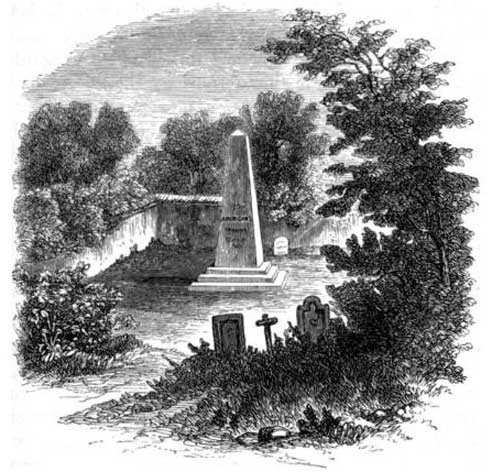
MONUMENT TO THE AMERICANS.
Tacuba is a very small village, and is not in any wise noted except for an immense cypress-tree, that must have been a wonder even in the time of Cortéz. Tacuba has the historical notoriety of being the place where hostilities first broke out between the Aztecs and the Spaniards, and the spot where the night retreat of the latter terminated. Here the land is quite fertile, and a little way from the village are several water-mills, where the grain raised in this part of the valley is ground into flour.
THE VIRGIN OF REMEDIES.
A little way beyond Tacuba is the hill and temple of the Virgin of Remedies. It was upon this hill, within the inclosure of an Indian mound, that the retreating party of Cortéz made their first bivouac, and built fires and dressed their wounds. Hence they gave to the hill the name of Remedios, and the church afterward erected was dedicated to our Lady of Remedies. Diaz tells us that it became very celebrated in his time. The story about Cortéz finding a broken-nosed image in the knapsack of one of his soldiers is not mentioned either by himself or Bernal Diaz, and must therefore be an afterthought, to give plausibility to a subsequent imposition. From this point Cortéz and his party, without their women or treasures, trudged along to the foot of the hills to Tepeac, or Guadalupe, and thence around the foot of Tezcuco to the plains of Otumba.
The story is, that while Cortéz and his men were resting here, a soldier took from his knapsack an image, with nose broken and an eye wanting, which Cortéz made the patron saint of the expedition, and held it up to their adoration, and that this little incident so encouraged the men that they started off with renewed vigor. The whole of this story is probably a very silly modern invention. The bulk of the forces of Cortéz was most probably composed of that class of reprobates that to this day can be found about almost any of the West India sea-ports, ready for any enterprise, however hazardous. They have no religion; they are not even superstitious, but yield a nominal acquiescence to the forms of the Catholic religion. Cortéz speaks often of his efforts to effect the conversion of the Indians, but it is in such a business sort of way as to lead to the impression, that it was all done to make an impression at home, but was really a matter that he did not care much about. The famous image, according to the current story, disappeared soon after the Conquest, but was found about 150 years afterward in a maguey plant, and was as much dilapidated as if it had been exposed to the weather for the whole of that century and a half.
Such, in substance, is the tradition of the Virgin of Remedies, who for a century divided with the Virgin of Guadalupe the adoration of the people in the most amicable manner. But when the insurrection of 1810 broke out, these two virgins parted company. "Viva the Virgin of Guadalupe!" became the war-cry of the unsuccessful rebels, while "Viva the Lady of Remedies!" was shouted back by the conquering forces of the king. The Lady of Guadalupe became suspected of insurrectionary propensities, while all honors were lavished upon the Lady of Remedies by those who wished to make protestations of their loyalty. Pearls, money, and jewels were bestowed upon her by the nobility and the Spanish merchants; and as one insurrectionary leader after another was totally defeated, the conquering generals returned to lay their trophies at the feet of the Lady of Remedies, to whose interposition the victory was ascribed. They carried her in triumphant procession through the streets of Mexico, singing a laudamus. Then it was that the Lady of Remedies was at the zenith of her glory. Her person was refulgent with a blaze of jewels, and her temple was like that of Diana of Ephesus, and all about the hill on which it stood bore marks of the greatest prosperity.
RISE AND FALL OF THE VIRGIN.
Her healing powers were then unrivaled, and the list of cures which she is claimed to have effected surpasses that of all the patent medicines of our day. She was an infallible healer, alike of the diseases of the mind and of the body. A glimpse of her broken nose and battered face instantaneously cured men of democracy and unbelief. Heretics stood confounded in her presence, while the halt, the lame, and the leprous hung up their crutches, their bandages, and their filthy rags, as trophies of her healing power, among the flags and other trophies of her victories over the rebels. Nothing was beyond her skill; from mending a leaky boat to securing a prize in the lottery; from giving eyes to the blind, feet to the lame, mending a broken or a paralyzed limb, or a broken heart, to putting the baby to sleep. Her votaries esteemed her omnipotent, and carried her in procession in times of drought, as the goddess of rain; and when pestilence raged in the city, she was borne through the infected streets. Such was she in the times of her glory.
Now all is changed. She is still a goddess, but her glory is eclipsed. She, like many a virgin in social life, neglected to make her market while all knees were bowing to her, and now, in the sear and yellow leaf, she is a virgin still. Her temple is dilapidated, her garlands are faded, her gilding is tarnished, the buildings about her Court are falling to decay, while the bleak hill which her temple crowns looks tenfold more uninviting than if it never had been occupied. When I entered this neglected temple of a neglected image, an old, superannuated priest was saying mass, and three or four old crones were kneeling before her altar. Such are the effects that followed the revolution of Iguala. Not only was her hated rival of Guadalupe elevated from her long obscurity to be the national saint, but the animosity against this dilapidated image of Remedies was carried to that extreme of cruelty that, when the Spaniards were expelled from Mexico, the passports of the "Lady of Remedios" were made out, and she was ordered to leave the country. Poor thing!
The porter's eye glistened at the now unwonted sight of a silver dollar, and he soon had me through the most secret recesses of the sanctuary. The only things I saw worthy of admiration were some pictures, made from down or the feathers of the humming-bird, by which a richness of color was imparted to the pictures that could not be obtained from paints.
At last we came to the back of the great altar, and the curtain of damask silk being drawn up by a little string, we saw sitting in a metallic maguey plant a bright new Paris doll, dressed in the gaudy odds and ends of silk that make such a thing an attractive Christmas present for the nursery. Paste supplied the place of jewels, and a constellation of false pearls were at the back of her shoulders. The man kept his gravity, and did reverence to the poor doll, while I burned with indignation at being imposed upon by a counterfeit "universal remedy for all diseases." I had often read in the apothecaries' advertisements cautions against counterfeits, and rewards for their detection, and I always noticed, from these printed evidences, that the counterfeits were exactly in proportion to the worthlessness of the genuine article, and that medicine which was utterly valueless itself suffered most from the abundance of counterfeits. So it was with the Lady of Remedios; after she had fallen below the dignity of a humbug, and no man was found so poor as to do her reverence, she was spirited away to the Cathedral of the city of Mexico, in order to save her three jeweled petticoats from being stolen, and a child's doll, covered with paste jewels, now personified the great patron saint of the vice-kingdom of New Spain.
AZTEC AND ROMISH IMAGES.
I again mounted my horse, angry at being cheated. Though the day was a most lovely one, I rode home in fit humor to contrast the system of paganism which Cortéz introduced with the more poetical system which preceded it, and to compare these cast-off child's dolls with the allegorical images of the Aztecs. My landlord had two boxes of such images, collected when they were cleaning out one of the old city canals. By way of parlor ornaments, we had an Aztec god of baked earth. He was sitting in a chair; around his navel was coiled a serpent; his right hand rested upon the head of another serpent. This, according to the laws of interpreting allegories, we should understand to signify that the god had been renowned for his wisdom; that with the wisdom of the serpent he had executed judgment; and that his meditations were the profundity of wisdom. And yet this allegorical worship, defective as it may have been, was forcibly superseded by the adoration of a child's doll—one that had very possibly been worn out and thrown from a nursery, and perhaps picked up by some passing monk, was made the goddess of New Spain, and clothed with three petticoats, one adorned with pearls, one with rubies, and one with diamonds, at an estimated cost of $3,000,000. Which was the least objectionable superstition?
We have been taught to look upon the worship of the Aztecs as monstrous; but the witnesses against them were themselves monsters, who were seeking for a pretense to excuse their own brutality in reducing the Indians to the most debasing slavery, while they appropriated to their own use the best looking of the squaws, and kept such swarms of supernumerary wives that each Spaniard had to brand them with a red-hot iron in order to know his own family. The fathers of the present mixed-breed population of Mexico tell us that the Aztecs offered human sacrifices, and feasted upon human flesh. They hope, by dwelling upon the enormities of the Indians, to excuse their own still more detestable crimes. For three centuries their stories were uncontradicted, and they have been received as historical verities. But the character of the witnesses warrants us in receiving their statements with some incredulity.
CHAPTER XX.
The Paséo at Evening.—Ride to Chapultepec.—The old Cypresses of Chapultepec.—The Capture of Chapultepec.—Molina del Rey.—Tacubaya.—Don Manuel Escandon.—The Tobacco Monopoly.—The Palace of Escandon.—The "Desierto."—Hermits.—Monks in the Conflict with Satan.—Our Lady of Carmel.
My residence was near the Paséo Nuevo, and at evening, while the sun had yet an hour of his daily task to finish, I habitually sauntered forth for a walk up and down the Paséo, to look at the crowd of coaches, with tops thrown back, so that the bare-headed ladies, in full dress for dinner, might enjoy the evening air, acquire an appetite, and salute their friends by presenting the backs of their hands, while they twirled their fingers at them with a hearty smile. Gentlemen on richly-caparisoned horses dashed along between the rows of advancing and returning carriages, stopping now and then by the side of a well-known carriage to exchange salutations, or, by an exhibition of a well-timed embarrassment, proclaim the favored object of their evening's ride. Crowds of foot-passengers sauntered along the road-side, looking at the rich display made by the aristocracy and nobility of the republic. At the entrance of the Paséo, in front of the amphitheatre, where on Sundays bulls are tortured to death as a popular amusement, is the equestrian bronze statue of Carlos IV., the work of Tolsa, who, as artist and architect, has won for himself undying renown at Mexico. The garden of Tolsa, the College of Mines, and the bronze horse, testify to the greatness of his genius. Half way down the Paséo is a fountain, around which two semicircles of coaches place themselves for a little time, to look on the passing current of carriages and horsemen. They soon disappear as the sun shows symptoms of descending behind the mountains. On Sundays the scene is more animated, and then the President, with his body-guard of lancers, and attendants in scarlet livery, is seen to dash into the Paséo, ride down and return through the Alameda, among whose trees and fountains the Sabbath crowds most do congregate.
One morning when all was quiet in this place of display, I rode down the street of San Francisco, and turned up the Paséo between the prison of the Acordado and the bronze horse. There was nothing to disturb the monotony that now reigned but cabs or omnibuses on their way to or returning from Tacubaya. Passing through the open gate of Belin, I rode along at the side of the aqueduct to the rock of Chapultepec.
CYPRESSES OF CHAPULTEPEC.
It calls up singular reflections to look upon a living thing that has existed for a thousand years, though it be only a tree. Though so many centuries have rolled over the venerable cypresses of Chapultepec, yet they still are sound and vigorous. The extensive springs of pure water that issue from beneath this immense rock have kept them flourishing in the midst of a tequisquite valley. Long gray threads of Spanish moss hang pendent from the extremity of their limbs and cover the lower leaves. These trees are the only living links that unite modern and ancient American civilization; for they were in being while that mysterious race, the Toltecs, were still upon the table-lands of Mexico—a race that has left behind, not only at Teotihuacan, but in the hot country, the imperishable memorials of a civilization like that of Egypt; and from them the Aztecs acquired an imperfect knowledge of a few simple arts.[38]
These trees had long been standing, when a body of Aztecs, wandering away from their tribe in search of game, fixed themselves upon the islands of this marsh, first about the rock of Chapultepec, then at Mexicalzingo and Iztapalapan, and finally at Mexico. These trees were undisturbed by the Spaniards when Cortéz took the city, and the Americans respected their great antiquity, so that during all the wars and battles that have taken place around and above them, they have passed unharmed.
Not only unnumbered generations, but whole races have appeared and disappeared, while these trees have quietly flourished amid the strife of the elements and the contentions of men, taking no heed of the passing events of which they were spectators. The Toltecs, of whom we must speak more fully hereafter, were the first of these races that disappeared from the table-land—the victims of wars, and of that plague of the Indian races, the matlazhuatl. As the Aztecs rose into importance by their success in war and by the multitude of their captives, Indian princes made the springs near Chapultepec their favorite bathing-place, and spread their mats under these trees, and in their shadow enjoyed their noontide slumbers. Then the pale-faces came, and peopled the valley with a race of mixed blood, and vice-kings occupied the place that had been the sacred retreat of the Aztec chiefs.
These trees had added many rings to their already enlarged circumference before the vice-kings disappeared, and an emperor sat in the shade which had been their favorite retreat; and the Aztec eagle floated again upon the standard that waved over Chapultepec; but it was only the galvanized corpse of that brave bird, and the emperor was only a victim prepared for the sacrifice. Since that time much bad gunpowder has been burned over the heads of the trees, and the roots have been shaken by the discharge of the cannon of the castle at every change of rulers, as one ephemeral government succeeded another, but these cypresses still remain unharmed, and may outlive many other dynasties.
CHAPULTEPEC AND MOLINA DEL REY.
The Americans captured Chapultepec by a coup de main. Having made several breaches through the stone wall behind the cypresses, they rushed through under those trees and up the side of the hill next to them, not allowing themselves to be delayed by the turnings of the road. The general in command, the late General Bravo, was a man of tried courage, and not deficient in military sagacity. He sent most urgent requests to Santa Anna for reinforcements, urging that General Scott was too prudent a soldier to attack the city before carrying the castle, and that the garrison was inadequate for its defense. But Santa Anna was completely paralyzed, as Scott designed he should be, by the large force, under General Smith, which was threatening the south front of the city. When it was too late, Santa Anna discovered that this was only a feint.
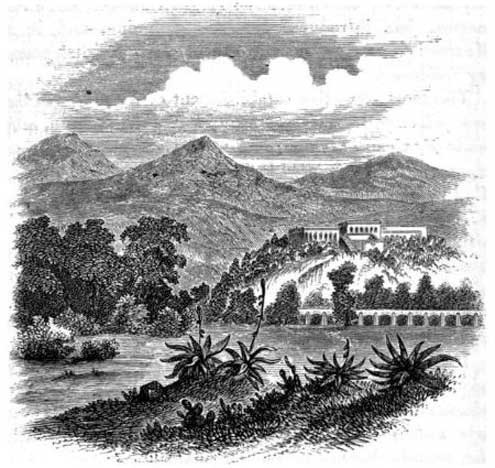
CHAPULTEPEC.
The King's Mill (Molina del Rey) is an old powder-mill, standing on elevated ground in the rear of Chapultepec. It has nothing about it to give it notoriety except the slaughter of the American troops that here took place from a masked battery, manned by a body of volunteers from the work-shops of the city. The whole affair was a military mistake. Its capture was not necessary to insure the capture of Chapultepec, for, as soon as that fortress, which commanded the mill, should be in our power, the mill would be untenable. But repeated successes had made the American officers imprudent, so that without first battering down its walls, the division of General Worth rushed up, regardless of a flank fire of the castle, to carry this old building by assault. After the sacrifice of about 700 lives, cannon were brought out and the breach made, and then the difficulty was at an end.
A mile or so by the road leading south and west from Chapultepec is Tacubaya, where are the suburban residences of the Archbishop, the President, and of divers city bankers; and where the English banker, Mr. Jimmerson, has introduced English gardening, and, in a Mexican climate, enjoys the pleasure of an English country residence.
DON MANUEL ESCANDON.
The most attractive establishment of Tacubaya is the new palace of Don Manuel Escandon, a native-born, self-made Mexican millionaire; a man whose capital has so enormously accumulated before he has even reached middle life, that he was able to propose to discount a bill for $7,000,000 as an ordinary business transaction, though ultimately government divided the bid with another house. This most remarkable instance of accumulation of wealth in modern times is deserving of a passing notice, which I give on the authority of my landlord, who had a personal knowledge of his history.
Don Manuel enjoyed, in addition to an intimate knowledge of his own countrymen, the advantages of a foreign education, which had extended to an examination of those arts and improvements that elevate Europeans above the semi-barbarous people of Spanish America. The first enterprise that brought him prominently forward was the establishment of that vast and most perfect system of stage-coaches, of which I have already spoken, on an original capital of $250,000. The wretched condition of the roads, and the heavy losses that at first always attend enterprises of that magnitude, disheartened his partners, who were glad to sell out to him $150,000 of the capital stock at a discount of 50 per cent. Afterward the late Zurutusa bought into the scheme, and ultimately became the owner of all the property, having, before his death, more than realized the highest anticipations of himself or Escandon. A hundred thousand dollars, or thereabouts, were the profits to Escandon by this establishment of a series of hotels and stages quite across the continent. By the successful running of a blockade of the coast, he realized nearly another hundred thousand dollars. The numerous enterprises open to men of superior sagacity, who fully understand the wants of a country in a state of chaos, and are familiar with the improvements of other countries, were readily embraced by him, until he found himself possessed of sufficient capital to become the principal purchaser of the extensive silver mines of Real del Monte, of which the salt-works of Tezcuco are but an outside appendage.
The tobacco monopoly had yielded to the King of Spain an average return of nearly a million annually. Under the Republic the consumption of the weed had greatly increased, but, from the prevalence of disorder in every branch of the administration, this important branch of the revenue was almost entirely absorbed by the officials through whose hands it passed, so that the sum realized by government in the most unproductive year fell off to $25,000, but finally reached $45,000, the amount at which it was farmed out by Escandon and Company. Since that time the return to government has gone on increasing, until it was advertised to be let the last year at the round sum of $1,200,000. How much more the partners realized during the years that they held the contract is, of course, known only to themselves.
The new house which Don Manuel has built at Tacubaya is decidedly the finest palace in the republic. The position is well chosen, and the sum of $300,000 has been laid out upon the house and grounds. It is a combination of an Italian villa, with the comforts and conveniences of English life. London, Paris, and New York have alike contributed to its furniture. I was told that $50,000 was invested in pictures alone. When I looked at the perfection to which the house, the grounds, and the ornamental works had been carried, my only wonder was that $300,000 could have paid for such a combination of elegance and good taste. The family, which consists only of Don Manuel and his widowed sisters, had left on account of the cholera then prevailing in Tacubaya, but the steward readily opened every door to my companion; and thus, without intruding upon the privacy of a family, or even having the honor of their acquaintance, I obtained access to one of the finest private residences that I have ever yet seen, either in this country or any other. In this house it was that the Gadsden treaty was proposed, at a dinner-party at which Mr. Gadsden and Santa Anna were present.
THE DESIERTO.
There was nothing to detain me longer at Tacubaya; but a ride upon the Tacubaya road is not well finished without being extended to the Desierto, a place now as attractive in its ruins as it was in its prosperity.
A description of what it once was I copy from old Thomas Gage: "But more north [south] westward, three leagues from Mexico, is the pleasantest place of all that are about Mexico, called the Solidad, or Desierto, 'the Solitary Place' or 'Wilderness.' Were all wildernesses like it, to live in a wilderness would be better than to live in a city. This hath been a device of bare-footed Carmelites, to make show of their apparent godliness, and who would be thought to live like hermits, retired from the world, that they may draw the world unto them. They have built them a stately cloister, which, being upon a hill and among rocks, makes it to be most admired. About the cloister they have fashioned out many holes and caves, in, under, and among the rocks, like hermits' lodgings, with a room to lie in, and an oratory to pray in, with pictures, and images, and rare devices for self-mortification, as scourges of wire, rods of iron, haircloth girdles with sharp wire points, to gird about their bare flesh, and many such like toys, which hang about their oratories, to make people admire their mortified and holy lives.
"All these hermits' holes and caves, which are some ten in all, are within the bounds and compass of the cloister, and among orchards and gardens, which are full of fruits and flowers, which may take two miles in compass; and here among the rocks are many springs of water, which, with the shade of the plantain and other trees, are most cool and pleasant to the hermits. They have also the sweet smell of the rose and the jessamine, which is a little flower, but the sweetest of all others; and there is not any flower to be found that is rare and exquisite in that country which is not in that wilderness, to delight the senses of those mortified hermits.
"They are weekly changed from the cloister, and when their week is ended others are sent, and they return into their cloisters; they carry with them their bottles of wine, sweetmeats, and other provisions. As for fruits, the trees do drop them into their mouths. It is wonderful to see the strange devices of fountains of water which are about the gardens; but much more strange and wonderful to see the resort thither of coaches, and gallants, and ladies, and citizens from Mexico, to walk and make merry in those desert pleasures, and to see those hypocrites, whom they look upon as living saints, and so think nothing too good for them to cherish them in their desert conflicts with Satan.
"None goes to them but carries some sweetmeats or some other dainty dish to nourish and feed them withal, whose prayers they likewise earnestly solicit, leaving them great alms of money for their masses; and, above all, offering to a picture in their church, called our Lady of Carmel, treasures of diamonds, pearls, golden chains, and crowns, and gowns of cloth of gold and silver. Before this picture did hang, in my time, twenty lamps of silver, the poorest of them being worth a hundred pounds. Truly Satan hath given them what he offered unto Christ in the desert.
"All the dainties and all the riches of America hath he given unto them in that desert, because they daily fall down and worship him. In the way to this place is another town, called Tacubaya, where is a rich cloister of Franciscans, and also many gardens and orchards; but it is, above all, much resorted to for the music in that church, wherein the friars have made the Indians so skillful that they dare compare with the Cathedral Church of Mexico."
CHAPTER XXI.
Walk to Guadalupe.—Our Embassador kneeling to the Host.—An Embassador with, and one without Lace.—First sight of Santa Anna.—Indian Dance in Church.—Juan Diego not Saint Thomas.—The Miracle proved at Rome.—The Story of Juan Diego.—The holy Well of Guadalupe.—The Temple of the Virgin.—Public Worship interdicted by the Archbishop.—Refuses to revoke his Interdict.—He fled to Guadalupe and took Sanctuary.—Refused to leave the Altar.—The Arrest at the Altar.
"Placuit pinturas in ecclesia esse non debere, ne quod colitur vel adoratur, in parietibus pingatur—Pictures ought not to be in the churches, nor should any that are reverenced or adored be painted upon the walls." So say the canons of the Council of Toledo.
I was one of a vast crowd that, on a Sunday of December, 1853, were hurrying out of the city by the old gate and causeway of Tepeac to the suburban village of Guadalupe Hidalgo, once Tepeac, but now consecrated to the Virgin Mary, who, tradition says, appeared there in a bodily form to an Indian peon. Juan Diego was the name of the Indian, and 1531 is the date assigned to the incident. I shall hereafter take occasion to relate the story as given by the veracious Juan, and duly attested by authority which ought to be competent to settle the question, if any thing can do so. I hope that my readers will do their best to believe it. If they honestly endeavor to do so, and do not succeed, I trust they will not suffer on account of their lack of faith.
The occasion that was drawing the multitude together was the consecration of the bishop-elect of Michoican, which was to be celebrated with great pomp at this most sacred shrine of the patron goddess of the Republic. The State and the Church were duly represented upon the platform by the President, the nuncio, and the archbishop. Beneath the platform, and within the silver railing, were the official representatives of foreign nations, who were easily distinguished by a strip of gold or silver lace upon the collars and lapels of their coats. To this uniformity of dress there was a single exception in the person of the new American embassador, Mr. Gadsden, whose plain black dress and clerical appearance would have conveyed the impression that he was a Methodist preacher, had he not been engaged, with all the awkwardness of a novice, upon his knees, in crossing himself.
This was the first occasion on which I had ever seen Santa Anna. If looks have any weight determining a man's character, then truly he was entitled to his position, for he was, by all odds, the most imposing in appearance of any person in that assemblage, or any other I have yet seen in Mexico. His part in the performance was that of godfather to the bishop. Surrounded by kneeling aids-de-camp, he alone stood up, in the rich uniform of a general of division, seeming the perfection of military elegance and dignity. Each badge of prelatical rank, before it was put upon the new bishop, was handed to Santa Anna, who kissed it, and then returned it. He stood without apparent fatigue during the whole of that long ceremony. I have often seen Santa Anna since that time, but never have I seen him appear to such advantage as upon this occasion.