ROBERT A. WILSON. (continued 3)
Reading edition
WEAKNESS OF THE SPANISH TITLE.
My limits will not permit me to follow General Tornel through his statement of the manner in which Louisiana, Florida, and Texas were acquired, and to notice his complaints of the injustice committed by the Americans in all these acquisitions. He loses sight of the fact that Spain had no title to her possessions in America but that of discovery, and that very doubtful claim had not, in a period of 300 years, been strengthened by actual settlement. Three or four dilapidated mud forts, and as many more feeble missions, constituted the sum total of the Spanish possession of Texas; and settlements scarcely worthy of the name in the other northern departments constituted all the title that Spain could put forth to those countries; while the right of Mexico was as much weaker, as Mexico was a weaker power than Spain, and morally incapable of settling the disputed territory. The claim of the United States was the necessity for land in which to settle her population, which was so rapidly augmenting by foreign immigration. Once in ten years she requires a portion of the wild land nominally belonging to Mexico, and once in ten years she must take it.
SANTA ANNA.
In 1836, while Santa Anna was a prisoner in Texas, Bustamente, then in banishment in Europe, was elected President by the same party that had chosen Santa Anna as Dictator. In 1838, the government having incurred the hostility of France, Vera Cruz was blockaded for several months, during which time a night foray was made into the town by a party of French sailors, headed by the Prince de Joinville. On their return, they were pursued by Santa Anna to the Mole, where they stopped farther pursuit by discharging a cannon, which deprived Santa Anna of one of his legs, and effectually wiped out the recollections of his unfortunate Texan campaign. In 1841, the government being no longer able to raise funds at two per cent. a month, the Minister of War, Valencia, pronounced against Bustamente in the citadel of Mexico. The result was, that Santa Anna was again elevated to supreme power, according to the plan of Tacubaya, and the interpretation he put on that plan. In 1843 a slight change was made in the Constitution, but he remained in power until 1845, when, having left the capital to put down the insurrection of Paredes, Congress declared against him. Herrera was appointed President, and Santa Anna was imprisoned for a while in the castle of Perote, and finally banished from the country. In 1847 he was recalled by the Federal party, with the consent of President Polk, and became the chief support of the war, notwithstanding his totally inadequate means for organizing a successful defense. When the defense could no longer be protracted, he left the city by night, and retired to the West Indies, and afterward to Carthagena, where he remained until he was recalled in 1852, and again restored to supreme authority.
We may sum up the politico-military life of Santa Anna by saying that he has been engaged in eight pronunciamientos. Five of these have been made by himself; three by others, for his benefit. Twice he has been chosen President by the Federal party of the Federal Republic of Mexico. Three times he has been made President by the Central, or Ecclesiastical party. He has been twice banished from Mexico, and each time recalled again and placed at the head of affairs. He has twice been taken prisoner, when his captors held long consultations upon the propriety of putting him to death. He has, in turn, been the candidate of all parties, and has served all parties faithfully in turn, but most faithfully of all he has served himself. Actively engaged through life as a politician and a soldier, he has found time to readjust the whole complicated system of Mexican laws, and, in a series of volumes of autocratic decrees, he has drawn from that chaotic mass a new system of jurisprudence, that will stand as a monument of his genius as long as the Mexican nation shall continue.
CHAPTER XI.
From Puebla to Mexico.—The Dread of Robbers.—The Escort—Tlascala.—The Exaggerations of Cortéz and Bernal Diaz.—The Truth about Tlascala.—The Advantages of Tlascala to Cortéz.—Who was Bernal Diaz.—Who wrote his History.—First View of Mexico.
At early twilight, two stage-loads of passengers, drawn rapidly by twelve wild horses through the now deserted streets of Puebla, approached the gate that opened out upon the road to Mexico. The rattle of the wheels and the clatter of so many hoofs had awakened the gatekeeper, and at our approach the ponderous portals that inclosed the city by night flew open, and away we whirled out into the beautiful vega of Puebla.
In times of civil disorder, this is a fine field for robbers to ply their vocation in; and even now, when all was quiet, there was no little apprehension of a visit from these sovereigns of the road. The passengers had noticed my unmistakable Anglo-Saxon name, as it was called at the stage-door, and, when I had taken my seat, an elegant, long Colt's revolver was passed to me by a passenger in full uniform. Such is one of the advantages that a traveler enjoys who belongs to a race of men of acknowledged courage—an advantage that enabled we to travel alone across the continent without encumbering myself with a weapon; for, where all supposed me fully armed, and skilled in the use of weapons by instinct, I found it convenient to go unarmed. Upon the present occasion, I did not wish to raise a smile of incredulity by protesting that I had never fired a pistol in my life, so I quietly consented to play the part of hero.
By displaying my weapon carelessly in my hand when we stopped to take coffee at Saint Martin's, I procured a seat upon the outside, which had been refused me at Puebla.
Our escort consisted of a body of six lancers, who, standing at the roadside, saluted us as we passed, and then rode after us at the top of their speed. Poor fellows! they found it hard riding to keep up with the coach. It was some consolation for them to see a man seated on the top of the stage with a Colt's pistol, even if he did not know how to use it, and for once they rode out their beat without getting frightened at their shadows. As the robbers were as great cowards as themselves, whether the man on the box was really a fire-eater or not, it answered the same purpose. These stage-guards are heroes in their way; they always come when the road appears the safest, and never fail to ask for charity, but invariably leave you just as the coach approaches a thicket. A few days ago, this guard caught a fellow on the road whom they believed to be a robber, and hung him with a pocket-handkerchief.
REPUBLIC OF TLASCALA.
We are now passing the borders of that famous Indian republic, of the high table-land, which shut out despotism by a lofty wall,[16] and was so completely isolated in the times of Montezuma that its people could obtain no foreign products, not even cotton or salt;[17] whose food was the maize which they cultivated, and the game which they caught upon the snow-capped mountains; whose clothing was made from the maguey, and from skins of animals taken in the chase; a people whose government was a council of elders, which was presided over by an hereditary chief; whose political institutions have been the study and admiration of the learned of many lands. That is, in plain English, they were an ordinary tribe of North American savages, obtaining their living, as other Indians did then and do now, by the cultivation of Indian corn and hunting, having the same crude form of government that is common to all the savage tribes of North America. They gloried in their savage notions of independence, and submitted only to the merest shadow of authority. They had not yet reached that point of social organization at which the loose government of savages gives way to the despotism of the next stage of advancement, which we shall call barbarism. The difference between the Tlascalans and the Aztecs was the same difference that exists between the North American savages, who live in underground wigwams,[18] and the barbarous tribes of the interior of Africa, that live in cities of mud huts above the ground, and who yield a slavish obedience to a half-naked emperor, who sits or squats upon an ox-hide in a mud palace, exercising the power of life and death, according to his momentary caprice, upon thousands of trembling slaves. The concentrated power and wealth of a whole tribe is in single hands, and is made available for conquest and for the sensual enjoyment of a single individual. Savages can only act in concert when all are agreed, hence councils are their governing power, and the orator has as much influence among them as the successful warrior; but when they have advanced a step, and power has become concentrated, the orator becomes silent, and the war-chief is the government.
I had read with avidity the histories of Mexico, and gave to them implicit credence, until I stood upon the Indian mound of Cholula, and searched in vain for the least vestige of that magnificent city of 40,000 houses, which, only 300 years ago, was in the height of its prosperity; and though it is not in the power of man, in the space of a thousand years, wholly to obliterate the traces of a great city, yet not a vestige of the Cholula of Cortéz can now be found. As I followed up the investigation, I soon discovered that not a vestige of any of the cities that entered into the alliance with Cortéz can now be found. Not a vestige exists even of the old city of Mexico, except the calendar and sacrificial stones, of which I shall speak hereafter.
CORTÉZ AND BERNAL DIAZ.
Cortéz says that a dry stone wall, nine feet high, inclosed Tlascala from mountain to mountain, through which he entered between overlapping semicircles of the wall. He says that he was attacked first by an army of 6000 Indians, then by an army of 100,000 on one day, and on the next by 149,000. He says farther, "I attacked another place, which was so large that it contained, according to an examination I caused to be made, more than 20,000 houses." Of the capital of Tlascala, he says, "It is larger than Granada, and much stronger, and contains as many fine houses and a much larger population than that city did at the time of its capture."
A comparison of the statements of Bernal Diaz and those of Cortéz will cast some discredit upon the narrative of the former. The stout old chronicler cuts down the 100,000 Indians in the second battle to 50,000, and makes no mention of the third great action, in which 149,000 Indians were said by Cortéz to have been engaged. Here is another comparison:
"There is," says Cortéz, "in this city [Tlascala], a market, in which every day 30,000 people are engaged in buying and selling, besides many other merchants who are scattered about the city. The market contains a great variety of articles, both of food and clothing, and all kinds of shoes for the feet, jewels of gold, and silver, and precious stones, and ornaments of feathers; all as well arranged as they possibly can be found in any public square in the world."[19]
Now see the difference between this great Munchausen and his professed apologist and companion, the writer of Bernal Diaz, who was familiar with the suppressed manuscript of Las Casas, and makes quotations from it. "The elder Xicotencotl," says Bernal Diaz, "now informed Cortéz that it was the general wish of the inhabitants to make him a present, if agreeable to him. Cortéz answered that he should at all times be most happy to receive one; they accordingly spread some mats on the floor, and over them a few cloaks, upon which they arranged five or six pieces of gold, a few articles of trifling value, and several parcels of manufactured nequen—altogether a poor present, and not worth twenty pesos (dollars). The caziques, on presenting these things to Cortéz, said to him, 'Malinche! we can easily imagine that you will not exactly experience much joy on receiving a present of such wretched things as these; but we have told you before that we are poor—possessing neither gold nor other riches, as the deceitful Mexicans, with their present monarch, Montezuma, have, by degrees, despoiled us of every thing we had. Do not look to the small value of these things, but accept them in all kindness, and as coming from your faithful friends and servants.' These presents were, at the same time, accompanied by a quantity of provisions."[20]
THE TRUTH ABOUT TLASCALA.
Thus, according to Cortéz, the Tlascalans dwelt in cities rivaling the most polished and commercial cities of Europe; according to Diaz, they were so poor that they were unable to make a present worth twenty dollars! Cortéz gives a view of "a large wall of dry stone, about nine feet in height, which extends across the valley from one mountain to the other: it was twenty feet in thickness, surmounted throughout its whole extent by a breastwork a foot and a half thick, to enable them to fight from the top of the wall." Diaz says, "We came to an enormous intrenchment, built so strongly of stone, lime, and a kind of hard bitumen, that it would only have been possible to break it down by means of pick-axes."[21] Such a wall, or the vestiges of it, would last for thousands of years; for it is not in the destructive power of man wholly to obliterate it, and yet I have been utterly unable to find even a ruin, and I verily believe the whole of this Chinese wall is a fiction.
Tlascala is an Indian reservation of an oval shape, sixty-nine miles long by forty-two miles wide. Its climate is cold. Its soil is not remarkably good. It has had its independent government since the time of Cortéz. Its means of subsistence have been increased, and extensive manufactories have been established. The only enumeration ever made of its inhabitants was in 1793, when it was found to contain 51,177 souls. In the extravagant official estimate of last year, its population is set down at 80,171.[22] Cortéz says that Tlascala contained a population of 500,000 inhabitants, according to a report made by his orders. We have here our historians within metes and bounds, between mountains and stone walls; a perfect non-intercourse established with all the world; all foreign means of supply cut off, and the Indians dependent for subsistence upon their own rude cultivation of maize. My readers may call me extravagant if I should say that Tlascala probably contained about 10,000 inhabitants in the time of Cortéz, and could therefore, in an emergency, produce 1000 warriors. A greater number than this would be contrary to the laws of population. I might here stop and call hard names, but it is not my purpose to "bring a railing accusation" against any. My only duty is to place evidence before the reader, and then let him judge how much reliance is to be placed upon any historical statements that have been trimmed and modified to suit the purposes of the Spanish Inquisition.
The quick wit of Cortéz early discovered that Tlascala was a great natural fortress, and that he could make it the centre and base of his operations in the wars he was contemplating against the different Indian tribes of the table-land. The hatred borne against the Mexicans by the Tlascalans assured him of their co-operation against Montezuma. Hence the Tlascalans were especially favored. They shared with him in all the perils of his enterprise, and in the plunder gathered from the conquered tribes; for with them rested the question whether he should succeed, and be hailed as the hero of a holy war, or should be branded as a buccaneer, robber, and enslaver. And when, in course of time, the Indian element became the ruling power, curses loud and deep were muttered against the enslaver of the Indians, and the Tlascalans came in for their share of imprecations.
CENSORSHIP OF HISTORICAL BOOKS.
But who was Bernal Diaz? This would be a strange question to ask in a country where there was liberty of speech and liberty of the press, but in Spain the censorship was not only repressive, but it was "suggestive." It not only suppressed the writings of authors, but compelled them to father productions that were the very opposite of those they wished to publish. Take the case of poor Sahagun, who wrote a refutation of the historian of the conquest, under the pretense of giving the Indian account of that event: when his book was finally allowed to see the light, after a delay of many years, it was found that his own account of the conquest had been suppressed, and the regular Spanish account had been substituted. Of Las Casas's "Apology for the Indians,"[23] which had occupied thirty-two years of his life, that part only was allowed to appear which treated of Saint Domingo. But his refutation of the histories of the conquest of Mexico is wholly suppressed. To have proved the Conquistadors a gang of unprincipled buccaneers would have spoiled a Holy War, which was just what the Inquisition would not allow to go before the world. To the little work of Boturini on Mexico there are appended, 1. The declaration of his faith in the Roman Catholic Church in the most unequivocal terms. 2. The license of the Jesuit father. 3. The license of an Inquisitor. 4. The license of the Judge of the Supreme Council of the Indias. 5. The license of the Royal Council of the Indias. 6. The approbation of the "qualificator" of the Inquisition, who was a bare-footed Carmelite monk. 7. The license of the Royal Council of Castile. Beyond all this, the writer must be a person in holy orders, and be a person of sufficient influence to obtain the favorable notice of all these bodies, who were instinctively hostile to the diffusion of all information, particularly in regard to the New World. Nor was this the end of the difficulty; the license of any one of these officials could be revoked at pleasure, and, when republished, the work had to be re-"viséd." Even as late as the year 1825, a Spanish standard author could not be republished without expurgation.[24] With such facts before us, it is safe to declare that not a single statement of fact that affected either the interests of the king or the Church was ever published in Spain or her colonies during the three hundred years of the existence of the Inquisition; but every thing published was modified to suit the wishes of the censors, without any regard to the sentiments of the putative author.
But who was Bernal Diaz? How came he to be familiar with the writings of Las Casas that never saw the light? Had he access to the secret archives of the convent? He refers to the account of Las Casas as follows:
"These [the slaughters at Cholula] are, among others, those abominable monstrosities which the Bishop of Chiapas, Las Casas, can find no end in enumerating. But he is wrong when he asserts that we gave the Cholulans the above-mentioned chastisement without any provocation, and merely for pastime."[25] The history of Diaz is among the standard literary productions of that age, and is a very picture of candor and simplicity. On every page there are such evident efforts at truthfulness as to raise a suspicion that something more than, a simple narrative was the object of writing this book fifty years after the conquest. By supposing the author to be only sixteen years old when he came to America, Lockhart makes him only seventy years of age when he wrote the work. But if we suppose him to have been of a reasonable age when he began his adventures, he must have been between eighty and ninety years old when this book is alleged to have been written. Gomara had overdone the matter in the superhuman achievements which he had ascribed to Cortéz, while Las Casas had proved the conqueror and his party to have been a gang of cruel monsters. Now, something had to be done to avert the odium that was beginning to attach to this crusade against the enemies of the Church. In Spain, where a padlock was upon every man's mouth, and where each one buried his suspicions in the most secret recesses of his heart, and trembled lest, even in his dreams, a thought of impiety might reach the ear of a familiar, history could always be made to conform to the interests of the Church.
Since the records of the Spanish Inquisition have become the property of the public, and the manner in which the facts of history were trifled with is now understood, it is a question more easily asked than answered, Who wrote such and such a book?
WHO WROTE BERNAL DIAZ?
Who, then, wrote the history of Bernal Diaz? We have seen that it cuts down the monstrous exaggerations of Cortéz more than a half, yet we shall see that the statements of Diaz are still incredible. It is a very religious book, as the Spaniards understand the word religion, and reflects great credit on the Church. But, with the slight evidence we have presented, no one would charge the work with being altogether a fiction, and Bernal Diaz a myth. All that can be said is, that we are left in that state of uncertainty in which every one finds himself who looks into a record that was within the control of the Inquisitorial censors.
Our stage-ride has been forgotten in discussing historical questions; and while we have been dwelling upon Cortéz and Bernal Diaz, we have crossed the plain, and been climbing the heights of Rio Frio, and now we begin to catch glances of the valley and of the city of Mexico—a city and valley so renowned in history and tradition, that it seems more like a city of the Old World than a town in the interior of the continent that Columbus discovered. Truly it is an old city. It was an old city before Columbus was born—an old city in a new world. It is one of the links that binds the present age to ages long past and almost forgotten—a city where the present and the past are strangely mingled together. In its streets are "penitents," wandering, in sackcloth and sandals, with a downcast look and a rope for self-castigation, among soldiers in new French uniforms and ladies in the latest Paris fashions. This is not the time for a favorable view of the valley from this point. To see it in its full glory, we must look upon it at sunrise.
CHAPTER XII.
Acapulco.—The Advantages of a Western Voyage to India.—The great annual Fair of Acapulco.—The Village and Harbor of Acapulco.—The War of Santa Anna and Alvarez.—The Retreat.—Traveling alone and unarmed.—The Peregrino Pass.—Quiricua and Cretinism.—Chilpanzingo.—An ill-clad Judge.—Iguala.—Alpayaca.—Cuarnavaca.
Let us now make a journey in another direction—from Acapulco northward to the city of Mexico—the route that the East India trade used to follow. But, first of all, let us discourse a little time about this port of Acapulco, once so famous upon the South Seas. It was not discovered when Cortéz built, in Colima, the vessels that went to search for a northwest passage; but when they had returned from their fruitless search, they anchored in the mountain-girt harbor of Acapulco. The discoveries of the celebrated navigator, Magellan, fixed the commercial character and importance of this sea-port. He had sailed through the straits that bear his name, and coasted northwardly as far as the trades. From this port he bore away to the Spice Islands, discovering on the voyage the Philippine Islands, where the city of Manilla was founded. By this voyage he demonstrated that the advantages of a route across the Pacific were so superior to a voyage around Cape Horn, as to justify the expense of a land transit from Acapulco to Vera Cruz, and reshipment to Spain. Now that the Panama Railroad is made, this demonstration may prove advantageous to other nations.
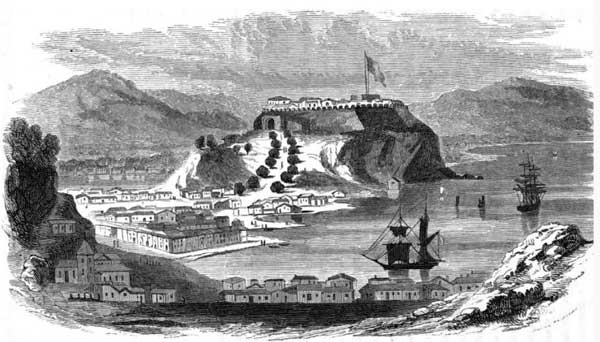
ACAPULCO.
The practical advantage of this discovery was the establishment of the annual Manilla galleon, in which was sent out 1,000,000 silver dollars to purchase Oriental products for the consumption of Spain and all her American colonies. In this galleon sailed the friars that went forth to the spiritual conquest of India. In it sailed Spanish soldiers, who followed hard after the priests, to add the temporal to the spiritual subjugation of Oriental empires. To this harbor the galleon returned, freighted with the rich merchandise of China, Japan, and the Spice Islands. When the arrival of the galleon was announced, traders hastened from every quarter of New Spain to attend the annual fair. Little vessels from down the coast came to get their share of the mammoth cargo. The king's officers came to look after the royal revenue; and caravans of mules were summoned to transport the Spanish portion of the freight to Vera Cruz. Thus, for a short time, the population of this village was swollen, from 4000 to 9000, which fell off again when the galleon took her departure.
ACAPULCO.
Such was the commercial condition of the town of Acapulco down to the time of the independence. From this time it was lost to commerce, until it was made a half-way house on the voyage to California. The town lies upon the narrow intervale between the hills and the harbor. It is built of the frailest material, and is destroyed about once in ten years by an earthquake.
The castle of San Diego stands upon the high bank, and, though commanding the entrance to the harbor, is itself commanded by the surrounding high lands, and has so often been taken by assault during the last thirty years as to be considered untenable. The harbor appears like a nest scooped out of the mountains, into and out of which the tide ebbs and flows through a double channel riven by an earthquake in the solid rock. Tradition says it once had another entrance, but that an earthquake closed it up and opened the present channel. There is still another opening in the sharp mountain ridge that incloses it from the sea, but this opening, dug by the labor of man, at a point opposite the entrance of the harbor, was to let the cool sea-breeze in upon one of the hottest and most unhealthy places upon the continent. Such, in substance, is and was the little city of Acapulco, the seat and focus of the Oriental commerce of New Spain and of all the Spanish empire.
WAR OF SANTA ANNA AND ALVAREZ.
Santa Anna and Alvarez are the only remaining insurrectionary chiefs in Mexico. When I was last in the capital, Santa Anna was reigning supreme in the vice-royal palace, and Alvarez was supreme at Iztla, the capital of the Department of Guerrero, of which Acapulco is the sea-port town. The two chiefs had been long hostile to each other, but a gold mine, discovered upon the bank of the River Mescala, was "the straw that broke the camel's back." Alvarez had not been consulted in the disposition made of it. Santa Anna felt himself powerful in his newly-equipped army of 23,000 men, the finest army that had ever been seen in Mexico—an army which he was maintaining at a daily cost of $23,000. Alvarez was equally strong in his mountain fastnesses, in the affections of the Pintos, or "Spotted People," and, above all, in the poverty of his country. Santa Anna took the initiative by sending 2000 men to garrison Acapulco, and Alvarez committed the first open hostility, by closing the passes against them. Then the campaign began. Santa Anna traveled at the head of his grand army. During his unobstructed march to Acapulco there occurred a great many victories, for victories are indigenous products of Mexico. The siege of the castle of San Diego de Acapulco was the first of the long list of unsuccessful sieges that distinguished the year 1854. The besiegers dared not risk an assault, and they had not sufficient material for conducting a regular siege. For some weeks the opposing forces remained looking at each other, while almost the only blood spilled was by the clouds of musquitoes that hovered over the camp of the grand army, and by the swarms of fleas that infested the castle. It might well be called a bloody war, for few escaped without bearing the scars of wounds and bloodletting.
While the besieging army was itself thus almost devoured, and had devoured all the eatables of the Pintos, symptoms of rebellion showed themselves at Mexico, to suppress which required the presence of Santa Anna. The generals of his army thought that they also might render more important services to the country in the streets of Mexico than in this inglorious war with bloody insects! A retreat was therefore sounded, and the country of the Pintos was evacuated. Thereupon rushed forth the little garrison from the clutches of the devouring insects, and issued a heroic proclamation, which was enough to frighten a whole army.
It is time to commence my itinerary across the mountains northward to the city of Mexico. My journey was by the same mule-path that Oriental merchants have climbed for centuries, as is shown by the vestiges of that strange race of which Humboldt speaks—an inter-mixture of Manillamen and Chinamen with the native race.
My traveling companion, who had a pistol, left me and went back at the first venta, or station-house, four leagues from Acapulco. At Lemones, the second station-house, four leagues farther, I passed the night sleeping upon a table on the veranda. This is the common lodging-place for solitary travelers in Mexico. Here I formed my first acquaintance with the venta pig, who considers himself the peculiar friend of the traveling public. All the advances made by my new acquaintance at this first interview were occasional tugs at the blanket during the night, and divers unsuccessful attempts to turn the table over. At Alta, two stages farther on, the pig ensconced himself on a mat with the children, while he gave me no farther annoyance than an occasional visit, and thrusting of his nose into the hammock where I slept.
It was still dark when I left Alta in order to clear the Peregrino Pass and reach Tierra Colorado that day. In a few hours I gained the top of the pass, and sat down to take a survey of the zigzag way up which my old horse had climbed, and of the extensive region of hill and mountain country before me. It is difficult to believe that over this slight mule-path all the Spanish commerce of India has passed, and cargoes of silver dollars, amounting to hundreds of millions, during a period of three hundred years. Over this pass armies have continued to advance and to retreat with one uniform result: if the army is a large one, it is starved out of the country; if it is a small one, it is destroyed. Hunger devours the large armies; the Pintos devour the little ones. All around was now as quiet and solitary as the grave. There were no signs to indicate that this spot had been the scene of so much life and contention. The prospect was a delightful one, and I could have enjoyed it much longer had I not been assailed by that common enemy, that has assailed every general and colonel that has crossed this pass—an empty stomach; so that I and my old horse did our very best to reach the ford of the Papagalla, where there was a presumptive possibility that eatables might be found. I found entertainment for beast at the ford, but no food for his rider until we reached Tierra Colorado.
Here prevails not only that harmless cutaneous affection, the Quiricua, which causes people to appear spotted or painted (Pintos), but also Cretinism, the much more formidable disease so prevalent among the mountains of Switzerland.
This town is also remembered as the scene of a bloody battle. General Garay, who had lost his way the day before, had here come up, and we jogged along together; but as a Mexican general and escort are a doubtful protection to an unarmed man, if there is any real danger on the road, a prudent traveler will shake them off and travel on alone.
We passed Buena Vista, the fine sugar estate of M. Comonfort, and Aquaguisotla, and slept at Mazatlan, and the next day arrived at the famous city of Chilpanzingo, or City of the Bravos, the centre and focus of the insurrection in the southern provinces. Here, in the public square or plaza, in front of a church built by Cortéz, there was a grand bull-fight, or rather ox-fight, in which great efforts were made to infuse some life into a dozen stupid cattle. These efforts were attended with very indifferent success. A deep barranca extends to the Mescala, the largest river in Southern Mexico, across which we passed on a raft of gourds, propelled by two naked Indians, who swam across, each holding in his right hand a corner of the raft.
AN ILL-CLAD JUDGE.
The next night, after dark, I arrived at a little village, and turned into an open caravansary. The old man of the establishment was very kind, and offered me a mat to lie on, but he had no corn for my horse. After making some inquiries that were a little unpleasant for a man who was traveling without a passport to answer, he said he would procure for me some corn from the alcalde. This village magistrate, who, in the absence of the "Judge of First Instance," is ex officio a judge, was an enormous negro, over six feet in height, whose dignity was not certainly dependent upon his official robes, for a single napkin constituted his whole apparel. He sat upon an ox-skin, which did duty for the wool-sack—the very personification of the majesty of the law, with curled wig, and hide as black as the gown of the Lord Chief Justice, with the advantage that both were natural. This was the second negro I had yet seen in the country. The other held a commission as captain in the army, and was in the escort of General Garay.
I had a hard day's ride to reach the city of Iguala in time to witness the celebration of the independence, which was proclaimed here in 1821. The celebration, for the most part, consisted in eating and drinking from booths placed around the central square of the town. As I had little time to spare, I hurried on, and soon came to the Puente de Iztla, the carriage-road, that is finished thus far southward from the city of Mexico.
I started early next morning upon my journey. During the greater part of the day the road led through a continuous corn-field, and toward evening we came to the pretty Indian village of Alpayuca, so neat and well-ordered that it might have passed for one of the missionary Indian villages of our northern Indians, were it not for the fine old Catholic church, which must have cost in its construction, centuries ago, fifty times the value of the present village, without including the cost of the bronze railing, brought from China in the prosperous days of the Manilla Company.
CUARNAVACA.
Not stopping to examine the ruins of great antiquity near this place, I rode on six leagues farther, when I arrived at the venerable city of Cuarnavaca, the place selected by Cortéz as the finest spot in all New Spain. This was bestowed upon him, at his own request, by the Emperor Charles V. as a residence. It merits to this day the distinction that has been given to it as one of the finest spots on earth. It stands close under the shadow of the huge mountains that shield it from the northern blast, and it is at the same time protected from the extreme heat of the tropics by its elevation of 3000 feet. The immense church edifices here proclaim the munificence of Cortéz, while the garden of Laborde, open to the world, shows with what elegant taste he squandered his three several fortunes accumulated in mining. The combination of a fine day in a voluptuous climate, the beautiful scenery, and the happy faces of the people celebrating New Year's day in the shade of the orange-trees, made an impression upon a traveler not easily forgotten.
I was too near the city of Mexico to remain long here, and I rode on, up the zigzag way that leads over the mountain rim of the Valley of Mexico. I was not fortunate enough to accomplish the journey from city to city in a single day, and, from necessity, had to pass the night at the half-way house, upon the summit of the mountain, 10,000 feet above the sea. A poor Hungarian, who had been detained here like myself, came and laid his blankets with mine, and then we lay down, and chattered and shivered together until the morning. Such a night as this detracts somewhat from the enjoyments of this otherwise pleasant journey; but when I got a morning view of the valley and city of Mexico from the Cross of the "Marquis of the Valley," the sufferings of the chilly night were soon forgotten.
CHAPTER XIII.
California.—Pearl Fisheries.—Missions.—Indian Marriages.—Villages.—Precious Metals.—The Conquest of California compared with that of Mexico.—Upper California under the Spaniards.—Mexican Conquest of California in 1825.—The March.—The Conquest.—California under the Mexicans.—American Conquest.—Sinews of foreign Wars.—A Protestant and religious War.—Early Settlers compared.—Mexico in the Heyday of Prosperity.—Rich Costume of the Women.—Superstitious Worship.—When I first saw California.—Lawyers without Laws.—A primitive Court.—A Territorial Judge in San Francisco.—Mistaken Philanthropy.—Mexican Side of the Picture.—Great Alms.—City of Mexico overwhelmed by a Water-spout.—The Superiority of Californians.
I can not enter the valley of Mexico, and there discuss the various subjects that present themselves, without first gathering from California the data that will elucidate the condition of a country abounding in precious metals.
MEXICAN CALIFORNIA.
There is a striking dissimilarity between the two Californias. The American State of California is as celebrated for its fertility as for its mineral wealth. Peninsular California, on the other hand, is not distinguished for its minerals, nor remarkable for its fertility. With the sea washing it on either side, it is a country of drought and barrenness. It is like a neutral ground between the two rainy seasons. To the north of it, the winter is the season of abundant rains, with dry summers. To the south of it, the summer rains are heavy and continuous, without any showers in winter. Thus, lying between the opposite climates, it rarely enjoys the refreshing rains of either. Its back-bone is not a continuation of the rich Sierra Nevada, but of the coast range, which is poor in minerals. The Mexican estimates set down the population as amounting to 12,000,[26] but an American, who has carefully examined the country, going down the whole length of the peninsula on the one side, and returning by the other, fixes it at 4000. The inhabitants are an imbecile race of mixed bloods and Indians, dwelling in the few small villages which the country contains, and upon the ranchos and haciendas.
CALIFORNIAN PEARL-FISHERY.
Cattle thrive where water is to be found, and many of the natives are excellent herdsmen. Fish are abundant, but the Californians lack the necessary energy to become successful fishermen upon a large scale. The pearl fisheries have for centuries brought strangers to this shore of the Gulf, and many of the inhabitants have served as divers with success. The production of pearls in the Sea of Cortéz, or Gulf of California, has been so great during the last three centuries, that Mexico has become the greatest country for pearls yet known. Every female above the rank of a peasant must have at least one pearl to ornament the pin that fastens her shawl or mantilla upon the top of her head. Most of these pearls are of small value, on account of their imperfection in shape or color; but their abundance is one of the first things that strike a stranger on entering Mexico. With a change of fashions, the foreign demand for pearls fell off so much that, for the last half century, these fisheries have been almost discontinued; but with the reviving demand for pearls, the fisheries have again risen to importance. For a more detailed account of these pearl-fisheries, I must refer to the following note.[27]
In the year 1600 the Jesuits first undertook the establishment of a mission at Loretto, on the Gulf coast, which has ever since been the capital of the Peninsula. From the time of their first establishment here down to the time of the expulsion of the Jesuits from all the dominions of Spain, in 1767, they continued to cultivate this field, though it proved more than a match for their wonted perseverance. In a few places, the soil was made to yield its increase by the skillful application of the waters that sprung up among the mountains and rocks. Wherever irrigation was possible at small expense, there an oasis made its appearance, which was in striking contrast to the general barrenness that prevailed.
The manner in which conversions were effected by the Spanish priests may seem a little strange to the "voluntaries" of our day. The idea of running down a convert with dogs may seem to be rather an original method of proselyting, and has been severely commented upon by Forbes, and other Americans who have visited the Missions. But then such men should bear in mind that Catholics are not voluntaries, and never rely upon persuasion to make converts when they have the power to use a stronger argument. If this same class of missionaries used dogs to convert the Waldenses in Italy, there is a greater reason for using them among the half-brutish Indians of California. With such a race, moral suasion has no force; and to adduce arguments to convince a man whose only rule of action is the gratification of his sensual appetites, would be labor thrown away.
The good fathers took a more sensible view of the case. Having once obtained the consent of an Indian to receive Christian baptism, they took good care that he should not fall back from his profession, but retained him a prisoner of the cross. They used as much mildness as is compatible with their system, and only compelled their converts to labor as much as was necessary to the success of the mission, the rest of the time being devoted to their spiritual edification; that is, they were employed in repeating Latin prayers and a Spanish catechism, after an old Indian who acted as prompter. Sometimes it was necessary to allow the Indians to go abroad for a time, but then their return was provided for by retaining the squaws and papooses as hostages, in the same manner as they provided for the return of the plantation bulls, by shutting up the cows and calves in the corral.
The system pursued by the Jesuits, and, after their expulsion, by the Dominicans, was to treat the Indians as though they were half human and the other half bestial. Abstractly considered, this was very wrong; but it was practically the only system of treatment that gave any promise of improving their condition. Though in many respects they were treated as slaves, yet the missionaries had generally at heart the best interests of the Indians. With them it was a settled rule, that when an Indian was to be married, his kindred should be carefully inquired after, and that among them he was to marry, or not at all; for long experience had taught the fathers that certain diseases, hereditary among them, were checked by each marrying into his own clan, while they were aggravated by intermarriage with a stranger.
We may sum up the whole story of the combined missionary and governmental efforts at colonization in Lower Peninsular California, during a period of two hundred and fifty years, by saying that they jointly succeeded in establishing a poverty-stricken village of mud huts, called San Josef, at Cape San Lucas, where the Manilla galleon, on its voyage to Acapulco, could procure a supply of fresh vegetables to stay the ravages of the scurvy among its crew. They also established a less important village at La Paz, which, with Loretto, and divers small hamlets and ranches, constitutes all there is of this parched peninsula.
Upper California comes to my aid in illustration of the early condition of Mexico, for, without this assistance, many phenomena that are witnessed in Mexico would be inexplicable. The effects of sudden wealth, the great accumulations of precious metals in few hands, the gross immoralities to which such a state of things gives rise, the almost fabulous state of society that arises when, by delays in its export, the accumulations become burdensome to the possessors, are no longer novelties in our day, and they now serve to illustrate the romance of the history of other times.
When, in the year 1847, a party of American settlers and trappers hoisted the bear-flag in Upper California, their situation was strikingly similar to that of Cortéz and his party. Numbers were about equal in each case. The Territory of California was equal to the whole empire of Montezuma. The hunters and trappers had a more formidable enemy to contend with than Cortéz had; but they proved themselves more than a match for all antagonists. Like Cortéz, they found numerous villages of mud huts and a country governed by priests, but immensely superior in civilization and in arms to the Aztecs.
MISSIONS IN CALIFORNIA.
In 1776, the monks of the angelic order of San Francis had established missions along the coast. Adopting in this fertile country the practice of enforcing the labor of the Indians, the missions became vast grazing farms, where the priest, like the patriarchs of old, was the spiritual and temporal head of the establishment, and had flocks and herds innumerable. Villages (pueblos) had been established by the aid of the royal government, and mud forts (presidios) were founded as a protection to both mission and pueblo; and ranges (ranchos) for cattle were granted to individuals.
Such was California when it submitted to the "Plan of Iguala." It was reported to have had 75,000 Indians in connection with its missions, and a large white and mixed population. But, according to our custom, we must deduct two thirds from all Spanish enumerations, and estimate the population of every class at only 25,000 at most.
The priests of the missions had quietly acquiesced in the usurpation of Iturbide, and acknowledged his empire; but when Santa Anna proclaimed a republic, they were struck with horror. The idea of conferring civil rights upon Indians was monstrous. The very existence of the missions depended on keeping these poor creatures in servitude. And as for republicanism, that was incompatible with the government of the Church; and, as good Catholics and priests, they solemnly protested against it. Had these missionaries been as poor as the apostles, they probably would not have been disturbed for their want of republicanism. But their wealth proved their ruin, and the ruin of Upper California.
The new republic was at peace, and the surplus soldiery had to be got rid of. It was not safe to disband them at home, where they might take to the roads and become successful robbers; but 1500 of the worst were selected for a distant expedition—the conquest of the far-off territory of California. And then a general was found who was in all respects worthy of his soldiery. He was pre-eminently the greatest coward in the Mexican army—so great a coward, that he subsequently, without striking a blow, surrendered a fort, with a garrison of 500 men, unconditionally, to a party of 50 foreigners.
MEXICAN CONQUEST OF CALIFORNIA.
Such was the great General Echandrea, the Mexican conqueror of California; and such was the army that he led to the conquest of unarmed priests and an unarmed province. It was a perilous expedition—perilous, not to the soldiers, but to the villagers upon their route. All dreaded their approach and rejoiced at their departure, for their march through their own country was a continued triumph, if one may judge from the amount of plunder they took from their friends upon the road. It was an expedition that Falstaff would have rejoiced to command, and his regiment would have distinguished themselves in such a war. Dry and dusty were the desert plains over which they marched, and dry and dusty were the throats of the army, for cigaritos were scarce, and muscal could seldom be found. But the toils of the long marches were relieved by frequent fandangoes, for the wives that followed the expedition equaled the men in numbers and courage.
This long journey, and these days of perilous marching and nights of dancing, at length came to an end by their arrival at the enemy's frontier—the frontier of California, which, to their joy, they found unguarded; nor was there any found to dispute their passage or "to make them afraid;" for, had there been fifty resolute persons to oppose them, this valiant army would have absconded, and California would have remained an appanage of the crown of Spain. But Providence had ordered it otherwise; and this horde of vagabonds (leperos) came rushing on, with their wives and children, until they reached the cattle-yards (corrals), and then was displayed their valor and their capacity for beef, and in the name of "God and Liberty" they gratified their appetite for plunder. The priests, on their part, stood up manfully, and witnessed a good confession. They refused to accept this phantom of liberty which a party of vagabonds brought to them. The conquerors, however, could afford to be magnanimous in the midst of so much good eating, and no vengeance was inflicted upon unarmed men. But when the prefect of the missions was shipped off to Manilla, the war was at an end, for there was no means of defense, or, rather, it was changed from a war against priests to one against the cattle.
Thus was California conquered and annexed to the United States of Mexico in the year 1825, and the laws and constitution of that republic extended over it. But it is an abuse of words to say that any law existed from that time onward. The confusion produced by the irruption of this horde of vagabonds continued uninterrupted, and it involved, in one chaotic mass, law, order, and every public and private right. The history of the country is inexplicable, and its public archives are a mass of such gross irregularities, and show such a total disregard of all law, that they are little better than the Sibylline leaves.
AMERICAN CONQUEST OF CALIFORNIA.
The party that raised the "bear flag" met with no opposition. The party that landed from the shipping, and took possession of Monterey and San Francisco, were alike successful. But when a small party of American soldiers, under General Kearney, entered the country from the west, the rancheros took the alarm, and rushed forth on their fleet horses to defend their private property from spoliation, for they had no idea of regular soldiers disconnected from robbery and cattle-stealing! The Californians fought bravely, and hemmed in the little army of Americans until they were in a suffering condition for provisions, and until the dreaded hunters and trappers, and draughts from the shipping, routed the herdsmen and released the beleaguered force. This is all there was that looked like war in the American acquisition of this most valuable territory.
Not only was there this similarity in respect to the inadequate means by which Mexico and California were acquired, but there is also a striking similarity in the fact of the immediate discovery of inexhaustible mines of precious metals, that gave importance to an otherwise comparatively insignificant conquest. Though so many centuries apart, each produced the same effect upon the political affairs of nations by suddenly furnishing the world with an abundant supply of the precious metals. The mines of Mexico, with some small supplies from South America, furnished the sinews of those religious wars that desolated Europe after the Reformation, and enabled Spain to maintain her vast armaments in the Spanish peninsula, and in her Italian kingdoms and principalities, and in her Belgian provinces. Spain was able to subsidize the armies of the Catholic League in France, and the forces of the Catholic Princes of Germany, and to turn back the tide of the Protestant Reformation after it had entered Italy, overrun Navarre, and reached her own frontier. The gold of California and Australia has furnished England the sinews by which she has set on foot armies, and subsidized nations in the present crusade against Russia.
At the time of the Reformation, all the precious metals were poured into the lap of a fanatical Catholic government; now they are in Protestant hands, and all, at last, find their resting-place, even those of Mexico, in the London market; while out of English Protestantism has our republic arisen, which is still united to her by a common language, a common religion, and commercial relations, so that the London market regulates the value of our stocks and the price of the food we eat. But our common Protestantism is not the Protestantism of the Reformation: that was the Protestantism of princes, and every where rested for support upon state patronage, the people, in that epoch, having no political existence. Protestantism was then a state institution, and soon lost its vitality in such an unnatural alliance. The Protestantism of our day is the Protestantism of dissent, which rejects state support, yet has shown itself more powerful than governments. It has restored peace to Ireland, and made its proselytes there by tens of thousands after the last British regiment was withdrawn. It has rent in twain the Church of Scotland, and is fast revolutionizing the Church of England, by driving to Rome those who prefer superstition to democracy, while it draws the remainder of the nation to itself. In the United States it is the ruling power, though it has here no political authority. It has penetrated the most obscure hamlets of France and Spain, and made thousands of converts in Italy itself. And where its preachers could not penetrate, there the written Word has found its way.
MEXICO TWO CENTURIES AGO.
The letters of Cortéz show that he, like his master, was above the superstitions of the Spanish race; yet both, skillful diplomatists, knew well how to avail themselves of the superstitions of others. The early Spanish adventurers to Mexico were a good illustration of the doctrine of total depravity, and the priests, that held them in leading-strings, were as depraved as themselves. "Like priests, like people." Our first settlers in California had learned self-government and self-control in the school of Protestantism; and when they took possession of that part of the country beyond the limit of Spanish settlements, where there were no laws and no written code, they were a law unto themselves, and the Spanish Americans that gathered about them found more perfect protection to life and property than they had ever before enjoyed. The Spanish adventurers at Mexico lavished the wealth which they had acquired by the forced labor of the Indians in the mines upon priests and monks, who amused them with lying miracles. They also gave money as an atonement for the criminal lives they led, and to shield themselves from the vengeance of the Inquisition, where they were suspected of being rich. The religion of the Californians was a simple veneration for the truths of Scripture. In some it amounted to devotion, but it was devotion sanctioned by reason and the understanding. They all alike despised superstition and abhorred despotism. In conclusion, I may add, that, had such a race of men as I saw in the mountains and villages of California at an early period of its settlement existed at the time of the conquest of Mexico, they would have revolutionized the world.
We have heard much of the immorality, excessive extravagance and luxury of the cities of California; but the following picture of the state of the city of Mexico in the heyday of its prosperity, five years before it was destroyed by an inundation, is from the black-letter volume of Thomas Gage, of which I have already availed myself.
"Almost all Mexico is now built with very fair and spacious houses, with gardens of recreation. The streets are very broad; in the narrowest of them three coaches may go, and in the broadest of them six may go in the breadth of them, which makes the city seem a great deal bigger than it is. In my time it was thought to be of between thirty and forty thousand inhabitants, Spaniards, who are so proud and rich, that half the city was judged to keep coaches; for it was a most credible report that in Mexico there were about 15,000 coaches.
"It is a by-word that at Mexico there are four things fair; that is to say, the women, the apparel, the horses, and the streets. But to this I may add the beauty of some of the coaches of the gentry, which do exceed in cost the best of the court of Madrid, and other parts of Christendom, for they spare no silver, nor gold, nor precious stones, nor cloth of gold, nor the best silks from China, to enrich them; and to the gallantry of their horses the pride of some doth add the cost of bridles and shoes of silver. The streets of Christendom must not compare with those in breadth and cleanness, but especially in the riches of the shops which do adorn them. Above all, the goldsmith's shops and works are to be admired. The [East] Indians, and the people of China, that have been made Christians, and every year come thither, have perfected the Spaniards in that trade. There is in the cloister of the Dominicans a lamp hanging in the Church, with three hundred branches wrought in silver, to hold so many candles, besides a hundred little lamps for oil set in it, every one being made with several workmanship so exquisitely that it is valued to be worth four hundred thousand ducats; and with such like curious works are many streets made more rich and beautiful from the shops of goldsmiths.
"To the by-word touching the beauty of the women I must add the liberty they enjoy for gaming, which is such that the day and night is too short for them to end a primera when once it is begun; nay, gaming is so common to them, that they invite gentlemen to their houses for no other end. To myself it happened that, passing along the streets in company with a friar that came with me the year before from Spain, a gentlewoman of great birth, knowing us to be new-comers, from her window called unto us, and, after two or three slight questions concerning Spain, asked us if we would come in and play with her a game at primera. Both men and women are excessive in their apparel, using more silks than stuffs and cloth. Precious stones and pearls farther much this vain ostentation. A hatband and rose made of diamonds in a gentleman's hat is common, and a hatband of pearls is ordinary in a tradesman; nay, a blackamore, or tawney young maid and slave, will make hard shift but she will be in fashion with her neck-chain and Bracelets of pearls, and her ear-bobs of considerable jewels.
MEXICAN COSTUMES.
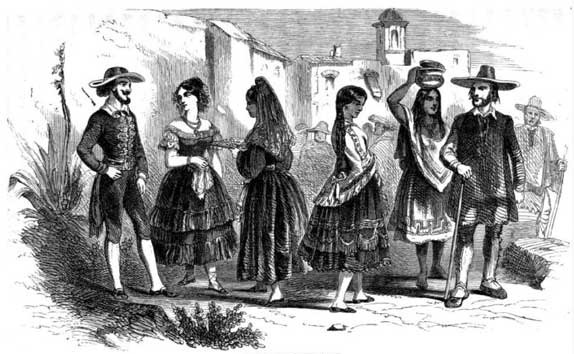
"Their clothing is a petticoat of silk or cloth, with many silver or golden laces, with a very double ribbon of some light color, with long silver or golden tags hanging down in front the whole length of their petticoat to the ground, and the like behind; their waistcoats made like bodies, with skirts, laced likewise with gold and silver, without sleeves, and a girdle about their waist of great price, stuck with pearls and knobs of gold. Their sleeves are broad and open at the end, of Holland or fine China linen, wrought, some with colored silks, some with silk and gold, some with silk and silver, hanging down almost to the ground; the locks of their heads are covered with some wrought quoif, and over it another of net-work of silk, bound with a fair silk, or silver, or golden ribbon, which crosses the upper part of their foreheads, and hath commonly worked out in letters some light and foolish love posie; their bare, black, and tawney breasts, are covered with bobs hanging from their chains of pearls. And when they go abroad, they use a white mantle of lawn or cambric, rounded with a broad lace, which some put over their heads, the breadth reaching only to their middles behind, that their girdle and ribbons may be seen, and the two ends before reaching to the ground almost; others cast their mantles only upon their shoulders; and swaggerers like to cast the one end over the left shoulder, while with their right arm they support the lower part of it, more like roaring boys than honest civil maids. Their shoes are high and of many soles, the outside whereof of the profaner sort are plated over with a lift of silver, which is fastened with small nails with broad silver heads. Most of these are or have been slaves, though love have set them loose at liberty to enslave souls to sin and Satan; and for the looseness of their lives, and public scandals committed by them and the better sort of the Spaniards, I have heard them say often, who possessed more religion and fear of God, they verily thought God would destroy that city, and give up the country into the power of some other nation.
"And I doubt not but the flourishing of Mexico in coaches, horses, streets, women, and apparel, is very slippery, and will make those proud inhabitants slip and fall into the power and dominion of some other prince of this world, and hereafter, in the world to come, into the powerful hands of an angry Judge, who is the King of kings and Lord of lords, which Paul saith (Heb. x. 31) is a fearful thing. For this city doth not only flourish in the ways aforesaid, but also in the superstitious worshiping of God and the saints they exceed Rome itself, and all other places of Christendom. And it is a thing which I have very much and carefully observed in all my travels, both in Europe and America, that in those cities wherein there is most lewd licentiousness of life, there is also most cost in the temples, and most public superstitious worship of God and the saints."
So much for worthy Thomas Gage, and his estimate of the Mexicans of his day.
AMERICANS IN CALIFORNIA.
I arrived at San Francisco in the midst of the gold excitement. The town was crowded with rough-looking muscular men in red shirts, slouch hats, and trowsers over which were drawn high-topped boots. A Colt's revolver, a belt filled with gold, and an unshaven visage completed the tout ensemble of a crowd who were purchasing supplies for their companions in the mines. They strode along, conscious that they belonged to the Anglo-Saxon race and the aristocracy of labor. As they turned into the temporary houses or booths which then constituted the town, or threaded their way among the piles of merchandise that encumbered the streets, the effeminate natives instinctively shrunk back, conscious of their own imbecility; the Spanish Americans were overawed by their presence; and even Sidney convicts thought it most profitable to turn their thoughts to honest labor.
The miner had his vices too as well as his virtues. If you will follow him as he opens right and left a crowd that surrounds a table heaped with lumps of gold and silver coin, you will see how carelessly he throws down a piece of metal, looking sharply into the eye of the cunning dealer of the monté cards. If he detects a false move, he cocks his weapon, and draws the gold back into his bag and strides away.
Such were the men who knew no fear, and dreaded no labor or fatigue, and who have made California in five short years a state more powerful than the Republic of Mexico.
In an interior town I was called to practice as an attorney. My first client was the driver of an ox-team, who was suing for extra services in addition to his regular wages of five hundred dollars a month and board (Doe vs. Pickett). My office was a space of four feet by six, partitioned off by two cotton sheets, in the corner of a canvas store. The ground was for a while the floor; yet I paid in advance the monthly rent of two ounces of gold, and never had occasion to regret the outlay. The heavy winter rains at length compelled my landlord to lay a floor of rough boards, which cost him seven hundred dollars for a thousand feet.
Before the establishment of the state government, there was a judiciary created by an autocratical edict of General Riley; and a pamphlet, extracted and translated from the Mexican Constitutional laws of 1836, constituted the Corpus Juris Civilis of the Territory of California. The remainder of the law was made up of the judge's ideas of equity, and of the law he had read before leaving home. Inartificial and rude as was this system, still it was wonderfully efficient; and it was well for the people of California that it was so, for an unparalleled immigration had brought with it an unparalleled amount of litigation.
With the daily occurring causes of litigation, crowds assembled at the school-house on the Plaza, where from morning to night sat a judge dispensing off-hand justice. In front of him sat three or four clerks conducting the business. The crowds of lawyers, litigants, and witnesses that surrounded the court were not idle spectators, but represented the ordinary accumulation of business for the day, which was to be disposed of before the adjournment of the court. Speedy justice was more desirable than exact justice, where labor was valued at a gold ounce a day; and none were more desirous of speed than the lawyers, whose prospects of compensation depended much upon the promptitude with which judgment was rendered.
The moving spirit of the whole scene, Judge A——, watched from behind the desk all that was said or done, seldom withdrawing his attention unless to administer an oath for the consideration of one dollar, or to sign an order for the consideration of two dollars. Sometimes he would change his position; but, whether warming his uncovered feet at the fire-place, or drawing on his boots, or replenishing his stock of tobacco, there was the same unalterable attention on his part. As soon as he comprehended a case, his authoritative voice was heard, closing the discussion, and dictating to a clerk the exact number of dollars and cents for which he should enter up a judgment. And then another, and another case was called up, and submitted to this summary process, until about nine o'clock at night, when the day's work terminated. All orders asked for by a responsible attorney were granted ex parte, the judge remarking that if the order was not a proper one, the other party would soon appear, and then he could ascertain the real merits of the case. The grand feature of this court was the facility with which an injunction could be obtained, and the rapidity with which it could be set aside.
CALIFORNIAN COURTS.
Crime was almost unknown until we got a state government and a code of laws, which, with misplaced philanthropy, had made the legal practice so easy upon criminals that a conviction was next to impossible. Then it was that crime stalked abroad in the face of day, and Sidney convicts plied their trade in San Francisco after it had become a city. Shops were entered and robbed in business hours; and by night, men were murdered in the streets; and thefts escaped punishment. Then it was that men, caught in the commission of crime, were hanged in the open streets, and combinations were formed for self-defense. But when a new Legislature gave efficiency to the laws, the community yielded a willing obedience to the magistrate. From an early day there had been "miners' courts," which, with their alcaldes, had conciliated differences. But when magistrates were elected, these courts disappeared. This was a change from bad to worse, for no condition is so deplorable as that of a people whose magistracy are powerless.
Such is a fair picture of California in its worst estate, when the worst and the best of all nations were there congregated, and kept in subjection by the law-abiding spirit of an Anglo-Saxon immigration—a state of society in the first year of its existence, yet infinitely superior to that existing in the city of Mexico a hundred years after the discovery of the mines of Haxal and Pachuca. But we may complete the contrast by adding the more deplorable part of the picture which Friar Thomas Gage has drawn.
"It seems," says he, "that religion teaches that all wickedness is allowable, so that the churches and clergy flourish. Nay, while the purse is open to lasciviousness, if it be likewise open to enrich the temple walls and roofs, this is better than any holy water, or water to wash away the filth of the other. Rome is held to be the head of superstition; and what stately churches, chapels, and cloisters are in it! What fastings, what processions, what appearances of devotion! And, on the other side, what liberty, what profaneness, what whoredoms, nay, what sins of Sodom are committed in it, insomuch that it could be the saying of a friar to myself, while I was in it, that he verily thought there was no one city in the world wherein were more Atheists than in Rome. I might show this much in Madrid, Seville, Valladolid, and other famous cities in Spain and in Italy; in Milan, Genoa, and Naples; relating many instances of scandals committed in those places, and yet the temples are mightily enriched by those who have thought their alms a sufficient warrant to free them from hell and purgatory. But I must return to Mexico, which furnishes a thousand witnesses of this truth—sin and wickedness abounding in it—and yet no such people in the world toward the Church and clergy. In their lifetime they strive to excel one another in their gifts to the cloisters of nuns and friars, some erecting altars to their best-devoted saints, worth many thousand ducats, others presenting crowns of gold to the pictures of Mary, others lamps, others golden chains, others building cloisters at their own charge, others repairing them, others, at their death, leaving to them two or three thousand ducats for an annual stipend.
MEXICO TWO CENTURIES AGO.
"Among these great benefactors to the churches of that city, I should wrong my history if I should forget one that lived in my time, called Alonzo Cuellar, who was reported to have a closet in his house laid with bars of gold instead of brick; though indeed it was not so, but only reported for his abundant riches and store of bars of gold, which he had in one chest, standing in a closet distant from another, where he had a chest full of wedges of silver. This man alone built a nunnery for Franciscan nuns, which stood him in above 30,000 ducats, and left unto it, for the maintenance of the nuns, 2000 ducats yearly, with obligation of some masses to be said in the church every year for his soul after his decease. And yet this man's life was so scandalous, that commonly, in the night, with two servants, he would go round the city visiting such scandalous persons, whose attire before hath been described, carrying his beads in his hands, and at every house letting fall a bead, and tying a false knot, that when he came home in the morning, toward break of the day, he might number by his beads the uncivil stations he had walked and visited that night.
"Great alms and liberality toward religious houses in that city commonly are coupled with great and scandalous wickedness. They wallow in the bed of riches and wealth, and make their alms the coverlet to cover their loose and lascivious lives. From hence are the churches so fairly built and adorned. There are not above fifty churches and chapels, cloisters and nunneries, and parish churches in the city; but those that are there are the fairest that ever my eyes beheld, the roofs and beams being, in many of them, all daubed with gold, and many altars with sundry marble pillars, and others with Brazil-wood stays standing one above another, with tabernacles for several saints, richly wrought with golden colors, so that twenty thousand ducats is a common price of many of them. These cause admiration in the common sort of people, and admiration brings on daily adoration in them to those glorious spectacles and images of saints; so Satan shows Christ all the glory of the kingdoms to entice him to admiration, and then he said, 'All these things will I give thee if thou wilt fall down and worship me' (Matthew, iv. 8, 9). The devil will give all the world to be adored.
"Besides these beautiful buildings, the inward riches belonging to the altars are infinite in price and value, such as copes, canopies, hangings, altar-cloths, candlesticks, jewels belonging to the saints, and crowns of gold and silver, and tabernacles of gold and crystal to carry about their sacrament [the Saviour of the world in the form of a wafer] in procession, all of which would mount to the worth of a reasonable mine of silver, and would be a rich prey for any nation that could make better use of wealth and riches. I will not speak much of the lives of the friars and nuns of this city, but only that they there enjoy more liberty than in Europe—where they have too much—and that surely the scandals committed by them do cry up to Heaven for vengeance, judgment, destruction.
"It is ordinary for the friars to visit their devoted nuns, and to spend whole days with them, hearing their music, feeding on their sweetmeats; and for this purpose they have many chambers, which they call loquatories, to talk in, with wooden bars between the nuns and them; and in these chambers are tables for the friars to dine at, and while they dine the nuns recreate them with their voices. Gentlemen and citizens give their daughters to be brought up in these nunneries, where they are taught to make all sorts of conserves and preserves, all sorts of music, which is so exquisite in that city that I dare be bold to say that the people are drawn to churches more for the delight of the music than for any delight in the service of God. More, they teach these young children to act like players; and, to entice the people to the churches, they make these children act short dialogues in their choirs, richly attiring them with men and women's apparel, especially upon Midsummer's day and the eight days before their Christmas, which is so gallantly performed that many factious strifes and single combats have been, and some were in my time, for defending which of these nunneries most excelled in music and in the training up of children."
Such is a picture drawn by a candid writer of one of the most devout Catholic cities in the world, where licentiousness and papacy went hand in hand until they reached that extreme point of corruption, that, as in the case of Sodom, God overthrew the city by a judgment from heaven; not by fire and brimstone, but by a water-spout, which, in the space of the five years that it lay upon the town three feet deep, loosened the foundations of all buildings and impoverished the inhabitants. And when at length the earth opened and swallowed up these waters, the city had to be rebuilt. The misery and distress that this flood inflicted upon the lower orders of the inhabitants was great in the extreme.
It was on Sunday morning that the cause of the moral superiority of the American miners over those of Mexico was visible. Then the noise and bustle about my residence was hushed. The most immoral seemed to be overawed by a sense of respect for the religious opinions of others; and when the sound of a ship-bell, hung on the limb of a tree, was heard, all except the baser sort repaired to the shade of an oak, so large and venerable that it might have shielded the whole household of Abraham while engaged in family worship. A portable seraphine gave forth a familiar tune, in which all joined in singing with a zest which is only realized by those whom it carries back in recollection to distant home. Then the voice of the preacher was heard invoking the blessing of God upon the assembled worshipers, and his pardon of their offenses; and then followed his exhortation to seek from God the pardon of their many sins; and as he, with heartfelt earnestness, "reasoned of righteousness, temperance, and a judgment to come," many a stern-visaged miner trembled for his condition, and went away a better and a more honest man—ten thousand times more improved than if he had presented a crown of gold to the Virgin Mary.
We are now prepared to enter the valley of Mexico, and examine the objects that there present themselves.
CHAPTER XIV.
First Sight of the Valley of Mexico.—A Venice in a mountain Valley.—An Emperor waiting his Murderers.—Cortéz mowing down unarmed Indians.—A new kind of Piety.—Capture of an Emperor.—Torturing an Emperor to Death.—The Children paying the Penalty of their Fathers' Crimes.—The Aztecs and other Indians.—The Difference is in the Historians.—The Superstitions of the Indians.—The Valley of Mexico.—An American Survey of the Valley.—A topographical View.—The Ponds Chalco, Xochimulco, and Tezcuco were never Lakes.
My first view of the Valley of Mexico was from the point where the Acapulco road passes the Cross of the "Marquis of the Valley." I had read with eagerness the History of the Conquest, and of the adventures of the noble Conquistador. Not a shadow of a doubt had then crossed my mind in regard to the truth of all that had been so elegantly written. Beautiful composition had supplied the place of evidence, and that practice of writing romances of history which the Spaniards had inherited from the Moors had completely captivated me, as it had thousands of others. The aspect of the valley was all that my fancy had painted it. The sun was in the right quarter to produce the greatest possible effect. The unnumbered pools of surface-water that abound in the valley appeared at that distance like so many lakelets supplied by crystal fountains, as each one reflected the bright sun from its mirror-like surface; these all were inclosed in the richest setting of nature's green.
It was such a scene as would justify the extravagant language which Spaniards have employed in describing it. While I recalled its traditional history, I was tempted to exclaim as a native would have done, and to give credence to the fables of which this valley has been the scene. Here, as the story ran, amid floating gardens of rarest flowers and richest fruits, lay, in olden time, another Venice—a Venice in an inland mountain valley—a Venice upon whose Rialto never walked a Shylock with his money-bags; for in this market-place the most delicious fruits the world produces, the loveliest flowers, rich stuffs resplendent with Tyrian dyes, and princely mantles of feather-work, were bought with pretty shells, and such money as the sea produces. It was a Venice with its street of waters and its central basin, where jostled the gondolas of the Aztec nobles and the light canoes of birch bark among the vessels of commerce which came laden with slaves and other merchandise from the surrounding villages—a basin that disappeared the same day that the Indian empire fell.
GUATEMOZIN.
This basin was the last vestige of Aztec dominion; and when there no longer was any safe shelter upon the land, Guatemozin retired to his canoe and took shelter here, and calmly waited till his time should come to be murdered. He could not flee. He could not capitulate, for he was an emperor. As he sat here waiting for death, what must have been his reflections! What thoughts did not the very boat he occupied call up! How often had it carried him out upon the lake to the floating gardens and volcanic islands, where he had witnessed so many times the gorgeous reflections of an evening sun upon the snow-capped Popocatapetl, in whose bowels "the god of fire" had his dwelling! And then the lake itself, how much it had perplexed his thoughts, that in one part its waters should be fresh, with islands teeming with the richest vegetation, and in another part salt and bitter, with utter barrenness resting upon its shores! How he used to meet his brother of Tezcuco in the after part of the day, to exchange congratulations and talk over affairs of interest to both the royal families! Now all these pleasures were terminated forever. His brother of Tezcuco was in the ranks of his enemies, seeking his destruction.
Thus sat the emperor, surrounded by a numerous fleet of canoes, whose occupants were without hope of escape or strength to fight; but, with Indian stoicism, all sat waiting their inevitable doom from freebooters whom they had disappointed of their prey. As the emperor and his nobles sat here witnessing the destruction of their pumice-stone palaces and mud-built huts, and the filling up of their canals, they consoled themselves with the reflection that their gold and their wealth were all at the bottom of these canals, and that the Spaniards, in their hot haste to enjoy the spoils of the city, were unwittingly burying forever the prize for which they were contending. Such were the thoughts of these Aztecs as they sat in their canoes, longing for death to relieve them from agony of suspense, enduring all the torments of the extremest thirst, which they vainly sought to quench by draughts of the brackish water of the lake. They had not long to wait; for, by the express commands of Cortéz, his followers were mowing down unresisting citizens, because the emperor, over whom they had no control, would not surrender himself.
Who can stand for the first time upon the mountain rim that incloses this valley, and not have his thoughts carried back to some such scene as this? The recollection is not easily eradicated that the remnant of a once powerful tribe of Indians, partially emerged from barbarism, here received their death, in cold blood, at the hands of a party of white murderers. The good Archbishop Loranzana commends the piety of Cortéz in never neglecting to attend mass before going out to his daily work of slaughter. It was a pious act, no doubt, that on the last morning of the siege he stopped and listened to a mass—that pantomime which set forth the death of the Redeemer of the world—preparatory to consummating the butchery of Indians incapable of resistance.
Garci Holguin, the master of a brigantine, or rather flat-boat, bolder than the rest, drove through the fleet of canoes that occupied the basin, until he encountered in the centre a canoe containing the person of the emperor, whom he made prisoner and brought to Cortéz, whereupon the slaughter ceased.
Neither the horrid sight which the city presented, nor the fallen fortunes of a brave enemy, could move the soul of Cortéz. A brigand knows no remorse and feels no pity. Gold had been the object of his pious mission, and when he found not gold enough to satisfy the cravings of his gang, he soaked the fallen emperor's feet in oil, and then burned them at a slow fire, to extort from him a confession of the place of concealment of his supposed treasure; and when, in after years, he was tired of the burden of such a prisoner, he wantonly hanged him up by the heels to die in a distant forest.
In this very city where Cortéz tortured Guatemozin was a son of Cortéz, who inherited the spoils of his father's atrocities, put to the torture by one of the Vice-kings, while the children's children of the Conquistadors paid for the wealth they inherited in the terrible penalties inflicted upon them by the buccaneers, that ravaged their coasts for two hundred years. Have not the sins of the fathers been visited upon the children?
The Aztecs, their empire, and their city, have long since disappeared; their crimes, and the despotism which they exercised over the tribes they had conquered, are all forgotten in the terrible catastrophe that extinguished their national existence. Three hundred years of servitude in the indiscriminate mass of Indian serfs has blotted out every feeling of nationality. A few vagabonds among them still claim royal descent, and, by virtue of their blood or their imposture, pretend to exercise, in obscure villages, an undefined jurisdiction over Indians as oppressed as themselves. But the characteristics of the North American Indians are still visible; they still exhibit the contradictory traits of Indian character—cruelty and kindness, shyness and self-possession; enduring the greatest trials without a murmur, and suffering oppression without complaint; delighting as much as their northern brethren in tawdry exhibitions, in traditions of the marvelous, they seem to carry hidden in their inmost soul an idea that the time will come when they may take vengeance of the despoilers of their race. They have the Indian's love of adventure and want of courage. They delight rather in a successful stratagem than in open hostility, and deem no act of treachery dishonorable by which they can gain an advantage. Still, they have less romance in their composition than the unenslaved northern Indians, into whose souls the iron of despotism has never entered.
THE AZTECS AND THEIR HISTORIANS.
The great difference between what is recorded of the North American Indian and the Aztec is owing less to any difference in themselves than to the character of the historians who have written of them. The northern writers were not carried away by the romance of Indian life; they were matter-of-fact men, and they drew only matter-of-fact pictures. Spanish historians, and all early Spanish writers upon New Spain, except the two brigands, Cortéz and Diaz, were priests. With them, truth was not an essential part of history. By the law of all countries, the Conquistadors had outlawed themselves by levying unlicensed war; but as they bore a painting of the Virgin Mary on one of their standards and the cross on the other, it would be impiety to place their conduct in its true light. Las Casas was an exception, and endured persecution for speaking the truth. "He had powerful enemies," was all that his apologist dare say, "because he spake the truth." And if we add to this the sevenfold censorship already described, my reader will agree with me that it is absurd to place confidence in records over which the Inquisition exercised a surveillance.
The fabled Aztec empire has almost passed from the traditions of the Mexican Indians. The name of only one of their chiefs, Montezuma, remains among them, and this name is affixed to almost every thing that has an ancient look and is in a dilapidated condition. In my wanderings among them, I never rejected their proffers of rude hospitality, and I have listened with pleasure to their wild traditions. I soon found that, like other Indians, they draw from a supernatural "dream-world" the fortitude that enables them to bear without a murmur their hard lot in the present. They readily embraced the superstitions of the Spaniards, and rendered to the virgin of Guadalupe the adoration they had formerly bestowed upon their own gods. Their conversion may be summed up in the words of Humboldt: "Dogma has not succeeded to dogma, but ceremony to ceremony. The natives know nothing of religion but the external forms of worship. Fond of whatever is connected with a prescribed order of ceremonies, they find in the Christian religion particular enjoyment. The festivals of the Church, the fire-works with which they are accompanied, the processions mingled with whimsical disguises, are a most fertile source of amusement to the lower Indians."
THE VALLEY OF MEXICO.
There has been a great deal of poetry and very little plain prose written about the valley of Mexico. At an early morning hour I stood upon the heights of Rio Frio; at another morning, as already said, at the Cross of the Marquis; again, upon the highest peak of the Tepeyaca, behind Guadalupe, I saw a tropical morning sun disengage itself from the snowy mountains. From these three favored spots I have looked upon the valley, where dry land and pools of water seemed equally to compose the magnificent panorama. Immense mirrors of every conceivable shape and form were reflecting back the rays of the sun, while the green shores in which they were set enhanced the effect. The white walls, and domes, and spires of the distant city heightened the effect of a picture that can only be fully appreciated by those who have looked downward through the pure atmosphere of such a lofty position; but when I came down to the common level, the charm was broken. Instead of lakelets and crystal springs, I found only pools of surface-water which the rains had left; and the canals were but the ditches from which, on either side, the dirt had been taken to build the causeway through the marsh, and were now covered with a coat of green. These lakes have no outlet, and as evaporation only takes up pure water, all the animal, vegetable, and mineral matter that is carried in is left to stagnate and putrefy in the ponds and ditches.
A practical "man of the times," with more common sense than poetry in his composition, must grieve as he looks at the great advantages here possessed for drainage and irrigation which are unimproved. There is not a spot in the whole valley that is not capable of the most perfect drainage,[28] while basins have been formed by nature in the highest points, from which irrigation could be supplied to the whole valley; but decay and neglect—fitting types of the social condition of the people—every where exhibit themselves. Water stands in all the narrow canals or ditches that occupy the middle of the streets, for the want simply of a sewer to draw it down to the level of the Tezcuco. Once a year the flags are taken off from the covered ditches, and the mud is dipped out, while a bundle of hay, tied to the tail of a dirt-cart, is daily dragged through the open ones.
I have spoken only of the lower division of this valley—the valley in which the city stands. If we consider the two partly separated valleys as one, the whole will constitute an oval basin 75 miles long from north to south, with an average width from east to west of 20 miles. Two thirds of the southern valley is a marsh, and might well be called the "Montezuma Marsh," it so strikingly resembles the marsh of that name in the State of New York, though the whole body of ponds and marshes of this valley contains much less water than its northern namesake. The stage-road from Vera Cruz crosses this marsh for fourteen miles, and has a great number of small stone bridges, beneath which the water runs with considerable current toward the north, on account of the difference of level between the southern fresh-water ponds and the lower salt-water ponds, as in the days of Cortéz. There are occasional dry spots, and now and then there is open water; but the greater portion is filled with marsh grass, and furnishes good feeding for the droves of cattle that daily frequent it for that purpose. The ancient village of Mexicalzingo, or "Little Mexico," the traditional home of the Aztecs before they built Mexico, is situated on one of the dry spots, slightly elevated above the level of the fresh water; and on another dry spot or island, six miles distant, stands the famous city of Mexico itself, resting on piles driven into a foundation of soft earth. The canal of Chalco commences at the northerly extremity of the Xochimulco, and, passing by Mexicalzingo and the floating gardens, continues along the eastern front of the city, and empties itself into the salt (tequisquite) pond of Tezcuco, having received as a tributary the canal of Tacubaya, which passes along the southern boundary of the city.
THE LAKES OF THE VALLEY.
The highest water of the valley of the city of Mexico is the pond of Chalco, in the extreme southeast, being 4-8/12 feet above the level of the Grand Plaza of the city, and 20 miles distant therefrom, and 11-2/12 feet above Tezcuco;[29] but its volume being small for the last 400 years, the slight impediments of long grass and a few Indian dikes have prevented any injury to the city by a too rapid flow to the northward. Xochimulco is the pond, or open space in the marsh, that extends from the Chalco to near Mexicalzingo. Tezcuco is the lowest water in the valley, being 6½ feet below the Grand Plaza of the city.[30] It receives the surplus of the waters that have not already been evaporated in the other ponds. At this great elevation, 7500 feet, evaporation does its work rapidly all over the valley, but it is in Tezcuco that the residuum of the waters is deposited.
CHAPTER XV.
The two Valleys.—The Lake with a leaky Bottom.—The Water could not have been higher.—Nor could the Lagunas or Ponds have been much deeper.—The Brigantines only flat-bottomed Boats.—The Causeway Canals fix the size of the Brigantines.—The Street Canals.—Stagnant Water unfit for Canals.—The probable Dimensions of the City Canals.—Difficulties of disproving a Fiction.—A Dike or Levee.—The Canal of Huehuetoca.—The Map of Cortéz.—Wise Provision of Providence.—The Fiction about the numerous Cities in and about the Lake.
It may be well here to repeat that, strictly speaking, there are two valleys of Mexico—the upper northern valley, and the valley of the city of Mexico; the first extends in an oval form to the north of the hills of Tepeyaca, some sixty miles, and communicates with the plains of Otumba and Apam. In this valley are the two ponds, or lagunas, of Zumpango and San Cristobal, the highest waters of Mexico; and in it also is the half of the Tezcuco, which is the lowest laguna of the valleys. It is a country of fine farming lands, and was probably inhabited long before the time of the arrival of the Aztecs in the lower valley, as I infer from its proximity to the extensive ruins of Teotihuican, that have come down from a remote and highly-civilized antiquity.