Front matter (continued 6)
Reading edition
I was settling myself as well as I could on the straw near a large fire, when all at once I felt pains in my legs and thighs, so violent that during a part of the night I did nothing but groan. I heard them saying, 'He will not be able to leave to-morrow.' I thought so too, and decided, as many had already done, to make my will. I called my friend Grangier, and told him that I was certain all was over with me. I begged him to undertake the charge of some small articles, to be given to my family if he had the good fortune to see France again. These articles were a watch, a cross in gold and silver, a little vase in Chinese porcelain. I possess the two last still. I also wished to dispose of all the money that I had, reserving some gold pieces that I meant to hide in the sheepskin wrapped about my foot, hoping that the Russians, when they took me, would not begin searching among my rags.
Grangier, who had listened without interrupting me, now asked if I were in a fever or dreaming. I said that I was in a fever, but I was quite clear-headed. He began to lecture me, reminding me of my courage in worse situations than this.
'Yes,' I said, 'but then I was stronger.'
He assured me that I had said as much at the passage of the Bérézina when I had been quite as ill, and since then I had come eighty leagues. As for the fifteen that remained before reaching Kowno, they would be done in a couple of days; with the help of my friends I should manage them very well. To-morrow they would only walk four leagues.
'So,' he said, 'try to rest, and wrap up those things again. I will only take your kettle, and carry it for you.'
Another said, 'I will take this other case (the surgeon's case), which must worry you.'
Meanwhile, Rossi, who was lying near, remarked: 'My friend, you will not be here alone to-morrow morning; I shall share your fate, for I am quite as bad as you are. The journey to-day has done for me, and I shall not be able to go any further. But when the rear-guard passes by, we may be able to march with it, for we shall have had some extra hours' rest. If we have not enough strength to follow it, we will go to the right. To the first village or the first house that we find, and put ourselves under the protection of the Baron or master; perhaps he will have pity on us until we are better, and we can reach Prussia or Poland. Very likely the Russians will not come further than Kowno.'
I told him that I would do as he wished. M. Césarisse, whom Grangier had just told of my intention, came up to comfort me. He said that the pain I suffered only came from the fatigue of yesterday. He made me lie before the fire, and, as there was plenty of wood, they piled on enough to roast me. This fire did me so much good that the pain gradually left me, and I slept for some hours. Poor Rossi did so too.
In 1830 I was appointed an officer of the staff at Brest. On the day of my arrival, sitting at table with my wife and children at the Hôtel de Provence, a man sat opposite to me, very well dressed, who looked at me a great deal. Every other moment he stopped eating, and, his head resting on his hand, he seemed to think deeply, or to be recalling certain memories. Afterwards he spoke to the landlord of the hotel. My wife, who was beside me, pointed it out to me.
'Yes,' I said, 'that man begins to puzzle me, and if it goes on I shall ask him what it means.'
At that very moment he rose, threw down his napkin, and passed into the office where travellers' names were registered. He re-entered the dining-room, exclaiming aloud, 'It is he—I was not mistaken' (calling me by my name). 'It is indeed my friend.'
I recognised him by his voice, and we were in each other's arms. It was Rossi, whom I had not seen since 1813, seventeen years before. He believed me dead, and I thought the same of him, for I had learnt on my return from prison that he had been wounded under the walls of Paris. This recognition interested all who were present, about twenty in number, and we were asked to relate our adventures during the Russian campaign. This we did willingly, and at midnight we were still at table, drinking champagne to Napoleon's memory. It is hardly surprising that at first I did not recognise my comrade, for I left him delicate, and I found him stout and strong, his hair almost gray. He lived at Montauban, and was now a rich merchant.
When the moment of departure came, I thought no more of remaining behind, but it was impossible to walk alone. Grangier and Leboude held me up under the arms, and others did as much for Rossi. At the end of half an hour's walking I was much better; but all the way I needed the help of one arm, often of two. In this manner we arrived in good time at the little village where we were to sleep; there were very few dwellings to be found, and, although we were the first to arrive, we were obliged to sleep in a yard. By chance we were able to find plenty of straw, which we used to cover us; but, with our usual ill-luck, the straw took fire. Everyone saved himself as best he could; many had their coats burnt. A quarter-master of Vélites, named Couchère, was more unfortunate than the others; the fire caught his cartridge-case, and his whole face was burnt. And as for me, without the help of my comrades I should probably have been roasted, as I could not possibly move by myself. I was taken by the legs and shoulders, and dragged up to the hut, where General Roguet and other officers were quartered. They fled on seeing the flames, thinking that the house itself was on fire. After this misfortune came a high north wind, and, as we were without shelter, we entered the General's house, which consisted of two rooms. We took possession of one, in spite of him; more than half of us were obliged to stand up the whole night, but, still, it was better than staying outside exposed to bad weather. That would have killed three-fourths of us.
December 13th.—Kowno was at least ten leagues off, so General Roguet made us start before daybreak.
A shower of hail had fallen, forming ice upon the road. If, as on the preceding evening, I had not had my friends' help, I should very probably, like so many others, have finished my life's journey on that last day in Russia.
It was hardly dawn when we reached the foot of a mountain which was one sheet of ice. What trouble we had climbing it! We had to squeeze ourselves into groups to obtain mutual support. On this march there was more readiness to help one another than before. Probably it was the hope of arriving at the end of the journey. I remember that, when a man fell, cries were heard, 'Stop! there is a man fallen!' I noticed a sergeant-major of our battalion shout, 'Stop, there! I swear that not one of you shall go on until the two left behind have been picked up and brought on.' It was by his firmness they were saved.
At the top of the mountain it was light enough to see, but the slope was so rapid, and the ice so smooth, that no one dared to venture down. General Roguet, some officers, and several sappers who were walking in front, had fallen. Some picked themselves up, and those who were strong enough went down in a sitting position, guiding themselves with their hands; others who were weaker trusted to Providence—that is to say, they rolled over and over like barrels. I was of this latter number, and I should most likely have thrown myself into a ravine, or been lost in the snow, but for Grangier, who went in front of me, moving backwards and stopping, so that I ran into him. He drove his bayonet into the ice to hold on by, and when I came up he moved further, sliding and repeating the same process, till I reached the bottom, bruised all over, and my left hand bleeding. The General had ordered a halt to assure himself that everybody had come up—the roll-call had been taken the evening before—and happily no one was missing. It was broad daylight, and we could see that the mountain might have been avoided by turning to the right. The other corps who were marching after us came along this side of it without accident. This climbing had tired me so much that I could only walk very slowly, and, as I did not wish to abuse the kindness of my friends, I begged them to follow the column. One of the company, however, stayed with me, a Piedmontese, by name Faloppa. I had not seen him for several days.
Those who were fortunate enough to keep their health, to have unfrozen feet, and to march at the head of the column, missed seeing all the disasters which I, for instance, sick and crippled, witnessed daily. Those in front could not see the men who fell around them, while we in the rear passed over the long train of dead and dying that each corps left behind it. We had also the disadvantage of being harassed by the enemy at our heels.
Faloppa, the man who had stayed with me, was in no better position. We had been walking together for a quarter of an hour, when he turned towards me, saying: 'Well, sergeant, if we had those little pots of dripping here that you made me throw away in Spain, you would be very glad, and we could make fine soup.' It was not the first time he had made that remark. The episode, comical enough, was this:
One day, after we had made a long expedition in the mountains of Asturias, we were quartered at St. Hiliaume, a little town in Castile, on the sea-coast. I was quartered with my subdivision in a large building forming the right wing of the Court House.[60] This part of it was very large, and inhabited by an old bachelor, absolutely alone. On arriving at his house we asked him whether we could buy some butter or dripping to make soup, and cook some haricots. He replied that even for gold there was none to be had in the entire town. A moment afterwards the muster was called. I left Faloppa to do the cooking, and commissioned another man to search through the town for some butter or fat, but none was to be had. When we came back, the first thing Faloppa said to us was that the old bachelor was a rascal. 'How is that?' He answered us, 'Look!'
He showed me three gallipots containing some beautiful fat that we saw was goose-dripping. Everyone exclaimed, 'There's your Spanish beggar for you. There's a rascal!' Our cook had made some splendid soup, and had prepared some haricots. We sat down to eat under a great chimney-piece, like the entrance to a house, when suddenly the Spaniard returned, wrapped in his brown mantle, and, seeing us eating, hoped we should enjoy our meal. I asked him why he had not wanted to sell us the dripping. 'No, señor,' he answered, 'I had none. If I had had any, I would have given it to you with pleasure, and for nothing!' Then Faloppa, taking up one of the little pots, showed it to him. 'Then this is not fat, is it, rascal of a Spaniard?' Looking at the little pot, he changed colour, and stood as if thunderstruck. Pressed for a reply, he told us that it certainly was dripping, but the manteca de ladron (thieves' fat). He was the town executioner, and what we had found and made our soup with was the fat of hanged men, which he sold for ointment.
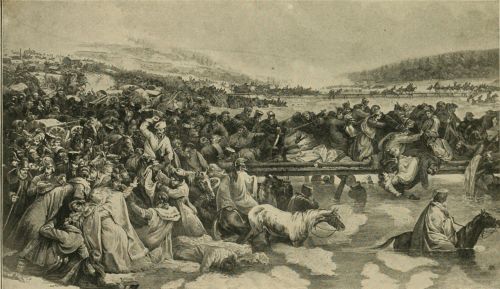
PASSAGE OF THE BÉRÉZINA, NOVEMBER, 1812.
Hardly had he finished, when all the spoons flew about his head. He had barely time to escape; and not one of us, although very hungry, wanted to eat any haricots; the soup was almost all gone. Faloppa only went on eating just the same, saying that the Spaniard had lied. 'And even were it so,' said he, 'the soup is good, and the haricots still better.' So saying, he offered me some to taste, which turned me sick. I went across to a brandy merchant's facing our quarters, and asked him with whom we were quartered. He crossed himself, repeating over and over again: 'Ave, Maria, purissima, sin peccado concebida!' He told me that it was the executioner. For some time I was ill and sick with disgust; but Faloppa, when he left, carried off the remainder of the fat, pretending he would prepare us soup with it again. I was obliged to make him throw it away; and that is why in Russia, when he had nothing to eat, he was always quoting this story.
For half an hour we had not lost sight of the column, showing that we had walked pretty well. I must say that the road happened to be better; but soon afterwards it became rough and as slippery as in the morning. The cold was very keen, and we had already passed some men dying by the way, although clothed in thick furs. Exhaustion, however, was answerable for a good deal. Faloppa fell several times, and if I had not been with him to help him up again, he would have been left behind.
The road now became better; we could see the long train of the column in front of us. We redoubled our efforts to rejoin it, but did not succeed. We came upon a hamlet of five or six houses, of which half were on fire, where we stopped a little while. Several men were gathered round; many seemed quite unable to go on, and several horses had dropped, dying, and were struggling on the snow. Faloppa cut a piece from the thigh of one of them, which we cooked on the points of our swords at the fire of the burning houses.
While we were busy with this job, cannonading was heard in the direction from which we had come. I then saw more than 10,000 stragglers spreading in disorder over the width of the road. Behind them marched the rear-guard. I have thought since that Marshal Ney was firing in order to make all these unfortunate creatures believe the Russians were upon us, and so hurry them on to Kowno that same day. It was part of the wreck of the Grand Army.
Our meat was not half cooked before we thought it wiser to decamp as quickly as possible, and not to be submerged in this fresh torrent.
There were still six leagues to walk before reaching Kowno, and we were quite worn out. It might have been about eleven o'clock, when Faloppa said: 'Sergeant, we shall not get there to-day, the ruban de queue is too long.[61] We shall never be able to leave this devil's country; it is all over, I shall not see my beautiful Italy again!' Poor fellow! he spoke the truth.
We had been walking about an hour since our last rest, when we came upon several groups of forty or fifty men, more or less composed of officers, non-commissioned officers, and some men, carrying in the midst of them the regimental eagle. These men, miserable though they were, seemed proud to have been so far able to keep and guard this sacred trust. It was evident that in marching they avoided mingling with the large masses that covered the road, so as to keep together in an orderly way.
We walked as long as we were able with these little detachments; we did all we could to follow them, but the artillery and musketry fire began again. The detachment halted at the command of some person; one could never have told by the rags covering him who he might be. Never shall I forget the tone of his command. 'Come, children of France! Another halt! It must never be said that we went faster at the sound of artillery. Right about face!' and instantly the men fell into rank without a word, and turned in the direction of the firing. As for us, having no colours to defend, we continued to drag ourselves along. It was very lucky for us that on this particular day the cold was not so intense, for we fell more than ten times, and if it had been freezing as on the day before, there we should have remained.
After walking a certain time among stragglers like ourselves, we caught sight of a moving line, a column apparently, in very close order, now moving, then halting, again moving on. This seemed as if there must be a defile just there. The road began to narrow to the right on account of a hill through which it had been cut, and on the left was bounded by a large river that I think must have been the Niemen. There the men, while waiting till some waggons passed coming from Wilna, hustled and shoved one another in great confusion. It was a question of who could get over the first. Many climbed down to the ice-covered river, in order to gain the right of the column or the end of the defile. Several who found themselves on the extreme edge were thrown down the banks, which in this place were at least five feet high; some were killed.
When we reached the left of this column, we had to do as those who preceded us—we had to wait. I came upon a sergeant of Vélites named Poumo, belonging to our regiment, who proposed that I should cross the river with him, telling me that on the other side we should find houses where we could pass the night, and that the next day, being thoroughly rested, we could reach Kowno easily; 'for,' said he, 'it is not more than two leagues further.' I consented to his proposal, especially as I had no strength to go on, and then there was the hope of spending a night in a house with a fire! I told Faloppa to follow us. Poumo went down first. I followed him, sliding on my back; but, after taking a few steps across the snow which covered the river in great heaps, I saw the impossibility of going further, so I signed to Faloppa, who had not got down, to stop, for I had just discovered that beneath the snow was nothing but a mass of jagged ice, with holes in between. This was probably the result of a thaw, followed by a hard frost.
In the meantime Poumo, who was walking some steps ahead of me, stopped; but, seeing that I was not following, he still got across himself with three old Grenadiers of the Guard. It was only, however, with great labour that they reached the other bank.
I got nearer to Faloppa, from whom I was separated only by the height of the bank, to tell him to follow the left of the column; that, as I was down on the ice, I was going to follow it up to the end of the defile, and that I would wait for him there. Then I followed the mass of men, slowly advancing, then stopping, shouting and swearing, for those on the bank were afraid of falling to the bottom.
I had already gone three-fourths of the length of the defile when I saw that the river turned abruptly to the left, while the road, widening again, went straight on. I had to return almost to the middle of the pass, to the spot where the bank seemed less steep; but weak as I was, and having only one hand of any use, I tried in vain to climb it.
I mounted on an ice-heap, so that without stooping very much some helping hand could be given me. I supported myself with my left hand on my musket, and held out the other to those who, within reach of me, could have pulled me up by a slight effort. But I asked in vain. No one answered me; they had not even the appearance of paying any attention to what I was saying. At last God had pity on me again. Just when the crowd of men had halted, I saw an old trooper of the Imperial Guard on foot, his moustaches and beard covered with icicles, and wrapped in a great white cloak. I spoke to him still in the same tone:
'Comrade, I beg of you, as, like me, you're in the Imperial Guard, give me a hand, and you will save my life.'
'How do you think I am to give you a hand?' he said, 'I have none.' At this answer I nearly fell off the ice-heap. 'However,' he continued, 'if you can take hold of my cloak, I will try to pull you up.'
Then he stooped. I grasped the cloak; I even held it with my teeth, and scrambled on to the road. Happily, at this moment there was no pressing forward, or I might have been trampled under foot without perhaps ever rising again. When I was really safe, the old Grenadier told me to keep a firm hold of him, which I did, but with much difficulty, as the effort which I had just made had greatly weakened me.
Shortly afterwards they began to move forward. We passed by three fallen horses, the waggon having overturned into the river. This was what had caused the delay in the march. At last we reached a point where the pass widened, and where we could walk more easily.
Just then Faloppa, whom I had left at the entrance of the pass, came up weeping and swearing in Italian, saying that he would never be able to go further. The old trooper asked me who this creature was who cried like a woman. I told him he was a barbet, a Piedmontese.
'He will never see the marmots and bears of his native mountains again,' he answered.
I encouraged poor Faloppa to keep on; I gave him my arm, and we continued to follow the column.
It might have been about five o'clock; we had still more than two leagues to go before reaching Kowno. The old Grenadier related how his fingers had frozen before reaching Smolensk. After suffering frightful distress up to the passage of the Bérézina, he had found a house on arriving at Ziembin, where he had spent the night. During that night all his fingers fell off one after the other, but since then he had not suffered nearly so much. His comrade, who had never left him before, had gone off to the mountain near Wilna to monter à la roue,[62] and since that day he had not seen him.
After going on for another half-hour, we reached a little village, where we stopped in one of the last houses to rest and warm ourselves a little; but we could not find room, for the house was crammed with men stretched out on the evil-smelling straw, and shrieking and swearing whenever one happened to touch them. Nearly all their hands and feet were frozen. We were obliged to be contented with a stable, where we came upon a trooper of the Guard of the same regiment and squadron as our old Grenadier. He still had his horse, and, hoping to find a hospital at Kowno, undertook the charge of his comrade.
We had still a league and a half to walk, and the cold had considerably increased. Fearing that it would grow still colder, I told Faloppa that he must go; but the poor devil, who had laid himself down on the manure-heap, could not get up. It was only by begging and swearing, with the help of the trooper, I succeeded in getting him on his legs and pushing him outside the stable. On the road I gave him my arm. When he was rather warm, he walked fairly well, but without speaking, for about a league.
During the time we had been resting in the village the great part of the stragglers after the army had passed us; there was no one to be seen either in front or behind but miserable creatures like ourselves—in fact, those whose strength was entirely gone. Several were stretched on the snow—a sign of their approaching end.
Faloppa, whom till then I had been continually coaxing on by saying, 'Here we are. Just a little more courage,' sank upon his knees, then on his hands. I thought he was dead, and fell at his side, overwhelmed with fatigue. The cold, which began to go through me, forced me to make an effort to rise again, or, to tell the truth, it was a fit of rage, for I got upon my knees swearing. Then, seizing Faloppa by the hair, I made him sit up; but he looked at me stupefied. Seeing that he was not dead, I said to him:
'Courage, my friend. We are not far from Kowno, for I can see the convent[63] on our left. Don't you see it, too?'
'No, sergeant,' he answered; 'I see nothing but the snow which is turning round me. Where are we?'
I told him we were near a place where we could sleep and find bread and brandy.
At this instant chance brought five peasants near us who were crossing the same road. I proposed to two of these men, in consideration of a five-franc piece each, that they should lead Faloppa as far as Kowno; but under pretext that it was late, and that they were cold, they made some difficulties. I guessed that it was the fear of not being paid (for they spoke German). I took two five-franc pieces from my bag and gave them one, promising them the other on our arrival. They were satisfied. I then told three others to go back to where a foot soldier was lying whom we had passed, and I said they would have some money for leading him, and they went off at once.
The two peasants had lifted Faloppa, but the poor devil could not stand. They seemed at a loss what to do. Then I showed them how to carry him on a musket, each supporting him with an arm behind. But we did not get far this way. They decided to take him on their backs in turn, while the other carried his knapsack and gun, and took me under his arm, for I could hardly drag my legs along. During the distance to the town, which was not more than half a league, we were obliged to stop five or six times to rest and change Faloppa from one back to another. If we had had to walk a quarter of an hour longer, we should never have got there.
Meanwhile the bulk of stragglers had passed us, but many others, as well as the rear-guard, were still behind us. We heard at intervals the sound of artillery, which seemed to us like the expiring sigh of our army. At last we reached Kowno by a road our peasants knew of, and that the column had not taken. The first place we saw was a stable. We went in, and the peasants set us down; but before giving them the last five-franc piece, I implored them to find us a little wood and straw. They brought some of both, and even made us a fire, for it was impossible for me to stir; and as for Faloppa, I looked upon him as dead. He was seated in the angle of the wall, saying nothing, but every now and then making faces, and lifting his hands to his mouth, as if to eat. The fire burning before him seemed to restore him a little. I at last paid my peasants. Before leaving us they brought us still more wood, and made me understand they would come back. Trusting to their promises, I gave them five francs, begging them to bring me some bread, some brandy, or anything else. They promised to do so, but never returned.
While we were in the stable, terrible things were happening in the town. The remnant of the corps arriving in front of us on the preceding evening, not being able to find lodgings, bivouacked in the street. They pillaged the flour and brandy stores. Many were intoxicated, and fell asleep on the snow, to wake no more. The following day I was told that more than fifteen hundred had died in this way.
After the departure of the peasants, five men, two of whom belonged to our regiment, came to find a place in the stable; but as they had met soldiers returning from the town who told them that flour and brandy were to be had there, two went off to try and get some. They left their arms and knapsacks, but did not return. To crown my misfortune, I had nothing to cook any rice in, for Grangier had my kettle. Not one of the three men remaining with me had anything we could make use of, and not one would stir to go and look for a pot.
Meanwhile the roar of the distant artillery and the howling of the wind were mingled with the cries of men dying on the snow. Although the cold on this day was not excessive, a large number of men perished from it. It was the last effort, and of those who had reached this point, not half had seen Moscow; they were the garrisons of Smolensk, of Orcha, of Wilna, as well as the remnant of the main army of Generals Victor and Oudinot, and of General Loison's division, which we had met dying of cold before reaching Wilna.
The men who were with me in the stable lay down around the fire. To keep myself alive, I ate a piece of the half-cooked horseflesh; it was the last before leaving this country of misfortune.
Afterwards I tried to sleep, but I lay awake a long time in great pain. However, sleep overcame me in its turn, and I dozed I do not know for how long. When I awoke I saw that the three soldiers who had arrived after us were preparing to go, and yet it was still far from daybreak. I asked them the reason. They told me they were going to instal themselves in a house they had discovered where there was some straw and a well-heated stove. The house was occupied by a man, two women, and four soldiers of the Kowno garrison.
I immediately set about following them, but I could not leave Faloppa. Looking towards the place where I had left him, I was astonished at not seeing him there. The soldiers told me that for more than an hour he had done nothing but prowl about the stable on all fours, howling like a bear. Our fire was low, and I had some trouble in finding him. At last I did so, and to see him better I lighted a piece of resinous wood.
When I went near him he began to laugh, growling like a bear, running first after one of us, and then the other, and all the time upon his hands and knees. Sometimes he spoke, but in Italian. I knew that he thought he was in his own country in the midst of the mountains, playing with the friends of his childhood; now and again he called for his father and mother; in short, poor Faloppa had gone mad.
As I had to leave him for a time to go and see the new lodging, I took care that during my absence nothing should happen to him. We put out the fire and shut the door. On reaching our new quarters, we found two of the men busily eating soup. They did not seem to have suffered much, and, indeed, since September they had been at Kowno.
Before throwing myself on the straw, I asked the peasant if he would come with me to fetch a sick man, that I would give him five francs, at the same time showing him the piece. The peasant had not yet replied, when the German soldiers proposed that we should give them the preference.
'We will go for nothing,' said one of the other soldiers.
'And give him some soup as well,' said another.
I showed my gratitude by saying that one could easily see that they were Frenchmen. They took a wooden chair on which to carry the sick man, and we set out, but as I could only walk with difficulty, they gave me an arm. I told them of Faloppa's sad plight if he were left to the mercy of the Russians.
'What, Russians?' said one of the soldiers.
'Certainly,' I said; 'Russian Cossacks will be here perhaps in a few hours!'
These poor soldiers thought that it was only cold and wretchedness we had brought with us.
On entering the stable we found the poor devil of a Piedmontese lying his full length behind the door. He was placed upon the chair, and in this way was carried to the new lodging. When he was laid near the stove on some good straw, he began to mutter disconnected words. I went near him to listen; he was no longer recognisable. His face was all over blood, but it was the blood from his hands that he had bitten or tried to eat; his mouth, too, was filled with straw and earth. The two women had pity on him, bathed his face with water and vinegar, and the German soldiers, ashamed to have done nothing, undressed him. A shirt was found in his knapsack, which we put on him instead of the ragged one he wore; then they offered him something to drink: he could not swallow, and every now and again clenched his teeth fast together. Afterwards he gathered up the straw with his hands, as if he would put it over him. One of the women said it was a sign of death. I was very sorry for it, as we had reached the limit of our suffering. I had done all I could to save him, just as he would have done for me, for he had been five years in the company, and would have died for me. He proved it on more than one occasion, especially in Spain. The gentle warmth of the room made me more comfortable than I could have thought possible. I felt no more pain, and I slept for two or three hours, a thing that had not happened since my departure from Moscow.
I was awakened by one of the soldiers, who said: 'Sergeant, I think that everybody is going, for there is a great noise outside. We shall have to muster in the square, according to the orders we received yesterday. As for your soldier,' he added, 'you must think of him no more; he is done for.'
I raised myself to see; the two women were at his side. The youngest handed me a leather purse containing money, saying that it had fallen from one of the pockets of the overcoat. There might have been about twenty-five to thirty francs in Prussian pieces, and some other money. I gave it all to the two women, telling them to look after the sick man till his last moment, which could not be far off, for he scarcely breathed. They promised me not to abandon him.
The noise in the street went on increasing. It was already day, but in spite of that we could not see much, for the little squares of glass were dimmed with ice, and the sky, covered with thick clouds, foretold a great deal of snow still to come.
We were ready to go out, when all at once we heard the sound of cannon from the direction of Wilna, and quite close to us. The discharge of musketry mingled with it, and the cries and oaths of men. We heard the falling of individual blows. We at once thought that the Russians were in the town, and that fighting was going on; we seized our arms. The two German soldiers, not used to this sort of music, were at a loss. However, they came and ranged themselves at our side. We had the muskets belonging to the two men who had left the evening before, and who had not returned, and Faloppa's also. They were all loaded; we had plenty of powder. One of the German soldiers had a bottle of brandy, which he had not so far mentioned; but thinking that he might want something of us, he offered it. It did us good. The other German gave me a piece of bread.
One of them said to me, 'Sergeant, suppose we put one of these guns into the hands of that peasant there who is trembling beside the stove? Do you not think he would be able to bring down his man?'
'No doubt,' I said.
'Come here, peasant,' said the soldier.
The poor devil, not knowing what was wanted of him, allowed himself to be led forward. He was offered a musket. He looked at it, like an imbecile, without taking it. It was placed upon his shoulder; he asked what he was to do with it. I told him it was to kill the Cossacks with. At that word he let his weapon fall. It was picked up by a soldier, who forcibly made him take hold of it, threatening if he did not fire upon the Cossacks to run a bayonet through his body. The peasant made us understand that he would be recognised by the Russians as being a peasant, and that they would kill him. During this colloquy, other cries were heard from the other extremity of the room; it was the two women weeping. Faloppa had just breathed his last.
The soldiers took the coat of the dead man, and forced the peasant to wrap himself in it. In less than two minutes he was completely equipped, for a sword and a cartridge-case were hung on him, and a cap put on his head, with the result that he could not have recognised himself.
This scene took place while the two women were making lamentations over the dead (probably on account of the money I had given them). They were therefore not aware of the transformation of their man.
The noise we had been hearing for the last few moments increased tremendously. I thought I could distinguish the voice of General Roguet; he indeed it was who was swearing and dealing blows to everyone indiscriminately, officers and non-commissioned officers as well as privates, to make them set out. He entered the houses, and made the officers search them to be sure no men were left in them. He did right, and it is perhaps the first good service I ever saw him render a soldier. Certainly this distribution of blows came easier to him than the distribution of bread and wine which he had made in Spain.
I caught sight of a foot soldier who had propped himself against a window, and was fixing his bayonet to the end of his musket. I asked him if the Russians were in the town.
'No, no; not at all.... Don't you see it is that brute of a General Roguet striking at everybody with his baton? But just let him come here; I'm waiting for him....'
We had not yet left the house, when I saw Adjutant-Major Roustan come to a halt in front of the door. Recognising me, he said: 'Well, what are you doing there? Out with you! No one is to remain within a house, no matter of what regiment, for I have orders to strike down any and everybody.'
We came out, but the peasant, whom we had forgotten, naturally remained in his own house, and closed the door. The Adjutant-Major, who saw the movement, and thought it was a soldier wanting to hide himself, opened it again in his turn, entered the house, and ordered the new soldier to get out, or he would be knocked down. The peasant looked at him without replying. The Adjutant-Major seized the man by the belt, and thrust him into the midst of us. The poor devil now tried to struggle, and to explain in his own language. He was not listened to; the Adjutant-Major, simply thinking it was because he had not given him the time to bring away his knapsack and gun, re-entered the house, took them both, and brought them to him. In the house he saw the dead man and two women weeping; so, coming out, he said aloud: 'This rascal here is not so stupid as he looks; he wanted to stay in the house in order to console the widow. He looks like a German. Of what company is he? I don't remember having seen him.'
No one paid much attention to what the Adjutant was saying; each one had enough to do to look after himself. The wife, who had heard her husband's voice, had run to the door where we were still standing. The man, on seeing her, began to speak, but could not make her recognise him. There he was amongst us, not able to stir; she never imagined that a Lithuanian, the Emperor of Russia's subject, had the honour of being a French soldier of the Imperial Guard, marching off, not to glory, but to misery. The whole affair took less than ten minutes. I have thought since that the poor devil must have felt pretty miserable, penned up there in the midst of us.
We set off, but very slowly. We were in an alley, where were several men who had died in the night from drinking brandy, and being afterwards seized by the cold; the greater number, however, were to be found in the town, which I did not enter.
Meanwhile we reached the place where there are two ways leading to the bridge over the Niemen. We now walked more easily, and in a few minutes we were on the banks of the stream. There we saw that several thousand men were already in front of us, squeezing and pushing to get across. As the bridge was narrow, a large number climbed down on to the ice-covered river, which was not strong enough to bear. It consisted merely of pieces of ice that had been thawed and frozen over again. At the risk of being drowned or hurt, everyone tried to get across as quickly as possible, thinking that once on the further side we would be safe. We found out later how greatly we were deceived.
While waiting till we could pass, Colonel Bodelin, who commanded our regiment, ordered the officers to prevent anyone crossing the bridge by himself. We were now about sixty men, or thereabouts, the remnant of 2,000, all grouped around the Colonel. He looked sadly on the remains of his fine regiment, probably drawing a contrast in his own mind. Five months before we had passed over this same bridge with the whole great and brilliant army, and now it was almost annihilated! To encourage us he made us a speech; I am afraid very few listened.
'Come, my men! I will not tell you to be brave—I know how much courage you have. During the three years I have been with you you have given proofs of it under all circumstances, and particularly during this terrible campaign, in battles and all the privations you have had to undergo. But, remember, the more distress and danger, the more glory and honour, and the greater the reward for those who have had the endurance to go through with it.'
Then he asked how many were present. I seized this opportunity to tell M. Césarisse that Faloppa had died that morning. He asked me if I was certain of it, and I answered that I had seen him die, and that Adjutant-Major Roustan himself had seen him.
'Who?—I?' responded the Adjutant-Major. 'Where?'
'In the house you told me to come out of, and which you entered to bring out another person.'
'True,' said he, 'I saw a dead man upon the straw, but it was the master of the house, for the woman was crying over him.'
I told him that the one he had turned into the street was the real husband, and the man on the straw was Faloppa. We looked for the peasant in our ranks, but he had disappeared.
While we were resting on the banks of the Niemen, those who were in front of us had crossed over the bridge, or over the ice. Now we advanced, but when we had got across we could not mount the bank by the road, which was blocked by waggons. Order was now at an end. Everyone went as he pleased. Several of my friends got me to follow them, and we went to the left. When we were about thirty paces from the bridge we began to climb up on to the road. I walked behind Grangier, whom I had fortunately found again, and who looked after me much better than after himself. He beat out a passage through the snow in front of me, shouting out in his Auvergne dialect, 'Come along, petiot' (little 'un), 'follow me.' But the petiot could not drag one leg after another.
Grangier was already three-quarters up the side when I had only done a third of the way. Stopping, and resting on his musket, he made signs that he would wait there for me. But I was so weak I could not pull my leg out of the snow. At last, unable to do more, I fell on my side, and rolled as far as the Niemen, landing on the ice.
As there was a great deal of snow, I did not hurt myself much, but I felt a pain in my shoulders, and my face was bleeding from the branches of some bushes I had rolled over. I picked myself up without a word, as if it was something perfectly natural, for I was so inured to suffering that nothing surprised me.
After having picked up my musket, I tried to climb up again at the same place, but the thing was impossible. I now thought I would see whether I could not manage to get under the waggons at the outlet of the bridge. There I dragged myself with difficulty. As I got near the first, I saw several Grenadiers and foot soldiers of the Guards mounted on the wheels, taking out handfuls of the money that was packed in the waggons. I was not tempted to do the same—I only tried to get through. But just then I heard a shouting: 'The Cossacks! To arms! to arms!' This cry was followed by several musket-shots, then by a great movement, which spread from the bottom to the top of the slope.
Not one among the Grenadiers and Chasseurs took any notice: their heads were in the waggon. I pulled one by the leg; he looked round, asking me if I had any money. I said, 'No; but the Cossacks are up there.' 'Is that all?' he replied. 'We are not going to disturb ourselves for those beasts, and leave them our money. Who wants some? I'll give it him.' And he threw two large bags of five-franc pieces on to the ground. All this was only to occupy those who were coming up, for I understood that they had just found some gold—I had heard the words 'jaunets' and 'forty-franc pieces.'
I took possession of the musket of one of the Grenadiers busy taking gold, left my own, which was filled with snow, and returned to the outlet of the bridge to go over the same ground again.
I had hardly reached the bridge, when I met Captain Debonnez of the Tirailleurs of the Guard, whom I have mentioned several times. He was with his Lieutenant and a private soldier—his whole company! The remainder, as he expressed it, had melted. He had a Cossack horse, which he could not get through the crowd. I told him my miserable condition. For sole answer he gave me a large piece of white sugar soaked in brandy. Then we separated, he to climb down upon the Niemen with his horse, I, biting at my sugar, to begin my climb upwards for the third time. Hardly had I begun, when I heard someone calling me. It was Grangier, who had climbed down the bank and was looking for me. He asked why I had not followed him, and I told him the reason. On that he walked in front of me, dragging me by his musket, I holding on to the end of the barrel. It was with immense difficulty, with the help of Grangier and biting at my lump of brandied sugar, that at last, completely exhausted, I reached the top.
Several of our friends were waiting for us—Leboude, sergeant-major; Oudicte, sergeant-major; Pierson, idem; Poton, sergeant. The others had scattered, walking like us in groups. The certainty that on entering Prussia the conditions would be better for us influenced us all, and began to make us indifferent to one another. From the spot where we were we could make out the Wilna road, some Russians marching upon Kowno, and others nearer; but the presence of Marshal Ney with a handful of men prevented their advancing. A man came towards us, walking with difficulty, leaning on a pine staff. On coming up to us he exclaimed: 'Ah, per Dio santo! I am not mistaken: these are friends!'
We looked at him, and recognised him by his voice and accent as Pellicetti, a Milanese, former Vélite-Grenadier. Three years before, he had left the Imperial Guard to enter that of the King of Italy as officer. Poor Pellicetti! It was only by the remains of his cap that we could guess to what corps he belonged. He told us that three or four houses had been enough to accommodate the only corps remaining of Prince Eugène's army. He was waiting for one of his friends, who had a Cossack horse carrying the bit of baggage left to them. They had been separated on leaving Kowno.
It was December 14th—it might have been about nine o'clock in the morning—the sky was gloomy, the cold bearable, and no snow was falling. We walked on without knowing where we were going, but on reaching the highroad we saw a great post with directions, informing the soldiers of the different corps of the road they must follow.
We took the one inscribed for the Imperial Guard, but many marched straight in front of them without taking any notice. A few steps further on we saw five or six unfortunate soldiers looking like spectres, their faces emaciated and bedaubed with blood off their hands, with which they had been scratching in the snow for crumbs of biscuit fallen from a waggon which had just been pillaged.
We went on till about three in the afternoon. We had only walked three short leagues on account of Sergeant Poton, who seemed to be suffering a great deal.
We had caught sight of a village to our right, about a quarter of a league from the road, and we decided to spend the night there. On reaching it we found two soldiers of the line, who had just killed a cow at the entrance to a stable. This was a good sign, and so we turned in. The peasant to whom the cow belonged came himself to cut some for us, in order to save as much of the meat as possible. He made a fire, and then brought two pots of water for soup. We had some clean straw and a good fire; it was a very long time since we had been so happy. Shortly afterwards we ate our soup; then we went to sleep.
I was lying near Poton, who did nothing but groan. I asked him what was the matter. He said: 'My dear fellow, I am certain I shall not be able to go further!'
Without knowing the reason why he talked like this (a serious accident, unknown to us all), I comforted him, telling him that after he had rested he would be much better; but soon after fever came on, and throughout the night he did nothing but cry and wander in his mind. Several times during the night I found him writing in a memorandum-book, and tearing out the leaves.
Once, when I was sleeping peacefully, I felt myself pulled by the arm. It was poor Poton, who said:
'Dear friend, I am utterly unable to leave here—even to take a step—so you must do me a great service. I count on you, if you have the happiness to see France again; if you do not, you must ask Grangier, on whom I count, as I do on you, to carry out my wishes. Here,' he continued, 'is a little packet of papers that you must send to my mother, to the address given, accompanied by a letter, in which you must describe the situation in which you left me, without, however, letting her lose all hope of seeing me again some day. Here is a silver spoon that I beg you will accept; it is far better that you should have it than the Cossacks.'
Then he handed me his little packet of papers, saying again that he counted on me. I promised him to do all he had just told me, but I little thought we should be obliged to leave him.
On December 15th, when we prepared to depart, I repeated to our friends what Poton had told me. They thought he had lost heart, or that he had gone mad, so that each began to chaff him in his own way.
But for sole answer the unhappy Poton showed us two hernias that he had had for a long time, a consequence of the repeated efforts he had made in climbing the bank at Kowno. We saw indeed that it was impossible for him to stir. Sergeant-Major Leboude thought it would be a good thing to leave him with the peasant who owned the house; but before fetching him, as Poton had a good deal of money—above all, gold—we made haste to sew up his gold in the waist-band of his trousers. Then we called the peasant, and, as he spoke German, it was easy to make him understand us. We offered him five five-franc pieces, telling him he should have four times as much, and perhaps more, if he would take care of the sick man. He promised, swearing in the name of God, and that he would even go and fetch a doctor. Then, as time pressed, we took farewell of our comrade.
Before leaving, he made me promise not to forget; we embraced him and left him. I do not know if the peasant kept his word, but never again did I hear Poton spoken of. According to all accounts, he was an excellent fellow, a true comrade, having received a good education, a rare thing at that period. He was a Breton gentleman, belonging to one of the best families of the country.
I religiously fulfilled my mission, for on my arrival at Paris, in the month of May, I sent all the papers to the address given. They contained his will, and the affecting farewell he had written during his fever. I took a copy of one, which I reproduce:
'Adieu, bonne mère, Mon amie; Adieu, ma chère, Ma bonne Sophie! Adieu, Nantes, où j'ai reçu la vie; Adieu, belle France, ma patrie; Adieu, mère chérie: Je vais quitter la vie— Adieu!'
For several years I gave up writing my Journal of the Russian Campaign—that is to say, I gave up putting those memoirs in order which I had written while a prisoner in 1813. A singular mania had come upon me; I doubted whether all that I had seen and endured with so much courage and patience in this terrible campaign was not the effect of my imagination.
Nevertheless, when the snow is falling, and I find myself sitting with my friends—former soldiers of the Empire—of whom some are of the Imperial Guard, and who, like myself, have gone through that memorable campaign, it is always there that our memories take us; and I have noticed that with them, as with me, indelible impressions are left. We speak of our glorious campaigns with pride.
To-day my mother has just brought me some letters that I wrote to her during this campaign, and of which I was regretting the loss, so I am taking courage again. I must add to that the advice of friends who are making me promise to finish it. For my own part, it makes me live my life over again. One day, perhaps—who knows?—my memoirs, although badly written, will interest those who read them. The great genius is no more, but his name will live for ever. Thus, taking my courage in both hands, I am going on; so that, after me, my grandchildren, reading their grandfather's memoirs, will say, 'Grandfather was in the great battles with the Emperor Napoleon!' They will see how, in Spain, he 'dressed down' the Prussians, the Austrians, the Russians, the English in Spain, and many others; they will see, too, that grandfather did not always lie upon a bed of roses; and although he may not have been one of the best Catholics in France, they will see that he often fasted, and more than once he fasted on a feast-day!
At seven o'clock on the morning of December 15th, we left the stable where we had spent the night, and walked in the direction of the road until we reached the spot where we had branched off the preceding evening; there we halted.
Grangier still had with him my little copper kettle. He carried it in front of him, fastened with a strap to his belt, for fear someone should make off with it, for a pan in which snow could be melted and something cooked was a precious article. Grangier returned it to me, for he foresaw that I might again be left behind, and might want it. He fastened it firmly to my knapsack.
The sky was clear, but the cold bearable. We saw only a very few men upon the road; from this we concluded that the evening before the greater number had gone on further, and in different directions.
We caught sight of a column of men upon the road in the direction of Kowno, but we could not make out if they were French or Russians; so in this uncertainty we resumed our march.
For an hour I walked fairly well, but at the end of this time a severe colic seized me, and I was forced to stop; it was still the result of my Wilna poisoning. I set down this relapse to the broth that I had taken overnight, and before setting out in the morning.
In this way I progressed till about three o'clock in the afternoon. I was now not very far from a forest that I had caught sight of some time before, and which I wanted to reach in order to pass the night there.
I was no further away from it than a musket could carry, when, to the right of the road, I caught sight of a house where, around a large fire, several soldiers of the different army corps were gathered, the greater part of them being of the Imperial Guard. As I was tired, I stopped to warm and rest myself a little. Some of the men proposed that I should remain with them; I accepted gladly.
The cold had been bearable throughout the day, and was so still, and we thought one might feel easy about the enemy; but some men coming up on the right of the road told us they had just caught sight of cavalry, and that they were sure it was Russian. 'And if it was the devil,' replied an old Chasseur of the Guard, 'it would not prevent me establishing my headquarters here! Friends, do as I am doing—load your weapons and fix bayonets.' We all quietly did as he said. 'And then,' he added, 'we can retreat to the wood. Upon my soul, it's a famous position!'
On this, he went up to a horse that had been killed a little distance from the fire, cut a piece off it, and returned calmly to seat himself upon his knapsack near the fire, and roast his meat at the end of his sword. More than twenty soldiers were also roasting horseflesh, some sitting on their knapsacks, others going on their knees.
Opposite to the Chasseur of whom I have just spoken was a woman, sitting on a soldier's knapsack. Her head was in her hands, her elbows resting on her knees; a soldier's gray overcoat over an old silk dress in tatters was all her clothing. On her head was a sheepskin cap, held in its place by a torn silk handkerchief tied under the chin. The Chasseur spoke to her:
'Look here, Mother Madeleine!'
She did not answer. Another man near her pushed her, saying:
'They're speaking to you, mother.'
'To me?' she said. 'My name is Marie. What do you want?'
'A drink of rogomme, as at drill-time.'
'Rogomme! You know very well I have none.' And she returned to her former position.
Another woman who was near the fire wore on her head a schabraque, bordered with red cloth, cut into festoons and drawn around the neck with the cord of a Grenadier's bearskin, the tassels of which fell under her chin. She had also over her dress a Guard's blue overcoat. This woman, hearing the Chasseur's voice, looked up, asking who wanted spirits.
'Ah! is that you, Mother Gâteau?' answered the soldier. 'It is I who am asking for spirits. I, Michaut. I dare say you are surprised to see me. Well, if anyone is more amazed than I am at meeting you, particularly schabraquée as you are, may the devil take him! Even before the passage of the Bérézina, thinking of you sometimes, dear Mother Gâteau, I imagined that the crows must long since have made a fristouille à la neige of your old carcase!'
'Wretch!' replied Mother Gâteau; 'they will eat you before they do me, you old drunkard! Ah,' she continued, in a jeering tone, 'you must be wanting spirits indeed! You've had to go without for three months; but very likely at Wilna, and yesterday at Kowno, you've taken a good dose: that's why you have so much tongue now. One thing astonishes me: that you're not dead of drink, like so many of the others we saw in the street. So many brave fellows left down yonder, and this good-for-nothing, this bad soldier, still lives!'
'Stop there, Mother Gâteau!' replied the old soldier; 'slang me as much as you like, but stop short of bad soldier! Halte-là!'
Then, jeering all the time, he continued to eat the piece of horseflesh he was holding in his hand, and which he had ceased to bite at while answering the old cantinière.
Directly afterwards she began again: 'For two years now he's had a spite against me, ever since I wouldn't give him credit at the Military School. Ah! if my poor husband were not dead—if a rascally ball had not cut him in two at Krasnoë!...'
And then she stopped.
'It wasn't your husband! You weren't married!'
'Not married! not married! Haven't I been with him nearly five years, ever since the Battle of Eylau, and I'm not married? What do you say to that, Marie?'—turning to the other cantinière.
But Marie, whose marriage was of the same kind as Mother Gâteau's, said nothing.
The soldier asked Mother Gâteau if she had monté à la roue on the mountains at Wilna.
'Ah!' she said, 'if I'd been strong enough, I shouldn't have missed the chance. I picked up some in the snow, but it hasn't done me much good. When you find yourself with rascals who respect nothing, we women can never feel safe. The evening after crossing the mountain, when I reached our men's bivouac, I had still a little of the brandy I had brought from Wilna, so I gave it them for a place at the fire, and lay down to sleep on the snow near two soldiers of our regiment—or, rather, two thieves, for they cribbed half of my money. By good chance I was lying on a pocket they could not get to. Trust a comrade after that! Happily, I still have enough to take me as far as Elbing. Once there, we shall find some way of beginning the campaign afresh. I want no more carts; I will have two cognias, with baskets on their backs. We shall be luckier, perhaps. What do you say, Marie?'
Marie did not reply.
'Marie,' said the old soldier, 'has had a second husband in a year, and if she likes I will marry her for a third.'
'You, you old scamp!' answered Mother Gâteau. 'She'd be hard up to take you!'
The Chasseur went up to Marie and offered her a piece of horseflesh. Marie took it, saying, 'Thank you, mon vieux.'
'So that's settled,' he went on. 'On reaching Paris I will marry you; I will make you happy.'
For sole answer, Marie sighed, saying, 'How can you chaff an unhappy woman like me?'
'What I have just said,' the old Chasseur replied, 'is no joke, and to prove it I will offer Mother Gâteau, without any malice, what I have just offered you—a little piece of "gee-gee" on my thumb.'
As he spoke, he moved forward to offer it; but Mother Gâteau, seeing him coming, looked at him angrily, and said, 'Go to the devil! I don't want anything of yours.'
At this speech of Mother Gâteau's, Marie, who was sitting in front of me, lifted her head, saying that this was no time to quarrel. Then she stared at me from head to foot.
'I am not mistaken,' she said, addressing me by name—'mon pays, is it you?'
'It is, Marie, really.'
I had just recognised her, too, by her voice, not by her face, for poor Marie's freshness had disappeared; cold, hardship, fire, and the smoke of the bivouac had made her unrecognisable. It was Marie, our former cantinière, whom I thought dead, and whose deserted cart with two wounded I had come upon on the night of November 22nd. This is her history:
Marie came from Namur; that is why she called me her pays. Her husband belonged to Liége, a fencing-master, and rather a bad lot. Marie was a good sort, thinking nothing of herself, retailing her goods to the soldiers—to those who had no money as well as to those who had.
In every one of our battles she had shown herself most devoted in helping the wounded. One day she herself was wounded; it did not prevent her from going on with her help, careless of the risks she was running, for the bullets and grape-shot were falling all round her. Besides all these good qualities, Marie was pretty; she had a number of friends, too, and her husband was not jealous.
In 1811, while encamped before Almeida (Portugal), some months before leaving for the Russian campaign, the poor fellow must go plundering in a village. He entered a country-house, carried off a clock not worth twenty francs, was foolish enough to bring it into camp, and was arrested. There were very severe orders against marauders, and General Roguet, our Commandant, court-martialed him. He was condemned to be shot within twenty-four hours. Marie therefore became a widow. In a regiment, particularly during a campaign, if a woman is pretty, she is not long without a husband; so at the end of two months' mourning Marie was consoled and married again, as they marry in the army.
Some months after, her new husband was transferred as non-commissioned officer to a regiment of the Young Guard, so she left us to follow him; she had been with us for four years.
In Russia she met with the fate of all the cantinières in the army: she lost horses, carts, money, furs, and also her protector. As for herself, she had the luck to get back. Four months and a half later, at the Battle of Lutzen, May 2nd, 1813, chance brought us together; she had just been wounded in the right hand, while giving drink to a sick man.
I learned afterwards that she returned to France, and reappeared in the Hundred Days. She was taken prisoner at the Battle of Waterloo, but, being a Belgian subject, she was released.[64]
I asked Marie where her husband was.
'Why, you know very well,' she answered, 'that he was killed at Krasnoë.' (I had not heard this before.) 'He was a good fellow; I miss him very much.'
Then she frowned and bent her head. A moment afterwards she raised it again, and, my eyes being still fixed upon her, she looked at me smiling, but it was a sad smile. I asked her what she was thinking about.
'About eating, as you can guess. I used to have a friend who got me food; now I eat whenever I have anything given me, or when I find something, and that doesn't happen often. There is only drink to be had.'
And as she spoke she took a pinch of snow, and carried it to her mouth. I saw her rise with great difficulty to set off on the march; she gave me her hand, and said 'Farewell.' I noticed that she was worn out with fatigue and privation; that she walked with difficulty, leaning on a stick. Mother Gâteau followed her, sheepskin on head, swearing and mumbling between her teeth. I concluded that it was still about the old Chasseur.
Just then there might have been about forty of us, and our number was continually increasing. I caught sight of Humblot, one of our sergeants. Seeing me, he asked what I was doing there. I answered that I was resting, and considering whether I should not do well to pass the night where I was, and start the first thing in the morning.
Humblot, a good fellow who liked me, observed, first, that the weather was bearable; then what advantage it would be to me to have crossed the forest: for, he said, on the other side we should find houses where we could spend the night. The next day early we could reach Wilbalen, a small town, from three to four leagues distant. There we should find our comrades, and be able to buy the necessaries of life. In fact, he said so much that I took up musket and knapsack and set off with Sergeant Humblot. While walking, Humblot told me that, although we were in Pomeranian Prussia, it was not wise to walk alone or lag behind, for several thousand Cossacks had crossed the Niemen on the ice.
Then he told me that he had left Kowno the day before with many others who had not troubled about anything, for Marshal Ney was still there to keep the Russians off the town, with a rear-guard composed of Germans and some French. The Germans, he told me, had formed part of the garrison of Kowno, and were in excellent condition, having wanted for nothing; but they were poor soldiers, and but for the few French among them, they would have thrown down their arms and fled.
'I am going to tell you,' he went on, 'what happened to me yesterday, and you will see if I am not right in persuading you to get out of this cursed country as soon as possible.
'After having crossed the Niemen and come within a quarter of a league of the town, we saw, some distance off, more than 2,000 mounted Cossacks and others. We halted to decide what was to be done, and also to wait for those who were behind. Shortly afterwards we found ourselves about 400 men strong, of all equipments. We formed into a column, so as, if need be, to re-form into a square. Some officers who were among us took the command. Twenty-two Poles afterwards joined us. About fifty of the strongest men, who possessed good weapons, took up a position as sharp-shooters, in front and on our flanks.
'We marched resolutely upon the cavalry, who at the approach of the sharp-shooters drew off to right and left of the way. On reaching the level of the Russians, the column halted to wait for some men still in the rear. Only a few would be able to rejoin us, it seemed, for a party of Cossacks detached themselves to cut off those farthest off.
'A man of the name of Boucsin,[65] who played the big drum in our band, was in the rear, and was doing his utmost to join the column with (marvellous to relate!) his drum still on his back, and in his hands a bag of five-franc pieces. This load hindered him from getting along quickly; he was attacked by the Cossacks at fifty paces to the rear and to the left of the column. He received a lance-thrust between the shoulders, and fell full length into the snow, the drum being thrown over his head. Two Cossacks instantly dismounted to strip him, but a Polish officer and three men ran upon them, took one prisoner with his horse, and freed the drummer of his instrument, which he left in the field. He got off with a lance-thrust and half of his money, which he distributed among those who had saved his life.
'After this the column set off again to the shouts of "Long live the Emperor!" with the Cossack and his horse in the middle of them.'
Humblot had barely finished his story before I was forced to stop, in the same trouble again. Meantime he walked slowly, so that I could catch up with him. When I resumed my march, I found a great crowd preventing me from getting along. I regained the road, but had hardly done so, when I heard repeated shouts: 'Look out for the Cossacks!' I imagined it was a false alarm, when I caught sight of several officers, armed with muskets, who halted and bravely stationed themselves in the road, facing the noise, and crying out: 'Never mind! Let the dogs come on!'[66] I looked behind me; they were so close that one of the horses touched me—three were ahead, others followed.
I had only just time to fling myself into the wood, where I thought I should be in safety; but the three Cossacks entered it almost at the same moment, and, unhappily, just at this spot the wood was very open. I tried to get further in, but by a bad stroke of luck one of my attackers came on. Imagine my position! I wanted to stop, but it was impossible, two of the three Cossacks being only a few steps away. Happily, a few steps further on the trees were closer together. The Cossacks were delayed by them, while I went on at the same pace; but, stopped short by some branches embedded in the snow, I fell full length, my head remaining buried. I tried to rise, but I felt myself held by one leg. I feared one of my Cossacks was gripping me, but it was only briars and thorns. Making a last effort, I rose and looked behind me. The Cossacks had halted; two were looking for a spot wide enough to get their horses through. Meanwhile, I dragged myself on with extreme difficulty.
A little further on I was stopped by a fallen tree, but I was so weak that I found it impossible to lift my legs over it, and I was obliged to sit down.
I had not been there five minutes, when I saw the Cossacks dismount and fasten their horses to a bush. I thought they were at last coming to take me, and I had already tried to make an effort to save myself, when I saw that the two were busying themselves with a third, who had received a furious sword-stroke on the face. The wounded man lifted up a piece of his cheek that was hanging down on to his shoulder, while the others got ready a handkerchief, which they passed under his chin and tied on the top of his head.
All this took place about ten paces away from me, the Cossacks looking at me while they talked.
When they had finished pasting their comrade's face, they bore down directly on me. But now, thinking myself lost, I made a last effort, mounted the tree-trunk, took up my loaded musket, and determined to fire on the first who came near. I had only the two men to deal with, as the third, after being bandaged, seemed to suffer like one of the damned, walking up and down, and banging the hind-quarters of his horse with his fists.
Seeing my fighting position, the two Cossacks stopped, and made signs that I was to go to them. I understood that they meant no ill towards me, but I remained as I was, all the same.
I heard on my left, in the direction of the road, shouts and oaths, accompanied by musket-shots, which made my enemies uneasy, for I saw them looking frequently in the direction of the sound. I hoped they would leave me, for the sake of their own safety; but a fourth savage now came up, as if making his escape. Seeing some of his comrades, he then caught sight of me, and, on account of the underwood, dismounted, fastened his horse up beside the others, and, pistol in hand, advanced towards me, under cover of the trees; the two others followed in the same fashion. It hardly needed all that ceremony for vanquishing me, but, as luck would have it, at that moment the shouts on the right grew louder, accompanied by shots; the horses, terrified, and not being very securely fastened, escaped in the direction of the road, and the Cossacks set off to pursue them.
Considering my deplorable condition, I felt it would be impossible to walk further without changing my clothes. It may be remembered that in a portmanteau found on the mountain of Ponari I had some shirts and white cotton breeches—clothes belonging to an army commissary.
Having opened my knapsack, I drew out a shirt, and hung it on my musket; then the breeches, which I placed beside me on the tree. I took off my jacket and overcoat, and my waistcoat with the quilted yellow silk sleeves that I had made out of a Russian lady's skirt at Moscow. I untied the shawl which was wrapped round my body, and my trousers fell about my heels. As for my shirt, I had not the trouble of taking it off, for it had neither back nor front; I pulled it off in shreds. And there I was, naked, except for a pair of wretched boots, in the midst of a wild forest, at four o'clock in the afternoon, with eighteen to twenty degrees of cold, for the north wind had begun to blow hard again.
On looking at my emaciated body, dirty, and consumed with vermin, I could not restrain my tears. At last, summoning the little strength that remained, I set about my toilet. With snow and the rags of my old shirt I washed myself to the best of my power. Then I drew on my new shirt of fine longcloth, embroidered down the front. I got into the little calico breeches as quickly as I could, but I found them so short that even my knees were not covered, and my boots only reaching half-way up my leg, all this part was bare. Finally, I put on my yellow silk waistcoat, my riding-jacket, my overcoat, over this my belts and collar; and there I was, completely attired, except for my legs. After this I got down from my tree-trunk, and going a hundred steps or so, I caught sight of two people, a man and a woman, and I recognised that they were Germans. They seemed to be frightened. I asked them if they would like to come with me, but in a trembling voice the man answered 'No,' and, pointing in the direction of the road, he uttered the single word 'Cossack!'
They were a canteen man and his wife, belonging to the Rhine Confederation, probably one of the Kowno garrison, who were following up the retreat, and being, like myself, surprised in the forest by the noise, had taken to flight. The woman advised her husband to join me, but the man would not consent, and, in spite of all I could say to him, I was obliged, to my regret, to go on alone.
After having wandered haphazard for about half an hour, I stopped to take my bearings, for night was coming on. In this part of the forest there was a great deal of snow—neither track nor beaten road, nor even a trace of one. Sometimes I sat down to rest upon trees lying uprooted by the great winds. I had to grasp at the twigs of the bushes in fear of falling, I was so weak. My legs were buried in the snow above my boots, so that they got filled. However, I was not cold—on the contrary, drops of sweat fell down my face; but my legs refused to carry me. In consequence of the efforts I was making to drag myself out of the snow, in which I sank often up to my knees, I felt an extraordinary lassitude in my thighs. I will not attempt to describe what I suffered. For more than an hour I was walking in the dark, lighted only by the stars. Not succeeding in getting out of the forest at that point nearest to the road, and able to do no more, exhausted, breathless, I resolved to rest. I propped myself up against the trunk of a tree and remained motionless. A moment afterwards I heard a dog barking. I looked in the direction of the sound, and saw a light shining. Sighing hopefully, and summoning all the strength I had, I turned towards this new quarter. But thirty paces further on were four horses, and, seated around a fire, four Cossacks. Three peasants were there too. Amongst them were the canteen man and his wife whom I had met, taken, no doubt, by those Cossacks who had wanted to make off with me. I easily recognised the one with the sabre-cut across the face, for I was not twenty steps away.
I watched them for some time, wondering if it would not be better to go and give myself up rather than die like a brute in the midst of the wood. The light of the fire tempted me; but for some unknown reason I did the exact opposite, and drew back. Still I watched them, and noticed that several earthen pots were around the fire. They had straw to lie on, and the horses had hay to eat.
The number of trees made it impossible for me to follow the exact direction I wished to take. I was obliged to bear to the left, fortunately for me, for, after taking a few steps, I found the forest clearer, but the snow in greater quantities, so that I fell several times. One last time I rose and reproached God for my misfortunes, who was yet watching over me. I now found myself at the end of the forest and on the high road. There I fell upon my knees and thanked Him against whom I had just rebelled.
I walked straight on. The road was good, and no doubt the right one; but the wind, which I had not felt in the forest, was too keen for my bare legs. My coat, being long, kept off a little of the cold.
Oddly enough, I was not hungry. I do not know whether the excitement I had been through since the Cossacks' attack were the cause, or if it were the effect of my sickness, but since leaving the stable where I had had some soup and meat I had no desire to eat. However, fancying that there ought to be a piece of meat still left in my bag, I searched for it, and was lucky enough to find it, and, although hardened by the frost, I ate it as I went along. My meal over, I raised my head, and saw two men on horseback on my left, apparently advancing with caution, and further on, along the road, was a man who seemed to be getting along better than I was. I doubled my pace to join him, but all at once he disappeared.
Looking to the left, I caught sight of a little hut, and went in. But hardly was I inside, when I heard the click of a musket, and a deep voice said:
'Who goes there?'
'A friend,' I answered, and added: 'A soldier of the Imperial Guard!'
'Ah, ah!' came the answer. 'Where the devil do you come from, comrade, that I haven't met you while I've been walking all alone?'
I related to him a part of what had happened to me since the Cossacks' attack, of which he knew nothing.
We resumed our march. I saw that my new comrade was an old Chasseur of the Guard, and that he carried on his knapsack and around his neck a pair of cloth trousers that apparently were of no use to him, but could be of the greatest benefit to me. I begged him to let me buy them of him, and showed him the naked state of my legs.
'My poor comrade!' he said, 'I would willingly oblige you if I could, but I must tell you that the trousers are burnt in several places, and are full of great holes.'
'Never mind that; let me have them. They may perhaps save my life.'
He pulled them off his knapsack, saying: 'Take them.'
Then I took two five-franc pieces from my bag, asking him if it was enough.
'Quite,' he answered. 'Make haste and let us be off, for I see two men on horseback coming down this way. They may be Cossack scouts.'
While he was speaking I had put on the trousers—I kept them in place as I had the former ones, with the shawl wrapped round my body—and we set off. We hadn't taken a hundred steps before my companion, who walked faster than I did, was already twenty yards in front of me. I saw him stoop and pick something up. At first I couldn't distinguish what it was, but coming to the spot, I saw a dead man, and recognised him as a Grenadier of the Royal Dutch Guard that, from the beginning of the campaign, had formed part of the Imperial Guard. He had neither knapsack nor bearskin, but he still had his musket, cartridge-pouch, sabre, and great black gaiters on his legs, reaching above the knee. I took the gaiters and put them over my trousers to cover the holes. Then I set off walking again, rather faster than usual, as if the dead man were running after me.
Meanwhile the Chasseur had gone on, and I could not see him. Soon afterwards I came to a great building, and recognising it as a posting-house, I made up my mind to pass the night there. An infantry soldier, the sentinel, called out: 'Who goes there?'
'A friend,' I answered, and entered.
The first thing I saw was about thirty men, some of them sleeping, others cooking horseflesh and rice, round several fires. To the right were three men, sitting round a bowl of rice. I sank down beside them. After a moment I tried to speak to one of them, pulling him by his coat. He looked at me without a word. Then, in a piteous tone, I said in a low voice, that the others might not hear: 'Comrade, I entreat you, let me eat some spoonfuls of rice. I will pay you. You will do me a great service; you will save my life.'
At the same time I offered him two pieces of five francs, which he took, saying, 'Eat.'
He handed me his spoon and an earthenware plate, and also gave up his place near the fire. For my ten francs there were about fifteen spoonfuls of rice still left.
I looked about me when I had eaten to see if the old Chasseur were there. I discovered him near a hayrack, busy cutting up a bearskin to make ear-lappets of. This bearskin belonged to the Dutch Grenadier; he had picked it up when I saw him stoop. I went over to him to rest, but hardly was I stretched on the straw when the sentinel exclaimed, 'Look out!' saying that he had caught sight of Cossacks.
Immediately everybody jumped up and seized their arms. A shout was heard, 'A friend—Frenchman!'
Two cavalrymen entered the barn, and, dismounting, showed themselves. But several began questioning them, in particular the old Chasseur, who said:
'How is it you are on horseback, and dressed like a Cossack? Probably to rob and pillage our sick and wounded.'
'Nothing of the sort,' replied one of the two troopers; 'when you see us you will believe it. We can prove it, and when we are settled we will tell you all about it.'
The speaker, after having tied up the two horses and given them some straw, of which there was plenty in the barn, returned to his companion, who seemed to walk with difficulty, and, taking him by the arm, led him up to a place beside me. After eating some bread and drinking brandy, and having also given a pull to the old soldier and myself, the man who had spoken before began:
'Yesterday evening I saved my brother from the Cossacks, who had wounded and taken him prisoner. I must tell you about it, as it is a most wonderful story.
'The evening before the arrival at Kowno, dying of cold and hunger, and spent with fatigue, I wandered from the road with two officers of the 71st, armed, like myself, with muskets, to find some village in which we could spend the night. But after having walked about half a league, we were able to go no further without running the risk of perishing in the snow, so we decided to pass the night in a deserted, tumble-down house, where, most luckily, we found both wood and straw, and, as I still had some flour left from Wilna, we made a good fire and had some broth.
'The next day, early in the morning, we set about finding our way back to the high road; but just as we were about to leave the house we were surrounded by about fifteen Cossacks. We stopped in front of the door to reconnoitre them; they made signs to us to approach, but we did the opposite. We re-entered the house, closed the door, and, opening the two little windows, began a fire which made the Cossacks fly. At long musket-shot they stopped, but we had reloaded our weapons and left the house, firing a second volley, at which a horse and rider fell. The latter freed himself of the horse and left it. We set off at our quickest pace, but had hardly taken fifty steps before we saw them bearing down upon us.
'Directly afterwards they went to the right to pick up a portmanteau off the horse we had shot. Soon they were lost to sight, and we gained the road to Kowno, which we were to reach that same day. We were now in the midst of over 6,000 stragglers, and, as it always happened amid this rabble, I was separated from my comrades.
'I walked all day, and it was hardly dark when I found myself near the Niemen, and about a league from Kowno. As there were houses to be seen on the other side, I decided to cross the river on the ice, so as to find a shelter, as I did the night before.
'On gaining the bank, I saw two or three houses about half a league to the right, where I was received fairly well by the peasants, and passed a quiet night. The next morning at daylight I took to the road, to rejoin the column on the other side of Kowno; but hardly had I gone a couple of hundred steps, when I was suddenly surrounded by a dozen Cossacks, who, without doing me any harm, or even thinking of disarming me, made me march in front of them in exactly the direction I had wanted to take. I was a prisoner, though I could not realize it.
'After an hour's walking, we came to a village. There I was relieved of my arms and of my money, but I was lucky enough to save some pieces of gold hidden in the lining of my waistcoat. I took off my shako and covered my head with a cap of black sheepskin I had found. I noticed that the Cossacks were laden with gold and silver, and that they did not pay much attention to me, so I decided to take the first opportunity of escaping.
'It might have been about ten o'clock when we left the village. We met another detachment of Cossacks escorting prisoners, some of whom were men belonging to the Imperial Guard, taken in the sortie from Kowno. I was placed among these.
'We marched, with frequent stoppages, till about three o'clock. I noticed that the leader was uncertain of the way, not knowing the country. Before nightfall we had reached a little village, and were put into a barn, where we all went through a very minute inspection. I trembled for my gold, but I trembled for nothing.