Front matter (continued 5)
Reading edition
We saw the brave pontonniers working hard at the bridges for us to cross. They had worked all night, standing up to their shoulders in ice-cold water, encouraged by their General.[50] These brave men sacrificed their lives to save the army. One of my friends told me as a fact that he had seen the Emperor himself handing wine to them.
The first bridge was finished at two o'clock in the afternoon. It was a painful and difficult piece of work, as the trestles sank continually in the mud. Marshal Oudinot's corps crossed immediately to attack the Russians, who had tried to prevent our passage. The cavalry of the 2nd Corps had already swum across, not waiting for the bridge to be finished, and every man took a foot soldier behind him. The second bridge, for the artillery and cavalry, was finished at four o'clock.[51]
Directly we arrived at the banks of the river I lay down wrapped up in my fur, and then found myself trembling all over with fever. I was delirious for a long time. I fancied I was at my father's house, eating potatoes, bread and butter à la flamande, and drinking beer. I do not know how long I was in this condition, but I remember my friend bringing me some hot broth in a bowl, which I drank eagerly, and I was soon in a perspiration, in spite of the cold. Besides my bearskin cloak, my friends had covered me with a great piece of waterproofing they had torn off a waggon. The rest of the night I lay quiet without moving.
On the next day (the 27th) I felt rather better, but terribly weak. That day the Emperor crossed the Bérézina with part of the Guard, and about a thousand men belonging to Marshal Ney's corps. Our regiment remained on the banks. Suddenly I heard my name called; I turned my head and saw M. Péniaux, director of the Emperor's stage posts and relays, who had searched me out. They told him that I was ill, and he came at once, not to give me anything—he had nothing to give, except encouragement. I thanked him for his kindness, and said I did not expect even to cross the Bérézina, or to see France again; but I begged him, if he were more fortunate than I, to tell my parents of my sad situation. He offered me money, but I declined it. I would willingly have exchanged 800 francs for the potatoes and bread-and-butter I dreamed I had eaten at home.
Before he left me he pointed out the house where the Emperor had stayed, saying he had been unfortunate, as the house was a flour warehouse, but the Russians had taken it all, so that he had nothing to offer me. He shook me by the hand and left me to cross the bridge.
As soon as he had gone, I remembered that he had spoken of some flour in the Emperor's house, so I rose, and, weak as I was, I dragged myself in that direction. The Emperor had only just left the house, and yet they had already taken off all the doors. I went through several rooms, and the traces of flour could be seen in them all. In one of them the boards in the floor were very badly laid down; there was more than an inch between them. I sat down and scraped out with my sword as much dirt as flour, which I collected and put into my handkerchief. After working more than an hour, I got out about two pounds in weight, an eighth of which was dirt, straw, and little bits of wood. That did not matter in the least; I went out happy. As I made my way towards our bivouac I saw a fire, where several men from the Guard were warming themselves. Amongst them was a musician from our regiment, who had a tin bowl on his knapsack. I signed to him to come to me, and as he seemed unwilling to leave his place, I pointed to my parcel, making him understand there was something inside it. He rose with difficulty, and when he was near enough I said, in a voice which the others could not hear, that if he would lend me his bowl, I would make some cakes which we could share. He consented directly, and as there were several fires near, we looked out for one in a quiet place. I then made a paste and four cakes from it; the half I gave to my musician, and took him back with me to the regiment, still camped on the bank of the river. I divided the rest of the cakes with the men who had helped me along the road; they thought them very good, still hot as they were from the baking. After drinking some of the muddy water of the Bérézina, we warmed ourselves, waiting for the order to cross the bridges.
Near our fire was a man belonging to the company attired in full uniform! I asked him what that was for, and he only laughed at me. The poor fellow was ill; that laugh was the laugh of death, as he succumbed during the night.
A little further off was an old soldier with two chevrons—fifteen years service, that is. His wife was cantinière. They had lost everything—carts, horses, baggage, besides two children, who had died in the snow; all this poor woman had left to her was despair and a dying husband. The poor creature, still a young woman, was sitting on the snow, holding her dying husband's head on her knees. She did not weep; her grief seemed beyond that. Behind her, leaning on her shoulder, was a beautiful young girl of thirteen or fourteen years, the only child remaining to her. This poor child was sobbing bitterly, her tears falling and freezing on her father's cold face. She wore a soldier's cape over her poor dress, and a sheepskin on her shoulders to keep out the cold.[52] None of their own comrades were there to comfort them. Their regiment was utterly destroyed. We did all that we possibly could for them, but I was not able to find out if these unhappy people were saved. Whichever way one turned, these terrible scenes were taking place. Old carts and waggons furnished us with wood enough to warm ourselves, and we made the most of this opportunity. My friends wanted to hear how I had spent my three days of absence. They told me on their side that on the 23rd, when they were marching across the forest, they caught sight of the 9th Corps drawn up by the roadside, shouting 'Vive l'Empereur!' They had not set eyes on this corps for five months. These men, who had scarcely suffered at all, and had never wanted food, were distressed at seeing their comrades' destitution. They could hardly believe that this was the Moscow army, then so splendid, now so miserable, and so sadly reduced in numbers.
The 2nd Corps d'Armée, commanded by Marshal Oudinot, and the 9th by Marshal Victor, Duke of Bellune, also the Poles under General Dombrowski, had not been to Moscow, but had remained in Lithuania. For the last few days, however, they had been engaged against the Russians, had repulsed them, and taken a large quantity of baggage; as the Russians retired they had burnt the bridge. This was the only bridge over the Bérézina, and had stopped our advance, keeping us penned up between two forests in the middle of a marsh. We were a medley of Frenchmen, Italians, Spaniards, Portuguese, Croats, Germans, Poles, Romans, Neapolitans, and even Prussians. I saw some canteen men whose wives and children were in great despair, weeping. We noticed that the men seemed to suffer more, both morally and physically, than the women. The women bore their sufferings and privations with an astonishing courage, enough to reflect shame on certain men, who had no courage and resignation to endure their trials. Very few of these women died, except those who fell into the Bérézina in crossing the bridge, or some who were suffocated.
We were quiet when night came, every one in his bivouac, and no one came to cross the bridge during the night of the 27th-28th, a most astonishing thing. I slept, as we had a good fire, but in the middle of the night I was seized with fever again, and became delirious. The sound of firing woke me at about seven o'clock. I got up, took my firearms, and without speaking to anyone I went up to the bridge and crossed it alone. I met no one but the pontonniers, who camped on the two banks to repair the bridge in case of any accident.
The first thing I saw when I reached the other side was a large wooden hut. The Emperor had slept there, and had not come out yet. I was shivering with fever, so went up towards a fire where several officers were engaged in studying a map. I received such a cold welcome, however, that I hastily retired. One of our men, who had observed me, now came up to tell me that our regiment had crossed the bridge, and was in the second line of battle behind Marshal Oudinot's corps. As the cannon roared, and the bullets came rattling over to where we were standing, I started off to join the regiment, saying to myself that I had better be shot than die of cold and hunger, so I walked forward into the wood. On the way I overtook a corporal of my company dragging himself painfully along, so we helped each other and arrived at the regiment together. There we saw a fire, and as the corporal was shivering with fever, I led him up to it. Hardly had we arrived, when a ball struck my poor comrade in the chest, and stretched him dead at my feet. I could not help crying out, 'Poor Marcelin! How lucky you are!' Just then the rumour ran that Marshal Oudinot was wounded.
When the Colonel saw one of his men fall, he ran to the fire, and noticing how ill I was, he ordered me to go back to the end of the bridge and wait for men who had not come up, and bring them to the regiment. The greatest disorder prevailed at this place. All the men who had not taken advantage of the night to cross had thrown themselves in a mass on to the banks of the river as soon as they heard the artillery, in order to cross by the bridges.
A corporal of our company named Gros-Jean, who came from Paris, asked me with tears in his eyes if I had seen his brother. I said no. Then he told me that he had been with him ever since the Battle of Krasnoë, as he was ill with fever; but just now, by some dreadful fatality, they had been separated. Thinking he had gone on in front, he had been inquiring of his comrades on all sides, and not finding him, he was going back over the bridge, for if he did not find him he would die. Wishing to dissuade him from such a fatal resolution, I begged him to stay with me at the head of the bridge, where we should very likely see his brother as he passed. But the poor fellow stripped off his arms and knapsack, saying that, as I had lost my own, he would make me a present of them if he did not return, and that there were plenty of muskets over at the other side. He then made as if he would go, but I stopped him. I pointed out to him the number of dead and dying already on the bridge, these last preventing others passing over by catching hold of their legs, and all rolling together in the Bérézina. They appeared for a moment amongst bits of ice, only to disappear altogether and make way for others. Gros-Jean did not even hear me. Fixing his eyes on this scene of horror, he thought he perceived his brother on the bridge, struggling to clear a pathway for himself through the crowd. So, listening only to the voice of despair, he climbed over the dead bodies of men and horses which blocked up the way from the bridge,[53] and rushed on. Those he first met tried to thrust him back, but he was strong, and did not give way. He succeeded in reaching the unfortunate man whom he had taken for his brother; but, alas! it was not he. I followed all his movements with my eyes. Seeing his mistake, he redoubled his efforts to reach the further end; but he was knocked over on to his back, on the edge of the bridge, and nearly thrown into the water. They walked over his body, his head, but nothing vanquished him. He collected all his strength for a new effort to rise, and seized hold of a Cuirassier's leg, who, in his turn, got hold of another man's arm. The Cuirassier, however, was hindered by a cloak over his shoulder; he staggered, fell, and rolled into the Bérézina, dragging after him Gros-Jean and the man whose arm he held. They sank then, adding to the number of men underneath the bridge and on each side of it.
The Cuirassier and his companion disappeared under the ice; but Gros-Jean, more fortunate, had seized one of the supports of the bridge, against which he found a horse. Climbing on to the horse by his knees, he begged for help, for a long time speaking to deaf ears. Finally some engineers threw him a rope, which he was clever enough to catch and tie round his body; and thus from one support to another, over dead bodies and lumps of ice, he was drawn over to the further side. I did not see him again; but I heard the next day that he had found his brother, a little distance off, but in a dying condition. Thus perished these two poor brothers, and also a third in the 2nd Lancers. When I got back to Paris I saw their parents, who begged me for news of their children. I left them one ray of hope by saying that their sons had been taken prisoners, but I felt certain they died.
While these sad events were taking place, the Grenadiers of the Guard, accompanied by an officer, went round the bivouacs, asking for dry wood to warm the Emperor. Everyone willingly gave the best they had. Even dying men raised their heads to say, 'Take what you can for the Emperor.' By this time it might be ten o'clock, and the second bridge, built for the cavalry and artillery, had just broken in under the weight of the latter; a number of men sank with it, and most of them perished. The disorder and confusion were thus doubly increased, for, as everyone rushed to the other bridge, it became an absolute impossibility to get across. Men, horses, carts, canteen men, with their wives and children, were all mingled in frightful disorder, crushed against each other; and in spite of the shouts of Marshal Lefebvre, who stood at the end of the bridge to keep all the order possible, he could not remain there. He was swept on with the others and forced to cross, to avoid being suffocated or crushed to death. I had managed to get together five men of our regiment, three of whom had lost their firearms in the confusion, and I had ordered them to make a fire. I kept my eyes fixed all the time on the bridge, and saw a man in a white cloak; he was pushed by those behind him, and fell over the body of a horse stretched on the ground. With extreme difficulty he got up, staggered a few steps, fell again, rose a second time, only to fall again by our fire. He remained thus for a little while, and, thinking that he was dead, we were about to lay him on one side and remove his cloak, when he raised his head and looked at me. It was the gunsmith of our regiment. He said sadly:
'Ah, sergeant, what misfortunes I have had! I have lost everything—horses, carts—all I had! I have only one mule left which I brought from Spain, and I have just been forced to leave him. I was carried across the bridge, but I nearly died.'
I told him that he would be very fortunate, and ought to thank Heaven, if he got back to France alive.
So many men now crowded round our fire that we were obliged to leave it and make another some little way back. The confusion and disorder went on increasing, and reached their full height when Marshal Victor was attacked by the Russians, and shells and bullets showered thickly upon us. To complete our misery, snow began to fall and a cold wind blew. This dreadful state of things lasted all day and through the next night, and all this time the Bérézina became gradually filled with ice, dead bodies of men and horses, while the bridge got blocked up with carts full of wounded men, some of which rolled over the edge into the water. Between eight and nine o'clock that evening Marshal Victor began his retreat. He and his men had to cross the bridge over a perfect mountain of corpses. On the night of the 28th-29th it was possible for all the unfortunate wretches on the opposite bank to get across, but, paralyzed by the cold, they stayed behind to warm themselves by the warmth of the burning waggons, which had been set on fire on purpose to make the men go across.
I remained in the rear with seventeen men and a sergeant named Rossière, led by one of the men, as he had become almost blind, and was shivering with fever.[54] I was sorry for him, and offered to lend him my bearskin to cover him, but so much snow had fallen during the night that it had saturated the cloak. The snow then melted with the heat of the fire and dried up again. When I took hold of the skin in the morning, it was as hard as iron and useless for wearing, and I had to leave it behind. Wishing, however, to make it useful to the last, I laid it over a dying man. We had passed a wretched night. Many of the men in the Imperial Guard had died. At about seven o'clock on the morning of the 29th I went towards the bridge, hoping to find some more of our men. The unfortunate men who had not taken advantage of the night to get away had at the first appearance of dawn rushed on to the bridge, but now it was too late. Preparations were already made to burn it down. Numbers jumped into the water, hoping to swim through the floating bits of ice, but not one reached the shore. I saw them all there in water up to their shoulders, and, overcome by the terrible cold, they all miserably perished. On the bridge was a canteen man carrying a child on his head. His wife was in front of him, crying bitterly. I could not stay any longer, it was more than I could bear. Just as I turned away, a cart containing a wounded officer fell from the bridge, with the horse also.[55] They next set fire to the bridge, and I have been told that scenes impossible to describe for horror then took place. The details I had witnessed were merely slight sketches of the horrible picture that followed.
I was now told that the regiment was moving. I made the men take up their arms, and counted them to the number of twenty-three, without the gunsmith. As the regiment moved off, each man joined his company.
We were at last on the march; it might be, perhaps, nine o'clock. We crossed a wooded piece of ground interspersed by marshes, which we traversed by means of bridges made of pine-wood, fortunately not burned by the Russians. We waited now and then for those in the rear to come up with us. The sun was shining, and I sat down on Gros-Jean's knapsack and went off to sleep; but an officer, M. Favin, catching sight of me, pulled me by the ears and the hair, others kicked me from behind, all without waking me. Several of them got hold of me and forced me to rise, and well for me that they did, or I should have slept the sleep of death. I felt very cross, however, at being roused.
Many who we thought had perished came on from the Bérézina. They embraced and congratulated each other as if it were the Rhine they had crossed, still 400 leagues off. They felt so happy that they were sorry for those left behind. They advised me to walk a little in front, so that I should not fall asleep again. This advice I took.
FOOTNOTES:
CHAPTER IX.
FROM THE BÉRÉZINA TO WILNA—THE JEWS.
I had been walking in advance of the regiment for about half an hour, when I met a sergeant of the Fusiliers-Chasseurs whom I knew. He seemed very happy about something (a most unusual thing), so I asked him if he had anything to eat.
'I have found some potatoes,' he said, 'in this village.'
I raised my head and saw that we were actually in a village at that moment. Walking with my eyes fixed on the ground, I had not noticed it. When I heard the word 'potatoes' I stopped him to ask in which house he had found them, and I ran there as fast as my legs would carry me. After much searching, I had the luck to find three little potatoes under an oven, about the size of nuts. I half cooked them on an almost extinct fire I found a little distance off the road. When they were done enough, I ate them with a bit of horseflesh, but I hardly tasted them, as the fever I had on me for the last few days had destroyed my appetite entirely, and I was sure that if it continued I should soon be dead.
When the regiment passed I took my place, and we marched as far as Ziemben, where the Emperor, with part of the Guard, had already arrived. We could see him gazing at the road to Borisow on our left, where we were told the Russians would come. Several of the horse-Guards were sent on in front, but no Russians were to be seen that day. The Emperor slept at Kamen with half the Guard, and we, the Fusiliers, Grenadiers, and Chasseurs, spent the night close by.
On the 30th the Emperor and his suite slept at Plechnitzié. We bivouacked some distance off. We arrived there on the following day, and heard that Marshal Oudinot had only just escaped being made prisoner there; that 2,000 Russians, with two field-pieces, had entered the place, and that the Marshal, although wounded, had entrenched himself in a house with twenty-five men, both officers and privates, many of them wounded. The Russians, astounded at these preparations for defence with so small a number of men, had retired on to some heights overlooking the house, and laid siege to it till the arrival of the Emperor with the troop of the Rhine Confederation and part of the Guard. As we passed, we looked at the house, pierced through by balls in many places. It seemed strange to us how 2,000 Cossacks had not sufficient courage to take an old wooden house defended by only twenty-five men.
On the next day, December 1st, we left early in the morning, and after an hour's march we reached a village, where the Fusiliers-Chasseurs had spent the night. They were waiting to set out with us. I made inquiries if there was anything to buy there, and was told by a sergeant-major that there was some gin to be had from a Jew. He took me to the place, and seeing the Jew with a long beard, I asked him politely in German if he had any gin for sale. 'No,' he answered rudely, 'I have none; the French have taken it all.' I said nothing, but I knew perfectly well he was telling a lie, and that he was only afraid of not being paid.
Just then a girl of fourteen or fifteen jumped down from a great stove she had been sitting on, and coming up to me, she said: 'If you will give me your silver lace, I will let you have a glass of brandy.' I said yes, so she took off the silver braid belonging to my haversack, worth thirty francs, which I had brought from Moscow. She hid it immediately in her dress, and gave me a miserable bit of cord instead. If I had allowed her, she would have taken the surgeon's pocket-case I had got from the Cossack, as she caught sight of the silver fittings. She then brought me a glass of very bad gin, but I felt so sick I could hardly swallow it. She also gave me a small oval-shaped cheese, the size of a hen's egg, smelling of aniseed. I put it carefully in my haversack, and went out.
I was hardly in the open air, when the abominable spirit flew to my head. I was obliged to cross a broad deep ditch on a tree thrown over to serve as a bridge. I danced across this without falling, and rushed in the same way amongst my comrades. More than that, I took hold of their arms, singing and trying to make them dance. Several of them, even officers, gathered round me, asking me what was the matter. I only sang and danced the more. The sergeant-major of our company took me a little way apart, and asked me where I came from. I told him that I had had some drink. 'Where?' 'Come with me,' I said. He followed, and we crossed the tree, holding each other by the hand. On the other side a friend of mine took my arm. This was a sergeant-major named Leboude, a Liègeois. He had just heard what I had been doing. When we got to the Jew's house, I told them if they had any gold or silver lace they could get some gin. 'If that's all,' said the Liègeois, 'here it is.' He had a very nice Astrakan cap, with a gold braid round it. The young Jewess took matters into her own hands again, and ripped off the braid. They gave us some gin, and we came away; but we were hardly out of the house, when the same kind of frenzy came over me, worse than before. It took hold of the Liègeois also, and he and I danced together. The sergeant-major looked at us, telling us to march back and rejoin our regiment. Instead of answering, we each took one of his arms, and danced towards the tree over the ditch. There the Liègeois slipped and fell, dragging the sergeant-major into the ditch, and me also. Under the snow in the ditch were more than two hundred dead bodies, thrown there during the last two days. At this sudden collapse the sergeant-major shrieked with rage and terror, swearing loudly at us. We were none of us hurt, however, and the Liègeois began to sing and dance afresh.
We had not the strength to get out again. Ice was everywhere under the snow, and when we got away from the dead bodies, it was too slippery to walk. If a company of Westphalians had not passed at that moment, there we should have stayed. They threw us ropes at first, but our hands were too much frozen to hold them. At last they put down the side of a cart, making a kind of ladder, and they helped us to mount by it. The fall had sobered the Liègeois and me a little. We rejoined the regiment, which had halted near a wood, and resumed our march. A mile farther on we met Prince Eugène, the vice-King of Italy, at the head of a small number of officers and a few Grenadiers of the Royal Guard, grouped round their colours. They were completely exhausted with fatigue. We made a good distance on that day, leaving a great many far behind. We found a deserted village, where we slept, and plenty of straw to lie down in. Horseflesh we had in abundance, but no saucepans to stew it or make soup in. We were therefore obliged, as on the preceding days, to eat some of the meat roasted; but at least we could sleep under shelter and make fires. During the night I was obliged to go out into the air several times, as I was quite unaccustomed to the heat of the houses.
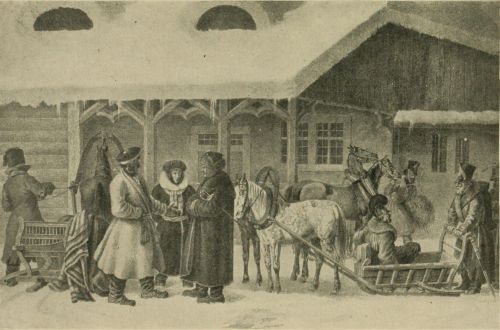
ON THE ROAD BETWEEN BRAUNSBERG AND ELBING, DECEMBER 21, 1812. From a sketch made at the time by an officer of Napoleon's army. The figure with the sword under the arm is Napoleon in the costume worn during the Russian campaign.
On the next day we started early; this was December 2nd. My fever came on again, and my legs almost gave way under me, so that after an hour's march I found myself behind the others. I went through a small village filled with stragglers, but I passed through without stopping. A little further on I saw large numbers of men gathered outside some houses busy roasting horseflesh. General Maison passed by and stopped, telling everyone to follow him if they wished to escape the Russian cavalry, now not far off. Most of the men, however, were too much famished and too demoralized to listen; they would not leave their fires till they had eaten, and many of them were prepared to defend the piece of meat they held against the enemy. I went on my way. Further on I met several men of my company, and begged them not to leave me; they promised me they would follow me anywhere—that they were quite indifferent where they went. In the evening we stopped near a wood for the night. Already several men from different corps were there, especially of the Italian army, and a few Grenadiers of the 1st regiment of the Guard, of whom I asked news of Picart. They said they had seen him the day before, but that he seemed quite mad, and they thought his brain was affected.
I had never till now thought of looking in poor Gros-Jean's knapsack, which he had given me at the Bérézina bridge. Now, as I felt certain he could not return, I opened it before two men of our company who were with me, and were, moreover, in his squadron. I found nothing of any importance, except a handkerchief containing oatmeal mixed with rye. One of the men happening to have a saucepan lid, we cooked the meal. I also found an old pair of shoes, but there was not a shirt, of which I was in great need; the rest was quite useless to me.
There was, fortunately, a great deal of wood about, so we made a large fire. The cold was endurable while the night lasted, but in the morning (the 3rd) a north wind got up, bringing with it twenty degrees of frost. We were forced to begin our march, as it was impossible to remain still. We started after eating some horseflesh, just following in the steps of those who walked before us, who knew no more than we did where they were, or in what direction they were going. The sun shone brilliantly, and the cold decreased a little; so we made good progress, stopping every now and then at houses with deserted bivouac fires. As far as I can remember, we slept in a posting-station.
The sun which we had enjoyed the day before was the forerunner of a terrible frost. I cannot write of this day, for I truly do not know how I got through it. When my comrades spoke to me, I answered as if I were mad. The cold was intolerable. Many took the first road they came to, in the hope of finding houses of some kind as shelter. We lost our way at last in following some Poles, who were going to Varsovia. One of them who spoke French assured me that we were more than a league from the road to Wilna. We tried to retrace our steps, and we lost ourselves again. We met three officers, followed by more than a hundred unfortunate men from different corps and of different nations, half dead with cold and want. When they heard from us that they were lost, many of them cried like children.
We were now near a pine-wood, so we decided to bivouac there with the men we had met. They had a horse, which we killed and divided amongst us. Two fires were made, and everyone cooked his meat at the point of his sword or a stick. When we had finished our meal, we gathered round the fires, and arranged that a quarter of the number should keep watch, as we feared we might be taken by the Russians, who were following the army on both sides of the road. An hour later the snow began to fall, and a high wind got up, driving us under the shelters we had made. The wind grew furious, driving the snow into the shelters, and entirely preventing us from sleeping, though we wanted it badly enough. I slept, however, seated on my knapsack, with my fur-lined collar on my head to keep off the snow. How many times during this miserable night I longed for my bearskin coat!
I did not sleep long, as a violent gust of wind carried away the shelter. I and my two men were forced to walk about to keep ourselves from freezing. When the dawn came at last, we set out on our march, leaving seven men behind in the bivouac, three of whom were already dead, and four unconscious.
At about eight o'clock we reached the high road, and after countless difficulties we arrived at Molodetschno at three in the afternoon, amid a rabble of men of all corps, especially of the army of Italy. The Emperor had slept here. We tried to find shelter for the night in some barn or stable, but found we were too late. We had to be content with a half-burnt house with no roof, and three-quarters filled with men already; but we considered ourselves lucky in getting any kind of shelter against the fearful cold, which went on increasing until we got to Wilna.
I heard later that it was from this place that the Emperor despatched his twenty-ninth bulletin, which caused such a sensation in France, announcing the destruction of our army. It was broad daylight when we started on the 5th. Mechanically we followed 10,000 men in front of us, marching in confusion, without knowing where they went. We crossed several marshes, where we should have all probably sunk and perished, but for the severe frost. Those who lagged behind were in no danger of losing their way, for the numbers of fallen men on the road served as guides. We arrived the next day at Brenitza. The Emperor had slept there, and had already left. This day we were more fortunate. I was able to buy a little flour, and we made some hasty-pudding; but we had not the luck to find a roofless house again, and were obliged to spend the night in the street. It was so bitterly cold that we got no sleep. The next morning we set off for Smorgony. The road was full of officers of different corps, and the remnants of the Doomed Squadron and Battalion, wrapped in worn-out furs, and half-burnt garments. Some had not even these, having, no doubt, parted with them for their friends. Many of them walked leaning on sticks, their beards and hair a mass of ice; others, no longer able to walk, looked vainly at the miserable men passing along the road, trying to find some part of the regiments they had commanded a fortnight before, and get help or an arm to lean on. It was all over, I fear, with those who could not walk.
The roads were like battlefields, there were so many dead bodies; but as the snow fell all the time, the horror of the sight was softened. We had lost all sense of pity, besides; we were insensible even to our own sufferings, let alone those of others. The men who fell imploring help were not listened to. Thus we arrived at Smorgony, on the 6th. On entering the town, we heard that the Emperor had left the evening before, at ten o'clock, for France, leaving the command of the army to King Murat. Many of the foreigners took advantage of this circumstance to blame the Emperor, but the step he took was a perfectly natural one, as, owing to Malet's conspiracy, his presence was necessary in France, not only for the administration, but to organize a new army. Amongst the numbers of dying men constantly arriving were others who were well dressed and vigorous, evidently foreigners, and these all exclaimed loudly at the Emperor's conduct. I have often thought since that these men were agents from England, come to create disaffection in the army.
In the crowd I lost one of the men who had been with me, but I had no time to look for him, I was so afraid of losing shelter for the night. Seeing an officer from Baden, who belonged to the garrison of the town, I followed him with my other man. He went to a Jew's house where he was quartered, and, seeing us after him, made no objection to our entrance. We sat down near a warm stove. One must go through the misery and suffering we had experienced to understand the delight of being in a warm house and having the prospect of a good night.
In the same room there was a young officer on the staff, ill with fever and lying on a wretched sofa. He told me that he had been ill ever since Orcha, and as he could go no farther, there was probably an end of him, as he would certainly be taken by the Russians. 'God knows,' he said, 'what will come of it, and what my poor mother will say when she learns!'
The Baden officer, who could speak French, tried to comfort him by saying that he would get him a horse for his sledge, as his own was dead. He promised soup and meat to us, but during the night he left with the rest of the garrison. The poor officer grew worse, and was delirious all night, and as for us, we got neither soup nor meat. We had only a few onions and some nuts the Jew had sold us, dearly enough, but the shelter was well worth the money.
After our rest we set out early on the 7th, as quietly as possible, so that the young officer might not hear us, as we could not possibly do anything for him. There were very few people on the road, and after a time we rested near a ruined barn. After half an hour, the column of the Imperial Guard came in sight; the fragment of our regiment was there, marching in as much order as possible. I joined their ranks. When we halted, they asked me, in an indifferent way, if I had found any food during the four days I had been away. When I told them I had nothing, they turned their backs to me, cursing and banging the butts of their muskets on the ground.
We continued our march, and got to Joupranouï very late; almost all the houses here were burnt, and the rest deserted, without roofs or doors. We huddled together as best we could, and as there was plenty of horseflesh, I cooked some ready for the next day.
On the 8th it was late when we started, but the cold was so intense that the men set fire to the houses to warm themselves. All the houses contained unfortunate soldiers, many of whom had not the strength to save themselves, and perished in the flames.
In the middle of the day we got to a small town the name of which I have forgotten. They told us that distributions of rations were to be made here, but we soon heard that the shops had been pillaged before our arrival, and that the people who had charge of the distributions had got away, and the commissaries also. We continued our route, therefore, striding over the dead and dying on our way. When we halted near a wood, one of the men of our company caught sight of a horse, and we gathered round to kill him, and each take some of the flesh; but as we had no knives or hatchets to cut it, we killed it for the sake of the blood, which we collected in a saucepan taken from a German cantinière. Finding a deserted bivouac fire, we began to cook the blood, putting some powder in it for seasoning, but it was only half done when we caught sight of a legion of Cossacks. We had just time to eat it as it was, and this we had to do from our hands, so that our faces and clothes were covered with blood. We were ghastly objects to look at.
This halt, caused by some difficulty with the artillery, had gathered together more than 30,000 men of all nations, making a spectacle impossible to describe. We started off again, and reached a large village three or four leagues from Wilna. I recognised the village for the same we had stayed at five months before, in going from Wilna to Moscow. Here I had lost a trophy, that is to say, a little box containing rings, hair necklaces, and portraits of the mistresses I had had in all the countries I had visited. I was much grieved at losing my collection. On the 9th we left Wilna, in twenty-eight degrees of frost.[56] Scarcely 2,000 arrived at Wilna, out of two divisions of more than 10,000. These, both French and Neapolitans, had joined us during the last two days. This enormous number was lost during this terrible journey. The men were well clothed, and wanted for nothing but food. They had left good quarters in Lithuania and Pomerania only a few days before. When they came they were filled with pity for our condition, but in two days they were worse off than we. They were less demoralized, and at first they tried to help each other; but when they saw what deprivation this meant, they grew as selfish as all the others, officers and privates alike.
I had plucked up a little courage in the hope of soon getting to Wilna, where we should have abundant food. I should call the efforts we made superhuman. This terrible cold was more than I had ever felt before. I was almost fainting, and we seemed to walk through an atmosphere of ice. How often in the dreadful time did I long for my bearskin cloak, which had saved me so often in cold like this! I could hardly breathe: my nose felt frozen; my lips were glued together; my eyes streamed, dazzled by the snow. I was forced to stop and cover my face with my fur collar to melt the ice. In this style I got to a barn where there was a fire burning, and where one could breathe a little. In all the buildings we passed were unfortunate men not able to get any further, and waiting there to die.
Now we could see the spires and roofs of Wilna. I tried to hurry on to get there amongst the first, but the old Chasseurs of the Guard prevented me. They blocked up the road in such a manner that no one could pass them without marching in order. These veterans, with ice hanging to their beards and moustaches, marched on, controlling their own sufferings to keep order in the ranks; but this order it was impossible to maintain. Once in the outskirts of the town, everything was in confusion. At the door of a house I saw one of my old friends of the Grenadiers lying dead. They had arrived an hour before us. A house was chosen for our battalion, and a distribution of beef was made. We had not the sense to put it all together and make soup. We each fell on our allowance like wild beasts, every man cooking or warming it as he could, and some even devouring it raw. One of my friends named Poton, who was a Breton gentleman, and a sergeant in my company, waited impatiently for his piece, about half a pound. As he was a short distance off, it was thrown to him. He caught it with both hands, like a cat, and began eating it convulsively, in spite of everything we could do to prevent him. He was incapable of seeing anything but the meat before him.
Soon afterwards I went into the town to see if I could not buy some bread and a little brandy. But the doors were almost all shut and bolted. The inhabitants, although our friends, had taken fright on seeing fifty or sixty thousand famished men, most of whom looked imbecile or mad. Many of our men had rushed about like lunatics, knocking at all the doors and shops, but had been refused, as the contractors wished to do everything in order. This was impossible, as order did not exist.
I soon saw that I could not get what I wanted, and was about to go back to my quarters, when I heard my name called. I turned round, and to my great surprise saw Picart, who threw himself on my neck, crying with joy. He had come across the regiment twice since we passed the Bérézina, but they had assured him that I was dead or taken prisoner. He said he had some flour, which I should share with him; and as for brandy, he would take me to his Jew, who would furnish me with that, and perhaps bread as well. I begged him to take me there while we were waiting for the distribution of rations. This we were sure to have later, as the shops were full.
I shall never forget the curious effect an inhabited house had on me. It seemed to me years since I had seen one. Picart gave me a little brandy, which I had great difficulty in swallowing. I then bought a bottle for twenty francs, which I carefully stowed away in my haversack. As to bread, I must wait for that till evening. For fifty days I had not tasted any, and it seemed that if only I could eat a little I should forget all my miseries. The Jew told me that the men who had arrived first in the morning had devoured everything. He advised us not to leave his house, even to sleep there, and that he would undertake to get us everything we wanted, also to prevent others from coming in. Taking his advice, I settled down to rest on a bench near the stove.
I asked Picart how it happened that he was on such friendly terms with the Jew, as I noticed they treated him as a member of the family. He said that he had passed himself off as the son of a Jewess, and that during the fortnight we had spent in the town in July he had attended their synagogue with them, and in consequence of this he had always got some schnapps to drink and some nuts to crack.
I had not laughed for long enough, but I burst out into a roar at this, until the blood poured down my lips. Picart went on with his funny stories, until suddenly we heard a rattle of artillery, and our host came hurriedly in. He looked dazed, and could not speak. At last he said that he had seen some Bavarian soldiers, followed by Cossacks, enter by the same gate at which we had come in.
The garrison of the town just then sounded the call. When Picart heard it, he seized his arms and came up to where I sat, unwilling to move.
'Come, mon pays,' he said, striking me on the shoulder; 'we belong to the Imperial Guard, and should be the first to go. We must not let these savages eat our bread. If you have strength, follow me, and we'll join with fellows who'll turn out these rascals.'
I followed Picart. A few men ran to join they hardly knew what, but a great number walked off as far as they could get, and the most part, quite indifferent to everything, paid no attention to what was going on.
When we got near the gate leading to the faubourg, we met a detachment of Grenadiers and Chasseurs of the Guard. Picart left me to take his proper place, and as I saw a few of our men following, and also some officers, I followed also, without knowing who commanded us or where we were going. We went up a mountain without any pretence of order, each one going as he could; many fell and remained behind. We had climbed, perhaps, two-thirds of the height—and I was astonished at having got so far—when I fell; and although helped up by a Lithuanian peasant, I could hardly rise. I begged the man not to leave me, and to secure his services I gave him about four francs in Russian money and some brandy in the little cup I still kept. The peasant was so delighted that I believe he would have carried me on his back. We went on over ground covered with dead men and horses. There were a great many firearms lying about. My peasant picked up a carbine and some cartridges, saying that he wished to fight the Russians himself. After great difficulty we at last reached the top of the mountain, where the Prussians were already fighting. Two hundred men, three-parts belonging to the Guard, were facing the enemy, consisting of cavalry, many of whom were scouts. As the Bavarians had in retreating left some men behind them, with two pieces of artillery, two discharges of grape-shot were sufficient to disperse them. As the position was untenable on account of the cold, we faced about to return to the town, where the greatest disorder prevailed. The garrison, almost entirely composed of foreigners, was in a state of panic. Some were preparing to leave the town, loading carts, sledges, and horses. On all sides we heard cries of 'Who has seen my horse?' 'Where has my cart got to?' 'Stop the man who is off with my sledge.' This disorder was mainly caused by the thieves who had followed us all through the retreat, and of whom I have spoken before. Now, seeing a good opportunity, they took advantage of it by seizing carts, horses, and sledges loaded with provisions, gold, and silver. The arrangements for departure were made by the commissariat, contractors, and other army employés, who now were making common cause with us. The thieves thus fled along the Kowno road, sure of not being pursued.
On entering the faubourg, I avoided the house where our battalion was quartered. I had two reasons for going into the town: firstly, for the bread I was to share with Picart; secondly, to let him know that I had taken part in the little expedition which had beaten the Russians. I ran to the right to find Picart, but to my surprise I was told that he had taken the first turning to the left, with ten other Grenadiers and Chasseurs, to be on guard for Murat. Murat had just left the town for the faubourg on the Kowno road.
I decided to look for him at Murat's quarters. On the way I passed the house where Marshal Ney was staying. Several Grenadiers of the line were before the door, warming themselves by a large fire, which gave me a terrible longing to be there, too. Seeing how wretched I looked, they made room for me. Many of them were quite strong and well dressed. When I showed my surprise at their appearance, they said they had not been as far as Moscow; they had been wounded at the siege of Smolensk, and left at Wilna, where they had remained ever since. Now they were well again and fit for fighting. I asked them if they could get me some bread. They answered as the Jew had done—that if I would return that evening, or stay with them, they were certain that I should have some. But, as I was obliged to go back to the battalion, I told the Grenadiers that I would return, and that I would give five francs for each loaf. Before leaving them, they told me that just before I arrived a German General had come to the Marshal, and had advised him to leave if he did not wish to be surprised by the Russians; but the Marshal had replied, pointing to a hundred Grenadiers warming themselves in the courtyard, that with those he could afford to laugh at all the Cossacks in Russia, and that he would sleep in the town.
I asked how many there were in the Marshal's body-guard.
'About sixty,' answered a drummer sitting on his drum; 'and another sixty we found here well and fit. I have been with the Marshal ever since the crossing of the Dnieper, and with him at our back we can manage those dogs of Cossacks. Coquin de Dieu!' he said, 'if it were not so cold, and if I hadn't frozen hands, I would sound the attack myself all day to-morrow.'
I returned to the faubourg, and found all my comrades asleep on the floor. There was a large fire, and the room was warm, and as I was completely worn out, I lay down with them.
It might be perhaps two o'clock in the morning when I awoke, and as I had now missed the rendezvous I had given the Marshal's Grenadiers, I told my comrades that I was going to the town to get some bread, and that now was a favourable time, as all the soldiers would be asleep; and, besides, I had some Russian bank-notes. Several of them tried to get up and go with me, but could not do so. Only one, Bailly, a sergeant, succeeded in rising, and the others gave us their money, amounting to about fifty francs.
It was a beautiful moonlight night, but when we were in the street it felt so bitterly cold that it would not have taken much to send us back into the house.
We met no one in the faubourg. At the gates of the town there was no sentry. The Russians could have got in as easily as we did. When we were opposite the first house on the left, I caught sight of a light through the entrance to the cellar, and, stooping down, I saw it was a bakehouse, and that bread was being made. The smell had made us aware of it before. My comrade knocked, and they asked us what we wanted. We answered: 'Open the door! We are Generals!' They opened at once, and we went in. They took us into a large room, where a number of officers were lying on the floor. They did not trouble to ask us if we were really what we pretended to be. For some time past it had been hardly possible to distinguish an officer from a private.
A very fat woman was standing against the cellar door, so we asked her if she had any bread to sell. She said no, it was not baked yet; we might go down to the cellar and see for ourselves. An officer lying on some straw, wrapped in a great cloak, got up and went down with us. Two bakers were there fast asleep, and looking all round, we could see nothing; and we began to think that the woman had spoken the truth, when on stooping down I saw under a kneading-trough a large basket, which I drew out. In it we found seven large loaves of white bread, weighing three or four pounds each, as good as those made in Paris. What luck! What a glorious find for men who had had no bread for fifty days! I began by taking possession of two, which I put under my arm and my cape. My comrade did the same, and the officer took the three others. This officer was Fouché, a Grenadier-Vélite, then an Adjutant-Major in a regiment of the Young Guard, and a Major-General. We came out of the cellar, and found the woman still standing at the door. We said that we would return in the morning when the bread was baked, and she was so anxious to get rid of us that she opened the door, and we found ourselves in the street.[57]
As soon as ever we were free, we dropped our muskets into the snow, and began to bite into the loaves voraciously; but, as my lips were cracked and bleeding, I could not open my mouth as comfortably as I wished. Just then two men came up to us, asking if we had nothing to sell or exchange, and we saw that they were Jews. I told them that we had Russian bank-notes for a hundred roubles each, and asked how much they would give.
'Fifty,' said the first in German. 'Fifty-five,' said the other. 'Sixty,' went on the first.
He ended by offering us seventy-seven, and I made the condition that they should give us some café-au-lait. They consented. The second then came behind me and said, 'Eighty!' But the price was concluded, and, as the man had promised us coffee, we did not wish to bargain over again for twenty francs at most.
The Jew now conducted us to a banker, as he was only an agent. The banker was also a Jew. He asked us at once for our notes, of which we had to give nine; three of them belonged to me. He looked very closely at them, and passed into another room, while we sat down on a bench to wait, furtively handling our bread.
Our longing for the coffee promised us overcame our patience, and we called out for the banker. No one appeared. The idea suddenly came to us that we were going to be robbed. I said as much to my comrade, who thought so too. To compel attention, therefore, he struck their counter as hard as he could with the butt of his musket. As no one came to this summons either, he knocked against a wooden partition dividing the two rooms. The Jews came out, looking as if they were plotting something together. After again asking for our money, we were told to wait; but my comrade loaded his musket before their eyes, and I took one of them by the throat, demanding our notes. When they were convinced that we should make a scene to their disadvantage, they hastily counted out our money, the most part of it in gold. We took hold of the man who had led us to the place, and forced him to leave with us; but as soon as we were in the street he swore that what had occurred was no fault of his. We thought it better to believe him in view of the coffee he had promised us, and he took us to his house.
After our meal, my comrade wished to go back to the faubourg; but I felt so tired, and even ill, that I decided to stay where I was till the next day, thinking myself safe with two Bavarian cavalrymen. So I lay down on a sofa—perhaps it might be five o'clock in the morning.
I had only been resting about half an hour, when I was seized with the most violent colic, after which I was terribly sick, and continued so ill that I felt sure the Jew had poisoned me. I thought I must die, as I was so weak as to be unable to get to the bottle of brandy in my knapsack. I begged one of the Bavarians to give me some, and after that I felt better; so I lay down again on the sofa and dozed off. I do not know how long I slept, but when I awoke I discovered that my bread had gone. Only a very small piece was left, which, fortunately, I had put in my haversack, along with the bottle of brandy, and hung at my side. My Rabbi's cap had also disappeared, so, too, had the Bavarians. That, however, was not what distressed me the most, but my own position, which was a dreadful one; besides my colic and sickness, my right foot was frozen, and my wound had reopened. The first joint on the middle finger of my right hand was on the point of dropping off, and the terrible cold of the preceding day had poisoned my foot to such a degree that I could not get my boot on. I was forced to wrap it up in rags, after rubbing it over with the grease the Poles had given me, and a piece of sheepskin over all, which I tied on with string. The same process I repeated with my right hand.
I was about to go out, when the Jew asked me to stay, saying that he had some rice to sell. I bought some, thinking it would stop my complaint. I begged him to get me some sort of pot to cook it in, and he fetched me a little copper pan; I tied this and my boot to the knapsack, and after giving the man ten francs I went out.
As soon as I was in the street, I heard despairing cries, and I saw a woman weeping over a dead body at the door of a house. She stopped me, asking me to help her to get back what had been taken from her.
'I have been staying in this house since yesterday,' she said, 'with these scoundrels of Jews. My husband was very ill. During the night they took everything we had, and this morning I went out to get help. As I saw I should get none anywhere, I came back to nurse my poor husband; but when I arrived, imagine my horror at seeing his corpse at the door! The villains had taken advantage of my absence to assassinate him. Oh, monsieur,' she went on, 'do not leave me! Come with me!'
I said that was impossible, but the best thing she could do now was to join those who were leaving the town. She made a gesture with her hand to say she could not do it; and, as I had heard several musket-shots, I had to leave the unfortunate woman and go in the direction of Kowno. I got into a crowd of 10,000 men, women, and children all hurrying and thrusting past each other to get out first.
As chance would have it, I met a Captain of the Young Guard belonging to my own part of the country.[58] He had with him his Lieutenant, his servant, and a wretched horse. The Captain had no company left; his regiment had ceased to exist. I told him all my misfortunes, and he gave me a little tea and a piece of sugar, but directly afterwards a vast number of people coming after us separated us.
A drummer was beating the retreat at the head of the first crowd, very likely a detachment of the garrison I had not seen. We marched on for half an hour, and arrived at the end of the faubourg; then we could breathe a little, and each one walk as he would. When I got outside the town, I could not help thinking of the state of our army: five months before it entered the Lithuanian capital, proud and rejoicing; now it went out, fugitive and miserable.
FOOTNOTES:
CHAPTER X.
FROM WILNA TO KOWNO—THE REGIMENTAL DOG—MARSHAL NEY—THE TREASURY OF THE ARMY—I AM POISONED—THE THIEVES' DRIPPING—THE OLD GRENADIER, FALOPPA—GENERAL ROGUET—FROM KOWNO TO ELBING—TWO CANTINIÈRES—THE ADVENTURES OF A SERGEANT—I FIND PICART AGAIN—THE SLEDGE AND THE JEWS—A SHREW—EYLAU—ARRIVAL AT ELBING.
We were only a quarter of a league from the town, when we saw the Cossacks to our left upon the heights, and to our right on the plain; however, they did not dare venture within reach of us. After having marched for some time, I found the horse of an officer of artillery stretched on the ground; it had a schabraque of sheepskin on its back. This was just what I wanted to cover my poor ears, for it would have been impossible for me to go any distance without risking the loss of them. I had in my haversack the scissors belonging to the surgeon's case found on the Cossack I had killed on November 23rd. I tried to set to work to cut some of it away, and make what we called ear-lappets to replace the Rabbi's cap; but having my right hand frozen, and the other benumbed, I could not manage it. I was in despair, when a man belonging to the garrison of Wilna came up. He was stronger than I, and succeeded in cutting the band fastening the schabraque to the horse; then he gave me half of it. Until I could arrange it better, I put it over my head and continued my way.
I now heard cannon, and then musketry fire; it was the rear-guard leaving the town, with Marshal Ney in command, engaging the Russians. Those who were no longer able to fight ran as fast as they possibly could. I tried to follow them, but my frozen foot and bad boots prevented me; then the colic, which came on repeatedly, and forced me to stop, hindered me, and I found myself always in the rear. I heard a confused sound behind me, and I was hustled by several men of the Rhine Confederation running off as fast as they could. I fell full length in the snow, and immediately several others passed over my body. I raised myself with great difficulty, for I was in great pain; but I was so accustomed to suffering, I said nothing. The rear-guard was not far off—if it passed me I was lost; but the Marshal called a halt, to give the other men still leaving the town time to join us. To hold the enemy in check, the Marshal had with him about 300 men.
In front of me was a man whom I recognised by his cloak as belonging to the regiment. He was walking very much bent, apparently overwhelmed by the weight of a burden he was carrying upon his knapsack and shoulders. Making an effort to get near him, I saw that the burden was a dog, and that the man was an old sergeant named Daubenton.[59] The dog he carried was the regimental dog, though I did not recognise it. I told him how surprised I was at seeing him carrying the dog, when he had trouble to drag himself along; and, without giving him the time to reply, I asked him if the dog was to eat—if so, I should prefer the horse.
'No,' he answered; 'I would rather eat Cossack. But don't you recognise Mouton? His paws are frozen, and now he can't walk any longer.'
'Now I do,' I said; 'but what can you do with him?'
As we walked, Mouton, whose back I had patted with my bandaged right hand, raised his head to look at me, and seemed to recognise me. Daubenton assured me that from seven in the morning, and even before, the Russians had occupied the first houses of the suburb where we had lodged, that all that remained of the Guard had left it at six, and that it was certain that more than 12,000 men of the army, officers and soldiers who were no longer able to march, had remained in the hands of the enemy. He had just missed submitting to the same fate himself through devotion to his dog. He saw very well that he would be obliged to leave him on the way in the snow. The evening of the day when we had arrived at Wilna—at twenty-eight degrees—the poor dog had had his paws frozen, and this morning, seeing that he could walk no longer, he had made up his mind to leave him; but poor Mouton got an idea that he was to be deserted, for he began to howl in such a way that in the end he decided to let him follow. But hardly had he taken six steps along the street when he saw his unfortunate dog fall upon his nose; so he fastened him across his shoulders over his knapsack, and it was in this fashion that he had rejoined Marshal Ney, who with a handful of men formed the rear-guard.
Whilst still marching, we found ourselves stopped by an overturned waggon barring part of the way; it was open, and contained canvas bags, but all these were empty. This waggon had probably left Wilna the preceding evening or in the morning, and had been pillaged by the way, for it had been laden with biscuits and flour. I proposed to Daubenton to halt a moment, for my colic had come on again; he consented willingly, especially as he wished to rid himself of Mouton in one way or another.
We had hardly stopped, when we saw at the back of a ravine a troop of about thirty young Hessians who had formed part of the garrison of Wilna, and had left there at daybreak. They were waiting for Marshal Ney, about thirty paces away from us, and ahead of us to the right. At the same moment we saw on our left another troop of horsemen, about twenty in number. We recognised them at once for Russians; they were Cuirassiers in black cuirasses over white coats, accompanied by several Cossacks scattered here and there. They moved on so as to cut off the Hessians and ourselves, and a vast number of other unfortunate men who had just caught sight of them, and who turned back to rejoin the rear-guard, crying out, 'Beware of the Cossacks!'
The Hessians, under command of two officers who had probably caught sight of the Russians before we did, put themselves in order of defence.
At this moment we saw a Grenadier of the line pass near to us, running to take rank among the Hessians; we prepared to do the same, but Daubenton, hampered by Mouton, wished to put him in the waggon. We had not time, however, for the cavalry came at a gallop alongside the Hessians. There they halted, signing to them to lay down their arms. A musket-shot was the reply; it was that of the French Grenadier, followed by a general discharge from the Hessians.
At this report, we expected to see half the troopers fall, but, to our astonishment, not one did so, and the officer who was in advance, and who ought to have been shot in pieces, seemed to be whole and sound. His horse simply leapt to one side. He turned round again instantly towards his men; they all thundered upon the Hessians, and in less than two minutes they were sabred. Several took to flight, but the cavalry pursued them.
At the same time Daubenton, wishing to rid himself of Mouton, called out to me to help him, but three of the men in pursuit of the Hessians passed close by him. So as to defend himself better, Daubenton thought of retiring under the waggon, where I had taken refuge, suffering terribly from colic and cold; but he had not time, for one of the three horsemen was on the point of charging him. Daubenton was fortunate enough to see the man in time, and get ready for him, but not so well as he could wish, for Mouton, barking like a good dog, hampered him in his movements. Meanwhile, although nearly dying of cold, I felt rather better, and had arranged my right hand to make use of my weapon the best way possible, having hardly any strength left, to speak of.
The man wheeled continually round Daubenton, but at a certain distance, fearing a musket-shot. Seeing that neither of us attempted to fire, he no doubt thought that we were without powder, for he advanced upon Daubenton and hit him a blow with his sword, which the latter parried with the barrel of his musket. Instantly the man crossed to the right, and gave him a second blow upon the left shoulder, which struck Mouton on the head. The poor dog howled enough to break one's heart. Although wounded and with frozen paws, he leapt off his master's back to run after the man; but being fastened to the straps of the knapsack, he pulled Daubenton down, and I thought all was over with him.
I dragged myself on my knees about two steps ahead and took aim, but the priming of my gun did not burn. Then the man, shouting savagely, threw himself on me, but I had had time to get under the waggon and present my bayonet at him.
Seeing that he could do nothing to me, he returned to Daubenton, who had not yet been able to rise on account of Mouton, who all the time dragged him sideways, howling and barking after the cavalry. Daubenton was dragged against the shafts of the waggon, so that his enemy on horseback could not get near him. This man faced Daubenton, his sword raised as if to split him in two, appearing all the while to mock at him.
Daubenton, although half dead with cold and hunger, his face thin, pale, and blackened by the bivouac fires, still seemed full of energy; but he looked odd and really comical, as that devil of a dog was barking all the time, and dragging him sideways. His eyes were shining, his mouth foamed with rage at being at the mercy of such an enemy, who in any other circumstances would not have dared stand up one minute before him. To quench his thirst, I saw him fill his hand with snow and carry it to his mouth, and instantly seize his weapon again; now in his turn he threatened his enemy.
By the man's shouts and gestures, one could see that he had no command over himself, and seemed to have drunk a great deal of brandy. We saw the others passing, repassing, and shouting round some men who had not been able to reach the side where the rear-guard would come; we saw them thrown into the snow and trampled under the horses' feet, for almost all who followed were without arms, wounded, or with frozen feet and hands. Others, who were stronger, as well as some Hessians escaped from the first charge, were able to withstand them for a little, but that could not last, either—they must be relieved or captured.
The cavalryman with whom my old comrade was doing business had just passed to the left, when Daubenton shouted out to me: 'Don't be frightened! don't stir! I'll finish him off.' Scarcely had he said these words, when he fired. He was luckier than I. The Cuirassier was struck by a ball which entered under the right arm first, and passed out again on the left side. He uttered a savage cry, moved convulsively, and at the same moment his sword fell with the arm that held it. Then a stream of blood came from his mouth, his body fell forward over his horse's head, and in this position he remained as if dead.
Hardly was Daubenton rid of his enemy and free from Mouton so as to seize the horse, when we heard behind us a great noise, then cries of 'Forward! Fix bayonets!' I came out of my waggon, looked towards the side from which the cries came, and saw Marshal Ney, musket in hand, running up at the head of a party of the rear-guard. The Russians, on seeing him, took to flight in all directions. Those who rushed to the right on the side of the plain found a large ditch filled with ice and snow, which prevented them crossing. Several flung themselves in it with their horses, others stopped still in the middle of the road, not knowing where to go. The rear-guard seized several horses, and made their riders walk on foot amongst them. Afterwards they were left on the road. What else could one do? One could barely look after one's self.
I shall never forget the Marshal's commanding air at this moment, his splendid attitude towards the enemy, and the confidence with which he inspired the unhappy sick and wounded round him. In this moment he was like one of the heroes of old time. In these last days of this disastrous retreat he was the saviour of the remnant of the army.
All this took place in less than ten minutes. Daubenton had rid himself of Mouton, so as to get hold of the horse, when a man, emerging from behind a clump of pines, threw the Cuirassier off the horse, seized the animal by the bridle, and made off. Daubenton shouted to him: 'Stop, rascal! That is my horse. I killed the fellow!' But the other escaped with the horse amongst the rabble of men who were hurrying forward. Then Daubenton called out to me: 'Look after Mouton. I am going after the horse; I must have him, or there will be the devil to pay.' The last word was hardly out of his mouth, when more than 4,000 stragglers of all nations came on like a torrent, separating me from him and from Mouton, whom I never saw again.
This seems to be the place for giving a little biography of the regimental dog.
Mouton had been with us since 1808. We found him in Spain, near the Bonaventura, on the banks of a river where the English had cut the bridge. He came with us to Germany. In 1809 he assisted at the Battles of Essling and Wagram; afterwards he returned to Spain in 1810-11. He left with the regiment for Russia; but in Saxony he was lost, or perhaps stolen, for Mouton was a handsome poodle. Ten days after our arrival in Moscow we were immensely surprised at seeing him again. A detachment composed of fifteen men had left Paris some days after our departure to rejoin the regiment, and as they passed through the place where he had disappeared, the dog had recognised the regimental uniform, and followed the detachment.
Whilst marching in the midst of men, women, and even some children, I was constantly looking about for Daubenton, whom I regretted very much; but behind only Marshal Ney and his rear-guard were to be seen, taking up a position on the little eminence where the Hessians had been attacked.
After this adventure I was forced to stop again, as I was suffering so much from my colic. In front, I could see the Ponari mountain from the foot to the summit. The road about three-fourths up the left slope could be traced by the number of waggons, carrying more than seven millions in gold and silver, as well as other baggage, and carriages drawn by horses whose strength was exhausted, so that they had to be left on the road.
A quarter of an hour after, I arrived at the foot of the mountain, where some had bivouacked during the night. Traces of the fires were still to be seen—several still alight, and around them men warming themselves before attempting the ascent. Here I learnt that the carts which had left Wilna the evening before at midnight, on reaching a defile, had not been able to go further. One of the first waggons had fallen open on turning over, and the money in it had been taken by those standing near. The other carriages, from top to bottom of the mountain, were obliged to halt. Many horses had fallen to rise no more.
While they told me this, we heard the musketry fire of Marshal Ney's rear-guard, and on the left Cossacks were visible, drawn by the sight of booty. They advanced very cautiously, however, waiting till the rear-guard should have passed to reap their harvest safely.
I started off again, but, instead of taking the road of the waggons, rounded the mountain to the right. Here several carts had tried to pass, but all had been overthrown into the ditch at the side. One waggon had a great many trunks still in it. I should have liked to carry one off, but in my feeble state I did not dare to risk it, fearing I might not be able to climb out of the ditch again if I once got down. Fortunately, a man of the hospital corps from the Wilna garrison, seeing my dilemma, was kind enough to go down, and threw me a box, in which I found four beautiful shirts of fine linen and some cotton trousers.
Since November 5th I had not changed a shirt, and my shreds and tatters were filled with vermin, so I put the whole into my knapsack, delighted.
A little further on I picked up a band-box containing two superb hats. As it was very light, I put it under my arm; I really don't know why-probably to exchange it for something else if I had the opportunity.
The road I was following turned to the left across some brushwood to rejoin the highway. This road had been beaten out by the first men who at daybreak had crossed the mountain. After half an hour of painful walking, I heard a heavy fusillade, accompanied by loud cries, coming from the side of the waggons. Marshal Ney, seeing that the booty could not be saved, was having it distributed among the men, and at the same time kept the Cossacks off by steady firing.
Over on my side, to the right, I saw some Cossacks advancing steadily. There was no one to check them but some men scattered here and there upon the mountain, trying to gain the road. All at once I was forced to stop: my legs gave way under me. I drank a good mouthful of my brandy and struggled on. I reached at last a point on the mountain not far from the road, and as I was searching for the right direction, the snow crumbled under me, and I sank more than five feet up to the eyes, and was nearly suffocated. It was with great trouble that I dragged myself out, completely exhausted with cold.
A little further on I caught sight of a hut, and seeing some people in it, I stopped there. They were about twenty men belonging to the Guard, all with bags containing five-franc pieces. Several of them, on seeing me, began to call out, 'Who would like 100 francs for a twenty-franc piece in gold?' But finding no one to exchange with them, they concluded by offering some to those who were without any. Just then I cared more for life than for money, so I refused, for I had about 800 francs in gold, and more than 100 francs in five-franc pieces.
I remained in this hut long enough to fasten the sheepskin over my head, so as to keep the cold off my ears, but I had no time to change my shirt. I left, following some musicians carrying money, but who were too heavily laden to go far.
The firing now came nearer, so that we were obliged to double our pace. Those who were laden with money, and could not run, lightened their burden by shaking the five-franc pieces out of their bags, saying that it would have been better to have left them in the waggons, especially as there was plenty of gold to take, but that there had not been time to bury the chests. However, there were many who had sacks of double napoleons.
A little ahead I saw several still coming from the direction of the waggons, carrying bags of money. As they were terribly weak and their fingers frozen, they called to those who had none, to give them a share; but it very often happened that those who had carried some money part of the way, and who wished to share it with the others, had no more to give, as, farther in front, men who had none had forced a share from them. Those poor devils who had been carrying money for so long saw it torn from them, and were lucky if in trying to defend what they had they held their own, for they were always the weakest.
I had gained the road, and, as I was not very cold, I stopped to rest. I saw other men come up, still laden with money, and who now and again stayed to fire on the Cossacks. Higher up the rear-guard had halted to allow some men to pass, as well as several sledges, some bearing the wounded, and loaded with as many barrels of money as it was possible for them to carry. This did not keep some men, drawn by the love of plunder, from still remaining behind, and when at bivouac in the evening, I was assured that many had rifled the waggons along with the Cossacks.
I went on slowly and painfully. Presently I saw an officer of the Young Guard coming towards me, very well dressed, and in good health, whom I recognised at once as Prinier, one of my friends, passed as officer eight months before. Surprised to see him going in the opposite direction, I asked him, calling him by his name, where he was bound for. He demanded in his turn who I was. At this unexpected question from a comrade in the same regiment for five years, I could not refrain from tears. He did not know me because I was so changed and wretched. But an instant afterwards: 'Why, my dear fellow, is it you? To think you should be so unlucky!' Then he offered me a bottle which hung from his side, containing wine, saying, 'Take some;' and, as I had only one hand free, the good fellow supported me with his left hand, and with the other poured the wine into my mouth.
I asked him if he had met the remnant of the army. He said no; that as he had been quartered the preceding night in a mill some distance from the road, it was very probable that the column had passed, but he had seen terrible traces of it in some dead bodies lying upon the road. He had only heard yesterday, and in a very vague way, of the disasters that we had experienced. He was on his way to rejoin the army, according to orders.
'But there is no army left.'
'What is that firing?'
'That is the rear-guard, commanded by Marshal Ney.'
Then he replied:
'I shall join the rear-guard.'
He embraced me before leaving, but as he did so he saw that I had a band-box under my arm, and asked what it contained. I told him they were hats: he asked me for them, and I gave them to him with much pleasure. It was exactly what he needed, for he still wore his non-commissioned officer's shako.
The wine he had made me drink had warmed me; I decided on going on to the next bivouac. An hour after leaving Prinier I caught sight of fires belonging to some Chasseurs. I went up in an imploring way. Without looking at me, they said: 'Do as we are doing; go and look for some wood, and make a fire yourself.'
I was expecting this reply—the usual one. There were six of them; their fire was a very poor one. They had no further shelter to protect them against the wind and the snow, should any happen to fall.
I remained a long time standing behind them, sometimes leaning forward and stretching out my hands to get a little warmth. Finally, overcome with sleep, I thought of my bottle of brandy. I offered it to the men; it was accepted, and they made room for me. We emptied the bottle, passing it round, and when we had finished I fell asleep seated on my knapsack, my head in my hands. I slept perhaps two hours, often disturbed by pain and the cold. When I awoke I took advantage of the little fire that was still left to cook some rice in the kettle I had bought of the Jew. I scraped up some snow, and melted it with some rice. I could not manage it with a spoon, as a Chasseur was eating with me, so I turned it out into my shako, and we ate it in this way. Afterwards I resumed my former position, and fell asleep again, the cold this night not being very severe.
December 11th.—When I woke it was still far from daybreak. After tying up my food, I rose to go on; for if I did not wish to die of cold and hunger, like so many others, I must rejoin my comrades. I walked alone till daybreak, stopping sometimes at a fire, where I found dead and dying men. When day came, I met some soldiers of the regiment, who told me they had passed the night with the staff.
A little further on, I saw a man with a sheepskin over his shoulders walking painfully, leaning on his musket. When I got near him, I saw that he was the quarter-master of our company. He uttered a cry of surprise and joy on seeing me, for they had told him I was a prisoner at Wilna. Poor Rossi had both feet frozen, wrapped up in pieces of sheepskin. He told me, that not being able to walk as quickly as the others, he had been separated from the remnant of the regiment, and that our friends were very uneasy about me. Two great tears ran down his cheeks, and he began to weep, saying, 'Poor mother! if you could only see me now! It is all over with me; I shall never see Montauban again' (the place he came from).
I tried to comfort him by pointing out that my situation was still worse than his own. We walked together for part of the day. I was obliged to stop often, owing to my colic.
It might have been noon when I proposed that we should stop at a village that we saw ahead of us. We entered an empty house, and found three unfortunate soldiers, who told us, not being able to go any further, they had resolved to die there. We warned them of the fate that awaited them should they fall into the hands of the Russians. For answer they showed us their feet. Nothing more terrible could be imagined. More than half their toes were missing, and the remainder ready to fall off. The feet were blue in colour, and seemed to be almost mortified. The men belonged to Marshal Ney's corps. Perhaps, when he passed by some time after, he may have saved them.
We stopped long enough to cook a little rice, and we also roasted a little horseflesh to eat later. Then we left, resolving to keep together; but the great crowd of stragglers came up, dragged us with them, and in spite of all our efforts we were separated, and could not find each other again.
I now arrived at a water-mill. There I saw a soldier who, in trying to cross the ice of the little mill-stream, had fallen through it. Although the water was only up to his waist, he could not get out, owing to the pieces of broken ice. Some artillery officers, who had found some ropes in the mill, threw them to him, but he had not strength to catch them; although still living, he was frozen and motionless.
A little further on I heard that the regiment, if it could be still called by that name, was to sleep at Zismorg, still five leagues off. I made up my mind that if I should have to drag myself there upon my knees, I would go; but what trouble it cost me! I fell from exhaustion on the snow, and thought I should rise no more. Happily, since my separation from Rossi the cold had greatly decreased. After superhuman efforts I got to the village; it was none too soon, for I had done all that man could do to escape death.
The first thing I saw on entering was a great fire to the right, against the gable end of a burnt house. Completely exhausted, I dragged myself there; and great was my surprise on seeing my comrades. When I got up to them I fell almost unconscious.
Grangier recognised me, and hurried with some others of my friends to help me; they laid me on some straw. It was the fourth time Grangier and I had met each other since we left Moscow. M. Césarisse, Lieutenant of the company, who had some brandy, made me take a little; then I was given some horse-broth. It tasted very good, for this time it was salted with salt, while so far we had eaten everything salted with powder.
My colic came on again worse than ever; so I called Grangier, and told him I thought I had been poisoned. On this he melted some snow in the little kettle, and brewed me some of the tea he had brought from Moscow. I drank a great deal, and it did me good.
Poor Rossi arrived in as miserable a state as myself. He was accompanied by Sergeant Bailly, whom he had met a moment after his separation from me. It was Sergeant Bailly with whom I had changed the bank-notes at Wilna, and who had drunk coffee with me at the Jew's. He was as ill as I was. He asked me how I was, and when I told him how ill I had been after taking the coffee, he was sure that they had meant to poison us, or at least make us good for nothing.