Front matter (continued 3)
Reading edition
Reflecting as I walked, my right foot, which already was half frozen, and giving me some pain, struck against something hard. I cried out with the pain, and fell all my length over a dead body, its face touching mine, then raised myself with great difficulty, and saw that it was the body of a dragoon, his helmet still strapped on, and his cloak, on which he had fallen. He had probably not been there long.
My cry of pain was heard by a man on my right, who called out to me to go to him, he had been waiting for so long. I was surprised, and very glad to find a human being when I thought I was quite alone, and I went in the direction of the voice. The nearer I got to it, the better I seemed to recognise it, and at last I cried:
'Is it you, Béloque?'[27]
'Yes,' he called back.
He was as much surprised as I at our meeting at this time of night, in such a desolate spot, and knowing no more than I did where we were. He had at first taken me for a corporal who had gone to get men on extra duty to help carry the sick who had been left at the gates. They had been got so far, but then it had been necessary to send for more help.
I told him how I had been lost, and of my adventure in the cellar, but I dared not say anything of the music I had heard, fearing he should say I was out of my mind. He begged me to stay with him, and I was glad to do so. Then he asked me why I had cried out, and I told him of my fall on to the dragoon, and how my face had touched his.
'Were you very frightened, poor fellow?'
'No,' I said; 'but I hurt myself horribly.'
'It was lucky for you,' he said, 'that you were so badly hurt as to cry out, as you might have passed on and never found me.'
We stamped backwards and forwards to keep ourselves warm while we waited for the men who were to carry away the sick.
The poor fellows were lying on a sheepskin, propped up one against another, and covered with the cloak and coat of a dead man. They seemed in a terrible condition.
'I am afraid,' Béloque said, 'that we shall not have the trouble of taking them away.'
We heard them murmur and breathe from time to time, but these were the last efforts of dying men.
While the fearful death-rattle was going on near us, the aerial music began again, but this time much nearer. I called Béloque's attention to it, and told him of the strange things which had happened to me when I heard the sounds before. And then he said that at intervals he had heard the music too, and could not make it out. Sometimes it made an infernal racket, and if men were amusing themselves in that way, they must have the devil inside them. Then, coming closer to me, he said in a low voice:
'My friend, these sounds are very like death-music. Death is all round us; and I have a presentiment that in a few days I shall be dead too.' Then he added, 'May God's will be done! But the suffering seems too great. Look at those poor wretches!'—pointing to two men lying in the snow.
I said nothing, for I thought just as he did.
He stopped speaking, and we listened attentively in a silence only broken by the heavy breathing of a dying man. Suddenly my companion said:
'To my mind, the sounds seem to come from above.'
As he said so, the sounds did certainly seem to come from just over our heads. All at once the noise ceased, and an awful silence followed, broken only by a mournful cry—the last breath of one of our men.
Just then we heard footsteps, and a corporal came up with eight men, to carry away the two who were dying; as there was now only one, he was removed at once—covered with his dead companion's clothes—and we all set out.
It was now past one o'clock: the wind had dropped, and the cold in consequence was not so great, but I was so worn out that I could walk no longer; and besides, I was so terribly tired that several times Béloque found me standing asleep in the road. He had told me where to find Grangier; the men of his company in charge of the only cart the Marshal had left remaining had seen their comrades, and had recognised the cart placed at the Marshal's door. When we got to the place where we left the rampart, I parted from the funeral cortège, and decided to follow the new way pointed out to me.
I had not been alone a minute, when the cursed music started again. I stopped, and, raising my head to listen better, I saw a light in front of me. As I walked on towards the light, the road descended rapidly and the light disappeared. In spite of this, I continued, but was stopped almost directly by a wall in front of me, and was forced to retrace my steps. I turned first to the right, then to the left, and found myself in a street of ruined houses. I strode on quickly, still guided by the music. At the end of the street there was a building lighted up, from which the sounds evidently came. There I was stopped by a wall surrounding the building, which I now saw was a church.
Tired as I was, I wished to avoid going all round the wall to find an opening, and decided to climb over it, feeling the depth on the other side with my musket. As it was not more than three or four feet, I climbed to the top and jumped down, and striking some round object with my feet, I fell. I was not hurt, however, but on walking a few steps I felt the ground uneven under my feet, and had to steady myself with my musket. I then became aware of the fact that more than 200 dead bodies lay on the ground, barely covered with snow. As I stumbled along, picking my way among the legs and arms of the bodies, a melancholy chant arose—like the Office for the Dead. Béloque's words came back to me, and I broke out into a cold sweat, not knowing where I was and what I was about. I found myself at last leaning against the church wall.
I came to myself in a bit, in spite of the diabolical noise, and walked on with one hand against the wall, at length finding an open door through which came a thick smoke. I went in, and saw a great number of people, who in the dense smoke looked like shadows. Some of them were singing, and others playing on the organ. All at once a great flame burst forth and the smoke disappeared. I looked round to see where I was; one of the singers came up to me and cried out: 'It's our sergeant!' He had recognised my bearskin, and I saw, to my immense surprise, all the men of my company! I was on the point of questioning them, when one of them offered me a silver cup full of brandy. They were all fearfully drunk!
One, rather less drunk than the others, said that they had been on extra duty when first they came, and that they had seen two men with a lantern coming out of a cellar; that they had banded together to go there after the distribution of rations, to see if they could find something to eat, and then spend the night in this church. In the cellar they had found a small cask of brandy, a bag of rice, and a little biscuit, besides ten capes trimmed with fur, and some Rabbi's fur caps.
With the men of the company were several musicians of the regiment, who had started playing the organ—being half seas over, as they say. This explained the harmony which had puzzled me so much.
They gave me some rice, a few pieces of biscuit, and a Rabbi's cap, trimmed with magnificent black fox fur. I put the rice carefully away in my knapsack. The cap I placed on my head, and pulling a plank in front of the fire, I lay down on it. I had scarcely laid my head on my knapsack when I heard shouts and curses from the door, so we hastened to see what was the matter. Six men were driving a cart drawn by a worn-out horse. The cart was filled with dead bodies to be left behind the church, with the others I had seen there. The ground was much too hard to dig graves, and the cold preserved the bodies in the meanwhile. These men told us that, if this sort of thing went on, there would soon be no room anywhere for the bodies; all the churches were used as hospitals, and were filled with the sick, whom it was impossible to help. This was the only church not full of them, and the dead had been laid here for the last few days. From the time that the column of the Grand Army had made its appearance, they had been unable to supply transport for the men who died as soon as they arrived. After hearing all this I lay down again. These ambulance men asked us if they might spend the rest of the night with us; they unharnessed their horse and brought him into the church.
I slept pretty well for the remainder of the night, but was awakened before daylight by the shrieks of an unfortunate musician, who had just broken his leg in coming down from the organ-loft, where he had slept. The men below had taken away some of the steps during the night to make a fire. The poor devil had a terrible fall, it was impossible for him to walk; most probably he never left the church. When I got up, nearly all the men were roasting meat on the points of their swords. I asked them where the meat came from, and they replied it was the horse who had drawn the dead-cart, and that they had killed him while the ambulance men were asleep. I don't blame them for doing it: one must live somehow. An hour afterwards, when a good quarter of the horse had disappeared, one of the undertakers told his companions what we had done. They were furious, and threatened to inform the chief director of the hospitals. We went on eating calmly, saying it was a pity he was so thin, and that half a dozen like him would be wanted for rations for the regiment. They went off threatening us, and in revenge they threw the seven corpses they had in their cart right in the doorway, so that we were obliged to climb over them to get out.
These ambulance men had not been through the campaign, or felt the want of anything, and they did not know that for the last few days we had lived on any horses we could find.
When I got ready to go back to my regiment it was seven o'clock. I told the fourteen men that were there that they must collect together and arrive in good order. We first had some very good purée de cheval au riz. After that, giving them the bag containing the Jew's fur capes to carry, we left the church, which was already filling with new-comers—some miserable wretches who had spent the night where they could, and many others who had left their regiments, hoping to find something better. They prowled about in all the corners, looking for food. They did not seem to notice the dead bodies in the doorway, but walked over them as if they had been wood, so stiff were they frozen.
When we reached the road I told my men of my adventure in the cellar, and proposed to go there, and they agreed. We found the way quite easily, for we had as sign-posts first the man whom Béloque had left dead, and then the dragoon over whom I had fallen, and who, I now saw, was without his cloak and his boots. After passing the gun-carriages where I nearly fell fatally asleep, we reached the cross I had made in the snow. After descending the slope in rather slower fashion than I had done the day before, we stood before the door, which was shut. We knocked, but no one answered; we burst the door in, but the birds had flown. We only found one man, so drunk he could not speak. I recognised him as the German who wished to turn me out. He was wrapped in a great sheepskin cape, which was taken from him by one of our musicians, in spite of his resistance. We found several portmanteaus and a trunk—stolen during the night—but all were empty, and also the cask brought by the Baden man, which had contained gin.
Before going on to the camp I noticed our position and was surprised to find that, although I had walked so much during the night, I had been no distance. I had simply walked round and round the church.
We then went back to the camp. As we went I met several men of our regiment, whom I joined to those already with me. Just afterwards I saw a non-commissioned officer in the distance, whom by his white knapsack I recognised at once as the very man I was looking for—Grangier. I had embraced him before he knew who I was, I had altered so much. We were mutually looking for each other, and if I had had the patience to wait, he said he would have taken me to his quarters and given me good soup, and straw to sleep on, for he had searched for me at this very place the evening before. He went with us to the camp, whither I brought my nineteen men in good order. Grangier then made me a sign, and opening his knapsack, he took out a piece of beef, ready cooked, which he said he had kept for me, and also a piece of bread.
I simply devoured the food, for it was twenty-three days since I had tasted anything like it. Then he asked me for news of a friend of his, whom he supposed dangerously ill. I could only tell him that he was in the town, but as we did not know the whereabouts of his regiment, he would be obliged to go through the gate by which we had entered, as many of the sick, unable to go further, had remained there. So we set off at once.
We soon reached the place where the poor dragoon lay. This time we found him almost stripped; he had been searched, no doubt, in the hope of finding a belt containing money. I showed Grangier the cellar, and then we arrived at the gate. The number of dead there was appalling; near the Baden sentry were four men of the Guard, who had died during the night. The officer on duty had forbidden the men to strip them, and he told us of two more he had in his guard-room. We went in to see them; they were both unconscious. The first was a Chasseur; the second, his face hidden in a handkerchief, was in our regiment. Grangier uncovered his face, and recognised the man he was in search of. We did all we possibly could to bring him round, relieving him of his sword and powder-flask and his collar, and trying to force a few drops of brandy between his lips. He opened his eyes without seeming to see us, and directly afterwards died in my arms. We emptied his knapsack, and found a watch and several little knick-knacks, which Grangier took charge of, to send as keepsakes to his family, if ever he were lucky enough to get back to France. We placed the Chasseur as comfortably as possible, and then left him to his melancholy fate; what else could we do?
Grangier then took me to his post, and when, soon afterwards, he was relieved by some Chasseurs, we asked them to look after the man we had just left. The sergeant immediately sent four men to fetch him.
We returned to the regiment, and the rest of the day we spent in getting our firearms into good order, in warming ourselves and talking. We killed several horses during the day, and divided them. Rations of rye and oatmeal were given out, consisting chiefly of straw with a little rye mixed.
At four o'clock the next morning we were ordered under arms and sent a quarter of a league from the town, where, in spite of the cold, we remained in order of battle until daylight. The same thing was repeated the few following days, as the Russian army was manœuvring on our left.
We had been three days already at Smolensk, and we did not know if we had to remain in this position or continue the retreat. To stay, they said, was impossible. Why, then, did we not leave a town where there were no houses to shelter us, and no provisions to feed us? On the fourth day, as we returned from our position of the morning, I saw an officer of a line regiment lying in front of a fire. We looked for some time at each other, trying to recall each other's appearance and features under the rags and dirt with which we were covered. I stopped; he got up, and, coming nearer to me, he said:
'I thought I was not mistaken.'
'No,' I said.
We had recognised and embraced each other without pronouncing a name. It was Beaulieu,[28] my messmate in the Vélites when we were at Fontainebleau.
How much we had both altered, and how wretched our condition now! I had not seen him since the Battle of Wagram, when he had left the Guard, to pass as an officer into the line, with other Vélites.
I asked him after his regiment; for answer he pointed out the eagle to me in the middle of a pile of arms. There were thirty-three of them left. He and the Surgeon-Major were the only officers; of the others, a great many had been killed in battle, but more than half had died of cold and hunger; a few had been lost on the road.
Beaulieu was Captain, and he had received orders to follow the Guard. I stayed with him for some time, and, as he had nothing to eat, we shared the rice the men in the church had given me. In those days, when food was not to be had for gold, this was the greatest proof of friendship one could possibly give.
On the morning of the 14th, the Emperor left Smolensk with the Grenadiers and Chasseurs; we followed a short time after as rear-guard, leaving behind us the corps belonging to Prince Eugène, Davoust, and Ney, reduced to lamentably small numbers. On first leaving the town we crossed the Sacred Field, so called by the Russians. A little past Korouitnia[29] we came upon a deep ravine; here we had to wait while the artillery crossed it. I went in search of Grangier, and proposed that we should cross first, as we were getting frozen while standing still. When we were at the other side, I saw three men round a dead horse; two of them staggered about as if they were drunk. The third, a German, lay on the horse; the poor wretch was dying of hunger, and, not being able to cut the flesh, was trying to bite it. He soon afterwards died where he was of cold and hunger. The two others, Hussars, were covered with blood about the hands and mouth. We spoke to them, but they did not answer; they looked at us, laughing in a horrible way, and then sat down close to the dead man, where they no doubt fell into the last fatal sleep.
We went on then, walking by the side of the highroad to come up with the right of the column, and then wait for our regiment near a fire, if we were lucky enough to find one. We met a Hussar—I think of the 8th Regiment; the poor fellow was struggling against death, continually rising and falling down again. We ran up to give him what help we could; but he fell once more, not to rise again. Thus, all along our way we were forced to step over the dead and dying. As we advanced with great difficulty, keeping to the right of the road to get past the convoys, we saw a man of the line sitting against a tree near a little fire; he was busy melting snow in a saucepan to cook the liver and heart of a horse he had just killed with his bayonet.
As we had rice and oatmeal with us, we asked him to lend us the saucepan to cook them, so that we could all eat together. He was delighted; so with the rice and straw-oatmeal we made some soup, seasoning it with a little sugar Grangier had in his knapsack, as we had no salt. While our soup was cooking, we roasted some bits of liver and kidneys from a horse, and enjoyed it greatly. We devoured our rice only half cooked, and hastened to join our regiment, which had passed us. That night the Emperor slept at Korouitnia, and we in a wood a short distance off. The next day we set out very early, so as to reach Krasnoë; but before we could get so far, the front of the Imperial columns was stopped by 25,000 Russians occupying the road. Stragglers at the front caught sight of them first, and immediately turned back to join the first regiments advancing; the greater part of them, however, united and faced the enemy. A few men, too careless or too wretched to care what they did, fell into the enemy's hands.
The Grenadiers and Chasseurs, formed into close columns, advanced against the mass of Russians, who, not daring to wait for them, retired and left the passage free; they took up a position on the hills to the left of the road, and turned their artillery on us. When we heard the cannon, we doubled our pace, as we were behind, and arrived just as our gunners were answering them. The Russians disappeared behind the hills as our fire began, and we continued our way.
An incident occurred at this time about which I cannot keep silence, and I have heard the same incident entirely differently related. What they say is this: That when, on first catching sight of the Russians, the first regiments of the Guard were grouped round the Emperor, marching as if no enemy were before them, the band played the air 'Où peut-on être mieux qu'au sein de sa famille?' and that the Emperor stopped the music, ordering to be played instead 'Veillons au salut de l'Empire!'
The incident did happen, but in quite a different fashion, as it was at Smolensk, on the day of our departure. The Prince Neuchâtel, then Minister of War, seeing that no orders for departure came from the Emperor, and that the whole army was in despair at being kept in such a wretched position, collected some men from the bands under the Emperor's window, and told them to play the air 'Où peut-on être mieux qu'au sein de sa famille?' They had scarcely begun, when the Emperor appeared on the balcony, and ordered them to play 'Veillons au salut de l'Empire!' The men were forced to play it as best they could, in spite of their pain, and immediately afterwards the order for departure on the next morning was given. How could it have been possible for the wretched men, even had they been to the right of the regiment, to have blown down their instruments, or used their poor frost-bitten fingers? This, on the other hand, was quite a possibility at Smolensk, as there were fires where they could get warm.
In two hours after the encounter with the Russians, the Emperor reached Krasnoë with the first regiments of the Guard—ours and the Fusiliers-Chasseurs. We camped behind the town. I was on guard with fifteen men at General Roguet's quarters: a miserable house in the town, thatched with straw. I put my men in a stable, thinking myself in luck to be under cover, and near a fire we had just lighted, but it turned out quite otherwise.
While we were in Krasnoë and the immediate neighbourhood, the Russians, 90,000 strong, surrounded us—to right, to left, in front, and behind, nothing but Russians—thinking, no doubt, they could soon finish us off. But the Emperor wished to show them it was not quite so easy a thing as they imagined; for although we were most wretched, and dying of cold and hunger, we still possessed two things—courage and honour. The Emperor, therefore, annoyed at seeing himself followed by this horde of barbarians and savages, decided to rid himself of them.
On the evening of our arrival, General Roguet received orders to attack during the night, taking with him part of the Guard, the Fusiliers-Chasseurs, the Grenadiers, the light companies, and skirmishers. At eleven o'clock a few detachments were sent on first to reconnoitre, and find out exactly where the Russians lay; we could see their camp-fires in the two villages they held. They seem to have expected us, for some were already prepared to receive us.
At about one o'clock in the morning, the General came to me, and said, with his Gascon accent:
'Sergeant, leave a corporal and four men here in charge of my quarters, and the few things I have left. Go back to the camp yourself, and rejoin the regiment with your guard. We shall have our work cut out for us presently.'
To tell the truth, I was very much disgusted at this order. I do not mean that I was afraid of fighting, but I grudged the time lost for sleep terribly.
When we got to the camp, preparations were already going on; evidently serious things were expected. I heard several men say that they hoped an end would at last be put to their sufferings, as they could struggle no longer.
At two o'clock we began to move forward. We formed into three columns—the Fusiliers-Grenadiers (I was amongst them) and the Fusiliers-Chasseurs in the centre, the skirmishers and light companies on the right and left. The cold was as intense as ever. We had the greatest difficulty in walking across the fields, as the snow was up to our knees. After half an hour of this, we found ourselves in the midst of the Russians. On our right was a long line of infantry, opening a murderous fire on us, their heavy cavalry on our left made up of Cuirassiers in white uniform with black cuirasses. They howled like wolves to excite each other, but did not dare to attack. The artillery was in the centre, pouring grape-shot on us. All this did not stop our career in the least. In spite of the firing, and the number of our men who fell, we charged on into their camp, where we made frightful havoc with our bayonets.
The men who were stationed further off had now had time to arm themselves, and come to their comrades' help. This they did by setting fire to their camp and the two villages near. We fought by the light of the fires. The columns on the right and left had passed us, and entered the enemy's camp at the two ends, whereas our column had taken the middle.
I have omitted to say that, as the head of our column charged into the Russian camp, we passed several hundred Russians stretched on the snow; we believed them to be dead or dangerously wounded. These men now jumped up and fired on us from behind, so that we had to make a demi-tour to defend ourselves. Unluckily for them, a battalion in the rear came up behind, so that they were taken between two fires, and in five minutes not one was left alive. This was a stratagem the Russians often employed, but this time it was not successful.
Poor Béloque was the first man we lost; he had foretold his death at Smolensk. A ball struck his head, and killed him on the spot. He was a great favourite with us all, and, in spite of the indifference we now felt about everything, we were really sorry to lose him.
We went through the Russian camp, and reached the village. We forced the enemy to throw a part of their artillery into a lake there, and then found that a great number of foot soldiers had filled the houses, which were partly in flames. We now fought desperately hand-to-hand. The slaughter was terrible, and each man fought by himself for himself. I found myself near our Colonel, the oldest in France, who had been through the campaign in Egypt. A sapper was holding him up by the arm, and the Adjutant-Major Roustan was there too. We were close to a farmyard filled with Russians, and blockaded by our men; they could retreat only by an entrance into a large courtyard close by a barrier.
While this desultory fighting was going on, I saw a Russian officer on a white horse striking with the flat of his sword any of his men who tried to get away by jumping over the barrier, and so effectually preventing his escape. He got possession of the passage, but just as he was preparing to jump to the other side, his horse fell under him, struck by a ball. The men were forced to defend themselves, and the fighting now grew desperate. By the lurid light of the fire it was a dreadful scene of butchery, Russians and Frenchmen in utter confusion, shooting each other muzzle to muzzle.
I tried to get at the Russian officer, who had now extricated himself from his horse, and was trying to save himself by getting over the barrier, but a Russian soldier got in the way and fired at me. Probably only the priming caught fire, otherwise there would have been an end of me; but the man who had fired reloaded his musket calmly, thinking, no doubt, that I was dangerously wounded. The Adjutant-Major, Roustan, ran to me and, seizing me by the arm, said:
'My poor Bourgogne, are you wounded?'
'No,' I answered.
'Then,' he said, 'don't miss him.'
That was what I meant also, and before the Russian had time to reload, I shot him through. Mortally wounded, he did not, however, fall at once, but reeled back, and, glaring at me, fell over the officer's horse at the barrier. The Adjutant-Major gave him a thrust with his sword. Just then I found myself near the Colonel, who was completely worn out and fit for nothing more. He was alone except for his sapper. The Adjutant-Major came up, his sword covered with blood, saying that, to get back to the Colonel, he had been forced to cut his way with the sword, and that he had a bayonet wound in his thigh. As he spoke, the sapper, who was supporting the Colonel, was struck in the chest by a ball. The Colonel instantly said:
'Sapper, you are wounded?'
'Yes, sir,' said the sapper, and, taking the Colonel's hand, he made him feel the hole the ball had made.
'Then go back.'
The sapper replied that he was strong enough to stay and die with him if necessary.
'And, after all,' said the Adjutant-Major, 'where could he go, in the midst of the enemy? We do not know where we are, and I can see that we shall have to wait here, fighting, till daylight.'
We had indeed lost all idea of our locality, blinded by the glare from the fires.
Five minutes after the sapper had been wounded, the Russians, whom we had held blockaded in the farm, seeing that they ran a chance of being burnt alive, offered to surrender. They sent a non-commissioned officer through a perfect storm of balls to make the proposal. The Adjutant-Major therefore sent me with the order to stop firing.
'Stop firing!' said one of our wounded men; 'the others may stop if they please, but as I am wounded, and very likely dying, I shall go on as long as I have cartridges to fire with.'
He went on, therefore, sitting in the snow all stained with his blood, and even asked for more cartridges when he had fired his own. The Adjutant-Major, seeing that his orders were disregarded, came himself with a message from the Colonel. But our men, now perfectly desperate, took no notice, and still continued to fire. The Russians, seeing that there was no hope for them, and probably having no more ammunition, tried to rush out all together from the building, where they were fast getting roasted; but our men forced them back. They made a second attempt, not being able to endure their position, but scarcely had a few of their number reached the yard, when the building collapsed on the rest, more than forty of them perishing in the flames, and those in the yard being crushed as well.
When this was over, we collected our wounded together, and gathered round the Colonel with loaded weapons, waiting for daybreak. All this time the rattle of musket-shots was going on continually round us, mingled with the groans of the wounded and the dying. There is nothing more terrible than a battle at night, when often fatal mistakes take place.
In this way we waited for the light. As soon as it appeared, we looked about us, and could see the result of the night's fighting. The whole ground we had been over was strewn with the wounded and dying. I saw the man who had tried to kill me, and who was not yet dead, so I placed him more comfortably away from the white horse near which he had fallen. All the houses in the village (either Kircova or Malierva) and the whole of the Russian camp were covered with half-burnt corpses. M. Gilet had his leg broken by a ball, and died a few days afterwards. The sharp-shooters (skirmishers) and the light companies lost more men than we.
During the morning I met Captain Débonnez, who came from my country and commanded a company in the Guards. He was looking for me to see if I were all safe. He said he had lost the third of his company, besides a Sub-Lieutenant and his Sergeant-Major.
After this bloody contest the Russians abandoned their positions without going very far off, and we remained on the battlefield during the day and night of the 16th and 17th, keeping on the qui-vive, however, all the time, neither being able to rest a moment nor even to warm ourselves.
During the day, while we were all talking together of our miserable discomfort and of the night's battle, the Adjutant-Major, Delaître, came up. He was the worst man I have ever known and the cruellest, doing wrong for the mere pleasure of doing it. He began to talk, and, greatly to our surprise, seemed much troubled by Béloque's tragic death.
'Poor Béloque!' he said; 'I am very sorry I ever behaved badly to him.'
Just then a voice in my ear (what voice I never knew) said:
'He will die very soon.'
Others heard it also. He seemed sincerely sorry for all his bad behaviour to those under him, especially to us non-commissioned officers. I do not think there was a man in the regiment who would not have rejoiced to see him carried off by a bullet. We called him Peter the Cruel.
On the morning of the 17th, almost before it was light, we took up our firearms, and forming into columns, set out to take up our position by the side of the road, opposite to the field of battle. When we got there we saw a part of the Russian army on a little hill in front of us, near a wood, and therefore deployed in a line fronting them. On our left and behind us was a ravine which crossed the road. This hollow sheltered all those near it. On our right were the Fusiliers-Chasseurs, with the head of their regiment a gun-shot from the town. In front of us, 250 yards off, was a regiment of the Young Guard, commanded by General Luron. Further still on the right were the old Grenadiers and Chasseurs. The whole was commanded by the Emperor himself, on foot. Walking with firm steps, as if on a grand parade day, he placed himself in the midst of the field of battle, opposite the enemy's batteries.
I was with two of my friends, Grangier and Leboude, behind Adjutant-Major Delaître. We were within half-range of the Russian artillery, and directly they caught sight of us they opened fire. Adjutant-Major Delaître was the first man to fall; a ball had taken off his legs, just above his knees and his long riding-boots. He fell without a cry, nor did he utter one at all. He was leading his horse, the bridle on his right arm. We stopped, as he filled up the path we walked on; we were forced to stride over him to get on at all, and as I was next after him I did so the first. I looked at him as I passed. His eyes were opened, and his teeth chattered convulsively. I went nearer to listen. He raised his voice and said:
'For God's sake take my pistols and blow my brains out!'
No one dared do this service for him, and without answering we went on our way—most luckily as it happened, for before we had gone six yards a second discharge carried off three of our men behind us, killing the Adjutant-Major.
Directly afterwards the Emperor arrived, and we began fighting. The enemy made terrible havoc in our ranks with their artillery. We had only a few pieces to reply with, and some of them were soon dismounted. Our men died without moving, and until two o'clock in the afternoon we maintained this dreadful position.
The Russians sent a part of their army to take up a position on the road beyond Krasnoë, and to cut off our retreat; but the Emperor anticipated them by sending a battalion of the Old Guard there.
While we stood thus exposed to the enemy's fire, our numbers continually diminishing, we saw to our left the remainder of Marshal Davoust's army in the midst of a swarm of Cossacks calmly marching towards us. With them was the canteen man's cart containing his wife and children. A ball intended for us struck them, and we heard the woman's shrieks, but we could not tell whether one of them was killed or only wounded.
Just then the Dutch Grenadiers of the Guard abandoned an important position, which the Russians instantly filled with their artillery, and directed their fire against us. Our position after this was untenable. A regiment sent to recover the ground was forced to retire; another moved forward as far as the foot of the batteries, but was stopped by a body of Cuirassiers. It then retired to the left of the battery, forming into a square. The enemy's cavalry came on to the attack again, but were received by a heavy fire, which killed a great many. A second charge was made, and met with the same reception. A third charge, supported by grape-shot, was successful. The regiment was overwhelmed. The enemy broke into the square and finished off the remainder with their swords. These poor fellows, nearly all very young, having their hands and feet mostly frost-bitten, had no power to defend themselves, and were absolutely massacred.
We witnessed this scene without being able to help our comrades. Eleven men only returned; the rest were all killed, wounded, or taken prisoners, driven by sword-thrusts into a little wood opposite. The Colonel himself,[30] covered with wounds, was made prisoner, with several other officers.
I must not omit to say that as we were getting into order of battle, the Colonel had given the word of command: 'Drapeaux, guides généraux sur la ligne!'
I was therefore guide général on the right of our regiment. But they omitted to give the order for our return, and as I made it a point of honour to remain at my post, there I stayed for more than an hour, holding the butt-end of my musket in the air, and in spite of the bullets flying round me, I did not move.
By two o'clock we had lost a third of our men, but the Fusiliers-Chasseurs were the worst off of all, as, being nearer to the town, they were exposed to a more deadly fire. For the last half-hour the Emperor had drawn back with the first regiments of the Guard to the highroad. We remained on the field alone with a very few men from different corps, facing more than 50,000 of the enemy. Marshal Mortier then ordered us to retreat, and we began to move, drawing off at walking pace as if we were on parade, the Russian artillery overwhelming us with grape-shot all the while. We took with us the least dangerously wounded of our men.
It was a terrible scene as we left the field, for when our poor wounded men saw that they were being abandoned, surrounded by the enemy, many of them dragged themselves painfully on their knees after us, staining the snow with their blood, and raising their hands to heaven with heart-rending cries, imploring us to help them. But what could we do? The same fate was in store for us, for at every moment men fell from our ranks, and were in their turn abandoned.
I saw, as I passed the position occupied by the Fusiliers-Chasseurs, several of my friends stretched dead on the snow, horribly mutilated by grape-shot. A man named Capon, from Bapaume, was one of my best friends.
After passing the Fusiliers-Chasseurs, as we entered the town, we saw on our left some pieces of artillery, firing at the Russians for our protection; they were served and supported by about forty men, gunners and Light Infantry—all that was left of General Longchamp's brigade. He was there himself with the remnant of his men, determined to save them or die with them.
As soon as he caught sight of our Colonel, he came to him with open arms. They embraced as two friends who had not met for long, and who perhaps were never to meet again. The General, with his eyes full of tears, showed the two guns and the few remaining men to our Colonel.
'Look,' he said; 'that is all I have left!'
They had been through the Egyptian campaign together.
After this battle, Kutusow, the General-in-Chief of the Russian army, was heard to say that the French, so far from being disheartened by their cruel sufferings, only rushed more madly on the guns which destroyed them. Wilson,[31] the English General who was present at this battle, called it the Heroes' Battle. The word ought to be applied to us, and to us only, who, with a few thousand men, fought against the whole Russian force of 90,000.
General Longchamps, with his poor remainder, was forced to leave his guns, all the horses being killed, and follow our retreat, taking advantage of what shelter he could find behind houses or banks as he went.
We were scarcely within the town of Krasnoë when the Russians, their guns mounted on sledges, took up a position near the outlying houses, and opened a fire of grape-shot on us. Three men of our company were wounded. A ball, which grazed my musket and split the stock, struck a young drummer on the head and killed him on the spot. The town of Krasnoë is divided in two by a deep hollow, which must be crossed. Arrived there, we saw at the bottom a herd of oxen dead of cold and hunger. So stiff were they frozen, that our sappers could scarcely cut them up with hatchets. Only their heads were visible, their eyes still open; their bodies were covered with snow. These bullocks belonged to the army, and had not been able to reach us: the extreme cold and want of fodder had killed them.
A large convent in this wretched town and all the houses were filled with wounded, who shrieked in despair when they heard they were to be left to the Russians. We were forced to leave them thus to a savage and brutal enemy, who stripped and robbed these unfortunate men without pity for their wounds or their condition.
The Russians still followed us, but slowly, and they were unable to do us much harm. Our road was through a deep cutting, and the bullets passed over our heads; the cavalry on our right also prevented the enemy coming to close quarters.
At a quarter of a league's distance from the town things grew quieter. We walked on sadly and silently, thinking of our dreadful situation, and of our unfortunate comrades left in the hands of the enemy. I seemed still to hear them begging for help; and looking back, we could see some of the slightly wounded already stripped almost naked by the Russians, and left in that condition. We were luckily able to save the poor fellows—at least, for the time, and we spared all we could to cover them.
That night the Emperor slept at Liadouï, a village built of wood. Our regiment camped a little further off. As I passed through the village I stopped near a wretched hovel to warm myself at a fire. There I had the good fortune to meet Sergeant Guignard again—from my own village—and his Hungarian cantinière. They gave me a little oatmeal broth and some horseflesh. I was badly in want of the food, as I was shockingly weak, having eaten hardly anything for two days. The sergeant told me that their regiment had suffered considerably in the battle, and their numbers were much diminished, but not nearly as greatly as ours; that he had thought much of me, and was heartily glad to see me again with a whole skin. He asked me after Captain Débonnez, but I had not seen him since the 16th. I left him to go back to my regiment, encamped near the highroad. We spent a dreadful night; there was a high wind, and half-melted snow was falling, which wetted us through, and we had very little fire. All this, however, was nothing compared to what we went through afterwards.
During this dreadful night many of the sharp-shooters came to warm themselves at our fire. I asked them for news of several of my friends, especially of two from my part who were in the Vélites with me. One was M. Alexandre Legrand, of the Quatre fils Aymon at Valenciennes; and the other, M. Laporte, from Cassel, near Lille, had been killed by a grape-shot.
At midnight one of our sentinels told me he could see a man on horseback appearing to come from our side. I ran at once with two of our men to see who it could be. I could distinguish the horseman perfectly, and in front of him a foot soldier, whom he was apparently forcing on before him. When they got near us I recognised a Dragoon of the Guard, who had made his way into the Russian camp to get food for himself and his horse. He had disguised himself by means of the helmet of a Russian Cuirassier whom he had killed the day before. He had brought away from the enemy's camp a bundle of straw and a little flour, and had wounded one sentinel and knocked down another, whom he made prisoner and brought along with him. This brave fellow was called Mellé, and he came from Condé. He stayed with us for the rest of the night. He said that he had run this risk for his horse, called Cadet, and not for himself; at any cost he had determined to get the animal some food. 'If I save my horse, he will save me afterwards.' This was the second time he had got inside the Russian camp since leaving Smolensk. On the first occasion he had brought back a horse already harnessed.
He was fortunate enough to return to France with his horse. They had already been through the Prussian and Polish campaigns of 1806-7 together, in Spain in 1808, in Germany in 1809, in Spain again 1810-11, and in Russia 1812; afterwards in Saxony in 1813, and France 1814. The poor horse was finally killed at Waterloo, after being through more than twelve great battles commanded by the Emperor, and over thirty smaller engagements. I met Mellé again during this wretched campaign on a lake breaking a hole in the ice with a hatchet to get water for his horse; and another time I saw him at the top of a burning barn, in peril of his life, getting straw from the roof for him, for the horses were as badly off as we were. The poor animals had to gnaw at the trees to feed themselves, until in their turn they fed us.
After this others followed Mellé's example and got into the Russian camp for provisions. Many of them were seized, and died afterwards. Our destitution was now so great that our men left their regiments at the least sign of a road in the faint hope of its leading to some village—if one can give that name to the collection of wretched hovels made out of tree-trunks, and containing absolutely nothing. I could never discover what these peasants lived on. Our men would come back sometimes bringing bits of bread as black as coal, and filled with long pieces of straw and grains of barley, so terribly hard that no teeth could bite into them; and, besides, our lips were all split and cracked by frost. During all this miserable campaign I never saw a man bring so much as a cow or a sheep with him. What these savages live on no one can tell. They have no beasts, that is certain, or we should have seen some. It is the devil's own country, for it is hell all through.
FOOTNOTES:
CHAPTER VII.
THE RETREAT GOES ON—I TAKE A WIFE—DISCOURAGEMENT—I LOSE SIGHT OF MY COMRADES—DRAMATIC SCENE—MEETING WITH PICARD.
On November 18, the day after the Battle of Krasnoë, we set out very early from our bivouac. The march was a sad and weary one, and terribly tiring. There was a thaw; our feet were wet through; and all day the fog was so thick we could see nothing. Our men were still in some sort of order, but the fighting of the preceding days and the forced abandonment of their imploring comrades had demoralized them; the same fate, no doubt, they thought was in store for them.
I was terribly tired that day. One of the men in our company named Labbé, seeing that I could scarcely walk, offered to carry my knapsack for me, as he had lost his own the day before. I gave it to him, as I knew he was honest; but it was like trusting my life in his hands, as the knapsack contained more than a pound of rice and oatmeal, picked up by chance at Smolensk, and kept by me for some desperate emergency, when there would be no more horses to eat. On that day the Emperor went on foot, carrying a stick.
At night it froze again, and the roads became so slippery that we fell down continually, and many were seriously hurt. I walked last of the company, keeping an eye, as far as possible, on the man with my knapsack, and sometimes regretting that I had given it up, and resolving to get it back when we stopped for the night. When night came, it was so dark that it was impossible to see anything. I called out 'Labbé! Labbé!' and I heard him answer, 'Here, sergeant!' but when I called again later, one of our men told me that he had just fallen down, and was probably following the regiment. I did not worry myself about it, as in a short time we should be obliged to come to a halt, and take up a position for the night. When we did so, the whole army was collected, except Marshal Ney's corps d'armée, which had dropped behind, and which we feared was lost.
Everyone did as best he could during this wretched night. Several of us non-commissioned officers joined together, and took possession of a barn (we were close to a village without being aware of it). Many of the men had entered with us, but those who came too late for that mounted on the roof. Just then we were told that further on there was a church (Greek) intended for our regiment's shelter, but that now it was filled with men from different regiments, who would let no one else enter.
On learning exactly where the church was, a dozen of us set out to find it. When we arrived, the men inside tried to prevent our entering. They were Germans, Italians, and a few Frenchmen, who tried to frighten us by presenting the points of their bayonets at us. We answered them in the same fashion, and forced an entrance. They drew back a little, and an Italian called out:
'Do as I do—load!'
'Ours are loaded—ready!' said one of our sergeant-majors, and we were on the point of a fierce encounter, when reinforcements arrived for us in the shape of some men from our regiment; so seeing they had nothing to gain by fighting, and that we were not disposed to let them stay with us, the men in the church decided to leave.
Unfortunately for them, the night grew much colder, with a high wind and a fall of snow, and the next morning on going out we found many of the poor wretches dead by the side of the road. Others had dropped down further on, while trying to find a place of shelter. We passed by these dead bodies in silence. We ought, no doubt, to have felt guilty and miserable at this sad spectacle, of which we were partly the cause; but we had arrived at the point of complete indifference to everything, even the most tragic events, saying to each other that soon we should be eating dead men, as there would be no more horses left.
An hour afterwards we got to Doubrowna, a little town partly inhabited by Jews, where all the houses were built of wood. Here the Emperor had passed the night with the Grenadiers and Chasseurs, and part of the artillery. They had been kept under arms all night by a false alarm. We crossed this town on our way to Orcha. After an hour's march, we had to pass over a deep ravine, which the baggage had enormous difficulty in crossing, and several horses died. At last, during the afternoon, we arrived at this little fortified town, garrisoned by men from different regiments. These were men who had stayed behind, and had come up in detachments to rejoin the Grand Army. There were amongst them some gendarmes and a few Poles. They were horror-struck at seeing our miserable condition, and at the enormous number of stragglers in such disorganization. Part of the Guard were kept in the town to establish a little order, and a small distribution of flour and brandy was made from some stores found there. We found a pontoon train, and a great deal of artillery, horses and harness; and by an extraordinary fatality we burned the boats forming the bridges, in order to make use of the horses to draw the guns. We little knew what was in store for us at the Bérézina, where the bridge would have been of untold service to us.
We were now only seven or eight thousand men in the Guard, the remnant of 35,000. Although most of us marched in order, a good many straggled painfully behind. As I have already said, the Emperor and part of the Guard stayed in the town, and the rest of the army camped outside. During the night Marshal Ney arrived with the remainder of his corps d'armée.
Two or three thousand remained to him out of 7,000. The Emperor's joy was unbounded when he heard that the Marshal was safe.
We stayed here over the 20th, and I spent the time looking for my friend with my knapsack, but in vain. On the 21st we set out without my having found him, and I began to despair, although I heard from many that he had been seen.
At a short distance from Orcha we heard musket-shots, and stopping for a moment, we saw some sledges intercepted by Cossacks. These men joined our ranks and we went forward again. I searched for my man and the knapsack among the sledges, but again fruitlessly. We stayed that night in a village called Kokanow, of which nothing remained but a barn and two or three houses.
On the 22nd, after a wretched night, we set out very early, walking with great difficulty over a thawed, muddy road. At mid-day we reached Toloczin, where the Emperor had slept. We halted at the other side of the town, and drew up by the side of the road. While we were there M. Césarisse, an officer in our company, told me that he had seen Labbé near a fire busy frying biscuits, and that he had ordered him to join his regiment. He answered that he was coming directly, but a horde of Cossacks came and took possession of the sledges, and most probably he had been taken also. So good-bye to my knapsack and its contents, which I had so set my heart on taking back to France! How proud I should have been to say, 'I brought this from Moscow!'
However, to make quite sure, I thought I would see for myself, and I turned back to the end of the village, which was full of men from all regiments, walking about independently and obeying no orders but their own. I saw the Cossacks in the distance carrying off their prisoners—and no doubt my poor knapsack also.
I was looking about me to right and left, when I caught sight of a woman, dressed in a soldier's cloak, looking curiously at me, and I could not help thinking I had seen her before. She recognised me by my bearskin, and being the first to speak, she said she had seen me at Smolensk. I remembered her as the woman in the cellar. She told me that the brigands had been taken at Krasnoë, before we got there; that they were in a house where they had beaten her, because she would not wash their shirts, and she had gone out to get water. She had seen some Russians and had run away. As for the brigands, they had fought desperately, trying to save their money, for they had much, she said, gold and jewels above all; but it had ended by their being killed, wounded, and plundered. She herself had been saved when the Imperial Guard arrived.
She would have told me much more if I had had time to listen to her. I asked her who was with her, and she said no one; that since the day her husband was killed she had been with the brigands; that she was now alone, but that, if I would take her under my protection, she would take good care of me, and I should be doing her a very great service. I consented at once, never thinking of the figure I should cut in the regiment when I arrived there with a woman.
As she went she asked me what had become of my knapsack. So I told her its history, and how I had lost it. She told me not to worry about it, as she had a well-filled bag herself. She also carried a basket on her arm, and she added that if I could find a house or a stable to change in, she could give me some fresh linen. I accepted this joyfully, but as we were looking for a suitable place we heard the call to arms, and I heard the drums beating. I told the woman to follow me, and wait for me on the road.
When I joined my company, the sergeant-major asked me if I had found Labbé and the knapsack. I said no, and that I had given up all idea of finding them, but that instead I had found a woman.
'A woman!' he exclaimed; 'what is the good of that? She can't wash your linen for you, as you have not got any.'
'She will give me some.'
'Ah,' he said, 'that's a different thing. And what about feeding her?'
'She will do as I do.'
Just then the Emperor came past with King Murat and Prince Eugène. The Emperor then placed himself amongst the Grenadiers and Chasseurs and made them an address, telling them that the Russians were waiting for us at the crossing of the Bérézina, and had sworn that not one of us should pass over. Then, drawing his sword and raising his voice, he cried:
'Let us all swear to die fighting rather than not see our country again!'
The oath was taken. Bearskins and caps were waved at the points of bayonets, and shouts were heard of 'Vive l'Empereur!' Marshal Mortier made us a similar address, and was received with the same enthusiasm, and so on with all the regiments.
It was a splendid moment, and for the time made us forget our miseries. If the Russians had only been within our reach then, we should have made short work of them, even had their numbers been six times greater than ours. We remained in this position till the right wing of the column began to move.
I had not forgotten my 'wife,' and while waiting for the regiment to start I went in search of her, but she was nowhere to be seen. She had been engulfed in the torrent of Prince Eugène's thousands. They and the corps belonging to Marshals Ney and Davoust were in complete disorder; three-quarters of them were sick and wounded, and the rest utterly demoralized and indifferent to everything.
I found myself at this moment near Marshal Lefebvre. He was alone and on foot in the middle of the road, shouting in his German accent, 'Come, my men, let us get together! Better large battalions than a pack of brigands and cowards.' He spoke to the men who were continually straggling away without apparent reason from their corps, sometimes in front, sometimes behind.
I made several inquiries about my 'wife,' as I so badly wanted the change of linen she had promised me, but I never saw her again, and so I found myself bereft both of her and of my knapsack.
Walking thus with the rabble, I had got far in advance of my regiment, and I stopped to rest by a fire left from a bivouac.
Up to the Battle of Krasnoë, I had managed to keep up my spirits, in spite of all the miseries I had to endure. I felt that the greater the danger and suffering, the greater the glory and honour, and my patience had astonished my comrades. But since the terrible encounters at Krasnoë, and, above all, since the news that two of my friends (besides Béloque and Capon) had been, one killed and the other mortally wounded—(sic).
To complete my misery, a sledge came up and stopped close to me. I asked who the wounded man was, and they told me it was an officer of their regiment. It turned out to be poor Legrand, who related to me the way he had been wounded. His comrade, Laporte, from Cassel, near Lille, had stayed behind invalided at Krasnoë; but hearing that his regiment was fighting, he set out to join it. Hardly, however, had he taken his place in the ranks, when he had both his legs broken. Legrand, seeing Laporte arrive, came to speak to him, and the same shot wounded him in the right leg. Laporte remained dead on the battlefield, and Legrand was taken to the town; he was placed in a wretched Russian cart drawn by a miserable horse, but the cart broke up the first day. Fortunately for him, close by was a sledge, into which he was moved; four men of his regiment were with him, and he had travelled in this manner for six days. I bade farewell to the unfortunate Legrand, and wished him a safe journey; he answered that he trusted himself to the care of God and the friendship of his brave comrades. One of the men then took the horse by the bridle, another gave it a blow, and two pushed from behind; with great difficulty the sledge was thus set in motion. As I saw it off, I thought with such equipment it could hardly go much further.
After this I never felt the same; I was depressed, and a prey to gloomy forebodings. My head ached and burned; I was in a fever. No doubt it was greatly owing to fatigue, as we were now obliged to start very early in the morning, and walk till very late. The days were so short; it was not light till eight o'clock, and it was dark by four in the afternoon. This was the reason of so many unfortunate men losing their way, for it was always night when we arrived at the bivouac, and all the remains of the different corps were in terrible confusion. At all hours of the night we heard the weak, worn-out voices of new arrivals calling out 'Fourth Corps!' 'First Corps!' 'Third Corps!' 'Imperial Guard!' and then the voices of others lying down with no strength left, forcing themselves to answer, 'Here, comrades!' They were not trying any longer to find their regiments, but simply the corps d'armée to which they had belonged, and which now included the strength of two regiments at most, where a fortnight earlier there had been thirty.
No one now knew anything about himself, or could mention which regiment he belonged to. Many, after walking the whole day, were forced to wander about half the night to find their particular corps. They hardly ever succeeded; then, not being aware of the hour of departure in the morning, they slept too late, and on waking found the Russians upon them. Thousands of men were taken prisoners, and perished in this way.
I kept near the fire, standing and trembling all over, and leaning on my musket. Three men were sitting round the fire in silence, mechanically watching people passing in the road, seeming disposed to stay where they were, simply for want of strength to move. I began to be uneasy at not seeing my regiment pass, when I felt someone pull at my bearskin cloak. It was Grangier come to tell me that the regiment was passing; but my eyes were so worn out that I could not see him, even looking straight at him.
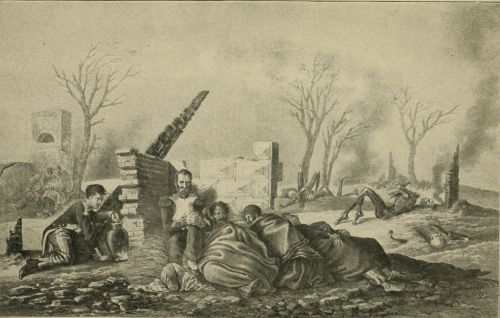
ON THE HIGH ROAD FROM MOJAISKA TO KRYMSKOÏE, SEPTEMBER 18, 1812. From a sketch made at the time by an officer of Napoleon's army.
'And the woman?' he said.
'Who told you anything about her?'
'The sergeant-major. But where is she?'
'I don't know; but I do know that she has a knapsack full of linen, which I want badly, and if ever you meet her you might tell me. She is dressed in a soldier's gray cloak, with a sheepskin cap on her head. She wears black gaiters, and she carries a basket on her arm.'
Grangier thought (as he afterwards told me) that I was light-headed, and, taking me by the arm, he led me down the road, saying:
'We must get on, or we shall not catch up with the regiment.'
We came up with it, however, after passing the thousands of men from all kinds of regiments who walked confusedly, hardly able to drag themselves along. We foresaw, on looking at them, that the journey, if long, would be a fatal one to most of us.
The march was indeed a long one; we passed a place where the Emperor was supposed to sleep, although he had got far in advance of it. A great number of men stopped here, for it was very late, and we heard that two leagues separated us yet from our bivouac in a large forest.
The road here was very wide, and bordered on each side by birch-trees.[32] There was plenty of room for us and the carts and waggons; but when evening came on there was nothing to be seen all the length of the road but dead horses, and the further we advanced, the more the road became blocked with carts and dying horses: whole teams succumbed at once from fatigue. The men who could go no further stopped and made bivouacs underneath large trees; here they said they had wood at hand to make fires from the broken carts, and horseflesh to eat, and these they would not find further on.
For a long time I had walked alone in the midst of a miscellaneous rabble, forcing myself on to reach the camping-place arranged. The road became more difficult at every step, as it had begun to freeze again on the top of the half melted snow, and I fell continually. In the midst of these miseries the night suddenly fell.
The north wind had redoubled its fury. I had lost sight of my comrades; several men, lost like myself, strangers to me, who did not belong to my regiment, by superhuman efforts dragged themselves along to come up with their own regiments. They did not answer when I spoke to them; they were too weak even for that. Others fell down dying, never to rise again. Soon I was alone, with only dead bodies along the road to guide me. The trees had quite disappeared; it was perhaps seven o'clock. The snow, now falling heavily, prevented my seeing the direction in which I was going, and the violent wind had already filled up the traces of the advancing column.
Up till that time I had worn my bearskin cloak with the fur outside, but now, seeing what an awful night was in store for me, I stopped a moment, and turned the fur inside. Owing to this I was able luckily to withstand the cold of this disastrous night, falling to twenty-two degrees of frost. I arranged the cloak over my right shoulder in the direction of the wind, and I walked thus for an hour, during which I am certain I only went a quarter of a league; for, often seized by a blinding storm of snow, I had to turn round and thus retrace my steps without being aware of it. It was only the sight of the dead bodies of men and horses, and the mass of broken vehicles I had passed before, that convinced me I was in the wrong direction. I had then to take my bearings again.
Either the moon or a faint Northern Light appeared in the sky at intervals. Black clouds shot swiftly across this light, but when it was clear it enabled me to distinguish one object from another. I saw far off a black mass which I imagined to be the immense forest we had to cross before reaching the Bérézina, for now we were in Lithuania. I made a guess that this forest was perhaps a league off.
Unfortunately a terrible sleepiness, the certain forerunner of death, began to come over me. I felt quite exhausted; my legs refused to carry me further. I had fallen down half asleep several times, and had I not been roused each time by the cold, all would have been over with me.
The road was here completely blockaded by dead men and horses, preventing me from dragging myself along, for I had no longer the strength to lift my feet from the ground. Whenever I fell it seemed as if I were dragged down by the unfortunate men stretched on the snow. Often these men would try to catch hold of the legs of those who passed, imploring their help, and many, in stooping to give help, fell themselves, not to rise again.
I walked on aimlessly for about ten minutes. I staggered as if I were drunk; my knees trembled under my weight. I thought my last hour had come at last, when all at once I stumbled over a sword on the ground, and fell all my length, stupefied, my chin having struck the butt-end of my musket. Coming to myself a little and getting on my knees, I picked up my musket, and was preparing to stand, when I saw a stream of blood coming from my mouth, and with a cry of despair, trembling with terror, I fell back again.
I had been heard by a miserable man lying a few yards off, and in a feeble voice he begged me to help him—I! so much in need myself. 'Stop! help us!'
The voice ceased; but I remained, still trying to find out who had spoken. Hearing nothing more, I began to think my senses had deceived me, and I called out as loud as I possibly could:
'Where are you?' adding to myself, 'If I only had a companion, we could walk on for the rest of the night encouraging each other.'
Then I heard the voice again, sadder and feebler this time:
'Come here and help.'
At that moment the moon came out, and I saw two men about ten yards off—one stretched at full length, and the other sitting near him. With great difficulty I struggled over a ditch filled with snow, and got near them. The man sitting laughed like a madman when I spoke to him, and said, 'Don't you know—you mustn't forget!' and began laughing again.
I recognised the terrible laughter of death. The other man was still living; turning his head a little, he said these last words to me:
'Save my uncle—help him. I am dying!'
I spoke to him, but he said no more. Then I turned to the other, and encouraged him to rise and come with me. He looked at me without speaking, and I saw that he was wrapped in a great fur-lined cloak which he tried to throw off. I endeavoured, without success, to help him to rise; but on taking hold of his arm I noticed that he wore officer's epaulettes. He began talking incoherently about reviews and parades, and ended by falling on one side with his face in the snow. I was obliged to leave him; if I had remained I must myself have succumbed to the same fate. Before I left I picked up a pouch lying on the ground, in the hope of finding something inside, but it was full of rubbish and papers only. Having regained the road, I walked slowly along, listening as I went, as now I constantly seemed to hear cries of distress.
Soon I began to walk faster, in the hope of coming to some bivouac, and at last I got to a point in the road completely blocked up with dead horses and broken carts. The bodies of men from various regiments were scattered round. Several belonged to the Young Guard, recognisable by their shakos. In this immense cemetery and this awful silence I was alone, a prey to the most gloomy thoughts—of my comrades from whom I was separated, my country, my relations—and I began to cry like a child. The tears relieved me, and gradually my courage came back.
Close to me I found a small hatchet, such as every company carries in a campaign. I tried to cut off a piece from one of the horses, but the flesh was frozen so hard that this was impossible. I had spent the remainder of my strength, and I fell exhausted, but the exertion had warmed me a little. I had picked up with the hatchet a few pieces of ice, which I now found to be blood from the horse. I ate a little of it, and put the rest carefully in my knapsack; and feeling stronger, I set out again, trusting to God's mercy; taking care to avoid the dead bodies, I went on, stopping and feeling my way whenever a cloud passed over the moon.
After walking for some time, I noticed at a short distance off something I took for a waggon. When I got nearer I saw it was a canteen cart belonging to a regiment of the Young Guard. The horses which had drawn it were not only dead, but partly cut in pieces for eating. Around the cart were seven dead bodies almost naked and half covered with snow; one of them was still covered with a cloak and a sheepskin. On stooping to look at the body, I saw that it was a woman. The instinct of self-preservation was at this time the first with me, and, forgetting that I had ineffectually tried the same thing a short time before, I set to work to hack off a piece of one of the horses. I found that this time again I was utterly unable to do it, and so I decided to spend the night in the cart, which was covered. I approached the dead woman to take the sheepskin for a covering, but it was impossible to move it. Noticing, however, that she wore a leather strap round her body, buckled on the other side, and that the strap must be unfastened, I put my musket under her body to act as a lever; but I had hardly done so, when a piercing cry came from the cart. 'Marie,' it said, 'Marie, give me something to drink! I am dying!'
I was stupefied. The same voice repeated directly afterwards, 'Ah, my God!'
Mounting on the body of the horse in the shafts, I steadied myself by the top of the cart. I asked what was the matter. A feeble voice answered with some difficulty, 'Something to drink.'
I thought at once of the frozen blood in the pouch, and tried to get down to fetch it; but the moon suddenly disappeared behind a great black cloud, and I as suddenly fell on the top of three dead bodies. My head was down lower than my legs, and my face resting on one of the dead hands. I had been accustomed for long enough to this sort of company, but now—I suppose because I was alone—an awful feeling of terror came over me. It was like a nightmare. I could not move, and I began screaming like a madman, as if something were holding me. But, in spite of all my efforts, I could not move. I tried to help myself up by my arm, but I found my hand on a face, and my thumb went into its mouth!
At that moment the moon came out and showed me all my dreadful surroundings. I shuddered all over, left hold of my support, and fell back again immediately. But a change came over me now; I felt ashamed of my weakness, and a wild sort of frenzy, instead of terror, took possession of me. I got up, raving and swearing, and trod on anything that came near me—faces, arms, and legs, not caring which; and I cursed the sky above me, defying it, and taking my musket, I struck at the cart—very likely I struck also at the poor devils under my feet.
When I felt calmer, I decided to spend the night in the cart, as some sort of shelter from the cold; and taking a piece of the frozen blood from the pouch, I climbed inside, feeling for the man who had asked me for drink, and who had ever since uttered feeble cries. When I got near him, I saw that his left leg was amputated.
I asked him the name of his regiment, but he did not answer. So, finding his head, I put a bit of the ice into his mouth. The man next him was as cold and hard as marble. I tried to move him, so as to take his place, and be able to leave the next day with those who were still behind, but I could not do it. I now saw that he had only a few moments to live, so I covered him with two cloaks belonging to the dead man, and searched in the cart for anything I might find useful. Finding nothing, I turned round to speak to the man again. I got no reply, and, passing my hand over his face, I found it quite cold, and the piece of ice I had given him still between his lips. His sufferings were over.
I now prepared to leave, but waited to take another look at the dead woman, thinking it might be Marie the cantinière, whom I knew well as coming from my native country. I looked at her carefully by the light of the moon, and satisfied myself that it was not she.
With my musket under the right arm like a hunter, two pouches, one of red leather and the other of gray canvas, which I had just found, slung across me, a piece of the frozen blood in my mouth, and my hands in my pockets, I started off. It was perhaps nine o'clock; the snow had stopped falling, the wind had abated in strength, and the cold was not quite so intense. I continued to walk in the direction of the wood.
At the end of half an hour the moon disappeared again. This was terrible for me. I stopped for a few minutes, stamping my feet on the ground, to prevent their being frozen, and waiting for the light to come out again; but I was disappointed in this, as the moon appeared no more.
My eyes, however, became accustomed to the dark, and I could soon see well enough to go on, but all at once I discovered I was not on the same road. In naturally trying to avoid the north wind, I had turned my back to it. My opinion was confirmed by my not seeing any of the army débris on the road.
I cannot say for how long I had been walking in this new direction, when I saw that I had got to the edge of a precipice. I made the discovery too late, however, to save myself, and I rolled down for at least forty feet, although my fall was broken by bushes on the way. This time I thought that I was quite done for, and, closing my eyes, I resigned myself to God's will. When I reached the bottom I was stunned for a time, but, after all my adventures, I had ceased being astonished at anything, and I soon got up and began to search for my musket, which I had lost in my fall; however, I decided to leave it and wait for daylight. As I drew my sword from its sheath and felt my way, I now became aware of a waggon close to where I had fallen, and the bodies of two dead horses; and feeling something warm under my feet, I found I was standing on the ashes of a half-extinct fire. So I lay down, and bathing my hands in the ashes to warm them, I luckily found a few pieces of coal, and was able by blowing to revive a few sparks. But where could I get wood to relight the fire? I dared not leave the ashes, for fear my sparks might be extinguished for good. I tore off a piece of my shirt, already in rags, made a match of it and lighted it. Then, feeling all round me, I fortunately came upon some tiny fragments of wood, and with much difficulty got them alight. Very soon flames crackled up, and in a minute or two I had quite a large fire.
I could now see for several yards round me, and I caught sight of some large letters on the waggon, 'Garde Impériale. État Major.' Over the inscription was the eagle. As far as I could see, the ground was covered with helmets, shakos, swords, cuirasses, broken chests, empty portmanteaus, bits of torn clothing, saddles, costly schabraques, and quantities of other things. But hardly had I glanced round me, when I became possessed with the idea that this place might be near a Cossack bivouac, and I felt terribly frightened, and dared not keep my fire up any longer. If Frenchmen had been anywhere near, I should have seen some bivouac fires. This place, above all others, sheltered as it was from the wind, would have been chosen for a bivouac. I was at a loss whether to stay or go.
While I reflected my fire had diminished, and I dared not put on more kindling. But at last the desire for warmth and rest overbore the feelings of fear. I picked up as much wood as I could find and piled it up near me. I also collected a number of schabraques to sit on, and wrapping myself in my bearskin cape, with my back against the waggon, I arranged myself for the night.
In putting wood on the fire I had found some horseflesh—enough to stay the hunger which now devoured me. Although covered with snow and ashes, it was more than I had dared to hope for. Since the evening before, I had eaten nothing but half a dead raven I had found, and a few spoonfuls of gruel mixed with grains of oats and rye, and salted with powder.
I hardly waited for my cutlet to be warmed through before I bit into it, in spite of the ash which covered it. In this way I made my miserable dinner, looking round me from time to time, to make sure that things were safe.
My situation was slightly better than before. I was not obliged to keep on walking, I was sheltered from the wind and cold, I had a fire for warmth, and food; but I was so terribly tired that I fell asleep while I was eating—sleep broken, however, by fear, and by dreadful pains in my legs. I felt as if I had been beaten all over. I do not know how long I slept, but on awaking there was still no appearance of daylight. In Russia the nights now are so long, and in summer there is scarcely any night at all.
I had fallen asleep with my feet in the ashes, and when I woke they still felt warm. I had learnt by experience that warmth refreshes tired limbs, and soothes pain, so I picked up and collected all the wood I could find, put it on my fire, and relit it.
I could now see round me again, and on my left caught sight of some object I took for an animal. As there are so many bears in Russia, I felt sure this must be one, especially as it walked on all fours. When it got to a distance of five or six yards off, I saw that it was a man. To guard against a surprise, I drew my sword, and, advancing towards the man, I cried, 'Who are you?' at the same moment placing the point of my sword against his back, as I saw him to be a Russian, a real Cossack with a long beard.
He raised his head and threw himself down like a slave, trying to kiss my feet, and saying, 'Dobray Frantsouz,'[33] and other words which I understood to mean that he was frightened. If he had only known it, I was as much frightened as he. He knelt upright to show me a sword-cut he had had on his face. I noticed then, even in this position, his head reached to my shoulders, so that his full height would be over six feet. I signed to him to come near the fire; then he made me understand that he had another wound—a ball had struck him in the stomach. The sword-cut on his face was frightful. It began at the top of the head, and cut open his face to the chin, losing itself in the beard. He lay down on his back to show me the bullet wound, and I could see in this position that he was unarmed. Then, without saying anything more, he turned on to his side. I sat opposite to him to watch him. I did not wish to sleep again, as I intended before daylight appeared to set fire to the waggon and leave at once; but suddenly the terrible thought struck me that the waggon might be full of powder!
I jumped up, tired as I was, cleared at one bound the fire and the poor devil lying beside it, and set off running, but stumbling over a cuirass in the way, I fell all my length on the ground. I was fortunate enough not to hurt myself; I might well have done so with all the firearms lying about. I got up and walked backwards, my eyes fixed on the waggon, as if I expected an explosion every instant. At last I recovered from my terror, and came back to the place I had left so foolishly, for I was quite as safe there as twenty yards off.
I took off the pieces of burning wood and carefully carried them to the place where I had fallen; then I took the cuirass to gather snow in and put out the fire. But I had hardly begun this work, when I heard a flourish of trumpets, and after listening attentively, I recognised it for the Russian cavalry, announcing that they were not far off. I saw the Cossack raise his head at the sound. I tried to read his thoughts by his expression, for the fire was now bright enough for me to see his features, which were truly hideous. He squinted, and his eyes were deeply set beneath a low, prominent forehead; his hair and beard were red and thick like a mane, giving him a wild and savage appearance. His shoulders were of Herculean proportions. He was probably suffering terribly from his wound, for he writhed as he lay, and from time to time ground his teeth. I was listening to the sound of the trumpets in a dazed sort of way, when all at once I heard another noise just behind me. I turned round, and, to my horror, saw the waggon opening like a tomb, and coming out of it an enormous individual, white as snow from head to foot, like the commander's ghost in the 'Festin de Pierre,' holding up the top of the waggon with one hand, and having a drawn sword in the other. I looked silently at this spectre, walking a few steps backward, and drawing my sword while waiting for it to speak first. It was trying, without success, to unfasten the great white cloak it wore with the hand which held the sword, as the other was engaged in holding up the top of the waggon.
At last, breaking the silence, I asked in rather a trembling voice:
'Are you a Frenchman?'
'Yes, of course I am French! What a d——d silly question! There you stand like a church candle! You see what a fix I am in, and you don't attempt to help me out of this coffin. I seem to have frightened you, my good fellow.'
'Yes, you did frighten me; but I thought you might be another of these beauties'—pointing to the man at the fire.
I helped him out as I spoke, and he threw off his cloak. Imagine my surprise and delight when I recognised one of my old friends of the Grenadiers of the Old Guard, a comrade called Picart—Picart by name and Picard by nation—whom I had not seen since the Emperor's review at the Kremlin! He and I had made our first campaign together; we had been at the battles of Jena, Pultusk, Eylau, Tilsit, and later, in 1809, at Mora, on the Spanish frontier, and other campaigns since then, although not in the same regiment. Picart scarcely knew me again, I had altered so much and looked so miserable. We gazed at each other in amazement—I to see him looking so clean and well, and he to find me so thin, and looking, as he said, like Robinson Crusoe. At last he said:
'Tell me, sergeant, my old friend, by what luck or misfortune do I find you here, alone and at night, with that villainous Cossack. Just look at him! See his eyes! He has been here since five o'clock yesterday, and then he disappeared. I can't think why he has come back. And you? What brought you here in the middle of the night?'
'Before I tell you, have you a bit of something to eat about you?'
'Yes, sergeant, a little biscuit.'
And he opened his knapsack and drew out a piece of biscuit the size of his hand, which I devoured at once. I had not tasted bread since October 27.[34] As I ate I said:
'Picart, have you any brandy?'
'No, mon pays!'
'I thought I smelt something like it.'
'You are right,' he said. 'Yesterday, when the waggon was pillaged, there was a bottle of brandy; but they quarrelled over it, and it was broken and the brandy spilt.'
I said I should like to see the place where it happened, and when he showed me I gathered up some snow à l'eau de vie, just as before I had collected horse's blood à la glace.
'That's good,' said Picart. 'I never thought of doing that. I think we can manage to get drunk, as there were several bottles in the waggon.'
The biscuit and brandied snow had done me a great deal of good, so I related to Picart all that had happened to me since the evening before. He could scarcely believe me; but when I told him of the misery the entire army was suffering, including his regiment and all the Imperial Guard, he was distressed beyond words. The readers of this diary will be surprised that Picart knew nothing of what had been going on. I will tell them the reason of this.