MECHANICAL SUFFOCATION. (continued 2)
Reading edition
The furrow, when once distinct, remains constant for a long time after death, even in putrefaction. Marks from soft substances, however, disappear sooner than those from strong and uniform compression.
The NECK nearly always appears stretched. According to Roth the mobility of the head is increased by this stretching. The HEAD is always inclined to the opposite side to that of the knot. In suicides the head is usually bent forward on the chest. The HANDS are often clinched so tightly that the nails are driven into the palms. This occurs more especially when the hanging has been done with violence. When the feet touch the ground, as often occurs in suicide, the hands may be stretched out. Roth found the hands and feet flexed in 44 of 49 cases. Taylor says that we may expect to find the hands clinched when constriction of the neck is sudden and violent. The LEGS are usually livid.
The FACE varies with the duration of the suspension; at first it is pale, afterward livid; congested and swollen, if the subject has been long suspended. Roth found the face pale in 43 of 49 cases. In about one-half the cases the features are calm and placid (syncope). Maschka found the lips bluish in 98 of 153 cases. The EYES are often prominent, staring, and congested, and usually the pupils are dilated. Lacassagne and Maschka[848] look upon ecchymoses of the eyelids and conjunctivæ, “piqueté scarlatin,” as important as favoring the idea of hanging or strangulation. Roth found in 49 cases the eyelids closed 28 times; half open, 12; congested in 6; ecchymosed in 2. Pupils dilated in 31; narrowed in 2. Dilated in 97½ per cent of Ogston’s cases (Cases 85, 86; rupture of crystalline lens). Harvey[849] says the blood was found flowing from the EAR in 6 cases of nearly 1,500, but no details were given. Ogston, one case. Hofmann saw a case in which there was bleeding from the ears. He says this is not due, as has been supposed, to rupture of the tympanic membrane, but to hemorrhage from subcutaneous vessels (Case 27).
The TONGUE is usually livid and swollen, especially at the base. According to Tidy, Dr. Guy looks on this as showing that suspension took place very probably during life. In about one-third of the cases the tongue is protruded and compressed between the teeth; sometimes bitten. Some observers found it protruded only as a result of putrefaction. The protrusion of the tongue is not believed to depend on the position of the ligature. Hackel in 67 cases found the tongue lying forward in all cases where the cord was between the larynx and the hyoid; in 55 per cent in front of the teeth, in 18 per cent between the teeth; where the ligature was lower down, the tongue was behind the teeth. He found by experiment that in the spasmodic expiratory effort the tongue was thrust forward; in the inspiratory movement, drawn backward. He concluded that the forward movement was the result of reflex action. Maschka[850] found the tongue between the teeth 58 times in 149 cases. Roth in 49 cases found the tongue projecting and bitten in 22, the teeth shut in 15 others; in 15 the mouth was open; the tongue was retracted in 30 cases.
Harvey, after examining reports of nearly fifteen hundred hangings, says: “In the majority of instances immediately after death the features were placid, the face pale, the eyes not unduly prominent, the mouth closed or half open, the tongue pressed against the teeth but not protruding; the superficial veins full, but the head, neck, and trunk free from lividity. After a longer or shorter time, however, and apparently after a very few hours, in India, all this is changed. Livid patches appear about the chest, back, and shoulders; the face and head become bloated and puffy, the tongue and eyes protrude.”
Bloody froth is sometimes seen at the nose and mouth.
Saliva is invariably secreted and runs out of the mouth down on the chin and chest. Its presence is considered as evidence that suspension occurred during life. The URINE and FÆCES are sometimes found to have been expelled. These discharges occur in all kinds of violent death. Tardieu found them, however, but twice in 41 cases of hanging. Roth in 49 cases found discharges of fæces in 17 and urine in 4; in 15 cases not noticed.
Harvey mentions a case where internal piles had burst, and there were stains and clots of blood about the perineum and anus. In such cases without careful examination there would naturally be a suspicion of violence.
In about one-fourth of the cases the GENITAL ORGANS are congested. The penis is large and more or less erect; seminal fluid, generally prostatic, and sometimes mixed with blood, is often expelled. The fluid may pass only into the urethra and it may be necessary to press the urethra to secure it. The clitoris may be found erect, and there may be a sort of menstrual flow. Orfila showed by experiment that swelling of the sexual organs and emission of semen can be produced after death in those who had been suspended during life. The flow of semen is found in all kinds of death by violence. Roth in 39 cases of hanging of men found the penis enlarged 18 times and ejaculation in 19. Hackel found the penis swollen in 43 per cent of cases of asphyxia. Erection may come on soon or late, even days after death.
Internal Appearances.—The CONNECTIVE TISSUE UNDER THE MARK is usually white and condensed, the more so if the body has been long suspended. This dryness or condensation was found by Hackel in 52 per cent of hangings. Deeper-seated parts are injured only when the hanging has been violently done. The MUSCLES, especially the sterno-mastoid, are sometimes ruptured. Hofmann[851] reports several cases. Lesser[852] in 50 hangings saw 11 ruptures of muscle. Maschka never saw the rupture in suicides. The sterno-mastoid was ruptured in the case of Wirtz (Case 96) and Guiteau (Case 95). Hackel in 67 cases failed to find the muscle ruptured. Hofmann[853] believes that the rupture of the muscle is sometimes post mortem. Coutagne[854] found the sterno-mastoid muscle ruptured once in 24 cases (Cases 29, 89, 95, 96).
The LARYNX may be fractured or dislocated. These lesions are very rare in suicide; more frequent in homicide and judicial hanging, and in the old where the cartilages are calcareous. Remer found the injury in but 1 case in 101 of suicidal hanging. Barker found the larynx lacerated in his judicial cases.[855] Harvey says that the TRACHEA was reported lacerated 11 times in nearly 1,500 cases; twice the laryngeal cartilages were separated from each other. In 5 these cartilages were fractured, but there was nothing to show under what conditions. Hemorrhage in vicinity of larynx, 43 times. Pellier[856] reports 1 case, and adds that the existence of the lesion easily escapes notice because of the mobility of the cornua. Roth in 49 cases failed to find any fracture. Pellier found the cricoid was injured oftener than the thyroid, which is the reverse of what is found in strangulation. Cavasse[857] was unable to cause fracture of larynx by hanging the cadaver. Chailloux[858] collected 6 cases of fracture of larynx in hanging. He concluded that the fracture could not be produced on the cadaver by hanging, and is, therefore, caused during life. Coutagne[859] in 24 cases found fracture of thyroid cartilage 8 times (Cases 9, 51, 82).
The HYOID BONE is rarely dislocated. Orfila mentions a case of fracture. Barker found the bone usually fractured in judicial cases. In the case of Wirtz (supra) the greater cornu was broken. Pellier reports 2 cases. Hofmann[860] says the hyoid cornua are often fractured, especially when the ligature is between the hyoid bone and thyroid cartilage. Coutagne found fracture of hyoid bone 8 times in 24 cases. He attributed the fracture to pressure against the spine. Pellier speaks of fracture of STYLOID PROCESS (Cases 51, 84, 88, 89, 95, 96).
Dr. Barker, of Melbourne,[861] states that in 50 cases of hanging by the old method there was not one case of fracture or dislocation of vertebræ. After adopting his suggestion to place the knot near the spine, he found that dislocation occurred between the second and third cervical vertebræ with fracture of the third and pressure on the spinal cord. Death was sudden and complete. The drop in these cases was short, three to four feet. Coutagne thinks that the ordinary mobility of the head, axis, and atlas on each other have led reporters into the mistake of supposing a dislocation of vertebræ. Roth failed to find fracture of vertebræ in any of 49 cases. These injuries are especially rare in suicide; but in violent hanging, dislocation or fracture may occur and also rupture of the ligaments. Harvey gives 5 cases of dislocation of vertebra and 4 of fracture of vertebra in suicides. Three of the latter were doubtful. Tardieu says these fractures have no significance as to the hanging having occurred during life. They can be produced on the cadaver; but infiltration of clotted blood around injured vertebræ shows that suspension occurred during life (Cases 5, 7, 8, 68, 76 to 79, 83, 84, 91, 92, 94).[862]
The CAROTID ARTERIES may be injured; usually the inner and middle coats are torn; and hemorrhage may occur into the wall of the vessel. The common carotids are the ones usually affected, and just below the bifurcation, but the external is also occasionally injured. The injury is said to be due to the stretching and squeezing of the artery, stretching being the most effective since the rupture often occurs at a distance from the mark of the ligature. Such injury of the artery does not prove that hanging took place during life because it has been produced on the cadaver; but hemorrhage into the wall of the vessel or wound or rupture after death is very improbable. Maschka says the lesion is very rare. Tardieu says that the injury to the carotid is rare and therefore unimportant. Pellier reports 4 cases of rupture of carotid in a total of 23. Levy records the experiments of Hofmann, of Vienna, and Brouardel and himself, of Paris, 5 in number. He concluded that compression of the carotid arteries, if it produces obliteration, can cause rapid loss of consciousness and death; and explains why in incomplete suicide the subject is unable to help himself. Coutagne found rupture of carotids 10 times in 24 cases. He insists on the importance of the lesion.
Hofmann[863] says the rupture is always transverse, may be simple or multiple and may occur in suicides; more apt to occur when the ligature is thin. Lesser[864] tabulated 50 fatal cases of suicidal hanging; in 29, he was satisfied that the hanging occurred during life. In 3 of these the skin of the neck alone showed any lesion; there was a double mark, the skin being otherwise bloodless. In 5 the deeper soft parts were the only ones affected. In 3 the skin showed lesions, the deeper soft parts none, but either the hyoid bone, larynx, or vertebræ were involved. In 12 the skin showed no mark, but the deeper soft parts and either the larynx or hyoid bone were involved; and in 6 the hyoid bone only or the bone and larynx were injured. In the remaining cases it was not possible to say that the hanging occurred during life. In 2 cases there were no marks at all; in 9 there were changes in the skin; in 4, changes in the skin and deeper parts; in 2, changes in the skin, deeper parts, and hyoid bone or larynx; in 3, changes in the skin and hyoid bone or larynx, or both. In 14 of the 50 cases the hyoid bone was fractured; in 20 the larynx; and in 1 the vertebræ. The common carotid arteries were injured in 6. The number and severity of the lesions bore no constant relation to the thickness of the ligature, nor to the force used, but rather to the position of the body.
Ecker[865] reported a case of suicidal hanging in a man, age 40, where the soft palate was swollen and filled up the passage so that the air evidently could not enter.
The LARYNX and the TRACHEA are usually deeply congested, of a red color; a violet color indicates putrefaction. Ogston reports mucus but not bloody froth 9 times in the pharynx, 6 in the trachea, and 4 in the lungs, in a total of 40 cases. In one case there was a quantity of blood in the larynx and pharynx. Taylor thinks that pinkish froth in the trachea indicates incomplete obstruction; and Chevers that it is due to spasmodic efforts to breathe when the obstruction is nearly complete. Chevers always found clear mucus in the larynx and upper part of trachea, each follicle being marked by a minute globule of mucus. Harvey states that this was noted a few times in his reports. Baraban[866] discusses the condition of the epithelium of the air passages in hanging.
The condition of the lungs and heart varies according to whether death is due to syncope or asphyxia. Ogston found, in 22 cases, the lungs were expanded in 4 and collapsed in 2.
Harvey says the LUNGS are congested in over seven-eighths of the cases; emphysematous in a few; and subpleural ecchymoses present in a few. Patenko[867] experimented on dogs by hanging them. When the constriction occurred after expiration the lungs were congested; when after inspiration, not congested. In the first case (p. 223) the blood flows from the periphery to the heart and thence to the lungs, but cannot flow from the lungs because of the difficult circulation in the dilated pulmonary vessels and deficiency of intrathoracic pressure. There is in both cases cerebral congestion in the region of the bulb. Tardieu holds that punctiform ecchymoses and apoplexies do not occur in hanging unless suffocation has preceded. Pellier,[868] however, found these ecchymoses 14 times in 22 cases. He says that the lesion is not characteristic of suffocation, and quotes Lacassagne, Grosclaude, Dechoudans, Vicq, Chassaing, and Legroux to the same purpose. Hofmann[869] says that the ecchymoses are relatively rare in adults. Maschka[870] found them 18 times in 153 cases.
Harvey states that the presence of serum in the PERICARDIUM seems more a matter of time elapsed after death than anything else. Still the fact is that it is found much oftener in strangulation than in hanging. The difference is explained by the comparative slowness of death in strangulation. Harvey finds that in about one-half of the cases, if the body is fresh, the right side of the HEART, pulmonary artery, and venæ cavæ are full of dark fluid blood, the lungs being also much congested, and the signs of death by asphyxia well marked. When blood is found in both sides of the heart, it is probable that death is due to neuro-paralysis. When decomposition is advanced all the cavities are often empty. Taylor says that if the examination is delayed for several days, the distention may not be observed.
The STOMACH is often much congested, and this fact might sometimes suggest the possibility of poisoning. The LIVER, SPLEEN, and KIDNEYS are usually much congested. Hofmann[871] says that this occurs in the kidney only when the body has been hung a long time.
The BRAIN is rarely much congested. In 101 cases Remer found hemorrhage but once; and in 106 cases Casper failed to find it. Tardieu[872] says the brain is oftenest anæmic. If, however, the body is cut down and placed horizontally, the blood-vessels of the brain may fill up. Evidence may be found in the brain suggesting insanity and therefore an explanation of a probable suicide. Harvey says that hemorrhages in or about the brain are found in a much larger proportion of cases in India than in Europe in cases of hanging. “No common condition likely to cause extravasation is apparent, only one man being noted as plethoric, but in many the rope seems to have been very tight.” Champouillon[873] reports a case of suicide in a man, age fifty-two; the rope broke and the body fell. The physician who made the necroscopy reported a rupture of the pons Varolii. Champouillon believed that the rupture must have been made in removing the brain from the skull. Wilkie[874] reports a judicial hanging in which a man age about twenty-five, fell about three and one-half feet. A recent clot was found in the brain. The experiments of Brouardel of hanging rabbits showed the brain anæmic.
The conjunction of the following appearances would suggest that the hanging had been of some duration: lividity of face, congestion and prominence of eyes, dryness of skin under the ligature, deep furrow, congestion of sexual organs, swelling and lividity of lower limbs, hypostatic congestion of lungs.
Page experimented on a young cat and young dog; both were hung in the same way. Examination of the cat showed the veins generally engorged; sublingual veins much engorged; tongue protruded slightly and much swollen; no frothy mucus in bronchi. In the dog the tongue did not protrude and was not swollen; right cavities of heart contained blood, left empty; brain and other organs normal. In the cat, the lungs were uniformly congested, dark red; no ecchymoses. In the dog, the lungs were much distended, posterior borders mottled violet; emphysematous patches on surface; no apoplectic effusions; subpleural ecchymoses bright red, irregular, clearly defined in outer surface, most numerous toward the roots and on the lower lobes.
Pellereau[875] gives an account of hanging as seen by him in warm climates. He had not seen the elongation of the neck described nor the erection of the penis, nor subconjunctival ecchymoses, nor fracture of larynx, nor rupture of walls of carotid artery, nor subpleural ecchymoses, nor fracture of vertebra. He always found a mark on the neck; the left cavities of the heart always empty, the right always full of black blood. Mackenzie says that in 130 cases of suicidal hanging, the protrusion of the tongue between the teeth, the open and protruding eyes, clinched hands, and blue nails were very frequent, the tongue was found bitten many times, there were urethral and rectal discharges and rupture of carotid artery. The penis was found erect several times. The hyoid bone fractured 24 times in 93 cases. In no case was the larynx or vertebra fractured. In 73 cases ropes were used; in 30, portions of clothing. The marks of ropes were always well defined, indented, and parchment-like; the marks of soft ligatures faint and reddish. In no case were the muscles of the neck, the larynx, trachea, or large bronchi injured, and in none was there subcutaneous hemorrhage or blister.
Proof of Death by Hanging.
As in strangulation, no single sign in any given case is sufficient of itself to prove that death was caused by hanging. But the sum total of the lesions found, viewed in the light of the surroundings of the body, will suffice to lead to a definite conclusion.
The fact that a body has been found suspended does not of itself prove that hanging caused the death, because the victim may have been killed in some other way, and the body afterward hung up to avert suspicion. Chevers records many cases of this kind.
The value of the presence or absence of marks on the neck and the characters of the marks has been questioned. Orfila, Casper, and Vrolik have shown by experiment that if a body is hanged within one or two hours after death the furrow, parchment skin, lividity, and the density of the connective tissue will appear just as is seen when suspension has occurred during life; but ecchymoses and infiltration, clotted blood in the skin, connective tissue, and muscles of the neck suggest suspension during life.
If a cord is removed immediately after death, there may be scarcely any mark at all.
Tardieu collected 261 cases of suicide by hanging where the subject was not entirely off the ground. In 168 the feet rested on the ground; in 42 the subject was kneeling; in 29 lying down; in 19 sitting, and 3 were huddled up or squatting. Fatal hanging may, therefore, occur in almost any position of body. He shows incomplete hangings by thirteen plates. Taylor also collected reports of 11 cases in a few years; in 3 the subjects were nearly recumbent; in 4, in a kneeling position; in 4, sitting. Remer in 101 cases of suicidal hanging found in 14 that the body was either standing or kneeling; in 1, sitting. Duchesne published 58 cases of partial suspension, 26 of which were new. Some of these failures of complete suspension were due to soft and elastic cords.[876]
Taylor says that “that which is difficult to a conscientious medical jurist in confining himself to the medical facts is often easily decided by a jury from these as well as the general evidence afforded to them.”
The limbs may be secured by the suicide before hanging himself. Persons even with some disability of the hand have suicided by hanging. Blindness is no obstacle, nor age; a boy as young as nine and a man as old as ninety-seven.
Burger[877] fully discusses the question whether the hanging is before or after death.
Hanging—Suicidal, Homicidal, or Accidental?
Hanging is usually suicidal. Lesser[878] states that for three years, 1876-79, there were admitted to the Berlin morgue 274 bodies of “hanged,” of which 272 were suicidal; 2 infants of three and eighteen months, homicidal. One man had first tried to kill himself with sulphate of copper; another by cutting his throat; a woman by cutting her arm. The other cases were uncomplicated. Pellier states that the number of suicides in France from 1876-1880 was 13,445, and nearly all were by hanging. Taylor[879] states that 2,570 persons committed suicide by hanging in England in five years, 1863-67; four-fifths of these were males. Harvey[880] reports for three years 1,412 cases of hanging in India, of which 2 were accidental, in 3 there was presumption of homicide, the rest probably all suicidal.
Feebleness of body does not preclude subjects taking their lives in this way. They sometimes also wound or poison themselves first and hang themselves afterward. A subject being found suspended in a room fastened on the inside, would be suggestive of suicide. The absence of signs of struggling or of any marks of injury also favors the idea of suicide.
The possibility of a suicide breaking a rope, being injured by the fall, and rehanging himself successfully, must be admitted (Cases 57, 58). The possibility of blood flowing after death must not be forgotten.
It is worthy of note that after beating or other violence children and women may commit suicide from shame. Again, as Tardieu says, many have hung themselves while partially intoxicated, and it is likely that some such have just previous to the suicide met with falls or other accidents which have left marks like those of violence. He also records the case of a woman who fastened a cord to a bed-post, put her head in a noose while kneeling on the bed, and made a deep wound in her arm with a razor. She closed the razor, laid it aside, and fainted from loss of blood. She must then have fallen forward and died from the pressure of the cord on her neck.[881]
Homicidal hanging is rare but does occur. Where the hands are tied together; where the injuries produced by the cord are severe; where there are contusions and well-marked ecchymoses; where the laryngeal cartilages and hyoid bone are fractured or the cervical vertebræ dislocated or fractured; or where the carotids are injured or there is hemorrhage into their walls; where there are severe wounds, the hemorrhage from which would be sufficient to threaten syncope; where there are many marks of violence on the body; where there is evidence of a severe struggle—in all these cases murder may be reasonably suspected. The number, situation, extent, and direction of must be carefully noted and weighed. If these are out of proportion to the ligature, the suspension, etc., they strongly suggest homicide, although they may occur in suicide (see Cases 4, 11, 18, 20, 28, 29, 44, 52, 55, 59, 66).
Homicidal hanging may be committed by an assailant who is strong on a subject who is weak, on a child, a woman, an old person; on one stupefied by liquor or narcotic poison; or by many combined against one person.
Cases are reported where injuries were inflicted or poison given, and the subject was afterward hanged to avert suspicion. Most of these cases are those of murder either by strangulation or suffocation (Cases 64, 65, 67, 68, 69, 70, 74).
Sometimes hanging is accidental. Children and even older persons play at hanging successfully. Taylor mentions the case of a boy who witnessed a hanging and afterward tried the experiment himself to ascertain the sensation, and caused his own death.
Tardieu[882] relates the case of a man, T., age 37, of small stature, feeble constitution, very thin, of sinister face, eyes hollow but lively, cunning nose and mouth, who meeting a man aged 81, learned that he had some trouble with his leg and promised to cure him. The old man lived alone. T. told him to buy a strong cord as thick as his little finger and one and one-half yards long, and keep the whole thing a secret. T. would see him at his room at 7 P.M. The old man became suspicious and had T. arrested. The investigation showed that already T. had made away with three old men by hanging, who were known to be opposed to suicide. Their bodies showed no trace of violence. Two others had escaped when the cord was passed around their necks.
Tardieu gives a number of cases of suicidal hanging which were falsely attributed to criminal violence, in which the pressure of public opinion joined to circumstances improperly explained by inexpert physicians caused deplorable judicial errors.
ILLUSTRATIVE CASES.
Suicide.
1. Harvey: Indian Med. Gaz., 1876, xi., p. 2.—Man, age 30. Found hanging by turban to bars of cell door; slip-knot around neck; heart beating feebly; died in about a minute after being cut down. “The point of suspension was forty-seven inches from the ground, the position of the noose twenty-eight inches, and the feet were forty-two inches away from the door supported on the toes.” Experiment showed that the turban could not have borne the full weight of the body. He died from strangulation.
2. Ibid., p. 3.—Insane man, age 60. Put his neck in a V-shaped fork of a tree and let his body swing. A broad abrasion found on each side of neck. Scalp, brain, and membranes much congested; reddish serum in lateral ventricles; two ounces clear fluid in pericardium. Lungs congested; all the heart cavities contained blood.
3. Ibid., p. 5.—Woman, age 28. Two marks of ligature on neck; one deep and circular passed up behind left ear; the other passed from the circular mark behind, crossed it on either side under lower jaw, thence up to chin. Appeared at first to be a case of strangulation following hanging; but the two marks were finally explained, that after the body was taken down it was ordered up again until the police should arrive.
4. Ibid., p. 5.—Man, age 45; first cut his throat and then hung himself. “He had probably only just had time to hang himself before dying.”
5. Ibid., p. 30.—Woman; hung herself with a twisted cloth. There was much ecchymosis about the neck and upper part of chest; lungs much congested; fibrin clot in left mitral orifice; liver, spleen, and stomach congested; transverse ligament of atlas ruptured.
6. Ibid.—Man, age 39. Distinct mark of cord around neck; no other mark of violence; laceration of larynx and dislocation of odontoid process; hands clinched; involuntary discharge of semen; thoracic and abdominal organs normal.
7. Ibid.—Man, age 70. Mark of cord around the neck, superficial in front, deep behind; second cervical vertebra dislocated; tongue slightly protruding; fingers clinched; meningeal vessels engorged; lungs tubercular, congested; right heart contained a little coagulated blood.
8. Ibid.—Sex and age not given. Found hanging on a tree; usual signs; odontoid process fractured; rope in a double noose without knot, a common dooree, such as is used for drawing water.
9. Ibid., p. 32.—Man, age 50. Face livid, eyes red and protruding; teeth clinched; lower jaw retracted; tongue behind the teeth; hands and feet contracted; anus covered with fæcal matter; circular depressed mark of cord around neck, hard as parchment, slightly ecchymosed along edges; some infiltration of blood in connective tissue beneath the cord; some tearing of soft parts; laryngeal cartilage displaced. Brain and membranes congested. Right cavities of heart distended with dark blood. Trachea congested.
10. Hurpy: Ann. d’ Hygiene, 1881, vi., pp. 359-367, with illustration.—Woman, age 77, suicided by hanging in the following way: a short cord was fastened by one end to a table leg; the other end was around her neck; she lay on the floor, face downward, clothing not disordered. The brain was congested; lungs congested and emphysematous; left side of heart empty (see Fig. 23).
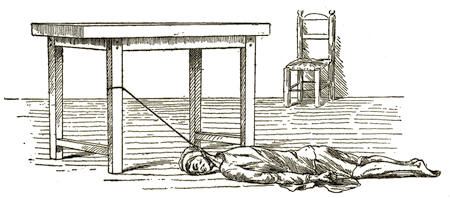
Fig. 23.—Suicide. The cord on the neck is 44 cent. from the cord on the table leg; vertex of head 30 cent. from table leg. Case reported by Hurpy (see p. 717, Case 10).
11. Champouillon: Same journal, 1876, xlvi., p. 129.—Man, age 62; first tried to suffocate himself with charcoal smoke and then hung himself, but the rope broke and the body fell. He lived two days.
12. Pellier: Lyon thesis, 1883, No. 188, p. 72.—Boy, age 16, hung himself; rope broke; he was resuscitated; reddish circular furrow on neck, not like parchment; he had erection and ejaculation; buzzing in his ears and flashes before his eyes.
13. Lacassagne: Pellier thesis (supra), p. 71.—Man; hung himself; was cut down and sent to hospital; was aphonic for four days; then a severe bronchitis set in, and at the end of a week a gangrenous expectoration. The mark of the cord lasted fifteen days.
14. Maschka: Archiv. de l’anthrop. crim., Paris, 1886, i., pp. 351-356.—Man, age about 60, found dead under a tree in the woods near Prague. No sign of violence. A cord thick as a sugar-loaf around the neck; another cord attached to a branch of the tree. There was at first a strong suspicion of violence, but the conclusion reached was that he had hung himself and that the body had fallen from breaking of the cord; that death was due to asphyxia was shown by the furrow on the neck, the dark liquid blood, and the congested lungs. There was no infiltration below the furrow in the neck, and no lesion of larynx. The man had shown signs of melancholy.
15. Friedberg: Virchow’s Archiv, 1878, lxxiv., p. 401.—Suicidal hanging. Examination twenty-eight weeks after death. The front of the neck showed a groove above the larynx, firm and of gray color; ecchymosis in subcutaneous tissue.
16. Bollinger: Friedreich’s Blätt. f. ger. Med., 1889, xl., p. 7.—Man, age 48; found dead. Had made a ligature out of a night-gown and tied it around his neck, the other end around top of a low bed-post; his neck hung by the ligature placed below the larynx. Illustrated.
17. Med. Times and Gaz., London, 1860, ii., p. 39.—Woman; had collected accounts of celebrated persons who had been hanged; finally hanged herself.
18. E. Hoffman: Mitt. d. Wien. Med. Doct. Colleg., 1878, iv., pp. 97-112.—1st. Woman, age about 25; found dead sitting in bed, a handkerchief around her neck fastened to the bed-curtain. The police thought she had been killed and then hung, but the physician concluded that she had committed suicide. An examination of the stomach showed that she had previously tried to poison herself with arsenic.
19. 2d. Woman, age 51; found hanging in half-lying position.
20. 3d. Man, age 50. First tried to kill himself with phosphorus, then sulphuric acid; finally hung himself in a half-kneeling position.
21. Müller-Beninga: Berlin. klin. Woch., 1877, xiv., p. 481.—Man, age 40; hung himself. There was no swelling of genitals and no soiling of clothing. Necroscopy showed death from asphyxia, and in urethra near meatus quite a quantity of seminal fluid, as shown by microscopical examination.
22. Tardieu: Op. cit., p. 18.—The Prince of Condé was found hanging in his room, August 27th, 1830. He was suspended by two handkerchiefs to a window fastening, his feet, however, touching the floor. The knot was at the back of the neck (as shown by the illustration), the face turned slightly to the left, the tongue protruding; face discolored; mucus at the mouth and nose; arms hanging and stiff; fists shut; heels raised; knees half bent. The text says that the knot was nearly under the right ear, but the illustration shows a different position (see Fig. 22, p. 743).
23. Allison: Lancet, 1869, i., p. 636.—Three cases of suicide by hanging, in which there was no mark: 1st. Woman, hung herself with a piece of sheep-net band; cut down before death. 2d. Man, hung with plough-string; cut down in about six minutes. 3d. A heavy man.
24. Tardieu: Op. cit., pp. 93-105.—Woman, died of coma and asphyxia from suicidal hanging, according to report of Drs. Costan and Facieu. Tardieu approved their report. It was at first thought a case of homicide with subsequent hanging, more especially because of the kind of knot used, nœud d’artificier. But Tardieu showed that it was also a nœud de batalier. Her feet touched a chair, and her knees were bent. There was a neckcloth in front of her mouth, but it did not seem to have interfered with respiration.
25. Ibid., pp. 67-72.—The famous case of Marc-Antoine Calas, who committed suicide by hanging (see Voltaire, “Traité sur le tolérance,” etc., in Nouv. Philos. Histor., 1772, xxxii., p. 30). He hung himself to a door. No sign of violence. The city hangman said it was impossible for a man to commit suicide in that way. The father was accused and convicted of homicide. Tardieu shows that the act was a suicide.
26. Ibid., p. 72.—Another famous case. A woman, age 30, hung herself to the key of her bedroom door. Her husband cut her down. He was accused and convicted of the crime and condemned to prison, where he died. Tardieu showed that the case was one of suicide.
27. Hofmann: Wien. med. Presse, 1880, xxi., p. 201.—Man, age 68, suicide by hanging. There was profuse hemorrhage from both ears.
28. Ibid.: 1878, xix., pp. 489-493.—Woman, found dead sitting in bed. She first tried to poison herself with arsenic, then hung herself.
29. Ibid.—Man, tried to poison himself with phosphorus and sulphuric acid, then hung himself. There was a transverse rupture of the sterno-cleido mastoid muscle and suffusion in its sheath.
30. Maschka: Wien. med. Woch., 1880, xxx., pp. 714, 747, 1075.—Man, age 63. It was at first a question of suicide by hanging or homicide by strangling. He concluded that it was the former.
31. Ibid.—Also man, age 58. Similar case. Same opinion.
32. Ibid. 1883, xxxiii., pp. 1118-1120.—Woman. age 23. Question whether she committed suicide by hanging or was strangled and then hung. Opinion, that it was a case of suicide.
33. Hofmann: Allg. Wien. med. Zeit., 1870, xv., pp. 192-214.—Man, age 60. Suicide by hanging or homicide; opinion, that it was the former.
34. Van Haumeder: Wien. med. Woch., 1882, xxxii., pp. 531-533.—Suicide by hanging or homicide. There were many wounds in the head; these occurred during the delirium of typhus.
35. Maschka: “Sammlung gericht. Gutacht.,” etc. (Prag), Leipzig, 1873, p. 137.—Boy, age 9; found dead in sitting position. Injuries on neck and elsewhere. Question, had he hung himself or been choked? Were the injuries inflicted before or after death? Opinion, suicide.
36. Ibid., p. 144.—Boy, age 13. Found hanging in sitting position. Question whether murder, suicide, or accident. Opinion, suicide.
37. Ibid., p. 149.—Woman, age 60; found hanging, sitting position. Suicide or homicide. Opinion, suicide.
38. Ibid., p. 156.—Woman, age 30; found hanging. Opinion, suicide.
39. Ibid., p. 165.—Man, age 63. Suicide by hanging, or homicide by strangling? Opinion, suicide.
40. Berliner: Viert. f. ger. Med. und öff. San., 1874, xx., pp. 245-253.—Woman, age 30; found hanging. Opinion, suicide.
41. Deininger: Friedreich’s Blät. ger. Med., 1884, xxxv., pp. 47-59.—Woman, age 61; found hanging. Opinion given, suicide.
42. Mader: Bericht d. k. k. Rud. Stift., Wien. (1875), 1876, p. 378.—Woman, age 43; tried to hang herself. She was at once cut down, bled, and taken to hospital unconscious. Next day, face red; pulse and temperature normal. Third day, conscious and could speak, but not aloud; tongue twisted and turned to right; paralysis of right hypoglossal nerve. Uvula drawn to left. Skin of right limb felt “furry.” Applied electricity and gave strychnine; phonation was more distinct during the use of the battery. Two months later she was still aphonic, but the vocal cords were in better action. The right hemiparesis was lessened.
43. Grant: Lancet, 1889, ii., p. 265.—Man, age 48; found sitting against a door, hung to the knob by a handkerchief.
44. White: Lancet, 1884, ii., p. 401.—Woman, age 53, insane. Made several attempts at suicide; once with a stocking around her neck, once with an apron; the last time by fastening a portion of her dress to a ladder. She was quickly cut down, cold affusion applied, and artificial respiration (Sylvester). The eyes were prominent and glassy, pupils widely dilated, no reaction to light; conjunctivæ insensitive; lips livid; tongue swollen and pale; face pale; oblique depressed mark on neck, most marked on left side; skin cold; no pulse; no heart-beat recognizable; no respiration; no reflex action. Galvanism failed to arouse any muscular action. The details are too numerous to give all of them. There was reduplication of heart-sounds for several days, due to interference with pulmonary circulation. She recovered both bodily and mental health.
45. Richards: Indian Med. Gaz., 1886, xxi., p. 78.—Man, age 20; suicide; was cut down and lived for four days.
46. Kite: Univ. Med. Mag., 1888-89, i., p. 475.—Man, age 69; suicide.
47. Terrier: Prog. Méd., 1887, vi., pp. 211-214.—Two men, age 29 and 25, insane. Attempted suicide by hanging. Both resuscitated.
48. Nobeling: Aertz. Intellig.-bl., 1884, xxxi., p. 213.—Two suicides by hanging; men, ages 24 and 40.
49. Ritter: Allg. Wien,. med. Zeit., 1886, xxxi., p. 375.—Soldier, found hanging. Cut down in ten minutes. Artificial respiration applied; fifteen minutes later, an effort at respiration; face changing from blue to white and then to red; pulse small, irregular; still unconscious; mark of ligature distinct; a few hours later had a maniacal seizure; gave morphia hypodermically and he slept; was also aphonic. Gradually recovered and returned to duty.
50. Strassmann: Viert. f. ger. Med., 1888, xlviii., pp. 379-381.—Three cases of suicidal hanging in men, ages 27, 37, and 40. The last was found kneeling.
51. Balta: Pest. Med. Chir. Presse, 1892, xxviii., p. 1244.—Man, age 45-50; hanging; suicide. Thyroid cartilage and hyoid bone broken.
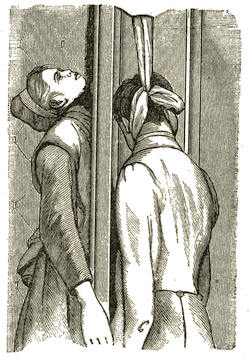
Fig. 24.—Double Suicide (see Case 55).
52. Hackel: Op. cit., p. 35.—Man, found hanging to a beam by a sheet. Had previously tried to choke himself with his hands.
53. Ibid.—Two cases of suicidal hanging where the cord made no mark. In the first the body hung free; in the second the body was partly supported. In the first there was no rubbing of the skin; in the second the body was soon cut down.
54. Freund: Wien. klin. Woch., 1893, vi., pp. 118-121.—Man, found hanging; cut down, but could not be resuscitated. Ligature between hyoid bone and larynx, then crossed over itself about middle line of neck, passed up along each side of face, knotted above the head, then thrown over a beam, and on the other side the loop was caught between his legs.
55. Hoffman: Op. cit., p. 525, illustrated.—Case communicated by Dr. Rosen, of Odessa. Man, age 21, and woman, age 17, hung themselves by same ligature thrown over an open door, one of them on each side. They had previously tried other means of suicide without success (see Fig. 24).
56. Ibid., p. 530.—Man found hanging by handkerchief to branch of tree but sitting on the ground. Mark of handkerchief superficial and pale. When the necroscopy was made the mark had disappeared. Also a similar suicide where there was no mark at all.
57. Ibid., p. 541.—Man found hanging to a window. Another man cut the cord and the suspended one fell into a cellar, fracturing his skull.
58. Ibid.—Man found hanging; cut down; the fall caused rupture of liver.
59. Ibid., p. 539.—Drunkard hung himself; there was evidence that he had previously injured himself during his drunkenness.
60. Ibid.—Boy hung himself because he had been punished by the schoolmaster. There were marks on his back and lower limbs from the punishment.
See also Taylor, “Medical Jurisprudence,” pp. 451-452; Tidy, “Medical Jurisprudence,” incomplete hanging, Cases 33 to 36 and 62; Hofmann, “Lehrbuch,” p. 538.
Homicide.
61. Harvey: Indian Med. Gaz., 1876, xi., p. 3.—Woman, age 20, feeble. Her mother-in-law had kicked her; she probably had fainted; supposing her to be dead, the husband hanged her to a tree within half an hour after the supposed death. Autopsy: No marks of injury; oblique mark of cord on right side of neck; tip of tongue between the teeth; face somewhat livid; right side of heart full of dark blood; lungs congested posteriorly.
62. Ibid., p. 4.—Woman, age 38. Rope close under the chin passed upward behind the ears. Head bent on chest. Large wound above clavicle. Under the rope was a depression (made after death) but no hemorrhage. Much blood in abdomen and a hole in the liver. Kidney bruised and blackened. Right lung torn through; blood in pleuræ. Wounds were supposed to be gunshot, but the husband confessed that he had thrust a sharp solid bamboo into her body and afterward hung it up. She died of hemorrhage.
63. Rehm: Friedreich’s Blät. f. ger. Med., 1883, xxxiv., pp. 332-362.—Man, age 73; first roughly maltreated; afterward hung.
64. Tardieu: Op. cit., p. 125.—Woman found hanging in her room. Circumstances indicated homicidal strangulation and that the hanging was done to avert suspicion. Post-mortem examination showed the base of the tongue ecchymosed, and ecchymosis extending up to the soft palate; mucous membrane of pharynx congested; connective tissue and mucous membrane between hyoid bone and larynx congested posteriorly; epiglottis showed slight ecchymosis, mucous membrane red. These ecchymoses were not caused by the cord, for the latter was placed below the hyoid bone and this bone was not broken. There were also marks on the collar-bone like the mark of two hands.
65. Ibid., p. 124.—Girl, 15 years old. Body found hanging. Post mortem showed beyond doubt that she had been violated, then strangled, then hung. Her head showed many ecchymoses from either the fist or the foot; blood flowing from left ear. Brain slightly congested. Tongue between teeth, bitten and bloody. On front of neck were two marks: the lower were impressions of fingers close together, nearly uninterrupted, and which had bruised, flattened, and tanned the skin, which here was dry, hard, and horny. This lesion was above the intraclavicular notch and extended toward the sides of the neck with regularity of curve and neatness of imprint, evidently made with the right hand. Above the first furrow under the skin was a kind of track, less extended, more regular, a bruising of the same nature as the preceding, but continued, due to the pressure of the index finger and thumb of left hand. A little below the jaw was a livid place on the skin, which was otherwise unaffected by the ligature. There was nothing to indicate a circular action of the ligature. Froth in larynx and bronchi. Lungs apparently normal. Food had passed from stomach into œsophagus and air-passages.
66. Ibid., p. 122.—Woman found hanging in her room, and was resuscitated. She stated that the man who lived with her had tried to strangle her and then hung her. Tardieu saw her in hospital. Respiration short and embarrassed; pains in neck and jaw. Found narrow, circular, sinuous, horizontal, uninterrupted line around the neck below thyroid cartilage; line everywhere equal, deep, and three to four mm. wide; the skin excoriated and covered with thick crust. Below this were several superficial excoriations. There were many contusions on other parts of the body. Tardieu concluded that the mark on the neck was from attempt to strangle; the wounds elsewhere to prevent resistance. She had at the time pulmonary consumption. She died of this disease aggravated by the assault.
67. Ibid., p. 106.—The Duroulle affair. Woman found hanging. Presumption of homicide; arrest of husband; acquitted. She was found with her face to the floor, one end of a cord around her neck; another similar cord attached seven feet above to a rafter, over which it passed three times. Bidault and Boulard reported it a suicide. The results of the post mortem were as follows: Skin of a red-violet color; face swollen; eyes prominent and congested; conjunctivæ a vinous red; lips violet; tongue swollen, tip between teeth; froth in air-passages; lungs congested; brain congested; blood fluid. Circular depression around neck with congestion of skin above and below; ecchymosis in subcutaneous tissue on level of angle of jaw and about one centimetre in size, supposed to correspond to the knot. Tardieu reported that the marks rather resembled those of strangulation than hanging; the ecchymoses were more like those produced by the hand over the mouth. The marks on the face supposed to have been made by a supposed fall of the body were by him considered to have been caused by violence. He believed the woman had been strangled and then hung.
68. Ibid., p. 130.—The Daugats affair. Man found hanging, sitting on the ground, head and trunk somewhat inclined to the left; legs stretched out; clothing not disordered; the part of the cord which was around the neck was applied to the neck of the waistcoat and shirt; on his head a woollen cap. The ground had been recently swept. Necroscopy twenty-four hours afterward. Face pale; right eye open and prominent, left closed; mouth closed, contained food apparently from the stomach; tongue retracted; slight mark on neck under which the tissue was normal: atlas dislocated on axis, but tissues around were normal; no lesion in spinal canal; penis not erect; moisture having the odor of urine on the shirt; large ecchymosis and infiltration of left cheek; extensive contusions on scrotum, with hemorrhagic infiltration, especially around right testicle. Veins of head engorged with black fluid blood. Brain normal. Some black fluid blood in right cavities of heart, left side empty. Lungs black. Other organs normal. Causse and Orfila concluded that the man had been suffocated and then hung. The wife and son confessed that they had injured the testicle through the pantaloons; he then fainted; they then suffocated him with the woollen cap placed over the mouth and nose; the son kneeled on the man’s belly, the body was then hung up and the head violently twisted.
69. Passauer: Viert. f. ger. Med. und öff. San., 1876, xxiv., pp. 26-49.—Woman found hanging in a kneeling position. The ligature on the neck was loose. The necroscopy showed the following: Tongue between the teeth; eyelids swollen and livid; livid spots on face and left ear; lower lip torn; a number of marks on neck; one red stripe not sharply limited; skin not parchmenty and no ecchymosis; ecchymoses of scalp; periosteum of skull reddened; hemorrhage in temporal muscle; brain and pia mater congested; much fluid in ventricle. Larynx and trachea dirty red-brown; right side of heart empty; a little dark fluid blood in left; great vessels, including aorta, containing much dark fluid blood. Lungs congested and œdematous. Liver, spleen, and kidneys congested. Opinion given that she died of asphyxia and was either choked or hanged. Reference to Royal College of Medicine, Königsberg, where the opinion was given that she died of injuries on head and neck and was afterward hanged.
70. Becker: Same journal, 1877, xxvii., pp. 463-473.—Woman, age 52; found hanging. Death caused by shock and incipient asphyxia from strangulation and probably the wounds on head and limbs.
71. Maschka: “Samm. gericht. Gutacht.,” etc. (Prag), Leipzig, 1873, published a number of interesting cases, in each of which there was a question raised as to the cause of death.
72. Ibid., p. 127.—Man found dead. Had he been strangled or hung, or had he died some other way? Opinion, death from paralysis of the brain.
73. Ibid., p. 133.—Woman, age 42; found hanging; a mark around her neck. Did she hang herself or die of other injuries? Opinion, died of other injuries.
74. Rehm: Friedreich’s Blätt., 1883, xxxiv., pp. 322-362.—Man, age 73; found hanging. Opinion, while weak, sick, and suffering from wounds inflicted by his own son, he was hanged by his daughter-in-law.
75. Hofmann: “Lehrbuch,” p. 538.—A father hung his five children, the eldest 9 years. Another man hung two children, the eldest 13 years.
See also Tidy, “Med. Juris.,” Cases 40, 48, 51, 57(?), 58(?); “Hanging after Death,” Case 50.
Judicial Hanging.
76. MacLaren: Indian Med. Gaz., 1873, viii., p. 234.—Three cases of judicial hanging; hung at the same time and cut down and necroscopy begun forty minutes afterward; drop twelve inches. In the first and third there were reflex movements for a few minutes after drop fell. First man, age 40; pupils slightly dilated; no protrusion of tongue or eyeballs; mark of cord above thyroid cartilage; no discharge of semen or fæces; ecchymosis under cord, left side; dislocation of atlas from axis; odontoid ligaments ruptured; transverse ligament uninjured. Brain and membranes much congested; clear fluid in lateral ventricles. Lungs collapsed, anæmic; one ounce straw-colored serum (measured) in pericardium; dark fluid blood in both ventricles of heart; liver much congested.
77. Second man, age 16; pupils widely dilated; eyeballs protruding. Marks of cord same as in preceding case. No discharge of fæces or semen. No ecchymosis under cord; dislocation and rupture of ligaments between axis and third vertebra. Brain did not show well-marked congestion. Lungs collapsed and anæmic. One and one-quarter ounces serum (measured) in pericardium. Heart normal; dark blood in both ventricles; liver normal.
78. Third man, age 20; pupils slightly dilated; eyeballs and tongue not protruded. Marks of cord as in preceding. No discharge of fæces or semen. Slight ecchymosis under cord; mark in front of neck. Dislocation of occipital bone from atlas. Brain and membranes much congested. Lungs collapsed and anæmic. Half ounce serum in pericardium. Heart normal; dark fluid blood in both ventricles; liver normal.
79. Cayley: Ibid., p. 122.—Man, age 35; executed by hanging. Scarcely any convulsive movements after drop fell. Necroscopy two hours afterward. No congestion or protrusion or swelling of the tongue; no muscular rigidity or contractions. About half-way around the neck was indentation of cord, obliquely directed; hardly perceptible in front; its surface appeared rubbed and compressed; no discoloration; no ecchymosis under skin. Cord lay across upper part of thyroid cartilage. Larynx and trachea not injured. Fracture and dislocation of upper cervical vertebræ. Lungs collapsed, not congested. Pericardium empty; heart distended, left side with red blood just beginning to clot; right side with fluid black blood. Liver and other abdominal organs much congested. No discharge of fæces or semen.
80. Garden: Same journal, 1880, xv., p. 12.—Man, age 40, weight about one hundred and twenty pounds; drop two feet; was in a fainting condition, and had to be supported; was not probably fully conscious when platform fell. There were spasmodic retractions of arms and legs for about two minutes; forty seconds after the drop his jungeas fell off; his penis was in strong erection, and the ejaculatory movements were seen. Necroscopy one and one-quarter hours after drop fell. Head and limbs cold; eyes open, natural; tongue not protruding; fingers clinched; superficial veins contained fluid black blood. Mark of cord extended from just below left mastoid process, where the knot was applied, across the thyro-hyoid membranes to a place on right side about two inches below ear. There was scarcely a trace of it behind. Skin dark and ecchymosed, but no ecchymosis of subcutaneous connective tissues. No discoloration nor fracture in neck. Subarachnoidal fluid in excess; puncta vasculosa unusually numerous. Under surface of epiglottis reddened and showed two small dark red ecchymoses; mucous membrane of larynx and trachea pale. Lungs showed venous congestion; no infarctions or small ecchymoses; right lung emphysematous; the left showed old firm adhesions throughout. Heart large, flabby, pale, a very little blood in each ventricle; subpericardial ecchymosis one-fourth inch square anteriorly, another larger one posteriorly; extensive pericardial adhesions. Liver and kidneys congested.
81. See two cases of judicial hanging by Wilkie, same journal, 1881, xvi., p. 275.
82. Porter: Archiv. Laryngol., New York, 1880, i., p. 142.—Redemier hung. Drop five feet. Pulse beat rapidly a few minutes, then lessened in frequency and stopped beating in fifteen minutes. During this time there was violent spasm of muscles of thorax and upper limbs. Necroscopy, dark groove around neck crossing larynx just below pomum Adami. Brain congested. Lungs emphysematous. Cricoid cartilage fractured diagonally. Laryngeal mucous membrane showed ecchymosis and œdema. Vertebræ neither fractured nor dislocated.
83. Another criminal hung at the same time had dislocation of cervical vertebræ.
84. Fenwick: Canada Med. Jour., 1867, iii., p. 195.—Man executed; drop six feet; second cervical vertebra torn from attachment to third; medulla torn across; hyoid bone and tongue torn from thyroid cartilage; general congestion of viscera; lenses normal; eyes congested; clot between sclerotic and choroid coats left eye.
85. Dyer: Trans. Amer. Ophthal. Soc., 1866, p. 13.—Man, age 24; weight one hundred and seventy-four and a half pounds; drop three feet; knot under left ear; for two minutes at intervals, slight motion of abdomen, like effort at respiration, and at same time knees drawn up a little. Death speedy and quiet. Cut down at end of thirty minutes. Necroscopy thirty-five minutes after drop. Body and head moist and warm; emission of semen; face livid; upper lid discolored; abrasion of skin under right ear; deep red mark around neck. Eyeballs not prominent; eyelids closed; corneæ dull; pupils a little dilated. Both lenses fractured. Brain normal; spinal cord normal. Heart empty.
86. Dyer: Same Trans., 1869, pp. 72-75.—Man hung. One eye showed fracture of lens, the other lens showed fine lines. A second case showed dislocation of a cataractous lens. A third showed fissure of lens.
87. Green: Same Trans., 1876, p. 354.—Man hung; drop seven or eight feet. Died quietly and without struggle. One-half to one hour after drop fell, eyes were examined. No lesion of capsule or lens.
88. Keen: Amer. Jour. Med. Sci., 1870, lix., p. 417.—Two criminals hung; drop five feet. Hyoid bone fractured in one; no fracture of vertebræ in other.
89. Clark: Boston Med. and Surg. Jour., 1858, lviii., p. 480.—Execution of Magee. Man, age 28; weight 130 pounds. Drop seven to eight feet. No struggle nor convulsion. Urine discharged at once. Seven minutes after drop fell, heart-beat one hundred; nine minutes, ninety-eight; twelve minutes, sixty and fainter; fourteen minutes, not audible; twenty-five minutes, body lowered. Face purple; pupils dilated; eyes and tongue did not protrude. Mark of cord just above thyroid cartilage, a deep oblique furrow except a small space under left ear; knot over mastoid process. Forty minutes, cord and strap removed; body, especially face, became paler. Necroscopy a little over an hour after drop fell. Body pale; skin mottled; small ecchymosis just above line of cord right side. Right sterno-mastoid muscle torn. Hyoid bone fractured; spine not injured. No seminal discharge. Ninety minutes, pulsation in right subclavian vein; heart-beat, eighty per minute; thorax opened, heart exposed; right auricle showed full and regular contractions and dilatations. The spinal cord was then divided. One hundred and twenty minutes, heart-beats forty per minute. These pulsations of right auricle continued at intervals for three and a half hours longer; readily excited by point of scalpel. Heart normal; left ventricle contracted; right ventricle not so; no coagulation. Brain normal; lungs collapsed; liver and spleen congested; mucous membrane of small intestine pinkish; other organs normal. In the discussion, Dr. Gay thought the absence of cerebral congestion was due to the circulation continuing in the left carotid.
90. Hofmann: Wien. med. Woch., 1880, xxx., pp. 477-480.—Man, a criminal, hung; after hanging ten minutes, the body was cut down. Examination half-hour after drop fell. He was resuscitated and partly regained consciousness, but died three days afterward of œdema of lungs after repeated severe convulsions. He had tumors of the neck which probably interfered with the compression of the trachea. See also Allg. Wien. med. Zeit., 1880, xxv., p. 161, and Wien. med. Blät., 1880, i., pp. 423-430; translated in Ann. Mal. Oreill. and Larynx, Paris, 1880, vi., pp. 99-112.
91. Kinkhead: Lancet, and 701-703.—Cases of hanging. In one, the body of the third cervical vertebra was broken across and the two pieces separated; in another case dislocation of second and third cervical vertebræ.
92. Nelson: Southern Clinic, 1885, viii., pp. 198-202.—Two colored men hung; drop five feet. In one there was atlo-axoid dislocation.
93. Dercum: Phila. Med. Times, 1886-87, xvii., p. 368.—Description of the brain of a man executed by hanging.
94. Kirtikar: Trans. M. and P. Soc., Bombay, 1885, vi., pp. 104-107.—Man, age 25, and woman, age 35. Both hanged. Drop nine feet. Knot tied over cricoid cartilage, a little to left side. In falling, the knots slipped to below the ear. There was fracture of the body of third cervical vertebra and rupture of ligaments. The cord was ruptured in each; in the woman in two places—once at the third cervical, the other at the dorso-lumbar junction.
95. Lamb: Med. News, Philadelphia, 1882, xli., pp. 42-45.—Execution of Guiteau. Drop six feet; knot placed under left ear, but slipped to back of head. Yellowish furrow a few lines wide around the neck, directed downward and forward. Sterno-mastoid muscles torn transversely about midway of their length. Thyro-hyoid ligament ruptured; hyoid bone and thyroid cartilage widely separated. Large blood-vessels not injured. No fracture or dislocation of vertebræ.
96. Thomson and Allen: Catalog. Surg. Sec. Army Med. Mus.; specimens 298 to 302.—Execution of Wirtz. Rope one-half inch diameter; drop five feet; knot under left ear. Several slight shrugs of shoulders, after which body was quiet; let down in fifteen minutes. No involuntary evacuation. Face pale, placid. Eyes partly open; pupils dilated; slight injection of conjunctivæ. Mouth open; tongue not protruding. Just above thyroid cartilage extending on right side from median line in front to spinous process was a dirty brown deep furrow with congested walls; on left side a line of discoloration due to direct action of rope. Soft parts above and below the line much swollen, particularly on right side. Larynx and hyoid bone unnaturally mobile. Right trapezius muscle torn; sterno-mastoid divided transversely, leaving an interval of two inches. Slight ecchymoses between muscle and larynx. Ecchymoses on ligamentum nuchæ. Hyoid bone, both greater cornua fractured and dislocated from body; lesions more marked on right side. Several small ecchymoses in vicinity. Larynx not injured. Brain normal. No bloody or frothy mucus in air-passages. Lungs not congested. One drachm of straw-colored serum in pericardium. Heart empty. Abdominal organs normal. Bladder somewhat distended with urine.
See also Tidy, “Med. Juris.,” Cases 1 to 4 and 60.
Accident.
97. Harvey: Indian Med. Gaz., 1876, xi., p. 3.—Boy, age 1½ years; was swinging by two ropes attached to two posts; the ropes became twisted around his neck. Necroscopy showed mark of very small rope in front of neck from ear to ear; mucous membrane of larynx dark; lungs much congested.
98. Hackel: Op. cit., p. 35.—Man, age 19, sitting on a load of wood, with the lines around his neck, fell and was hung by the lines.
99. Biggs and Jenkins: New York Med. Jour., 1890, lii., p. 30.—Case 16; child, 6 months old, sitting on a high chair, fell between the chair guard and seat and was asphyxiated by compression of neck.
See also Tidy (op. cit.), Cases 53 and 54.
SUFFOCATION.
The term suffocation is applied in a special sense to the act and condition of preventing access of air in other ways than by pressure on the neck, as by pressure on the chest, by obstruction at the mouth or nose, by obstruction in the air-passages or on them from neighboring organs, by irrespirable gases, etc.
This article will consider all of these except drowning and irrespirable gases, which are treated of elsewhere by other writers.
Smothering is generally understood to mean the act and effect of stopping the mouth and nose.
Causes.
External Causes.—Overlaying is a frequent cause of suffocation in infants, which in such cases have usually occupied the same bed with one or both parents. In some cases the parents have been drunk or otherwise unable to prevent the injury, and the infant may also be partly stupefied with the alcohol derived from its mother’s milk. Infants are also sometimes overlaid by domestic animals. Again, they have been suffocated by being pressed too closely to the mother’s breast, or by covering with bedclothes, shawls, etc. Noble[883] attributes some cases of asphyxia in the new-born to anæmia of the brain from pressure on the skull by forceps, etc., and recommends as treatment for this condition hanging the child head downward, so that the blood may gravitate to the brain (Cases 12 and 30).
Infants are sometimes smothered for mercenary purposes.
Persons have been suffocated by the pressure of a crowd. Pressure on the chest combined with forcible closure of the mouth and nose was the method of Burke and Williams, in the notorious burking murders (Case 58). The close application of a hand, cloth, or plaster over nose and mouth is of itself sufficient to cause suffocation, especially in children and feeble persons. Pressure on the abdomen crowds up the diaphragm and interferes with breathing. It is very likely that no external mark will be found in cases of pressure on the chest and abdomen, but the lungs will be marbled and emphysematous.
Taking plaster casts of the face and neck without inserting tubes in the nostrils has caused death in some cases. Suffocation often follows the falling of walls, houses, banks of earth, piles of coal or corn or wheat. One may fall into and be imbedded in some mobile substance as coal, wheat, corn, quicksand, or nightsoil, and be suffocated. Infants have been destroyed[884] by burying them in manure, ashes, bran, etc. In these cases there is not only the entrance of the foreign body into the air-passages, but the pressure of the mass against the chest and abdomen.
Internal Causes.—The air-passages may be closed up by foreign bodies within them, or within adjoining organs, especially the œsophagus. A great variety of substances in one of these two ways has caused suffocation: mud, cotton, rags, corn, meat, beans, pepper, potato skins, the fang of a tooth, artificial teeth, buckles, shells, flint, buttons, screws, crusts of bread, bones, fruit, stones, heads of grass, coins, slate pencils, nuts, nut-shells, shot, penholders, worms, fish, etc. (see Cases 6 and 55). Taylor[885] states that there were eighty-one deaths in one year in England and Wales from food in the air-passages.
Should an inspiration occur in the act of vomiting, the vomitus may pass into the air-passages; a similar accident may occur in a person who attempts to swallow and speak at the same time. Infants have been suffocated by inspiring vomited milk. Fitz[886] states that food may pass from the digestive tube to the air-passages after death.
A case of suffocation in an infant by retraction of the base of the tongue is recorded. It has been stated that negroes have committed suicide by doubling back the tongue into the throat, or, as it is called, swallowing the tongue.[887] In giving anæsthetics, the subject being supine, and the head and neck somewhat flexed, the tongue, epiglottis, and soft palate may fall backward and suffocation may follow. Howard[888] states that pulling the tongue forward under such circumstances may reopen the pharynx, but will not lift the epiglottis. The thorax should be raised and head and neck extended backward. He believes that in giving anæsthetics the head should be lower than the shoulders. In order to avoid vomiting no food should be taken for some hours before the anæsthetic.
Cases are recorded of artificial teeth having fallen from the mouth into the air-passages during anæsthesia and sleep, and in epileptic and puerperal convulsions. It would appear advisable that these teeth should be worn only while eating (Case 13).
Hemorrhage from the lungs, from rupture of an aneurism or from injury of the mouth or throat, may make its way into the air-passages and cause suffocation. So also the bursting of an abscess of the tonsils or other part near the air-passages (Case 7).
Œdema of the glottis from scalding or other irritation of the fauces or glottis, or from disease of the kidneys; tumors pressing on some portion of the air-passages; rapid, profuse bronchial secretion in infants; acute double pleuritic effusion; cheesy glands ulcerating into trachea; simultaneous œdema of both lungs—all of these may cause suffocation (Cases 18 and 49). [For cases of enlarged thymus gland, see Hofmann, op. cit., pp. 587, 588.]
Paralysis of the muscles of swallowing, from diphtheria or other cause, predisposes to suffocation. Progressive asthenia in which the muscles are exhausted; injury of spinal cord or pneumogastrics; paralysis of muscles of respiration from the use of curare; the spasms of tetanus and strychnia poisoning; the entrance of air into the pleural cavities with collapse of the lungs—all tend to cause mechanical suffocation either by pressure or by paralysis (for deaths in epileptics, see Cases 1, 10, 11, 33, and 40).
It is not necessary that the air-passages should be absolutely closed to cause suffocation.
The cause of death is more likely to be pure asphyxia, because of the absence of the complicating pressure of the hand or ligature on the vessels and nerves of the neck, and of fracture of larynx or vertebræ.
Symptoms.—Foreign bodies[889] entering the trachea naturally fall toward the right bronchial tube instead of the left because of the size and position of the entrance of the right tube. If then but one tube is involved, the signs will usually be on the right side; whereas if the foreign body stop in the larynx or trachea, both sides will be affected. The latter condition is much more dangerous. The symptoms would be resonance over the lung with the respiratory murmur partly or wholly absent; less mobility; puerile breathing on the unaffected side. In either case there may at first be little disturbance, especially if the shape of the foreign body is such as not to greatly interfere with the access of air; otherwise there may be at once, and almost always will be after a time, more or less urgent dyspnœa. Diminution of the necessary oxygen may cause convulsions, apoplexy, and other brain symptoms. Acute emphysema of the portion of lung not obstructed may follow its forcible distention. The local effect of the foreign body is an irritation which causes spasm and cough. It may be carried upward by the expirations and downward again by each inspiration. Inflammation is likely to appear eventually and may involve the lung. If the obstruction is not complete there may follow periods of alternation of good and bad health, ending perhaps in recovery. The foreign body may be expelled after a greater or lesser interval. On the other hand death may result from secondary causes. In the absence of correct history the symptoms may lead to a wrong diagnosis and inappropriate treatment; as where a patient whose symptoms resulted from the presence of a piece of bone in the larynx, was treated for syphilis. A foreign body may be coughed up from the lung into the trachea and fall backward into the opposite lung.
Partial closure of the larynx, most likely caused by a flat or irregular substance, rather than globular, may cause gradual asphyxia with symptoms of apoplexy, making the diagnosis difficult.
When a foreign body remains a long time in the larynx, spasmodic cough and croupy breathing usually ensue, expectoration tinged with blood, hoarseness, or complete aphonia, pain, dyspnœa, possibly crepitation and dulness over the lungs. The case may end suddenly in death from closure of the glottis, or the foreign body may pass into the trachea and set up a new train of symptoms, or it may be expelled.
The frequency with which foreign bodies in the pharynx or œsophagus obstruct respiration, and the facility with which they may usually be removed, suggest a careful examination. Otherwise the patient may be treated indefinitely for supposed obstruction in the air-passages. Foreign bodies in the œsophagus have perforated into the trachea, and even the lungs, heart, and aorta.
In complete suffocation death will occur in from two to five minutes (see remarks under Strangulation). Death may also occur instantaneously.
The experiments of the Committee on Suspended Animation[890] showed that when the trachea of a dog was exposed, incised, and a tube tied in, the average time covered by the respiratory efforts after stopping up the tube with a cork was four minutes five seconds; the heart-beat stopping at seven minutes eleven seconds on the average. After four minutes ten seconds it seemed to be impossible for the dog, unaided, to recover. Faure[891] made the following experiment upon a large dog: He fixed a cork in the trachea. At first the dog was quiet; it then extended its neck, parted its jaws, and made efforts as if to vomit; then tried to walk, but its gait was uncertain; fell down and rose up. Its eyes became dull, and finally it fell down on its side, and became convulsed; then after several seconds stretched itself out. The thoracic movements were at first tumultuous, then became rapidly feeble; the heart beating very slowly. At the necroscopy the lungs filled the thorax, were full of thick dark blood and emphysematous. The blood was black and fluid in the left ventricle and arteries, and in the right cavities and veins resembled molasses. Liver darkly congested. There was no mucus in the trachea and no ecchymosis in the lungs. He also (p. 306) tried the experiment upon a large dog of fastening boards against its thorax and tightening them by means of cords. For some minutes it was quiet, but suddenly it became much agitated, stood upon its hind legs, threw itself against the wall, rolled on the ground, and uttered frightful cries; finally fell on its side. There was no movement of the thorax, but the muscles of the neck and belly were in full and rapid action, dry and sonorous râles were heard, and a large quantity of mucus appeared at the nose and mouth. The movements grew feebler, the respirations infrequent, and at the end of thirty-four minutes it was dead. The necroscopy showed the blood black and thick; heart relaxed; lungs red, a little emphysematous, containing but little blood, and on their surface were blackish points and small red spots.
The death of Desdemona (Shakespeare’s “Othello”) has been much criticised. The declaration that she was strangled (or suffocated) does not consist with the symptoms described (see Med. News, Philadelphia, May 1st, 1886, p. 489).
Treatment.
The obvious indication is to search for and remove the obstruction. The means and methods of treatment are fully treated of in surgical works, but may be briefly mentioned here.
Laryngoscopical examination may be necessary. A curved forceps is usually the best instrument for removing the foreign body. A tallow candle may serve to push it into the stomach if there is no bougie at hand. Suction may be used. Sneezing may be brought on by tickling the nostrils; coughing by tickling the glottis; vomiting by irritating the fauces, or by emetic; the body of the subject may be inverted and in this position the fauces may be tickled, or fingers may be passed back into the pharynx. Johnson[892] says that at the moment of inversion the patient should try to take a deep inspiration; this opens the glottis and facilitates the expulsion of the foreign body. The inspiratory current has no appreciable effect in retarding the movement of the foreign body in the direction of gravity.
Noble recommends inversion of the body in new-born infants in which asphyxia may be supposed to be due to anæmia of the brain. Tracheotomy or laryngotomy may be necessary. It may be necessary to administer oxygen. Foreign bodies like beards of grass and fish-heads can be withdrawn only with difficulty because of their sharp projections. Intense suffering and dyspnœa in a robust subject may necessitate venesection. Generally speaking it is better to bring up the foreign body than to push it down into the stomach. Beveridge suggests to blow into the ear, to induce a reflex action and cause expulsion of the foreign body. Cold affusions, artificial respiration, galvanism, frictions of the limbs, artificial heat, stimulants by mouth and rectum, may one or all be needed.
Hamilton[893] says that it is useless to expect good results from electricity if five minutes have elapsed since life appeared to be extinct; Althaus,[894] that three hours after death the muscles will cease to respond to faradization; and Richardson,[895] that a low temperature prolongs the sensitiveness of the muscle.
With regard to insufflation, Le Bon[896] objects to it in asphyxia as being hurtful and not useful. Colin[897] tamponed the trachea of a horse; in four minutes fifty seconds it was apparently dead; the tampon was removed and insufflation practised for fifteen to twenty minutes without effect. He claims that artificial respiration is useless after the circulation ceases.
Fell[898] and O’Dwyer[899] recommend forced inspiration. McEwen[900] uses a tracheal tube by the mouth.
Dew[901] offers a new method of artificial respiration in asphyxia of the new-born; Lusk[902] considers the subject of life-saving in still-births; Forest,[903] artificial respiration in the same; Read[904] discusses Schultze’s method with approval; Duke[905] plunges the infant into hot water; Richardson[906] recommends artificial circulation by injection of vessels, or electric excitation; Jennings[907] recommends the same; Richardson[908] also considers fully the subject of artificial respiration and electrical excitation; Woillez[909] has described and recommended what he calls a spirophore.
After the removal of a foreign body the irritation remaining may cause a sensation as if the body was still lodged.
Death may occur from hemorrhage after its removal.
Post-Mortem Appearances.
These are mainly those of asphyxia. There may also be evidences of external violence, homicidal or accidental, as of pressure on the chest. Persistent deformity, flattening of the nose and lips, and excoriation of these parts may result from forcible closure of mouth and nose.
The SKIN AND CONJUNCTIVA usually show patches of lividity and punctiform ecchymoses; especially lividity on the lips and limbs. The face may be pale or violet; it is often placid, especially if the suffocation is accidental. Tardieu[910] admits that infiltration of the conjunctiva and punctiform ecchymoses of the face, neck, and chest may also be found sometimes in women after severe labor, and in epileptics. He records the result of the examination of those who died from suffocation at the Pont de la Concorde, 1866. The face and upper parts of the trunk were generally light red to a deep violet or black color, with punctated blackish ecchymoses on the face, neck, and upper part of chest.
The EYES are usually congested. Mucus and sometimes bloody froth are found about the NOSE and MOUTH. The TONGUE may or may not protrude.
The BLOOD is usually dark and very fluid. Wounds after death may bleed. According to Tardieu[911] fluidity of the blood is most constant in compression of the chest and abdomen, as also its accumulation in the vessels and right side of heart. Its color varies from red to black.
The BRAIN and pia mater are generally congested. This is said to be invariable if the eyes are congested. Mackenzie in thirteen cases found the brain congested in all.
The HEART varies much in appearance and condition. The right side is often full of blood; occasionally empty. Sometimes subpericardial ecchymoses are found, usually along the coronary vessels. The blood in the heart may be partly coagulated if the agony has been prolonged and there has been a partial access of air, which is gradually diminished. Mackenzie[912] found the right cavities full and the left empty in nine out of thirteen cases. Johnson[913] as a result of experiment on animals claims that when access of air is prevented there is a rise in pressure in the arteries, the right side of the heart fills, the pulmonary capillaries become empty, and therefore the left side of the heart becomes empty. As a result of further experiments[914] he verified his former conclusion, and added that in the last stage of asphyxia there is increased pressure on the pulmonary artery and lessened pressure in the systemic vessels. He thinks[915] that when both sides of the heart contain blood, there is paralysis of vaso-motor nerves and the arteries.
The TRACHEA is usually bright red and often contains bloody froth. The LARYNX or trachea as well as PHARYNX or ŒSOPHAGUS may contain a foreign body. If the latter has been removed the resulting irritation may be seen. The LUNGS are sometimes congested, at others normal; color red or pale. Sometimes one lung only is affected. They may be emphysematous. Mackenzie found them congested in all of thirteen cases examined by him. The lungs of young persons may be found comparatively small, almost bloodless, and emphysematous. Tardieu, Albi, and others believed that the punctiform subpleural ecchymoses indicated suffocation, and were due to small hemorrhages from engorged vessels which ruptured in the efforts at expiration. These spots are usually round, dark, from the size of a pin-head to a small lentil, and well defined. They are not like the petechiæ in the lungs and heart after purpura, cholera, eruptive fevers, etc., nor like the hemorrhages under the scalp after tedious labor, all of which are variable in size. These punctiform spots are usually seen at the root, base, and lower margin of the lungs. Hofmann states (“Lehrbuch”) that they are found in the posterior part of the lungs and in the fissures between the lobes. They are indisputably frequent after death from suffocation, and if well marked either in adults or infants that have breathed, they indicate suffocation, unless some other cause of death is clear. Simon, Ogston, and Tidy, however, have shown that they are sometimes absent in fatal suffocation, and are sometimes present in the absence of suffocation, as after hanging and drowning; in fœtuses before labor has begun; often in still-births, although some of these are probably due to suffocation from inhaling fluid or from pressure. Also in death from scarlet fever, heart disease, apoplexy, pneumonia, and pulmonary œdema. Grosclaude[916] quotes from Pinard, who declares that these ecchymoses are found in fœtuses which die from arrest of circulation. Grosclaude himself made a large number of experiments on animals by drowning, hanging, and strangling, and fracturing the skull. The ecchymoses were found in nearly all the cases.
The ecchymoses are partly the result of venous stasis, which overcomes the resistance of some capillaries; and the latter rupture, partly from the aspirating action of the thoracic wall, the lung being unable to fill itself with air, but mainly[917] from vaso-motor contraction and lateral pressure at the maximum of the asphyxia, the time of tetanic expiration. If the asphyxia is interrupted before this stage, the spots do not appear. Similar ecchymoses may be found under the scalp, in the tympanum, retina, nose, epiglottis, larynx, trachea, thymus, pericardium, in the parietal pleura, along the intercostal vessels, rarely the peritoneum, in the stomach, and sometimes the intestines; and in other parts of the body, especially the face, base of neck, and front of chest; in convulsive affections, as eclampsia and epilepsy, and in the convulsions of strychnia and prussic acid poisoning there may be suffusion and congestion of the lungs though not the punctated spots.
Mackenzie, in thirteen cases of suffocation from various causes, failed to find the Tardieu spots either externally or internally. Briand and Chaudé[918] state that they are less constant and characteristic in those who have been buried in pulverulent substances.
Ogston[919] holds that in infants that are smothered the ecchymoses are found in greater number in the thymus gland; while in adults dying from other forms of asphyxia they were found only once in that gland. The spots are found in clusters in infants that are smothered, but only single and scattered in adults who die from drowning, hanging or disease. They were wanting in the lungs of but one infant.
They may be recognized as long as the lung tissue is unchanged. The apoplectic spots in the lungs seen in strangulation are not found in suffocation.
Tardieu[920] from experiments on animals and examination of twenty-three new-born infants who showed traces of violence around the mouth, found the lungs rather pale and anæmic, subpleural ecchymoses well marked. All the deaths were rapid. In cases of compression of chest and abdomen[921] the congestion of the lungs was extensive, and pulmonary apoplexy frequent; more so than in other forms of suffocation. He gave strychnia to animals which died in convulsions, and found very irregular and partial congestions, generally not marked because death was so prompt; blood always fluid; no subpleural ecchymoses.
The LIVER, SPLEEN, and KIDNEYS are generally congested; the kidney more than the other organs named. The spleen is said to be often anæmic. Semen has sometimes been found, unexpelled, in the urethra.
Page[922] experimented on three kittens, suffocating them in cinders. The post-mortem examinations showed the veins engorged, left side of heart empty, right side full of dark, half-clotted blood. Lungs distended, much congested, color violet; many small fluid hemorrhages in substance; no subpleural ecchymoses. Frothy mucus tinged with blood in trachea and bronchi; bronchi congested. Brain and abdominal organs normal.
Proof of Death by Suffocation.
It is sometimes difficult in a given case to state WHETHER DEATH IS DUE TO SUFFOCATION. There is no lesion which of itself could be accepted as proof. But a collation of the lesions found taken in connection with the surroundings of the body will in many if not in most cases lead to a definite conclusion.
Infants have been found alive four and five hours after having been buried in the earth.[923] If the pulverulent material has penetrated into the œsophagus and stomach, the burial has occurred during life. Exceptionally when burial has occurred after death and traces of the material are found in the air-passages, they are not found in the œsophagus or stomach.
The committee on “Suffocation,” of the New York Med. Leg. Soc., reported[924] the following group of appearances as evidences of death by suffocation: The general venous character of the blood, the turgidity of the larger veins, the congestion of the parenchymatous organs, especially at the base of the brain, the lungs congested in a variable degree and œdematous, frothy mucus in the bronchi, the right side of the heart always fuller than the left. Fitz[925] holds that suffocation is a condition composed of a group of symptoms and appearances due most probably to accumulation of carbon dioxide in the blood and a deficiency of oxygen. The appearances are: The blood dark and fluid (though in gradual suffocation there may be clots in the right side of the heart), the right side of the heart full, venous congestion of the lungs (not constant), interstitial emphysema of the lungs, and venous congestion of the liver, kidneys, and brain. He prefers the word engorgement to congestion in this connection.
Tardieu[926] holds that when in infants buried in pulverulent substances we find emphysema of the lungs in high degree, bloody froth in the air-passages, abundant subpleural and subpericardial ecchymoses and the blood fluid, the burial has occurred during life. The same lesions are found in small animals similarly treated.
It must not be forgotten that an intoxicated person or one in an epileptic spasm is practically helpless, and can, therefore, be suffocated, accidentally or otherwise, under circumstances in which one in possession of his senses would be able to escape.
Accidental, Homicidal, and Suicidal Suffocation.
Accidental suffocation is frequent, as has already appeared. Suicidal suffocation is very rare. Homicidal suffocation occurs. Foreign bodies have been forced into the air-passages. Smothering has been done by holding the face in various materials to prevent access of air; by pressure on the chest; by forcible closure of the mouth and nose as in burking; by laying compresses over the face, as in the case of King Benhadad,[927] whom Hazael killed. “And it came to pass on the morrow that he took a thick cloth and dipped it in water, and spread it over his face so that he died; and Hazael reigned in his stead.” Benhadad was already quite ill and not expected to live.
Death by suffocation[928] may be considered as presumptive of homicide unless the facts are already referable to accident.
In infants, suffocation is, of course, either accidental or homicidal; in adults usually accidental. The absence of signs of a struggle in adults suggests accident; unless there is cause of suspicion of previous stupefying with narcotics.
Taylor[929] calls attention to a dangerous practice among some attendants upon infants, of putting into the mouth of the child to quiet it a bag containing sugar; and instances a case in which the child would have died of suffocation but for the fortunate discovery of a part of the bag protruding from the mouth.
In ten years, 3,612 deaths were reported in the city of London, of infants smothered by being overlaid.[930]
Infants may be born into a mass of blood and fæces, from which the unattended mother in her weakness may be unable to remove them.
Page[931] shows by experiment that the inspiratory effort when violently exerted is sufficient to convey small objects into the air-passages. Cinders passed thus into the trachea and œsophagus of kittens and rabbits. Berenguier[932] experimented on new-born pups, placing them in ashes, plaster, and starch. In ashes they lived fifteen hours; these found their way into the middle of the œsophagus, but were stopped at the glottis. Plaster and starch formed a paste with the oral mucus and the movement of the mass was not so great as the ashes. In no case did either of the materials pass beyond the glottis. Tardieu[933] examined three infants which had been buried during life. One was in ashes: the nose was obstructed, mouth full: ashes also in the œsophagus and stomach, but none in larynx or bronchi. The second infant was in manure; a greenish stuff was found in the mouth and stomach. The third in bran (confessed to by the mother); the nose and mouth were full, but there was none in the throat; a few grains in the trachea. Tardieu experimented on rabbits and Guinea pigs by burying them in bran, sand, and gravel, some of them being alive and the others dead. In those buried alive he found the substance filling the mouth and nose to the base of the tongue; in most of the cases the œsophagus and trachea were not penetrated. In the animals first killed and then buried, the substance had not passed into the mouth or nose. In one case only he found ashes in the larynx and trachea of a rabbit which had been buried many hours after death in a box of ashes. Matthyssen[934] held a Guinea pig, head downward, with its nose under mercury; the lungs were full of globules of mercury (which has a specific gravity of 13.5). A dog was plunged head first into liquid plaster-of-Paris; the plaster was found in the bronchial tubes.
ILLUSTRATIVE CASES.
Accidental.
1. Huppert: Vier. ger. Med. und öff. San., 1876, xxiv., pp. 237-252.—Two cases. A man choked by piece of bread in pharynx. Second, an epileptic, suffocated by flexion of chin on larynx. In both cases seminal fluid was found in urethra near meatus, unexpelled; determined by microscope.
2. Johnson: Lancet, 1878, ii., p. 501.—Boy swallowed penny, became black in face; eyeballs protruded; symptoms soon subsided. Some hours afterward it was found that he could not swallow solids, and liquids only with difficulty and coughing. Throat much irritated; discharge of mucus sometimes tinged with blood, from mouth; moist rattling noise in throat in respiration; frequent cough; could not sleep. Laryngoscope showed penny in upper part of œsophagus, just below laryngeal opening. Removed by long curved forceps.
3. Ibid.—Man suddenly fell while at dinner; face blue; breathing stertorous. Died. Piece of tendon found under epiglottis.
4. Ibid.—Boy, age 5 years. Button in larynx. Aphonia, dyspnœa, stridulous breathing. Distress gradually subsided. Many years afterward found mucous membrane of larynx thickened; vocal cords red and uneven.
5. Ibid.—Man, drunk, swallowed a half-sovereign. Urgent dyspnœa; pain in throat; aphonia; stridulous breathing; dysphagia; cough; copious mucous expectoration. Laryngoscopic examination showed coin in œsophagus. The crico-thyroid membrane was incised and coin pushed upward and ejected.
6. Med. Times and Gaz., 1874, i., p. 486.—Man, age 20, had severe dyspnœa. In taking a living fish in his teeth (it was about four inches long and had large dorsal fin), the fish passed into the pharynx and lay doubled up. Impossible to remove it because of spines. Tracheotomy at once. Twenty-four hours afterward the fish had decomposed enough to be partly removed. Patient died of exhaustion.
7. Littlejohn: Edin. Med. Jour., 1875, xx., p. 780.—Woman found dead in bed. Suffocated by pus from abscess of tonsil which burst during sleep. Found pus in air-passages down to smallest bronchi; lungs congested; right side of heart distended with dark fluid blood; left side contracted and nearly empty. Blood everywhere fluid. Some lividity of face. The woman had died quietly lying beside her husband, who was not awakened.
8. Sayre: New York Med. Jour., 1874, xix., p. 420.—Girl, age 7, swallowed a bead. Had continuous cough; much pain under middle of sternum. The bead moved upward and downward in respiration. Tracheotomy. Four days afterward she coughed the bead out, inspired once, and apparently died. Artificial respiration used; alcohol injected into rectum; galvanization of phrenic nerves. She finally coughed up a piece of thick mucus and recovered.
9. Duffy: Trans. Med. Soc. No. Car., 1874, p. 126.—Boy, age 8, swallowed a cow-pea. It lodged in the trachea. Some months afterward, laryngotomy performed. The boy seemed to die at once. Artificial respiration used. After a while he expelled first some mucus, then the pea. Recovered.
10. Tardieu: Op. cit., p. 290.—Man, age 50, found dead on the floor. At base of neck and front of chest were many punctated ecchymoses. Brain and lungs much congested; the latter showed subpleural spots. Tongue and lips bitten. Death was due to cerebral and pulmonary congestion from an epileptic seizure.
11. Oesterlen: Vier. f. ger. Med. und öff. San., 1876, xxiv., p. 10.—Woman, age 30, epileptic. Found dead. Examination showed signs of asphyxia; blood-vessels engorged, marked œdema of lungs, etc. Opinion given that she died in epileptic paroxysm, and certain injuries observed were caused by a fall.
12. Tardieu: Op. cit., p. 322.—Two children, one 2 months old, the other 18 months old; in bed together. The older overlay the younger, which died. Necroscopy: lungs voluminous, in places congested, in others pale; abundant subpleural ecchymoses; quite emphysematous. Fluid blood in heart.
13. Blum: New York Med. Jour., 1885, xlii., p. 207.—Woman, found dead. Vulcanite plate of usual size, with four teeth attached, found wedged in trachea about two inches below larynx.
14. Wyeth: Same journal, 1884, xl., p. 487.—Boy, age 12, inspired a pin-dart in trying to blow it through a blowgun. Violent cough, gasping for breath, lividity of face for a few minutes; symptoms subsided leaving slight cough. The dart had lodged in right bronchus beyond first bifurcation, as shown by hissing, fluttering sound in both inspiration and expiration. Tracheotomy. The dart could not be reached. At a later date the dart was brought up into the mouth by a strong expiration.
15. Partridge: Same journal, 1890, li., p. 303.—Child, 4 months old, found dead; fluid, partly digested milk in air-passages.
16-41. Biggs and Jenkins: Same journal, 1890, lii., p. 30.—Report of many cases of fatal suffocation from foreign bodies, etc. Boy, age 15—collar-button in larynx. Boy, age 10—mass of butter in larynx. Boy, age 5—bronchial gland discharged into trachea at bifurcation. Boy, age 3—screw in larynx. Boy, age 5—rubber balloon with whistle attached; it was partly inflated with each expiration. Girl, age 10—a “jack” in larynx. Man, age 45—had been drinking freely; piece of meat in larynx. Man, age 40—piece of meat in larynx and pharynx. Man, age 40—ditto. Insane patient—piece of meat in trachea. Man—piece of meat in larynx. Man, age 40—crackers and cheese in larynx. Child—rubber nipple in larynx. During administration of ether, patient vomited; vomitus entered larynx. Two children in bed asleep; one, 3 years old, overlay the face of the younger, age 5 months. Woman, age 25, epileptic—fell on a child and smothered it. Two children found dead, covered with bedclothing. Man, age 21, epileptic—found lying on his face in bed. Girl, age 12, epileptic—ditto. Woman, age 21—ditto. Girl, age 18—ditto. Woman, age 35, epileptic—fell on the floor. Woman, age 28—ditto. Man, age 35, epileptic; vomited while in spasm; vomitus entered larynx. From Dr Janeway: Man, epileptic, fell on his face in pile of manure, which entered larynx. Man, drunk, lying on his face.
42. Roy. Indian Med. Gaz., 1880, xv., p. 71.—Man, believed to be drunk, had vomited in bed; vomitus entered trachea and bronchi.
43-47. Mackenzie: Same journal, 1890, xxv., p. 257.—Reports fatal cases: Boy—bone button in larynx. Sailor—meat in larynx. Boy—vomited matter in larynx. Infant—while taking the breast, a rush of milk suddenly filled the air-passages. Also three cases of crushing under walls; two buried in loose earth; two crushed in a crowd; one by bags of grain.
48. Feulard: Bull. Soc. Anat., 1883, viii., pp. 384-386.—Woman, age 79. Piece of beef in larynx. Necroscopy showed hematoma in dura mater.
49. Poupon: Bull. Soc. Clin., Paris (1882), 1883, vi., pp. 236-238.—Boy, age 5½ years. Death from cheesy gland in trachea.
50. Pons: Jour. Méd., Bordeaux, 1889-1890, xix., pp. 57-61.—Woman, age 24. Death from œdema of larynx from presence of particles of food.
51. Kemény: Wien. med. Blat., 1890, xiii., p. 37.—Man, age 45. Suffocated by curdled milk in air-passages.
52. Maschka: Vier. ger. Med., 1885, xliii., pp. 11-14.—Man, age 65. Accidental compression of chest.
53. Heidenhain: Same journal, 1886, xliv., pp. 96-101.—Vomited matter passed into air-passages while subject was drunk.
54. Langstein: Wien. med. Woch., 1880, xxx., pp. 624-626.—Child found dead in bed; had vomited food while asleep and breathed it into air-passages.
55. Ward: Catalog. Army Med. Mus., Med. Sec., p. 33.—Soldier, age 17; choked to death by lumbricoid worm passing from pharynx into right bronchus. Specimen 7,737.
Suicide.
56. Sankey: Brit. Med. Jour., 1883, i., p. 88.—Epileptic; found dead in bed, lying on his back. A round pebble in each nostril; strip of flannel rolled up and stuffed in throat.
57. Macleod: Ibid., 1882, ii., p. 1246.—Suicidal maniac. Had to be fed because he refused food. Was seen to be blue in the face and breathing hard. His mouth was forced open; roll of flannel found in throat. Macleod refers to another case, a woman in dissecting-room, with similar roll of flannel in throat.