THE WAYFARERS
Reading edition
BY MARY STEWART CUTTING
AUTHOR OF "LITTLE STORIES OF COURTSHIP," "LITTLE STORIES OF MARRIED LIFE," ETC.
ILLUSTRATIONS BY ALICE BARBER STEPHENS
XXIII
Justin was in Chicago—the fact was verified—and he would start for home on the morrow. There seemed to be no details, save the comforting one that Billy Snow was with him. After that first sharp immediate relief from suspense, Lois again felt its filminess settling down upon her.
Girard had gone back very early to the Snows' to breakfast. He talked to Lois by telephone, but he did not come to the house; while Dosia, wrapped in an outward abstraction that concealed a whirl within, went about her daily tasks, living over and over the scene of the night before. The shattering of the pitcher seemed to have shattered something else. Once he had felt, then, as she had done; once—so far away that night of disaster had gone, so long was it since she had held that protecting hand in her dreams, that the touch brought a strange resurrection of the spirit. She had an upwelling new sense of gratitude to him for something unexpressed, some quality which she passionately revered, and which other men had not always used toward her.
"Oh, he's good, he's good!" she whispered to herself, with the tears blinding her, as she picked up Redge's blocks from the floor. She felt Lawson's kisses on her lips, her throat—that cross of shame that she held always close to her; George Sutton's fat face thrust itself leeringly before her. How many girls have passages in their lives to which they look back with the shame that only purity and innocence can feel! Yet the sense of Girard's presence before was as nothing to her sense of it now—it blotted out the world. She saw him sitting alone in the dining-room, with his head resting on his hand, the attitude informed with life. The turn of his head, the shape of his hand, were insistent things. She saw him standing in front of her, long-limbed, erect of mien. She saw—If she looked pale and inert, it was because that inner thought of her lived so hard that the body was worn out with it.
Neither telegram nor any other message came from Justin, except the bare word that he had started home. On the second morning, just as Lois had finished dressing, she heard the hall door open and shut. She called, but cautiously, for fear of disturbing her baby, who had dropped off to sleep again.
Justin was standing by the table, looking at the newspaper, as she entered the dining-room. With a cry, she ran toward him. "Justin!"
He turned, and she put her arms around him passionately. He held her for a moment, and then said, "You'd better sit down."
"But, Justin—oh, my dearest, how ill you look!" She clung to him. "Where have you been? Why didn't you send me any word?"
"I've been to Chicago."
"Yes, yes, I know. Why did you go?"
"I don't know."
"You don't know?"
"Lois, will you give me some coffee?"
She poured out the cup with trembling hands, and sat while he took a swallow of the hot fluid, still scanning the newspaper. At last she said:
"Aren't you going to tell me any more?"
"There isn't any more to tell. There's no use talking about it. I believe I had some idea of selling the island when I went to Chicago, but I don't know how I got there. I didn't know I was there until I woke up two nights ago at a little hotel away out on the West Side. Billy pounded on the door, and said they told him I had been asleep for twenty-eight hours. I suppose I was dead tired out. I don't want to speak of it again, Lois; it wasn't a particularly pleasant thing to happen. Will you tell Mary to bring in the rest of the breakfast? I must catch the eight-thirty train back into town. I thought you might be bothered, so I came out first. Where are the children?"
"They are coming down now with Dosia," said his wife, helping Mary with the dishes. Redge ran up to his father, hitting him jubilantly with a small stick which he held in his chubby hand, and bringing irritated reproof down upon him at once; but Zaidee, her blue eyes open, her lips parted over her little white teeth, slid into the arm outstretched for her, and stood there leaning against "Daddy's" side, while he ate and drank hurriedly, with only one hand at his disposal. Poor Lois could not help one pang of jealousy at being shut out, but she heroically smothered it.
"Mr. Harker was here the evening before last; he brought me some money," she ventured at last.
"That was all right."
"And Mr. Girard was very kind; he stayed here all that night—until your message came."
"I hope you haven't been talking about this all over the place."
"No—oh, no," said Lois, driving back the tears at this causeless injury. "Mr. Leverich said it was best not to. Nobody knows about your being away at all. You're not going now, Justin—without even seeing baby?"
"I'll see him to-night when I come home," said Justin, rising. He kissed the children and his wife hastily, but she followed him into the hall, standing there, dumbly beseeching, while he brushed his hat with the hat-brush on the table, and then rummaged hastily as if for something else.
"Here are your gloves, if that is what you are looking for," she said.
"Yes, thank you." He bent over and kissed her again, as if really seeing her for the first time, with a whispered "Poor girl!" That momentary close embrace brought her a needed—oh, so needed!—crumb of comfort. She who had hungered so insatiably for recognition could be humbly thankful now for the two words that spoke of an inner bond.
But all day she could not get rid of that feeling of suspense that had been hers for five days past; the strain was to end, of course, with Justin's return, but it had not ended—in some sad, weighting fashion it seemed just to have begun. What was he so worried about? Was she never to hear any more?
That night Girard came over, but with him was another visitor—William Snow. No sun could brown that baby-fair skin of William's, but he had an indefinably large and Western air; the very way in which he wore his clothes showed his independence. Dosia did not notice his swift, covert, shamefaced glance at her when she came into the room where he was talking to Lois—his avoidance of her the year before had dropped clear out of her mind; but his expression changed to one of complacent delight as she ran to him instantly and clasped his arm with both hands to cry, "Oh, Billy, Billy, I'm so glad to see you! I am so glad—I can't tell you how glad I am!"
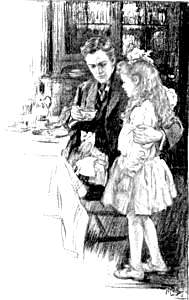
"STOOD THERE LEANING AGAINST 'DADDY'S' SIDE"
"All right, Sweetness, you're not going to lose me again," said William encouragingly. "My, but you do knock the spots out of those Western girls. Can't we go in the dining-room by ourselves? I want to ask you to marry me before we talk any more."
"Yes, do," said Dosia, dimpling.
It was sweet to be chaffed, to be heedlessly young once more, to take refuge from all disconcerting thoughts—from a new embarrassment—with Billy, in the corner of the other room, where she sat in a low chair, and he dragged up an ottoman close in front of her. Through the open window the scent of honeysuckle came in with the gloom.
"Oh, but you've grown pretty!" he said, his hands clasped over his knees, gazing at her. "That's right, get pink—it makes you prettier. I like this slimpsy sort of dress you've got on; I like that black velvet around your throat; I—have you missed me much?"
"No," said Dosia, with the old-time sparkle. "I've hardly thought of you at all. But I feel now as if I had."
Billy nodded. "All right, I'll pay you up for that some day. Oh, Dosia, you may think I'm joking, but I'm not! There have been days and nights when I've done nothing but plan the things I was going to do and say to make you care for me—but they're all gone the moment I lay eyes on you. I'll talk of whatever you like afterward, but I've got to say first"—Billy's voice, deep and manly and confident, had yet a little shake in it—"that nobody is going to marry you but me, and don't you forget it. I'm no kid any more." Something in his tone gave his words emphasis. "I know how to look out for you better than any one else does."
"Dear Billy," said Dosia, touched, and resting her cheek momentarily against the rough sleeve of his coat, "it's so good to have you back again."
Lois, who had been longing intolerably all day for evening to come, so that she could be alone with her husband, sat in the drawing-room, trying to sew with nervous, trembling fingers, while her husband, looking frightfully tired, and Bailey Girard smoked and talked—of all things in the world!—of the relative merits of live or "spoon" bait in trolling, and afterward went minutely into details of the manufacture of artificial lures for catching trout.
Those wasted "social" hours of non-interest, non-satisfaction, how long, how unbearably long, they can seem! Lois' face twitched, as well as her fingers; she did not realize, as women often do not, that to Justin this conversation, banal and irrelevant to any action of his present life or his present anxiety, was like coming up from under-depths to breathe at a necessary air-hole.
After five days of torturing, unexplained absence, to talk of nothing but fishing, as if his life depended on it! Girard himself had wondered, but he accepted the position allotted to him as a matter of course. He had thought, from Justin's manner to-day, that he was to know something of his affairs; but if Justin did not choose to confide in him—that was all right. Possibly the affairs were all right, too; they were none of his business, anyway.
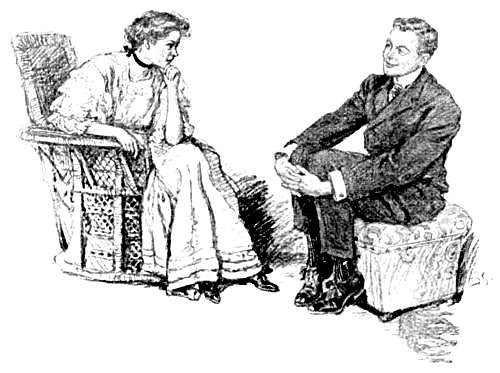
"IT WAS SWEET TO BE CHAFFED, TO BE HEEDLESSLY YOUNG ONCE MORE"
Suddenly a word caught the ears of the two who were sitting in the dining-room.
"That was the kind Lawson Barr used when he went down on the Susquehanna. By the way, I hear that he's dead."
Lawson! Dosia's face changed as if a whip had flicked across it, and then trembled back into its normal quiet. William leaned a little nearer, his eyes curiously scanning her.
"Hadn't you heard before?"
"No; what?"
"He's dead."
"Lawson dead! Not Lawson?" Her dry lips illy formed the words.
"Yes, Dosia. Don't look like that—don't let them see in there, Girard is looking at you; turn your face toward me. Leverich told us, coming up to-night. Lawson died a week ago."
"How?"
"Fell from his horse somewhere up in a cañon—he was drunk, I reckon. They found him twenty-four hours afterward. The superintendent of the mines wrote to Leverich. He'd tried to keep pretty straight out there, all but the drinking, I guess that was too much for him. It was the best thing he could do—to die—as Girard says. Girard hates the very sound of his name."
"Oh," breathed Dosia painfully.
"The superintendent said that some of the miners chipped in to bury him, and the woman he boarded with sent a pencil scrawl along with the superintendent's letter to say that she'd 'miss Mr. Barr dreadful,'—that he'd get up and get the breakfast when she was sick, and 'the kids, they thought the world of him.' She signed herself, 'A true mourner, Mrs. Wilson.'"
Lawson was dead!
Dosia sat there, her hand clasping Billy's sleeve as at first—something tangible to hold on to. Her gaze had gone far beyond the room; even that haunting consciousness that Bailey Girard was near her was but a far, hidden subconsciousness. She was out on a rocky slope beside a dead body—Lawson, his head thrown back, those mocking, caressing eyes, those curving, passionate lips, closed forever, the blood oozing from between his dark locks. As ever with poor Dosia, there was that sharp, unbearable pang of self-reproach, of self-condemnation. Of what avail her prayers, her belief in him, when he had died thus? Oh, she had not prayed enough. She had not been good enough to be allowed to help; she had not believed hard enough. Perhaps it had helped just a little—he had "tried to keep pretty straight, all but the drinking; that was too much for him."
That covered some resistance in an underworld of which she knew nothing. Poor Lawson, who had never had the right chance, whose youth had been poisoned at the start! In that grave where he lay, drunkard and reveler, part of the youth of her, Dosia Linden,—once his promised wife, to whom she had given herself in her soul,—must always lie too, buried with him; nothing could undo that. To die so causelessly! But the miners had cared a little; he had been kind to a woman and her little children—"the kids had thought the world of him"; she was "a true mourner, Mrs. Wilson." Dosia imagined him cheeringly cooking for this poor, worn-out mother, carrying the children from place to place as she had once seen him carry that little boy home from the ball, long, long ago.
A strain from that unforgotten music came to her now, carrying her to the stars! Oh, not for Lawson the splendid rehabilitation of the strong, except in that one moment of denial when he had risen by the might of his manhood in renunciation for her sake; only the humble virtues of his weakness could be his—yet perhaps, in the sight of the God who pities, no such small offering, after all!
"Dosia, you didn't really care for him!"
She smiled with pale lips and brimming eyes—an enigmatic answer which Billy could not read. He sat beside her, smoothing her dress furtively, until she got up, and, whispering, "I must go," left the room, unconscious of Girard's following gaze.
"I think we'd better be getting back," said the latter, in an odd voice, rising in the middle of one of Justin's sentences, as Billy came straying in to join the group.
Lois' heart leaped. She had felt that another moment of live bait and reminiscences would be more than she could stand.
"You need some rest," she said gratefully. "You have been tired out in our service."
"Oh, I'm not tired at all," he returned, shortly. Her work seemed to catch his eye for the first time and, in a desire to change the subject, "What are you making?" he asked.
"A ball for Redge. I made one for Zaidee, and he felt left out—he's of a very jealous disposition," she went on abstractedly. "Are you of a jealous disposition, Mr. Girard?"
"I!" He stopped short, with the air of one not accustomed to taking account of his own attributes, and apparently pondered the question as if for the first time. When he looked up to answer, it was with abrupt decision: "Yes, I am."
"Don't look so like a pirate," said young Billy, giving him a thump on the back that sent them both out of the house, laughing, when Lois rose and went over to Justin's side.
Husband and wife were at last alone.
XXIV
In the days that followed, Justin, going away in the morning very early with a set face, coming home very late in the evening with that set face still, hardly seemed to notice the children or Dosia.
"Justin has so much on his mind." Lois kept repeating the words over and over, as if she found in them something by which to hold fast. Rich in beauty as she was, full of love and tender favor, with the sweetness and the pathos of an awakening soul, her husband seemed to have no eyes, no thought for her. That one murmured sentence in the hallway was all her food to live on—his only personal recognition of her.
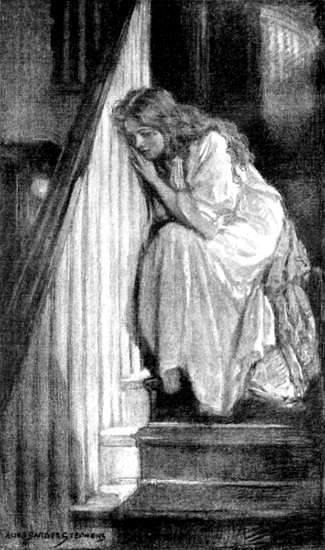
"SHE CREPT OUT UPON THE LANDING OF THE STAIRS, AND SAT THERE DESOLATELY ON THE TOP STEP"
On the other hand, he poured out his affairs and his plans to her with a freedom of confidence unknown before, a confidence which seemed to pre-suppose her oneness of interest with him. He had talked exhaustively about everything but those few days' absence; that was a sore that she must not touch, a wound that could bear no probing. She had striven very hard not to show when she didn't understand, taking her cues for assent or dissent as he evidently wished her to, letting him think aloud, since it seemed to be a relief to him, and saying little herself. The only time when she broke in on her own account was when he told her about Cater, and the defective bars, and Leverich's ultimatum. Her "Justin, you wouldn't do that; you wouldn't tell!" met his quick response: "No, I couldn't."
"Oh, I know that. I'd rather be a hundred times poorer than we are! Aren't you glad that you couldn't do it?"
"No; I think I'm rather sorry," said Justin, with a half-smile. The peculiar sharpness of the thought that it was between Cater and Leverich—his friends, Heaven save the mark!—that he was being pushed toward ruin, had not lost any of its edge.
There had been a tonic in a certain attitude of Cater's mind toward Justin—an unspoken kindliness and admiration and tenderness such as an older man who has been along a hard road may feel toward another who has come along the same way. Cater's kind, unobtrusive comradeship, the fair-dealing friendliness of his rivalry, had seemed to be one of the factors of support, of honesty, of commercial righteousness. Justin could smile proudly at Leverich, but he couldn't smile when he thought of Cater—it weighed upon and humiliated him for the man who had been his friend.
"I am glad, anyway!" said Lois. "It wouldn't have been you if you had! Can't you take a rest now, dear, when you look so ill? No, no; I didn't mean that—of course you can't!"
"A rest!" He rose and walked up and down the room. "Lois, do you know that, in some way, I've got to get it before the 13th? Those days in Chicago—at the worst time! It makes me wild to think of the time I've lost. I'm looking out for a partner who will buy out Leverich and Martin, and we've got a chance yet—I'll swear we have! But Lewiston's note has got to be paid first; then I can take time to breathe. Harker saw a man from Boston from whom we might have borrowed the money, if I had only been here. If we get that, we can hold over; if we don't, we go to smash, and so does Lewiston. Lewiston trusted me. I've been to several places to-day to men that would be willing enough to lend the money if they didn't know I needed it."
"George Sutton?" hazarded Lois.
Justin's lips curved bitterly. "Oh, he's a cur. He had some money invested last year when he was sweet on Dosia, and drew it all out afterward! And, after all, I went to him to-day, like a fool!"
"Can't you go to Eugene Larue?"
"No. We talked about it once, but he fought shy; he didn't think the security enough. If he thought so then, it would be worse than useless now."
"Mr. Girard?"
"There's no use telling things to him, he hasn't any money." Justin turned a dim eye on her. "I tell you, Lois, I haven't left a stone unturned, so far, that I could get at. If we could only sell the island! Girard's looking it up for me; there may be a chance of that. There are lots of chances to be thought out. I don't even know how we keep running, but we do. Harker's a trump! If I can hold up my end, we'll be all right."
"Then go to bed now," said Lois, with a quick dread that gave her courage. "And you must have something to eat first—and to drink, too. Come, Justin! Do as I say." Her voice had a new firmness in it which he unconsciously obeyed. She crept to her bed at last, aching in every limb, but with her baby pressed close to her, her one darling comfort, the source from which she drew a new love as the child drew its life from her. It was the first time in all her married life that she had borne the burden of her husband's care, a burden from which she must seek no solace from him.
She bent all her energies, these next days, to keeping him well fed, and ordering everything minutely for his comfort when he came home, aided and abetted by Dosia. The two women worked as with one thought between them, as women can work, for the well-being of one they love, with fond and minute care. Every detail, from the time he went away in the morning, stooping slightly under the weight of something mysterious and unseen, was ordered with reference to his home-coming at night—the husband and father on whose strength all this helpless little family hung for their own sustenance.
Everything that was done for him had to be done covertly, it was found; he disliked any manifestation of undue attention to his wants. Sometimes he was terribly irritable and unjust, and at others almost heartbreakingly gentle and mild. Lois had persuaded him to have the doctor, who told him seriously that he must stay home and rest—a futile prescription, which he treated with scorn. Rest! He knew very well that it was not rest that he needed, but money—money, money, the elixir of life!
It was near the end of this week when Justin came home, as Lois could see at once, revived and encouraged, though still abstracted. He had an invitation to take a ride in the doctor's motor, the doctor being a man who, when the hazard of dangerous cases had been extreme, absented himself for a couple of hours, in which, under a breathless and unholy speed of motoring, he reversed the pressure on his nerves, and came to the renewed sanity of a wind-swept brain when every idea had been rushed out of it.
Lois felt that it would be good for Justin, too, and was glad that he had been persuaded to go; yet she caught him looking at her with such strange intentness a couple of times during the dinner that it discomposed her oddly. It made her a little silent; she pondered over it after she had gone up, as usual, to the baby. Was there something wrong with her appearance? She looked anxiously in the glass, and was annoyed to find that the white fichu, open at the throat, was not on quite straight, and her hair was a little disarranged. She was pale, and there were dark lines under her eyes. She hated not to look nice. Yet it might not be that. Was it, perhaps, that something else was wrong—that he had bad news which he did not like to tell? Was he to leave her again on some journey? She turned white for a moment, and sat down to get the baby to sleep, and then resolutely tried to drive the thought from her. Yet, as she sat there rocking gently, the thought still came back to her, oddly, puzzlingly. Why had he looked at her like that? The smoke of his pipe down-stairs kept her still aware of his presence.
Presently he came up-stairs and tiptoed into the room in clumsy fashion, for fear of waking the baby, in his quest of a pair of gloves in a chiffonier drawer. After finding them, he stopped for a moment in front of her, with that odd, arrested expression once more.
"You don't mind my going out to-night and leaving you?" he murmured. "The doctor ought to have asked you, instead; you need it more than I."
"Oh, no, no!" she hastened to reassure. "I don't mind at all, really!" Her eyes gazed up at him, limpidly clear, and emptied of self. "I have to run up and down stairs so many times to baby now that I couldn't go, no matter how much I was asked to. I'm only glad that you will have the distraction—you need it. I hope you'll have a lovely time."
She listened to his descending footsteps, and after a moment or two arose and laid the sleeping child down in his crib.
In the dim light she went about the room, picking up toys and little discarded garments left by the children, folding the clothes away, her tall, graceful figure, in the large curves of its repeated bending and straightening, seeming to exemplify some unpainted Millet-like idea of mother-work, emblematic of its unceasing round. She was hanging up a tiny cloak in the half gloom of her closet, when she heard her husband's step once more stealing into the room, and the next moment saw him beside her.
"What's the matter?" she asked, with quick premonition.
"Nothing, nothing at all; we haven't started yet." He put one arm around her and with the other lifted her face up toward his. "I only came back to tell you"—His voice broke; there seemed to be a mist over the eyes that were bent on hers. "I can't talk. I can't be as I ought to be, Lois, until all this is over—but—I don't know what's getting into me lately, you look so beautiful to me that I can't take my eyes off you! I went around all to-day counting the hours, like a foolish boy, until it was time to come back to you; I grudge every minute that I spend away from my lovely wife."
Sometimes we have a happiness so much greater, so much more blessed than our easily imagined bliss, that we can only hide our eyes from it at first, like those of old, when in some humble and unthought-of place they were visited by angels.
XXV
Very late that night Bailey Girard arrived at the house, after an absence of ten days. Dosia had gone to bed unusually early, but she could not sleep. She could not seem to sleep at all lately—the tireder she was, the more ceaselessly luminous seemed her brain; it was like trying to sleep in a white glare in which all sorts of trivial things became unnaturally distinct. Darkness brought, not a sense of rest, but that dread knowledge that she was going to lie there staring through all the hours of it. Since that night that the pitcher had broken, she was ever waiting tensely for the day to bring her something that it never brought. Lawson's death—Girard—Billy, who was getting a little troublesome lately—the dear little brothers far away, mixed up with tiny household perplexities, kept going through and through her mind. Her heart was wrung for Justin and Lois; yet they had each other! Dreams could no longer comfort and support Dosia. Prayer but wakened her further. If she could only sleep and forget!
To-night she heard Justin's return from the automobile ride; apparently the machine had broken down, but the accident seemed only to have added to the zest. Lois was still dressed and waiting up for him. Then Girard came—he had seen the light in the window. Dosia could hear the murmuring of the voices down-stairs—Girard's sent the blood leaping to her heart so fast that she pressed her hands against it. For a moment his face seemed near, his lips almost touched hers—her heart stopped before it went on again. Why had he come now? It seemed suddenly an unbearable thing that those others down-stairs should see him and hear him, and that she could not. Why, oh, why, had she gone to bed so early to-night of all nights? She was ready to cry with the passion of a disappointment that seemed, not a little thing, but something crushing and calamitous, a loss for which she never could be repaid. She could imagine Justin and Lois meeting the kind glances of those gray eyes, smiling when he did. He was beautiful when he smiled! She was within a few yards of him, but convention, absurd yet maddening, held her in its chains. She couldn't get dressed and break in upon their intimate conference—or it seemed as if she could not. Besides, he would probably go very soon. But he did not go! After a while she could lie there no longer. She crept out upon the landing of the stairs, and sat there desolately on the top step, "in her long night-gown, sweet as boughs of May," with her little bare feet curled over each other, and her hands clasping the balustrade against which her cheek was pressed, watching and waiting for him to go. The ends of her long fair hair fell into large loose curls where it hung over her shoulder, as she bent to listen—and to listen—and to listen.
"I want to be there, too—I want to be there, too!" she whispered, with quivering lips, in her voice the sobbing catch of a very little child. "I want to be there, too. They're having it all—without me. And I want to be there, too. They might have called me to come down, and they didn't." They might have called her! All her passion, all her philosophy, all her endurance, melted into that one desire. If she had only known at first that he was going to stay so long, she would have dressed and gone down. She could hardly bear it a moment longer.
After a while a door on the landing of the second story below opened, and a little figure crept out—Zaidee. She stood irresolute in the hall, looking down; then she looked up, and, seeing Dosia, ran to her and climbed into her lap, resting her little pigtailed head confidingly against Dosia's warm young shoulder.
"They woke me up," she said placidly. "Did they woke you up, too, Cousin Dosia?"
"Yes," said Dosia, hugging the child close. "Hush! some one is coming; you'll get sent to bed again." This time it was Lois. Her abstracted gaze seemed to take in the two on the upper stairway as a matter of course.
"Oh, it's you, is it?" she said. "I thought I heard some one talking." She rested on the post below, looking up. "I came to see if you'd take Zaidee in with you for the rest of the night, Dosia. I want to give Justin's room to Mr. Girard."
"Is he going to stay?" asked Dosia.
"Yes. It's too late for him to disturb the Snows, and he's been traveling all day; he's dreadfully tired. He wanted to sleep on the sofa down-stairs, but I wouldn't let him." She was carrying Zaidee, already half asleep again, in her arms as she talked, depositing her in Dosia's bed, while Dosia followed her.
"Did he sell the island?" asked Dosia.
Lois shook her head. "No. They may really sell it next week, but not now—only that will be too late to save the business. Of course, Mr. Girard doesn't know that, and Justin will not tell him—he says Mr. Girard cannot help. Oh, Dosia, when Justin came in from that ride he looked so well, and now—" She covered her face with her hands, before recovering herself. "It's time you were both asleep."
"Can't I help you?" asked Dosia; but Lois only answered indifferently, "No, it's not necessary," and went around making arrangements, while Dosia, with Zaidee nestling close to her, slept at last.
It was late the next morning before Girard came down. Justin had had breakfast, and gone; Lois was up-stairs with the children, and Dosia, who had been tidying up the place, was arranging some flowers in the vases when he strode in. There was no vestige of that sick-hearted, imploring maiden of the night before; no desolate frenzy was to be seen in this trim, neat, capable little figure, clad in blue gingham, that made her throat very white, her hair very fair. Something in Girard's glance seemed to show an instant pleasure that she should be the one to greet him, but he bent anxiously over the watch he held in his hand.
"Will you tell me what time it is? My watch has stopped."
"It's half-past nine," said Dosia.
"Half-past nine!" He looked at her in a sort of quick, horrified arraignment. "What do you mean?" His eye fell upon the clock, and conviction seemed to steal upon him against his will. "Heavens and earth, why wasn't I called? On this morning of all others, when every moment's of importance! I thought I asked particularly to be waked early."
"I suppose they thought you were tired and needed the rest," apologized Dosia.
"Needed the rest!" His tone was poignant; he looked outraged; but his anger was entirely impersonal—there was in it even a sort of boyish appeal to her, as if she must feel it, too.
"You had better sit down and have some breakfast."
"Oh, breakfast!" His gesture deprecated her evident intention. "Please don't. Thank you very much, but I don't want any breakfast; I only want to get to town."
"There isn't any train for twenty-five minutes, so you might as well sit down and eat," said Dosia firmly. "Come out to this little table on the piazza." She led the way to the screened corner at the end, sweet with the honeysuckle that swung its long loops in the wind, and faced him sternly. "Do you take coffee?"
"Please don't, please don't cook me anything! I'd hate to trouble you." He seemed so distressed that she relented a little.
"A glass of milk and some fruit, then; you'll have to take that."
"Very well—if I must. Can't I get the things myself?"
"No." She ran away to get them for him, with some new joy singing in her heart as she went backward and forward, bringing a pitcher of milk, a glass, a dish of strawberries, some cream, and the sugar, sitting down herself by the table afterward as he ate and drank. He gave her a sudden smile, so surprised and pleased that the color surged in her cheeks.
"I'm not used to this," he said simply. "What is that dress you have on—silk?"
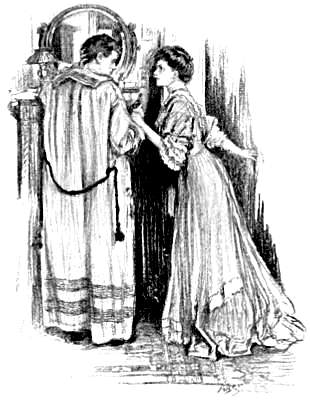
SHE TOOK THE PISTOL FROM HIS RELAXED HOLD
"No, it's cotton; do you like it?"
"Very much. Oh, please don't get up—Zaidee wasn't calling you. I won't eat another mouthful unless you stay just where you are—please!"
"Well!" said Dosia, with laughing pleasure.
"Besides, I've been wanting to consult you about the Alexanders," he went on, leaning across the table toward her, intimately. "It's so beautiful to see them together, that to feel that they're in trouble distresses me beyond words. You're so near to them both, I thought that perhaps"—His face clouded partly. "Do you know anything about the real state of Mr. Alexander's affairs?"
Dosia shook her head. "No; only that he is very much worried over them."
"He wanted to sell the island; he sent me off on that business lately. He'll sell it sometime, of course, but I don't know how complicating the delay is. He's the kind of man you can't ask; you have to wait until he tells you. You can't make a person have confidence in you. Won't you please have some of these strawberries with me? Do!"
"No; you must eat them all," said Dosia, with charming authority, her arms before her on the table, elbow-sleeved, white and dimpled, as she regarded him. He seemed to take up all the corner, against the background of the green honeysuckle in the fresh morning light. With that smile upon his face, he seemed extraordinarily masculine and absorbing, yet appealing, too.
Dosia felt carried out of herself by a sudden heady resolution—or, rather, not a new resolution, but one that she had had in mind for a long, long time, before, oh, before she had even known who this man was. She had planned over and over again how she was to say those words, and now the time had come. She could not sit here with him in this new, sweet friendliness without saying them. She had imagined the scene in so many different ways! When she had gone over it by herself, her cheeks had flushed, her eyes had shone with the tears in them. The words as she spoke them had gone deeply, convincingly, from heart to heart—or perhaps, in an assumed, tremulous lightness, the meaning in her impulse had shown all the clearer to one who understood. For a year and a half the uttered thought had been the climax to which her dreams had led; it would have seemed a monstrous, impossible thing that it had not been reached before.
She began now, in a moment's pause, only to find, too late, that all warmth and naturalness had left her with the effort. Fluent dream-practice is only too apt to make one uncomfortably crude and conscious in real life.
"I want to thank you for being so kind to me the night of that accident on the train coming up from the South." Poor Dosia instantly felt committed to a mistake. Her eyes fell for a moment on his hand, as it lay upon the table, with a terribly disconcerting remembrance that hers had not only rested in it, but that in fancy she had more than once pillowed her cheek upon it, and, knowing that he had seen the look, she continued in desperation, with still increasing stiffness and formality: "I have always known, of course, that it was you. You must pardon me for not thanking you before."
The old unapproachable manner instantly incased him, as if in remembrance of something that hurt. "Oh, pray don't mention it," he said, with a formality that matched hers. "It was nothing but what anyone would have done—little enough, anyway."
What happened afterward she did not know, except that in a few minutes he had gone.
She watched him go off down the path with that swift, long, easy step; watched till the last vestige of the gray suit was out of sight—he had a fashion of wearing gray!—before clearing off the table. Then she went and sat on the back steps that led into the little garden, bright with the sunshine and a blaze of tulips at her feet....
She had never supposed that any girl could care for a man until he had shown that he cared for her—it was the unmaidenly, impossible thing. And now—how beautiful he was, how dear! A wistful smile trembled around her lips. All that had gone before with other men suddenly became as nothing, forgotten and out of mind, and she herself made clean by this purifying fire. Even if she never had anything more in her whole life, she had this—even if she never had anything more. Yet what had she? Nothing and less than nothing. If he had ever thought of her, if he had ever dreamed of her, if her soft, frightened hand trustfully clinging fast to his, only to be comforted by his touch, had been a sign and a symbol to him of some dearer trust and faith for him alone—if in some way, as she dimly visioned it, the thought had once been his, it had gone long ago. Every action showed it. And yet, and yet—so unconquerably does the soul speak that, though he might deny her attraction for him, she knew that she had it. It was something to which he might never give way, but it was unalterably there—as it was unalterably there with her. All that year at home, when she believed she had not been thinking of him, she really had been thinking of him. We learn to know each other sometimes in long absences. She began to perceive in him now a humility and a pride strangely at variance with each other and both equally at variance with the bright assurance of his outer manner. He gave to every one; he would work early and late for others, in his yearning sympathy and affection: yet he himself, from the very intenseness of his desire for it, stood aloof, and drew back from the insistence of any claim for himself. They might meet a hundred times and grow no closer; they might grow farther and farther away.
Dosia felt that other women must have loved him—how could they have helped it? She had a pang of sorrow for them—for herself it made no difference. If she had pain for all her life afterward, she was glad at this moment that he was worthy to be loved; she need never be ashamed of loving him—he was "good." The word seemed to contain some beautiful comfort and uplifting. No matter what experience he had passed through in his struggle with the world, he had held some simple, honorable, clean quality intact. The Dosia who must always have some heart-warm dream to live by had it now; for all her life she could love him, pray for him. She had always thought that to love was to be happy; now she was to love and be unhappy—yet she would not have it otherwise.
So slight, so young, so lightly dealt with, Dosia had the pathetically clear insight and the power that comes to those who see, not themselves alone, their own desires and hopes, but the universe in which they stand, and view their acts and thoughts in relation to it. She must see Truth, "and be glad, even if it hurt."
The sunshine fell upon her in the garden; she was bathed in it. Whether she had nights of straining, bitter wakefulness and days of heartache afterward, this joy of loving was enough for her to-day—the joy of loving him. She saw in that lovely, brooding thought of him what that first meeting had taught of his character, and molded in with it her knowledge of him now, to make the real man far more imperfect, though far dearer. Yet, if he ever loved her as she loved him, part of that for which she had always sought love would have to be foregone—she could never come to him, as she had fondly dreamed of doing, and pour out to him all those hopes and fears, those struggles and mistakes and trials and indignities, the shame and the penitence that had been hers. She could never talk of Lawson—her past must be forever unshriven and uncomforted. Bailey Girard would be the last man on earth to whom she could bare her heart in confession; these were the things that touched him on the raw. He "hated the sound of Lawson's name." How many times had George Sutton's face blotted out hers? If he knew that! She must forever be unshriven. There would be things also, perhaps, that she could not bear to hear! The eternal hurt of love, that it never can be truly one with the beloved, touched her with its sadness, and then slipped away in the thought of him now—not the man who was just to help and protect her with his love, but the man whom she longed to help also. His pleased eyes, his lips, the way his hair fell over his forehead—She thought of him with the fond dream-passion of the maiden, that is often the shyest thing on earth, ready to veil itself and turn and elude and hide at the first chance that it may be revealed.
"Dosia! Dosia, where are you?"
Suddenly she saw that the sunshine had faded out, the sky had grown gray, a chill wind had sprung up. All the trouble, all the stress of the world, seemed to encompass her with that tone in the voice of Lois.
XXVI
"Justin has come home ill; he was taken with a chill as soon as he got to town; he came in a carriage from the station. I want you to telephone for the doctor, and ask him to get here as soon as he can." Lois spoke with rapid distinctness, stooping as she did so to pick up the scattered toys on the floor and push the chairs into place, as one who mechanically attends to the usual duties of routine, no matter what may be happening. "And, Dosia!" she arrested the girl as she was disappearing, "I may not be down-stairs again. Will you see about what we need for meals? My pocket-book is in the desk. And see about the children. They're in the nursery now, but I'll send them down; they had better play outdoors, where he won't hear them."
"Oh, yes, yes; I'll attend to everything," affirmed Dosia hurriedly, going off for her first duty at the telephone, while Lois disappeared up-stairs. For a man to stop work and come home because he is not well argues at once the most serious need for it. It is the public crossing of the danger zone.
With all her anxiety, Dosia was filled now with a wondering knowledge of something unnatural about Lois, not to be explained by the fact of Justin's illness. There was something newly impassioned in the duskiness of her eyes, in the fulness of her red lips, in every sweeping movement of her body, which seemed caused by the obsession of a hidden fiery force that held her apart and afar, goddess-like, even while she spoke of and handled the things of every-day life. She looked at the common-place surroundings, at the children, at Dosia; but she saw only Justin. When she was beside him, she smiled into his gentle, stricken eyes, telling him little fondly-foolish anecdotes of the children to make him smile also; patting him, talking of the summer, when they would go off together—anything to make him forget, even though the effort left her breathless afterward. When she went out of the room and came back again, she found him still watching the place where she had been with haggard, feverish, burning eyes. He would not go to bed, but lay on the outside of it in his dressing-gown, so that he might get ready the more quickly to go downtown again if the doctor "fixed him up," though now he felt weighted from head to foot with stones.
There was a ring at the door-bell in the middle of the morning, which might have been the doctor, but which turned out surprisingly to be Mr. Angevin L. Cater.
"I heard Mr. Alexander was taken ill this morning and had gone home, and as I had to come out this way on business, I thought I'd just drop in and see if there was anything I could do for him in town," he stated to Dosia.
"I'll find out," said Dosia, and came down in a moment with the word that Justin would like to see the visitor.
Cater himself looked extraordinarily lean and yellow. The fact that his clothes were new and of a fashionable cut seemed only to make him the more grotesque. He looked oddly shrunken; the quality of his smile of greeting seemed to have shrunk also—something had gone out of it.
"Well, Cater, you find me down," said Justin, with glittering, cold cheerfulness.
"I hope not for long," said the visitor.
"Oh, no; but, when I get up, you won't see me going past much longer. I'll soon be out of the old place. I guess the game is up, as far as I'm concerned. Your end is ahead."
"Mr. Alexander," began Cater, clearing his throat and bending earnestly toward Justin, "I hope you ain't going to hold it up against me that I had to make a different business deal from what we proposed. I've been thinking about it a powerful lot. There wasn't any written agreement, you know."
"No, there was no written agreement," assented Justin; "there was nothing to bind you."
"That's what I said to myself. If there had been, I'd 'a' stuck to it, of course. But a man's got to do the best he can for himself in this world."
"Has he?" asked the sick man, with an enigmatic, questioning smile.
"I'd be mighty sorry to have anything come between us. I reckon I took a shine to you the first day I met up with you," continued Cater helplessly. "I'd be mighty sorry to think we weren't friends."
Justin's brilliant eyes surveyed him serenely. Something sadly humorous, yet noble and imposing, seemed to emanate from his presence, weak and a failure though he was. "I can be friends with you, but you can't be friends with me, Cater; it isn't in you to know how," he said. "Good-by."
"Well, good-by," said the other, rising, his long, angular figure knocking awkwardly against chairs and tables as he went out, leaving Justin lying there alone, with his head throbbing horribly. Yet, strangely enough, in spite of it, his mind felt luminously clear, in that a certain power seemed to have come to him—a power of correlating all the events of the past eighteen months and placing them in their relative sequence. A certain faith—the candid, boyish, unquestioning faith in the adequacy of his knowledge of those whom he had called his friends—was gone; the face of Leverich came to him, brutal in its unveiled cupidity, showing what other men felt but concealed; yet his own faith in honor and honesty remained, stronger and higher than ever before. Nothing, he knew, could take it from him; it was a faith that he had won from the battle with his own soul.
By to-morrow night that note of Lewiston's would be protested, and then—the burning pain of failure gripped him in its racking clutches once more, though he strove to fight it off. He would have to get well quickly, so as to begin to hustle for a small clerkship somewhere, to get bread for Lois and the babies. Men of his age who were successful were sought for, but men of his age who were not had a pretty hard row to hoe.
Lois was long gone—probably she was with the baby. He missed his handkerchief, and rose and went over, with a swaying unsteadiness, to his chiffonier drawer in the farther corner to get one. A pistol lying there in its leather case, as it had done any time this five years, for a reserve protection against burglars, caught his eyes. He took it out of its case, examining the little weapon carefully, with his finger on the trigger, half cocking it, to see if it needed oil. It was a pretty little toy. Suddenly, as he held it there, leaning against the chiffonier, his thin white face with its deep black shadows under the eyes reflected by the high, narrow glass, the four walls faded away from him, with their familiar objects; his face gleamed whiter and whiter; the shadows grew blacker; only his eyes stared——
A room, noticed once a year and a half ago, came before him now with a creeping, all-possessing distinctness—that loathsome, dreadful room (long since renovated) which, with its unmentionable suggestion of horror, had held him spellbound on that morning when he had begun his career at the factory. It held him spellbound now, evilly, insidiously. He stood by that blackened, ashy hearth in the foul room, with its damp, mottled, rotting walls, his eyes fastened on that hideous sofa to which he was drawn—drawn a little nearer and a little nearer, the thing in his hand—did it move itself? Cold to his touch, it moved——
The door opened, and Lois, with a face of awful calm, glided up to him. She took the pistol from his relaxed hold; her lips refused to speak.
"Why, you needn't have been afraid, dear," he said at once, looking at her with a gentle surprise. "I'm not a coward, to go and leave you that way. You need never be afraid of that, Lois."
"No," said Lois, with smiling, white lips. She could not have told what made the frantic, overmastering fear, under the impulse of which she had suddenly thrown the baby down on the bed and fled to Justin—what strange force of thought-transference, imagined or real, had called her there.
She busied herself making him comfortable, divining his wants and getting things for him, simply and noiselessly, and then knelt down beside him where he lay, putting her arms around him.
"You oughtn't to be doing this for me; I ought to be taking care of you," he said, with a tender self-reproach that seemed to come from a new, hitherto unknown Justin, who watched her face to see if it showed fatigue, and counted the steps she took for him.
The doctor came, and sent him off sternly to bed, and came again later. The last time he looked grave, ordered complete quiet, and left sedatives to insure it. Grip, brought on by overwork, had evidently taken a disregarded hold some time before, and must be reckoned with now. What Mr. Alexander imperatively needed was rest, and, above all things, freedom from care. Freedom from care!
Every footfall was taken to-day with reference to this. An impression of Justin as of something noble and firm seemed to emanate from the room where he lay and fill the house; in his complete abdication, he dominated as never before. More than that, there seemed to be a peculiar poignancy, a peculiar sweetness, in every little thing done for him; it made one honorable to serve him.
The light was still brightly that of day at a quarter of seven, when Dosia, who had been putting Zaidee and Redge to bed, came into Lois' room, and found her with crimson cheeks and eyes red from weeping. At Dosia's entrance she rose at once from her chair, and Dosia saw that she was partially dressed in her walking-skirt; she flared out passionately in speech as she was crossing the room, as if in answer to some implied criticism:
"I don't care what you say—I don't care what anybody says. I can't stand it any longer, when it's killing him! He can't rest unless he has that money. Am I to just sit down and let my husband die, when he's in such trouble as this? Is that all I can do? Why, whose trouble is it? Mine as well as his! If it's his responsibility, it's mine, too—mine as well as his!"
She hit her soft hand against the sharp edge of the table, and was unconscious that it bled. "If there's nobody else to get that money for him, I'll rise up and get it. He's stood alone long enough—long enough! He says there is no help left, but he forgets that there's his wife!"
"Oh, Lois," said Dosia, half weeping. "Oh, Lois, what can you do? There, you've waked the baby—he's crying."
"Get me the waist to this and my walking-jacket. No, give me the baby first; he's hungry."
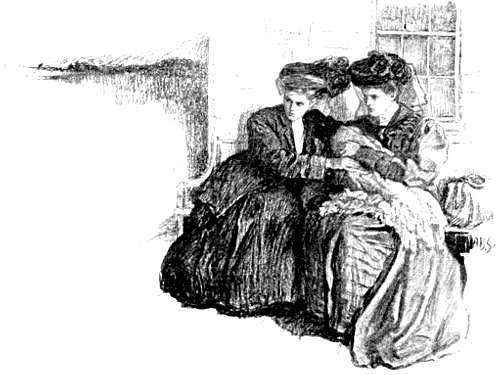
"THE TWO WOMEN SITTING ON THE BENCH, WRAPPED AROUND BY THE LONELINESS AND THE INTENSE STILLNESS OF THE ONCOMING NIGHT"
She spoke collectedly, bending over the child as she held him to her, and straightening the folds of the little garments. "There, there, dear little heart, dear little heart, mother's comfort—oh, my comfort, my blessing! Get my things out of the closet now, Dosia, and my gloves from that drawer, the top one. Oh, and get out baby's cloak and cap, too. I forgot that I couldn't leave him. I must take him with me." She sank her voice to a low murmur, so as not to disturb the child.
"Where are you going?" asked Dosia.
"To Eugene Larue."
"Mr. Larue!"
"Yes. He'll let me have the money—he'll understand. He wouldn't let Justin have it, but he'll give it to me—if I'm not too proud to ask for it; and I'm not too proud." She spoke in a tone the more thrilling for its enforced calm. "There are things a man will do for a woman, when he won't for a man, because then he has to be businesslike; but he doesn't have to be businesslike to a woman—he can lend to her just because she needs it."
"Lois!"
"Oh, there's many a woman—like me—who always knows, even though she never acts on the knowledge, that there is some man she could go to for help, and get it, just because she was herself—a woman and in trouble—just for that! Dosia, if I go to Eugene Larue myself, in trouble—such trouble——"
"But he's out at Collingswood!" said Dosia, bewildered.
"Yes, I know. The train leaves here at seven-thirty, it connects at Haledon. It only takes three quarters of an hour; I've looked it up in the time-table. I'll be back here again by ten o'clock. I—" She stopped with a sudden intense motion of listening, then put the child from her and ran across the hall to the opposite room.
When she came back, pale and collected, it was to say: "Justin's gone to sleep now. The doctor says he will be under the influence of the anodynes until morning. Mrs. Bently is in there—I sent for her; she says she'll stay until I get back." Mrs. Bently was a woman of the plainer class, half nurse, half friend, capable and kind. "If the children wake up, they won't be afraid with her; but you'll be here, anyway."
"Leave the baby with me," implored Dosia.
"No, I can't—suppose I were detained? Then I'd go crazy! He won't be any bother, he's so little and so light."
"Very well, then; I'll go, too," stated Dosia in desperation. "I am not needed here. You must have some one with you if you have baby! Let me go, Lois! You must!"
"Oh, very well, if you like," responded Lois indifferently. But that the suggestion was an unconscious relief to her she showed the next moment, as she gave some directions to Dosia, who put a few necessaries and some biscuits in a little hand-bag, and an extra blanket for the baby in case it should grow chilly.
The train went at seven-thirty. The house must be lighted and the gas turned down, and the new maid impressed with the fact that they would be back at a little after nine, though it might really be nearer ten. After Lois was ready, she went in once more to look at Justin as he slept—his head thrown forward a little on the pillow, his right hand clasped, and his knees bent as one supinely running in a dream race with fate. Lois stooped over and laid her cheek to his hair, to his hand, as one who sought for the swift, reviving warmth of the spirit.
Then the two women walked down the street toward the station, Lois absorbed in her own thoughts, and Dosia distracted, confused, half assenting and half dissenting to the expedition.
"Are you sure Mr. Larue will be there?" she asked anxiously.
"Justin saw him Saturday. He said he was going out there then for the summer."
So far it would be all right, then. They had passed the Snows' house, and Dosia looked eagerly for some sign of life there; she hesitated, and then went on. As they got beyond it, at the corner turning, she looked back, and saw that Miss Bertha had come out on the piazza.
"I'll catch up with you in a moment," she said to Lois, and ran back quickly.
"Miss Bertha!"
"Why, Dosia, my dear, I didn't see you; don't speak loud!" Miss Bertha's face, her whispering lips, her hands, were trembling with excitement. "We've been under quite a strain, but it's all over now—I'm sure I can tell you. Dear mother has gone up-stairs with a sick-headache! Mr. Sutton has just proposed to Ada—in the sitting-room. We left them the parlor, but they preferred the sitting-room. Mother's white shawl is in there, and I haven't been able to get it."
"Oh!" said Dosia blankly, trying to take in the importance of the fact. "Is Mr. Girard in? No? Will he be in later?"
"No, not until to-morrow night," said Miss Bertha, as blankly, but Dosia had already gone on. She did not know whether she were relieved or sorry that Girard was not there. She did not know what she had meant to say to him, but it had seemed as if she must see him!
Lois did not ask her why she had stopped; her spirit seemed to be wrapped in an obscurity as enshrouding as the darkness that was gathering around them. Only, when they were at last in the train, she threw back her veil and smiled at Dosia, with a clear, triumphant relief in the smile, a sweetness, a lightness of expression that was almost roguish, and that communicated a similar lightness of heart to Dosia.
"He will lend me the money," said Lois, with a grateful confidence that seemed to shut out every conventional, every worldly suggestion, and to breathe only of her need and the willingness of a friend to help—not alone for the need's sake, but for hers.
Dosia tried to picture Eugene Larue as Lois must see him; his bearded lips, his worn forehead, his quiet, sad, piercing eyes, were not attractive to her. The whole thing was very bewildering.
It was twenty miles, a forty-minute ride, to Haledon, where they changed cars for the little branch road that went past Collingswood—a signal station, as the conductor who punched their tickets impressed on Lois. Haledon itself was a junction for many lines, with a crowd of people on the platform continually coming and going under the electric lights. As Lois and Dosia waited for their train, an automobile dashed up, and a man and a woman, getting out of it with wraps and bundles, took their place among those who were waiting for the west-bound express. The woman, large and elegantly gowned, had something familiar in her outline as she turned to her companion, a short, ferret-faced man with a fair mustache—the man who lately had been seen everywhere with Mrs. Leverich. Yes, it was Mrs. Leverich. Dosia shrank back into the shadow. The light struck full athwart the large, full-blown face of Myra as she turned to the man caressingly with some remark; his eyes, evilly cognizant, smiled back again as he answered, with his cigar between his teeth.
Dosia felt that old sensation of burning shame—she had seen something that should have been hidden in darkness. They were going off together! All those whispers about Mrs. Leverich had been true.
There were only a few people in the shaky, rattly little car when Lois and Dosia entered it, whizzing off, a moment later, down a lonely road with wooded hills sloping to the track on one side and a wooded brook on the other. The air grew aromatic in the chill spring dusk with the odor of damp fern and pine. Both women were silent, and the baby, rolled in his long cloak, had slept all the way. It was but seven miles to Collingswood, yet the time seemed longer than all the rest of the journey before they were finally dumped out at the little empty station with the hills towering above it. A youth was just locking up the ticket-office and going off as they reached it. Dosia ran after him.
"Mr. Larue's place is near here, isn't it?" she called.
"Yes, over there to the right," said the youth, pointing down the board walk, which seemed to end at nowhere, "about a quarter of a mile down. You'll know when you come to the gates. They're big iron ones."
"Isn't there any way of riding?"
"I guess not," said the youth, and disappeared into the woods on a bicycle.
"Oh, it will be only a step," said Lois, starting off down the walk, followed perforce by Dosia, with the hand-bag, both walking in silence.
The excursion, from an easily imagined, matter-of-fact daylight possibility, had been growing gradually a thing of the dark, unknown, fantastic. A faint remnant of the fading light remained in the west, vanishing as they looked at it. High above the treetops a pale moon hung high; there seemed nothing to connect them with civilization but that iron track curved out of sight.
The quarter of a mile prolonged itself indefinitely, with that strangely eternal effect of the unknown; yet the big iron gates were reached at last, showing a long winding drive within. It was here that Eugene Larue had built a house for his bride, living in it these summers when she was away, alone among his kind, a man who must confess tacitly before the world that he was unable to make his wife care for him—a darkened, desolate, lonely life, as dark and as desolate as this house seemed now. An undefined dread possessed Dosia, though Lois spoke confidently:
"The walk has not really been very long. We'll probably drive back. It's odd that there are no lights, but perhaps he is sitting outside. Ah, there's a light!"
Yet, as she spoke, the light left the window and hung on the cornice above—it was the moon, and not a lamp, that had made it. They ascended the piazza steps; there was no one there.
"There is a knocker at the front door," said Lois. She pounded, and the house vibrated terrifyingly through the stillness. At the same instant a scraping on the gravel walk behind them made them turn. It was the boy on the bicycle, who had sped back to them.
"Mr. Larue ain't there," he called. "The woman who closed up the house told me he had a cable from his wife, and he sailed for Europe this afternoon. She says, do you want the key?"
"No," said Lois, and the messenger once more disappeared.
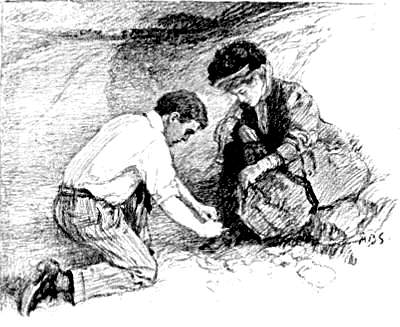
"'THEY'LL GET FULL OF EARTH AGAIN,' SHE PROTESTED"
This, then, was the end of her exaltation—for this she had passionately nerved herself! There was to be neither the warmth of instant comprehension of her errand nor the frank giving of aid when necessity had been pleaded; there was nothing. She shifted the baby over to the other shoulder, and they retraced their way, which now seemed familiar and short. There was, at any rate, a light on a tall pole in front of the little station, although the station itself was deserted; they seated themselves on the bench under it to wait. The train was not scheduled for nearly an hour yet.
"Oh, if I could only fly back!" Lois groaned. "I don't see how I can wait—I don't see how I can wait! Oh, why did I come?"
"Perhaps there is a train before the one you spoke of," said Dosia, with the terribly self-accusing feeling now that she ought to have prevented the expedition at the beginning. She got up to go into the little box of a house, in search of a time-table. As she passed the tall post that held the light, she saw tacked on it a paper; and read aloud the words written on it below the date:
NOTICE
NO TRAINS WILL RUN ON THIS ROAD TO-NIGHT AFTER 8.30 P.M. ON ACCOUNT OF REPAIRS
Dosia and Lois looked at each other with the blankness of despair—the frantic, forlornly heroic impulse, uncalculating of circumstances, now showed itself against them in all its piteous woman-folly.
XXVII
Only fifty miles from a great city, the little station seemed like the typical lodge in a wilderness; as far as one could see up or down the track, on either side were wooded hills. A vast silence seemed to be gathering from unseen fastnesses, to halt in this spot.
There were no houses and no lights to be seen anywhere, except that one swinging on the pole above, and the moon which was just rising. It was, in fact, one of those places which consist of the far, back-lying acres of the great country-owners, and which seem to the casual traveler forgotten or unknown in their extent and apparently primitive condition.
To the women sitting on the bench, wrapped around by the loneliness and the intense stillness of the oncoming night, the whole expedition appeared at last, unveiled in all its grim betrayal.
For the first time since Lois had left home, a wild, seething anxiety for Justin possessed her. How could she have left him? She must get back to him at once!
"Oh, Dosia, we must get home again; we must get home!" she cried, starting up so vehemently that the baby in her arms screamed, and Lois walked up and down distractedly hushing him, and then, as he still wailed, sat down once more and bared her white bosom to quiet him. "We shall have to get back; Dosia, we must start at once."
"We shall have to walk to Haledon," said Dosia.
"Yes, yes. Perhaps we may come to some farm-house where they will let us have a wagon. It is seven miles to Haledon—that isn't very far! I often walked five miles with Justin before I was married, and a mile or two more is nothing. There are plenty of trains from Haledon."
"Oh, we can do it easily enough," said Dosia, though her heart was as lead within her breast. "You had better eat some of these biscuits before we start," she advised, taking them out of the bag; and Lois munched them obediently, and drank some tepid water from a pitcher which Dosia had found inside. As she put it back again in its place, she slipped to the side of the platform and looked down the moon-filled, narrow valley.
Through all this journey Dosia had carried double thoughts; her voice called where none might hear. It spoke now as she whispered, with hands outspread:
"Oh, why weren't you in when I went for you? Why didn't you come and take care of us, when I needed you so much? Why did you let us go off this way? You might have known! Why don't you come and take care of us? There's no one to take care of us but you! You could!" A dry sob stopped the words—the deep, inherent cry of womankind to man for help, for succor. She stooped over and picked up an oakleaf that had lain on the ground since the winter, and pressed it to her bosom, and sent it fluttering off on a gust of wind down the incline, as if it could indeed take her message with it, before she went back to Lois.
After some hesitation as to the path,—one led across the rails from where they were sitting,—they finally took that behind the station, which broadened out into a road that lay along the wooded slope above, from which they could look down at intervals and see the track below. One side of that road was bordered by a high wire fencing inclosing pieces of woodland, sometimes so thick as to be impenetrable, while along other stretches there would be glimpsed through the trees some farther, open field. To the right, toward the railway there were only woods and no fencing.
They two walked off briskly at first, but the road was of a heavy, loose, shelving soil in which the foot sank at each step; the grass at the edge was wet with dew and intersected by the ridged, branching roots of trees; the pace grew, perforce, slower and slower still. They took turns in carrying the baby, whose small bundled form began to seem as if weighted with lead.
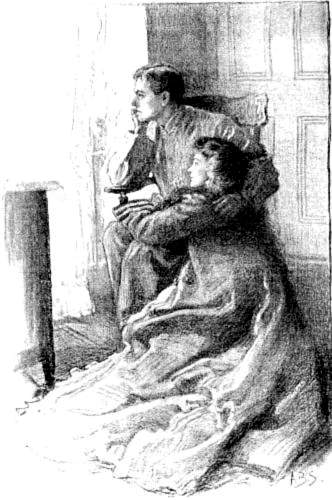
"LOIS STOLE INTO THE ROOM"
Far over on what must have been the other side of the track, they occasionally saw the light of a house; at one place there seemed to be a little hamlet, from the number of lights. They were clearly on the wrong bank; they should have crossed over at the station. The only house they came to was the skeleton of one, the walls blackened and charred with fire. There was only that endless line of wire fencing along which they pushed forward painfully, with dragging step; instead of passing any given point, the road seemed to keep on with them, as if they could never get farther on. Wire fencing, and moonlight, and silence, and trees. Trees! They became night-marishly oppressive in those dark, solemn ranks and groups—those silent thicknesses; the air grew chill beneath them; terror lurked in the shadows. Oh, to get out from under the trees, with only the clear sky overhead! If that road to the house of Eugene Larue had seemed a part of infinity in the dimness of the unknown, what was this?
They sat down now every little while to rest, Dosia's voice coaxing and cheering, and then got up to shake the earth out of their shoes and struggle on once more—bending, shivering, leaning against each other for support; two silent and puny figures, outside of any connection with other lives, toiling, as it seemed, against the universe, as women do toil, apparently futile of result.
Once the loud blare of a horn sent them over to the side of the road, clinging to the wire fencing, as an automobile shot by—a cheerful monster that spoke of life in towns, leaving a new and sharp desolation behind it. Why hadn't they seen it before? Why hadn't they tried to hail it when they did see? To have had such a chance and lost it! Once they were frightened almost uncontrollably by a group approaching with strange sounds—Italian laborers, cheerful and unintelligible when Dosia intrepidly questioned them. They passed on, still jabbering; two bedraggled women and a baby were no novelty to them. Then there was more long, high fencing, and moonlight, and silence, and shadows, and trees—and trees——
"Do you suppose we'll ever get out of here?" asked Lois at last, dully.
"Why, of course; we can't help getting out, if we keep on," said Dosia, in a comfortingly matter-of-fact tone.
It was she who was helper and guide now.
"Oh, if I had never left Justin! Why, why did I leave him? How far do you think we have walked, Dosia?"
"It seems so endless, I can't tell; but we must be nearly at Haledon," said Dosia. "Let's sit down and rest awhile here. Oh, Lois, Lois dear!" She had taken off her jacket and spread it on the damp grass for them both to sit on, huddled close together, and now pressed the older woman's head down on her shoulder, holding both mother and child in her young arms.
Lois lay there without stirring. Far off in the stillness, there came the murmur of the brook they had passed in the train—so long since, it seemed! The moon hung high above now, pouring a flood of light down through the arching branches of the trees upon her beautiful face with its closed eyes, and the tiny features of the sleeping child. Something in the utter relaxation of the attitude and manner began to alarm the girl.
"Lois, we must go on," she said, with an anxious note in her voice. "Lois! You mustn't give up. We can't stay here!"
"Yes, I know," said Lois. She struggled to her feet, and began to walk ahead slowly. Dosia, behind her, flung out her arms to the shadow-embroidered road over which they had just passed.
"Oh, why don't you come!" she whispered again intensely, with passionate reproach; and then, swiftly catching up with Lois, took the child from her, and again they stumbled on together, haltingly, to the accompaniment of that far-off brook.
The wire fencing ceased, but the road became narrower, the walls of trees darker, closer together, though the soil underfoot grew firmer. They had to stop every few minutes to rest. Lois saw ever before her the one objective point—a dimly lighted room, with Justin stretched out upon the bed, dying, while she could not get there.
"Hark!" said Dosia suddenly, standing still. The sound of a voice trolling drunkenly made itself heard, came nearer, while the women stood terrified. The thing they had both unspeakably dreaded had happened; the moonlight brought into view the unmistakable figure of a tramp, with a bundle swung upon his shoulder. No terror of the future could compare with this one, that neared them with the seconds, swaying unsteadily from side to side of the road, as the tipsy voice alternately muttered and roared the reiterated words:
For I have come from Pad-dy land, The land—I do adore!
They had fled, crouching into the bushes at the edge of the path, and he passed with his eyes on the ground, or he must have seen—a blotched, dark-visaged, leering creature, living in an insane world of his own. They waited until he was far out of sight before creeping, all of a tremble, from their shelter, only to hear another footfall unexpectedly near:—the pad, pad, pad of a runner, a tall figure as one saw it through the lights and shadows under the trees, capless and coatless, with sleeves rolled up, arms bent at the elbows, and head held forward. Suddenly the pace slackened, stopped.
"Great heavens!" said the voice of Bailey Girard.
"Oh, it's you, it's you!" cried Dosia, running to him with an ineffable, revealing gesture, a lovely motion of her upflinging arms, a passion of joy in the face upraised to his, that called forth an instantly flashing, all-embracing light in his.
In that moment there was an acknowledgment in each of an intimacy that went back of all words, back of all action. The arm that upheld her gripped her close to him as one who defends his own, as he said tensely:
"That beast ahead, did he touch you?"
"Oh, no; he didn't see us. We hid!" She tried to explain in hurrying, disconnected sentences. "I've been longing and praying for you to come! I tried to let you know before we started, and you weren't there. Lois was half crazy about Justin. Come to her now! She wanted to see Mr. Larue, and he was gone. We've walked from Collingswood; we have the baby with us."
"The baby!"
"Yes; she couldn't leave him behind. Oh, it's been so terrible! If you had only known!"
"Oh, why didn't I?" he groaned. "I ought to have known—I ought to have known! I was in that motor that must have passed you; it was just a chance that I got out to walk." They had reached the place where Lois sat, and he bent over her tenderly. She smiled into his anxious eyes, though her poor face was sunken and wan.
"I'm glad it's you," she whispered. "You'll help me to get home!"
"Dear Mrs. Alexander! I want to help you to more than that. I want you to tell me everything." He pressed her hand, and stood looking irresolutely down the road.
"I could go to Haledon, and send back a carriage for you; it's three miles further on."
"No, no, no! Don't leave us!" the accents came in terror from both. "We can walk with you. Only don't leave us!"
"Very well; we'll try it, then."
He took the warm bundle that was the sleeping child from Lois, saying, as she half demurred, "It's all right; I've carried 'em in the Spanish-American war in Cuba," holding it in one arm, while with the other he supported Lois. The dragging march began again, Dosia, stumbling sometimes, trying to keep alongside of him, so that when he turned his head anxiously to look for her she would be there, to meet his eyes with hers, bravely scorning fatigue.
The trees had disappeared now from the side of the road; long, swelling, wild fields lay on the slopes of the hillside, broken only by solitary clumps of bushes—fields deserted of life, broad resting-places for the moonlight, which illumined the farthest edge of the scene, although the moon itself was hidden by the crest of a hill. And as they went on, slowly perforce, he questioned Lois gently; and she, with simple words, gradually laid the facts bare.
"Oh, why didn't Alexander tell me all this?" he asked pitifully, and she answered:
"He said it was no use; he said you had no money."
"No; but I can sometimes get it for other people! I could have gone to Rondell Brothers and got it."
"Rondell Brothers? I thought they were difficult to approach."
"That depends. I was with Rondell's boy in Cuba when he had the fever, and he's always said—but that's neither here nor there. Apart from that, they've had their eye on your husband lately. You can't hide the quality of a man like him, Mrs. Alexander; it shows in a hundred ways that he doesn't think of. They have had dealings with him, though he doesn't know it—it's been through agents. Mr. Warren, one of their best men, has, it seems, taken a fancy to him. I shouldn't wonder if they'd take over the typometer as it stands, and work Alexander in with it. If Rondell Brothers really take up any one!"—Girard did not need to finish.
Even Lois and Dosia had heard of Rondell Brothers, the great firm that was known from one end of the country to the other—a commercial house whose standing was as firm, as unquestioned, as the Bank of England, and almost as conservative. Apart from this, their reputation was unique. It was more than a commercial house: it was an institution, in which for three generations the firm known as Rondell Brothers had carried on their business to high advantage—on the principles of personal honor and honesty and fair dealing.
No boy or man of good character, intelligence, and industry was ever connected with Rondell's without its making for his advancement; to get a position there was to be assured of his future. Their young men stayed with them, and rose steadily higher as they stayed, or went out from them strong to labor, backed with a solid backing. The number of young firms whom they had started and made, and whose profit also afterward profited them, was more than had ever been counted. They were never deceived, for they had an unerring faculty for knowing their own kind. No firm was keener. Straight on the nail themselves, they exacted the same quality in others. What they traded in needed no other guaranty than the name of Rondell.
If Rondell Brothers took Justin's affairs in hand! Lois felt a hope that sent life through her veins.
"Oh, let us hurry home!" she pleaded, and tried to quicken her pace, though it was Girard who supported her, else she must have fallen, while Dosia slipped a little behind, trying to keep her place by his side, so that when he looked for her she would be there.
"You're so tired," he whispered, with a break in his voice, "and I can't help you!" and she tried to beat back that dear pity and longing with her comforting "No, no, no! I'm not really tired"; her voice thrilled with life, though her feet stumbled.
In that walk beside him, toiling slowly on and on in the bright, far solitude of those empty fields, where even their hands might not touch, they two were so heart-close—so heavenly, so fulfillingly near!
Once he whispered in a yearning distress, "Why are you crying?" And she answered through those welling tears:
"I'm only crying because I'm so glad you're here!"
After a while there was a sound of wheels—wheels! Only a sulky, it proved to be—a mere half-wagon set low down in the springs, and a trotting horse in front, driven by a round-faced boy in a derby hat, the turnout casting long, thin shadows ahead before Girard stopped it.
"You'll have to take another passenger," he said, after explaining matters to the half-unwilling boy, who crowded himself at last to the farthest edge of the seat, so that Lois might take possession of the six inches allotted to her.
She held out her arms hastily. "My boy!" she said, but it was a voice that had hope in it once more.
"Oh, yes, I forgot; here's the baby," said Girard, looking curiously at the bundle before handing it to her. "We'll meet you at the Haledon station very soon now."
In another moment the little vehicle was out of sight, jogging around a bend of the road.
So still was the night! Only that long, curving runnel of the brook again accompanied the silence. Not a leaf moved on the bushes of those far-swelling fields or on the hill that hid their summit; the air was like the moonlight, so fragrantly cool with the odors of the damp fern and birch. The straight, supple figure of Girard still stood in the roadway, bareheaded, with that powerful effect which he had, even here, of absorbing all the life of the scene.
Dosia experienced the inexplicable feeling of the girl alone, for the first time, with the man who loves her and whom she loves. At that moment she loved him so much that she would have fled anywhere in the world from him.
The next moment he said in a matter-of-fact tone:
"Sit down on that stone, and let me shake out your shoes before we go on; they're full of sand."
She obeyed with an open-eyed gaze that dwelt on him, while he knelt down and loosened the bows, and took off the little clumpy low shoes, shaking them out carefully, and then put them on once more, retying the bows neatly with long, slowly accomplishing fingers.
"They'll get full of earth again," she protested, her voice half lost in the silence.
"Then I'll take them off and shake them out over again."
He stood up, brushing the earth from his palms, smiling down at her as she stood up also. "I've always dreamed of doing that," he said simply. "I've dreamed of taking you in my arms and carrying you off through the night—as I couldn't that first time! I've longed so to do it, there have been times when I couldn't stand it to see you, because you weren't mine." Then—her hands were in his, his dear, protecting hands, the hands she loved, with their thrilling, long-familiar touch, claiming as well as giving.
"Oh—Dosia!" he said below his breath.
As their eyes dwelt on each other in that long look, all that had hurt love rose up between them, and passed away, forgiven. She previsioned a time when all her life before he came into it would have dropped out of remembrance as a tale that is told. And now——
It seemed that he was going to be a very splendid lover!
XXVIII
The summer was nearly at an end—a summer that had brought rehabilitation to the Typometer Company, yet rehabilitation under strict rule, strict economy, endless work. Nominally the same thing, the typometer was now but one factor of trade among a dozen other patented inventions under the control of Rondell Brothers.
If there was not quite the same personal flavor as yet in Justin's relation to the business which had seemed so inspiringly his own, there was a larger relation to greater interests, a wider field, a greater sense of security, and a sense of justice in the change; he felt that he had much to learn. There was something in him that could not profit where other men profited—that could not take advantage when that advantage meant loss to another. He was not great enough alone to reconcile the narrowing factors of trade with that warring law within him. The stumbling of Cater would have been another stumbling-block if it had not been that one. That for which Leverich, with Martin always behind him, had chosen Justin first, had been the very thing that had fought against them.
The summer was far spent. Justin had been working hard. It was long after midnight. Lois slept, but Justin could not; he rose and went into the adjoining room, and sat down by her open window. The night had been very close, but now a faint breath stirred from somewhere out of the darkness. It was just before the dawn. Justin looked out into a gloom in which the darkness of trees wavered uncertainly and brought with it a vague remembrance. He had done all this before. When? Suddenly he recollected the night he had sat at this same window, at the beginning of this terrible journey; and his thoughts and feelings then, his deep loneliness of soul, the prevision of the pain even of fulfilment—an endless, endless arid waste, with the welling forth of that black spirit of evil in his own nature, as the only vital thing to bear him secret company—a moment that was wolfish to his better nature. Almost with the remembrance came the same mood, but only as reflected in the surface of his saner nature, not arising from it.
As he gazed, wrapped in self-communing, on the vague formlessness of the night, it began gradually to dissolve mysteriously, and the outlines of the trees and the surrounding objects melted into view. A bird sang from somewhere near by, a heavenly, clear, full-throated call that brought a shaft of light from across the world, broadening, as the eye leaped to it, into a great and spreading glory of flame.
It had rained just before; the drops still hung on bush and tree; and as the dazzling radiance of the sun touched them, every drop also radiated light, prismatic, and scintillating an almost audibly tinkling joy. So indescribably wonderful and beautiful, yet so tender, seemed this scene—as of a mighty light informing the least atom of this tearful human existence—that the profoundest depths of Justin's nature opened to the illumination.
In that moment, with calm eyes, and lips firmly pressed together, his thoughts reached upward, far, far upward. For the first time, he felt in accordance with something divine and beyond—an accordance that seemed to solve the meaning of life, what had gone and what was to come. All the hopes, the planning, the seeking and slaving, whatever they accomplished or did not accomplish, they fashioned us ourselves. As it had been, so it still would be. But for what had gone before, he had not had this hour.
It was the journey itself that counted—the dear joys by the way, that come even through suffering and through pain: the joy of the red dawn, of the summer breeze, of the winter sun; the joy of children; the joy of companionship.
He held out his arm unconsciously as Lois stole into the room.