AMERICAN IMPRESSIONS
Reading edition
BY ELLEN TERRY
ILLUSTRATED WITH PHOTOGRAPHS AND WITH A DRAWING BY ERIC PAPE
Copyright, 1908, by Ellen Terry (Mrs. Carew)
It is only human to make comparisons between American and English institutions, although they are likely to turn out as odious as the proverb says! The first institution in America that distressed me was the steam heat. It is far more manageable now than it was, both in hotels and theatres, because there are more individual heaters. But how I suffered from it at first I cannot describe. I used to feel dreadfully ill, and when we could not turn the heat off at the theatre, the play always went badly. My voice was affected, too. At Toledo, once, it nearly went altogether. Then the next night, after a good fight, we got the theatre cool, and the difference to the play was extraordinary. I was in my best form, feeling well and jolly!
If I did not like steam heat, I loved the ice which is such a feature at American meals. Everything is served on ice. I took kindly to their dishes—their cookery, at its best, is better than the French—and I sadly missed planked shad, terrapin, and the oyster—at its best and at its cheapest in America—when I returned to England.
Travelling in America
The American hotels seemed luxurious even in 1883; but it only takes ten years there for an hotel to be quite done, to become old-fashioned and useless as a rusty nail. Hotel life in America is now the perfection of comfort. Hotels as good as the Savoy, the Ritz, the Carlton, and Claridge's can be counted by the dozen in New York, and are to be found in all the principal cities.
I liked the travelling, but then we travelled in a very princely fashion. The Lyceum Company and baggage occupied eight cars, and Henry's private parlour-car was lovely. The only thing that we found was better understood in England, so far as railway travelling is concerned, was privacy. You may have a private car, but all the conductors on the train, and there is one to each car, can walk through it. So can any official, baggage-man, or newsboy who has the mind!
There were, of course, people ready to say that the Americans did not like Henry Irving as an actor, and that they only accepted him as a manager—that he triumphed in New York, as he had done in London, through his lavish spectacular effects. This is all moonshine. Henry made his first appearance in "The Bells," his second in "Charles I," his third in "Louis XI." By that time he had conquered, and without the aid of anything at all notable in the mounting of the plays. It was not until we did "The Merchant of Venice" that he gave the Americans anything of a "production."
My first appearance in America in Shakespeare was as Portia, and I could not help feeling pleased by my success. A few weeks later I played Ophelia at Philadelphia. It is in Shakespeare that I have been best liked in America, and I consider that Beatrice was the part about which they were most enthusiastic.
During our first tour we visited in succession New York, Philadelphia, Boston, Baltimore, Brooklyn, Chicago, Cincinnati, St. Louis, Detroit, and Toronto. To most of these places we paid return visits. I think it was in Chicago that a reporter approached Henry Irving with the question: "To what do you attribute your success, Mr. Irving?"
"To my acting," was the simple reply.
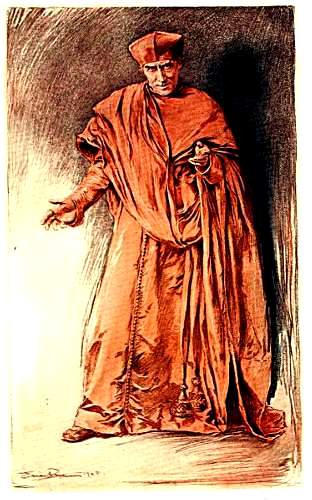
HENRY IRVING AS CARDINAL WOLSEY IN "HENRY VIII."
FROM A DRAWING BY ERIC PAPE
We never had poor houses except in Baltimore and St. Louis. Our journey to Baltimore was made in a blizzard. They were clearing the snow before us all the way from New Jersey, and we took forty-two hours to reach Baltimore. The bells of trains before us and behind us sounded very alarming. We opened in Baltimore on Christmas Day. The audience was wretchedly small, but the poor things who were there had left their warm firesides to drive or tramp through the slush of melting snow, and each one was worth a hundred on an ordinary night.
At the hotel I put up holly and mistletoe, and produced from my trunks a real Christmas pudding that my mother had made. We had it for supper, and it was very good.
Burned Hare Soup and Camphor Pudding in Pittsburg
It never does to repeat an experiment. Next year at Pittsburg my little son Teddy brought me out another pudding from England. For once we were in an uncomfortable hotel, and the Christmas dinner was deplorable. It began with burned hare soup.
"It seems to me," said Henry, "that we aren't going to get anything to eat, but we'll make up for it by drinking!"
He had brought his own wine out with him from England, and the company took him at his word and did make up for it.
"Never mind!" I said, as the soup was followed by worse and worse. "There's my pudding!"
It came on blazing and looked superb. Henry tasted a mouthful.
"Very odd," he said, "but I think this is a camphor pudding."
He said it so politely—as if he might easily be mistaken. My maid in England had packed the pudding with my furs! It simply reeked of camphor.
So we had to dine on Henry's wine and L. F. Austin's wit. This dear, brilliant man, now dead, acted for many years as Henry's secretary, and one of his gifts was the happy knack of hitting off people's peculiarities in rhyme. This dreadful Christmas dinner at Pittsburg was enlivened by a collection of such rhymes, which Austin called a "Lyceum Christmas Play."
Everyone roared with laughter until it came to the verse of which he was the victim, when suddenly he found the fun rather laboured.
The first verse was spoken by Loveday, who announces that the "Governor" has a new play which is "wonderful"—a great word of Loveday's.
George Alexander replies:
But I say, Loveday, have I got a part in it, That I can wear a cloak in and look smart in it? Not that I care a fig for gaudy show, dear boy— But juveniles must look well, don't you know, dear boy; And shall I lordly hall and tuns of claret own? And may I murmur love in dulcet baritone? Tell me, at least, this simple fact of it— Can I beat Terriss hollow in one act of it?[1]
Norman Forbes:
Pooh for Wenman's[2] bass! Why should he make a boast of it? If he has a voice, I have got the ghost of it! When I pitch it low, you may say how weak it is, When I pitch it high, heavens! what a squeak it is! But I never mind; for what does it signify? See my graceful hands, they're the things that dignify: All the rest is froth, and egotism's dizziness— Have I not played with Phelps? (To Wenman) I'll teach you all the business!
T. Mead (of whom much has already been written in these pages):
What's this about a voice? Surely you forget it, or Wilfully conceal that I have no competitor! I do not know the play, or even what the title is, But safe to make success a charnel house recital is! So please to bear in mind, if I am not to fail in it That Hamlet's father's ghost must rob the Lyons Mail in it! No! that's not correct! But you may spare your charity— A good sepulchral groan's the thing for popularity!
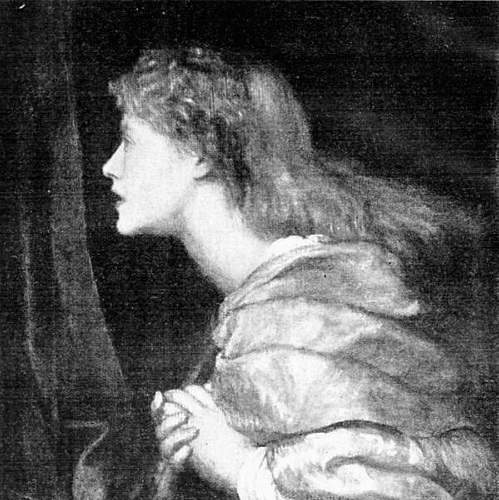
ELLEN TERRY
FROM A PAINTING, NEVER BEFORE REPRODUCED, BY GEORGE FREDERICK WATTS
H. Howe (the "agricultural" actor, as Henry called him):
Boys take my advice, the stage is not the question But whether at three score you'll all have my digestion, Why yearn for plays, to pose as Brutuses or Catos in, When you may get a garden to grow the best potatoes in? You see that at my age by Nature's shocks unharmed I am! Tho' if I sneeze but thrice, good heavens, how alarmed I am! But act your parts like men, and tho' you all great sinners are, You're sure to act like men wherever Irving's dinners are!
J. H. Allen (our prompter):
Whatever be the play, I must have a hand in it, For won't I teach the supers how to stalk and stand in it? Tho' that blessed Shakespeare never gives a ray to them, I explain the text, and then it's clear as day to them! Plain as A, B, C is a plot historical. When I overhaul allusions allegorical! Shakespeare's not so bad; he'd have more pounds and pence in him, If actors stood aside, and let me show the sense in him![3]
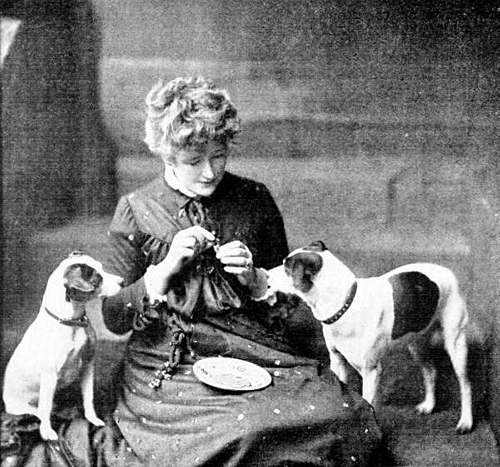
ELLEN TERRY WITH HER FOX-TERRIERS, DUMMY AND FUSSIE; FROM A PHOTOGRAPH TAKEN IN 1889
Louis Austin's little "Lyceum Play" was presented to me with a silver water-jug, a souvenir from the company, and ended up with the following pretty lines spoken by Katie Brown, a clever little girl who played all the small pages' parts at this time:
Although I'm but a little page, Who waits for Portia's kind behest, Mine is the part upon this stage To tell the plot you have not guessed. Dear lady, oft in Belmont's hall Whose mistress is so sweet and fair, Your humble slaves would gladly fall Upon their knees, and praise you there. To offer you this little gift, Dear Portia, now we crave your leave. And let it have the grace to lift Our hearts to yours this Christmas eve. And so we pray that you may live Thro' many, many, happy years, And feel what you so often give, The joy that is akin to tears!
How nice of Louis Austin! It quite made up for my mortification over the camphor pudding!
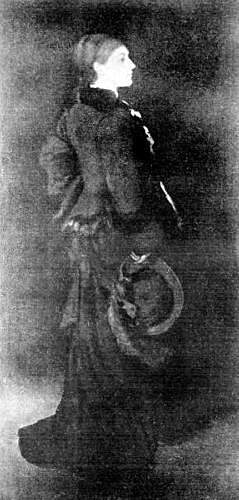
MISS ROSA CORDER
FROM THE PAINTING BY JAMES McNEILL WHISTLER
Reproduced from an approved print in the possession of the Lenox Library.
The Best Ophelia of My Life
When I played Ophelia for the first time in Chicago, I played the part better than I had ever played it before, and I don't believe I ever played it so well again. Why, it is almost impossible to say. I had heard a good deal of the crime of Chicago, that the people were a rough, murderous, sand-bagging crew. I ran on to the stage in the mad scene, and never have I felt such sympathy. This frail wraith, this poor demented thing could hold them in the hollow of her hand! The audience seemed to me like wine that I could drink, or spill upon the ground.... It was splendid! "How long can I hold them?" I thought. "For ever!" Then I laughed. That was the best Ophelia laugh of my life—my life that is such a perfect kaleidoscope, with the people and the places turning round and round.
At Chicago I made my first speech. The Haverley Theatre, at which we first appeared in 1884, was altered and rechristened the "Columbia" in 1885. I was called upon for a speech after the special performance in honour of the occasion, consisting of scenes from "Charles I.," "Louis XI.," "The Merchant of Venice," and "The Bells," had come to an end. I think it must be the shortest speech on record:
"Ladies and Gentlemen, I have been asked to christen your beautiful theatre. 'Hail Columbia'!"
"Lonesome Brooklyn"
When we acted in Brooklyn, we used to stay in New York and drive over that wonderful bridge every night. There were no trolley cars on it then. I shall never forget how it looked in winter, with the snow and ice on it—a gigantic trellis of dazzling white, as incredible as a dream. The old stone bridges were works of art—this bridge, woven of iron and steel for a length of over five hundred yards, and hung high in the air over the water so that great ships can pass beneath it, is the work of science. It is like the work of some impersonal power.
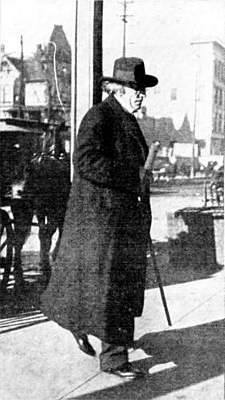
SIR HENRY IRVING
FROM A SNAP-SHOT TAKEN IN THE UNITED STATES
It was during our week at Brooklyn in 1885 that Henry was ill, too ill to act, for four nights. Alexander played Benedick and got through it wonderfully well. Then old Mr. Mead did (did is the word) Shylock. There was no intention behind his words or what he did.
I had such a funny batch of letters on my birthday that year: "Dear, sweet Miss Terry, etc., etc. Will you give me a piano?" etc., etc.; another: "Dear Ellen. Come to Jesus. Mary"; another, a lovely letter of thanks from a poor woman in the most ghastly distress; and lastly an offer of a two years' engagement in America. There was a simple coming-in for one woman acting at Brooklyn on her birthday!
Brooklyn is as sure a laugh in New York as the mother-in-law in a London music-hall. "All cities begin by being lonesome," a comedian explained, "and Brooklyn has never got over it."
My only complaint against Brooklyn was that they would not take Fussie in at the hotel there. Fussie was still my dog during the early American tours. Later on he became Henry's. He had his affections alienated by a course of chops, tomatoes, strawberries, "ladies' fingers" soaked in champagne, and a beautiful fur rug of his very own presented by the Baroness Burdett-Coutts.
Fussie
How did I come by Fussie? I went to Newmarket with Rosa Corder, whom Whistler painted. She was one of those plain-beautiful women who are so far more attractive than some of the pretty ones. She had wonderful hair,—like a fair, pale veil,—a white, waxen face, and a very good figure; and she wore very odd clothes. She had a studio in Southampton Row, and another at Newmarket, where she went to paint horses. I went to Cambridge once and drove back with her across the heath to her studio.
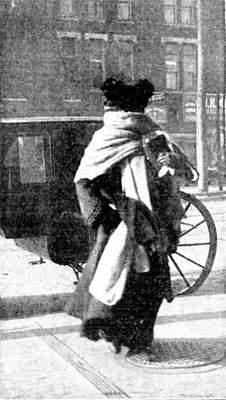
MISS ELLEN TERRY
FROM A SNAP-SHOT TAKEN IN THE UNITED STATES
"How wonderfully different are the expressions on terriers' faces," I said to her, looking at a painting of hers of a fox-terrier pup. "That's the only sort of dog I should like to have."
"That one belonged to Fred Archer," Rosa Corder said. "I daresay he could get you one like it."
We went out to find Archer. Curiously enough, I had known the famous jockey at Harpenden, when he was a little boy, and I believe used to come round with vegetables.
"I'll send you a dog, Miss Terry, that won't be any trouble. He's got a very good head, a first-rate tail, stuck in splendidly, but his legs are too long. He'd follow you if you went to America."
Prophetic words! On one of our departures for America, Fussie was left behind by mistake at Southampton. He found his way back from there to his own theatre in the Strand, London.
Fred Archer sent him originally to the stage door at the Lyceum. The man who brought him out to my house in Earl's Court said:
"I'm afraid he gives tongue. Miss, he don't like music anyway. There was a band at the bottom of your road, and he started hollering."
Fussie and "Charles I."
We were at luncheon when Fussie made his début into the family circle, and I very quickly saw that his stomach was his fault. He had a great dislike to "Charles I.," we could never make out why. Perhaps it was because Henry wore armour in one act—and Fussie may have barked his shins against it. Perhaps it was the firing off of big guns. But more probably it was because the play once got him into trouble. As a rule, Fussie had the most wonderful sense of the stage, and at rehearsal would skirt the edge of it, but never cross it. But at Brooklyn one night when we were playing "Charles I.," the last act, and that most pathetic part of it where Charles is taking a last farewell of his wife and children, Fussie, perhaps excited by his run over the bridge from New York, suddenly bounded on to the stage! The good children who were playing Princess Mary and Prince Henry didn't even smile; the audience remained solemn; but Henry and I nearly went into hysterics. Fussie knew directly that he had done wrong. He lay down on his stomach, then rolled over on his back, a whimpering apology, while carpenters kept on whistling and calling to him from the wings. The children took him up to the window at the back of the scene, and he stayed there cowering between them until the end of the play.
America seems to have been always fatal to Fussie. Another time when Henry and I were playing in some charity performance in which John Drew and Maude Adams were also acting, he disgraced himself again. Henry having "done his bit" and put on hat and coat to leave the theatre, Fussie thought the end of the performance must have come; the stage had no further sanctity for him, and he ran across it to the stage door barking! John Drew and Maude Adams were playing "A Pair of Lunatics." Maude Adams, sitting looking into the fire, did not see Fussie, but was amazed to hear John Drew departing madly from the text:
"Is this a dog I see before me, His tail towards my hand? Come, let me clutch thee."
She began to think he had really gone mad!
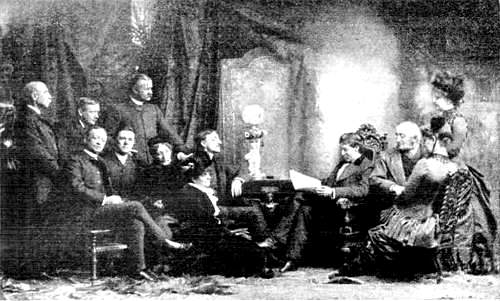
From the collection of Robert Coster
AUGUSTIN DALY AND HIS COMPANY OF PLAYERS
ADA REHAN, MRS. GILBERT, AND JOHN DREW FORM THE GROUP DIRECTLY FACING DALY
When Fussie first came, Charlie was still alive, and I have often gone into Henry's dressing-room and seen the two dogs curled up in both the available chairs, Henry standing while he made up, rather than disturb them!
When Charlie died, Fussie had Henry's idolatry all to himself. I have caught them often sitting quietly opposite each other at Grafton Street, just adoring each other. Occasionally Fussie would thump his tail on the ground to express his pleasure.
Irving's Strategy
Wherever we went in America, the hotel people wanted to get rid of the dog. In the paper they had it that Miss Terry asserted that Fussie was a little terrier, while the hotel people regarded him as a pointer; and funny caricatures were drawn of a very big me with a very tiny dog, and a very tiny me with a dog the size of an elephant. Henry often walked straight out of an hotel where an objection was made to Fussie. If he wanted to stay, he went in for strategy. At Detroit the manager of the hotel said that dogs were against the rules. Being very tired, Henry let Fussie go to the stables for the night, and sent Walter to look after him. The next morning he sent for the manager.
"Yours is a very old-fashioned hotel, isn't it?"
"Yes, sir, very old and ancient."
"Got a good chef? I didn't think much of the supper last night—but still—the beds are comfortable enough—I am afraid you don't like animals?"
"Yes, sir, in their proper place."
"It's a pity," said Henry meditatively, "because you happen to be overrun by rats!"
"Sir, you must have made a mistake. Such a thing couldn't——"
"Well, I couldn't pass another night here without my dog," Henry interrupted. "But there are, I suppose, other hotels?"
"If it would be any comfort to you to have your dog with you, sir, do, by all means, but I assure you that he'll catch no rat here."
"I'll be on the safe side," said Henry calmly.
And so it was settled. That very night Fussie supped off, not rats, but terrapin and other delicacies in Henry's private sitting room.
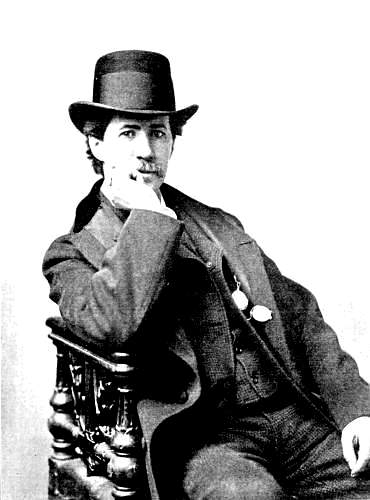
Photograph by Sarony
AUGUSTIN DALY
It was the 1888 tour, the great blizzard year, that Fussie was left behind by mistake at Southampton. He jumped out at the station, just outside where they stopped to collect tickets. After this long separation, Henry naturally thought that the dog would go nearly mad with joy when he saw him again. He described to me the meeting in a letter:
"My dear Fussie gave me a terrible shock on Sunday night. When we got in, J——, H——, and I dined at the Câfé Royale. I told Walter to bring Fussie there. He did, and Fussie burst into the room while the waiter was cutting some mutton, when, what d'ye think—one bound at me—another instantaneous bound at the mutton, and from the mutton nothing would get him until he'd got his plateful.
"Oh what a surprise it was indeed! He never now will leave my side, my legs, or my presence, but I cannot but think, alas, of that seductive piece of mutton!"
The Death of Fussie
Poor Fussie! He met his death through the same weakness. It was at Manchester, I think. A carpenter had thrown down his coat with a ham sandwich in the pocket, over an open trap on the stage. Fussie, nosing and nudging after the sandwich, fell through and was killed instantly. When they brought up the dog after the performance, every man took his hat off. Henry was not told until the end of the play. He took it so very quietly that I was frightened, and said to his son Laurence, who was on that tour:
"Do let's go to his hotel and see how he is."
We drove there and found him sitting, eating his supper, with the poor dead Fussie, who would never eat supper any more, curled up in his rug on the sofa. Henry was talking to the dog exactly as if it were alive. The next day he took Fussie back in the train with him to London, covered with a coat. He is buried in the dog's cemetery, Hyde Park.
His death made an enormous difference to Henry. Fussie was his constant companion. When he died, Henry was really alone. He never spoke of what he felt about it, but it was easy to know.
We used to get hints how to get this and that from watching Fussie. His look, his way of walking! He sang, whispered eloquently and low—then barked suddenly, and whispered again. Such a lesson in the law of contrasts!
The first time that Henry went to the Lyceum after Fussie's death, every one was anxious and distressed, knowing how he would miss the dog in his dressing-room. Then an odd thing happened. The wardrobe cat, who had never been near the room in Fussie's life-time, came down and sat on Fussie's cushion! No one knew how the "Governor" would take it. But when Walter was sent out to buy some meat for it, we saw that Henry was not going to resent it! From that night onwards the cat always sat, night after night, in the same place, and Henry liked its companionship. In 1902, when he left the theatre for good, he wrote to me:
"The place is now given up to the rats—all light cut off, and only Barry (the stage door-keeper) and a foreman left. Everything of mine I've moved away, including the Cat!"
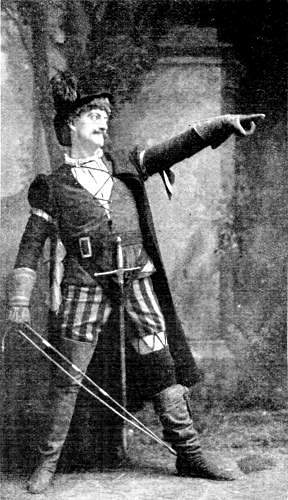
Photograph by Sarony
JOHN DREW
AS PETRUCHIO IN "THE TAMING OF THE SHREW"
The Old Daly Company
The Daly players were a revelation to me of the pitch of excellence which American acting had reached. My first night at Daly's was a night of enchantment. I wrote to Mr. Daly and said: "You've got a girl in your company who is the most lovely, humorous darling I have ever seen on the stage." It was Ada Rehan! Now, of course I didn't "discover" her or any rubbish of that kind; the audience were already mad about her; but I did know her for what she was, even in that brilliant "all-star" company and before she had played in the classics and got enduring fame. The audacious, superb, quaint Irish creature! Never have I seen such splendid high comedy. Then the charm of her voice,—a little like Ethel Barrymore's when Miss Ethel is speaking very nicely,—her smiles, and dimples, and provocative, inviting coquetterie! Her Rosalind, her Country Wife, her Helena, her Railroad of Love, and above all, her Katharine in "The Taming of the Shrew!" I can only ejaculate. Directly she came on I knew how she was going to do the part. She had such shy, demure fun—she understood, like all great comedians, that you must not pretend to be serious so sincerely that no one in the audience sees through it.
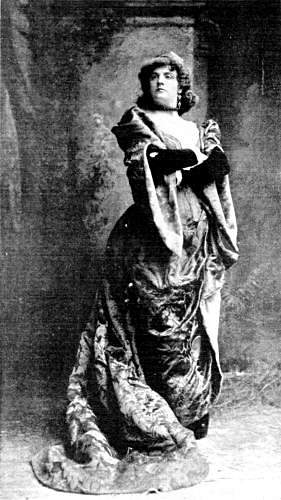
Photograph by Sarony
ADA REHAN
AS KATHARINE IN "THE TAMING OF THE SHREW"
As a woman off the stage Ada Rehan was even more wonderful than as a shrew on. She had a touch of dignity, of nobility, of beauty, rather like Eleonora Duse's. The mouth and the formation of the eye were lovely. Her guiltlessness of make-up off the stage was so attractive! She used to come in to a supper with a lovely shining face which scorned a powder-puff. The only thing one missed was the red hair which seemed such a part of her on the stage.
Here is a dear letter from the dear, written in 1890:
"My dear Miss Terry:
"Of course, the first thing I was to do when I reached Paris was to write and thank you for your lovely red feathers. One week is gone. To-day it rains and I am compelled to stay at home, and at last I write. I thought you had forgotten me and my feathers long ago. So imagine my delight when they came at the very end. I liked it so. It seemed as if I lived all the time in your mind; and they came as a good-bye.
"I saw but little of you, but in that little I found no change. That was gratifying to me, for I am over-sensitive, and would never trouble you if you had forgotten me. How I shall prize those feathers—Henry Irving's presented by Ellen Terry to me for my Rosalind Cap. I shall wear them once and then put them by as treasures. Thank you so much for the pretty words you wrote me about 'As You Like It.' I was hardly fit on that matinée. The great excitement I went through during the London season almost killed me. I am going to try and rest, but I fear my nerves and heart won't let me.
"You must try and read between the lines all I feel. I am sure you can if anyone ever did; but I cannot put into words my admiration for you—and that comes from deep down in my heart. Good-bye, with all good wishes for your health and success.
"I remain,
"Yours most affectionately, "Ada Rehan"
I wish I could just once have played with Ada Rehan. When Mr. Tree could not persuade Mrs. Kendal to come and play in "The Merry Wives of Windsor" a second time, I hoped that Ada Rehan would come and rollick with me as Mrs. Ford,—but it was not to be.
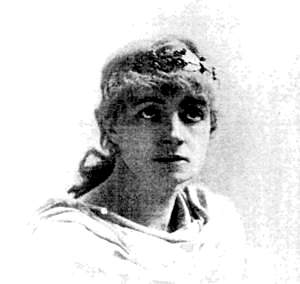
From the collection F. H. Meserve
HELENA MODJESKA
Mr. Daly himself interested me greatly. He was an excellent manager, a man in a million. But he had no artistic sense. The productions of Shakespeare at Daly's were really bad from the pictorial point of view. But what pace and "ensemble" he got from his company!
May Irwin was the low comedian who played the servants' parts in Daly's comedies from the German. I might describe her—except that she was far more genial—as a kind of female Rutland Barrington. On and off the stage her geniality distinguished her like a halo. It is a rare quality on the stage, yet without it the comedian has up-hill work. Generous May Irwin! Lucky those who have her warm friendship and jolly, kind companionship!
The John Drew Family
John Drew, the famous son of a famous mother, was another Daly player whom I loved. With what loyalty he supported Ada Rehan! He never played for his own hand, but for the good of the piece. His mother, Mrs. John Drew, had the same quiet methods as Mrs. Alfred Wigan. Everything that she did told. I saw Mrs. Drew play Mrs. Malaprop, and it was a lesson to people who overact. Her daughter, Georgie Drew, Ethel Barrymore's mother, was also a charming actress. Maurice Barrymore was a brilliantly clever actor. Little Ethel, as I still call her, though she is a big "star," is carrying on the family traditions. She ought to play Lady Teazle. She may take it from me that she would make a success in it.
Modjeska, who, though she is a Polish actress, is associated with the American stage, made a great impression on me. She was exquisite in many parts, but in none finer than in "Adrienne Lecouvreur." Her last act electrified me. I have never seen it better acted, although I have seen all the great ones do it since. Her Marie Stuart, too, was a beautiful and distinguished performance. Her Juliet had lovely moments, but I did not so much care for that, and her broken English interfered with the verse of Shakespeare. Some years ago I met Modjeska and she greeted me so warmly and sweetly, although she was very ill.
During my more recent tours in America, Maude Adams is the actress of whom I have seen most, and "to see her is to love her!" In "The Little Minister" and in "Quality Street" I think she is at her best, but above all parts she herself is most adorable. She is just worshipped in America, and has an extraordinary effect—an educational effect—upon all American girlhood.
Mary Anderson
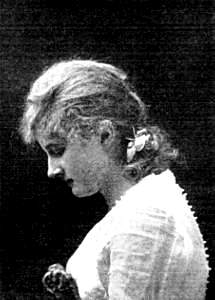
From the collection of Robert Coster
MARY ANDERSON
I never saw Mary Anderson act. That seems a strange admission, but during her wonderful reign at the Lyceum Theatre, which she rented from Henry Irving, I was in America, and another time when I might have seen her act, I was very ill and ordered abroad. I have, however, had the great pleasure of meeting her and she has done me many little kindnesses. Hearing her praises sung on all sides, and her beauties spoken of everywhere, I was particularly struck by her modest evasion of publicity off the stage. I personally only knew her as a most beautiful woman—as kind as beautiful—constantly working for her religion—always kind, a good daughter, a good wife, a good woman.
She cheered me before I sailed for America by saying that her people would like me.
"Since seeing you in Portia and Letitia," she wrote, "I am convinced you will take America by storm." Certainly she took England by storm! But she abandoned her triumphs almost as soon as they were gained. They never made her happy, she once told me, and I could understand her better than most, since I had had success too, and knew that it did not mean happiness.
Henry and I were so fortunate as to gain the friendship and approval of Dr. Horace Howard Furness, perhaps the finest Shakespearean scholar in America, and editor of the Variorum Shakespeare, which Henry considered the best of all editions—"the one which counts." It was in Boston, I think, that I disgraced myself at one of Dr. Furness' lectures. He was discussing "As You Like It" and Rosalind, and proving with much elaboration that English in Shakespeare's time was pronounced like a broad country dialect, and that Rosalind spoke Warwickshire! A little girl who was sitting in the front of me had lent me her copy of the play a moment before, and now, absorbed in Dr. Furness' argument, I forgot the book wasn't mine and began scrawling controversial notes in it with my very thick and blotty fountain pen.
"Give me back my book! Give me my book!" cried the little girl. "How dare you write in my book!" she cried with rage.
Her mother tried to hush her up: "It's Miss Ellen Terry."
"I don't care! She's spoilt my nice book!"
I am glad to say that when the little girl understood, she forgave me. Still, it was dreadful of me and I did feel ashamed at the time.
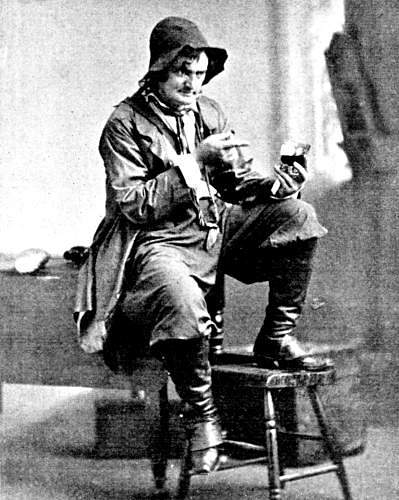
From the collection of F. H. Meserve
JOSEPH JEFFERSON AS RIP VAN WINKLE
Joseph Jefferson
In November, 1901, I wrote in my diary: "Philadelphia. Supper at Henry's. Jefferson there, sweeter and more interesting than ever—and younger."
Dear Joe Jefferson—actor, painter, courteous gentleman, profound student of Shakespeare! When the Bacon-Shakespeare controversy was raging in America (it really did rage there!) Jefferson wrote the most delicious doggerel about it. He ridiculed, and his ridicule killed the Bacon enthusiasts all the more dead because it was barbed with erudition.
He said that when I first came into the box to see him as "Rip," he thought I did not like him, because I fidgetted and rustled and moved my place, as is my wicked way. "But I'll get her, and I'll hold her," he said to himself. I was held indeed—enthralled!
The Night of the Great Blizzard
Our first American tours were in 1883-1884; the third was in 1887-88, the year of the great blizzard. We were playing in New York when the storm began, and Henry came to fetch us at half-past ten in the morning. His hotel was near the theatre where we were to play at night. He said the weather was stormy, and we had better make for his hotel while there was time. The German actor, Ludwig Barnay, was to open in New York that night, but the blizzard affected his nerves to such an extent that he did not appear at all and returned to Germany directly the weather improved!
Most of the theatres closed for three days, but we remained open, although there was a famine in the town and the streets were impassable. The cold was intense. Henry sent Walter out to buy some violets for Barnay, and when he brought them in to the dressing-room—he had only carried them a few yards—they were frozen so hard that they could have been chipped with a hammer.
We rang up on "Faust" three-quarters of an hour late. This was not bad, considering all things. Although the house was sold out, there was hardly any audience, and only a harp and two violins in the orchestra. But discipline was so strong in the Lyceum Company that every member of it reached the theatre by eight o'clock, although some of them had had to walk from Brooklyn Bridge. The Mayor of New York and his daughter managed to reach their box somehow. Then we thought it was time to begin. A few members of Daly's company, including John Drew, came in, and a few friends. It was the oddest, sparsest audience! But the enthusiasm was terrific.
Five years went by before we visited America again. Five years in a country of rapid changes is a long time, long enough for friends to forget. But they didn't forget. This time we made new friends, too, in the Far West. We went to San Francisco, among other places. We attended part of a performance at the Chinese theatre. Oh, those rows of impenetrable faces gazing at the stage with their long, shining, inexpressive eyes. What a look of the everlasting the Chinese have! "We have been before you—we shall be after you," they seem to say.
The chief incident of the fifth American tour was our production at Chicago of Laurence Irving's one-act play "Godefroi and Yolande." I regard that little play as an inspiration. By instinct the young author did everything right.
In 1900-1 I was ill and hated the parts I was playing in America. The Lyceum was not what it had been. Everything was changed.
In 1907—only the other day—I toured in America for the first time on my own account—playing modern plays for the first time. I made new friends and found my old ones still faithful.
But this tour was chiefly momentous to me because at Pittsburg I was married for the third time, and married to an American, Mr. James Usselman of Indiana, who acts under the name of James Carew.