CHIEF KITSAP, FINANCIER
Reading edition
BY JOSEPH BLETHEN
ILLUSTRATED WITH PHOTOGRAPHS
When young Johnny Kitsap, having made up his mind that his clerkship in the reservation agency did not offer the chance of advancement to which the son of a Puyallup chief and a graduate of Carlisle was entitled, applied for work to the President of the Elliott Bay National Bank, it was not an act of such presumption as some might suppose. No one, to be sure, when he saw the high cheek-bones, wiry black hair brushed pompadour, dull brown eyes, and copper complexion, could possibly have been deceived by Johnny's well-cut clothes, clean linen, and good English. Nor did Johnny affect these things as a disguise or as signifying that, in adopting the apparel and speech of the white man, he had renounced his nationality—had, to all intents and purposes, become a dead Indian. Quite to the contrary, what secured Johnny his position in the bank was precisely that, besides having a pleasant manner and civilized ways, he was so manifestly an exceptionally live Indian.
The Elliott Bay National's famous line of "red paper" had paid from the start. When, some years before, the proposition to loan old Peter Coultee, a full blood of the Puyallup reservation, was laid before the directors, they had laughed, but, like true Western men, they wanted to know the details. What they learned was that old Peter Coultee owned one hundred and sixty acres of fine reservation land, well stocked and highly cultivated; that his crop of hops was fast ripening; that he needed money to pay the hop-pickers of his own tribe; and that hop-house receipts in the White River Valley were as good as wheat receipts in the Palouse. This put the matter in other, at least, than a sneering light, and one of the laughing directors offered to visit the reservation and make a full report. The result was that old Peter Coultee got his loan, and that this turned out to be the first of many others, both to himself and to his tribesmen, and all of much mutual profit alike to white man and red.
When, accordingly, Johnny Kitsap did the Elliott National the honor of preferring its employment to that of the government, the president did not laugh, but, with all due formality, laid his application before the board, and suggested that a bank which loaned money to Indians might in time find it convenient to have a clerk who could interpret not only the language of the Siwash customers, but the more subtle emotions of the Indian heart. And so Johnny came by his job, and the bank had as little cause to regret it as the first loan to old Peter Coultee, which was the original cause of it.
To the young Indian, the bank became a magic house. The brass-barred windows before the tellers; the wire cages; the tiled floors; the great doors of the vault, with the tick-tick-tick of the time locks; all seemed to him to be parts of a powerful chieftain's house. The vault itself, with its store of gold and currency, and its cabinet of mysterious treaties, which the tyee made with the busy white men, filled him with awe. This was the white man's magic treasure-chest, wherein money bred money. No one bought or sold, so far as he could see, yet this treasure-chest paid salaries, distributed profits, and always continued full. With his imagination thus enlisted in firing his work with the zest of play, it is no wonder that he proved an apt pupil and in a rapidly flying trio of years had filled various positions and had earned high appreciation.
With his entrance upon the duties of collection clerk, Kitsap became the credit man on all "red paper." Every bit of Indian business received the approval of the Chief before the discount committee would act upon it. Thus the young Indian became surely, even if indirectly, a power on the reservation, where the tribal leaders regarded him as being at heart a white man and continued to address him quizzingly as Italapas (The Coyote That Wanders). Kitsap maintained a modest room in Seattle, enjoyed the privileges of an athletic club, owned a one-twentieth interest in a yacht, and, out on the reservation, kept a cayuse in father Kitsap's corral and a suit of Indian finery in father Kitsap's house. Thus he zigzagged across the borderland of civilization and led a most picturesque, but strictly honorable, double life.
Kitsap had been four years in the bank when three hop-buyers from St. Louis attempted to raid the White River hop fields in advance of picking and to buy the entire crop of the valley at fourteen cents a pound. The raid had progressed far towards success when Kitsap accidentally heard of it.
The Indian hop-growers of the reservation had made their fall estimates, Kitsap had inspected their fields and approved their items, and some ten thousand dollars in "red paper" was entered on the books of the Elliott Bay National Bank, the loans to be secured by the warehouse receipts on hops. Kitsap had spent the first Sunday of the picking on the reservation, greeting friends who had come on their annual pilgrimage to the hop fields from other reservations; and early on Monday morning he was on the way to take a train for Seattle, when Peter Coultee's cayuse overtook him, bearing Peter Coultee's oldest son.
"Good morning, Italapas. Is your bank short of money?" called the young Indian, with enough dire suggestion in his tone to start a Wall Street panic.
Kitsap faced his questioner. "It has more gold than the son of Coultee can count," he retorted sharply.
"Then why is Lamson, who owns the largest fields of all the white men in the valley, saying that the bank will not loan him enough to pay the pickers?"
Lamson, who was wealthy, as ranchers go, was a heavy client of the Elliott Bay National, but, since he was a white man, his accounts were unknown to Kitsap. The bank clerk was thus taken at a disadvantage and could not give a direct answer. But, desiring to learn what he could, he bantered the younger Indian to talk on, and listened carefully, that his words might be carried to the cashier.
"Lamson is paying two picking tickets out of every three in cash; for the third ticket he gives an order on the stores in the village. When the pickers complain, he laughs and says that the bank has loaned the Indians so much that it cannot lend him the little he needs. Peter Coultee sends word to you: Let Italapas run to the bank and count the gold." Then the younger Indian smiled suggestively, whirled his cayuse, and rode away.
Kitsap was troubled by young Coultee's words. Not that any thought of weakness in the Elliott Bay National entered his mind; but he felt at once that such a report, if allowed to circulate undenied, would be harmful to the magic treasure-chest. He was all nerves when he reported to the cashier.
As soon as the president arrived, the cashier went to him with the report. Together they reviewed Lamson's account, and decided that no danger was to be found there. Lamson's hops were being delivered to a warehouse, and the warehouse receipts were being delivered to the bank as security for the hop-gathering loan. All this was regular and customary. But Lamson's motive in making such talk disturbed the president. He sent for Kitsap to question him.
Never before had the young red man been called into a conference with the president. He felt both proud and alarmed at the incident. When told the facts, Kitsap was greatly relieved, but he could suggest no motive for Lamson's story. He volunteered to visit the valley in an endeavor to ascertain the facts. The suggestion pleased the president, who at once ordered it put into effect.
"I suppose," said the gray-headed president, "that you will enjoy this scouting expedition all the more because you are on the trail of a white man. But while I am going to trust to your own good sense and your knowledge of your people in running this lie right back to the man who fathered it, I want to caution you to play well inside the rules of the game.
"Now, you are out to hit the trail of that lie and chase it home. When you have corralled it, let me know what company it is keeping and I will tell you what to do next. Lamson has been a good client and this lie may run away from him. If so, we must not offend him and thus lose his account. But if it hikes home to his ranch house, then I want to know what he is doing, and the nearer he is related to this rumor, the quicker we shall cash his hop receipts and cancel his note.
"If you find it necessary to use the bank's authority, then come out strong as ambassador plenipotentiary and read the stiffest kind of a bluff to your man in the name of the Elliott Bay National Bank. Talk as little as possible about the bank; but when you do talk, make every man jealous of your connection with the institution. A conservative remark may bring a new customer to our books; a flippant word may go into business for itself and start a run that no bank could weather. Now get at it, and let us hear something from you by day after to-morrow."
Scout! The president himself had said it! The Indian's blood thrilled with his commission. His voice shook a little in its attempt to be very, very steady as he telephoned out to the reservation station for a saddle-horse. Then he ran for the five o'clock south-bound train.
At eight o'clock Kitsap arrived at the reservation. On all sides were the lights among the camps, where the hop-pickers were making merry. More than one group hailed him as he passed, demanding to know if he had come out from town to dance, to gamble, or to see a maid. But he had replied to each in kind and pressed on to his father's house. Kitsap the elder greeted his son in the native tongue.
"Huh! Is The Coyote still prowling?"
"The Coyote hunts big game for his tyee, my father. Let The Coyote's horse be cared for till he returns."
Then Kitsap, the bank clerk, decked himself as an Indian should and as The Coyote went forth to listen at many camp-fires and to hear what tales were telling there. Till far into the night he prowled, learning what families of Indians were picking for Lamson, what form Lamson's bank story was taking, and to what store the orders were sent for redemption. The fires were low and the valley was still when he sought his father's house and slept.
The next morning he resumed the dress of the white man. It was a day spent in the saddle. He rode from store to store, from ranch to ranch and warehouse to warehouse, the length and breadth of the valley, questioning, listening, brisk, businesslike, and polite, in all respects the decorous representative of the white man's bank. Yet, as he stood that evening at the white man's telephone, and recounted to his cashier the facts he had learned, the gleam in his eyes and the pride in his heart were those of the young red warrior who has tracked his foe and makes report to the high chiefs of his tribe. He concluded by asking his cashier to telegraph to St. Louis and the other hop markets and ascertain the probable trend of hops, and telephone him in the morning.
And then Kitsap, the clerk, donned the tribal finery of his ancestors and again The Coyote prowled among the camp-fires. At each he dropped a faggot for thought:
"Lamson, the biggest hop rancher in the valley, is buying hops at fourteen cents and paying his pickers with store orders. That's why he lied about the bank."
The pickers buzzed the news about the fires till the overseers heard it; the overseers bore the tale to the ranchers; the ranchers went to their telephones and set the tale to flashing. In the morning, when the valley rose to resume picking, Lamson's raid was in cold type in the Seattle papers and at eight o'clock Lamson himself read it. Then he realized that the pool had been betrayed, and he went on the war-path to find the mysterious Indian.
Kitsap rose late, and loitered about, gossiping with the idle, till ten o'clock. Then he called up the bank. The cashier had received a wire from the East.
"Hops opened in St. Louis at sixteen cents, Milwaukee sixteen cents, Cincinnati seventeen cents," said the cashier over the telephone. "Crop reports indicate light yield abroad and heavy demand on American hops. Rise in price certain. I have asked a Seattle broker to cable Liverpool. The president says to spread the news and call me again at four o'clock."
Then Kitsap mounted his own spotted cayuse and rode from ranch to ranch till every Indian planter on the reservation had heard his news:
"The biyu tyee of the money house sends greetings. Hops are seventeen cents and going up."
At four o'clock Kitsap was once more at the telephone, and received a message from the cashier which sent his heart pounding in his throat for very enthusiasm.
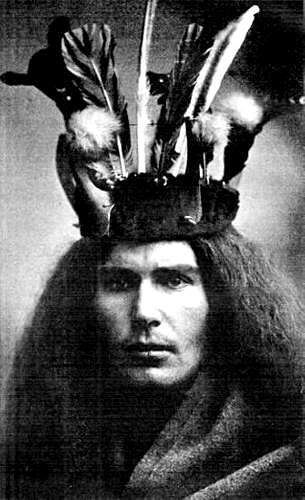
Copyrighted by E. S. Curtis, Seattle
"KITSAP, THE CLERK, DONNED THE TRIBAL FINERY OF HIS ANCESTORS"
"I have sent you an important letter by express on the three o'clock train," said the cashier. "Get it and read what I have written. Stay as long as you need to, but smash that pool, and teach Lamson not to lie about the Elliott Bay National."
Then Kitsap waited for the train, secured his express package, and opened it. It contained a letter from Lamson to the bank—a letter that was ammunition for the Indian—and instructions to make certain use of it.
He could make no more progress indirectly; he must face the raiders, or his own people would doubt him. He must seek out Lamson, and standing in front of that white man, the Indian must throw back into his teeth that lie about the bank. The warm red blood in him yearned for a clash and a tussle. He would go to the store to spend the evening. If a collision with the fourteen-cent raiders was to be effected anywhere, the store would afford it.
To the store that night came Lamson and the St. Louis buyers, all in evil mood. Kitsap's news had completely arrested the effect of their pessimistic talk. No rancher would sell at fourteen cents with a bank's messenger rioting over the valley quoting hops in Liverpool at eighteen cents. Indeed, those who had already contracted to sell were grumbling, and many of them came to the store that night, eager to hear the truth of a market which had been misrepresented to them. These men were listening to Kitsap, whose words put them in a very sullen temper, when Lamson and the three buyers entered.
"So you're the Injun who's been going around bulling the market," shouted Lamson, his voice keyed high with temper. He stepped quickly into the crowd of ranchers about Kitsap, conscious that he must rout the Indian or see the end of the pool.
The young Indian faced the irate rancher and looked him coolly up and down. This was Lamson; the heaviest owner of land in the valley. This was the white man who had lied about the Elliott Bay National. The meeting for which he had hoped had come. The Indian drew a deep breath of sheer delight. Then, in a clear, ringing tone, he returned the white man's fire:
"So you are the rancher who lied about the Elliott Bay National Bank?"
The blood leaped to the rancher's temples and he stepped menacingly toward the Indian. But before he could strike, Kitsap's voice again rang out:
"You are a double liar! You borrowed money to pay pickers, but used it to buy hops at fourteen cents, after telling the ranchers that you had sold. That was the first lie. You told the Indians that the bank would not loan you enough to pay them. That was another lie. But the bank has found you out!"
The rancher stood speechless before the unexpected words of the Indian. The clenched fist fell to his side. The young man who stood there before him, with the straight proud poise of the savage chieftain, spoke the words of the white man's warfare, the warfare of the mart and of barter. He must be met and beaten on his own ground. Clearly, he had spoken to effect, and the rancher must justify his position before his fellow ranchers, whose eyes were so intently watching him.
"You seem to know a lot about the bank's business," he began, with an attempt at sarcasm. "I suppose the president consults you on loans."
"The president did on this one," replied the Indian. The ranchers laughed.
"Then perhaps he told you that this one was amply secured by my hop receipts," boasted Lamson.
"He did."
"Then what the bloomin' —— is it to him what I do with the cash?"
"He sent me to give you back that lie about the bank."
"Well"——
"I have. I called you a liar, and then proved it. Your name is—Two Lies!"
Lamson's color came back, but this time it was the color of anger. His hand went half-way to his revolver, but a broad-shouldered rancher caught his arm.
"None o' that, Lamson."
Lamson wrenched his arm away. The big rancher faced him.
"This here Kitsap is telling the truth," said he. "I reckon he's got still more of it to give us. And we will expect you to fish or cut bait. But I'll hold this." Then he clapped his hand on Lamson's gun pocket and disarmed him. The three St. Louis hop buyers looked wistfully toward the door. But prudence held them to the spot.
"You are making a big fuss over nothing," sputtered Lamson. "Whose business is it if I do buy hops? The bank is secured on its loan."
"It's our business a whole lot," said the big rancher, gently tapping the handle of Lamson's revolver on Lamson's chest. "You give out that you are selling hops at fourteen cents and advise a lot of us fellows to do the same. Now we're told that you've been buyin' at fourteen cents. It's our business to find out which end up you're playin' this market."
"Oh, rot!" roared Lamson. "Hops are fourteen cents now. I'm buying a few to hold 'em. If I can afford to take the risk, I'm entitled to the profit."
"The bank knows that hops are eighteen cents to-day," broke in Kitsap.
"That's another lie," yelled the enraged Lamson, and the ranchers laughed at the unconscious admission.
"Is it?" said Kitsap quietly. "Do you dare to bet on it?"
"I'll bet you a hundred dollars," roared the rancher, "that you can't get over fourteen cents for hops in this valley this fall."
"I will bet you that amount that I can get at least sixteen cents for the Indians on the reservation."
"Where's your money?" said Lamson, drawing out a roll of bills.
Kitsap had not looked for this. He was puzzled for a moment. Then he drew forth a pocket check-book, signed a check, and handed it to an Indian rancher, who endorsed it. Turning to Lamson, Kitsap said:
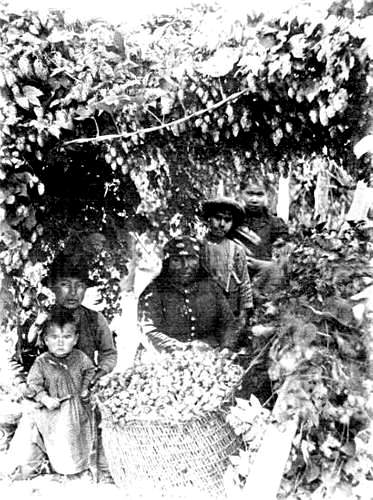
Copyrighted by E. S. Curtis, Seattle
"ON ALL SIDES THE HOP-PICKERS WERE MAKING MERRY"
"Will this do, or shall I telephone the cashier to assure its payment?"
"It's good," said Lamson.
"Very well. But if you are so sure about the price of hops, Mr. Two Lies, why don't you make it two to one that I can't get seventeen cents?"
"That's my money!" and Lamson began counting out another hundred.
"Or three to one that I can't get eighteen cents?"
"It goes!"
"Or four to one that I can't get nineteen cents?"
"Yes; or five to one that you can't get twenty," roared the exasperated planter.
"Five to one," replied Kitsap. "And if I win, I will throw your money in silver from the steps of the reservation school to the Indian children."
Kitsap noted the effect on the Indians in the room as the money was placed in the hands of the town marshal. He knew how every red man on the reservation would work for twenty-cent hops now.
But the Indian was not through with the white man. He turned on him again.
"If you think the bank lied when it said eighteen cents, there is a telephone. Call up the cashier at his home. He sent me here to tell the white men and Indians who are our clients. Ask him for yourself."
Lamson and the three buyers noted the words "Our clients." To Lamson it brought identification of the Indian as Johnny Kitsap, the clerk; to the buyers it was just mysterious enough to be alarming.
"Confound the cashier! All he knows is what somebody else has told him."
"Mr. Lamson, do you yourself think that fourteen cents for hops to-day is a fair price?" asked Kitsap, suddenly taking a conciliatory tone.
"Certainly I do. But if I want to buy hops at fourteen cents now and hold them on a speculation, it's my own business."
"Entirely," said the Indian. "But I believe your conduct with the ranchers who have agreed to sell is based on your statement that you had already sold your own hops to these buyers from St. Louis for fourteen cents."
"That's right," said Lamson boldly. "I can sell my hops for what I like."
"Liar," said Kitsap, "you have not sold your hops."
Lamson sprang to his feet, but the big rancher put out a big hand and shoved him back.
"Sit down," said the big man. "Can't you see this here Kitsap's got the floor?"
"As I understand it," continued Kitsap, turning to the men who had signed the contract to sell to the raiders, "unless Mr. Lamson has already delivered his hops to the buyers under his contract, the very agreement is void, and you are all released."
"You bet your life that's right," said the big man with the gun, and from all parts of the crowd came words of confirmation.
Lamson, for the first time during the encounter, felt uneasy. He looked blankly at the three buyers. One of the gentlemen from St. Louis drew the contract from his pocket.
"The young man is right," said the gentleman from St. Louis, in a conciliatory tone. "Here is the contract, and I can safely assure our friends that Mr. Lamson has carried out his part of the agreement."
"You bet," shouted Lamson, recognizing a very pretty bluff on the part of the buyer.
"May I see the contract?" asked Kitsap.
The buyer passed it to him. Kitsap read the contract aloud, and then tossed it over his head into the hands of the men who had signed it. The buyers and Lamson came to their feet.
"Worthless paper," said Kitsap. "Lamson has not delivered his hop receipts and therefore there is no contract."
A yell of delight went up from the crowd, and a shower of tiny bits of white papers showed the fate of the instrument. Kitsap pointed his finger at the enraged Lamson, and as the shower of paper fell about him fairly shouted his denunciation:
"I, Kitsap, the clerk, am a representative of the Elliott Bay National Bank. I come here by the orders of the tyee—the president. Your hop receipts are in the bank's treasure-chest, and here is your letter received at the bank last Monday." Kitsap opened the letter that had come to him by express and read:
Picking is progressing well, and the valley will yield a big crop. A few hungry ranchers are selling at fourteen cents cash at the warehouse, but I look for better prices later. I hope you will be willing to carry my receipts till November, when I look for a price close to twenty cents.
As Kitsap read, his voice rose, and, as he ended, there was absolute silence for an instant. Then the ranchers took their spellbound eyes from the quivering Indian and looked at the pale face of the speechless Lamson. The store-keeper looked with the others, and it was his groan that broke the spell:
"Thunder! I stood to make a thousand on the deal."
Then the overjoyed ranchers found their voices in a wild laugh, and laid enthusiastic hands on Kitsap. Lamson and the buyers slipped away, beaten and humiliated, to lament the failure of the fourteen-cent raid, and to spend a few bitter hours in planning a new offer next morning at a better price, for there was need to cover promises made to Eastern houses.
The ranchers quickly formed themselves into a meeting and sent couriers out to notify all signers of the contract that the deal was off. Then they appointed a committee to go to the bank next day with Kitsap and be witnesses to his report to his superiors.
Before another day passed, the spirit of the valley had changed from a desire to sell quickly for cash into a determination to hold the crop for a twenty-cent market. The Elliott Bay National secured daily bulletins from inside sources and kept the world's markets before the entire valley. Picking progressed to an end, and the Indians held their last feast and departed. Then buyers came from other markets, inspected the crop, and made offers. Gradually the valley ranchers joined the lead of the reservation Indians and placed their receipts with the Elliott Bay National, to be held for a rise and sold as near twenty cents as possible. The cashier sent East for a prominent broker, who replied that he would arrive by the Sound in mid-October. Then the other buyers began bulling the market, hoping to induce a rancher here and there to sell and, by thus breaking the ranks, run prices down. But Kitsap, on the ground, and the cashier, in the bank, were able to hold them together till the new broker arrived.
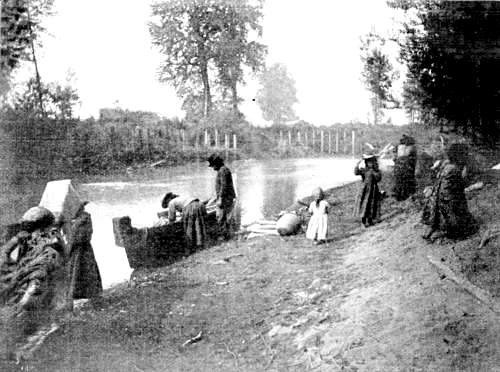
Copyrighted by E. S. Curtis, Seattle
"PICKING PROGRESSED TO AN END, AND THE INDIANS HELD THEIR LAST FEAST AND DEPARTED"
The new man was business from the ground up. He knew where he could sell hops, and for what price. He inspected the valley crop of hops and frankly announced his intention to pay twenty-one cents. Then the other buyers rushed in to get a share, and the result was an agreement by which the new broker got half the crop at twenty-one cents and the late lamented fourteen-cent raiders divided the other half among themselves at twenty-three cents, the money to be distributed through the Elliott Bay National to all ranchers at the average of twenty-two cents.
Kitsap telephoned the news to the reservation, and the priest sent the son of Peter Coultee on his spotted cayuse to ride into the village with the news. DeQuincey's Royal Mail with the news of Waterloo did not create more enthusiasm than the Indian's triumphant shout. As he dashed along he yelled to the white men:
"Hops sold at twenty-two cents!"
To the Indian ranchers he called out the same news in the jargon:
"Hops marsh mox-taltum-tee-mox."
Down the street he rode, yelling and winning yells in return. The news spread from street to street, men carried it into the valley, and that night many a heart among the ranches beat quicker and many a voice at the firesides murmured the name of "Kitsap."
The town marshal made the trip to Seattle and delivered the six-hundred-dollar wager to Kitsap. The Indian told the cashier the terms of the wager and asked to be excused on the following Saturday, that he might assemble the reservation children and scatter the Lamson money.
"It will be a great event to them," said Kitsap. "I shall take all of Lamson's five hundred dollars in dimes, and the whole reservation will come out to see the fun."
The cashier granted the leave of absence gladly.
"If you will hold the event in the afternoon, I think the president would be pleased to go out and see it," said he.
Kitsap needed no other hint, but went boldly to the president and invited him to witness the scattering of the coins.
"With pleasure," replied the president.
"Come on the three o'clock train, and I will have a carriage for you," said Kitsap.
The reservation had been waiting for twenty-cent hops as a band of children wait for the circus. Five thousand dimes to be thrown to less than three hundred children! It would be a rare scramble. Indian children raided their mothers' button-baskets that they might throw the buttons in the sand and practise scrambling for them. Then came the news of twenty-two cent hops, and every Indian, young or old, jumped up and down and shouted that Kitsap had won that Lamson money.
"Saturday afternoon at four o'clock," was Kitsap's message to the reservation priest, and the priest assembled ten young men for a conference. It was decided to mark off ten squares on the lawn in front of the schoolhouse. On each square a squad of thirty children should stand, the children of each squad graded so as to be nearly of a size, girls and boys in alternate squares. Before each square one of the ten young men should stand with five hundred silver coins in a dish. At a signal from Kitsap, who should stand on the school steps, the ten young men should throw the dimes in the air and the scramble would begin.
When the train stopped at the reservation station that October afternoon, the president of the Elliott Bay National found Kitsap the elder there to meet him, with a clean spring wagon. During the short drive to the reservation school, he noted that the road was deserted, but when the school was reached a scene of color and animation met his eye. The tribe was out in full regalia, even the clients of the bank, who came gravely to the president's wagon to greet him. Kitsap the elder drove to a spot reserved for the head men of the tribe, and the chief of the money-house was welcomed to a place among them. Then a hush fell upon the assembly.
A procession of young men, headed by Kitsap, decked in tribal finery, came out of the schoolhouse. Kitsap remained on the stairs, as the ten young men, bearing dishes of dimes, took their places before the squares. Every child stood waiting—every grown person held his breath. The voice of Kitsap, speaking each sentence first in the jargon and then in English, made a short harangue. The president smiled as he caught this glimpse of Kitsap's own interpretation of a bank.
"Lamson, the white man, told a lie about the money-house. The great tyee of the treasure-chest sent Kitsap, who is a brave of the white tyee's house, to tell the Puyallups the truth. The Great Spirit made Lamson angry and caused him to lose this money to Kitsap, who serves the great white tyee. But the great white tyee said: 'Behold, the Great Spirit has punished Lamson. Forever will he be called Two Lies. The money shall be for the children, as Kitsap said. I will go myself to see Kitsap throw the silver coins to the children, for it is a lesson. Let them always speak true words, or the Great Spirit will punish them, and they will have an evil name like Lamson!' And look, children, Kitsap's tyee sits with the tyee of the Puyallups to see you scramble. Remember, keep on your own square and do not strike. Push and pull, but do not strike. Show the white tyee who lives in the magic treasure-house that you can play your games fairly. Then he will be pleased and tell his own people of the silver coins that Kitsap throws to the children."
There was silence a moment, and then Kitsap raised a feathered wand. In the native tongue he shouted:
"All ready? Throw!"
Ten lithe Indians threw their silver treasure into the air. Five thousand silver coins flashed in the sun and fell in a sparkling shower on the heads of the tribal children. With one voice the children screamed and sprang to the scramble; with one voice the Puyallup tribe roared in glee; with one motion the tribal hats went into the air, and the president of the Elliott Bay National yelled in his enthusiasm, pounded a red man on the back, waved a silk hat on high, and became as one of these child-hearted aborigines.
Late that night, while the president sat at his club, hoarse but happy, and told what he had seen, a band of Indians out on the reservation held a ceremony in a big tent. The rite was as old as the tribal memory—the rite of formally adopting a chief—and a young man was declared to have won a great fight, and to be worthy of a high place in the councils of the tribe. They wanted to name him Chief Who-Made-The-Silver-Rain, but the young man replied that Chief Kitsap, being his father's name, was good enough for him.