THE WAYFARERS
Reading edition
BY
MARY STEWART CUTTING
AUTHOR OF "LITTLE STORIES OF COURTSHIP," "LITTLE STORIES OF MARRIED LIFE," ETC.
ILLUSTRATIONS BY ALICE BARBER STEPHENS
XV
Lois, would you mind very much if we didn't move into the new house, after all?"
"Not move into the new house! What do you mean? I thought it would be finished next week."
"It means that I shall not be able to increase my living expenses this year," said Justin.
Husband and wife were sitting on the piazza, in the shade of the purple wistaria-vines, on a warm Sunday afternoon, a month after Dosia's return. From within, the voices of the children sounded peacefully over their early supper.
The afternoon, so far, had savored only of domestic monotony, with no foreshadowing of events to come. Dosia was out walking with George Sutton, and the people who might "drop in," as they often did on Sundays, had other engagements to-day. Lois, gowned in lavender muslin, had been sitting on the piazza for an hour, trying to read while waiting for Justin to join her. She had counted each minute, but now that he was there, she put down her book with a show of reluctance as she said:
"Why didn't you tell me before? I gave the order for the window-shades yesterday when I was in town—that was what I wanted to talk to you about this afternoon. You have to leave your order at least two weeks beforehand at this season of the year."
"You can countermand it, can't you?"
"I suppose I'll have to—if we're not to move into the house," said Lois in a high-keyed voice, with those tiresome tears coming, as usual, to her eyes. She felt inexpressibly hurt, disappointed, fooled. "I thought you said you were having so many orders lately. Does the money all have to 'go back into the business,'" she quoted sardonically, "as usual? I think there might be some left for your own family sometimes. I'm tired of always going without for the business." It was a complaint she had made many times before, but in each fresh pang of her resentment she felt as if she were saying it for the first time.
"We have orders, I'm glad to say, but we've had one big setback lately," he answered.
He knew, with a twinge, that she had some reason on her side. The very effort for success was meat and drink to him; he cared not what else he went without, so the business grew. But she might have had a little more out of it as they went along, instead of waiting for the grand climax of undoubted prosperity. A little means so much to a wife sometimes, because it means the recognition of her right.
"I've been in a lot of trouble lately, Lois, though I haven't talked about it," he continued, with an unusual appeal in his voice. The blasting fact of those returned machines had been all he could cope with; he had been tongue-tied when it came to speaking about it—the whirl and counter-whirl in his brain demanded concentration, not diffusion and easy words to interpret. But now that he had begun to see his way clear again, he had a sudden deep craving for the unreasoning sympathy of love.
"I waited until the last possible moment to tell you, in hopes that I shouldn't have to, Lois. Anyway, Saunders is going to put up a couple of houses for next year that you'll like much better, he says."
"Oh, it will be just the same next year; there'll always be something," said Lois indifferently, getting up and going into the house.
He was bitterly hurt, and far too proud to show it. He could have counted on quickest sympathy from her once; he knew in his heart that he could call it out even now if he chose, but he did not choose. If his own wife could be like that, she might be.
"Papa dear, I love you so much!"
He looked down to see his little fair-haired girl, white-ruffled and blue-ribboned, standing beside him a-tiptoe in her little white shoes, her arms reached up to tighten instantly around his neck as he bent over.
"Zaidee, my little Zaidee," he said, and, lifting her on his knee, strained her tightly to him with a rush of such passionate affection that it almost unmanned him for the moment. She lay against his heart perfectly still. After a few moments she put her small hand to his lips, and he kissed it, and she smiled up at him, warm and secure—his little darling girl, his little princess. Yet, even in that joy of his child, he felt a new heart-hunger which no child love, beautiful as it was, could ever satisfy, any more than it could satisfy the heart-hunger of his wife.
She had begun, since the ball, to go around again as usual, and the house looked as if it had a mistress in it once more, though the atmosphere of a home was lacking. She was languid, irritable, and unsmiling, accepting his occasional caresses as if they made little difference to her, though sometimes she showed a sort of fierce, passionate remorse and longing. Either mood was unpleasing to him: it contained tacit reproach for his separateness. Then, there were still occasionally evenings when he came home to find her windows darkened and everything in the household upset and forlorn; when every footfall must be adjusted to her ear—that ear that had strained and ached for his coming. Her whole day culminated in that poor, meager half-hour in which he sat by her, and in which her personality hardly reached him until he kissed her, on leaving, with a quick, remorseful affection at being so glad to go.
The typometer disaster had proved as bad as, and worse than, he had feared, but he was working retrieval with splendid effort, calling all his personal magnetism into play where it was possible. He had borrowed a large sum from Lanston's,—a young private banking firm, glad at the moment to lend at a fairly large interest for a term of months,—holding on to the dissatisfied customers and creating new demand for the machine, so that the sales forged ahead of Cater's, with whom there was still a good-natured we-rise-together sort of rivalry, though it seemed at times as if it might take a sharper edge. Leverich's dictum regarding Cater embodied an extension of the policy to be pursued with minor, outlying competitors: "You'll have to force that fellow out of business or get him to come into the combine."
Leverich again smiled on Justin. Immediate success was the price demanded for the continuance of a backing. There was just a little of the high-handed quality in his manner which says, "No more nonsense, if you please." That morning after the ball had shown Justin the fangs that were ready, if he showed symptoms of "falling down," to shake him ratlike by the neck and cast him out.
"Papa dear, papa dear! There's a man coming up the walk, my papa dear."
"Why, so there is," said Justin, rising and setting the child down gently as he went forward with outstretched hand, while Lois simultaneously appeared once more on the piazza. "Why, how are you, Larue? I'm mighty glad to see you back again. When did you get home?"
"The steamer got in day before yesterday," said the newcomer, shaking hands heartily with host and hostess. He was a man with a dark, pointed beard and mustache, deep-set eyes, and an unusually pleasant deep voice that seemed to imply a grave kindliness. His glance lingered over Lois. "How are you, Mrs. Alexander? Better, I hope? Which chair shall I push out of the sun for you—this one?"
"Yes, thank you," responded Lois, sinking into it, with her billows of lilac muslin and her rich brown hair against the background of green vines. "Aren't you going to sit down yourself?"
"Thank you, I've only a minute," said the visitor, leaning against one of the piazza-posts, his wide hat in his hand. "I'm out at my place at Collingwood for the summer, and the trains don't connect very well on Sunday. I had to run down here to see some people, but I thought I wouldn't pass you by."
"Did you have a pleasant trip?" asked Lois.
"Very pleasant," rejoined Mr. Larue, without enthusiasm. "Oh, by the way, Alexander, I heard that you were inquiring for me at the office last week. Anything I can do for you?"
"Have you any money lying around just now that you don't know what to do with?" asked Justin significantly.
Mr. Larue's dark, deep-set eyes took on the guarded change which the mention of money brings into social relations.
"Perhaps," he admitted.
"May I come around to-morrow at three o'clock and talk to you?"
"Yes, do," said the other, preparing to move on. "Please don't get up, Mrs. Alexander; you don't look as well as I'd like to see you."
"Oh, I'm all right," said Lois.
"You must try and get strong this summer," said Mr. Larue, his eyes dwelling on her with an intimate, penetrating thoughtfulness before he turned away and went, Justin accompanying him down the walk, Zaidee dancing on behind. Lois looked after them. At the gate, Mr. Larue turned once more and lifted his hat to her.
A faint, lovely color had come into Lois' cheek, brought there by the powerful tonic which she always felt in Eugene Larue's presence. She felt cheered, invigorated, comforted, by a man with whom she had hardly talked alone for an hour altogether in their whole five years' acquaintance. He had a way of taking thought for her on the slightest occasion, as he had to-day: he knew when she entered a room or left it, and she knew that he knew.
It was one of those peculiar, unspoken sympathetic intimacies which exist between certain men and women, without the conscious volition of either. His glance or the tone of his voice was a response to her mood; he saw instinctively when she was too warm or too cold, or needed a rest. Her husband, who loved her, had no such intuitions; he had to be told clumsily, and even then might not understand. Yet she had not loved him the less because she must beat down such little barriers herself; perhaps she had loved him the more for it—he was the man to whom she belonged heart and soul: but the barriers were a fact. She had an absolute conviction that she could do nothing that Eugene Larue would misunderstand, any more than she misunderstood her involuntary attraction for him. Above all things, he reverenced her as his ideal of what a wife and mother should be. He would have given all he possessed to have the kind of love which Justin took as a matter of course.
Eugene Larue had been married himself for ten years, for more than half of which time his wife, whom Lois had never seen, had lived abroad for the further study of music, an art to which she was passionately devoted. If there had been any effort to bring a hint of scandal into the semi-separation, it had been instantly frowned away; there was nothing for it to feed on. Mrs. Larue lived in Dresden, under the undoubted chaperonage of an elderly aunt and in the constant publicity of large musical entertainments and gatherings. She sometimes played the accompaniments of great singers. Her husband went over every spring, presumably to be with her, living alone for the greater part of the year at his large place at Collingwood. Neither was ever known to speak of the other without the greatest respect, and questions as to when either had been "heard from" were usual and in order; it was always tacitly taken for granted that Mrs. Larue's expatriation was but temporary.
But Lois knew, without needing to be told, that he was a man who had suffered, and still suffered at times profoundly, from having all the tenderness of his nature thrown back upon itself, without reference to that sting of the known comment of other men: "It must be pretty tough to have your wife go back on you like that." In some mysterious way, his wife had not needed the richness of the affection that he lavished on her. If her heart had been warmed by it a little when she married him, it had soon cooled off; she was glad to get away, and he had proudly let her go.
Lois smiled up at Justin with sudden coquetry as he mounted the porch steps, but he only looked at her absently as he said:
"There seems to be a shower coming up. Dosia's hurrying down the road. I think I'd better take the chairs in now."
XVI
Dosia had come back from the Leverichs' to a household in which her presence no longer made any difference for either pleasure or annoyance. She came and went unquestioned, practised interminably, and spent her evenings usually in her own room, developing a hungry capacity for sleep, of which she could not seem to have enough—sleep, where all one's sensibilities were dulled and shame and tragedy forgotten. She had, however, rather more of the society of the children than before, owing to their mother's preoccupation. Nothing could have been more of a drop from her position as princess and lady-of-love in the Leverich domicile, where she had been the center of attraction and interest. Everything seemed terribly unnatural here, and she the most unnatural of all—as if she were clinging temporarily to a ledge in mid-air, waiting for the next thing to happen.
Lois had really tried to show some sympathy for the girl, but was held back by her repugnance to Lawson, which inevitably made itself felt. She couldn't understand how Dosia could possibly have allowed herself to get into an equivocal position with such a man—"really not a gentleman," as she complained to Justin, and he had answered with the vague remark that you could never tell about a girl; even in its vagueness the reply was condemning.
The people whom Dosia met in the street looked at her with curiously questioning eyes as they talked about casual matters. Mrs. Leverich bowed incidentally as she passed in her carriage, where another visitor was ensconced, a blonde lady from Montreal, in whom her hostess was absorbed.
Dosia had been twice to see Miss Bertha, with a blind, desultory counting on the sympathy that had helped her before; but she had been unfortunate in the times for her visits. On the first occasion Mrs. Snow, with majestic demeanor and pursed lips, had kept guard; and on the second the whole feminine part of the family were engaged, in weird pinned-up garments, in the sacred rite of setting out the innumerable house-plants, with the help of a man hired semiannually, for the day, to set out the plants or to take them in. Callers are a very serious thing when you have a man hired by the day, who must be looked after every minute, so that he may be worth his wage. As Mrs. Snow remarked, "People ought to know when to come and when not to." Dosia got no farther than the porch, and though Miss Bertha asked her to come again, and gave her a sprig of sweet geranium, with a kind little pressure of the hand, she was not asked to sit down.
Your trouble wasn't anybody else's trouble, no matter how kind people were; it was only your own. Billy Snow, who had always been her devoted cavalier, patently avoided her, turning red in the face and giving her a curt, shamefaced bow as he went by, having his own reasons therefor. It would have hurt her, if anything of that kind could have hurt her very much. But Dosia was in the half-numb condition which may result from some great blow or the fall from a great height, save for those moments when she was anguished suddenly by poignant memories of sharpest dagger-thrusts, at which her heart still bled unbearably afresh, as when one remembers the sufferings of the long-peaceful dead which one must, for all time, be terribly powerless to alleviate.
Mr. Sutton alone kept his attitude toward her unchanged. He sent her great bunches of roses, that seemed somehow alive and comfortingly akin when she buried her face in them. He had come to see her every week, though twice she had gone to bed before his arrival. If his attitude was changed at all, it was to a heightened respect and interest and solicitude. It might be that in the subsidence of other claims Mr. Sutton, who had a good business head, saw an occasion of profit for himself which he might well be pardoned for seizing. He required little entertaining when he called, developing an unsuspected faculty for narrative conversation.
Foolish and inane in amatory "attentions" to young ladies, George was no fool. He had a fund of knowledge gained from the observation of current facts, and could talk about the newsboys' clubs, or the condition of the docks, or the latest motor-cars and ballooning, or the practical reasons why motives for reform didn't reform; and the talk was usually semi-interesting, and sometimes more—he had the personal intimacy with his topics which gives them life. Dosia began to find him, if not exciting, at least not tiring; restful, indeed. She began genuinely to like him. He took her thoughts away from herself, while obviously always thinking of her.
This Sunday afternoon Dosia—modish and natty in her short walking-skirt and little jacket of shepherd's check, and a clumpy, black-velveted, pink-rosed straw hat—walked companionably beside the square-set figure of George up the long slope of the semi-suburban road. Dosia had preferred to walk instead of driving. There was a strong breeze, although the sun was warm; and the summerish wayside trees and grasses had inspired him with the recollection of a country boy's calendar—a pleasing, homely monologue. He was, however, never too occupied with his theme to stoop over and throw a stone out of her path, or to hold her little checked umbrella so that the sun should not shine in her eyes, or to offer her his hand with old-fashioned gallantry if there was any hint of an obstacle to surmount. The way was long, yet not too long. They stopped, however, when they reached the summit, to rest for a while.
As they stood there, looking into the distance for some minutes, Dosia with thoughts far, far from the scene, George Sutton's voice suddenly broke the silence:
"I had a letter from Lawson Barr yesterday."
Dosia's heart gave a leap that choked her. It was the first time that anybody had spoken his name since he left. She had prayed for him every night—how she had prayed! as for one gone forever from any other reach than that of the spirit. At this heart-leap ... fear was in it—fear of any news she might hear of him; fear of the slighting tone of the person who told it, which she would be powerless to resent; fear of awakening in herself the echo of that struggle of the past.
"He's at the mines, isn't he?" she questioned, in that tone which she had always striven to make coolly natural when she spoke of him.
"Yes; but I don't believe he's working there yet. He seems to be mostly engaged in playing at the dance-hall for the miners. Sounds like him, doesn't it?"
"Yes," assented Dosia, looking straight off into the distance.
"I call it hard luck for Barr to be sent out there," pursued Mr. Sutton. "It's the worst kind of a life for him. He's an awfully clever fellow; he could do anything, if he wanted to. I don't know any man I admire more, in certain ways, than I do Barr."
Sutton spoke with evident sincerity. Lawson's clever brilliancy, his social ease and versatility and musical talent, were all what he himself had longed unspeakably to possess. Besides, there was a deeper bond. "I've known him ever since he was a curly-headed boy, long before he came to this place," he continued.
"Oh, did you?" cried Dosia, suddenly heart-warm. With a flash, some words of Mrs. Leverich's returned to her—"Mr. Sutton brought Lawson home last night." So that was why! Her voice was tremulous as she went on: "It is very unusual to hear any one speak as you do of Mr. Barr. Everybody here seems to look down on—to despise him."
"Oh, that sort of talk makes me sick," said George, with an unexpected crude energy. His good-natured face took on a sneering, contemptuous expression. "Men talking about him who——" He looked down sidewise at Dosia and closed his lips tightly. No man was more respectable than he,—respectability might be said to be his cult,—yet he lived in daily, matter-of-fact touch with a world of men wherein "ladies" were a thing apart. No man was ever kept from any sort of confidence by the fact of George Sutton's presence. His feeling for Barr and toleration of his shortcomings were partly due to the fact that George himself had also been brought up in one of those small, dull country towns in which all too many of the cleanly, white, God-fearing houses have no home in them for a boy and his friends.
"If Lawson had had money, everybody would have thought he was all right," he asserted shortly. "Perhaps we'd better be going home; it looks as if there was a shower coming up. Money makes a lot of difference in this world, Miss Dosia."
"I suppose it does; I've never had it," said Dosia simply.
"Maybe you'll have it some day," returned Mr. Sutton significantly. His pale eyes glowed down at her as they walked back along the road together, but the fact was not unpleasant to her; Lawson's name had created a new bond between them. Poor, storm-beaten Dosia felt a warm throb of friendship for George. He sympathized with Lawson; he prized her highly, if nobody else did, and he was not ashamed to show it. He went on now with genuine emotion: "I know one thing; if—if I had a wife, she'd never have to wish twice for anything I could give her, Miss Dosia."
"She ought to care a good deal for you, then," suggested Dosia, picking her way daintily along the steeply sloping path, her little black ties finding a foothold between the stones, with Mr. Sutton's hand ever on the watch to interpose supportingly at her elbow.
"No, I wouldn't ask that; I'd only ask her to let me care for her. I think most men expect too much from their wives," said George. "I don't think they've got the right to ask it. And I don't think a man has any right to marry until he can give the lady all she ought to have—that's my idea! If any beautiful young lady, as sweet as she was beautiful, did me the honor of accepting my hand,"—Mr. Sutton's voice faltered with honest emotion,—"I'd spend my life trying to make her happy; I would indeed, Miss Dosia. I'd take her wherever she wanted to go, as far as my means would afford; she should have anything I could get for her."
"I think you are the very kindest man I have ever known," said Dosia, with sincerity, touched by his earnestness, though with a far-off, outside sort of feeling that the whole thing was happening in a book. Her vivid imagination was alluringly at work. In many novels which she had read the real hero was the other man, whom no one noticed at first, and who seemed to be prosaic, even uncouth and stupid, when confronted with his fascinating rival, yet who turned out to be permanently true and unselfish and omnisciently kind—the possessor, in spite of his uninspiring exterior, of all the sterling qualities of love; in short, "John," the honest, patient, constant "John" of fiction. His affection for the maiden might be of so high a nature that he would not even claim her as a wife after marriage until she had learned truly to love him, which of course she always did. If Mr. Sutton were really "John"—Dosia half-freakishly cast a swift inventorial side-glance at the gentleman.
The next moment they turned into the highroad, and a rippling smile overspread her face.
"Here's the very lady for you now," she remarked flippantly, as Ada Snow, prayer-book in hand, came into view at the crossing against a dust-cloud in the background, on her way to a friend's house from service at the little mission chapel on the hill. Ada's cheeks took on a not unbecoming flush, her eyes drooped modestly beneath Mr. Sutton's glance,—a maidenly tribute to masculine superiority,—before she went down the side-road.
Mr. Sutton's face reddened also. "Now, Miss Dosia! Miss Ada may be very charming, but I wouldn't marry Miss Ada if she were the only girl left in the world. I give you my word I wouldn't. You ought to know——"
"We'll have to hurry, or we'll be caught in the rain," interrupted Dosia, rushing ahead with a rapidity that made further conversation an affair of ineffective jerks, though she dreaded to get back to the house and be left alone to the numb dreariness of her thoughts. Justin and Lois were gathering up the rugs and sofa-pillows, as they reached the piazza, to take them in from the blackly advancing storm. Lois greeted Mr. Sutton with unusual cordiality; perhaps she also dreaded the accustomed dead level.
"Do come in; you'll be caught in the rain if you go on. Can't you stay to a Sunday night's tea with us?"
"Oh, do," urged Dosia, disregarding the delighted fervor of his gaze. Lois' hospitality, never her strong point, had been much in abeyance lately; to have a fourth at the table would be a blessed relief. She felt a new tie with Mr. Sutton: they both sympathized with Lawson, believed in him!
She ran up-stairs to change her walking-suit for a soft little round-necked summer gown of pinkish tint, made at Mrs. Leverich's, which somehow made her pale little face and fair, curling hair look like a cameo. When she came down again, she ensconced herself in one corner of the small spindle sofa, to which Zaidee instantly gravitated, her red lips parted over her little white teeth in a smile of comfort as she cuddled within Dosia's half-bare round white arm, while Mr. Sutton, drawing his chair up very close, leaned over Dosia with eyes for nobody else, his round face getting brick-red at times with suppressed emotion, though he tried to keep up his part in an amiable if desultory conversation. Lois reclined languidly in an easy-chair, and Justin alternately played with and scolded the irrepressible Redge, in the intervals of discourse.
Through the long open windows they watched the sky, which seemed to darken or grow light as fitfully, in the progress of the oncoming storm, the wind lifted the vines on the piazza and flapped them down again; the trees bent in straightly slanting lines, with foam-tossing of green and white from the maples; still it did not rain. Presently from where Dosia sat she caught sight of a passer-by on the other side of the street—a tall, straight, well-set-up figure with the easy, erect carriage of a soldier. He stopped suddenly when he was opposite the house, looked over at it, and seemed to hesitate; then he moved on hastily, only to stop the next instant and hesitate once more. This time he crossed over with a quick, decided step.
"Why, here's Girard!" cried Justin, rising with alacrity. His voice came back from the hall. "Awfully glad you took us on your way. Leverich told you where I lived? You'll have to stay now until the storm is over. Lois, this is Mr. Girard. You know Sutton, of course. Dosia——"
"I have already met Mr. Girard," said Dosia, turning very white, but speaking in a clear voice. This time it was she who did not see the half-extended hand, which immediately dropped to his side, though he bowed with politely murmured assent. Stepping back to a chair half across the room, he seated himself by Justin.
A wave of resentment, greater than anything that she had ever felt before, had surged over Dosia at the sight of him, as his eyes, with a sort of quick, veiled questioning in them, had for an instant met hers—resentment as for some deep, irremediable wrong. Her cheeks and lips grew scarlet with the proudly surging blood, she held her head high, while Mr. Sutton looked at her as if bewitched—though he turned from her a moment to say:
"Weren't you up on the Sunset Drive this afternoon, Girard?"
"Yes; I thought you didn't see me," said the other lightly, himself turning to respond to a question of Justin's, which left the other group out of the conversation, an exclusion of which George availed himself with ardor.
There is an atmosphere in the presence of those who have lived through large experiences which is hard to describe. As Girard sat there talking to Justin in courteous ease, his elbow on the arm of his chair, his chin leaning on the fingers of his hand, he had a distinction possessed by no one else in the room. Even Justin, with all his engaging personality, seemed somehow a little narrow, a little provincial, by the side of Girard.
Lois, who had been going backward and forward from the dining-room,—with black-eyed Redge, sturdy and turbulent, following after her astride a stick, until the nurse was called to take him away,—came and sat down quite naturally beside this new visitor as if he had been an old friend, and was evidently interested and pleased. As a matter of fact, though all women as a rule liked Girard at sight, he much preferred the society of those who were married, when he went in women's society at all. Girls gave him a strange inner feeling of shyness, of deficiency—perhaps partly caused by the conscious disadvantages of a youth other than that to which he had been born; but it was a feeling that he would have been the last to be credited with, and which he certainly need have been the last to possess. Like many very attractive people, he had no satisfying sense of attractiveness himself.
It was raining now, but very softly, after all the wild preparation, with a hint of sunshine through the rain that sent a pale-green light over the little drawing-room, with its spindle-legged furniture and the water-colors on its walls, though the gloom of the dining-room beyond was relieved only by the silver and the white napkins on the round mahogany table with a glass bowl of green-stemmed, white-belled lilies-of-the-valley in the center.
The people in the two separate groups in the drawing-room took on an odd, pearly distinctness, with the flesh-tints subdued. In this commonplace little gathering on a Sunday afternoon the material seemed to be only a veil for the things of the spirit—subtle cross-communications of thought-touch or repulsion, impressions tinglingly felt. Something seemed to be curiously happening, though one knew not what. To Dosia's swift observation, Girard had lost some of the brightness that had shone upon her vision the night of the ball; he looked as if he had been under some harassing strain. Her first impression that he had come into the house reluctantly was reinforced now by an equal impression that he stayed with reluctance. Why, then, had he come at all? Was it only to escape the rain? Her rescuer, the hero of her dreams, still held his statued place in the shrine of her memory, as proudly, defiantly opposed to this stranger. Had he known? He must have known, just as she had. It was not Lawson who had hurt her the most! She could not hear what he said, though the room was small; he and Justin and Lois were absorbed together. It was evident that he frankly admired Lois, who was smiling at him. Yet, as he talked, Dosia became curiously aware that from his position directly across the room he was covertly watching her as she sat consentingly listening to George Sutton, whose round face was bending over very near, his thick coat sleeve pinning down the filmy ruffles of hers as it rested on the carved arm of the little sofa.
She still held Zaidee cuddled close to her, the light head with its big blue bow lying against her breast, as the child played with the simple rings on the soft fingers of the hand she held.
Mr. Sutton got up, at Dosia's bidding, to alter the shade, and she moved a little, drawing Zaidee up to her to kiss her; Girard the next instant moved slightly also, so that her face was still within his range of vision, the intent gray eyes shaded by his hand. It was not her imagining—she felt the strong play of unknown forces: the gaze of those two men never left her, one covertly observant, the other most obviously so. George came back from his errand only to sit a little closer to Dosia, his eyes in their most suffused state. He was, indeed, in that stage of infatuation which can no longer brook any concealment, and for which other men feel a shamefaced contempt, though a woman even while she derides, holds it in a certain respect as a foolish manifestation of something inherently great, and a tribute to her power. To Dosia's indifference, in this strange dual sense of another and resented excitement,—an excitement like that produced on the brain by some intolerably high altitude,—Mr. Sutton's attentions seemed to breathe only of a grateful warmth; she felt that he was being very, very kind. She could ask him to do anything for her, and he would do it, no matter what it was, just because she asked him. He was planning now a day on somebody's yacht, with Lois, of course; and "What do you say, Miss Dosia—can't we make it a family party, and take the children too?" he asked, with eager divination of what would please this lovely thing.
"Yes, oh, why can't you take us?" cried Zaidee, trembling with delight.
The rain had ceased, but the sunlight had vanished, too; the whole place was growing dark. There was a sudden silence, in which Dosia's voice was heard saying:
"I'll get my photograph now, if you want it." She rose and left the room,—she could not have stayed in it a moment longer,—and Zaidee ran over to her father, her white frock crumpled and the cheek that had lain against Dosia rosy warm.
"You had better light the lamp, Justin," said Lois, and then, "Oh, you're not going?" as Girard stood up.
He turned his bright, gentle regard upon her. "I'm afraid I'll have to."
"I expected you to stay to tea; I've had a place set for you."
"I'd like to very much—it's kind of you to ask me—but I'm afraid not to-night. I'll see you to-morrow, Sutton, I suppose. Good evening, Mrs. Alexander." His hand-touch seemed to give an intimacy to the words.
"Your stick is out here in the hall somewhere," said Justin, investigating the corners for it, while Zaidee, who had followed the two, stood in the doorway.
"I wonder if this little girl will kiss me good-by?" asked Girard tentatively.
"Will you, Zaidee?" asked her father, in his turn.
For all answer, Zaidee raised her little face trustfully. Girard dropped on one knee, a very gallant figure of a gentleman, as he put both arms around the small, light form of the child and held her tightly to him for one brief instant while his lips pressed that warm cheek. When he strode lightly away, waving his hand behind him in farewell, it was with an odd, somber effect of having said good-by to a great deal.
For the second time that day, it seemed that Zaidee had been the recipient of an emotion called forth by some one else.
XVII
"Lois?"
"Yes?"
Dosia had come into the nursery, where Lois sat sewing, a canary overhead swinging with shrill velocity in a stream of sunshine. Her look gave no invitation to Dosia. She did not want to talk; she was busy, as ever, with—no matter what she was doing—the self-fulness of her thoughts, which chained her like a slave. She had been longing to move into the other house, where, amid new surroundings, she could escape from the familiar walls and outlook that each brought its suggestion of pain, with the wearying iterancy of habit, no matter how she wanted to be happy.
Dosia dropped half-unwillingly into a chair as she said:
"I've something to tell you, Lois."
"Well?"
"I'm engaged to George Sutton."
"Dosia!"
Lois' work fell from her hand as she stared at the girl.
"I'm sure I don't see that you need be surprised," said Dosia. She looked pale and expressionless, as one who did not expect either sympathy or interest.
"No, I suppose not," said Lois. "Of course, I know he has been paying you a great deal of attention, but then, he has paid other girls almost as much." She stopped, with her eyes fixed on Dosia. In a sense, she had rather hoped for this; the marriage would certainly solve many difficulties, and be a very fine thing for Dosia—if Dosia could——! Yet now the idea revolted Lois. To marry a man without loving him would have been to her, at any time or under any stress, a physical impossibility. Marriage for friendship or suitability or support were outside her scheme of comprehension. She spoke now with cold disapproval:
"Dosia, you don't know what you are doing. You don't love George Sutton."
Dosia's face took on the well-known obstinate expression.
"He loves me, anyhow, and he is satisfied with me as I am. If he is satisfied, I don't see why any one else need object! He likes me just as I am, whether I care for him or not."
She clasped both hands over her knee as she went on with that unexplainable freakishness to which girlhood is sometimes maddeningly subject, when all feeling as well as reason seems in abeyance, though her voice was tremulous. "And I do care for him. I like him better than any one I know. We are sympathetic on a great many points. No one—no one has been so kind to me as he! He doesn't want anything but to make me happy."
Lois made a gesture of despair. "Oh, kind! As if a man like George Sutton, who has done nothing but have his own way for forty years, is going to give up wanting it now! Marriage is very different from what girls imagine, Dosia."
"I suppose so," said Dosia indifferently. She rose and came over to Lois. "Would you like to see my ring?" She turned the circle around on her finger, displaying a diamond like a search-light. "He gave it to me last night."
"It is very handsome," said Lois. "I suppose you will have to be thinking of clothes soon," she added, with a glimmer of the natural feminine interest in all that pertains to a wedding, since further protest seemed futile. "I will write to Aunt Theodosia."
"Thank you," said Dosia dutifully.
A hamper of fruit came for her at luncheon, almost unimaginably beautiful in its arrangement of white hothouse grapes and peaches and strawberries as large as the peaches; and the contents of a box of flowers filled every available vase and jug and bowl in the house, as Dosia arranged them, with the help of Zaidee and Redge—the former winningly helpful, and the latter elfishly agile, his bare knees nut-brown from the sun of the springtime, jumping on her back whenever she stooped over, to be seized in her arms and hugged when she recovered herself. Flowers and children, children and flowers! Nothing could be sweeter than these.
In the afternoon, in a renewed capacity for social duties, she put on her hat with the roses and went to make a call, long deferred and hitherto impossible of accomplishment, on a certain Mrs. Wayne, a bride of a few months, who, as Alice Lee, had been one of the girls of her outer circle. Dosia did not mean to announce her engagement, but she felt that Alice Wayne's state of mind would be more sympathetic, even if unconsciously so, than Lois'.
As she walked along now, she thought of George with a deeply grateful affection. How good he was to her! He had been unexpectedly nice when he had asked her to marry him; the very force of his feeling had given him an unusual dignity. His voice had broken almost with a groan on the words:
"I have never known any one with such a beautiful nature as yours, Miss Dosia! I just worship you! I only want to live to make you happy."
He did not himself care for motoring—being, truth to tell, afraid of it; but she was to choose a car next week. She had told him about her father and her mother and the children. She was to have the latter come up to stay with her after she was married—do anything for them that she would. In imagination now she was taking them through all the shops in town, buying them toy horses and soldiers and balls, and dressing them in darling little light-blue sailor-suits. She could hardly wait for the time to come! She thought with a little awe that she hadn't known that Mr. Sutton was as well off as he seemed to be. And the way he had spoken of Lawson—Ah, Lawson! That name tugged at her heart. This suddenly became one of those anguished moments when she yearned over him as over a beloved lost child, to be wept over, succored only through her efforts. She must never forget! "Lawson, I believe in you." She stopped in the shaded, quiet street with its garden-surrounded houses, and said the words aloud with a solemn sense of immortal infinite power, before coming back to the eager surface planning of her own life, with an intermediate throb of a new and deeper loneliness. The Dosia who had so upliftingly faced truth had only strength enough left now to evade it. Perhaps some of that exquisite inner perception of her nature had been jarred confusingly out of touch.
Mrs. Wayne was in, although, the maid announced, she had but just returned from town. A moment later Dosia heard herself called from above:
"Dosia Linden! Won't you come up-stairs? You don't mind, do you?"
"No, indeed," answered Dosia, obeying the summons with alacrity, and pleased that she should be considered so intimate. This was more than she had expected—an informal reception and talk. With Dosia's own responsive warmth, she felt that she really must always have wanted to see more of Alice, who, in her lacy pink-and-white negligée, might be pardoned for wishing to show off this ornament of her trousseau.
"I hope you won't mind the appearance of this room," she announced, after a hospitable violet-perfumed embrace. "I went to town so early this morning that I didn't have time to really set things to rights, and I don't like the new maid to touch them."
"You have so many pretty things," said Dosia admiringly.
"Yes, haven't I? Take that seat by the window; it's cooler. Please don't look at that dressing-table; Harry leaves his neckties everywhere, though he has his own chiffonnier in the other room—he's such a bad boy! He seems to think I have nothing to do but put away his things for him."
Mrs. Wayne paused with a bridal air of important matronly responsibility. She was a tall, thin, black-haired, dashing girl, not at all pretty, who was always spoken of compensatingly as having a great deal of "style"; but she seemed to have gained some new and gentle charm of attraction because she was so happy.
"Have this fan, won't you?" she went on talking. "Harry and I saw you and George Sutton out walking yesterday. We were in the motor, and had stopped up on the Drive to speak to Mr. Girard. He is just the loveliest thing! What a pity he won't go where there are girls! Harry is quite jealous, though I tell him he needn't be." Mrs. Wayne paused with a lovely flush before going on. "You didn't see us, though we stopped quite near you. My dear, it's very evident that—" She paused once more, this time with arch significance. "Oh, you needn't be afraid. I never know anything until I'm told. But George is such a good fellow! I'm sure I ought to know—he was perfectly devoted to me. Not the kind girls are apt to take a fancy to, perhaps,—girls are so foolish and romantic,—but he'd be awfully nice to his wife. Harry says he's a lot richer than anybody knows. And people are so much happier married—the right people, of course."
"Did you have a pleasant time while you were away?" asked Dosia, as she lay back in her low, wide, prettily chintz-covered arm-chair. If she had had some half-defined impulse to confide in Alice Wayne, it was gone, melted away in this too fervid sunshine of approval. She had, instead, one of her accessions of dainty shyness; the ring on her finger, underneath her glove, seemed to burn into her flesh. Her eyes roved warily around the room as Mrs. Wayne talked about her wedding-trip and her husband, folding up her Harry's neckties as she chattered, her fingers lingering over them with little secret pats. She brought out some of her pretty dresses afterward for Dosia's inspection. From the open door of a closet beyond, a pair of shoes was distinctly visible—Harry's shoes, which the wife laughingly put back into place as she went and closed the door. It was impossible not to see that even those clumsy, monstrously thick-soled things were touched with sentiment for her because the feet of her dearest had worn them.
In Dosia's world so far it was a matter of course that some people were married—their household life went unnoticed; the fact had no relation to her own intangible dreams or hopes; it was a condition inherent to these elders, and not of any particular interest to her. But Alice Wayne had been a girl like herself until now. This matter-of-fact community of living forced itself upon her notice, as if for the first time, as an absolutely new thing. The blood surged up suddenly through the ice of her indifference; the room choked her. George Sutton's neckties, not to speak of his shoes——!
"I'll have to be going," she interrupted precipitately, rising as she spoke.
"Why,"—Alice Wayne stopped in the middle of a sentence, looking at her in surprise,—"what's the matter? Aren't you well?"
"Yes, yes, but I have an appointment," affirmed Dosia desperately. "I've been enjoying it all so much, but I'd forgotten I must go—at once! Good-by."
She almost ran on the way home. There was no appointment, but it was imperative that she should be alone, away from all suggestion of the newly married. She hoped that there would be no visitors. But as she neared the house she saw that there was some one on the piazza—George Sutton, frock-coated and high-hatted, with a rose above his white waistcoat and a beaming face that rivaled the rose in color as he came to meet her.
"Why, I thought you were not coming until this evening," said Dosia demandingly,—"not until you could see Justin."
"Did you think I could stay away as long as that?" asked George. His manner the night before had been almost reverential in the depth of his honest emotion; the kiss he had imprinted on her forehead had seemed of an impersonal nature, and she a princess who regally allowed it. She was conscious now of a change.
"Where is Lois?" she asked, as they went up the steps together.
"The maid said she had stepped out for a moment."
"Then we'll sit out here on the piazza and wait for her," said Dosia, without looking at her lover. Taking the hat-pins out of her hat, she deposited it on a chair with a quick decision of movement, and then seated herself by a wicker table, while Mr. Sutton, looking disappointed, was left perforce to the rocker on the other side.
The piazza was rather a long one, and, except for a rambling vine, open toward the street; but around the corner of the house Japanese screens walled it off from passers-by into a cozy arbored nook, sweet with big bowls of roses.
"Come around to the other end of the porch," said George appealingly.
"No," said Dosia, with her obstinate expression; "I like it here."
She stripped the long gloves from her arms, and spread out her hands, palms upward, in her lap. The diamond, which had been turned inward, caught the sunshine gloriously. His gaze fell upon it, and he smiled. Dosia saw the smile and reddened.
"I wish you wouldn't sit there looking at me," she said in a tone which she tried to make neutral.
"Come down to the other end of the piazza—just for a moment."
"No!" said Dosia again. She gave a sudden movement and changed her tone sharply: "Oh, there's a spider on the table there, crawling toward me! Please take it away." Her voice rose uncontrollably. "I hate spiders—oh, I hate spiders! I'm afraid of them. Make it go away! Please! There—now you've got it; throw it off the piazza, quick! Don't bring it near me!"
"The little spider won't hurt you," said George enjoyingly.
Dosia, flushing and paling alternately, carried entirely out of her deterring placidity, her blue eyes dilatingly raised to his, her red lips quivering, was distractingly lovely. Fear gave to her quick, uncalculated movements the grace of a wild thing. George, in spite of his solid good qualities, possessed the mistaken playfulness of the innately vulgar. He advanced, the spider now held between his thumb and forefinger, a little nearer to her—a little nearer yet. There is a type of bucolic mind to which the causeless, palpitating fear of a woman is an exquisitely funny joke.
"Don't," said Dosia again, in a strangled voice, ready to fly from the chair. The spider touched her sleeve, with George's fatuously smiling face behind it. The next instant she had fled wildly down to the screened corner of the veranda, with George after her, only to be stopped by the screens at the end. His following arms closed tightly around her as he kissed her in happy triumph.
After one wild, instinctive effort at struggle, Dosia stood perfectly still, with that peculiarly defensive self-possession that came into play at such times. She seemed to yield entirely now to the rightful caresses of an accepted lover as she said in a perfectly even and casual tone of voice:
"Let me go for a moment, George! I must get my handkerchief up-stairs. I'll be right back again."
"Don't be gone long," said George fondly, releasing her half-unconsciously at the accent of custom.
"No," said Dosia, very pale, and smiling back at him coquettishly as she went off with unhurried step—to dart up two pairs of stairs like a flying, hunted thing, and into her room, to lock the door fast and bolt it as if from the thoughts that pursued her.
Lois, coming up the stairs half an hour later, rattled the door-knob ineffectually before she knocked.
"Dosia, what's the matter? To whom are you talking? Let me in! Katy said, when she came up, you would not answer. She said Mr. Sutton had been walking up and down the piazza for a long time. Dosia, let me in; let me in this minute!"
The key clicked in the lock, the bolt slipped back, and the door flew open. Dosia, in her blue muslin frock, her hair in wild disorder, was standing in the center of the room, fiercely rubbing her already scarlet cheeks with a rough towel. Every trace of assumed listlessness had vanished; she was frantically alive, with blazing, defiant eyes, and talking half-disconnectedly.
"Never let him come here again—never, never!" she appealed to Lois.
"Whom do you mean?"
"George Sutton!"
A contraction passed over her face; she began rubbing again with renewed fury.
"Don't do that, Dosia! You'll take the skin off. Stop it!"
Lois, alarmed, put her arm around the girl, trying to push the towel away from her. "Dosia, sit down by me here on the bed—how you're trembling! What on earth is the matter? Dosia, you must not; you'll take the skin off your face."
"I want to take it off," whispered Dosia intensely. "I hate him, I hate him! I never want to see him again. I can't see him again. I threw the ring out in the hall somewhere; you'll have to find it. I couldn't have it in the room with me! Lois, you must tell him I can't see him again; promise me that I'll never see him again—promise, promise!" She clung to Lois as if her life depended on that protection.
"Yes, yes, dear, I promise," said Lois, with a sudden warmth of sympathy such as she had never before felt for the girl. This situation, this feeling, she could comprehend—it might have been her own in similar case. She had known girls before who had been engaged for but a day or a week, and then revolted—it was not so new a circumstance as the world fancies.
She drew the towel now from Dosia's relaxed fingers, and held her closer as she said:
"There, be quiet, Dosia, and don't make yourself ill. I don't see what that poor man is going to do—of course he'll feel dreadfully; but you can't help that now—it's a great deal better than finding out the mistake later. I'll tell him not to come again; I promise you. Of course, I'll have to speak to Justin—I don't know what he will say!" Lois broke into a rueful smile. "Dosia, Dosia! What scrape will you get into next?"
"Isn't it dreadful!" gasped poor Dosia. She sat up straight and looked at Lois with tragic eyes.
"Now two men have kissed me. I can never get over that in this world. I can never be nice again—no one can ever think I'm nice again! No one can ever—love me in this world!" She buried her hot face in Lois' bosom, sobbing tearlessly against that new shelter, in spite of the other's incoherent words of comfort, so unalterably, so inherently a woman made to be loved that the loss of the dream of it was like the loss of existence. After a moment Dosia went on brokenly:
"It seems so strange. Things begin, and you think they are going to turn out to be something you want very much, and then all of a sudden they end—and there is nothing more. Everything is all beginning—and then it ends—there is nothing more. And now I can never be really nice again!"
"Nonsense! You'll feel very differently about it all after a while," said Lois sensibly.
"I don't want to go down-stairs again." Dosia began to shake violently. "If he were to come back——"
"Well, stay up here. Zaidee shall bring you your dinner," said Lois humoringly. "I must go down now; I hear Justin. Only, you'll have to promise me to be quiet, Dosia, and not begin going wild again the moment I'm out of the room."
"No, I'll be good," murmured Dosia submissively. "Oh, Lois, you're so kind to me! I love you so much!"
Her head ached so hard that it was easy to be quiet now. She could not eat the meal which Zaidee, assisted to the door by the maid, brought in to her. It seemed, oddly enough, like a reversion back to that first night of her arrival—oh, so long ago!—after tempest and disaster. Yet then the white, enhancing light of the future had shone down through everything, and now there was no future, only a murky past, and she a poor girl who had dropped so far out of the way of happiness that she could never get back to it, never be nice again. That hand that had once held hers so firmly, so steadily, that she could sleep secure with just the comfort of its remembered touch, the thought of it had become only pain, like everything else. Oh, back of all this shaming hurt with Lawson and George Sutton was another shame, that went deeper and deeper still. Since that visit of Bailey Girard's, she had known that he had thought of her as she had thought of him, with a knowledge that could not be controverted. It is astonishing that we, who feel ourselves to be so dependent on speech as a means of communication, have our intensest, our most revealing moments without it. He had thought of her as she had of him, and, with the thought of her in his heart, had been content easily that it should be no more.
Oh, if this stranger had been indeed the hero of her dreams,—lover, protector, dearest friend,—to have sought her mightily with the privilege and the prerogative of a man, so that she might have had no experience to live through but that white experience with him!
"Dosia! Open the door quickly."
It was the voice of Lois once more, with a strange note in it. She stood, hurried and breathless, under the gas she turned on as she held out a telegram—for the second time the transmitter of bad news from the South. The message read: "Your father is ill. Come at once."
XVIII
There are times and seasons which seem to be full of happenings, followed by long stretches that have only the character of transition from the former stage to something that is to come. Weeks and months fly by us; we do not realize that they are here before they are gone, there is so little to mark any day from its fellow. Yet we lay too much stress on the power of separate and peculiar events to shape the current of our lives, and do not take into account that drama which never ceases to be acted, which knows no pause nor interim, and which takes place within ourselves.
It was April once more before Dosia Linden came North again, after extending months, in no day of which had her stay seemed anything but temporary—a condition to be ended next week or the week after at farthest. Her father's illness turned out to be a lingering one, taking every last ounce of strength from his wife and his daughter; and after his death the little stepmother had collapsed for a while, with only Dosia to take the helm. Dosia had worked early and late, nursing, looking after the children, cooking, sewing, and later on, when sickness and death had taken nearly all the means of livelihood, trying to earn money for the immediate needs by teaching the scales to some of the temporary tribe at the hotel—an existence in which self was submerged in loving care for those who clung to her; and to cling to Dosia was always to receive from her. Sleep was the goal of the day, and too much of a luxury to have any of its precious moments wasted in wakeful dreaming; besides, there was nothing to dream about any more. As she crept into her low bed, she turned away from the moonlight, because there are times, when one is young, when moonlight is very hard to bear.
The little family, bewildered and exhausted, had come to the end of its resources, when Mrs. Linden's brother in San Francisco offered her and her children a home with him—an offer which, naturally, did not include Dosia. She was very glad for them, but, after all, though she had worked so hard for them, they were not to belong to her for her very own. The aunt whose generosity had given her the money for her musical education had also died, leaving a small sum in trust for the girl. It was that which furnished her with means when she went once more to stay at the Alexanders'. Justin himself had written to see if she could come.
There was another baby now, a couple of months old, and Lois needed her. No fairy-story maiden this, going out to seek her fortune, who took an uneventful train journey this time—only a very tired girl, worn with work and worn with the sorrow of parting, yet thankful to lean her head against the back of the car-seat and feel the burden of anxiety and care slip from her for a little while.
Hard work alone is not ennobling, but drudgery for those whom we love may have its uplifting trend. Dosia was pale and thin; the blue veins on her temples showed more plainly. Her face was no longer the typical white page, unwritten upon; that first freshness of youth and inexperience had gone. Dosia had lived. Young as she was, she had tasted of the tree of the knowledge of good and evil; she had known suffering; she had faced shame and disappointment and—truth; yes, through everything she had faced that—taken herself to account, probed, condemned, renounced. What she had lost in youthfulness she had gained in character. She had an innocent nobility of expression that came from a light within, as of one ready to answer unwaveringly wherever she might be called. Yet something in her soft eyes at times trembled into being, indescribably gentle, intolerably sweet—the soul of that Dosia who was made to be loved.
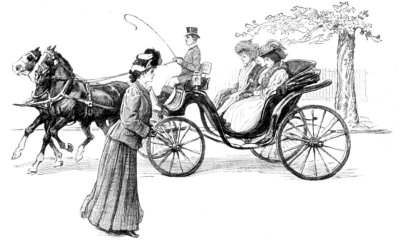
"MRS. LEVERICH BOWED INCIDENTALLY"
If she had changed since that first journeying a year and a half ago, so had the conditions changed in the household to which she went. Justin had had the not unusual experience of the business man who has achieved what he has set out to achieve without the expected result; in the silting-pan which holds success some of the gold mysteriously drops through. The Typometer Company was doing a very large business, quadrupled since the day of its inception. The building was hardly big enough now to hold the offices and manufacturing plant; the force had been greatly increased, and an additional floor for storage had been hired next door. The typometer had absorbed the output of two small rival companies, one out West and one in a neighboring town—both glad, in view of a losing game, to make terms with the successful arbiter. Where one person used a typometer three years ago, it was in request by fifty people now, for many things—for many more, indeed, than had been thought of at first; every week plans in special adjustments were made to fit the machine for different purposes. It was undoubtedly not only a success in itself, but was destined to fit into more and more of the needs of the working world as a standard product.
Orders came in from all parts of the globe. Justin, as he hurried over to his office or held important consultations with the men who wanted to see him, was awarded the respect given to the head of a large and successful concern. He was marked as a rising man. Yet, in spite of all this real accomplishment of the Typometer Company, the net profits had always fallen short of the mark set for them; the company was in constant and growing need of money.
Prices of everything to do with manufacturing had increased—prices of copper and steel, of machinery, of wages, in addition to the larger number of hands employed, and the rent of the additional floor. It was always necessary for one's peace of mind to go back to the value of the material stock and the assets to be counted on in the future. The steady branching out of the business in every direction was proof of the fact that if it did not it must retrench; and to retrench meant fewer orders, fewer opportunities—financial suicide.
It was the powerful shibboleth of the world of trade that one must be seen to be doing business; only so could the doors of credit be opened. If Cater came in with him now, as seemed at last to be expected, the doors must open farther. No matter how one tries to see all around the consequences of any change, any undertaking, there always arise minor consequences which from their very nature must be unforeseen, and yet which may turn out to be the really powerful factors in the main issue; unimportant genii that, let out of their bottle, swell immeasurably. The consequences of the fire, small as it was, seemed never-ending. The defective bars had proved a disastrous supply for the machine, in more ways than one.
Left by the Leverich-Martin combination to work his own retrieval, he had borrowed the ten thousand from Lewiston, and had used part of the money to pay the interest to the others; and later, in the flush of reinstatement, he had borrowed another ten thousand from Leverich, a loan to be called by him at any time. Lewiston's loan had seemed easy of repayment at six months. Justin knew when the money was coming in, but he had been obliged, after all, to anticipate, and get his bills discounted before they came due for other purposes, often paying huge tribute for the service. Lewiston had renewed the note for sixty days, and then for sixty more, but with the proviso that this was the last extension.
In short, the whole process of competently keeping afloat had been gone through, with a definite aim of accomplishment. Cater's cooperation, about which he had been so slow, would infuse new blood into the business. It was maddening at times to have so many good uses for money, and to be unable to command it at the crucial moment. He had approached Eugene Larue on that past Sunday afternoon, only to find him cautiously negative where once he had seemed friendlily suggesting.
Such a process, to be successful, depends on the power of the man behind it, which must not only comprehend and direct the larger issues, but must be able to carry along smoothly all the easily entangling threads of detail; he must not only have a capable brain, but he must have the untiring nervous energy that can "hold out" through any crisis. Such men may go to pieces after incredible effort, but they are on the way to success first. Danger only quickens the sure leap to safety.
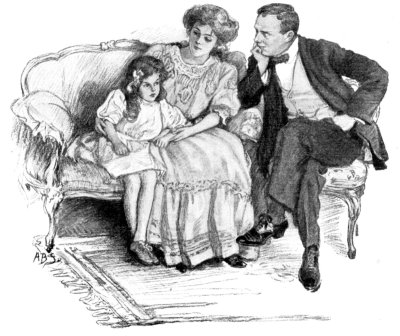
"WITH EYES FOR NOBODY ELSE"
Justin, preëminently clear-headed, had been conscious lately of two phases—one an almost preternatural illumination of intellect, and the other a sort of brain-inertia, more soul-and body-fatiguing than any pain. There were seasons when he was obliged to think when he could instead of when he would. He looked grave, alert, competent, but underneath this demeanor there went an unceasing effort of computation and reckoning to which the computation and reckoning on the first night of his agreement with Leverich was as a child's play with toy bricks is to the building of an edifice of stone.
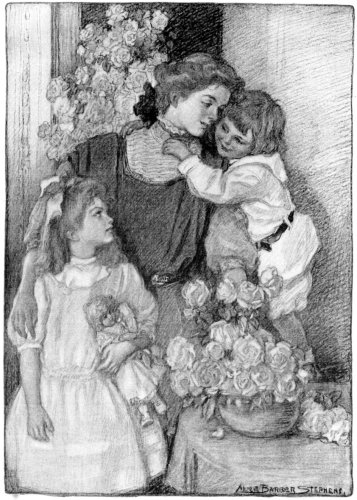
"FLOWERS AND CHILDREN—CHILDREN AND FLOWERS!"
The large business responsibilities now incurred clashed grotesquely with the daily need of money at home for petty uses, a condition of affairs which often happens at the birth of a child, when the household is at loose ends, and the expenses are necessarily greater in every direction, at the time when it seems most imperative to limit them. He seemed never to have enough "change" in his pockets, no matter how much he brought home.
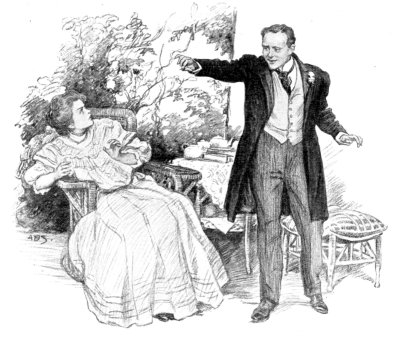
"'THE LITTLE SPIDER WON'T HURT YOU'"
In some men the business faculties become more and more self-sufficing when there is no other passion to divide them—the nature grows all one way; and there are others who seem independent, yet who are always as dependent as children on the unnoticed, sustaining help of affectionate love that makes the home a refuge from the provoking of all men; that unreasonably, and at all times, hotly champions the cause of the beloved against the world. No help-giving virtue had gone out from this household in the last year; it had all been a dead lift.
Justin had never spoken of his affairs to Lois since that Sunday when she had said that she hated them. When she had asked for money, she had always added the proviso, "if he could afford it," and accepted the fact either way without comment. He was, as time went on, more and more affectionately solicitous for her welfare, even if he was, as she keenly felt, less personally loving.
If she went to bed early in the evening, he took that opportunity to go out; and if she stayed up, he remained at home and went to sleep on the lounge, and the little touch that binds divergence with the inner thread of sympathy was lacking.
Yet, strange as it might seem, while she consciously suffered far the most, his loss was mysteriously the greater; the fire of love of which she was by right high priestess still burned secretly for her tending as she covered over the embers on the hearthstone, though he was cold and chill for lack of that vital warmth.
There were moments when she felt that she could die gladly for him, but always for that glory of self-triumphing in the end. Then that which seemed as if it could never change began to change.
Before the child was born, and now since that, there was a difference. Men and women who suffer most from imaginary wrongs may become sane and heroic in times of real danger. Lois, noble, sweet, and brave, thoughtful for Zaidee and Redge and Justin even while she trembled, excited reverence and a deep and anxious tenderness in her husband.
Then, afterward, he was proud of his second son. When Justin came in at the end of each day and sat down by her bedside, holding her blue-veined hand while she smiled peacefully at him, there was a sweet, sufficing pleasure about those few minutes, singularly soothing, though the interim had no relation to actual living, except in the fact that one anxiety had been lifted. While the expectant birth of the child had been to her, as it is to almost every woman, a separate and distinct calamitous illness to which she looked forward as one might look forward to being taken with typhoid or diphtheria, he considered it as a manifestation of nature, not in itself dangerous, and her fear that of a child, to be soothed by reason.
Still, he had had his moments of a reluctant, twinging fear. One cause for disquieting thought was removed. Now the helplessness of this little family, for whom he was the provider, tugged at a swelling heart.
As he walked toward his office to-day somewhat later than was his wont, he diverged from his usual custom: instead of entering his own doorway, he went across the street to Cater's after a moment's hesitation. Now that Cater's coöperation was at the consummating point, it was wiser not to run the risk of its sagging back. Leverich and Martin were keenly for its success. Justin's credit would rise immeasurably with it. The Typometer Company had absorbed the minor machines with so little trouble that the unabsorbability of the timoscript had seemed an unnecessary stumbling-block. Time and time again Justin had sought Cater with tabulated figures and unanswerable arguments. The combination, he firmly believed, would be highly beneficial for both. The field was, in its way, too narrow to be divided with the highest profit; together they could command the trade.
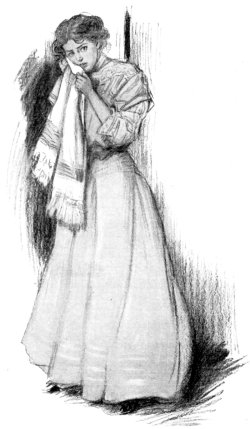
"'NEVER LET HIM COME HERE AGAIN—NEVER, NEVER!'"
Cater was opposed to all combinations as trusts,—a word against which he was principled,—with obstinate refusal to differentiate as to kind, quality, or intent. Like many men who are given to a far-seeing philosophy in words, he was narrow-mindedly cautious when it came to action, apt to be suspicious in the wrong place, and requiring to be continually reassured about conditions which seemed the very a-b-c of commerce. The rivalry between the two firms had been apparently good-natured, yet a little of the sharp edge of competition had shown signs of cutting through the bond.
The typometer had put its prices down, and the timoscript had cut under; then the typometer had gone as low as was wise, and the timoscript had begun to weaken in its defenses.
Cater was already at work at a big desk as Justin entered, but rose to shake hands. There was a look of melancholy in his eyes, in spite of his smile of greeting.
"Anything wrong with you?" asked Justin, instinctively noticing the look rather than the smile.
"No," said Cater. He hooked his legs under his chair, and leaned back, the light from the high unshaded window striking full on his lean yellow countenance. "No, there's nothing wrong. Got some things off my mind, things that have been bothering me for a long time, and I reckon I don't feel quite easy without 'em."
"I think you're very lucky," said Justin. The light from the high window fell on his face, too—on his brown hair, turning a little gray at the temples, on the set lines of his face, in which his eyes, keen and blue, looked intently at his friend. He was well dressed; the foot that was crossed over his knee was excellently shod.
Cater shifted a little in his seat. "Well, I don't know. My experience is some different from the usual run, I reckon. I never had any big streak of luck that it didn't get back at me afterwards. There was my marriage—I know it ain't the thing to talk about your marriage, but you do sometimes. My wife's a fine woman,—yes, sir, I was mighty lucky to get her,—but I didn't know how to live up to her family. It's been that-a-way all my life. Sure's I get to ringin' the bells, the floorin' caves in under me."
"We'll see that the flooring holds, now that you're coming in with us," said Justin good-naturedly. "I've got some propositions to put up to you to-day."
Cater shook his head. "There's no use of your putting up any propositions. I've been drawin' on my well of thought so hard lately that I reckon you could hear the pumps workin' plumb across the street. I've been cipherin' down to the fact that I can't go it alone, any more'n you,—there we agree; hold on, now!—but I can't combine."
"You can't!" cried Justin, with unusual violence. "Why not?"
"Well, you know my feelin's about trusts, and—I like you, Mr. Alexander, you know that, mighty well, but I balk at your backin'. I don't believe in it. It'll fail when you count on it most. It'll cramp on you merciless if you come short of its expectations. Leverich isn't so bad, but Martin cramps a hold of him, and I can't stand Martin havin' a finger in any concern I have a hold of."
"He's clever enough to make what he touches pay," said Justin.
Cater's eyebrows contracted. "You say he's clever; because he's tricky—because he's sharp. He isn't clever enough to make money honestly; he isn't big enough. You and me, we're honest, or try to be; but we haven't the brain to give every man his just due, and get ahead, too. It's the greatest game there is, but you got to be a genius to play it. You and me, we can't do it; we ain't got the brain and we ain't got the nerve. I haven't. You've just everlastingly got to do the best for yourself if you've got a family; the best as you see it."
"What's all this leading up to? What change have you been making, Cater?" asked Justin, with stern abruptness.
"I've given the agency of the machine to Hardanger."
"Hardanger!" Justin's face flushed momentarily, then became set and expressionless. To stand out on abstract questions of honor, and then tacitly break all faith by going in with Hardanger!
"I shut down on part of my plant when I began figuring on this change," continued Cater. "I've been getting the steel fittin's on contract from Beuschoten again, as I did at first; it'll come cheaper in the end. Gives us a pretty big stock to start off with. I was sorry—I was sorry to have to turn off a dozen men, but what you going to do? I've got to cut down on the manufacturing as close as I can now."
"I suppose so."
"I wanted to tell you the first one," said Cater.
"Well, I congratulate you," said Justin formally, rising.
"This isn't going to make any difference in the friendship between me and you, Mr. Alexander? I've thought a powerful lot of your friendship. If I'd 'a' seen any way to have come in with you, I'd 'a' done it. But business ain't going to interfere between two such good friends as we are!"
"Why, no," said Justin, with the conventional answer to an appeal which still pitifully claims for truth that which it has made false. The handshake that followed was one in which all their friendship seemed to dissolve and change its character, hardening into ice.
Hardanger!
Hardanger & Company represented one of the greatest factors in the trade of two hemispheres. To say that a thing was taken up by Hardanger meant its success. They took nothing that was not likely to succeed; they made it succeed—for them. Their agents in all parts of the known world had easy access to firms and to opportunities hard to be reached by those of lesser credit. Their reputation was unassailed; they kept scrupulously to the terms agreed upon. The only bar to putting an article into their hands was the fact that their terms—except in the case of certain standard articles which they were obliged to have—embraced nearly all the profits, only the very narrowest margins coming to the original owners. Everything had to be figured down, and still further and further down, by those owners, to make that margin possible. It was cutthroat all the way through—a policy that made for the rottenness of trade.
Justin and Leverich had once made tentative investigations as to Hardanger, with the conclusion that there was far more money outside, even if one must go a little more slowly. It was better to go a little more slowly, for the sake of getting so much more out of it in the end. Hardanger was to be kept as a last resort, if everything else failed. Cater had expressed himself as feeling the same way; that was the understanding between them. But now? Backed by this powerful agency, the timoscript assumed disquieting proportions. In the distance, a time not so very far distant either, Justin could see himself squeezed to the wall, the output of his factory bought up by Hardanger for the price of old iron—forced into it, whether he would or no. Why had he been so short-sighted? Why hadn't he made terms himself sooner? But Cater had been a fool to give in to those terms when, by combining, they could have swung trade between them to their own measure. Then Hardanger might have been obliged to seek them, to take their price!—Hardanger, who could afford to laugh at his pretensions now!
He thought of Cater without malice—with, instead, a shrewd, kind philosophy, a sad, clear-visioned impulse of pity mixed with his wonder. So that was the way a man was caught stumbling between the meshes, blinded, dulled, unconsciously maimed of honor, while still feeling himself erect and honest-eyed! There had been no written agreement between them that either should consult the other before seeking Hardanger; but some promises should be all the stronger for not being written.
This thing couldn't happen; in some way, he must get his foot inside the door, so that it couldn't shut on him. There was that note of Lewiston's, due in thirty days—no, twenty-five now. What about that?
Later in the day, after he had been seeing drayful after drayful of boxes leave the factory opposite, Bullen, the foreman, came into the office with some estimates, pointing out the figures with a small strip of steel tubing held absently in his fingers.
While the clerks were all deferential, and those of foreign birth obsequious, Bullen had an air that was more than sturdily independent—the air and the eye of the skilled mechanic. On his own ground he was master, and Justin, with a smile, deferred to him. But Justin broke into Bullen's calculations abruptly, after a while, to ask:
"What's that you've got there? It looks like one of those bars that nearly smashed us."
"You've got a good eye, sir," said Bullen approvingly. "A year and a half ago you'd not have seen any difference between one bit of steel and another. But there's one thing I didn't see about it myself until Venly—he's a new man we've taken on—pointed it out to me. He came across a case of these to-day we'd thrown out in the waste-heap. We thought our machine had jarred them out of shape, because they were a fraction off size; well, so they were. But Venly he spotted them in a minute, when he was out there, and he asked me if they weren't from the Beuschoten factory—he was turned off from there last week; they're cutting down the force; they always do, come spring. He said they looked like part of a bum lot that had flaws in them. He got the magnifying-glass and showed me, and, sure enough, 'twas right he was! He says they've got piles of them they've been workin' off on the trade at a cut price. Venly he said he didn't have any stomach for a skin game like that."
"That's a pretty ruinous way to do business, isn't it?" asked Justin.
"Oh, they're going to sell out in July, so they don't care. I pity any one that's counting on any sort of machine that's got these in 'em. Would you take the glass and look for yourself, sir? Every one of 'em is flawed!"
to be continued