"OLIVIA" AND "FAUST" AT THE LYCEUM[41]
Reading edition
"OLIVIA" AND "FAUST" AT THE LYCEUM[41]
BY ELLEN TERRY
ILLUSTRATIONS FROM PHOTOGRAPHS AND FROM DRAWINGS BY ERIC PAPE AND HARRY FENN
The first night of "Olivia" at the Lyceum was about the only comfortable first night that I have ever had! I was familiar with the part, and two of the cast, Terriss and Norman Forbes, were the same as at the Court, which made me feel all the more at home. Henry left a great deal of the stage-management to us, for he knew that he could not improve on Mr. Hare's production. Only he insisted on altering the last act, and made a bad matter worse. The division into two scenes wasted time, and nothing was gained by it. Never obstinate, Henry saw his mistake and restored the original end after a time. It was weak and unsatisfactory, but not pretentious and bad, like the last act he presented at the first performance.
We took the play too slowly at the Lyceum. That was often a fault there. Because Henry was slow, the others took their time from him, and the result was bad.
The lovely scene of the vicarage parlour, in which we used a harpsichord, and were accused of pedantry for our pains, did not look so well at the Lyceum as at the Court. The stage was too big for it.
The critics said that I played Olivia better at the Lyceum, but I did not feel this myself.
At first Henry did not rehearse the Vicar at all well. One day, when he was stamping his foot very much as if he were Mathias in "The Bells," my little Edy, who was a terrible child and a wonderful critic, said:
"Don't go on like that, Henry. Why don't you talk as you do to me and Teddy? At home you are the Vicar."
The child's frankness did not offend Henry, because it was illuminating. A blind man had changed his Shylock; a little child changed his Vicar. When the first night came, he gave a simple, lovable performance. Many people now understood and liked him as they had never done before. One of the things I most admired in it was his sense of the period.
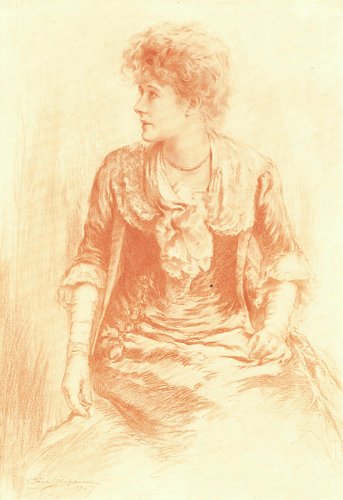
ELLEN TERRY AS "OLIVIA"
FROM A DRAWING BY ERIC PAPE
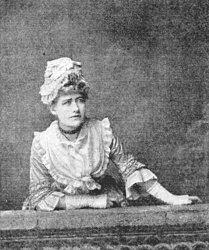
Copyrighted by Window & Grove
ELLEN TERRY AS OLIVIA
In this, as in other plays, he used to make his entrance in the skin of the part. No need for him to rattle a ladder at the side to get up excitement and illusion, as another actor is said to have done. He walked on and was the simple-minded old clergyman, just as he had walked on a prince in "Hamlet" and a king in "Charles I."
A very handsome woman, descended from Mrs. Siddons and looking exactly like her, played the Gipsy in "Olivia." The likeness was of no use, because the possessor of it had no talent. What a pity!
"Olivia" a Family Play
"Olivia" has always been a family play. Edy and Ted walked on the stage for the first time in the Court "Olivia." In later years Ted played Moses, and Edy made her first appearance in a speaking part as Polly Flamborough, and has since played both Sophia and the Gipsy. My brother Charlie's little girl, Beatrice, made her first appearance as Bill, a part which her sister Minnie had already played; my sister Floss played Olivia on a provincial tour, and my sister Marion played it at the Lyceum when I was ill.
I saw Floss in the part, and took from her a lovely and sincere bit of "business." In the third act, where the Vicar has found his erring daughter and has come to take her away from the inn, I always hesitated at my entrance, as if I were not quite sure what reception my father would give me after what had happened. Floss, in the same situation, came running in and went straight to her father, quite sure of his love, if not of his forgiveness.
I did not take some business which Marion did on Terriss' suggestion. Where Thornhill tells Olivia that she is not his wife, I used to thrust him away with both hands as I said "Devil!"
"It's very good, Nell, very fine," said Terriss to me, "but, believe me, you miss a great effect there. You play it grandly, of course, but at that moment you miss it. As you say 'Devil!' you ought to strike me full in the face."
"Oh, don't be silly, Terriss," I said. "Olivia is not a pugilist."
Of course I saw, apart from what was dramatically fit, what would happen!
However, Marion, very young, very earnest, very dutiful, anxious to please Terriss, listened eagerly to the suggestion during an understudy rehearsal.
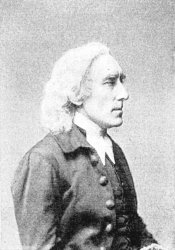
Copyrighted by Window & Grove
HENRY IRVING AS THE VICAR
"No one could play this part better than your sister Nell," said Terriss to the attentive Marion, "but, as I always tell her, she does miss one great effect. When you say 'Devil! hit me bang in the face."
"Thank you for telling me," said Marion gratefully.
"It will be much more effective," said Terriss.
It was. When the night came for Marion to play the part, she struck out, and Terriss had to play the rest of the scene with a handkerchief held to his bleeding nose!
Ellen Terry and Eleanora Duse
I think it was as Olivia that Eleanora Duse first saw me act. She had thought of playing the part herself sometime, but she said: "Never now!" No letter about my acting ever gave me the same pleasure as this from her:
"Madame: With Olivia you have given me pleasure and pain. Pleasure by your noble and sincere art—pain because I feel sad at heart when I see a beautiful and generous woman give her soul to art—as you do—when it is life itself, your heart itself, that speaks tenderly, sorrowfully, nobly beneath your acting. I cannot rid myself of a certain melancholy when I see artists as noble and distinguished as you and Mr. Irving. Although you are strong enough (with continual labor) to make life subservient to art, I, from my standpoint, regard you as forces of nature itself, which should have the right to exist for themselves instead of for the crowd. I would not venture to disturb you, Madame, and moreover I have so much to do that it is impossible for me to tell you personally all the great pleasure you have given me, because I have felt your heart. Will you believe, dear Madame, in mine, which asks no more at this moment than to admire you and to tell you so in any manner whatsoever.
"Always yours, "E. Duse."[42]
It was worth having lived to get that letter!
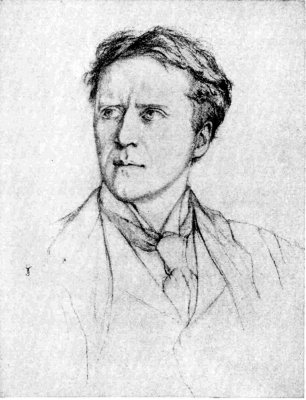
From a drawing by the Marchioness of Granby
H. BEERBOHM TREE WHO PLAYED WITH ELLEN TERRY IN "THE AMBER HEART"
"Faust"
A claptrappy play "Faust" was, no doubt, but Margaret was the part I liked better than any other—outside Shakespeare. I played it beautifully sometimes. The language was often very commonplace, not nearly as poetic or dramatic as that of "Charles I.," but the character was all right—simple, touching, sublime. The Garden Scene I know was a bourgeois affair. It was a bad, weak love-scene, but George Alexander as Faust played it admirably. Indeed, he always acted like an angel with me; he was so malleable, ready to do anything. He was launched into the part at very short notice, after H. B. Conway's failure on the first night. Poor Conway! It was Coghlan as Shylock all over again.
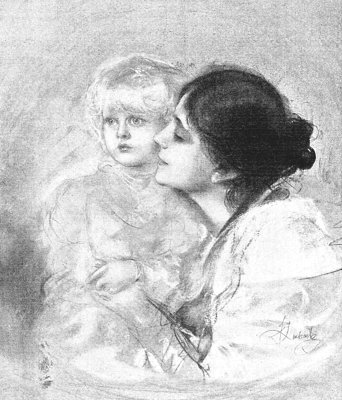
ELEANORA DUSE WITH LENBACH'S CHILD
from the painting by franz von lenbach
Conway was a descendant of Lord Byron, and he had a look of the handsomest portraits of the poet. With his bright hair curling tightly all over his well-shaped head, his beautiful figure, and charming presence, he created a sensation in the eighties almost equal to that made by the more famous beauty, Lily Langtry. As an actor he belonged to the Terriss type, but he was not nearly as good as Terriss.
Henry called a rehearsal the next day—on Sunday, I think. The company stood about in groups on the stage, while Henry walked up and down, speechless, but humming a tune occasionally, always a portentous sign with him. The scene set was the Brocken scene, and Conway stood at the top of the slope, as far away from Henry as he could get! He looked abject. His handsome face was very red, his eyes full of tears. He was terrified at the thought of what was going to happen. As for Henry, he was white as death, but he never let pain to himself (or others) stand in the path of duty to his public, and his public had shown that they wanted another Faust. The actor was summoned to the office, and presently Loveday came out and said that Mr. George Alexander would play Faust the following night.
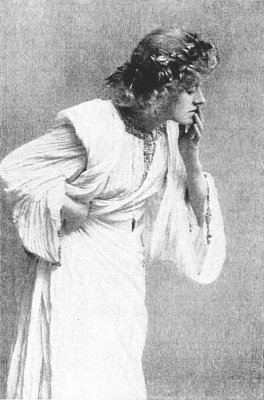
Copyrighted by Window & Grove
ELLEN TERRY AS ELLALINE IN "THE AMBER HEART"
from the collection of miss frances johnston
George Alexander and the Barmaids
Alec had been wonderful as Valentine the night before, and as Faust he more than justified Henry's belief in him. After that he never looked back. He had come to the Lyceum for the first time in 1882, an unknown quantity from a stock company in Glasgow, to play Caleb Decie in "The Two Roses." He then left us for a time, returned for "Faust," and remained in the Lyceum Company for some years, playing all Terriss' parts.
Alexander had the romantic quality which was lacking in Terriss, but there was a kind of shy modesty about him which handicapped him when he played Squire Thornhill in "Olivia." "Be more dashing, Alec!" I used to say to him. "Well, I do my best," he said. "At the hotels I chuck all the barmaids under the chin, and pretend I'm a dog of a fellow, for the sake of this part!" Conscientious, dear, delightful Alec! No one ever deserved success more than he did, and used it better when it came, as the history of St. James' Theatre under his management proves. He had the good luck to marry a wife who was clever as well as charming, and could help him.
The original cast of "Faust" was never improved upon. What Martha was ever so good as Mrs. Stirling? The dear old lady's sight had failed since "Romeo and Juliet," but she was very clever at concealing it. When she let Mephistopheles in at the door, she used to drop her work on the floor, so that she could find her way back to her chair. I never knew why she dropped it—she used to do it so naturally, with a start, when Mephistopheles knocked at the door—until one night when it was in my way and I picked it up, to the confusion of poor Mrs. Stirling, who nearly walked into the orchestra.
"Faust" a Paradoxical Success
"Faust" was abused a good deal—as a pantomime, a distorted caricature of Goethe, and a thoroughly inartistic production. But it proved the greatest of all Henry's financial successes. The Germans who came to see it, oddly enough, did not scorn it nearly as much as the English who were sensitive on behalf of the Germans, and the Goethe Society wrote a tribute to Henry Irving after his death, acknowledging his services to Goethe!
It is a curious paradox in the theatre that the play for which every one has a good word is often the play which no one is going to see, while the play which is apparently disliked and run down has crowded houses every night.
Our preparations for the production of "Faust" included a delightful "grand tour" of Germany. Henry, with his accustomed royal way of doing things, took a party which included my daughter Edy, Mr. and Mrs. Comyns Carr, and Mr. Hawes Craven, who was to paint the scenery. We bought nearly all the properties used in "Faust" in Nuremberg, and many other things which we did not use, that took Henry's fancy. One beautifully carved escutcheon, the finest armorial device I ever saw, he bought at this time, and presented it in after years to the famous American connoisseur, Mrs. Jack Gardner. It hangs now in one of the rooms of her palace at Boston.
It was when we were going in the train along one of the most beautiful stretches of the Rhine that Sally Holland, who accompanied us as my maid, said: "Uncommon pretty scenery, dear, I must say!"
When we laughed uncontrollably, she added: "Well, dear, I think so!"
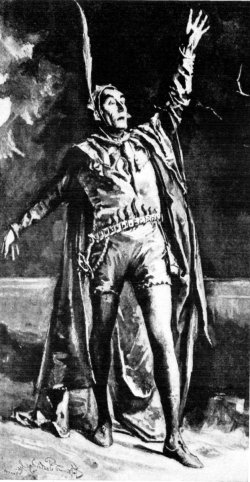
Copyrighted by the London Stereoscopic Co.
HENRY IRVING AS MEPHISTOPHELES IN "FAUST"
from the drawing by bernard partridge
Irving on Long Runs
During the run of "Faust" Henry visited Oxford, and gave his address on "Four Actors" (Burbage, Betterton, Garrick, Kean). He met there one of the many people who had recently been attacking him on the ground of too long runs and too much spectacle. He wrote me an amusing account of the duel between them:
"I had supper last night at New College after the affair. A. was there, and I had it out with him—to the delight of all.
"'Too much decoration' etc., etc.
"I asked him what there was in Faust in the matter of appointments, etc., that he would like left out.
"Answer—nothing.
"'Too long runs.'
"'You, sir, are a poet,' I said. 'Perhaps it may be my privilege some day to produce a play of yours. Would you like it to have a long run or a short one?' (Roars of laughter.)
"Answer: 'Well, er, well, of course, Mr. Irving, you—well—well, a short run, of course, for art, but——'
"'Now, sir, you're on oath,' said I. 'Suppose that the fees were rolling in £10 and more a night—would you rather the play were a failure or a success?'
"'Well, well, as you put it, I must say—er—I would rather my play had a long run!'
"A. floored!
"He has all his life been writing articles running down good work and crying up the impossible, and I was glad to show him up a bit!
"The Vice-Chancellor made a most lovely speech after the address—an eloquent and splendid tribute to the stage.
"Bourchier presented the address of the 'Undergrads.' I never saw a young man in a greater funk—because, I suppose, he had imitated me so often!
"From the address: 'We have watched with keen and enthusiastic interest the fine intellectual quality of all these representations, from Hamlet to Mephistopheles, with which you have enriched the contemporary stage. To your influence we owe deeper knowledge and more reverent study of the master mind of Shakespeare.' All very nice indeed!"
Irving's Mephistopheles
I never cared much for Henry's Mephistopheles—a twopence coloured part, anyway. Of course he had his moments,—he had them in every part,—but they were few. One of them was in the Prologue, when he wrote in the student's book, "Ye shall be as gods, knowing good and evil." He never looked at the book, and the nature of the spirit appeared suddenly in a most uncanny fashion.
Another was in the Spinning-wheel Scene, when Faust defies Mephistopheles, and he silences him with "I am a spirit." Henry looked to grow a gigantic height—to hover over the ground instead of walking on it. It was terrifying.
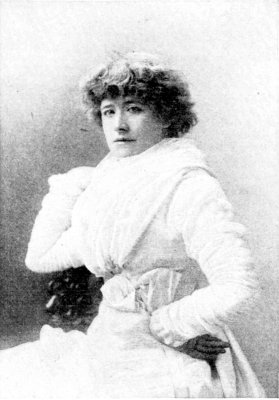
From the collection of Robert Coster
ELLEN TERRY
from a photograph taken about 1885, the year in which "olivia" and "faust" were produced at the lyceum
I made valiant efforts to learn to spin before I played Margaret. My instructor was Mr. Albert Fleming, who, at the suggestion of Ruskin, had recently revived hand-spinning and hand-weaving in the north of England. I had always hated that obviously "property" spinning-wheel in the opera and Margaret's unmarketable thread. My thread always broke, and at last I had to "fake" my spinning to a certain extent, but at least I worked my wheel right and gave an impression that I could spin my pound of thread a day with the best!
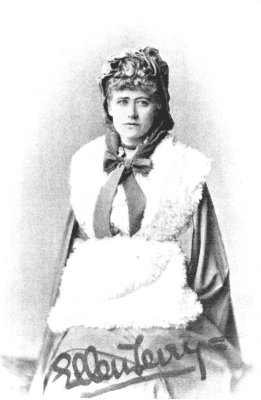
Copyrighted by Window & Grove
ELLEN TERRY'S FAVOURITE PHOTOGRAPH AS OLIVIA
FROM THE COLLECTION OF MISS EVELYN SMALLEY
Two operatic stars did me the honour to copy my Margaret dress—Madame Albani and Madame Melba. It was rather odd, by the way, that many mothers who would take their daughters to see the opera of "Faust" would not bring them to see the Lyceum play. One of these mothers was Princess Mary of Teck, a constant patron of most of our plays.
Other people "missed the music." The popularity of an opera will often kill a play, although the play may have existed before the music was ever thought of. The Lyceum "Faust" held its own against Gounod. I liked our incidental music to the action much better. It was taken from Berlioz and Lassen, except for the Brocken music, which was the original composition of Hamilton Clarke.
"Faust's" Four Hundred Ropes
In many ways "Faust" was our heaviest production. About four hundred ropes were used, each rope with a name. The list of properties and instructions to the carpenters became a joke among the theatre staff. When Henry first took "Faust" into the provinces, the head carpenter at Liverpool, Myers by name, being something of a humorist, copied out the list on a long, thin sheet of paper which rolled up like a royal proclamation. Instead of "God save the Queen," he wrote at the foot, with many flourishes:
"God help Bill Myers!"
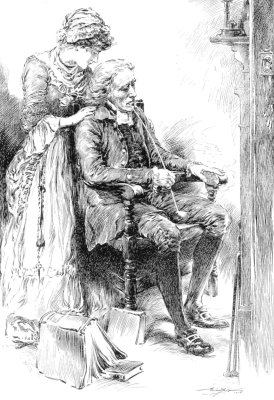
ELLEN TERRY AS OLIVIA AND HENRY IRVING AS THE VICAR IN WILLS' PLAY "OLIVIA"
from a drawing by eric pape
The crowded houses at "Faust" were largely composed of "repeaters," as Americans call those charming playgoers who come to see a play again and again. We found favour with the artists and musicians, too, even in "Faust"! Here is a nice letter I got during the run (it was a long one) from that gifted singer and good woman, Madame Antoinette Sterling:
"My dear Miss Terry,
"I was quite as disappointed as yourself that you were not at St. James' Hall last Monday for my concert.... Jean Ingelow said she enjoyed the afternoon very much....
"I wonder if you would like to come to luncheon some day and have a little chat with her, but perhaps you already know her. I love her dearly. She has one fault—she never goes to the theatre. Oh, my! What she misses, poor thing, poor thing! We have already seen Faust twice, and are going again soon, and shall take the George Macdonalds this time. The Holman Hunts were delighted. He is one of the most interesting and clever men I have ever met, and she is very charming and clever, too. How beautifully plain you write! Give me the recipe. With many kind greetings,
"Believe me, sincerely yours,
Antoinette Sterling MacKinlay.
In "Faust" Violet Vanbrugh "walked on" for the first time.
My girl Edy was an "angel" in the last act. This reminds me that Henry one Valentine's Day sent me some beautiful flowers with this little rhyme:
White and red roses, Sweet and fresh posies: One bunch, for Edy, Angel of mine— Big bunch for Nell, my dear Valentine.
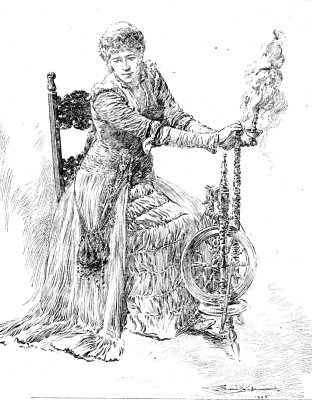
ELLEN TERRY AS MARGUERITE IN "FAUST"
from a drawing by eric pape
Henry Irving has often been attacked for not preferring Robert Louis Stevenson's "Macaire" to the version which he actually produced in 1883. It would have been hardly more unreasonable to complain of his producing "Hamlet" in preference to Mr. Gilbert's "Rosencrantz and Guildenstern." Stevenson's "Macaire" may have all the literary quality that is claimed for it, although I personally think Stevenson was only making a delightful idiot of himself in it! Anyhow, it is frankly a burlesque, a skit, a satire on the real "Macaire." The Lyceum was not a burlesque house! Why should Henry have done it?
It was funny to see Toole and Henry rehearsing together for "Macaire." Henry was always plotting to be funny. When Toole, as Jacques Strop, hid the dinner in his pocket, Henry, after much labour, thought of his hiding the plate inside his waistcoat. There was much laughter later on when Macaire, playfully tapping Strop with his stick, cracked the plate, and the pieces fell out! Toole hadn't to bother about such subtleties, and Henry's deep-laid plans for getting a laugh must have seemed funny to dear Toole, who had only to come on and say "Whoop!" and the audience roared.
Henry's death as Macaire was one of a long list of splendid deaths. Macaire knows the game is up and makes a rush for the French windows at the back of the stage. The soldiers on the stage shoot him before he gets away. Henry did not drop, but turned round, swaggered impudently down to the table, leaned on it, then suddenly rolled over, dead.
Henry's production of "Werner" for one matinée was to do some one a good turn, and when Henry did a good turn he did it magnificently. We rehearsed the play as carefully as if we were in for a long run. Beautiful dresses were made for me by my friend Alice Carr, but when we had given that one matinée they were put away for ever. The play may be described as gloom, gloom, gloom. It was worse than "The Iron Chest."
While Henry was occupying himself with "Werner" I was pleasing myself with "The Amber Heart," a play by Alfred Calmour, a young man who was at this time Wills' secretary. I wanted to do it, not only to help Calmour, but because I believed in the play and liked the part of Ellaline. I had thought of giving a matinée of it at some other theatre, but Henry, who at first didn't like my doing it at all, said: "You must do it at the Lyceum. I can't let you, or it, go out of the theatre."
So we had the matinée at the Lyceum. Mr. Willard and Mr. Beerbohm Tree were in the cast, and it was a great success. For the first time Henry saw me act—a whole part and from the "front," at least, for he had seen and liked scraps of my Juliet from the "side." Although he had known me such a long time, my Ellaline seemed to come quite as a surprise. "I wish I could tell you of the dream of beauty that you realised," he wrote after the performance. He bought the play for me, and I continued to do it "on and off," in England and in America, until 1902.
Many people said that I was good, but that the play was bad. This was hard on Alfred Calmour. He had created the opportunity for me, and few plays with the beauty of "The Amber Heart" have come my way since. "He thinks it's all his doing!" said Henry. "If he only knew!" "Well, that's the way of authors!" I answered. "They imagine so much more about their work than we put into it that although we may seem to the outsider to be creating, to the author we are, at our best, only doing our duty by him!"
Our next production was "Macbeth"; but meanwhile we had visited America three times. In the next chapter I shall give an account of my tours in America, of my friends there; and of some of the impressions that the vast, wonderful country made on me.