THE PERSONAL FORCE OF CLEVELAND.
Reading edition
By E. Jay Edwards.
In his eulogium upon President Garfield, Mr. Blaine touched with impressive emphasis upon the rapidity with which honors came to him. Within six years after Williams College had sent Garfield forth equipped, “he was successively president of a college, State Senator of Ohio, Major-General of the Army of the United States, and a Representative-elect to the national Congress. A combination of honors so varied, so elevated, within a period so brief and to a man so young, is without precedent or parallel in the history of the country.”
Those whose privilege it was to hear that matchless eulogy will not forget the meaning glance with which Mr. Blaine, lifting his eyes from his manuscript, swept that splendid company before him, the President and his Cabinet, the Justices of the Supreme Court, in their silken robes, the deliberate Senate and impetuous House, and the remaining distinguished heroes of the war, in brilliant uniform, as though saying to them, “You at least can understand how wonderful a thing it is to so speedily gain such honors as these.”
Yet before the echoes of this eulogy had ceased, a political career had been begun which was to be more marvellous in its successes and the celerity of its successive achievements than that of Garfield. Within ten years after Mr. Blaine pronounced this eulogy, a man then unknown beyond the city in which he lived had been chosen Governor of New York by a plurality unparalleled in the history of any State; had stepped from that office before its term was ended to the chair of the Chief Executive of the nation, and had again been elected to the presidency; and elected the second time while a private citizen—an unmatched political honor.
The swiftly succeeding successes of Garfield are no longer unparalleled and unprecedented; that distinction is now Grover Cleveland’s. Carrying a torch as a private in evening campaign processions in 1880, he was to be four years later the successful presidential candidate of his party. He had gained no distinction for subtle or extraordinary strategy; he had not sat as a member in a legislative hall; his name had been associated with no important measure conceived and executed for public good; not of social inclination, not greatly learned, possessing no wide acquaintance, and having somewhat limited experience, he, nevertheless, revealed himself to the American people within the short space of two years as a man of extraordinary personal force, the quality of which is a puzzling mystery, which men of intellectual power seem to find a fascination in trying to analyze.
What is this mysterious and impressive quality? We may tell its manifestations; its influence has made history.
“What is it that is so impressive and overwhelming about your friend Governor Cleveland?” said a distinguished politician to the late Daniel Manning, at a time when Mr. Manning was with great skill directing the politics that had Cleveland’s first presidential nomination in view.
“I do not know what it is, but I know that it is there,” was Mr. Manning’s reply.
“My political intuitions are infallible,” said Governor Tilden, after a single interview with Mr. Cleveland; “and I am of opinion that this man is of somewhat coarse mental fibre and disposition, but of great force and stubbornly honest in his convictions.”
“His name should be Petros,” Mr. Blaine once said of Mr. Cleveland, “for when he has once formed opinions he stands upon them with the firmness of a granite foundation.”
It would be possible to quote many similar opinions uttered by able men who have had opportunity to see and study Mr. Cleveland. Some of these opinions do not wholly compliment Cleveland’s mental powers. But all of the opinions, whether uttered by political friends or enemies, have this in common: they express amazement, not so much at the swift successes of his career, as for that mystic personal quality which has made him able to hold the politicians of his party in the hollow of his hand, to defy political conventionalities, to break down machines, and, above all, to gain the confidence of the American people. This personal quality, which has given him these victories, he seems to have furnished no hint of in his childhood or youth. Before he came to his majority he must have led an unimpressive life, for those who knew him in those early days have no anecdote to tell of him which suggests that anything he did or said was of uncommon quality.
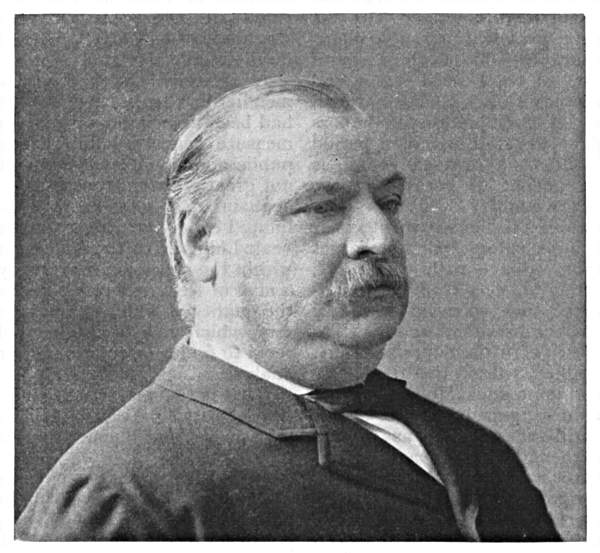
GROVER CLEVELAND. FROM THE LATEST PHOTOGRAPH TAKEN BY PACK BROTHERS OF NEW YORK.
The Buffalo bar at that time was a brilliant one. The leaders of it were men of great ambition. It would have been impossible for a young man, and especially for a young Democrat, to have gained influence with those men had there not been even then some personal quality which won their respect; and Mr. Cleveland gained a great measure of respect while he was still a very young man, and he seems to have been able to form close and permanent intimacies with young men whose advantage in beginning life had been much greater than his. He passed swiftly from the ranks of the poor law-student to the companionship of such men.
When young Bissell, fresh from his successful career at Yale College, blessed with some wealth, and possessing all the advantages which gentle social relations give, returned to Buffalo from his college life, one of his closest intimacies was developed with Grover Cleveland. Mr. Folsom, one of the brightest men at the Buffalo bar, must have been early impressed by this quality of Cleveland’s, for he took the young man into partnership, and before Cleveland was thirty years of age he had established, with men of intellectual power, a standing not due to unusual mental gifts, but to this same personal quality which has made him conspicuous above other Americans for the past twelve years.
In 1884, after Mr. Cleveland’s nomination for the presidency, President Arthur was asked if he knew the man whom the Democratic party had nominated.
“I know him slightly, and have heard much of him,” was the President’s reply. “I know that he is a good companion among the rather worldly men at the Buffalo bar, or was when he was there; but I also know this of him: he is a man of splendid moral fibre, and I have been told that his fidelity to his convictions and professional duties is regarded by his associates at the Buffalo bar as something wonderful. I do not think that he is a man of strong, original mind, but he is the faithfullest man to what he believes to be right and his duty that his party has—at least in New York State.”
Roscoe Conkling, not long after Mr. Cleveland’s nomination, was asked if he knew the Democratic candidate, and Mr. Conkling replied, with more of emphasis than he was accustomed to employ in speaking of any public man at that time:
“I do not know much about Mr. Cleveland as a politician, but my impression is that he is no politician, as the word is commonly understood. But I do know this about him. As a lawyer he prepares his cases well, as thoroughly, perhaps, as any man whom I have known in my practice.”
Mr. Manning said, after he had retired from Mr. Cleveland’s cabinet:
“Whatever may be said of the President as to his relations with the politicians, this much must be said, that he has never done anything since he has been in the White House for any selfish, personal motive, and that he is the most conscientious man in his adherence to what he believes to be his duty, and in his attempts to make out his duty when he is not entirely clear about it, that I have ever seen; and I do not believe any President has ever exceeded him in these respects.”
One of the greater powers in one of the greatest railway systems of the United States, not long ago meeting a company of friends at a private dinner in the Union League Club, sat for some time listening to the very interesting and acute analyses of Cleveland which were made by many brilliant men who were in that party.
This railway prince, for that word justly describes him, at last said:
“I do not think any of you has touched upon what is, after all, the quality which has made Mr. Cleveland what he is in American politics. I had some reason to know wherein his power lies, at a time when he probably had no other thought of his future than the expectation of earning a competence at the bar. It so happened that I was associated with certain litigations in which Mr. Cleveland was employed as counsel. He was not employed either for or against the interests which I represented, for they were merely incidental to these suits. I was amazed, after a little experience with him, to see the way in which he worked. I thought I had seen hard work and patient fidelity, but I never saw a lawyer so patient and so faithful to his clients as Cleveland was. I remember speaking about it to an eminent lawyer who has since become a judge, and he told me that Grover Cleveland was the most conscientious man in his relations with his clients that he had ever met. I spoke of it to somebody else, and that man told me that Cleveland had once actually lost a case by over-conscientiousness and too thorough preparation. He had examined his witnesses so persistently and exhaustively in private, and had pursued the case in all its details with such supreme drudgery, that when his witnesses went upon the stand their testimony seemed to the jury to be almost parrot-like; to be so glib, so perfectly consistent, that it seemed as though there must be a weakness in the case, and that such perfection must have come from rehearsals. For that reason the jury decided against him, although he won the case afterwards on appeal.
“Now, I am satisfied that it is just this quality in that man which made it possible for him, in Buffalo, where the Republican party was predominant, to gain minor political victories, and it certainly was that which brought to him such Republican support as enabled him to carry the city in a mayoralty election. We have been seeing just this thing manifested throughout the country since Cleveland became prominent. There probably never was a President since Washington who so completely gained the confidence of a great element in the opposing party as Mr. Cleveland has done; and you can’t explain it in any other way than that just as in Buffalo, in his professional struggles, or in political contests, he was believed to be a faithful man, rigid and true in his convictions; so the opinion has spread throughout the United States, and is entertained by a great many members of the opposing political party, that here is a man who is absolutely true to his own convictions and who is faithful to his responsibilities as he understands them. Now, I have seen enough of American politics to know that while our people admire talent, and sometimes go into spasms of enthusiasm over men who have emotional qualities which appeal to the masses, and which make them personally popular, yet, after all, there is an abiding faith in sincerity, fidelity, and character which compels the American masses to choose the man who has these qualities rather than that one who has brilliant talents; and I think there is no doubt that it was a latent suspicion that Mr. Blaine did not always possess that higher character, while endowed with far more brilliant genius than Mr. Cleveland possesses, which caused the people to choose Cleveland rather than Blaine in 1884.”
We had some indication that this railway prince was correct in his estimate, at a time during the past summer when Mr. Cleveland was in some peril of physical ailment. The greatest of American advocates, himself an ardent Republican, a man whom his party would be delighted to honor if he would permit it, having heard of Mr. Cleveland’s illness, said to a friend:
“I am more deeply interested in these reports about Mr. Cleveland’s health than I can tell you. I have every confidence in Mr. Cleveland’s integrity of purpose, and in the sincerity of his desire to lift these financial questions above the range of partisanship, and it would be a terrible misfortune for this country if he were to be disabled by illness at this time.”
This from a man who did not vote for Cleveland, who had never met him more than once or twice, but who had intuitively recognized that quality which is Cleveland’s power. Again, another man, one of preëminent genius in the world of finance, a very strong Republican, having also heard that Mr. Cleveland was seriously ill, went to a friend who had intimacy with the President, and said:
“I wish you would find out for me whether it is true that the President is in danger. I have heard that it is so, and if it is, it is the blackest cloud upon our horizon to-day. I did not vote for Mr. Cleveland, for I do not believe in some of the principles of his party, and I do not agree with him in some of his views. Yet if he had been the candidate of my party I would gladly have voted for him, for I think he is the most conscientious man I ever knew. I have perfect faith in his fidelity to his sense of duty, and I have never seen an action of his as President which I thought was inspired simply by a desire for partisan advantage. I think he is the faithfullest public man that we have had since Lincoln in his adherence to his convictions.”
There is only one word that will give a name to this quality that distinguishes Mr. Cleveland, and that is, Character—that quality which Emerson describes as a reserve force which acts directly and without means, whose essence, with Mr. Cleveland, is the courage of truth.
Not long ago a group of notable men were discussing Cleveland as a politician, and they seemed to be agreed that in the sense in which the word “politician” is customarily used he is not a man of remarkable ability, and there were anecdotes told to justify such opinion as that. His nomination for governor was the result of as purely political manipulation as New York State has ever seen, but he had no part in it. Those who were sincerely urging his nomination permitted him to take no part in these politics, for they had learned that he was possessed of two weaknesses as a politician, which, unless he were restrained, would be likely to defeat their plans: one of them the political fault of honesty. It was displayed in Buffalo once, when, it being proposed to nominate him for mayor, and the ticket agreed upon having been shown to him, he declared, with expressions more emphatic than pious, that he would not permit his name to go on the ticket upon which was the name of a certain man whom he believed to be unworthy, although this man had great political influence.
Another weakness, from the politicians’ point of view, is a seeming incapacity to understand the need of organization in political work. It is not only incapacity to understand the need, but also ignorance of the way in which organization can be effected. It has been revealed in all of Mr. Cleveland’s campaigns. After his election as Governor of New York by a plurality of nearly two hundred thousand, his availability as a presidential candidate was recognized, and, later, was strengthened by the assurance that his messages while Mayor of Buffalo had brought him the respect and confidence of the independent element; yet Mr. Cleveland’s friends very soon discovered that if they were to bring about his nomination for President, it must be done through organization of which he was either ignorant or to which he would be indifferent. So Mr. Cleveland had almost no part in that splendid game of 1884. He knew almost nothing of those things which were being done for him. Mr. Manning and the others had taken him up at first because of his availability; but Mr. Manning soon discovered that a man might be available and still be as ignorant of the science of politics, as understood by those who make it a professional pursuit, as a child.
After Mr. Cleveland became President, he sometimes drove his friends almost to distraction by his seeming incapacity to understand movements in the game of politics, which his friends suggested to him. A number of them went to him some time near the middle of his term as President, to set forth the political condition in New York State. They were men of long training and considerable achievement in politics. They had made successes both in New York City and New York State. They spoke to him with freedom—some of them with bluntness. They said to Mr. Cleveland that the then Governor of New York, Mr. Hill, was constructing with unusual cunning and consummate ability a political machine which might not be friendly, and was perhaps likely to be actively hostile, to him; and then, with much of detail, they showed Mr. Cleveland how he could break down such organization, utterly scatter it, and create and maintain in New York State one upon which he could rely with serenity. The merest tyro in politics can easily understand with what chagrin and astonishment these friends departed from his presence, because he did not seem to have been impressed in the slightest by their assertion that he was in political danger in New York State, and did not appear to comprehend the methods which they suggested by which the danger could be overcome.
Then again, in the spring and summer of 1892, when it seemed for a time as though the tide was setting against his nomination, when it was certain that the most powerful influence ever arrayed against a leading candidate for a presidential nomination had been secured, and one which, according to all precedent, would be successful, Mr. Cleveland astonished and almost vexed those friends of his who were working in and out of season to bring about his nomination, by professing indifference to the opposition of the New York State delegation, and of some of the most powerful politicians in the Democratic party. He had been at the Victoria Hotel one evening, listening in an almost perfunctory way to the plaints and warnings of his friends. He had no suggestions to offer, no advice to give. A stranger seeing him there would have thought that he was not one of that company holding this consultation, but perhaps a friend, there by chance, whose presence was not offensive, and was therefore tolerated.
At last, complaining of the warmth of the evening, he proposed a stroll; then, taking two friends by their arms, he walked slowly up Fifth Avenue, and astonished them by saying:
“These things which you have told me do not alarm me at all. They can do their worst, and yet I shall be nominated in spite of them.”
And, later on, after his prediction was justified, and his name in the Chicago Convention had triumphed over all political precedent, and conquered the most powerful and perfect opposition ever arrayed against a candidate, while there was still grumbling and bitter feeling and revengeful threats of New York State, he again amazed these friends by saying to them, when they proposed a certain form of counter-organization to prevent treachery, “No, no, do not do it. Let them do their worst; I can be elected without New York.”
At a time when the financial clouds were gathering last spring, a little company of politicians, who were personal friends as well, called upon Mr. Cleveland by appointment, and were received in that upper chamber through which for many days a persistent procession filed before the President asking for office. Mr. Cleveland planted himself firmly for an instant before each supplicant, so firmly that it almost seemed to these friends of his standing a little way off that his determination to be persuaded by no appeal to emotion, gratitude, friendship, or by any other thing than fitness revealed itself even in the rigidness of the muscles of his body. Patiently listening to each request and making perfunctory response, the President then received the next and then the next, and no man of all that number who thus met him knew whether his plea had met with favor or refusal. At last the throng was gone, the doors were closed, and there came to the face of the President a strange, hard look, tinged with something of surprise, and turning to his friends who remained he threw himself wearily into his chair and was silent for a moment. When he spoke there was something of sadness, something of reproach, in his tone and manner, and he said:
“You have seen a picture which I see every day, and you may now know why it is that my ears must be deaf to such appeals; why I scarcely hear the words they speak; why I almost fear that with most men who seek with great persistence political office the sense of truth is apt to be blunted, and why, therefore, it is imperative for me to be always suspicious.” Then the President added, with something of indignation:
“But how any man who is a good citizen can come to me now and plead for office, when there is impending financial calamity, I cannot understand. Politics! Is it possible that the politicians do not see that the best as well as the imperative politics now is that which will bring the country back to financial prosperity?”
Some hours later, one of that company had another glimpse of the President. Washington was still for the night. The White House was dark, excepting for a light that burned in the room where the President works. At his desk sat the man who had said in the morning that his ears were deaf to the office-seekers’ appeals, and yet with patient drudgery he was now examining the indorsements and recommendations of the different applicants, as he had been doing for hours. Then, taking up his pen, he began to write. The pen seemed scarcely ever to stop, and, watching through the partly opened door that led into an outer office, the President’s friend was reminded by it of something which he had read or heard. “Where have I heard or seen something which that sight brings to my memory?” he asked himself. The impression remained with him after he left Washington, until at last, taking down from his library shelf a biography, he read this passage:
“Since we sat down I have been watching a hand which I see behind the window of that room across the street. It fascinates my eye; it never stops. Page after page is finished and put upon a heap of manuscript, and still the hand goes on unwearied, and so it will be till candles are brought, and God knows how long after that. It is the same every night. I well know what hand it is—’tis Walter Scott’s.”
Cleveland is not, however, indifferent to political organization. He believes in it; he supports it. That was revealed at the conference which he held in October, 1892, in the Victoria Hotel, with some of the leaders of what is called the Democratic machine in New York. Some time there will be a revelation of what was said and done there in all detail, and it will furnish important light upon Mr. Cleveland’s character as well as his more purely political capacity. This much is known: that he did there and with emphasis maintain the right and duty of party men to form associations, to submit to discipline, and to act by common agreement—in other words, to use a colloquialism, he “recognized the machine.” But he also made one magnificent manifestation of that higher quality of his which is his character, for when there was something like threatening intimation made by one of those present, Mr. Cleveland declared that rather than do the thing that was asked of him he would withdraw from the ticket, and the country would know why he had withdrawn; and, after he said that, he held those men who had dared to make such intimation of threat subdued and supple in the hollow of his fist, from which condition they have not strayed from that day to this.
He would have been a failure in the House of Representatives as a parliamentary leader, probably a failure as a debater. The parliamentary leader is for his party always, right or wrong, and Mr. Cleveland could never have assumed command incurring such responsibilities as that. His intellectual processes are not quick enough for the give and take of debate. Blaine or Garfield, Randall or Thurman, would have overmatched him. Probably no member of either House has more greatly interested him than Mr. Reed, who in all respects, excepting personal force, differs from him. Each has expressed something of regard for the personal qualities of the other, and there has come to light a keen interest in Mr. Cleveland’s eyes as friends have described Reed, the parliamentary leader and debater, to him. He has never seen Reed standing in the aisle just beyond his desk, a throng of associates with hot, eager faces surrounding him, he towering above them, his head thrust slightly forward and a little to one side, a half-whimsical, half-defiant curl upon his lips, and the sneer of the coming sarcasm already betrayed by suggestive swelling of his nostrils; or else with the placid, serene, and tantalizing composure with which he prepares to hurl an epigram, already in his mind, at his antagonists. Nor has Mr. Cleveland seen that readiness to deliver almost tiger-like ferocity of attack if it be needed. The black flag—no quarter asked or given—hoisted when necessary, that furious, all-controlling, unconquerable determination to win, to beat down opposition at all hazards and any cost except outright dishonor, straining even a little toward unfair advantage when that and nothing else will win, and expecting to meet unfairness in return; bent on winning—somehow, anyhow, but winning—Mr. Cleveland has never seen such impressive spectacle as Reed makes when at his finest as the champion of his party in parliamentary battle and debate. But they have told him of these things, and he has seemed not to tire, but to delight to hear them.
He could not do that. He would stand by a principle or fall with it. Reed might beat him down in a turbulent body like the House, but he would go down like Galileo, crying, “But the world DOES move!”
Mr. Cleveland has himself recognized this intellectual defect, if it be one, for last spring, when a company of New York friends were speaking to him about the financial condition, he said, with great earnestness, “I do not quite see where I am; I must have time;” and then added a favorite expression of his, “My head is in a bag now; I cannot see clearly.” But these men, when they heard him say this, realized that when he did see clearly, as he believed, then his convictions would become established, and it would almost be as easy to move the earth from its axis as to shift him from them.
When he met his first cabinet, there were gathered around the table two men of extraordinary brilliancy of intellect, another of splendid repute and vast experience, and all of them were men of perhaps finer intellectual quality, and certainly had many advantages, both natural and acquired, which he did not possess. Yet Secretary Whitney, speaking of this meeting to an old college friend of his, some time after, said, “When we met the President in the cabinet room, we had not been there ten minutes before we realized that ‘Where MacGregor sat, there was the head of the table.’” Whitney himself was the only member of the cabinet who was younger than Cleveland, and three members of it had been active in public life before Cleveland was admitted to the bar.
After Mr. Cleveland had been elected to the presidency the second time, but before his inauguration, he spent an evening with a gentleman whose political experience began with the formation of the Republican party. They were together in Mr. Cleveland’s library in New York, until long past midnight. The conversation touched upon public men and political history, and it was then revealed to his visitor that Mr. Cleveland had that order of intellect which absorbs not from books but from personal contact with men of experience. It was evident that he had learned far more of public men than he was believed to know, and he had gleaned this information by persistent inquiry. It was made plain that he got such grasp of public questions as he possessed, by searching investigation, not of books, but of men’s minds and experience. Late that night Mr. Cleveland asked his visitor about Lincoln, being anxious to know everything that this man could tell him about the Republican party’s first President; and when Mr. Cleveland put a certain question to his friend, then it was made plain that Lincoln’s career had been deeply studied by Mr. Cleveland, and that he anxiously sought to learn the secret of his mastery of men and direction of events. That question was, “How was Mr. Lincoln able to overcome the politicians, to defeat conspiracies, to control a half-rebellious and not personally loyal cabinet, and to maintain himself in spite of attack, open and insidious?” And the visitor, who knew Lincoln well, said in reply, “Mr. Cleveland, Lincoln did this because he weighed every act by his judgment of what the estimation of the plain people of the country would be about it. He reached over the heads of the politicians, and out to that great body of American citizens whom he called ‘the plain people.’ He believed that the plain people were year in and out accurate in their judgments, and he believed that the man who had their confidence could face the politicians with contempt even, because he was sure to be right.”
For some moments Mr. Cleveland said nothing, and then, with great impressiveness and something of serenity, he said, “I have long seen that. The public man cannot go astray who follows the plain people, nor can the politician err who respects their impulses.” In this single remark we have probably the secret revealed of the influence which controls Mr. Cleveland.
It has been said of Mr. Cleveland that Republicans have supported him because he is a better man than his party, but the assertion seems a flippant and thoughtless one. Mr. Cleveland is no better than the best ideals of the Democratic party, although he is immeasurably better than the false and abhorrent influences and elements which have been pleased to associate themselves with that party. At its best the Democratic party is a splendid force. Mr. Cleveland is esteemed better than his party by some Republicans, because his party has not always been true to its principles. But he is a true Democrat.