PATTI AT CRAIG-Y-NOS.
Reading edition
By Arthur Warren.
Two queens travel from the Paddington station of the Great Western Railway in London to their palatial homes—the Queen of England, and the Queen of Song. If you ask at Paddington for directions to Craig-y-Nos Castle, the porters will inform you with not less alacrity than they would have shown had you inquired the way to Windsor. And you observe they delight in the duty. They make you as comfortable as possible for your two-hundred-mile journey. You depart with the circumstance of an ambassador. Had you been accredited to the foot of the throne by some reigning monarch of the continent you could not be more thoughtfully attended by the railway serving-men. You are a guest of Madame Patti, and that, in the eyes of these honest fellows, is as good as being a guest of Queen Victoria.
I pulled up at the end of a broiling hot day in August, at a wee bit station on the top of a Welsh mountain. The station is called “Penwyllt;” it overlooks the Swansea Valley, and stands about half-way between Brecon and the sea. When a traveller alights at Penwyllt there is no need to question his purpose. He can have but one destination, and that is Craig-y-Nos Castle. A carriage from the castle was awaiting me, and we set off down the steep road to the valley, a sudden turn showing the Patti palace there on the banks of the Tawe. The place was two miles distant, and a thousand feet below our wheels, but I could see an American flag flying from the square tower, and there it waved during the successive days of my visit; for it is Madame Patti’s way to welcome a guest with the emblem of his nationality. A prettier compliment is not conceivable.
Mr. Gladstone, in a vein of pleasantry, once told Madame Patti that he would like to make her Queen of Wales. But she is that already, and more. She is Queen of Hearts the world over, and every soul with an ear is her liege. But, literally, in Wales Madame Patti is very like a queen. She lives in a palace; people come to her from the ends of the earth; she is attended with “love, honor, troops of friends;” and whenever she stirs beyond her own immediate domain the country folk gather by the roadside, dropping courtesies, and throwing kisses to her bonny majesty.
Her greeting of me was characteristic of this most famous and fortunate of women, this unspoiled favorite of our whirling planet. A group of her friends stood merrily chatting in the hall, and, as I approached, a dainty little woman with big brown eyes came running out from the centre of the company, stretched forth a hand, spoke a hearty welcome, and accompanied it with the inimitable smile which has made slaves of emperors. The vivacious and charming creature was Madame Patti, or, as we know her in private life, Madame Patti-Nicolini. Her husband is a handsome man of fifty-eight, though he looks twenty years younger. He is as devoted as if he were the newly accepted lover of an entrancing lass in her teens, and though his English is rather hazardous, he contrives to get about bravely in Wales.
My visit could not have been more happily timed. I found a sort of family party at Craig-y-Nos, and there was no stiff ceremonial to be encountered.
Note.—Our illustrations of Craig-y-Nos, interior and exterior, are reproductions from photographs specially taken for McClure’s Magazine by W. Arthur Smith, Swansea, South Wales.—Ed. as the case usually is in British country-houses. La Diva’s guests were intimate friends, and chiefly a company of fair English girls who pass every summer with her. When the guests, in full dinner-dress, assembled in the drawing-room, I found that we covered five nationalities—Italian, German, French, English, and American—and while we awaited the appearance of our hostess, the gathering seemed like a polyglot congress.
As the chimes in the clock-tower pealed the hour of eight, a pretty vision appeared at the drawing-room door. It was Patti, royally bedecked. The defects of the masculine mind leave me incapable of describing the attire of that sparkling little woman. But the spectacle brought us to our feet, bowing as if we had been a company of court-gallants in the “spacious days of great Elizabeth,” and we added the modern tribute of applause, which our queen acknowledged with a silvery laugh. I remember only that the gown was white, and of some silky stuff, and that about La Diva’s neck were loops of pearls, and that above her fluffy chestnut hair were glittering jewels. With women it may be different, but no man can give a list of Patti’s adornments on any occasion; he knows only that they become her, and that he sees only her radiant face. Before our murmurs of delight had ceased, Patti, who had not entered the room, but merely stood in the portal of it, turned, taking the arm of the guest who was to sit at her right hand, and away we marched in her train, as if she were truly the queen, through the corridors to the conservatory, where dinner was served.
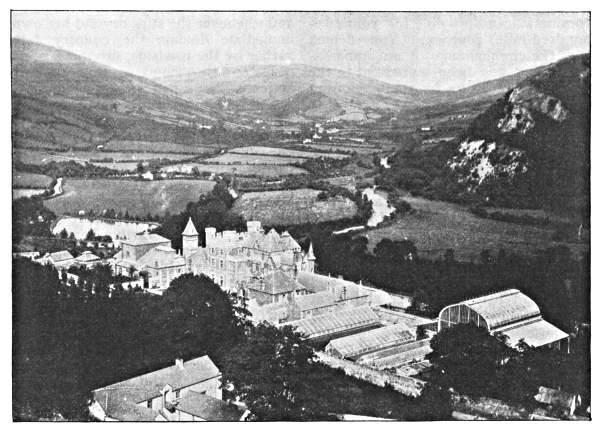
CRAIG-Y-NOS.
It was my privilege at the castle table to sit at Madame Patti’s left. At her right was one whose friendship with her dates from the instant of her first European triumph, thirty-two years ago. I was taken into the family, as it were. But the best of my privilege was that it brought me so near our hostess, and made easy conversation possible. The delight of those déjeuners and dinners at Craig-y-Nos is not to be forgotten. There is a notion abroad that these meals are held in state; but they are not. There is merely the ordinary dinner custom of an English mansion. The menu, though, is stately enough, for the art culinary is practised in its most exquisite fashion there. The dining-room is very seldom used, for, handsome as that apartment is, Patti, and her guests too, for that matter, prefer to eat in the great glass room which was formerly the conservatory and is still called so. There we sit, as far as outlook goes, out of doors, for, in whatever direction we gaze, we look up or down the Swansea Valley, across to the mountains, and along the tumbling course of the river Tawe. To the imminent neglect of my repast, I sat gazing at the wood-covered cliffs of Craig-y-Nos (Rock-of-the-Night) opposite, and listening to the ceaseless music of the mountain stream. Patti, noticing my admiration for the view, said, “You see what a dreadful place it is in which I bury myself.”
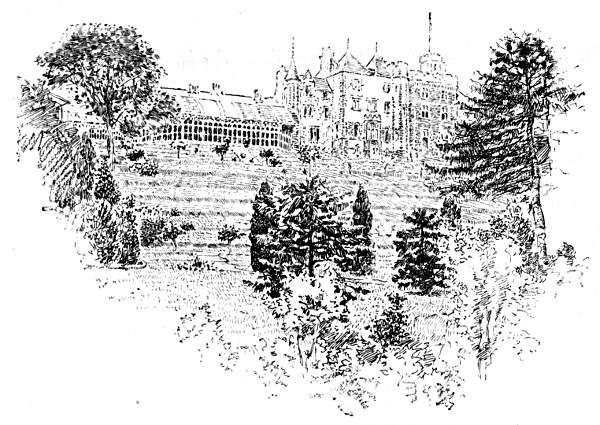
CRAIG-Y-NOS AND TERRACES FROM THE RIVER.
“‘Bury’ yourself! On the contrary, you have here all the charms of life, and you seem to have discovered the fountain of perpetual youth. A ‘dreadful’ place? Indeed, it is a paradise in miniature!”
“But one of your countrymen says that I hide far from the world among the ugly Welsh hills. He writes it in an American journal of fabulous circulation, and I suppose people believe the tale, do they not?” La Diva laughed heartily at the thought of a too credulous public, and then she added: “Really, they do write the oddest things about my home, as if it were either the scene of Jack the Giant-killer’s exploits on the top of the Beanstalk, or a prison in a desolate land.”
After visiting Patti at Craig-y-Nos one need no longer wonder why this enchanting woman sings “Home, Sweet Home” with such feeling. For she inhabits a paradise. There is not anywhere a lovelier spot, nor is there elsewhere a place so remote and at the same time so complete in attractiveness, and in every resource of civilization.
The dinner passed on merrily. Merrily is exactly the word to describe it. Up and down the table good stories flew, sometimes faster than we could catch them. Nobody likes a good joke better than Patti, and when she heard one that particularly pleased her she would interpret it to some guest who had not sufficiently mastered the language in which the original anecdote was told. It was delightful comedy, and after watching it with high pleasure, while La Diva spoke in a brace of languages, I said: “I wonder if you have what people call a native tongue, or whether in all of them you are ‘native and to the manner born’?”
“Oh, I don’t know so many,” she replied, “only—let’s see—English, German, French, Italian, Spanish, and Russian.”
“And which language do you speak best, if I may ask?”
“I really don’t know. To me there is no difference, as far as readiness goes, and I suppose that in all of them readiness helps.”
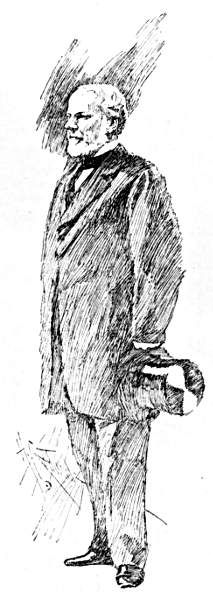
MADAME PATTI’S FATHER.
“But you have a favorite among them?”
“Oh, yes, Italian. Listen!” And then she recited an Italian poem. Next to hearing Patti sing, the sweetest sound is her Italian speech. I expressed my delight, and she said:
“Speaking of languages, Mr. Gladstone paid me a pretty compliment a little while ago. I will show you his letter to-morrow, if you care to see it.”
Patti forgets nothing. The next day she brought me Mr. Gladstone’s letter. The Grand Old Man had been among her auditors at Edinburgh, and after her performance he went upon the stage to thank her for the pleasure he had felt in listening to her songs. He complained a little of a cold which had been troubling him, and Patti begged him to try some lozenges which she had found useful. That night she sent a little box of them to Mr. Gladstone, and the statesman acknowledged the gift with this letter:
“6 Rothesay Terrace, Edinburgh, October 22, 1890.
“Dear Madame Patti:
“I do not know how to thank you enough for your charming gift. I am afraid, however, that the use of your lozenges will not make me your rival. Voce quastata di ottante’ anni non si ricupera.
“It was a rare treat to hear from your Italian lips last night the songs of my own tongue, rendered with a delicacy of modulation and a fineness of utterance such as no native ever in my hearing has reached or even approached. Believe me,
“Faithfully yours,
“W. E. Gladstone.”
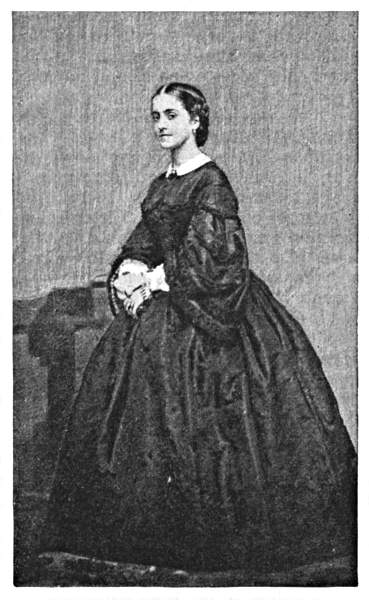
MADAME PATTI AT EIGHTEEN.
This letter very naturally gave our conversation a reminiscent turn, and, after some talk of great folk she has known, I asked Madame Patti what had been the proudest experience in her career. “For a great and unexpected honor most gracefully tendered, nothing that has touched me deeper than a compliment paid by the Prince of Wales and a distinguished company, at a dinner given in honor of the Duke of York and the Princess May, a little while before their wedding. The dinner was given by Mr. Alfred Rothschild, one of my oldest and best friends. There were many royalties present, and more dukes and duchesses than I can easily remember. During the ceremonies the Prince of Wales arose, and to my great astonishment, proposed the health of his ‘old and valued friend Madame Patti.’ He made such a pretty speech, and in the course of it said that he had first seen and heard me in Philadelphia in 1860, when I sang in ‘Martha,’ and that since then his own attendance at what he was good enough to call my ‘victories in the realm of song’ had been among his most pleasant recollections. He recalled the fact that on one of the occasions when the princess and himself had invited me to Marlborough House, his wife had held up little Prince George, in whose honor we were this night assembled, and bade him kiss me, so that in after life he might say that he had ‘kissed the famous Madame Patti.’ And then, do you know, that whole company of royalty, nobility, and men of genius rose and cheered me and drank my health. Don’t you think that any little woman would be proud, and ought to be proud, of a spontaneous tribute like that?”
It is difficult, when repeating thus in print such snatches of autobiography, to suggest the modest tone and manner of the person whose words may be recorded. It is particularly difficult in the case of Madame Patti, who is as absolutely unspoiled as the freshest ingénue. Autobiography such as hers must read a little fanciful to most folk; it is so far removed from the common experiences of us all, and even from the extraordinary experiences of the renowned persons we usually hear about. But there is not a patch of vanity in Patti’s sunny nature. Her life has been a long, unbroken record of success—success of a degree attained by no other woman; no one else has won and held such homage; no one else has been so wondrously endowed with beauty and genius and sweet simplicity of nature—a nature unspoiled by flattery, by applause, by wealth, by the possession and exercise of power. Patti at fifty is like a girl in her ways, in her thoughts, in her spirit, in her disinterestedness, in her enjoyments. Time has dimmed none of her charms, it has lessened none of her superb gifts. She said to me one day: “They tell me I am getting to be an old woman, but I don’t believe it. I don’t feel old. I feel young. I am the youngest person of my acquaintance.” That is true enough, as they know who see Patti from day to day. She has all the enthusiasms and none of the affectations of a young girl. When she speaks of herself it is with the most delicious frankness and lack of self-consciousness. She is perfectly natural.
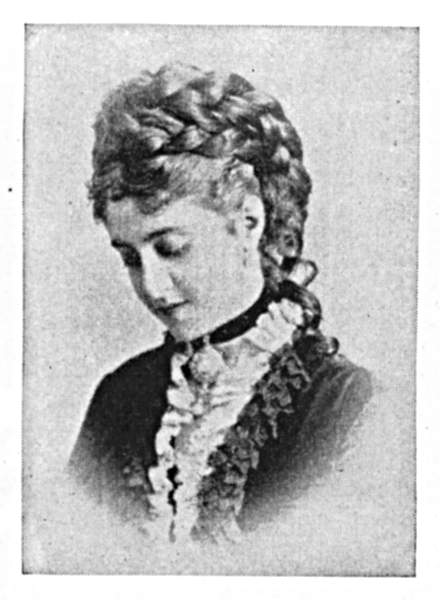
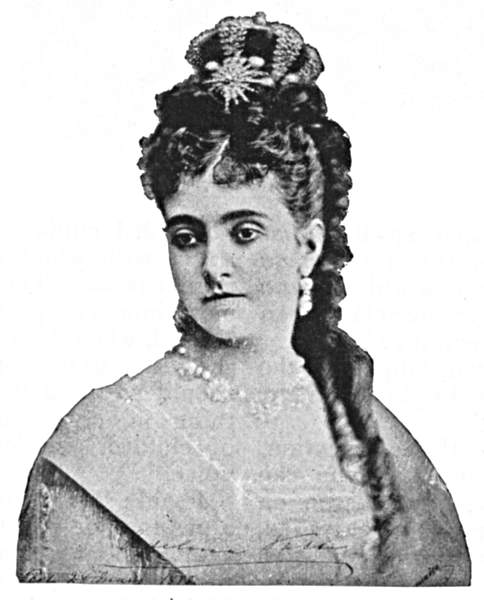
MADAME PATTI IN 1869 AND IN 1877.
She promised to show me the programme of that Philadelphia performance before the Prince of Wales so long ago, and the next day she put it before me. It is a satin programme with gilt fringe, and its announcement is surmounted by the Prince of Wales’s feathers. At that Philadelphia performance Adelina Patti made her first appearance before royalty. In the next year she made her London début. It was at Covent Garden, as Amina in “La Sonnambula.” The next morning Europe rang with the fame of the new prima donna from America. “I tried to show them that the young lady from America was entitled to a hearing,” said she, as we looked over the old programmes.
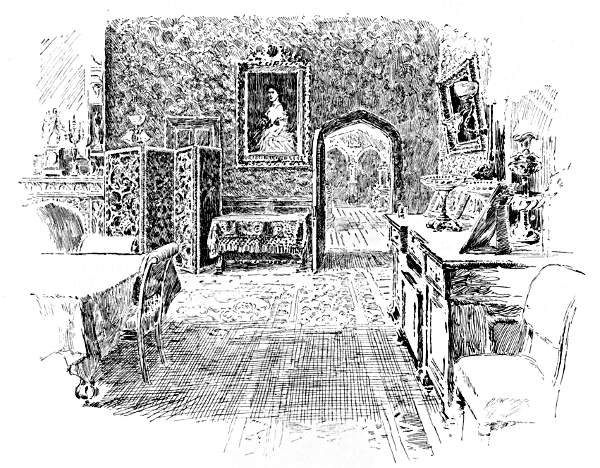
THE DINING-ROOM.
“And has the ‘young lady from America’ retained that spirit of national pride, or has she become so much a citizen of the world that no corner of it has any greater claim than another upon her affections?”
“I love the Italian language, the American people, the English country, and my Welsh home.”
“A choice yet catholic selection. The national preferences, if you can be said to own any, have reason on their side. Your parents were Italian, you were born in Spain, you grew from girlhood to womanhood in America, you first won international fame in England, and among these Welsh hills you have planted a paradise.”
“How nice of you! That evening at Mr. Alfred Rothschild’s, the Prince of Wales asked me why I do not stay in London during ‘the season,’ and take some part in its endless social pleasures. ‘Because, your Royal Highness,’ I replied, ‘I have a lovely home in Wales, and whenever I come away from it I leave my heart there.’ ‘After all,’ said the prince, ‘why should you stay in London when the whole world is only too glad to make pilgrimages to Craig-y-Nos?’ Wasn’t that pretty?”
I wish I could somehow convey the naïveté with which the last three words were uttered. The tone expressed the most innocent pleasure in the world. Indeed, when Patti speaks in this way she seems to be wondering why people should say and do so many pleasant things in her behalf. There is an air of childish wonder in her look and voice.
I said: “All good republicans have a passion for royalty. I find that an article about a king or a queen or a prince is in greater demand in the United States than anywhere else in the world. Do tell me something more about the Prince and Princess of Wales. I promise you, as a zealous democrat, that no one on the far side of the Atlantic will skip a word. Have the prince and princess visited Craig-y-Nos?”
“No. But they were coming here a couple of years ago. See—here is the prince’s letter fixing the date. But it was followed by their sudden bereavement, and then for many, many months they lived in quiet and mourning, only coming forth in their usual way just before the recent royal wedding. They sent me an invitation to the wedding festivities. But alas! I could not attend them. I had just finished my season, and was lying painfully ill with rheumatism. You heard of that? For weeks I suffered acutely. It’s an old complaint. I have had it at intervals since I was a child. But about the royal wedding. When the Prince and Princess of Wales learned that I was too ill to accept their gracious invitation, they—well, what do you suppose they did next?”
“Something very apt and graceful.”
“They sent me two large portraits of themselves, bearing their autographs, and fitted into great gilt frames. You shall see the portraits after dinner. They occupy the place of honor in Craig-y-Nos Castle.”
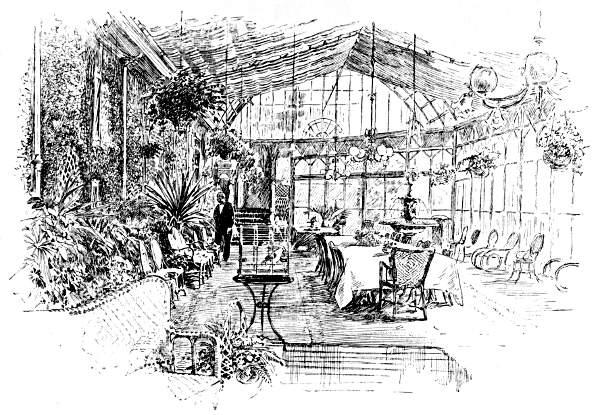
THE CONSERVATORY.
We had reached the coffee stage of the dinner, and the cigars were being passed. The ladies did not withdraw, according to the mediæval and popular English habit, but the company remained unbroken, and while the gentlemen smoked, the ladies kept them in conversation. Presently, some one proposed Patti’s health, and we all stood, singing “For She’s a Jolly Good Fellow.”
That put the ball of merriment in motion. One of the young ladies, a goddaughter of our hostess, carolled a stanza from a popular ditty. At first I thought it audacious that any one should sing in the presence of La Diva. It seemed an act of sacrilege. But in another instant we were all at it, piping the chorus, and Patti leading off. The fun of the thing was infectious. The song finished, we ventured another, and Patti joined us in the refrains of a medley of music-hall airs, beginning with London’s latest mania, “Daisy Bell, or a Bicycle Made for Two,” and winding up with Chevalier’s “Old Kent Road” and the “Coster’s Serenade,” Coburn’s “Man that Broke the Bank at Monte Carlo,” and the transatlantic “Daddy Wouldn’t Buy me a Bow-Wow.”
Madame turned with an arch look—“You will think our behavior abominable.”
“On the contrary, I find it very jolly, not to say a rare experience; for it is not everybody who has heard you sing comic songs.”
Patti’s answer was a peal of laughter, and then she sat there singing very softly a stanza of “My Old Kentucky Home,” and as we finished the chorus she lifted a clear, sweet note, which thrilled us through and through, and stirred us to rapturous applause. “What have I done?” Patti put the question with a puzzled look. The reply came from the adjoining library: “High E.” One of our number had run to sound the piano pitch. Then I recalled what Sir Morell Mackenzie had told me a little while before he died. I was chatting with the great physician in that famous room of his in Harley Street. We happened to mention Madame Patti. “That great singer,” said Sir Morell, “has the most wonderful throat I have ever seen; it is the only one I have ever seen with the vocal chords in absolutely perfect condition after many years of use. They are not strained, or warped or roughened, but, as I tell you, they are absolutely perfect. There is no reason why they should not remain so ten years longer, and with care and health twenty years longer.”
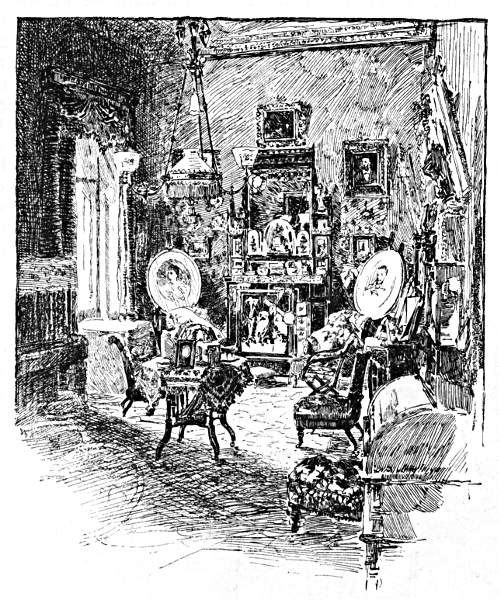
MADAME’S BOUDOIR.
Remembering this, I asked Madame Patti if she had taken extraordinary care of her voice. “I have never tired it,” said she; “I never sing when I am tired, and that means that I am never tired when I sing. And I have never strained for high notes. I have heard that the first question asked of new vocalists nowadays is ‘How high can you sing?’ But I have always thought that the least important matter in singing. One should sing only what one can sing with perfect ease.”
“But in eating and drinking? According to all accounts you are most abstemious in these things.”
“No, indeed. I avoid very hot and very cold dishes, otherwise I eat and drink whatever I like. My care is chiefly to avoid taking cold, and to avoid indigestion. But these are the ordinary precautions of one who knows that health is the key to happiness.”
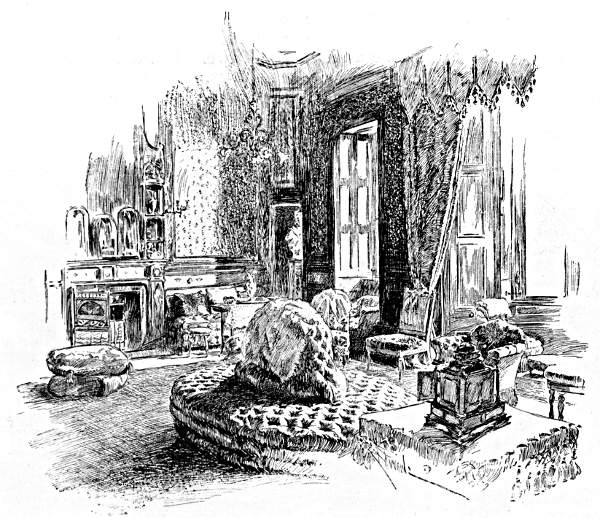
THE SITTING-ROOM.
“And in practising? Have you rigid rules for that? One hears of astounding exercise and self-denial.”
“Brilliant achievements in fiction. For practising I run a few scales twenty minutes a day. After a long professional tour I let my voice rest for a month and do not practise at all during that time.”
During my visit to Craig-y-Nos we usually spent our evenings in the billiard-rooms. There are two at the castle, an English room and a French one. In the French room there is the great orchestrion which Madame Patti had built in Geneva at a cost of twenty thousand dollars. It is operated by electricity, and is said to be the finest instrument of the kind in the world. Monsieur Nicolini would start it of an evening, and the wonderful contrivance would “discourse most eloquent music” from a repertoire of one hundred and sixteen pieces, including arias from grand operas, military marches, and simple ballads. Music is the one charm that Madame Patti cannot resist. The simplest melody stirs her to song. In the far corner from the orchestrion she will sit, in an enticing easy-chair, and hum the air that is rolling from the organ-pipes, keeping time with her dainty feet, or moving her head as the air grows livelier. Now and again she sends forth some lark-like troll, and then she will urge the young people to a dance, or a chorus, and when every one is tuned to the full pitch of melody and merriment she will join in the fun as heartily as the rest. I used to sit and watch her play the castanets, or hear her snatch an air or two from “Martha,” “Lucia,” or “Traviata.”
One night the younger fry of us were chanting negro melodies, and Patti came into the room, warbling as if possessed by an ecstasy. “I love those darky songs,” said she, and straightway she sang to us, with that inimitable purity and tenderness which are hers alone, “Way Down Upon the Swanee River,” and “Massa’s in the Cold, Cold Ground,” and after that “Home, Sweet Home,” while all of us listeners felt the tears rising, or the lumps swelling in our throats.
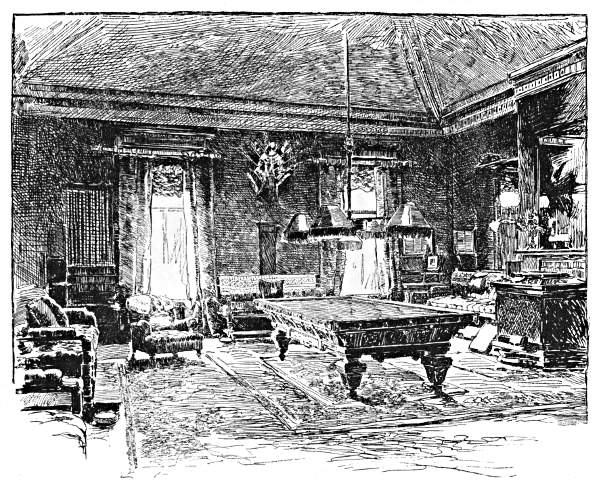
THE FRENCH BILLIARD-ROOM.
Guests at Craig-y-Nos are the most fortunate of mortals. If the guest be a gentleman, a valet is told off to attend upon him; if the guest be a lady, a handmaid is placed at her service. Breakfast is served in one’s room at any hour one may choose. Patti never comes down before high noon. She rises at half-past eight, but remains until twelve in her apartments, going through her correspondence with her secretary, and practising a little music. At half-past twelve an elaborate déjeuner is served in the glass pavilion. Until that hour a guest is free to follow his own devices. He may go shooting, fishing, riding, walking, or he may stroll about the lovely demesne, and see what manner of heavenly nook nature and Patti have made for themselves among the hills of Wales. Patti’s castle is in every sense a palatial dwelling. She saw it fifteen years ago, fell in love with it, purchased it, and has subsequently expended at least half a million dollars in enlarging and equipping it. The castellated mansion, with the theatre at one end and the pavilion and winter garden at the other, shows a frontage of fully a thousand feet along the terraced banks of the Tawe. But the place has been so often described that it is unnecessary for me to repeat the oft-told story, or to give details of the gasworks, the electric-lighting station, the ice-plant and cold-storage rooms, the steam-laundry, the French and English kitchens, the stables, the carriage-houses, the fifty servants, the watchfulness of Caroline Baumeister, the superintending zeal of William Heck. These matters are a part of the folk-lore of England and America. But I would like to say something of Patti’s little theatre. It is her special and particular delight. She gets more pleasure from it than from any other of the many possessions of Craig-y-Nos. It is a gem of a place, well-proportioned and exquisitely decorated. Not only can the sloping floor be quickly raised, so that the auditorium may be transformed into a ballroom, but the appurtenances of the stage are the most elaborate and perfect extant. For this statement I have the authority of an assistant stage-manager of the Royal Opera House at Covent Garden. This expert was supervising some alterations at the Patti theatre while I was at Craig-y-Nos, and he told me that the pretty house contained every accessory for the production of forty operas.
Occasionally Patti sings at concerts in her theatre. All her life she has treasured her voice for the public; she has never exhausted it by devising an excess of entertainment for her personal friends. So most of the performances in the little theatre are pantomimic. Although Patti seemed to me always to be humming and singing while I was at the castle, yet there was nothing of the “performing” order in what she did. She merely went singing softly about the house, or joining in our choruses, like a happy girl.
I remember that one morning, while a dozen of us were sitting in the shade of the terrace, the ladies with their fancy work, the gentlemen with their books and cigars, we heard from the open windows above us a burst of song, full-throated like a bird’s. It was for all the world like the notes of an English lark, which always sings in a kind of glorious ecstasy, as it mounts and mounts in the air, the merrier as it climbs the higher, until it pours from its invisible height a shower of joyous song. No one among us stirred. La Diva thought us far away up the valley, where we had planned an excursion, but we had postponed the project to a cooler day. We were afraid of disturbing Madame, so we kept silent and listened. Our unseen entertainer seemed to be bustling about her boudoir, singing as she flitted, snatching a bar or two from this opera and that, revelling in the fragment of a ballad, and trilling a few scales like my friend the lark. Presently she ceased, and we were about to stir, when she began to sing “Comin’ Thro’ the Rye.” She was alone in her room, but she was singing as gloriously as if to an audience of ten thousand persons in the Albert Hall. The unsuspected group of listeners on the terrace slipped from their own control and took to vigorous hand-smiting and cries of delight.
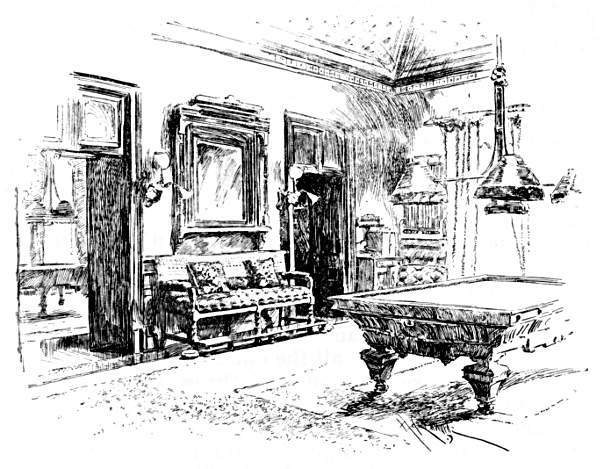
THE ENGLISH BILLIARD-ROOM.
“Oh, oh, oh!” said the bird-like voice above.
We looked up, and saw Patti leaning out at the casement.
“Oh,” said she, “I couldn’t help it, really I could not. I am so happy!”
At luncheon Madame proposed an entertainment in the theatre for the evening. We were to have “Camille” in pantomime.
She persuaded Monsieur Nicolini to be the Armand Duval. Nicolini had never cared to act in the little theatre, but now he consented to make his début as a pantomimist, and he proved to be a master of the art. He had learned it, in fact, at the Conservatoire, when, as a young man, he had studied for the stage. “In those days,” says he, “the study of pantomime was part of an actor’s training. Pity it is not so now.”
The preparations for the pantomime went on apace. Among the guests were several capable amateurs. The performance began a little after ten on the evening of the following day. Some musicians were brought from Swansea. A dozen gentlefolk hastily summoned from the valley, those of us among the guests who were not enrolled for the pantomime, and a gallery full of peasantry and servants, made up the audience. We had “Camille” in five acts of pantomime, and altogether it was a capital performance, and a memorable one. Of course, Madame Patti and her husband carried off the honors. There was a supper after the play, and the sunlight crept into the Swansea Valley within two hours after we had retired.
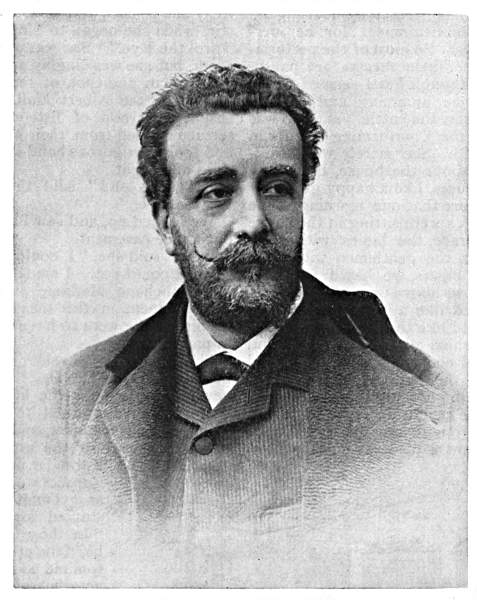
SIGNOR NICOLINI.
I said to Patti after the pantomime, “You do not seem to believe that change of occupation is the best possible rest. You appear to me to work as hard at rehearsing and acting in your little theatre as if you were ‘on tour.’”
“Not quite. Besides, it isn’t work, it is play,” replied the miraculous little woman. “I love the theatre. And, then, there is always something to learn about acting. I find these pantomime performances very useful as well as very pleasant.”
Every afternoon about three o’clock Patti and her guests go for a drive, a small procession of landaus and brakes rattling along the smooth country roads. You can see at once that this is Patti-land. The cottagers come to their doors and salute her Melodious Majesty, and all the children of the country-side run out and throw kisses. “Oh! the dears,” exclaimed the kind-hearted cantatrice as we were driving toward the village of Ystradgynlais (they call it “Ist-rag-dun-las”), one afternoon, “I should like to build another castle and put all those mites into it, and let them live there amid music and flowers!” And I believe that she would have given orders for such a castle straightway, had there been a builder within sight.
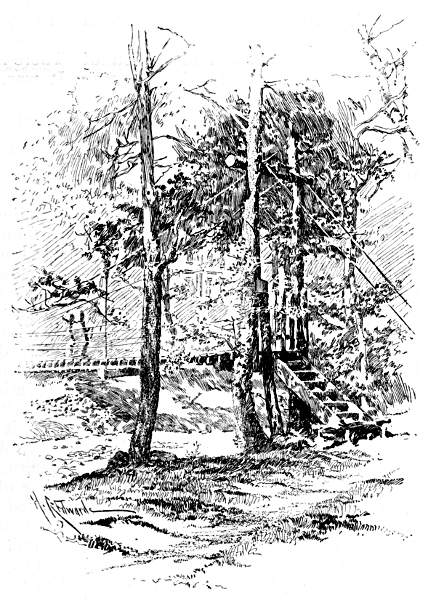
A BIT IN THE PARK. THE SUSPENSION BRIDGE.
On the way home Patti promised me “a surprise” for the evening. I wondered what it might be, and when the non-appearance of the ladies kept the gentlemen waiting in the drawing-room at dinner-time I was the more puzzled. Nicolini, to pass the time, showed us some of Madame’s trophies. It would be impossible to enumerate them, because Craig-y-Nos Castle is like another South Kensington Museum in the treasures it holds. Every shelf, table, and cabinet is packed with gifts which Madame Patti has received from all parts of the earth, from monarchs and millionaires, princes and peasants, old friends and strangers. There is Marie Antoinette’s watch, to begin with, and there are the new portraits of the Prince and Princess of Wales, to end with. There is a remarkable collection of portraits of royal personages, presented to Madame Patti by the distinguished originals on the occasion of her marriage to M. Nicolini. Photographs of the Grand Old Man of Politics and the Grand Old Man of Music rest side by side, on a little table presented by some potentate. Gladstone’s likeness bears his autograph, and the inscription: “Con tanti e tanti complimenti;” Verdi’s, his autograph, and a fervid tribute written in Milan a year ago. There are crowns and wreaths and rare china; there are paintings and plate and I know not what, wherever one looks. If one were to make Patti a gift, and he had a king’s ransom to purchase it withal, he would find it difficult to give her anything that would be a novelty, or that would be unique, in her eyes. She has everything now. For my part, I would pluck a rose from her garden, or gather a nosegay from a hedgerow, and it would please her as truly as if it were a priceless diadem. She values the thought that prompts the giving, rather than the gift itself. She never forgets even the smallest act of kindness that is done for her sake. And she is always doing kindnesses for others. I have heard from the Welsh folk many tales of her generous charities. And to her friends she is the most open-handed of women. There was one dank, drizzly day while I was at Craig-y-Nos. To the men this did not matter. The wet did not interfere with their projected amusements. But every lady wore some precious jewel which Patti had given her that morning—a ring, a brooch, a bracelet, as the case might be. For the generous creature thought her fair friends would be disappointed because they could not get out of doors that day. How could she know that every one in the castle welcomed the rain because it meant a few hours more with Patti?
The “surprise” she had spoken of was soon apparent. The ladies came trooping into the drawing-room attired in the gowns and jewels of Patti’s operatic rôles. Patti herself came last, in “Leonora’s” white and jewels. What a dinner party we had that night—we men, in the prim black and white of “evening dress,” sitting there with “Leonora,” and “Desdemona,” and “Marguerite,” and “Rachel,” and “Lucia,” and “Carmen,” and “Dinorah,” and I know not how many more! Nobody but Patti would have thought of such merry masquerading, or, having thought of it, would have gone to the trouble of providing it.
Of course, we talked of her favorite characters in opera, and then of singers she has known. She said it would give her real pleasure to hear Mario and Grisi again, or, coming to later days, Scalchi and Annie Louise Cary. The latter being an American and a friend, I was glad to hear this appreciation of her from the Queen of Song. “Cary and Scalchi were the two greatest contraltos I have ever known; and I have sung with both of them. I remember Annie Louise Cary as a superb artist, and a sweet and noble woman.” I said “Hear, hear,” in the parliamentary manner, and then Patti added: “Now we will go into the theatre again. There is to be another entertainment.” It was, of all unexpected things, a magic-lantern show. Patti’s magic-lantern is like everything else at Craig-y-Nos, from her piano to her pet parrot, the only one of its kind. It is capable of giving, with all sorts of “mechanical effects,” a two-hours’ entertainment every night for two months without repeating a scene. Patti invited me to sit beside her and watch the dissolving views. It seemed to me that it would be like this to sit by the queen during a “state performance” at Windsor. Here was Patti Imperatrice, dressed like a queen, wearing a crown of diamonds, and attended by her retinue of brilliantly attired women and attentive gentlemen of the court. And it was so like her to cause the entertainment to begin with a series of American views, and to hum softly a verse of “Home, Sweet Home,” as we looked out upon New York harbor from an imaginary steamship inward bound.
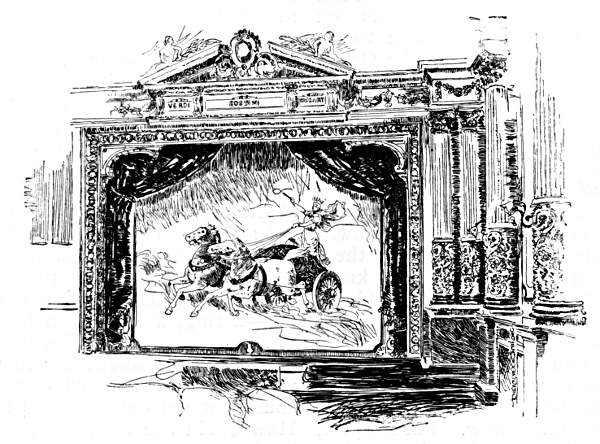
THE PROSCENIUM OF CRAIG-Y-NOS THEATER.
The next morning I started from Craig-y-Nos for America. As the dog-cart was tugged slowly up the mountain-side the Stars and Stripes saluted me from the castle tower, waving farewell as I withdrew from my peep at paradise.