V. BOTANY.[78] By D. Oliver, F.R.S., F.L.S., Professor of Botany in University College, London. (Plates J, K.)
Reading edition
V. BOTANY.[78] By D. Oliver, F.R.S., F.L.S., Professor of Botany in University College, London. (Plates J, K.)
Order RANUNCULACEÆ.
* Ranunculus pinnatus, Poir.
Order POLYGALACEÆ.
* Polygala virgata, Thunb.
Order TILIACEÆ.
Triumfetta Welwitschii, Masters.
Order MALPIGHIACEÆ.
Acridocarpus pruriens, A. Juss.
Order ZYGOPHYLLACEÆ.
* Zygophyllum Dregeanum, Presl?
Order AMPELIDEÆ.
Vitis, sp.
Order LEGUMINOSÆ.
* Sutherlandia frutescens, R. Br.
Erythrina, sp.
Eriosema, sp.
Bauhinia fassoglensis, Kotschy.
Cassia tettensis, Bolle?
* Acacia, sp.
Order ROSACEÆ.
* Cliffortia linearifolia, E. and Z.?
Order SAXIFRAGACEÆ.
Vahlia capensis, Berg.
Order COMBRETACEÆ.
Combretum, sp.
Combretum Zeyheri, Sond.?
Order TURNERACEÆ.
Wormskioldia longepedunculata, Masters.
Order UMBELLIFERÆ.
Peucedanum capense, Dietr.?
Order RUBIACEÆ.
Fadogia Zeyheri, Sond.?
Order COMPOSITÆ.
* Geigeria Zeyheri, Harv.
* Artemisia afra, Jacq.
* Denekia capensis, D. C.
Nidorella auriculata, D. C.
* Gerbera natalensis, Schultz Bip.
Order CAMPANULACEÆ.
Wahlenbergia Banksiana, A. D. C.
Lobelia decipiens, Sond.?
Order ERICACEÆ.
* Erica, near coccinea, Berg.
Order OLEACEÆ.
Jasminum, sp.
Order APOCYNACEÆ.
Carissa, near tomentosa, A. Rich.
Order CONVOLVULACEÆ.
Evolvulus alsinoides, Linn., var.
Order BORAGINACEÆ.
Trichodesma physaloides, A. D. C.
Order SOLANACEÆ.
Solanum subexarmatum, Dunal?
Order GENTIANACEÆ.
Chironia, sp.
Order SCROPHULARIACEÆ.
Lyperia Burkeana, Benth.
* Limosella tenuifolia, Nutt.
* Diclis reptans, Benth.
Order ACANTHACEÆ.
* Hypoestes Forskahlii, R. Br.?
* Hypoestes verticillaris, R. Br.?
Order SELAGINACEÆ.
* Hebenstreitia, near Dentata, Thunb.
Order VERBENACEÆ.
Lippia asperifolia, Rich.
Lantana or Lippia, sp.
Order LABIATÆ.
* Leonotis Leonurus, R. Br.
Ocymum, or Orthosiphon, sp.
Order AMARANTHACEÆ.
Achyranthes aspera, L.?
Order EUPHORBIACEÆ.
Euphorbia, sp.
Order ORCHIDACEÆ.
Lissochilus, 2 sp.
Order IRIDACEÆ.
Gladiolus brevifolius, Jacq.
Gladiolus, near Quartinianus, A. Rich.
Order AMARYLLIDACEÆ.
Hæmanthus, near multiflorus, Martyn.
Order HYPOXIDACEÆ.
Hypoxis villosa, L.
Order LILIACEÆ.
Anthericum (Trachyandra) Oatesii, Baker in Trimen’s Journal of Botany, 1878, p. 324. (Plate J.)
Rootstock not seen complete; outer tunics produced as a membrane round its neck. Produced leaves 5–6, contemporary with the flowers, terete above the sheathing base, ½ foot long, ½ line in diameter, clothed with fine soft deflexed white hairs as long as the diameter of the leaf. Scape as long as the leaves, pilose in the lower part glabrous upwards. Raceme lax, simple, ½ a foot long, 1–1¼ inch in diameter; bracts minute, deltoid; pedicels erecto-patent, the lower ones ½–¾ inch long. Perianth white, fugacious; segments ¼ inch long, lanceolate, with a distinct 1-nerved or obscurely 3-nerved brown keel. Stamens falling a little short of the perianth-segments; filaments muricate; anthers oblong, very minute. Style declinate, just overtopping the anthers.
App.Pl.J.
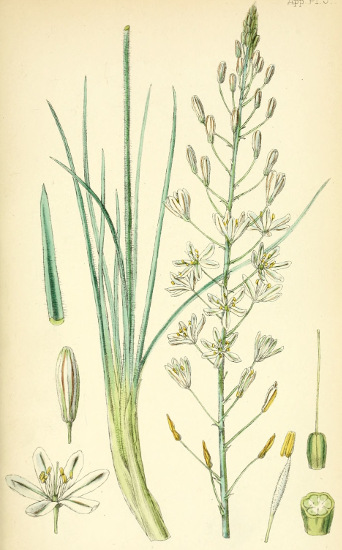
W. H. Fitch del. Mintern Bros. imp.
ANTHERICUM OATESII.
App.Pl.K.
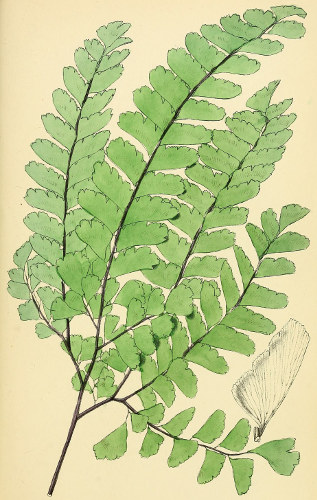
W. H. Fitch del. Mintern Bros. imp.
ADIANTUM OATESII.
Near the Abyssinian A. Saltii, and Cape A. pubescens.
Aloe, sp.
Asparagus, sp.
* Androcymbium melanthioides, Willd.
Order GRAMINEÆ.
* Panicum (Tricholæna) roseum (Nees.)
* Andropogon, sp.
* Andropogon (Cymbopogon) hirtus, L.
Order FILICES.
* Pellæa consobrina, Hook.
Adiantum æthiopicum, L.
Adiantum Oatesii, Baker. (Plate K.)
Stipe slender, brown, glabrous. Lamina pedate, with 6–7 pinnate divisions, the largest 6–8 inches long, 1¼–1½ inch broad; end segment cuneate, ½–1 inch broad; side segments dimidiate, shortly petioled, all, except the lowest, rather ascending, imbricating over the rachis at the inner anterior corner, the largest ¾–⅞ inch broad, ½ inch long, straight and truncate on the lower and inner borders, cut into deep rounded lobes on the upper and outer borders; lower segments gradually dwindling down in size; rachis quite glabrous and scale-less, bright brown; texture thin, membranous; both surfaces bright green and glabrous. Sori not seen. Veins close, fine, distinct, flabellate, free.
Closely allied to the American and Asiatic A. pedatum, Linn., from which it differs by the fewer divisions of the frond, the outer ones not falcately curved, and its shortly-petioled ultimate segments, which are fewer, broader, and imbricated over the rachis.
Adiantum lunulatum, Burm.
Cheilanthes farinosa, Kaulf.
Nephrodium molle, Desv.
Nephrodium (Lastrea), sp.
Nephrolepis exaltata, Schott.
Nephrolepis cordifolia, Presl.
Mohria caffrorum, Desv.