MEMOIR.
Reading edition
“To be able to give one’s name to a bird, or a flower, may seem to many but a poor ambition; and yet, materially considered, it is quite as likely to be perpetuated as to give it to a street or town, and is much more likely to define the tastes and individuality of the giver.”—Bret Harte.
The saying has seldom been truer of any one than of the writer of the succeeding pages, that “the child is father of the man.” His love of nature generally, and of natural history in all its branches, was one of Frank Oates’s earliest instincts; and to the study of our English wild-birds—their ways and haunts, their comings and their goings—he was especially devoted from boyhood. The pages of Waterton and Buffon, treating of wider fields of study, supplied his imagination at that period with richer food; and the plates of Audubon’s Birds, when access could be had to them, were turned by him with feelings little short of reverence. From his earliest days he had resolved to visit those distant, and, to him, still mysterious lands, where the page of nature was yet to the white man in great part an unread book; and those who, after his death in the full prime of manhood, witnessed the arrival at his English home of his large collections of natural history specimens, brought from the interior of South Africa by the devoted service of a friend, realized strangely how the boy’s ambition had been fulfilled in after life, and felt that, though cut off in the very perfection of his powers, the purpose of his being had not wholly failed. Those even who knew him best were surprised indeed, when these evidences of his work abroad arrived, to see how much he had accomplished in the brief period—a little short of two years—of his absence. As, one after another, the packing-cases were opened, each in its turn afforded to the looker-on some fresh illustration of the untiring determination of the deceased traveller to make the very utmost of his opportunities whilst abroad. The voice that could alone have told the story of those collections, the hand that had brought them thus together, were silent and still in a far distant grave; but an utterance—the more pathetic because it was inaudible—seemed to go forth, unbidden, from those speechless records of devoted work and enterprise, and tell the secret tale of a life in earnest sympathy with nature curtailed,—the hand, as it were, yet warm from its labours.
There, on the one hand, lay the opened cases of rare and brilliant bird-skins, each specimen with its separate label, in the collector’s writing, carefully recording its habitat, and other particulars useful to the student, accompanied in many instances by examples of nests and eggs. There, on the other hand, were lesser boxes, filled with varied specimens of insects, some from those very Victoria Falls of the Zambesi, the rich and almost untried harvest-ground of the naturalist, whose attractions had lured the wanderer to his untimely grave. And there, again, were those large wide-necked bottles, familiar to the collector, containing, some of them, strange-looking beetles, others still stranger reptiles; there the packets of botanical drying paper, each sheet enveloping its floral treasure. Turning again to other cases, were found in numbers the singular implements of savage warfare, or industry, and with them many of those rude yet tasteful attempts at ornamentation suggested by native fancy; evidences—the whole of them—of that untutored skill and delicate refinement of workmanship which characterize many of the finer races of unlettered savages. Whilst further, the mighty tusks of the huge African elephant, the skins of the lion, the leopard, and the cheetah,—for it was these beasts of prey that the traveller had especially loved to hunt,—besides those of many an African antelope, with horns and heads of equal grace and beauty, told silently of stirring adventures in the bush. Lastly, but yet not least, were those scientific instruments he had used in taking observations of his journey with so much faithful perseverance; the note-books; the letters of friends (some of these unopened, containing those trifling items of home news, so sweet to the far-off traveller, which his eyes had never seen, for they had arrived after his decease); the pencilled outlines of the country’s scenery; the water-colour drawings of those fatal Falls; how much did not these records breathe to the silent bystander, how much suggest of what had been, and still more what might have been! Poor fellow! not there himself to speak to us, those records of an earnest life, those cared-for and well-worn letters which he had received and treasured, how far more eloquent they were to us than any words could have been! They told us all, more than all, than any words which he could, or at least would, have spoken—so lightly did he ever treat his own achievements—and seemed to leave the world and ourselves poorer and yet richer by his death!
But the subject has led me, in my capacity of editor of these pages, beyond the proper limits of my duties, and I must crave the indulgence of the reader for this long digression. My object is merely to relate, as briefly as I can, such simple facts of Frank Oates’s earlier life as may serve to illustrate the scope and bearing of the ensuing pages, and bring to view the motives which led him to enter on his life of travel. What I have said, indeed, may perhaps, it is true, help to show—what I was anxious early to point out—how very catholic were the interests of the deceased, how great the hold each separate department of the world’s life, and history, and daily growth, had laid upon him. Devoted to the study of natural history, as I have already pointed out, and especially to that of birds—the pursuit of which might be called his ruling passion—yet never did he close his eyes to all those varied interests of other kinds, which were constantly opening round him in his life of foreign travel. “He was not” indeed, as has lately been said of the young French naturalist Jacquemont, who, like Frank Oates himself, died early and in harness,—“He was not at all one of those specialists who shut themselves up in a narrow speciality, and become blind and deaf to the great interests of human life.”[1] Rather may it be said of him, that his interests were perhaps too wide, and that he overtaxed his strength and powers in following the promptings of his nature. Speaking indeed in homely phraseology, whilst out in Africa, he admitted himself that he had “too many irons in the fire,” and some of the difficulties and vexations which beset him upon his journey must be attributed to the delays which were occasioned by his desire of embracing every opportunity which presented itself, not only of adding a new specimen to his collection, but also of noting any fresh fact with regard to the country and its inhabitants which came before his notice. For, in addition to his natural history pursuits, he was, as above intimated, engaged on this journey in taking observations of the country which he passed through, and laying down his route, and also, wherever possible, in seeking intercourse with the natives, and gaining knowledge of their character.
This same tendency of his—to attempt too much—had once before also served him in evil stead when at the University in earlier life. Born on the 6th of April 1840, a son of the late Mr. Edward Oates, of Meanwoodside, near Leeds—himself a lover of nature, and a man of literary tastes—Frank Oates entered at Christ Church, Oxford, at the close of 1860. And here his love of nature and her teachings soon displayed itself by his choice of reading for a class in the Natural Science Schools. His work, however, in this direction did not keep him from study in many other departments of knowledge; and, besides his studies, all out-door pursuits had each their respective fascination for him. Of these, riding held with him, as it had always done, the foremost place; and when the time of year or incidental circumstances kept him from an occasional gallop with the hounds, he would have a long day’s ride into the country instead, drinking in, the while, deep draughts of enjoyment from the scenes he passed through. One such ride, still showing him faithful to his love of birds, he describes himself in a letter to one of his brothers on May Day, 1864, as follows:—
“I had a jolly ride,” he writes, “to Wychwood Forest a few days ago, with S—— of Wadham. We both enjoyed it, as we both entered into the loveliness of the scene. Unfortunately the day was cold, and few birds were seen, though we did hear the nightingale once, and the cuckoo once or twice. We were riding about the forest in the dark, with some prospect of being lost, and did not get back to Oxford till eleven o’clock, having ridden about thirty-six miles.”
The exhilaration of these long rides was almost a necessity to him, counteracting, as they did in a measure, the strain of mental work. He also loved bathing, swimming, and sailing, the first two of which Oxford supplied him with in liberal measure, whilst even the last-named he found occasional opportunity of indulging his taste for on the Isis. Then there were cricket and rowing, to both of which he gave a share of his attention, with rifle-shooting at the butts, and fencing at the gymnasium.
This is a tolerable list of occupations, in addition to which Oxford had also its social attractions for him; for, besides the undergraduates of his own standing whom he knew, he was further privileged with the acquaintance of a few such men as the present Dean of Westminster—then Regius Professor of Ecclesiastical History in the University—the present distinguished Master of Balliol, the late Sir Benjamin Brodie, and Professor Henry Smith; whilst the nature of his studies brought him into frequent pleasant intercourse with Professor Rolleston and others at the museum. The second year of his residence he sustained a loss, which he long felt, in the death of his young tutor, Mr. G. R. Luke, Senior Student of Christ Church, to whom he had formed no slight attachment. Of this event, rendered doubly sad by the circumstances under which it occurred, he wrote to a friend the day afterwards (March 4, 1862) as follows:—
“Oxford,” he says, “has just lost one of its brightest lights, and I a valuable friend, whom, I fear, I did not sufficiently appreciate in his lifetime—poor Luke! It would be too much to say that there was not so good, but I can confidently assert that I do not think there was a better, man in Oxford. He was such a genuine, worthy, and conscientious fellow as is rarely met with; and his kindness was equalled by his noble spirit—his modesty by his high learning and abilities. And this valuable life, difficult as it is to realize it, has been cut short;—Luke was drowned in the river yesterday, having gone alone, quite contrary to his custom, in a whiff. It seems that he was near half an hour in the water, and dead when taken out. This sad accident, coming so suddenly, must throw a damp over the feelings of many; and if there is any gratitude amongst men, there must have been many a sigh for him last night. I heard the news before six o’clock, and it had reached Christ Church some time before, the accident having happened about four. You may imagine my horror when, on entering my rooms to put on my cap and gown for hall, I was met by my scout, and asked if I had heard that Mr. Luke was drowned. In an hour or two I should have been reading with him.”
And now enough may have perhaps been said to give some insight into Frank Oates’s life at Oxford, and with one more quotation from his letters, this period of his history shall be closed. His first year at college an attack upon his chest in early spring had prevented his residence during the summer term at the University, and led to his spending as much of the succeeding winter as the Oxford terms admitted of in Italy, where he gathered many pleasant reminiscences. The following spring, too, he was late in coming up, owing to a return of his ailment during the Easter vacation, when he was again a prisoner to his room at home. Writing on April 23d (1862), during this period of confinement, he says, “I see the tree-tops tipped with green, and hear the thrush’s voice, telling me of old times, and asking me why I keep house, and I’ve no doubt spring is here. So I want to be out again, and to greet her as an old friend.” And presently he was out again, revelling in the spring sunshine with his friends, the birds. But this is not the intended quotation. Sufficiently recovered from this illness for the journey back to Oxford, he returned there on May 9th to find the place “shaded with its great green trees, and with its gray old walls looking almost joyous.” It was not, however, till two evenings later that he “came in for the full benefit of the May aspect of things,” as he describes it, when he took a long ramble into the country to Wytham, and first saw the rich pastoral country which surrounds Oxford in its summer dress. His account of this walk, written (again to the same friend) on May 12th, tells forcibly of his appreciation of all country sights and sounds.
“... Your letter arrived yesterday morning,” he says, “and of course my evening was at once laid out for me, and now I come to what I ought to have begun with—my ramble of last night. You perhaps thought, as it grew dusk, that I was still lingering about the scene you describe; and so I was. It was with really joyous feelings that I set out at six o’clock, and trudged along the Sevenbridge Road. It was Sunday evening, and the road was crowded with Oxford folks and the militia. The floods which surrounded the road seemed an object of interest to them, but I pushed on, bestowing a hurried glance now and then at the tufted willows, and islands, and shores of long grass, which dotted over and surrounded the lake-like fields, with the dappled sky reflected on their watery surface. Botley reached, I inquired the way to Wytham. A shady green lane was pointed out to me, and I was soon away in thought, all alone in that quiet place; and so on I strolled, through the fields, past the wood, through the village, and, as night closed in, back again. If I were a word-painter I might describe my walk; but not being one, should any attempt of mine thereat be intelligible to you, it will only be because you know what I would describe, and can realize my feelings.
“There had been some little rain, and it was still rather dull and damp when I set out; but I should have gone if it had been worse, and really the evening ended almost brightly. I enjoyed the freshness of everything, and the wild-birds seemed to enjoy it; they did not appreciate it as I did, but they enjoyed it more. The notes of many a songster rang out from the thick cover of the wood on my left, and amongst the well-known notes some strange music was mixed, now and then becoming louder and more distinct. These must have been the wonderful soft strains of the nightingale. The woodpeckers were laughing wildly, and the rooks returning to the tops of the elms, and talking as is their wont; the youngsters responding eagerly, and seeming as if they were chattering and being fed at the same time. The cows were placidly grouped about the hedges, or wandering leisurely to and fro, favouring the passerby with a whiff of their scented breath. On the other side, flooded fields were rich in the most luxuriant vegetation; whilst continually, and, as it grew later, more continually, the cuckoos answered one another from many a deep shade. I was glad to think that you would be thinking me there, and hoped you would not fancy that I should give up the excursion.”
Nor, passing now from reminiscences of his Oxford life, was his love of the country and its associations, here sufficiently evinced, confined to one particular sort of scenery; and the wild moorlands of his native county attracted him as strongly as the quiet and peaceful beauties of Oxfordshire, or even more so. During the Easter vacation of 1864 he had been on a short walking tour into the Yorkshire dales with one of his brothers and some other friends.
“There is always a sense of freedom,” he writes from near Leeds soon afterwards, “in getting away to the moors and mountains which surround us, and lie so near that they seem to invite Leeds men to visit them. For though the river at Kirkstall is sadly changed from the stream that leaves Malham Tarn, and the mountain air has lost somewhat of its freshness when it sweeps over this place, the sight and sound of railways are a constant reminder that a few minutes’ consignment to the train, and the payment of a few shillings, are sufficient charm to place one in the world of nature. May those moors and valleys long continue desolate, if desolation may be understood to mean no presence but that of the spirit of nature. I care not what that spirit may be, but I feel a breathing life and an unsurpassable harmony, where man has not utterly defiled the face of the country. What I long for,” he concludes, “is a fishing tour in the neighbourhood of Kilnsey or Wensleydale. I must be incorrigibly idle, and born to hate anything that even looks like work; and yet I want to be active, to do something, to find a field for my energies, such as they are.”
In the last passage the writer did himself some injustice, and what he seems to have taken for “incorrigible idleness,” was in reality nothing else than the demand of nature within him for some real rest and relaxation from his Oxford studies. His scrupulous conscientiousness, moreover, was already beginning to cause him much anxiety with regard to his future life, as the time for his leaving Oxford was approaching. That warning voice of nature, however, unhappily was not attended to. He would have entered the Schools for his final examination the succeeding autumn, or at latest the following spring; but in the latter part of the summer of this year (1864), under the strain of overwork, his health broke completely down, and for a period of some years he was obliged to live in a state of enforced, and to him scarcely endurable, inactivity. A great portion of this time he spent in the retired parts of Wales, and the English Lake District, and some part of it in Ireland. On one occasion, during this period, writing to one of his brothers on his experiences of overwork, he says:—
“Let me advise you earnestly not to try to do too many things. I killed the goose with a vengeance, and got no golden egg. I was expecting in a few weeks [when taken ill] a degree with honours, and a good start in life, and ... had to leave Oxford without even an ordinary degree, which I knew more than enough to have taken the Easter before, if it would have satisfied me. I should have been surprised to have been told that season, when I was riding H——’s little cob in Rotten Row, in the glory of summer and all the hope of youth, that before the leaves had all left the trees that very horse would have been H——’s death, and that I should be a hundred times worse than dead.”[2]
Throughout the whole of this weary time, however, he never relinquished—so indomitable was his spirit—the hope of a better time approaching. Once at Liverpool, indeed, for a short stay in 1869, he writes upon this subject, “I like to be where I can be amused and see life without having to take part in it, though I would fifty times rather be at work at something. I wonder,” he adds, “whether I ever shall be again.” And he was at work again, not quite two years later, once more restored to health, and busily preparing for a trip across the Atlantic, which had been recommended to him for the thorough re-establishment of his health, and which accorded happily with the early fancies of his boyhood. It was by this time almost too late for him, even had he now wished it, to have thought seriously of adopting one of the recognized professions. A few years earlier he had thought both of the army and the bar; but with the love of adventure and research so strong within him, it is scarcely probable, had he adopted either, that he would have endured their trammels long. Once, too, it had seemed not unlikely that his strong love of painting, which held with his passion for natural history divided sway over his earlier years, might have proved the more powerful impulse of the two, and led him ultimately to the definite pursuit of art. In choosing against it, however, he probably selected well, as the somewhat sedentary life thereby involved would not so well have harmonized with his constitutional need for physical activity.
On this expedition to America he was absent about a year, a considerable portion of the time being spent in Central America—chiefly in Guatemala,—and a part of it in California, camping out amongst the Rocky Mountains. Unlooked for circumstances brought his journey to a speedier close than he had intended; but if unaccompanied by other results, he was at least successful in forming a collection of birds and insects of some interest and value, and contracted several valuable friendships. “His manliness and irreproachable conduct and kindliness,” wrote Sir Henry Scholfield, the British Consul at Guatemala, after his decease, “gained for him, during his short stay here, a friend in every one he met.” And wherever else in the country he made any sort of stay, he appeared to have been scarcely less fortunate in this respect.
Soon after his return from America in 1872 he began to make arrangements for a more extended journey—the one of which this volume treats, and on which he started in March 1873. His plan on this occasion was to reach the Zambesi from Natal, and if possible visit some of the unexplored country to the north of that river. In the latter hope he was destined to disappointment, and the number of obstacles he met with in realizing the former serve to illustrate some of the ordinary difficulties which may be encountered in African travel. Of the results, however, such as they were, of this journey, in which he lost his life, the reader must be left to form his own judgment from the perusal of the ensuing pages. He had at least acquired much of that needful experience of rough travel and adventure, without which little can be accomplished in the way of exploration or research. It is almost certain that, had he lived, his next journey would have been of a more ambitious kind, remarkable as he was for that love of enterprise which characterizes the true explorer; of this he spoke merely as a “little trip.” His experiences, moreover, in this two years’ travel, must still further have convinced him, if in a different manner, of those evil effects of attempting too many things, which his Oxford career had previously warned him of. The diversity of his pursuits led him into many delays, each one of which no doubt contributed its share, together with the obstructiveness of native tribes, to that long detention on his journey which finally threw his visit to the Zambesi into the unhealthy season of the year. It must be granted, however, at the same time, that his love of adventure led him into places where the field for inquiry was especially inviting, and offered exceptional advantages; and also that his devotion to natural history beguiled throughout his journey what might otherwise have proved many a weary march. It is more than probable—so fully had the need of this now been brought home to him—that on another journey, had he been spared to make one, he would have concentrated his chief energies upon fewer objects. What these might have been must remain, indeed, matter of conjecture; but whatever else he had abandoned, the pursuit of ornithology would certainly have held a place second only to that of exploration.
In character and temperament Frank Oates was admirably fitted for his work. “I like anything,” he once wrote when at Oxford, “that seems difficult of attainment,”—the very zest of the pursuit proving in such cases its own reward to him. So too, in disposition; he had just the one which recommends itself to strangers. “There was something singularly winning about him,” wrote a friend, upon his death; “that peculiar combination of courage and gentleness, which is one of the finest traits of character.” It was, in fact, this very association of a genial nature with a remarkable openness and candour of disposition, that won for him friends, especially amongst his own countrymen, wherever his lot was cast, and so smoothed his way over many difficulties. And if, as would sometimes happen, he fell amongst unfriendly natives, he preserved himself on such occasions by a seeming show of condescension, and a coolness under danger which commanded their respect. A faithful and accurate observer, but little was lost that came before his notice; and if at the time of his death—in February 1875—he had not realized all that he had hoped from his expedition, he may at least be said to have justified the choice that he had made, and had contributed a measure of faithful labour to the causes of progress and research.
On hearing of his death, the Dean of Christ Church, who had always particularly regretted the illness which in earlier life had prematurely closed his University career, wrote of the untimely termination of his later efforts in a spirit of no less concern. “His name,” wrote the Dean at this time, “must be added to the list of those devoted and enterprising Englishmen, who ‘scorn delights and live laborious days,’ who by their frank love of truth and justice have made our name respected from one hemisphere to the other. I retain a dear memory of him,” he concludes, “and grieve to think that so much manly spirit has so soon been quenched.”
This manly love of truth here noticed, his zeal in action, and energy for work, had marked Frank Oates conspicuously from a boy. Life was for him no lounge, merely to be dreamed through, but an active, burning reality, from which the fruit that the hour yielded was to be plucked and harvested. From his earliest days, when he watched at springtide the coming of the swallow, or lurked in autumn by the hedgerow, to note the flocks of redwings as they passed—from the time when those authors whom he loved had given him his first glimpses into that distant realm of nature where his imagination loved to wander, and he hoped one day to follow them—till the arrival of the period when that desire was at length destined to be realized, and he had threaded the forests of tropical America, and roamed through the thorny wastes of Southern Africa, was he ever adding something to his knowledge of nature, something to his love of science, or something to his appreciation of the beautiful. With him, indeed, were no half measures. His interest once fairly roused in any subject, he gave to it the strength of his whole soul; a purpose once formed rarely failed in its fulfilment; and such was the elasticity of his temperament that he would turn from one subject to another, each as a mere refreshment from the last. To this was added, in no common measure, a certain freshness and buoyancy of the spirit, which enabled him in a moment to throw off the spell which bound him, and join on occasion in the frolic of the hour. A peculiar brightness characterized his being, and rendered the common incidents of life attractive to him; and should any be found who regard as incongruous the lightness of spirit which occasionally manifests itself even in the ensuing pages, in connexion with more serious subjects, such ones may read with interest the following extract from the writings of the late Charles Kingsley, with reference to this very tendency, as manifested in another posthumous author, whose book was edited by a friend. “With a reverence for the dead,” he says, “which will at once be understood and honoured, he [the editor] has refrained, perhaps here and there too scrupulously, from altering a single word of the documents as he found them, respecting even certain scraps of Cambridge and Winchester slang, which may possibly offend that class of readers who fancy that the sign of magnanimity is to take everything au grand sérieux, and that the world’s work must needs be done upon stilts; but which will be, perhaps, to the more thoughtful reader only additional notes of power, of that true English ‘Lebensglückseligkeit,’ as the German calls it, which makes a jest of danger and an amusement of toil. Jean Paul makes somewhere the startling assertion that no man really believes his religious creed unless he can afford to jest about it. Without going so far as that, I will say boldly,” adds the writer, “that no man feels himself master of his work unless he can afford to jest about it; and that a frolicsome habit of mind is rather a token of deep, genial, and superabundant vitality, than of a shallow and narrow nature, which can only be earnest and attentive by conscious and serious efforts.”[3] There were few circles of society where Frank Oates was not welcome; and once received in any of them, a place was ever after reserved for him in their midst. Whatever raciness or originality of character was to be met with where his lot for the time was cast, he failed not to find it out; and he eagerly availed himself of every opportunity which enabled him to see life in its less conventional aspects. A certain chivalry endeared him to the weak, his fearlessness attached to him the strong, and no act of kindness was ever lost upon or forgotten by him. He wandered far afield; but at home or abroad it ever was the same with him, and he had friends, go where he would: for the intellect, in his case, never overruled the affections; and perhaps it has fallen to the lot of few, dying at his comparatively early age, to leave so many sorrowing hearts behind them.
And now, but one word further. The late Charles Kingsley—again to quote his writings, still in the same connexion as before, with reference, that is, to his friend, Charles Mansfield, traveller, ornithologist, and devotee of science, the posthumous writer above referred to—has said some touching words, which the editor of these pages, too partial, it may be, in his estimate of the deceased, would fain transcribe, and apply to the subject of the present memoir. “He was one of those rare spirits,” writes Charles Kingsley,[4] “to whom this life and this world have been, as far as human minds can judge, little beyond a schoolhouse for some nobler life and world to come. Cut off at the very climacteric of his years, just as he was beginning to give the world evidence of his faculties, and just as he had acquired the power of using them in an orderly and practical method, he has left little behind but the disjecta membra philosophi.... Never have I met a human being to whom as clearly as to him the thing which seemed right was a thing to be done forthwith, at all hazards, and at any sacrifice.... He had gathered round him [ere he died], friends, both men and women, who looked on him with a love such as might be inspired by some being from a higher world.... Oh, fairest of souls!” concludes the writer, “Happy those who knew thee in this life! Happier those who will know thee in the life to come!”
C. G. O.
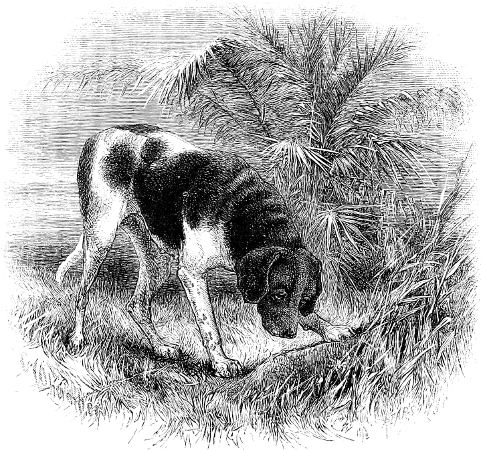
“Nor yet quite deserted, though lonely extended, For faithful in death, his mute favourite attended.”—Scott. See page 265.