IV. ENTOMOLOGY. By J. O. Westwood, M.A., F.L.S., Etc. Hope Professor of Zoology in the University of Oxford. (Plates E-H.)
Reading edition
The Collection of Insects formed by Mr. F. Oates, now in the Entomological Museum of the University of Oxford, although not of considerable extent, fortunately comprises examples of many of the very peculiar groups and genera characteristic of the greater part of the African continent.
The geographical distribution of animals has, during the last few years, attracted so much attention among naturalists, that a few preliminary observations on the subject will not be considered out of place.
M. Lacordaire, in the chapter on the geographical distribution of insects, in his “Introduction à l’Entomologie,” divided the African continent into numerous regions, as follows:—1. Upper Egypt, Nubia, and Abyssinia; 2. The country south of the Atlas Range, as far as the Great Desert, and including Morocco; 3. Senegambia; 4. The coast of Guinea; 5. Congo; 6. The Cape of Good Hope; 7. Madagascar; 8. The islands of Mauritius and Bourbon.
In the still more recent works of Mr. Wallace on the geographical distribution of animals, we find that (with the exception of the whole of North Africa—including the northern half of Egypt and of Arabia—which are united with the Mediterranean sub-region and regarded as a portion of the primary Polar Arctic region) the remainder of Africa, south of the tropic of Cancer, is constituted into a primary region, to which the name of “Ethiopian” has been applied, and in which the zoological productions are of a remarkably homogeneous character. Of this Ethiopian region the portion which extends on the western side of the continent, between the rivers Gambia and Congo, and consequently embracing Guinea and the Gold Coast, and reaching as far as 25° East long., is of a distinct character, being occupied by dense forests. To this sub-region the name of “West African” has been applied. Another sub-region, the “South African,” is formed of that part of the continent south of the tropic of Capricorn, but extending northwards along the east coast as far as Mozambique.
The remainder of Africa, from the tropic of Cancer to the river Gambia on the west coast, and including Senegambia, Timbuctoo, South Egypt, Abyssinia, the eastern half of Africa (including the great lakes, and Zanzibar), and reaching from Mozambique on the east to Angola, Benguela, and Damara Land on the west coast, is considered as forming a third sub-region, to which the inappropriate name of “East Africa” has been applied. It is in the south-eastern portion of this third sub-region that the collection of insects formed by Mr. F. Oates was obtained.
The surface of all this sub-region is described by Mr. A. R. Wallace as “generally open, covered with a vegetation of high grasses or thorny shrubs, with scattered trees and isolated patches of forest in favourable situations. The only parts where continuous forests occur are on the eastern and western slopes of the great Abyssinian plateau, and on the Mozambique coast from Zanzibar to Sofala. The whole of this great district has one general zoological character. Many species range from Senegal to Abyssinia; others from Abyssinia to the Zambesi; and a few, as Mungos fasciatus and Phacochærus æthiopicus (to which great numbers of species of insects may be added), range over the entire sub-region.” Various species of quadrupeds and birds are mentioned, which are found in Gambia, Abyssinia, and South-east Africa, but not in the West African sub-region; and yet Mr. Wallace adds, “Although this sub-region is so extensive and so generally uniform in physical features, it is by far the least peculiar part of Africa. It possesses, of course, all those wide-spread Ethiopian types which inhabit every part of the region; but it has hardly any special features of its own. The few genera which are peculiar to it have generally a limited range, and for the most part belong either to the isolated mountain-plateau of Abyssinia, which is almost as much Polar-Arctic as Ethiopian, or to the woody districts of Mozambique, where the fauna has more of a West or South African character.” Surely these circumstances, if correctly stated, together with the fact connected with the existence of the Great Sahara desert, extending many hundred miles wide across Africa, lead to the conclusion that the division of Africa south of the tropic of Cancer into three principal areas is unnatural, and that, with the exception of the necessary consequence of greater life-action within the tropics, there is so much uniformity in the animal productions of Africa as to render it (with our present knowledge at least) undesirable to cut up the continent into these sub-regions.
Order LEPIDOPTERA.
The Lepidopterous insects (butterflies and moths) especially attracted much of the attention of Mr. Oates; and of the day-flying species (Rhopalocera) he collected seventy-three different kinds, of which nineteen appear to be previously undescribed. As they form the most important part of his collection, I have given a complete catalogue of them in the following pages. These insects abound in certain districts, and in Mr. Trimen’s work on South African butterflies, as many as 226 different species are recorded.
Species of the families Danaidæ, Satyridæ, Acræidæ, Nymphalidæ, Lycænidæ, Pieridæ, Papilionidæ, and Hesperiidæ occur in each of the three divisions into which Mr. Wallace has divided the continent south of the Great Desert; but of the families Elymniidæ, Libytheidæ, and Nemeobiidæ no species have been found in the South African sub-region, which, however, possesses seven genera peculiar to itself,—two belonging to the Satyridæ, one to the Acræidæ, three to the Lycænidæ, and one to the Hesperiidæ. The beautiful species of Zeritis are also peculiar to this sub-region; one additional species only inhabiting West Africa.
Of the Danaidæ (including the greater part of the Heliconian butterflies), species occur in each of the four Ethiopian sub-regions. Of the Satyridæ, which also occur in all the four sub-regions, Gnophodes, Leptoneura, and a few other small genera are exclusively African. Of the Elymniidæ, which are peculiar to the Malayan and Moluccan districts, one species also occurs in Ashanti. The Morphidæ, Brassolidæ, and typical Heliconiidæ do not occur in Africa; the Acræidæ, on the contrary, have their metropolis in this continent, which produces more than two-thirds of all the known species. Of the Nymphalidæ, which is the largest and most universally distributed family of butterflies, species occur in all the sub-regions of Africa. There are fourteen genera of these butterflies exclusively African, including Lachnoptera, Amphidema, Catuna, Euryphene, Romaleosoma, Aterica, and Harma. Libythea (constituting the family Libytheidæ) is widely distributed, and occurs in Western Africa and Madagascar, but not in Central, Eastern, and Southern Africa. Such is also the case with the family Nemeobiidæ. No representative of the family Erycinidæ (proper) occurs in the old world or Australia. The Lycænidæ, on the other hand, are found in all the sub-regions of the globe, the genera Pentila, Liptena, D’Urbania, Axiocerces, Capys, Phytala, Epitola, Hewitsonia, and Deloneura, being peculiar to Africa. Of the family Pieridæ, Teracolus and Pseudopontia are the only genera exclusively African; but the species of other genera are very numerous, especially in the group of white butterflies with orange tips to their fore wings. The family Papilionidæ are very widely distributed over all the warmer regions of the globe; and although no peculiar genus belonging to the family is found in Africa, there are several very interesting groups of species, such as Pap. Nireus and its allies, with black wings spotted or banded with green. The Merope group, with its cream-coloured males, spotted with black and furnished with tails, is remarkable for having tailless females in South Africa, so much unlike their partners as to have been described as several distinct species; whereas in Madagascar the females of this group can scarcely be distinguished either in form or colours from the males. Lastly, of the Hesperiidæ, distributed all over the globe, thirteen of the genera contain species which are natives of Africa, three of them being peculiar to that region—namely Abantis, from Mozambique, Ceratrichia, Butler, from Western Africa, and Caprona, Wallengren, from Southern Africa.
LEPIDOPTERA RHOPALOCERA.
Family Papilionidæ.
Genus Papilio, Auct.
1. (1) Papilio Demoleus, Linnæus.
Papilio Demodocus, Esper.
Ranges from Western Tropical Africa to the Cape of Good Hope.
Genus Callidryas, Boisduval; E. Doubleday, Gen. D. Lep. p. 66.
Catopsilia, W. F. Kirby, Syn. Cat. p. 481.[76]
2. (1) Callidryas Swainsonii, Westw.
Colias Pyrene, Swainson, Zool. Ill. vol. i. pl. 51. (Not of Linnæus, which is an Indian species, belonging to the genus Thestias, Boisduval.)
Callidryas Pyrene, Butler, Lep. Exot. pl. 16, f. 8–10.
Callidryas Florella, Boisduval; Trimen, Rhopal. Afr. Austr. p. 68; but not of Fabricius nor Donovan, Nat. Repos. III. pl. 90.
Many individuals of this species were taken at the Motloutsi River, varying in having the black spot of the disc of the fore wings, and the orange spots on the under side of the hind wings. A specimen from Guinea, received by Mr. Hope from Mr. Westermann of Copenhagen as the Florella, Fabr., is identical with the South African specimens of Swainson’s species. The type specimen described by Fabricius, drawn by Jones (Icones, v. 2, Dan. Cand. pl. 5, f. 3, 4), copied by Donovan, is from Sierra Leone, and was, and still is, in the Banksian Collection. C. Swainsonii is very widely dispersed.
3. (2) Callidryas Rhadia, Boisduval; Trimen, p. 69.
Callidryas Castalia, E. Doubleday, Gen. D. Lep. p. 68 (not of Fabricius).
Two specimens captured at Tati. The Rev. H. Rowley sent it from the Zambesi to the Oxford Museum.
Genus Teracolus, Swainson.
4. (1) Teracolus subfasciatus, Swainson, Zool. Ill. 2 ser. Ins. pl. 115[77]; Boisduval; Trimen.
Ptychopteryx Bohemanni, Wallengren, Lep. Caffr. p. 18.
Originally described from the Burchell Collection now at Oxford. Six specimens from Tati. The species appears to be very rare, as Mr. Trimen had not seen an individual. The female has the extremity of the fore wings brilliant orange-red, instead of pale orange-yellow, as figured by Swainson.
5. (2) Teracolus Agoye, Wallengren, Lep. Caffr. p. 15; Trimen, p. 325.
Anthocharis Eosphorus, Trimen, Trans. Ent. Soc. 1863, p. 523.
One specimen. Locality not noted.
Genus Pieris, Auct.
6. (1) Pieris Mesentina, Cramer, pl. 270, f. A, B; Godart; Boisduval; Trimen, p. 35.
Papilio Aurota, Fabricius, Ent. Syst. III. i. 197.
Many specimens taken at Bamangwato, the Motloutsi River, Tati, Gubuleweyo, Inyati (November 30, 1873), the Gwailo River, and at or near the Victoria Falls.
7. (2) Pieris Severina, Cramer, pl. 338, f. G, H; Godart; Boisduval; Trimen, p. 32.
Two specimens, of unrecorded locality.
Genus Idmais, Boisduval.
8. (1) Idmais Eris, Klug, Symbol. Phys. t. 6, f. 15, 16; Boisduval; Reiche in Ferret and Galinier, Voy. Abyss. pl. 31, f. 1–3; Trimen, p. 59.
Var. Idmais Fatma, Felder, Reise Novara, pl. 25, f. 3.
Tati; and the Ramaqueban River, July 29, 1874.
9. (2) Idmais Vesta? Reiche in Ferret and Galinier’s Voy. Abyss. pl. 31, f. 7, 8. (Not of Trimen, p. 62, which = Idmais Chrysonome, E. Doubleday, Gen. D. Lep. pl. 7, fig. 5; nor of Klug nor Boisduval = Idmais Hewitsoni, Kirby, Syn. Cat. p. 498.)
The specimens collected by Mr. Oates have the base of all the wings on the upper side broadly white, the remainder ochreous buff, with a large dark brown spot at the extremity of the discoidal cell of the fore wings, a dark brown, very irregular bisinuated fascia running across the fore wings beyond the middle, and extending across the middle of the hind wings, nearly reaching the anal angle; the outer margin of the fore wings is dark brown, with two rows of ochreous buff spots, the outer ones small; the outer margin of the hind wings is brown, inwardly dentated, with a marginal row of ochre spots. Beneath, the fore wings are bright orange-yellow at the base, yellow in the middle, with the apex and the entire hind wings brownish ochre, the markings of the fore wings ill defined, and with three obscure bands across the hind wings. In the female the ground colour of the upper surface of the wings is uniformly pale yellowish buff. The fascia across the hind wings separates this species from Chrysonome Dbd., Vesta of Trimen. M. Reiche’s figure apparently represents a larger and more suffused insect, the under side especially being more variegated, and the ground colour of the hind wings bright yellow.
Genus Tachyris, Wallengren.
10. (1) Tachyris Agathina, Cramer, pl. 237, f. D, E; Godart; Boisduval; Trimen, p. 28; Hopffer in Peters’s Reise Mossamb. t. 21, f. 11, 12.
Pieris Thysa, Hopffer in Peters’s Reise Mossamb. t. 21, f. 7–10.
Near the Victoria Falls, in January.
Genus Callosune, E. Doubleday, Gen. D. Lep. p. 57.
11. (1) Callosune Eupompe, Klug, Symb. Phys. t. 6, f. 11–14; Boisduval; Trimen, p. 45.
Papilio Evippe, Cramer, pl. 91, f. D, E. (nec Linn.).
Pontia Acaste, Klug, Symb. Phys. pl. 7, f. 16, 17.
Pieris Polycaste, Boisduval.
Anthopsyche Theopompe, Felder, Reise Novara, ii. p. 183. no. 175.
Motloutsi River, August 1873.
12. (2) Callosune Danaë, Fabricius; Donovan, Ins. India, t. 26, f. 2; Boisduval; E. Doubleday, Gen. D. Lep. pl. 7, f. 2; Trimen, p. 44.
Papilio Eborea, Cramer, pl. 352, f. C-F.
This handsome species inhabits Natal, Damara Land, Ceylon, Bengal, Madras. Male, Inyati (November 30, 1873); females, near the Gwailo River (October 19, 1873), and Impakwe River (February 12, 1874).
13. (3) Callosune Evippe, Linnæus; Clerck, Icones, pl. 40, f. 5; Cramer, pl. 91, f. F, G; Godart; Boisduval; Lucas, Exot. Lep. pl. 37, f. 1.
Tati; and between Inyati and Gubuleweyo, December 1, 1873.
14. (4) Callosune Omphale, Godart; Boisduval; Trimen, p. 50.
Near the Victoria Falls, in January.
15. (5) Callosune Antigone, Boisduval, Sp. Gén. p. 572; Trimen, p. 52.
Both sexes, Ramaqueban River, February 14, 1874; also females at the Gwailo River in October. These females have no orange on the upper side of the fore wings.
16. (6) Callosune Casta, Gerstaecker in Decken’s Reisen in Ost-Afrika, pl. 15, f. 1, 1 a.
Taken at Tati.
17. (7) Callosune Keiskamma, Trimen, p. 56, pl. 2, f. 3, 4.
Var. Anthopsyche Topha, Wallengren, Wien. ent. Mon. iv. p. 34.
Ramaqueban River, July 28, 1874. Kirby cites Klug’s Pontia Evarne, Symb. Phys. t. 6, f. 1–4, as identical with this species, but the rounded fore wings of the male, with the black exterior margin, and the submarginal row of black spots on the hind wings, at once separate these two insects. See the observations of Mr. Weale on this subject (Trans. Ent. Soc. 1877, p. 273).
18. (8) Callosune inornata, Westw.
Alis supra albis, basi nigro parum pulverosis, anticis macula trigona distincta apicali aurantia: alis anticis infra albis apice albido-lutescenti, intus magis brunnea; alis posticis lutescenti-albidis, linea recta longitudinali media paullo obscuriori. Expans. alar. antic. lin. 19.
The locality of this very simply coloured species is not recorded.
19. (9) Callosune Ione, Godart; Boisduval; Lucas, Exot. Lep. t. 37, f. 4; Reiche in Ferr. and Gal. Voy. Abyss. t. 30, f. 1–8; Hopffer in Peters’s Reise Mossamb. t. 21, f. 1–6; Trimen, p. 43.
Anthopsyche speciosa, Wallengren, p. 16.
Anthocharis Erone, Angas, Kafirs Ill. pl. 30, f. 3.
Two males, taken at Tati.
The species of this genus, in which the males have the extremity of the fore wings marked with a brilliant blue or pale purple patch, are so closely allied together as to suggest the possibility of their being geographical sub-species; they appear indeed to be constant in their characteristic markings, and the females are even more distinct than the males, which they are generally so unlike that their sexual relations might readily be suspected.
In the male specimens of C. Ione, captured by Mr. Oates at Tati, the fore wings have the faintest trace of a very minute black discoidal dot, a brilliant silky purple subapical patch, the apex itself black, and the inner edge margined with black, which is slightly scalloped. The hind wings are pure white, with delicate black veins, without any discoidal spot. On the under side the fore wings have the minute discoidal dot, and the apical patch is replaced by pale greyish buff, with a slightly defined darker inner margin; the veins of the hind wings are not black, the basal half of the costa is orange, with a short brownish transverse dash, near the middle of the costa, extending only to the first branch of the subcostal vein; the remainder of the wing white. One of the specimens taken by Mr. Oates at Tati is very small (1⅔ inch in the expanse of the fore wings), with the black veins excessively slender.
20. (10) Callosune regina, Trimen, Trans. Ent. Soc. 1863, p. 520. (Plate E, figs. 9, 10.)
The males have the veins of the fore wings, beyond the middle, very slender and black, and with a very minute discoidal dot. The female of this species, here for the first time represented (Pl. E, figs. 9, 10), has the wings on the upper side white, with the veins concolorous; a large black round spot at the extremity of the discoidal cell, and a large purple-red subapical spot, down the middle of which is a richer shade of purple, edged internally with blackish brown, the apex and apical margin being of the latter colour; the base of the wings is slightly powdered with grayish scales, and there are two minute dusky dots towards the inner angle of the fore wings. On the under side the purple patch of the fore wings is replaced by dirty pale buff, having an oblique row of five pale black spots, and the hind wings are slightly fleshy buff coloured, finely freckled all over with pale brown irrorations, with a discoidal spot, and a curved row of oblong spots beyond the middle of the wing, of pale brown; the costal margin is slightly fulvous at its base. The expansion of the fore wings is 2⁵⁄₁₂ inches. Taken at Tati.
A male, in the Hopeian collection, from the Zambesi, has the hind wings marked along the outer margin with black dots at the extremity of the longitudinal veins.
21. (11) Callosune Theogone, Boisduval; Trimen, p. 51.
One specimen. Locality not recorded.
22. (12) Callosune Buxtoni. (Plate E, figs. 7, 8.)
Callosune Buxtoni, Butler, MS. in British Museum.
The female (or rather the reputed female) of this species here figured differs from the male in having a large orange patch at the extremity of the fore wings, which are white with a slight yellowish tinge; a minute discoidal black dot and a curved row of brown spots within the orange mark, those towards the costa being most indistinct; the inner margin of the orange mark is also brownish, as is the apex itself and the apical margin, the brownish margin terminating near the hinder angle in a brownish spot; the hind wings are uniformly white, with the extremity of the veins towards the outer angle more or less dusky. On the under side the orange spot of the fore wings wants both the inner and apical dark edging, and bears a curved row of brown spots; the hind wings are very pale fleshy buff, and very delicately freckled, with a bar of darker brown extending from the middle of the costa to the median vein, where it is curved backwards; there is also a brown dot on a small whitish spot near the extremity of the discoidal cell. The female varies from 1¾ to 2¼ inches in the expansion of the fore wings. Taken at Tati.
23. (13) Callosune Evenina, Wallengren, Lep. Caffr. p. 12; Trimen, p. 322, and in Trans. Ent. Soc. 1870, t. 6, f. 11.
One specimen (locality not noted), with the black markings on the upper surface of the wings much less diffused than in the figure given by Mr. Trimen; possibly a male. Another specimen in Burchell’s African collection, in the Hopeian Museum, has the large dark spot on the fore wings extending over the discoidal cell, but the hind wings are almost unspotted.
24. (14) Callosune Eione, Boisduval, p. 578.
One broken specimen, without locality, is very closely allied to the insects noticed above, as C. Antigone.
25. (15) Callosune pseudetrida, Westw.
Alis supra pallide flavescentibus, apice fusco cum serie subapicali macularum 6 aurantiacarum, puncto minuto nigro discoidali, nubilaque parva fusca ante angulum posticum; alis posticis serie marginali macularum conoidearum fuscis (versus angulum analem interdum obsoletis) nubila parva pone medium costæ, fasciaque valde abbreviata pone medium disci versus angulum externum, pallide fuscis: alis anticis infra pallide flavescentibus, apice alisque posticis luteo-albidis; anticis striga obsoleta et obliqua fuscescenti versus apicem, posticis punctis duobus fuscescentibus pone medium disci versus angulum externum. Expans. alar. antic. unc. 1, lin 5.
Affinis C. Deuræ, Klug, et præsertim C. Etridæ (Indiæ orientalis incolæ).
Habitat prope Tati.
Obs. The orange subapical spots in the male are dilated into a broader yellow fascia in the female.
26. (16) Callosune Wallengrenii. (Plate E, figs. 3, 4.)
Callosune Wallengrenii, Butler, MS. in British Museum.
Alis supra albis; anticarum apice late aurantiaco; puncto discoidali, striga angulata guttarum fuscarum pone medium apiceque fusco, intus ad venas angulatim producto; alis posticis pone medium fascia abbreviata e maculis fuscis formata, margineque postico fusco-maculato. Expans. alar. antic. unc. 1⁵⁄₁₂.
Habitat ad ripas Touani fluv.; mense Augusto capta.
The wings on the upper side are white, with a slight yellow tinge, the apical half being of a fine orange-red colour; the base is suffused with brown scales; a round black dot is placed at the extremity of the discoidal cell, in front of which the costa is dusky; half way between the cell and the apex is an oblique row of four brown spots, succeeded by a larger one, extending more towards the base of the wing, which is followed by a double spot towards the middle of the hind margin; the apical margin is brown, which colour extends upwards along the veins, forming a row of brown teeth, the largest of which is at the end of the first branch of the median vein; the hind wings are powdered with brown scales at the base; beyond the middle of the wing is a curved row of brown spots, extending from the costa to the middle, and with a row of brown spots along the outer margin. On the under side the fore wings are suffused with orange, preceding the row of subapical spots, the apical portion being buff, which is also the colour of the hind wings, which have a white spot in the centre surrounded by a brown ring, and followed by a curved row of pale brown spots, rather more dilated and somewhat ocellated in the middle of the row; the apical margin of all the wings is destitute of the brown markings of the upper side.
27. (17) Callosune ramaquebana, Westw. (Plate E, figs. 5, 6.)
Parvus alis supra albis, albo-ciliatis anticis plaga maxima fusca marginis postici, puncto nigro discoidali, apiceque late fusco, serie macularum fulvarum inclusa; alis posticis basi fuscis, margine postico late fusco, serie macularum albarum plus minusve confluentium, præsertim versus angulum analem, inclusa: alis subtus flavido-tinctis, posticis puncto minuto discoidali nigro, flavo supra tincto. Fœm. supra absque colore fulvo. Expans. alar. antic. unc. 1⅓.
Habitat prope Ramaqueban fluv.; mense Februario capta.
This pretty little species appears to be undescribed. It is nearly allied to C. Etrida and Eione, but differs in its characteristic markings. On the upper side the wings of the male are white, with a very slight yellowish tinge; the anterior have a large brown patch occupying the greater portion of the posterior margin, and extending over the greater part of the discoidal cell, at the extremity of which is a small round black spot; the extremity of the wing is very broadly brown, the dark colour commencing on the costal margin in front of the discoidal spot, and extending nearly to the posterior angle of the wing, where it is much narrowed, especially in the spaces between the anal vein and the first and second branches of the median vein, extending considerably more forward between the second and third branches of the latter, so as nearly to unite with the truncated extremity of the large brown patch; the brown apex of the wing bears a row of five fulvous oval spots, the hind one of which is ill defined and less strongly coloured: the hind wings are brown at the base, and beyond the middle they are marked with a curved irregular brown bar, which is partially connected with the brown spotted hind margin of the wing, having a row of white spots between them, which become larger and more or less confluent, especially towards the anal angle. On the under side the fore wings are tinged with yellow, especially towards the tips, the large brown markings of the upper side being nearly obsolete: the hind wings are also yellowish, with a faint dusky fascia beyond the middle, with a black discoidal spot surmounted with yellow scales; the costa at the base is bright yellow, and the fringe of all the wings is white. The female is slightly larger, with the brown markings more suffused, the orange spots of the fore wings obsolete, and replaced by brown, and the white submarginal spots of the hind wings almost obliterated and replaced with brown.
Genus Terias, Swainson.
Eurema, Kirby, Syn. Cat. (haud recte).
28. (1) Terias Rahel, Fabricius; Godart; Boisduval; Trimen, p. 76.
Ramaqueban River, February; near the Victoria Falls in January; and near the Dry River, beginning of March.
29. (2) Terias Zoë, Hopffer in Peters’s Reise Mossamb. pl. 23, f. 10; female.
Mas. Alis supra minus saturate atomosis, posticis limbo nigro omnino carentibus et unicoloribus.
Near the Ramaqueban River, in February.
30. (3) Terias Seruli, Westw.
Alis supra pallide flavis, anticis apice macula trigona fusca intus parum curvata integra, ante angulum posticum desinente; angulo extremo apicali pallescenti; alis posticis immaculatis: alis anticis subtus flavis, costa, apice, alisque posticis carneo-lutescentibus, omnibus immaculatis. Expans. alar. antic. fere 1½ unc.
Habitat ad ripas Seruli fluv.; mense Augusto capta.
Family Acræidæ.
Genus Acræa, Fabricius.
31. (1) Acræa Atergatis, Westw. (Plate F, figs. 1, 2.)
Alis supra rufo-aurantiis, nigro-maculatis, anticis apice nigro et sub apicem nigro-lineatis margine apicali omnium nigro. Expansio alar. antic. unc. 2¹⁄₁₂.
Habitat prope “Victoria Falls;” mense Januario capta.
The upper side of the wings is of a rich orange-red colour, the base of all the wings slightly powdered with black atoms; a black spot is placed in the middle of the cell of the fore wings, followed by a smaller transverse one at the extremity of the cell; at a little distance beyond the cell is a short black, rather oblique fascia, formed of five more or less confluent spots, the innermost being incurved and placed between the 2d and 3d branches of the median vein; this last spot is succeeded by two other spots, the three being parallel with the apical margin of the wing; there is also a minute round dot towards the base of the wing behind the basal part of the median vein, and two small dots near the inner angle; the veins are black in the apical part of the wing, with the interstices between the veins marked with thin black lines, the margin itself as well as the apex of the wing being also black; the hind wings are marked with twelve round black spots; the six outer ones arranged in a very waved line; the margin is also black. On the under side the fore wings are of a more rosy tint, except towards the apex, where they are more orange; the spots of the upper side are here reproduced: the hind wings on this side are more variegated; the black spots are more numerous, being about 18 in number, several close to the base of the wing being visible, which are not seen on the upper side; the spots are placed on pale greyish buff spaces, which gives them an ocellated appearance; and the outer margin of the wing is pale greyish buff with a very thin black marginal line, preceded by very thin black lunules, the veins rather thickened and black along the margin, the spaces between the veins being rosy red in the part of the wing between the terminal row of spots and the lunules. Antennæ black; palpi fulvous, with the last joint black; body black, spotted with white and rose-colour; legs fulvous, tarsi black; abdomen, above black with thin yellowish edges to the segments, each of which has two fulvous spots, beneath fulvous with two rows of black specks.
Another specimen, which I cannot distinguish specifically from the preceding, was also taken at the Victoria Falls in January 1875, and has the upper surface of the wings rather brighter orange-red, with two minute additional black dots within the discoidal cell, at about half its length from the base, and with the abdomen orange-fulvous, the three basal segments on the upper side being alone black, varied with orange. The apical margin of the fore wings in this specimen is not so rounded as in the other with the spotted abdomen, which is evidently a female, the probability being that the male has the wings rather less rounded and the abdomen not spotted.
32. (2) Acræa Atolmis, Westw. (Plate F, figs. 3, 4.)
Alis supra aurantiacis basi nigricantibus, maculis nigris minutis notatis, anticarum apice venis nigris margineque tenuissimo nigro maculaque postica prope angulum posticum posita. Expans. alar. antic. unc. 1¹¹⁄₁₂.
Habitat prope “Victoria Falls;” mense Januario capta.
This species is smaller than the preceding, with the various black markings very small, the interspaces of the apical portion of the fore wings not striolated with black, and the posterior spot of the fore wings placed just between the preceding spot and the hind angle of the wing. The upper surface of the wings is uniformly orange, with the basal half rather redder, the base itself being suffused with black scales; within the discoidal cell is a small kidney-shaped black spot, followed by a narrow oblique one at the extremity of the cell; behind this (between the 1st and 2d branches of the median vein) is another spot, and between the latter and the posterior angle of the wing is a third, the three forming nearly a straight row; beyond the discoidal cell is a short oblique row of small black dots, between which and the apical margin of the wing the veins are black: the hind wings have a small black dot within the discoidal cell, and a curved row of six small black dots across the wing close to the extremity of the cell; the hind margin is very slenderly black, and the veins also have their apical portions black. The wings beneath are of an uniform rosy buff-colour, with the black spots more numerous and distinct than above, the hind wings having about 18 small but distinct ones, those at the base and near the anal margin not visible above; the apical margin of all the wings is very slenderly black, the hind wings having no trace of the lunular markings of the preceding and following species. Body black, sides of thorax with yellowish buff spots; abdomen buff, with the basal segments dusky above.
Note.—In the engraving the apical margin of the fore wings is represented rather too much rounded.
33. (3) Acræa Axina, Westw. (Plate F, figs. 5, 6.)
Alis supra luteo-fulvis, nigro-maculatis, posticis magis aurantiacis; anticarum apice, lineolisque abbreviatis apicalibus (inter venas) nigricantibus; alis posticis maculis minoribus, exterioribus lineam irregularem multo pone medium alæ formantibus, margine externo nigro. Expans. alar. antic. unc. 1⅚.
Habitat prope Tati et Gwailo fluv.; mense Octobre capta.
This small species has the upper side of the fore wings rather dirty luteo-fulvous, that of the hind wings being brighter coloured. The extremity of the fore wings and the narrow apical margin are black, and the interspaces between the veins near the apex of the wings are marked with slender abbreviated black lines, leaving a narrow paler space beyond the fascia; the five spots between the base and the middle of the wings are strongly marked, and the abbreviated oblique black fascia beyond the cell is more continuous: the hind wings have the black spots also well marked, the outer ones forming an irregular row considerably beyond the middle of the wing, the central spot especially being not far from the black marginal border. On the under side the fore wings are slightly rosy, the apical portion being more buff with the spaces between the veins orange; the black spots on this side are not so strongly marked as above: the hind wings are more pale buff, with the spaces between the veins strongly marked with rose-colour, the black spots resting on pale spaces, giving them an ocellated appearance; the very narrow black outer margin of these wings is preceded by a series of small black arches, including a row of pale yellow spots. The palpi, head, and sides of the body are coloured as in the preceding species; the abdomen in one of our specimens is broken off, but in the other it is pale buff, with the upper side of the basal segments black, with two pale dots, indicating (as well as the shape of the fore wings) this individual (represented in our figures) to be of the male sex.
Note.—The orange and rosy tints described above are almost obliterated in one of the two specimens, most probably from longer exposure in the winged state.
34. (4) Acræa Acontias, Westw. (Plate F, figs. 7, 8.)
Alis supra obscure fusco-rufis, nigro-maculatis, maculis 4 in medio alarum anticarum, fascia abbreviata maculari, margine apicali late venisque apicalibus nigris; alis posticis basi maculisque submediis lineam irregularem formantibus, margineque postico cum venis nigris. Expans. alar. antic. unc. 1⅚.
Habitat prope “Victoria Falls;” mense Januario capta.
The dull brownish red colouring of the upper side of the wings distinguishes this species. The fore wings are marked near the base, behind the middle of the cell, with a small black dot, followed by four rather large spots of the same colour, placed so as to form an oblique triangle; beyond the cell is the ordinary abbreviated fascia, formed of four black spots, which is succeeded by a narrow paler buff space, the apex being traversed by black veins, the extremity of the anterior margin and the whole of the apical margin being also black: the hind wings have a suffused black spot near the base, the middle of the wing being crossed by zigzag rows of small but nearly uniform black spots; the outer margin is black, as are the veins beyond the middle of the wing. On the under side the fore wings are more rosy coloured from the base to the abbreviated fascia, beyond which they are paler buff, with orange stripes between the veins: the hind wings have the black dots smaller but more numerous than on the upper side, there being about 20 on each wing, the ground colour of which is buff, with the spaces between the veins in the basal portion rosy, but beyond the cell they are marked with longitudinal orange stripes between the veins; the outer margin is very narrowly black, preceded by a very narrow black line parallel with the margin. The body is black, much spotted at the sides below the wings with buff and rosy; the abdomen is orange, marked above with black fasciæ, forming more or less incomplete lateral circular spots; the ventral surface yellow, with two rows of black spots. The apical margin of the fore wings is but slightly convex, but the spotting of the abdomen indicates the specimen to be a female.
35. (5) Acræa Aglaonice, Westw. (Plate F, figs. 9, 10.)
Alis supra rufo-puniceis, anticis apicem versus magis aurantiacis, macula fenestrata bipartita subapicali notatis, nigro-maculatis, venis apicalibus nigris; posticis maculis minutis margineque latiori apicali nigris. Expans. alar. antic. unc. 2¹⁄₁₂.
Habitat prope Tati.
This species has the upper surface of the wings more richly coloured than any of the others captured by Mr. Oates, being of an orange-carmine colour, especially in the hind wings. The fore wings are marked half-way between the end of the discoidal cell and the tip of the wings with a square vitreous spot, through which runs a veinlet dividing it into two parts; the base of the wings, especially in the hind parts, is irrorated with black scales; the discoidal cell has a rather large oval black spot beyond its middle, followed by a smaller lunate one at the extremity of the cell; beyond which is an oblique row of five conjoined black dots; another round black spot is placed towards the base of the wing behind the median vein, and two other circular ones behind the extremity of the cell placed transversely; the veins at the extremity of the wings are slenderly black: the hind wings are marked with about 10 minute black dots (varying, however, in size), and the hind margin of the wing is rather broadly edged with black. On the under side the fore wings are rosy coloured, with the spots of the upper side, including the vitreous spot, reproduced: the hind wings are greyish buff, with the spaces between the veins varied with rosy at the base and along the anal margin, and with rich orange between the middle of the wing and the row of submarginal black lunules, which latter rest upon a narrow yellowish buff margin; the spots on this side, about 17 in number, are distinct, appearing partially ocellated. Body black, with rosy spots behind the eyes and on the sides of the chest, which is also spotted with pale buff; palpi orange, terminal joint black; legs orange, tarsi black; abdomen broken off.
The unique specimen of this species collected by Mr. Oates has the abdomen mutilated, but the structure of the fore legs and the shape of the fore wings prove that it is a male individual.
36. (6) Acræa Acronycta, Westw. (Plate F, figs. 11, 12.)
Alis supra luteo-aurantiacis; anticis triente basali fusco; macula ad apicem cellulæ, pone medium alæ fascia abbreviata maculari, maculisque duabus posticis (margine postico parallelis) nigris; alis posticis magis albidis, ante medium nigro-maculatis, margineque postico latiori nigro: subtus maculis magis distinctis margineque albido-maculato. Expans. alar. antic. unc. 1¾.
Habitat ——?
The upper surface of the wings (especially the hind pair) of this species is whitish orange, the base being strongly suffused with dark brown scales hiding the spots in that part; one of these, near the extremity of the discoidal cell, is visible, and the cell itself is closed by a semicircular spot, followed at a short distance by an oblique abbreviated black fascia formed of conjoined spots, of which the hinder one is smallest and most distinct; two other spots appear on the disc of the wing behind the extremity of the cell, and are placed nearly parallel with the apical margin, which is very narrowly black and slightly concave: the hind wings have a somewhat more suffused whitish hue than the anterior; they are brown at the base, and are marked before the middle with an irregular series of black dots, followed by two minute ones beyond the middle; the posterior margin is widely black. On the under side the fore wings have five black spots in the middle, followed by the abbreviated macular fascia: the hind wings are more tinged with rose-colour than the anterior ones, and are marked with about twelve black dots of different sizes; the posterior margin is pale yellowish white, surmounted by a row of black arches, resting upon a very narrow black edging. The head and body are black, spotted with pale buff, the sides of the thorax beneath the wings with a reddish spot; the abdomen is nearly white, the basal segments on the upper side black, with a pair of round white dots.
37. (7) Acræa amphimalla, Westw. (Plate E, figs. 1, 2.)
Alis supra fulvo vel puniceo luteis nigro-guttatis, anticarum apice late nigro triangulariter terminata, posticarum margine apicali e lunulis nigris, maculis concoloribus inclusis, notato. Expans. alar. antic. unc. 1¾–2¹⁄₁₂.
(An Acræa Caldarene alicujus?)
Habitat prope Tati, et marg. fluv. Motloutsi; mense Maio capta.
This very distinct species has the wings on the upper side of a buff colour, varying from dull orange to reddish; the black spots are of small size, and the fore wings have the apex broadly and triangularly black, whilst the hind wings have the slender apical outer black margin preceded by a series of slender depressed black arches enclosing spots of the ground colour of the wing; the ordinary black spot in the middle of the discoidal cell is sometimes preceded by a smaller, more or less slightly marked, dot, behind which is another small one; the cell is partially closed by a small oblique black spot, followed at some distance by a row of four small spots placed obliquely, and there are two other small spots between the middle of the wing and the posterior angle, the outer one being occasionally duplicated; in the hind wings the black spots, about twelve in number, are of nearly uniform small size. On the under side the black apex of the upper side is replaced by the ground colour of the rest of the wing, the spaces between the veins being more strongly marked with orange stripes: the hind wings are buff-coloured, with the spaces between the veins in the basal portion marked with red, having the black dots (about twenty in number) surrounded with buff, whilst in the apical half of the wing the intervening spaces are more orange; the black arcade preceding the slender outer black edging is marked more distinctly than on the upper side. The head and body are spotted as in the preceding species.
38. (8) Acræa natalica, Boisduval in Delegorgue’s Voy. Afr. Austr. ii. p. 590; Hopffer in Peters’s Reise Mossamb. pl. 23, figs. 12, 13.
Acræa Bellua, Wallengren, Lep. Caffr. p. 22.
Acræa Hypatia, var. B, Trimen, p. 98.
A series of small specimens, measuring only 2 inches in expanse of the fore wings, were taken at Tati. A large specimen (2¾ inches expanse) was taken near the Dry River in the beginning of March, and one (2½ inches expanse) was taken near the Motloutsi River in August.
39. (9) Acræa Anemosa, Hewitson, Ex. Butt. t. 3, Acr. 3, f. 14, 15.
Near the Umvungu River, end of October; and near the Victoria Falls in January.
40. (10) Acræa Neobule, E. Doubleday and Hewitson, Gen. D. Lep. pl. 19, f. 3; Reiche in Ferr. and Gal. Voy. Abyss. pl. 33, f. 3, 4.
An var. Acræa Mahela, Boisduval, Faune Madag. pl. 6, f. 1?
Ramaqueban River, February 14, 1874.
41. (11) Acræa Rahira, Boisduval, Faune Madag. pl. 5, f. 4, 5; Trimen, p. 103.
Taken on the Zambesi road, end of November.
42. (12) Acræa Dircæa, Westw.
Alis supra fulvis, puniceo interdum tinctis; anticarum apice late nigris maculisque 9 parvis nigris, 4 in lineam obliquam pone medium positis; alis posticis maculis circiter 14 parvis nigris discoidalibus, margine tenui nigro fulvo-maculato: alis subtus pallidioribus, apice anticarum lutescenti, fulvo-strigoso; maculis nigris parum majoribus præsertim in alis posticis, interstitiis rubro-maculatis. Expans. alar. antic. unc. 2.
Acr. Oncææ affinis sed apice lato nigro alarum anticarum optime distincta.
Numerous specimens taken at Tati and the Motloutsi River in May.
Family Nymphalidæ.
Genus Charaxes, Ochsenheimer.
43. (1) Charaxes Pelias, Cramer, pl. 3, f. C, D; Godart; Trimen, p. 175; Butler, Lep. Exot. pl. 10, f. 5.
Near the Seruli River, August 19, 1873; and near the Victoria Falls in January.
Genus Cynthia, Fabricius.
44. (1) Cynthia Cardui, Linnæus.
Taken at the Indunas’ Tree, near the Umvungu River, end of November.
Genus Junonia, Hübner.
45. (1) Junonia Clelia, Cramer, pl. 21, f. E, F; Trimen, p. 128.
Bamangwato, Ramaqueban River, Gubuleweyo, and near Tati.
46. (2) Junonia Œnone, Linnæus: Cramer, pl. 35, f. A, C; Trimen, p. 125.
Tati, Ramaqueban River, and about the Matengwe River.
47. (3) Junonia Orithya, Linnæus: Cramer, pl. 19, f. C, D, pl. 32, f. E, F, and pl. 290, f. A, B. Common in India, etc.
This species, not included in Trimen’s work, was taken near the Victoria Falls in the month of January. The Hopeian collection also has it from Sierra Leone.
48. (4) Junonia Octavia, Cramer, pl. 135, f. B, C; Trimen, p. 130.
Near the Victoria Falls in January.
49. (5) Junonia natalica, Felder, Wien. ent. Mon. iv. p. 106.
Junonia Hecate, Trimen, p. 140.
Near the Victoria Falls in January.
50. (6) Junonia Cloantha, Cramer, pl. 338, f. A, B; Trimen, p. 137.
Near the Dry River, middle of March.
Genus Diadema, Boisduval.
51. (1) Diadema Misippus, Linnæus.
Fœm. var. Papilio Inaria, Cramer, pl. 214, f. A, B.
Near the Victoria Falls; also from Sierra Leone, the Zambesi, and Mauritius, in the Hopeian collection.
Genus Aterica, Boisduval.
52. (1) Aterica Meleagris, Cramer, pl. 66, f. A, B; Drury, Ill. Exot. Ent. vol. iii. pl. 17, f. 3, 4; Trimen, p. 157.
Indunas’ Tree, near the Umvungu River, in November.
Genus Danais, Latreille.
53. (1) Danais Chrysippus, Linnæus; Cramer, pl. 118, f. B, C.
Indunas’ Tree, near the Umvungu River; and near Gubuleweyo in December.
Genus Hypanis, Boisduval.
54. (1) Hypanis Ilithyia, Drury, Ill. Exot. Ent. vol. ii. pl. 17, f. 1, 2; Cramer, pl. 214, f. C, D; Trimen, p. 214.
Tati, Ramaqueban River, Inkwesi River (March 1874), Dry River; and Indunas’ Tree, near the Umvungu River.
Family Satyridæ.
Genus Cyllo, Boisduval.
55. (1) Cyllo Leda, Linnæus et auct.
An extremely variable species. The specimen from the Nata River (beginning of December 1874) has an obscure fulvous subapical patch bearing two black spots in the fore wings; beneath, pale brown, with dark brown fasciæ, and scarcely any trace of ocelli on the hind wings. Specimens from Ashanti are pale brown beneath, strongly freckled all over with brown, and with large ocelli on the hind wings.
Genus Erebia, Dalman.
56. (1) Erebia Narycia, Wallengren, Lep. Caffr. p. 32; Trimen, p. 198.
Ramaqueban River, middle of March.
Genus Ypthima, Hübner.
57. (1) Ypthima Nareda, Kollar in Hügel’s Kaschmir, vol. iv. pl. 2, p. 451; Hewitson, Trans. Ent. Soc. 1865, pl. 17, f. 6, 7.
Near the Victoria Falls, in January.
Genus Mycalesis, Hübner.
58. (1) Mycalesis Victorina, Westw.
Sordide fusca, alis anticis pone medium nonnihil pallidioribus; ocellis duobus nigris ochreo anguste cinctis, singulo punctum album includente subapicali multo minori; posticis concoloribus lineis duabus tenuibus submarginalibus pallidioribus serieque ocellorum ut in anticis: alis subtus pallidioribus magis lutescentibus, fascia angusta recta communi pone medium, anticis 2-posticis 7-ocellatis, ocellis valde inæqualibus, in posticis lineis pallidis valde sinuatis inclusis. Expans. alar. antic. unc. 1¾.
Affinis M. Eusiro, Hopffer in Peters’s Reise Mossamb. pl. 25, f. 3–6.
Near the Victoria Falls.
Family Lycænidæ.
Genus Amblypodia, Horsfield.
59. (1) Amblypodia Natalensis, D. W. and H., Gen. D. Lep. pl. 75, f. 4; Hopffer in Peters’s Reise Mossamb. p. 399; Trimen, p. 227.
Spindasis Masilikazi, Wallengren, Lep. Caffr. p. 45.
Near the Victoria Falls, in January.
60. (2) Amblypodia? LEROMA, Wallengren, Lep. Caffr. p. 42; Trimen, p. 231.
Near Tati.
Genus Zeritis, Boisduval.
61. (1) Zeritis Perion, Cramer, pl. 379, f. B, C.; Trimen, p. 267; Hopffer in Peters’s Reise Mossamb. pl. 26, f. 1–3.
Gubuleweyo, beginning of December.
62. (2) Zeritis Amanga, Westw.
Fœm. Alis supra læte rufo-aurantiacis; anticis macula magna basali nigra, costa pone medium margineque apicali nigris; alis posticis, rufo-aurantiacis basi nigricantibus: alis subtus purpureo-rufis, anticarum costa ad basim guttisque duabus parvis prope basim tertia parum majori submedia, alteraque subapicali, argenteis; posticis guttis perpaucis argenteis vix notatis. Expans. alar. antic. unc. 1⅓.
Near the Gwailo River. The red basal half of the costa of the fore wings, the outwardly angulated apical margin, the shorter hind wings, with both the anal and outer margin emarginate near the tails, and the splendid silvery base of the costa of the fore wings beneath, separate this insect from Z. Perion.
Mas. (Zambesi, Rowley. In Mus. Hopeiano Oxoniæ). Alis anticis supra fuscis, costa ad basim maculaque late trigona versus angulum externum marginis postici rufis; alis posticis rufis, basi venisque versus angulum externum nigricantibus: alis infra castaneo-rufis, costa anticarum basi, guttisque tribus argenteis ut in fœmina, squamis perpaucis argenteis in lineas transversas dispositis; alis posticis strigis tribus undulatis gracilibus obscurioribus guttisque nonnullis argenteis prope caudam. Margo externus alarum anticarum in medio angulatus, inter medium et angulum posticum emarginatus.
Genus Polyommatus, Latreille.
63. (1) Polyommatus Telicanus, Hübner, Eur. Schm. Pap. f. 371–2, 553–4; Godart; Boisduval; Trimen, p. 238.
Tati, the Gwailo River, and near the Victoria Falls.
64. (2) Polyommatus Otacilia, Trimen, Trans. Ent. Soc. 1868, p. 90.
Near the Victoria Falls, in January.
65. (3) Polyommatus Sybaris, Hopffer in Peters’s Reise Mossamb. pl. 26, f. 6–8; Trimen, p. 242.
Near the Victoria Falls, in January.
Genus Lycæna, Fabricius.
66. (1) Lycæna Parsimon, Fabricius; Godart; Boisduval.
Papilio Celæus, Cramer, pl. 379, f. K, K; Trimen, p. 247.
Lycæna Asteris, Godart; Wallengren, Lep. Caffr. p. 40.
Var. Lycæna Methymna, Trimen, Trans. Ent. Soc. 1862, p. 280.
Male, Ramaqueban River, in February; female, Bamangwato, Tati.
67. (2) Lycæna Jesous, Guérin in Lefebvre’s Voy. Abyss. pl. 11, f. 3, 4; Wallengren, Lep. Caffr. p. 39; Trimen, p. 350.
Near the Gwailo River, October 12, 1873.
68. (3) Lycæna Asopus, Hopffer in Peters’s Reise Mossamb. pl. 26, f. 13–15; Trimen, p. 249.
69. (4) Lycæna Lochias? MSS.?
Alis supra fuscis purpureo parum squamosis, posticis maculis duabus inequalibus nigris pallidius cinctis, submarginalibus, ciliis albis: alis subtus pallide fuscis albidoque alternatim fasciatis; posticis macula nigra intus aurantiaco, extus argenteo, notata, alteraque simili sed multo minori ad angulum analem, cauda nulla. Expans. alar. antic. lin. 10.
Locality not indicated.
Genus Chrysophanus, Hübner.
70. (1) Chrysophanus Lara, Linnæus; Fabricius; Trimen, p. 260.
Papilio Jolaus, Cramer, pl. 270, fig. F, G.
Papilio Gorgias, Stoll, pl. 33, f. 5, 5d.
Family Hesperiidæ.
Genus Ismene, Swainson.
71. (1) Ismene Pisistratus, Fabricius; Jones, Icones, vol. vi. pl. 26, f. 1 (Typus in Mus. Britann.)
Note.—The black mark extending from near the anal margin on the under side of the hind wings, was more divided than usual in Drury’s specimen, figured by Jones, so as to have led Fabricius to describe the hind wings as four-spotted.
Rhopalocampta Valmaran, Wallengren, Lep. Caffr. p. 48.
Var. Fascia alba latitudine æquali absque maculis nigris.
Papilio Forestan, Cramer, pl. 391, f. E, F; Godart; Boisduval; Trimen, p. 318.
Holfontein, July 13, 1873.
Genus Leucochitonea, Wallengren.
72. (1) Leucochitonea Levubu, Wallengren, Lep. Caffr. p. 52; Trimen, p. 306.
Near the Dry River, beginning of March.
Genus Caprona, Wallengren.
73. (1) Caprona Pillaana, Wallengren, Lep. Caffr. p. 51; Trimen, p. 308.
Near Tati or Gwailo.
Genus Pamphila, Fabricius.
74. (1) Pamphila Ranoha, Westw.
Alis supra nigrofuscis, costa prope basim fulvo-irrorata, fascia fulva e basi marginis interni per medium alæ extensa, sensim dilatata et ante apicem alæ desinente, maculam ovalem inter cellulam et apicem nigram gerente, ciliis fulvis; alis posticis fascia lata irregulari pone medium fulva: alis subtus fulvis, anticis linea prope basim, macula discoidali ovata strigaque subapicali ad angulum analem sensim dilatata nigrofuscis; alis posticis fulvis nigro-guttatis, guttis novem in lineas duas margine postico parallelas dispositis. Expans. alar. antic. unc. 1⅙.
Near the Victoria Falls, in January.
75. (2) Pamphila Harona, Westw.
Magnitudo P. Lineæ, Linnæus. Alis supra fulvis, anticarum costa (ad basim valde angusta) margineque apicali nigris; macula basali marginis interni, striga recta in cellula discoidali et macula conica ad apicem cellulæ nigris; alis posticis fulvis costa late nigra, ultra medium ad angulum externum angusta: alis infra fulvis, posticis pallidioribus; anticis macula magna baseos costam non attingente, altera parva transversa ad apicem cellulæ, tertiaque parva conica marginis apicalis versus angulum internum; alis posticis immaculatis; striola longitudinali magis brunnea, margine anali parallela. Expans. alar. antic. unc. 1⅙.
Near the Victoria Falls, in January.
LEPIDOPTERA HETEROCERA.
Moths of various sizes and hawk-moths appear to be very numerous in Southern Africa. A large number of species of the former were collected by Mr. Oates, chiefly of small size, the majority of which, unfortunately, were ill preserved.
Family Sphingidæ.
The Sphingidæ are not especially remarkable. The death’s-head moth, Acherontia Atropos, occurs throughout South Africa, and was found between Gubuleweyo and the Gwailo River. Chœrocampa capensis, with its bright pink under wings, extends from the Cape to Natal and Zulu Land. A new species, closely allied to this last insect, was captured by Mr. Oates, which may be thus described:—
Chœrocampa virgo, Westw. (Plate E, fig. 11.)
Alba albido vix tincta, alis posticis plaga fere basali ovali punicea; omnibus subtus omnino concoloribus. Expans. alar. antic. fere unc. 3.
Habitat prope Gubuleweyo vel Gwailo fluv.
The Genus Nephele, Hübner (Zonilia, Boisduval), contains several South African species, e.g. Sphinx Peneus, Cramer; fumosa, Boisduval; comma, Gerstaecker; viridescens, Walker, and the beautiful argentifera, Walker. Several species of the silver-striped hawk-moths occur in South Africa, as Chœrocampa Charis, Boisduval; Schenkii, Moschler; Thyelia, Linn. (Eson, Cramer), etc. The lovely Smerinthus Dumolinii, Boisduval, is from Natal. The clear-winged Sesia Hylas, Linnæus, was captured at Gubuleweyo. And lastly, it may be mentioned that the Rev. H. Rowley sent the Macroglossa hirundo, Gerstaecker in Decken’s Reisen in Ost-Afrika, pl. 15, fig. 7, from the Zambesi.
It may also be mentioned as a remarkable circumstance in entomological geography that the grand Urania (Chrysiridia) Rhipheus, supposed until quite recently to be confined to Madagascar, and to be the only old world representative of the splendid new world Uraniæ, has been found on the east coast of Africa, near Zanzibar. Gerstaecker has figured the continental individual as a distinct species, but specimens which I have examined appear not to differ specifically from the Madagascar ones.
Family Zygænidæ.
In this family a beautiful species of Zygæna, closely allied to the very striking Z. ochroptera, Felder, was taken at Tati, which may be thus characterised:—
Zygæna tricolorata, Westw.
Chalybea, humeris alisque anticis aurantiacis, harum margine apicali nigro; alis posticis sanguineis limbo nigro ante angulum analem desinente. Expans. alar. antic. unc. 1, lin. 5.
Obs. Z. ochroptera, Felder, differt colore alarum limboque nigro multo angustiori.
Another species from Gubuleweyo is allied to Felder’s Euctenia Zygænoides (pl. 82, f. 21), but has the sanguineous portion of the hind wings divided by a transverse black band. On the under side the white spots at the base and middle of the fore wings are sanguineous.
The beautiful South African species, Z. caffra, Linn., ampla, Walker, concinna, Walker (Delagoa Bay), and especially Z. negamica, from Damara Land and Lake Nyassa, require careful examination as to their generic position. Several species of Procris and Syntomis were also taken by Mr. Oates.
Family Agaristidæ.
This family is represented in Mr. Oates’s collection by a beautiful undescribed species of Eusemia, allied to E. Euphemia, Cramer, pl. 345, fig. A, E. longipennis, Walker, Butler, Exot. Lep. Brit. Mus. pl. 5, fig. 5; E. pallida, Butler, l. c. fig. 3; and E. contigua, Butler, l. c. pl. 4, f. 8:—
Eusemia adulatrix, Westw. (Plate G, fig. 1, and Plate H, figs. 3, 3a, 3b.)
Alis anticis nigris, maculis duabus parvis subbasalibus, fascia obliqua integra submedia, alteraque magna late ovali inter medium et apicem, interstitiis argenteo-irroratis; striga minuta marginis interni pone medium punctoque rotundato intus angulum posticum flavo-albidis; alis posticis sanguineis, limbo nigro; abdomine luteo, nigro-annulato. Expans. alar. antic. unc. 2¼.
Habitat prope Tati et Gwailo fluv.
I take this opportunity of describing several other African allied species of this beautiful genus:—
Eusemia niveosparsa, Westw.
Corpore tenui, abdomine nigro, fulvo-annulato; alis anticis nigris maculis 7 parvis niveis,—1ma. parva in medio cellulæ; 2da. obliqua cellulam terminante; 3tia. ovali inter cellulam et apicem alæ; 4ta. elongata ante medium marginis interni; 5ta. pone maculam 2am; 6ta. bipartita inter 3am et 7am prope angulum posticum; alis posticis sanguineis, limbo nigro. Expans. alar. antic. unc. 3.
Habitat in Montibus Cameroons, Afr. occid. In Mus. Hopeiano.
Eusemia æmulatrix, Westw.
Mediocriter angusta, alis anticis angustis, nigris, albido-maculatis,—macula parva rotunda in medio cellulæ; 2da. majori ad apicem cellulæ; 3tia. fasciæformi in partes quinque venis nigris divisa, angusta et in medio extus angulata; 4ta. elongata e basi ad medium marginis interni extensa; 5ta. irregulari-ovata pone 2am.; 6ta. minuta intus angulum posticum; alis posticis sanguineis, limbo nigro; abdomine fulvo, ano nigro-barbato. Expans. alar. antic. unc. 2⅓.
Habitat ——? In Mus. Hopeiano.
Eusemia pardalina, Walker, Trans. N. Hist. Soc. Glasgow, vol. i. (1873).
The type of this species, from Congo, is in the Hopeian collection, together with a second individual brought from Angola by Monteiro. It differs from E. Euphemia in its smaller size, and in having the ground colour of the hind wings rich orange fulvous instead of sanguineous.
Eusemia meretrix, Westw.
Alis anticis nigris, maculis 5 fulvis,—1ma. obliqua subbasali marginem anticum et posticum non attingenti; 2da. ovali ad apicem cellulæ; 3tia. duplo majori oblongo-ovali et obliqua inter cellulam et apicem alæ; 4ta. fere rotundata pone 2am; 5ta. parva angulo postico proxima; costa basi albo-guttata, margine postico immaculato; alis posticis rufis, limbo nigro. Expans. alar. antic. unc. 2¾.
Habitat in Africa merid. (D. Buxton). In Mus. Hopeiano.
Eusemia nugatrix, Westw.
Alis anticis nigris, costa ad basim biguttata, maculis 6 luteo-albidis,—1ma. subtrigona ante medium cellulæ; 2da. subquadrata parum obliqua ante apicem cellulæ; 3tia. magna subovali obliqua inter medium et apicem alæ, intus vena 3tia mediana in dentem nigrum incisa; 4ta. oblonga marginis postici, medium marginis fere attingente; 5ta. pone 2am; 6ta. fere ad angulum posticum alæ; interstitiis argenteo parum squamosis; alis posticis rufo-aurantiacis, limbo simplici nigro. Expans. alar. antic. unc. 2⅔–3¼.
Habitat apud promontorium, “Cape Palmas,” Afr. occid. (Savage). In Mus. Hopeiano.
Eusemia glossatrix, Westw.
Alis supra nigris, purpureo-nitidis, præsertim in alis posticis; anticis fascia media parum curvata tripartita straminea, alteraque inter medium et apicem alæ e punctis 4 albis formata, interstitiis squamis argenteis perpaucis ornatis; alis posticis margine postico albo, intus dentato; abdomine supra nigro, subtus fulvo; collare et pedibus subtus fulvis. Expans. alar. antic. unc. 2¼.
Habitat in Afric. orient-merid. In Mus. Hopeiano.
Family Saturniidæ.
This splendid family is well represented in Africa, particularly in the south-eastern portion, where a number of beautiful species have been found, especially in Natal. A monograph of these insects, so far as then known, was published by myself in the “Proceedings of the Zoological Society,” in 1849 (with four coloured plates containing thirty-three species), of which half were previously undescribed. Of these, perhaps the most striking is the long-tailed species Actias mimosæ, with pale green wings, which lives upon the Mimosa, on the banks of the river Tugela, the boundary of the kingdom of Amazulu, between Delagoa Bay and Natal, the cocoons of which are used by the natives for tobacco boxes. Another fine species is Saturnia Alcinoë, Cramer, pl. 322, fig. A, (= S. Caffraria, Stoll, pl. 31, f. 2, S. caffra, Boisduval in Delegorgue’s Voy. Afr. Austr. ii. p. 601). A specimen of this species, measuring seven inches in the expansion of the fore wings, was taken by Mr. Oates, but the precise locality was not recorded. Another species, which appears to be undescribed, was also taken by Mr. Oates, which may be thus characterized:—
Saturnia cervina, Westw.
Tota roseo-cervina, alis anticis spatio minuto transverso squamis destituta ad apicem cellulæ, striolaque paullo obscuriori paullo curvata et vix distincta inter cellulam et marginem posticum; alis posticis macula parva trigona ad apicem cellulæ; abdomine magis fulvo; alis anticis apice subrotundatis. Expans. alar. antic. unc. 4⅔.
Habitat prope Tati.
A beautiful species, nearly allied to the European emperor moth, was taken by Mr. Oates, which appears to be undescribed, although it has been named by Mr. Butler, in manuscript, in the British Museum collection:—
Saturnia flavida.
S. Apolloniæ, Cramer, pl. 250, fig. A, persimilis; differt colore fusco-griseo alarum flavido-tincto, fascia fusca pone ocellum, absque maculis duabus nigricantibus subapicalibus, colore fusco subapicali omnium alarum intus flavido latius marginato. Expans. alar. antic. unc. 3⅓.
Habitat prope Gubuleweyo.
I take this opportunity of describing two additional species of Saturnia, closely allied to S. flavida, in the Hopeian collection, together with a remarkable species collected by Mr. Buxton:—
Saturnia Terpsichorina, Westw.
S. Apolloniæ similis at multo minor et pallidior, ocello alarum anticarum ovali, fascia tenui extus connexa, hac prope apicem alæ absque maculis duabus nigris; alis posticis basi albis absque fascia indistincta subbasali, ocello ovali extus cum fascia tenui fusca conjuncta, fascia 2da submarginali ut in S. Apollonia; thoracis dorso macula livido-fusca; incisuris abdominis livido-marginatis. Expans. alar. antic. unc. 2¾.
Habitat in Africa merid.-orient. In Mus. Hopeiano.
Saturnia Dyops, Maassen and Weymer, Beitr., fig. 21.
This species is also closely allied to S. Apollonia, but wants the ocellus in the hind wings. Maassen obtained it from Natal. Specimens from South Eastern Africa, and from Angola (Monteiro), are in the Hopeian collection at Oxford.
Saturnia Hyperbius, Westw.
Alis anticis ferruginosis, puncto minimo vitreo ad apicem cellulæ; striga recta obliqua pone medium alæ cinerea, area pone strigam magis aurantiaca, margine apicali plumbeo-tincto, ciliis rufis; alis posticis fulvis ocello mediocri medio cinereo (medio albido) circulo nigro; striga angusta cinerea inter ocellum et marginem posticum plumbescentem, ciliis rufis: alis subtus saturatioribus, venis flavis, anticis macula rotunda nigra, medio vitrea; cellula in posticis fere obliterata, strigaque pone medium angustiori et minus distincta; corpore rufo, abdomine magis fulvo. Expans. alar. antic. fere unc. 5.
Habitat in Africa merid. (D. Buxton.) In Mus. Hopeiano.
Family Bombycidæ.
The family Bombycidæ appears to be rich in species of the sub-family Limacodides, the caterpillars of which are clothed with short erect bristles, which are capable of inflicting poisonous wounds; their cocoons are very solid and egg-shaped. Notwithstanding their defensive appendages they are subject to the attacks of parasites, and in the “Transactions of the Entomological Society,” 1876, pl. 10, I have given the history of a curious dipterous insect, Systropus crudelis, which destroys individuals of one of the species of this group. Mr. Oates obtained a number of species, the majority of which are, however, in a very mutilated condition. Of one, which is a very showy insect and appears to be undescribed, I give the description below:—
Limacodes argentifera, Westw.
Læte pallido-viridis, alis anticis basi macula media fasciaque subapicali valde curvata e guttis argenteis, singulis guttis annulo brunneo cinctis, fascia externa e medio marginis postici versus apicem extensa at guttis sensim decrescentibus; alis posticis abdomineque fulvis. Expans. alar. antic. unc. 1¼.
Pantoctæniæ Gemmanti, Felder, Reise Novara, pl. 82, fig. 16, proxima.
Habitat prope Gubuleweyo.
A large species of this family, Jana Mariana, was collected by Mr. Oates at Tati, and is figured in Plate G, fig. 6. The type specimen is in the British Museum from Congo. It belongs to the modern Genus Jana, of Boisduval, but was described by the late Adam White under the name of Bombyx Mariana (Ann. Nat. Hist. xii. 264). It is fawn-coloured, the fore wings with four slender oblique undulating brown bands. In the hind wings the bands are rather broader and more distinct, and there is a large purplish black spot at the base of the latter. The fore wings measure from 4 inches to 4⅔ inches in expanse.
The species of the remaining Lepidopterous families captured by Mr. Oates did not comprise any remarkable new species, and were for the most part in a much broken condition, rendering their determination very difficult.
Order COLEOPTERA.
Family Cicindelidæ.
Of the carnivorous ground beetles five genera of Cicindelidæ Manticora, Platychile, and Dromica, with Ophryodera and Bostrichophorus, are peculiar to the central and eastern sub-regions of Africa. Of the first-named genera, Mr. Oates collected specimens of the gigantic Manticora latipennis, Waterhouse, together with a fine new species of Dromica characterized below:—
Dromica (Myrmecoptera) Oatesii, Westw. (Plate G, fig. 5, and Plate H, figs. 1, 1a, 1b.)
Nigra, capite rugose striolato, labro lævi, in medio fulvo; pronoto subopaco transverse striolato, linea media dorsali albo-hirta, elytris obovalibus granulatis, singulis 5-costatis, costis longe ante apicem desinentibus; costa suturæ proxima e tuberculis oblongis formata; costa 2da ad basim straminea, nigro-punctata; margine externo inter medium et apicem linea gracili albida notato; antennis pone articulum 4tum dilatatis, compressis, articulis sensim ad apicem decrescentibus. Fœm. Long. corp. unc. 1, lat. med. elytr. lin. 3½.
Family Carabidæ.
Of this family there are 17 peculiarly South African Genera, including Crepidogaster, Hystrichopus, Arsinoë, and Piezia. The genera Eunostus, Glyphodactyla, and Megalonychus, occur in Madagascar as well as in South Africa. The greater portion of the gigantic species of Anthia are African, and of these a number were collected by Mr. Oates, including A. maxillosa, Fabricius, Mellyi, De Breme, cinctipennis, Dupont, guttata, Melly, MS. in Brit. Mus., and an apparently undescribed species. Of the allied Genus Cypholoba, specimens were captured of C. alveolata, De Breme, and 7-guttata, Fabricius. Of Polyhirma two species, P. macilenta, Olivier, and amabilis, Boheman (?), and two species of Graphipterus, G. cordiger, Dejean, and Westwoodii, De Breme (?). Drypta jucunda and Orthogonius caffer, complete the list of Carabidæ.
Family Scarabæidæ.
Of the sacred beetles, Scarabæidæ, eminently characteristic of Africa, and especially of the southern region, specimens of the gigantic Pachylomera femoralis, Kirby, and a Heliocantharus, the largest species of the genus, were taken by Mr. Oates, together with H. transversus, Laporte (operosus, Dejean), and H. intricatus. Circellium Bacchus, Chalconotus cupreus (varietas minor et brevior); three charming species of Gymnopleurus, G. Olivierii, fulgidus, and speciosus; Sisyphus, one small species; Copris, eight species, including C. Jachus, Œdipus, Nemestrinus, and cœlatus; six small obscure species of Onthophagus; Onitis inuus and ciliatus:—the preceding, of all of which specimens were taken, together with several small obscure species of Aphodius, all being coprophagous in their habits, sufficiently testify to the existence of numbers of large mammalia in the regions where they occur.
Family Melolonthidæ.
Of this family a number of small obscure-coloured species were also collected, with two species of Trox; but of the very characteristic genera Anisonyx, Peritrichia, Lepitrix, Pachycnema, Dichelus, Monochelus, and Gymnoloma, all very numerous in species, and peculiar to South Africa, no specimens were captured by Mr. Oates.
Family Dynastidæ.
Oryctes Boas, Fabricius, and a small Syrichthus, allied to S. gagates, were the only Dynastidæ captured; the former in large numbers.
Family Cetoniidæ.
Of the family of the Rose Chafers (Cetoniidæ), containing about 1000 described species, twelve genera are peculiar to Western Africa, fourteen to South Africa, and twenty-one to Madagascar. Of the gigantic species of Goliath beetles, Goliathus albo-signatus, Boheman (Kirkii, G. R. Gray), inhabits the Zambesi country. Ceratorhina splendens, Bertoloni (Petersiana, Klug), one of the loveliest and most remarkable of beetles, inhabits the Tati district and Mozambique, but none of these singular insects were found by Mr. Oates. Six species of Cetoniidæ were taken by Mr. Oates, including Pachnoda obsoleta, Schaum; Spilophorus plagosus; Phoxomela umbrosa, Gory and Perchéron; and Oxythyrea discicollis, Reiche, and hæmorrhoidalis, Fabricius.
Family Lucanidæ.
Of this family there are ten genera in South Africa, seven of which are peculiar, and two of these are confined to the Island of Bourbon; two genera are peculiar to Western tropical Africa and three to South Africa; whilst the otherwise widely-ranging genera Lucanus and Dorcus are absent from Africa. No species of this family was taken by Mr. Oates.
Family Buprestidæ.
This family is very extensive, containing at least 2700 species, many of which are splendidly coloured insects, of gigantic size, amongst which is a group essentially African, remarkable for the numerous pencils of short erect hairs dotted over their whole upper surface (Genus Julodis, Eschscholtz). The species of Steraspis and Sternocera are also of large size and great brilliancy. Twenty-seven genera of these insects occur in South Africa, of which six are peculiar, but Mr. Oates only collected four small and obscure species. The singular Genus Polybothris, with widely dilated elytra, is peculiar to Madagascar, no species of the genus having been found on the African continent.
Family Elateridæ.
This family is also of great extent, consisting of not fewer than 2700 described species, many of which are exclusively natives of South-Eastern Africa and Madagascar, the finest group being Tetralobus, and its immediate allies, having flabellate antennæ, which are almost restricted to Africa, a few only occurring in New Holland. Of this group Mr. Oates collected a very interesting species, which I have figured in Plate G, fig. 4, and which appears to be identical with Tetralobus bifoveolatus of Boheman (although apparently differing in certain points).
Family Paussidæ.
Africa possesses a number of species of this singular family, found in Natal by Herr Guienzius in ants’ nests. Mr. Oates, however, collected only one species, Pleuropterus alternans, Westw., Thesaurus Ent. p. 74, pl. 16, f. 2.
Family Histeridæ.
These insects, which are generally found in excrement, appear to be numerous in individuals, although only about eight species were taken, one of large size.
Family Silphidæ.
Of the carrion beetles one alone, Silpha (micans, Fabricius), was captured.
Family Bostrichidæ.
Of the numerous family of wood-boring beetles, five species were found in considerable numbers, including Apate (monacha and cornutus, Fabricius).
Family Tenebrionidæ.
This extensive family, belonging to the Heteromerous Section of the Order, in its widest extent, as catalogued by Gemminger and Von Harold, comprises more than 4500 described species, many of the largest and finest of which are peculiarly African, such as Chiroscelis and its allies (of which I published an illustrated monograph in the “Transactions of the Zoological Society,” vol. iii. 1849), and the gigantic species of Moluris, such as M. Bertolonii, Guérin, from Mozambique; M. Rowleiana, Westw., from the Zambesi; M. gravida, Damara Land; and M. Procrustes, Delagoa Bay, illustrated in my paper in “Trans. Ent. Soc.” 1875, pl. 6. Many of these insects, which are especially natives of large sandy districts, were captured by Mr. Oates, including Moluris Perretii, M. gibbosa, M. albipes, etc., Dichtha inflata, Gerstaecker, Anomalipus lineatus and intermedius, Hypomeles rugosus, Fabricius, etc. Numerous smaller species of Melasomatous Heteromera, and Helopidæ, were also taken, as well as ten species of Mylabridæ.
Family Helopidæ.
Amongst the Helopidæ, apparently allied to Centronipus and Stenochia, is an insect captured by Mr. Oates, which must be referred to a new Genus,
Genus Derosphærius, Westw.
Corpus oblongum, subcylindricum; capite parvo, conico, ante oculos utrinque rotundato-elevato, antennis longitudine dimidii corporis, articulis æqualibus, externis paullo brevioribus at non crassioribus; mandibulis capitis longitudine æqualibus curvatis, supra prope basim cornu erecto, apice inciso, armatis; labro subrotundato, antice emarginato; palpis maxillaribus elongatis, articulo ultimo vix securiformi; mentum transversum antice angustatum; palpis labialibus parvis, subcylindricis; prothorax rotundatus, subglobosus; pedes satis graciles; tarsis heteromeris, simplicibus, unguibus simplicibus.
Derosphærius anthracinus, Westw. (Plate G, fig. 3, and Plate H, figs. 2, 2a, 2b, 2c.)
Niger nitidus, capite inter antennas biimpresso, pronoto subtiliter punctatissimo; elytris punctato-striatis. Long. corp. fere lin. 6.
Family Curculionidæ.
Of the still more extensive family of the Weevils (Genus Curculio, Linnæus), of which, including the Scolytidæ, Brenthidæ, and Anthribidæ, not fewer than 1200 species have been described, large numbers are peculiarly African, especially the great Genera Brachycerus, Episus, Microcerus, Platycopes, Sciobius, and many others, the species of most of which are distinguished by their dull colours and sluggish movements, fitting them for their existence in wide arid sandy districts, where they emulate the Pimeliæ and Molurides. Of this great tribe only nine species were captured, including numbers of individuals of the gigantic Brachycerus apterus, remarkable for the red spots on its black body, B. congestus, etc.
Family Cerambycidæ.
Of the great family of Longicorn beetles (Cerambyx, Linnæus), consisting of not less than 8000 already described species, there are in South Africa 262 genera, of which no less than 67 are peculiar, namely 5 of Prionidæ, 25 of Cerambycidæ, and 37 of Lamiidæ. The most conspicuous of these genera are Sternotomis, Zographus, Alphitopola, Tragocephalus, Phryneta, Ceroplesis. The giant Prionides are evidently very rare, but the remarkable genera may be mentioned, Cacoscelis, Cantharoctenus, and Cantharoplatys, Westw. (Thes. Ent.). Of this great group only 23 species were collected by Mr. Oates, including Ceroplesis hottentotta, C. cruentata, and two other species, Phrissoma giganteum, Callichroma latipes, Hamaticherus sericeus and denticornis, and Amphidesmus analis, Olivier.
Family Chrysomelidæ.
The Phytophagous or plant-eating beetles (Chrysomela, Linn.), as may be inferred from their habits, are exceedingly numerous, both in species and individuals, in all parts of the world, more than 10,200 species having been described. Some few groups are especially African, such as Pæcilomorpha, Hope, belonging to the Megalopides, numerous species of Sagra, Antipa, Melitonoma, Acolastus, Eurytus, Pausiris, Pallena, Cyno, Macrocoma, etc. Only twenty-three species of these insects were taken by Mr. Oates, including Sagra festiva, Gerst., Diamphidia femoralis, Gerst., Clythra tettensis, and various species of Eumolpus, Cassida, Hispa, Colaspis, etc.
The other orders of insects received but little attention, and but few are contained in Mr. Oates’s collection.
Order ORTHOPTERA.
In this order several large and beautiful species of locusts were taken, including Acridium leprosum and scabrosum, and Petasia cruentata, Pamphagus haploscelis, and the curious wingless grasshopper, Eugaster loricatus of Gerstaecker. Two or three different kinds of Crickets and four species of Blattidæ were also taken.
Order NEUROPTERA.
In this order a large species of Myrmeleon, marked like M. Libelluloides, and the lovely Palpares citrinus, were collected.
Order HYMENOPTERA.
In this order two large species of sand wasps with steel blue wings were taken.
Order HEMIPTERA.
Of Hemiptera twelve species of Cimicidæ were taken.
Order DIPTERA.
In this order various species injurious to cattle and horses, including six species of Tabanidæ, one being the beautiful Tabanus africanus of Gray (Griff. Anim. Kingd. Ins. pl. 114, fig. 5), were taken; also two species of Hippobosca, and various specimens of the terrible TSETSE (Glossina morsitans, Westw., Proc. Zool. Soc., 10th December 1850), of which I have thought it would be desirable to give a fresh figure (Plate G, fig. 2). The figure which I gave of this insect, accompanying my original description, was afterwards copied upon the titlepage of Dr. Livingstone’s Travels (without acknowledgment), and in my memoir I ventured to suggest not only that the Tsetse was identical with the Zimb of Bruce, but also possibly with the Tsaltsalya; and further, that “the fly that is in the uttermost part of the rivers of Egypt,” described by the prophet Isaiah (ch. vii. 18, 19), and considered as the cause of one of the plagues of Egypt, may also have been no other than the Tsetse. Two notes recently published on this insect, with suggestions of remedying or preventing its attacks, may be added:—
Lewis Hornor, in the “Times,” 25th February 1879, writes, “Having hunted in the African fly country and seen many horses and oxen die of the bite, against which no external application is, I firmly believe, any safeguard, I venture to call attention to the precautions adopted by the Boer elephant hunters in the interior. The Tsetse inhabits narrow and clearly defined strips of country, familiar to all natives, and readily evident to strangers. On approaching one of these ‘fly belts’ (so called) a halt is made, and inspanning again at sundown the Boer treks through at night in safety. I only remember one case of mishap, when, in crossing a belt near the confluence of the Chobé and Zambesi, two or three oxen out of nearly forty were bitten, and that, if my memory serves me, on a bright moonlight night.”
The African traveller Hildebrandt recommends strongly, in the “Korrespondenzblatt der afrik. Gesellschaft,” the use of petroleum for those travelling in the tropics, as a protection against insects. Occasional applications to the face and hands ensured entire freedom from mosquitoes, and the same method sufficed to preserve horses and cattle against the deadly attacks of the Dondorobo gadfly, which so often cripples the movements of the explorer. Petroleum likewise protected the Natural History Collections of the traveller from ants, moths, etc.
[The description of Plates E-H is given on p. 365.]
App.Pl.E.
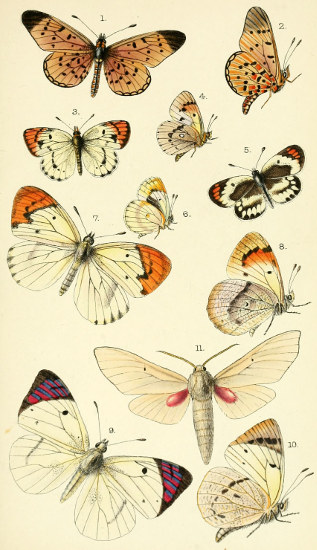
. del. Mintern Bros. lith.

App.Pl.F.
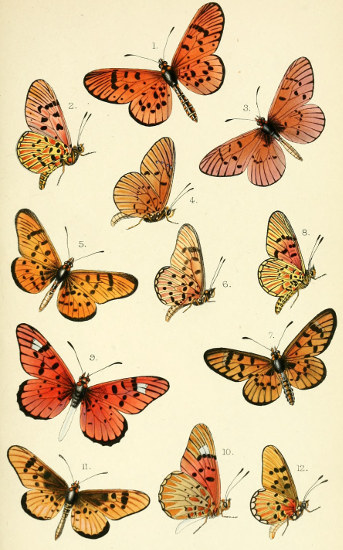
. del. Mintern Bros. lith.
App.Pl.G.
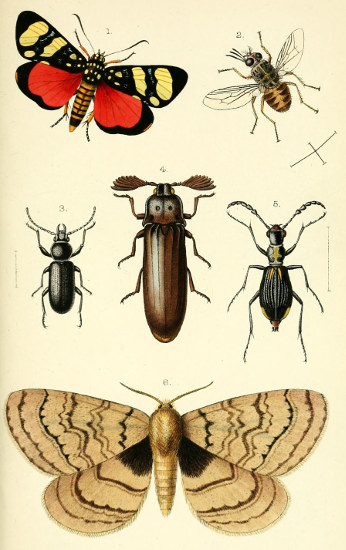
. del. Mintern Bros. lith.
App.Pl.H.
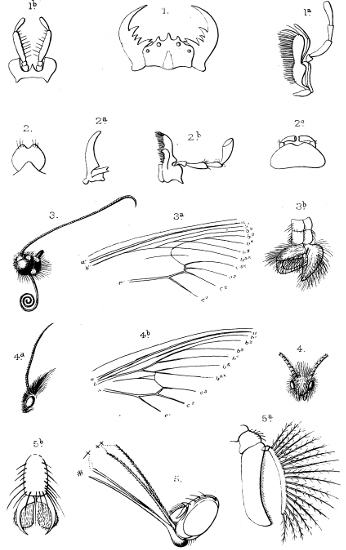
. del. Mintern Bros. lith.