Front matter
Reading edition
Masters of Contemporary Music
A SERIES OF BIOGRAPHICAL AND CRITICAL SKETCHES
Masters of Contemporary Music.
WITH PORTRAITS, &c.
MASTERS OF ENGLISH MUSIC. By CHARLES WILLEBY, Crown 8vo, cloth, 5s. MASTERS OF GERMAN MUSIC. By J. A. FULLER MAITLAND, Crown 8vo, cloth, 5s. [In the Press.
Preface Contents Illustrations Appendix Footnotes
CH. GOUNOD Frontispiece.
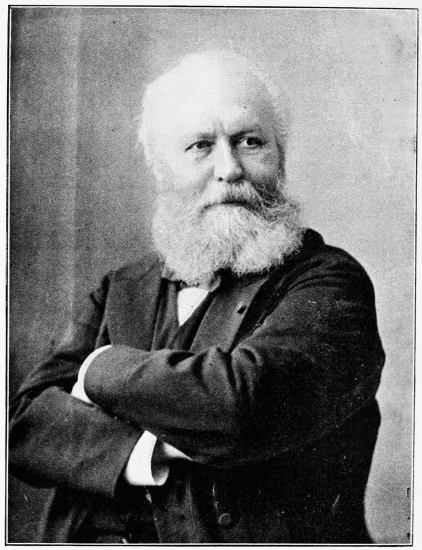
Masters of French Music
BY ARTHUR HERVEY WITH ILLUSTRATIONS LONDON OSGOOD, McILVAINE & CO. 45 ALBEMARLE STREET 1894
THIS LITTLE VOLUME IS BY SPECIAL PERMISSION DEDICATED TO HER ROYAL HIGHNESS THE PRINCESS OF WALES
PREFACE
THE reader who turns to these pages with the idea of finding therein a large and exhaustive account of the composers mentioned, with a technical analysis of their works, will, I fear, be disappointed. My intention has been a far more modest one.
The dimensions of this volume would not have allowed me to devote that amount of space to each composer that might be considered due to his merits.
The object I have had in view has been to give an account of their lives and to draw attention to the tendencies exhibited in their works.
The French can boast a splendid musical record, particularly as regards the opera. Paris was for many years the centre towards which foreign artists were wont to gravitate. It was here that Gluck laid the seeds of his musical reforms; that Cherubini and Spontini lived and brought out their best works; it was the influence of French taste that caused Rossini to forsake the inartistic devices of his earlier Italian operas and write "Guillaume Tell," his masterpiece; it was for Paris that Meyerbeer composed "Robert le Diable," "Les Huguenots," "Le Prophète," and "L'Africaine;" that Donizetti wrote the "Favorite," and Verdi, "Don Carlos." It was Paris that Wagner had in his mind when he composed his "Rienzi."
Then if we cast a glance at their native composers what treasures of melody, what grace, and what innate dramatic feeling do we not find in the works of Méhul, Boïeldieu, Auber, Hérold, Adam, Halévy, and others whose operas during the first half of the present century were heard all over Europe.
Of a different type to the above we meet the Titanic figure of Berlioz, whose influence has been so great over the younger generation of composers and whose orchestral innovations have borne such fruit. In the present volume I am only dealing with living composers, otherwise there are four who occupy prominent places in the records of contemporary music whose names would have been included, Bizet, Lalo, César Franck, and Léo Delibes.
Bizet, the gifted author of "Carmen," the inspired musician who wrote "L'Arlésienne," snatched away at the very moment when his genius was beginning to meet with recognition. Who knows what he might not have done had he lived! As it is, "Carmen" is probably the most generally popular opera that has been written by a Frenchman since Gounod produced his "Faust," and Bizet was only thirty-seven years of age when he died!
Edouard Lalo, whose death occurred last year (1892), had to wait a long time before his merits received the recognition to which they were entitled. His popularity in France may be said to date from the time when his opera, "Le Roi d'Ys," was first produced at the Opéra Comique some five years ago, when the composer had reached his sixtieth year. An opera of his entitled "Fiesque," composed many years previously, was accepted by one manager after another, but some circumstance invariably occurred to prevent its being brought out. His ballet "Namouna" contains much that is both charming and original, yet it failed to captivate the public of the Paris Opéra when it was produced.
Amongst his orchestral works are to be found a fine symphony, which I remember hearing at one of the Lamoureux concerts in Paris and which ought to be given here; two Norwegian Rhapsodies, and the "Symphonie Espagnole" for violin and orchestra. The work he will probably be best remembered by is "Le Roi d'Ys." A great admirer of Wagner, Lalo in this opera applies the master's theories in a restricted sense only, and "Le Roi d'Ys" has a greater affinity with "Tannhäuser" and "Lohengrin" than with "Tristan" or the "Meistersinger." His chamber compositions and orchestral works reveal a considerable amount of originality and knowledge of effect, allied to consistently elevated notions with regard to the æsthetics of his art. A tendency towards the employment of curious rhythms often imparts a peculiar "cachet" to Lalo's compositions. In all his works he exhibits a complete mastery over orchestral resources, a branch of the art in which French composers as a rule excel.
The name of César Franck is less known in England. Although a Belgian by birth, he may through his long residence in France be reckoned amongst the composers of that country. His reputation has been steadily on the increase of late, and some of his enthusiastic admirers have not scrupled to call him the "French Bach."
Perhaps we may one day have an opportunity of judging works such as "Ruth," "Rédemption" and "Les Béatitudes," which last is generally considered as his masterpiece.
Léo Delibes will be remembered chiefly through his exquisite ballet music, such as "Coppelia" and "Sylvia," full of grace, charm and refinement, never commonplace, and bearing the stamp of a distinct individuality. His operas, "Le Roi l'a dit," "Jean de Nivelle," and "Lakmé," do not show his talent off to the same advantage, albeit containing many delightful pages.
Léo Delibes' music is typically French and is full of that "esprit" so characteristic of our neighbours. A pupil of Adolphe Adam, Delibes seems to have acquired his master's lightness of touch and gift of melody, to which he was able to add a quality of distinction which the composer of "Le Postillon de Lonjumeau" did not possess.
It is, however, with the living that we are concerned, and, having paid a passing tribute to the memory of the above deceased musicians, I will now proceed with my task, once more claiming the indulgence of my readers, and begging them to bear in mind that, whatever defects may be noticeable in these imperfect sketches, I can at least claim that they have been written in perfect good faith.
ARTHUR HERVEY.
P.S.—Among the books that I have had occasion to consult I may mention especially Mons. Adolphe Jullien's "Musiciens d'Aujourd'hui," Mons. Pagnerre's "Charles Gounod," Mlle. de Bovet's "Life of Gounod," Mons. Hugues Imbert's "Profils de Musiciens," and "Nouveaux Profils de Musiciens."
I also take this opportunity of expressing my indebtedness to my friend, Mr. Robin H. Legge, for having been instrumental in procuring for me information of a valuable nature.
A.H.
July 1893.
Note.—Since these sketches were written, the death of Charles Gounod has deprived France of one of her greatest musicians. The composer of "Faust" died on the 18th of October (1893), the anniversary of the first performance of his opera, "La Nonne Sanglante," which was produced in 1854. His loss is one that will be mourned, not by France alone, but by all other nations, and Englishmen will not forget that their country was the birthplace of the "Redemption" and "Mors et Vita."
A. H.
CONTENTS
PAGE
AMBROISE THOMAS 1
CHARLES GOUNOD37
CAMILLE SAINT-SAËNS107
JULES MASSENET173
ERNEST REYER207
ALFRED BRUNEAU223
SOME OTHER FRENCH COMPOSERS253
APPENDIX277
ILLUSTRATIONS
CH. GOUNODFrontispiece
AMBROISE THOMASTo face p.1
CH. GOUNOD"37
FACSIMILE OF AUTOGRAPH SCORE BY GOUNOD"92
CAMILLE SAINT-SAËNS"107
FACSIMILE OF AUTOGRAPH SCORE OF "SAMSON ET DALILA""144
JULES MASSENET"173
FACSIMILE OF AUTOGRAPH SCORE OF "WERTHER""200
ERNEST REYER"207
ALFRED BRUNEAU"223
FACSIMILE OF AUTOGRAPH SCORE OF "LE RÊVE""240
The frontispiece and the portrait of M. Massenet are taken from photographs by M. G. Camus, Paris. The portrait of the late M. Gounod, facing page 37, is taken from a photograph by M. Petit, Paris; and the portraits of MM. Thomas, Saint-Saëns, Reyer, and Bruneau, from photographs by MM. Benque and Co., Paris.
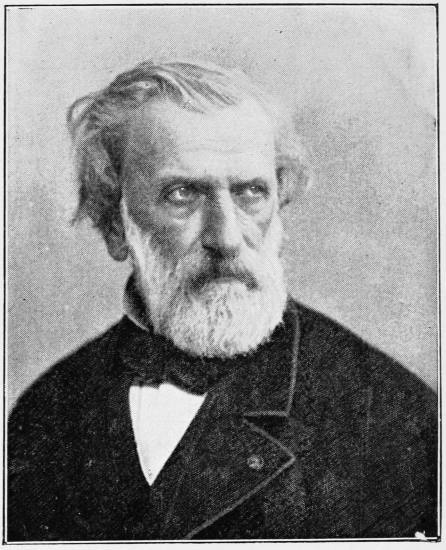
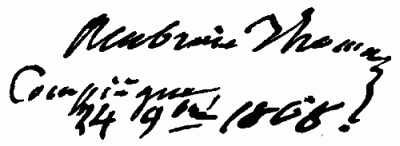
AMBROISE THOMAS
IT has become a trite saying that music is the youngest of the arts. The truth of this is nevertheless indisputable, and the remark is perhaps more applicable to music as represented in the "lyrical drama" than in any other form. What pleases one generation is often distasteful to the next, and a period of twenty or even ten years has sometimes been sufficient to witness a thorough evolution in the methods and general style of dramatic music.
The career of the composer whose name heads this chapter is, from this point of view, interesting to study, and a cursory glance at the state of musical affairs at the time when he emerged from the Paris Conservatoire, having won the "Grand Prix de Rome," will not be out of place, and may help towards forming a more accurate estimate of his talent.
Every art has traversed a period of degeneration, when true æsthetics have been neglected and men of undoubted talent, or even genius, have been unable to free themselves from the shackles of a vitiated taste. This applies, perhaps, more to music than to any other art, probably for the reason that in this case the demand upon the intellect is proportionately greater, and a certain degree of culture is absolutely necessary for its due appreciation. There is a semblance of truth in the contention advanced by Rubinstein, that music is the reflex of its time, and even re-echoes the political events and general state of culture of the age. The following paradoxical opinion of the eminent Russian composer and pianist, taken from his "Conversation on Music,"[1] is well worth quoting in extenso: "I can follow musically even the events of our century. Our century begins either with 1789, the French Revolution (musically with Beethoven), or the year 1815 is to be looked upon as the close of the eighteenth century, disappearance of Napoleon from the political horizon, the Restoration, &c. (musically the scholastic-virtuoso period: Hummel, Moscheles, and others); flourish of modern philosophy (third period of Beethoven); the July Revolution of 1830, fall of the Legitimists, raising the son of Philippe Egalité to the throne, the Orleans dynasty, democratic and constitutional principle in the foreground, monarchical principle in the background, 1848 in sight (Berlioz); the Æolian harp of the Polish rebellion of 1831 (Chopin); romanticism generally and its victory over the pseudo-classic (Schumann); flourish of all the arts and sciences (Mendelssohn); the triumph of the bourgeoisie, in sense of material existence, a shield against all disturbing elements of politics and culture (Capellmeister music); Louis Napoleon becomes Emperor (Liszt, the virtuoso, becomes the composer of symphonies and oratorios); his reign (the operetta a branch of art); the German-Franco war, Germany's unity, the freedom of Europe resting on ten millions of soldiers, change in all formerly accepted political principles (Wagner, his music-drama, his art principles, &c.)."
We are able with a tolerable degree of certainty to determine the period when a house was built by the style of its architecture, just as we experience no difficulty, as a rule, in discovering the date when a picture was painted through details that unmistakably reveal the epoch when the artist lived, even if the subject he may have chosen to illustrate be ever so remote. The well-known picture by Paul Veronese of the "Marriage Feast of Cana" is a case in point.
In respect to music, a similar law would appear to govern its manifestations, and special characteristics are associated with the productions of different epochs. This is made evident by the non-success that attends the composer whose genius impels him onward towards new and unknown horizons. Woe be to the one who has the temerity to forestall his own generation. Although immortality and a tardy homage to his memory may be his reward, these will perhaps scarcely afford compensation for the trials and hardships endured whilst battling for sheer existence in this vale of tears. It is a moot consideration whether the wisest course to adopt is that followed by Hector Berlioz, or the one that has brought prosperity as well as celebrity to Ambroise Thomas; for whereas the former may result in post-mortem panegyrics, the latter procures a more immediate recompense, and may lead to the directorship of the Paris Conservatoire.
There is something inexpressibly sad in the evanescence of music, and in thinking of the comparatively small number of compositions destined to survive their age. In this respect music is at a decided disadvantage in comparison with the sister arts; the fact of the former being essentially creative possibly accounting in some measure for this. At any rate, whereas masterpieces of classic art, such as "The Dying Gladiator" and the "Apollo Belvedere" remain unrivalled and do not betray a vestige of their antiquity, much of the music composed fifty years ago has become so hopelessly old-fashioned that it can scarcely be listened to with patience.
Is it that in this special case familiarity breeds a larger dose of contempt than usual? The fact has been proved over and over again, that compositions that seem absolutely incomprehensible to one generation, are accepted as comparatively simple by the next; whereas those that have caught on with the public at once very soon lose their hold.
The great test of an art work, as such, is its truth of expression. The moment this is wanting, its value diminishes, and it is powerless to survive the caprice of fashion.
Thus we find that those works into which composers have poured their innermost feelings, untrammelled by any desire to purchase an ephemeral popularity at the cost of the sacrifice of principle, are those that have remained. This is so much the case with stage works that it is necessary to state it definitely before proceeding any further.
For years the operatic composer was almost entirely at the mercy of the singer, and it has required many efforts on the part of great artists to shake off the load, the final emancipation being effected through the agency of one whose genius towers far above that of his contemporaries, and whose influence upon music has been as widespread as it has been beneficial. Need I say that I allude to Richard Wagner?
The spirit of routine, so engrained in the human mind, has also much to account for in preventing the development of music as represented in the opera. It is far from my desire to say anything in disparagement of a form of art such as the "opéra comique," a genre that has been illustrated with so conspicuous a degree of success by composers such as Grétry, Monsigny, Dalayrac, Nicolo, Boiëldieu, Hérold, and Auber. At the same time, it must be admitted that the ideal aimed at by modern French musicians is altogether a higher one. The "lyrical drama" has usurped the place of the old "opéra comique," and those composers whose inability or disinclination have kept them from following the prevalent movement, have perforce drifted into that mongrel species of art known as the "opérette." From an æsthetic point of view the change is emphatically for the better, as the "opéra comique," corresponding to the German "Singspiel," and to our "ballad opera," and consisting of an amalgam of speech and song, being neither fish, flesh, nor fowl, is utterly inconsistent with logic.
That there is still, however, a place for works coming under the denomination of a modernised form of "opéra comique," as distinct from the "opérette," without pretensions of too lofty an order, is evidenced by the delightful works of the late Léo Delibes, "Le Roi l'a dit," "Jean de Nivelle," and "Lakmé"; and more recently by Mons. Chabrier's "Le Roi Malgré Lui" and Mons. Messager's "La Basoche."
In the year 1832, when Ambroise Thomas had completed his twenty-first birthday, the Rossini fever was at its height. Beethoven was comparatively little known in France, and those amongst his symphonies that had been brought to a hearing had excited more wonder than admiration.
"Il ne faut pas faire de la musique comme celle-là," Lesueur had said to Berlioz after having listened to the C Minor Symphony; "Soyez tranquille, cher maître, on n'en fera pas beaucoup," had been the answer vouchsafed by the future author of "La Damnation de Faust." In the meanwhile Boiëldieu never lost the opportunity of playing through Rossini's operas to his pupils, and descanting upon their merits. It is indeed difficult to account for the extraordinary influence exercised by Rossini over his contemporaries. That his "facile" melodies should have proved agreeable to the general public, and his florid ornamentations grateful to the singers, "passe encore." But that an entire generation of composers should have been so fascinated by the sham glitter of his brilliant though shallow compositions as to follow his methods in so faithful a manner, is incomprehensible. It is eminently to the credit of French taste that "Guillaume Tell," his only really great work of serious import, should have been written for the Paris Grand Opéra.
Entirely devoid of artistic conscience or of any of those lofty aspirations towards the ideal that stamp the true artist, be his name Bach or Beethoven, Schubert or Schumann, Berlioz or Wagner, Rossini deliberately squandered his genius. Success seems to have been his only object, and this once acquired he was content to idle away the remainder of a long existence, sublimely unconscious of the great musical upheaval that was being accomplished by genuine workers in the cause of art.
What can we think of a composer who could employ the same overture to precede operas so widely different in regard to their subject-matter as "Elisabetta, Regina d'Inghilterra" and "Il Barbiere"? What of the musician who thought that a brilliant martial strain was the right musical interpretation of the sublime and poignant words expressive of Mary at the foot of the Cross? "Cujus animam gementem, contristantem et dolentem"; words of indescribable sadness and depth; a mother mourning her Divine Son; a theme unexampled in point of pathos and emotion, set to a melody that would be in its proper place in some pageant descriptive of the triumphal entry of a conqueror into a city!
What, again, of the composer who could prefix a tragedy like "Othello" with an overture fit for an "opéra bouffe?" And what would be said nowadays of the musician who, finding himself short of an idea, pilfered that of another composer, as Rossini did in "Il Barbiere," the trio in the last act of which being palpably taken from Haydn's "Seasons"? The greater a man's genius—and no one would dream of denying this attribute to Rossini—the greater his responsibility. Noblesse oblige. In order that I may not be accused of formulating too harsh a judgment upon the Italian master, I will quote the following words of Blaze de Bury, his friend and admirer: "Avec du génie et les circonstances, on fait les Rossini; pour être Mozart ou Raphaël, Michel Ange ou Beethoven, il faut avoir quelque chose de plus: des principes."
What has been termed the "golden epoch" of the "grand opéra" was at this time at its apogee, and the period often years from 1828 to 1838 witnessed the production upon the same boards of Auber's "La Muette de Portici," known here as "Masaniello," Rossini's "Guillaume Tell," Halévy's "La Juive," and Meyerbeer's "Robert le Diable" and "Les Huguenots."
It has been too much the fashion in recent years to decry the works of Meyerbeer, and to lay stress upon their shortcomings whilst giving but a grudging half-hearted acknowledgment to the many undeniable beauties that pervade them. Against so unjust a verdict I desire emphatically to protest, for however much Meyerbeer may have sacrificed for the sake of effect, there can be no doubt that he contributed in a large measure towards raising the operatic standard, then at a very low level.
If we find the rich crop of wheat not devoid of chaff, we must at any rate admit that the former is of excellent quality. To be the author of "Les Huguenots," the fourth act of "Le Prophète," and the music to "Struensee," not to speak of many another dramatic masterpiece, is in itself a sufficient title to rank amongst the greatest musicians of the age.
It would occupy too much space were I to enter further into a question which I may in the course of this volume have occasion to allude to again. I will therefore terminate these preliminary observations by stating the position occupied by the three great emancipators of dramatic and instrumental music—Berlioz, Liszt, and Wagner—at the time I mention, circa 1832.[2] The first was endeavouring to obtain a hearing for works that were condemned as incoherent and unintelligible, the second had achieved high fame as a pianist, and the third was qualifying for the humble position of "Capellmeister" in a German provincial town. The charge of incoherence was destined to cling to Berlioz even unto the end, whilst the colossal reputation of Liszt as an executant for a long while caused his labours as a creative musician to be underrated. As to Wagner, the number of misrepresentations that he had to live through are too numerous and too well known to mention.
Time, however, sets all things right, and the three masters are little by little gaining the position in public estimation to which they are entitled.
Ambroise Thomas was born at Metz on the 5th of August 1811, the same year as Liszt. He entered the Paris Conservatoire, of which institution he is at the time I am writing the honoured director, in 1828, and studied there under Zimmerman, Dourlen, and Lesueur;[3] also receiving instructions from Kalkbrenner,[4] and Barbereau.[5] The vein of sentiment which in later years was to be so prominent a feature in his compositions must have been noticeable even at that time, for it is said that his master Lesueur, on being told that the future author of "Mignon" was seventh in the class, remarked: "Thomas est vraiment ma note sensible." (The seventh note of the scale, or what we in England call the leading note, is known in French as "la note sensible.") Having won the "Prix de Rome" in 1832, for a cantata entitled "Herman et Ketty," Ambroise Thomas repaired to Italy, where he spent the following three years according to the usual custom.
It must have been about this time that he composed the trio and "Caprices en forme de Valses" for piano, marked respectively Opus 2 and 4, which were appreciated in the following terms by Schumann.[6]
"We come to an extremely pleasant composition, a 'salon trio,' during which it is possible to look around without completely losing the musical thread; neither heavy nor light, neither deep nor superficial, not classical, not romantic, but always euphonious and in certain parts full of beautiful melody; for instance, in the soft leading motive of the first movement, which, however, loses a great deal of its charm when it reappears in the major, and even sounds commonplace," etc.
"The 'Caprices' of Thomas move in a higher circle than Wenzel's 'Adieu de St. Petersbourg,' but, notwithstanding the evident application and the great amount of talent evinced, are nothing more nor less than higher-class Wenzel; 'lederne' German thoughts translated into the French language, so pleasant that one must needs beware of them, and so pretentious that one could well get vexed with them. Occasionally the composer wanders into mystic harmonies, but, soon frightened at his own temerity, returns to his natural mode of expression, to what he possesses and is able to give. But what do I expect? The 'Caprices' are pretty, sound well," etc.
During his sojourn in the eternal city, Thomas made himself popular with all who came across him, and was alluded to by Ingres, the celebrated painter, at that time head of the school whither were sent the successful young artists and musicians who had won the "Prix de Rome," as "l'excellent jeune homme, le bon Thomas."
The operatic career of the composer of "Mignon" dates from the year 1837, his first venture being a one-act comic opera entitled "La Double Échelle," produced at the Opéra Comique. This was succeeded the following year by "Le Perruquier de la Régence," three acts, at the same theatre; and in 1839 by "La Gipsy," a ballet at the Opéra, in collaboration with Benoist, and "Le Panier Fleuri," at the Opéra Comique.
The prolific nature of the composer's talent was further illustrated by the production in quick succession of "Carline" (1840), "Le Comte de Carmagnole" (1841), "Le Guerillero" (1842), and "Angélique et Médor" (1843), none of which obtained any appreciable success. It was otherwise with "Mina," a three-act comic opera, produced at the Opéra Comique in 1843, which enjoyed a certain vogue at the time, but has not survived.
The first permanent success achieved by Thomas was with "Le Caïd," a light opera given in 1849, which rapidly became popular, and is regarded by some as the precursor of the style of opéra bouffe which was destined later on to achieve so great a notoriety at the hands of Offenbach and his imitators. This is scarcely a correct view to take, as the innate refinement of a nature such as that of Ambroise Thomas has little in common with the vulgarities associated with the genre. "Le Caïd," in which the composer amusingly parodies the absurdities associated with the now happily obsolete Italian opera style of the period, would nowadays pass muster as a high-class opérette. This bright little score is full of that esprit of which French composers seem to possess the secret, and is wedded to an exceedingly amusing libretto. "Le Caïd" has remained popular in France, and occupies a permanent place in the répertoire of the Paris Opéra Comique.
Before proceeding with the composer's operatic career, it may be well to mention a phase in his existence during which he bravely performed his duties as a citizen. At the time of the political troubles of 1848, when art was forcibly relegated into the background, Ambroise Thomas donned the uniform of a garde national. It is related that one night, when passing under the windows of his friend and collaborator Sauvage, with whom he was at that moment working, he shouted out to him, brandishing his gun, "This is the instrument upon which I must compose to-day; the music it produces requires no words."
Happily Thomas was able soon to revert to more pacific and profitable occupations.
The composer's next work was of a different nature, and if "Le Songe d'une Nuit d'Été" ("A Midsummer Night's Dream"), given at the Opéra Comique in 1851, did not achieve a similar success to "Le Caïd," it possessed merit of a higher order, and is even now still occasionally performed.
This opera has nothing to do with Shakespeare's comedy, as its name might imply. Curiously enough, the immortal bard is made to figure as the hero of the piece. He is represented as a drunkard, who is rescued by Queen Elizabeth from his evil habits through a stratagem, by which he is made to see the veiled figure of a woman, when he is recovering from a drunken bout, whom he mistakes for the embodiment of his own genius, and who threatens to abandon him unless he promises to reform. It is strange that such a farrago of nonsense should have been deemed worthy of serving as an operatic text.
"Raymond," a three-act opera, founded upon the story of the Man with the Iron Mask, followed the above work in 1851. The overture is the only number that has survived. It is a brilliant orchestral piece, somewhat in the style of Auber.
In the course of the same year Ambroise Thomas was elected a member of the Institute in the place of Spontini. It can scarcely be said that this brought him much luck, for of the five operas that he wrote within the ten succeeding years, not one has kept the stage. They need not detain us long. Their names are "La Tonelli" (1853); "La Cour de Célimène" (1855); "Psyché'" (1857), a revised version of which was produced at the Opéra Comique in 1878; "Le Carnaval de Venise" (1857); and "Le Roman d'Elvire" (1860).
After these comparative failures the composer appears to have taken a much-needed rest and devoted some time to reflection, which was to be productive of excellent results. It may safely be urged that had Thomas died at this period he would have been only entitled to rank with musicians of subordinate talent, such as Massé, Maillart, Clapisson, "e tutti quanti."
As it happens, he had not then given the full measure of his worth, and the two works destined to procure for him the European reputation he enjoys belong to his full maturity.
The following is the opinion emitted by Fétis in his "Dictionnaire des Musiciens" upon Ambroise Thomas. It must be remembered that these lines were written before the production of either "Mignon" or "Hamlet": "Talent fin, gracieux, élégant, toujours distingué, ayant l'instinct de la scène, souvent mélodiste, écrivant en maître et instrumentant de même, cet artiste n'a malheureusement pas la santé, necessaire a l'énergie de la pensée. Il a le charme délicat et l'esprit, quelquefois il lui manque la force. Quoi qu'il en soit, M. Ambroise Thomas n'en est pas moins un des compositeurs les plus remarquables qu'ait produits la France."
Six years after the "Roman d'Elvire," the bills of the Opéra Comique announced the first performance of "Mignon," the instantaneous success of which must have helped to console the composer for former reverses. In constructing an opera book out of Goethe's "Wilhelm Meister," the librettists, Michel Carré and Jules Barbier, showed an even greater independence of spirit than they displayed when adapting the same poet's "Faust," for they deliberately altered the original dénouement, and instead of ending the work with Mignon's death, they prosaically allowed her to marry the hero, with whom she is presumably supposed to live happily for ever afterwards, possibly in order not to depart too abruptly from the conventionalities of the Opéra Comique Theatre, which has long been a match-making centre for the bourgeoisie.
Happily, Ambroise Thomas did not compose his "Hamlet" for the same boards, otherwise who knows but that the Prince of Denmark would not have been made to see the error of his ways, and wed the fair Ophelia, who would thereby have been saved from going mad, and spared the trouble of mastering the vocal acrobatics that are always indulged in by operatic heroines who are bereft of reason.
The marriage festivities given in honour of Hamlet and Ophelia would have enabled Ambroise Thomas to make use of his ballet music, and every one would have been left happy and contented, except perhaps the Ghost, who is sufficiently tedious not to deserve any sympathy. It is but fair to say that the requirements of habitués at the Opéra Comique have considerably changed. Realism has invaded the stage, and a tragic ending is no longer the exception to the rule in works destined for this theatre.
The poetical subject of "Mignon" was well suited to the refined nature of the composer's talent, and the musical value of the work has amply justified its success. What soprano vocalist is there who has not sung the suave cantilena, "Connais-tu le pays"?
The melodious duet between Mignon and the old harpist ("Légères Hirondelles"), the piquant little gavotte that precedes the second act, the tenor song, "Adieu, Mignon," and the brilliant overture, are amongst the most noteworthy and popular numbers of the opera.
The original interpretation of "Mignon" was of great excellence. Nothing could have been more perfect than Mme. Galli Marié's[7] assumption of the heroine, an actual embodiment of Ary Scheffer's well-known pictures of Mignon. I have heard many artists in this part, but none who so completely realised the character in all its details. Mme. Cabel[8] personified Philine, and the cast was completed by Achard (Wilhelm Meister), Couderc (Laertes), Bataille (Lothario), etc. Mme. Christine Nilsson, Mme. Minnie Hauk, and Miss van Zandt must be mentioned as successful interpreters of the title rôle. For the Italian version, Ambroise Thomas altered the small part of Frédéric, and added a vocal arrangement of the "Entr'acte Gavotte" for the late Mme. Trebelli.
"Mignon," it may be mentioned, was the opera that was being performed on the night of the terrible fire that destroyed the Opéra Comique in 1887.
In Germany and in Austria this opera has not proved less successful than it has in France, and the following appreciation of Dr. Hanslick[9] may not prove uninteresting: "This opera is in no place powerfully striking, and is not the work of a richly organised, original genius. Rather does it appear to us as the work of a sensitive and refined artist showing the practical ability of a master-hand. Occasionally somewhat meagre and tawdry, akin to the vaudeville style, the music to 'Mignon' is nevertheless mostly dramatic, spirited and graceful, not of deep, but of true, and in many instances warm feeling. Its merits and defects are particularly French, which is the reason why the first are more noticeable upon the French and the latter upon the German boards."
Having followed the example of Gounod in going to Goethe for a subject, Ambroise Thomas further trod in his illustrious confrère's footsteps by seeking for inspiration in the works of Shakespeare.
The opera of "Hamlet," performed for the first time in 1868, was the result. After having cruelly libelled the bard of Avon by presenting him in the character of a drunkard in his "Songe d'une Nuit d'Été," the composer of "Mignon" was but making an amende honorable in doing his best to provide one of the immortal poet's greatest works with a worthy musical setting. If his attempt can scarcely be said to have been crowned with the fullest amount of success, the fault is not entirely his own, unless he may be blamed for ignoring the fact of discretion being the better part of valour.
In endeavouring to set Shakespeare's tragedy to music Ambroise Thomas undertook an almost impossible task, and it is scarcely surprising that he should not have been absolutely successful. It would require the genius of a Wagner to give an adequate musical rendering of a work so deep and philosophical, and the Bayreuth master took care not to attempt it. Then again the peculiar nature of Ambroise Thomas's talent would appear to be absolutely unsuited to the musical interpretation of a tragedy of this description.
In judging the operatic version of "Hamlet," the fact must be borne in mind that this was written for the Paris Opera, and subjected to the exigencies of that institution, which were then far more stringent than at the present time, when Wagner has at last been admitted into the stronghold, "Lohengrin" forms part of the regular répertoire, and the "Walküre" draws large audiences. Amongst these exigencies must be specially mentioned the introduction of a "ballet" towards the middle of an opera, whatever its subject. Wagner's refusal to conform to this practice had not a little to do with the failure of "Tannhäuser" at the Paris Opera in 1861.
The French are ever priding themselves upon their superiority to the rest of the world in all matters theatrical. They are nevertheless prepared to accept the most glaring inconsistencies in the matter of operatic "libretti." What, for instance, can be more incongruous than the introduction of a set ballet in a tragedy like "Hamlet"? This can almost be placed on a similar level of absurdity as the mazourka introduced by Gounod in his "Polyeucte," the action of which takes place during the time of the early Christian martyrs, or as the Scotch ballet supposed to be performed at Richmond in Saint-Saëns' "Henry VIII."
Curiously enough, the most successful portion of Ambroise Thomas's "Hamlet" turns out to be precisely this ballet act, during which all the choregraphic resources of the Paris Opera House are called into play. In order to render justice to this work it is necessary to try and forget Shakespeare as much as possible and look upon it in a purely operatic light, when much will be found that can be unreservedly admired. The melodies are refined, and a certain poetical tinge, peculiar to the composer, pervades its pages, whilst the instrumentation is altogether of great excellence. In this last branch Ambroise Thomas has ever shown himself highly proficient, and I do not think that the following remarks of Mons. Lavoix[10] are unmerited: "Mons. Ambroise Thomas' orchestration is clear in its general design, spirituel and ingenious in its details, always interesting and full of poetical touches and of pleasant surprises."
The original interpretation of "Hamlet" had much to do with the success that attended it, and the parts of Ophelia and Hamlet found unrivalled exponents in Mme. Christine Nilsson and Mons. Faure. During the rehearsals, in order to be free from interruption, Ambroise Thomas transferred his abode to the Opera House itself, where he was allotted a room and kept a strict prisoner by the manager, with his piano and a goodly assortment of cigars to keep him company, for the composer of "Hamlet" has always been an inveterate smoker. On the night following the first representation he was re-accorded his liberty, and being asked to make a few alterations in his score, plaintively remarked that he thought "his two months were over."
At this period Ambroise Thomas was one of the lions of the day, and a favourite at the Court of Napoleon III. His presence at the sumptuous entertainments given by the Emperor at the palace of Compiègne will be remembered by many who profited by the Imperial hospitality. Every autumn the beautiful château was used to entertain series of visitors, and all the notabilities of Paris were bidden thither as the Emperor's guests. How some of these requited his hospitality later on, when trouble had gathered about his head, is unhappily a matter of history.
Ambroise Thomas had now reached the apogee of his fame, and this was to receive its final consecration when he was called upon to succeed the veteran Auber, whose last days were embitterred, and possibly shortened, by the misfortunes that had befallen his country and disturbed his essentially pacific habits, as director of the Paris Conservatoire. This office he has continued to hold until the present day.
Since then his dramatic compositions have been few and far between, and if we except "Gille et Gillotin," a one-act trifle written many years previously, and played at the Opéra Comique in 1874, have consisted of "Françoise de Rimini," a grand opera in five acts produced at the Opéra in 1882, and "La Tempête," a ballet given at the same theatre in 1889. These works have maintained their composer's reputation, without, however, in any material way adding to it.
In examining the compositions of Ambroise Thomas it is impossible to avoid being struck by the eclecticism that pervades them all.
The composer of "Mignon" is not one of those great leaders of musical thought whose individuality becomes stamped in an indelible fashion upon the art products of their period. He has been content to follow at a respectful distance the evolution that has gradually been effected in the "lyrical drama," taking care to avoid compromising himself through a too marked disregard of recognised traditions. Hence the presence of much needless ornamentation and countless florid passages, introduced obviously in order to show off the singer's voice, that cause many of his works to appear old-fashioned.
Mons. Adolphe Jullien, the well-known critic, somewhat severely sums up the measure of the composer's talent in the following words; "The principal talent of Mons. Thomas consists in having been able to bend himself to the taste of the public by serving up in turn the style of music that suited it best. Very clever in his art, but without any originality or conviction of any sort, he began by writing opéra comiques imitated from Auber, and pasticcios of Italian opéra buffa imitated from Rossini (such as "Carline" and "Le Caïd"); he then attempted the dramatic opéra comique, after the manner of Halévy, in the "Songe d'une Nuit d'Été," and "Raymond." Later on he did not disdain to compete with Clapisson in writing "Le Carnaval de Venise" and "Psyché"; then, after a long period of inaction provoked through several repeated failures, during which the star of M. Gounod had risen on the horizon, he has attempted a new style, imitated from that of his young rival, with "Mignon" and "Hamlet." In one word, he is a musician of science and worth absolutely devoid of artistic initiative, and who turns to all the four quarters of the winds when these blow in the direction of success."
These words contain undoubted elements of truth, inasmuch as they accentuate the fact that Ambroise Thomas' talent partakes largely of an assimilative nature. Notwithstanding this, there is a certain degree of personality evident in much of his music, discernible through an indefinable touch of melancholy that imparts a measure of distinction to many of his works, which can be sought for in vain amongst the compositions of his more immediate contemporaries.
Ambroise Thomas is one of the last offshoots of a brilliant period, showing in his later works indications of a desire to follow the new movement, without possessing sufficient strength to do more than make a feeble attempt at breaking through the bonds of operatic "routine," and ridding himself of the tyranny of the vocalist.
His work is unequal as a whole, but there is sufficient good in "Mignon" and "Hamlet" to atone for many weaknesses, and it is through these operas that his name will be handed down to posterity.
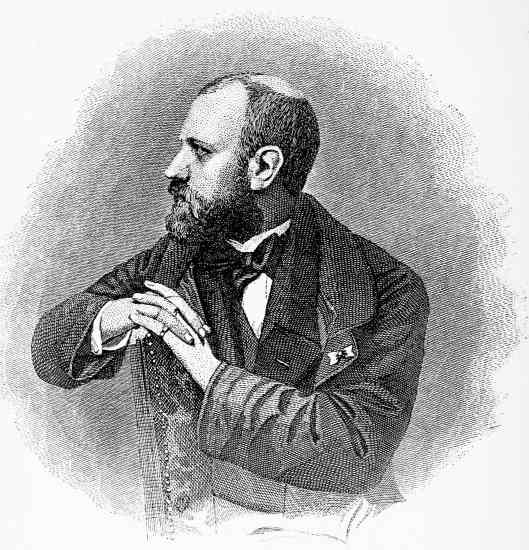
CHARLES GOUNOD
TO be the composer of "Faust" is in itself sufficient to establish a claim upon the sympathy and gratitude of many thousands, as well as to enjoy the indisputable right of occupying a niche by the side of the greatest and most original composers of the century.
There are but few creative musicians whose individuality is so striking that it leaves its impress, not only upon their own productions, but upon those of their contemporaries. Their genius is reflected, their mode of thought copied, and even their mannerisms are reproduced by numberless admirers and conscious or unconscious imitators.
As it was with Mendelssohn, Schumann, and Wagner, so it has been with Gounod. A higher tribute of praise it is indeed impossible to offer.
The French master has himself defined in a few words the indebtedness of every composer to his predecessors, and the difference existing between that which is communicable and that which is individual.
"The individuality of genius consists," he says, "according to the beautiful and profound expression of an ancient writer, in saying in a new way things that are not new: 'Nove non nova.' The influence of the masters is a veritable paternity: wishing to do without them is as foolish as to expect to become a father without ever having been a son. Thus the life which is transmitted from father to son, leaves absolutely intact all that in the son constitutes personality. In this way is it with regard to the tradition of the masters, which is the transmission of life in its impersonal sense: it is this which constitutes the doctrine which the genius of St. Thomas Aquinas admirably defines as the science of life."[11]
With some masters the personality above alluded to shows itself earlier than usual, as in the case both of Mendelssohn and Gounod.
There exists a point of contact between these two composers, so entirely dissimilar one from another in every way, which it may be well to point out. This is in respect to the nature of the influence they have exercised over other composers, which consists not so much in the adoption of any special mode of thought or art principle, but is exemplified by the servile imitation of specific mannerisms. Less far-reaching and wide-spread than that of Wagner, the influence of the above masters has also been less beneficial, for the reason that it has been more objective than subjective, and has shown itself rather in the outward details of many a composition than through its inward conception. The likeness has been more in the cut of the garment than in the material thereof. This may be accounted for by the fact that both Mendelssohn and Gounod are mannerists in the highest sense of the word, and their favourite methods of expression being easy to imitate, have been repeated by others ad nauseam, until they have begun to pall; whereas Wagner has opened a vast expanse, beyond which stretches an illimitable horizon, whither the composer of the future will be able to seek fresh sources of inspiration. His art, which has been described by some as typically Teutonic, is in reality universal, because it reposes upon the immutable principles of truth and logic, and is applicable to all nations, amongst which it has imperceptibly struck root and become acclimatised, perhaps nowhere more so than in the country of the composer with whom I am now dealing.
Two elements have in their turn exercised their sway over Gounod, and both have helped to impart, either separately or jointly, to his music certain of those characteristics familiar to all who have studied his works—religion and love. The mysticism and sensuous tenderness that pervade his compositions, whether sacred or secular, are evidently the reflex of a mind imbued with lofty aspirations, swayed at one moment by worldly tendencies, but returning with renewed intensity towards the pursuit of the ideal. Something of the same spirit may be discerned in the musical personality of another great artist, and both Liszt and Gounod exhibit in their widely different works the dual ascendancy of divine and human love.
"Das Ewig Weibliche zieht uns hinan," the words with which Goethe terminates the second part of his "Faust," are singularly applicable to the composer whose greatest work is founded upon the immortal poet's tragedy, and who has been especially successful in his treatment of the sentimental portions thereof.
The sensuous nature of his music is noticeable even in his religious compositions, of which it does not constitute the least charm.
The future composer of "Faust" was born in Paris on the 17th of June 1818.
From his earliest age he displayed exceptional musical aptitudes, and showed signs of an undoubted vocation for the career in which he was destined so conspicuously to shine. In her "Life of Gounod" Mdlle. de Bovet relates the following anecdotes of his childhood: "At the age of two, in the gardens of Passy, where he was taken for exercise, he would say, 'That dog barks in Sol,' and the neighbours used to call him Le petit musicien. He likes to repeat what he said one day in that far distant childhood. He had been listening to the different cries of the street vendors, 'Oh!' he exclaimed suddenly, 'that woman cries out a Do that weeps.' The two notes with which she hawked her carrots and cabbages actually formed the minor third—C, E flat. The baby, scarcely out of his leading-strings, already felt the mournful character of this combination."
When about seven years of age he was taken to hear Weber's "Freischütz," or rather the mutilated version of this masterpiece by Castil-Blaze known under the name of "Robin des Bois." The impression produced upon his youthful mind by Weber's beautiful melodies appears to have been very great. A few years later, when a schoolboy, he heard Rossini's "Otello" interpreted by Malibran and Rubini, and the Italian "maestro's" florid strains seem to have struck him in an equal degree. His enthusiasm, however, reached its highest pitch when he became acquainted with "Don Giovanni." He has ever since been an ardent devotee at the shrine of Mozart, and of late years his admiration for the master's music seems, if anything, to have increased.
Having had the misfortune to lose his father at an early age, he was brought up under the care of his mother. His first studies in composition were pursued under Reicha, one of the most celebrated theorists of the time; and having completed his general education at the college of St. Louis, he entered the classes of the Conservatoire in 1836, receiving instruction in counterpoint from Halévy, and in composition from Lesueur. In 1839 he obtained the "Grand prix de Rome," and soon afterwards left for Italy. During his sojourn in Rome Gounod devoted himself largely to the study of religious music, and spent a great portion of his time in perusing the works of Palestrina and Bach.
Whilst residing at the famous Villa Médicis he made the acquaintance of Fanny Hensel, the sister of Mendelssohn, in whose correspondence may be found several interesting details concerning the future composer of "Faust."
In a letter dated April 23, 1840, she writes: "Gounod has a passion for music; it is a pleasure to have such a listener. My little Venetian air delights him; he has also a predilection for the Romance in B Minor composed here at Rome, for the duet of Felix, his 'Capriccio' in A minor, and especially for the concerto of Bach, which he has made me play more than ten times over." Later on, in another letter, she writes as follows: "On Saturday evening I played to my guests, and performed, amongst other things, the Concerto of Bach; although they know it by heart, their enthusiasm goes 'crescendo.' They pressed and kissed my hands, especially Gounod, who is extraordinarily expansive; he always finds himself short of expressions when he wishes to convey to me the influence I exercise over him, and how happy my presence makes him. Our two Frenchmen form a perfect contrast: Bousquet's nature is calm and correct, Gounod's is passionate and romantic to excess. Our German music produces upon him the effect of a bomb bursting inside a house."
In June 1840 Fanny Hensel and her husband left for Naples. The following extract from a letter is interesting, as showing to what extent, even at that early period, Gounod had become imbued with religious ideas: "Bousquet confided to us on the way his fears concerning the religious exaltation of Gounod since he had come under the ascendancy of the Père Lacordaire ... whose eloquence had already during the previous winter grouped around him a number of young men. Gounod, whose character is weak and whose nature is impressionable, was at once gained over by Lacordaire's stirring words; he has just become a member of the association entitled 'John the Evangelist,' exclusively composed of young artists who pursue the regeneration of humanity through the means of art. The association contains a large number of young men belonging to the best Roman families; several amongst these have abandoned their career in order to enter into holy orders. Bousquet's impression is that Gounod is also on the point of exchanging music for the priest's garb."
In 1843 we find Gounod in Vienna, where a "Requiem" of his composition attracted some attention. On his return to Paris he vainly endeavoured to find a publisher for some songs he had composed while at Rome. When we hear that these included "Le Vallon," "Le Soir," "Jésus de Nazareth," and "Le Printemps"—that is to say, some of the most beautiful inspirations that have emanated from his brain—it becomes difficult to account for the obtuseness of the publishers.
Discouraged in this quarter, Gounod devoted his attention once more to religious music, and accepted the post of organist to the chapel of the "Missions Etrangères." He even entertained the idea of entering into holy orders. Happily this was not to be. The name of Gounod was becoming known in musical circles, and through the influence of Mme. Viardot, the celebrated singer, sister of Malibran, the young composer was commissioned to write the music of an opera to a book by Emile Augier,[12] for the "Académie Nationale." This, his first contribution to the lyric stage, was "Sapho," which was brought out in 1851, without, however, achieving much more than a succès d'estime. It was revived in a curtailed form seven years later, and finally, remodelled and enlarged, was reproduced in 1884. Notwithstanding its failure to attract the public, "Sapho" commanded the approbation of many competent judges, amongst whom we find no less a musician than Berlioz, who thus expressed himself upon the composer's merits: "M. Gounod is a young musician endowed with precious qualities, whose tendencies are noble and elevated, and whom one should encourage and honour, all the more so as our musical epoch is so corrupt."
"Sapho" is by no means the worst opera Gounod has composed, though unequal as a whole. The original version remains the best.
The year after the production of "Sapho" Gounod married a daughter of Zimmermann,[13] a well-known musician and professor.
His next venture was at the Théâtre Français, for which he wrote incidental music to "Ulysse," a tragedy by Ponsard. A detail to note is that the orchestra was conducted by Offenbach. Although the music to this was universally praised, it did not suffice to save the piece from dire failure. "La Nonne Sanglante," a five-act opera, founded upon a novel by Monk Lewis, produced in 1854, was even less successful than "Sapho." At the same time, the press was sufficiently favourable, and Gounod's reputation, though awaiting its final consecration, was at any rate on the increase. It is as well to mention here the success achieved in London of some religious compositions of Gounod's at a concert given in 1851, which called forth an enthusiastic article in the Athenæum.
The year 1855 witnessed the production of one of the master's most individual works, the "Messe de Ste. Cécile," the popularity of which has remained unabated on both sides of the Channel, and which furnishes perhaps the most typical example of his genius in this particular line. Mons. Pagnerre, Gounod's biographer, very rightly considers this as occupying the same position in regard to his religious as "Faust" does to his dramatic works.
For years Gounod had cherished the desire of setting Goethe's "Faust" to music, and in 1855 he mentioned the subject to the librettists Michel Carré and Jules Barbier, who immediately set to work and provided the required text. Circumstances, however, combined to prevent him from completing his work, and Mons. Carvalho, then director of the Théâtre Lyrique, having suggested something of a lighter description, Gounod interrupted his labours, and in five months completed the score of "Le Médecin Malgré Lui," an operatic version of Molière's comedy, which was performed for the first time on January 15, 1858. This little opera is a perfect gem of delicate fancy and refined humour. It affords a proof of what can be achieved with limited means by a true artist, and how burlesque situations are susceptible of being treated without a suspicion of vulgarity or triviality. Berlioz well defined its true worth when he wrote: "Everything in this comic opera is pretty, piquant, fresh, spontaneous; there is not a note too much nor a note too little." It has frequently been performed in England under the title of "The Mock Doctor."
We now approach the culminating point in the composer's career. The score of "Faust" was almost finished in October 1857, and Gounod was said to be at work upon a grand opera entitled "Ivan the Terrible," which was never completed, or at all events never played. The composer utilised several portions thereof in other operas: the celebrated soldier's march in "Faust" was originally composed for the above work. "Faust" was first performed at the Théâtre Lyrique on the 19th of March 1859, with the following cast: Faust, Barbot; Mephistophéles, Balanqué; Valentin, Reynald; Siebel, Mdlle. Faivre; Marguerite, Mme. Carvalho. It was transferred to the Grand Opéra in 1869, with certain alterations, including new ballet music for the fifth act, when it was interpreted by Colin, a young tenor of great talent and promise, who was destined to die prematurely not long after; Faure, unsurpassed as Mephistophéles; Devoyod, Mdlle. Mauduit, and Mme. Nilsson, the best of Marguerites.
The success of "Faust" did not for some time assume anything like the proportions it was destined to attain later on, and the following extracts from some of the criticisms of the day may not be uninteresting. Berlioz was on the whole distinctly favourable to his young rival's work, and his appreciation, coming from one who had himself sought for inspiration from the same source, acquires thereby additional importance. According to him, the most remarkable portion of the score is the monologue of Marguerite at her window, which closes the third act. In this it is probable that many will now agree.
Scudo,[14] the once famous critic of the Revue des Deux Mondes, was less favourable than Berlioz, although he admitted the work to be thoroughly distinguished; "but," he added, "the musician has not seized the vast conception of the German poet; he has not sufficiently succeeded in appropriating unto himself the epic force of Goethe, to render any new attempt impossible." In this, Scudo was perhaps not altogether wrong. As, however, he always showed himself the uncompromising opponent of Berlioz, Wagner, and the newer school of musical thought, his judgment loses some of its weight, and it is not surprising that he should have pronounced the soldier's march to be a masterpiece, whilst failing to recognise the beauty of the garden scene.
Strangely enough, neither Berlioz nor Scudo, judging the work from such different standpoints, were in any way impressed by the musical beauties or dramatic force of the prison scene. Jouvin, the critic of the Figaro, whilst praising the second and fourth acts, thought the third monotonous and lengthy. On the other hand, the critic of the Illustration considered this as the finest. Scudo having died in 1864, he was succeeded on the Revue des Deux Mondes by Blaze de Bury, who proved even more hostile to Gounod than his predecessor.
"Faust" was first performed in London under Col. Mapleson's régime, in 1864, with the following cast: Mme. Titiens, Marguerite; Mme. Trebelli, Siebel; Giuglini, Faust; Gassier, Mephistophéles; Santley, Valentine. Signor Arditi was the conductor.
Later on, during the same season, it was given at Covent Garden and interpreted as follows: Mme. Miolan-Carvalho, Marguerite; Mme. Nantier Didier, Siebel; Tamberlik, Faust; Faure, Mephistophéles; Graziani, Valentine.
Since then, the number of singers who have appeared in this unique work has been very great. There probably does not exist a prima donna who has not enacted the part of Marguerite; and "Faust" has usurped the place formerly occupied by "La Sonnambula" as the débutante's opera.
In his amusing Memoirs, Colonel Mapleson gives an entertaining account of the production of "Faust" in London.
Finding that there appeared to be a lack of public interest in the new work, discernible through the fact that only £30 worth of seats had been disposed of for the first night, he adopted the bold and singular course of distributing the tickets for the first three performances far and wide, and giving out that the house was sold out. He then put an advertisement in the Times, stating that, "in consequence of a death in the family, two stalls for the first representation of 'Faust,' the opera that had excited so much interest that all places for the first three representations had been bought up, could be had at 25s. each." The success of this stratagem appears to have been complete. Public curiosity was aroused, and the triumphant career of "Faust" in this country was begun.
The success "Faust" has achieved all the world over is probably unprecedented in operatic annals.
Gounod is said to have got only £40 for the English rights, and he was deemed lucky to get even that.
It would appear to be an impossibility for a composer to succeed in pleasing every one, and although perhaps "Faust" possesses this gift as much as any other operatic work, yet it is not surprising that it should have been criticised adversely from many varied points of view. That it should have proved distasteful to Wagner is but natural, considering the fact that the "libretto" must have seemed to the German master a desecration of Goethe's poem, even as much as the book of "Guillaume Tell" was a parody of Schiller's play.
Amongst the most singular appreciations of "Faust" is that emitted by Blaze de Bury, who qualifies it as an "Italian" opera!
As a contrast to this, several others have commented upon the composer's German tendencies, and the names of Mendelssohn and Schumann have been freely mentioned as furnishing the source of his inspiration. In point of fact, "Faust" is neither German nor Italian, but French, essentially French in its melody, essentially French in its harmony. The few unmistakable reminiscences of Mendelssohn do not detract from this any more than does the undoubted influence in many places of Meyerbeer. Of Schumann I can find but few if any traces. On the other hand, the work bears the stamp throughout of Gounod's own individuality. It is not an occasional reminiscence or a passing thought that suffices to class a work as belonging to any special school, but rather its general characteristics. Those who want a typical German Faust must go to Schumann, whilst those who prefer Goethe as seen through Italian spectacles can apply to Boïto. As regards the essentially Gallic interpretations of Berlioz and Gounod there can be no question.
Probably no legend has ever been turned to such account by poet, dramatist, and musician as that of "Faust." The fascination of the story, whether looked at in its philosophical or purely romantic aspect has proved irresistible to many generations. The original Faust appears to be a mythical personage, who in some form or another has figured in the folk-lore of all nations, and is not to be confounded with Faust, or Fust, the printer. An individual of this name is mentioned by Melancthon in his "Table Talk" as having been a professor of magic at Cracow, and a great traveller, who had startled the inhabitants of Venice by flying through the air. The Reformer pleasantly alludes to this person as "Turpissima bestia et cloaca multorum diabolorum." The existence of this Faust at Cracow is further corroborated by Wierns in 1588, a year later than the publication of the earliest version of the Faust legend by Spiess. It is upon this last that Marlowe founded his "Dr. Faustus," which was brought out in the following year. The long narrative of the story by Widman appeared in 1599. In all these versions the character of Marguerite is absent. It was reserved for Goethe to evolve this beautiful conception from his brain.[15]
Since the appearance of the great German poet's masterwork, the subject, as treated by him, has been utilised in various manners by numberless musicians. It would perhaps not be uninteresting to cast a glance at some of these. The following composers had preceded Gounod in making use of "Faust" as an opera text: Lickl (1815), Strauss (1814), Spohr (1814), Seyfried (1820), Béancourt (1827), Sir Henry Bishop (1825), Lindpaintner (1831), Mdlle. Berlin (1831), Rietz (1837), and Gordigiani (1837).[16] What has become of all these works? Chi lo sa? The only one that has in any way survived is that by Spohr, extracts from which are still occasionally heard in the concert-room. Boïto's "Mefistofele" belongs of course to a subsequent period. It redounds greatly to the credit of the Italian composer that he should have succeeded in imposing a new operatic setting of Goethe's poem when this was so intimately associated in most people's minds with the music of Gounod.
Although strangely unequal, "Mefistofele" is nevertheless in many ways a highly remarkable work, particularly as marking a departure from the usual methods peculiar to Italian composers, and aiming at a higher ideal. It has born fruit. Boïto is a poet as well as a musician, and in his operatic adaptation of "Faust" he has evidently striven to depart as little as possible from Goethe's plan. This is of course commendable. Unfortunately, the result has not been altogether satisfactory, for in endeavouring to compress the two "Fausts" of Goethe into one work, the Italian composer has been compelled to make a selection from the different situations occurring in the original, and has only succeeded in presenting a succession of scenes strung together apparently without rhyme or reason. A proper sub-title for "Mefistofele" would be, "A selection of scenes from the two Fausts of Goethe, operatically treated by A. Boïto." Certainly the librettists of Gounod's opera have shown but scant regard for Goethe's intentions, but they have at any rate concocted a story with a well-regulated and dramatically logical plot. Boïto, on the other hand, in his evident desire to do justice to Goethe, has attempted too much and achieved too little. "Qui trop embrasse, mal étreint." This has been the case with Boïto. Many people have tried to discover a philosophical meaning, and the realisation of a quantity of abstract notions in Boïto's music, which only exist in their imagination. Perhaps the three composers who have best grasped the spirit of the wonderful poem have been Schumann, Liszt, and Wagner: the first in his "Scenes from Faust," the second in his "Faust Symphony," the third in his "Faust Overture." Gounod has been more successful in this respect than many people are inclined to allow. It is only necessary to point to the first bars of the Prelude and the commencement of the first act as a proof of this fact.
Of late years Berlioz's "Damnation de Faust" has acquired a well-deserved though tardily-bestowed popularity. It was considered by the composer as one of his best works, a judgment which has since then received a practically universal endorsement. At the same time, it is rather by reason of its own individuality than as a satisfactory interpretation of Goethe, that the above "dramatic legend" is entitled to the high rank it occupies in the esteem of musicians, and much of the effect produced by this extraordinary composition can in a large measure be assigned to the glamour shed over it by the wonderful orchestral colouring that Berlioz knew so well how to employ, his mastery of which will probably remain his chief glory with posterity. Berlioz states that the score of his "Faust" was composed by him with an amount of facility that he rarely experienced in connection with his other works. The famous march on a Hungarian theme was written by him in one night. "The extraordinary effect," he writes, "that it produced at Pesth decided me to introduce it into the score of 'Faust,' in taking the liberty of placing my hero in Hungary at the outset of the work, and causing him to assist at the passing of a Hungarian army across the plain where he is indulging in dreamy thoughts." Berlioz excuses this liberty by stating that in composing his "Faust" he had never intended to bind himself into following the plan adopted by Goethe in his masterpiece. This specious sort of argument is all very well in its way, and the adoption of similar methods might prove of infinite service to composers in enabling them to utilise previously-written works, and thereby save themselves trouble. Whether it is artistic or not, is another matter. If we suppose, for instance, that Berlioz had had by him a "Tarantella" and an Irish jig, he might have transported his hero alternately to Italy and to Erin, and named his work "The Travels of Faust," which at any rate would not have been open to the same objection as the original title chosen by him. Despite these casual observations and the fact that, looked at from the point of view of a satisfactory interpretation of Goethe's poem, the work falls short, Berlioz's "Faust" none the less remains one of its author's most inspired compositions; beautiful in parts, though needlessly eccentric in others; powerful, and, above all, eminently individual.
If the "Faust" of Berlioz may be ranked as one of its author's best works, the same place of honour can undoubtedly be ascribed to the "Scenes from Faust" of Schumann in the lengthy catalogue of the master of Zwickau's compositions, and it is strange that so few opportunities should be afforded to Londoners of appreciating its beauties. The second part of this work is generally considered by musicians as being the most remarkable, but Schumann's setting of the Church scene counts amongst his finest inspirations. The overture is the weakest portion, and cannot compare with Wagner's masterly tone-poem known as "Eine Faust Ouverture," one of the most striking examples of modern orchestral music. I must not omit to mention the "Faust Symphony" of Liszt, which is also too seldom performed, probably on account of its length and extreme difficulty, also possibly owing to the uncompromising hostility entertained in certain quarters against the master's music. Although consisting of three movements—labelled respectively "Faust," "Marguerite," and "Mephistophéles," the work in question might rather come under the category of a "symphonic poem." It is constructed upon entirely unconventional lines, the themes being subjected to various transformations, after the method peculiar to Liszt. The second portion is one of the most beautiful movements in the entire range of instrumental music.
The following composers have also treated the same subject more or less successfully: Prince Radziwill, Litolff, Hugo Pierson, Zöllner, and Eduard Lassen.[17] The latter's incidental music is constantly given in Germany in conjunction with the drama. As this is the age of festivals, I should like to suggest to the minds of those responsible in such matters the feasibility of attempting what might be termed a "Faust" festival. This could be made to occupy the inside of a week, and would be devoted entirely to works inspired by Goethe's poem. I venture to think that the idea is susceptible of being turned to good account. Many musical treasures, the existence of which is unsuspected, would thereby come to light.
It would appear to be almost needless to attempt to give a description of the music that Gounod has wedded to Messrs. Michel Carré and Jules Barbier's operatic version of "Faust." That it is perhaps the most popular opera composed during the last fifty years is a generally recognised fact, and one that is not likely to be seriously contested, whatever restrictions may be made from different points of view concerning its merits. Since it was first produced, a new generation has sprung up, and what appeared startlingly bold thirty years ago has long ceased to be so considered. In 1859 matters were very different from what they now are. The operatic pabulum in England consisted of the works of Balfe and Wallace. In France, Auber was at the head of the Conservatoire; Ambroise Thomas had written neither "Mignon" nor "Hamlet"; Clapisson, Massé, Maillart, and composers of that calibre, enjoyed the confidence of the patrons of the Opéra Comique; whilst Berlioz and Wagner were looked upon as musical iconoclasts.
In Italy, Verdi reigned supreme, the Verdi of "Il Trovatore" and "La Traviata," and nothing tended to foreshadow the astonishing transformation of style that was eventually to lead the master to compose works such as "Aïda," the "Requiem," "Otello," and "Falstaff."
Musical education has made considerable progress since those days, and the all-absorbing individuality of Wagner has exercised a sway over musical art that is far from having spent itself.
The form in which "Faust" was composed did not tend to differ in any appreciable degree from that adopted by Meyerbeer, with the exception that certain Italianisms and concessions to the vocalist were dispensed with.
Gounod's method, from which he has not since departed, seems to have been to musically delineate each phase of the drama, treating every scene as a separate whole—that is to say, without having recourse to any connecting link or leit motiv; the recurrence of previously-heard melodies in the fifth act hardly coming under this category. He is satisfied to depict his characters in music that is intended to be more or less in accordance with their individuality. Herein consists the great difference that separates his works from those that are conceived after Wagnerian ideas.
The music allotted to Mephistophéles has an appropriate amount of Satanic colouring, and is invested with a certain grim humour. It has been remarked that Gounod has been less successful than Berlioz in his musical depiction of the philosophical side of Goethe's poem. This may or may not be true, but in comparing the two works it must be recollected that the composers cannot be judged from the same point of view, for whereas Berlioz was hampered by no theatrical trammels or operatic conventionalities, but was able to turn the legend to whatever account he chose, even to transporting Faust to the plains of Hungary and accompanying him to the infernal regions, Gounod was to a certain extent dependent upon his librettists, who saw in Goethe's poem nothing more than a story susceptible of being turned to operatic purposes. As to what really constitutes the philosophical in music, probably no two people will agree. Music is intended to convey certain impressions which in turn cause corresponding emotions to the listener, in accordance with that which it has been the composer's intention to depict. If it fails in so doing, the fault may be ascribed either to the composer's incapacity, or to a want of sympathetic feeling on the part of the listener.
It is eminently to the credit of Gounod that he should have found the means in his "Faust" of pleasing a variety of differently constituted individuals, who probably admire his work from totally different standpoints.
To the great majority the charm of "Faust" lies in melodies such as those of the "old men's" and soldiers' choruses, the Kermesse and well-known waltz; the more refined and sentimental will prefer the famous love duet and the prison trio; prime donne will incline to the jewel song, which furnishes them with the opportunity of displaying the agility of their throats; and the cultivated musician will single out parts that do not attract the same amount of attention, but are not the less noteworthy—such as the opening bars of the Prelude, the entire first act, the end of the third act, the death of Valentine, the Church scene, the commencement and end of the last act. When "Faust" was transferred from the Théâtre Lyrique to the Grand Opera in 1869, Gounod wrote additional ballet music, which, though charming enough in itself, is absolutely out of keeping with the nature of the subject, and might equally well figure in any opera of the type associated with this theatre.
"Faust" may be considered as an important landmark in French music, and from the year 1859 may be said to have sprung up an entirely new generation of composers, imbued with a high and noble ideal, and differing in many essentials from their predecessors. Previous to this the voice of Berlioz remained that of one crying in the desert, unheeded and scoffed at. The author of the "Symphonie Fantastique" had come too soon, and, moreover, was altogether too thorough in his ideas and devoid of any spirit of compromise. The pen of the critic, which he wielded with such a conspicuous amount of success, was too often dipped in gall, and the shafts of sarcasm which he unremittingly hurled at his enemies kept their rancour alive, and mayhap did something to prevent even a moderate amount of fair criticism from being meted to his musical compositions. Although not a reformer in the same sense, Gounod nevertheless contrived, in a quieter and less obtrusive manner, to impose certain innovations without offending the prejudices of the partisans of the older style of operatic music. To us nowadays it seems difficult to realise that an opera so full of melody as "Faust" should have seemed at all unduly complicated, but so it appears to have been thought, and the Parisians of thirty years ago concentrated their admiration upon the lighter portions, and looked askance at the rest. These same Parisians were destined two years later to show the measure of their musical aptitudes by the disgraceful manner in which they received Wagner's "Tannhaüser" on the occasion of the memorable performances of this work at the Opéra in 1861. At that period Gounod was professedly an admirer of the German master, although since then his opinions seem to have become sensibly modified. It is necessary to remember that Wagner was only known then as the author of "Tannhaüser" and "Lohengrin," and as holding certain heterodox views upon dramatic art.
After the fiasco of "Tannhaüser" Gounod appealed to the detractors of the master, and gave them rendezvous in ten years' time before the same work and the same man, when, he said, they would lift their hats to them both. It has required somewhat more than ten years for this, but the Parisians have gone even further now than Gounod, and possibly the popularity of Wagner in Paris may eventually equal, if it does not surpass, that of the composer of "Faust."
Within a year after the production of this last work, a new opera by Gounod was brought out at the Théâtre Lyrique. "Philémon et Baucis," played for the first time on February 18th, 1860, is a graceful and delicate little score, that has remained popular in France and only recently has obtained a fair measure of success in London, where it was produced by Sir Augustus Harris at Covent Garden in 1891.
This pleasing work belongs entirely to the Opéra Comique genre, and consists of a number of detached pieces connected together through the means of spoken dialogue. In writing it Gounod evidently did not trouble himself about questions of operatic reform, but was content with filling in the framework provided for him, and allowing his ideas to flow naturally. There is nothing forced in this melodious little opera. Everything is pure and limpid as crystal. Putting aside all æsthetic considerations as to the somewhat old-fashioned form in which the composer's ideas are expressed, it is impossible not to feel charmed by their refinement and delicacy.
"La Colombe," a little comic opera given at Baden in 1860, and later on at the Opéra Comique, is comparatively of little importance. A charming entr'acte still occasionally finds its way into concert programmes. A work of larger dimensions was "La Reine de Saba," produced on February 28th, 1862, the third opera written by Gounod for the Grand Opéra.
The music of this work is unequal, and the libretto devoid of interest. There are, however, certain numbers that have survived the wreck of this ill-fated score, which has been somewhat too harshly condemned. Amongst these may be mentioned the air, "Plus grand dans son obscurité" (which has remained a favourite with dramatic prime donne), the graceful women's chorus at the beginning of the second act, the characteristic ballet music, and the grand march. These last two extracts have become popular, and form part of all properly constituted concert répertoires. At the period when this opera was produced, the peculiar disease known as "Wagnerophobia" was raging in Paris, and every composer with something new to say was gratified with the epithet Wagnerian, which was held to be a term of contumely, implying absence of melodic ideas and want of inspiration.
There is not much in the "Reine de Saba" that suggests the influence of the German master, except a passing reminiscence of "Tannhaüser," but at that time people did not look too closely into these matters. The score was both long and monotonous, it did not contain too plentiful a proportion of sops to the singers, and it was forthwith pronounced to be Wagnerian, an expression as condemnatory in its intention as its real meaning was little understood. Gounod himself laid great store upon his work, and being met a short time after its production by a musical critic at Baden, he told him that he was travelling on account of a family bereavement. "I have lost," he said, "a woman whom I loved deeply, the Queen of Sheba."
Only those who know the amount of labour involved in the composition of a five-act opera can measure the disappointment that must accrue to its author on finding that his work has failed to satisfy that agglomeration of entities known as the public. "La Reine de Saba" was more successful in Brussels than in Paris, and was well received in Germany, where, however, it has been dethroned in favour of the far finer work by Goldmark bearing the same name. It has also been heard in London under the title of "Irene."
The opera of "Mireille," played for the first time at the Théâtre Lyrique in 1864, and introduced to the notice of the English public at Her Majesty's Theatre during the same year, is one of Gounod's most characteristic productions in the way that it illustrates the composer's qualities and defects perhaps as much as anything he has done. The poem upon which it is founded is the "Mireio" of Frederick Mistral, the celebrated Provençal poet. It is a pastoral, and as such necessarily appealed irresistibly to a composer who is never so happy as when treating a subject of this kind.
The story is simple enough, and is thus condensed by Mons. Pagnerre, Gounod's clever biographer, to whose work I may refer those amongst my readers who seek for further information upon the composer's life: "A rich young girl, a poor young man, an ill-fated love; and death of the young girl through sunstroke."
This tragic dénouement was subsequently altered, and, according to the latest version of the opera, Mireille lives presumably to enjoy connubial bliss with her lover.
Gounod has been less happy in his treatment of the essentially dramatic portions of the story than in those in which the lyrical element predominates. The general colour of his score is quite in keeping with a subject dealing with Provençale life, although it can scarcely be said that he has proved so successful in this respect as Bizet has in his music to Alphonse Daudet's "L'Arlésienne."
Notwithstanding this, there are many charming pages in "Mireille," strongly marked with the composer's individuality, suggestive of warm sunshine and southern skies. If the opera is emphatically a disappointment when considered as a whole, if it absolutely fails to carry conviction as a musical drama, if it is full of contradictions of style and concessions to the vocalist, it may at least claim to be replete with melody of a refined nature and to contain several numbers that are always heard with pleasure. The melodious duet, "Oh Magali ma bien-aimée," has been one of the chief items in the répertoire of tenors and sopranos during the last five-and-twenty years, and has been massacred by numberless amateurs in countless drawing-rooms.
The overture is a delightfully fresh composition of a pastoral nature, and serves as a fitting prelude to the story. For some reason, best known to himself, Gounod has written two endings to this, the first of which is immeasurably superior, which is probably the reason why the second is usually played. In the first act the composer has introduced a vocal waltz of the same type as the one he was subsequently to place in the mouth of Juliet, both being evidently written for the purpose of giving Mme. Carvalho, the creatrix of these parts, the opportunity of indulging in vocal acrobatics. Such concessions to the exigencies of the singer are much to be deplored.
Amongst the most noticeable numbers in "Mireille" I would mention, in addition to those I have already singled out, the opening chorus of the first act, the "couplets" of Ourrias, so often sung in our concert rooms by Mr. Santley, the "Musette," the shepherd's song, and Mireille's air, "Heureux petit berger." This opera was originally in five acts; it was then reduced to three, and restored to five, with certain modifications, on the occasion of its revival at the Opéra Comique in 1874.
If Gounod had not succeeded since his "Faust" in producing any work that could bear comparison with this masterpiece (however creditable in their way the operas that had followed it might be), he was destined in "Romeo and Juliet" to be more fortunate, and to wed music to Shakespeare's story, that many of his admirers have not scrupled to place upon the same level as the former work. With this estimate I am by no means disposed to agree, although I should be inclined to consider "Romeo" as occupying the second place in the list of the composer's dramatic works.
Shakespeare's wondrous tragedy had already been set to music by several composers,[18] amongst whom it will be sufficient to mention Dalayrac, Steibelt, Zingarelli, Vaccai, Bellini, and Marchetti. An opera by the Marquis d'Ivry, entitled "Les Amants de Vérone," on the same theme, although written before the production of Gounod's work, was brought out in Paris in 1878 with Capoul as Romeo. It may be well to point out also that, by a curious coincidence, Gounod once more chose a subject that had been treated by Berlioz, whose symphony of "Romeo and Juliet" remains one of his greatest works.
In her interesting biography of Gounod, Mdlle. de Bovet makes the following apt observations: "'Faust,' as we have seen, is remarkable for its homogeneity, the happy outcome of the subordination of the fantastic to the emotional element. It is not possible to say that all the parts of 'Roméo et Juliette' are linked by so close a bond, and this could not well have been so. All Jules Barbier's cleverness could not make the plot other than a love duet, or rather a succession of love duets."
It is this fact that accounts in a measure for the tinge of monotony noticeable in this opera. When Mons. A. Jullien very truly remarks that of all musicians Gounod is the one whose ideas, method, and style vary the least, he strikes a vulnerable point in the composer's armour. Thus the duets in "Romeo" have appeared to many people as attenuated versions of the love music in "Faust." Not that the themes in themselves bear any appreciable likeness one to another, but that the general characteristics and harmonic colouring are similar. To many this will appear an additional evidence of powerful individuality, whereas others will see in it an element of weakness. Wagner has proved that it is possible to write love duets totally distinct in conception one from the other, yet bearing the impress of the same hand, in "Lohengrin," "Die Walküre," "Tristan," and "Siegfried."
Although the love music of "Romeo" cannot compare with that of "Faust," yet there is no denying the charm that pervades it. Over-sentimental and apt to cloy, it is eminently poetical and full of melody. If we miss the note of true passion, we find in its stead a fund of tenderness. The prelude, or prologue, in which the characters are seen grouped upon the stage, is altogether happily conceived and novel in point of form. There is little in the first act that calls for much notice, with the exception of the clever song for Mercutio, "La Reine Mab," and the graceful two-voiced madrigal. The vocal waltz to which I have previously alluded is out of place in a work of this kind. The second act contains the balcony scene, and is conceived in a delicate and refined vein well adapted to the situation. The music throughout is suave and charming. There is nothing particularly noticeable in the treatment of the marriage scene in the cell of Brother Lawrence.
During the next scene we witness the famous quarrels in which Mercutio and Tybalt are killed. The influence of Meyerbeer is strongly marked here, although the music lacks the dramatic force which is so prominent in the works of the composer of the "Huguenots." The finale to this, with its impassioned tenor solo, is highly effective.
Gounod is once more in his element in the fourth act, which contains the celebrated love duet, "Nuit d'Hyménée," and in the phrase "Non ce n'est pas le jour" he strikes a note of genuine inspiration.
The charming orchestral movement accompanying the sleep of Juliet and the final love duet bring us to the end of the numbers demanding special attention.
"Romeo" proved successful in France from the outset, whereas in England it failed to maintain itself in the operatic répertoire for a number of years, notwithstanding the appearance of Mme. Patti as Juliet. Recently it has acquired an undoubted popularity, owing possibly in part to Mons. Jean de Reszke's assumption of the principal character.
Alike to "Faust," "Romeo" has also been transferred to the répertoire of the Grand Opéra. It is in these two works that the essence of the master's genius would appear to be concentrated.
Gounod having been successful in his treatment of works by Molière, Goethe, and Shakespeare, now turned his attention to Corneille, whose "Polyeucte" exercised an irresistible fascination over his mind.
Several events, however, were destined to transpire before this work was to be brought to a termination.
The Franco-German war broke out, and Gounod, who was past the age to serve his country in a military capacity, took refuge in England. During his sojourn in London he composed the cantata "Gallia," inspired by the troubles that had befallen his native land. This work was written for the inauguration of the Royal Albert Hall, where it was performed for the first time on May 1st, 1871. On this occasion four composers were asked to contribute to the solemnity. Sir Arthur Sullivan represented England, Gounod France, Pinsuti Italy, and Ferdinand Hiller Germany. Gounod entitled his work a "biblical elegy." It met with success in London, and was subsequently performed in Paris. The best portion of "Gallia" is the effective finale for soprano and chorus, "Jerusalem." Gounod was at that time working at his "Polyeucte," and was also engaged upon the "Redemption." Mrs. Weldon was to take the principal part in the first of these works.
Whilst in London Gounod composed a great deal. In addition to "Gallia" he wrote several choral works and a quantity of songs. Amongst these last may be mentioned such popular favourites as "Maid of Athens," "Oh that we two were maying," "There is a green hill far away," "The Worker," "The fountain mingles with the river," and the fascinating duet entitled, "Barcarolle." The "Funeral march of a Marionette" also dates from this epoch, as does the charming "Recueil" of songs entitled "Biondina," instinct with southern spirit. It may be amusing to peruse his opinion of English musical feeling, as recorded by Mdlle. de Bovet: "When one sees Englishmen attentively follow the execution of a score, as grave and solemn as if they were fulfilling an austere duty; then suddenly, as if a spring had been touched, raise their heads and with beaming faces exclaim, 'Oh, how nice! very beautiful indeed!' and again bury themselves in their book as gravely and solemnly as before, one cannot help thinking that they are would-be rather than real musicians. They are actuated by British pride, because their artistic taste must be superior to the taste of other nations, just as their navy is more powerful and their cotton and flannel of better quality."
The opera "Polyeucte," which was terminated in London, was not brought out until October 7, 1878. Previous to this Gounod had set to music an operatic version of Alfred de Vigny's "Cinq Mars," given for the first time at the Paris Opéra Comique on April 5, 1877, which may be classed among his weakest productions. It bears manifest signs of haste. Apart from a suave "cantilena," "Nuit resplendissante," and some graceful ballet music, there is little in "Cinq Mars" that calls for notice.
Gounod was not much luckier with his "Polyeucte," over which he had devoted so much thought and labour. This opera, which savours rather of the oratorio, was not particularly suited to the stage of the Grand Opéra, notwithstanding the introduction of a set ballet, very charming in its way, but utterly unfit for the subject. A gorgeous mise-en-scène and an admirable interpretation did not save it from failure. Out of this elaborate and unequal score it is possible to detach certain pages that are worthy of the illustrious name by which they are signed, but the work in its ensemble is thoroughly disappointing. Gounod seems after "Romeo" to have adopted an entirely retrograde style of composition in his operas, and to have receded with each new operatic attempt.
If "Cinq Mars" and "Polyeucte" were both destined to accentuate this fact, "Le Tribut de Zamora," given at the Grand Opéra in 1881, confirmed it without further doubt. This last work is certainly one of his least interesting operas, not so much in respect of want of ideas, as from the fact of its being constructed upon old and obsolete models. Gounod has pursued an absolutely contrary course to that adopted by Wagner and Verdi, for whereas these masters have produced their greatest works at a comparatively advanced period of their lives, the composer of "Faust" has lost ground at each successive production. In saying this I allude especially to his operas. Mons. Adolphe Jullien, in an article on the "Tribut de Zamora," makes the following apt remarks: "Generally speaking, musicians as they advance in their career obtain renewed strength, and follow an upward course—at any rate, as long as they have not attained old age. It is even the case with certain musicians, such as Rossini and Verdi, that a revelation at a later stage of their career enables them to perceive a new ideal, which they endeavour to attain, with more or less success, according to the amount of genius they possess; even for the one who is unable to reach his aim, it is always a merit to have had it in view. There is nothing of this in M. Gounod. After the long period of rest that followed the production of his best works, from 'Faust' to 'Roméo,' he has re-entered the career with ideas absolutely modified as regards dramatic music; he has returned straight to the old type of opéra comique and opera, carefully cutting up each act into airs and recitatives, each romance or melody into short square periods, simplifying the orchestral accompaniment as much as possible, and subordinating it to the voices, which it often doubles. According to this retrograde system he has written his last operas, 'Cinq Mars,' 'Polyeucte,' and 'Le Tribut de Zamora,' whilst the young French musicians taking his earlier works as their starting-point, were endeavouring to add to the refinement of his orchestration, and to treat each act as a vocal and orchestral symphony. There can be no doubt that it is to this that the dramatic music of the present day tends, and it is all the more strange to see M. Gounod going against this irresistible movement that he has been one of the first to help."
Before taking leave of the master as a dramatic composer it is necessary to mention a musical version of Molière's "Georges Dandin," which has never been performed, and may possibly be still unfinished. The peculiarity of this work consists in the fact of the music being composed to Molière's actual prose. In a preface destined to precede the above opera, Gounod has exposed his ideas with a considerable amount of ingenuity regarding the superiority he considers that prose possesses over verse for operatic purposes. It is to be hoped that an opportunity may some time or other be offered to the public of judging the practical value of these theories by the production of "Georges Dandin." According to Gounod, the substitution of prose for verse opens to the musician "an entirely new horizon, which rescues him from monotony and uniformity." The question, it may be added, had already been mooted by Berlioz, who expressed himself favourable to the employment of prose in an article published in 1858.