Front matter (continued 3)
Reading edition
The following lines, written by Camille Saint-Saëns after the first performance of "Hérodiade" at Brussels, will be read with interest. I will not spoil the charm of the original words by attempting to translate them; "La qualité maîtresse de la musique du jeune maître est la fraîcheur, qualité si rare que M. Massenet me parait être le seul à la possèder. On dirait par moments qu'il n'en sent pas le prix, à le voir poursuivre, en apparence du moins, un idéal de force violente. N'est-ce donc rien que le parfum de la rose, la voix du rossignol et l'aile du papillon? Bien des gens trouveront que la rose, le rossignol et le papillon ne sont pas fort a plaindre, et qu'ils n'ont que faire de lutter avec le tigre et le mancenillier."
We now arrive at the work through which Massenet is best known in this country, one which perhaps displays the peculiar nature of his talent to the greatest advantage. "Manon," that very fascinating musical setting of the Abbé Prévost's romance, was first played at the Opéra Comique in 1884. For twelve years no new opera by Massenet had been produced at this theatre, and he had since then conquered celebrity as a dramatic composer and as an orchestral writer. The famous novel of the Abbé Prévost had already previously been utilised for operatic purposes by Auber, and has since been used as an opera text by the Italian composer Puccini. It furnished Massenet with a subject particularly suited to his muse.
Apropos of Auber's setting, the following story is related:
Auber did not enjoy the reputation of being a great reader. One day he received a visit from a friend, who found him at his writing-table. Upon inquiring what he was working at, Auber replied: "I am busy with the first act of my new opera."—"By whom is the book?"—"By Scribe."—"Might I ask its title and subject?"—"Manon Lescaut."—"Manon! that splendid masterpiece?"—"The romance; do you mean a romance?" asked Auber.—"Yes, certainly."—"Mon Dieu! I have never read that," said Auber.—"What! you write an opera on the subject of Manon, and have not read the story?"—"True; I have not got it in my library, for I have just been looking for it."—"Well, borrow it from Scribe."—"But I don't think Scribe has read it either," said Auber, "he may have glanced at it to get the situations, but Scribe never wastes his time if he can help it."
Massenet's opera contains an innovation which has a certain importance and deserves to be noted. It is well known that the old-fashioned opéra comique comprised spoken dialogue. The tendency of late years has been to abandon this illogical custom, and the ideas of most composers nowadays tend in this direction. Certain ingrained habits are hard to get rid of, and even now there are composers of eminence who either have not the courage or inclination to break with a custom so antagonistic to the principles of the lyrical drama.
Massenet, a musician of compromise, imagined a method which he doubtless thought would give musical continuity to his work without departing absolutely from the customs of the theatre. This was to retain the spoken dialogue, but to accompany it with an orchestral commentary in keeping with the words. A similar method has been employed with success in dramas for which incidental music has been written. It is not a course that can be recommended for operatic purposes, although the effect in "Manon" is not unpleasing. The analogy existing between the stories of "Manon" and "La Traviata," or rather "La Dame aux Camélias," is sufficiently striking. Several situations are almost identical. In both cases we have a heroine for whom it is difficult to feel much sympathy, a weak young man, and a heavy father given to singing long-winded cantilenas. The subject is essentially French, or rather Parisian, and the music of Massenet fits it like a glove. The composer's mannerisms seem less out of place in the mouth of Manon than they do in that of Mary Magdalen. Massenet is essentially a colourist, and even as he had succeeded in imparting an Eastern cachet to his "Roi de Lahore," and giving a tinge of the antique to his music for "Les Erinnyes," so in "Manon" he has felicitously caught the spirit of the last century. This delicately perfumed score is in many places suggestive of the boudoir of a petite maítresse. There are plenty of accents of genuine passion noticeable in the course of the work, such as those in the great duet between Manon and Des Grieux; also in the fine monologue of the latter. It is in what might be termed operas de demi caractère that Massenet excels, and he would do well in future to confine himself to this and eschew works of larger calibre, such as "Le Cid" and "Le Mage," the two latest operas that he has produced upon the stage of the Grand Opéra.
"Manon" has been successful on the Continent, but curiously enough, does not appear to have taken much in London, despite the superb interpretation of the hero by M. Van Dyck. An English version was produced by the Carl Rosa Company in 1885, and it has remained in the répertoire.
The year after the production of "Manon" Massenet reappeared as the musical delineator of another French classic. This time he sought inspiration from Corneille, undeterred by the failure of Gounod over "Polyeucte."
"Le Cid" is one of the great dramatic poet's finest works, and one with which I will not do my readers the injustice to suppose them unacquainted. The music of this opera contains much that is excellent, but fails in many respects to do justice to the heroic subject. In his efforts to be powerful the composer is often merely noisy. The best portions are certain hors d'œuvre, such as the delightfully characteristic ballet music. "Le Cid" has apparently proved to the taste of the habitués of the Opéra, and has been successfully performed on the Continent.
A work which I should from many points of view be disposed to prefer is "Esclarmonde," produced at the Opéra Comique in 1889, the year of the International Exhibition. In this opera Massenet has taken a step in advance as regards the musical form he has adopted. "Esclarmonde" is constructed more according to the lines of the modern "lyrical drama," and the composer has made use of "representative themes" to a great extent. One of these indeed bears a certain affinity to a motive in the "Meistersinger." This apparent adherence to the principles of the Bayreuth master caused some waggishly disposed critic to allude to Massenet as "Mlle. Wagner." "Esclarmonde" is really a remarkable opera, and should be given in London. The story, which is taken from an old romance of chivalry, is a species of fairy tale and has this peculiarity about it that, reversing the ordinary order of things, it is the heroine who falls in love with the hero, who, it must be owned, does not seem inclined to repel her advances. The lady in question being gifted with magic powers, causes the object of her flame to be transported to an enchanted island, where she visits him every night without his being allowed to contemplate her features. The love duet between the two is one of the most passionate and voluptuous examples of amorous music that has been heard on the stage. A species of orchestral interlude, played whilst the lovers are gradually surrounded by the trees and boughs of the enchanted island, is remarkably expressive, impregnated as it is with a peculiar sensuousness of utterance and exuberance of passionate feeling. This perhaps is the finest page in an opera that must count as one of its author's best works. Mons. Adolphe Jullien, whom I have had occasion to quote more than once in the course of this volume, remarks that Massenet's great fault is that he alternately attempts every style and perseveres in none. Certain it is that "Le Cid" was a distinct falling off after "Manon," and that "Le Mage," produced at the Grand Opéra in 1891, was absolutely inferior to "Esclarmonde." It is of course impossible for any musician to command inspiration. Certain subjects have the power of appealing to a composer more than others. With Massenet, as I have previously remarked, these rather pertain to the genre intime.
"Le Mage" is a spectacular opera upon a large scale, the action of which takes place in the time of Zoroaster.
It furnished grand opportunities for the scenic artists to display their skill, but was admittedly a disappointment from a musical point of view. The composer was destined to take his revanche with "Werther," performed for the first time in Vienna on the 16th of February 1892. The composition of this work dates already some years back. It was in 1885, the master relates himself, when he had just terminated "Le Cid," that Mons. Hartmann, his publisher, suggested to him the idea of setting Goethe's story to music. Pleased with the notion, Massenet entered into communication on the subject with Messrs. Milliet and Blau, the authors of the libretto. The book having been supplied, Massenet set to work in the spring of 1885, and the opera was completed at the end of the winter of 1886.
When he was asked for a new opera by the director of the Opéra Comique, to be played during the International Exhibition of 1889, the composer preferred to let him have "Esclarmonde," deeming this to be more fitted for the occasion.
Having had to go to Vienna to superintend the rehearsals of "Manon," a proposition was made to produce his "Werther" at the Imperial Opera House.
Massenet, in the course of a conversation published in the Echo de Paris, gives some interesting details concerning the administration of the two imperial theatres in Vienna.
"Hierarchically, and in the first rank, Prince Hohenlohe, the direct representative of His Majesty, dominates. After him come first a high official personage bearing the title of General Intendant, and then in the third place the director, Mons. Jahn. The artists, including the ballet-dancers, are looked upon as accomplishing a service of State. Each day official carriages take them to the rehearsals. These take place from ten o'clock to half-past twelve, in the most absolute huis clos. In the evening equally, during the performance, no one is admitted either behind the scenes or in the boxes, and this from the point of view of the strictest morality. They play, sing, and dance without any stranger being allowed to be present. The archdukes themselves are not admitted."
Massenet also gives an account of the trying ordeal he underwent when playing through his score for the first time before the director and all the artists. He was admitted into an immense and luxuriously furnished room, capable of containing over 200 people. "All the artists," he relates, "were seated there, grouped in a charming but imposing ensemble. At my entrance they all got up and bowed. The director approached me and said a few amiable and too flattering words of welcome. All this was assuming the intimidating aspect of an official reception. I felt much moved. With the exception of my two old interpreters, Mdlle. Renard and Vandyck, I knew no one. Meanwhile the director led me to the piano, on the desk of which my yet unpublished score was placed, open at the first page. I sat down on the stool and was about to strike the first chord.... At this moment I must tell you an intense feeling of emotion came over me.... My heart was beating as if it would burst.... In one second, with a really painful intensity, I felt the vivid notion of the artistic responsibility which I was incurring.... What a terrible game I was about to play.... This score of 'Werther' was six years old.... I scarcely had it in my memory.... How many works by me had not been played since.... I was finding myself, alone, far from my country, representing by the force of circumstances French musical art.... On the other hand, I had full conscience of the undeserved honour that was being conferred on me.... Was I not in Vienna, the guest of the Emperor, invited at the expense of the State, and remembering that alone two masters before me—both above criticism—Verdi and Wagner, had been the objects of such a high and such a precious distinction?... All these thoughts suddenly came into my brain; tears rose to my eyes, and stupidly, like a weak woman, I began to weep. Then what kindness and delicate attention was shown all around me. 'Courage, courage,' was said to me from all sides. I made an immense effort, and still trembling with emotion I played through the entire score. This was in Vienna the first hearing of 'Werther.'"
In Goethe's sadly pathetic story, Massenet has found a subject eminently suited to the peculiar nature of his talent. The idyllic charm of the sad tale has inspired him to write pages full of poetry and refinement.
"Werther" was a distinct success in Vienna, and this success was repeated when the opera was produced in Paris at the Opéra Comique. Massenet has seemingly been desirous in this work of writing a "lyrical drama" rather than an ordinary opera. He has kept his music well within the bounds of a subject so simple yet so interesting and so human. We do not find set duets, choruses, or ensembles in this delicate and artistic score, and we need not regret their absence.
FACSIMILE OF AUTOGRAPH SCORE OF "WERTHER"
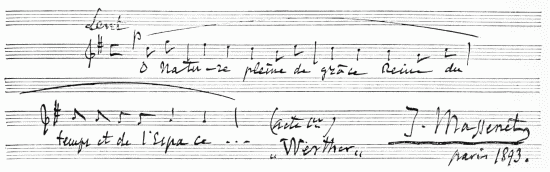
Long before Massenet's time, "Werther" had been set to music by Pugnani, musical director to the King of Sardinia. It was played at the Burg Theatre in Vienna in 1796. Pugnani's work was described as a symphony, which the composer sought to make as realistic as possible. On one occasion it was performed at Turin before a party of invited guests. Pugnani conducted in his shirt sleeves. At the moment when Werther dies, Pugnani pulled a pistol out of his pocket and fired it.
Blangini also wrote a cantata upon the same subject, which he entitled "Werther's Swan Song, half an hour before his death." At that time Werther's Lotte (Frau von Kestner) was still living in Hanover, and she journeyed to Cassel on purpose to hear Blangini's work.
A curious thing happened when Massenet's "Werther" was given at Weimar in 1892. Giessen, the Weimar tenor, was deputed to sing the title rôle. His real name happens to be Buff, and he is a grand-nephew of Lotte, whose name was also Buff. When the Weimar performance took place it was therefore discovered that Giessen had to make love to his own great-aunt. In the German version of the opera Goethe's text is faithfully followed. Both Lotte and Werther are drawn from life.
A few days after the first performance of "Werther" at Vienna a ballet, entitled "Le Carillon," by the same composer, to a scenario furnished by M. Van Dyck, was successfully produced upon the same boards. Massenet has another opera in readiness, which has not yet been presented to the public—"Thaïs," a lyrical drama in three acts, words by Louis Gallet.
The composer of "Werther" is an indefatigable worker, and being in the full force of his maturity, may yet be counted upon to further enrich the operatic répertoire. Concerning his powers of work the following story is related: The director of one of the French operas, in speaking with the composer, said, "My dear Master, give me the secret of your abnormal creative ability. Every day you listen to a crowd of singers, you attend every rehearsal, and, besides, you are professor at the Conservatoire. When do you find time to work?" "When you are asleep," replied Massenet, quickly. It is true that Massenet rises every day at five, and works incessantly until midday.
In the Supplement to the "Biographie des Musiciens" of Fétis, edited by M. Arthur Pougin, published in 1880, mention is made of two "lyrical dramas," entitled "Robert de France" and "Les Girondins," upon which the composer was supposed to be engaged at the time. I am not aware whether these have been finished or not. Recently he has terminated the orchestration of Léo Delibes' "Kassya," left unfinished.
Whatever the composer's defects may be (and who is free from them?), there can be no doubt that Massenet has indisputably a style of writing peculiar to himself, which is more than can be said of all of his "confrères." His individuality may not be so marked as that of Gounod, whose influence, by the way, can be traced in some of his compositions, but it is none the less existent, and has been reflected in the works of many of his pupils.
Few musicians can touch him in the art of handling the orchestra. At the time when he was studying at the Conservatoire he astonished every one by the prodigious amount of work he got through, and the ease with which he was able to compose. This facility of production does not seem to have deserted him, and the danger lies, not in his composing too little, but in producing too much.
Massenet's position is so well established that he can now afford to concentrate his mind upon his work without troubling himself as to whether or not it pleases the superficial portion of the public. What he now requires is a good subject and a well-written libretto. I trust he may find both.
Although necessarily absorbed by his multifarious labours, Massenet finds time occasionally to attend to his social duties. A story is told of how one evening, when he was dining out, the mistress of the house insisted upon making him listen to her daughter's playing. At the end of the performance, upon being asked his opinion, Massenet gravely remarked that it was quite evident that the young lady had received a Christian education. "Why?" ejaculated the surprised parent. "Because she so scrupulously observes the precept of the evangelist—her right hand knoweth not what her left hand doeth."
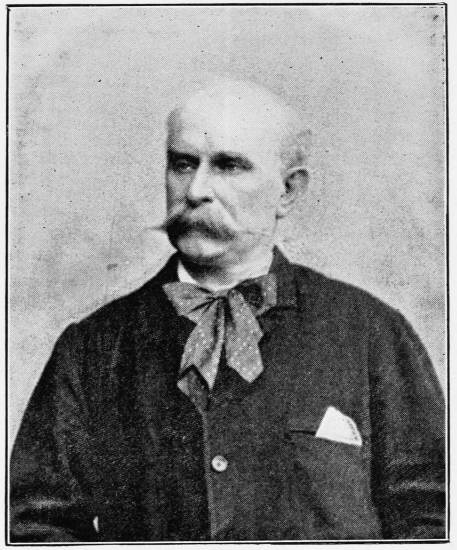
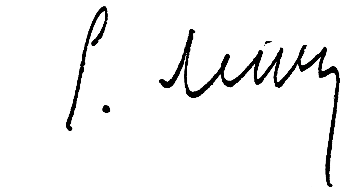
ERNEST REYER
"NOWADAYS, more than ever, musicians have the leisure to occupy themselves with other things than music."
These bitter words, savouring of disappointed expectations, occur in the preface to the volume entitled Notes de Musique, written by Ernest Reyer and published in 1875.
Since that time the author of the above lines has received a tardy compensation for a somewhat unaccountable neglect, and his operas "Sigurd" and "Salammbô" have achieved what promises to be a permanent success at the Paris Opera.
Although the composer of these works is but little known in this country, yet he none the less occupies an honourable position in the front rank of modern musicians. His "Sigurd," which was given at Covent Garden some few years since, did not meet with the success due to its unquestionable merits.
A man of strong convictions, imbued with a high ideal and averse to anything approaching the spirit of compromise, Ernest Reyer had to wait longer before receiving due recognition than if he had been disposed to pander to the taste of the public at the cost of his artistic principles. This he has never done but he has been satisfied to work quietly and wait patiently until his hour should arrive, careless of popularity, and content to devote his talents to the sole cause of art. Born on Dec. 1, 1823, at Marseilles, Ernest Reyer at the age of sixteen went to Algeria, where he spent some time, living with his uncle, who had an appointment in the province of Constantine.
It may be that the early influences of the milieu in which he was thrown may have had something to do with developing a tendency he exhibited later on of setting Oriental subjects to music. His first important work was an eastern symphonic ode, entitled "Le Sélam," the words of which were by Théophile Gautier, produced in 1850. This composition had the misfortune to come a little too late. Félicien David, in his "Désert," had already musically illustrated a subject in many ways similar, and the success of his work proved detrimental to that of his younger colleague.
Many years later (in 1876), Ernest Reyer was destined, curiously enough, to succeed Félicien David as a member of the Institute.
The début of Reyer as a dramatic composer dates from the year 1854, when "Maître Wolfram," a one-act opera, was produced at the Opéra Comique. This was followed in 1858 by "Sacuntala," a ballet, at the Opéra; and in 1861 by "La Statue," at the Théâtre Lyrique. It was this last work which brought the composer's name in a prominent manner before the public. The distrust that existed at that period against all musicians holding so-called "advanced" ideas naturally affected Ernest Reyer, who was known to be an intimate friend of Berlioz, and to hold unorthodox views with regard to the nature of dramatic music. "Le Sélam" had come too late, "La Statue" arrived too soon. At a time when the beauties of "Tannhaüser" were unrecognised and this work had been hissed off the stage, when even Gounod's "Faust" was looked upon with suspicion, it is not surprising that a work exhibiting qualities of so serious a nature as "La Statue" should have met with only a partial success. At the same time the qualities abounding in this work were recognised by the press, and its author was by common consent classed among the most rising composers and looked upon as one from whom much was to be expected.
"La Statue," in its original form, included spoken dialogue. On the occasion of its revival at the Opéra Comique in 1878, the composer set this to music, to the great advantage of his work, thereby insuring that continuity which nowadays is rightly regarded as essential in operas of serious import.
The music to this work is impregnated with an indefinable Oriental colouring which imparts to it an undoubted measure of charm.
To Félicien David must be accorded the credit of being perhaps the first to employ distinctively Eastern characteristics. It was doubtless this that helped to ensure the prodigious success that attended "Le Désert." Without in any way laying himself open to the charge of plagiarism, Reyer may be said to have followed in his footsteps with conspicuous success. Since then many composers have treated Oriental subjects, and have endeavoured to invest their music with the peculiar "cachet" associated with the East. Amongst these may be mentioned Bizet, in his "Pêcheurs de Perles" and "Djamileh," Rubinstein in "Feramors," Goldmark in "The Queen of Sheba," Saint-Saëns in "Samson et Dalila," Massenet in "Le Roi de Lahore," Bruneau in "Kérim," and Villiers Stanford in "The Veiled Prophet."
Bizet considered "La Statue" as the most remarkable opera that had been given in France for twenty years. It is sad that this, in company with many other works of value, should never have been offered to the judgment of the British public.
The composer's next operatic venture took place on German soil. It was at Baden-Baden, at that period in the prime of its glory and the chosen playground of Europe, that "Erostrate," a two act opera, was brought out in the summer of 1862.
Nothing at that moment seemed to presage any strained relations between France and Germany. French tourists came in crowds to the gay watering-place and deposited their offerings with a light heart in the temple of chance presided over by Mons. Bénazet; that very same year a cantata, the words of which were by Méry and the music by Reyer, given at Baden-Baden, celebrated the praises of "The Rhine, symbol of peace."
Quantum mutatus ab illis. The French element disappeared with the war of 1870, and the suppression of the tables has long since brought Baden-Baden down to the same level of respectability as many another "Kurort."
Musical amateurs sojourning in the picturesque valley of the Grand Duchy of Baden at this epoch seem to have had a good time of it.
Berlioz was in the habit of directing every year a grand festival at which were performed extracts from his orchestral works. Reyer states that each concert given by Berlioz used to cost a matter of 20,000 francs to Mons. Bénazet the energetic head of the "Kurhaus." Certain it is that this enterprising director must have had strong musical proclivities, for it is to his initiative that the production of Berlioz's "Béatrice et Benédict" is due. This work served to inaugurate the opening of the new theatre at Baden. Two days later witnessed the first performance of Reyer's "Erostrate," which was shortly afterwards followed by another new work, "Nahel," by Henry Litolff. "Erostrate" seems to have pleased the cosmopolitan public of Baden better than it did Parisian amateurs when it was transferred to the Grand Opéra ten years later, where it was only accorded two representations. The composer was reproached at this time for having dedicated his score to the Queen of Prussia. As if it were possible for any one, in 1862, to foresee the course of events that were destined to happen in 1870. Patriotism occasionally seems to have the effect of deadening the intelligence.
It certainly appears strange that after the favourable reception accorded to "La Statue" in 1861, Reyer should have been ostracised from the Paris theatres, if we except the two performances of "Erostrate" in 1872, and the revivals of "Maître Wolfram" in 1873, and of "La Statue" in 1878, for a period of twenty-four years, when he made a triumphal reappearance at the Opéra with "Sigurd." This last opera had been performed the year before at Brussels.
The Belgian capital seems to be a sort of refuge for those French composers who experience a difficulty in obtaining a hearing in their own country.
It was at the Théâtre de la Monnaie that the following operas were first produced: Reyer's "Sigurd" and "Salammbô," Massenet's "Hérodiade," the brothers Hillemacher's "St. Mégrin," Godard's "Jocelyn," and Chabrier's "Gwendoline." It was also there that some of Wagner's later music dramas were heard for the first time in French.
"Sigurd" had been composed many years previous to its production on the stage, and fragments had frequently been introduced into the concert-room. I recollect myself hearing an important extract performed at one of the far-famed Conservatoire concerts, and the overture at one of Pasdeloup's concerts, in 1876. The subject of this opera is taken from the same source as Wagner's "Ring des Nibelungen."
Sigurd and Siegfried are one and the same individual, and many of the incidents of the French composer's opera are identical with those that occur in the "Götterdammerŭng." This is, of course, unfortunate, and although it has been pointed out that Reyer composed his work before the completion of the "Ring," yet he must have been aware that the German master was treating the same subject, considering that Wagner had published the poem of his four works as far back as 1853. Notwithstanding the reputation he had already achieved, endless difficulties had to be surmounted before Reyer was able to get his work performed. The nature of the subject frightened Mons. Halanzier, the then director of the Paris Opéra, who imagined that the barbarous sounding names of the leading characters might prove objectionable to the public. Who had ever heard of Sigurd, Hagen, Gunther, or Hilda? The last name seemed especially to act upon his nerves. "Why not call her Bilda?" he exclaimed. "Do I call you Balanzier?" answered Reyer. There was nothing for the luckless composer to do but wait for another opportunity, which happily occurred some years later.
It is immensely to the French composer's credit that, in spite of inevitable comparisons, he should have been able to succeed as well as he has.
"Sigurd" is full of dramatic power, and bears evidence of the constant endeavour of the composer to fit his music to the sense of the words, avoiding as much as possible any of those conventional effects so dear to the uneducated section of the public. His style has been described as proceeding from Gluck and Weber, whilst his admiration for Berlioz and Wagner reveals itself in the richness and variety of his instrumentation. This appreciation is perfectly correct, and although his operas may be criticised in some respects, they reveal a true artistic temperament both in their method and execution. It may be said with truth that Reyer's individuality is not of the most marked, that his melodies sometimes lack distinction, and that his inventive faculty is scarcely equal to his skill in making the most of his materials; but none will contest the true artistic feeling that presides over all his compositions, or deny him the possession of strongly pronounced convictions impelling him to do his utmost towards raising the standard of operatic art.
After having been the first town to offer hospitality to "Sigurd," Brussels was destined to have the primeur of "Salammbô," the last opera that Reyer has composed, which was brought out in 1890 with great éclat, and produced later on in Paris, where it at once succeeded in establishing itself in the favour of the public. Perhaps of somewhat less sustained interest than "Sigurd," the music of "Salammbô" shows the same tendencies on the part of its composer to adhere to a strict interpretation of the drama, and contains many pages of great beauty. Those who have read Flaubert's powerful and imaginative work will probably consider it somewhat unsuited for the purposes of a "lyrical drama." It must be admitted, however, that the composer has found in it a subject well adapted to his artistic temperament, and that it has enabled him to produce a work which is an honour both to himself and to his country.
The production of "Salammbô" in London is an event much to be desired, and a revival of "Sigurd" would also be of the greatest interest. Now that the British public are more familiarised with Wagner's "Nibelungen Ring" they would be able to draw interesting comparisons between the treatment of the same legend by the German master and the French composer.
If Reyer has acquired a well deserved reputation in France as a composer, he is equally well known as a writer on music, and for many years has occupied the post of critic to the Journal des Débats, formerly held by Berlioz.
The opinions advanced by Reyer have always been remarkable for sound common sense. An intimate friend and ardent admirer of Berlioz, he enjoys the credit of having been one of the first in France to recognise the genius of Wagner.
The perfect honesty of his convictions is apparent to those who read his writings with care, and it may in passing be noted to his honour that when the course of time and increased acquaintance with his subject have caused him to modify any previously expressed opinions, he has never hesitated to say so. No one is infallible, but many pretend so to be.
When travelling in Germany in 1864 Reyer, who was already a strong admirer of Wagner's earlier works, had occasion to run through the score of "Tristan," then still unperformed. The first impressions produced upon him by this most complicated of scores was not a favourable one, and Reyer in stating this avowed that his admiration for the German master would stop at "Lohengrin," until the beauties of the "Nibelungen Ring" should have been revealed to him.
In 1884 when the first act of "Tristan" was given at one of Mons. Lamoureux's concerts, Reyer made amends for the appreciation somewhat hastily recorded by him twenty years previously by expressing his intense admiration for the wondrous beauties of this sublime work. "What a metamorphosis," he wrote, "had taken place in my musical faculties during twenty years! But also what a difference in the execution! It was the first time that I was hearing 'Tristan' with the orchestra."
Reyer in his criticisms has always held up the banner of high art, and his writings will doubtless not have been without influence in determining the nature of the musical movement in France during these last few years. His admiration for Berlioz has not diminished, whilst his admiration for Wagner has increased. Apropos of the "Proserpine" of Saint-Saëns, he wrote: "We are practically all affected with Wagnerism, perhaps at different degrees; but we have drunk and we will drink at the same source, and the sole precaution for us to take is not to drown our own personality."
This frank avowal may not be to the taste of all French composers, but it is none the less true.
Ernest Reyer has almost entirely confined himself to operatic compositions. He is not a quick worker, and his operas all bear evidence of thought and an avoidance of claptrap effects.
He is still a bachelor and has the appearance rather of a retired military officer than of the traditional musician. Reyer is bibliothécaire of the Opéra, and inhabits a quiet little apartment on a fifth floor, where he is able to work undisturbed and meditate upon the trials and uncertainties of a composer's existence.
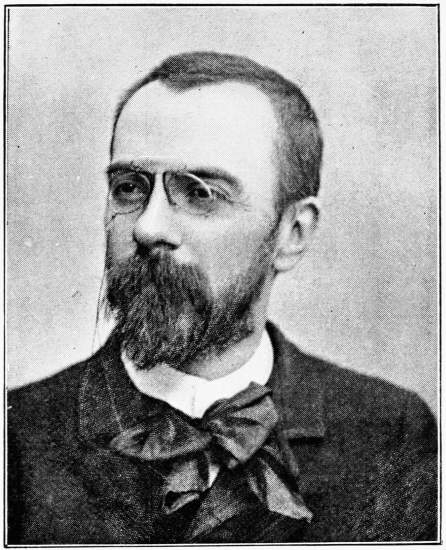
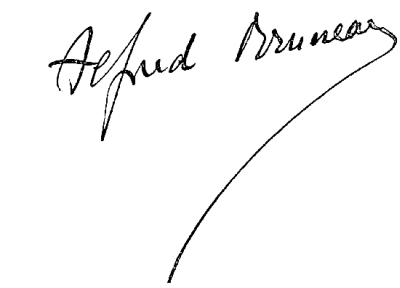
ALFRED BRUNEAU
IN the month of November 1891, there was brought out at Covent Garden Theatre a work that had the effect of setting the musical world of London into a state of ferment. This was "Le Rêve," a musical rendering of Emile Zola's well-known romance, by the composer whose name heads this chapter. The absolute unconventionality of the music, the boldness and the novelty of the composer's method, took the public by surprise and led to many a discussion, at the end of which both antagonists and supporters remained unconvinced and, as is generally the case, retained their own opinions.
It has always appeared to me to be idle to attempt to impose one's ideas upon the relative merits of a composition on those whose disposition is antagonistic to its due appreciation. There are many to whom the later works of Wagner appear as a senseless agglomeration of notes, devoid of meaning and destitute of feeling, a mere jumble of sound. These people are doubtless absolutely sincere in their convictions. Where is the argument that would cause them to change their minds? If no sympathetic current is generated between the music and the listener, it may be taken for granted that these are not meant one for another, and all the arguments in the world will not alter the fact. On the other hand there can be no doubt that increased familiarity often causes the reversal of a previously expressed opinion, one sometimes formulated in undue haste, and this is especially the case with a work such as "Le Rêve," the tendencies of which are so novel and the methods so uncompromising in their thoroughness.
The composer has boldly flown in the face of recognised traditions and flung all compromise to the four winds. He has treated "Le Rêve" according to his own ideas, careless as to whether these should be agreeable to the vocalist, who looks upon an opera solely as the means of displaying his voice; to the average amateur, whose fondness for a good square tune of doubtful originality is as great as ever; or to the musical pedant who gauges the value of an art-work according to the theoretical ideas of a past generation.
Art and literature have during the last few years been invaded by a strong current of realism. The marked tendency exhibited by the present generation of inquiring minutely into all matters and subjecting them to a searching process of analysis, has been pregnant in its results. The physiology of the mind appears to be the leading factor in the works of many of the lights of contemporary literature. This is discernible in the writings of poets like Swinburne and George Barlow, in the novels of Emile Zola and Alphonse Daudet, and in the studies of Tolstoï, to mention only a few. In music the same tendencies are apparent, and it is rather the inner motives of the action than its outward details that the serious operatic composer is tempted to depict.
Bruneau exemplifies the latest phase of that evolution that has been taking place during recent years in the domain of dramatic music. It may be taken for granted that the theory enunciated by Gluck in his preface to "Alceste" more than a hundred years ago has now come to be universally adopted. This is, that "the true aim and object of dramatic music is to enhance the effect and situations of a poem, without interrupting the dramatic action or marring the effect by unnecessary ornamentation." It is this which forms the basis of Wagner's theories. There are, however, many other points of importance raised by the German master which practically amount to innovations. Of these none has perhaps a greater bearing on the construction of the "lyrical drama" of the future than the employment of leit-motiven, or representative themes.
It has been argued that Wagner can scarcely claim to be the actual inventor of this device.
To this it may be replied that Wagner's method differs essentially from that followed by any of his predecessors. The bare repetition of a phrase previously heard may be dramatically significant, but it only represents the Wagnerian idea in its most embryonic form, and has little in common with a system subject to which an entire opera is constructed upon a certain number of themes susceptible of being modified and transformed according to the sentiments expressed by the words. Whatever objections may be adduced against such a system if pushed to its furthest limits and adopted as rigorously as Wagner has in his later "music dramas," it must be conceded that it opens a large field to the composer and adds a powerful element of interest to the musical exposition of a plot.
So far, French composers who have profited by Wagner's many innovations have shown themselves shy in following the master in this particular one. Some of them have, it is true, adopted it to a certain extent, and endeavoured to effect a compromise by trying at the same time to retain set pieces of the kind associated with the older forms of opera. Saint-Saëns in "Henri VIII." and "Ascanio," Massenet in "Esclarmonde," to name only two, have exhibited a marked tendency in this direction. It has, however, been reserved for Alfred Bruneau to employ the Wagnerian plan in a more complete way than any French composer has yet done. I am not here venturing to express an opinion as to whether or not the total absence of set form in an opera is advisable. It is evidently quite possible to compose a "lyrical drama" on a different plan than one entailing the strict employment of representative themes. Art should comprise every method that is likely to add to its scope, and the use of leit-motiven opens a vista of illimitable possibilities to the composer of the future. It is a powerful agent of dramatic expression, and one which requires musical ability of a very high order if it is to be employed in any profitable manner. When I mention Alfred Bruneau as being perhaps the first French composer who has applied the Wagnerian system so thoroughly in his "lyrical dramas," it must not be implied that he is in any way a servile imitator of the German master, and he must not be confounded with composers who, having no original ideas of their own, trade upon those of other people. As his friend and collaborator Mons. Louis Gallet remarks in his Notes d'un Librettiste, "Son criterium est tout personel." There is one point, for instance, in which he diverges entirely from Wagner. This is in his choice of subjects. Instead of searching for inspiration in the legendary lore so dear to the composer of "Tristan," Bruneau prefers to musically illustrate a story of modern life. His ideas upon the lyrical drama are best expressed in his own words, and I do not scruple to reproduce the following passage from a letter addressed to myself: "Je suis pour l'union aussi intime que possible de la musique et des paroles, et voudrais faire du théâtre vivant, humain et bref. J'aurais aussi l'ambition de traiter une suite de sujets essentiellement Français et modernes d'action comme de sentiments. C'est pourquoi, après 'Le Rêve,' d'un mysticisme bien Français je crois, viendra 'L'Attaque du moulin,' drame pris au cœur saignant de notre pays. Mais la suite n'est qu'un projet que je n'aurai peut-être jamais la force de mettre à exécution."
It is the human element that predominates in Bruneau's compositions which constitutes so powerful a fascination to those who are in sympathy with his ideas. His music is not theatrical in the ordinary acceptation of the term but intensely dramatic, inasmuch as it aims at depicting the innermost details of the action, and describes in searching accents the varied emotions of the leading characters.
He has been blamed for his disregard of the so-called rules of harmony, and for apparently revelling in the employment of discords, strange progressions, and harsh modulations. Let it be remembered that there is scarcely a composer of eminence who has not been subjected to the same reproach. To take a few of the most notable instances, it is only necessary to mention the cases of Schumann, Wagner, Berlioz, and Bizet. A name that may carry conviction even further is that of Beethoven. Is it not a fact that within the memory of some who are still amongst us, the "Choral Symphony" was stigmatised as the work of a genius whose powers were on the wane, and this mighty work was pronounced dull and incoherent?
The question as to how far a composer may go in his search after novel effects, and what discords he may or may not employ, is one that cannot easily be answered. Where is the musician who will have the presumption to erect himself as the supreme arbiter upon so complex a question, and venture to say to the composer, "Thus far shalt thou go and no further?"
Undoubtedly there must be rules of some kind, but these are intended for the student and are not meant to hamper the inspiration of the master. In order to explain my meaning I cannot do better than quote the following extract from the preface of Mr. Ebenezer Prout's admirable work on "Harmony,"[27] which conclusively disposes of the question:
"The principle must surely be wrong which places the rules of an early stage of musical development above the inspirations of genius! Haydn, when asked according to what rules he had introduced a certain harmony, replied that 'The rules were all his very obedient humble servants;' and when we find that in our own time Wagner, or Brahms, or Dvórak, breaks some rule given in old text books, there is, to say the least, a very strong presumption, not that the composer is wrong, but that the rule needs modifying. In other words practice must precede theory. The inspired composer goes first, and invents new effects; it is the business of the theorist not to cavil at every novelty, but to follow modestly behind, and make his rules conform to the practice of the master."
These are golden words, involving a precept that should be seriously taken to heart by those who are inclined to pass a hasty verdict upon works exhibiting tendencies of a novel nature. At the same time it does not follow that composers of inferior talent should be allowed a liberty which with them often degenerates into licence, and imagine that it is only necessary for them to stud their scores with consecutive fifths and octaves, and avoid any but the most out-of-the-way modulations in order at once to be ranked as men of genius. There is a vast amount of difference between the crude harmonies, obviously introduced for effect, that occur in the scores of some composers, and those employed with a due sense of dramatic fitness by a musician like Bruneau.
The composer of "Le Rêve" was born on the 1st of March 1857. He is, therefore, at the present time in the full flush of his creative ability, and his powers of production have doubtless not yet reached their full maturity of expression. There is no knowing how far a musician of his calibre may not eventually go, or what works he may be destined to produce. Up to the present he has shown a wonderful amount of independence of thought, and his very exaggerations are the evident outcome of a consistent striving to attain an elevated ideal.
Alfred Bruneau's musical studies were begun in a brilliant manner at the Paris Conservatoire, where he obtained the first prize for violoncello in 1876. He entered into the composition class, presided over by Massenet, and finally, in 1881, triumphantly carried off the "Prix de Rome." This was already a great step towards fame and fortune, although it has been proved over and over again that it leads to neither. Many an old winner of the "Prix de Rome" has, after a fruitless struggle, been compelled to give up the game and resign himself to a life of comparative obscurity. For an artist to remain true to his convictions and resist the temptations thrown in his way of obtaining an ephemeral popularity by pandering to the taste of the public, is not always so easy an achievement as it may appear. It was through the means of the concert-room that Alfred Bruneau's name first became known to the musical public of Paris. An "Ouverture Héroïque," a symphonic poem entitled "La Belle au bois dormant," and "Léda," styled a "poème antique;" these works were played at different times, and sufficed to stamp their author as a musician of undeniable capacity and distinct promise. "Penthésilée" is the name of a symphonic poem of great daring and originality for a solo voice and orchestra, which was only recently produced at one of Mons. Colonne's concerts. It is a musical interpretation of some wild and striking stanzas by the poet Catulle Mendès. Thoroughly independent in structure as it is in its workmanship, bold almost to excess, distinguished by a most unconventional harmonic treatment, this composition exhibits a masterly grip that irresistibly commands attention. The interest may be said to be mainly concentrated in the orchestra, the voice part being strictly declamatory.
It is, however, through his conception of the "lyrical drama" that Bruneau especially asserts his individuality.
"Kérim," his first stage work, brought out in 1887 at the Théâtre du Chateau d'Eau, provisionally given up to operatic performances, does not appear to have excited much attention, possibly owing to the inadequacy of the interpretation. In this work, the tendencies which are so accentuated in "Le Rêve" are already foreshadowed. There is but little in this interesting score that denotes the beginner, and "Kérim" is distinguished by qualities for which we may search in vain through the pages of many works that have acquired a greater popularity. For some reason hard to assign, operas dealing with Eastern subjects do not seem to appeal readily to the taste of the public, at any rate in England. And yet what delightful musical impressions are evoked by the recollection of works such as Goldmark's "Queen of Sheba," Cornelius' "Barber of Bagdad," Bizet's "Djamileh" and others! It may be remarked en passant that the fact of the first of these works being practically unknown on this side of the channel scarcely redounds to our credit.
From the very first page of "Kérim," it becomes evident that we are in the presence of a composer who has something new to say and who intends to say it whether or not it pleases the musical faculty or those who measure the value of a work according to a preconceived standard.
In the matter of harmonic boldness Bruneau goes to very great lengths, and from this point of view alone the score of "Kérim" will prove highly interesting to musicians. The plan upon which he works is admirably logical. He commences by exposing some of his most important themes in their simplest guise, so that they may in a way impose themselves upon the attention of the listener. These are then subjected to various transformations according to the sense of the words they are intended to interpret, and are heard in different forms, either singly or jointly, being employed in combination when the composer has in view the expression of some complex sentiment. It is this system, which in a more embryonic form is apparent in "Kérim," that constitutes the constructive basis of "Le Rêve."
The first of these works, which is termed an opera, but has more of the characteristics of the lyrical drama, treats of an Eastern legend.
An emir of Beyrouth (nothing in common with Baireuth!), is in love with an unknown maiden who appears to him in his sleep and tells him that she will belong to him if he finds her some tears that are the outcome of a truly suffering heart. These will then be turned into pearls which he can offer her. The emir pursues his quest far and wide without success, and finally himself bursts into tears which are suddenly transformed into pearls. The object of his thoughts then appears and tells him that he has found what she required, and that the tears produced by genuine love have won her as his own.
It can scarcely be said that the above story offers material of a particular interesting order. It has, however, been sufficient to furnish Bruneau with the opportunity of exercising his skill and displaying his fancy often to great advantage. Before taking leave of "Kérim" I may point out, for the benefit of those who might experience the curiosity of perusing this score, the monologue for tenor in the first act with its delightful accompaniment in canon, the effective treatment of some popular Oriental tunes, and specially the consistent working out of the representative themes. I must also mention the delicious "Adagietto," sung by the heroine in the last act, as an example of simple and pure melody.
There are certain legends that require a long time before they are dispelled, and the accusation that for a considerable while hung over the heads of Wagner and Berlioz of being deficient in melodic power, has been levelled against many other composers. Bruneau has not escaped it, but he may console himself with the thought that he is in very good company. It is I think Liszt who invented the excellent definition of a species of melody "à plusieurs étages," which it is not given to every one to grasp.
We now come to the work that has been instrumental in bringing the name of Bruneau to the front in a prominent manner. If "Le Rêve," which was first played at the Paris Opéra Comique in 1891, has given rise to much controversy, it has at any rate not been passed by in silence or damned with faint praise.
The mysticism and poetical charm of Zola's book, so different to the majority of novels by the apostle of realism, has caused it to be widely appreciated even in circles where his romances are not usually admitted. Bruneau's desire originally had been to write a "lyrical drama" upon "La Faute de l'abbé Mouret." It was only when he found that Massenet had chosen the same subject that he was forced to give up the idea and turn his attention to "Le Rêve." I am not aware whether Massenet has abandoned his intention of turning "La Faute de l'abbé Mouret" into an opera or not. Now that composers appear bent upon introducing realism into their music, it is not impossible that even "L'Assommoir" may eventually serve as the groundwork of an operatic textbook. We trust that this will not be so. However realistic musicians may strive to be, they should not associate their muse with themes that are not susceptible of being idealised.
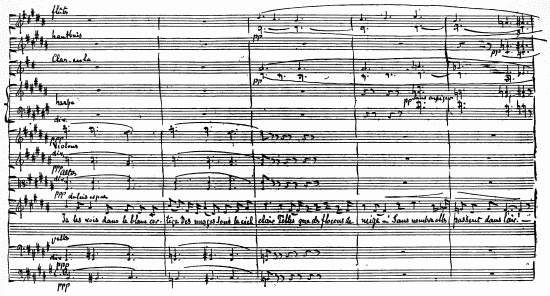
FACSIMILE OF AUTOGRAPH SCORE OF "LE RÊVE" Act I.
The desire nowadays of musically photographing, if I may employ a somewhat far-fetched comparison, certain types of humanity is excellent in its way. But it is as well in so doing to choose a period remote from ours, where no sense of incongruity can be produced through the appearance of operatic characters clad in the prosaic garb of the present day. The general characteristics of humanity have always been the same, and Wagner, with his marvellous poetical insight, knew well what he was about when he drew the subjects of his "music dramas" from mythical sources.
In "Le Rêve" Bruneau has written a work remarkable in point of originality and sustained expression. His music must be either accepted in its entirety or rejected altogether. Upon those who appreciate its beauties it exercises an irresistible fascination. Bruneau is a psychologist, and he aims at musically describing the innermost feelings of the soul. He has also in "Le Rêve" proved himself to be an idealist.
I will in a few words endeavour to sketch the subject-matter of this admirable work.
Angélique is a young girl, the adopted child of a respectable old couple, embroiderers by trade. She is subject to hallucinations, and through constantly reading a book entitled "The Golden Legend," dealing with the lives of saints and martyrs, fancies she hears voices in the air, and dreams of the arrival of a prince who will come and carry her off. As the first scene closes, she imagines she sees the one she has been dreaming of, who turns out to be the son of the Bishop Jean d'Hautecœur, still sorrowing for the wife he lost many years ago. It stands to reason that the two young people fall in love with one another, and that the course of their love, according to the usual precedent, does not run smooth. The bishop intends his son to become a priest and refuses to consent to his marriage, remaining deaf to his entreaties. Angélique thereupon pines away and is on the point of death, when her lover finally induces his father to give in, and save her by performing a miracle such as was accomplished by his ancestor, who cured the sufferers of a plague by kissing them on the forehead and using the words, "Si Dieu veut, je veux," which have since become the motto of his family. The Bishop yields and performs the miracle. The lovers are about to be united, but at the very porch of the church where they are to be married, Angélique hears voices in the air calling to her, she staggers, and dies. This last scene was omitted at Covent Garden.
As I have previously remarked, "Le Rêve" is constructed entirely upon a number of representative themes. There is a practically complete absence of set pieces, the work running its course uninterruptedly without a break. Bruneau has in fact treated his setting of Zola's book in a form that might be best described as "speech in song" accompanied by an orchestral commentary. It is doubtful though whether the word "accompany" can be used at all in connection with his music, seeing that the most important part is allotted to the orchestra. The themes employed are most impressive, thoroughly characteristic, and well adapted for polyphonic treatment. There are certain scenes in which the melodic interest lies mainly in the voice parts, although the instrumental portion is invariably pregnant with suggestion, fragments of motives being blended together and worked in with consummate skill. Angélique's appeal to the Bishop is one of these, and is marked by genuine dramatic feeling. One of the most strikingly original scenes is the one comprising the Bishop's monologue. The poignant accents are admirably fitted to describe the emotions of one whose life has been blighted through the loss of the woman he loved, and whose determination to force his son into the priesthood is shaken by the affection he bears him.
Pages such as these are sufficient in themselves to stamp their author as an artist of the first rank and a musician of genius.
The chorus occupies but a small place in "Le Rêve," and the choristers are never seen upon the stage. A few bars for the sopranos, supposed to represent the voices in the air heard by Angélique, an "Ave verum," sung in the cathedral, and an old French hymn heard in the distance sung as a procession is passing underneath the windows, represent the choral numbers.
At the commencement of the second scene we have a lively dance to an old French tune. In this place I think the effect would have been greatly enhanced by the adjunction of voices to the orchestra. This would have been æsthetically correct, as there is a certain incongruity in the fact of a number of young girls dancing and apparently enjoying themselves in silence.
I would draw attention to the admirable delineation of the dear old embroiderers, as kindly a couple as could well be imagined, a creation that Dickens might well envy, whose characteristics have been musically transcribed by Bruneau in accents so suave and so touching.
The composer of "Le Rêve" possesses the sense of contrast to a very high degree. Witness the manner in which he has set the following words when the Bishop describes how his motto, "Si Dieu veut, je veux!" came to be adopted by his family:
"Pendant une peste cruelle, Il pria tant que Dieu le fit vainqueur Du terrible fléau.—Pour ramener la vie Aux corps déjà glacés par l'agonie, Il se penchait vers eux, Les baisait sur la bouche et n'avait rien qu'à dire Aux mourants: 'Si Dieu veut, je veux!' On voyait les mourants sourire; Car, dès qu'il les touchait des lèvres seulement, Les malades étaient guéris soudainement."[28]
The part dealing with the description of the plague is accompanied by a strange and gruesome succession of chords, which gradually leads to a lovely melody typical of the miracle that is supposed to have been worked. Nothing can be more appropriate than the strains that accompany the above words to which they appear intimately allied.
When "Le Rêve" was given at Covent Garden it was accorded a well-nigh perfect rendering. Mdlle. Simonnet realised the character of Angélique to the life, and imparted an infinity of charm to the music. The part of the Bishop furnished Mons. Bouvet with the opportunity of presenting an admirable character study. The remaining parts were exceptionally well performed by Mdme. Deschamps-Jéhin, and Messrs. Engel and Lorrain. A better ensemble it would be difficult to imagine. The orchestra was conducted by Mons. Jéhin.
Like so many other composers, Alfred Bruneau is also a musical critic, and has succeeded the late Victor Wilder in that capacity upon the Gil Blas.
Victor Wilder was ever one of the strongest advocates of Wagner on the Parisian press, and it is to him that are due the excellent translations into French of the master's later music dramas.
It may be interesting to my readers to peruse a specimen of Bruneau's writing, and I will therefore cite an extract from an article he lately wrote concerning the first performance of the "Walküre" in Paris, in which he lucidly defines the difference existing between the old-fashioned opera and the "lyrical drama." I must apologise if my translation fails to do justice to the original.
"It is not only the independence of music (l'indépendence des sons) that we owe to Richard Wagner. Owing to his prodigious genius, the musical drama has entered into a new era, an era of true reason, of rigorous good sense and of perfect logic. No one nowadays is unaware of the profound dissimilarity existing between the 'lyrical drama' and the opera. In the one, the music unites itself intimately to the poetry in order to impart life, movement, passionate interest to a human action, the course of which must run uninterruptedly from the rising of the curtain to the last scene.
"In the other, the music is divided into a number of pieces which are occasionally nothing but cumbersome hors d'œuvres, the traditional form of which hampers the action of actors and choristers contrary to the most elementary scenic necessities.
"In the one, the symphony comments upon the inward thoughts of the different characters, makes known the reasons that cause them to act, and whilst depicting their natures, magically evokes before our eyes the subtle and fabulous scenes dreamed of by our fancy.
"In the other, with a singular docility, the orchestra submits itself to the slavery of the voice. Its function, which is absolutely secondary, consists in accompanying the voices, in playing ritournelles, in striking a few chords during which the recitatives are being declaimed, and in more or less harmoniously accompanying the entries and exits.
"Alone the overture is reserved; and even this often serves but as a pretext for the composition of a piece of instrumental display rather than as a description of sentiments and facts.
"In the one, the melody is infinite, as Richard Wagner has rightly expressed it; it goes and comes, moves from the voices to the orchestra, ever renewing itself in the freedom of its flight.
"In the other, it appears only in certain places: if the vocal portion is melodious, the accompaniment is rudimentary and the traditional recitative endlessly intervening in the middle of the music in order to divide it into set forms, arbitrarily condemns melody to submit to wretched formulas and snatches away its wings."
In the course of the same article, Bruneau expresses himself thus:
"These are, however, terms imagined rather for the purpose of defending certain ideas than for designating certain works, as there exist in the classical form of opera masterpieces worthy of eternal and fervent admiration. One does not necessarily run down works such as 'Don Juan,' 'Fidelio,' 'Iphigénie,' and so many others in desiring the rejuvenescence of an art that owes to these masterpieces its imperishable glory.
"After Gluck, Mozart, Beethoven, Wagner, fresh innovators will come, who, respectful of the traditions of the past and eager for the conquests of the future, will still further enlarge the field of action of the musical drama."
The above words may be taken in a measure as furnishing Bruneau's profession of faith as regards matters operatic. He has finished the score of a new "lyrical drama" entitled "L'Attaque du Moulin," founded upon a tale of Zola, which at the time I am writing has not yet been performed. It is to be produced shortly at the Paris Opéra Comique Theatre.
I must not fail to allude to Bruneau's characteristic settings of Catulle Mendès' "Lieds de France," which are distinguished by an evidently studied simplicity of expression.
Unless I am mistaken, it was the late Victor Wilder, his predecessor on the Gil Blas who once alluded to the composer of "Le Rêve" as "the standard-bearer of the young French school," a qualification to which he is, in my humble estimation, well entitled.
NOTE.—Since this volume has gone to press, "L'Attaque du Moulin" has been produced at the Paris Opéra Comique, with great success.
SOME OTHER FRENCH COMPOSERS
IT may with truth be averred that France has never been so well provided with composers of talent as she is at the present time. Every year the far-famed Conservatoire turns out a number of young men whose musical knowledge is undeniable, and who are all of them filled with buoyant hopes of achieving distinction in the arena of fame. The musical progress that has been effected in France during the last thirty years is immense. This may be largely attributed to the initiative of Pasdeloup[29] the organiser and conductor of the celebrated concerts which were started at the Cirque d'Hiver in 1861, and to the zeal and talent of his successors Messrs. Lamoureux and Colonne. It is through the efforts of the above indefatigable chefs d'orchestre that instrumental music of a high class has come to be generally appreciated in Paris. The famous Conservatoire concerts, it must be remembered, were, and are, only accessible to a few privileged individuals.
Pasdeloup began his work by familiarising the Parisians with the symphonic works of Haydn, Mozart and Beethoven. Mendelssohn and Schumann followed, and the valiant chef d'orchestre from time to time introduced the names of Berlioz and Wagner. The appearance of the latter on the programme generally foreshadowed a disturbance. Nowadays, when we witness the spectacle of large crowds listening in wrapt attention to some of the most complicated works of the great master at the concerts of Messrs. Lamoureux and Colonne, it seems difficult to realise the possibility of such turbulent scenes as I remember myself witnessing only a few years since at the Pasdeloup concerts. On one occasion a performance of the Prelude to "Lohengrin" produced a veritable disturbance, one section of the audience desiring to hear it over again in spite of the manifest opposition displayed by the major portion of the spectators. Pasdeloup adopted the sensible course of making an impromptu speech, in which he said that as many people wished to hear the Prelude once more he would repeat it at the end of the concert, when those who objected to it would be at liberty to retire. By thus severing the Gordian knot the clever chef d'orchestre effectually disposed of the difficulty to the manifest disappointment of the anti-Wagnerites present.
The members of the younger generation of French composers have had no cause to complain of any want of hospitality at the hands of either Pasdeloup or Messrs. Lamoureux[30] and Colonne,[31] and many a now well-known musician has won his spurs through their help.
It would almost appear as if a veil which for a long period had obscured the vision of the musical section of the public had at length been removed. The genius of Berlioz and that of Wagner are now uncontested, unless it be by a few retrograde individuals whose opinions are not entitled to any weight, and the influence of these masters upon the modern French school has been both great and far-reaching. It is highly regrettable that the spirit of free trade is not acted upon to a greater extent in the matter of musical affairs. If this were the case we should be afforded more chances of becoming acquainted with the works of those members of the young, and if I may so term it, militant French school, which are not sufficiently known on this side of the channel.
In like manner, our native composers might be given the opportunity of proving to the Parisians the fallacy of the notion, seemingly entertained abroad, that England is destitute of creative musical talent. Art has not, or ought not to have, any boundaries. That which is good deserves to be known and to survive; as for the rest, it matters not.
In music, time seems to march with disconcerting rapidity. Composers who but a few years since were considered as hopelessly advanced in their ideas are now in danger of being left behind by their juniors.
One of the most ardent champions of the new school of thought some years ago was Victorin Joncières, who enjoys a well-established reputation in Paris as composer and critic.
Born in 1839, this artist is the author of several operas denoting aptitudes of no mean order, although devoid of any distinctive originality. Passing by such early works as "Sardanapale" (1867), and "Le dernier jour de Pompei" (1869), we come to "Dimitri," which contains several good numbers, "La Reine Berthe" (1878), and "Le Chevalier Jean" (1885). This last work has been played in Germany with success under the title of "Johann von Löthringen." "Dimitri" and "Le Chevalier Jean" may be looked upon as the composer's best operas.
The influence of Wagner's earlier style is very apparent in these works. Mons. Joncières is also the author of an interesting "Symphonie Romantique." As a critic he has done much to aid the cause of Wagner in France, although not going to the length of some of the master's thick and thin admirers.
A musician of a different type is Théodore Dubois, born in 1837. This composer, like his friend Camille Saint-Saëns, whom he succeeded as organist at the Madeleine, has written a great deal and attempted a variety of genres. Amongst his works it will be sufficient to mention the opera "Aben Hamet," the ballet "La Farandole," the concert overture "Frithjoff," "Paradise Lost," an oratorio which gained the prize offered by the city of Paris in 1878, and his setting of the "Seven Words of the Cross" (1867).
Besides these, Théodore Dubois, who won the "Prix de Rome" in 1861, is the author of a number of orchestral works, piano music, and religious compositions which denote talent of an uncommon order and exhibit qualities that entitle him to occupy an important place amongst contemporary musicians.
Another composer whose name is better known in England, and who has also achieved distinction as an organist, is Charles Marie Widor, born in 1845, several of whose compositions have been heard at the Philharmonic and Crystal Palace Concerts. This composer has given proof of a considerable amount of versatility in his different contributions to orchestral and chamber music, also in his charming ballet "La Korrigane." His opera "Maître Ambros" did not meet with success. He has also written a quantity of excellent piano music and many songs. There is imagination and skill displayed in Widor's compositions, and much may yet be expected from him.
If the name of Widor is known in England, the same may be said of Benjamin Godard, born in 1849, in whom we have one of the most prolific of the younger generation of French composers. Godard exhibits a decided individuality of his own. He is endowed with an extraordinary facility of production, and is, in fact, apt to err on the side of over-productivity, and to spread his talents over too large an area. His dramatic poem "Le Tasse," which won the prize offered by the city of Paris in 1879, is a work of considerable importance, revealing an undoubted personality.
With his operas "Pedro de Zalamea," "Jocelyn," "Dante," Godard has been less successful. It is in works such as the "Concerto Romantique" for violin, the "Symphonie Légendaire," the piano trio, amongst others, that his talent finds its true expression. The composer of these works is in the full force of his powers, and it is not too much to state the belief that he has yet much to say. Godard is perhaps greater in small things than he is in large. There is an exquisite charm in some of his songs such as "Ninon," and "Te souviens tu," whilst many of his piano pieces have a savour all their own.
Emile Paladhile, born in 1844, is the composer of the famous "Mandolinata," which has been warbled by every vocalist all the world over. This single melody has probably done more to render his name popular than all his other works put together. His opera "Patrie" has met with success in Paris. Amongst his other dramatic works may be mentioned "Le Passant," "L'Amour Africain," and "Suzanne."
Some composers are doomed to wait a long while before an opportunity is offered them of obtaining a hearing. Such has not been the case with Gervais Bernard Salvayre, born in 1847, who has had several operas performed, without, however, so far scoring any great success.
His first opera, "Le Bravo" played in 1877, was favourably received, but none of his later works, "Egmont," "Richard III.," or "La Dame de Monsoreaux," have succeeded in maintaining themselves in the répertoire. The second of these, unless I am mistaken, was first produced in St. Petersburg, and the last at the Paris Opéra, where it was a complete fiasco. This composer is also the author of a ballet entitled "La Fandango," a "Stabat Mater," and several other works, including a graceful "Air varié" for stringed instruments.
As the dimensions of this volume are restricted, I am unable to do more than draw attention to some composers whose works would merit more than a cursory mention. Amongst these I may name the erudite Bourgault-Ducoudray, Lenepveu, whose opera "Velléda" was brought out in London some years ago with Mme. Patti in the principal part, Henri Maréchal, the brothers Hillemacher, joint composers of a remarkable opera founded on Dumas' "Henri III.," Wormser, author of "L'Enfant Prodigue," Diaz, Pierné, Pessard, Pfeiffer, Mdlle. Chaminade, Lefebvre, Véronge de la Nux, Cahen, and Messager. This last composer's name is well known in London, where his delightful opera "La Basoche" was successfully performed at the English Opera House, now given up to that form of art, the variety entertainment, so dear to the British public.
The music he has lately composed to Loti's "Madame Chrysanthème" will surely add much to his reputation. It is full of refinement and charm.
We now come to an interesting group of composers who are understood to represent musical ideas of a more "advanced" kind. Some of these are pupils of the late César Franck, and have been humorously designated as forming part of "La République Franckaise."
It may here be said that the almost absolute ignorance existing in England as regards the compositions of so eminent a musician as César Franck does not redound to our credit. Surely it would be worth the while of our choral societies to produce a work so remarkable in every way as "Les Béatitudes," and a place might occasionally be found in our concert programmes for some example of his chamber music. His fine violin sonata was recently played at the St. James's Hall by Mme. Frickenhaus and Mons. Ortmans, and great credit is thereby due to both these artists, who have shown an example that might with advantage be followed.
There exists a certain "Prélude, Choral et Fugue," for the piano, published by Messrs. Enoch, that I can confidently recommend to the notice of musicians, who will find therein the expression of a strong, deep, and noble talent.
Vincent d'Indy, one of César Franck's best pupils, is equally little known in England, except by name. Born in 1852, this composer has produced a number of works, the value of which has caused him to be regarded as one of the most earnest and promising amongst the younger French musicians, as well as one of those who consider their art as sacred, and do not seek the suffrages of the masses, but are content with gaining the approval of a select few.
The entire modern French school is strongly tinged with Wagnerism, but the essentially Teutonic nature of Brahms would seem to render his style absolutely uncongenial to a French mind. According to Mons. Hugues Imbert, the impression caused upon Vincent d'Indy by the perusal of Brahms' "Requiem," in 1873, was such that he forthwith started for Germany in order to become acquainted with the master. He first sought him in Vienna, then at Munich, and finally came across him at the Starnberger See, in Bavaria. The result of the long-desired interview does not seem to have been so satisfactory as it might have been, the German composer receiving the young enthusiast with a certain amount of reserve.
The first work by Vincent d'Indy which was given in Paris was the overture to the "Piccolomini," which forms the second part of Schiller's trilogy of "Wallenstein." This took place in 1875. It was not until five years later that he terminated his symphony bearing the title of "Wallenstein," a composition conceived upon a large scale, displaying a marked capacity in the handling of the orchestra, and revealing symphonic aptitudes of a high order.
Perhaps the most remarkable work that Vincent d'Indy has as yet produced is his dramatic legend "Le Chant de la Cloche," op. 18, the words of which are adapted from Schiller's well-known poem. This composition was awarded the prize offered by the city of Paris in 1886. The predominating influence in this work is that of Wagner. Perhaps somewhat unduly complicated in the matter of detail, the score is remarkable as an example of consummate workmanship and as an evidence of the lofty aspirations and elevated ideas held by its author. I must not omit to mention the Symphony in G for piano and orchestra, op. 25, which has the merit of decided originality in the matter of structure. It is divided into three parts, and is mainly constructed upon a French popular melody, which is subjected to a variety of transformations. So far, his only contribution to the stage consists in a one-act opera, entitled "Attendez moi sous l'Orme," played some ten or twelve years since at the Opéra Comique.
Vincent d'Indy is essentially a symphonist, and the same may be said of Gabriel Fauré, whose talent and originality English audiences have occasionally had an opportunity of appreciating. The habitués of the Monday Popular Concerts will not have forgotten a certain quartet played at these exclusive gatherings a year or two ago, and amateurs may recollect the brilliant violin sonata which Saint-Saëns introduced on the occasion of one of his last visits amongst us. Every violinist plays, or ought to play, his delicious "Berceuse."
Fauré, who was born in 1845, has written works of high musical value, such as the quartet above mentioned, the violin concerto, op. 14, and the symphony in D minor, op. 40. Many admirable songs and a large number of pianoforte works are also due to his pen.
Mons. Hugues Imbert commences his interesting notice of the composer, included in his "Profils de Musiciens," with the following words: "If there be a French musician who by temperament and taste has left the French school in order to approach the German symphonic school; if there be a composer who has the profoundest respect for his art, who loves it with his whole soul; if there be a man who despises self-advertisement, and is averse to all concessions in favour of the doubtful taste of the public, it is Gabriel Fauré."
Whilst agreeing with the measure of praise allotted to the composer in the above lines, and recognising the influence of German music discernible in his works, I am of opinion that his nationality is perhaps more marked than his biographer would seem to imagine.
The nature of Fauré's talent has been appreciated by Mons. Camille Benoit in these terms: "Fauré's talent has especially manifested itself in 'La Musique Intime,' that which one hears in an artist's salon or at a concert of chamber music, that which wants neither scenery nor orchestra. From all points of view, if I had to liken him to a contemporary foreign composer, it is to the Norwegian, Eduard Grieg, that I should compare him. That is to say, that in France, G. Fauré is the first in the special line he has chosen, and towards which his nature has impelled him."
I now come to a composer who has only comparatively recently made a name. Emmanuel Chabrier was born in 1842, and commenced his musical career somewhat late in life. Always a musical enthusiast, and having found time to cultivate his favourite art as a pastime, he threw up an administrative appointment in 1879, and resolved to devote himself entirely to composition. Two years previously he had written an "opéra bouffe," entitled "L'Etoile," which was played at the Bouffes Parisiens. It was not, however, in this style that he was destined to shine. Very different is "Gwendoline," an opera performed for the first time in 1886 at Brussels with great success, and which has since been given in Germany, notably at Carlsruhe and Munich, and is, I believe, shortly to be mounted in Paris. Highly imaginative and poetical, this work must undoubtedly rank amongst the best operas that have emanated from the brain of a French composer for many years. The intense admiration that Chabrier entertains towards Wagner has not obscured the individuality of his own musical ideas. Ernest Reyer wrote an extremely eulogistic article on this work, from which I will cite an extract:—"Je me trouve en présence d'une œuvre extrêmement intéressante, renfermant des pages superbes et qui dans ses parties les moins saillantes, porte quand même la griffe puissante d'un compositeur admirablement doué."
For some reason, which I do not pretend to fathom, Chabrier has introduced a popular Irish melody into his score!
In "Le Roi Malgré Lui," played at the Opéra Comique in 1887, Chabrier has attempted a different style. This pleasing work is especially striking through the ingenuity of the orchestral treatment, which often redeems the occasional banalité of its themes. It is altogether a delightful example of a modernised form of "opéra comique," and had reached its third representation when the luckless "Opéra Comique" Theatre was burnt to the ground. The orchestral rhapsody "España," constructed upon Spanish melodies, brimful of entrain and scored with a wonderful lightness of touch, has largely contributed to popularise the name of Chabrier in the concert room. There is both fancy and originality in the "Pièces Pittoresques" for piano, published by Messrs. Enoch in the Litolff edition. Chabrier is said to be at work upon an opera entitled "Briseis."
I must not pass over in silence composers such as Arthur Coquard, Mdlle. Augusta Holmès, a lady of extraordinary talent, some say genius, Vidal, Chapuis, Hue, Camille Benoit, Marty, Henri Duparc, and Gustave Charpentier, one of the youngest and not the least gifted.
With these few lines concerning some of the most remarkable amongst living French composers, I must take leave of my readers. That France will yet produce works destined to keep up and further enhance her prestige there can be no doubt. The essentially dramatic temperament of her composers will continue to assert itself, and it is highly unlikely that they will allow themselves to fall into the exaggerations of any particular system.
If during the first half of the century the influence of Rossini has been predominant, that of Wagner has been at least equally so during the latter portion. In either case, French composers have taken as much from each master as would amalgamate with their individuality without abrogating that national element which is so recognisable in their productions.
Truth of expression and dramatic characterisation are now universally sought for by operatic composers. Whether these are attained through the employment of one method or another matters but little. A composer is no more bound to construct an opera upon a number of representative themes than he is to reject all set forms. If his inspiration prompts him to compose in one particular style, by all means let him do so, provided he be sincere, and that his music bears the stamp of conviction. Musicians are apt to be too exclusive in their tastes. It should be possible to entertain preferences without necessarily condemning everything that does not come within the radius of one's ideas. The French school has, during this century, left its mark in an undeniable manner upon operatic history, and the versatility of its composers has over and over again been proved.
Casting a cursory glance backwards, do we not find, side by side with a work of such severely classic proportions, noble aspirations, yet simple construction as Méhul's "Joseph," bright specimens of the "opéra comique," like Boïeldieu's "Dame Blanche," Hérold's "Pré aux Clercs," Auber's "Fra Diavolo," and "Domino Noir"? The Grand Opéra stage is enriched by works so full of natural spontaneity as Auber's "Muette de Portici," and of dramatic power as Halévy's "La Juive." Later on, Berlioz revolutionises orchestral methods whilst raising the ideal previously aimed at, Gounod adds an elegiac note and an intensity of poetical feeling to the characteristics of his nation, and Bizet gives evidence of a genius unhappily too soon cut short, and prepares the way for the realistic operatic style now so much in vogue. "Faust," "Mignon," "Carmen," "Manon," "Samson et Dalila," and other operas acquire a European fame, whilst the younger French composers are impatiently waiting for the opportunity to vie with their elders.
In closing this little volume I must again express the consciousness I entertain of the inadequacy of my efforts to deal with a subject that would require several volumes to do it justice.
If, however, I have succeeded, in addition to furnishing particulars of the lives of the most popular French composers, in drawing attention to the works of some who are less well-known than they deserve to be, my object will have been attained, and this little book will not have been written in vain.
APPENDIX
LIST OF THE PRINCIPAL WORKS COMPOSED BY AMBROISE THOMAS, GOUNOD, SAINT-SAËNS, MASSENET, REYER, AND BRUNEAU
AMBROISE THOMAS
DRAMATIC WORKS
1."Le Double Échelle," opéra comique, 1 act. 1837.
2."Le Perruquier de la Régence," op. com., 3 acts. 1838.
3."La Gipsy," ballet, 2 acts. 1839.
(In collaboration with Benoist.)
4."Le Panier fleuri," op. com., 1 act. 1839.
5."Carline," op., 3 acts. 1840.
6."Le Comte de Carmagnole," op., 2 acts. 1841.
7."Le Guerillero," op., 2 acts. 1842.
8."Angélique et Médor," op. com., 1 act. 1843.
9."Mina," op. com., 3 acts. 1843.
10."Betty," ballet, 2 acts. 1846.
11."Le Caïd," op. com., 3 acts. 1849.
12."Le Songe d'une Nuit d'Été," op. com., 3 acts. 1850.
13."Raymond," op., 3 acts. 1851.
14."La Tonelli," op., 2 acts. 1853.
15."La Cour de Célimène," op. com., 2 acts. 1855.
16."Psyché," op., 3 acts. 1857.
17."Le Carnaval de Venise," op. com., 3 acts. 1857.
18."Le Roman d'Elvire," op. com., 3 acts. 1860.
19."Mignon," op., 3 acts. 1866.
20."Hamlet," op., 5 acts. 1868.
21."Gille et Gillotin," op. com., 1 act. 1874.
22."Françoise de Rimini," op., 5 acts. 1882.
23."La Tempête," ballet. 1889.
SACRED WORKS
Requiem.
Messe Solennelle.
Marche Religieuse.
3 Motets.
MISCELLANEOUS WORKS
"Hommage a Boïeldieu," cantata.
"Souvenirs d'Italie," 6 romances, pour chant et piano.
Quintet for strings.
Quartet for strings, op. 1.
Trio for piano, violin, or violoncello.
"Fantaisie," for piano or orchestra.
"Fantaisie sur un air écossais," for piano.
"Six caprices pour piano."
"Deux nocturnes."
"Rondeaux pour piano à quatre mains."
Choruses for male voices.
&c. &c.
CHARLES GOUNOD
DRAMATIC WORKS
1."Sapho," op., 3 acts. 1851.
2."La Nonne sanglante," op., 5 acts. 1854.
3."Le Médecin Malgré Lui," op. com., 3 acts. 1858.
4."Faust," op., 5 acts. 1859.
5."Philémon et Baucis," op. com., 2 acts. 1860.
(Later enlarged to 3 acts.)
6."La Colombe," op. com., 2 acts. 1860.
7."La Reine de Saba," op., 5 acts. 1862.
8."Mireille," op., 5 acts. 1864.
9."Roméo et Juliette," op., 5 acts. 1867.
10."Cinq Mars," op., 4 acts. 1877.
11."Polyeucte," op., 5 acts. 1878.
12."Le Tribut de Zamora," op., 4 acts. 1881.
"Georges Dandin," op. com. (unperformed).
SACRED WORKS
Several Masses, of which the best known is the "Messe de Ste. Cécile," 1855. Amongst the others may be mentioned the "Messe aux Orphéonistes," 1852; "Messe du Sacré Cœur," 1876; "Messe de "Pâques,"1885, and "Messe à la Mémoire de Jeanne d'Arc," 1887.
"Tobie," oratorio. 1854.
"The Redemption." 1882.
"Mors et vita." 1885.
"Hymne à St. Augustin." 1885.
"De Profundis."
"Te Deum."
Also a quantity of motets, choruses, and other religious compositions.
VOCAL WORKS
"1er. Recueil de 20 Mélodies." (Includes the "Ave Maria" on the first prelude of Bach; "Venise," "Sérénade," "Le Vallon," "Chanson du Printemps," "Jésus de Nazareth," "Le Soir," etc.).
"2ème. Recueil de 20 Mélodies." (Includes "Marguerite," "Medjé," "Envoi de Fleurs," "Au Printemps," "Ce que je suis sans toi," etc.).
"3ème. Recueil de 20 Mélodies." (Includes "La Pâquerette," "Où voulez-vous aller?" "Le Ciel a visité la Terre," several extracts from operas, etc.).
"4ème. Recueil de 20 Mélodies." (Includes "Le Banc de Pierre," "Le Nom de Marie," several extracts from operas, etc.).
A volume of 15 duets.
The above are published by Messrs. Choudens.
During his sojourn in England Gounod composed a large number of songs, the best known of which are: "Maid of Athens," "The Fountain mingles with the River," "Oh, that we two were Maying!" "The Worker," "There is a green Hill far away," and "Biondina," a collection of 20 songs to Italian words.
MISCELLANEOUS WORKS
Music to the tragedy "Ulysse." 1852.
Music to "Les deux Reines." 1872.
Music to "Jeanne d'Arc." 1873.
Symphony No. 1, in D. 1854.
Symphony No. 2, in E flat. 1855.
Funeral March of a Marionette.
Saltarello.
Pianoforte music, Marches, etc.
CAMILLE SAINT-SAËNS
DRAMATIC WORKS
1."La Princesse Jaune," op. com., 1 act. 1872.
2."Le Timbre d'Argent," op., 3 acts. 1877.
3."Samson et Dalila," Biblical op., 3 acts. 1877.
4."Etienne Marcel," op., 4 acts. 1879.
5."Henri VIII," op., 4 acts. 1881.
6."Proserpine," op., 3 acts. 1887.
7."Ascanio," op., 5 acts. 1890.
10."Phryné," op. com., 2 acts. 1893.
SACRED WORKS
Messe Solennelle, op. 4.
"Tantum ergo," chorus, op. 5.
"Oratorio de Noël," op. 12.
Psalm xviii., "Cœli enarrant," op. 42.
"Le Déluge," poème biblique, op. 45.
"Les Soldats de Gédéon," double chorus, op. 46.
Messe de Requiem, op. 54.
ORCHESTRAL WORKS
Symphony in E flat, No. 1, op. 2.
Symphony in A minor, No. 2, op. 55.
Symphony in C minor, No. 3, op. 78.
Overture, "Spartacus."
"Le Rouet d'Omphale," symphonic poem, op. 31,
"Phaëton," symphonic poem, op. 39.
"Danse Macabre," symphonic poem, op. 40.
"La jeunesse d'Hercule," symphonic poem, op. 50.
"Orient et Occident," march for military band, op. 25.
"Marche héroïque," op. 34.
Suite (Prelude, Sarabande, Gavotte, Romance, Final), op. 49.
"Suite Algérienne," op. 60.
"Une Nuit à Lisbonne," barcarolle, op. 63.
"La Jota Aragonese," op. 64.
"Sarabande et Rigaudon," op. 93.
CONCERTOS AND WORKS FOR A SOLO INSTRUMENT WITH ORCHESTRA.
Concerto for the piano in D, No. 1, op. 17.
Concerto for the piano in G minor, No. 2, op. 22.
Concerto for the piano in E flat, No. 3, op. 29.
Concerto for the piano in C minor, No. 4, op. 44.
Rhapsodie d'Auvergne, piano & orchestra, op. 73.
"Africa," fantasia, piano & orchestra, op. 89.
Introduction et Rondo Capriccioso, violin & orchestra, op. 28.
Concerto for violin, No. 1.
Concerto for violin in C, No. 2, op. 58.
Concerto for violin in B minor, No. 3, op. 61.
Romance in D flat for violin or flute, op. 37.
Romance in C for violin, op. 48.
"Morceau de Concert," for violin, op. 62.
"Havanaise," for violin, op. 83.
"Tarantelle," for flute & clarionet, op. 6.
Concerto for violoncello, op. 33.
"Allegro appassionato," for violoncello, op. 43.
CHAMBER MUSIC
Trio in F, piano, violin & violoncello, No. 1, op. 18.
Trio in E minor, piano, violin & violoncello, No. 2, op. 92.
Quartet in B flat, piano, violin, viola & violoncello, op. 41.
Septet for trumpet, two violins, viola, basso & piano, op. 65.
Suite for violoncello & piano, op. 16.
Sonata for violoncello & piano, op. 32.
Sonata in D minor, for violin & piano, op. 75.
PIANO MUSIC
Six Bagatelles, op. 3.
1ère Mazourka, G minor, op. 21.
Gavotte, C minor, op. 23.
2ème Mazourka, G minor, op. 24.
Six Études, op. 52.
Menuet et valse, op. 56.
3ème Mazourka, B minor, op. 66.
Album of six pieces, op. 72.
"Souvenir d'Italie," op. 80.
"Les Cloches du Soir," op. 85.
Valse Canariote, op. 88.
Suite, op. 90.
Variations on a theme of Beethoven, for two pianos, op. 35.
"Wedding-cake," "caprice-valse" for piano and strings, op. 76.
Polonaise for two pianos, op. 77.
"Feuillet d'Album," for piano duet, op. 81.
"Pas redoublé," piano duet, op. 86.
Scherzo for two pianos, op. 87.
MISCELLANEOUS WORKS
"La Lyre et la Harpe," ode, op. 57.
"Hymne à Victor Hugo," op. 69.
"La Fiancée du Timbalier," ballade, op. 82.
"Scène d'Horace," op. 10.
"3 Rhapsodies sur des Cantiques Bretons," for organ, op. 7.
"Bénédiction nuptiale," for organ, op. 9.
"Elévation ou Communion," for organ, op. 13.
"Romance," for horn & piano, op. 36.
"Berceuse," for piano & violin, op. 38.
Romance for violoncello & piano, op. 51.
2 Choruses, words by Victor Hugo, op. 53.
2 Choruses, op. 68.
2 Choruses for men's voices, op. 71.
Saltarelle, chorus, op. 74.
"Caprice" on Danish melodies, for flute.
Oboe, clarionet, and piano, op. 79.
"Les Guerriers," chorus for men's voices, op. 84.
"Chant Saphique," for violoncello & piano, op. 91.
Music to "Antigone."
Also a number of piano transcriptions of Bach, Beethoven, &c. &c.
The large majority of the compositions of Saint-Saëns are published by Messrs A. Durand & Fils.
JULES MASSENET
DRAMATIC WORKS
1."La Grand'tante," op. com., 1 act. 1867.
2."Don César de Bazan," op. com., 3 acts. 1872.
3."Le Roi de Lahore," op., 5 acts. 1877.
4."Hérodiade," op. 1881.
5."Manon," op., 4 acts. 1884.
6."Le Cid," op., 4 acts. 1885.
7."Esclarmonde," op. 1889.
8."Le Mage," op., 5 acts. 1891.
9."Werther," op. 1892.
10."Le Carillon," ballet. 1892.
11."Thaïs," op. (as yet unperformed).
SACRED WORKS
Requiem.
"Marie Magdeleine," drame sacré.
"Eve," mystère.
"La Vierge."
VOCAL WORKS
"Poème d'Avril."
"Poème d'Octobre."
"Poème pastoral."
"Poème du Souvenir."
"Poème d'Hiver."
"Chants intimes."
"Vingt Mélodies."
(These include "Elégie," "A Colombine," "Nuit d'Espagne," "Sérénade du Passant," &c.) &c. &c.
MISCELLANEOUS WORKS
"Mlle. de Montpensier," cantata } early works.
"David Rizzio," cantata
"Paix et Liberté," cantate officielle. 1867.
"Narcisse," idylle antique.
Music to Leconte de Lisle's tragedy, "Les Erinnyes."
Music to Victorien Sardou's piece, "Le Crocodile."
"Pompeia," four symphonic pieces for orchestra.
Concert Overture.
Overture to Racine's "Phèdre."
First Orchestral Suite.
Second Orchestral Suite. "Scènes Hongroises."
Third Orchestral Suite.
Fourth Orchestral Suite. "Scènes Pittoresques."
Fifth Orchestral Suite. "Scènes Dramatiques"
(after Shakespeare).
Sixth Orchestral Suite. "Scènes Alsaciennes."
Sarabande Espagnole, for small orchestra.
"Lamento" to the memory of Georges Bizet.
Introduction and variations for strings, flute, oboe, clarionet, horn and bassoon.
"Scenes de Bal," for piano.
Improvisations, for piano.
"Le Roman d'Arlequin," pantomime enfantine.
&c. &c. &c.
ERNEST REYER
PRINCIPAL WORKS
"Le Sélam," ode symphonique. 1850.
"Maître Wolfram," op., 1 act. 1854.
"Sacountala," ballet. 1858.
"La Statue," op. com., 3 acts. 1861.
"Erostrate," op., 2 acts. 1862.
"Sigurd," op., 4 acts. 1884
"Salammbô," op., 5 acts. 1890.
ALFRED BRUNEAU
DRAMATIC WORKS
"Kérim," opera, 3 acts. 1887.
"Le Rêve," lyrical drama, 4 acts. 1891.
"L'Attaque du Moulin," lyrical drama, 4 acts. 1893.
MISCELLANEOUS WORKS
Ouverture héroïque.
"Léda," poème antique.
"Penthésilée," poème symphonique.
"La Belle au Bois dormant," poème symphonique.
"Lieds de France," album of songs.
Printed by BALLANTYNE, HANSON & CO. London & Edinburgh.