Front matter (continued 2)
Reading edition
There remain two important compositions of Gounod's to be mentioned, both of which naturally possess great interest to the British public, having been heard for the first time in England. "The Redemption," which was produced at the Birmingham Festival of 1882, has obtained a great and lasting success amongst us. It forms part of the current répertoire of the Royal Choral Society.
FACSIMILE OF AUTOGRAPH SCORE BY GOUNOD
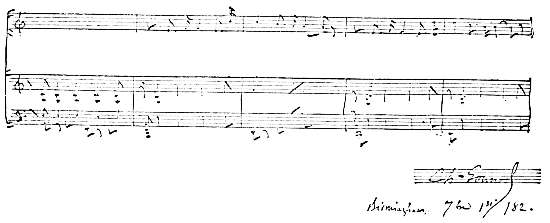
Gounod has preceded the score of what he terms a sacred "trilogy" with a few explanatory words. He describes his work as being the expression of the three great events upon which rest the existence of Christianity: (1) The Passion and death of the Saviour; (2) His glorious life on earth between His resurrection and ascension; (3) The diffusion of Christianity throughout the world by the apostolical mission. These three parts of the "trilogy" are preceded by a prologue on the Creation, the first Fall, and the promise of a Redeemer. This is, indeed, an ambitious programme, and it is scarcely to be wondered at that Gounod should not have succeeded altogether in realising it. The music rarely approaches the grandeur and depth of expression requisite for an adequate interpretation of such a theme. It is full of sensuousness and mystic charm, but although containing several numbers of undeniable beauty, the effect of the work as a whole is decidedly monotonous. Having dedicated the "Redemption" to Queen Victoria, Gounod dedicated "Mors et Vita," a sacred "trilogy" produced at the Birmingham Festival of 1885, to Pope Leo XIII. This companion work to the "Redemption" is at least equally ambitious in its scope. The first part consists of a "Requiem," the second is descriptive of the Judgment, and the last deals with Eternal Life. Hence its title, "Mors et Vita." This work has not obtained the same popularity in England as the "Redemption," to which I personally am inclined to prefer it.
Having arrived thus far in the composer's life, I will have to content myself with the bare mention of works, such as the incidental music written by him to "Les Deux Reines," "Jeanne D'Arc," and "Les Drames Sacrés." Gounod is also the author of two symphonies, composed at an early stage of his career, several masses, and other religious works. As a song-writer he has greatly distinguished himself, and his melodies have long been the delight of vocalists all the world over. Amongst these is one that deserves special mention and has probably done more to popularise his name than the majority of his larger works. I allude to the famous "Ave Maria," composed upon the first prelude of Bach. A facetious Teuton a year or two ago published a book purporting to contain biographies of great musicians. His sketch of Bach runs thus: "John Sebastian Bach owes his great reputation almost entirely to the fortunate circumstance that he received a commission to write the accompaniment to a famous melody by Gounod. With a most incomprehensible impertinence he also published his accompaniment, without Gounod's melody, as a so-called 'prelude,' together with a number of small pieces under the title of 'Wohltemperirte Clavier,' but the book had little success, on account of its silly title, among the admirers of the melody. His numerous sons are, to the annoyance of historians, also called Bach."
Gounod has lately attempted to improve (?) another of Bach's preludes, but with indifferent results. Such things are not to be repeated. Amongst his other songs it is only necessary to mention at random such exquisite gems as the "Serénade," "Medjé," "Le Vallon," "Le Printemps," "Au Printemps," "Prière," "Ce que je suis sans toi," &c., in order to revive the most delightful recollections. Occasionally the composer of "Faust" has been tempted to express his views upon art and artists. Of late years he has exhibited an exuberant admiration for Mozart, upon whose "Don Juan" he has written a pamphlet abounding in expressions of the most dithyrambic description. In a preface to the "Lettres Intimes" of Berlioz, he expresses his great admiration for that master. He has also written two interesting and eulogistic notices of Saint-Saëns's "Henry VIII." and "Ascanio."
Composers are proverbially bad judges of each other's works. This is probably due to the fact that every composer looks upon his art from a special point of view, and is often unable to appreciate works that are constructed upon different lines to his own. Every one knows the manner in which Weber and Spohr criticised Beethoven, and how Schubert was unable to perceive the beauties of Weber's "Euryanthe." Meyerbeer fared badly at the hands of Mendelssohn, Schumann, and Wagner. The last-named has been freely condemned by many of his contemporaries. Nevertheless, there is a decided attraction in hearing the opinion of one creative artist about another, and Gounod's ideas concerning some of the great musicians are worth recording. We are already aware of his boundless enthusiasm for Mozart, whom he terms "the first, the only one." Bach and Beethoven have also exercised their sway upon him, and both these masters run the composer of "Don Giovanni" hard in Gounod's estimation. He is reported to have one day expressed himself in the following terms concerning Bach: "If the greatest masters, Beethoven, Haydn, Mozart, were to be annihilated by an unforeseen cataclysm, in the same manner in which the painters might be through a fire, it would be easy to reconstitute the whole of music with Bach. Dans le ciel de l'art, Bach est une nébuleuse qui ne s'est pas encore condensée."
According to Mdlle. de Bovet, "Rossini is in Gounod's estimation the most limpid, broad, and lofty of lyric authors"—after Mozart be it said. This certainly would seem to upset my theory that a composer is not able to appreciate works conceived after different methods to his own, for what operas could possibly be more opposed in style than say "Semiramide" or "La Gazza Ladra" and "Faust?" Certainly, if we read the following passage in Mdlle. de Bovet's book we find that Gounod considers that Rossini's work "is summed up in two masterpieces of strangely opposite character, 'Il Barbiere di Seviglia' and 'Guillaume Tell,'" which possibly qualifies the force of the preceding passage. His appreciation of Berlioz is curious. According to Gounod, the composer of the "Romeo and Juliet" symphony is "fantastical and emotional; he suffers, he weeps, he grows desperate, or loses his head. The personal side of things seizes hold of him: he has been called the Jupiter of music. Granted; but a Jupiter who stumbles, a god who is a slave to his passions and his transports; but withal possessing masterly qualities: a marvellous colourist, he handles orchestration—which is the musician's palette—with a sure and powerful grasp. And then we come suddenly amongst remarkable passages, upon mistakes, awkward bits, betraying a tardy and faulty education—in short, an incomplete genius." As regards Wagner, the composer of "Faust" prefers to keep his opinion to himself, or at any rate only to deliver it in words the ambiguity of which fit them for an illustration of the saying that La parole a été donnée à l'homme pour cacher sa pensée.
Gounod inhabits a handsome house in Paris. Mdlle. de Bovet has given the following interesting description of his study, which I will take the liberty of reproducing: "It is an immense apartment, rising the height of two floors, lit by a broad window with light-stained glass; it is panelled with oak and vaulted like a church. And is it not the sanctuary of art? At the further extremity, on a platform reached by several low steps, stands a large organ by Cavaillé Coll; the bellows are worked by a hydraulic machine in the basement. A medallion representing a head of Christ is placed in the centre of the instrument. The writing-table, under the stained-glass window, is one of those composite ones used by musicians, a movable keyboard sliding backwards and forwards under the desk at will. The Renaissance mantelpiece in wood, richly carved in high relief representing scenes of the Passion, is decorated with a bronze medallion of Joan of Arc and massive iron ornaments. In the centre of the room is a large grand piano by Pleyel. One side is filled with bookcases—works on Theology and Philosophy occupying a conspicuous place—and with musical scores; amongst these, the collection of ancient ones inherited by Gounod from his father-in-law is extremely valuable." "In this immense room," writes Mons. Pagnerre, "the author of 'Faust' can often be seen, clad in black velvet, with a loose cravat round his neck, and his feet imprisoned in small slippers fit for a woman. There is ever something feminine about Gounod. His conversation is charming and persuasive. The musician is a witty and eloquent conversationalist. His physiognomy is mobile, his voice is soft, and when he speaks it is like music."
The individuality of a great composer is ever attractive to his admirers, and when in addition to his gifts as a creator he possesses that peculiar qualification known as "personal magnetism," their enthusiasm occasionally causes them to outstep the bounds of common-sense. It is especially members of the fair sex who are prone to indulge in exaggerated expressions of hero-worship. The emotional nature of music causes it to appeal to their minds with such intensity that they make a fetish of their idol, and fall down and worship not only him but everything he touches and looks upon. There are plenty of most amusing incidents on record which might be cited in support of this. Amongst these I will mention the following, concerning which it may be said, Se non è vero, è ben trovato:
A story is told of a lady admirer of his who once paid him a visit. Noticing a cherry-stone on the mantelpiece, she annexed it, took it home and had it set by a jeweller as a brooch, surrounded by diamonds and pearls. Paying a visit to Gounod some weeks later the lady drew attention to her act of reverence, when Gounod said: "But, madam, I never eat cherries; the stone you found on the mantelpiece was from a cherry eaten by my servant Jean!" Tableau!
In summing up the qualifications of a great composer—and as such there can be no doubt that Gounod must be reckoned—it is evidently better to dwell upon that which he has actually achieved than upon what he may have left undone.
The composer of "Faust" has imprinted his mark in an unmistakable manner upon his epoch. He has struck a note that had not previously been heard, and if he has perhaps reiterated this note somewhat too frequently, thereby attenuating its effect, the credit of having been the first to employ it must not be refused to him.
Mons. Adolphe Jullien judges him severely when he says that the more he has had occasion to hear and study his works, the more convinced he has become that Gounod possesses the genius of assimilation. According to him, the greatness of Gounod's talent is derived through the study of the works of all the masters, and especially of those of Bach, Handel, Schumann, and Berlioz. This I consider open to doubt. That Gounod has studied the works of his predecessors and profited thereby is evident, but this has been the case with all musicians. Something more is required to compose a work such as "Faust"; that something which is the appanage of but few composers, and which is known as "individuality."
Mons. Arthur Pougin, in his Supplement to Fétis's "Dictionnaire des Musiciens," thus describes the genius of Gounod: "Musically and as regards the theatre, M. Gounod is more spiritualistic than materialistic, more of a poet than a painter, more elegiac and more nervous than truly pathetic. It is perhaps this that has caused people to say that he lacked dramatic feeling; those who have expressed themselves thus have been mistaken, for it is not the dramatic feeling—that is to say, la perception passionée—which Gounod occasionally wants, but rather the temperament. At the same time, the author of 'Faust,' 'Roméo,' 'Le Médecin Malgré Lui,' remains a true poet, an inspired creator, an artist of the first rank and of high order."
The essence of the master's genius is contained in "Faust." Although since then he has composed many works of great merit, yet he has never been inspired to a similar degree. He may have abused certain formulas, and employed the same devices ad nauseam, but at any rate he can claim them as his own. It is not his fault if his imitators have reproduced his mannerisms to so great an extent.
Ernest Reyer once remarked that every one nowadays wrote music in the style of Gounod. "So far," added the witty Academician, "it is still that of Gounod himself that I prefer." This opinion, I venture to think, will probably be endorsed by my readers.
I cannot better terminate this notice on the composer of "Faust" than by reproducing the following sonnet addressed to him by Camille Saint-Saëns:
"Son art a la douceur, le ton des vieux pastels Toujours il adora vos voluptés bénies, Cloches saintes, concert des orgues, purs autels; De son œil clair, il voit les beautés infinies. Sur sa lyre d'ivoire, avec les Polymnies, Il dit l'hymne paiën, cher aux Dieux immortels. 'Faust,' qui met dans sa main le sceptre des génies Egale les Juan, les Raoul et les Tell. De Shakespeare et de Goethe il dore l'auréole; Sa voix a rehaussé l'éclat de leur parole, Leur œvre de sa flamme a gardé le reflet. Echos du Mont Olympe, échos du Paraclet Sont redis par sa Muse aux langueurs de créole; Telle vibre à tous les vents une harpe d'Eole."
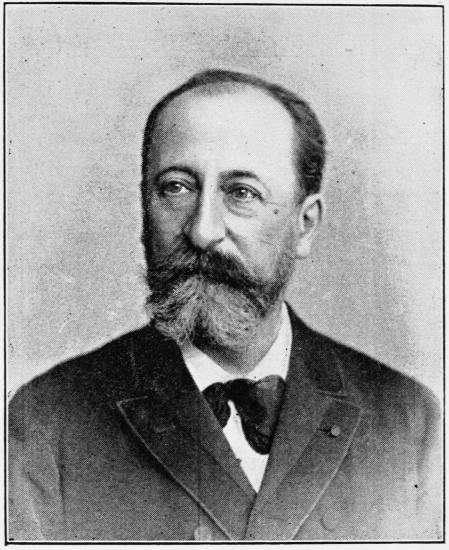
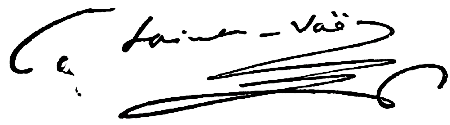
CAMILLE SAINT-SAËNS
THERE probably does not exist a living composer who is gifted with a musical organisation so complete as that of Camille Saint-Saëns. A perfect master of his craft, the French composer has contributed his quota to every branch of his art, and may truly be said to have distinguished himself in each. An eclectic in the highest sense of the word, Saint-Saëns has attempted every style and form, disseminating his works right and left with seemingly reckless prodigality. Never at a loss for an idea, invariably correct and often imaginative, going from a piano concerto to an opera, and from a cantata to a symphonic poem with disconcerting ease, composing rapidly, yet never exhibiting any trace of slovenly workmanship, finding time in the meanwhile to distinguish himself as organist and pianist, and to wield the pen of the critic, the astonishing capabilities of this wonderfully gifted musician may be put down as absolutely unique. His eclecticism may indeed be said to have been with him both a source of strength and weakness, for reasons which I shall propose to examine later on. Before endeavouring to formulate an opinion upon his multifarious works, a few biographical notes will not be out of place.
Camille Saint-Saëns was born on October 9, 1835. He lost his father when a child, and was brought up by his mother and his great-aunt, thanks to whose combined care he was able to battle against the natural delicacy of his constitution. Many anecdotes are related concerning the precocity of his musical development, and the ease with which he mastered those first principles of his art which usually appear so trying to the youthful mind.
One day, when he was at play, a visitor having been ushered into the adjoining room, the child, in listening to his footsteps, gravely observed, to the amusement of those present: "That gentleman in walking marks a crotchet and a quaver." The visitor in question walked with a limp.
It was from his great-aunt that he learnt the elements of music. Later on, he studied the piano under Stamaty,[19] and composition under Maleden, subsequently entering the Conservatoire in the class presided over by Halévy.
In 1852 he competed without success for the "Prix de Rome," and that same year witnessed the production of his first symphony by the Société de Sainte-Cécile under Seghers.
Twelve years later, he once more entered the lists, but again failed, and the prize was awarded to Victor Sieg.[20]
Saint-Saëns was luckier in 1867, when his cantata "Les Noces de Prométhée" was allotted the first place in a competition organised for a work to be performed on the occasion of the opening of the International Exhibition.
No less than one hundred and two musicians competed for the prize. Berlioz wrote as follows to his friend Ferrand concerning the success achieved by Saint-Saëns: "On avait entendu les jours précédents cent quatre cantates, et j'ai eu le plaisir de voir couronner (à l'unanimité) celle de mon jeune ami Camille Saint-Saëns, l'un des plus grands musiciens de notre époque.... Je suis tout ému de notre séance du jury! Comme Saint-Saëns va être heureux! j'ai couru chez lui, lui annoncer la chose, il était sorti avec sa mère. C'est un maître pianiste foudroyant. Enfin! voilà donc une chose de bon sens faite dans notre monde musical. Cela m'a donné de la force; je ne vous aurais pas écrit si longuement sans cette joie."[21]
A curious incident is related as having occurred on the occasion of this competition. The works sent in naturally did not bear the names of their authors, and many of the judges seemed to imagine that Saint-Saëns' cantata, which was far ahead of the others in point of merit, was by a foreigner. This caused the veteran Auber to make the following remark: "Je voudrais être certain que l'auteur de ces 'Noces' soit un Français. C'est un symphoniste si sur de ses moyens, si franc du collier, d'allure si libre, que je ne vois pas chez nous son pareil."
The fact of Saint-Saëns having sent his score from London led some of his judges to imagine that they were voting for Sir Julius (then Mr.) Benedict.
Saint-Saëns had been named organist at the church of Saint Merry when only seventeen years of age, and in 1858 was appointed to a similar post at the Madeleine, in succession to Lefébure Wély.[22] He relinquished this position in 1877, finding that he had not sufficient time to devote to his duties, and was succeeded by Théodore Dubois.[23] In the meanwhile, the reputation of Saint-Saëns as a pianist had been spreading, and during frequent journeys over Europe he invariably met with great success wherever he went.
The opinion of one artist concerning another is ever interesting, and the following words of Hans von Bülow, written in 1859, will give an idea of the esteem in which the great German pianist held his French colleague: "There does not exist a monument of art of whatsoever country, school, or epoch, that Saint-Saëns has not thoroughly studied. When we came to talk about the symphonies of Schumann, I was most astonished to hear him reproduce them on the piano with such an amount of facility and exactitude that I remained dumbfounded in comparing this prodigious memory with my own, which is thought so much of. In talking with him I saw that nothing was unknown to him, and what made him appear still greater in my eyes was the sincerity of his enthusiasm and his great modesty." It must be recollected that at that time Schumann was comparatively little known in France. Testimony of this kind coming from a musician like Hans von Bülow is indeed precious. We have already seen what Auber and Berlioz thought of Saint-Saëns, it remains to record the opinions emitted by Wagner and Gounod.
The composer of "Tristan," in a réunion consisting of several French artists who had journeyed to Switzerland to see him, drank to the health of Saint-Saëns, whom he qualified as the "greatest living French composer."
Gounod has never lost an opportunity of expressing his admiration for his friend's wonderful gifts, and has recorded his appreciation of the surprising versatility so often exhibited by Saint-Saëns in the following words: "He could write at will a work in the style of Rossini, of Verdi, of Schumann, or of Wagner."
Mons. Edouard Schuré has endeavoured to trace the musical physiognomy of Saint-Saëns in the following lines, occurring in the preface written by him to the interesting "Profils de Musiciens" of Mons. Hugues Imbert: "Personne ne possède plus à fond la science technique de la musique, personne ne connait mieux les maîtres, de Bach jusqu'à Liszt, à Brahms, et Rubinstein, personne ne manie plus habilement toutes les formes vocales et instrumentales. Mons. Saint-Saëns peut dire: 'Rien de musical ne m'est étranger.' Il a abordé tour à tour tous les genres et presque avec un égal bonheur. On remarque chez lui une imagination souple et vive, une constante aspiration à la force, à la noblesse, à la majesté. De ses quatuors, de ses symphonies se détachent des échappées grandioses, des fusées trop vite évanouies. Mais il serait impossible de définir l'individualité qui se détache de l'ensemble de son œuvre. On n'y sent pas le tourment d'une âme, la poursuite d'un idéal. C'est le Protée multiforme et polyphone de la musique. Essayez de le saisir; le voilà qui se change en sirène. Vous êtes sous le charme? Il se métamorphose en oiseau moqueur. Vous croyez le tenir enfin? mais il monte dans les nuages en hypogriffe. Sa nature propre perce le mieux en certaines fantaisies spirituelles d'un caractère sceptique et mordant comme la 'Danse Macabre' et le 'Rouet d'Omphale.'"
Saint-Saëns is no stranger to us. His visits to London have been frequent, and his cantata, "The Lyre and the Harp," was composed expressly for the Birmingham Festival of 1879. This very year, 1893, the University of Cambridge has paid homage to the greatness of the musician by conferring upon him the honorary degree of Doctor of Music. His first appearance in London was at the Musical Union in 1871. He played at Philharmonic Concerts in 1874 and 1879, choosing Beethoven's concerto in G on the first occasion, and his own concerto in G minor on the second. He has also been heard at the Crystal Palace, and this year (1893) he again appeared at a Philharmonic Concert, playing the same concerto in G minor of his own composition, and conducting his symphonic poem, "Le Rouet d'Omphale." During one of his visits to London, some ten or twelve years ago, he met with an accident that might have had fatal results. He fell through an open trap-door, and received serious injuries to his back, from which he did not recover for a long while. Having promised to take part in an arrangement for eight hands of his "Marche Heroïque," at a concert given by Sir Julius Benedict, he somehow contrived to get on to the platform and perform his task, but when it came to acknowledge the applause of the audience he was unable to bend forward or bow, and had to slide off as best he could. As a pianist, Saint-Saëns may be classed in the very first rank. His execution is prodigious, and his lightness of touch quite unique. He is, perhaps, heard at his best when interpreting Bach, with whose works he is as intimately acquainted as any living musician.
Unfortunately, he now seriously contemplates giving up performing in public, not feeling anxious to continue after his powers are on the wane. The reason he alleges will scarcely be accepted as a good one, for so far there has been no falling off whatever in his execution. What is more likely is that he finds he has no time to practise. As a matter of fact he now rarely touches the instrument, and a paragraph that recently appeared in a paper to the effect that he was in the habit of practising all day long, caused him to indulge in a prolonged fit of merriment. In his humorous way—for Saint-Saëns is a humorist, comme il y en a peu—he told me that he considered that an executant should know how to stop in time, and that he was not desirous of emulating the example of certain artists who went on giving concerts until they had completed their allotted span of life, and were capable, even after their demise, of finding sufficient strength to announce a "posthumous recital."
In the course of his eventful career Saint-Saëns has had some amusing experiences of the stupidity of those amateurs who pretend to be musical, and whose knowledge may be put down at zero. The Duchess de C—— once expressed the desire to hear him perform some strictly classical music. A party was organised, and none were invited but those whose musical proclivities were known to be of a serious order. Saint-Saëns seated himself at the piano, and asked the Duchess de C——, who was by his side, what she would wish him to play. There was a pause, the Duchess thought deeply, and suddenly turning towards him, said she would so like to hear the Miserere from the "Trovatore."
On another occasion he was asked by a lady who was giving a party to play something that would not be too difficult of comprehension. "Play a piece suitable for a pack of donkeys," she said. As it happened, Saint-Saëns had just got up a "fantasia" upon Bellini's "Casta diva," one of those drawing-room show pieces utterly devoid of any musical value; so he expressed himself ready to provide the required article. The evening arrived; he sat down at the piano and duly went through his fireworks. The moment the piece was at an end, up jumped a gentleman, who was profuse in his expressions of delight, and warmly clasping the hostess's hand, exclaimed: "I am sure you got him to play this beautiful piece for my benefit!"
Having remarked at the beginning of this sketch that Saint-Saëns had distinguished himself as a composer in every branch of his art, I will endeavour to allude briefly to those amongst his works that have contributed the most to ensure him the supremacy he now occupies amongst the musicians of his country, a supremacy which is practically uncontested, if only for the reason of the universality of his gifts. Whereas other composers occupy, perhaps, an equal or even superior rank in some particular line, there is not one who has shown himself capable of shining in conspicuous fashion in so many varied styles. Mons. Gauthier Villars, in a clever article upon the composer, has remarked that there exist in Camille Saint-Saëns "three men—three temperaments that influence one another. There is an 'absolute' musician, a dramatic musician, and a critic, whose polemics are always erudite, frequently witty, occasionally bitter and violent." These words will serve in a great measure to explain certain apparent inconsistencies that are noticeable in the composer's works. A thorough master of every technical detail of his art, a contrapuntist of unsurpassed excellence, a musician endowed with a prodigious facility of production, Camille Saint-Saëns has not always been able to keep his productivity within due bounds. His sureness of hand enables him to complete a work in so short a time that he has not invariably given proof of that spirit of concentration which shows itself in the compositions of some masters. With Saint-Saëns it is the impulse of the moment that compels him to compose in one style or another. This will account for the fact that if in some cases his works betray a want of inspiration, yet they rarely smell of lamp oil, or seem unduly laboured. He is essentially a fantaisiste, careless of any preconceived plan, but exhibiting a wondrous command of musical resources, and a complete grasp over his subject. The themes he employs may sometimes lack character or distinction, yet no one knows better than he does how best to treat them, and by ingenious transformations to render them interesting. This applies more especially to his chamber music, of which the piano trio in F, op. 18, the piano quartet, op. 41, and the septet for trumpet, piano, and strings, op. 65, are perhaps the best examples. In these compositions the classical turn of mind, to which a happy admixture of modern elements lends additional charm, is very noticeable. This peculiar combination of the classical and the romantic is a special characteristic in the works of Saint-Saëns, and is found in the majority of his productions. Janus-like, he keeps one side of his head turned towards Bach, Handel, and Beethoven, whilst he finds means with the other of gazing at Liszt, Wagner, and Gounod. These masters have exercised a very marked influence upon his style.
The simplicity of treatment and perfect clearness in the workmanship noticeable in his chamber music, form a distinct contrast to the complexities indulged in by that section of the modern German school represented by Brahms. The perfectly balanced nature of his mind, and his predilection for works of classic proportions, prevent Saint-Saëns from ever falling into any musical aberrations of intellect. At the same time, he rightly considers that new forms in music do not necessarily imply formlessness, as some people appear to imagine, and in his larger orchestral compositions he has ever displayed a tendency to avoid recognised models. His four symphonic poems illustrate the dual nature of his talent as much as any of his productions. If in these we miss the powerful grandeur of Liszt, we find in its stead a clearer and more compact method of expression.
These four works constitute one of the most abiding titles to the composer's fame. They also offer an opportunity of discussing a question over which there has been much controversy—viz., the position occupied by so-called "programme music" in contradistinction to "absolute music." The partisans of musical reaction, who are ever doing their utmost to stifle any attempt at emancipation from routine, and place every obstacle in the way of true progress, have often directed their sneers against this particular form of art. It is difficult to understand the reason that actuates them when they try all they can to shut the doors upon the efforts of musicians whose only desire is to serve the cause of true art to the best of their ability. These dogmatic pedants would lead one to believe that "programme music" is the product of our degenerate age, invented by musicians barren of inspiration, eagerly clutching at anything enabling them to earn even a fictitious reputation.
In reality, "programme music," in some form or other, has existed for many generations.
Kühnau, the precursor of Bach, has left a sonata intended to describe the fight between David and Goliath. Bach himself has not disdained the "form" in question. His capriccio on the departure of a friend, with its differently labelled parts, comes distinctly under the above denomination.
It is as well though, in dealing with this subject, to draw a distinction between purely imitative and descriptive music. Whereas the former exemplifies a puerile, and necessarily inferior, form of art, the latter is susceptible of serving the noblest ends.
It stands to reason that a musical imitation of physical sounds must necessarily fall short of the reality.
A single clap of thunder will produce more effect than all the symphonic thunderstorms that have ever been composed, with all due deference to Beethoven and Rossini. Haydn has attempted to imitate all manner of sounds in the "Creation," from the bounding of a deer to the falling of snow! These things fail to do more than provoke a smile. Music should act by suggestion rather than actual imitation. At the same time, a composer should not be denied the use of any device calculated to aid his inspiration, or to enable him to enlarge the domain of art by the employment of new or little used formulas.
Beethoven and Mendelssohn have both given the sanction of their names to "programme" music, and the example shown by the composers of the "Pastoral" symphony and the "Hebrides" overture ought to be sufficient to silence the objections of the partisans quand même of "absolute" music.
In an admirable article upon the "Symphonic Poems" of Liszt, Saint-Saëns has dealt fully and conclusively with the matter, and I cannot do better than reproduce the French master's own words, which have the advantage also of drawing attention to the great and still imperfectly recognised merits of Liszt as a composer. After laying stress upon the fact that Liszt had dared to break with the traditions regulating the symphonic form, and had by this shown a greater amount of boldness than Weber, Mendelssohn, Schubert, or Schumann, he proceeds to discuss the principle of "programme music" in the following terms:
"To many people, 'programme music' is a necessarily inferior genre. A quantity of things have been written upon this subject that I find it impossible to understand. Is the music in itself good or bad? Everything lies there. Whether it be or not accompanied by a programme, it will be neither better nor worse. It is exactly as in painting, when the subject of a picture, which is everything for the vulgar, is nothing or is but little for the amateur. There is yet more: the reproach made against music of expressing nothing of itself, without the help of words, applies equally to paintings. A picture will never represent Adam and Eve to a spectator who does not know the Bible; it will only represent a naked man and woman in a garden. And yet the spectator, or listener, will lend themselves easily to this deception, which consists in adding to the pleasure of the eyes or ears the interest or emotion of a subject. There is no reason to refuse them this pleasure, neither is there any compelling one to grant it. The liberty in the matter is complete; the artists profit by it, and they are right. What is undeniable is that the taste of the public at the present epoch tends towards the picture with a distinct subject and towards music with a programme, and that the taste of the public, at least in France, has drawn artists in this direction. 'Programme music' is, for the artist, only a pretext to explore new tracks, and new effects require new means."
Saint-Saëns has put his theory into practice with considerable success in the four symphonic poems entitled "Le Rouet d'Omphale," "Danse Macabre," "Phaëton," and "La Jeunesse d'Hercule." Fundamentally different the one from the other, each of these compositions comes under the category of descriptive music, and is intended to illustrate a special subject. In the "Rouet d'Omphale," the composer has employed the well-known classic tale of Hercules at the feet of Omphale as a pretext for illustrating the triumph of weakness over strength.
No words can express the art with which the composer has developed his themes, or give an idea of the delicacy of an instrumentation which, gossamer-like, seems to float in an atmosphere of melody.
Perhaps the most characteristic of the four symphonic poems is the well-known "Danse Macabre." This work is suggested by a poem of Henri Cazalis, the first verse of which runs thus:
"Zig et zig et zag, la mort en cadence Frappant une tombe avec son talon La mort à minuit joue un air de danse Zig et zig et zag, sur son violon."
The hour of midnight is heard to strike, and Death is supposed to perform a weird and ghastly dance, which grows wilder and wilder, until the cock having crowed, the excitement gradually subsides, and quiet reigns once more.
The way in which Saint-Saëns has succeeded in musically depicting the above story is intensely original and masterly. The general plan of the piece is perfectly clear and logically worked out. The two themes upon which it is constructed are admirably adapted for the purpose, and susceptible of being employed together with striking effect. There is a certain passage which produces the uncanny impression of the wailing of an unhealthy night wind through the trees of a churchyard. In order to give an imitation of the rattling of bones, Saint-Saëns has made use of the xylophone. A curious detail to be noted is the introduction, in a species of burlesque manner, of the "Dies Iræ," transposed into the major and converted into a waltz, to which the skeletons are supposed to dance. Strikingly original and ingenious is the effect of the "solo" violin, with its string tuned to E♭, producing a diminished fifth on the open strings A and E♭, which, being reiterated several times, conveys a peculiar sensation of weirdness. The "Dance Macabre" has contributed largely to spread its author's reputation all over Europe. It is undoubtedly one of his most popular works. "Phaëton," op. 39, and "La Jeunesse d'Hercule," op. 50, although less well known, are not the less remarkable. The first of these deals with the well-known story of Phaëton, who has obtained permission to drive the chariot of his father, the Sun, through the skies. His unskilled hands are powerless to retain the steeds. The entire universe is about to perish through the too close proximity of the flaming chariot, when Jupiter strikes the imprudent Phaeton with his thunderbolts. Upon this legend Saint-Saëns has constructed a symphonic piece of great descriptive power. The music may indeed be said to tell its own story. A prelude of a few bars describes Phaeton gathering up his reins. He starts, and, presumably, after a preliminary canter, induces the horses to proceed quietly. Suddenly, however, they break away. Vainly does he use all his endeavours to stop them in their frantic course. The catastrophe is nearing, when a formidable crash puts an end to Phaeton and his misplaced ambition.
The instrumentation of "Phaëton" is in itself worth a detailed notice, and is a perfect marvel of ingenuity.
"La Jeunesse d'Hercule" is the most elaborate of the four symphonic poems, and is, perhaps, the least well-known. It attempts to describe the legend of Hercules, who at the outset of life saw two roads open to him, that of pleasure and that of duty. The hero does not allow himself to be swayed by the seductions of nymphs or bacchantæ, but resolutely follows the path of struggles and of combats, at the end of which he is to receive the recompense of immortality.
In treating this subject Saint-Saëns has given full rein to his imagination, and has shown a complete independence of spirit in the matter of construction. The score of this poetical and original composition will fully repay any amount of study that may be devoted to it. It is, of course, impossible to attempt an analysis of this interesting work in these pages. I would, however, draw the attention of musicians to the wonderfully ingenious manner in which the climax is reached, producing an accumulative effect of concentrated force bursting through its bonds, evidently descriptive of the final triumph of Hercules.
A symbolic meaning is attached to all these symphonic poems, with the possible exception of the "Danse Macabre," and although they are each professedly intended to describe an actual story, this is only used as a means of suggesting the abstract idea that underlies it.
Saint-Saëns has published four pianoforte concertos, the second and fourth of which are the best known. Some years since he told me that he contemplated writing a fifth, but for some reason best known to himself he did not put his project into execution. The second and fourth concertos are two of the most striking examples of the kind that have proceeded from the pen of a modern composer. Why the third should be so persistently neglected is more than I profess to understand, except for the reason that pianists are like the traditional moutons de Panurge, and are, as a race singularly destitute of initiative, preferring to follow on the beaten track sooner than give themselves more trouble than necessary.
The form adopted by Saint-Saëns in his second concerto, op. 25, is sufficiently novel. Its first movement is labelled "Andante sostenuto," and commences with a long introduction for the piano, somewhat in the style of Bach. The passionate melody which succeeds to this, and may be considered as the principal theme of the movement, is, however, quite modern in character. The delightful "Scherzo" and inspiriting "Finale," are slightly suggestive of both Weber and Mendelssohn, whilst bearing the distinctive mark of their composer's personality. In his fourth concerto in C minor, op. 44, Saint-Saëns has departed still further from the usual model. This work is divided into two sections, which include five changes in the "tempo." A noticeable feature in the concerto is the reintroduction in the last movement of themes previously heard in the first, thus producing a sense of homogeneity.
The fourth concerto is the most ambitious work of the kind that Saint-Saëns has written. It is also the best. A few years since, the composer attempted the experiment of performing all four works in succession at a concert given at the St. James's Hall.
Saint-Saëns did not make his début as an operatic composer until he had reached the age of thirty-seven, and then only with a one-act opéra-comique, entitled "La Princesse Jeaune," produced at the Opéra Comique Theatre in 1872. This curious little work, the scene of which is laid in China, was not well received and speedily disappeared from the bills. The overture is delightfully quaint, and is occasionally heard at concerts. Now that one-act works are coming into vogue, this delicate little score might well be reproduced.
The reputation acquired by Saint-Saëns as a symphonist, and what is known in France as "un musicien savant," had been sufficient to cause any pretension on his part to aspire to the fame of a dramatic composer to be looked upon with suspicion. Added to this, he had the reputation of harbouring feelings of admiration for Wagner, which at that time was quite enough to prevent a manager from producing his works.
An opera entitled "Le Timbre d'Argent," not to be confounded with Vasseur's operetta "La Timbale d'Argent," was written before the war of 1870, and was destined for the Opéra Comique Theatre. It was, however, not brought out until 1877, when it was played at the Théâtre Lyrique under the direction of Mons. A. Vizentini.
The influence of Gounod is very apparent in this work, and Bizet even found therein certain affinities with Auber which I confess myself unable to discover. One thing certain is, that this opera has but little in common with Wagner. "Le Timbre d'Argent" reveals the hand of the practised musician, but is very unequal as a whole, and does not occupy an important place in the composer's dramatic outfit. A point to note in this opera is the superiority of the orchestral treatment and general workmanship over the melodies, many of which border upon the commonplace.
The same year that "Le Timbre d'Argent" was produced in Paris, the Grand Ducal Theatre of Weimar announced the first performance of a new opera by Saint-Saëns, entitled "Samson et Dalila."
As many consider this the composer's finest dramatic work, and as it is only comparatively recently that its beauties have come to be generally recognised, and that it has been incorporated into the répertoire of the Paris Opera, a short account of the genesis of this remarkable composition may not be out of place, the more so as if will accentuate the difficulties that appear to beset composers and stand in the way of works of the highest merit.
"Samson et Dalila" was begun by Saint-Saëns before the year of the Franco-German war.
The second act was tried over in private, when the part of Samson was sung by the ill-fated painter, Henri Regnault, who was destined to be killed a year later, during the war. The "Marche Heroïque," composed by Saint-Saëns, is dedicated to the memory of the unfortunate artist.
The score of "Samson et Dalila" was terminated towards 1872, and a performance of the second act was given by Madame Viardot at her country-house at Croissy two years later. On this occasion the gifted hostess undertook the part of Dalila, and all who can remember her incomparable method of singing will agree that she must have been an admirable interpretress of the passionate accents allotted by Saint-Saëns to the heroine of his opera.
The influence of this admirable artist upon French music has been very great. In a volume of verses recently published Saint-Saëns thus apostrophises her:
"Gloire de la Musique et de la Tragédie; Muse qu'un laurier d'or couronna tant de fois, Oserai-je parler de vous, lorsque ma voix Au langage des vers follement s'étudie? Les poëtes par Apollon vainqueur Ont seuls assez de fleurs pour en faire une gerbe Digne de ce génie éclatant et superbe Qui pour l'éternité vous a faite leur sœur. Du culte du beau chant prêtresse vénérée, Ne laissez pas crouler son autel précieux, Vous qui l'avez reçu comme un dépôt des cieux, Vous qui du souvenir êtes la préférée! Ah! comment oublier l'implacable Fidés De l'amour maternel endurant le supplice, Orphée en pleurs qui pour revoir son Eurydice Enhardi par Éros pénétre dans l'Hades! Grande comme la Lyre et vibrante comme elle, Vous avez eu dans l'Art un éclat nonpareil. Vision trop rapide, hélas! que nul soleil Dans l'avenir jamais ne nous rendra plus belle!"
In 1875 the first act of "Samson et Dalila" was given in its entirety in Paris at one of Mons. Colonne's concerts.
It was, however, not until the second of December 1877 that "Samson et Dalila" was brought out upon the stage. Liszt, ever anxious to further the progress of art, had been struck by the merits of the work, and undertook to have it mounted at Weimar, where some twenty-five years earlier he had been instrumental in producing "Lohengrin" for the first time on any stage.
Musicians of the calibre of Liszt are indeed rare, and it is right to tender a passing tribute to the absolute disinterestedness of this great man, who never lost an opportunity of helping a brother artist. Having been brought out on German soil for the first time, a fact which the composer should remember when indulging in those patriotic ebullitions that of late years have so frequently appeared from his pen, "Samson et Dalila" was played at Hamburg in 1883 with Frau Sucher in the principal part.
It was not until 1890 that the opera was given in France, Rouen being the first town in which it was played. During that year it was produced in Paris at the Eden Theatre under the same manager. On this occasion the principal parts were interpreted by Mme. Rosine Bloch and Mons. Talazac, both of whom have recently died.
Lyons, Marseilles, and Aix-les-Bains followed in 1891, and the next year "Samson et Dalila" was given at Toulouse, Bordeaux, Montpellier, Nantes, Nice, Florence, Monte Carlo, Geneva, and Dijon, receiving its final consecration by being produced on a grand scale at the Paris Opera House, having thus occupied a period of twenty years in reaching its goal. It has since then been played in other continental towns. London still remains, and upon this I should like to say a word. The fact of "Samson et Dalila" being taken from a Biblical source has been accepted as a reason for its non-production in our metropolis. That a work of the most serious import should thus be excluded from our stage when productions of the most futile description are passed without demur, is another example of the contradictions that exist in our pharisaical country.
Not so long ago an operetta was licensed in which ministers of religion were held up to ridicule, and jokes were freely made concerning matters that must by a great portion of the audience have been held sacred, and yet nothing was said. But should some manager think of producing an episode culled from the Old Testament, and treated in a strictly serious and even reverent manner, the British conscience, that article of home manufacture of which Englishmen are so proud, is at once up in arms. We cannot support too many music-halls or give too much encouragement to those bastard specimens of operatic music known as "original" (?) comic operas, but our feelings of propriety revolt against anything like the stage treatment of works founded upon Biblical subjects. Let us be consistent whilst we are about it. If it is wrong to introduce Samson, Dalila, the Queen of Sheba, Joseph, Moses, or other Biblical personages upon the stage, it is surely worse to sanction the performance of operas or dramas in which scenes are introduced representing the interior of churches, or religious ceremonies of any description! Worse than all is the performance of pieces calculated to throw ridicule upon ministers of religion. To see respectable audiences sitting complacently gazing at a popular actor personifying a clergyman dancing in a pas de quatre with his chapel in the background, and to think that some of these very individuals may possibly be numbered amongst those who object to Sunday concerts, is indeed more than strange.
In the meanwhile as this state of things exists, and the musical public is debarred from hearing a work like "Samson et Dalila" on the stage, it may be wondered that no one seems to have been struck with the idea of producing it in oratorio form in the concert-room. It is not creditable that England should remain the only nation where "Samson et Dalila" has not been given.[24]
The prejudice existing against the employment of Biblical subjects for operatic purposes is unfortunate, as the fund of material is apparently exhaustless. The story of Samson and Dalila has furnished Saint-Saëns with a plot such as he has since sought for in vain in the pages of English and French history. The less complicated the story, the better it is fitted for operatic treatment. Wagner has exposed his reasons at length concerning the superiority of a legendary over a historical subject. Saint-Saëns is unfortunately not of this way of thinking. Of later years the bias of his mind has been rather tending towards historical subjects.
"Samson et Dalila" may be considered not only as one of the master's best operas, perhaps even as the very best, but as one of the finest dramatic works produced by any French composer during the last five-and-twenty or thirty years.
A work like this cannot be otherwise than the spontaneous outcome of a composer's feelings, untrammelled by outward considerations. The varied influences that are noticeable in the musical style of Saint-Saëns, and to which I have already made allusion, are perhaps more marked in this work than in any of his other operas. In the first act the choruses sung by the captive Hebrews breathe the spirit of Bach and Handel, and are conceived rather in the oratorio style. As a strong contrast to these we have the dainty chorus of the priestesses of Dagon and their characteristic dance, the fascinating trio in which Dalila endeavours to cast her spell over Samson, and the lovely air, "Printemps qui commence," which terminates the act and which has been sung by every contralto. Samson's spirited appeal to arms must also be mentioned. The second act commences with Dalila's invocation to love, praying for aid in her design to ensnare Samson. The lengthy duet between the heroine and the high priest is eminently dramatic, and the following duet between her and Samson may be ranked amongst the finest love scenes ever written. It contains a beautiful phrase sung by the temptress when endeavouring to inveigle her victim, which is reproduced later on in an admirably suggestive manner by the orchestra, and reappears in the third act, transformed into a mocking theme, when Dalila is scoffing at her victim in chains and deprived of his sight. The third and last act contains a touching prayer for Samson, bewailing his lost sight, some admirable ballet music, in which the composer has made effective use of the Eastern scale, and a masterly scene depicting the revelries of the Philistines, culminating in the destruction of the temple by Samson. So ends this beautiful score, the merits of which are so transparent and yet have remained so long unrecognised.
FACSIMILE OF AUTOGRAPH SCORE OF "SAMSON ET DALILA"
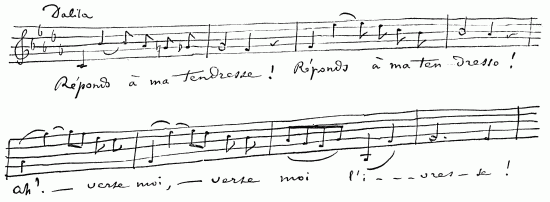
In "Samson et Dalila" Saint-Saëns had made use of representative themes, and although he has done so in a sufficiently discreet fashion, avoiding anything approaching to Wagnerian polyphony, the fact deserves to be noted as affording, perhaps, the first instance in which the system has been rigorously followed by a French composer. There can be no doubt but that the device contributes to a great extent in securing that unity which is so much sought for nowadays in dramatic works. Another point to be noted is the suppression of detached numbers, the opera being divided into scenes that are logically developed.
The instrumentation of "Samson et Dalila" is rich and varied, yet never unduly complicated. Saint-Saëns knows how to distribute his effects with unerring certainty, and his work is a model of orchestral skill. The opera is scored for a very full orchestra, of which it may be interesting to give the composition. In addition to the strings and usual wood wind, he employs a third flute, a cor anglais, a bass clarinet, a double bassoon, four horns, two trumpets, two cornets, three trombones, a bass tuba, two ophicleides, two harps, three kettledrums, a grosse caisse, cymbals, a triangle, a glockenspiel, crotales, castagnettes made of wood and iron, a tambour de basque, and a tamtam.
These constitute a powerful engine of sound, which is made subservient to the composer's will, and reproduces his thoughts with unimpeachable exactitude.
"Samson et Dalila" perhaps remains the dramatic masterpiece of Saint-Saëns. His other operas may be equally remarkable in point of style and more elaborate in the matter of detail, but they often lack that apparent spontaneity which constitutes not the least charm of the Biblical work, and, although containing much that is admirable, are perhaps less inspired. Saint-Saëns could not write an uninteresting work if he chose, and musicians will find much to admire in his later operas. In "Samson et Dalila" he has succeeded in compelling the admiration of both musicians and the public at large, perhaps for the very reason that when he wrote it he did not attempt to please either, but was content to follow the bent of his inspiration without arrière pensée of any sort.
"Etienne Marcel," the composer's next opera, produced at Lyons in 1879, has not received the amount of attention due to its merits. The defects in this work arise from a certain want of unity, consequent upon the obvious desire of the composer to reconcile the conflicting elements of the old and the new schools. Putting such considerations aside, there can be no doubt as to the general effectiveness of the music. The subject deals with a stirring episode of French history. If in treating it the composer has not discarded the older forms associated with the "grand opéra" style, he has imparted a modern colouring to his score which goes far to redeem any shortcomings in this respect. He has been particularly happy in his treatment of the scenes of popular life that abound in this opera. There is a freshness and an irresistible entrain in the ballet music, which is deliciously scored and abounds in charming details. The presence of a waltz in an opera, the action of which is laid in the fourteenth century, may cause some surprise, but it does not do to be over-particular in such matters, and much may be forgiven when the result is so pleasing.
A few years ago it was quite on the cards that "Etienne Marcel" should be performed at Covent Garden, with Mme. Patti in the principal character. The great prima donna had taken a strong fancy to the music, and expressed a desire to sing it. Unfortunately circumstances occurred which induced the diva to change her mind, and to display her vocalisation in an opera of little musical worth, which has long since disappeared from the répertoire.
If would be a thousand pities if an opera containing so much that is excellent should be allowed to suffer perpetual neglect, and it may be hoped that some day we may be afforded the chance of hearing it in England.
The great moment in the dramatic career of Saint-Saëns was now at hand—that psychological moment so long desired and eagerly anticipated by every French aspirant to operatic fame. The doors of the Opera, that sanctum sanctorum, was at length to be opened to him. After the comparative failure of such works as Gounod's "Tribut de Zamora," and Ambroise Thomas' "Françoise de Rimini," the prestige of the French school wanted looking after, and some fresh blood was required to renew it. That a composer such as Saint-Saëns should be obliged to go to Weimar and Lyons in order to get played seemed an anomaly, and the author of "Samson et Dalila" was at last, and not too soon, commissioned to write a work for the leading operatic stage of Paris.
Great expectations had been formed concerning the opera that so consummate a musician, and one holding such high artistic notions, would produce. It was held that a composer so well endowed would prove to be the one, par excellence, destined to free the French operatic stage from the bondage of "routine," and be the standard-bearer of French progressive art. These anticipations were destined to be only partly realised. Leaving French history for the nonce, Saint-Saëns found in the life of our much-married monarch a subject congenial to his muse, and "Henri VIII." was produced with success in March 1883. If this opera is ever to be performed in England certain alterations will have to be made, as the inclusion of a Scotch ballet danced at Richmond might tend to ridicule.
It must be admitted that if the book of "Henri VIII." is in many senses disappointing, yet it is not devoid of merit, and contains several highly dramatic situations that have been well treated by the musician. The authors, Messrs. Détroyat and Silvestre, have not adhered entirely to Shakespeare. The action takes place at the time when Henry has begun to be struck with the charms of Anne Boleyn, who also has an admirer in Don Gomez, the Spanish ambassador. The divorce of the King from Katharine of Arragon is at hand, and the Pope's Legate having refused to sanction it, the King, amidst the acclamation of the people, proclaims the schism with the Roman Church. The last act is perhaps the best. Anne Boleyn is now Queen, and Katharine, who is dying, has in her possession a compromising letter from Anne to Don Gomez. Henry is devoured by jealousy, and comes, accompanied by Don Gomez, to endeavour to obtain possession of this document. Anne has also come to see if she can regain the letter. This leads to the capital situation in the opera. Henry, in order to excite the jealous and revengeful feelings of Katharine, speaks in the tenderest tones to Anne, whose eyes are fixed upon the note that Katharine has in her hands. At length Katharine, having prayed for strength to resist the temptation, throws the letter in the fire, and falls down dead.
There is no denying the dramatic force of this situation, which has been treated by Saint-Saëns in a masterly manner. The splendid quartet which terminates the work, in which the different emotions of the four characters are depicted in accents as powerful as they are varied, may rank amongst his finest inspirations, and as one of the most stirring scenes in the entire range of modern opera.
An interesting feature in "Henri VIII." is the partial employment of leit-motiven. Saint-Saëns, who at one time was looked upon as a disciple of Wagner, has taken pains to dispel this impression. And yet in the first work composed by him for the chief French operatic theatre, he set to work by making use of one of the Bayreuth master's favourite devices. He will probably urge that it is not so much Wagner himself that he has been combating, but the unreasoning enthusiasm of some of his thick-and-thin admirers. This may be so, but the fact remains, that Saint-Saëns has laid himself open to misconception, which might easily have been avoided had he displayed a less militant tendency in his criticisms. At any rate, he has deliberately adopted the system of representative themes in his "Henri VIII.," and if, whilst so doing, he has not abandoned the old operatic set forms, the innovation is a sufficiently important one to note. It is this attempt to reconcile such antagonistic elements that is held by some as constituting a weak point in this remarkable work. "From the beginning," writes a well-known critic, "we see the two forms of the opera and the lyrical drama in juxtaposition, and thus all unity of style is at once broken."
The opinions of Saint-Saëns himself on the subject of dramatic music are interesting, as they explain the spirit of compromise that exists in all his works. "Henri VIII." was considered by some as foreshadowing a new departure in the composer's style. These were doomed to be disappointed, for the works that have succeeded it are not in any way more "advanced." Saint-Saëns has taken the trouble to write and explain his views on the subject, and from these it is highly unlikely that he will now depart. In a letter written to the editor of the Carillon Théatral, soon after the performance of his opera "Proserpine," Saint-Saëns expressed himself thus: "My theory of dramatic art is this: I believe the drama is progressing towards a synthesis of different elements, song, declamation, and symphony blending in an equilibrium which leaves the composer free to avail himself of all the resources of art, while it affords the spectator the gratification of every legitimate desire. It is this equilibrium which I seek, and which others will one day find. Both heart and head impel me to pursue this aim, and to this I must adhere. It is for this reason that I am disowned, now by those Wagnerites who despise the melodic style and the art of singing, now by those reactionaries who lay the entire stress on those elements, and consider declamation and symphony as mere accessories."
The above definition of the "musical drama" is rational enough, and I do not see what even the most uncompromising Wagnerite could find to object in it. As to the allusion to "those Wagnerites who despise the melodic style," it would be interesting to know precisely to whom the composer refers. If there exist a few fanatics who imagine that melody can be banished with impunity, they are in absolute disaccord with Wagner himself, who wrote that "the one and only form of music is melody; no music is conceivable without melody, and both are absolutely inseparable." Mons. Imbert, in an article upon Saint-Saëns, has amusingly termed him "le Wagnérien sans le savoir."
The truth of the matter is, that every composer nowadays is actuated by the same desire, namely, to make his music fit the subject he is illustrating as closely as possible. If the method adopted differs in any way, this must be ascribed to a variety of causes, the composer's temperament, his education, his nationality, and others. As to the interpolation of ballets and sundry hors d'œuvre introduced often apparently without rhyme or reason, that still find their way into operas, it must in justice to the composer be remembered that he has a number of conventionalities to fight against and prejudices to overcome. Every one has not got the prestige of a Wagner, and even he had to fight a fearfully uphill battle, and only reaped the full fruits of his labours at the end of his career.
The taste of the public is little by little coming round to the "lyrical drama" as distinct from the opera, and composers are but following the tendency of the age. The transformation of style that has led Verdi to rise from "Trovatore" to "Otello" is there to attest it.
The next opera—or shall we say "lyrical drama"?—composed by Saint-Saëns was "Proserpine," brought out at the ill-fated Opéra Comique in 1887, the same year during which the theatre was destined to be burned to the ground. Despite its title, this work has nothing in common with mythology. It is taken from an early work by the poet Vacquerie, published some fifty years ago.
The action takes place in Italy during the sixteenth century. Proserpine, a courtesan, is in love with Sabatino, a young nobleman, who is engaged to be married to Angiola, the sister of his friend. After endeavouring vainly to entrap Angiola and her brother, assisted by Squarocca, a bandit, she seeks Sabatino, who is awaiting his bride. When Angiola enters, Proserpine hides behind some drapery. Maddened by jealousy at hearing the lovers interchange protestations of affection, she rushes forward and strikes Angiola with her stiletto. Sabatino then snatches the weapon from her hands and plunges it into her heart.
This story was considered somewhat melodramatic in Paris, and the dénouement has since been somewhat modified. A few alterations have been made in the score, and in its new form "Proserpine" will surely be performed sooner or later. There are some delightful numbers in this opera, which throughout bears the impress of the master's hand. I will especially draw attention to the closing scene of the second act, which is a perfect gem of delicate fancy and exquisite workmanship. The scene represents the interior of a convent, and a number of mendicants enter to receive alms. Their voices are accompanied by a melodic figure which is repeated in various guises until the fall of the curtain, without ever sounding monotonous in any degree, through the consummate art and skilful manipulation with which it is handled.
With his next opera Saint-Saëns returned to the Grand Opéra, where "Ascanio" was produced in 1890. Benvenuto Cellini is the leading character in this work, but the composer discarded the great sculptor's name as his title, probably out of deference to the memory of Berlioz, whose first dramatic attempt bore that name. These scruples did not trouble Mons. Diaz, who curiously enough brought out an opera bearing that title during the same year at the Opéra Comique, where it met with no success. There has always been something of the mystifier in Saint-Saëns. He likes to go his own way, regardless of what may be expected of him or whether he satisfies the partisans of any particular style of music. Mons. Camille Bellaigue remarks that he was not much astonished that this work should have produced a feeling of surprise and even of disappointment. "L'œuvre," he says, "que peut-être on attendait puissante et grandiose, n'est que touchante parfois, toujours intime et presque familière."
This definition gives so good an idea of the general character of the opera that I do not hesitate to reproduce it here. The plot of "Ascanio" is rather complicated for a "lyrical drama," the numberless episodes that occur detracting from the continuity of the work. Saint-Saëns appears to have composed the music in a remarkably short space of time, less than a year. Those who take the trouble to study this interesting score, which has been aptly termed a musical mosaic, will appreciate the prodigious amount of labour involved. The composer has again employed representative themes, very much after the system he had previously adopted in his "Henri VIII." The score of "Ascanio" is a veritable monument of ingenuity, and if it does not produce an altogether satisfactory impression, the fault may be ascribed rather to the book than to the music.
A curious incident in connection with the first performance of this opera was that the composer, doubtless anxious to seek perfect rest after his prolonged labours, and desirous of avoiding the fatigues consequent upon attending its production, took himself away and carefully omitted to leave his address behind. Weeks elapsed, and no news of him was forthcoming. Fanciful stories were concocted of how he had met with foul play. Telegrams were dispatched all the world over, with the result that he was authoritatively declared to have been seen in at least a dozen different places several hundred miles away one from the other. Finally, he was discovered, quite by chance, under an assumed name in the Canary Islands. A visitor staying in the same hotel, hearing some one playing the piano in a manner the reverse of amateurish, and having that morning read about the mysterious disappearance in the French papers, had the curiosity to go down and verify the suspicions that had occurred to him. He had no difficulty in identifying the composer, and in a very short time the news had spread all over the place. Saint-Saëns then had to pay the penalty of being a celebrity. He wrote thus to Mons. Louis Gallet, his friend and collaborator: "For the last three days, since I have been recognised, I lead an insupportable life. I do not have a moment to myself. I am scribbling you these lines whilst talking. If there is no common sense in what I say, do not be surprised."
The last dramatic work produced by Saint-Saëns is "Phryné," a two-act comic opera, given at the Opéra Comique in the month of May of the present year (1893).
It might have been hoped that a composer such as Saint-Saëns would have thought fit to devote his great gifts to the elaboration of a "musical comedy" that might have ranked side by side with Wagner's "Meistersinger" and Verdi's' "Falstaff." Not one of his countrymen is better qualified than he is for such a task. Perhaps he may undertake it later on. At any rate, he has not attempted anything of the kind in "Phryné," which is modelled upon an old pattern, includes spoken dialogue, and consists of a number of detached pieces, following the conventional practice associated with the Opéra Comique.
In writing this graceful score Saint-Saëns has evidently aimed at simplicity. There are some charming numbers of a melodious nature in this little work, which also displays the composer's capacity of dealing with humorous situations to great advantage. Perhaps the best portion is the "Invocation to Venus," in which the means employed are of the simplest, whilst the results are eminently poetical and effective. "Phryné" has proved very successful in Paris. The title part has been interpreted by Miss Sybil Sanderson, whom the composer has gratified with a liberal allowance of roulades and other vocal acrobatics.
It now remains for me to allude to some of the other compositions of Saint-Saëns in various lines—and what line has he not attempted? That one who has achieved so great a reputation as an organist should also have distinguished himself as a composer of sacred music stands to reason. One of his most representative works of this kind is his oratorio "Le Déluge," which exhibits the peculiar characteristics of his style to an almost equal degree as "Samson et Dalila." Every one knows, or ought to know, the beautiful Prelude with the lovely violin solo, the commencement of which is suggestive of Bach, whilst the end is reminiscent of Gounod. I must also mention his noble "Requiem" and fine setting of the psalm "Cœli enarrant." The "Oratorio de Noël" is an early work, but contains several charming pages.
To analyse in detail all the compositions of this indefatigable worker would take up a volume in itself. I must therefore be content with the bare mention of songs full of originality, such as the "Mélodies Persanes," pianoforte music like the "Menuet et Valse," "Six études," and the three Mazourkas; violin music such as the three Concertos, the "Introduction et Rondo Capriccioso" so often played by Señor Sarasate, the Sonata, op. 75, for the same instrument; and violoncello music such as the characteristic "Suite," the admirable Sonata, op. 32, and the Concerto, which is a favourite with all 'cellists. Neither must I omit the masterly variations for two pianos on a theme of Beethoven, or the splendid pianoforte transcriptions from Bach. Several of these works may almost be said to rank as classics. Two important compositions remain to be noted, both of which were produced for the first time in England. The first of these is the picturesque cantata "La Lyre et la Harpe," composed for the Birmingham Festival of 1879; and the second is the Symphony in C Minor, first produced by the Philharmonic Society in 1885. It seems strange indeed that a work so remarkable in every way as the last should not be given oftener. Saint-Saëns has not here written a symphony upon the usual model, but has endeavoured to produce something entirely unconventional, whilst keeping within certain limits, that enabled him to claim the title of symphony for a work which, although possessing many of the characteristics of the genre, yet in the matter of form differs much from the compositions of recognised masters. If the influence of Beethoven is not absent, neither is that of Liszt, and there is as much if not more of the "symphonic poem" in a work, that is unique in its way, than of the symphony proper. A curious detail to note is that in this work the organ and piano are added to the usual orchestra.
Saint-Saëns is a very quick worker. The rapidity with which he is able to conceive and transcribe a work of large proportions is all the more remarkable for the reason that his writing never exhibits the slightest sign of that carelessness often engendered by undue haste. The following extract from Mons. Hugues Imbert's "Profils de Musiciens" will give an idea of this: "With Saint-Saëns the conception is rapid; he writes without pause or hesitation (d'un seul jet). Once the idea is chosen and defined, he immediately realises the development. He orchestrates with the greatest ease, whilst conversing, and almost without making any corrections. Scarcely does he find it necessary to have recourse to the piano in order to aid his inspiration. His opera 'Proserpine' was composed at Chaville, without the aid of any instrument. He writes a score or a symphony as he would pen a letter or an article, or as he would solve a problem. A number of instances are cited concerning his prodigious facility of creation; we will only recall the following: A few years ago he had promised to write an opérette revue for the Cercle Volney, of which he is a member. A few days before the performance nothing had as yet arrived. Upon inquiry from Saint-Saëns himself it was discovered that he had totally forgotten his promise. 'But,' said he, 'the evil can be repaired;' and in the space of two hours he wrote off twenty-one pages of full score."
Some critics have found the music of Saint-Saëns devoid of feeling, cold and passionless. How it is possible to come to this conclusion after hearing pages such as the famous love duet in "Samson et Dalila," or the quartet in "Henri VIII.," it is difficult to understand.
And yet Mons. Arthur Pougin, the well-known critic, has not scrupled to pass the following judgment on Saint-Saëns in his article upon the composer, included in the Supplement to Fétis's "Biographie des Musiciens": "Le tempérament musical de Mons. Saint-Saëns est sec, nerveux, absolument dépourvu de tendresse, de sentiment et de passion." After this it again becomes evident that a great man is not necessarily a prophet in his own country. When he penned the above lines Mons. Arthur Pougin was presumably unacquainted with "Samson et Dalila."
In the course of this incomplete sketch of one of the most remarkable artists of his time I have alluded to his polemics as a critic. A few years since, he collected some of his writings together, and published them in a volume entitled "Harmonie et Mélodie." In this book will be found various criticisms, many of which are as just as they are well expressed, but it is to be regretted that the author should occasionally have thought fit to mix up so-called "patriotic ideas" with his musical opinions.
For many years Saint-Saëns used to be considered one of the ardent champions of Wagner. The moment, though, that the Bayreuth master's music seemed to obtain a firm hold upon the French public, through the medium of the weekly concerts given by Messrs. Lamoureux and Colonne, the French composer's zeal appeared to cool down, and the enthusiast gave way to the critic. Any one is of course entitled to air his opinions, and no one more so than a composer of such eminence as Saint-Saëns. The mistake was that he chose the wrong moment to publish his views, and thereby stirred up a controversy which would best have been avoided.
In 1879 he recorded his impressions of the "Ring des Nibelungen" in a series of remarkable articles that are reproduced in the volume above mentioned. His opinion of this colossal work was summed up in these words: "From the height of the last act of the 'Götterdämmerŭng,' the entire work appears, in its almost supernatural immensity, like the chain of the Alps seen from the summit of Mont Blanc."
He terminates the preface of "Harmonie et Mélodie" by these words: "I admire the works of Richard Wagner profoundly, in spite of their eccentricities (en dépit de leur bizarrerie). They are superior and powerful, which suffices for me. But I have never belonged, I do not belong, and I never shall belong, to the Wagnerian religion!"
This being the case, I am unable to see why the composer of "Henri VIII." should have taken so much pains to qualify his opinions. He admires Wagner, and it certainly would be odd if a composer of his value did not; but he is anxious to avoid being comprised amongst those fanatics, whose admiration of Wagner prevents their acknowledging the greatness of any other composer.
It may here be noted that when the publisher Flaxland acquired the French copyright of "Lohengrin," the translation was at the author's request submitted to Saint-Saëns, who wrote, in the newspaper La France, that when "Lohengrin" was about to be produced in Paris, he, at the desire of the publisher and M. Charles Nuitter the translator, revised the French version and refused to participate in the droits d'auteurs.
Amongst his many gifts Saint-Saëns possesses that of the poet, and has proved his capability of writing charming verses. I will quote the following satirical lines written by him after the production of Bizet's "Djamileh," the delightful little one-act work which has recently been revived with success on various operatic boards, the merits of which were totally unrecognised by the Parisians in 1872:
"'Djamileh,' fille et fleur de l'Orient sacré, D'une étrange guzla faisant vibrer la corde, Chante, en s'accompagnant sur l'instrument nacré, L'amour extravagant dont son âme déborde. Le bourgeois ruminant dans sa stalle serré, Ventru, laid, à regret séparé de sa horde, Entr'ouvre un œil vitreux, mange un bonbon sucré, Puis se rendort, croyant que l'orchestre s'accorde. Elle, dans les parfums de rose et de santal, Poursuit son rêve d'or, d'azur et de crystal, Dédaigneuse à jamais de la foule hébétée. Et l'on voit, au travers des mauresques arceaux, Ses cheveux dénoués tombant en noirs ruisseaux, S'éloigner la Houri, perle, aux pourceaux jetée."
He has lately published a little volume of poems which he has entitled "Rimes Familières," from which I have extracted the lines addressed to Mme. Viardot.
There is a great fund of humour in Saint-Saëns. This has shown itself in many of his works, and occasionally he has given full rein to his fanciful imagination by writing a burlesque set of pieces entitled "Le Carnaval des Animaux," and another time by composing a parody of Italian opera, which he called "Gabriella di Vergy." Is there not a vein of grim humour in the "Danse Macabre"?
It is related that he once took part in an amateur performance of Offenbach's "Belle Hélène," and interpreted the character of Calchas! A detail to note: the composer of "Samson et Dalila" is still known as "ce jeune maître," although his birthday belongs to the year 1835. It is more than probable that he will keep this title to the end.
Camille Saint-Saëns has retained all his freshness of inspiration, and there is no knowing into what paths his fancy may lead him. But whether he elects to add to the number of his symphonic poems, to produce some fresh example of chamber music, or to elaborate the score of a "lyrical drama," he may rest assured that his doings will be followed with deep attention on the part of all who take interest in music.
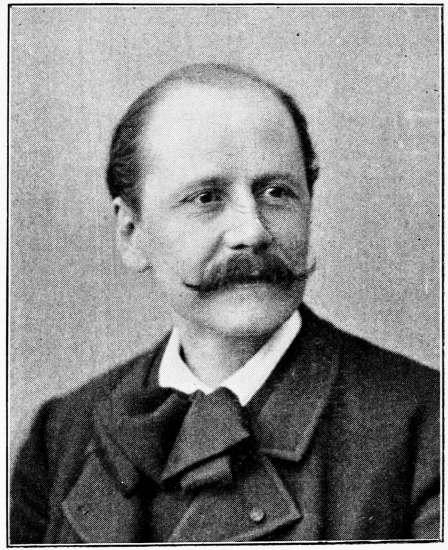

JULES MASSENET
IN the year 1842 there lived near St. Etienne, in the department of the Loire, an ironmaster of the name of Massenet, an ex-superior officer of engineers, who had been twice married, and both of whose unions had been blessed in a manner apparently rare in France. In the year in question yet one more offspring was destined to be added to the already crowded quiverful. This child, who was named Jules, was the future composer of "Manon" and "Werther." It is needless to state that, alike to all great musicians, Massenet gave evidence of talent at an early age, to the extent that he was sent to the Conservatoire, where he rapidly distinguished himself.
His family, who at that time resided in Paris, were, however, obliged, on account of his father's health, to leave the capital. It appears that young Massenet, tormented by the desire to resume studies that had been so brilliantly begun, thereupon made up his mind to quit the paternal roof, which was then situated in the town of Chambéry, in Savoy, and one day, without saying a word to any one, he undertook to walk all the way to Lyons. How he ever got there it is difficult to say, for he had apparently neglected to provide himself with ready cash, doubtless deeming this a superfluity and a needless encumbrance. Trifles such as these sit lightly on a mind of fourteen, and young Massenet succeeded somehow or other in reaching the great manufacturing centre; where he discovered the abode of a relative, and presented himself, tired and hungry, to his astonished gaze. Having explained the cause of his sudden appearance, the young truant was forthwith expedited back to his parents, who, seeing that it was useless to combat so decided a vocation, made up their minds to send him to Paris in order that he might continue his studies. Unfortunately, it is impossible to live upon air, and during the time when he was mastering the principles of his art the young neophyte was obliged to look for some occupation that would help him to keep body and soul together. This he was fortunate enough to find at the Théâtre Lyrique, where he obtained the privilege of presiding over the kettledrums at a salary of 65 francs a month. It was not precisely riches, but it sufficed to keep the wolf from the door. For six years did Massenet have the opportunity of venting the superfluity of his energies by striking the drums. In the meanwhile he was not idle, and the first prize for piano as well as the first prize for fugue were both successfully awarded to him. Finally, at the age of twenty-one he reached the goal of his ambition, obtained the "Grand Prix de Rome" through a cantata entitled "Rizzio," and departed for the Eternal City, where he remained for two years.
Massenet has himself recorded his impressions of Rome in some interesting autobiographical notes published recently in the Century.
"It was at Rome," he says, "that I began to live; there it was that during my happy walks with my comrades, painters or sculptors, and in our talks under the Villa Borghese or under the pines of the Villa Pamphili, I felt my first stirrings of admiration for Nature and for Art. What charming hours we spent in wandering through the museums of Naples and Florence! What tender, thoughtful emotions we felt in the dusky churches of Siena and Assisi! How thoroughly forgotten was Paris with its rushing crowds! Now I had ceased to be merely a musician; now I was much more than a musician. This ardour, this healthful fever still sustains me, for we musicians, like poets, must be the interpreters of true emotions. To feel, to make others feel—therein lies the whole secret."
It is natural that with recollections such as these Massenet should consider a sojourn in Rome to be fraught with great advantage to young musicians. He believes that a residence there "may give birth to poets and artists, and may awaken sentiments that otherwise might remain unknown to those in whom they lie dormant."
It was at the close of the year 1865 that he left Rome, and shortly after, a one-act comic opera from his pen, entitled "La Grande Tante," was produced at the Opéra Comique, according to the regulations, which prescribe that every winner of the "Prix de Rome" should have a one-act work played at this theatre. Massenet's hour had not yet arrived. His "Poème d'Avril," one of his most delicate inspirations, had been refused by a publisher, and he found himself obliged to earn his livelihood by giving lessons.
In 1869 he took part in the competition for the composition of an opera upon a libretto entitled "La Coupe du Roi de Thulé,"[25] but without success, the prize being awarded to Mons. Diaz,[26] whose work was subsequently brought out at the Opéra without creating any great sensation. This shows the value from an artistic point of view of these competitions.
The Franco-German war came to interrupt Massenet in his labours, and like a good patriot he served his country on the ramparts of Paris.
After matters had settled down he was able to again set to work. His next operatic venture was "Don César de Bazan," played at the Opéra Comique in 1872, concerning which it is not necessary to say much. A piquant little entr'acte has survived, and is occasionally heard at concerts. A more important work was the music he composed to Leconte de Lisle's drama, "Les Erinnyes," which still ranks amongst his most remarkable productions.
Massenet has been most successful in imparting a sort of antique colouring to his score. A selection of the music has found its way into the concert-room, and was heard at the Crystal Palace under the composer's direction some years ago. The best numbers are the beautiful invocation of Electra and the characteristic dances.
The turning-point in the composer's career was at hand. He had written a sort of oratorio entitled "Marie Magdeleine," and having shown the score to Mme. Viardot, this great artist, who had been instrumental in furthering Gounod's début as an operatic composer, was much struck by its merit, and determined to have it produced and sing in it herself. "Marie Magdeleine" was accordingly performed at the Odéon in 1873, and created a great stir in musical circles. This delicate and refined score reveals many of the special characteristics well known to those who admire the composer's music. It is very different from what we understand in England as an oratorio. The sensuous vein of melody and the sickly sentimentality which Massenet so often mistakes for true feeling are noticeable in many of its pages. "Marie Magdeleine" was just the sort of work to please a French audience of twenty years ago, whose acquaintance with Berlioz and Wagner was limited, and whose ideal was bounded by Gounod. It was the Bible doctored up in a manner suitable to the taste of impressionable Parisian ladies—utterly inadequate for the theme, at the same time very charming and effective. These words apply equally to "Eve," a work of the same nature that was produced two years later with equal success.
It is but right to say that Massenet has not employed the title of "oratorio" for either of the above works. "Marie Magdeleine" is styled a sacred drama, and "Eve" a mystère. Concerning the first of these Mons. Arthur Pougin informs us that Massenet had not intended to adopt "the broad, noble, and pompous style of the oratorio. Painter and poet, he had endeavoured in this new and long-thought-out work, to introduce rêverie and description; he further employed the accents of a veritably human passion, of a tenderness in some way terrestrial, which might have given rise to criticism had he let it be imagined that he intended to follow on the traces of Handel, Bach, or Mendelssohn."
The feminine nature of Massenet's talent has often led him to choose frail members of the fair sex as heroines of his works, such as Mary Magdalen, Eve, Herodias, and Manon. He lacks depth of thought and strength to grapple successfully with Biblical subjects, and the absence of these is not atoned for by an artificiality of expression, and the too frequent employment of affected mannerisms. At the same time, there is a distinct element of poetry noticeable in all his works, and a peculiar sensuous charm is prominent in most of his compositions. These qualities are not to be despised. To them are to be added a richly-coloured and varied instrumentation, and an always interesting and often original harmonic treatment. Massenet's name was now well known to concert-goers, and was shortly to become so to that larger section of the community, the theatre-going public, through the production of his opera "Le Roi de Lahore." Previous to discussing the value of this work it will be well to mention the orchestral suites composed by him at different times, some of which occupy a permanent place in concert répertoires. Of these the most popular is entitled "Scènes Pittoresques," a set of four short movements, simple in structure, melodious, and well scored. There is not much in them, but although the material is scanty the workmanship is extremely clever, and the general effect decidedly pleasing. The "Scènes Dramatiques," after Shakespeare, the "Scènes Hongroises," and the "Scènes Alsaciennes" are interesting and replete with imagination and fancy.
Perhaps the most remarkable of the composer's purely instrumental works is the overture to Racine's "Phèdre," a composition full of passion and feeling, well worked out and admirably orchestrated, which is fully entitled to rank amongst the best modern concert overtures. It is to be regretted that the composer has not produced more works of the same kind. There is a virility of accent and an avoidance of specific mannerisms that may often be sought for in vain in his other compositions.
"Le Roi de Lahore," produced at the Opéra in 1877, obtained a great success, partly, perhaps, owing to the magnificence of the mounting, but also, it must be said, on account of the intrinsic value of the music. A spectacular opera in the fullest sense of the word, "Le Roi de Lahore" was a work eminently suited to a theatre such as the Grand Opéra, where the ballet, mise-en-scène, and other accessories rank on an equal footing with the music. It was produced on a grand scale, the ballet act, taking place in the Paradise of Indra, forming one of the most gorgeous spectacles possible.
This act is perhaps the best from a musical point of view. In it Massenet has given full rein to his fancy, and has composed dance music of a really superior kind, which he has enriched with a piquant and effective instrumentation. "Le Roi de Lahore" remains perhaps the best work that Massenet has composed for this theatre. It is more spontaneous than either "Le Cid" or "Le Mage," and contains many portions of great excellence. Every one knows the suave cantilena for baritone that Mons. Lassalle used to interpret in so incomparable a fashion. In his criticism of this work Mons. A. Jullien formulates the following opinion of Massenet and the present school of French composers: "They all know their work admirably, and treat the orchestra to perfection. They have more or less natural grace and tenderness, but they often lack power and originality. They make up for the first of these by the employment of noisy effects, and for the other by a search after novelty that occasionally amounts to eccentricity. Neither have they got sufficiently settled ideas: they try to reconcile the elements of different schools; they do not write any more roulades or points d'orgue, but they allow singers to spread out their fine voices on final cadences; they understand the necessity of renovating and vivifying the opera, but they only dare to make timid attempts in this direction at long intervals, and return immediately to used-up formulas, to ensembles, to choruses, and to the most commonplace finales."
There is a great deal of truth in these words; at the same time it is difficult to foresee an epoch when the "lyrical drama" will have attained that state of perfection as to be no more susceptible of improvement. The progress that has been effected in France during these last thirty years in the direction of a higher conception of the musical drama has been enormous. The ball has been set rolling by some of those composers who would perhaps now be anxious to arrest its course, but the impetus having been given, it has been kept going by the younger aspirants to operatic fame, and is not likely to stop.
"Le Roi de Lahore" obtained a distinct success, which was repeated in a number of continental cities, including our own metropolis.
Massenet visited England in 1878, and conducted a concert devoted to his own music at the Crystal Palace. The programme included extracts from "Le Roi de Lahore" and "Les Erinnyes." He also appeared at a concert given by Mme. Viard Louis at the St. James's Hall, on which occasion he directed the performance of his orchestral suite entitled "Scenes from Shakespeare."
Massenet's reputation was now established upon a solid basis. On the death of F. Bazin he had succeeded him as one of the leading professors of the Conservatoire. He had also been elected a member of the Institute. His next work, a religious cantata entitled "La Vierge," produced at the Opéra in 1880, was, however, coldly received. Massenet, who conducted the orchestra in person, was grievously disappointed at this, but set to work with renewed vigour at an opera entitled "Hérodiade," which was brought out with great success at Brussels in 1881. This work has since been given in Paris, as well as in various continental towns, where it has been well received. The nature of the subject necessarily stands in the way of its being produced in London. Certain extracts, however, have been heard in our concert-rooms. The score of "Hérodiade" abounds in examples of that sensuous melody so characteristic of the composer. There is very little Biblical about it, and it is to be regretted that another and better subject was not hit upon than this parody of Holy Writ. Massenet's strains would probably have been equally appropriate, and the susceptibilities of those who look upon this sort of thing as a desecration of religion would have been respected.
There is indeed a vast difference between taking a subject like "Samson et Dalila," against which none but the most strict could object, and turning St. John the Baptist into a commonplace operatic hero. If it were not for the libretto, "Hérodiade" ought to be heard in London, as it counts amongst its author's best works, and, despite certain weaknesses, occupies an honourable place in the ranks of modern operas.