BOOK FOURTH.
Reading edition
I.
Animals eat that they may live. Man eats, not only that he may live, but that he may gather strength, and fulfil his high destiny on earth.
When God gave form and animation to the dust of the earth, and man appeared, he did not intend that the sustenance of life should be left to chance or to careless selection. This intent of the Creator is revealed in the study of the organic world, where wonderful varieties and productions are offered to the appetite of man, in order that the “force of the universe may glow within his veins,” and that the faculties of his mind may so expand that he may behold and comprehend the works and designs of his Maker.
Food, next to the purity of the air, determines the degree of the physical well-being; it gives the beauty of contour to the form; it builds up the marvellous structure of the brain; the ravishing smile of the features, the sublimity of thought, depend alike in great measure upon the benign influence of food.
It not only gives to nations their characteristics of strength and solidity, but it bestows upon society more of grace and refinement than philosophy is willing to allow.
II.
The question of alimentation with the civil laborer, exposed to healthy influences of properly distributed air and sunlight, and to the regular motions of a well-conducted life, is easy of solution to the inquiring mind.
But when it relates to the soldier, subjected to strange and unhealthy influences, the explanations involve much study, care, and research.
In the natural condition of man it is easy to determine how much food will support life and sustain physical exertion. The dietaries of the public institutions of different countries, the experiments of physiologists, and the records of history give the data with sufficient clearness. As to the amount of food required daily to repair the waste and wants of the human organism, much depends upon the degree of muscular exertion and nervous excitation, as well as the temperature of the season. In the alimentation of armies scientific principles must not be disregarded. Food must be considered as force; it must contain, not only material, but power. The strength of men, says Baron Liebig, is in direct ratio to the plastic matter in their food.
In determining the absolute quantities of nutrient substances required by the system, Lehman observes that there are three magnitudes especially to be considered.
The first is the quantity requisite to prevent the animal from sinking by starvation. The second is that which affords the right supply of nourishment for the perfect accomplishment of the functions, and the last is that which indicates the amount of nutrient matter which may, under the most favorable circumstances, be subjected to metamorphosis in the blood. No one of the four classes, the carbohydrates, the fats, the albuminous matters, and the salts, will answer the purpose alone, but all must be employed together, and this invariable proportion according to the local, and, therefore, variable waste of the system. These considerations indicate how complicated the problem is.
III.
Life is an action; the principle of life, whatever may be its nature, is eminently and visibly a principle of excitation, of impulsion, a motive power.
“It is taking a false idea of life,” says Cuvier, “to consider it as a simple link which binds the elements of the living body together, since, on the contrary, it is a power which moves and sustains them unceasingly.”
These elements do not for an instant preserve the same relation and connection; or, in other words, the living body does not for an instant keep the same state and composition. “This law,” adds Flourens, “does not affect alone the muscles, viscera, and tissues, but there is a continual mutation of all the parts composing the bone.” These views have been substantiated by the extended experiments of Chossat, of Von Bibra, and a host of experimentalists, showing how positive and decided are the changes in the material composition of the body, and especially the constitution of even the bone from the influence of food.
IV.
“It is from the blood that life derives the principles which maintain and repair it. The more vigorous, plastic, and rich in nutritive material, so much the more life increases and manifests itself, so much the quicker the reparatory processes restore a lesion to its natural condition.
“The blood owes its vivifying properties to the presence of oxygen, which it receives by the respiratory organs; but that nourishing fluid, to complete its physiological rôle, needs to receive combustible and organizable material.”
These Protean principles of the healthy blood form one fifth of its weight.
Oxygen unites with the carbon of the food in the blood of animals; carbonic acid is formed and heat evolved. When the atmosphere is vitiated, the oxygenating processes are diminished in ratio to the vitiation.
The experiments of Seguin, Crawford, and De la Roche show that in a vitiated and highly heated atmosphere the blood is not thoroughly decarbonized, thereby deranging the nervous system, and affecting the animal functions as well as the mental faculties. The blood is subject to incessant variations. The more feeble the respiration the less rich it is. Man absorbs twenty to thirty quarts of oxygen every hour. The pure air is a real food, and is as necessary for the development and repair of the physical force as the more solid forms of matter. Nine ounces of carbon are consumed every day, and the phenomenon of the expired carbonic acid has its maxima and minima during the day, like the regular variations of the barometer or the tides of the ocean.
V.
The great nervous prostration and the lack of energy which were observed among the prisoners, were not due entirely to climate. The activity of the nervous mechanism depends greatly upon the supply and purity of the arterial blood. It is the same with the nerve fibres as with the nerve centres, but in less degree. We observe that the exaltation and depression of the nervous power are within the control of man by the administration of certain drugs, or respiration of appropriate gases. The accumulation of bile or urea in the blood diminishes the nerve energy. Many physiologists enumerate moral depressions among the principal causes of epidemics; and this opinion is not strange when we consider how completely the system is under control of the nervous influence, and how much the supply of oxygen and blood to the organs and tissues depend upon the nervous power; and how much, moreover, the integrity of the nervous system depends upon the purity of the blood.
In the process of starvation, during the struggle for life, the hidden forces in reserve—the superabundant muscle, fat, tissues, even the brain-substance—are gradually absorbed. The volume of blood may remain the same, but the vivifying particles which circulate in the vital stream are rapidly consumed by the wants of the wasting economy, and disappear. And when these hematic globules are lessened to a certain limit below the normal proportion death ensues. Vierodt has discovered that the limit of this singular law is 52 per 1000 for the dog, and about 60 per 1000 for some other species of the mammalia. The physiologists have shown how the vivifying principles acquire vigor through the blood discs, and how these, when absorbing pure oxygen through the pulmonary circulation, contribute to the development of muscular fibre and the nervous material. Mammals and birds, when deprived of food, die in ten to twenty days, losing from one third to one half of their weight.
VI.
In determining the nutritive value of aliments by the study of their chemical composition, we cannot adhere strictly to the results furnished by analysis. For, says Baron Liebig, we cannot reckon upon results in the human stomach with the same regularity as we would in the alembics of our laboratories.
Physiologists divide alimentary substances into two classes: the nitrogenous, which, according to Dumas, supply the demands of assimilation, and the non-nitrogenous, which are called by Liebig respiratories, from furnishing the products consumed by respiration. Neither the one nor the other will alone support life indefinitely, and when one or the other decreases below well-defined limits, health declines, and finally life becomes extinct from inanition.
Milne Edwards gives, as the mean amount of these two classes, required for all climates, not less than three hundred and fifteen grains of nitrogen and thirty-three hundred and fifty grains of carbon in the twenty-four hours. These views are adopted by most physiologists; yet the analyses of Schlossberger and Kemp indicate that the idea of estimating the value of food by the quantity of nitrogen it contains is a fallacious one.
The beautiful experiments of Bernard and the modern physiologists have unfolded many of the laws that regulate digestion and assimilation. Yet the human researches in the great arcana of nature are extremely limited, in comparison with the vast range of physical phenomena, and every day we are reminded of the remarks of Boerhaave to his students: “Let all these heroes of science meet together; let them take bread and wine, the food which forms the blood of man, and by assimilation contributes to the growth of the body; let them try by all their art, and assuredly they will not be able from these materials to produce a single drop of blood,—so much is the most common act of nature beyond the utmost efforts of the most extended science.”
The composition of the typical food of nature is revealed to us in the analysis of human milk.
VII.
The need of varied food is apparent to the casual observer, and it is well proven in the immortal work of Cabanis. “The experience of civilized life has shown,” says Professor Horsford, in his admirable pamphlet on the marching ration of armies, “that the human organism requires, to maintain it in health, both organic and inorganic food.
“Of the organic, it needs nitrogenous food for the support of the vital tissues for work; and saccharine, or oleaginous food, for warmth. Of the inorganic, it needs phosphates for the bones, brain, muscles, and blood; and salt for its influence on the circulation and the secretions, and for various purposes where soda is required for a base; and doubtless both phosphates and salt for many offices as yet imperfectly understood. ‘A man may be starved by depriving him of phosphates and salt, just as effectively as by depriving him of albumen or oil.’ (Dalton’s Physiology.)
“The salts of potassa, magnesia, and iron, of manganese, silica, and fluorine, are always present, and perform services of greater or less obvious moment in the animal economy. These organic and inorganic substances are essential, but they are not all that are needed. Man, especially when compelled to exhausting labor, requires beverages and condiments. He wants coffee, or tea, or cocoa; or, in the absence of these, he may feel a craving for wine or spirits. He wants salt, pepper, and vinegar. To preserve a sound body, then, there are required organic and inorganic food, beverages, and condiments.”
“A mixed food,” says another writer, “which varies from time to time, seems to be essential; and there can be no doubt that the changes which physicians have recognized in the nature of the predominating diseases, from century to century, are connected with changes which have taken place in the nature of the diet. Excess of oil, albumen, and starch produce liability to arthritic, bilious, and rheumatic affections; a deficiency of oleaginous materials, scrofula, &c.”
VIII.
In attempting to form a proper estimate of the alleged ration furnished by the rebels to their prisoners at Andersonville, we will endeavor to arrive at just conclusions by comparing the known quantities with the dietaries of long-established hospitals, prisons, and the ration of armies of different periods of history.
The effects of food upon the civil prisoners, both of the long and short term, have been carefully studied by Christison, Liebig, Barral, and Edwards; and it is conclusively shown by their statistics of the prisons of Europe how much food will keep the prisoners in athletic condition when exposed to healthy influences. The quantity of food required depends upon the wants of the system and the quality of food consumed. Some articles are far more nutritious than others, and are far less bulky; for instance, the rice eaters of China, the potato and milk consumers of Ireland, eat enormously, compared with the beef-eating people.
But rarely will a less quantity than seventeen ounces suffice for the animal economy, and not then, even, unless it is the concentrated essences and principles of carefully selected grains, and healthy meat from cattle killed in their native pastures, like the scientific ration correctly proposed by Professor Horsford. This ration is intended to enable armies to change their base with intervals of more than a month, and to assist raiding parties to perform long journeys without relying for subsistence on the doubtful and difficult forage along the route, or on the distant depots at the point of departure.
A handful of the ripe, golden grains, roasted and mixed with a little sugar, with a few ounces of beef dried from the meat of healthy cattle killed instantly, will sustain the power of life wonderfully. This is shown by the mountaineers of the Cordilleras, of the Andes, and the Rocky Mountains.
It was substantially the same ration that enabled the Romans to traverse countries far remote from their main depots of supplies, and the Greeks to advance across, with safety, the immense arid deserts of Asia. Any of our splendidly equipped and fed armies of modern times would perish in a few days along the route where Xenophon and his immortal ten thousand passed with safety, and without much loss.
IX.
The mode of rationing the Roman armies, and the manner in which the supplies were obtained and preserved, is well shown in the extant writings of those times. Besides the allowance of wheat daily,—one to two pounds,—the Roman soldiers often received a ration of pork, mutton, legumes, cheese, oil, salt, wine, and vinegar. With the grain, a porridge-pot, a spit, the casque for a cup, and with vinegar to mix with their water,—which formed the regulation drink posea, or acetum,—they marched rapidly, and retained their extraordinary vigor in the midst of pestilential regions. Every soldier carried his own food for a given length of time, which was from eight to twenty-eight days. “Cibo cum suo.” Hence Josephus wrote, the Roman soldier is laden like a mule. This food was always of the best quality; and the wheat was always carefully selected by a commission appointed for the purpose, as we may learn from the inscription on the column of Trajan. This wheat was not always eaten raw; but was oftener roasted, and crushed upon a stone.
“Frugesque receptas Et torrere parant flammis et frugere saxo.”
With all of these arrangements and movements, there was method even as to the time of taking food. The soldier ate twice a day, and at appointed hours—at the sixth hour, “Prandium;” and at the tenth hour, “Vesperna.”
X.
The requirements of the system differ greatly, according to the degree of heat, the purity of the air, and the degree of physical exercise. What suffices at the equator would be but a morsel at the pole. What sustains the quiet student would starve the active athlete.
When Volney spoke in surprise of the few ounces required to sustain the Bedouin, he forgot the purity of the air of the desert, as well as the indolent life of the Arab.
When we offer as example the frugal diet of Cornaro, which was twelve ounces of solid food, with fourteen ounces of wine, daily, we must remember that the celebrated man lived a life of moderation, avoided bad air, and guarded against the extremes of heat and cold.
The data of Frerichs, the observations of Sir John Sinclair, and the determinations of Professor Horsford, show that eighteen ounces of properly selected food may sustain life; and they also show that the nutrient substances must be of known value.
XI.
In forming our ideas as to the required amount of food necessary to healthy vigor, we will not attempt to analyze the magnitudes of Lehman, nor accept the statement of Chossat, that the animal body loses daily about one twenty-fourth of its weight by the metamorphosis of tissue; but will again examine the diet tables of the prisons, hospitals, and armies of Europe, leaving the reader to form his own conclusions.
The distinguished physiologist, Milne Edwards, maintains that the food must contain three hundred and fifteen grains of nitrogen and three thousand three hundred and fifty grains of carbon, otherwise the animal economy loses force, and gradually deteriorates. The data of Frerichs give the same views, and they accord with the observations of the ten years’ study of the regimens of the prisons of Scotland. Dumas, in his calculations of the ration of the French army, gives as its equivalent three hundred and thirty-five grains of nitrogen and four thousand nine hundred and fifty grains of carbon.
In the prisons and hospitals of England, Scotland, France, and Germany, the dietaries furnish from seventeen to twenty-eight ounces of nitrogenous and carbonaceous food.
For a time, the solid ration of the prisons of Scotland was reduced to seventeen ounces, but the prisoners lost weight. In the public institutions of England we find the total quantity of solid food to be as follows: The British soldier receives in home service 45 ounces; the seaman of the Royal navy 44 ounces; convicts 54 ounces; male pauper 29 ounces; male lunatic 31 ounces. The full diet of the hospitals of London furnish from 25 to 31 ounces of solid food, besides from one to five pints of beer daily. The Russian soldier has about 50 ounces; the Turkish more than 40 ounces; the French nearly 50 ounces; the Hessian 33 ounces; the Yorkshire laborer 50 ounces; United States navy 50 ounces; and the soldier of the United States army about 50 ounces, of solid food.
XII.
The food allowed to the prisoners at Andersonville, according to the statements of the prisoners and other witnesses, was from two to four ounces of bacon, and from four to twelve ounces of corn bread daily; sometimes a half pint to a pint of bean, pea, or sweet potato soup, of doubtful value. Vegetables were unknown. Thus giving a total weight of solid food, per diem, of six to sixteen ounces of solid food. The amount was not constant: some days the prisoners were entirely without food, as was the case at Belle Isle and Salisbury. Neither was the deficiency afterwards made good. The amount given was oftener less than ten ounces than more.
The contrast furnished by the dietaries of our own military prisons, of those of the British hulks (so much cursed during the last war), or by the food given by the Algerine pirates to their prisoners and slaves, gives rise to terrible convictions as to the regard the rebel authorities placed upon the lives of their prisoners. The United States allowed to the rebel prisoners held by them thirty-eight ounces of solid food at first; but afterwards, in June, 1864, they reduced the ration to thirty-four and a half ounces per day. The range of articles composing the ration was the same as with our own troops, the exception being in the weight in bread. In the Dartmoor prison in England, where our men were confined by the English, when taken prisoners during the last war, and of which so much cruelty has been alleged, the authorities allowed to the prisoners for the first five days in the week 24 ounces of coarse brown bread, 8 ounces of beef, 4 ounces of barley, ⅓ ounce of salt, ⅓ ounce of onions, and 16 ounces of turnips daily (or more than 50 ounces of solid food); and for the remaining two days the usual allowance of bread was given with 16 ounces of pickled fish. The daily allowance to our men, at the Melville Island prison, at Halifax, during the last war, was 16 ounces of bread, 16 ounces of beef, and one gill of peas; the American agent furnishing coffee, sugar, potatoes, and tobacco. The allowance on the noted Medway hulks was 8 ounces of beef, 24 ounces of bread, and one gill of barley, daily, for five days; and 16 ounces of codfish, 16 ounces potatoes, or 16 ounces of smoked herring, the remaining two days of the week. Furthermore, in addition to these generous allowances of the British people, it can be said that the quality of the food was almost always excellent.
The writer, with one exception, knows of no dietary to compare with that adopted, or made use of without the formality of adoption, by the rebel authorities in the treatment of their prisoners.
This exception is found in ancient history, which Plutarch has handed down to us. The Athenians, captured at the siege of Syracuse, were placed in the stone quarries of Ortygia, and fed upon one pint of barley and half a pint of water daily. Most of them perished from this treatment.
XIII.
The corn bread furnished was made, according to the evidence, from corn and the cob, ground up together, and sometimes mixed with what is called in the south cow peas. It varied from four to twelve ounces in weight daily, generally from four to eight ounces. A pound (of sixteen ounces) of corn bread contains, according to chemical analysis, two thousand eight hundred grains of carbon and one hundred and twenty-one grains of nitrogen, and therefore the highest quantity of corn bread furnished, say twelve ounces, afforded but two thousand one hundred grains of carbon and ninety grains of nitrogen, leaving a deficiency, according to the physiologists, of more than twelve hundred grains of carbon and two hundred grains of nitrogen, to be supplied by the two or four ounces of doubtful bacon.
That the bacon could not furnish this deficiency must be apparent to the scientific observer. The quantity of bread alone, required to furnish the desired amount of carbon and nitrogen, would have been over three pounds daily, which quantity the prisoners did not have.
Milne Edwards, after treating at length the subject of alimentation, and offering many examples, arrives at the conclusion that the mean quantity of bread and meat required to sustain the life of man, consists of sixteen ounces of bread and thirteen ounces of beef daily. This conclusion is sustained by most of the experimentalists, and if lesser quantities are used, they must be of choice selections. A small loaf of bread made of flour, ground from ripe, healthy wheat, will accomplish more for nutrition than two or three larger loaves, baked of damaged and unripe grain; and likewise it is with meat: half a pound of beef from cattle killed instantly in their native pastures, when the flesh retains all its natural juices and sweetness, is worth more for the support of the system than two or three pounds of beef from animals that have been fasted and terrified, and have thereby lost, in a very great measure, their nutritious qualities.
The flesh of mammalia undergoes a great change in its nutritive qualities by reason of fasting, disturbance of sleep, and long-continued suffering, resulting in its becoming not only worthless, but deleterious.
XIV.
Vegetable substances alone will not sustain life for a great length of time in every climate, but there is a vast difference between the wants of man at the equator and his necessities at the pole.
Nature requires for the working of her plans materials of diverse natures: neither the oil, nor starch, nor sugar, will sustain life alone. Chemical analysis and physiological history point out to us how positive is the law which fixes the component parts of grains and plants, and how imperative the necessity of adjusting in alimentation these forms of nutritive matter, which spring up on every side in profusion, and offer endless variety to the wants of man.
There must be harmony of certain principles; there must be union of starch, of gluten, and fat, to complete the process of digestion and assimilation. To feed a patient upon arrow-root, tapioca, or sago, and the like, is to consign him to certain death. Instinct impels us sometimes to make use of articles which our habits have thrown aside.
XV.
It appears from the reasoning of Baron Liebig, that when we replace the flesh and bread of ordinary diet by juicy vegetables and fruits, the blood is beyond all doubt altered in its chemical character, the alkaline carbonates being substituted for the phosphoric acid and alkaline phosphates, which are supposed to exert a disturbing influence in so many diseases, especially typhoid and inflammatory affections. The gluten of grain, and the albumen of vegetable juices, are identical in composition with the albumen of blood, but there are varieties of wheat, the ashes of which are in quantity and in relative proportion of the salts the same as those of boiled and lixiviated meats, and it cannot be maintained that bread made of such flour would, if it were the only food taken, support life permanently.
The experiments of the French academicians, show that dogs fed exclusively on white bread, made from the sifted flour, died in forty days; but when fed on black bread (flour with the bran), they lived without disturbance of health. Bread should always be made of grains grown in healthy places, and should contain the entire seed, with the exception of the husk; then it will realize the idea of Paracelsus: “When a man eats a bit of bread, does he not therein consume heaven and earth, and all of the heavenly bodies, inasmuch as heaven by its fertilizing rain, the earth by its soil, and the sun by its luminous and heat-giving rays, have all contributed to its production, and are all present in the one substance?”
Desiccated vegetables, which have lost the water of vegetation and other gaseous elements, which chemistry thus far has been unable to discover, cannot adequately replace the fresh articles; the particular principle, the water of vegetation, can no more be restored to them than the dust of the crushed quartz can be recrystallized by the simple addition of water.
XVI.
In the alimentation of armies bread is the basal element. If it be poor, the whole system of the commissariat is deranged. History shows that it is the most important item in the feeding of soldiers, and that many a campaign, since the disaster to the army of Belisarius at Methon, has been lost in consequence of the quality of its munition bread.
France allows to her soldiers 26 ounces of bread, England 24, Belgium 28, Sardinia 26, Spain 23, Prussia 32, Austria 32, Turkey 33, United States 22, Rebel Prisons 4 to 12 ounces!
The quantity of corn meal allowed to the rebel soldiers by the rebel government was about one and one-third pounds daily: this would give about 28 ounces of bread, allowing 30 per cent. of water, which is the rule among bakers; at least it is the average quantity established by the civil tax commission of Paris. Besides the corn meal they had six ounces of bacon, and peas, and rice. This ration was sufficient to preserve life, as it has been shown by the condition of the rebel armies; the bread alone contained 4900 grains of carbon, and 210 grains of nitrogen, without the aid of bacon or the peas. The bread alone has an excess of 1600 grains of carbon, and a deficiency only of about 100 grains of nitrogen, which was readily supplied by the bacon and other articles. Corn bread is one of the chief articles of diet in the Southern States, and it is likewise used extensively in the South of Europe. It makes heavy bread unless carefully prepared and mixed with flour, and when mixed with the cob it often produces a laxative effect, the degree of which depends greatly upon the quantity the meal contains. When properly prepared with milk and the usual ingredients, it becomes an agreeable and nutritious article of diet, but carelessly handled, it is disagreeable to the palate and difficult to digest.
The bread furnished to the prisoners was simply mixed with salt and the dirty water from the brook, or the foul spring in the rear of the bakery, and then dried in the heat of the oven. That bad effects arose from such a quality of bread cannot be doubted; the injurious influences of impure water in panification have been pointed out by Boussingault, in a paper presented to the French Academy in 1857.
It is the common saying in the Southern States, where the use of wheaten bread is comparatively rare, that a bushel of corn contains more nutriment than a bushel of wheat. Yet the southern wheat is superior to the northern varieties, and is richer in the azotized, glutinous principles so essential to the formation of blood and muscle. Vermicelli and macaroni can be made only from the best southern wheat.
Of the varieties of Indian corn in America, the yellow flinty corn is reckoned the sweetest and most nutritive; the white corn of the South makes the fairest, but considerably the weakest flour. We do not find special fault with the coarsely ground meal, provided the cob is not included, for Mayer has pointed out, in discarding the commercial bran we throw away fourteen times as much phosphoric acid as there is in superfine flour. In this bran are contained most of the layers of gluten, in which are lodged the phosphates and the companion nitrogenous compounds—the sources of living tissues. The nutritious Graham bread is an example; also the pumpernickel of Westphalia, the black bread of Russia, the coarse oatmeal of Scotland, contain all the gluten, all the phosphates and nitrogenous compounds, as well as the starch of the grains. Such was the bread that Celsus considered as equal to flesh in its capacity of nourishing.
XVII.
Fresh meat was rarely furnished to the prison, according to the reports and statements of witnesses, and we should doubt that it was furnished at all, if it were not for the number of sections of the horns of cattle which are strewn about the enclosure, and which the prisoners had used for drinking dishes; still, many of these horns may have been taken from the cattle killed for the guards.
That the issue of fresh beef would have been beneficial to the men, there is no doubt; in fact, the experiment at Jamaica, which continued twenty years, proves it; for the troops who were fed with a larger allowance of fresh meat suffered far less from dysentery than any of the troops of the West India islands. There is always great difficulty in preserving the good qualities of fresh meat in hot climes, and, on the other hand, the use of salt meat in the same regions is apt to engender scorbutic disorders. Whenever putrefactive fermentation begins with any kind of meat, or any recently living nitrogenized substance, catalytic action takes place, ammonia is evolved, and the product is no longer pleasant to the taste or nutritious to the system. Food, when even exposed to vitiated air, becomes deteriorated in quality, just as good flour is rendered worthless by mixture with the damaged fungoid grain. Butchers’ meat on the average affords but thirty-five per cent. of real nutritive matter, at least such was the opinion presented to the French Minister of the Interior by Vauquelin and Percy. Accepting this determination, we may form some idea of the relative value of the scanty allowance of the doubtful beef furnished to the prisoners, if it was furnished at all.
That bacon was furnished, there is no doubt; neither has the quantity been underrated by the sufferers themselves, as we shall presently see. And there is no reason why the quality should not have been most excellent, unless it had been selected for the purposes of cruelty. There is evidence that it was sometimes of very bad quality; but that it was generally and systematically selected to disgust the prisoners, we are unwilling to believe, although we have evidence that rotten bacon was furnished by contractors, and the fact boasted of by them. The influence and effect of this decomposed food may be surmised by the following remark of Donovan: “Flesh contains the elements of some of the most deadly poisons that are found even in the vegetable kingdom; a slight change in their mode of combination, or of the ratio of their quantities, may convert nutriment into a source of death.”
XVIII.
There is another very important item to be considered in the dietary of this prison, and that is the quality and quantity of the water furnished for potable purposes. “Water,” says Milne Edwards, “is an aliment, as well as sugar and fibrine; for it is indispensable for the nutrition of the body, and, by whatever means it arrives in the economy, its rôle is always the same.”
The water consumed in the prison was obtained from the brook, and from the few wells or springs within the stockade. The volume of water in the brook was quite sufficient to furnish all the drinking water desired, if it had been introduced into the stockade by means of sluices. As it was, the course of the stream was left to nature, and no effort made to prevent its defilement by the camps situated farther up, or by the bake-house located close by. All the camps on the declivities about Andersonville were drained into this stream. Some few wells were sunk in the prison which yielded scanty supplies, and there were also a few springs undefiled; but the quality of water everywhere was surface water, tinged and tainted with the impurities of the soil and the infections of the collected filth. The thirst, which was excessive among the prisoners, could only be slaked by drinking the impure waters. Yet a very little care on the part of the rebel authorities would have increased the comfort of the prisoners in this respect, and prevented the loss of life to a very considerable degree.
“The preservation of potable water,” writes Felix Jacquot, “is certainly one of the capital points of hygiene.”
“I am sometimes disposed to think,” states Dr. Letheby, the health officer of London, “that impure water is before impure air as one of the most powerful causes of disease.” In cold climates slight impurities in the drinking water are not of vital importance; but in the tropics, and the adjacent regions, the least decayed vegetable or animal matter renders it injurious and unpalatable, and often is the determining cause of disease, especially enteric, to a fearful degree.
XIX.
During the months of June, July, August, and September, 1864, there was an aggregate number of prisoners of about twenty-eight thousand for each month. To supply this vast number of men with bread would have been ordinarily no easy task, requiring, as it would have done, twenty-eight thousand rations of bread daily, or eight hundred and forty thousand rations monthly. We have shown that the bakery could not have furnished more than ninety-six hundred rations of corn bread, of the United States weight of twenty ounces, or ninety-six hundred rations daily, or two hundred and eighty-eight thousand rations monthly, and probably furnished but five thousand rations daily, or one hundred and fifty thousand rations monthly. If this deficiency of a half a million of rations existed, how can it be explained?
Was munition bread brought from a distance to supply the deficiency? When and whence, we will ask?
During the period embracing the months of July, August, and September, 1864, the rebel commissary furnished, according to his statements, two hundred and twenty-three thousand bushels of corn meal, and thirty-seven hundred bushels of flour for the prison.
There was, during this time (ninety-two days), a monthly aggregate of twenty-nine thousand prisoners, who required twenty-nine thousand rations of corn meal daily; or, multiplied by ninety-two days, two million six hundred and sixty-eight thousand rations for the period of three months; or, allowing the same weight as the rebel ration, we have 2,668,000 × 1⅓ = 3,567,333 pounds of corn meal, or seventy-one thousand one hundred and forty-six bushels, allowing fifty pounds to the bushel. If we now estimate the rebel garrison to have been four thousand in the aggregate, we will have for the requirements, 4000 × 92 × 1½ = 552,000 pounds of meal, or ten thousand one hundred and ninety bushels, which gives, as total for the prison and garrison, eighty-one thousand two hundred and eighty-six bushels of corn meal.
Yet the commissary states that he sent two hundred and twenty-three thousand bushels, or almost three times as much as the quantity required. This is a strange statement to make, as we shall endeavor to show.
The rebel ration allowed by their law gave thirty-seven and a half pounds of corn meal, three pounds of rice, or five pounds of peas, ten pounds of bacon, salt, &c., monthly, of twenty-eight days, or about twenty ounces of meal daily, and about six ounces of bacon. We have, as an aggregate number of men for the above period (prisoners and guards), 29,000 + 4000 × 92 = 3,036,000 men, requiring, according to law, three million seven hundred and ninety-five thousand pounds of corn meal. Now the commissary states that he furnished 226,700 bushels of corn meal and flour; or, multiplied by 50 pounds = 11,335,000 pounds, thus giving to each man more than three and one-fifth pounds of meal and flour; or, allowing the usual per cent. of water, more than four pounds of bread. That these men had sixty-eight ounces of corn bread apiece, or that they could have eaten it if they had been furnished that quantity, is not for a moment to be considered. This analysis betrays the falsity of the commissary’s statement, and invalidates the remainder of his accounts.
It cannot be said that this meal was to be stored for future use, for it is well known that corn meal will not keep in this climate but for a few days without fermentation taking place. There is, again, another serious item to be considered in connection with this statement. Why should this overplus, of more than seven millions of pounds of meal, be sent to this prison, when the army of Virginia was calling loudly for grain? The statement and the figures indicate simply a foolish desire to cover up deficiencies, and that too in a very hasty manner.
XX.
The same commissary states that he sent, during the same period of time, three hundred and thirty-nine thousand pounds of bacon, or five million four hundred and twenty-four thousand ounces. This will give thirty-six hundred and eighty-four pounds of bacon each day of the ninety-two days; and, after allowing six ounces per man to the rebel garrison, we shall have remaining but two thousand pounds to be divided among the twenty-nine thousand prisoners, or about one and one seventh ounces of bacon to each man. Thus the account of the commissary, if true, proves that the statement of the prisoners, that they received but two to four ounces of bacon daily, was correct.
If the full amount of bacon had been allowed, there would have been required, at the rate of six ounces per man, ten thousand eight hundred and seventy-five pounds daily, whereas there was in reality but two thousand pounds, leaving a deficiency of more than eight thousand pounds daily. If fresh beef had been allowed at the same rate as the bacon, there would have been required ten thousand eight hundred and seventy-five pounds daily, or a herd of thirty of the native cattle, allowing three hundred and sixty pounds net weight to each carcass. If the full ration of one pound of fresh beef had been furnished, there would have been required more than one hundred and twenty of the same class of cattle daily.
XXI.
That the dietary of the prisoners was far from being adequate to their wants there is no doubt, and it only remains to be determined whether this deficiency arose from design, from ignorance, or from real scarcity of food.
We have very serious doubts as to the truth of the statements that there was a scarcity of food in this vicinity during the time of the occupation of the prison.
At the time of its selection the region was considered to be the richest in cereals of all the Southern States.
In times previous it had proved to be fertile, and during the progress of the war the slave labor was undisturbed by the Federal troops. It is shown by their own statistics that in 1860 the four counties near the prison, and along the line of railroad, produced nearly fourteen hundred thousand bushels of corn, thirty-three thousand bushels of wheat, three hundred thousand bushels of potatoes, and more than one hundred thousand bushels of beans and peas, besides forty-eight thousand bales of cotton. It is highly probable that these quantities were doubled, if not trebled and quadrupled during the succeeding years of the war, when the planting of cotton was forbidden by rebel ukase, and all energy and labor were turned to the production of food. There were in these four counties alone more than twenty thousand slaves.
In the south of Georgia, in the wire-grass region, were great numbers of cattle roaming at will, and the numbers in the everglades of Florida were so vast, that two old steamboat captains offered to furnish the rebel government, at this very period, with half a million pounds of salt beef, along the railroads in Florida. Governor Watts wrote from Alabama in April, 1864, that there were ten million pounds of bacon accessible in that State. In September of the same year, Mr. Hudson, of the adjoining State of Alabama, offered to deliver to the rebel government half a million pounds of bacon in exchange for the same quantity of cotton.
The rebel war clerk, in his diary at Richmond, wrote, March 17, 1864, “It appears that there is abundance of grain and meat in the country;” and again, July 3, 1864, he notes down, “Our crop of wheat is abundant, and the harvest is over.”
According to the census of 1860, there were in Florida more than six hundred thousand cattle and swine, and more than five millions in Georgia and Alabama. These two States produced during the same year more than sixty million bushels of corn and thirteen million bushels of potatoes. (Vide Appendix.)
XXII.
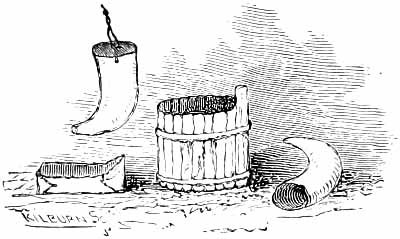
As to the arrangement for the distribution of the food, there was but little attention paid to system. The prisoners were ordered to arrange themselves into squads of two hundred and ninety men, and these squads were then subdivided into three messes. None of these messes appear to have been properly supplied with utensils to receive and distribute their food. Every prisoner was obliged to take care of himself, and all around the area of the stockade may be seen at the present day remains of bent pieces of tinned iron, the rudely-fashioned little tub, and sections of the horns of cattle which the poor prisoners had worked up with their knives, and utilized for their necessities. Civilized men would never have resorted to these primitive, rough, and slovenly means, if they had been supplied with the ordinary utensils. At certain hours carts, laden with the corn bread and bacon, were driven into the enclosure, and the rations were distributed right and left. When soup was made, it was brought in pails, and the prisoners received it in their horn cups, wooden tubs, or as best they could. No drink was allowed but the water from the brook, whose ripples were like the river Lethe, for they contained the elements of oblivion and death.
XXIII.
It is evident to the writer that the quantity of food furnished to the prisoners was far from being adequate to support animal life, and from this deficiency alone he can explain to his satisfaction the enormous loss of life. The admirable experiments of Boussingault and the French academicians show how the increase of weight in the feeding of animals is in direct proportion to the amount of plastic constituents in the daily supply of food, and how positive is the law which regulates the animal economy. Again, we can form some idea of the positive effects of the horrible condition of the prison, and of the extremes of heat and moisture upon the feeble digestion and assimilation, by the experiments of Claude Bernard, who shows how these functions may be disturbed by external influences, and how agony even causes the disappearance of sugar in the hepatic organ, and how fear disturbs the glucogenic process. There is connected with inanition a singular tendency to decomposition and putridity, alike in the blood and viscera. The system left unnourished rapidly wastes, and its vitality soon lessens to a degree beyond recovery. This degree depends upon the forces in reserve, which belongs especially to youth; middle age is less liable to impressions, but when once affected, has less support from the system. The rapidity with which the dead decomposed immediately after death, astonished the observing surgeon.
The prevailing diarrhœa and scorbutic condition were the results of the want of food and the combined influences of the bad air and water, and not the primary causes of the feebleness and death.
The effect of the want of food first appears in loss of color—wasting away of the form, diminution of strength, vertigo, relaxation of the system of the viscera as well as of the muscles, diarrhœa appears, and rapidly closes the struggle of the natural forces for life.
A few days, or a few weeks, according to the initial condition, is sufficient to test the tenacity of the powers of life. Death always takes place whenever the diminution of the total weight of the body reaches certain limits, which is from 40⁄100 to 50⁄100 of the usual weight. We observe this law to be quite positive and regular with the lower animals, with whom the effect of starvation has been well studied, and the limit of loss, compatible with life, found to be 40⁄100 for mammals and 50⁄100 for birds.