BOOK THIRD.
Reading edition
I.
Let us now examine and consider, with impartial eye, the Stockade in detail—the locality, the hospital, the dietary, and, in fact, all that relates to the condition of life in this region; reviewing at length the laws which regulate the animal economy, and judging of cause and effect with that spirit which Bacon calls the “prudens quæstio.”
In selecting new grounds for the habitations of human families, whether in large or limited numbers, particular care must always be observed, especially in warm climes, or where malarial influences are known to prevail. In the selection of places for the encampment of troops, the problem is still more difficult to treat, on account of the general dyscrasial condition of the soldier; and oftentimes far more skill and prudence are required than in the choosing of a field for battle.
How many a noble regiment have we seen impaired in its effective strength, and robbed of its glorious future, by the injudicious encampment, where vain and ignorant officers have sacrificed the health and morale of their men to please their fanciful ideas as to military etiquette—the form of shelter, the position, and the regularity of the prescribed lines of encampment!
In one of the last campaigns of Europe, when all the resources which modern wealth could afford were lavished with unsparing hand, there was a useless and preventible loss of life, that recalled the most disastrous epidemics of the sixteenth and seventeenth centuries.
War is one of the natural laws for the demolition of the human race, and we see the spirit of destruction silently at work among friends as well as foes. The supreme commands seem mysteriously to be placed in the hands of men who can cause the greatest devastation and sacrifice of life; who march their columns steadily to the deadly and murderous assault when there is no occasion for it; who encamp their troops in pestilential lowlands, when the healthy heights offer safer and better accommodations.
“Nobilitas cum plebe perit, lateque vagatur ensis.”
II.
It is a melancholy fact, attested by the distinguished Marshal Saxe, that the military men of modern times are far less informed than the great generals of antiquity in the profound knowledge of public hygiene, and especially of that which relates to the economy of armies. We can admire, but hardly improve, the physical education imposed upon the volunteers of Sparta and the legionaries of Rome; and we have not surpassed their scientific, yet rude alimentation, by which they marched over immense distances with rapidity, and preserved their vigor and morale. From the extant documents of the ancients, from Xenophon or Vegetius, it is shown that their acquaintance with whatever related to clothing, encampment, food, the graduation of exercises, and the employ of forces, was of the highest character.
The effects of high and low lands, of good and bad water, on the diseases, energy, character, and intellect of man, have been sketched in a masterly manner by Hippocrates.
The exposure of a few hours to malignant influences may impair the strength of an army to such a degree as to thwart the most skilful plans, the wisest combinations for vigorous campaigns, as, for instance, the Walcheren expedition of the English, the Neapolitan campaign of France, when her army was reduced from twenty-eight thousand to four thousand effective men, in one hundred hours, from an injudicious encampment at Baie, or when Orloff lost his army in Paros, or, still later, the disaster to the splendid division of the French army under Espinasse, in the fatal Dobrutscha.
Armies have been lost, the fate of empires decided, by the violation or neglect of the simple rules of hygiene; and all through the blood-stained pages of military history do we observe examples, from the time when Scipio lost the battle of Trebbia, or when Bajazet threw away his vast empire on the plains of Angora, down to Kunersdorf, when the impetuosity of Frederick the Great would not allow rest to his men or horses.
III.
In 1863 the depots near Richmond became so crowded by the Federal prisoners that it became a matter of serious consideration to the rebel authorities how to guard them, and attempt to feed them and the regiments guarding them. Then the idea was conceived of forming a Great camp in the Gulf States, in a locality fruitful in grain, and in a position secure from raids from the Federal cavalry. Several locations were examined, but none pleased the selecting officer, until he had examined the site at Andersonville, to which he conceived a particular fancy. There were places in this section of the country where pure water could be obtained in abundance, but these spots were not so readily accessible, and wood was not so plenty and handy as at this. There was another consideration in the public view of its selection, that it was in the heart of the best corn-producing region at that time in Georgia, and easy access could be had with the everglades of Florida, where herds of half wild cattle roamed at will.
It is not the belief of the writer, although there are many facts to warrant such an inference, that the selection was made with the view of deliberately destroying the prisoners openly, and without reserve, for there were other localities far more pestilential than this; and yet, on the other hand, there were also many situations infinitely more salubrious and easy of access. There was in reality not much reflection in the matter. The selectors thought only of the geographical and strategical position; they cared not for its topography or its meteorology.
They consulted only their convenience. The idea of the preservation of the lives of their unfortunate prisoners never troubled their minds, never disturbed their conscience. They would build a safe and secure pen, and if God, in his infinite and mysterious mercy, chose to summon from earth any of the hapless wretches, they would not consider themselves as accountable for the premature deaths. Such was their reasoning. Such was their philosophy. Such was their conscience. The exult of Winder, when asserting that he was doing more for the Confederacy than a dozen regiments at the front, and the exclamation of Howell Cobb, when pointing to the ten thousand graves, “That is the way I would do for them,” were perhaps the bravado of the southern slaveholder. Even at this late date we can find men, of some tenderness, in this vicinity, who have reasoned their weak minds into the idea and belief that no harm was ever done or intended; and even if it can be proved, then the Federals only received what they deserved, and no more than their own sons in the prisons of the North endured.
Such was the conscience of the Pharisee.
Such was the remark made to the writer by a southern gentleman over the graves of the victims.
IV.
The topographical features of the site are not particularly objectionable for an encampment of a few hundred men.
The northern and southern banks incline sufficiently towards the stream in the centre to allow of proper drainage. The stream itself furnished water in sufficient volume to provide for the wants of ten thousand men, if it had been turned from its channel above the stockade, and introduced into the prison by simple sluices. But to this important item there was not the least attention paid.
To preface the analysis of this stockade, &c., we may wisely review the remarks of the late Dr. Jackson, the chief medical officer of the British army.
V.
“A necessity occurs in war, on many occasions, which leaves no option of choice in occupying posts of an unhealthy character: but there is, unfortunately, an authority, derived from example and the sanction of great names, which directs the military officer, when under no military necessity, to fix his encampment on grounds which are unhealthy in themselves, or which are exposed by position to the influence of noxious causes, which are carried from a distance.
“Such advice proceeds from the desire to act on a presumption of knowledge, which cannot be ascertained, rather than to act by the experience of facts, which man is qualified to observe and verify.
“It is consonant with the experience of military people, in all ages and in all countries, that camp diseases most abound near the muddy banks of large rivers, near swamps, and ponds, and on grounds which have been recently stripped of their woods. The fact is precise: but it has been set aside to make way for an opinion.
“It was assumed, about half a century since, by a celebrated army physician, that camp diseases originate from causes of putrefaction, and that putrefaction is connected radically with a stagnant condition of the air. As streams of air usually proceed along rivers, with more certainty and force than in other places, and as there is evidently a more certain movement of air, that is, more winds, on open grounds than among woods and thickets, this sole consideration, without any regard to experience, influenced opinion, and gave currency to the destructive maxim, that the banks of rivers, open grounds, and exposed heights, are the most eligible situations for the encampment of troops. They are the best ventilated: they must, if the theory be true, be the most healthy. The fact is the reverse. But demonstrative as the fact may be, fashion has more influence than multiplied examples of fact, experimentally proved.
“Encampments are still formed in the vicinity of swamps, or on grounds which are newly cleared of their woods, in obedience to theory, and contrary to fact. The savage, who acts by instinct, or who acts directly from the impressions of experience, has in this instance the advantage over the philosopher, who, reasoning concerning causes he cannot know, and acting according to the result of his reasonings, errs and leads others astray by the authority of his name.
“The savage feels, and acting by the impression of what he feels, instead of fixing his habitation on the exposed bank of large rivers, unsheltered heights, or grounds newly cleared of their woods, seeks the cover of the forests, even avoids the streams of air which proceed from rivers, from the surface of ponds, or from lands newly opened to the sun. The rule of the savage is a rule of experience, founded in truth, and applicable to the encampment of troops, even of civilized Europeans.
“In accordance with this principle, it is almost uniformly true, cæteris paribus, that diseases are more common, at least more violent, in broken, irregular, and hilly countries, where the temperature is liable to sudden changes, and where blasts descend with fury from the mountains, than in large and extensive inclined plains, under the action of equal and gentle breezes only. From this fact, it becomes an object of the first consideration, in choosing ground for encampments, to guard against the impression of strong winds, on their own account, independently of their proceeding from swamps, rivers, and noxious soils.
“In countries covered with woods, abundantly supplied with straw, and other materials applicable to the purpose of forming shelter, it is, upon the whole, better to raise huts and construct bowers than to carry canvas. The individual is exercised by labor, and as his mind is employed in contriving and executing something for self-accommodation, he is furnished with a daily opportunity of renewing the pleasure. The mode of hutting, here recommended, effectually precludes the evils arising from those contaminations of air in which contagion is generated—an evil which often arises in tents, and is carried about with an army in all its movements in the field.”
The view of the ancients in regard to the encampment of troops may be understood from the counsel of Vegetius: “Ne aridis et sine opacitate arborum campis, aut collibus ne sine tentoriis æstate milites commorentur.”
VI.
As we have remarked before, the site of the prison was covered with trees when its outlines were traced and surveyed by the rebel engineers. These trees, felled to the ground, were hewn, and matched so well on the inner line of the palisades as to give no glimpse of the outer world across the space of the dead line, which averaged nineteen feet in width, and which was defined by a frail wooden railing about three feet in height, from fifteen to twenty-five feet distant from the palisades.
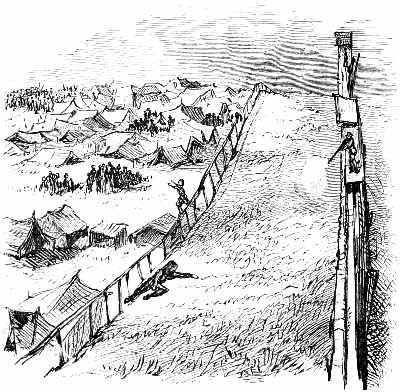
This line of stockade rose from fifteen to eighteen feet above the surface of the ground, while the outer line of logs, which was erected about sixty paces distant from the inner line, was formed of the rough trunks of pines, and projected twelve feet above the earth. The original stockade measured but ten hundred and ten feet in length, and seven hundred and eighty-three feet in width; and within this space were jammed together, for several months, from twenty-two thousand to thirty-five thousand men, thus giving a superficial area to each man, when the prison contained thirty thousand prisoners, but seventeen square feet, after deducting the nineteen feet average for the dead line, and the quagmire, three hundred feet in width. This measurement would allow for thirty-five thousand men but fifteen square feet of area, or less than two square yards to each person, or more than twenty times the density of Liverpool. This was all the space that was afforded before the enlargement, and this reckoning does not include roads or by-paths for communication among the prisoners.
Seventeen and a half square feet of earth are allowed for the coffin’s length in the field of sepulchres. There were here to be seen twelve acres of living men, packed together like the immense shoals of fish in the ocean, but like nothing that has life on the earth, not even the ant-fields. The ratio of density was equivalent to more than sixteen hundred thousand people to the square mile. The densest portion of East London has the great number of one hundred and sixty thousand to the square mile.
VII.
In the month of August the stockade was lengthened six hundred and ten feet, by what influence or from what cause it is unknown; but nevertheless it was enlarged to the length of sixteen hundred and twenty feet,—thus making the entire area sixteen hundred and twenty by seven hundred and eighty-three feet. This enlargement was a salutary movement on a small scale, but it only prolonged the sufferings of the victims. The thirty thousand men had now twenty-two acres, minus the dead line and marsh, or thirty square feet per man, or three and a half square yards. There were actually, during this month, thirty-five thousand men within the prison, and some authorities give me as high as thirty-six thousand. This density is enormous, and cannot be tolerated by animal life in any climate, in any latitude, of the world. There must be space for organic life to develop and maintain itself, otherwise it perishes. To give a correct idea of the crowded condition of this pen, we do not know where to turn for example. The great cities of civilized lands do not even approximate in their ratio of populations.
The relation of density, in the three great divisions of London, give thirty-five, one hundred and nineteen, and one hundred and eighty square yards to each inhabitant. The densest portion of Liverpool, with its lofty and immense brick ranges of buildings, swarming with industrial life, gives more than eighty square feet to each person. The early Roman camps, which are a marvel to military men, and the closest known to military science, gave to the ordinary legion three hundred and sixty-seven square feet of area to each man. The plans of Polybius give two hundred and thirty square feet to each soldier of the consular army of two legions, numbering nearly eighteen thousand men, and the descriptions of Hyginus give similar ratios.
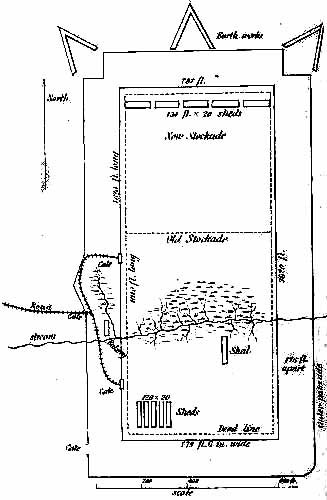
PLAN OF PRISON GROUNDS ANDERSONVILLE Measured by Dr. Hamlin Copy right secured J. H. BUFFORD’S LITH BOSTON.
The encampments of the United States infantry afford, in the most restricted portion (between stacks of arms and kitchens), two hundred and forty-four square feet per man, or seventeen hundred and thirty-one square feet per man for the whole camp.
The space allowed by law for barracks alone is fifty-four square feet for each soldier, reckoned on the basis of a full complement of men. The rules of the rebel army concerning camps are the same as those of the regulations of the United States army.
The United States prison at Elmira contained six thousand men, and extended over forty acres. The other prisons, at Chicago, Johnson’s Island, Point Lookout, and Fort Delaware, were provided with spacious exercise grounds, and furnished with covered barracks, built of proper form, and fitted up with the required conveniences of life. Belle Isle, which held ten thousand prisoners, had but six acres, and no shelter, no conveniences whatever.
Andersonville, which contained over thirty thousand prisoners, had in the stockade, before enlargement, but eighteen acres in all, and but twelve acres for the use of the prisoners, minus the dead line and the marsh.
The prison at Dartmoor, in England (which was a paradise in comparison with Andersonville), where our prisoners were held in captivity by the English during the last war, furnished two hundred to three hundred square feet to every prisoner in the barracks, besides allowing spacious yards, where the prisoners were permitted to exercise daily. There were there seven large two-story stone buildings, each one hundred and eighty feet in length. Five thousand prisoners enclosed within twenty acres of land at Dartmoor, thirty thousand in twelve acres, or thirty-five thousand in twenty-two acres, at Andersonville.
VIII.
The timbers composing the stockade were of entire trunks of pines, massive and solid, and measuring from one to three feet in diameter. They were sunk into the earth for about five or six feet, and held in position at the top by long, slender pines, nailed on the outer side by large iron spikes. There were but two gates for this vast prison, and but two corresponding apertures in the outer palisade. These gates were constructed of massive timbers, and protected by a strong porch, occupying a base of about thirty feet square. These were always strongly guarded, to prevent the sudden rush of masses of men. At intervals of about one hundred feet, were erected detached and covered platforms, upon the outer side of the palisades, which, overlooking the summit of the wall, and the enclosure beyond, served as sentry boxes. The sentries, perched buzzard-like on the wall, could observe, from their high positions, at all times, the actions, the motions of the uncovered prisoners, and with their rifles shoot down the offending prisoner, whether he stood talking with his comrades, in the centre of the space, or whether he approached the sacred precincts of the dead line.
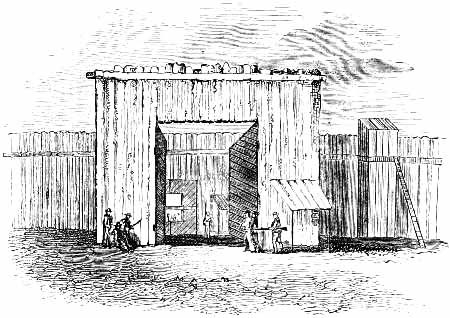
Sometimes they threw down their unconsumed fragments of bread to the hungry men. Sometimes they were hurled with curses; rarely were they thrown from feelings of compassion. Yet there were some kind-hearted men here, in the degrading position of the sentry box, who viewed the scene with affright, and who wept bitterly over the awful torture and sacrifice of life.
The author, travelling on foot among the mountains and forests of Northern Georgia, after peace was declared, found these evidences of humane feeling among the letters preserved in the humble cabins of the poor whites. That unoffending men were shot down without warning, there is no doubt whatever; that men, weary of torture, staggered to the dead line, and calmly, joyfully received the fatal shot, there is positive evidence.
IX.
The trees were all removed from the enclosure, and with the specific intent of cruelty, as was openly stated by the brutal builders. They should have no shade, it was said, and no shade had the wretched men but what was cast by the few ragged and rotten blankets and shelter tents that the prison examiners passed by as utterly worthless in their examination and search for articles of value, whether watches, bank notes, hats, shirts, and even shoes. There were men who, robbed at the outer gates, entered the prison almost naked. This system of robbery was open and audacious, and it is said that the only prisoners who escaped spoliation were those who were taken from Sherman when Atlanta fell, and when consternation prevailed at the prison in consequence. It is positively stated that it was sanctioned by Wirz and Winder. At all events, two men, by the names of Hume and Duncan, robbed the prisoners systematically, and appropriated the packages sent to the prisoners, from the United States, to such an extent that few if any articles ever reached the poor men to whom the boxes of food and clothing were sent.
These blankets and rags were vainly stretched over sticks, to form the semblance of a habitation, wherever the earth gave firm foothold, even along the borders of the pestilential marsh. Those who were destitute of even these shreds of cloth, dug with their hands holes in the earth, after the example of wild beasts, or with the slimy water from the brook they built up, with handfuls of mud, little cabins over hollows scooped out from below the surface of the ground, and as rude as the clumps of earth, which that lowest degree of the human form—the Digger Indian—inhabits.
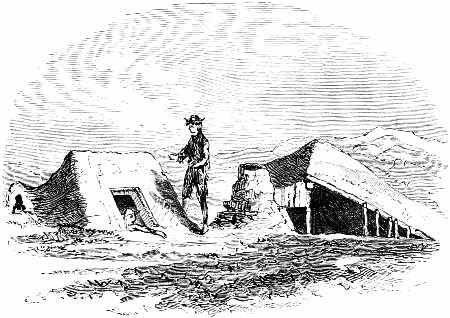
These may be seen at the present day, looking like the lodges of the beaver, or the mounds of the marmots of the prairies, and half concealed by those wild, useless, and noxious weeds which linger in, and cling to the footsteps of man, as he wanders in his migrations over the uncultivated lands of the globe.
Sometimes the heavy rains washed away the roofs of mud, inundating the occupants beneath. Some of the poor wretches had not the strength to lift up the incumbent mass of earth, and perished miserably in their dens. There are now in these demolished excavations the bones of some of our fellow-citizens, unknown and unhonored. The cry of distress was so constant that few heeded the smothered moan. The stumps of the fallen trees were grubbed up by the knives and fingers of the prisoners for firewood to warm themselves with, or to cook their scanty food; even the roots were followed down deep into the earth, for the purpose of obtaining the means of warmth which were almost entirely denied them by the prison keepers.
X.
There is no excuse for this wanton exposure to the vicissitudes of the climate, for the forests adjoining were immense in their extent, and thousands of the suffering men offered, begged to go and obtain material to build sheds or huts to protect them from the inclemency of the weather. Neither parole was allowed for this purpose, nor real attempts made to obtain the building tools. To show the force of the argument that the rebels had not sufficient aid, and that it would have been dangerous to have paroled any of these prisoners, there is the fact that there were several large steam saw-mills in the vicinity, and they could have easily afforded, in few weeks, all the lumber required for the purpose of shelter.
Was it recklessness, was it perversity, or was it malice aforethought, that withheld from the prisoners the means of shelter? The few sheds that were erected were not commenced until late in the term of its occupation, too late to render much service. They were merely roofs of boards, placed upon posts, at the distance of seven feet from the ground. There were neither sides nor partitions to these sheds, and they were not required during the hot months.
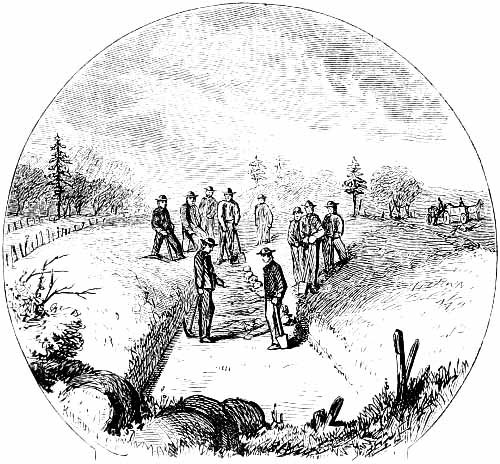
View of the manner in which the Dead were Interred.
The bodies were laid in rows of one hundred to three hundred, and after the earth was thrown over them a stake was thrust down to mark the place of burial. This view is taken from a rebel photograph.—Page 57.
Pity was not a virtue that was recognized here: the noble impulses of the heart were reversed, and the natural instincts perverted.
The dead bodies of the thousands who perished within the stockade, without medical attendance, were dragged forth, without care, and thrown promiscuously into the common field-carts, which, with their carelessly heaped-up burdens, proceeded to the trenches, where the dead heroes were laid in long lines, side by side, two or three hundred in a trench, and then a stick was thrust into the ground, at the head of each man, to indicate the place of burial. For the care observed in the burial of the dead after the carts arrived at the cemetery, and the preserving of the records of the victims, and the place, we are indebted to our own men, who were paroled especially for the purpose.
The only solicitude observed by the rebels during or after interment of their victims, was shown by the civil engineer or surveyor of the town. He thought that so much animal matter should not go entirely to waste, and so commenced to plant grape vines over the mounds of the decomposing dead.
To show the utter want of decency which ruled all things connected with the prison, it is stated by positive eye-witnesses that the same carts that transported the dead, went forth (without being cleansed of their reeking and disgusting filth), to the shambles and the depots for the meat and corn for the living prisoners.
XI.
An eminent statistician has stated that mortality is in direct ratio to the density of population, and that superficial area is as essential to health as cubic space. To the writer’s mind, the overcrowding of the men, and their exposure to the variations of heat and cold, the influence of moisture, and the foul emanations of the infected soil, were sufficient to cause great destruction of human life; and when combined with the deficient dietary, the imagination can hardly conceive of a better field for disease and death than the condition of this swarming pen. All the elements and combinations of physical destructiveness were here in full play. “Losses by battle,” says Sir Charles Napier, “sink to nothing, compared with those inflicted by improperly constructed barracks, and the jamming of soldiers—no other word is sufficiently expressive.” “Diseases,” states the French Inspector Baudens, “slay more men than steel or powder, and it is often easy to prevent them by a few simple hygienic precautions.”
In all campaigns where the care of the soldier is left to the military man,—who is educated for destruction, and has not been taught in the economy of life,—we see in the mortuary and non-efficient lists a disgraceful and culpable array of thoughtless routine, vulgar prejudices, and systems. In our Military Academies the elements and the means of destruction are taught, but not a law unfolded that relates to the principles of health, strength, and life. To alleviate the burden of the military list by sanitary measures is an idea unheard of, or at least unnoticed. “For these works,” writes Chadwick, in his papers on “Economy,” “a special training is needed for our military engineers, whose present peculiar training is only for old works for war, and for those imperfectly,—works for the maintenance of the health of an army being necessary means to the maintenance of its military strength.
“The one-sided character of the common training of our military engineers was displayed in the Crimea, in the proved need of a sanitary commission to give instruction for the selection and the practical drainage of proper sites for healthy encampments, for the choice collection and the proper distribution of wholesome water, for the construction of wholesome huts, and the proper shelter and treatment of horses as well as men.”
XII.
In this enclosure, during a period of twelve months, from five thousand to thirty-six thousand human beings ate, slept, and drank, whilst the piles of filth were constantly accumulating, and the germs of infection silently at work. There was no regularity in the arrangement of the interior. Men collected in groups in the day time, and they lay in rows, like swine, at night.
The stream, which with little ingenuity could have been turned to a blessing for the prison, was allowed to be obstructed by the heaps of grime; and enlarging its area, it assisted in forming the extensive quagmires, which were several acres in extent. So little care was observed for the comfort or the health of the prisoners, that all the washings of the bakery, all the filth of the out-houses of the workmen, were allowed to pass down and mingle with the current of the stream only thirty feet above the point of entrance into the stockade. The traveller can observe to-day that this malicious act of refined cruelty, or fatal error in hygiene, was really perpetrated.
Besides this, the drains of the camp and the town above emptied themselves into this stream which supplied the prison with water.
XIII.
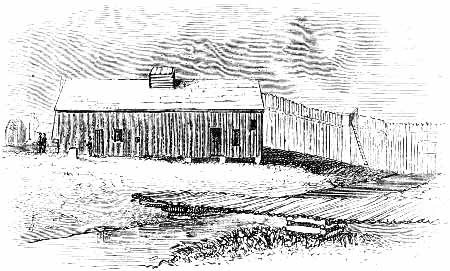
The bakery was located on the west side of the stockade, about equidistant from either line of palisade. It was of rough boards, and but one story in height. Its interior disclosed two rooms, one of which communicated with the two ovens, which were built of common brick. These two ovens—fourteen feet in length by seven feet in width, and with one kneading-trough fifteen feet long, and less than three feet in width—supplied the prisoners with all the bread they obtained; and so far the writer has not learned that there was any other source of supply.
These same ovens, kept red hot, and worked night and day, to the fullest capacity, by the commissary bakers of the United States service, could not have produced but eight thousand rations of white bread, and but nine thousand six hundred rations of corn bread. This is the extreme limit; and regarded by the workmen, who have made the calculations, as almost an impossibility. The ordinary capacity of this establishment was probably about four or five thousand rations of corn bread. This quantity, divided daily among thirty thousand men, would give but a small morsel to each one; and this gives the appearance of truth to the statement, that from two to six ounces of corn bread were furnished as rations to the prisoners.
Ask a survivor of this prison treatment, if perchance you can find one, how he preserved his life, and he will tell you, “By eating the rations of the dying.” Ten thousand men were sick or dying in this enclosure at one time.
After the carts, with their scanty burdens of food, had passed into the prison, and distributed their contents, ten or fifteen thousand of the haggard and starving men might be seen collected together in the central portion of the prison trading with each other. Some of the poor wretches would be offering a handful of peas for a knot of wood no larger than the human fist, in order that they might cook their allowance; others offering, in barter, their remnants of clothing—a cap, or a shoe, or anything they possessed—for a morsel of food.
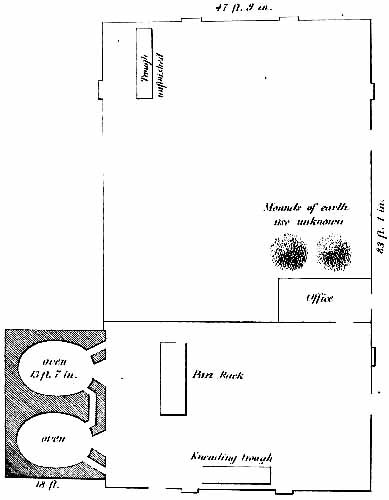
PLAN OF PRISON BAKERY ANDERSONVILLE Ga.
The little knots of wood above mentioned had a standard value of fifty cents; yet there were immense forests all around, and within sight on every side.
XIV.
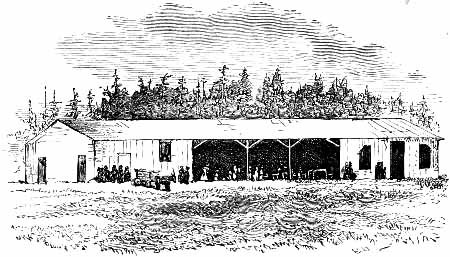
There appears to have been but one kitchen for this vast assemblage, and that strangely situated—far in rear of the outer palisade, away from water-course or spring. The soil to-day does not present traces of a much-travelled road from its doorway to the main gate, distant about one third of a mile by the route taken. Consider the enormous weight of provisions which should have passed over this road when the prison contained more than twenty thousand men. This kitchen was a plain one-story shed, built of rough boards, one hundred feet in length, and less than fifty feet in width. It contained in the interior two medium-sized ranges, and four boilers of fifty gallons’ capacity each. The capacity indicated does not by far equal the cooking apparatus which is required and furnished to the Lincoln and Harewood Hospitals, of Washington, for twelve hundred men.
It is the opinion of the writer, who is familiar with the amount of cooking apparatus required by large hospitals and camps, that this kitchen, with its implements, could not, in the course of twenty-four hours, by constant relays of industrious workmen, have furnished cooked rations to more than five thousand men. There may have been other arrangements for cooking in the open air; but there are no longer any traces of such operations, nor has the writer any evidence that such was the case.
XV.
Upon the banks of the same stream, and near the railroad station, was erected the stockade which was intended for the confinement of the officers; but it was abandoned, after few weeks’ occupation, partly from motives of prudence and in fear of revolt in keeping officers near so great a number of the rank and file of the army, and partly from the unfortunate selection of the locality. The officers were removed to Macon, and were confined there in the cotton sheds during a long period. This pen, known as the officers’ stockade, was built of pine-tree palisades, fifteen feet high, and measured one hundred and ninety-five feet in length by one hundred and eight feet in width, and was provided with a shed in the interior forty-five feet long by twenty-seven feet wide, and also with a walk, suspended on the outside of the palisade, for the use of the sentries. The location and the provisions of this stockade were worse and more dangerous than even the main prison.
XVI.
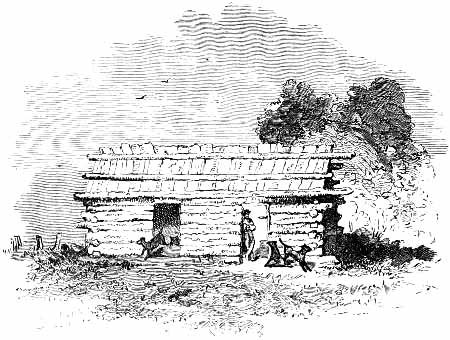
On the pathway to the graveyard, not far from the prison, and in open sight, was built the hut where the bloodhounds were kept, always ready to track and pursue the fugitives, who were so fortunate as to escape by evading the vigilance of the guards, or by the slow and dangerous process of tunnelling beneath the palisades. The system of pursuit was so perfect, the dogs so numerous and well trained, that it was very rarely that any one escaped, and then it was only by the kind intervention of the black man.
There were but nine bloodhounds kept here, but there were more than fifty dogs, kept in relays, along the route of escape, extending from the town to the city of Macon, fifty miles distant. The names of these inhuman wretches, who kept and hunted with these hounds, are known to the writer, the places of their residence, the number of their animals, and the price they received for each hapless victim overpowered by their dogs. These packs of hounds were generally accompanied by dogs of fierce and determined courage, to seize and hold the object pursued until the hunters arrived. The ordinary bloodhound of these regions is cowardly from degeneration, and dare not face the look, nor disregard the voice of man, and until the catch-dogs arrive and dash in, and lead the way, they bay and show their teeth from safe distances; but the victim once disabled, they tear and rend the living limbs without reluctance. The bloodhound is said, when in a state of tranquillity, to be the most affectionate of all the canine race, but when once excited, he no longer recognizes the blood of his master from that of the stranger. That many men were pursued, and caught, and paid for by the rebel authorities, at the price of thirty dollars a head, there is abundant proof; that men were disabled, and torn wantonly by the hounds, and afterwards died of their wounds, the writer has positive proof. That Federal soldiers were overpowered and destroyed in the forests by the dogs, and their brutal owners, there is evidence.
It did not shock the civil communities of the South to hear of the use of the bloodhounds to pursue and maim men of their own race and nation, for in every locality, for a long period past, it had been the custom to rear and train dogs to catch the hapless slave who had incurred the rage of his master, and vainly sought to escape from his fury in the obscure recesses of the tangled forests.
Usage, by long repetition, had blunted the natural sympathies, so that hate readily excused the difference in class and color.
XVII.
The bloodhounds here used appear to have been of a degenerate breed, and to have lacked the great strength, the invincible determination, which the true race possesses. The bloodhounds introduced into Cuba, to exterminate the Indians, were ferocious and powerful animals. From these the present stock in Southern Georgia were probably descended, and during three centuries of change, have gradually lost their nobler qualities, but have preserved the form. The true bloodhound is taller than the fox-hound, and stronger in his make. His color is of a reddish brown, shaded here and there with darker tints. His muzzle and jaws wide and strong, and the frame firmly knit. His scenting power is extraordinary, and from time immemorial his services have been made use of in tracking wounded animals or fugitives from justice.
“Soon the sagacious brute, his curling tail Flourished in air, low bending, plies around His busy nose, the steaming vapor snuffs Inquisitive, nor leaves one turf untried, Till, conscious of the recent stains, his heart Beats quick; his snuffing nose, his active tail Attest his joy: then with deep, opening mouth, That makes the welkin tremble, he proclaims Th’ audacious felon: foot by foot he marks His winding way, while all the listening crowd Applaud his reasonings, o’er the watery ford, Dry sandy heaths, and stony, barren hills; O’er beaten paths, with men and beasts disdained, Unerring he pursues, till at the cot Arrived, and seizing by his guilty throat The caitiff vile, redeems the captive prey.”