BOOK SECOND.
Reading edition
I.
“Plus in carcere spiritus acquirit, quam caro amittit.”—Tertullian.
“Eternal spirit of the chainless mind! Brightest in dungeons, Liberty! thou art, For there thy habitation is the heart— The heart which love of thee alone can bind: And when thy sons to fetters are consigned— To fetters, and the damp vault’s dayless gloom, Their country conquers with their martyrdom, And Freedom’s fame finds wings on every wind.” Prisoner of Chillon.
Within the deadly shadows of this enormous palisade were assembled and confined together at one time during the hot months of 1864, more than thirty-five thousand soldiers, of the various armies of the United States—more men than Alexander led across the Hellespont to the conquest of Asia; more men than followed Napoleon in those glorious campaigns over the bright fields of Northern Italy, where every helmet caught some beam of glory.
Here were men of all conditions, birth, and fortune—some of the best blood and sap of the republic.
The strong-limbed lumbermen from the forests of Maine, the tall, gigantic men from the mountains of Pennsylvania, the hunters of the great prairies of the West,—those men of wonderful courage and endurance,—the artisan from the workshop, the student from his books, the lawyer from the forum, the minister from the pulpit, the child of wealth, and the poor widow’s only son, were collected here in this field of torture.
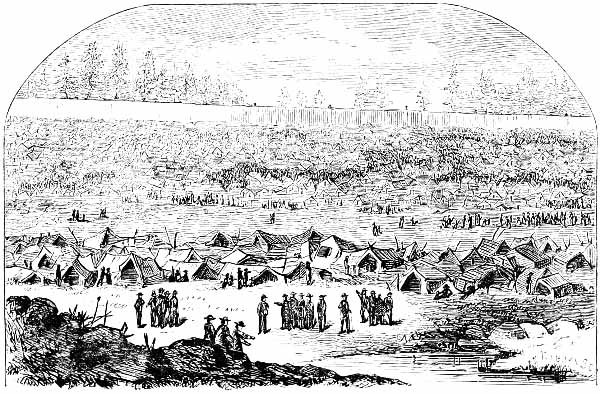
View of Interior of the Prison, with the quagmire and crowds of huts and men beyond. From rebel photographs.—Page 29.
They were men in the prime of life—young, vigorous, and active—when they surrendered themselves as prisoners of war. And as prisoners, they were entitled to the care and treatment acknowledged by the general laws and usages of civilized nations, and expected even more from those who boasted of having revived the generosity and chivalric tone of the feudal ages. Besides justice to all men, we owe special grace and benignity to those who come into our power from the hazard of battle. However degraded the suppliant may be, there is always some commerce between them and us, some bond of mutual relation.
Why these men did not receive that respect which true courage always accords to the vanquished brave, why they did not receive even that atom of compassion which belongs to the nature of man, and which is seen even among the lower animals, history, which loves to avenge the weak and oppressed, and which affords to all men, to all nations, the opportunity for their justification, their vengeance, their glory, will surely exhibit in burning characters of horror and shame. There are men even now who would sanctify the acts of cruelty of the rebellion over the very ashes of this the nation’s sepulchre. There are men even now who would outrage virtue, and deify the crime. There are men living, like those of the past, but not forgotten iron age, possessed of that remorseless fury, that implacable hatred, which nothing could arrest, nothing could disarm, and which could no more receive a sentiment of compassion than that sophistry which allowed outrage and death to the tender and guiltless child of Sejanus.
“Ut homo hominem, non iratus, non timens, tantum spectaturus occidat.”
II.
The intention which directed the formation of this vast camp was Cruelty. The system which governed, or rather the want of system which neglected, each department, whether hospital or commissariat, meant Death. The evidence against the leaders of the Confederacy is not wanting, neither is it obscure. It is true that most of the witnesses have perished, or are fast passing prematurely away; but the chain of circumstantial evidence is so connected, so apparent, that, unless the faith of humanity changes, that voice, which Tacitus calls “the conscience of the human race,” will, until the end of time, overwhelm with withering scorn the memory of these men as the assassins of sedition, rather than the heroes and saints of a just revolution.
We may search history in vain for a parallel in modern times. Civilization, in its known vicissitudes, cannot point out a spectacle so horrible.
The massacre, in hot blood, of the Tartars of the Crimea by Potemkin, will not compare with this slow, merciless, implacable process of murder by starvation, and violation of those hygienic laws upon which the principle of life depends. The fusilades of that saturnalia of blood, the French Revolution, which swept away whole generations, had the pomp of military executions, which threw a gleam of brilliancy over the scene, and gave momentary enthusiasm to the victims. Those great immolations of the Saracens and Persians by the Tartars were as rapid as the cimeters could flash. “The fury of ideas,” says Lamartine, “is more implacable than the fury of men; for men have heart, and opinion none. Systems are brutal forces, which bewail not even that which they crush.”
“See,” said Timour to the learned men of Aleppo, “I am but half a man, and yet I have conquered Irak, Persia, and the Indies.” “Render glory, therefore, to God,” replied the Mufti of Aleppo, “and slay no one.” “God is my witness,” said, with apparent sincerity, the destroyer of so many millions of men, “that I put no one to death by a premeditated will; no, I swear to you I kill no one from cruelty, but it is you who assassinate your own souls.”
III.
The world has never seen such a display of courage and devotion as was exhibited by the intelligent masses of the freemen of the North, when the liberties of the great republic were menaced by the fierce gestures of the slave faction and their misguided supporters.
Men of all classes, forsaking home, kindred, and property, rushed to present a living barrier to the impetuous march of the enraged and misguided horde that pressed on with almost resistless fury, and threatened to overwhelm and destroy the noblest fabric of the enlightened mind. At last the carnage of battle has ceased. Nature smiles again, and rapidly obliterates the marks of the ravages left upon her green fields, where the huge and desperate armies have swayed and struggled in deadly conflict. The emblems of civil liberty are again restored, the fasces replaced; and it now becomes the country to arouse itself from the depths of apathy, and revive those sentiments of tenderness and gratitude which nature everywhere bestows upon the memory of those who upheld the cause of liberty, and fell in its defence.
IV.
To understand fully the determined character, the steadfast loyalty, of these brave and unfortunate men, we must consider at length the details of this enclosure, with its hungry, emaciate, filthy mass of humanity, whence arose a stench of death so powerful as to be perceived at the distance of a league—the burning sky, the array of instruments of torture, the manifest design of cruelty.
The suffering wretch had only to pronounce the magic words, “Allegiance to the Rebel cause,” and his sufferings and misery were at an end. The huge gates flew open, and with grim smiles, the enfeebled and tottering apostate was welcomed as an accession to the southern ranks.
But the republic was safe here, and the sacred fire of its altars burned steadily through all the horrors and noxious vapors of this hell on earth.
Strange to relate, that out of the seventeen thousand registered sick, there is record of only about twenty-five who accepted the offers to save their lives, and took the oath of the rebels. Is it not wonderful that this great number of men should thus, in silence, brave the horrors by which they were surrounded, and remain firm in their convictions of right and wrong? An entire army perished, rather than deny the country which gave them birth! They would no more surrender their principles, than their homes and altars, as ransoms for their lives.
Has the world’s history a parallel to this devotion?
“But these are deeds which should not pass away, And names that must not wither, though the earth Forgets her empires with a just decay.”
V.
Heroism in the damp and noxious prisons, where the noble qualities of the mind are shaken and swayed by the sufferings of the body, is far different from that which is displayed upon the battle-field, amid the glittering and inspiring pomp of war.
The men at Thermopylæ fought in the shadows of the soul-inspiring mountains, and beheld, through the charm of distance, their homes and the beautiful valleys they had sworn to defend. The Decii saw the shining swords of their enemies when they rushed into battle, and the dying nobly and the glory made all fear of death but of little weight.
Here, instead of bright and glorious banners and the flash of arms, the long array of men eager for the contest, and the songs, the shouts of defiance, there was a vast ditch, crowded with living beings of scarce the human form, haggard and unnatural in appearance—a sea of red and fetid mud, trampled and defiled by the immense throng. Instead of the white tents and canopies of military encampments, there were the ragged blankets vainly stretched over upright sticks; there were the holes in the earth, the burrows in the sand, like the villages of the rats of the great prairies of the West. They were more like the dens of the beasts of the desert than habitations for human beings.
No Christian hand ever penetrated to their depths to aid the sick and suffering inmates, to nourish the hungry and console the dying, save one Romish priest; and in spite of the horrors and dangers of the place, he was faithful to his trust. Noble man! you have proved by these acts that humanity is not a mendacious idol, and that devotion to humanity is not a mere matter of gain and self-aggrandizement.
More than four thousand human beings perished in these excavations!
It seemed as though vengeance was prolonged beyond death itself.
“Where was thine Ægis, Pallas, that appalled Stern Alaric and Havoc on their way?”
VI.
Life here was brief. The victims, as they entered the gate, were appalled at the horrors that were presented to them in this living sepulchre. Nature seemed to have abandoned the struggle early, and the young men passed, with rapid pace, from youth—that youth so rich in its future—to manhood, from manhood to old age. Neither prudence nor philosophy could protect them from the grievous influences of the morbid conditions to which they were exposed. The delicate and noble faculties were blunted and destroyed. Some perished at once, almost as quickly as though struck by the lightning of heaven, whilst others lingered, according to the strength of the hidden resources, the reserved and superabundant powers of youth.
Among the few survivors of the present day we can learn of the fearful struggle between life and death, by the gray hairs, the impassive features, from which the smile of youth has fled forever, the feeble and tottering steps of the man who has prematurely arrived at his limit of earthly existence.
The integrity and character exhibited by these men, in the midst of these tortures, is unsurpassed.
It was the same morale that immortalized the armies of Italy and Moreau, that covered with splendor the heroes of Sparta and Rome, and proved incontestably the superiority of the volunteer over the mercenary regular. The wretched men died in silence, or with the name of home or the loved ones on their lips, and adjuring their comrades to stand firm in defence of their faith, their country, their God. “My treatment here is killing me, mother; but I die cheerfully for my country.” They died as the wounded French died at Jemappes, with the delirium and exaltation of patriotism, uttering at the last moment some of the strains of the songs of freedom, and the names of country and liberty. “Thus the enthusiasm of the combat prolonged or reproduced itself, and survived even in their agony.”
The sufferings of these men, wasting, putrefying, dying daily by scores, by hundreds, without touching the remorseless hearts of the prison-keepers, recall to mind those monsters which history points out as rising now and then from out the wreck of social order. It was one of the results of Slavery, for Slavery weakens the natural horror of blood.
Cruelty is naturally progressive, for it engenders the fear of a just revenge. New cruelties succeed, until extermination becomes the rule and ends the scene.
“To hate whom we have injured is a propensity of the human mind,” says Tacitus.
VII.
At the distance of about five hundred paces northwestward from the stockade, in a little field which is almost overshadowed by the surrounding pines, appear a multitude of stakes standing upright in the earth, in long and regular lines.
Upon every one of these fragments of boards figures have been carelessly scratched by an iron instrument; and they run up to the appalling number of almost thirteen thousand! Each stick represents a dead man,—a hero,—and this multitude of branchless and leafless trunks reminds us rather of a blasted vineyard than of a cemetery arranged for the human dead.
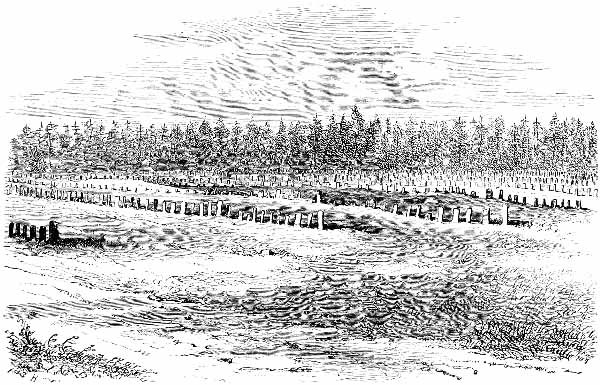
View of the Graveyard, with its thirteen thousand victims, as the rebels left it. Taken from rebel photographs in possession of the author.—Page 37.
I have seen many of the rarest sculptures in civilized lands, where art has lavished and exhausted its powers to awaken sympathy for the dead, but have met with none that moved my heart more impressively than the brief, vague inscriptions, the rude memorials of this silent and neglected field, where sleep an entire army of freemen, who preferred lingering death rather than allegiance to a rebel and wicked faction.
Beneath the red clods of this field, thickly as the leaves of autumn, are stretched side by side a number of men more numerous than all of the American soldiers who perished by disease and casualty of battle during the Mexican war—more than all of the British soldiers who were killed, or perished from their wounds, on the bloody fields of the Crimea, the desperate struggles at Waterloo, the four great battles in Spain,—Talavera, Salamanca, Albuera, Vittoria,—and also the sanguinary contest at New Orleans. All these losses of the sons of the British empire do not build up a hecatomb of the human dead so high, so vast, so red, as this one single link of the great chain of wrong that stretched from Virginia to Texas.
There is no battle-field on the face of the globe, known to the antiquary, where so many soldiers are interred in one group as are gathered together in the broad trenches of this neglected field among the pine forests of Georgia. What a gathering is this! What a monument of the incarnation of political lust, of the reckless desperation, the implacability of the depraved human heart, when resolved upon cruelty! The world does not offer, among all of her extant memorials, a more terrible, a more impressive comment upon the ambition, the power, the glory of mankind.
VIII.
Respect to the dead is an instinct of nature; and to leave the remains of a fallen comrade upon the field, unhonored, is repugnant even to the red men of the forest. How much more, then, does a civilized nation, of high degree, owe to the memory of its brave defenders! Will it now forget the noble sacrifice of its sons amid the debasing influences of commerce and manufacture? Shall these sticks, which mark the nation’s sacrifice, moulder into dust, and with their brief inscriptions be swept away by the winds of the world, and all traces of this heroism, this martyrdom, lost?
Here is something required more than brief, hollow, human gratitude, and a sonorous, perishable epitaph.
Whatever rises above the level of this plain to commemorate for future ages the devotion of the men who sleep beneath, should be of lasting material, and as colossal as the gigantic proportions of the republic itself: or the field should be levelled and swept, and every distinguishing sign blended and effaced, and the true altar of memorial erected in the hearts of all men who believe and revere those eternal principles of love, justice, truth.
Liberty has but one inscription to offer, and that is the noble lines which were traced on the dungeon wall in the blood of the noblest and purest of the Girondins: “Potius mori quam fœdari”—Death rather than dishonor.
IX.
Impartial history will give to the memory of these men a place among the records of useless murder.
The law of parole was all-sufficient to prevent their return to service, and their absence from the fields of campaign would have been of no material weight with the prolific North.
But the intent of their captors was cruelty; and they strove to reduce the numbers, and to intimidate the courage, of the Federal soldiers, by acts of savage barbarity, as the relentless Tartar hoped to terrify the Hindoos into the profession of Mohammedanism by sacrificing multitudes, and deluging whole countries in blood.
To deny the criminality is, as Lamartine says of the massacres of September, “to belie the right of feeling of the human race. It is to deny nature, which is the morality of instinct. There is nothing in mankind greater than humanity. It is not more permissible for a government than for a man to commit murder. If a drop of blood stains the hand of a murderer, oceans of gore do not make innocent the Dantons. The magnitude of the crime does not transform it into virtue. Pyramids of dead bodies rise high, it is true, but not so high as the execration of mankind.”