THE WHITE CAP
Charles Wharton Stork translation

—I—
When Martin Birck had got the white cap, his first errand was to go into a cigar booth to buy a cane of cinnamon wood and a package of cigarettes. The young girl who stood in the shop had black eyes and a thick bang. Her exterior corresponded but imperfectly with the ideal of his dreams, which belonged to a more blonde and Gretchen-like sphere; but when she congratulated him pleasantly on his white cap and at the same time regarded him with a look full of kindliness, despite the fact that he had never before been in her shop, he suddenly felt all warm about the heart, caught her dirty hand, which lay outstretched across the counter display of Cameo and Duke of Durham, and tenderly kissed it. However, he repented almost at once. He had no doubt behaved badly. He did not, to be sure, imagine that the young girl was completely innocent—she had no doubt a lover, possibly several; but that was no reason why any one at all had the right to come in from the street and kiss her hand just like that. He was embarrassed and didn’t know what to say or do, till he finally plucked up courage to select a cane, light a cigarette, and go out.
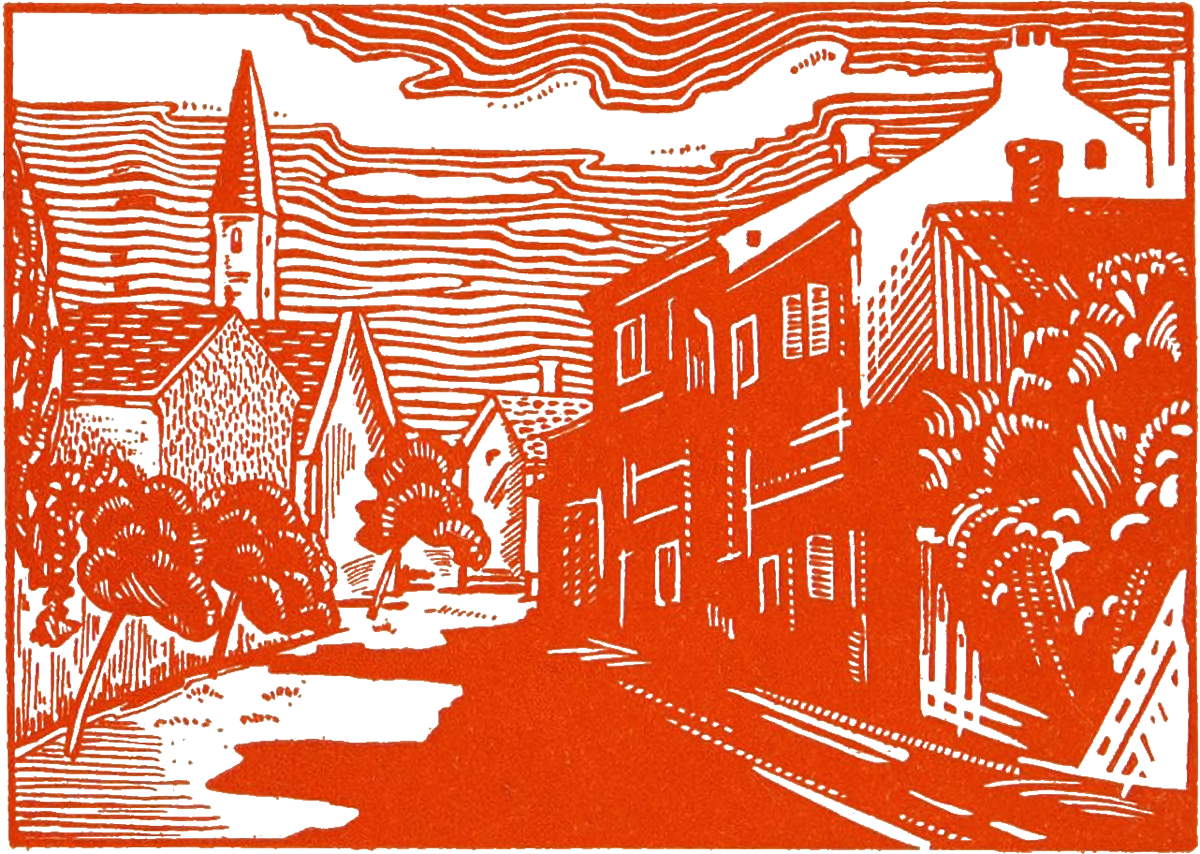
Queen Street was still wet after the last shower, little ladies with jogging bustles lifted their skirts to jump over puddles, which mirrored the blue above; stylish gentlemen with thin angular legs and canes like Martin’s swung their top-hats in pompous salutation, revealing in the act heads so close-clipped that the scalp shone through. Over the roofs and chimneys of the gray houses the restless white spring clouds hurried in fluttering haste, and far down at the bottom of the street the sunlight quivered between churches and towers.
Martin stopped in front of every store window to see the reflection of his white cap. He could not understand how he had become a student. Up to the last he had believed he would be flunked. His surprise was the more joyous when he received his student certificate the same as the others, and especially when he came to the closing lines, «In consideration whereof the aforesaid M. Birck has been adjudged worthy to receive the certificate: Graduated with honor.» These words caused his heart to swell with deep gratitude toward his corps of teachers, for although he considered himself fairly proficient, it was far beyond his expectations to find this idea shared by his instructors. During the last terms he had seldom known his lessons. Often he had not even been able to bring himself to read them over in the ten-minute intermission before classes or to slip a couple of loose leaves from his textbook into his Bible so as to study them during morning prayers, while the lector in theology stood on the platform and talked bosh—a resource which ordinarily even the most frivolous of his comrades would not fail to use. He would, however, have liked to gratify his parents with good marks, although for his own part he had not any great ambition in that direction; but during the last years there had come over him a dull apathy for everything connected with school, against which he could do nothing. It was so hard for him to take it in full earnest. Whenever, contrary to his custom, he had distinguished himself in this or that subject, he was almost ashamed within himself, as if he had done something stupid. As often as he was supposed to dig down into the paltry details in which textbooks delight, he felt himself as ridiculous as the man who, when his house was on fire, saved the poker.
Now that the poker was saved, however, he was so overjoyed that he could have sung; he felt that he was happy and free, as he hastened home with his white cap, home to the blossoming street of his childhood. But the street was no longer the same as before. From a single plot the cherry tree still stretched its branches out over a mossy board fence; everything else was great red brick buildings and small commonplace meeting-houses. The rowdy Franz could no longer disturb what idyllic atmosphere was still left, for he had grown up and become big, and had now been for some time behind the bars of Langholm jail.
—II—
Home was quieter and more empty than before. Maria, Martin’s sister, had been married a year ago to a doctor who lived far away in the country, and grandmother was no longer there.
In the evening Martin and his companions were to have a supper at Hasselbacken. Martin’s father gave him five crowns to offer to the joy of youth, and his mother took him aside and said: «Martin, Martin, you must promise me to be careful tonight and not be led into any foolishness. Don’t make a point of emptying your glass every time any one drinks a toast with you, or you’ll lose your head. The best thing would be just to pretend you drank. And I must tell you, Martin, that there is a class of dreadful women who do nothing else but try to lead young men to their destruction. You must beware of them especially. Dear Martin, if I only knew you had given yourself to the Lord and had your thoughts fixed on Him, I shouldn’t be anxious about you; but I know you don’t do that. Their very breath is poisonous; if you only stand on the street and talk to such a woman, you may catch the most frightful diseases that no doctor in the world can cure.»
«Mother dear,» said Martin, «you’re always getting off on that.»
He took up his white cap, said good-by and went.
His mother followed him with troubled eyes, and when he was gone, sat down in a dark corner and wept. For she knew she was going to lose him as mothers always lose their sons.
—III—
Martin thought of his mother as he went along the Avenue on the way to the Park. How could the relations between them have become what they were? To her he was still a little child. When he first began to speak to her of his religious doubts, she pretended to believe that it was something he had got from outside, from bad comrades or some wicked book. Later things reached such a point that he could no longer talk to her about anything but the most ordinary subjects—about shirts and socks and buttons to be sewed on. If their conversation ever took a serious turn, they treated each other mutually as little children. Thus, without his meaning it or noticing it before it was too late, he got a condescending tone that hurt her, so that after such a conversation a thorn remained in the heart of each.
She often lay awake at night weeping and sorrowing over his unbelief. She herself, however, was of the earth in her thoughts, her hopes, and the whole of her being. She believed in hell of course, because she believed in the Bible; but she could never seriously imagine that her son or any one at all whom she knew and associated with would go to such a horrible place. It was not therefore on account of his soul that she grieved most but for his future here on earth, since she had observed that things did not ordinarily go well in the world with those who contemned God and religion. Some of them got into prison, others left their country to go among strangers, and all aroused distrust and ill-will among respectable folk. She feared that her son might come to be one of these, and it was this idea which kept her awake at night and left her with swollen eyes. She had no more precious dream than that he should be «like other folk,» as most people are, if possible better and above all happier, but still on the whole as they were. She could imagine that her son might become a poet, she could even wish it, for she loved poetry; the tears came into her eyes when he read her some of his poems; but she pictured it that he would sit at some office work on weekdays, and only on Sundays or in his free hours write some verses about sunsets, which he would send in to the Swedish Academy and get a prize, so that he would become at the same time a great poet and a respected business man with an assured income. She believed in full seriousness that he would be more highly thought of among poets if he was in an office and had a title than if he just wrote. That was how it had been with all the real poets. Tegnér was a bishop, and even Bellman had at least had a position in the lottery bureau. As an example that Martin should especially take to follow, she used to mention a poet whom she had known when she was young, who was now an auditor in the Court of Exchequer and wrote verses about everything that was grand and beautiful, about the sea and the sun and the king, and had been decorated with the Order of Vasa. Such a life she considered noble and to be emulated, and when her dreams of her son’s future were at their highest, it was something of this sort she imagined.
But Martin dreamed other dreams. He wanted to be a poet. He would write a book; a novel or a lyric sequence, or best of all a drama of ideas in the same verse form as «Brand» or «Peer Gynt.» He would devote his life to searching for the truth and giving to mankind what he found or thought he had found of it. He would also become famous, a great man; he would earn a lot of money, he would buy a little house for his father and a new silk dress for his mother—her old one was worn and faded. He would be envied by men and sought after by women, but of all the women in the world he should not love more than one, and that one a woman who loved another man. This unhappy love should give his thoughts depth and bitterness and his poems wings. But he had a dark feeling that while he sought for truth he should only find truths, and that while he gave them to men in verse more wonderful than any music or in a clear and cold prose with words like sharp teeth, he would despise himself for reaping honor and gold for the morsels he had found by accident while he was seeking for something else. This self-contempt would eat into his soul and make of him an empty husk. But he would not let the world note anything; he would paint his cheeks, pencil his eyebrows and hold up his head, and at the very moment when he himself most deeply despised his poetry and set it below the humblest manual labor, he would inspire men most and be elected to the Swedish Academy to succeed Wirsén. With a countenance immobile as a mask he would give the usual flowery oration on his predecessor. Never again after that would he set pen to paper. In a strangely colorful and disordered life he would seek to deaden his despair. No sin should be unknown to him; in broad daylight he would drive in an open carriage through the streets with harlots and buffoons, and he would pass the nights in drinking and play. Till one gloomy October night he wearied of his mad and empty life, made a fire in his stove and burned his papers, emptied a glass of dark red wine spiced with a strange herb, and went to sleep to awake no more....
Or perhaps it was unnecessary that his life should end so tragically. When he thought it over more carefully, this seemed to him even a trifle banal. He might just as well move to a small town, to Strengness or Grenna. There he could live alone with a parrot and a black cat. He might also have an aquarium with goldfish. Behind closed shutters he would dream away the day, but when night came he would light candles in all the rooms and pace back and forth, back and forth, meditating on the vanity of life. And when the townfolk passed his house on the way home from their evening toddy at the rathskeller, they would stop to point at his window and say: «There lives Martin Birck. He has taught like a sage and lived like a fool, and he is very unhappy.»
All this and a lot more Martin Birck thought as he went out the Avenue across the park on the way to Hasselbacken.
—IV—
The orchestra struck up the opening bars of «Mefistofele.»
Martin was sitting out by the balcony railing with Henrik Rissler. They listened to the music, looked out across the terraces, and said little. Henrik Rissler had a smooth white forehead and calm limpid eyes. His glance was long and questing; it seemed to slip over the objects nearest it in order more quickly to reach those farther off. He was the only one of Martin’s comrades who had sought his company outside of school. They used to go to each other’s homes in the afternoon to talk and smoke cigarettes, and once in a while they had gone on long walks together, often in rain, snow, or wind, out to the park or through the suburbs, talking the while of everything that concerns young men, of girls and God and the immortality of the soul. Or they would go into the gas-lighted streets with the sensation of throwing themselves into the turmoil of the world, would stand in front of etchings in book-shop windows, where they admired beyond everything a lithograph entitled «Don Juan in Hades» with a motto from Baudelaire:
The hero all the while, half leaning on his sword, Gazed at the vessel’s wake and deigned not to look up.
This picture excited their imagination, their hearts beat more quickly when in the current of humanity they brushed elbows with a pretty girl, and they believed they were living through an entire adventure every time an old painted professional threw them an ardent glance.
But the original cause of their friendship was that they had both read Jacobsen’s novel, Niels Lyhne, and loved it more than other books.
Inside the house the others were talking and laughing around the punch-bowls, forming themselves into groups and coteries. Most of them grouped themselves after their old custom according to social and intellectual similarities and differences, which even on the school benches had united some and separated them from others; Gabel and Billfelt, Jansson and Moberg, Planius and Tullman. Others went about somewhat morosely and talked about all keeping together.
Josef Marin rapped on a bowl and called for a toast «to the ontological proof.» It was drunk with rather half-hearted acclaim. Everyone was so tired of school matters that it didn’t seem worth the trouble even to make fun of them.
Josef Marin was to be a clergyman, but he was still not quite settled in his faith.
The music played student songs, «Stand Strong!» and «Here’s to Happy Student Days!» Dusk began to fall over the tops of the trees, over the roofs and chimneys of the city and the heights of the southern mountains, the pallid dusk of spring twilight, which rarefies and uplifts all things, making them hover with the unreality of a dream world. The crowd, who were clinking glasses and drinking down on the terrace and who a little while ago could still be clearly divided into their component parts as lieutenants and students, guardsmen and girls, and townsfolk with their wives and children, had now melted together in the dusk into an indefinite mass. As though by an inexplicable caprice the murmur suddenly became silent, so that for the moment one could hear the plash of the water in the fountain and the last sleepy bird-notes from the trees. And in the west already flamed a solitary and mighty star.
«Look at Venus,» said Henrik; «how she glitters!»
Martin sat contemplatively drawing on the table, and the strokes under his hand formed themselves into a woman’s arms and breast.
«Tell me,» he asked suddenly—he felt that he was blushing—«tell me, do you think it’s possible for a man to live chaste till real happiness in love comes to him? That’s surely what one would wish. To be with women whom one has no feeling for, who belong to another class, who have dirty linen and use ugly words and only think about being paid—that must be loathsome.»
Henrik Rissler too became a little red.
«It’s possible,» he said; «yes, for some it’s always possible. People are so different. But I know this much of myself, that it will hardly be possible for me. Then at least the great love mustn’t keep me waiting much longer.»
They sat silent and gazed at the star, which glittered ever more brightly in the darkening blue.
«Venus,» Martin murmured, «Venus. She’s a great and beautiful star. But I don’t see why she should have a name. Anyhow, she doesn’t come when she’s invoked.»
Martin suddenly heard a strange voice behind his chair.
«Very true,» said the voice, «very true. She doesn’t come when she’s invoked. An equally mournful and accurate observation!»
Martin turned in surprise. The stranger was a man carelessly dressed, with a student cap, a pale narrow face and black mustaches which hung down over his mouth so that it wasn’t easy to see whether he smiled or was serious. His face looked oldish for the white cap, and it was not entirely clean.
One of Martin’s companions stood beside him and made the introduction, «Doctor Markel.»
Doctor Markel had come there with an older brother of Billfelt’s. They had come from Upsala that day, eaten dinner at Hasselbacken, and then invited themselves to share the student supper. The elder Billfelt was giving a talk inside at the moment. Martin heard something about «Upsala» and «alma mater.»
Doctor Markel sat down beside Henrik and Martin without further ceremony.
«Two young poets, eh?» he asked. «I venture to assume so, since the gentlemen sit here by themselves apart from the vulgar throng and talk about the stars. May I ask what your attitude toward life is? Do you believe in God?»
Henrik Rissler looked at the stranger in surprise, and Martin shook his head.
Doctor Markel looked entirely serious, except that there was a slight mist over his eyes, which were large and mournful.
Some of the others had come up and were now listening to the conversation. Planius and Tullman presented the same docile countenances with which they had listened in class to the exposition of the instructor. Gabel simpered sarcastically with his fine aristocratic face, and behind him Josef Marin pressed up. Josef Marin was short and slight; he looked pale and overworked. The two or three glasses of punch he had drunk had already made him a bit convivial; but now when he heard a serious question proposed and could not see that there was any joke behind it, he broke in with all the earnestness he could summon up at the moment: «I believe in God. But I don’t conceive Him as a personal being.»
Doctor Markel seemed pleasantly surprised.
«Oh, you are a pantheist, charming! That’s what you must be too»—he turned to Martin—«you who are studying to be a poet. For poets and those who want to seduce girls—and that all poets wish—I cannot sufficiently recommend the pantheistic conception. Nothing can be more suited for turning the head of a young girl than the pantheistic rhapsodizing with which Faust answers Gretchen’s simple question, ‹Do you believe in God?› If he had answered as simply and unaffectedly as she asked, ‹No, my child, I don’t believe in God,› you may be sure the girl would have crossed herself, run home to her quiet chamber, and turned the key twice in the lock. Instead he answers that he both believes and disbelieves—which gives the impression of deep spiritual conflict—and that God is really a name for the feeling that two lovers have when they lie in the same bed. This he says with much feeling and in beautiful language, so that it does not shock her modesty; on the contrary, she thinks he talks like a priest, and the rest we know—— And for a poet—— But first allow me as an elder student....»
With easy familiarity Doctor Markel drank brotherhood with all who were within range and then continued:
«For a poet, pantheism is a pure godsend, a regular gold-mine. If he is a churchman, he will be given the Order of Charles XIII and a good income, but will only be read by missies and be ridiculed by the liberal papers, which have the largest circulation. If he is an atheist, he will be considered a shallow and superficial fellow, a poor sort, and he will have a hard time to borrow money. No, a poet should believe in God, but in a god who is out of the ordinary run, something not yet existent, never before shown in any circus, that one can never really get hold of, for then the game would be up. The pantheistic god is exactly the raw material needed for such a being. That is the ideal for a god. Each and every one can carve him to his own taste, he is never without humor, he never punishes and of course never rewards either, he takes the whole show easily, which comes from the fact that he lacks a small characteristic that even the simplest of the town rowdies possesses to some extent: namely, personality. That’s just the choice thing about him. To a personal god one must stand in a personal relation; that is, one must become a religionist. To be a religionist is excellent if one has just come out of Langholm jail and needs to be rehabilitated in society. Otherwise it is unnecessary. You see my drift, gentlemen: to stick to a personal god entails a lot of unnecessary trouble, to be without a god entirely is ticklish. Therefore one must have an impersonal god. Such a god sets the imagination going and comes out finely in poetry without in return entailing any obligation. With such a god one will be regarded by cultured circles as a person of noble and enlightened thought and may become pretty nearly anything from an archbishop to the editor of a radical newspaper.
«In formal style this god may be called the Allfather, in common speech the Lord. As a matter of fact he doesn’t need any name, it is with him as with that star off there: no matter how one calls him, he won’t come.»
The gesture with which Doctor Markel sought and, as it were, beckoned to the star met only a dark and sullen firmament, for great clouds had gathered, the star was gone, it had grown dusky as an autumn evening, and some big raindrops now began to fall on the railing.
Doctor Markel’s lecture was not well received. Josef Marin, who had been drinking more punch meanwhile and had become even paler than before, muttered something to the effect that he ought to have a smack on the jaw. The others got up in groups and discussed whether they should go home.
The elder Billfelt took in the situation, rang for the waiter and ordered champagne. He raised his glass and returned thanks in well-rounded periods for the cordiality with which he and his friend, Doctor Markel, representatives of Upsala and alma mater, had been received by the future alumni. He then paid for the champagne and went off with Markel.
«Your brother is a gentleman,» said Gabel to Billfelt.
It rained as if the heavens were opened. They crowded into a street car to go into the city and have coffee. Most of them voted to go to the Hamburg Bourse.
Martin, who had always believed the Hamburg Bourse was a place where the German merchants of Stockholm assembled to do business, found himself to his surprise entering a café that seemed to irradiate a fabulous magnificence. Here and there on the couches sat some of his former teachers and a lot of oldsters who lifted their glasses and nodded genially.
Coffee and liqueurs were brought in. There was talk of future plans. Most of them were to study law and expected to spend the summer in reading up. Enthusiasm rose, and rash promises were made to keep in touch and not forget each other. At one end of the table Gabel and Billfelt swore eternal friendship; at the other Jansson expatiated on his feeling for Moberg. It was only with difficulty that Josef Marin could be restrained from prophesying. When Josef Marin prophesied he would read out long rigmaroles of stuff, marriage announcements from the Daily News mixed with bits from Tegnér’s Svea and Norbeck’s Theology, all recited in the solemn monotone with which he imagined Elisha had chastised Ahab, and Ezekiel foretold the destruction of Israel and Judah. It was one o’clock, getting on towards two, and various members of the party had already said good night and gone off, especially those who seriously meant to read up for law. The crowd was thinning, the electric light had long ago been turned off, only a couple of gas jets were still burning, and the waiters stood with the air of martyrs as they yearned for sleep and pourboire. There was nothing to do but break up.
Outside, the glimmer of dawn had already begun to spread over the streets and squares. It was no longer raining, but the air felt moist and cold and misty, and through the mist the clock-face of Jacobs church shone like a moon in a comic paper.
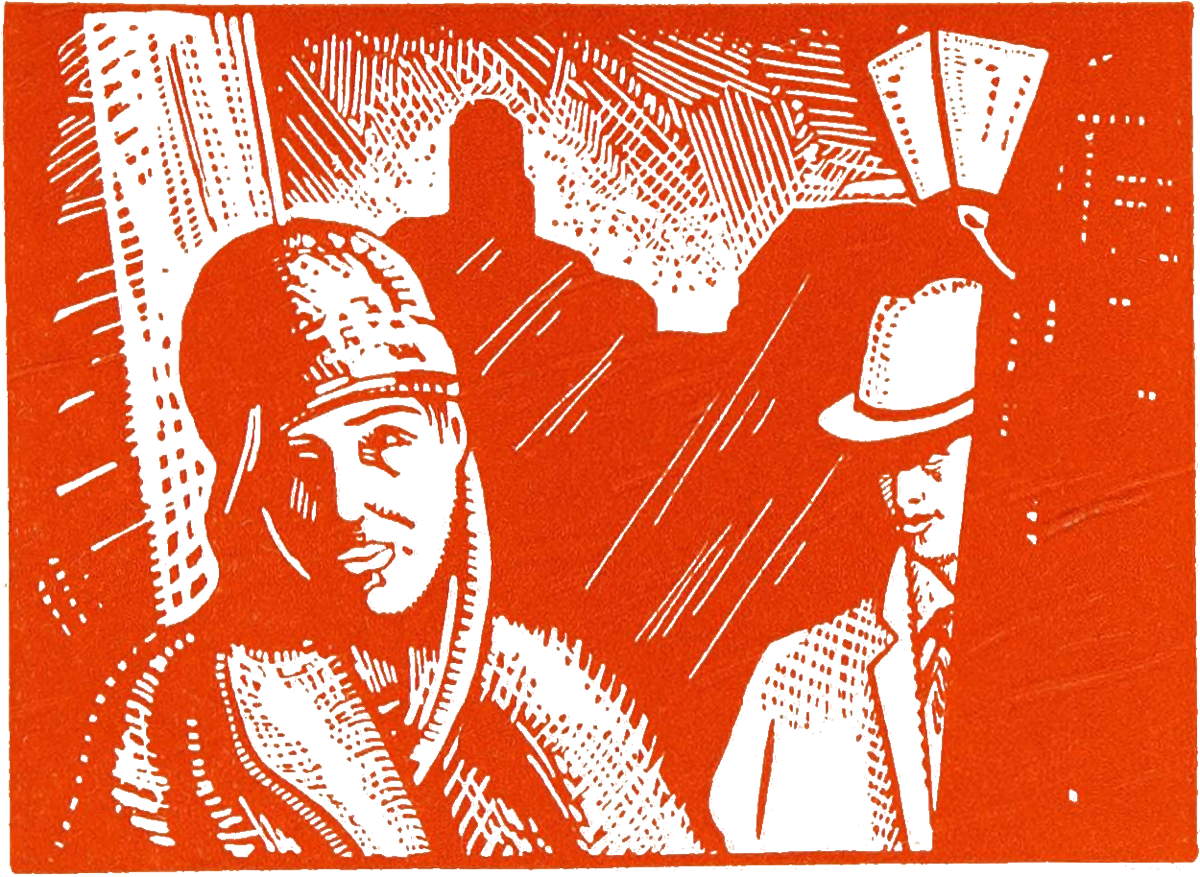
It was hard to separate, and the company walked some distance down along the car tracks past the opera house. Out of Lagerlunden came a group of poets and journalists, and Martin looked at them reverently, wondering whether it would ever be vouchsafed him to become one of them. The student caps gleamed white in the night, whereupon moths came fluttering from right and left, slipping their arms under those of the young men and tempting them with promises of the greatest happiness in life, until amid convivial mirth and harmless joking they arrived at Charles XII’s Square, for Josef Marin had the fixed idea that he must prophesy before Charles XII. But while he was prophesying, Gabel caught the prettiest girl around the waist and began to waltz with her around the statue, Moberg followed and trod a measure with an elderly bacchante, and Martin stood with a pounding heart staring at a pale little piece of mischief with eyes as black as charcoal and wondered if he dared go up to her. But while he was wondering, Planius put an arm around her waist and scampered off, and Martin stood alone and watched them whirl about in the mist, pair after pair. But the morning breeze from the south now began to clear the mist, driving it across the river like white smoke, and the cross on St. Katarina’s cupola burned like the morning star in the first rays of the dawn.
A policeman loomed up from down by the docks and gradually came nearer, one of the girls set up a cry of warning, and the crowd dispersed in all directions. A stout nymph took Martin by the arm and went along with him.
«I must hold your arm, ducky,» she said, «or the cop will pull me in. Besides, you might like to come home with me, eh? I’ve a right nice place, you’ll see. I have a big lovely bed and sheets I embroidered myself. I sit and embroider mornings mostly. One must have some fun for oneself, and I can’t stand playing cards with mamma day out and day in like the other girls, and they swear and carry on and act vulgar. I don’t care about that sort of thing; I like nice agreeable boys like you. If you’re real nice and come to me and come often, I’ll embroider you a nightshirt for a keepsake——Oh, you haven’t any money! The hell, you say; that’s another pair of galoshes! Then you must come again when you have some. Just ask for Hulda. But tell me, is it true there’s a girl at Upsala that’s called Charles XII?»
«Not that I know,» answered Martin.
«Well, good-by then»....
It was not quite true that Martin had no money; he still had a few crowns left from the honorarium for a poem published in the Home Friend and had only made the excuse so as not to hurt Hulda’s feelings.
—V—
Martin lay awake a long time, unable to sleep. It was the little pale girl with the black eyes that left him no rest. She had stood there so pale and still and lonely; she had not taken any one’s arm or laughed or chattered like the others. She had surely been seduced and deserted; she perhaps had a little child that would freeze or starve to death if she didn’t get it food and clothes by selling her body. How he would kiss her if he had her in his arms now, how he would caress her and give her the tenderest names, so as to make her forget who she was, a common street-walker, and who he was, a chance customer like all the rest! With whom was she now? With Planius, maybe. What could Planius be to her? He was no better looking than Martin and he was as stupid as a codfish. He had been one of the worst grinds and had only had a plain «graduated» on his certificate. Why should she pick out just him? But she, to be sure, had made no choice; she had just taken the first that came along. Martin understood this and found it quite natural. She had given away her heart and soul and had no longer anything to give but her body, so why should she deny that to any one when it was her profession to sell it and when she had already got as deep in the mire as a human being can get? Yet still, if Martin could meet her and she could get to know him, perhaps she might become fond of him and begin a new life. For her he would give up everything—all his dreams of poetic fame and his future; he would choose some profession in which he could immediately earn her and his upkeep; they would be married and live far away from men in a little house by a lake deep in the woods. They would row among the rushes in a little boat and dream away the hours, they would land on an island and be together there all night, while the stars burned above their heads. He would kiss away all sorrow, all dark memories from her brow, and would be as fond of her little child as if it was his own....
But while Martin let his fancy wander thus, he knew quite clearly at the same time that under all these reveries lay nothing but desire—a young man’s hunger for a woman’s white body. And the further on into the night this lasted, while he lay awake and stared at the gray dawn light trickling in through the blinds, the more bitterly he regretted that he had said no to the other girl, the fat one.
—VI—
When one asks a young man who has just passed his school examinations, «What do you intend to be?» he cannot answer, «A poet.» People would turn away their heads and put their hands over their mouths. He may answer, a lawyer or a painter or a musician, for a man can train himself for all these fields at some public institution, and even in one’s apprenticeship one has a modest place in the community, a profession to follow, one already is something; a student at the university, or a pupil in the art school or the conservatory. It is not much, but still it is always a sop to throw to indiscreet questioners, and a conceivable future to point to in the case of these more kindly disposed. But he who is to become a poet is nothing but a mockery before God and man until he is recognized and famous. He must therefore during all his long prentice years hang a false sign over his door and pretend to be busy at something that people consider respectable.
This Martin realized, he found it perfectly natural and not to be altered, and so when his father asked him what he was to be, he answered not that he meant to become a poet but that he should like to work as an extra in a government office. His father was pleased with this answer, perceiving in it a sign that his son would be as sensible and happy as himself. He had feared that Martin might want to go to Upsala and study æsthetics and he felt within himself that he could not have refused, but he trembled at all the outlay and trouble there would be for a poor father of a family to keep a son at the university. He was therefore delighted with the reply and had nothing to remark except that Martin ought to try to enter not one office but as many as possible. That evening he invited his son to go to Blanch’s café to hear the music and drink toddy.
But the very next day he put the affair in motion, speaking with his acquaintances in various departments and helping Martin to write applications.
—VII—
Martin had to attend upon the chief of the bureau to which he most desired to submit his services at eight o’clock in the morning in a frock coat and white necktie. Cold and hungry, for he had not had time to eat, he went up the steps of a quiet house in a fashionable street and rang at the door of the general director. An attendant in gold braid announced him and opened the door of a dark private room with curtains only half up. Various articles of dress lay scattered about here and there on the chairs, a great green laticlave hung on the mirror, and at the threshold stood a chamber-pot, which he nearly tripped over but checked himself in time and stood there making an awkward bow. In the middle of the room stood a venerable old man in a purple-red satin dressing-gown, gesticulating with a razor, his chin covered with lather. Then out of the red satin and the white lather proceeded a voice, which said: «You have a fine student certificate, young gentleman, but don’t forget that honesty and diligence are and will continue to be the highest requisites in government service. You are accepted and may report tomorrow to begin your duties, if there is anything to do. Above everything, be honest! Good-by.»
Martin assumed that this discourteous injunction was in accord with ancient custom and refused to be daunted. He went to the office of the department, where he was given a place at a table and a thick ledger to inspect. He added up column after column. If the figures came out right, his duty was to put ticks in the margin; if they did not, he was to make notes of the fact. But they always did come out right. Martin gradually came to the conviction that there were never any mistakes in these accounts, and when this conviction became rooted in him, he gave up adding entirely and merely put in ticks. Sometimes he looked up from his real or pretended work and listened to the buzzing of the flies or the rain plashing on the windowpanes, or to the conversation and grumbling of the older men, or to a blind man playing a flute in the yard.
And he said to himself, «So this is life.»
—VIII—
But for Martin this was not life. For him it was a retreat, an asylum in which he had sought repose for a time, which he hoped to make short.
He read and thought. In books and in his own thoughts he searched for what one so often seeks in youth in order to forget in age that one has ever bothered about it: a faith to live by, a star to steer by, a concord in things, a meaning, and a goal.
Martin had been a Christian up to his sixteenth year. It is natural for a child to believe what his elders say is true. He had believed everything and had not doubted, and on Sundays he had gone to church with his parents. If the preacher was a good talker and a charlatan, he felt edified and moved and wished he could become such a preacher; but if it was an honest unassuming minister who preached as well as he could without making any fuss or gesticulations, he generally went to sleep.
But when he was sixteen he was confirmed. Up to then religion had been a detail of school work set side by side with other details; now it became all of a sudden the one essential, that which daily demanded his time and consideration. The question could not be appeased by the thought: «This is just a matter of the emotions,» since it was customary to weep when one «went forward.» It freely developed the claim to be the highest of all, the dominant force in life, the one thing that mattered. And Martin could not escape the discovery that if religion was the truth, then it was right in this claim, the claim to be above everything else, and he must devote all his powers and his whole soul to it; he must become religious. But if it was not the truth, then he must seek the truth wherever he could find it; he must become a free-thinker. The course between, the Christianity of use and custom such as is professed and believed in by the multitude, was to him mere thoughtlessness and conventionality. This was an evasion which seemed natural to him in most of his comrades, but it never occurred to him to think that this was open to him. He stood at the parting of the ways and had to choose.
But one night when he lay awake pondering over this, unable to sleep, while the moon shone straight into his room and the thoughts crowded into his head, suddenly it stood clear to him that he did not believe. It seemed to him that he had long realized the Christian religion was something that no one could really believe if he wished to be honest with himself. It became evident to him that the problem as to the truth of Christianity was something which he had already gone past and that it was actually a quite different problem which now disturbed him: how was it possible that the others could believe in this when he could not? By «the others» he meant not only his comrades—for they did not seem to concern themselves any further in such matters, and he knew besides that one could get them to believe in a little of everything—but his parents, his teachers, all the grown-ups, who must know more of life and the world than he did. How was it possible that he, Martin Birck, who wasn’t sixteen yet and lay in a little iron bed in the home of his parents, could think differently about the highest and most important things than did old and experienced people, and how could he be right and they wrong? This seemed to him almost as wildly absurd as the faith he had just rejected. Here he was completely at a loss; he couldn’t come to any solution. He got up out of bed and went to the window. Snow was glittering white on the roofs, it was dark in the houses, and the street lay empty. The moon stood high in the heavens, but it was a gray-white winter moon, small and frost-bitten and infinitely far away, and in the moon-haze the stars twinkled sleepily and dully. Martin stood tracing with his finger on the pane. «Give me a sign, God!» he whispered. Then he stood long at the window, getting chilly and staring at the moon; he saw it glide in and become hidden behind a black factory chimney and he saw it creep out again on the other side. But he received no sign.
In the depths of his heart he did not wish for a sign either, for he felt that a conviction was something that one could not and should not have as a gift by means of a miracle. To seek for truth and be honest with oneself in the search, that was the one clue he could find.
Martin supposed that confirmation and the first communion were duties prescribed by law which he could not evade. His father had no different conception, or if he had he did not say so, for he reverenced the proverb: Speech is silver, silence is golden. Martin therefore went to communion with the other neophytes. It was a spring day with sun and tender green in the old trees of the churchyard, and when Martin heard the bells roar and sing and the organ begin the processional hymn, his eyes filled with tears and he grieved in his heart that he was not as the others and could not believe and feel as they did. And when he saw the church full of serious folk and heard the voice of the preacher enjoining the young people from the pulpit to hold fast to the faith of their fathers, he felt unrest and confusion through his inmost soul, and again the question came to trouble him: «How is it possible that all these can believe, and not I? It’s mad to think that I alone can be right against all these and against all the dead who sleep in their graves out there, who lived and died in the faith I reject. It’s mad, it’s mad! I must conquer my reason and teach myself to believe.» But when he came to the actual ceremonies and saw the ministers in their surplices going back and forth before the altar, while they dispensed the bread and wine and carried napkins over their arms like waiters, he felt faint and disgusted and could not understand that he had let himself be fooled into such mummery. And although he knew or believed that these ministers who shuffled about there in the gloom were in everyday life about as honest as most people, they seemed to him at that moment shameless hypocrites.
Belief in a God and in a life after this was what Martin had left at this time of his childhood faith. But his god was no longer a fatherly god who listened to prayers and nodded approval if they were needful and intelligent, or shook his head if they were childish and stupid. His god had become cold as ice and remote as the moon he had stood staring at on the winter’s night, and Martin ceased saying his evening prayer, for he did not believe there was anyone who heard it. Then finally came the day when Martin realized that what he had been calling god these last days was something with which no human being could come into any relation either of love or obedience or opposition, something which could only have the name of god by a wanton play of words and a misuse of the incompleteness of language.
And when he examined his belief in immortality, he soon found that he had got far away from the blue heaven of his childhood. He had observed that all who on any ground other than that of revelation preserved their belief in a life after this also assumed a life before this, and he found such an assumption both natural and logical. Only that is eternal which has always existed. What has come into being will sometime cease to be: such was the law for everything existent. But Martin had no memory of any earlier existence, nor had he either read or heard tell of any one who had with any gleam of probability given it out that he remembered any such state. There were, to be sure, people who asserted that they recalled their preëxistence, but they regularly maintained that they had been some historic personage of whom they had read in books during their present life: e.g., Julius Caesar or Gregory VII. Only rarely could any one remember having been a slave or a waiter or a shop-clerk. This circumstance appeared peculiar. In any event it was clear that the great majority of people, and Martin among them, had not the slightest recollection of any previous existence. He concluded from this that neither in a future life would he be able to remember anything of the present, that indeed he would not be able to verify his own identity; and he found that if one called such an existence immortality, it was again—as in the question of God—a weakness of thought, a play with the imperfection of language, and nothing else. And it struck him as even more bizarre to give such a name to the passage of the dead body into living nature, into plants and animals and air and water. He had no mind for such kinds of word-play.
Things went on in this way so that Martin set out in life without any other belief than that he would grow up, get old and die like a tree in the ground, as his forefathers had done, and that the green earth which he saw with his eyes was his only home in the world and the only space in which it was given him to live and act. And among the many dreams he composed about his life was that in which he was to become like a great and beautiful tree by the wayside with rich foliage, giving coolness and shelter to many. He wished to create happiness and beauty around him and to clear away illusions; he meant to speak and write so that all would have to perceive at once that he was right. To be sure he was not quite certain that truth in itself could produce happiness, but history had taught him that illusion created unhappiness and crime. Like pestilences the various religions had passed over the world, and he was astounded when he thought of all the desolation with which Christianity had marked its way through times and peoples. But he believed in full confidence that its days were reckoned, that he lived at the dawn of a new time, and he wanted to play his part in thought and poetry toward breaking the road for what was to come.
At the time when Martin believed and thought thus it still occurred to him that life, no matter how short and unstable it was, had nevertheless a sort of meaning. He felt himself to be in a state of development and growth; every day new truths arose before his mind and new beauty before his senses during his long lonely wanderings to the edge of the city or in the woods when spring had begun. And spring.... At that time spring was still a real spring—not a disease, an intoxication, a fever in the blood, in which all old half-forgotten yearning and regret rises to the surface and says: «Look, here I am! Do you recognize me? I have slept long but I am not dead.» Nothing of that sort, but an awakening, a morning, a murmur in the air, and a resounding song. And at that time the thousand unsatisfied desires which he bore within him were like so many shimmering hopes and half-uttered promises, for no long years of emptiness and disappointment had yet managed to sharpen them into cutting knives which wounded and tore at the soul. And if he did not believe that all these obligations, or even most of them, would be redeemed by life, they were still like bribing possibilities, like a lever for dreams without goal or bounds; and even at the moment when the book he held in his hand or the experience he had had in the course of the day whispered warnings in his ear and advised him not to believe in happiness, these dreams were woven into a longing without bitterness and a melancholy as luminous as a spring twilight.
Nevertheless these warnings came ever more closely together, and ever more often it happened that in the midst of the dreams youthful blood conjured up he caught himself listening to the other voice, the voice that welled up from the depths of the oldest times and was echoed in the newest books of the day, the strange voice that none of the hundred new gospels which periodically as equinoctial storms had blown through the minds of men could silence for more than a brief moment, the voice which said: «All is vanity, and there is nothing new under the sun.» Why was he alive, and what was the meaning of it all? He did not cease to ask himself these questions, for he still continuously demanded of the life which he saw with his eyes that there should be something behind it, something which could be called life’s meaning. For most of the happiness which he saw men possess and that which he saw them strive for seemed to him like the fairy gold in the story, to be withered leaves, or it appeared to him like nice playthings, something not to be taken seriously. If he turned his gaze to his own life as he lived it from day to day, he could not escape the thought that in itself it was miserable and empty and that its only worth lay in the uncertain hope that it would not remain as it was. But what he hoped for was not something that one could approach step by step with work and patience and a hundred small sacrifices—competence and respect and that sort of thing—what he hoped for was something indefinite and indescribable: a sunrise, a break-up of the ice, an awakening from a painful and purposeless dream.
For it was like a painful and purposeless dream that his life appeared when he looked at it with waking eyes and found it filled with shabby joy, with vulgar sorrow and ignoble anxiety. Now and then he wrote some poems and stories to earn a little money and to prove how far his words could follow his thoughts, but with every new year all he had written in the old seemed to him childish and worthless, and he felt that nothing would amount to anything which could not fill him completely with the joy of creation. Beyond this he fulfilled almost automatically the sum of actions, or more properly gestures, which usually characterize a young man in a government office or to which other circumstances may lead. He went to his work as late in the day as possible and left as early as propriety allowed. He made acquaintance with his fellow employees and shared in their amusements. He drank punch, ate suppers, and visited cheap girls of the streets; he loved music and often sat at the opera among the blackamoors and musical enthusiasts of the upper gallery, and he sang quartettes and took his reward in double file when an old school superintendent hung the gilded tin funnel on a rose-colored ribbon around his neck with paternal hands.
And he said to himself: «No, I’m dreaming. This is not life.»
—IX—
Years passed.
... Martin was roaming about in the twilight. The streets and squares lay white, snow was falling softly and silently. A man went in front of him on a zigzag course lighting a lamp here and a lamp there.
Martin went along without a purpose; he hardly knew where he went.
Suddenly he noticed that he was crying as he walked. He did not clearly know why. He did not ordinarily find it easy to cry. Some snowflakes must have caught in his eyelashes, and his eyes had got wet.... He turned off into a side street and came to a bit of park, he brushed past a couple half snowed in on a bench, and proceeded on among the trees, where it was lonely and empty and the branches drooped heavily under the wet snow.
... Strange! A hovel in an alley, a smoking lamp. Two naked arms which bent and reached forward to the window, and the sound of curtains coming down. The girl, who was humming the latest popular tune while she slowly and unconcernedly hung up her red bodice—he hummed too so as not to speak aloud—was she pretty or ugly? He did not know, he had hardly set eyes on her. It was not she for whom he longed.
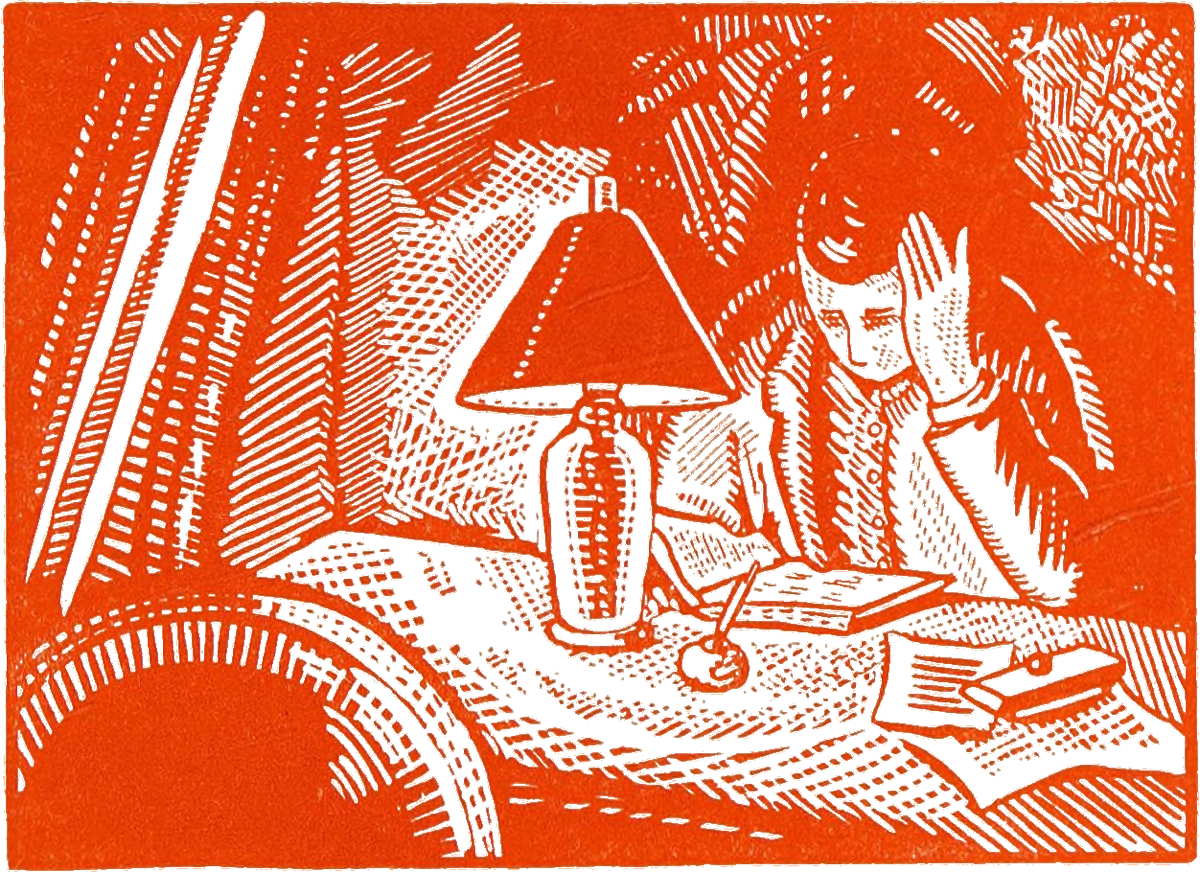
He had sat at home in the dusk, the icy blue dusk of a March afternoon, twisting and turning over an old poem that never would get itself finished. Then all at once he had begun to think of a woman. He had met her at noon as he came from his work, and he had felt the encounter as a sudden intoxication. She was walking in the full sunlight, and many men turned their heads after her as she went. But she seemed to notice or suspect nothing. She was very young—eighteen or possibly twenty. She was neither expensively nor humbly dressed, but she carried her head carelessly and easily, perhaps too a little proudly. Slender and straight, she went on her way, her brown hair shining in the sunlight, and now and then she smiled to herself. He followed her at a distance; she went up to Östermalm and vanished at last in a gateway.
So it was that she had come before his mind again in the twilight, as he sat in his rocking-chair and hunted for rhymes; and she left him no rest—he threw down his pen and went out. There was no longer sunshine; it was snowing. He came to the large gray house where he had seen her go in; he walked to and fro on the pavement directly opposite and saw a window light up here and a window there. Who was she? He remembered he had seen her speak to a man he knew. He went up the steps and read the names on the doors, until at last, deciding that he was childish and stupid, he pulled up his coat collar and went back into the snow. He took by the arm the first girl that gave him a meaningful glance and went home with her.
Now he was standing there in her room. He stood stiffly and silently surveying her as she took off her clothes and chatted and hummed. He hardly asked himself whether she was pretty. He only knew that she might have been prettier without tempting him more and uglier without tempting him less. She showed the marks of her calling. She was still young, and yet one saw that she had long ago tired of choosing and rejecting among her customers. With the same habitual motions of her hand, the coarse hand of a working girl, she hung up her vulgar bodice for any one who asked it of her, for lieutenant or clerk, minister of justice or waiter, making no distinction between them unless possibly that in her heart she preferred the waiter, since he was less haughty than the others and understood her better.
Whence did she come? Perhaps from a back yard with an ash barrel and a privy, perhaps from a village in the woods. The latter seemed likelier; there was still something of the wood girl in her eyes. Glad among other glad children, she had run bare-legged on the slopes and picked strawberries. Early her contemporaries had taught her to bite of the forbidden fruit. So she had come to the city and had fared as did many others. It was perhaps not a necessity in itself; she might have become a workman’s wife if she had wanted, but she had decided that their lot was harder and without much thinking had gone the way that was smoothest to her feet. With a little more intelligence and better luck she might also have become a tradesman’s wife, such as goes to the square with her maid and bargains for her boiled beef and horse-radish.
«Well,» she said, «aren’t you going to undress?»
He stared at her fixedly, and suddenly had no idea of the whole thing, why he had come and what he wanted of her. He muttered something about not feeling very well, laid several crowns on the dressing-table, and departed. She didn’t get angry, only looked surprised and didn’t throw any taunt down the stairs after him.
It snowed continuously. Would it never end, this winter? It was now getting on to the end of March, the trees drooped with the snow and it was bitterly cold....
Martin was weary, he sat on a bench under one of the white trees and let the snow deposit itself in drifts on his hat and shoulders.
«What are we doing with life, we mortals?»
The life he led, the pitiful joy he sought and sometimes found, seemed to him at that moment like the fantasy of a madhouse. Nevertheless that life was the normal life. Most of the men he knew lived thus. He was twenty-three. In the four or five years he had been in the game he ought to have got used to it....
No, he didn’t understand humanity nor did he understand himself. He often listened to the talk of his friends and acquaintances about these things. He had noted that the most respectable of the young men, and of the old for that matter, believed in two kinds of love, a pure kind and a sensual kind. Young women of the better sort were to be loved with the pure kind, but that meant betrothal and marriage, and that one could seldom afford. As a rule, therefore, it was only girls of means who could inspire a pure love; outside of that the feeling was more at home in lyric poetry than in reality. The other sort, on the contrary, the sensual, a man might and should possess about once a week. But this side of existence was not considered to have a serious meaning; it was not anything that could render a man happy or unhappy; it was simply comic, the material for funny stories, an equally pleasant and hygienic diversion when one had received his salary and drunk his bottle of punch. But in the intervals the entire sexual life interested but slightly the respectable and decent class of men; they found its functions unbeautiful and disreputable, or, as they otherwise put it, bestial, since they could not exercise them without feeling themselves like beasts.
This was the prevalent opinion throughout the community, and such conditions were explained in that this way of living was the healthiest and wisest, not of course in the sermons of the clergy, the speeches of the politicians, or the leading articles of the newspapers, but in the enlightened judgment between man and man in all circles. It was considered necessary in order that young men might preserve their health and good spirits and that young women of the better classes might preserve their virtue. The young men accordingly drank punch, visited girls of the streets, became fat and florid, and succeeded not only in putting up with this life as with a sort of wretched substitute, but it appealed to them to such a degree that often even after they were married they did not scorn to make excursions to their old haunts, which had become so endeared. The girls of the better class meanwhile were allowed to preserve their virtue and beyond that were not asked for their opinion, but for some of them their precious jewel became at last too heavy to carry....
«What have we done with our life, we mortals?
«Happiness, the joy of youth, whither has it gone? Life is regulated for the old, therefore it is a misfortune to be young. It is regulated for the thoughtless and stupid, for those who take the false for the true or even prefer the false, because it is a disease to think and feel, a childish disease which one must go through before one becomes a man.»...
The apparition of a woman glided slowly past the bench where he sat, and scarcely had it passed when it stood still, turned its head, and fixed upon him two great dark eyes.
He rose, shook off the snow, and went away.
He walked quickly, for he was cold.
He thought about life and books. During his adolescence a new literature had broken forth, which was at war with the prevalent morals of the community and endeavored to change them. Now it had grown silent. Little had been accomplished, almost nothing, and already it was losing its hold. What the new writers had fought for and in behalf of which they had taken and given such hard blows now suddenly belonged to the «’Eighties» and as such had once for all been tried and condemned, weighed in the balance and found too heavy. Instead the blue flower of poetry exhaled its perfume around him as never before. Once again the old words rang like new; earth returned to the golden age, the woods and waters were filled afresh with centaurs and nymphs, knights and damsels roamed into the sunset, and Song herself, with eyes wide awake and bright after her long sleep, stood forth again in the midst of the people and chanted as she had not done in a hundred years. Martin loved this poetry, its rhythms and words stole into the verses he himself sat and tinkered with in the dusk, and yet all this was strangely foreign to him. The world was just the same all the while, everything went its usual way, and no victory was won. Was this the time to sing? It was true that, when he looked more closely, he discovered ideas at the bottom of this new poetry also, and these ideas too were in open warfare against current morality. But only a few readers noted this and hardly any one attached any importance to it. It was just verse.
It was verse, and as a form for ideas poetry was and remained on about the level of the royal opera. There too the baritone might bellow against tyrants without thereby running any risk of missing his Vasa decoration, there too seduction scenes were played by artificial light without any one’s taking umbrage; what in ordinary life was called by ordinary citizens bestial was conceived of by the same people with regard to «Faust» and «Romeo and Juliet» as poetic and pretty and thoroughly suitable for young girls. It was the same with poetry. Ideas, when woven into verse and beautiful words, were no longer contraband; they were not even noticed.
Would a man never come who did not sing, but spoke, and spoke plainly!
He had come out on Strand Avenue. The ice on Nybro Inlet had just been broken, a tug was now forcing its painful way along between the cakes of ice. To the left several newly built millionaire barracks towered up in the snowy mist, in one of which the electric lights and polished glass prisms already gleamed from a long suite of rooms, and in a large hall a white shimmering maze of dancing couples moved behind the muslin curtains.
Several lonely wanderers had paused in a group as if rooted to stare at the paradise above them. Martin also stopped a minute and proceeded with his thoughts. Several measures of the waltz had reached his ears; it was the «Blue Danube»; he walked on humming it and couldn’t get it out of his head.
O Eros, Eros! The harlot’s room and the festal hall up there.... In both temples the same god was worshiped, and in both temples he was worshiped by the same men. But the women!
He did not dance, and yet he loved balls. He enjoyed standing in a doorway and watching the others whirl by. What atmosphere was there around all their festivals of youth which fascinated him and made him meditative and sick with longing after the impossible? Look at the women! Held close in the arms of the men, with eyes half-shut and mouths open, the most innocent young girls flitted past in dresses which exposed or emphasized their young panting bosoms. What were they thinking of, what were they dreaming of? There were some no doubt who thought of nothing, dreamed of nonsense, and had no other longing than to stir their legs and keep in motion, regular young girls after the hearts of their mothers and aunts. But they were surely not all so. The daughters of men could not have changed so extraordinarily since the not too remote times when youths and maidens carried phallic images in procession, singing holy songs. What did they talk about, these young girls, when they sat together and whispered in a corner? «She is secretly engaged to him»; «He’s in love with her, but she’s fond of someone else.» What was in the books they read? The same thing: People who were in love with each other, and how it turned out, and who got whom. To «get,» what did that mean? That one found out on the bridal night.
But the years passed, and the bridal might have to wait. The young girl got to be twenty-five, she was nearly thirty, and still she danced at balls with half-closed eyes, but her mouth was no longer open; she now knew that this looked unseemly, so she held it convulsively shut, a blood-red streak. Would it never come, the great, the wonderful experience? Her glance was that of a drowning woman. «Save me, I’m sinking, I’m going under! Youth is so short. Look! my color is already fading, my bosom is sinking in, and my young flower is withering!» She tried being provocative and bold, she was afraid she had been too timid before, perhaps that was not the right way.... But the gentlemen were already laughing at her covertly when they drank healths over their punch, and some of them mocked her in public. Others understood her better and thought within themselves that she might make a good wife and an ardent mistress. But they had no desire to marry, and to seduce a girl of family would be a risky business. When they left the ball they could easily and without any ado find the way to their old place, to the room with the smoking lamp, or with a red night-lamp hanging from the ceiling.
«What are we doing with our lives, we men, and what are we doing with theirs?»
Martin turned back into the city.
On a street corner he met a poet, who was freezing in a thin yellow-green ulster. He was a few years older than Martin and already a bit famous, for he wrote with fabulous ease the loveliest verses on any theme, mostly about girls and flowers and June nights on the lowlands of Scania, whence he had come. He had a pale face and a thin red beard; and when he met a fellow-artist, his great childlike eyes took on a wild and staring expression, as if he were considering within himself: «Shall I murder him, or shall we go in somewhere and consume alcohol?»
They went up to the «Anglais» and drank green chartreuse.
The poet talked about himself. He confided to Martin that he was a decadent. He worshiped everything that was disintegrating, rotten at the core, and doomed to destruction. He hated the sun and light—here he shook a clenched fist at the gas candelabra on the ceiling—he loved the night and sin and all alcoholic drinks of a green shade. He had most of the well-known venereal diseases and an insane fear of crowded squares. Nothing in the world could make him go diagonally across Gustavus Adolphus Place. This disease gave him a very special pleasure, for he took it as the forerunner of general paralysis. And general paralysis was the great sleep; it was nirvana.
Martin listened absently. «Light is good,» he said to himself, «and darkness is good too. But sometimes darkness is bad, and light too.»
«But how is it,» he asked, «that your poems are really not in any essential way different from those which generally get the prize in the Academy?»
At these words the poet’s glance darkened, his lips suddenly became thin and narrow. He took a dirty sheath-knife from his pocket, pulled it halfway out, and laid his index finger on the bare blade.
«How deep can you stand cold steel?» he asked.
«You misunderstand me entirely,» said Martin, laying his hand calmingly on the other’s arm. «I love your poems. Only I don’t see rightly the connection between them and your inner life as you have just pictured it.»
The poet laughed.
«It’s amusing to hear that you love my poems,» he said. «The things I’ve allowed to be published up to now, you see, are mere skits. Good enough for the mob. Look here!»...
He took a newspaper clipping from his pocket, a review of his last volume signed by a well-known critic. This authority mildly deplored that some of the poems could not be acquitted of a certain tinge of sensualism which gave an unpleasing effect. In others again the poet struck purer tones, such as were fitted to give rich promise for the future.
«Well, that was quite friendly,» observed Martin, when he had read it.
«Friendly!» The poet again made a convulsive grab in his pocket where the knife lay. «Friendly, you say? Shouldn’t such an insect creep in the dust before the wretchedest of my poems?»
«Oh, yes,» said Martin, «yes, naturally; but since it isn’t the custom for older folks with younger——»
The poet was silent, took a drink, then was silent a long while.
Martin drank too. The strong green liquor burned in his palate and his brain. Thereupon the woman of the morning was there, the one who walked in the sunlight and smiled. Was she asleep now, did she dream, did she smile in her dreams? Or did she twist about sleepless on her bed in longing for a man?
Should he write to her? He could easily find out her name. No. She would only show the letter to her friends, and they would titter and laugh....
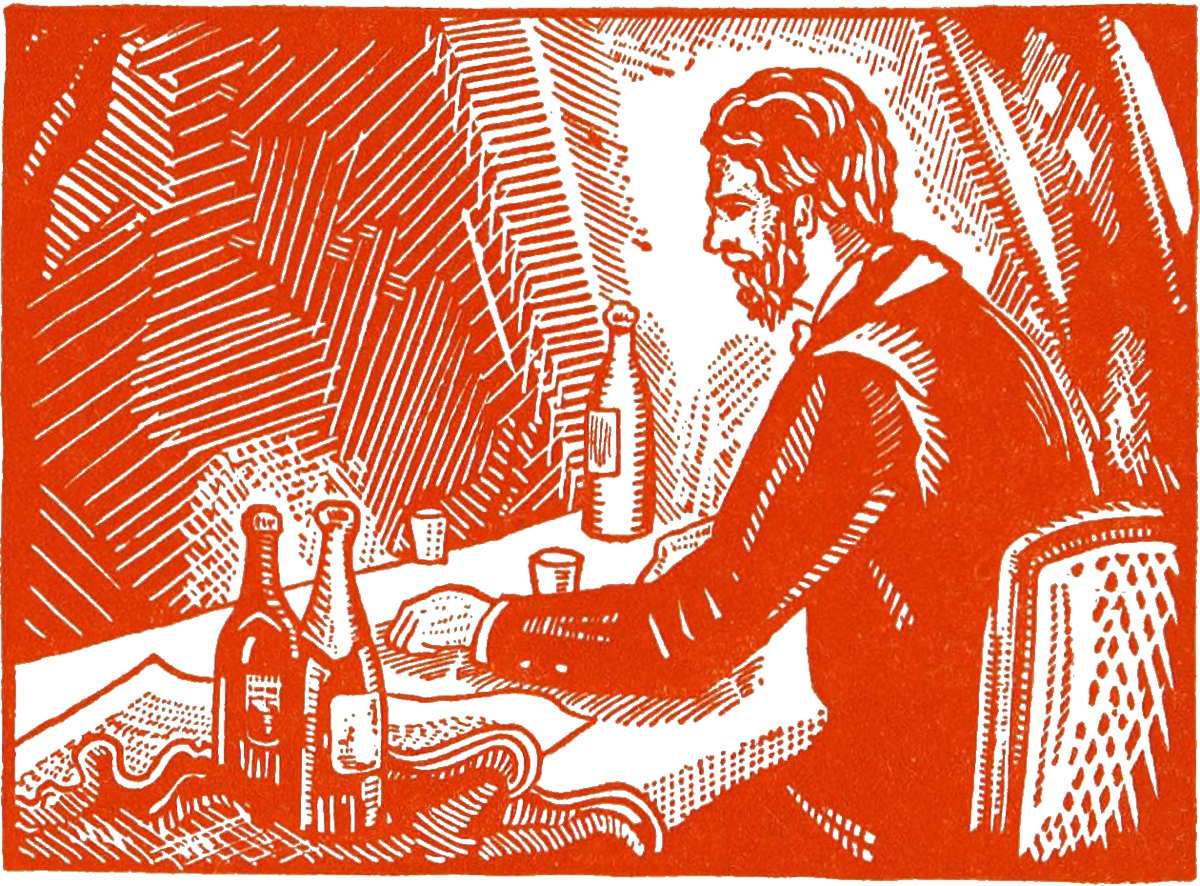
The café was nearly empty. In the farthest corner a regular customer sat alone behind a newspaper. In a mirror on the opposite wall was the vision of an old gentleman with white whiskers and a red silk handkerchief sticking out of his breast-pocket. He was fat and red and white, red by nature and white with powder, and as he leaned his chest and arms against the bar, he looked like a sphinx.
The poet emitted a sigh. Martin studied him: the face of a child under the red-bearded mask of a pirate. It occurred to him that he had possibly hurt this man’s feelings just now, and he felt the need of saying something agreeable.
«Do you know,» he said, «if you shaved off your beard you would certainly look like the most profligate kind of monk?»
The poet brightened up.
«I dare say you’re right,» he said, trying to get a look at himself in a mirror. «What’s more, I’ve written poems with a leaning toward Catholicism. You ought to read my poems sometime, the real ones, the ones that can’t be printed.»
«Surely,» said Martin. «Where do you live?»
The poet declared that he didn’t live anywhere. He hadn’t had any dwelling-place for three weeks, and he didn’t need any. He wrote his poems on the table of the café and slept with girls. In the house of one of them he had his green-edged traveling bag with some extra collars and the poems of Verlaine, and there too were his own manuscripts.
Martin began to be really impressed, but he found no outlet for his thoughts, and silence once more spread itself between the two whom chance had driven together on a street corner.
The clock struck twelve, the gas was turned half down, and the poet, feeling the approach of inspiration with the darkness, began to write verses on the table.
Martin said good night.
Sture Square lay white and empty. The snow had ceased, the moon was up, and it was more bitterly cold than ever. To the east a new street without houses opened like a great hole in a wall. To the west a snow-covered jumble of old shanties and stone gables was spread out in the misty moonlight, and from one of the streets of sin which slunk between them echoed a woman’s laugh and the sound of a gate being opened and shut.
—X—
It was late when Martin came home, and he was dead tired but could not sleep. Black butterflies fluttered before his eyes, and thoughts and rhythms came to him as he lay and stared into the dark. He raised himself in bed and relighted the candle on his bedside table, where paper and pen were at hand as always. He felt no feverish overexcitement, only a deep weariness, which pained him but did not delude. He saw clearly where his thought wavered and needed the support of a rhythm, a bit of melody; he changed and erased, and finally a poem evolved.
You up yonder Who are deaf and dumb! You up yonder, Who with your right hand squeeze The fresh and sweetly-smelling fruit of Good And with your left constrict The poison-dripping maggot nest of Ill, Looking upon them With equal satisfaction! You up yonder, Whose glance is dim With all the emptiness of space— I have a prayer to you. One prayer, but one, Which you can never hear And cannot fulfill: Teach me, Teach me to forget I ever met your glance. For look! In youthful days I myself made a god In mine own image, A warm and living and aggressive god, And on a spring day I went out To seek for him through all the world and heavens. Not him I found, But you. Not life’s divinity But death’s I found under the mask of life. Take the memory of the sight of you Away, O horrible One! That memory is A hidden sickness, is a worm that gnaws My life-tree’s root. I know it well, with every barren year And every day that runs in vain It gnaws yet closer to my being’s nerve. It gnaws and preys upon All that in me which is of human worth, All that which dares, all that which wills and works; Nor does it spare The wondrous, brittle time-piece of the soul Which points out Good and Ill. Speak, you up yonder, Is it your will To re-create me after your own image? Was that the meaning hidden in your word: «He who hath seen God, he must die the death»? O horrible One, Have you the heart to infect Me, a poor child of men, With your immortal vices?
—XI—
The afternoon sun fell across the writing table and gilded everything: the inkstand, the books, and the words he wrote on the paper. The smoke from the chimneys rose straight and tranquilly toward heaven, and in a window just opposite a young Jewess was playing with her child.
Martin was writing to his sister:
Dear Maria:
Thanks for your letter. Mamma is poorly as usual, perhaps a little better these last weeks. Papa keeps the same, only he gets more silent every year. It’s very quiet here at home, for as you know I am not one either to love idle talk. Silence is golden. Uncle Janne, Aunt Louise, etc., are still, unfortunately, alive and in health, though it doesn’t make much difference anyhow, since we are not likely to be their heirs. But they are always annoying me by asking about the prospects of my work, whether papa isn’t in line for the Order of Vasa soon, whether it’s true that your husband takes morphine, and so on. Otherwise there is no harm in them.
You ask whether I’m writing much just now. No, very little, but on the other hand I have an appointment for a long job as amanuensis, and last night I dreamed very clearly and distinctly that papa and I got an Order of Vasa together, since the king couldn’t manage to give us each one.
Thanks for the invitation to come to you in the summer, but it’s not likely I can get off—my appointment will last over the summer. Too bad your husband is nervous. Nice your little boy is well. Remember me to all.
Your brother Martin.
He put the letter in an envelope and laid it aside.
He sat and thought about his sister.
«Is she happy?» he asked himself. And he was forced to answer: «No, she is not happy. She does not perhaps know it herself. Six years ago she was very happy, when she was married and became a doctor’s wife and had her own little home in the country to look after—just what she had most dreamed of. She hasn’t had any sudden fall from the peak of happiness since then. She has just very quietly slipped down, as usually happens with the years. Her husband is amiable and talented and a clever doctor, but he offends the rich people in his district and has most of his practice among the poor. Therefore he is sometimes hard up. Besides, I am afraid his health is undermined and his disposition is sometimes rather bitter. However, he was in very good humor when he was up here last alone, without her. He amused himself as well as he could, and I fear he was a bit unfaithful.
«A curious bird, happiness....»
During these thoughts Martin had begun again to write. He wrote slowly and half in play, with an intention here and there yet without exactly knowing whither he was tending.
«You do not know me. I met you one day in the sunlight. It is weeks, yes, months since then. You went on the side of the street where the sun shone; you went alone with head lowered and smiled to yourself.
«It was one of those days when the snow was beginning to melt on the street and the pavement shone wet and bright. You stopped at the corner of a street, greeted an old lady and conversed with her. The old lady was very ugly and very stupid, and I imagine too a little cross, as stupid people generally are. But when you looked at her and talked with her, she at once grew less cross and less ugly.
«A little farther up the street a gentleman saluted you, and you bowed and returned his greeting. I felt my heart become bitter with envy, and I followed him with my glance as he went on down the street. But one could not see it in him that he had just spoken to you. One could rather believe he was a lieutenant who had just saluted a major.
«I have met you often since then. You do not know me, and it is not likely that you will ever know who I am. You go in the sunlight, I go for the most part in the shadow. I am dressed like many other men, and I always avoid looking at you so that you see it. No, you cannot find out who I am.
«You have a lamp with a yellow shade. Yesterday you stood long at the window in the yellow glow, after you had lighted the lamp, looking at the stars. You went to the window to pull down the curtains, but you forgot about it a little while. Straight in front of your window was a star which burned more brightly than the rest. I could not see it, for I stood shut in by a little black gate opposite the house where you live; but I know that on spring evenings it stands just so that you must see it from your window. It is Venus.
«You do not know me, and I do not know you otherwise than I do the women who sometimes give me the great joy of visiting me at night in my dreams. It is therefore I speak to you so intimately. But among these women you have for some time been the only one, the others have forsaken me, nor do I feel any longing after them.
«Read this letter and think no more of it; burn it, if you will, or hide it at the bottom of your little secret drawer, if you will. Read it and think no more of it, go out as before in the sunlight and smile in your own happy thoughts. But you are not to show it to your friends and let them giggle and snicker over it. If you do that, for three nights in a row you will not be able to sleep for bad dreams, and a little devil from hell will sit on the edge of your bed and look at you from evening till morning.
«But I know you will not do such a thing—you will not show it to any one. Good night, my beloved, good night!»
Martin sat long with this letter in his hand. «What could it lead to if I sent it?» he asked himself. «To nothing, presumably. It would set her imagination off a bit, her young girl’s longing would perhaps have an impulse toward the new and unknown. She might perhaps bring herself to show the letter to her friends, seeing that faith in devils is on the wane; but she wouldn’t go so far as to burn it. She might perhaps be amused with it, she might even consider it her duty to feel offended. But in reality it would in the long run cause her joy, and if in the process of nature she was married and had children and grew old with household cares and every year sunk deeper down in the inconsolable monotony of existence, she would come to remember this letter and wonder who wrote it and if perhaps it was there that the true seed of happiness lay hid. And she would never once recall that it ever made her angry. Nor as a matter of fact does it contain anything that could properly hurt her. It shows her only that she is desired by a man, and as she is twenty and from head to foot an uncommonly beautiful and glorious creation of nature, she must already have noticed that men desire her. And that doesn’t at all make her angry, but on the contrary happy and joyous, and that is why she walks in the sunlight and smiles.»
Amid such thoughts he sat a long while weighing the letter in his hand as if it had been a human destiny, till in the end he found his hesitation ridiculous, put the letter in an envelope of thick untransparent paper, and wrote the address in a thin and non-committal girlish style so as not to rouse any curiosity in the young lady’s family. Without revealing any special interest on his part he had succeeded in learning her name. She was a Miss Harriet Skottë. Her father had an estate in the country, in the Malar district, and she was now spending the winter in Stockholm with some relatives to study something or other, French or art-tapestry or something of the sort ... in order to get engaged, to put it briefly.
Harriet Skottë. He repeated the name to himself and tried to analyze the impression it evoked. He dwelt in particular on the forename and murmured, «Harriet, Harriet.» But this gave him no impression of her nature; it roused only an indefinite conception of something English and pale and blonde, a sensation of tea fumes and benevolence and chilly bedrooms with varnished floors as at a hospital. The surname, again, only suggested family, an uncle who was on the Board of Trade, and a cousin who was a lieutenant in the Army Service Corps. But if he whispered to himself the whole name, «Harriet Skottë,» there came in a new element which quite excluded the others, then it became something quite different and new, then he felt as if she herself passed through the room with her brown hair glinting in a sunbeam.
He started at the ringing of the hall bell; he heard the maid open the front door and a familiar voice asking if he was at home. He stuffed the letter into his pocket. The next instant the door opened and Henrik Rissler stood in the doorway blinking at the sunlight, whose copper-red rays struck horizontally across the room.
—XII—
Henrik Rissler had come down from Upsala. He had just taken his preliminary degree and in a couple of weeks was to make a tour down in Europe while he wrote his thesis, «On Romantic Irony.» He had no independent means, but his uncle—a bank lawyer, politician, and millionaire—had offered to pay for the trip. This Martin already knew from Henrik’s letters. But before he started he was to rest a few weeks. He was somewhat overworked, for he had studied hard so as to get away from Upsala as soon as possible, and he had also taken extra time to write some critical studies for a magazine and so become a little better known among the score or so of men who interested themselves in such things.
Martin had been expecting him for a couple of days and had a bottle of wine and a pack of cigarettes ready.
Henrik shaded his eyes from the sun and said: «Here everything is the same. Here time has stood still.»
«Yes, in this immediate region,» answered Martin. «Only they have built a big factory chimney over opposite. It has been quite a diversion for me in solitude. For a while I worked in competition with the masons, but I was beaten. I began on a poem when they had just begun on the chimney; now the chimney is done, but not the poem. It’s beautiful, what’s more—the chimney, I mean. Especially in the evening as a silhouette. The smoke no longer belches out, one forgets its purpose; it is no longer a chimney, it is a pillar tower built by some Chaldæan prince and priest, who mounts it when night comes on and measures the course of the stars.»
«Yes,» said Henrik, «one forgets the purpose, then first it becomes beautiful.»
«No,» replied Martin, «it doesn’t become beautiful because one forgets its purpose, but because one invents for it another which has the prestige of old and venerable poetic tradition. But outside of that, in and for themselves, without any fancification, factory chimneys are among the most beautiful of modern structures. They promise less than they make good, and at least they are no masquerade figures either in Gothic or Renaissance.»
Henrik smiled. «You’re talking in the style of the ‹’Eighties,›» he said.
Henrik Rissler sat in his old place in the sofa corner, Martin sat in the rocking-chair at the writing table. They were drinking wine and talking about Upsala, about books and women, and about a new philosopher by the name of Nietzsche. And as they talked, the sunbeam in which the motes danced like red sparks grew ever narrower and more oblique and more decidedly red.
Martin surveyed Henrik. He found him changed; his face was leaner, stronger, and more masculine in contour. Why had he said, «Here everything is the same, here time has stood still»? He had had an experience, but what? He was in love presumably; he would perhaps go so far as to get engaged—to whom? Was it his cousin Anna Rissler? She was fond of him and he knew it. No, that couldn’t be. Was it Maria Randel, or Sigrid Tesch?
«It’s curious,» observed Henrik. «Have you felt the same thing?—how painful it is to search for old associations and not to find them. To read over a book one has been fond of, or hear an opera into which one has formerly been able to put everything imaginable and a bit more—and sit empty-handed, wondering where it has all gone to!»
«Yes,» Martin agreed, «it’s a strange, oppressive feeling. One feels as if it was one’s duty to stick to the past, as if one were committing an infidelity.... And one can do nothing. Why is it really so painful? Is it perhaps because there is no plaintiff in the suit, no clearly formulated claim to meet? For the plaintiff is not the book or the music which one has lost touch with, not the mood which shrinks away; the plaintiff is one’s old self, and that is dead and buried, it is supplanted and refuted by the new, it has no plea to make and yet it does make a sort of plea. Therein lies the paradox, and there is nothing as vexatious as a paradox, when it is not comic.»
Henrik took up the thread.
«Yes, you are right; it is between the old and the new self that the battle is, and as long as there is a new which is the stronger, one can always master the phantoms. There is a continuous growth. The old goes, the new comes—or the old goes, that’s really the one certain thing, for how long can one be sure whether the new will come in its place? Suppose the supply should stop some day, suppose nothing under the sun should be new any more, and one only became poorer with every year and every day that passed!»
«Yes,» said Martin, «that sort of thing happens sometimes. And there are cases then in which a man digs up the oldest, the deadest, and most withered thing in his past and begins to worship it anew without seeing the caricature. That’s nearly the worst of all. Better the old saying: poor but proud.»
They sat silent a few minutes. The sun had gone, and still it was not twilight yet. It was almost brighter in the room than just before; everything in it had merely become suddenly pale.
Henrik broke the silence.
«Yes,» he said, «it’s a melancholy feeling to grow out of oneself and one’s old associations—but what’s it matter so long as one grows? And what is melancholy, anyhow, if it isn’t what the rowdy said of the toothbrush, a new kind of amusement invented by the upper classes? But the melancholy is only there when it’s a matter of associations and music and ideas. It was really something else I’ve been thinking of all the time. I’ve been thinking of love and women. If one comes into that province, it isn’t only just melancholy any longer; no, one can’t get off so cheaply. A man is fond of a woman. He wants the whole of eternity to be in that feeling. And yet he can’t escape reflecting that this emotion must be subordinate to the same law of growth as everything else in the world, that some day he will weary of what he loves just as one wearies of the moonlight music in ‹Faust.› I have not had many love affairs, but, believe me, I have never even in my imagination begun the game otherwise than with the thought: may she be the first to tire, and not I!»
«I’m afraid that prayer will not be often uttered,» said Martin. «To be sure both a lover and a married man may be betrayed, but it rarely happens that they wish to be.»
«Still I’m ashamed of the prayer, for I know it comes straight from my heart’s great cowardice. How far must we not have come from the primitive simple and straightforward conception of these things to think it is happier to be betrayed than to betray! And yet that’s how I feel. What does love signify to me; what does it ever mean to a man? Why should there be anything tragic in the fact that a man is betrayed in love? If he takes it tragically he merely becomes comic. And if on the discovery that he is a cuckold he breaks off reading a good book, he deserves to be one. But women—it’s a different thing with them.»
Henrik’s glance was fixed on vacancy.
«Deserted women,» he said—«there’s something special about them. One can’t escape lightly from the thought of them. No, if they scold and fuss and make a row, it’s easier at once; then the whole thing becomes burlesque, one shakes it off, and is free. Then one asks oneself, ‹How did I ever come to love such a creature?› One easily persuades oneself that one has never loved her, and so she’s out of the story. But the others—it seems the most painful thing of all to me to imagine her whom I love withered and pale, discarded, put in the shadow side of life, while I myself live on.... It is a paradox, I realize—it can never happen; one cannot at the same time act so and feel it so. And yet ... I met an old woman just now, here on the street, right outside your door. She was old and very pale and a little comic. She was quite shabbily dressed, too—one of the poor who are too proud to beg. One often sees such old women; there was nothing remarkable about her, nothing that distinguished her from any others of her kind, except that all at once, when I came close to her, she struck me as so like—— No, I can’t tell you straight out. There’s a young girl I’m very fond of. I’m so fond of her that we’re going to be married, perhaps very soon. It was she that the old woman was like, despite the difference in age and all the rest—it was one of those indefinite resemblances that one thinks one sees the first moment, and the next it’s gone without one’s knowing in what it consists. But that moment was enough for me; a chill went through me, a shudder as if I had seen something terrible, and it seemed to me only all the worse that everything else was as usual: the sun was shining and people were on the street.... The girl I care for stood before me, she passed me, withered, discarded, a little comic. It came over me that not even the thought that I myself was dead and lying under the earth could be any consolation to me in such a case; the only conception that could bring any relief was that I was living as wretched and exhausted as she.»