THE WHITE CAP (continued 2)
Charles Wharton Stork translation
They sat quiet a long while.
«Tell me,» Martin finally asked, «who is she, the girl you are fond of? That is, if it’s no secret. Do I know her?»
«Yes,» said Henrik, in a subdued voice, «you know her, and I can tell you. It is Sigrid Tesch.»
Sigrid Tesch. Martin saw before him a young and supple figure, with dark abundant hair and delicate regular features. He had met her a couple of times quite cursorily. He knew she had made an impression on Henrik, and in his own twilight thoughts she had sometimes passed by with a pallid dream smile.
So it was she then, Sigrid Tesch, who was to be Henrik’s bride.
«Yes,» said Henrik, «isn’t it inexplicable that one can dare go into such a thing as love?... And yet....»
«Yes,» said Martin, «and yet....»
They both smiled.
Henrik Rissler got up.
«It is dusk,» he said; «we can hardly see the glasses. Will you go out with me? It’s wonderful outside tonight. Oh, you want to write—— Well, we’ll see each other again soon. Good-by!»
—XIII—
It was dusk now, almost dark, and Martin was still sitting in his rocking-chair at the table and could not get up energy to light the lamp. There was a little wine left in the bottle; he poured it into his glass and drank. He had raised the window to let the smoke drift out, and through the trampling of feet which rose from below like the sound of a hundred ticking clocks he heard the house door open and close again and steps going off down the street—they were Henrik’s. Martin thought about his love and what he had said about it, and he was at once struck with the fact that at the mere touch of this bit of reality his own love affair evaporated and was gone like mist and dream. Harriet Skottë.... He asked himself: «If I should read in the paper tomorrow that she was engaged or married, or that she was dead—what would that signify to me? Nothing, no reality lost, no expectation gone to shipwreck—just a mood burst, which would soon have burst anyhow.»
He took from his pocket the letter he had written, tore it open, and read it again. «I’ll burn it,» he thought—«but why burn it? I may be able to use it sometime in a story.»
He tossed it into a table drawer among other manuscripts. Then he sank again into reverie.
Suddenly his mother stood in the doorway. She held a lamp in her hand and was leaning forward, looking at him.
«You’re sitting in the dark,» she said. «Papa has gone out. May I sit with you here a while?»
Martin nodded. She set the lamp on the table, fetched a basket with her sewing, and sat down to sew.
She sat silent, bent over her work. At length she raised her eyes, large with tears and sleeplessness.
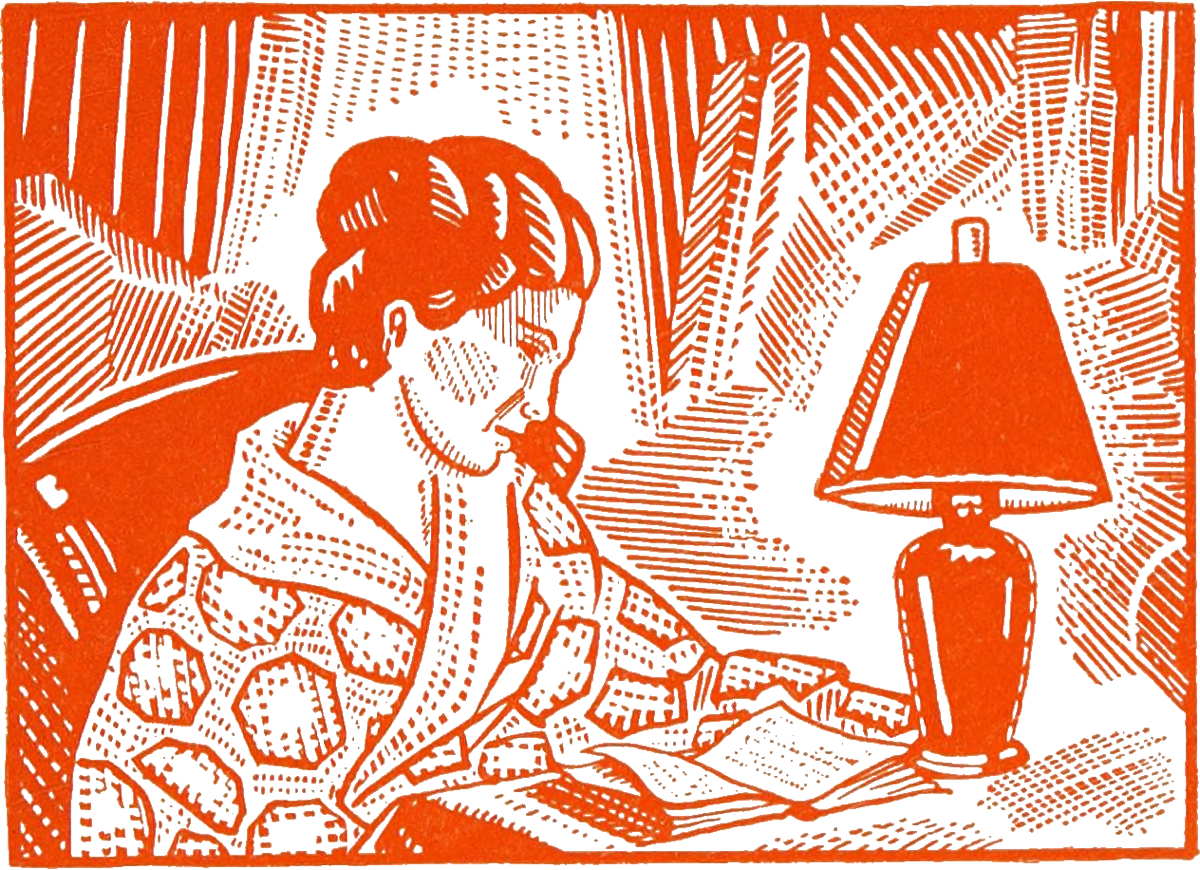
«Tell me, Martin,» she said; «you mustn’t be cross, but one day when you were out I couldn’t help pulling out a drawer of your table and glancing at your papers. Otherwise I should never know what you’re thinking about. And what I got hold of made me so worried that I had to sit down and cry. I didn’t understand it, I don’t know if it was supposed to be verse or what it was, but I thought it was only full of terrible blasphemies. I got so frightened, I almost thought for a moment that you were out of your head. I know I don’t understand anything, but so much I can still see, that you’ll never get anywhere with writing that way. You can write very finely, too, if you want to.»
Martin was silent. What should he answer? He divined, or at least supposed, that his mother had really wished to say something quite different, and that her saying he wouldn’t get on in the world was merely a forced expedient which she caught at when thoughts and words deserted her. She had of course felt and suspected that the poem she had found in the drawer was meant to be taken quite differently from the way she now feigned to think, she wanted him to explain himself, to talk to her about his thoughts. She was pounding at the door, «Let me in! don’t make me stand outside; I’m cold and it’s so lonely!» And yet he didn’t open the door, he couldn’t; he hadn’t fastened it, it had locked itself.
What ought he to answer her? Her words had filled him with a deep discouragement. If he had any ambition, it was to write so that each and all who really cared to could understand him. He had no taste for any literary freemasonry; he did not believe in a literature for the élite, nor had he failed to observe how often it happened that no one wanted to be of the élite. Now it suddenly became clear to him how hopeless was his ideal: there was no art for all, there were no thoughts for all; on the contrary the simplest ideas in the clearest language were but seldom understood by others than those who were familiar beforehand with just that type of thought. How should he be able to speak with her about his thoughts, when her vocabulary, as the monotony of the years had developed it, did not even suffice to express what she herself thought and felt at the bottom of her heart? The god with whom his poem dealt was of course Spinoza’s god, the World Soul; but this god was merely an intellectual experiment, whereas hers—his mother’s—was at least a product of the imagination and as such had a bit more life and more blood. How should he explain that what she called blasphemies did not apply to her god? She would have answered that there was only one god. He knew all she would answer and say; therefore he remained silent and looked out of the window, listening to the Saturday tread of tired feet on the pavement, and the rain which began to fall against the windowpanes.
And as to what she had said about his future, what could he say? To that there was but one answer: to be successful, to become famous. And that answer he could not give. «If I win recognition some day,» he thought to himself, «a recognition such as would gratify her, it will be when she is no longer alive. So it always is. Why should I hope for an exception for her and me?» What was he to do? Ought he to put his arms around her neck, ought he to stroke her hair and kiss her? No, that wouldn’t seem natural. He didn’t care for that sort of deception and she didn’t either; he knew her; she wouldn’t be satisfied with that. She had asked, and it was an answer she awaited. He could answer nothing, and he was silent.
He was silent and felt at the same time how the silence burned in her breast, and though he could say nothing he sought instead with his glance to meet her eyes, those eyes which used to smile so bright and blue when they looked into his. It still happened sometimes in the midst of dinner or in the evening at the tea-table that she looked at him and nodded and smiled brightly as before, as mothers nod and smile to their little children before they are able to talk. Perhaps she had the feeling that time had gone in a circle, and that this smile was the only form of expression she still had in her power when she wished to communicate with her children. It was just so that he wished she could have looked at him and nodded and smiled, with a smile far beyond all the unimportant things which separated them.
But she did not smile now; she sat silent with hands crossed on her knees, and her eyes, generally so near to weeping, now stared tearless into the shadows as if they sought and asked, «Are all mothers as unhappy as I? As lonely? As deserted by their children?»
The lamp flame fluttered in the night wind. She rose and said good night, took the lamp, and went out.
—XIV—
Martin still sat a long while at the window.
«Here time has stood still,» Henrik Rissler had said. «Yes, he was right. Here it stood still, time. It is by changes that one measures the course of time; I have nothing to measure it with. I shouldn’t even know it was Saturday today if I didn’t hear the tramping down there.»
An old story came to his mind. There was once a sinner who died one evening in his bed. Next morning he awoke in hell, rubbed his eyes, and called, «What’s the time?» But at his side stood the devil laughing and holding up before him a clock that had no hands. Time was over and eternity had set in.
«Eternity; no hurry any more....
«Other people have day and night, workday and holiday, Christmas and Easter. For me it all flows into one. Am I then already living in eternity?»
And he thought on: «Tomorrow is Sunday. What does that mean for me? It means that tomorrow I am free from my ostensible work, and that I thus feel twice as strongly the demand of that which should be my real work. But if the weather is fine, I shall naturally go out for a walk.... So, anyhow, it won’t be a real Sunday no matter what I do. What a strange sort of work I have taken upon me! Wouldn’t it be better to give it up while there is still time, to submit to the rules that hold for other men? One is never done with this, there is never a feeling of quiet and rest. Many a free Monday, but never a real Sunday, never any more!
«My ostensible and my real work—how long shall I be able to keep up this illusion? The truth is I’m in a good way to get a permanent job, that in eight or ten years I could become a regular clerk, and in forty years would get my discharge with a pension. My poor mother would be able to spare herself a deal of trouble if she saw all that clearly as I do now. But she imagines in the innocence of her heart that what I write on a few scraps of paper at night will hinder my advancement, for she has no conception of the boundless indifference of men of ideas. To hurt my prospects I should be forced to write personal abuse about my superiors, and why should I do that? They are good-natured men and have got me gratuities and commissions although others deserved them better. They have certainly taken an interest in me. I am not the sort of fellow to put a torpedo under the ark; they have felt that instinctively, and they are presumably right.»
He felt that he would eventually be lost in the multitude. He could not escape the thought that he was at bottom like all the rest; and whether this was his rightful fate, or whether he was too exceptional to be effective among exceptions, he felt only that routine held him every day more tightly a prisoner and that he was going to be lost in the crowd. And the other thing—his poetry; what was that and whither could it lead? Once when he had needed money he had collected a bundle of his poems and gone around to the publishers. A couple of them had wanted to print the volume but none had been willing to pay anything. «No,» he had answered very seriously, «do not count on my ambition!» When he had come home he had looked through these verses again; and again, as so many times before, he had found them uninspired and empty. Most of them were written so as to be sold at once to a magazine and showed that they were so written. And he said to himself, «How absurd it is for a man to make a business of ideas when he has no sure means of subsistence! As clever as the way the minister at a funeral sermon transforms the dead man’s means of livelihood into a mission in life. But existence knows how briskly and mercilessly to transform a mission in life into a means of livelihood for a man with no income. Yet supposing this should be a real means of livelihood—but no, it won’t be; distaste and weariness will come, one will tire of the whole thing and sink back, down into the crowd.
«Down into the crowd; one will do as the others do, there will at least be no more need of conjuring tricks, one will get back his sense of time, one will have Sundays and weekdays, work and rest, real rest....»
The night air streamed in cold through the window, he shivered but couldn’t make himself raise his arms and shut the sash. The rain fell steadily, and, as often happened when he was very tired, his thoughts began to go into meter and rhyme:
I sit alone in the darkness And hear the falling rain, I hear the drops come plashing Against the windowpane. A grief on my heart lies heavy, My labored breath comes fast. Drop after drop my youthtime Is trickling, trickling past.