RODENTS Including the Lagomorphs (hares and pikas)
Reading edition
21
Rodents are the most numerous mammals of the Southwest. This is not an unusual condition; they enjoy numerical superiority over other mammals throughout the world. As a rule rodents are small animals; the largest to be found in the uplands of the Southwest are the beaver and the porcupine. Although these two are considerably larger than all others of the group, they cannot be classed as big animals. Because of the large number of species represented and the varying conditions under which they live, rodents have wide differences in physical characteristics. They can all be identified as belonging to this group, however, by one common characteristic—that of having long, curving incisors. As a rule these number two above and two in the lower jaw, the only exception being the hares and some of their closely allied species. These properly belong to the order Lagomorpha but will be included here with rodents.
The incisors are deeply set in the jaws, that part above the gums being a hollow tube filled with pulp. Unlike the incisors of other mammals, they continue a slow steady growth throughout the life of the animal. This is a means of compensating for the wear the cutting edges must undergo. The fronts of these teeth are covered with a heavy coat of enamel, while the back surfaces are either bare dentine or at best covered with very thin enamel. The wear thus results in a bevel-edged surface much like that of a chisel which, with the whetting it receives during the normal movements of eating, remains sharp. A uniform sharpening of both upper and lower incisors is assured by a peculiar arrangement of the hinge of the lower jaw. A more-than-average play in this ball and socket joint allows the lower incisors to slide either behind or in front of the uppers so that both sets receive approximately the same wear on both sides. Should one of the incisors be broken or otherwise damaged so that normal attrition cannot take place, its opposite will grow to such a degree that the animal is unable to take food and then may starve to death. Canine teeth are absent in all rodents, and premolars are lacking in many species. The large gap thus left between the narrow incisors and the comparatively massive molars accounts in part for the wide skull that tapers quickly to the laterally compressed face so typical of rodent features.
Food habits of the various types of rodents differ to a great degree. Perhaps the term omnivorous might be applied to most of them because virtually all rodents will eat insects and meat in addition to the usual fare of vegetable matter. A few might be classed as insectivorous or even carnivorous. Some species store up hoards of food against lean seasons; others eat like gluttons when food is abundant and hibernate through times of want; still others are equipped to spend the whole year in a busy search for something to eat.
Habitats are equally diverse. Some species live below the earth, some on the surface of the ground, at least two species are aquatic, and a few are arboreal. Regardless of where they live, the great majority are home builders. They strive to locate their homes in the most protected places and usually line their nests with soft materials. Outstanding 22 exceptions are the jackrabbit and the porcupine, both of which lead nomadic lives.
In spite of their secretive habits, rodents suffer a tremendous mortality. Practically all carnivorous animals, most predatory birds, and many snakes prey on rodents, and for many of them these persecuted animals form the chief food. This situation is not as harsh as it might seem, for most rodents are prolific to a high degree. Elliott Coues summed up their place in Nature’s balance very aptly: “Yet they have one obvious part to play,... that of turning grass into flesh, in order that carnivorous Goths and Vandals may subsist also, and in their turn proclaim, ‘All flesh is grass.’”
Snowshoe hare Lepus americanus (Latin: hare ... of America)
Range: Found throughout the greater part of Canada and Alaska with extensive penetrations into the Southwest in Utah, Colorado, New Mexico, and western Nevada. Its occurrence in northern California is rather rare, and is confined to only a few higher mountain ranges.
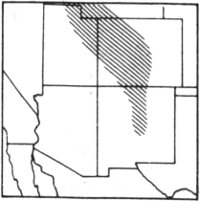
Habitat: In the vicinity of streams or in conifer forests in the Canadian and Hudsonian Life Zones.
Description: A small, chunky hare with medium long ears and large hairy hind feet. An average individual will have a total length of about 18 inches with a tail less than 2 inches. Hind foot about 6 inches in length. Summer pelage brown, except feet and belly white, and tail brownish black above. Winter coat white except for the tips of the ears which are black. Young, three to six, born in May or June.
The snowshoe hare, found sparingly in mountains of the Southwest, is the same as that which lives in the muskeg not far from the Arctic Circle. The climate of the mountain zones is surprisingly like that of the north country even though the terrain is different. The closest equivalent is to be found in the brushy borders of mountain streams, and here the “snowshoes” are most often found. During summer they feed on grasses, herbs, and leaves of many different shrubs and the tender tips of young branches. Winter, a period of famine for many animals, is just the opposite for these large-footed hares. Able to run about on the surface of snowdrifts, each new snowfall lifts them closer to the tender twigs that earlier in the year were far above their reach. Clean diagonal cuts much like those made with a knife mark their depredations and, since they are hearty eaters, the whole tops of many favorite food shrubs may be pruned out in one season.
In common with several other hunted creatures and a comparatively few that hunt, the “snowshoe” undergoes a complete change of color between its summer and winter coat. The transformation begins 23 when the first snows are due, and usually the white coat is complete when the snows lie deep on the mountains. It is not, as was once supposed, a case of the brown guard hairs turning white, but a molt. The summer guard hairs are shed and white ones taken their place. The under fur changes color to a less marked degree. Close to the skin the animal is still brown. Outwardly it is pure white except for black ear tips. Marvelous as this protective coloration is, it is not absolute proof against enemies. There are many, and chief among them are lynxes, bobcats, wolves, weasels, and great horned owls. In many places in the far north the snowshoe hare is the chief host of the lynx, their numbers fluctuating in unison.
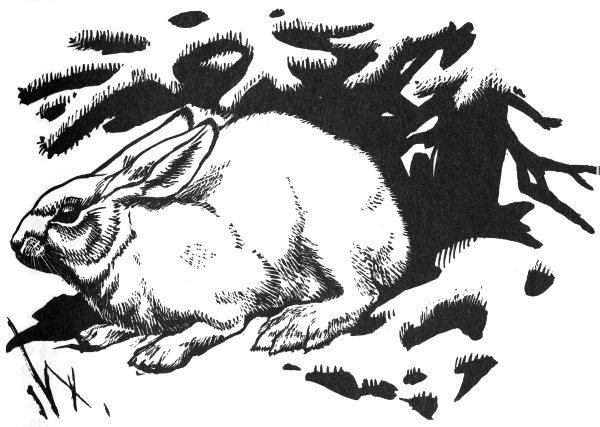
snowshoe hare
Like most other hares the “snowshoe” spends a great share of its leisure time in a “form.” This is usually nothing more than a well concealed hollow. The semi-darkness under low hanging evergreens is much favored by these nocturnal animals for this purpose. They do not, at any time, frequent burrows, the closest approach to this kind of home being in winter when they are sometimes completely snowed under. They suffer but little during severe storms, because their long, fluffy fur is protection against the cold. Their greatest danger lies in the possibility of being buried alive in the event of a freezing rain following the snow.
The young are born in late spring or early summer. They come into the world amid plushy surroundings indeed. The mother has lined the surface nest with soft hair pulled from her own coat, and a softer, 24 more comfortable nursery could hardly be imagined. The little hares are born fully furred, with eyes open, and usually with the incisor teeth already through the gums. Their development is rapid, and long before cold weather arrives they are out on their own.
White-tailed jackrabbit Lepus townsendi (Latin: hare ... for J. K. Townsend)
Range: North of the Canadian border to the southern portion of Colorado and Utah, and from the Cascade Mountains east to the Mississippi River.
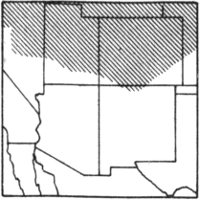
Habitat: Plains and open country, in the foothills, and even in the high mountains. Found in both Upper Sonoran and Transition Life Zones.
Description: A large hare with a white tail and a lanky build, found usually only in open country. Total length (average) 18 to 24 inches. Tail up to 4 inches. Ears up to 6 inches in length. Weight 5 to 8 pounds. Color varies with the seasons. The summer coat is buffy gray, the winter coat is white. The tail, long for a hare, is white throughout the year. The tips of the ears are black both summer and winter. Young, three to six in a litter, born in May. There may be a second litter during late summer. As with all the hare family, the young are well furred and have their eyes open at birth.
The white-tailed jackrabbit is the largest hare native to the United States. Its great size is further emphasized by its rangy build and long legs and ears. Such physical characteristics are usually marks of an animal that is fiercely pursued by its enemies. This denizen of the open country is no exception. It is preyed upon by innumerable predators, including man, the most relentless and cunning of all. Yet its place in the modern world is still secure, for though it is almost totally lacking in offensive weapons, Nature has given it defensive advantages far beyond most other creatures. Perhaps the most important is the deceptive speed with which it floats across the prairie. Fastest of its tribe and exceeded in this respect by only one native animal, the pronghorn, this lanky jackrabbit simply runs away from most pursuit. Effective though this tactic is, the animal uses it usually as a last resort, preferring to employ the exact opposite, that of crouching motionless in an effort to avoid detection. Absolute immobility is itself an admirable defense, but when augmented by camouflage such as this creature possesses it is even more effective.
Like most members of the hare family, the white-tailed jackrabbit is more active at night than during the day. It spends most of the daylight hours resting in a form that it hollows out under shelter of a low shrub or large tuft of grass. In summer the tawny coat blends well with the color of the surroundings, and the winter coat is possibly even more 25 effective. Then the crouched body resembles nothing more than a mound of snow; the black tips of the ears suggest black weed stems sticking up through the white surface.
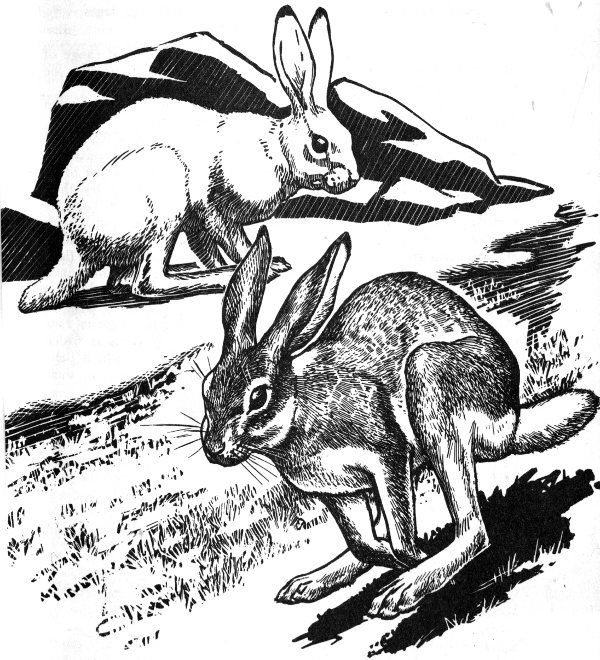
white-tailed jackrabbit
26
Mountain cottontail Sylvilagus nuttalli (Latin: sylva, wood and Greek: lagos, hare. For Nuttal)
Range: Western United States but east of the coastal range of mountains. The northern limits are along the Canadian border; the southern limits in central Arizona and New Mexico.
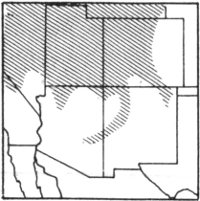
Habitat: Mountains of the west through the Transition and Canadian Life Zones. Seldom found below the pines.
Description: The “powder puff” tail is the best field characteristic by which to recognize this rabbit, usually the only cottontail in its range at the elevations given above. It is one of the largest of its kind, averaging 12 to 14 inches in total length with the tail less than 2 inches long. Average weights run from 1½ to 3 pounds. Ears are relatively short and wide for a cottontail. Color varies somewhat with relation to habitat, but in general it is gray with a faint yellowish tinge. Darkest areas are about the back and upper sides; under parts are light to almost white. The winter coat is heavier than the summer, but much the same color. The underside of the tail is the cottony white so well known to city and country dwellers alike. From the scanty records available on the number of young it would seem that three to four constitute the average litter. Perhaps the higher elevations at which they live keep them free from many of the predators to which their lowland cousins succumb, and thus they are able to maintain their numbers with smaller families.
Though often found in the depths of the forest, these shy rabbits prefer to live in the brushy thickets that border high mountain meadows and line the streams. There, in true cottontail fashion, they venture into the open to feed, always ready at the first sign of danger to scurry back to safety under tangled branches. Once fairly entered into the maze of paths that they alone know, there is little danger of capture. There they can count themselves safe from further pursuit by the larger predators and have a distinct advantage over those their own size or smaller. Although so clever at turning and doubling back in their chosen refuges, they seldom use much evasive action when surprised in the open. Their first thought seems to be to reach cover in the straightest possible line, and as a consequence many are snapped up by predators who not only rely on this behavior but often gain the advantage of a surprise attack as well.
Food habits are much the same as those of other cottontails, modified to some extent by the different plant associations with which they are found. In summer, tender grasses and herbs are the favorite fare, but in winter when deep snow isolates them from even the taller herbs, these adaptable animals turn to bark and such small twigs as meet their taste. At this time even the tips of conifer twigs are often eaten. Access to this food, which during the summer is usually out of reach, is facilitated 27 by the growth of long hair on the bottom of the feet, especially on the hind feet. Though these seasonal “snowshoes” do not approach those of the Arctic hare in size, they serve very well to support the lighter cottontails as they move over the soft surface. They are especially useful when the animal stands on its hind feet to reach some inviting bit that would be out of reach in the normal crouching position. During this operation it reaches for food with the mouth alone; the forepaws cannot be used to gather food, but hang loosely in front of the body as an aid to balance.
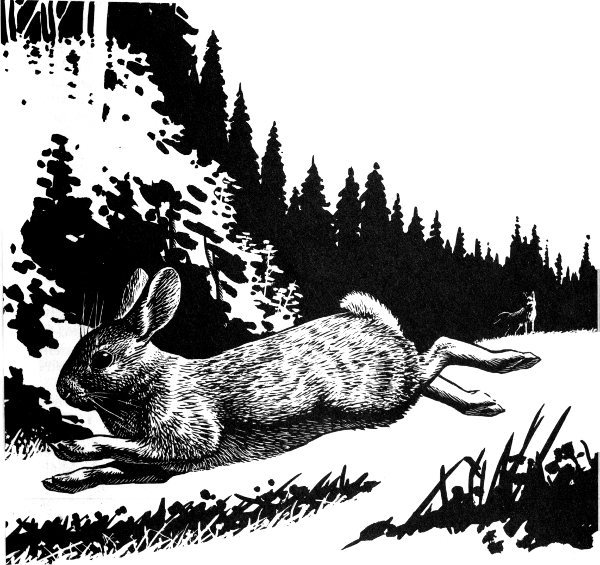
mountain cottontail
This inability to grasp or handle objects with the front feet is characteristic of all those animals which in the United States we call “rabbits.” Though here included with the rodents, the jackrabbits, snowshoe hares, and cottontails all lack the dexterity with the forepaws with which the rest of the group is endowed. The structure of the bones is much like that of the ungulates in that the feet cannot be turned sideways. Thus front legs are used mainly for running, digging, and washing the face and ears, a procedure much like that employed 28 by domestic cats, except that it is carried out with the sides of the paws rather than the insides of the wrists as Tabby does.
Though it lives in a different habitat than other closely related species, the mountain cottontail shares many of their habits. It is a nocturnal animal, seldom seen at large except at dusk or in early morning hours. During the greater part of the day it seeks refuge under some brush pile or deep in the recesses of the slide rock. On occasion it will make itself a form in long grass or under a shrub, but usually prefers more substantial protection. In areas which are being logged, cottontails are quick to take advantage of the shelter offered by huge piles of limbs and debris left by loggers. Later in the season, when the piles are burned, it is not unusual to see as many as three or four cottontails scurry from one pile.
Nests for rearing the young are not of such great concern to these rabbits. Perhaps they instinctively choose places where an enemy would never expect to find them. Many are mere hollows in tall grass or shallow burrows in an accumulation of pine needles. They are lined with soft grasses or needles and hair which the mother pulls from her own body. More hair and grass fibers are cleverly matted together to form a loosely woven blanket which she pulls over the nest when she leaves. It is arranged with such cunning and blends so well with the surrounding that unless one sees the rabbit leave it is only by accident a nest is discovered. The three to five young are born blind and naked, but thrive so well in the warm nest that in about a month they are fully furred and able to leave. At this age they are extremely playful little creatures, often indulging in a game much like tag, although to a human observer it is never quite clear just who is “It.”
In this connection it is interesting to note than among the “hunted” mammals the play spirit is usually manifested by running games in which there is little if any physical contact. By contrast, the young of predators indulge in wrestling games featuring use of teeth and claws, often beyond the point where fun ceases and anger begins.
Pika Ochotona princeps (Mongol name of pika ... Latin: chief)
Range: Mountainous areas of the western United States, western Canada, and southern Alaska. Found in the southwestern United States in Utah, Colorado and New Mexico.
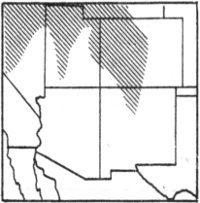
Habitat: Talus slopes of the Hudsonian and Alpine Life Zones.
Description: A small animal bearing some resemblance to a guinea pig; found only among or in the vicinity of rock slides. Total length from 6½ to 8½ inches. No visible tail. Color, gray to brown. Eyes small, ears large and set well back on head. The front legs are short and are exceeded but little by the hind legs. They are all quite concealed by the long hair of the sides. This gives the animal much the 29 appearance of a mechanical toy as it glides smoothly over the rocks. The soles of the feet are covered with hair, the only bare spots on the feet being the pads of the toes. The call is distinctive, the most common being an “eeh” repeated several times. This sound is shrill, but has a falsetto quality as though it were being produced during an inhalation. Young thought to number from three to six.
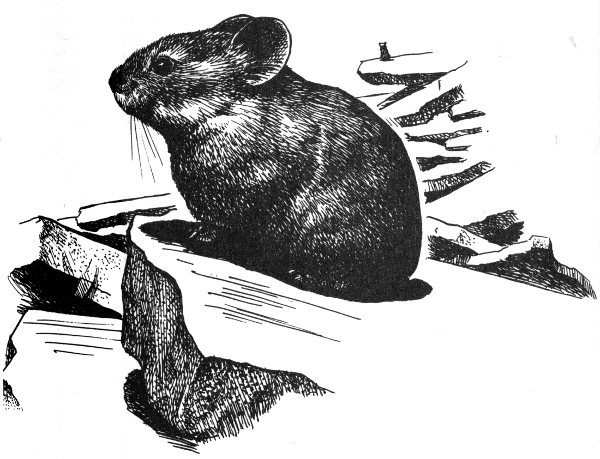
pika
Far up on the mountainside, above timberline but below the eternal snows, a great field of talus rests uneasily on the massive slopes of bedrock. From a distance it seems merely a smooth gray scar that softens the otherwise abrupt lift of the summit. A closer inspection reveals it as a tumbled mass of variously shaped slabs of stone varying from tiny fragments to huge blocks weighing many tons. Its entire bulk is shot through with chinks and crevices of every conceivable shape and form.
Here and there a wisp of grass or an occasional stunted shrub has found a precarious foothold among the slabs. Other low matlike plants occur in considerable numbers. The only sounds are faint whisperings of wind among the rocks and a distant 30 sighing from the forest below. Suddenly a sharp “eeh-eeh” breaks the silence, then all is quiet again. The shrill sounds are repeated, this time from a different quarter. You look toward the sound but see nothing. Finally, if you are lucky, your eyes focus on a little face somewhat resembling that of a tiny cottontail rabbit, peering at you from the safety of a home among the rocks. It is the pika you see and this rock slide is his castle.
The pika bears a superficial facial resemblance to the rabbit, to which it is most nearly related. This is occasioned no doubt by the long silky whiskers and deeply cleft upper lip, for the eyes are small and the ears, while large, are shaped much differently from those of its larger relative. Its other physical characteristics are entirely unlike those of the rabbit. The chunky body, short legs, and almost total lack of a tail are more like those of the guinea pig to which it is more distantly allied. Several species are known. All are inhabitants of the Northern Hemisphere and all, whether Asiatic, European, or American, are found living in rock slides at or above timberline. In the western United States the pika is known by a variety of other common names of which “coney,” “little chief hare,” and “rock rabbit” are perhaps the best known.
Living as it does in only one type of habitat, the pika has developed highly specialized habits. The most remarkable is its practice of cutting hay for winter food. At timberline the growing season is short, but the herbs and grasses which this animal eats spring up and mature in a matter of weeks. During this time the pika lives high on the succulent leaves and stems, but during the latter part of the season it carefully harvests enough food to last through the coming winter. None of this hoard is carried directly into the burrow. Instead, it is painstakingly transported to suitable areas which are exposed to the hot sun, and there piled in miniature haycocks and left to cure. No human harvester ever worked harder to gather his crop or laid it up with more care than this tiny husbandman. Fortunately its tastes are not critical; thus, although the individual plants are scattered, the pika is able to select a sufficient store from the considerable number of species represented at this altitude.
In Utah and Colorado the “haying” time arrives with the height of the summer blooming season. At timberline this usually occurs during August. As though realizing that a hard frost would ruin its delightfully fragrant crop, the pika sets furiously to work. After cutting down as much herbage as it can handle at one time, it gathers the mass into an unwieldy bundle and carries it by mouth to one of the sites it has selected as a curing place. Usually these areas have been used the previous season for the same purpose, and a mass of the least edible stems remain to mark their location. Depositing the load on this base, the pika scurries away for another bundle. Long familiarity with routes across the uneven rocks enables it to make its way with never a misstep, even though the load carried may be of such size that vision to the front is completely obscured. Working early and late the pika distributes its harvest among the various piles. As a result, the hay dries out 31 evenly and when cold weather calls a halt to the work each little stack is perfectly cured without a trace of mildew. The truly monumental work to which this little creature goes is shown by as many as a half dozen haycocks, each of which may contain up to a bushel or more of feed.
Comparatively little is known of the pika’s life history. What has been recorded has been noted during those periods when it was seen on the surfaces of rock slides. What goes on deep in the labyrinths of its habitat can only be conjectured. It seems reasonable to suppose that in some subterranean cavity the pika has constructed a comfortable nest lined with soft grasses. Certainly it remains active all winter, although buried under many feet of snow, for in the spring its stacks of hay have been largely consumed.
The number of young is thought to range from three to six. They probably are born in early summer, as when they appear on the surface, usually in late July or early August, they are about half grown. Though family ties are closely knit until the young mature, pikas cannot be considered gregarious animals. The scarcity of food alone would be sufficient reason to prohibit large groups in one small area. Each adult takes up squatter’s rights on a territory large enough to support it, and thereafter holds it with but little interference from others of its kind.
Few natural enemies prey on the pikas. The very openness of their habitat prevents the larger predators from stealing up unseen. Hawks and eagles account for some, and weasels are able to penetrate their underground maze at will, but the natural fecundity of the species seems to balance these losses very well. To the nature student the pika offers a tempting challenge. It is far from being a rare animal, yet at the same time it is one about which almost nothing is known. As qualifications for learning its secrets, one must be somewhat of a miner and considerable of an arctic explorer.
Tassel-eared squirrel (Abert’s) Sciurus aberti (Latin: shade-tail ... for Col. J. J. Abert)
Range: Northern Arizona, northwestern New Mexico, extreme southeastern Utah, and south central Colorado in the United States; also found in the Sierra Madre Mountains of northern Mexico.
Habitat: Ponderosa pine forests of the Transition Life Zone.
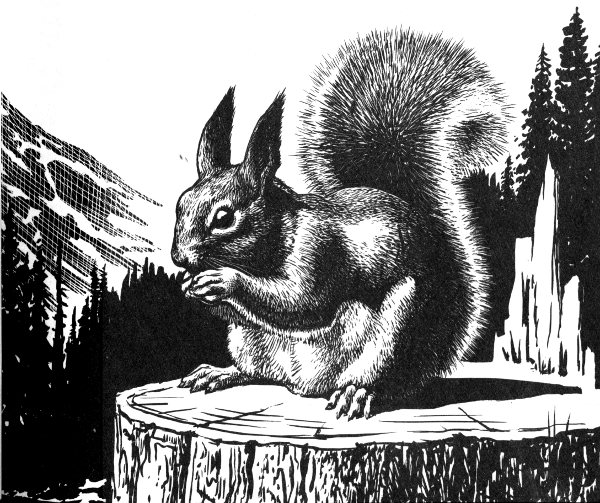
Description: The only squirrels in the United States that have conspicuous pencils of hair on the tips of the ears. Sciurus aberti is a large squirrel with a total length of about 20 inches. Tail about 9 inches. The summer pelage is brown on the back, with gray sides and pure white underparts. The beautiful bushy tail is silvery below and gray above. During summer the long ears have no tassels on the tips. Beautiful as is the summer coat, it is far surpassed by the winter one. Then the 32 heavier fur becomes richer brown on the back, and the contrast between the gray and white areas is further emphasized by appearance of a narrow black band between them. The ears too become more spectacular with the addition of the penciled tufts which give this animal its common name. Breeding habits of this squirrel are variable and evidently depend to a great extent on the food supply. There may be as many as two litters in a fruitful year and none at all in a lean year. The usual number is three or four young to a litter. These are born sometimes in a hollow tree, but more often in a bulky nest of leaves built in a tree top.
No mammal of the United States has a more appropriate generic name than the large tree squirrel. Sciurus literally translated means “shade-tail” and refers of course to the beautiful and useful appendage sported by all of our arboreal types of squirrels. It is doubtful if any can equal the striking plume carried by aberti; certainly none can surpass it. Its distinctiveness is not occasioned by its size, for several species have tails that are longer. Rather, its elegance is derived from the width, the striking coloration, and the easy grace with which the animal displays its beauty. Whether in full flight across a grassy clearing or in repose on some lofty limb, the first field mark of this unusual squirrel will be the tail; the second, the tasseled ears.
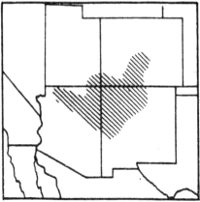
As the map shows, Sciurus aberti and its many forms are confined in the United States mainly to the high country along parts of the Colorado River, and also to that great escarpment known as the Mogollon Rim, whose length is divided about equally between New Mexico and Arizona. In this range is found what is often referred to as the “greatest unbroken stand of ponderosa pine to be found in this country.” Of the many species of plants and animals found as associates of this forest, perhaps none is more dependent on ponderosa pine than the tassel-eared squirrel. This rough-barked tree furnishes a major source of food and shelter. In return, for Nature always demands that restitution be made, the squirrels plant a part of the seeds that insure continuation of the ponderosas.
It is a common belief that squirrel’s diet consists of nuts and little else. This is true only to a degree. A squirrel is fond of nuts and will eat and hoard them during the short season when they are available. For the greater part of the year, when its stores have been depleted, it turns to many other types of food among which are fruit, herbage, leaf buds, and flowers. Favorite food of the tassel-eared squirrel is, of course, the large single-winged seeds found under scales of ponderosa pine cones. Next favored are acorns from the oak that mingles with pine at the lower edge of the Transition Life Zone. If the season is good, great quantities of cones and acorns are buried for future use. These are hidden singly, not in caches, as is the habit of some squirrels. In the event the squirrel does not return for its hidden stores, some of the seeds will sprout eventually and take their part in the slow cycle of growth and decay that is continually going on in the forest.
During months when these favorite foods are scarce, squirrels find the cambium layer of young pine twigs very acceptable. This is the 33 tender layer that lies between the wood and the bark. In the growing season it is especially sweet and nutritious. This was as well known to the Indians as the squirrels, and they too took advantage of the supply during times of famine. The squirrel obtains this food by cutting off the terminal clusters of needles, then severing a denuded portion of the branch, of a size that may be conveniently carried to a favorite eating place. Here the outer bark is deftly removed, the edible portions consumed, and the base wood cast to the ground. Although large numbers of the terminal twigs are taken, the trees seem to suffer no serious damage from this seasonal pruning.
tassel-eared squirrel
In selecting a nesting site the tassel-eared squirrel turns again to its favorite tree, the ponderosa pine. Because few of these healthy giants have knotholes or cavities of a size to accommodate this large species, the nests are usually built in the thick upper growth of branches. Material for their construction consists of small twigs of deciduous trees, cut with the leaves on them. These are cleverly woven together so that as the leaves wither and dry they tend to hold the bulky mass together. Aspen branches frequently are used when available, the large, almost round leaves combining to form a warm wall and at the same time a thatch impervious to all but the most driving rains. Several 34 exits are provided in case an enemy should enter the nest, and the interior is lined with soft fibers. Usually more than one nest is built by each squirrel, so that in an area where they are common the bulky homes are conspicuous not only for their size but by reason of their numbers. With several ports in a storm, so to speak, the squirrels weather the winter very well. During the coldest days they remain snugly curled up in their nests, but on bright, still days they will be seen searching out their hoarded supplies, even though they may have to dig through several inches of snow to get to them. At such time their gruff bark, deep in timbre, may be heard for a considerable distance.
Breeding takes place in early spring, often before the snow is off. The squirrels are fully polygamous, which is one of the reasons this species can almost disappear and then restores its numbers within a season or two. There may be two litters each year, the first arriving as early as May and the second in August or September. As mentioned before, this species is variable and the young may differ in coloration from their parents and from each other. Melanistic individuals are frequent; these should not be confused with the Kaibab squirrel which they resemble superficially. Several subspecific forms are recognized but are not easily identified by the layman.
One’s first introduction to this beautiful species is an experience long to be remembered. It was no less interesting to the early naturalists who first penetrated the wild regions where it lived. Their accounts abound with adjectives such as, “handsome,” “graceful,” etc. Dr. S. W. Woodhouse, who accompanied the Sitgreaves expedition on the exploration of the Zuni and Colorado Rivers, noticed it at once and formally described it as a species in 1852. Since that time it has been introduced into many of the “sky island,” mountains that lie south of its original range. It adapts very well to new conditions, seeming to need only a favorable climate and a ponderosa pine forest in which to live. What effect its presence will have on these new surroundings is not yet known. There is always danger that the native plants and animals will suffer from such new competition in an established association. Such introductions should never be made without a study of all the factors involved.
Kaibab squirrel Sciurus kaibabensis (Latin: shade-tail ... from the Kaibab, a forest in northern Arizona)
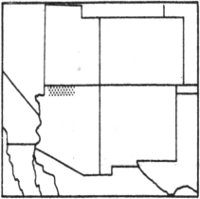
Range: An area approximately 30 × 70 miles in size in northern Arizona. The southern limit is bounded by the north rim of the Grand Canyon of the Colorado, and much of the range is included within the boundaries of Grand Canyon National Park.
Habitat: Ponderosa pine forests in Canadian and upper Transition Life Zones.
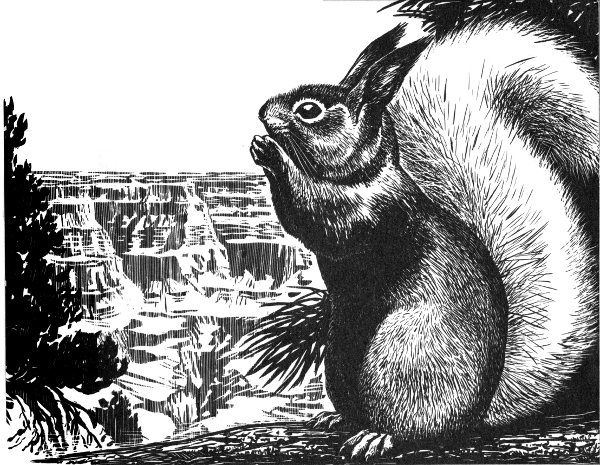
Description: A tassel-eared squirrel with an all white tail. In size this species is the same as Sciurus 35 aberti but the coloration is different. The Kaibab squirrel has the same rich, chestnut brown area along the back and upper part of the head, but the sides are deep gray and underparts gray to black. The tail is either all silvery white or it may have barely discernible light gray edging on the upper surface. Nesting and breeding habits are the same as with aberti.
Kaibab squirrel
This beautiful squirrel has a distinctive appearance and an uncertain specific rank. It is included here because of all the mammals discussed in this booklet it best exemplifies the effects of isolationism. There is little doubt that the ancestors of both aberti and kaibabensis were of one common stock. How the progenitors of the Kaibab squirrel came to be marooned on the North Rim of the Grand Canyon is of little moment. Perhaps they were already there when the Colorado plateau was young and the river was just beginning its mighty task. Possibly they emigrated later when the gorge was not as deep as it is now. At any rate, it can be assumed that they have lived on the North Rim for thousands of years, isolated from their cousins on the South Rim by only 20 miles of thin air horizontally, but a trip on foot that involves a descent of a mile through two life zones (Upper Sonoran and Lower Sonoran), a crossing of a wide and turbulent river, and an ascent to the South Rim through the same two desert zones. Surely 36 this is an undertaking for a squirrel of the cool forests that would be too hazardous to be successful, even if attempted.
The factors that have changed this squirrel’s coloration are not definitely known, but climatic conditions are probably at least partially responsible. The North Rim is approximately a thousand feet higher than the South Rim and is considerably colder. At this higher elevation much of the Kaibab squirrel’s habitat falls within the Canadian Life Zone. This in turn makes certain vegetable food available which is rare or unknown on the South Rim. Thus diet also may have something to do with its unusual appearance.
At various times the Kaibab squirrel has been known as a distinct species, Sciurus kaibabensis; at others, it has been considered merely a subspecies of Sciurus aberti. The latter is its standing at this time. Regardless of specific rank, it is a form that should be stringently protected. The population is small and goes through the same fluctuations as Sciurus aberti. During the summer of 1946 only one individual was known in the area around Grand Canyon Lodge, where they usually were found in some numbers. At such times the heedless destruction of only a few squirrels could conceivably result in the extermination of this rare and beautiful animal.
Arizona gray squirrel Sciurus arizonensis (Latin: shade-tail ... of Arizona)
Range: Central to southeastern Arizona and adjacent parts of western New Mexico in the Upper Sonoran and Transition Life Zones.
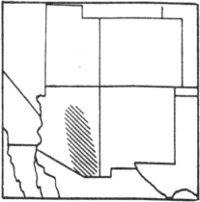
Habitat: Associated with the native black walnuts of canyons, or often found among the pines on canyon rims.
Description: The common gray tree squirrel to be found in the range given above. The Arizona gray is a large animal. Total length is from 20 to 24 inches with a large tail accounting for from 10 to 12 inches of this measurement. In the typical form the color is dark gray above with underparts and feet pure white. The tail also is dark gray with a silvery white margin. The finest examples of this species may be found along the edge of the Mogollon Rim in Arizona and New Mexico. Farther south the pelage often has a yellowish or brownish tinge. In the mountains along the border the Arizona gray squirrel should not be confused with the Mexican fox squirrel (Apache squirrel) which here barely invades the United States. The Mexican cousin, about the same size as Sciurus arizonensis, is definitely yellowish brown and has lighter underparts of the same color. Like other large tree squirrels of the west, the Arizona gray builds a bulky nest of leaves and twigs, usually in the upper branches of a deciduous tree. Young, four or five to a litter; under exceptionally favorable conditions two litters may be reared in one season.
When compared with the royal tribe of Abert’s 37 squirrels, this common gray animal of the Southwest seems but a peasant. When it is seen alone comparisons are forgotten. Deliberate in its movements, whether crossing the forest floor or traveling the leafy aisles of the tree tops, it seems always to have calculated its next maneuver. The result is a careless grace that presents the sturdy body and beautiful tail to the best advantage. Calm in temperament and with but little of the suspicious nature that is characteristic of the smaller squirrels, the Arizona gray may easily be tamed in outdoor surroundings and becomes one of the most satisfactory of wild friends. It is not recommended, however, that they be fed from the hand or handled at any time. “Familiarity breeds contempt” is a saying that does not apply to humans alone. A squirrel’s bite can be serious as well as painful.
Both Mearns and Bailey, who wrote of this species many years ago, mention it as occurring mostly among the walnut trees of the Upper Sonoran Life Zone. Perhaps during the intervening years the press of civilization has driven them from their chosen habitat into a higher elevation. At any rate, although they still frequent the more isolated valleys, they are now found also in considerable numbers among the pines of the Transition Life Zone. The rough broken country along the Mogollon Rim seems best suited to their requirements, and they are now quite abundant there.
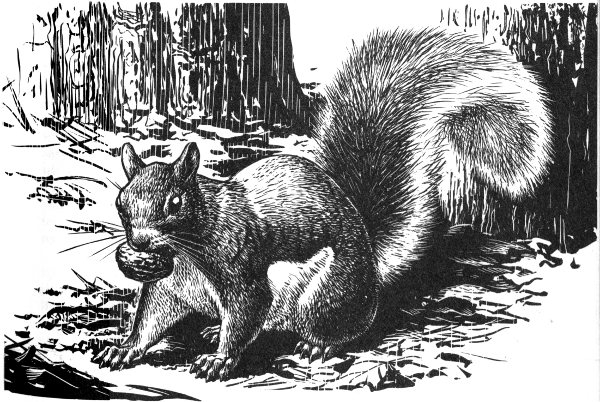
Arizona gray squirrel
Along the border of the Upper Sonoran and Transition Life Zones this adaptable animal finds a wide variety of food. Although the squirrels generally are known as gatherers and storers of nuts, there are many other types of vegetable food that they will take when conditions 38 warrant. The cambium layer of bark and leaf buds of various species of trees are eaten in spring when nut stores have been depleted. Berries, fruit, and even flowers form a considerable part of the diet during the summer. In the fall the ripening crop of pine nuts and walnuts provides not only food for immediate use but stores for the long winter season when, unless enough has been laid by, the unfortunate may starve to death. The gathering period is a time of unremitting labor. From dawn to dusk the squirrels work feverishly carrying nuts to the hiding places they have selected. Sometimes these are in a hollow tree or a nest, but usually the harvest is buried in the humus and debris that collect about the bases of trees.
There are two phases to the work. In the first the squirrel works in the tree cutting off the cones or nuts and letting them fall to the ground. When a considerable number have been thrown down, it descends and carries them away, one at a time. The latter operation is the most dangerous since enemies have an undue advantage over this aerialist when it is on the ground. During the harvest the squirrels plainly show the effects of their work. In gathering pine cones the fur of their forelegs and undersides becomes matted with pitch. The juice of walnut fruits (related to the eastern black walnut, Juglans nigra, which the early pioneers used as a source of dye for coloring their hand-loomed cloth) stains their underparts a dirty brown. These marks of their labor remain with them until the summer coat is shed to make way for the heavy winter pelage.
When the generic name Sciurus (meaning shade-tail) is mentioned, I am reminded of an Arizona gray squirrel I observed several years ago. During late fall my wife and I were camped near the headwaters of the Hassayampa River in a mixed forest of hardwoods and conifers. Our arrival had interrupted the work of a squirrel which was gathering walnuts in the immediate vicinity, but he soon became accustomed to our presence and renewed activities. Every sunny hour he was busy storing the nuts, many of them at the base of an old pine tree near camp. Shortly thereafter a fall storm set in and lasted for several days. It developed into a pattern of misty drizzle followed by periods of clearing weather when the sun might appear for a few minutes. During sunny intervals the squirrel would appear, but as soon as it became overcast again he would as quickly disappear. Finally we discovered his retreat. When it would threaten more rain he would run up the trunk of the pine to the first branch. Here he would turn his rump to the hole and hunch up into a small furry ball with his long bushy tail laid forward over his back and head and extending down in front of his nose, forming an admirable protection against the few drops that spattered down through the thick foliage overhead.
Squirrels are not the only animals who use their bushy tails for protection against the elements. Many mammals curl up and wrap the tail around themselves for warmth, but only the squirrel tribe has a tail long, wide, and flat enough to be used as a roof. Though the origin of the term Sciurus has been lost, it is not too far fetched to suppose that it was suggested by a squirrel’s use of its tail as a parasol.
39
Spruce squirrel, Pine squirrel (DOUGLAS SQUIRREL, CHICKAREE) Tamiasciurus hudsonicus fremonti (Greek: tamia, steward and Latin: sciurus, shade-tail ... of the Hudson, named after Fremont)
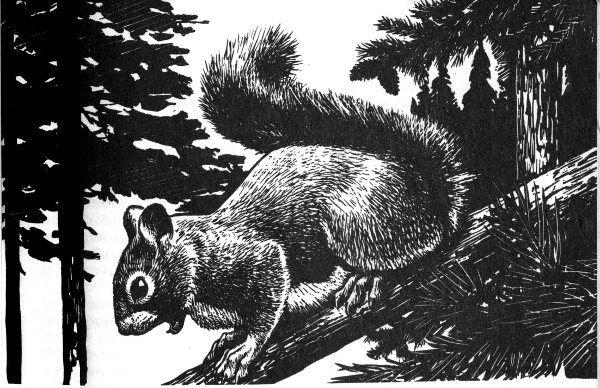
spruce squirrel
Range: Utah, Colorado, Arizona and New Mexico in the Hudsonian and Canadian Life Zones.
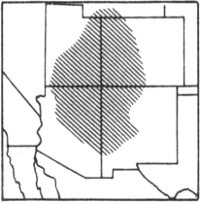
Habitat: Conifer forests, preferably spruce, in the higher mountains.
Description: A small gray squirrel, usually the only squirrel to be found at the elevation at which it lives. Total length 13 to 14 inches. Tail 5 to 6 inches. Two distinct colors of pelage are seasonal. The winter coat is olive gray to rufous gray above with lighter underparts; the summer coat is brownish gray to yellowish gray with almost white belly and feet. A black stripe along the sides is prominent at all seasons. The tail is narrow and noticeably shorter than the body. It is gray beneath, rufous gray above, with black border and a black tip. Little is known of the breeding habits. The four young are born in early summer and by August are usually out foraging with the mother.
Spruce squirrels (distribution shown in accompanying map) include several of the more than two dozen varieties of red squirrels in the United States belonging to the species hudsonicus. Combined with several subspecies of the Douglas squirrels, (species douglasi, the “chickaree” of the far western mountains), they make up the genus Tamiasciurus. This 40 term, a combining form of Tamias (the genus of chipmunks) and Sciurus (that of squirrels) clearly indicates relationship of the red squirrels to both groups. It is equally apparent in the field where the short narrow tail, the black stripe along the side, and the nervous disposition remind one of the chipmunks, while the arboreal habits, comparatively large size, and coughing bark are distinctively squirrel-like.
The spruce squirrel is seldom, if ever, found below an elevation of 6500 feet, and then only in the shady canyons on the northern exposure of mountains. From this low it will be found up to timberline, or rather just below that point at which the trees are too stunted to offer the required protection. It prefers the dense shade of heavily forested areas, so is rare near the southern limit of its range, and increasingly common in the northern portion.
In common with the rest of its group, this bright-eyed little animal keeps well informed on everything that goes on in the territory it has chosen as its own. Any intruder is thoroughly investigated, then as thoroughly castigated, and driven out if possible. Since these squirrels seem to recognize each other’s domain, a trespasser of its own kind usually leaves at the first sign of trouble. With larger animals and humans the attack consists of psychological rather than physical warfare. From a limb at a safe distance above the ground, the doughty warrior chatters and scolds with increasing vehemence as long as a passive interest is displayed by the imagined adversary. At the first threatening movement it disappears in a flash around the opposite side of the tree. Scratching noises and falling flakes of bark, together with noises of peevish defiance, indicates that it is working its way up the trunk. Suddenly it reappears on another limb some distance above the first and the real show begins. Paroxysms of rage, stamping of feet, waving of tail, and streams of invective all are meant to show that one step closer spells trouble. A few squeaks from your pursed lips and this tremendous bluff gives up to curiosity. In a few minutes the erstwhile challenger is back on the first limb trying to make out what this strange creature is about. This amusing procedure can be carried out over and over again, and usually is, just to observe the stuttering rages of which this tiny creature is capable. With more considerate treatment they soon become quite tame, although even then a quick movement will send them helter skelter to the closest tree.
It is well that this squirrel is a quick and tireless worker. The seeds it extracts from the spruce cones are so tiny it takes an enormous number of them to provide that energy. With such a quantity to handle, it is not so careful in storing the crop as some larger squirrels. A comparatively few cones are buried in the soft loam beneath the trees; the rest are stuffed into holes beneath the spreading roots or simply piled in heaps near the base of the trunk. In a year when cones are plentiful there may be a bushel or more in one of these piles. With several such piles within easy reach of the warm nest fastened in the branches of a nearby conifer, the small harvester has prospects of an easy winter ahead. Only in the most inclement weather are these active animals confined to their nests. They keep tunnels open to their supplies, and 41 each snowfall adds to the security of the caches. All winter long the stockpiles diminish while the snow beneath some favorite perch becomes littered with the scales and discarded centers of the cones. By spring, which comes late at this elevation, the cones are gone and the squirrel returns to its summer diet of leaf buds, seeds, berries, mushrooms, and herbs.
The spruce squirrel is the last of what might be called the true squirrels in this book and, because the group has much in common as regards food, enemies, and relations to mankind, a short summary might be in order.
As has been mentioned, the principal diet of these animals is vegetable. However, all of them, if opportunity offers, will take birds’ eggs and young birds. This is not intended in any way as a condemnation of the squirrel tribe. Their inroads on the bird population are what might be termed “natural losses.” Nature long ago established a norm in bird reproduction which takes such losses into account.
The enemies of squirrels are legion. From the air, the larger hawks and owls, and even eagles, are ever alert to swoop in on them. On the ground lynx, bobcats, foxes, and coyotes take their toll. In northern Utah and Colorado the marten is one of the most important local controls on the squirrel population. Fast and powerful, the marten is equally at home on the ground or in the trees, and it is a fortunate squirrel that can escape one. The toll taken by all of these predators is high, yet the natural fecundity of the squirrel is so great that the population sometimes gets out of hand and disease has to eliminate the surplus.
In their relationship to man the squirrels are among the most remarkable of our native mammals. It is not ordinarily the purpose of this book to point out the economic importance of our mammals, but the beneficial work carried on the squirrels is too important to pass by. One of the most valuable natural resources that America has is forests. To the arid Southwest the mantles of living green that cover the mountains are invaluable. These are sweeping statements, but they are sober facts.
Squirrels play a considerable part in perpetuating this national heritage. The fact that they do this more or less accidentally merely serves to call attention to the subtle patterns in which all living things move to serve one another. Take their simple mechanics of storing a pine cone, for instance. A hole is dug to a depth of several inches in the soft duff under a shady conifer. The cone is pushed firmly into the bottom of the hole and tamped into place with several vigorous shoves of the nose. Then the hole is carefully filled and smoothed over so that no marauder will discover it. This procedure may be repeated hundreds of times by one individual. If the animal never returns (and the rate of mortality among squirrels is high), the cone can be considered planted. Not only is it planted at the correct depth and in the most suitable material for successful germination and growth, but it is full of plump fertile seeds. Through some instinct the squirrel knows which nuts and cones are healthy and fully developed. If you 42 doubt this, examine some of those they have left on the tree. Invariably they will be infested by insects or “inferior” in some other respect. One of the favorite sources of pine nuts for reforestation projects in the Northern States is the stockpiles of the red squirrel. The scales of the cones are tightly closed when they are taken, but as they open on the drying floor the healthy, fertile nuts prove the unerring judgment of the harvester.
Northern flying squirrel Glaucomys sabrinus (Greek: glauco, silvery and Greek: mys, mouse)
Range: Widely distributed throughout most of our Northern States and Canada. In the section covered by this book, found only in northeastern and south central Utah, with possible occurrence in northwestern Colorado.
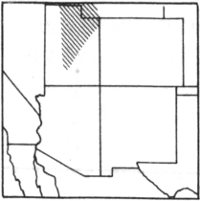
Habitat: Associated with conifer forests of Transition to Alpine Life Zones.
Description: Our only airborne mammal with a long bushy tail. Total length 9¾ to 11½ inches. Tail 4½ to 5½ inches. Characteristic of this species is the fold of skin along each side from the fore to the hind leg. There is considerable color variation in the numerous subspecies of this squirrel. In general the upper parts vary from dark brown to cinnamon brown. Sides of face gray; underparts white to pinkish cinnamon beneath. Hind feet are brown, fore feet gray. The flying membrane is brownish black above, white to cinnamon beneath. The eyes are large and dark brown. Young, two to six in a litter, born in spring; a second litter is sometimes produced in early autumn.
Because flying squirrels are almost entirely nocturnal, they are seldom seen. This is unfortunate, for they are among the most interesting forest creatures. Probably more people have seen flying squirrels through the predations of a house cat than in any other way. Gentle and unafraid, the squirrels fall easy prey to this night prowler, which sometimes brings them home to show its owners. Strangely enough, the victims often are not injured seriously, and if taken from the cat and allowed to recover from their initial fright they will glide about the room with much of the grace they display in the wild.
Properly speaking, these squirrels do not fly; that is to say, they are incapable of sustaining level or ascending flight. Rather they climb to some height in a tree then launch out and glide to a lower point, usually the trunk of another tree. As the angle is usually quite sharp they attain considerable speed. They check this momentum by inclining upwards just before reaching their objective. This results in a four-point landing against the tree trunk, sometimes with an impact that can be heard for some little distance on a quiet night. During these flights, 43 which may extend 50 yards or more, they are able to change direction or maneuver against wind currents. This is done by manipulating the flying membrane and using the tail as a rudder. After a flight they usually ascend to the safety of the foliage above. They cannot be considered awkward on the ground, but it is not their chosen habitat. Flying squirrels are more arboreal than any of our mammals, excepting a few species of bats.
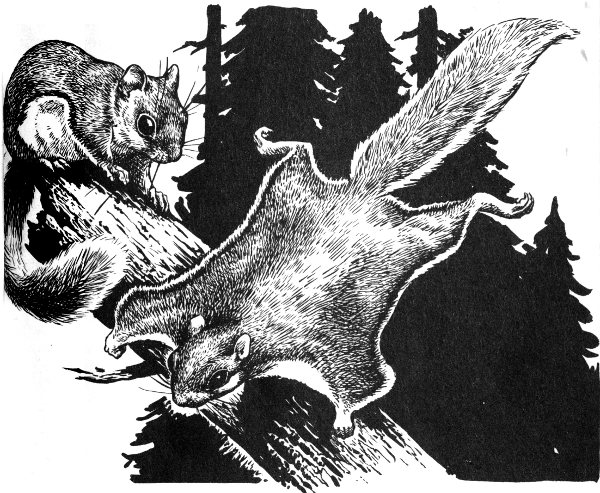
northern flying squirrel
Little is known of the habits of this unusual squirrel, but they differ considerably from those of its relatives who are active during the sunny hours. Instead of living in a bulky nest hung in tree branches, this nocturnal aerialist chooses a hollow tree or an abandoned woodpecker’s hole where the sun’s rays never penetrate. Nests have been found also under slabs of bark hanging to old lightning-blasted snags. Lined with soft fibers and shredded bark, they often shelter whole families of flying squirrels for, unlike the other squirrels, these gentle creatures get along together. In fact, they might almost be considered gregarious. Contrary to ordinary squirrel behavior, they never bark or scold. Their only utterance is a fine whistling squeak, and this is 44 heard usually only in the nest.
Though delicate in appearance the flying squirrel is extremely hardy. It is abroad throughout the winter, being confined to its nest only during stormy weather. It stores food for the winter, but its caches are usually above ground in hollow trees and crevices rather than buried in the loam. Their food consists mostly of pine nuts, seeds, and acorns, but they are also fond of meat. Many a flying squirrel has met its death trying to take the bait from a trap set for larger game. This taste is unexplained; it is not known to prey on other animals.
Western chipmunks Genus Eutamias (Greek: eu, well or good and tamias, steward)
There are at least four species of chipmunks native to the area covered by this book. Ordinarily but one, or perhaps two, species of a genus have been chosen for discussion. In this case, however, the chipmunks are such provocative little creatures and their presence causes so much interest that all four species will be included, although briefly. Since the ranges and life zones of some of them overlap in many areas, positive identification of a species will be difficult in those places, but in others one species will be dominant or alone. Here the more subtle characteristics and behavior of that type can be fixed in mind, and in time it will be less difficult to separate one from the other. Remember that most of these species have several subspecies. These generally occur along the upper or lower edges of the life zone frequented by the type. In the field they are usually indistinguishable from the type to any but the most practiced observer.
1. Colorado chipmunk (Eutamias quadrivittatus)
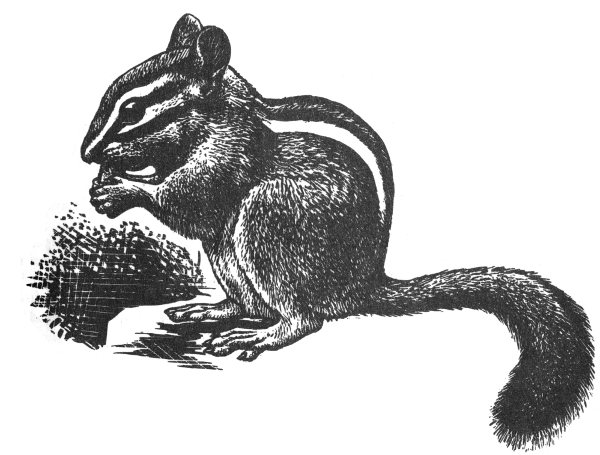
Colorado chipmunk
Range: Northern Arizona, northern New Mexico, most of Utah, and all but the most northern portion of Colorado. This chipmunk lives largely in the Transition Life Zone. The closely related species umbrinus, commonly called “Uinta chipmunk” inhabits the Canadian and Hudsonian Life Zones in the Uinta and Wasatch Mountains of northeastern Utah.
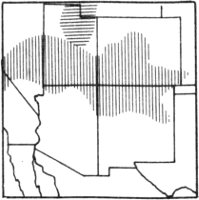
Colorado
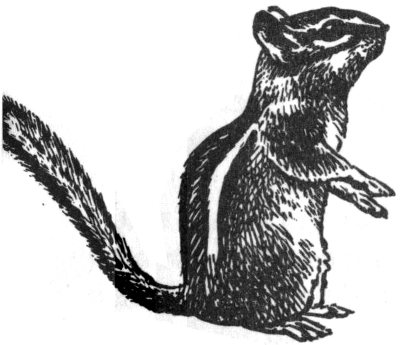
Uinta chipmunk
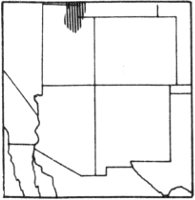
Uinta
2. Gray-necked chipmunk (Eutamias cinereicollis)
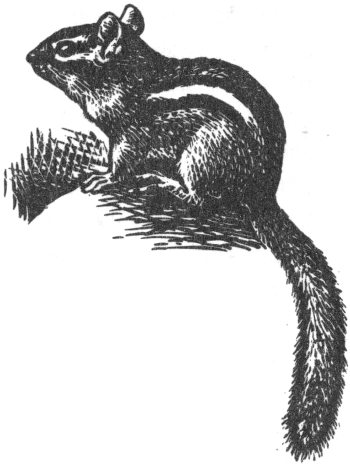
gray-necked chipmunk
Range: Central Arizona eastward into southwestern and south central New Mexico. Total length 7½ to 10 inches. Tail 3½ to 4½ 45 inches. Transition Life Zone and above. Neck and shoulders gray.
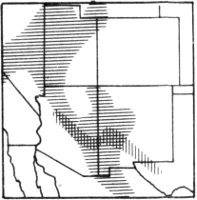
Gray-necked, Cliff
3. Least chipmunk (Eutamias minimus)
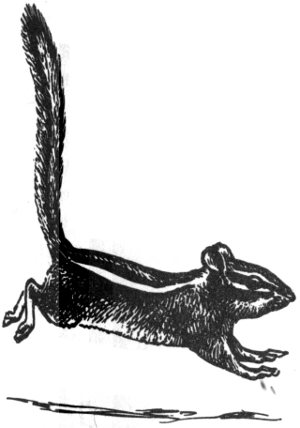
least chipmunk
Range: Western Colorado, western Utah, northern and eastern Arizona, northern and central New Mexico. Inhabits all zones from Upper Sonoran to Alpine. Total length 6⅔ to 9 inches. Tail 3 to 4½ inches. The smallest chipmunk with proportionally the longest tail. Tail carried straight up when running.
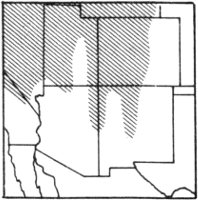
Least
4. Cliff chipmunk (Eutamias dorsalis)
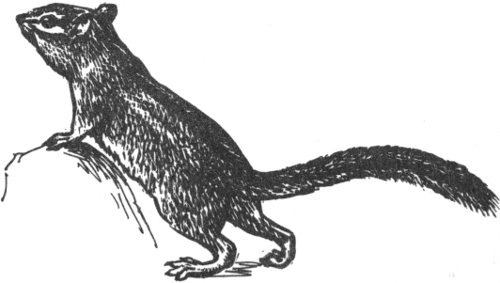
cliff chipmunk
Range: North and western Utah extending through southeastern 46 Arizona and western New Mexico. Found mainly in the Upper Sonoran Zone. Total length 8⅘ to 9½ inches. Tail 3⅘ to 4½ inches. The most indistinctly striped of any of these chipmunks.
Generally speaking, chipmunks are the link between ground squirrels and tree squirrels. Physically they have characteristics of both groups, a combination that is pleasing indeed. A field mark that is a positive identification of the chipmunk group is the striped face. In addition to facial stripes, chipmunks also are striped along the back. The pattern consists of a dark to black median line bordered by two more similar lines of varying intensity along each side. These fine lines are separated by broader bands of contrasting color ranging from chestnut to white. The latter characteristic is shared by several of the ground squirrels, which often are confused with chipmunks. Predominant colors of southwestern chipmunks run to rufous, chestnut, and grayish white with the dark to black lines mentioned above. Underparts are always considerably lighter than the back. Chipmunks’ tails are usually shorter than their bodies, flattened horizontally, and short haired when compared with tree squirrels. All species have cheek pouches of considerable capacity.
As will be seen from ranges given above, habitat of the chipmunks encompasses the whole area from sagebrush-covered foothills to timberline. Their densest population, however, is to be found in thick forest about midway between these two extremes. Here their bright colors and sprightly actions do much to enliven somber surroundings. Despite their wonderful climbing ability, they are most often seen at ground level or just a little higher. They are fond of areas containing fallen trees. The prostrate trunks serve admirably as highways for their forays in search of food, and under the litter which accumulates around them are many havens into which a hard pressed chipmunk may pop when pursued by an enemy. The territory appropriated by each of these little creatures is explored with the most minute care, and all places of refuge are noted for future emergencies. Any attempt to chase them will reveal their uncanny memory for these temporary hiding places and that they are seldom at any great distance from one.
Their permanent homes usually are underground, excavated beneath the roots of trees or in rocky terrain. At the end of a narrow tunnel a room of considerable size is worked out. The dirt is often carried out by a side tunnel, which is permanently plugged with soil when the excavation is completed. The underground chamber is lined with soft grasses and fibers as insulation against the cold. At the higher elevations the ground may freeze to a depth of several feet during the long winters. Permanent nests are sometimes built in hollow logs, but almost never in holes in upright trees. Chipmunks have little taste for upstairs apartments. In addition to the large cavity which contains the nest, several storage chambers are constructed to hold the winter’s food. These may be connected to the main apartment by tunnels or may be entirely independent of living quarters and some distance away. As a special feature, many of the more elaborate homes have a separate chamber reserved for sanitary purposes. Like most of our native rodents, 47 chipmunks are fastidiously clean in their habits.
It is difficult to discuss the habits of a group as large and of such wide distribution as our southwestern chipmunks in any but a most superficial manner. In general they are much more terrestrial than squirrels and prefer brushy, rock terrain to the more open forests frequented by their larger relatives. Nevertheless, they are adept climbers and do not hesitate to take to the trees in search of food or to escape their enemies. These arboreal excursions are usually limited to one tree; they do not ordinarily attempt the daring leaps from one to another that are characteristic of the squirrels. They progress quietly while on the ground, threading their way through the undergrowth so expertly that their presence is often undetected.
Normally chipmunks are shy creatures at first acquaintance, but if their friendship is encouraged they often become bold to the point of being unwelcome. Woe to the camper whose grub box is invaded during his absence. These tiny opportunists can carry away a surprising amount of food in a very short while. Their natural diet differs widely according to habitat. Chipmunks of the foothills eat a great variety of grass seeds, berries, and cactus fruits. These are possibly the favorite foods of the whole group, but as the elevation increases this supply becomes limited and is supplemented by juniper berries, acorns, and pine nuts. Considerable quantities of these less perishable foods are laid away for future needs. During the summer months herbage, fungi, small tubers, and some insects add variety to an otherwise dry menu.
It is doubtful if any southwestern chipmunks enter true hibernation during the winter. Those of lower elevations are active throughout the colder months, except when a period of exceptionally inclement weather will force them to remain underground for a few days. At higher elevations they will disappear, perhaps for weeks at a time, but it is assumed they remain active in their underground quarters. The fact that during the fall they do not lay on a coat of fat, like many species which are known to hibernate, substantiates this theory.
Breeding habits of chipmunks are not too well known. The number of young averages from four to six. Those species living at low elevation sometimes bear two litters each year; those at higher elevations are limited to one. Like the ground squirrels, the young are able to leave the burrow when but little more than half grown. At this early age they present a rather ludicrous appearance with their large heads and sparsely-haired tails. This is a time of great danger, for the youngsters are easily caught by predators which would be eluded with little difficulty by a mature individual. Principal predators of the chipmunks are bobcats, hawks, foxes, and coyotes. The last two often dig out the burrows. The marten is possibly their worst enemy, but fortunately for the chipmunk tribe is a rare animal throughout its range.
Chipmunks are quite common in several of our southwestern National Parks and Monuments. Despite signs to the contrary, the public cannot resist feeding these little beggars, and many are the situations that develop from this practice. I recall camping at Bryce Canyon National Park where the least chipmunk is a common resident. Upon our 48 return from Rainbow Point one day we spied a chipmunk with bulging cheek pouches leaving our tent for its den somewhere on the edge of the canyon rim. We found that our visitor had entered the grub box and gnawed a neat hole in the top of a carton of rice. Although we had been gone but a short time, more than half the contents had already been carried away. This was a state of affairs that needed mending so we decided to teach the marauder a lesson. On his return trip we waited until he had entered the carton and then clapped a dishtowel over the hole. The cellophane window in the side of the carton gave us an excellent view of our prisoner. Interrupted in his pilfering, he at first tried to get out of the carton but, finding no exit, returned to stuffing his cheek pouches with more rice. When they were filled to capacity he calmly sat back and returned stare for stare. In the end we let him go and gave him the rest of the rice, exacting such payment as we could by taking pictures of his labors.
Golden-mantled ground squirrel Citellus lateralis (Latin: citellus, swift, and lateralis, belonging to the side, referring to the stripe along the side)
Range: Western United States and Canada. In the area covered by this book to be found in western Colorado, from northeastern Utah south through central Utah to central Arizona thence east into western New Mexico.
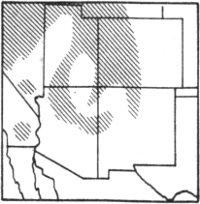
Habitat: Higher mountains of this area. Usually found in evergreen forests of the Transition, Hudsonian, and Canadian Life Zones. It sometimes occurs near the upper limits of the Upper Sonoran Zone.
Description: A chipmunk-like ground squirrel lacking the stripes along the sides of the face characteristic of the chipmunks. Total length 8½ to 12½ inches. Tail 2½ to 4½ inches. There is much color variation in this species. Head coppery to chestnut, upper surfaces of body brownish gray to buffy. A light to white stripe bordered with black is present on each side of the back. Under surface of tail gray to yellow. Tail short but fully haired. Under surfaces of body lighter, gray to buffy gray. Legs short, body chunky in comparison with chipmunks. Young, four to eight, with but one litter each year.
The golden-mantled ground squirrel has been chosen from the rather large group of southwestern ground squirrels because it is most typically a mountain dwelling species. As such it does not have the advantages of a long summer season like its lowland relatives. This results in two definite periods 49 each year. One is feverish activity during summer, a time of breeding, rearing the young, storing food, and laying on fat for the cold months ahead. The other in winter is the exact opposite—a long interval of hibernation when, buried deep under the snow in a snug burrow, the squirrels sleep away the winter.
Though hampered by the short summers of higher elevations, the golden-mantled ground squirrels manage to lengthen the season slightly by a very simple expedient. Instinct prompts them to dig their burrows on a southern exposure, often under the base of a log or in a rock slide. Here the snow melts away first and they often have a bare spot of ground in front of the burrow several weeks in advance of the season. The squirrels emerge from their long sleep weak and emaciated, and their first days above ground are spent soaking up the warm sunshine and waking up, so to speak. During this period they live on stores laid away the previous summer, and by the time the snow has melted they are fully active and ready for mating.
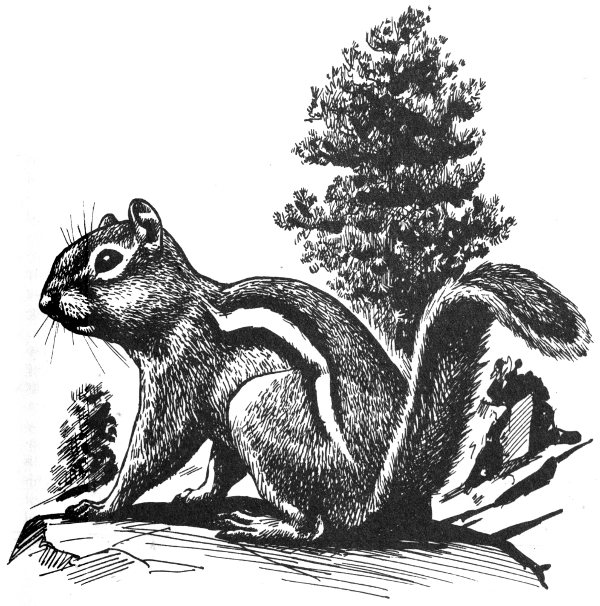
golden-mantled ground squirrel
50
As with the ground squirrels of lower areas, the summer diet consists largely of whatever starts to grow first. During late spring, grass, buds, young leaves, and flowers are eaten. Later, seeds of the annuals are gathered, berries are taken whenever possible, and insects often form a considerable part of the diet. As fall comes on, acorns, pine nuts, and a great number of smaller seeds and fruits become available. At this time the ground squirrels must not only lay on enough fat to maintain themselves through hibernation, but must also store away enough food to tide them over between the time of their emergence and the appearance of new growth. Evidently this is an adaptation forced upon them by the exceptionally long winter season. Most rodents which lay on coats of fat preparatory to hibernation depend almost entirely on it to carry them through. With a hibernating period of from 5 to 7 months, however, it is not difficult to realize the problems this ground squirrel must face.
Though the golden-mantled ground squirrel resembles the chipmunks in appearance, its temperament is quite different. Chipmunks are bright, nervous little sprites, always pursuing their activities with explosive energy. The ground squirrels move more sedately, as though they had planned every move and there was no hurry. They love to lie in the sun in some exposed place and watch the rest of the world go by. In habitat, too, the species differ materially. Chipmunks choose thick undergrowth where they can go about their business unobserved. Ground squirrels prefer more exposed locations where they take their chances in the open, but with one eye always cocked aloft as insurance against attack by hawk or eagle. Creatures of the earth, they are always reluctant to climb. Rarely do they ascend more than a few feet, and then only to reach some especially toothsome delicacy that their keen noses have detected in a low shrub or small tree.
With its wide distribution, visitors to the southwestern mountains can hardly fail to notice this golden-headed member of the ground squirrel family. It is easily tamed; too easily in fact for, like the chipmunk, it can quickly wear out its welcome. In many of the National Parks and Monuments they compete with chipmunks for the crumbs around camp sites and picnic tables. Visitors find their cunning way irresistible and feed them despite warnings to the contrary. Because they do tame so easily there is always danger that some well-meaning person will attempt to pick them up. This can lead to unpleasant results. Their long sharp incisors can inflict a serious wound.
One of the most fascinating places to observe both chipmunks and these ground squirrels is from the windows of the long tunnel leading northward out of Zion National Park. On the talus slopes beneath the windows a great number of these rodents take up summer quarters, depending for food on the largesse distributed by visitors as they eat their picnic lunches on the broad ledges of the windows. Their constant movements as they run among the rocks seeking stray crumbs result in many a collision and often an angry dispute as well. This proves a dangerous game, as rocks sometimes will be loosened by their movements and roll down the steep incline. I recall seeing a ground squirrel crushed by one of these miniature rock slides in 1946.
51
White-tailed prairie dog Cynomys gunnisoni (Greek: kun, a dog and mys, mouse ... for Captain Gunnison whose expedition took the type)
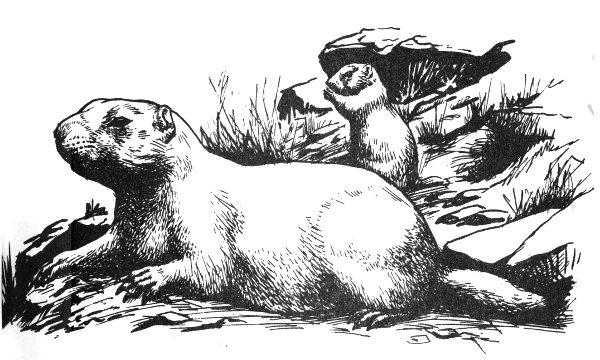
white-tailed prairie dog
Range: Western Colorado and eastern Utah to central Arizona and New Mexico.
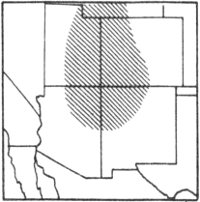
Habitat: Grassy meadows and mountain parks mainly in the Transition Life Zone although they are often found both above and below this area.
Description: A ground-dwelling rodent somewhat resembling a ground squirrel but several times larger than the biggest species of that genus. Total length 12½ to 15 inches. Tail 2¼ to 2½ inches. Weight 1½ to 2½ pounds. Color buff to cinnamon buff, the short fully-haired tail tipped with white. Sides of face darker with a dark area over the eyes. Legs, feet, and underparts pale cinnamon buff. Young, usually five in number, born in early summer.
Cynomys gunnisoni is the representative species of the western group of prairie dogs. The two remaining of the group, Cynomys leucurus and Cynomys parvidens, both white-tailed species, are very similar and possibly will be classified with Cynomys gunnisoni in the future. Cynomys leucurus is found in northwestern Colorado and northeastern Utah, while Cynomys parvidens is native to mountainous valleys in central Utah.
The common name “white-tailed prairie dog” is usually applied to Cynomys gunnisoni, the most widely distributed member of the race. The range of this species borders on but seldom overlaps that of the black-tailed prairie dog which lives farther 52 east and at lower elevation. Climatic and geographic barriers separating these two races are largely responsible for pronounced differences in their habits. Prairie dogs are gregarious creatures, perhaps more so than any other rodent. Formerly the black-tail species inhabited countless thousands of acres in the Great Plains region. A single colony might occupy an area several miles in diameter and number many thousands. On this relatively flat land, every home site was equally advantageous and the grass and herbage all ideally suited to the prairie dog’s use. Periodic flooding of their burrows on these level prairies was avoided by building conical mounds with a rim of earth around the entrance. This ingenious practice, simple though it seems, represents a long step in the adaptation of these animals to their environment.
White-tailed prairie dogs, on the other hand, are limited to the narrow valleys and infrequent open meadows of the mountains. Here there is neither room nor food to maintain the huge colonies characteristic of the black-tailed. Under these conditions the number of individuals in a town will vary from a few to 200, seldom more. If the town becomes crowded, many of the inhabitants may migrate to some more favorable location. This sometimes entails a trip of several miles, a hazardous undertaking for a small animal whose only escape from large predators is in an underground burrow.
Food of this mountain prairie dog is varied. The standard diet of grass and roots is augmented with browse, bark, and tubers. Bulbs of mariposas are taken wherever available. Coarse-leaved annuals such as sunflowers are not passed by. In addition to this vegetable diet, worms, beetles, and larvae as well as mature forms of most insects are eaten whenever possible.
Burrows of white-tailed prairie dogs, though comfortable, are not made with the painstaking care found in those of the lowland species. There is no need for a conical mound or built-up rim because there is virtually no drainage problem on the sloping terrain of the mountains. Naturally the burrows will not be excavated in the path of flood waters, but on higher ground. Earth brought out from the underground workings is piled to one side or in front of the entrance. The mound thus formed is used as a place to sun bathe or, even more important, as a look-out post from which to see all that goes on. Because these small colonies do not have the advantage of numbers, each individual must be especially alert to approaching danger. Burrows often have more than one entrance, each with its well-packed sentry post at hand, the underground plan is simple. It consists of a more or less vertical shaft from which one or more tunnels extend horizontally. It is common supposition that the prairie dog digs deeply enough to strike water. This is not so; many burrows do not go deeper than 6 feet. In any event, they penetrate just far enough to insure a comfortable average temperature in both summer and winter. Water requirements of prairie dogs are met largely by the succulent nature of their food. It is also presumed that during late summer months when the diet consists to some extent of seeds, a chemical process within the system transforms some of the starches to water.
53
The nest is usually situated in an underground room dug at the end of a tunnel, less often somewhere along its length. It is a bulky structure, built of shredded bark or coarse grasses and lined with the softest fibers obtainable. In these modern days prairie dogs do not object to paper, rags, and wool.
The life of the prairie dog is simple. Early in the spring it emerges from hibernation, a bit groggy but still well padded with fat. This nourishment sustains it until the first green shoots of grass appear. From then on food is obtainable in an ever increasing supply, limited only by the distance to which these indifferent runners dare venture from their burrows. Summer is a time of eating, of dozing on the mounds in the warm sun, and of conversing with neighbors in the shrill barking whistles characteristic of this group. It is also a time of constant vigilance against predators, of dust bathing to rid themselves of mites and fleas, and of rearing the young. The four to six young are born in late spring and first appear at the burrow entrance when about the size of an average adult ground squirrel. Within a few days they are foraging for themselves, and about 3 weeks later are able to make their own way. At this time the mother frequently deserts them and builds herself a new burrow, leaving her offspring to divide the old homestead as best they can. As fall draws near, a thick coat of fat is put on, and by the middle of October most of the town’s inhabitants have retired for the long winter’s sleep.
Yellow-bellied marmot (woodchuck) Marmota flaviventris (Marmota, Dutch name of European species of woodchuck. Latin: flavus, yellow, and venter, belly)
Range: Northwestern United States. Common in northern to south central Utah, northern and southeastern Colorado, and extreme north central New Mexico.
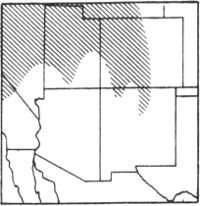
Habitat: Canadian, Hudsonian, and Alpine Life Zones in rock slides, rocky hillsides, under rock piles, and around outcroppings in mountain meadows. Seldom found below the Canadian Zone but often occurring in the Alpine Zone to the very summits of the mountains.
Description: A large, dark, brown marmot with a comparatively long bushy tail. Total length 19 to 28 inches. Tail 4½ to 9 inches. Body color, yellowish brown to dark brown above; under parts yellow. The body fur has a grizzled appearance. Sides of neck buffy, and sides of face dark brown to black. Light brown to white between the eyes. The feet are buff to dark brown. Tail dark brown above, lighter below. Young, five to eight, born in early summer.
This large western marmot is not too far removed from the ground squirrels in either relationship or habits. It is the largest ground-dwelling 54 rodent native to the Southwest. As mentioned above, marmots occupy a tremendous altitudinal range, reaching from above timberline down into the Transition Life Zone. This distribution from arctic to almost desert conditions is responsible for many variations in their habits. Most important is the practice of estivation by those individuals which live at the lower elevations. This summer sleep is used as a defense against that period of drought between rainy seasons. It usually starts early in June and ends about the latter part of July. In the higher life zones there is no lack of green food throughout the summer, consequently marmots there remain active.
Because of large size and ability to make good use of its sharp teeth and claws, the marmot’s life is not so restricted as that of many smaller ground-dwelling rodents. It has enemies, to be sure. Bears, mountain lions, wolves, lynxes, wolverines, and eagles all are alert for a possible catch. Yet it is so well on guard and has so many burrows that it is next to impossible to catch one above ground. Should the marmot be surprised away from a burrow, its bold show of defense often gains enough time to work its way to a place of safety. When cornered its appearance alone is enough to make the average predator pause and consider. With hair standing on end and long claws at the ready, the marmot clatters its sharp teeth and hisses loudly at the enemy. This pose is not all bluff. These big rodents are courageous and able adversaries against any animal up to several times their size. As far as man is concerned, they are timid and secretive. On many an occasion their loud, full-toned whistles will be heard, but the whistler will be nowhere in sight. If cornered, however, they will put up the same courageous defense they display against other enemies, and certainly are not animals with which to trifle.
Burrows are usually in open places where a good view of the surroundings is obtained. Too, they are almost always in clefts of rocks, under boulders, or in coarse rocky soil. This lessens the probability of their being dug out by some large predator. Each marmot usually will have several burrows, some being “escape” means and one a permanent home. Well-worn trails lead from one to another, for these are active animals which travel extensively within the limits of their territories. Escape burrows may be deep or shallow, as circumstances dictate, but the home burrow generally is a labyrinth of long passages that terminate in a nest chamber up to 2 feet across. Several auxiliary tunnels are usually reserved for sanitary purposes. None is used for food storage; records indicate that this creature does not lay up stores for later use. The nest is the usual bulky affair, built of coarse materials and lined with the softest grasses and fibers obtainable.
Late to bed and early to rise is characteristic of the marmots. Classed as a diurnal animal, they nevertheless travel about a good deal at dusk. During the breeding season they may even make an extended trip at night to find a mate. Sunrise signals the beginning of the marmot’s day. The slanting rays have no more than touched the boulder above its burrow before the inmate will climb up to take advantage of their warmth. It may stay atop its vantage point for an hour or more. 55 There are many things a marmot can attend to while taking the early morning sunbath. A leisurely toilette, whistled comments to neighbors, a long scrutiny of the terrain for possible danger—all these are matters requiring thorough attention.
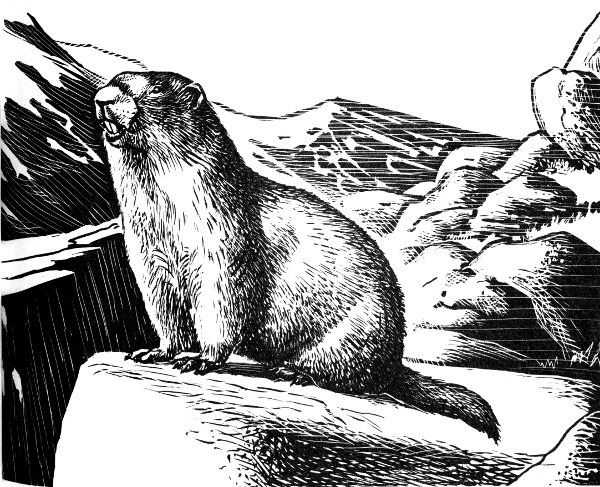
yellow-bellied marmot
Should this procedure be interrupted by a prowling enemy, excitement runs high. If the intruder is still some distance away, the marmot often will stand up on its hind legs, picket pin fashion. Each explosive whistle will be accompanied by several flicks of the tail. When it is judged time to retire it will dash for its burrow, making sharp chirps as it goes. Once inside the burrow it may chance another look outside, and if the caller looks menacing enough the burrow entrance will be plugged with earth from inside, the chirps becoming fainter as the barricade is forced into place. Emergence from the burrow after a fright of this kind is governed to some extent by the time of year. If it 56 is autumn and the marmot is about ready to hibernate, it may go to sleep in its cozy nest and not reappear until the next day. Even in spring and summer it will remain underground for a considerable time before venturing out again.
The marmot is by nature a stocky animal. Short-legged and barrel-bodied, it can lay on a surprising amount of fat for the period of hibernation. Length of this winter sleep depends on the elevation at which the animal lives. On the higher mountain tops it begins about October 1. At lower elevations it may be considerably later. Older individuals usually go into hibernation first, presumably because they are able to lay on the necessary fat sooner than younger ones. As a rule they retire by stages, disappearing for several days at a time; their movements are lethargic and they act as if already half asleep. The young of the year have spent the greater part of the summer growing up, and it is rather a grim race with time to determine whether they will be able to put on enough fat to carry them through the long winter with a reserve supply, or whether they can survive the cold weather that greets them. Especially at the higher elevations, they do not retire until forced to do so by cold weather.
Hibernation is as profound with these big rodents as with many of the ground squirrels. They will curl up into furry balls in their cozy nests, noses covered with fluffy tails, and sink into a deep sleep that approaches suspended animation. Bodily functions slow to a fraction of the normal rate, and the system draws on its store of fat to survive. The drain on this nourishment is slow, as it necessarily must be, for this single source of food must last for a period of perhaps 5 months.
The date of emergence varies. Although February 2nd is recognized as groundhog day on our calendar, this date would be chilly indeed on the peaks of our Southwest mountains. Nevertheless, the marmots do appear before the snow is entirely gone, and once their sleep has ended they rarely resume it, whether or not they see their shadows.
Breeding takes place shortly after emergence. The young are born in April or May. They are born blind; the eyes do not open until about a month after birth. The youngsters develop rapidly, and by the time they are half grown a daily session of sunbathing and playful tussles outside the entrance of the den is part of their routine. By September they are fully grown, and at this time they usually strike out for themselves, although cases have been recorded in which the family remained together through the first winter’s hibernation.
Marmots have always been favorites of this writer. Their clear-toned whistle is as much a symbol of the rugged peaks and lovely fir-rimmed mountain meadows as the coyote’s barks are of the desert. Several writers characterize marmots as “stupid.” Surely this is an unfortunate choice of word. Stupid by what standards? Can one species be compared with another when all must live under the different conditions to which they have adapted themselves? The mere fact that a balance of Nature has been attained indicates that each has the adaptations, the habits, and the degree of intelligence necessary for that species to live in harmony with the whole.
57
Deermouse (white-footed mouse) The genus Peromyscus (Greek: pera, pouch, and muscus, diminutive of mys, mouse)
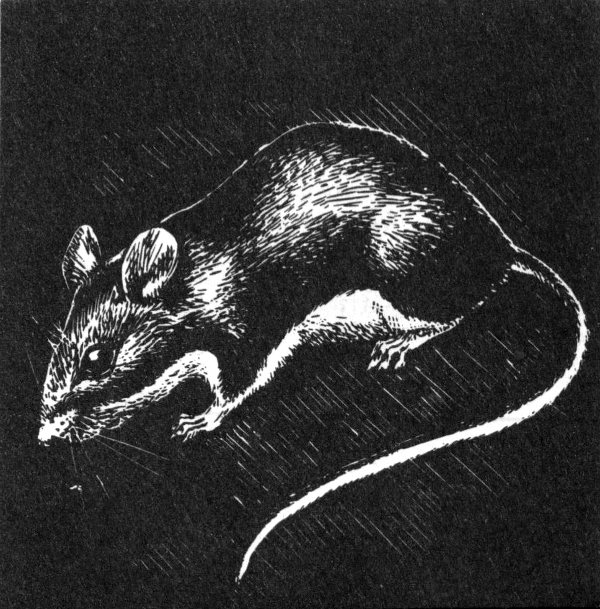
deermouse
Range: All life zones throughout North America.
Habitat: Some species of deermouse can be found in almost any association imaginable.
Description: A large-eared mouse with white feet. Since there are many species in this genus and most of them are quite similar, characteristics common to the greatest number will be given. Bear in mind that these may not hold true with every species of the genus.
Deermice are rather small, averaging 7 to 8 inches long. Tail 3 to 4 inches. Most species are a buffy gray above shading to brighter buff on the sides and light buff to white beneath. Feet are always white. The ears are large for a mouse, usually sparsely covered with short, fine hairs, but in some species almost naked. Eyes appear black but have a brownish shade when viewed closely in a good light. Tail long, up to the length of head and body, as a rule sparsely haired; bicolor in some species. Young, four to six, born almost any time of the year, with several litters except at higher elevations where only one litter may be born, and this during late spring.
In the Southwest the mild climate and plentiful food supply of the lower life zones combine to attract a great number of small rodents. By far the greater number of species is found in the Upper and Lower Sonoran Zones. This does not mean that mice are rare in the high mountains. They live there in great numbers, but of fewer species. One is the long-tailed deermouse (Peromyscus maniculatus), probably the most outstanding member of the genus, and the most widely distributed mouse in the United States. As might be expected, it is quite variable in appearance, having at least three distinct color phases. These vary from golden tan to a dark gray. All phases have a sharper bicolor tail, white beneath and like the rest of the upper body on top.
The deermouse is well known to those who are fortunate enough to own summer cabins in the mountains. This is the little rodent which moves into the cabin as soon as the vacationer departs. Fortunately it is not so destructive as the common house mouse (which, by the way, is an introduced species) and limits its destructiveness for the most part to building a large and comfortable nest in which to live during the winter months. Deermice do not hibernate, so they must prepare against the bitter cold. However, it is not their habit to store food either, and doubtless many of them starve to death over a hard winter.
58
Mountain vole Microtus montanus (Latin: small ear ... of the mountains)
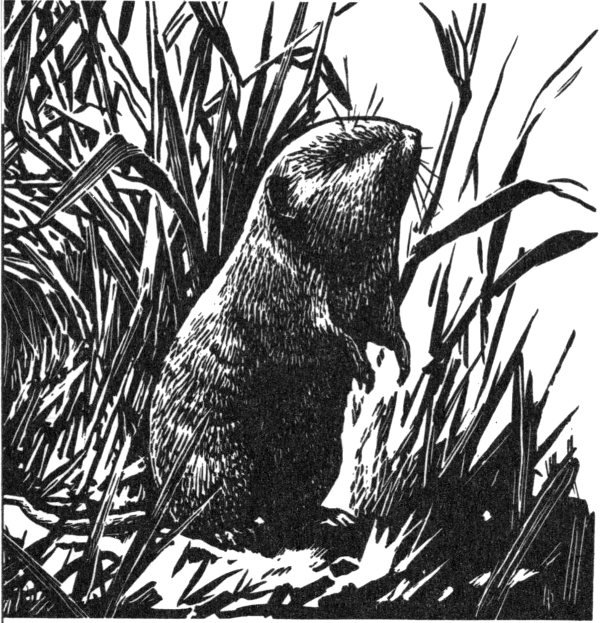
mountain vole
Range: The mountainous regions of northwestern United States extending eastward to central Colorado and southward below the northern borders of Arizona and New Mexico.
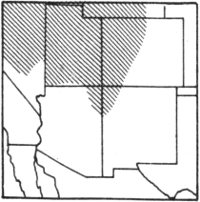
Habitat: Valleys and grassy meadows seldom lower than the Transition Zone.
Description: A small sturdy rodent with short tail, total length 5½ to 7½ inches. Tail 1½ to 2½ inches. This is a very short tail for a rodent of this size, amounting to only about a fourth of the total length. Color, grayish brown to black above; underparts lighter to a silvery gray. This is but one of many species found in southwestern mountains. The Mexican vole and the long-tailed vole are two which share its range. They are quite similar in appearance and their life histories also are much the same.
In several ways this heavy-set rodent resembles the pocket gopher. The small ears and eyes as well as the short tail are all reminiscent of that animal. Like many other rodents, voles are quite prolific. From four to eight young are born in a litter. The number of litters each year depends to a great extent on the altitude. They have been recorded in the Canadian Zone, where the summers are too short to permit the rearing of more than one litter. In the Transition Life Zone they commonly bear two litters and sometimes more each year.
These are the small rodents which most people call “field” or “meadow” mice. In the prairie states this genus is well known for its habit of congregating under shocks of small grain and corn. Here they build their nests and temporarily live in peace and plenty. When the shocks are taken from the field, they are rudely evicted from their snug shelters to fall prey to the farmer’s dog or to face the prospect of building a new home before winter descends upon them. In the West, too, this “field mouse” makes itself at home in agricultural areas, but its native haunts are the natural meadows in mountain valleys. Here they build tunnels in the tangled growth of grass, and excavate shallow burrows in the soft earth. Marshy places are particularly to their liking, because they are quite at home in water. Too, the thick cover in these areas gives them considerable protection from their many enemies. A normally high reproduction rate (several litters per year with up to eight young in each litter) coupled with a secretive way of life insures their perpetuation. In cases where a natural balance has been upset, their population can soar to fantastic heights. In one agricultural 59 district in Nevada a survey revealed an estimated 8,000 to 12,000 “field mice” per acre.
Voles do not hibernate. They are active night and day, summer and winter. During winter storms they may remain in their snug nests for a few days at a time, but with the return of clear weather, openings to their tunnels will soon appear in freshly fallen snow.
Western jumping mouse Zapus princeps (Greek: za, intensive and pous, foot. Latin: princeps, chief)
Range: Western United States from central Arizona and New Mexico to Alaska.
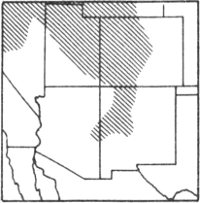
Habitat: High mountains in dry places with abundant low ground cover.
Description: A small rodent, two-toned in color, that leaps through the grass much like a kangaroo rat. Total length 8 to 10 inches. Tail 4½ to 6 inches. Color buffy along sides, shading to almost black on the back and white on the underparts and feet. Tail bi-color, dark above and light gray beneath. Ears relatively long, dark in color with light buffy marginal lines. Eyes beady, set in long face with sharp nose. Front legs short but hind legs and feet large and muscular. Young, four to six in a litter, with no more than one litter a year in the higher elevations.
The jumping mice are among the most specialized small rodents in the United States. The genus is typically North American, only one species being found outside this continent. At some time in the distant past this little creature adapted itself to a mode of flight much like that of the kangaroo and jerboa. In this respect it exceeds the kangaroo rats and pocket mice of the United States, species to which it is distantly related. Its general build is distinctly like that of the kangaroo, with the same delicately formed front quarters and heavier hind quarters. The tail, though not club-shaped like the kangaroo’s, is long enough to serve the same purpose—that of a rudder to guide the direction of flight. The hindlegs are muscular enough to propel the body on proportionally longer jumps than even the kangaroo. Here the resemblance ceases, however, for the jumping mouse is not related, even distantly, to this marsupial. The only pouches the jumping mice have are internal cheek pouches used exclusively for transportation of food.
Jumping mice have one more peculiarity that set them apart from most other North American mice; they hibernate. The period of hibernation is 60 not a short one at the elevations at which these mice live. It may last for as long as 6 months. Preparation for this extensive period of inactivity consists mainly in gathering and eating grass seeds until a thick layer of fat is stored under the skin. With the first cold weather the jumping mice retire to previously prepared underground burrows and sleep the winter away.
Since they are almost exclusively seed eaters, they may have a difficult time on emerging in the spring. Apparently there is no food cache stored away for this period, so the hapless rodents must search for what can be found until the grasses head out again. The method of harvesting grass seed is unique, and once seen will not be easily mistaken. Living as they do in a jungle of tall grass, they are not able to reach the heads nor to climb the slender stems. Instead, they cut off the stem as high as they can reach, pull the upper part down to the ground and cut it again. This goes on until the head is brought within reach. Small piles of grass stems, all cut to an average length, indicate that this is the species which has been at work.