HOOFED ANIMALS Artiodactyla (even-toed hoofed animals)
Reading edition
1
This order includes all of the hoofed animals native to the United States. These are the mammals which are ordinarily spoken of as the “cloven-hoofed animals.” An odd-toed group (Perissodactyla), which includes the so-called wild horses and burros, cannot properly be included as natives since these animals date back only to the time of the Spanish conquest of our Southwest. In earlier geologic ages horses ranged this continent, but in more primitive forms than those now found in other parts of the world.
Through a study of fossil forms it has been determined that our present hoofed animals evolved from creatures which lived on the edges of the great tropical swamps that once covered large areas of our present land masses. They were long-legged and splay-footed, well adapted to an environment of deep mud and lush vegetation. As the waters gradually disappeared and the animals were forced to take to dry land, their strange feet underwent a slow transformation. Because they had become accustomed to walking on the tips of their toes to stay up out of the mud, the first toe did not touch solid ground at all in this new environment. Since it was of no use it soon vanished entirely or became vestigial. Some species developed a divided foot in which the second and third toes and the fourth and fifth toes combined respectively to bear the animal’s weight. Eventually the third and fourth toes assumed this responsibility alone, and the second and fifth toes became dew claws. These are the cloven-hoofed animals of today. In other species the third toe was developed to bear the weight, and this resulted in a single-toed group of which the horse is an example. In all cases an enormous modification of the nails or claws with which most animals are equipped has resulted in that protective covering called the hoof. The under surface of the foot is somewhat softer and corresponds to the heavy pad that protects the bottom of a dog’s toe. This brief explanation refers only in the broadest sense to the order as represented in the United States. The feet of the various species have become so specialized to their separate ways of life that an individual can usually be easily identified by its tracks alone. It is quite possible that many species are still undergoing subtle changes in this respect.
With but one exception the cloven-hoofed animals of our southwestern mountains bear either horns or antlers. The exception is the collared peccary, “javelina,” (pecari tajacu) which, during the heat of the summer, sometimes ascends to the Transition Life Zone in southern Arizona and southwestern New Mexico. Essentially an animal of the low desert, it will not be included in this book. The species which have hollow, permanent horns are the bighorn and pronghorn. The pronghorn is distinctive in shedding the sheaths of its horns each year, but the hollow, bony core remains intact. In this group both sexes bear horns. Animals bearing antlers are the elk and the deer. The antlers are deciduous, being shed each year at about the same time as the winter coat. Only the males of these species have antlers, any female with antlers can be considered abnormal.
2
The Southwest is fortunate in still having a number of the species of this order native to the United States. The bison can hardly be considered a wild species, since it exists now only through the efforts of a few conservationists who brought it back from virtual extinction. Mountain goats, caribou, and moose are the only other species not known to inhabit the Southwest.
In Nature’s balance the order Artiodactyla seems to have been meant as food for the large predators. Their protection against the flesh eaters consists mainly in fleetness of foot, keen hearing, and a wide range of vision, as evidenced by the large eyes set in the sides of the head. They are but poorly equipped to actively resist attack by the larger carnivores. Their best defense is flight.
Bighorn (mountain sheep) Ovis canadensis (Latin: a sheep from Canada)
Range: This species, with its several varieties, inhabits most of the mountainous region of the western United States. In Mexico it occurs in the northern Sierra Madres and over almost the whole length of Baja California.
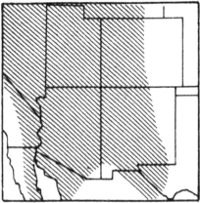
Habitat: Among or in the vicinity of more precipitous places in the mountains.
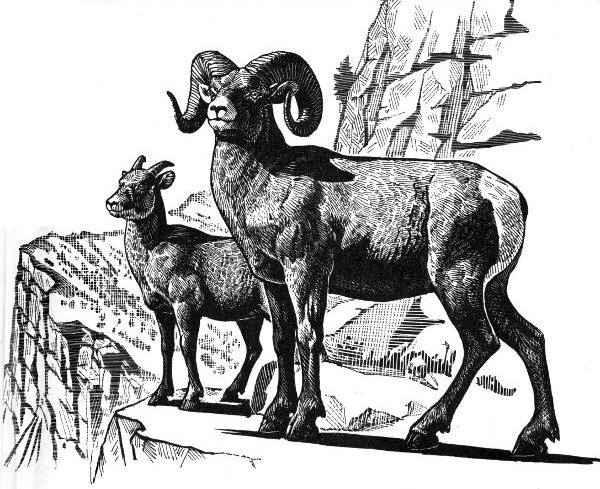
Description: A blocky animal, rather large, with heavy, curving horns. Total length of adult male 5 feet. Tail about 5 inches. Weight up to 275 pounds. General color a dark gray to brown with lighter areas underneath belly and inside of legs. The rump patch is much lighter than any other part of the body; in most cases it can be described as white. Females are similar in appearance to the males except that they are smaller and the horns are much shorter and slimmer. Young, one or two, twins being common.
Interesting as the desert varieties of this species may be in their adaptation to an environment that seems foreign to their nature, they cannot compare with the high mountain animal. Seen against the backdrop of a great gray cliff or silhouetted against the skyline of a snowy crest the bighorn has a magnificence that is thrilling. In flight it is even more spectacular as it bounds from one narrow shelf to another in an incredible show of surefootedness. Yet this airy grace is exhibited by a chunky animal that often weighs well over 200 pounds. The secret lies in the specially adapted hooves with bottoms that cling to smooth surfaces like crepe rubber and edges that cut into snow and ice or gain a purchase on the smallest projections of the rocks. The legs and body, though heavy, are well proportioned and so extremely well muscled that no matter what demands are placed on them this sheep seems to have a comfortable reserve of power. No doubt the display of complete coordination adds to the illusion of ease with which it ascends to the most inaccessible places. Descents often are even more spectacular, the animal 3 seldom hesitating at vertical leaps of 15 feet or more down from one narrow ledge to another.
bighorn
In the high mountains where this sheep prefers to make its home it usually ranges near or above timberline. During winter storms it may sometimes be forced down into the shelter of the forests, but as soon as conditions warrant it will go back to its world of barren rocks and snow. Here, with an unobstructed view, its keen eyes can pick out the stealthy movements of the mountain lion, the only mammal predator capable of making any serious inroads on its numbers. It has few other natural enemies. A golden eagle occasionally may strike a lamb and knock it from a ledge, or a high ranging bobcat or lynx may be lucky enough to snatch a very young one away from its mother, but these are rare occurrences.
Bighorns depend mainly on browse for food. This is only natural since in the high altitudes they frequent little grass can be found. Usually there is some abundance of low shrubs growing in crevices on the rocks, however, and many of the tiny annuals are also searched out during the short summer season. At times a sheltered cove on the south exposure of a mountain will become filled with such shrubs as the snowberry, and the sheep take full advantage of such situations. As a rule they keep well fed for, scanty though it seems, there are few competitors for the food supply above timberline.
4
I have observed these sheep many times in the Rockies. Perhaps my most memorable experience with this species was on Mount Cochran in southern Montana. It was a gray, blustery day in September with occasional snow flurries sweeping about the summits. On the eastern exposure of the mountain a steep slope of slide rock extended for perhaps 1,000 feet from one of the upper ridges to timberline. Not expecting to see any game at that elevation, I made my way up this slope with no effort to keep quiet. In my progress several rocks were dislodged and went rattling down across the mass of talus. At the summit of the ridge a low escarpment made a convenient windbreak against the gale that was tearing the clouds to shreds as they came drifting up the opposite slope, and I sat down to catch my breath before entering its full force. As I sat there surveying the scene spread out below, my attention was attracted by a low cough close by. Looking to the left about 40 feet away and 15 feet above me, I saw two magnificent rams standing on a projecting point looking down at me. They seemed to have no fear; rather they evinced a deep curiosity as to what strange animal this was that had wandered into their domain. For the better part of a half hour I hardly dared breathe for fear of frightening them. At first they gazed at me fixedly, occasionally giving a low snorting cough and stamping their feet. Then as I did not move, they would wheel about and change positions, sometimes taking a long look over the mountains before bringing their attention back. Finally when the cold had penetrated to my very bones, I stood up. They were away in a flash, reappearing from behind their vantage point with two ewes and an almost full-grown lamb following them. While I watched they dashed at a sheer cliff that reared up to the summit, and with hardly slackening speed bounded up its face until they were lost in the clouds.
Although this happened in 1928 the experience is as vivid in my mind as though it happened yesterday. Perhaps the most striking feature of bighorns seen at this close range is the eyes. They might be described as a clear, golden amber with a long oval, velvety black pupil. Credited with telescopic vision, they must be some of the most useful as well as beautiful eyes to be found in the animal kingdom.
Pronghorn (antelope) Antilocapra americana (Latin: antelope and goat, American)
Range: West Texas, eastern Colorado and central Wyoming to southern California and western Nevada, and from southern Saskatchewan south into northern Mexico.
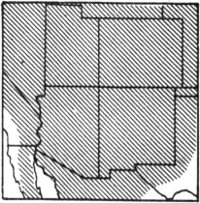
Habitat: Grasslands of mesas and prairies, mostly in the Upper Sonoran Zone.
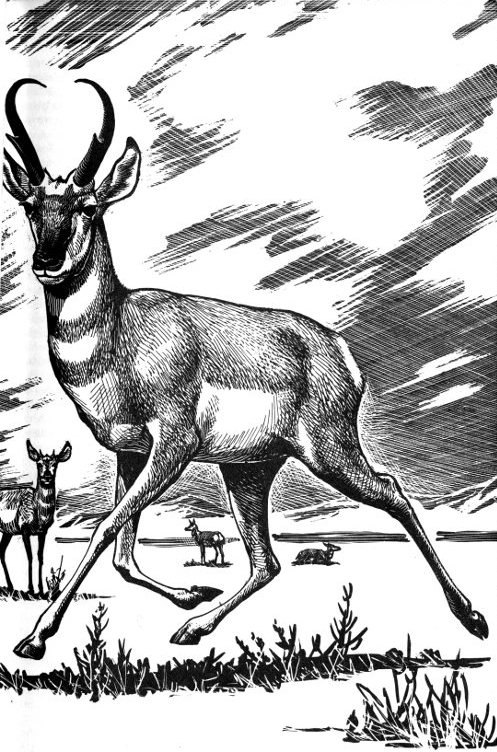
Description: A white and tan colored animal, considerably smaller than a deer; horns with a single flat prong curving forward. Total length about 4 feet. Tail about 6 inches. Average weight 100 to 125 pounds. Color, tan or black shading to white under belly and insides of legs. Two conspicuous white bands under the neck, and the large white rump patch of erectile hairs are unlike the markings of any other native animal. A short, stiff mane of dark hairs follows the back of the neck from ears to shoulders. Hooves black, horns also black except for the light tips on those of older males. Both sexes horned. Young, usually two, born in May.
5
pronghorn
6
Pronghorns are unique among cloven-hoofed animals of the Southwest. There is only one species, with several subspecies; a variety mexicana, once common along the Mexican border, is considered extinct in this country. The pronghorn has no “dew claws” like most other animals with divided hooves. It has permanent bony cores in its horns but sheds the outer sheaths each year. When these drop off the succeeding sheaths are already well developed. Although at first these new sheaths are soft and covered with a scanty growth of short stiff hairs, corresponding to the velvet in antlered animals, it does not take long for them to harden and become dangerous weapons. They reach full development at about the time of the rut; bucks have been known to fight to the death in the savage encounters that break out at this time.
Were it not for its unusual horns the pronghorn probably would be known by a common name such as the white-tailed antelope, for the beautiful white rump patch is undoubtedly its next most conspicuous feature. However, at least two other animals have been named “antelope” because their posteriors have some similarity. They are the white-tailed ground squirrel and the antelope jackrabbit of the Sonoran Life Zone. The ground squirrel (Citellus leucurus) has merely a white ventral surface on its tail which may or may not act as a flashing signal when flipped about, but the antelope jackrabbit (Lepus alleni) has a rump patch that bears a striking likeness to the pronghorn’s both in appearance and manner of use. In both cases the rump patches are composed of long, erectile white hairs which are raised when the animal is alarmed. In flight they are thought to act as warning signals; at any rate they are very effective in catching the eye, and on the open plains the pronghorn’s can be seen at a distance where the rest of the animal is indistinguishable. It may well be, on the other hand, that this flashy ornament is meant to attract the attention of an enemy and lead it in pursuit of an adult individual rather than allowing it to discover the helpless young. Neither animal can be matched in speed on level ground by any native four-footed predator.
In times past the pronghorn usually lived in the valley and prairie country. In the Southwest it roamed over much of both the Upper and Lower Sonoran Life Zones, wherever suitable grass and herbage could be found. On the prairies of the Midwest bands of pronghorns grazed in close proximity to herds of buffalo. During the middle of the last century it was the only animal whose numbers even approached those of the latter. More adaptable than the buffalo, it has retreated before the advance of civilization and taken up new ranges in rough and broken country which is unsuited to agriculture. As a rule this is much higher than its former range. Pronghorns are no longer found in the Lower Sonoran Life Zone, except as small bands that have been introduced 7 from farther north. The greatest population now ranges in the upper portions of the Upper Sonoran and along the lower fringe of the Transition Life Zone. The animal has always been considered migratory to some extent because it moved from mesa summer ranges to the protection of warmer valleys during winter months. This habit is even more pronounced in later years at the higher levels it now inhabits. These slim, long-legged creatures are virtually helpless in deep snow and avoid it whenever possible. They have even been known to mingle with cattle and join with them at the feed racks during severe winters, an indication of the extreme need to which shy pronghorns are sometimes reduced.
They are essentially grazing animals. In the past they ate prairie grasses during the summer; in winter these same grasses made excellent hay that lost little in nourishment from having dried on the roots. In addition, they ate low herbage and nibbled leaves, buds, and fruits from shrubs that grew along the watercourses. Their food today is much the same except that in the many areas where they receive competition from range cattle they undoubtedly resort to more browse than formerly.
Natural enemies of the pronghorn are legion, their success indifferent. Every large carnivore will snap at the chance to take one, and even the golden eagle has been known to kill them. The most serious depredations are carried out on those young too small to follow the mother. However, these attacks are fraught with danger, for the females are very courageous in the defense of their young and at times several will join in routing an enemy. In addition to this protection accorded them by adult members of the band, the young have an almost perfect camouflage in their plain coats that blend so closely with the color of the grass in which they usually lie concealed. Because of their fleetness, few adults fall prey to predators. Many attempts have been made to clock the speed of the pronghorn in full flight but the estimates vary greatly. Although a fast horse can keep up with one on smooth, level ground, it is soon outdistanced on stony soil or in rough country.
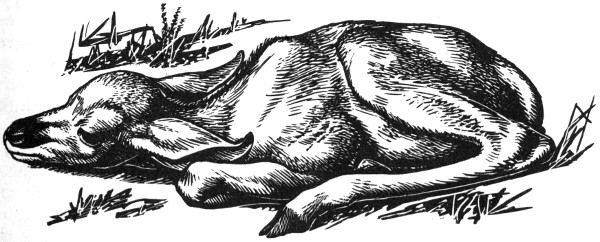
baby pronghorn
8
Bison (buffalo) Bison bison (Teutonic name given to this animal)
Range: At present bison exist only in widely scattered sanctuaries. In Colonial times they ranged from southern Alaska to the Texas plains, from the Rocky Mountains to the Atlantic, and as far south as Georgia. They are known in historic times in Utah, Colorado, and New Mexico.
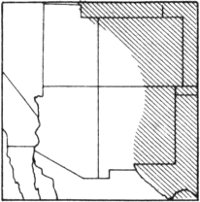
Habitat: Mainly grasslands; a comparatively small number known locally as “wood” bison lived in the fringes of the forests.
Description: Although bison are familiar to almost everyone, some figures on weights and dimensions may be surprising. Bulls weigh up to 1800 lbs., reach 6 feet height at the shoulders and up to 11 feet in length, of which about 2 feet is the short tail. Cows average much smaller from 800 to 1000 pounds, and rarely over 7 feet long. Both sexes have heavy, black, sharply curving horns, tapering quickly to a point, and a heavy growth of woolly hair covering most of the head and forequarters. A large hump lies over the latter and descends sharply to the neck. The head is massive, horns widely spaced, and small eyes set far apart. A heavy “goatee” swings from the lower jaw. All these features combine to give the animal a most ponderous appearance. Nevertheless, bison are surprisingly agile and are not creatures with which to trifle, especially in the breeding season, when bulls will charge with little provocation. Like most wild cattle, bison normally bear but one calf per year. Twins are uncommon.
The history of the bison is unique in the annals of American mammalogy. It hinges on simple economics, reflecting transfer of the western prairies from Indian control to white. It is a pitifully short history in its final stages, requiring only 50 years to drive a massive species, numbering in the millions, from a well balanced existence to near extinction. Yet considering the nature of civilization and progress there could have been no other end, so perhaps it is well that it was quickly over.
For countless centuries the bison had roamed the prairies, their seasonal migrations making eddies in the great herds that darkened the plains. They were host to the Indian, and to the gray wolf, yet so well were they adapted to their life that these depredations were merely normal inroads on their numbers. They drifted with the seasons and the weather cycles, grazing on the nutritious grasses of the prairie. Weather and food supply; these were the main factors which controlled the “buffalo” population until the coming of the white man.
The first white man to see an American bison is thought to have been Cortez, who in 1521 wrote of such an animal in Montezuma’s collection of animals. This menagerie was kept in the Aztec capitol on the site of what is now Mexico City. There the bison was an exotic, hundreds of miles south of its range. In 1540 Coronado found the Zuni Indians in 9 northern New Mexico using bison hides, and a short distance northeast of that point encountered the species on the great plains. The eastern edge of the Rio Grande Valley in New Mexico seems to have been the western limit of bison in the Southwest. Unfavorable climate, plus the comparatively heavy Indian population of the valley probably combined to halt farther penetration in that direction.
From 1540 until 1840 the white man limited his activities on the western plains to exploring. American colonization had reached the Mississippi River, but remained there while gathering its forces for the expansion which later settled the West. Under Mexican rule, the Southwest progressed very slowly. Then in the span of 50 years a chain of events occurred which determined the destiny of the West and sealed the fate of the bison herd.
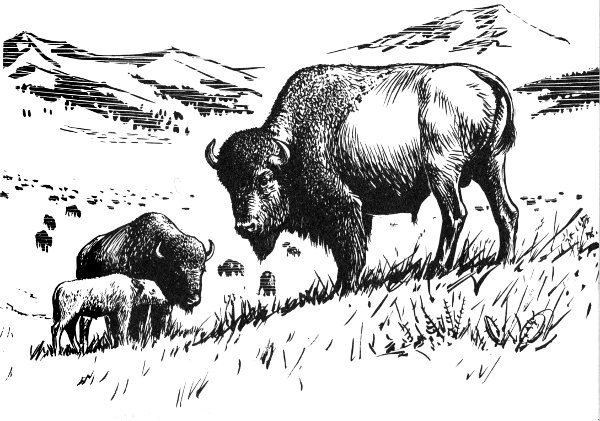
bison
Outstanding among these events were: the War with Mexico, 1844; the 1849 Gold Rush to California; the Gadsden Purchase in 1854; and completion of the transcontinental railroad in 1868. The first three added new and important territory to the United States. This made construction of transportation and communication facilities a vital necessity, hence the railroad. Completion of the Union Pacific Railroad in 1868 divided the bison population into southern and northern herds and made market hunting profitable. Three factors contributed to extermination: profit in the traffic of hides, meat, and bones; control of troublesome Indian tribes through elimination of one of their major sources of food; and finally, removal of any competition on the grassy plains of Texas and Kansas against the great herds of Longhorn 10 cattle which were beginning to make Western range history. In 1874, only 6 years after completion of the Union Pacific, the slaughter of the southern herd was complete. It is of interest to note that not one piece of legislation was passed to protect the southern herd.
The northern herd did slightly better. Closed seasons were established in Idaho in 1864, in Wyoming in 1871, Montana in 1872, Nebraska in 1875, Colorado in 1877, New Mexico in 1880, North and South Dakota in 1883. Nevertheless, the herd dwindled, and by 1890 was nearly extinct. Since that time, through careful management, a few small herds have been established in Parks and refuges, but today the bison must be considered more a domesticated animal than a wild one.
Although the animal was not as important economically to the southwestern as to the plains Indians, it was a religious symbol of some value. Archeological finds far west of the historic range, and dances still used in ceremonies, reveal that several southwestern tribes sent hunting parties eastward into bison country. This must have been very dangerous, for plains Indians would have considered them invaders. Bison were food, shelter, and clothing to them. Imagine their consternation when white men began to slaughter the source of their living.
There are today but few reminders of the great herds of the west. Perhaps one well versed in the ways of these wild cattle could still find traces of the deeply cut trails which led to the watering places, or shallow depressions where the clumsy beasts once wallowed in the mud. Many of the Indian dances recall the importance of this animal to primitive man. Perhaps our most constant reminder is the coin which commemorates this symbol of the wild west, showing the Indian on one side and the bison on the other.
Mule deer Odocoileus hemionus (Greek: odous, tooth and koilus, hollow. Greek: hemionus, mule)
Range: Western half of North America from Central Canada to central Mexico.
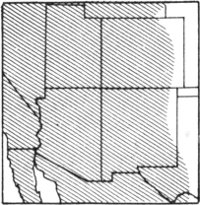
Habitat: Forests and brushy areas from near sea level to lower edge of the Alpine Life Zone.
Description: A large-eared deer with a tail that is either all black above or black tipped. Total length of an average adult about 6 feet. Tail about 8 inches. The coat is reddish in summer and blue-gray in winter. Under parts and insides of legs lighter in color. Some forms of this species have a white rump patch, others none. The tail may be black-tipped, or black over the whole dorsal surface, but is more sparsely haired than that of other native deer and is naked over at least part of the under surface. Only the bucks have antlers. These are typical in forking equally from the main beam. They are shed every year.
11
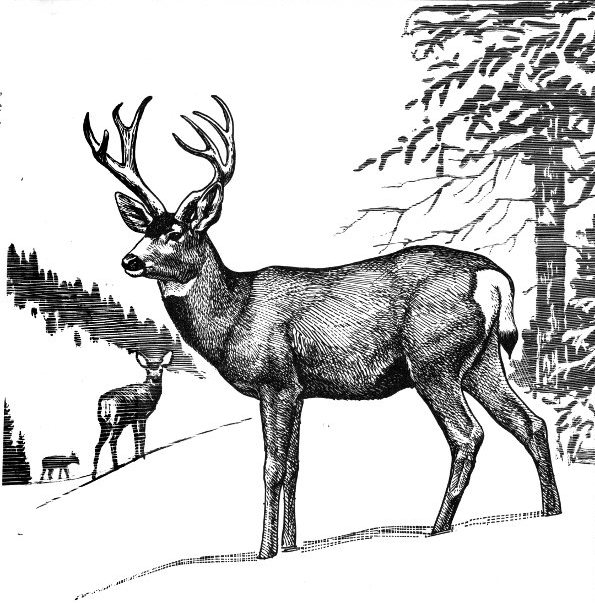
mule deer
The mule deer is typical of the western mountains. Even in early days it was never found east of the Mississippi and now is seldom seen east of the Rockies. Only one species is recognized in the United States, although over its vast range are many subspecific forms. All are notable for the size of their ears, from which derives the common name “mule.” The black-tailed deer of the Pacific Coast, long considered a distinct species, is now rated a subspecies of the mule deer.
In a general way the deer of the United States may be divided into two groups, these separated geographically by the Continental Divide. East of this line is the territory occupied by the white-tailed group; westward of it live the mule deer. Inasmuch as species seldom stop abruptly at geographical lines, we find in this instance that a whitetail subspecies, locally known as the Sonora fantail, is found along the Mexican border as far west as the Colorado River, territory also occupied by desert-dwelling mule deer. In like fashion the mule deer of the Rocky Mountains can even now be seen in the Badlands of North 12 Dakota, several hundred miles east of the Continental Divide and well within the western range of the plains white-tailed.
Though the two species mingle in places, they are easily distinguished from each other, even by the novice. Because in many cases the animal is seen only in flight, the manner of running is perhaps the most prominent field difference. The mule deer, adapted to living in rough country, bounds away in stiff-legged jumps that look rather awkward on the level but can carry it up a steep incline with surprising speed. The white-tailed, on the other hand, stretches out and runs at a bobbing gallop. Deer seldom take leisurely flight from a human, usually straining every muscle to leave their enemy as soon as possible. In the rough, broken country frequented by mule deer this tactic often makes considerable commotion.
I am reminded of a herd of an estimated 70 deer that I jumped on a steep mountainside in southern Utah. The crashing of brush, crackling of hooves, and noise of rocks kicked loose in their flight created the impression of a landslide.
Another easily seen field difference between mule and white-tailed deer is the dark, short-haired tail of the former as compared with the great white fan of the latter. The tail of the mule deer seems in no way to be used as a signal. In flight it is not wagged from side to side as is that of the white-tailed.
Antlers of the mule deer are unlike those of any other large game species inhabiting their range. They are impressively large as a rule and, because of the high angle at which they rise from the head, often look larger. The spread is wide in proportion to the height; thus it is not unusual for a well-antlered buck to be mistaken for an elk, especially at a distance. The antlers are unique in having a beam that forks equally to form the points. Thus a typical head might have five points, these being: the basal snag, a small tine rising from the beam near the head; and four points, two from the forking of each division of the beam. The western manner of counting the points consists of numbering those of one antler only; the method often used in the East counts all of the points of both. The number of points does not necessarily denote the age of a deer. Under normal conditions the antlers will increase in size and points with every new pair until maturity is attained. They will then grow to approximately the same size for several years. In old age, the antler development will usually dwindle with each succeeding year until, in senility, they may be as small as those of a young deer. The condition of teeth and hooves is a more accurate indication of age even though this method lacks prestige of the time-honored system of points.
It would seem, from the ease with which this big deer can be established in varying types of habitat, that it is in little danger of extinction. It is probable that the various subspecies will disappear before long because their range is rapidly being taken up by agriculture or lumbering. Given some protection, the species will endure in the higher mountains for many years to come.
13
White-tailed deer Odocoileus virginianus (Greek: odous, tooth and koilus, hollow. Latin: of Virginia)
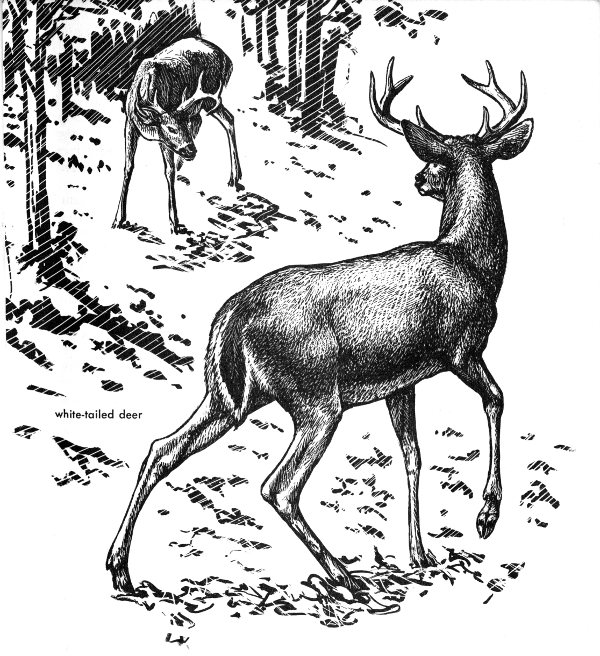
white-tailed deer
Range: Mostly east of the Continental Divide in the United States, north into southern Canada, and most of Mexico except Baja California.
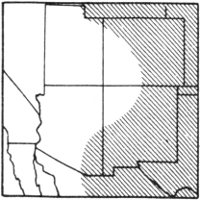
Habitat: Brushy and wooded country.
Description: A deer with a large, white tail, held aloft and wagged from side to side as it runs away through the underbrush. In the Southwest, two geographic variants occur, the subspecies virginianus and the subspecies couesi; the latter known locally as Sonora fantail, and seen in the United States only in a limited range along the border. Odocoileus virginianus of the Southwest is a large deer. It usually weighs 14 between 150 and 250 pounds, and sometimes up to 300. The average adult animal will measure around 6 feet in total length. Tail about 10 inches. Color is reddish in summer, changing to gray with the winter coat. Belly, insides of legs, and undersurface of tail are white. Ears are small. Antlers have upright tines from a single beam.
As the specific name indicates, this is the same deer that is found in the Eastern States. It is also known as the plains whitetail, because it was once common along brushy draws and river bottoms throughout the prairie regions. Preeminently an eastern animal, it occurs most abundantly in the Eastern States, dwindling in numbers westward to the Continental Divide. A few scattered groups are found in the Pacific Northwest, and the subspecies couesi extends westward along the Mexican border to the Colorado River.
The white-tailed deer may be distinguished from mule deer by any of three characteristics, all readily apparent in the field. These are: shape and construction of antlers, size and color of tail, and method of running. Antlers consist of two main beams which, after rising from the head, curve forward almost at right angles with a line drawn from forehead to nose. The tines rise from these main beams. In the mule deer the beams rise at a higher angle from the head and fork rather than remain single. The white-tailed tail is long and bushy, fully haired all around and pure white beneath. In flight it is erected and “wigwagged” from side to side. This, together with the white insides of the hams, presents a great show of white hair as the animal retreats. The mule deer has a thin, sparsely-haired tail that is bare underneath and does not wave from side to side in running. The “whitetail” runs at a brisk gallop with belly close to the ground; the mule deer bounds away with a series of ballet-like leaps.
This is the deer that contributed so much to the pioneers in their westward trek from the Atlantic States. It was important not only for its flesh but for its hide, which after tanning became the buckskin moccasins, breeches, and coats commonly worn by outdoorsmen in early days. Its distribution is now spotty compared with the former range, although there are today probably more white-tailed deer in the United States than in colonial times. This is mainly because in the thickly settled Eastern States predators have been reduced to a minimum and hunting seasons carefully regulated. It is too early yet to know if predator elimination will result in an inferior strain of deer, but the relative overpopulation in many localities has been indicated by lack of browse, disease, and excessive winter kill. The latter especially has been a problem in some of the Northern States. “Whitetails” are gregarious creatures, banding together in considerable numbers at times, especially during winter. A band of them in deep snow will stay together and their hooves will soon tramp down the snow over a small area. As succeeding snows fall, the drifts become deeper around the “deer yards” and eventually the occupants become as imprisoned by this white barrier as though they were fenced. If the number of animals in the 15 yard is too great, available browse soon disappears and many will starve to death before warm weather returns. Over most of the mountainous area occupied by white-tailed deer in the Southwest snow is no problem. The herds merely move down to lower country when the snow gets too deep. This seasonal movement is so pronounced that this deer is classed as a migratory animal in some localities.
In line with this migratory tendency the “whitetail” follows a varied but well-marked routine in its life pattern. About the time of shedding the winter coat late in the spring, the bucks also cast their antlers. With the loss of these beautiful weapons their personalities suffer. They leave the group with which they have spent the winter and ascend to the higher mountains, there to consort with a few similarly afflicted individuals until a new growth of antlers restores their dignity. The does, left behind, have problems of their own. These include driving the yearling fawns away to fend for themselves in order that the does may give undivided attention to the tiny, spotted newcomers that arrive in midsummer. By this time the adults have put on the short, yellowish-red summer coat. The fawns are reddish too, but covered with pale spots, a combination that blends well with lights and shadows in the brushy places where the does choose to hide them. As soon as the fawns are large enough to follow their mothers the little family groups begin a gradual trek up the mountainside. There are several reasons for this exodus, chief of which are cooler temperatures, better browse, and fewer stinging insects.
While the does have been rearing their young, the bucks have been staging a slow comeback on the ridges above. By early fall their new antlers have hardened, been cleaned of velvet, and polished in the brushy thickets. With restored weapons they again seek company of the does. The season of the rut comes in a time when the bucks are at the peak of vigor and combativeness. Yearlings and weaker bucks are soon outclassed, leaving the most virile and aggressive males to become progenitors of the following year’s fawns. The simplicity of this system is equalled only by its effectiveness. Natural selective breeding is one of the most important items in perpetuation of a species. A decline in numbers of the best breeding animals often results in an inferior strain. In conservation of deer herds it is well to remember that it is not always the number of animals that is the prime consideration. A smaller group of healthy, vigorous individuals is usually more to be desired than a larger population in average condition.
Although the species has vanished from many of its haunts in the Prairie States, it will not likely become extinct for a long time. Ranked by many authorities as our foremost game animal, it has been the “guinea pig” in many conservation experiments. Adaptable to almost any environment with suitable shelter and browse factors, it needs only a little protection to become well established. The “key” deer of the Florida Everglades, a tiny animal attaining a weight of only 50 pounds, is, however, on the verge of extinction. Another subspecies, the “Sonora fantail,” native to Mexico and the southwestern United States, is greatly reduced in numbers and seems destined to vanish.
16
Elk Cervus canadensis (Latin: stag or deer, from Canada)
Range: Along the Rocky Mountains of the United States and Canada. Also found in central Canada, western Oregon and Washington, central California, and various small areas in those Western States where it has been introduced.
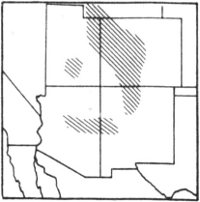
Habitat: Wooded places and high sheltered mountain valleys.
Description: A very large deer with enormous antlers, a thin neck, and a light rump patch. Total length 80 to 100 inches. Tail 4 to 5 inches. Shoulder height 49 to 59 inches. Average weight 600 to 700 pounds, with a maximum of about 1100. Coat dark in summer, lighter in winter. Longer hair on neck and throat of the bull forms a mane that is distinguishable at some distance. Antlers extremely large, usually six points on adult males. Females do not normally bear antlers. Hooves are black. Young usually one, although twins not rare.
The elk is the largest member of the deer family native to the southwestern United States. It was once widely distributed, known not only throughout the Middle West but also in most of the Eastern States. In fact, one of its common names, “wapiti,” is of eastern American Indian origin; it was so called by the Algonquins. The Crees of Canada and the Northern States call it “wapitiu” (pale white) to distinguish it from the darker colored moose with which it was associated in that region. It is now confined to the Rockies and westward in the United States, and to the Rockies and central portion of Canada. Many herds now found in Western States have been introduced to take the place of those thoughtlessly exterminated in the early days. This has been the case in Arizona and New Mexico, where Merriam’s elk disappeared before 1900. This elk, now known only from scanty records and a few mounted heads and skulls, was a giant of its kind. Not only was it larger than the Wyoming elk which now takes its place, but it had correspondingly massive antlers. Its passing is a grim warning of what could happen easily to the tule elk, a pygmy elk of central California which has been reduced to a dangerously small herd. The elk now present in the Southwest, chiefly if not all, are descendants of individuals brought down from the large herds of the Yellowstone Park area. In their new homeland they maintain the same habits that characterize the species in Wyoming.
Next to buffalo, elk are the most gregarious large mammals in the United States. The degree to which they band together varies with the seasons and can be attributed to their migratory instincts. During summer months the bands are small and widely scattered high in the Transition Life Zone and even higher at times. With the advent of cold weather they work their way down to lower country, and winter finds them gathered in sheltered grassy valleys. This exodus to winter quarters can be one of the most thrilling sights in Nature. In the north it 17 is not uncommon for herds of a thousand or more of these stately animals to move into one of the more favored valleys. They have the instinct so highly developed among most animals of knowing when a storm is imminent, and the migration may be completed within a period of 48 hours, or even less if foul weather is brewing.
The concentration of hundreds of these hungry animals into one small area creates numerous problems, the most serious being that of feed. Before the white man came, the elk population was more scattered, and many winter feeding grounds were available. In those ungrazed areas they were able to paw down through the snow to the nourishing dry grass beneath. Large herds must now be fed on hay to avoid winter losses that would otherwise result. In the Southwest, with its comparatively mild winters and small population, the animals experience little difficulty in weathering the storms without human aid. The present herds appear well established, and with proper conservation measures should be a valuable part of our wildlife for many years to come.
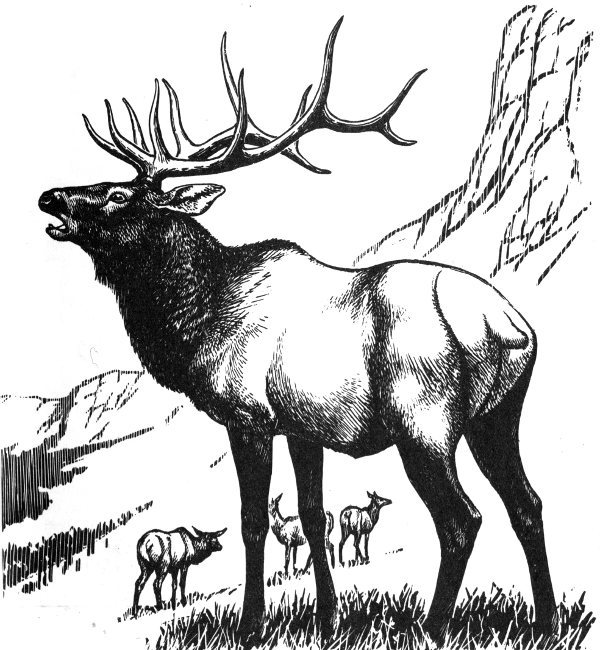
elk
18
Migratory though they are, elk still must weather a great seasonal range of temperature. In adapting to these changes they have developed two definite coats, one for summer and one for winter. The winter garb is put on early in the fall; it consists of a heavy coat of brown woolly underfur with guard hairs that vary from gray on the sides to almost black on neck and legs. Old bulls tend to be more black and white than the cows and younger animals. This heavy pelage, often called the “gray” coat, effectively wards off cold winds that sweep through the mountains and insulates the wearer against snow that is driven into the outer surface. In the spring this coat is shed to make way for a light summer coat. The matted hair falls away in great bunches, and the animals are unkempt in appearance for 2 months or more. The summer coat is made up of short, stiff hairs with little underfur. The pelage is glossy when compared with the harsh guard hairs of the winter coat. In color it is tawny, appearing reddish at a distance. The rump patch is a light tawny color in both coats.
With the coming of spring the bulls lose the great antlers which they have carried through the winter. This takes place through a general deterioration of the antler base accompanied by some reabsorption of tissues at that point. The antlers may simply drop off or, in their weakened condition, be snapped off on contact with low hanging branches. They are usually shed in March, and by May a new pair begins to grow. As with the rest of the deer family, a thick growth of velvet covers the new growth. The first stages look rather ludicrous as the antlers develop points by successive stages, each tine coming to maturity before the next begins to grow. Eventually the height of the antlers “catches up,” so to speak, with the overprominent base. At full maturity, attained by August, there are few sights so impressive as a bull elk in the velvet. When this stage is reached the antlers, until now extremely tender, begin to harden and lose their sense of feeling. The bulls strip off the velvet by rubbing against branches and brush. Gradually the hard core emerges, stained a rich brown, except for the tips of the tines which are a gleaming ivory white. The antlers are so beautifully symmetrical that they seem graceful despite their size. One of the largest pairs on record has a length of beam of 64¾ inches and a spread of 74 inches.
A mature bull usually has six tines on each antler. These have definite names. The first tine extends forward from the head and is known as the “brow” tine; the next to it as the “bez” tine. Collectively they are called the “lifters,” formerly known as “war tines.” The next point inclines toward the vertical; this is the “trez” tine. The fourth is the “royal” or “dagger” point, and the terminal fork of the antler forms the final two points which are called “surroyals.”
Unwieldy as this tremendous rack of antlers appears, the animals handle them with comparative ease. In the normal walk or trot the body is carried along smoothly with the nose held up and forward. In this posture the antlers are well balanced and are carried without undue strain. In running through brush the nose is lifted still higher; this throws the antlers farther back along the shoulders, and as the 19 nose parts the branches they slide along the curving beams without catching on the tines. Despite these cumbersome impediments, the elk creates less disturbance than most large forest animals when in flight. Antlers as weapons of offense are far overrated, for they seldom serve this function. Males have been severely injured and even killed in fights among themselves, but these are exceptions, and most fighting is done by striking with the front feet. If antlers are used it is usually with a chopping, downward motion that rakes, rather than puncturing the hide of the opponent.
Despite the fine appearance he presents, the bull elk is not content merely to be seen, but insists on being heard as well. His vocal effort is a high, clear, mellow tone commonly known as bugling, although it seems to have more the quality of a whistle than the sound of a horn. The call begins on a low note that is sustained for perhaps two seconds and then rises swiftly for a full octave to a sweet mellow crescendo, drops by swift degrees to the first note, and dies away. This is followed by several coughing grunts that can be heard only at close range. Bugling can be heard for a great distance, and on a clear quiet evening one of the greatest charms of wilderness camping is to hear this clear challenge flung out from some nearby ridge. The response is quickly returned from other hillsides, some so far away as to be mere whispers in the distance.
Bugling is indulged mainly during the rutting season and lasts from August to November. During this time it undoubtedly is intended as a challenge to other bulls and perhaps also to impress the cows with their lords’ great importance. At other seasons it is heard but infrequently, and then probably is simply an expression of abundant animal spirits. Cows have been known to bugle, but this is a rare occurrence.
The single calf is born between mid-May and mid-June. Twins are not uncommon. At birth the calf will weigh 30 to 40 pounds, and is an awkward animal. It has a pale brown coat liberally sprinkled with light spots, and a very prominent rump patch. For several days it remains hidden in the grass while the mother grazes nearby and keeps constant vigil. Several times daily she will return to let the calf suckle, but this is done as hurriedly as possible. Many are the predators that are only too anxious to catch the little one, such as mountain lions, wolves, bobcats, coyotes, bears, and even golden eagles. Should the calf be molested it emits a shrill squeal and the cow charges in with sharp hooves flashing. She usually is successful in driving away the smaller predators and sometimes intimidates even the largest with her bristling show of fury. After the calf is large enough to follow the mother, she warns it of danger with a hoarse, coughing bark.
The presence of canine teeth in elk is a peculiarity not found in other American deer. They are of modified form, being bulbous growths without known function. They occur in both sexes but those in bulls have the greatest development. At maturity they become highly polished and stain a light brown.
20