CARNIVORES Including the Insectivores and Chiropterans
Reading edition
79
This group is distinguished from other animals by having canine teeth in both jaws. The function of these teeth is to catch and hold other animals, for carnivores are the predators. This is the most highly developed branch of the animal world and reaches a peak of specialization in man who, while lacking some of the physical qualifications of the other predators, has developed a brain which has enabled him to gain and keep ascendancy over all other animals. Considered with the group in this book are two other orders, the Insectivora and the Chiroptera. These orders embrace the mammals in North America that live principally on worms or insects rather than on other mammals. They are the shrews and bats, respectively.
Since carnivores are the hunters rather than the hunted, they enjoy far greater mobility than, for instance, the rodents. It is not necessary that they have a burrow in which to escape the attacks of other animals, for it is unusual for them to prey upon each other. Most of the predators remain in one area only from choice or, in the case of adult females, in order to rear the young. Few of them hibernate; bears and skunks do spend a considerable time during the cold weather in a torpor, but it is an uneasy sleep at best, as anyone who has disturbed these animals at this time can attest. As far as the Chiroptera are concerned, some species of bats hibernate and others migrate to a warmer climate to spend the winter. Since most of the predators are active all winter, while many of the rodents are in hibernation, this can be a period of famine for carnivores. At the same time, it is a season of increased danger for those species which are still active and upon which these predators prey.
Because these hunters are continually stalking other animals, their habitats are as varied as those of their quarries. Thus, the mountain lion is a creature of the rimrock, where he can most conveniently find deer browsing on mountain-mahogany; while his smaller cousin, the bobcat, stalks smaller animals in the slope chaparral. The wild dogs hunt plains and brushy country for ground squirrels and rabbits. In the weasel family we find the marten in the treetops pursuing squirrels, the weasel hunting mice in the meadow, and mink and otter pursuing prey near to or in the water, Some species, such as the bears, are omnivorous and may be encountered almost anywhere that a plentiful supply of food of any kind can be found. Practically all of the species, excepting bats and skunks, can be considered diurnal as well as nocturnal, but the majority are most active during the hours between dusk and sunrise.
Since the carnivores’ purpose in Nature’s scheme is to control the vegetable eaters, it follows that each predator must be somewhat superior, either physically or mentally, or both, to the species upon which it preys. The associations between pursuer and pursued may be casual with species such as the coyote, which preys on a great number of smaller species, or they may be sharply defined as with the lynx, which in certain localities depends almost entirely upon the snowshoe hare for food. The apparent ferocity with which some predators will kill, not 80 only enough for a meal, but much more than they need, cannot as yet be explained. This habit is most pronounced in the weasel family. It may be that more than ordinary control is called for in the case of their host species, rodents in most cases. Whatever the reason, this wanton killing has not upset the balance which these species maintain. Man, the most ruthless and intelligent predator of all, is the only species which has been successful in exterminating others.
The predators hold a favored place in the esteem of most naturalists. At first, sympathy for the weak and indignation against the strong are perfectly natural human feelings. As the necessity for control and the wonderful way in which Nature attains a balance becomes apparent, the role of the predator becomes more and more appreciated by the student.
Mountain lion Felis concolor (Latin: a cat of the same color; referring no doubt to the smooth blending of the body coloration)
Range: At present, mostly confined to the western United States and Canada, and all of Mexico south to the southern tip of South America. There are a number of mountain lions in Florida, and persistent reports indicate that they may be making a comeback in a number of other Eastern States.
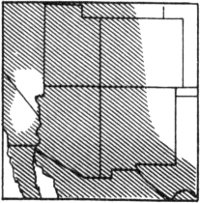
Habitat: As the range indicates, habitats vary widely. Mountain lions in the Southwest show a preference for rimrock country in the Transition Life Zone or higher, but they are often seen in all the life zones.
Description: A huge, tawny cat with long, heavy tail. The long tail is a field mark identifying the young, which, having a spotted coat, otherwise resemble young bobcats to some degree. Total length 72 to 90 inches. Tail 30 to 36 inches. Weight 80 to 200 pounds. Color may vary from tawny gray to brownish red over most of the body, the underparts being lighter. The head and ears appear small in proportion to the lean muscular body. The teeth are large, the canines being especially massive. Like most members of the cat family, the mountain lion has large feet with long, sharp claws. The tracks show the imprint of four toes together with a large pad in the center of the foot. The young may be born at any time of the year. Only one litter is born every 2 to 3 years, and the average number of young is three.
Probably no species of mammal in the New World equals the mountain lion in farflung distribution. From the Yukon to Patagonia, this elusive carnivore can still be found in considerable numbers in spite of aggressive campaigns against it. In the United States, it is the chief representative of the wild cats, a group noted for fierce and predacious habits. Fortunate indeed is the person who sees one of these great felines in the wild. This may not be as difficult as one might imagine because mountain lions often travel through comparatively well settled areas. It is especially possible in the Southwest, for the four-State area covered by this book contains the heaviest population of mountain lions in the United States. However, the comparative abundance of this carnivore has not resulted in a better understanding of it. The mountain lion is still one of the least known and most maligned creatures of our times.
81
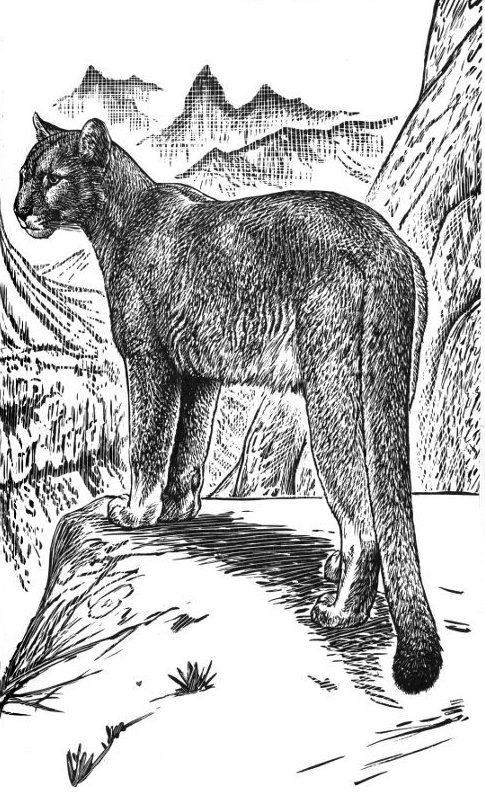
mountain lion
82
The Mexicans know this cosmopolite as “leon.” In Brazil it is called “onca.” Perhaps the most distinguished name, and rating as the first in New World history, is “puma,” given it by the Incas. Early American settlers of the east coast called it “panther,” “painter,” and “catamount.” In the northwestern United States, it is known as “cougar” and in the Southwest, as mountain lion. Although there is but the one species concolor, there are a number of subspecies. About 15 are now recognized, most of them geographical races and not markedly different from the species. Four of these subspecies are found in the four States with which we are concerned. One of the most interesting is hippolestes which inhabits the State of Colorado. Translated from the Greek this is “horse thief,” an appropriate epithet indeed for this ghostly marauder. As might be expected from their vast distribution, the several subspecies have a tremendous vertical range. In the Southwest they are found from near sea level in southwestern Arizona to the tops of the highest peaks in Colorado.
In the more than four centuries that have elapsed since the white man first set foot on soil of the New World, a great mass of folklore concerning the mountain lion has accumulated. Half fact, half fiction, these tales have been repeated from one generation to another and few details have been lost in the telling; indeed, in most cases, several have been added. Most common are those which describe its fierceness and its attacks on man. In the main, these tales are lurid and convincing, but they do not stand up under scientific scrutiny. It is true that such attacks have occurred; one of the most recent and best verified was that on a 13-year old boy in Okanogan County, Washington, in 1924. It resulted in the death and partial devouring of the unfortunate youngster. Yet sensational as this incident was, it resulted in publicity far out of proportion to its importance. In fact, articles concerning this case are still appearing at intervals. The truth of the matter is that very few authentic cases of mountain lion attacks upon humans have ever occurred in the United States, and that most of these could have been caused by the mountain lion’s being rabid. Certainly such attacks are not typical behavior of the normal animal. As far as man is concerned, the lion will take flight whenever possible, and even when cornered it is not nearly so pugnacious as its little cousin, the bobcat.
Other stories about the mountain lion often emphasize the bloodcurdling screams with which it preludes its stalk of some unfortunate person deep in the forest. The facts are that there is no reason to believe that lions cannot or do not scream, but most authorities agree that such vocal expressions are most likely to be made by an old male 83 courting his lady love or warning away a rival. The cats are creatures of stealth and cunning that creep upon their prey as noiselessly as possible. Lions would hardly announce their presence with the sort of screams with which they are credited. It seems safe to say that at least 90 percent of these alleged screams can be traced to owls or amorous bobcats. Oftentimes these sounds have been linked to large tracks found in the vicinity as proof that a mountain lion was in the area. This has led one author to remark that “the witness usually is unable to distinguish the track of a large dog from that of a mountain lion.” In addition, the infrequent screams made by captive mountain lions indicate that such sounds in Nature would be far from spectacular. They consist of a sound that is more like a whistle than the demoniacal wail so often ascribed to the wild animal.
Many stories are told of a person, usually a pioneer ancestor, who has been followed by a mountain lion. In most cases this person has returned to the area suitably armed and with witnesses who found tracks of the beast together with those of their friend. Strange to say, such incidents are not at all uncommon. They have been recorded and verified a number of times. In these cases the animal often has made no effort at concealment but has followed the person quite openly. Despite this boldness it seems there is no sinister motive, merely a naive and surprising curiosity on the part of the big cat as to what kind of creature man is. It is most unfortunate that so little data have been recorded in these instances, yet this is quite understandable under the circumstances.
Finally, in most stories there is only one size of mountain lion—big! As the story makes its rounds the lion never gets smaller; it invariably grows larger. Somehow the records have missed all these really big lions. Any lion which measures more than 8 feet in length and 200 pounds in weight will be an extremely large, old male in the record class. The average will be much smaller. Statistics show most lions to be 5 to 7 feet in length and 80 to 130 pounds in weight for adult females, and 6 to 8 feet in length with weights of 120 to 200 pounds for adult males. Errors in estimating the size of these big cats are easily accounted for. In the first place the lion is a long, low, sleek creature that gives an impression of being longer than it is. Too, its size is unconsciously exaggerated by many people who are impressed with its 84 tremendous power and agility. Many of its feats of strength seem impossible for an animal so small. Lastly, its tanned hide may be available for measurement. Actually this proves nothing; hides often are stretched 2 feet or more at the time the animal is skinned, and tanning does not shrink them appreciably.
None of the above is meant to detract in any way from the reputation of the mountain lion or its place in American folklore. It is the third largest predator in the Southwest, being exceeded only by the jaguar and the bear in size, and surpassing them both in agility. In the past, it has been feared and hated by those whose herds and flocks have suffered from its depredations. Their efforts to exterminate it have resulted in grave biological problems at times, but in the light of more advanced study it seems probable this big carnivore will be spared in the future to keep its rightful place in our wilder areas.
The mountain lion “goes with the deer”; that is to say, its function is to keep deer in check so that they will not eat up their range and starve to death. Though at first glance such a possibility seems out of the question, this has become a serious problem in recent years. It will be further intensified as suitable deer range becomes more restricted with the advance of civilization. Another function of the mountain lion-deer relationship is to weed out the diseased and inferior individuals so that the deer herd will remain healthy and up to good physical standards. It may be argued that the same end is reached by hunting, and so it is, with one major exception. The nimrod, intent on a fine trophy head, takes the buck in the prime of life, a time when he should be sireing the herd of the future. The cougar does not consciously select its victims; it takes the most easily caught, thus leaving the wisest and healthiest survivors as breeding stock.
Though deer are the lion’s preferred food, many other species of mammals are preyed upon when deer are scarce. These range in size from the smallest rodents to animals as large as elk. Among the more unlikely species recorded are skunk and bobcat. The lion also has the dubious distinction of being one of the chief predators of the porcupine. Dining on this last species is fraught with danger, however, because no matter how expertly the carcass is removed from its spiney covering, a few quills will penetrate the flesh of the diner. Little prey other than mammals is ever taken. Birds are not easily caught by such a large animal and, although it does not shun water, it is poorly equipped to take any form of aquatic life. The mountain lion will not eat carrion except under the most dire circumstances and prefers food that it has killed itself.
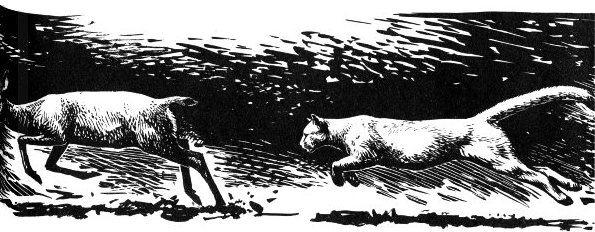
There are two principal methods by which the mountain lion catches its prey. The stalk and pounce technique of the common house cat is most effective in brushy country where the low crouch of the lion places its bulk behind the close ground cover. With tip of tail twitching, it creeps forward until a short run and spring, or the spring alone, will carry it to the front flank of the unsuspecting victim. If the neck of the hunted is not broken by the impact of the heavy body, the sharp claws or massive canine teeth are brought into play to rip the 85 jugular vein and end the struggle. In the other method of hunting, the lion chooses a ledge above a game trail and simply waits there until some animal to its liking passes below. The weight of its body usually is sufficient to bear the victim to the ground and it is soon dispatched. Mountain lion studies in California have determined that in hunting deer the animal will catch one in every three attempts. It has been estimated that in an area of heavy deer population each mountain lion will kill one each week. It is of interest to note that in many places in the Southwest deer are on the increase, indicating the need for more predators to keep down their number.
Since the mountain lion has few enemies, its reproduction rate is low. Two to four kittens are born in each litter, but usually at 2- to 3-year intervals. Dens are sometimes located deep among the rocks; others may be no more than a grass nest in the brush on a rocky ridge. Like domestic kittens the young are born blind. They have an interesting color pattern at birth, a strongly spotted coat and a faintly ringed tail. This completely disappears when they are about half grown, leaving them with the tawny reddish coat which blends so well with their surroundings. They mature at about 2 years of age; beautifully evolved killers which must be admired by everyone who has come to understand the methods by which Nature regulates the animal world.
Bobcat Lynx rufus (Latin: name of animal, and rufus, reddish)
Range: Common throughout much of the United States and Mexico. Found throughout the Southwest.
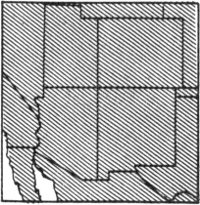
Habitat: This common species is found in all zones wherever there is sufficient cover to hide it.
Description: A bobcat distinguished from the lynx by having small ear tufts, a more rufous color, and a black band which crosses only the upper surface of the tail tip. Total length 30 to 35 inches. Tail 5 inches. Weight 15 to 30 pounds. This is a chunky animal with long, muscular legs and large feet. The sides of the face are heavily streaked with black, backs of ears dark, coat generally tawny to rufous above, underparts lighter. Dark spots rather prominent throughout coat, insides of front legs often barred with darker color. Young from two to six, usually born in early spring; only one litter per year.
These are the most common wild members of the cat family in the Southwest. Their distribution over the United States takes a strange pattern, inasmuch as they are not found in several of the midwestern and southeastern States, and in a large area in central Mexico. In all there are a dozen subspecies of Lynx rufus in North America. They are tough 86 little predators, among the last to retreat before the advance of civilization. In fact, they may often be found on the very fringes of our larger cities, existing on the rats that infest the city dump.
In the wilder areas, which are the bobcat’s appropriate home, its tracks are distinguishable from those of the larger Felidae only by their smaller size. Like the larger members of the cat family, it is equipped with a set of strong retractile and extremely sharp claws. Although there are five toes on each front foot and only four on the hind feet, the tracks of both feet are similar. This is because the fifth toe, corresponding to our thumb, is so high on the inside of the foreleg that normally it does not touch the ground. During normal travel the claws are always in the retracted position and never show in the tracks. All native cats have a tendency to place the hind feet in the tracks left by the front feet, so that in effect each track is a double print. This may be one of the reasons a cat’s approach is so silent!
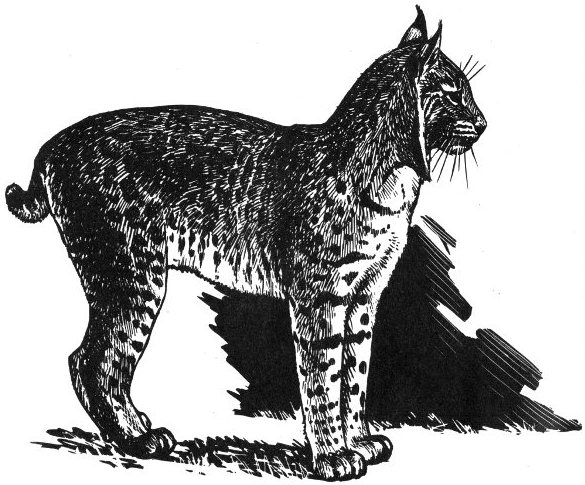
bobcat
Bobcats have numerous traits in common with their relative, Lynx canadensis (not treated in this book because of its extreme rarity in the Southwest), but are more versatile in their dietary tastes. While the lynx is sufficiently dependent on the snowshoe hare that its population corresponds closely in fluctuation with that of its “host,” the bobcat has a much less discriminating appetite. It also loves snowshoe hares and rabbits, but takes various other mammals as opportunity offers, and ground-living birds. Bobcats will even eat carrion, but prefer fresh meat. They are reliably reported to eat porcupines, young pronghorns, deer, and sheep, both bighorn and domestic; and they sometimes kill adult deer, although this is a difficult and dangerous proceeding. 87 Usually a kill is at least partially covered with debris, and the cat will return at least once to feed again on it.
Though bobcats are the least spectacular of our native cats they are the most numerous and evenly distributed. Thus collectively they may be of more importance in Nature’s master plan than we realize. Their role may even increase in importance as time goes on, because of the increasing scarcity of the larger cat species.
Red fox Vulpes fulva (Latin: a fox ... fulva, meaning deep yellow or tawny)
Range: Found throughout most of North America north of the Mexican border. Exceptions in the United States are areas in the southeastern and central States and desert portions of the Southwest.
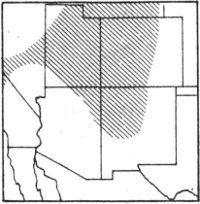
Habitat: In the Southwest these foxes are restricted to wooded areas of mountains. They usually are found in the Transition Life Zone or higher.
Description: About the size of a small dog, having a bushy tail with white tip. Total length 36 to 40 inches. Tail 14 to 16 inches. Weight 10 to 15 pounds. Besides the type, this fox has at least two well-defined color phases with many intermediate forms. These will be considered separately. A typical western form of red fox will be more yellow than red. The brightest red will be a rufous median line running down the back. This fades to an ochre yellow along the edges and grades to the lighter yellow of the sides. The tail is usually dark yellow with black guard hairs and always a white tip. The underparts are light yellow to white. Fronts of feet and lower legs and backs of ears are always very dark to black. The underfur is lead-colored. The head is small with large ears, yellowish eyes having elliptical pupils, narrow nose and jaws. The young, four to six in a litter, are born early in the summer and but one litter is produced each year.
The western form of red fox might more aptly be named the “yellow” fox, since it is definitely more yellow than red. To add to the confusion, the gray fox, Urocyon cinereoargenteus, of the West usually has more good red in its coat than the red fox. However, the gray fox is a denizen of the desert and will not often be found at elevations preferred by the red fox. In addition, its tail is tipped with black; this definitely separates the two species at a glance. The differences of color phases within the red fox group are more pronounced and have led many people to consider them separate species. The two most distinct types of these varieties are known as the “cross” fox and the “black” or “silver” fox.
The term “cross” fox refers neither to the disposition of the animal nor to its being a hybrid variety, although it often is cross or mean and is not a hybrid. It alludes to the dark cross on its back. 88 This is formed by a dark to black median line crossing at right angles to a dark band that traverses the shoulders. Its effect is increased by considerable amounts of gray and black mixed with the normal yellow color of the sides. The long hairs of the tail are yellowish gray to black, the general effect being dark but, as with the type, the tip is pure white. As might be expected, there are many gradations between this color phase and the type, some of them being among the most striking and beautiful foxes in the world.
The “black” or “silver” fox is a melanistic form of the red fox. In the most striking form it is a smooth shining black, the general sombreness of its coat being relieved by a sprinkling of silvery white guard hairs. These are thickest in the area of the shoulders, on the posterior portion of the back, and on the top and sides of the head. The underparts, though black, lack the lustrous “finish” so evident on the back and sides. The tip of the tail is pure white in this form also. This is the “silver” fox of commerce, an animal which through selective breeding has become standardized in the fur industry. Nevertheless, the black color is a recessive character, as evidenced by the throw-backs that often make their appearance in otherwise black litters. Without constant vigilance on the part of breeders, the “silver” fox would soon become a rarity again. The Mendelian law cannot be cancelled out by a few generations of selective breeding.
The foxes are the smallest canines native to the United States. Though they look much larger because of their long fur and bushy tail, the average red fox will not outweigh a large house cat. They make up for this lack of size, however, by being exceedingly quick in their movements. They are thus able to catch many of the small mammals which outmaneuver coyotes and wolves. Rabbits are about the largest mammals with which they can cope, but mice, woodrats, pikas, and ground squirrels are all a common part of their diet. In addition, they take many large insects and ground nesting birds and eggs whenever possible. Foxes are not as omnivorous as coyotes, but they relish berries and stone fruits and sometimes raid watermelon patches.
The social life of foxes is most interesting. The family is a closely knit unit which as a rule does not break up until the young are well able to care for themselves. Foxes are monogamous; that is, they normally choose their mates for life. Dens may be in burrows dug in the soil or in deep crevices in the rocks. They are usually in some spot where there is a good view of the surrounding territory. The pups are born rather early in the spring and by early summer will be playing around in the den entrance, although they do not venture to any distance until much later. Should the den be approached while the young are in it, the female often will be very bold in her attempts to lead the intruders away from it. As soon as the young are weaned the male joins his mate in bringing food to them. By early fall, the family is hunting together.
The red fox has been a symbol of sagacity and cunning since long before Aesop. Much of this reputation is well earned, as witness their stubborn withdrawal as civilization surrounds them. Yet sometime one wonders if their wisdom is not overrated. I am reminded of an old 89 female who every year whelped her young in the mouth of a tile drain which drained a marshy piece of ground that had since become dry. The upper end of the tile was buried some 15 feet below the surface of the ground. My friend would watch the area until the pups were about half grown. Then he would block the entrance to the tile with a box trap and catch them as hunger drove them out to the bait. This went on for several years, the old vixen never seeming to learn from bitter experience that her family would be taken away from her.
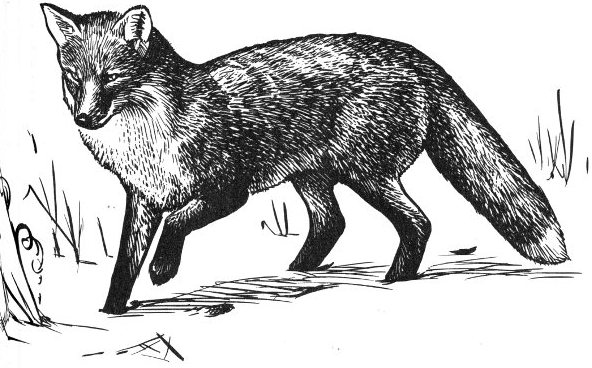
red fox
Gray wolf Canis lupus (Latin: dog ... a wolf)
Range: Canada and Alaska north to the northern coast of Greenland. In the United States it is found in three widely separated areas in Oregon, Utah and Colorado, and New Mexico and Arizona. It extends south into the tablelands of Mexico.
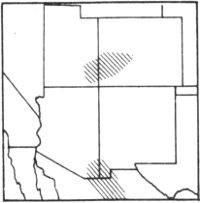
Habitat: In the Southwest the wolf, like the coyote, is leaving the plains, which are its chosen habitat, to live in the broken country of the Transition Life Zone.
Description: Doglike in appearance, but larger than a big dog. Carries its short, bushy tail above the horizontal when traveling. The gray wolf is almost unbelievably big. Total length 55 to 67 inches. Tail 12 to 19 inches. Height at shoulders 26 to 28 inches. Weight 70 to 170 pounds. These animals show a tremendous variation in color, but the average individual will appear very much like a big German shepherd dog. From 90 this average, they will vary from the almost white coat found in Alaska to the black phase of the red wolf of Texas. The head of the wolf is distinctive. It has a broad face with a wide but short nose. The straw-yellow eyes have round pupils. The ears are short and round, much more like a dog’s than a coyote’s. The feet, in keeping with the rest of the body, are large. The front feet have five toes; as is usual with canines, the first toe or “thumb” does not touch the ground. The hind foot has but 4 toes. These animals have a high reproduction rate. Each year the single litter may consist of from 3 to 4 to as many as 12; the average is assumed to be from 6 to 8.
The wolf’s association with man is older than recorded history. When man first gained his ascendency over other mammals, the wolf is believed to have been the progenitor of the dog. As man’s partner in the chase, it helped him become the one superior animal capable of exterminating it. At the present time, man has come close to doing just that. Only a few of these magnificent wild dogs remain in the United States. Those are concentrated mainly in the Southwest, and some of them undoubtedly have come across the border from Mexico. Before long the species probably will become extinct in this country, but the large numbers remaining in Alaska and Canada should persist for many years.
Much of the public antipathy for wolves comes from literature. Who, as a child, has not thrilled to the danger that surrounded Little Red Riding Hood, and rejoiced at the ultimate end of the arch villain? Long before animated cartooning took over nursery rhymes, children’s books were well thumbmarked at the page where the “big bad wolf huffed and puffed and blew the house down.” To “keep the wolf from the door” is an expression as full of meaning today as it was in the 15th century when the animal became extinct in England. The wolf has always been a symbol of taking ruthlessly. The genus lupinus (Latin: wolf), a beautiful group of plants of the pea family, is so called because early botanists thought it robbed the soil. The “wolf” so often encountered at house parties is included in this class. None of these characterizations gives a good impression, and all are indicative of man’s feeling toward the wolf. It is most unfortunate that man so often condemns anything which interferes with his own economic progress. Nature has a place for the wolf, a specialized task for which it is admirably adapted.
In the days before the white man, bison roamed the western plains in great herds which were constantly followed by packs of wolves and coyotes. As long as the bison remained close together they were relatively safe, but woe to the sick or weak that lagged behind. These were quickly pulled down, and after wolves had eaten the choicest portions, the coyotes and vultures moved in for the rest. When the white man exterminated the bison, the wolves’ host was gone and they turned to the logical substitute, the white man’s cattle. This could have but one result. In the predator control campaign which followed, a wedge was driven through the wolf population of the Southwest, leaving one group isolated in Utah and Colorado and another in southern Arizona and 91 New Mexico. The latter group is actually formed by immigration of wolves from Mexico. It fluctuates in numbers as the animals move back and forth across the border in response to local conditions. During the extermination program, the behavior of the wolf was affected to a considerable extent.
Accounts of early travelers stress the easy familiarity with which the gray wolf accepted their presence. When a wayfarer shot a bison, the wolf sat down within easy range and waited until the choicest cuts had been taken away. It then moved in for its share. Since that time the wolf has become one of the most wary and cunning of our wild creatures. Gifted with a keen intelligence, it has found that only by complete isolation can it escape the methods devised for its destruction. To this end, it has moved from the plains into the more inaccessible places in the mountains. Few will ever see a wolf in the Southwest again, and I consider myself fortunate to have seen this gray ghost of the plains in years long past, and to have heard its deep howl break the silence of a cold winter night.
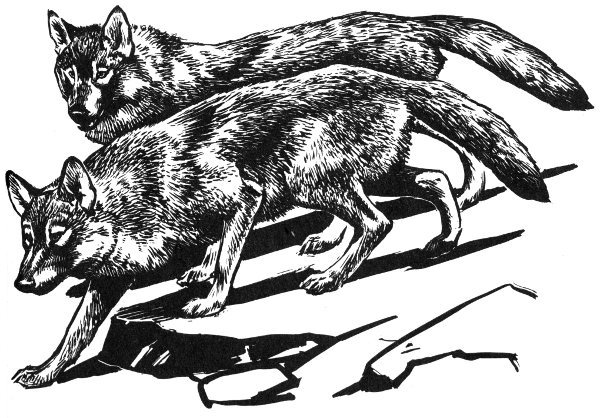
gray wolf
92
Coyote Canis latrans (Latin: dog ... barking)
Range: The coyote is common throughout the Southwest.
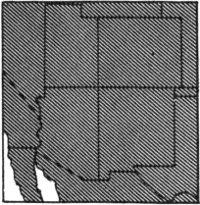
Habitat: This little wolf, once a creature of the prairies, now is found in all life zones and among many different associations.
Description: Because of their varied associations and wide climatic range, coyotes are of many sizes and colors. In general, they resemble a rather small, lean German shepherd dog with yellowish eyes. A good field mark is the bushy tail which is carried low while the animal is running and seldom is elevated above the horizontal at any time. Average total length 43 to 55 inches. Tail 11 to 16 inches. Color tawny to reddish gray with white or light-colored throat and chest, dark legs and feet. There is usually a dark median line down the back, and the tail also is somewhat darker than the body. Coyotes are lean animals; despite an impression of bulkiness suggested by the long fur, a large coyote seldom weighs more than 30 pounds. The track is much like that of a medium-sized dog; however, the prints of the claws tend to converge toward a center line more than those of the domestic animal. Coyotes are moderately prolific. The average litter contains from 4 to 6 pups, although as many as 11 have been recorded. The best indication that coyotes are in an area is their “singing” during the evening. They will sometimes greet the sunrise, but are infrequently heard during the day.
There probably is more controversy about the status of the coyote in its relationship to other animals than any other North American mammal today. The solution to the argument can be found by taking a 10 minute walk through a bit of the great outdoors. Those living things, plant or animal, which cannot adapt themselves to most changing conditions presented by a slowly dying world must perish. Those which survive do so because they have a mission to fulfill; they must give as well as take from their environment. To me, the unequalled ability of the coyote to withstand the campaigns of man toward its extermination indicates that this animal must be an especially favored child of Nature. Certainly many of the subtle relationships which it maintains with its associations have never been fully explored and others have not been discovered.
In the light of recent studies and with the influence of excellent documentary films in its favor, the coyote’s place in Nature is now becoming better known to the public. There seems to be no valid reason why people, who in general like dogs, should express indifference to the fate of this little wolf, which is but a wild dog with what most naturalists agree is a higher degree of native cunning and intelligence than that of the average domestic breed. In general, this attitude seems to stem from unfavorable and usually inaccurate stories circulated by word of mouth. A few hours spent in reading the scientific literature on the 93 coyote will disprove many of these folk tales. For lighter reading try J. Frank Dobie’s The Voice of the Coyote (Little, Brown & Co., Boston 1949) or Sierra Outpost (Duell, Sloan & Pearce, 1941) by Lila Loftberg and David Malcolmson. These delightful accounts present the coyote for what it is—one of the more important creatures in animal society.
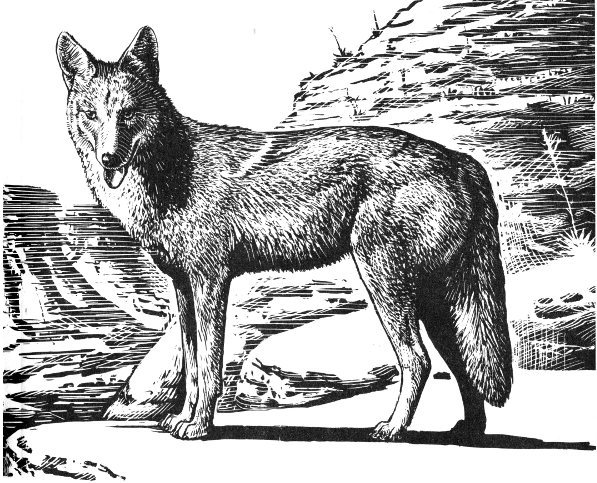
coyote
When the first whites pushed their way across the western prairies, the coyote was chiefly a plains animal. Here it lived along the fringes of the huge bison herds, seldom venturing to make its own kills but sharing with the vultures the remnants left from those of the big gray wolves. With small game it was more successful, making heavy inroads upon the rodent and rabbit population. Then, as now, the coyote was also a scavenger and helped rid the plains of the carcasses of larger animals which died of natural causes. When the bison and wolves were practically exterminated, the coyote “took to the hills” and now is as frequently encountered in the higher mountains as anywhere. Farther west in the desert areas the story has been much the same. As civilization has advanced, the coyote has stubbornly retreated into the hills until now its “song” is heard in the highest canyons. The medium size and omnivorous tastes are factors which probably have much to do with its success in this new environment.
About half way between the gray fox and gray wolf in size, the coyote is large enough to subdue the big hares, yet nimble enough to 94 catch the smaller rodents which make up a large part of its animal diet. The rest is supplied by a long list of other small creatures which are less often encountered, including birds, reptiles, and insects. The vegetable portion of its food is no less varied. Berries, stone fruits, cactus fruit, various gourds, some herbs, and even grass are eaten in considerable quantity, depending on the season and availability of meat. Besides this diet of what might be called fresh food, the coyote will usually take carrion. This is the basis for many unfounded accusations against the species. Because scats are sometimes composed almost entirely of the hair of such large mammals as deer, elk and mountain sheep, the coyote is thought to be killing these animals. Actual records of such occurrences are rare; the coyote is not built for such big game. Nature meant this to be the province of the gray wolf. Should such predation by coyotes take place, some other factor undoubtedly would restore the balance before long. Nature’s laws are as definite as those of human society and far more sternly enforced.
The family life of these intelligent creatures is interesting in its variations. No two pairs will follow any given pattern. As a rule coyotes, like wolves, will mate for life; but should one be killed, the other will usually seek another partner. Breeding takes place in early spring, followed some 60 to 65 days later by the appearance of a litter of up to 11 pups. The den is usually at the end of a burrow dug in soft soil close to a vantage point which overlooks the surrounding area. More rarely the den is chosen in a crevice among the rocks, and some have been found which are no more than hollows in the shelter of overhanging shrubs. During early life of the pups the male coyote is not allowed to approach them. Later, when they are able to take solid food, he brings his offerings to the neighborhood and the female carries them to the young. Up until the time the pups are able to leave the den, both parents are extremely wary in their approach to the area. They usually come in down wind so as to detect the presence of an intruder. If a human investigates too closely, the pups are moved to a new location at once.
When the young are big enough to emerge from the den, a new phase of their existence begins. At first, they play around the entrance like a group of collie pups, stopping now and then to survey this wonderful new world with wide eyes. Soon the wandering instinct asserts itself, however, and they begin to make short sorties away from the den. This is the time the parents have been anticipating. Now the young can be taken away from an area which becomes more dangerous with every passing day. The family may now hunt as a unit, initiating the young into the coyote way of life, or the mother may scatter the young along the perimeter of her range, bringing food to them as she makes her rounds. In either event, they soon learn to fend for themselves and by the following spring are mature animals.
Unlike his larger relative, the gray wolf, which is a great traveler, the coyote will establish a range and stick to it. In time, he will learn every yard of it and will notice the slightest changes. This is of great importance, not only in evading attempts on his life but also in the 95 matter of filling his stomach. The woodrat, which tonight may be deep within its fortress of rock and branches, will be remembered and called upon again tomorrow when it may be out foraging for pinyon nuts. The cottontail, which reached the brush pile last night, may be intercepted en route tonight.
Several coyotes often share the same range and hunt together. This is especially true of a mated pair which is feeding young. Such a combination is especially efficient in running down such animals as jackrabbits and, more rarely, pronghorns. These creatures tend to run in a circle, and the coyotes alternate in chasing and resting until the animal is exhausted. Then they both close in for the kill. Pronghorn hunting is fraught with danger, however, especially during the time their young are small. These sharp-hoofed animals have been known to pursue and kill coyotes.
It is to be hoped that the relentless persecution of the coyote will soon be a thing of the past. The species has an important place in the ecology of the Southwest, and it cannot be removed without seriously affecting the status of its associates. This is a situation that is deplored by anyone interested in natural history. It is unthinkable that the West should lose this colorful species that is so interwoven with its legends and history.
Wolverine Gulo luscus (Latin: having to do with the throat ... one eyed; purblind)
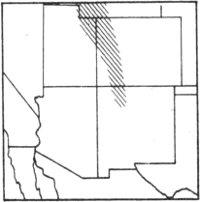
Range: Canada and the high mountains of California, Utah, Colorado, and possibly New Mexico.
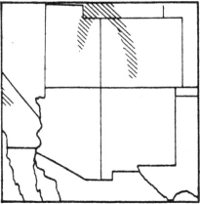
Habitat: Near timberline in the most remote areas.
Description: A large (20 to 35 pounds), dark-colored animal somewhat resembling a small bear in build. Total length 36 to 41 inches. Tail 7 to 9 inches. In coloration the wolverine shows variation, but with no sharp contrasts. The back is dark brown, shading to a paler color on top of the head. The sides of the body are marked with dull yellowish bands which begin at the shoulders and join near the root of the tail. The underparts are lighter and usually a “blaze” or spot of white decorates the front of the chest. The legs are short and exceptionally powerful, the large feet are armed with long, horn-colored claws. These register rather prominently in the track which otherwise is somewhat like that of a large bobcat. The breeding habits of the wolverine are not well known, but it is assumed the den is located among rocks in talus slopes. The average number of young is thought to be four or less. They are born early in the year.
This mammal, largest of the weasel family, possibly will never be seen by anyone who reads these lines, so scarce has it become in the United States. 96 Yet, because it is such a notorious animal and so little understood, and because it has been recorded in both Utah and Colorado several times, and long suspected to have been a native of New Mexico, it is here included. It would be a shame, indeed, for a layman to see this celebrated creature and not be aware of this unusual good fortune.
The wolverine has been an object of fear and revulsion not only to the white man but to the Indian. It seems to be one of the few mammals which goes out of its way to create destruction and carries a chip on its shoulder toward all other animals which interfere with its desires. It is a creature of mystery, whose life history at this late date we shall probably never fully learn before it becomes extinct.
When the Hudson Bay Company trappers invaded upper North America they found the Objibwa Indians living in a sort of armed truce with the wolverine. They called it “Carcajou,” a term said to have been derived from the Algonquin, and accorded it the respect due a malevolent spirit. I have forgotten the Chippewa name for the animal, but I well remember that it was considered a “windigo” or evil spirit. Eskimos coveted its fur for trimming the hoods of their parkas. The long guard hairs protected the face from the bitter air without collecting frost, and the underfur did not collect snow and frost like other furs.
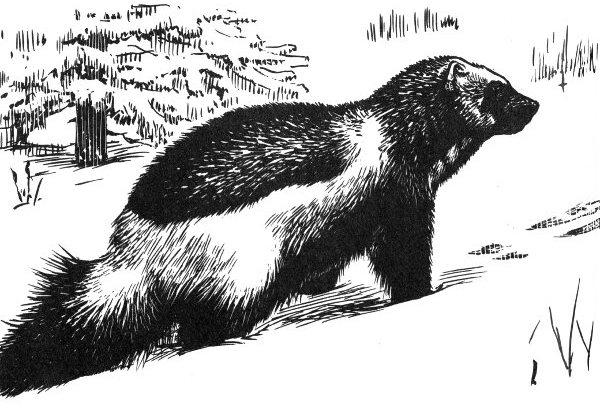
wolverine
The scientific name of the wolverine is interesting. Gulo, the Latin term for throat, no doubt has reference to the gluttonous habits of the animal. Luscus, also Latin, means one-eyed or, as some authors suggest, blind. This may refer to the small eyes, so deeply set as to be almost invisible at a little distance, or may date back to the first wolverine taken to Europe from Hudson Bay. This specimen was said to have 97 lost one eye, and the name may have been derived from that. At any rate, the normal wolverine is neither one-eyed nor blind.
The wide distribution of the wolverine provides an admirable example of what life zones mean. This same species lives at timberline in the high mountains of desert country and is also found at or near sea level far north of the Arctic Circle. It is well adapted to this environment, with exceptionally thick and heavy fur which does not mat easily with snow. In addition, during the season of greatest snowfall, the edges of the feet and toes grow stiff hairs which, in effect, act as small snowshoes, and enable the animal to travel with less effort.
Food habits of the wolverine are far from selective. Heavy and clumsy in build, it is doubtful if many large game animals fall prey to this awkward hunter. However, it does not hesitate to drive larger predators away from their kills and appropriate them for itself. At such times it eats as much as it can, then hides the rest for future repasts. It will return to the site until the remains are completely devoured, even if they spoil in the meantime. Natural prey includes rodents which it can dig out of burrows, and such ground-nesting birds as it comes across in its travels. It is said to be one of the few successful predators of the porcupine. Thief, predator, and scavenger, the wolverine roams its isolated ranges feared by hunter and hunted alike.
The wolverine is one of the few animals that seems to take malicious delight in harassing human beings. Though robbing of traps can be explained by hunger, theft and destruction of the traps themselves seems to represent deliberate and clever planning. So, too, does the breaking into and entering of isolated cabins with attendant pilferage of their contents. What cannot be eaten is either broken up and defiled or carried away and hidden.
Marten Martes americana (Latin: a marten ... America)
Range: North America from Alaska through the greater part of Canada, thence through northwestern, United States and south into California, Utah, Colorado, and New Mexico.
Habitat: Usually coniferous forests of the Canadian Life Zone up to the Alpine Zone.
Description: In the trees, this animal is often mistaken for a large squirrel. On closer inspection it will resemble a house cat with a short, bushy tail. Total length 22 to 27 inches. Tail 7 to 9 inches. Weight 2 to 4 pounds. The coloration of the marten is distinctive. The body is a beautiful, soft, yellow-brown, darker on the back, legs and tail. On the chest the color lightens to a pale buff or sometimes a rather distinct orange. The underparts are lighter than the rest of the body. The fur is extremely fine and thick. It is distinctive in being almost entirely underfur, there being very few guard hairs. The body is extremely graceful with 98 relatively long legs and small feet. The head is small with features somewhat resembling those of the weasel. The ears are large for a member of the weasel family and lend an alert appearance to the face. This alertness is further borne out by the lively movements of this animal, which is the most active of any in that group.
The marten, often called “pine marten,” is one of the most solitary animals of a group whose members habitually travel alone. Perhaps this is because in this family of predators each species is fully able to overpower any resistance put up by its accustomed prey, individually and not through force in numbers. Perhaps, too, it is because the entire group is made up of voracious eaters which, if they ran in packs, could not encounter enough prey to adequately feed them all. Finally, this clan has several species which instinctively kill far in excess of normal needs. This is a practice which, almost without exception, is confined to those members of the weasel family which prey on rodents. It is evidently one of Nature’s methods of controlling the rodent population. To operate at highest efficiency these killers should hunt alone. These factors all apply in some degree to the marten. As a consequence, although there may be many in an area, the marten is usually found alone except for a brief time during the breeding season or in the case of a female with young. The male evidently has no part in bringing up the family.
The marten has always been more or less plentiful throughout its range, and there is no reason to believe that it will not continue to be seen by alert observers for many years to come. Its chosen habitat is among the evergreens near timberline. This is also an area of rock slides, and the marten loves to hunt the small rodents which make their homes there. Indeed, it divides its time between the two environments, hunting in the talus slopes during summer months, and taking to the trees in winter when rock slides are buried deep beneath the snow. It is an extremely hardy creature which holes up in an abandoned squirrel or woodpecker nest only during the short periods of storm, when hunting would be useless. As might be expected, its summer and winter diets vary widely. Both, however, have as their basic item the spruce squirrel, the important host of the marten, and like it a hardy creature that is abroad throughout the year.
There is considerable variety in the summer diet. On and in the ground there is available an amazing number of species which are denied to the marten during the winter, some because of protection afforded them by the deep snowdrifts and others because they hibernate. Among these are pikas, ground squirrels, woodrats, chipmunks, and many species of mice. In summer, the marten also takes eggs and young of ground-nesting birds. In the trees are found other nests, not excepting those of the woodpecker, into which the marten inserts its forepaw and comes out not only with young birds, but often the adult as well. Martens are known to eat quantities of the larger insects and, since they are fond of fruits and berries when raised in captivity, there is little doubt that they indulge in these delicacies in the wild.
Winter diet consists of the spruce squirrel, augmented by such 99 other small creatures as may be abroad during cold weather. Though it would seem that the marten might suffer from the curtailment of its lavish summer menu, the opposite is the case. They remain fat and healthy under weather conditions that would seriously hamper most other predators. To a large extent, this ability to survive is due to the untiring perseverance and great skill with which they hunt. In addition, few creatures have been endowed with so many adaptations with which to withstand the long, cold winter.
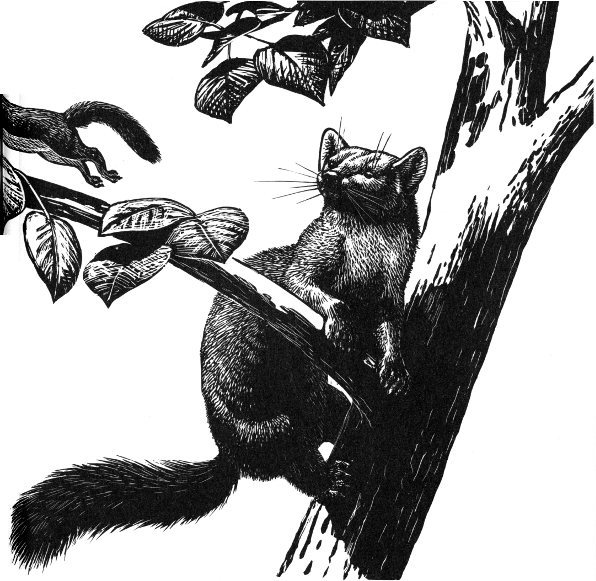
marten
It will be apparent, even to the casual observer, that the marten is most precisely evolved to meet the frigid conditions imposed by its boreal habitat. The long, fine-haired winter coat is extremely warm and does not mat with snow or frost. With such an insulated covering any hollow log or woodpecker’s nest will do as a resting place. Snow is the least of the marten’s troubles; not only does it stay warm among the drifts, but travels across them with ease on its “built-in” hair snowshoes, which also keep the toe pads warm. The midwinter track of a marten is rather confusing, as it shows no definite toe marks, but is 100 a blurry outline in soft snow, and on harder snow scarcely registers at all. However, if it is remembered that this animal travels much like a weasel, that is, it jumps instead of walking, the larger prints will serve to identify it as a marten.
Interesting as the physical adaptations of the marten may be, the response of its life history to the pressures of a long winter are no less fascinating. As has been stressed, the marten is a solitary and more or less nomadic animal. Apparently the only time of the year that is favorable for breeding is during the summer, as this is the only time when adults of the two sexes are commonly found together. This starts a reproductive cycle which, while not too uncommon, is unusual enough to excite one’s interest. For the following information, I am indebted to James Campbell of Hope, Idaho, who live-trapped and raised many of these interesting animals years ago when knowledge concerning them was relatively meager.
Box traps were used to take the marten during the middle of the winter, when snow lay from 15 to 25 feet deep along the trap lines. This was at an elevation of up to 6,500 feet in the panhandle of northern Idaho. As a sprung trap was approached, the outraged captive could be heard growling its resentment and struggling to escape. A flour sack would be placed around the entrance and the door opened. The marten, apparently mistaking the white glare for snow, invariably would leap out into the sack. Great care was necessary at this point, for the marten was usually wet with perspiration from its struggles within the box trap, and if allowed to chill would quickly die from exposure. The sack was placed within several others and the bundle placed in a pack-sack and carried down the mountain, where the marten was cooled gradually in the house, then put in the outdoor pens. Here they soon became so tame that they would readily accept food from the hand, never becoming treacherous like their unpredictable cousins, the mink. They loved fruit and berries, and were especially fond of chocolate candy.
Early in the venture, it was observed that winter-caught females were giving birth to young in April. Further observation revealed that breeding took place from the early part of July into late August, but that no matter when breeding was accomplished the young would be born in April. The first signs of pregnancy, however, would not be apparent until about 50 days before birth of the young. This indicates that, like most of the hibernating bats, breeding takes place in one season, but the fertilized ova remain quiescent and do not begin to develop until conditions are propitious for the birth of the young. This also insures arrival of the little ones quite early in the season, so that they may enter the following winter fully grown. The number of young varies from three to five, usually the smaller number.
No description of the marten would be complete without mention of its tremendous vitality. In trees it is superior to the squirrel, especially in long, arching leaps, which it makes from one lofty perch to another. In winter time it will often leap from the trees into soft snowdrifts, seemingly for the sheer thrill of the sport. It is not uncommon for martens to burrow through snowdrifts for some distance apparently 101 in search of rodents. I have found that a marten, startled in the forest, is not usually too afraid of its arch enemy, man. At first it will run away but, if pursued too hotly, will come to bay on a low limb and put on a great display of hissing and growling while baring its sharp, white teeth. It is not improbable that if it were pressed further it might attack its tormenter.
River otter Lutra canadensis (Latin: otter ... of Canada)
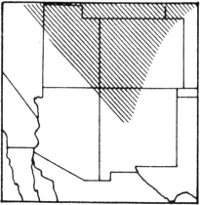
Range: Most of North America south to central Arizona and New Mexico in the Southwest, and south to the Gulf of Mexico in the east.
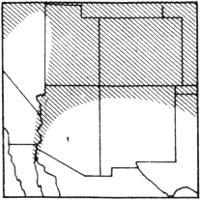
Habitat: Along and in fresh water streams and lakes.
Description: A short-legged, stream-lined creature with a thick tapered tail, usually seen in the water. Total length 3 to 4 feet. Tail 12 to 17 inches. Weight up to 20 pounds. Color mostly a rich, dark brown with a silvery sheen on the underparts. The throat and chest are lighter than the rest of the body. The otter is well adapted to aquatic life, having a long, round body and short, muscular legs. All four feet are webbed. The head is long and round, with short ears. Long, stiff whiskers stand out near the rather thick nose. The tail is thick at the base, and the body literally tapers off into the tail, increasing the general “torpedo” effect.
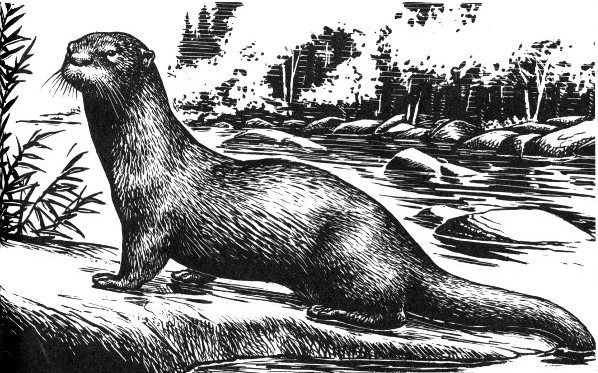
river otter
The otter, never plentiful in the Southwest, has become extremely rare in recent years. This is due in large part to its highly specialized 102 habits, coupled with an inability to compete with man in the use of the few fresh water streams and lakes in the desert mountains. Yet, it has been recorded often enough in the past decade to warrant the hope that with careful management and complete protection it might increase in numbers. This is much to be desired because the otter is unique in several respects among our native mammals. This mild-mannered member of the weasel family lacks many of the fierce and blood-thirsty habits of its more ferocious relatives. It is, instead, gentle, even playful.
Outstanding among these characteristics is the otter’s habit of building slides. These are probably nothing more or less than a refinement of the way otters travel through the tules and slippery mud flats, in which they spend much of their time hunting crayfish and small amphibians. The remarkable thing about the slides is that they seem to be built for one specific purpose, that of sport, an activity which ordinarily is one of the least important to most mammals. In soft or muddy places, even in soft snow, the otter slides along on its chest with head held high and forelegs trailing alongside the body. Motive power is furnished by thrusts of the hind legs. Excessive wear on the underparts is reduced by many coarse, close-set overhairs which seem to have been developed for this very purpose. The slide itself is only a narrow groove, 12 to 20 inches wide, that is worn down a steep bank to the water’s edge. The wet bodies of the otters make it smooth and slippery, and soon they are able to shoot down it with only an occasional helping kick of the hind feet. This fascinating game may go on for hours on end. The descent often is followed by a general rough and tumble in the “swimming hole.” There the action is almost too fast for the eye to follow, because few mammals can match the otter for grace and speed in the water.
Aquatic as the otter is, it does not care to be always wet, and this leads to another curious institution in its way of life. Near the slide, and usually at several other places along the waterway which is frequented by a family of these delightful creatures, will be found areas several feet in diameter, located among dry tules or in tall grass, where the animals roll and thus dry themselves. These seem also to be community news centers, because usually near such areas are found the scent “posts,” where otters deposit scent from the glands common to all members of the weasel family. In otters these glands do not secrete the high-potency perfume produced by those of skunks and minks. Nevertheless, it is sufficiently “loud” to be identified with the otter.
The dens present great contrast in location and type. They are usually situated near water, but one was found more than half a mile from the nearest stream. On the other hand, an otter will often take over the abandoned burrow of a bank beaver, and access to this abode must be by an underwater entrance. In many instances, the den is merely a nest in a thick clump of tules completely surrounded by water.
The two to four young are born in early spring. At birth they are blind, toothless, and amazingly helpless in comparison with their development 103 6 weeks later. At this age they begin to leave the den, and before long are quite at home in the water. Though the male may be in the neighborhood, the female will not allow him near the young until they are half grown. At this time, the family will begin to live together until the young are fully able to make their own way.
Otters are cosmopolitan in their tastes; being carnivores, they will prey on many species. Fish is their preferred food, and in most cases they capture rough fish species, these as a rule being slow and easy to catch. They are fully capable of catching trout, however, should other supplies fail. Otters in captivity do not thrive on fish alone, so evidently the great numbers of other small animals upon which they prey must be necessary adjuncts to their diet. These include crayfish, frogs, several species of small mammals, and such birds and eggs as may be available.
The presence of otters in an area is not difficult to detect. A slide, “rolling place,” or characteristic web-toed track are all sure indications that this interesting animal is a neighbor. Cultivate its acquaintance if you can. The otter is diurnal as well as nocturnal, and should you be so fortunate as to see this happy animal coast down his slippery slide, I am sure you will get as big a thrill from it as he does.
Mink Mustela vison (Latin: weasel ... forceful, powerful)
Range: The range of the mink is strikingly similar to that of the otter, that is, it embraces most of northern North America, extending southward into southwestern United States in the west, and to the Gulf of Mexico in the east.
Habitat: This semi-aquatic animal seldom is found far from fresh water streams or ponds.
Description: The mink is about as long as an average house cat, but is much more streamlined in appearance. Total length for males 20 to 26 inches. Tail 7 to 9 inches. Weight up to 2¼ pounds. Females will average almost one-third smaller. Color is dark brown over most of the body, shading to lighter brown on the sides and darkening along the tail to a black tip. There are usually a few irregular white spots on chest and belly. The body is long, and round, tapering into the long, round neck. The head is small with rather a triangular face, small ears, and dark, beady eyes. The legs are short and, as would be expected on an aquatic animal, the feet are webbed, but in this case only the bases of the toes are joined by the webs. The underfur is thick and fine, the guard hairs coarse and conspicuously shiny. Mink will bear as many as 10 young, but the average is around 5. Dens usually are in a burrow, 104 which may or may not have an underwater entrance.
The presence of mink in any given area is usually quite easily determined by scouting sand bars and mud flats along the water’s edge. The tracks are quite distinctive, especially in softer mud, because here the animal spreads its toes to keep from sinking, and in places the outlines of the partially webbed toes become clearly apparent. In most cases if tracks are at all discernible, marks of the claws are conspicuous. The occurrence of mink away from water can not be considered normal, because this creature ranks second only to the otter, among southwestern carnivores, in its preference for an aquatic life. Exceptions do occur, however; mink have been encountered crossing mountain ranges where they might be many miles from the closest watercourse. It is thought that these infrequent cases may be migrations from unfavorable areas, or that such a trip may be undertaken in search of a mate.
Much of the mink’s dependence on water stems from its diet. Some of its preferred foods are fish, crayfish, and frogs, none of which are more adept in the water than the mink. Other food items, taken whenever circumstances permit, are birds and eggs and rodents. It is interesting to note that the muskrat is no match for the agile mink, and that one of these fierce carnivores moving into an area has resulted in the extermination of a whole colony of muskrats. Cottontails, too, are unable to cope with the tactics of the mink, although their reproductive proclivities usually keep their numbers well ahead of such inroads. Even with this wide variety of prey and its expertness at hunting, the mink is so voracious that in some areas it has been estimated 100 acres are only enough to support one adult. The continual hunt for food may be the motivation for another interesting habit of the mink which is seldom found among other carnivores.
Many beasts of prey will hide or bury a kill and come back to it later for several more meals. In fact the wolverine, one of the mink’s close relatives, will do this. However, the mink actually collects a considerable store of food during periods of good hunting and caches it away against time of need. Caches will often consist of larger animals, such as muskrats and ducks, laid neatly away under an overhanging bank. Since these stores are highly perishable, this is mostly a cold weather practice. The mink is not normally a carrion eater.
A characteristic of the weasel family is the occurrence of anal glands which secrete a liquid having a powerful odor. The skunks are best known in this respect. In my opinion the mink and weasel both release an odor which, by comparison, makes the skunk’s “almost nice.” The one saving grace in their case is that the odor soon evaporates, while that released by the skunks retains its strength for a long time, and regains much of the original potency with every rain. Like the skunks, these animals use the disagreeable odor as a defensive weapon. It no doubt has other uses too, such as identifying the individual and its territory to other animals of the same species.
Considering the weasel family as a group, it becomes apparent that here is a rather large number of species, all closely related, yet having widely divergent habits. For instance, the marten is as much at home 105 in trees as is the squirrel; the otter can catch fish with ease; and the badger is able to dig better than even the ground squirrels and spends much of its life underground. In the same way, the group varies widely in temperament. At one end of the scale stands the wolverine, surly and defiant; at the other are the marten and otter, playful and even affectionate. The mink might be classified as nervous and irritable. There seems in its temperament to be an actual blood lust. When the mood is upon it, it will continue to kill even when a human is close by. I have seen a mink continue to slaughter a flock of ducks even as I was attempting to drive it away. A mink cornered is a creature to reckon with; there are few animals its size that are so courageous.
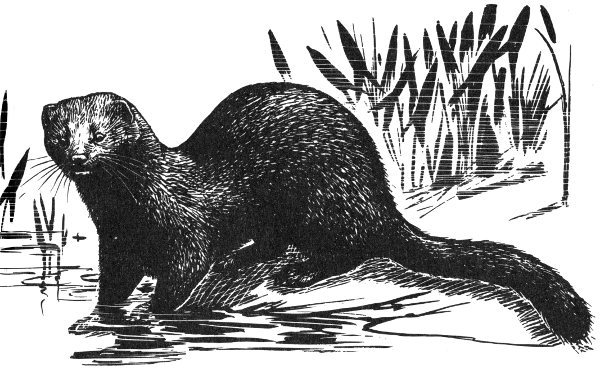
mink
As might be suspected, such wildly fierce creatures make poor parents. The females sometimes desert the young while they are still too small to make their own way. Yet this, after all, is but a human criticism. Who is to condemn an animal which Nature has allowed to exist under conditions that would have eliminated a more amicable species?
Short-tailed weasel (ermine) Mustela erminea (Latin: weasel ... from the fur ermine)
Range: From northern Greenland south to northern United States with one extension south into Utah, Colorado, and New Mexico. To be expected in northern Arizona.
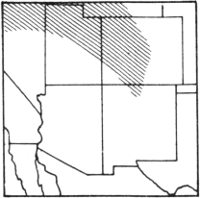
Habitat: Generally found in forests of the Transition Life Zone and higher. It will often be found in the Arctic Zone.
Description: A tiny predator with long body and short legs. Total 106 length from 7 to 13 inches. Tail 2 to 4 inches. Weight 1½ to 3⅔ ounces. This wide range in statistics is from comparing the smallest females with the largest males. Males consistently average from one-fifth to one-fourth larger than females. Summer color is dark brown with white underparts and feet. There is a white line down the insides of the hind legs connecting the white of the feet with that of the belly. The tip of the tail is black. Winter coat is all white with the exception of the black tail tip. The body is long and supple, legs are short, the neck long and round. The head is small with rather large, bulging dark eyes. The ears are large for a creature of this size. Breeding dens are usually in the ground under large rocks or among the roots under a tree. Average number of young is thought to be about four.
I have a special affection for this tiny predator which, because of its fearlessness, has given me many a glimpse into its private life which would not have been possible in the case of a larger or more timid creature. Let no one underestimate the courage of this small mustelid which, if left alone, will continue its normal activities even under the close scrutiny of an observer, but if molested will often turn on its tormenter with a fury matched by few large animals. It shares these characteristics with two other relatives of the United States: the longtailed weasel (Mustela frenata), which is also found in the Southwest, and the least weasel (Mustela rixosa), which inhabits part of the northern United States, Canada, and Alaska. The short-tailed weasel will not be mistaken for either of the other species, since the least weasel has no black tip on the tail and the long-tailed weasel has a tail about one-third of its body length. The tail of the short-tailed weasel is only about one-fourth of its body length, and this species is considerably smaller than the long-tailed weasel.
Short-tailed weasels are the smallest carnivores in the Southwest. In fact, except for the least weasel, they are the smallest on the North American Continent. Despite its size, Mustela erminea is so hardy it ranges to the northernmost point of land in the Northern Hemisphere. This, the north coast of Greenland, is but a few degrees from the North Pole. The European form, not specifically distinct from ours, is equally hardy. It, too, inhabits not only the more temperate zones, but penetrates far north of the Arctic Circle wherever land is found. In our Southwest they are sometimes encountered at low elevations but more often in the higher mountains. Here they go through the winter change of color, but not so regularly nor so completely as in the far north.
The term “ermine” refers to this animal’s fur in the winter pelage. This is the royal ermine, reserved in days past for the use of the aristocracy. At its best this fur is a spotless white, except for the sharply contrasting black tail tip. In heraldry the pure white had symbolic significance, but to the weasel it has more mundane uses. These are as camouflage, both in pursuing prey and in avoiding attacks of enemies. In the far north this seasonal change of garb is mandatory and complete, but in the mild (by comparison) climate of our southwestern 107 mountains the situation is somewhat altered. Here the creature can descend to lower elevations as winter comes on and, if it wishes, evade most of the severe weather. Under conditions which to some extent are left to its own choice, the degree of color change varies greatly. In snowy areas on higher peaks it will change to true ermine; lower down it probably will turn to a light yellow, and below snowline the animal will retain the same brown above and white below that it wears all summer.
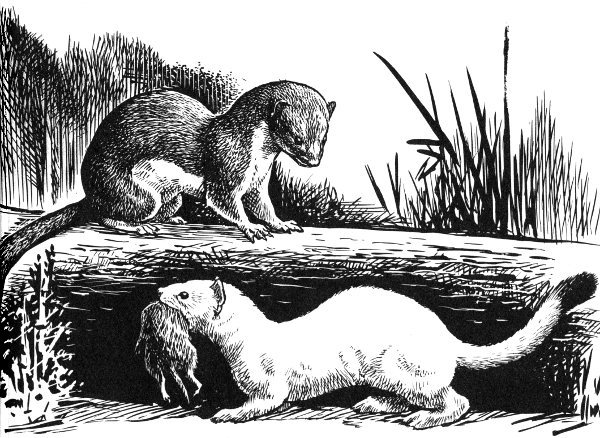
short-tailed weasel
Like most other members of the weasel family, these small mustelids are admirably adapted to do their part in Nature. Their size permits them to enter the homes of all but the very smallest rodents. Their strength and suppleness combined with ferocity enables them to subdue animals several times as large. Surprisingly enough, though well able to climb, they do not eat many birds. Most of their prey is rodents. Small mice seem to be preferred, though chipmunks, ground squirrels, and woodrats also are taken. Pikas and small rabbits fall prey to these mighty mites, and there are many recorded cases of snakes being killed by them. Like the mink, short-tailed weasels will gather a cache of food when hunting is good. For their size they have a tremendous appetite; it has been estimated that one will eat half of its own weight in food 108 every 24 hours. From this it will be seen that they can live only in an area where rodents are plentiful, and that they play a large part in keeping these creatures under control.
I have been privileged to see this weasel many times and under varying circumstances. In all of these encounters it has seemed evident that at first the animal accepts the intrusion of man not so much as an enemy, but rather as a competitor. Under these condition it will continue its activities and pay very little attention to the intruder. However, should any hostile action be taken against it, the weasel will make its escape, if possible. If cornered it will savagely defend itself, and as a last resort spray its attacker with the foul-smelling contents of the anal gland. Not so long lasting as the skunk’s perfume, this odorous mist is nearly as effective while it lasts. How much better to stand aside and watch the little predator go about its work!
If you are fortunate enough to be in an area where a hay meadow is being irrigated, you will see the meadow voles (meadow mice) being flooded out of their homes. A careful watch may reveal one or more short-tailed weasels taking their toll of these hapless refugees. You may even find a cache laid away during this period of good hunting. Neither pity the voles nor scorn the weasel; both are only fulfilling their destinies in an ages-old plan.
Spotted skunk Spilogale gracilis (Greek: spilos, spot and gale, weasel ... gracilis, Latin: slender)
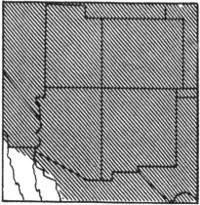
Range: This species, together with several subspecies, is the common spotted skunk of the Southwest. It has a “spotty” distribution over the whole of the four-State area with which this book is concerned.
Habitat: Common in most situations which offer suitable environment from near sea level, to an elevation of approximately 8,000 feet. Seldom encountered above timberline. These skunks normally live in burrows in the ground, but are not averse to taking up residence under buildings or in the walls or attics of frame houses.
Description: A small, nocturnal, black and white animal about the size of an average grey tree squirrel. Total length about 16 inches, of which 6 inches is taken up by the tail. One description of the color pattern would be to call it marbled. The head usually has a prominent white spot between the eyes, with several smaller spots on the sides of the face. The forequarters are marked with four lateral, irregular white stripes which reach to mid body. The rump is variously blotched with white. Tail very bushy and about half white and half black. Eyes dark in color, ears small. Feet small but plantigrade as in the larger 109 species of skunks. Young number three to six, born in early summer.
Although this little animal has a slight heaviness of the hind quarters, reminiscent of the larger skunks, it is indeed, as both generic and specific names suggest, much more like a weasel. This impression is heightened by its quick movements and a bright-eyed attention to details which its larger relatives would hardly notice. It lacks the wild and fierce disposition of the weasels however, and becomes a charming and confiding nocturnal visitor if properly encouraged. Remember though that this acquaintance can be no more than an armed truce, and that should the articles of Formal Conduct be violated it can be terminated at a moment’s notice.
Probably no nocturnal mammal in the Southwest is more likely to be encountered than this little skunk. How many of my readers can recall drifting up from an uneasy sleep to the sibilant whisper of, “there’s something in the tent.” While eyes strain to pierce the darkness, faint patterings on the floor and urgent scratching at the grub box indicate that there is indeed “something in the tent.” Turning over with the utmost care, while the joints of the cot loudly complain, the flashlight under the pillow is finally extricated. Surely the creature has been frightened away, but no, the rattlings continue—in the dishes now. The brilliant white beam stabs in that direction. Red eyes stare back, interested perhaps, but unafraid. The rounded ball of black and white fluff waits motionless to see if any harm is intended. When none is offered, his highness makes his way to the door and ambles away into the enveloping darkness. In the morning tiny squirrel-like tracks in the dust show that Spilogale has paid a nocturnal call. These, and perhaps the contents missing from the butter and bacon grease containers, because this little animal dearly loves animal fats. These are the foods which attract these animals to camp sites in such numbers that they frequently become a nuisance.
In the wild, spotted skunks live largely on insects. These are taken not only in the adult form but also in great numbers in the larval stage, as is shown by the well-winnowed debris under clumps of cactus and around the bases of shrubs and trees. In these searches for insects small prey of other kinds is captured as circumstances permit. Worms and scorpions as well as small rodents are not refused. More rarely a ground-nesting bird may be disturbed and the eggs or young taken. In rural communities hen roosts are sometimes raided too but in the main the spotted skunk should be considered beneficial, with control of grasshoppers and beetles it’s chief function.
Like most predators, this member of the weasel family has few natural enemies. This is not surprising; few animals willingly take a chance on attacking this doughty little warrior, which sometimes does a handstand the better to spray it’s enemies. These tactics avail nothing against the steely monsters that rush up and down our highways in the dead of night. In the space of 50 years the automobile has developed into the most successful enemy of the spotted skunk. Yet even in death on the highway the skunk has it’s revenge. Few will pass the spot for many a day without paying unwilling tribute to this malodorous legacy.
110
Striped skunk Mephitis mephitis (Latin: a pestilential exhalation)
Range: The southern half of Canada, the whole of the United States, and the northern half of Mexico.
Habitat: All life zones up to timberline in places which have a sufficient food supply and proper cover.
Description: This is the “wood kitty,” approached with due respect by all but the most naive. About the size of a house cat. Total length 22 to 30 inches. Tail 8 to 15 inches. Weight 6 to 10 pounds. Body color is black, with black tail except for the tip, which is commonly white. There are usually two white stripes on the back joining in a “V” at the back of the head and a white stripe down the front of the face. The head is small with a rather pointed nose, small black eyes, and small ears. Front legs are short, and the small feet are tipped with stout claws. Hind legs are longer and appreciably more of the large hind feet touch the ground. The tail is quite long and extremely bushy. It is carried in a downward curve when traveling; if its owner is startled or angry, it is held straight up with the hairs flared out. Dens of the striped skunk are usually in an underground burrow, but dens in hollow logs have been recorded. The usual number of young average from four to six. The family remains together for the greater part of a year before the young leave to make their own way.
There are four species of skunks in the Southwest, but the observer in the higher country will see only two. These are the striped and the spotted. They are distinguished by two characteristics: first, the striped skunk is easily double the size of the spotted skunk; and, second, the spotted has a pattern of broken stripes and spots of white, whereas the larger animal has definitely long, continuous white stripes along sides or back. Both species have the same method of defense, but the odor of the smaller skunk is said to be somewhat less pungent and dissipates sooner than that of the striped. To the recipient of either barrage this has the same consolation as if he were given a choice between being hit by the H bomb or the A bomb. In the event of a direct strike it makes little difference.
Should the reader be involved in an encounter with one of these malodorous creatures, there are many remedies prescribed but few giving any great measure of relief. If the skin is washed with a weak solution of acid such as lemon or tomato juice and then scrubbed thoroughly with soap and water, much of the odor will disappear. Clothes can be given the same treatment, but usually it is cheaper and easier to burn them and charge the cost to experience. Grandpa said to bury scented clothes in damp earth. Perhaps in time this will do the trick; I contend they are better left there.
So much misinformation exists about the skunk’s defensive mechanism and the manner in which it is employed that brief explanation may not 111 be amiss. The scent is a fluid stored in two glands located near the base of the tail. These glands are embedded in a mass of contractile muscle, and each has a duct which connects with a tiny spray nozzle that can be protruded from the anus. When danger threatens the tail is lifted, the nozzles aimed at the enemy, and the contraction of the muscles around the glands forces out a spray of fine droplets which may carry as far as 15 feet. The result is usually effective and lasting. Contrary to popular belief, the odor is distressing to the skunk as well as to its enemy. The tail is kept out of the way if possible, since its plumey depths would hold the scent for a long time.
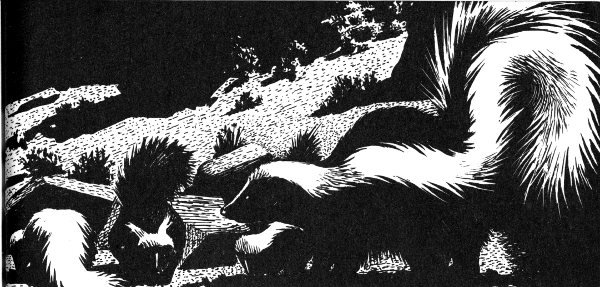
striped skunk
Skunks of different species will use this defensive weapon against each other. Whether individuals of the same species use it in their fights together is not known. In situations involving humans the skunk will try to bluff the enemy if possible. This consists of stamping the front feet, of short runs at the intruder, and finally of hoisting the tail and aiming the “guns.” If a skunk is approached deliberately and if quick movements are avoided, it is surprising what liberties may be taken before it will resort to scent. On the other hand, should it be taken by surprise or should it be physically hurt, retaliation is swift and certain. In all cases where skunks are encountered at close range, remember that this little animal is one of the most independent creatures on earth, that this nonchalance stems from a supreme confidence in its defensive powers, and that if left alone or at least treated with consideration it will go on its way as soon as possible.
This independent attitude inherent in all skunks probably has much to do with the happy-go-lucky life that the young family lives. About midsummer when the young are able to leave the burrow, the mother often will take them for a stroll early in the afternoon. As she walks, oblivious to danger, the young play along behind her, sometimes a ball of struggling little bodies with now and then a fluffy tail breaking free and again all at odds in a mock show of ferocity with front feet stamping and flared tails held aloft. When the patient mother finds a tidbit on the trail, there is a concerted rush for the prize, which is seldom won without a struggle. All of this is excellent practice 112 against the time when they will be on their own. It is during this early age that the young first learn to catch insects, items of great importance in skunk diet. Later frogs and small mammals will also be preyed upon.
The striped skunk is generally considered a hibernating animal. This is not strictly true for, while it may remain inactive in its den for weeks at a time, the body processes do not slow down to the extent common in true hibernation. The skunk does lay on a considerable amount of fat each fall in preparation for this period of winter when food is scarce. Actual retirement to a den for even a few days is rare in the Southwest, however. The mild climate makes this unnecessary, except in the highest part of their habitat.
Black bear Euarctos americanus (Latin: a bear ... of America)
Range: At present the range of the black bear in the United States is confined to a narrow strip adjacent to both the Atlantic and Pacific coasts, a few of the southeastern States, a narrow band in the Great Lakes area, and the Rocky Mountain chain.
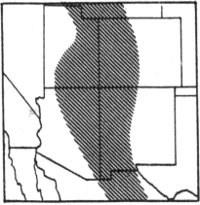
Habitat: In the Southwest, the higher mountains mostly in the Transition Life Zone and above.
Description: The black bear needs little description because through pictures and reputation it has become well known to almost everyone. It averages 5 to 6 feet in total length with a tail so short as to be inconsequential. Height at shoulders is 2 to 3 feet. Weight 200 to 400 pounds. Color varies in the Southwest from deep, shining black through brown to light cinnamon. In all color phases the nose is brown almost back to the eyes and there is usually a white “blaze” on the chest. The legs are short and muscular. The feet are plantigrade, that is, the bear steps on the whole foot, not just the toes. There are stout claws on all four feet. The head proper is rather round, the muzzle long and pointed. Ears are relatively small, as are the dark eyes. The young number from one to four, with twins being very common. They are born while the mother is still in winter quarters. When the weather moderates to a point where she can leave, the cubs are large enough to follow her.
Bears are probably the most popular of our wild creatures to those who visit the National Park Service areas. Why this should be is hard to say. Perhaps it dates back to the nursery tale of the three bears, familiar to all of us from the time we were able to walk. Perhaps too it stems from the easy familiarity with which these roadside bandits hail the tourist in hopes of a handout. At any rate, these seemingly friendly clowns have become endeared to the hearts of the American public. This is regrettable because actually in the Park Service areas these big carnivores are the most dangerous of all animals. Native intelligence indicates to the bears that food may be had merely by standing up 113 alongside the road when a car stops. More complicated routines are soon learned to wheedle bigger and better handouts. At this professional level, a substantial reward is expected when Bruin has “sung for his supper,” and should none be forthcoming, trouble is apt to ensue. This is but a minor annoyance to a bear, however, when compared with some of the indignities dealt out to these big creatures by a thoughtless public. It must be said in all fairness that anyone who teases a bear deserves whatever is handed out in return. It is unfortunate that retribution may be in the form of serious injury or even death. Though this applies mainly to the half-tame bears which roam along the highways in our National Parks, it is only common sense to avoid incidents with any bear wherever encountered. This is especially true of an old female with cubs, a combination well nigh irresistible to the average vacationer with camera.
In more remote areas where bears have not had contact with man, they are wary to the point of timidity. Gifted with a keen sense of hearing and smell which makes up for their poor eyesight, they are difficult to approach. Like most animals, they instinctively know that by “freezing” they can in most cases escape being seen. The sunburned coat of the brown phase of the black bear is especially hard to spot in the underbrush. However, with patience and the aid of binoculars, it should not be too difficult to get a glimpse into the private life of these engaging creatures.
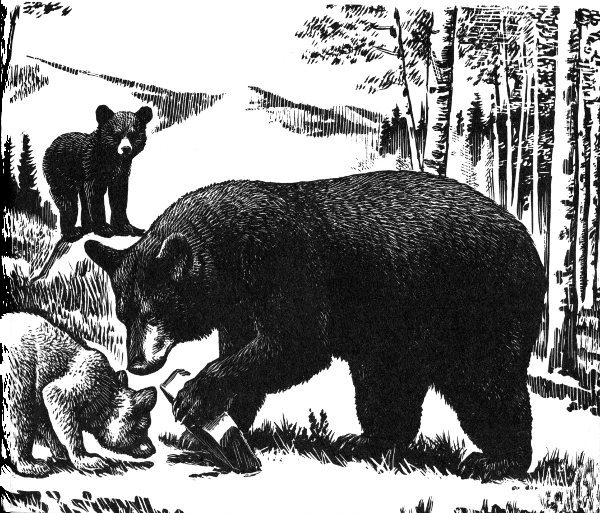
black bear
114
Though bears, because of their dentition, are classed as carnivores, they might more accurately be termed omnivores. It is a matter of record that the black bear will eat almost anything, either animal or vegetable. Nevertheless, its appetite is prodigious and demands little variety, if but a few kind of foods are available. Its status as a predator is somewhat confused. Technically speaking, since the black bear preys on ground squirrels, mice and other small rodents it should be classed as a predator. It will also take young deer and elk whenever it can, but these opportunities come rarely. Actually this bear has little direct influence on its mammal neighbors. As a scavenger it has considerable value in cleaning up the remains of kills made by other predators.
Some of the small animals eaten are in almost amusing contrast with the huge size of their enemy. For instance, ants are eagerly lapped up by most bears, and they will literally tear old logs apart to get at these toothsome morsels. Grubs are another small item which may be found around fallen logs and under stones. Bears are extremely fond of honey and will go to great lengths to get at this delicacy, which they eat comb, bees, and all. Another food item which seems unusual is fish. At spawning time a bear will wade out into a stream and either snag a passing fish on its long claws or flip it out on the bank where it is more easily subdued. Finally, their natural animal diet is greatly augmented in most Park Service areas by the scraps and bones which they pick up on the garbage heaps. They can become a great nuisance in the camping areas where, under cover of darkness, their ingenuity and great strength enable them to steal many a ham and side of bacon.
Wide as this variety of animal food seems, it cannot equal the cosmopolitan tastes of these bears in a vegetable diet. Roots and bulbs of many species are dug up. Grass and browse are eaten during several seasons of the year; even pine needles are recorded as having been eaten. The liking of bears for berries of all kinds is well known. Arctostaphylos, the generic name of the manzanitas, translated from the Greek means “bear grape.” Pinyon nuts, acorns, chokecherries, and other stone fruits all are gathered in season. These heavy animals often damage trees severely in their search for fruit. On the garbage heaps, watermelon rinds and seeds, peelings of all kinds, leafy vegetables, and corn cobs add to the fare. All tin cans are licked clean, and in many cases greasy paper and cellophane wrappings are eaten.
The yearly cycle of a bear’s life is a study in contrasts. Much of the warm part of the year is spent in search for food with which to build up a store of fat so that the winter may be spent in inactivity. Bears hibernate or, more properly, retire for several months of the winter. They do not fall into the deep sleep indulged by some of the rodents. Theirs is an uneasy sleep broken by periods of lethargy when they are awake but avoid any activity. By these means they conserve enough of their thick layer of fat to live out the cold weather and emerge in early spring with a considerable reserve.
Hibernation takes place in late autumn, usually after the first light snows. Evidently the animals have a den already located, for when they feel the urge to retire they strike out across country to it. 115 The same winter quarters often will be used by one individual for several seasons. Dens are chosen in a variety of locations. They may be in old hollow logs or in the bases of fire-gutted trees. Some are in crevices among huge boulders, others in caves. The main concern seems to be to find a place sheltered from the wind and snow. If the floor happens to be covered with chips or leaves, so much the better. It usually is, either from air currents which bring in falling leaves or through the labors of woodrats which deposit much litter in such places. The bears curl up on the floor, and after the first heavy snow there is nothing to mark the spot. In the case of a small den, such as a cavity in the base of a tree, an airhole may form in the drift from the warmth of the animal’s respiration.