THÉOPHILE GAUTIER (continued 4)
I. G. Burnham translation
Perhaps one can really love none but a virgin—a virgin in body and in mind—a fragile bud that has never been caressed as yet by any zephyr and whose carefully hidden breast has neither received the drop of rain nor the pearl of dew; a chaste flower that displays its white robe for you alone, a beautiful lily with a silver urn at which no desire has slaked its thirst and which has been gilded only by your sun, swayed by no breath but yours, watered by no hand but yours.—The glare of the noonday sun is less agreeable than the divine pallor of the dawn, and all the ardor of an experienced heart that knows what life is, yields the palm to the celestial ignorance of a youthful heart just awaking to love.—Ah! what a bitter, degrading thought it is that you are wiping away another's kisses, that there may not be a single spot upon that brow, those lips, that bosom, those shoulders, that whole body which is yours now, that has not been reddened and branded by other lips; that those divine murmurs which come to the relief of the tongue that can find no more words of love, have been heard before; that those excited senses did not learn their ecstasy and their delirium from you, and that away, away down in one of those recesses of the heart which are never visited, there lives an inexorable memory which compares the joys of an earlier day to the joys of to-day!
Although my natural nonchalance leads me to prefer the high roads to unbroken paths, and the public watering-trough to the mountain spring, I absolutely must try to love some virginal creature as spotless as the snow, as timid as the sensitive plant, who can only blush and look down; it may be that, from that limpid stream, which no diver has as yet investigated, I shall fish up a pearl of the fairest water, worthy to be a pendant to Cleopatra's; but, in order to do that, I should have to cast off the bond that binds me to Rosette,—for I am not likely to realize that longing with her,—and to tell the truth, I do not feel strong enough to do it.
And then, too, if I must make the confession, there is at the bottom of my heart a secret, shameful motive, which dares not show itself in broad daylight, but which I must tell you of, since I have promised to conceal nothing from you, and a confession, to be deserving of credit, must be complete;—the motive I speak of has much to do with all this uncertainty.—If I break with Rosette, some time must necessarily pass before her place is filled, however easy of access the class of women may be among whom I shall seek her successor; and I have fallen into a habit of enjoying myself with her which it will be hard for me to break off. To be sure I have the resource of courtesans; I liked them well enough in the old days and I did not hesitate to resort to them under such circumstances;—but to-day they disgust me beyond measure and make me ill.—So I must not think of them, and I am so softened by indulgence, the poison has penetrated so deep into my bones that I cannot bear the idea of being one or two months without a woman.—That is pure egoism of the basest kind; but it is my opinion that the most virtuous men, if they would be perfectly frank, would have to make nearly a similar confession.
That is the true secret of my captivity and, if it weren't for that, Rosette and I would long ago have fallen out for good and all. Indeed it is such a deathly bore to pay court to a woman, that I haven't the heart to attempt it. To begin again the charming idiocies I have already said so many times, to play the adorable once more, to write notes and reply to them; to escort the charmer, in the evening, to some place two leagues away; to catch cold in your feet and your head standing in front of the window watching a beloved shadow; to sit upon a sofa calculating how many thicknesses of tissue separate you from your goddess; to carry bouquets and go the round of the ball-rooms to reach the point where I now am, is a vast deal of trouble!—It's about as well to remain in one's rut.—What is the use of leaving it, only to fall into another exactly like it, after much unnecessary agitation and untold trouble? If I were in love, the thing would go of itself and it would all seem perfectly delightful to me; but I am not, although I have the most earnest desire to be; for, after all, there is nothing but love in the world; and if pleasure, which is only its shadow, has so many allurements for us, what must the reality be? In what an ocean of ineffable bliss, in what seas of pure, unalloyed delight must they swim whose hearts Love has pierced with one of his gold-tipped arrows, and who burn with the delicious warmth of a mutual flame!
Beside Rosette I feel that insipid tranquillity, that sort of slothful well-being which results from the satisfaction of the senses, but nothing more; and that is not enough. Often that voluptuous indolence turns to torpor, and that tranquillity to ennui; thereupon I fall into aimless meditation and dull, spiritless reveries that weary and harass me;—it is a state of things that I must put an end to at any price.
Oh! if I could only be like some of my friends, who kiss an old glove with ecstasy; who are made perfectly happy by a clasp of the hand; who would not exchange for a sultana's jewel-case a few wretched flowers half-withered by the heat of the ball-room; who cover with tears and sew into their shirt, where it will rest against the heart, a note written in an inelegant style and so stupid that you would think it was copied from the Parfait Secrétaire; who adore women with large feet and apologize for them on the ground that they have noble souls! If I could follow tremblingly the vanishing folds of a dress, or wait for a door to open in order to see a cherished white apparition pass in a blaze of light; if a word spoken beneath the breath would make me change color; if I had the virtue to go without my dinner so as to arrive sooner at a rendezvous; if I were capable of killing a rival or fighting a duel with a husband; if by a special dispensation of Providence, I were endowed with the power of considering ugly women clever, and those who are ugly and stupid as well, pleasant and agreeable; if I could make up my mind to dance the minuet and to listen to sonatas played by young ladies on the harpsichord or harp; if my capacity should rise to the height of learning ombre and reversis; in short, if I were a man and not a poet—I certainly should be much happier than I am; I should be less bored myself and should bore others less.
I have never asked but one thing of women—beauty; I am very willing to go without intellect and soul.—In my eyes a beautiful woman is always intellectual;—she knows enough to be beautiful, and I know no other knowledge as valuable as that.—It takes many sparkling sentences and keen shafts of wit to equal the value of the flash of a lovely eye. I prefer a pretty mouth to a pretty speech, and a well-modeled shoulder to a virtue, even one of the theological sort; I would give fifty souls for a dainty foot, and all poetry and all the poets for the hand of Joanna of Aragon, or the brow of Foligno's virgin.—Above all things I adore a beautiful figure; to my mind beauty is manifest Divinity, palpable happiness, heaven come down to earth.—There are certain undulations of outline, certain turns of the lip, a certain droop of the eyelids, certain inclinations of the head, certain elongations of the profile which enchant me beyond all expression and fix my attention for whole hours.
Beauty, the only thing that cannot be acquired, inaccessible forever to those who haven't it at first; an ephemeral and fragile flower that grows without being sown, a pure gift from heaven!—O beauty, the most radiant diadem with which chance can crown the human brow—thou art admirable and precious like everything that is beyond man's reach, like the azure of the firmament, like the gold of the star, like the perfume of the seraphic lily!—Man may change his stool for a throne, may conquer the world; many have done it; but who could fail to kneel before thee, thou pure personification of God's thoughts?
I ask only beauty, it is true; but I must have beauty so perfect that I probably shall never find it. I have seen here and there women who were admirably beautiful in some respects but only mediocre in others, and I have loved them for what was best in them, ignoring the rest; it is a difficult task, however, and painful, to suppress thus the half of one's mistress, and to amputate mentally the ugly or commonplace portions of her anatomy, limiting one's glances to what points of beauty she may have.—Beauty is harmony, and a woman who is equally ugly in all parts is often less disagreeable to look at than one who is unevenly beautiful. Nothing offends my sight so much as an unfinished masterpiece, or beauty in which something is lacking; a grease-spot is less offensive upon coarse sackcloth than upon rich silk.
Rosette is not ill-favored; she might be considered beautiful, but she is far from realizing the ideal of my dreams; she is a statue, several portions of which have been completed. The others are not so sharply cut from the block; there are some parts brought out with much skill and charm, and others more carelessly and hurriedly. To ordinary eyes the statue seems entirely completed and perfectly beautiful; but a more careful observer soon discovers places where the work is not close enough, and outlines which need to be touched and retouched many times by the workman's nail before attaining the purity that belongs to them;—it is for love to polish the marble and complete it, which is equivalent to saying that I shall not be the one to do it.
However, I do not confine beauty to this or that particular form or contour.—The manner, the gesture, the gait, the breath, the coloring, the voice, the perfume, everything that is a part of life enters into the composition of beauty in my estimation; everything that sings or shines or perfumes the air is rightfully a part of beauty.—I love rich brocades, gorgeous stuffs with their ample and stately folds; I love great flowers and jars of perfume, transparent running water and the gleaming surface of fine weapons, blooded horses and the great white dogs that we see in Paul Veronese's pictures. I am a genuine heathen in that respect, and I do not adore misshapen gods;—although I am not at heart exactly what is called irreligious, there are few who are in fact worse Christians than myself. I do not understand the mortification of the flesh that forms the essence of Christianity, I consider it a sacrilegious act to lay hands upon God's work, and I do not believe that the flesh is wicked, since He Himself moulded it with His own fingers and in His own image. I think but little of the long sober-hued frocks from which only a head and two hands emerge, or of the pictures in which everything is drowned in shadow except some one radiant brow. I want the sun to shine everywhere, to have as much light and as little shadow as possible, the bright colors to gleam, the lines to undulate, the nude body to exhibit itself proudly and the flesh not to lie hidden, since it, as well as the spirit, is a never-ending hymn to the praise of God.
I can understand perfectly the wild enthusiasm of the Greeks for beauty; and for my part I can see nothing absurd in the law that compelled the judges to listen to the arguments of the lawyers in some dark place, lest their noble bearing, the grace of their gestures and attitudes should prejudice the judges in their favor and throw undue weight into the scales.
I would buy nothing of an ugly shopwoman; I give alms more freely to beggars whose rags and emaciation have a touch of the picturesque. There is a little fever-ridden Italian, as green as an unripe lemon, with great black and white eyes that take up half of his face;—you would say he was an unframed Murillo or Espagnolet exposed for sale on the sidewalk by a second-hand dealer:—he always gets two sous more than the others. I would never whip a handsome horse or a handsome dog, and I would not care for a friend or a servant who is not pleasant to look at.—It is downright torture to me to look at ugly things or ugly people.—Bad taste in architecture, a piece of furniture of ugly shape, prevent my enjoying myself in a house, however comfortable and attractive it may otherwise be. The best wine seems to me almost sour in an ungraceful glass, and I confess that I would prefer the most unsubstantial broth on one of Bernard of Palissy's enamelled plates to the most toothsome game on an earthen platter.—The exterior of things has always exerted a powerful influence upon me, and that is why I avoid the society of old men; they irritate me and affect me disagreeably because they are wrinkled and deformed, although some of them have some special beauty; and in the pity that I feel for them there is much disgust;—of all earthly ruins, the ruin of man is assuredly the saddest to contemplate.
If I were a painter—and I have always regretted that I am not—I should people my canvases with none but goddesses, madonnas, nymphs, cherubim, and loves. To devote one's brush to painting portraits, unless of beautiful people, seems to me a crime against the majesty of the art; and, far from seeking to duplicate those mean or ugly faces, those insignificant or vulgar heads, I should incline toward ordering the originals to be cut off. The ferocity of Caligula, if diverted in that direction, would seem to me almost praiseworthy.
The only thing on earth that I have desired with any constancy, is to be beautiful.—By beautiful, I mean as beautiful as Paris or Apollo. To have no deformity, to have features almost regular, that is to say, to have the nose in the centre of the face and neither flat nor hooked, eyes that are neither red nor bloodshot, a mouth of suitable dimensions, is not to be beautiful: on that theory I should be, and I consider myself as far removed from my ideal of virile beauty as if I were one of the puppets that strike the hour on church-bells; if I had a mountain on each shoulder, the crooked legs of a terrier and the muzzle of a monkey, I should resemble it as closely. Often and often I sit and look at myself in the mirror, for hours at a time, with incredible fixity and close scrutiny, to see if my face has not improved in some degree; I wait for the outlines to make a movement and straighten out or take on a more graceful and purer curve, for my eye to brighten and swim in a more sparkling fluid, for the hollow that separates my forehead from my nose to fill up, and for my profile thus to become as simple and regular as the Greek profile; and I am always greatly surprised that it does not happen. I am always in hopes that some spring or autumn I shall cast off my present shape as a serpent casts his old skin.—To think that I need so little to be handsome and that I never shall be! What! half a hair's breadth, the hundredth or the thousandth part of a hair's breadth more or less in one place or another, a little less flesh on this bone, a little more on that—a painter or sculptor would have it all arranged in half an hour. What was it that made the atoms of which I am composed crystallize in this way or that? Why need that outline bulge out here and sink in there, and why was it necessary that I should be thus and not otherwise?—Upon my word if I had chance by the throat, I believe I would strangle him.—Because it pleased a vile mass of I don't know what to fall from I don't know where and coagulate stupidly into the awkward creature that I visibly am, I shall be miserable forever! Isn't it the most absurd and pitiful thing in the world? How is it that my soul, although eagerly longing to do so, cannot let the poor carcass that it now holds erect, fall prostrate, and enter into and animate one of those statues whose exquisite beauty saddens and ravishes it? There are two or three people whom it would give me the greatest pleasure to assassinate, taking care, however, not to bruise or mar them, if I knew the word by which souls are made to pass from one to another.—It has always seemed to me that, in order to do what I wish—and I don't know what I do wish—I needed very great and perfect beauty, and I fancy that if I had had it, my life, which is so entangled and harassed, would have been just the same.
We see so many lovely faces in pictures!—why is not one of them mine?—so many charming faces disappearing under the dust and decay of time in the recesses of old galleries! Would it not be better for them to leave their frames and bloom anew on my shoulders? Would Raphaël's reputation suffer greatly if one of the angels whom he drew in swarms flying about in the deep blue of his pictures, should turn his mask over to me for thirty years? There are so many parts of his frescoes, and among them some of the most beautiful, that have scaled off and fallen because of their age! No one would notice. What have the silent beauties to do that hang around those walls, and at whom men scarcely cast an absent-minded glance? and why has not God or chance the wit to do what a man does with a few hairs stuck in the end of a stick and pigments of different colors mixed together on a board?
My first sensation before one of those marvellous faces whose painted glance seems to look through you and into infinite space beyond, is profound amazement and admiration not unmixed with terror: tears fill my eyes, my heart beats fast; then, when I have become a little accustomed to it and have penetrated farther into the secret of its beauty, I mentally draw a comparison between it and myself; deep down in my soul jealousy writhes in knots more intricate than a viper's, and it is with the utmost difficulty that I refrain from throwing myself upon the canvas and tearing it in pieces.
To be beautiful, that is to say, to have in yourself such a charm that every one smiles upon you and welcomes you; that every one is prepossessed in your favor and inclined to be of your opinion, even before you have spoken; that you have only to pass through a street or show yourself on a balcony to raise up friends or mistresses for yourself in the crowd. To have no need to be lovable in order to be loved, to be exempt from all the expenditure of wit and complaisance which ugliness makes incumbent upon you, and to be excused from having the thousand and one moral qualities that one must have to supplement physical beauty—what a superb, magnificent gift!
And he who should combine supreme strength with supreme beauty, who, beneath Antinous's skin, should have the muscles of Hercules,—what more could he desire? I am sure that with those two things and the mind that I now have I should be emperor of the world within three years!—Another thing that I have longed for almost as much as beauty and strength is the gift of transporting myself from one place to another with the swiftness of thought. Angelic beauty, the strength of the tiger and the wings of the eagle, and I should begin to conclude that the world is not so badly organized as I used to think.—A beautiful mask to charm and fascinate the prey, wings to pounce down upon it and carry it off, nails to tear it to pieces;—so long as I have not those I shall be unhappy.
All the passions and all the tastes I have had have been simply disguised forms of those three desires. I have loved weapons, horses, women: weapons to replace the muscles I had not; horses to serve as wings; women, so that I might possess in some one the beauty that I lacked myself. I sought in preference the most ingeniously deadly weapons, and those whose wounds were incurable. I have never had occasion to use any of the krises or yataghans, yet I like to have them around me; I take them from their scabbards with an indescribable sense of security and power, I lay about me in every direction with the greatest energy, and if by chance I see the reflection of my face in a mirror, I am astonished at its ferocious expression.—As for my horses, I override them so that they must either founder or say why.—If I hadn't given up riding Ferragus he would have died long ago, and it would be a pity, for he's a fine beast. What Arabian steed ever had limbs so fleet as my desire? In women I have not looked below the exterior, and as those whom I have seen thus far are a long way from fulfilling my ideal of beauty, I have fallen back upon pictures and statues; which, after all, is a pitiful expedient when one's senses are so inflammable as mine. However, there is something grand and noble about loving a statue, for it is a perfectly disinterested love, you have to dread neither satiety nor distaste with your triumph, and you cannot reasonably hope for a second miracle like the story of Pygmalion.—The impossible always had a charm for me.
Is it not strange that I, who am still in the fairest months of youth, who have not even used the simplest things, much less abused anything, have reached such a degree of satiety that I am tempted only by what is unusual or difficult of accomplishment?—That satiety follows enjoyment is a natural law and easily understood. Nothing is more easily explained than that a man who has eaten heartily of every dish at a banquet should no longer be hungry and should try to stimulate his benumbed palate by the thousand stings of condiments or dry wines; but that a man who has just taken his seat at the table and has hardly tasted the first course, should already be assailed with that superb disgust, should be unable to touch without vomiting any except highly-seasoned dishes, and should like only gamey meats, cheese with blue streaks running through it, truffles and wine that smells of the flint, is a phenomenon that can result only from a peculiar constitution; it is as if a child of six months should deem his nurse's milk insipid and refuse to suck anything but brandy. I am as exhausted as if I had performed all the prodigious feats of Sardanapalus and yet my life has been apparently very chaste and peaceful; it is a mistake to think that possession is the only road leading to satiety. We arrive there also through desire, and abstinence is more exhausting than excess.—Such a desire as mine is more fatiguing than possession. Its glance envelops and penetrates the object which it longs to have and which gleams above it, more swiftly and more deeply than if it were in contact with it. What more could use teach it? what experience can equal that constant, passionate contemplation?
I have gone through so much, although I have travelled very little, that only the steepest peaks tempt me now. I am attacked by the disease that fastens upon nations and powerful men in their old age—the impossible. Anything that I can do has not the slightest attraction for me. Tiberius, Caligula, Nero, ye great Romans of the Empire, whom posterity has so ill understood, and whom the pack of ranters pursues with its yelping, I suffer with your disease and I pity you with all the pity I have left in my heart! I, too, would like to bridge the sea and pave its waves; I have dreamed of burning cities to illuminate my fêtes; I have longed to be a woman to learn new forms of pleasure. Thy golden palace, O Nero, is only a filthy stable beside the palace I have built; my wardrobe is better furnished than thine, Heliogabalus, and much more magnificent.—My circuses are noisier and bloodier than yours, my perfumes more acrid and more penetrating, my slaves more numerous and of better figure; I also have nude courtesans harnessed to my chariot, I have walked over men's bodies with as disdainful heel as you. Colossi of the ancient world, there beats behind my feeble ribs a heart as great as yours, and if I had been in your places I would have done all that you have done and perhaps more. How many Babels have I piled one upon another to reach the sky, to cudgel the stars and spit upon all creation! Why am I not God—as I cannot be man?
Oh! I believe that I shall need a hundred thousand centuries of nothingness to rest from the fatigue of these twenty years of life.—God in heaven, what stone will You roll down upon me? into what darkness will You plunge me? from what Lethe will You make me drink? beneath what mountain will You entomb the Titan? Am I destined to breathe a volcano through my mouth and to cause earthquakes when I turn from side to side?
When I think of this, that I was born of a gentle, resigned mother, simple in her tastes and manners, I am surprised that I did not burst her womb when she was carrying me. How does it happen that none of her calm, pure thoughts passed into my body with the blood she transmitted to me? and why must it be that I am the son of her flesh only, not of her mind? The dove begat a tiger who would like to have all creation fall a prey to his claws.
I grew up amid the most chaste and tranquil surroundings. It is difficult to imagine an existence in a setting so pure as mine. My years were passed in the shadow of my mother's easy-chair, with my little sisters and the house-dog. I saw about me only the kindly, placid faces of old servants who had grown gray in our service and were in a certain sense hereditary, of grave, sententious relations or friends, dressed in black, who placed their gloves one after another in their hat brims; a few aunts of uncertain age, plump and neat and sedate, with dazzling linen, gray skirts, thread mitts, and hands upon their waist-bands like people of a religious turn of mind; furniture severely simple to the point of melancholy, bare oak wainscoting, leather hangings—a gloomy, sober-hued interior such as some Flemish masters have painted. The garden was damp and dark; the box that marked the divisions, the ivy that covered the walls, and a few firs with bare branches were entrusted with the duty of representing verdure there and had but ill success; the brick house, with its very high roof, although roomy and in good condition, had something dull and drowsy about it. Certainly nothing could be better adapted to prepare one for a secluded, austere, melancholy life than such a place of abode. It seemed as if all the children brought up in such a house must inevitably end by becoming priests or nuns: ah well! in that atmosphere of purity and repose, amid that gloom and meditation, I rotted away little by little, without any outward sign, like a medlar on the straw. In the bosom of that upright, pious, saintly family I reached a horrible depth of depravity.—It was not contact with the world, for I had never seen it; nor the fire of passion, for I was benumbed in the icy sweat that oozed from those stout walls.—The worm did not crawl from the heart of another fruit to my heart. It came to life of itself where my pulp was thickest and gnawed and furrowed it in every direction: but nothing appeared outside and warned me that I was tainted at the core. I had neither spot nor worm-hole; but I was all hollow inside and nothing remained but a thin bright-colored pellicle, which the slightest blow would have broken.—Is it not an inexplicable thing that a child born of virtuous parents, brought up with care and judgment, kept at a distance from everything bad, should become perverted all by himself to such an extent, and reach the point I have reached? I am sure that, even if you should go back to the sixth generation, you would not find among my ancestors a single atom like those of which I am made. I do not belong to my own family; I am not an offshoot of that noble trunk, but a poisonous toadstool planted among its mossy roots on some dark, stormy night; and yet no one ever had more aspirations, more impulses towards the beautiful than I, no one ever tried more obstinately to spread his wings; but every attempt has made my fall the greater and the things that should have saved me have been my ruin.
Solitude has a worse effect upon me than society, although I desire the first more than the second. Whatever takes me out of myself is salutary; society bores me, but it tears me by force from the vain reverie whose winding staircase I ascend and descend, with bent head and folded arms. And so, since one tête-à-tête came to an end and there have been people here with whom I am compelled to put some constraint upon myself, I am less subject to my black moods and am less tormented by those immeasurable longings that pounce upon my heart like a swarm of vultures, as soon as I am left for a moment without occupation. There are some very pretty women and one or two young men who are very pleasant and jovial; but of all this swarm of provincials, the one who has the most charm for me is a young cavalier who arrived two or three days ago. He took my fancy at the very first, and I became fond of him simply from seeing him alight from his horse. It is impossible to be more graceful; he is not very tall, but slender and well set-up; there is something supple and undulating in his gait and his movements, which is pleasing beyond expression; many women would envy him his hand and foot. His only defect is that he is too beautiful and has too delicate features for a man. He is blessed with a pair of the loveliest and blackest eyes in the world, which have an expression impossible to define and a glance that it is not easy to sustain; but, as he is very young and has no sign of a beard, the softness and perfection of the lower part of his face temper somewhat the vivacity of those eagle eyes; his glossy, brown hair falls over his neck in great curls and gives his head a character of its own.—Here then at last is one of the types of beauty I have dreamed of, made flesh, and actually before my eyes! What a pity that it's a man, or what a pity that I am not a woman! This Adonis, who, in addition to his lovely face, has a very keen intellect of very wide range, still enjoys the privilege of having at the service of his bright remarks and his jests, a voice of a silvery and penetrating quality which it is difficult to hear without emotion.—He is really perfect.—It seems that he shares my taste for beautiful things, for his clothes are very rich and well chosen, his horse very spirited and a thoroughbred; and, in order that everything might be complete and well assorted, he had behind him, riding a pony, a page of some fourteen or fifteen years, fair-haired, pink-cheeked, pretty as a seraph, who was half asleep, and so exhausted by his long ride that his master was obliged to lift him from his saddle and carry him to his room in his arms.
Rosette welcomed him very warmly and I think she has formed a plan to use him to arouse my jealousy and thus kindle the tiny flame that is sleeping under the ashes of my passion. However redoubtable such a rival may be, I am little inclined to be jealous of him, and I am so attracted to him that I would gladly abandon my love to secure his friendship.
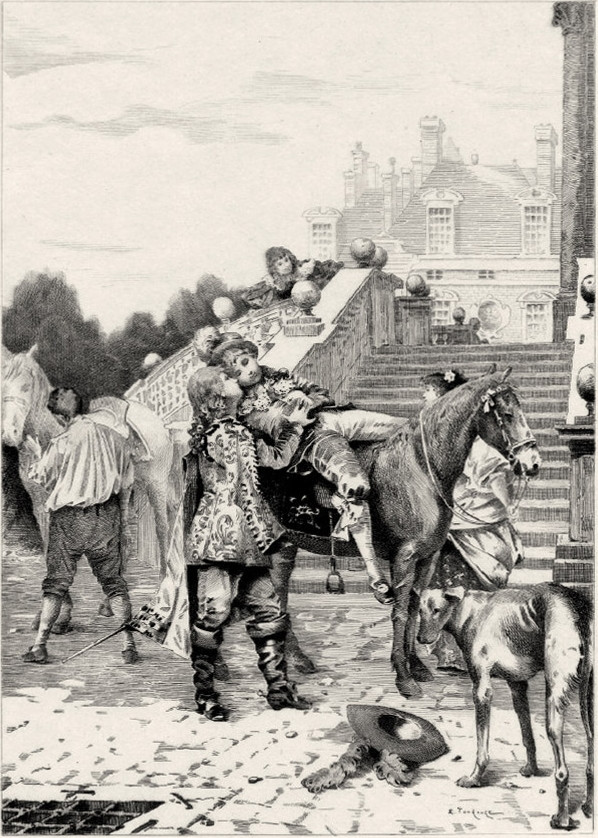
Chapter V — A page of some fourteen or fifteen years, fair-haired, pink-cheeked, pretty as a seraph, who was half asleep, and so exhausted by his long ride that his master was obliged to lift him from his saddle and carry him to his room in his arms.
VI
At this point, with the permission of the indulgent reader, we propose to abandon for some little time to his meditations, the worthy personage who has thus far occupied the stage all by himself and has spoken in his own behalf, and to adopt the ordinary form of the novel, reserving the right, however, to resume the dramatic form hereafter, if occasion should arise, and to draw still farther upon the species of epistolary confession that the aforesaid young man addressed to his friend, being fully persuaded that, however penetrating and sagacious we may be, we certainly cannot know so much about him as he knows about himself.
The little page was so overdone that he slept in his master's arms, and his little head, with its hair all in disorder, rolled from side to side as if he were dead. It was some distance from the stoop to the apartment set aside for the new arrival, and the servant who escorted him offered to take his turn at carrying the child; but the young gentleman, to whom the burden seemed no more than a feather-weight, thanked him and declined to relinquish it; he laid him gently on the couch, taking the utmost care to avoid waking him; a mother could have done no better. When the servant had retired and the door was closed, he knelt beside him and tried to remove his boots; but his little feet were so swollen and painful that the operation was a difficult one, and the pretty sleeper uttered from time to time vague, inarticulate exclamations, like a person who is on the point of waking; thereupon the young gentleman would stop and wait until he was sound asleep again. The boots yielded at last and the most important point was gained; the stockings made little resistance.—This operation at an end, the master took the child's feet and placed them side by side on the velvet covering of the sofa; surely they were the two loveliest feet in the world, no larger than that, white as new ivory, and reddened a little by the pressure of the boots in which they had been imprisoned seventeen hours—feet that were too small for a woman and looked as if they had never walked; the part of the leg that could be seen was round, plump, smooth, transparent, delicately veined, and of the most exquisitely graceful shape—a leg worthy of the foot.
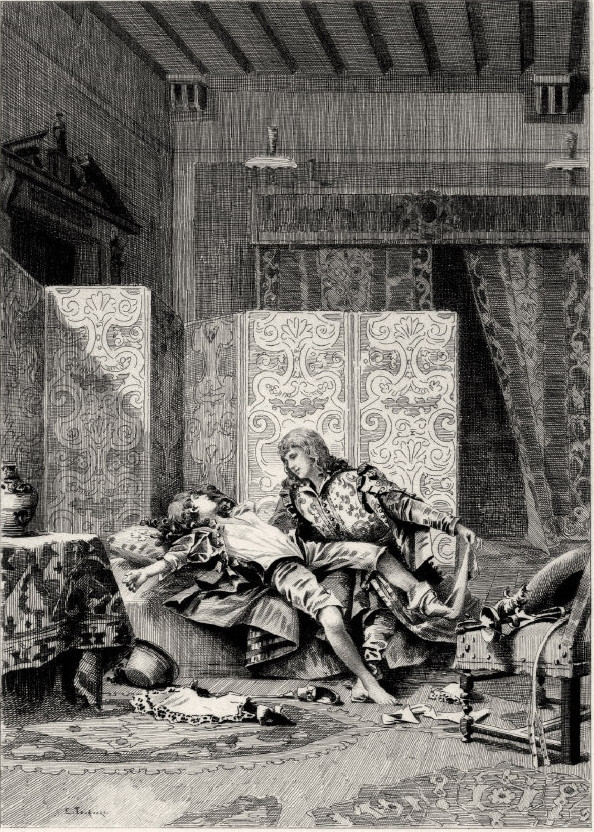
Chapter VI — The pretty sleeper uttered from time to time vague, inarticulate exclamations, like a person who is on the point of waking; thereupon the young gentleman would stop and wait until he was sound asleep again. The boots yielded at last and the most important point was gained; the stockings made little resistance.
The young man, still on his knees, gazed at the two little feet with amorous, admiring intentness; he stooped, raised the left one and kissed it, then the right one and kissed that; then, from kiss to kiss, he ascended the leg to the place where the clothes began.—The page raised his long lashes slightly and cast an affectionate, sleepy glance at his master, in which there was no trace of surprise.—"My belt hurts me," he said, passing his finger under the ribbon; and he fell asleep again.—The master loosened the belt, placed a cushion beneath the page's head, and finding that his feet, which had been burning hot, were a little cold, he wrapped them carefully in his cloak, drew an arm-chair close to the sofa and sat down. Two hours passed thus, the young man watching the sleeping child and following the shadow of his dreams on his brow. The only sounds to be heard in the room were his regular breathing and the ticking of the clock.
It was certainly a very lovely picture. In the contrast between the two types of beauty there was an opportunity for effect, of which a skilful painter might have made good use.—The master was as beautiful as a woman—the page as lovely as a young girl. The round, rosy face, set in its frame of hair, resembled a peach among its leaves; it had the same fresh and velvety look, although the fatigue of the journey had lessened somewhat its usual brilliancy; the half-open mouth disclosed two rows of small teeth of a milky whiteness, and beneath the full, gleaming temples a network of blue veins crossed and recrossed; his eyelashes, like the golden threads around the heads of virgins in missals, reached almost to the middle of his cheeks; his long, silky hair resembled both gold and silver—gold in the shadow, silver in the light; his neck was at the same time plump and slender, and gave no sign of the sex indicated by his clothes; two or three buttons of his doublet were unbuttoned to enable him to breathe more freely and as the fine shirt of Dutch lawn beneath was open, a glimpse was afforded of an inch or two of firm rounded flesh of admirable whiteness, and the beginning of a certain curved line difficult to account for on a young boy's breast; upon looking closely one might have discovered also that his hips were a little too fully developed.—The reader will form what opinion he chooses; these are simple conjectures that we put forward; we have no better information on the subject than he, but we hope to learn something more in a short time, and we promise to keep him fully informed of our discoveries.—Let the reader, if his sight is keener than ours, bury his eyes under the lace of that shirt and decide conscientiously whether the contour is too swelling or not; but we warn him that the curtains are drawn and that there is a sort of half-light in the room, ill-adapted to that sort of investigation.
The young gentleman was pale, but his was a golden pallor, full of strength and vitality; his eyes swam in a crystalline blue fluid; his straight, thin nose imparted a wonderful air of pride and energy to his profile, and the flesh was of so fine a texture that it allowed the light to pass through it on the edge; his mouth wore the sweetest smile at certain moments, but ordinarily it was arched at the corners, curving in rather than out, as in some of the faces we see in the pictures of the old Italian masters; a detail that gave a charmingly disdainful expression to his face, a smorfia alluring beyond words, an air of childish sulkiness and ill humor, very unusual and very fascinating.
What were the bonds that united the master to the page and the page to the master? Assuredly there was something more between them than any conceivable affection between master and servant. Were they friends or brothers?—In that case, why this masquerading?—It would have been difficult for any one witnessing the scene we have just described to believe that those two individuals were just what they seemed to be and nothing more.
"Dear angel, how he sleeps!" murmured the young man; "I don't believe he ever travelled so far in his life. Twenty leagues in the saddle, and he so delicate! I'm afraid that he will be sick with fatigue. But no, it will amount to nothing; to-morrow there will be no sign of it; he will have recovered his brilliant color and will be fresher than a rose after the rain.—How handsome he is like that! If I weren't afraid of waking him I would eat him up with kisses. What a fascinating dimple he has in his chin! what fine, white skin!—Sleep soundly, sweet treasure.—Ah! I am downright jealous of your mother, and I wish I had brought you into the world.—He can't be sick? No, his breathing is regular and he doesn't stir.—But I believe some one knocked."
In fact, some one had knocked twice, as gently as possible, on the panel of the door.
The young man rose, but, fearing that he might be mistaken, waited for a repetition of the knocking before opening the door.—Two more taps followed, a little more pronounced, and a soft female voice said, in a very low tone:—"It is I, Théodore."
Théodore opened the door, but with less eagerness than a young man naturally exhibits about admitting a woman whose voice is soft and who knocks mysteriously at his door at nightfall.—The open door gave passage to—whom do you suppose?—to the mistress of the perplexed D'Albert, to the Princess Rosette in person, rosier than her name, and her bosom as deeply moved as ever woman was upon entering a handsome youth's room in the evening.
"Théodore!" said Rosette.
Théodore lifted his finger and placed it on his lips so as to represent a statue of silence, and, pointing to the sleeping child, led her into the adjoining room.
"Théodore," continued Rosette, who seemed to take strange pleasure in repeating the name, and at the same time to be collecting her thoughts,—"Théodore," she continued, retaining the hand the young man had offered her to lead her to her chair, "so you have returned at last? What have you been doing all the time? where have you been?—Do you know that it is six months since I saw you! Ah! Théodore, that is not right; we owe some consideration, some pity to those who love us, even if we do not love them."
THÉODORE.
What have I been doing.—I have no idea.—I have gone away and come home, I have waked and slept, I have sung and wept, I have been hungry and thirsty, I have been too warm and too cold, I have been bored, I have less money and am six months older—I have lived, that's the whole of it.—And how about yourself, what have you been doing?
ROSETTE.
I have loved you.
THÉODORE.
Have you done nothing but that?
ROSETTE.
Absolutely nothing.—I have made a bad use of my time, haven't I?
THÉODORE.
You might have made a better use of it, my poor Rosette; for example, you might have loved some one who could return your love.
ROSETTE.
I am unselfish in love as in everything.—I don't lend love at interest; it is a pure gift on my part.
THÉODORE.
That is a very rare virtue and one that can exist only in a noble heart. I have often wished that I could love you, especially as you desire it; but there is an insurmountable obstacle between us which I cannot tell you.—Have you had any other lover since I left you?
ROSETTE.
I have had one whom I still have.
THÉODORE.
What sort of a man is he?
ROSETTE.
A poet.
THÉODORE.
The devil! who is this poet, and what has he written?
ROSETTE.
I haven't a very clear idea—a volume that nobody knows anything about, and that I tried to read one evening.
THÉODORE.
So you have an unpublished poet for a lover?—That must be interesting.—Is he out at elbows, does he wear dirty linen and rumpled stockings?
ROSETTE.
No; he dresses very well, washes his hands and has no ink-spots on the end of his nose. He's a friend of C——; I met him at Madame de Thémines',—you know, that tall woman, who plays the child and puts on such innocent airs.
THÉODORE.
And might one know the name of this eminent personage?
ROSETTE.
Oh! Mon Dieu, yes! he is the Chevalier d'Albert.
THÉODORE.
Chevalier d'Albert! I think that was the young man who was on the balcony when I alighted from my horse.
ROSETTE.
Precisely.
THÉODORE.
And who examined me so closely.
ROSETTE.
Himself.
THÉODORE.
He's a very good-looking fellow.—And he has not made you forget me?
ROSETTE.
No. Unfortunately you are not one of those whom one forgets.
THÉODORE.
He loves you dearly no doubt?
ROSETTE.
I am not so sure of that.—There are moments when you would think he loved me very dearly; but at heart he doesn't love me, and he is not far from hating me, for he is angry with me because he can't love me.—He did as many others before him have done; he developed a very keen taste for passion, and was greatly surprised and disappointed when his desire was surfeited.—It is a mistake to think that two people must mutually adore each other because they have lain together.
THÉODORE.
And what do you propose to do with this lover who is not a lover?
ROSETTE.
What we do with bygone quarters of the moon or with last year's fashions.—He hasn't courage enough to leave me the first, and although he does not love me in the true sense of the word, he is bound to me by the habit of enjoyment, and those are the habits it is hardest to break. If I don't assist him, he is quite capable of conscientiously submitting to be bored with me till the last judgment and beyond; for he has within him the germ of all noble qualities; and the flowers of his soul ask naught but an opportunity to bloom in the sunshine of everlasting love.—Really I am very sorry that I did not prove to be the sunbeam for him. Of all my lovers whom I have not loved, I love him the most; and, if I were not as kind-hearted as I am, I would not give him back his liberty, but I would still keep him.—But that is what I will not do; I am finishing with him at this moment.
THÉODORE.
How long will it last?
ROSETTE.
A fortnight, three weeks, but at all events not so long as if you had not come.—I know that I shall never be your mistress.—There is, you say, an unknown reason for that, to which I would bow if it were possible for you to disclose it to me. Thus I am forbidden to entertain any hope in that direction, and yet I cannot make up my mind to be another man's mistress when you are here; it seems to me like a profanation, and as if I should not have the right to love you.
THÉODORE.
Keep this lover for love of me.
ROSETTE.
If it will give you pleasure I will do it.—Ah! if you could have been mine, how different my life might have been from what it has been!—The world has a very false idea of me, and I should have lived and died without any one suspecting what I am—except you, Théodore, the only one who has understood me and been cruel to me.—I have never wanted any one but you for a lover, and I have never had you. O Théodore, if you had loved me, I should have been virtuous and chaste, I should have been worthy of you; instead of that, I shall leave behind me—if any one remembers me—the reputation of a dissolute woman, a sort of courtesan, who differed from her of the gutter only in rank and fortune.—I was born with the highest aspirations; but nothing depraves one so much as being unloved.—Many people despise me who have no idea what I have had to suffer before reaching my present position.—Being sure that I shall never belong to the man I would prefer above all others, I have allowed myself to float with the current, I have not taken the trouble to defend a body that could not be yours.—As for my heart, no one has had it and no one ever will. It is yours, although you have broken it;—and I am different from the majority of women who believe themselves virtuous provided they have not passed from one bed to another, in this respect—although I have prostituted my flesh, I have been faithful in heart and soul to the thought of you.—At all events I shall have made some few people happy, I shall have caused white-robed illusions to dance about some pillows. I have innocently deceived more than one noble heart. I have been so miserable at being spurned by you, that I have always been horrified at the thought of compelling any one else to undergo such torture. That is the sole worthy motive of adventures which are commonly attributed to a spirit of libertinage pure and simple!—I, a libertine! O society!—If you knew, Théodore, how intensely painful it is to feel that your life is a failure, that you have let slip your chance of happiness, to see that everybody misunderstands you and that it is impossible to make people change their opinion of you, that your most estimable qualities are tortured into defects, your purest essences into deadly poisons, that nothing except the evil in you has transpired; to have found doors always open to your vices and always closed to your virtues, and to have been unable to bring to perfection, amid such a wilderness of hemlock and aconite, a single lily or a single rose! you know nothing of that, Théodore.
THÉODORE.
Alas! alas! Rosette, what you have just said includes the history of the whole world; the best part of us is that which remains within us and which we cannot display.—It is the same with poets.—Their noblest poem is the one they have not written; they carry more poems to the grave than they leave in their library.
ROSETTE.
I shall carry my poem to the grave with me.
THÉODORE.
And I mine.—Who has not written one at some time in his life? who is so fortunate, or so unfortunate, as not to have composed his in his head or in his heart?—Even headsmen may have composed poems, all moist with tears of the tenderest sensibility; poets perhaps have composed some that would be suited to headsmen, so bloody and monstrous they are.
ROSETTE.
Yes.—White roses can fitly be placed on my grave. I have had ten lovers, but I am a virgin, and I shall die a virgin. Many virgins, on whose graves there is a constant snow of jasmine and orange blossoms, were veritable Messalinas.
THÉODORE.
I know what a noble creature you are, Rosette.
ROSETTE.
You only in all the world have seen what I am; for you have seen me under the influence of a love that is perfectly genuine and very deep-rooted, as it is hopeless; and no one who has not seen a woman in love can say what she is; that is the one thing that consoles me in my bitterness of spirit.
THÉODORE.
And what does this young man think of you, who is your lover to-day in the eyes of the world?
ROSETTE.
The mind of a lover is a gulf deeper than the Bay of Portugal, and it is very difficult to say what there is in the depths of a man; if the lead were attached to a line a hundred fathoms long and every fathom unreeled, it would still sink without meeting anything to stop it. Yet I have touched bottom several times with this man, and the lead has sometimes brought up mud, sometimes lovely shells, but most frequently mud and fragments of coral mixed together.—As to his opinion of me, it has varied greatly; he began where others leave off, he despised me; young men with vivid imaginations are likely to do that. There is always a tremendous fall in the first step they take, and the passage from their chimera to reality cannot be made without a shock.—He despised me and I entertained him; now he esteems me and I bore him. In the early days of our liaison he saw only the commonplace side of me, and I think that the certainty of meeting with no resistance had much to do with his determination. He seemed in great haste to have an affair, and I thought at first that it was a case of a full heart seeking only an opportunity to overflow, one of those vague passions that a man has in the May of youth and that impel him, in default of women, to throw his arms around the trunks of trees, and to kiss the flowers and grass in the fields.—But it wasn't that;—he simply passed through me to reach something else. I was a means to him, and not an end.—Beneath the fresh exterior of his twenty years, beneath the first down of adolescence, he concealed profound corruption. He was tainted to the core; he was a fruit containing nothing but ashes. In that young and lusty body was a heart as old as Saturn—a heart as incurably wretched as heart ever was.—I confess, Théodore, that I was frightened and that I was almost taken with vertigo as I looked into the black depths of that existence. Your sorrows and mine are nothing compared to those. If I had loved him more I should have killed him. Something irresistibly attracts and summons him—something that is not of this world or in this world, and he cannot rest day or night; and like the heliotrope in a cellar, he twists about to turn toward the sun which he cannot see.—He is one of those men whose mind was not completely dipped in the waters of Lethe before being attached to his body, but retains memories of the eternal beauty of the heaven from which it comes—memories that work upon it and torment it—and remembers that it once had wings and now has feet only.—If I were God, I would deprive of poetry for two eternities, the angel guilty of such negligence.—Instead of being under the necessity of building a castle of bright-colored cards in which to shelter a fair, youthful fancy for a single spring, it was necessary to erect a tower higher than the eight temples of Belus piled one upon another. I had not the strength, I pretended not to have understood him, and I let him flutter about on his wings in search of a peak from which he could take flight into boundless space.—He thinks I have noticed nothing of all this, because I have fallen in with all his caprices without seeming to suspect their object. Being unable to cure him, I determined—and I hope that I shall receive credit for it some day before God—to give him at least the happiness of believing that he was passionately loved.—He aroused in me so much pity and interest that I was easily able to assume a tone and manner sufficiently affectionate to deceive him. I have played my part like a consummate actress; I have been playful and melancholy, sensible and voluptuous; I have feigned anxiety and jealousy; I have shed false tears, and I have summoned flocks of ready-made smiles to my lips. I have arrayed this counterfeit of love in the richest stuffs; I have taken him to drive through the avenues of my parks; I have requested all my birds to sing as he passed, and all my dahlias and daturas to bend their heads in salutation; I have sent him across my lake on the silvery back of my darling swan; I have concealed myself inside the manikin and bestowed my voice, my wit, my youth and beauty upon it and given it such a seductive appearance that the reality fell far short of my deception. When the time comes to shatter this hollow statue, I shall do it in such a way that he will think the wrong is all on my side and so will have no remorse. I shall be the one to make the pinhole through which the air with which the balloon is filled will make its escape.—Is not that sanctified prostitution and honorable deception? I have in a glass jar some tears that I have collected just as they were about to fall.—They are my jewel-case and my diamonds, and I shall present them to the angel who comes for me to lead me before God.
THÉODORE.
They are the loveliest that can glisten on a woman's neck. A queen's jewels are less precious than they. For my own part, I believe that the ointment Magdalen poured on Christ's feet was made of the tears of those she had comforted, and I believe, too, that the Milky Way is strewn with such tears, and not, as has been said, with drops of Juno's milk.—Who will do for you what you have done for him?
ROSETTE.
No one, alas! since you cannot.
THÉODORE.
O dear heart! would that I could!—But do not lose hope. You are lovely and still very young. You have many avenues of lindens and flowering acacias to pass through before reaching the damp road lined with box and leafless trees, which leads from the tomb of porphyry in which your happy dead years will be buried, to the tomb of rough and moss-covered stone where they will hasten to bestow the remains of what once was you, and the wrinkled, tottering spectres of the days of your old age. You still have much of the mountain of life to climb and it will be long before you reach the zone where the snow begins. You are now only at the level of aromatic plants, of limpid cascades over which the iris suspends its tri-colored arches, of stately green oaks and sweet-smelling larches. Mount a little higher and from that point, with the broader horizon spread out before you, perhaps you will see the blue smoke rising above the roof beneath which he who will love you sleeps. You must not, in the very beginning, despair of life, for vistas open in our destiny which we had ceased to expect. Man, in his life, has often made me think of a pilgrim toiling up the winding stairway of a Gothic tower. The long granite serpent winds upward in the darkness, every coil a stair. After a few circumvolutions the little light that came from the door dies out. The shadow of the houses, which are not yet passed, does not allow the loopholes to admit the sun: the walls are black and moisture oozes from them; you seem rather to be going down into a dungeon from which you are never to come forth, than ascending to the turret which, from below, seemed to you so slender and graceful, covered with lace-work and embroidery as if it were about starting for the ball.—You hesitate whether you ought to go higher, the damp shadows weigh so heavily upon your forehead.—A few more turns of the staircase and more frequent openings cast their golden trefoils on the opposite wall. You begin to see the notched gables of the houses, the carving of the entablatures, the strange forms of the chimneys; a few steps more and your eye overlooks the whole city; it is a forest of steeples, of spires and towers, bristling upon all sides, toothed and slashed and hollowed, stamped as with dies, and allowing the light to shine through their numberless apertures. The domes and cupolas raise their rounded forms like a giant's breasts or the skulls of Titans. The islets formed by houses and palaces appear through shadowy or luminous openings. A few steps more and you will be on the platform; and then you will see, beyond the walls of the city, the green fields, the blue hill-sides and the white sails on the changing ribbon of the stream. A dazzling light bursts upon you, and the swallows fly hither and thither, close at hand, with their joyous twitter. The distant sounds reach your eyes like a soothing murmur or the hum of a swarm of bees; all the bells scatter their necklaces of pearls of sound through the air; the breezes bring you the odors of the neighboring forest and of the mountain flowers: it is all light and melody and perfume. If your feet had been weary or discouragement had seized upon you, and you had remained on a lower step or had turned back and gone down again, that spectacle would have been lost to you.—Sometimes, however, the tower has only a single opening, in the centre or at the top.—The tower of your life is built so.—In that case you must have more obstinate courage, perseverance armed with sharper nails, to cling, in the darkness, to the protruding stones, and to reach the opening, resplendent with light, through which the eye embraces the surrounding country; or it may be that the loopholes have been filled up, or no one has thought to cut them, and then you must go on to the summit; but the higher one goes without looking out, the more extended the horizon seems, and the greater the surprise and pleasure.
ROSETTE.
O Théodore, God grant that I may soon reach the point where the window is! For a long, long time I have been following the winding staircase in the most profound darkness; but I am afraid the opening has never been cut and I must climb to the very top; and suppose this staircase with the countless stairs should end at a walled-up doorway, or an arch closed by blocks of stone?
THÉODORE.
Do not say that, Rosette, do not think it.—What architect would build a stairway that led nowhere? Why imagine that the placid Architect of the world was stupider and less far-sighted than an ordinary architect? God makes no mistakes and forgets nothing. It is incredible that He should have amused Himself by playing a trick upon you and shutting you up in a long stone tunnel without exit or opening. Why should you suppose that He would haggle with such poor ants as we are over our paltry momentary happiness and the imperceptible grain of millet that falls to each of us in this immeasurable universe?—In order to do that He must be as savage as a tiger or a judge; and if we were so obnoxious to Him, He would simply have to bid a comet turn aside a little from its path and annihilate us all with a hair of its tail. How the devil can you think that God diverts Himself by spitting us all on a gold pin as the Emperor Domitian did with flies?—God isn't a concierge or a church-warden, and although He is old, He is not yet in His dotage. All such petty malice is beneath Him and He is not foolish enough to show off His smartness to us and play tricks on us.—Courage, Rosette, courage! If you are out of breath, stop a bit and take breath and then continue your upward course; perhaps you have only a score more steps to climb to reach the embrasure from which you will see your happiness.
ROSETTE.
Never! oh never! and if I reach the top of the tower, it will only be to hurl myself from it.
THÉODORE.
Banish these gloomy thoughts that flutter about you like bats, and cast the opaque shadow of their wings on your fair brow, my poor afflicted one. If you want me to love you, be happy, and do not weep. (He draws her gently to his side and kisses her on the eyes).
ROSETTE.
What a misfortune for me that I ever knew you! and yet, if I could live my life over, I would still prefer to have known you.—Your harshness has been sweeter to me than the passion of other men; and, although you have made me suffer intensely, all the pleasure I have ever had has come to me from you; through you I have caught a glimpse of what I might have been. You have been a flash of light in my darkness, and you have illuminated many dark places in my soul; you have opened new perspectives in my life.—I owe it to you that I know what love is,—unhappy love, it is true; but there is a melancholy and profound fascination in loving without being loved, and it is pleasant to remember those who forget us. It is a joy simply to be able to love, even when one loves alone, and many die without having had it, and often they who love are not the most to be pitied.
THÉODORE.
They suffer and feel their wounds, but at all events they live. They have some interest in life; they have a star about which they gravitate, a pole toward which they ardently extend their hands. They have something to long for; they can say to themselves: "If I reach that point, if I obtain that, I shall be happy."—They suffer frightful agony, but when they die, they can at least say to themselves: "I am dying for him."—To die thus is to be born again. The really unhappy, the only ones who are irreparably so, are they whose wild embrace takes in the whole universe, they who want everything and nothing, and who would be embarrassed and speechless if an angel or fairy should descend to earth and say suddenly to them: "Express one wish and it shall be gratified."
ROSETTE.
If a fairy should come I know what I would ask her.
THÉODORE.
You know, Rosette, and therein you are happier than I, for I do not know. There are in my heart many vague longings, which become confounded with one another and give birth to others which eventually consume them. My desires are a cloud of birds that fly aimlessly this way and that; yours is an eagle that has its eyes on the sun and is prevented by lack of air from soaring upward on its outspread wings. Ah! if I could only know what I want; if the idea that haunts me would stand out clear and well-defined from the mist that envelops it; if the lucky or unlucky star would appear in the depths of my sky; if the light I am to follow would shine out through the darkness, a deceitful will-o'-the-wisp or a friendly beacon; if my column of fire would go on before me, even though it were through a desert without manna and without springs of water; if I knew where I am going, even though my path ends at a precipice!—I would prefer the wild flights of accursed huntsmen through bogs and thickets, to this absurd and monotonous stamping and pawing. To live thus is to follow a trade like that of the horses with bandages over their eyes, who turn the wheel of a well, and travel thousands of leagues without seeing anything or changing their position.—I have been turning a long while, and the bucket ought to be at the top.
ROSETTE.
You resemble D'Albert in many ways, and, when you speak, it seems to me sometimes as if he were speaking.—I have no doubt that, when you know him better, you will become much attached to him; you cannot fail to suit each other.—He is tormented as you are, by these same aimless impulses; he is head over ears in love but does not know with what; he would like to ascend to Heaven, for the earth seems to him like a stool hardly fit for one of his feet to rest upon, and he has more pride than Lucifer before his fall.
THÉODORE.
I was afraid at first that he was one of those poets, of whom there are so many, who have driven poetry off the face of the earth, one of those stringers of false pearls who see nothing in the world but the last syllables of words, and who, when they have made ombre rhyme with sombre, flame with âme, and Dieu with lieu, fold their arms and legs conscientiously and permit the spheres to accomplish their revolutions.
ROSETTE.
He is not one of that kind. His verses are beneath him and do not contain his thought. You would form a very mistaken idea of his nature from what he has written; his real poem is himself, and I don't know if he will ever produce another. He has, in the depths of his mind, a seraglio of choice ideas which he surrounds with a triple wall, and of which he is more jealous than ever sultan was of his odalisques.—He puts in his poetry only those ideas that he holds in light esteem, or with which he has become disgusted; he makes his verse the door through which he expels them and the world receives only those for which he has no further use.
THÉODORE.
I can understand his jealousy and his modesty.—Just as many men do not care for the love they have had until they no longer have it, or for their mistresses until they are dead.
ROSETTE.
It is so hard for one to have anything to one's self in this world! every candle attracts so many moths, every treasure attracts so many thieves!—I love the silent men who carry their ideas to the grave and do not choose to abandon them to the filthy kisses and shameless handling of the vulgar crowd. Those lovers please me best who do not carve their mistress's name on the bark of any tree, who confide it to no echo, and who, while they sleep, are haunted by the fear that they may utter it in a dream. I am one of that number; I have not divulged my thoughts and no one shall know my love.—But it is almost eleven o'clock, my dear Théodore, and I am preventing your taking rest that you must sadly need. When I am obliged to leave you I always have a feeling of oppression at my heart, and it seems to me as if it were the last time I should ever see you. I postpone it as long as I can; but I always have to go at last. Good-night, for I am afraid D'Albert may be looking for me; good-night, my dear friend.
Théodore put his arm around her waist and thus escorted her to the door; there he stopped and followed her a long time with his glance; the corridor was lighted at intervals by small windows with narrow panes, through which the moon shone, making alternate light and dark patches of fantastic shape. At each window Rosette's pure, white form gleamed like a silvery phantom; then it vanished to appear, even more brilliant, a little farther away; at last it disappeared altogether.
Théodore stood for some moments motionless, with folded arms, as if buried in profound meditation; then he passed his hand over his forehead and threw back his hair with a jerk of his head, returned to his room, and went to bed after kissing the brow of the page, who was still asleep.
VII
As soon as the daylight entered Rosette's room, D'Albert made his appearance, with an eagerness that was not usual with him.
"Here you are," said Rosette, "I would say very early, if you could ever arrive early.—To reward you for your gallantry I present you my hand to kiss."
And she drew from beneath the sheet of Flemish linen trimmed with lace the prettiest little hand that was ever seen at the end of a plump, well-shaped arm.
D'Albert kissed it with compunction:—"And the other, little sister, are we not to kiss that too?"
"Mon Dieu, yes! nothing is easier. I am in my Sunday humor to-day; here."—And she extended her other hand with which she tapped him lightly on the lips.—"Am I not the most obliging woman on earth?"
"You are grace itself, and temples of white marble should be erected to you in thickets of myrtle.—Really, I am very much afraid that the same thing will happen to you that happened to Psyche, and that Venus will be jealous of you," said D'Albert, taking the fair one's hands in one of his and raising them together to his lips.
"How you say all that without taking breath! any one would think it was something you had learned by heart," said Rosette, with a delicious little pout.
"No; you deserve to have the phrase turned expressly for you, and you were made to pluck the virgin bloom from compliments," rejoined D'Albert.
"Oho! whatever is the matter with you to-day? are you ill that you are so gallant? I fear you are dying. Do you know that when one's character suddenly changes, and without any apparent reason, it is an evil omen? Now it is a well-known fact, to all the women who have taken the pains to love you, that you are usually as morose as a man can be, and it is no less certain that at this moment you are as charming as a man can be, and inexplicably amiable.—Really, I think you are pale, my poor D'Albert: give me your arm and let me feel your pulse;" and she pushed back his sleeve and counted the pulsations with mock gravity.—"No, you are perfectly well and you haven't the slightest symptom of fever. In that case I must be furiously pretty this morning! Go and find my mirror so that I can see how far your gallantry is justified."
D'Albert brought a small mirror from the toilet-table and placed it on the bed.
"In truth," said Rosette, "you are not altogether wrong. Why don't you write a sonnet on my eyes, Monsieur le Poète. You have no excuse for not doing it. Just see how unfortunate I am! to have eyes like these and a poet like this, and to be left without sonnets just as if I were one-eyed and had a water-carrier for a lover! You don't love me, monsieur; you have never written so much as an acrostic sonnet for me.—And my mouth, what do you think of that? I have kissed you with that mouth and perhaps I will kiss you with it again, my dark-browed beauty; and upon my word, it is a favor that you hardly deserve—I am not speaking of to-day, for to-day you deserve anything;—but, to talk about something beside myself, you are incomparably fresh and comely this morning, you look like a brother of Aurora, and, although it is hardly daylight, you are already arrayed in your best clothes as if for a ball. Can it be that you have designs upon me? and do you meditate dealing an unexpected and final blow to my virtue? do you propose to make a conquest of me? But I forget that you have already done that, and that it's ancient history."
"Don't joke like that, Rosette; you know that I love you."
"Why, that depends. I don't know it; and you?"
"I know it perfectly well, and from such symptoms that, if you should have the kindness to forbid me your door, I should try to prove it to you, and I venture to flatter myself that I should do it most triumphantly."
"Not that way: however anxious I may be to be convinced, my door will remain open; I am too pretty to be shut up behind closed doors; the sun shines for one and all, and my beauty shall be like the sun to-day, if you approve."
"Upon my honor I strongly disapprove; but act as if I approved as strongly. I am your very humble slave, and I lay my wishes at your feet."
"That is as jolly as can be; continue to entertain such sentiments and leave your key in your door to-night."
"Monsieur le Chevalier Théodore de Sérannes,"—said a huge negro, putting his round, good-humored face between the wings of the folding-door, "desires to pay his respects to you and begs that you will deign to receive him."
"Admit Monsieur le Chevalier," said Rosette, pulling the sheet up to her chin.
Théodore went first to Rosette's bed and made a very low and graceful courtesy, which she returned with a friendly nod; then he turned to D'Albert, whom he also saluted in an off-hand, courteous manner.
"What were you talking about?" said Théodore. "It may be that I interrupted an interesting conversation: go on, I beg, and tell me in a few words what it is all about."
"Oh, no!" Rosette replied with a mischievous smile; "we were talking business."
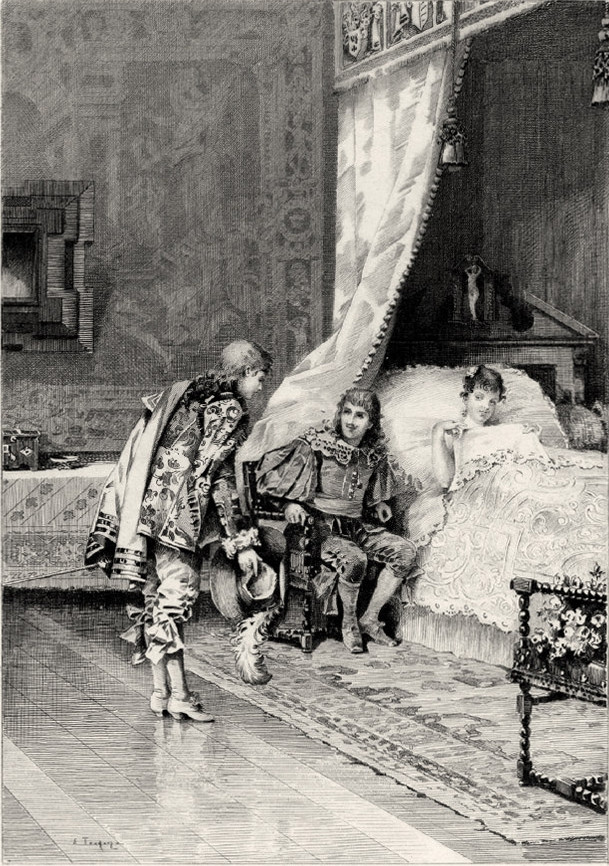
Chapter VII — "Admit Monsieur le Chevalier," said Rosette, pulling the sheet up to her chin.
Théodore went first to Rosette's bed and made a very low and graceful courtesy, which she returned with a friendly nod; then he turned to D'Albert, whom he also saluted in an off-hand, courteous manner.
Théodore seated himself at the foot of Rosette's bed, for D'Albert had taken his place at her pillow, by right of having arrived first. The conversation wandered for some time from subject to subject, very bright and gay and animated, and that is why we do not report it; we should be afraid that it would lose too much in being transcribed. The manner, the tone, the vivacity of speech and gesture, the countless ways of uttering a word, the effervescent wit, like the foam of champagne which sparkles and evaporates at once, are details that it is impossible to note down and reproduce. We leave that hiatus for the reader to fill, and he will certainly acquit himself of the task better than we could do. Let him imagine here five or six pages filled with whatever is most capricious, most refined, most curiously original, most ingenious and most sparkling in the way of conversation.
We are well aware that we are resorting to an artifice which reminds one a little of that resorted to by Timanthes, who, in despair of ever being able to reproduce Agamemnon's face, threw some drapery over his head; but we prefer to be timid rather than imprudent.
It would not perhaps be amiss to inquire into the motives that had led D'Albert to rise so early, and what spur had impelled him to call upon Rosette at as unseasonable an hour as if he had still been in love.—It would appear as if it were a slight attack of secret, unconfessed jealousy. To be sure he cared but little for Rosette, indeed he would have been very glad to be rid of her,—but he preferred to leave her voluntarily and not to be left by her, a thing which always inflicts a deep wound on a man's pride, although his first flame may be utterly extinct.—Théodore was such a well-favored cavalier that it was difficult to view his appearance on the scene while a liaison was in progress without apprehending what had in fact happened many times, that is to say, that all eyes would turn in his direction and the hearts follow the eyes; and, strangely enough, although he had taken away many women, no lover had harbored the enduring resentment that men usually feel for those who have supplanted them. There was in his whole behavior such winning charm, such unaffected grace, a something so gentle and so dignified, that even men were touched by it. D'Albert, who had come to Rosette's room, intending to speak very sharply to Théodore, if he should meet him there, was greatly surprised to find that he did not feel the slightest sensation of anger in his presence, and that he was inclined to receive with warmth the advances he made. In half an hour's time, you would have said that they had been friends from boyhood, and yet D'Albert felt in his inmost heart, that if Rosette was destined ever to love, she would love that man, and he had every reason to be jealous, for the future at least, for he did not suspect anything at present. What would he have thought, had he seen the fair creature in a white peignoir gliding like a night-moth on a moonbeam into the handsome youth's room, and coming out three or four hours later with mysterious precautions? He might well, in very truth, have deemed himself more unfortunate than he really was, for it is a thing rarely seen that a pretty, lovelorn young woman comes forth from the bedroom of a no less attractive young man, exactly the same as when she went in.
Rosette listened to Théodore with much attention and as one listens to a person one loves; but what he said was so entertaining and upon so many different subjects, that her attention was perfectly natural and easily explained. And so D'Albert took no offence at it. Théodore's manner toward Rosette was courteous and friendly, but nothing more.
"What shall we do to-day, Théodore?" said Rosette, "suppose we go for a row on the river? what do you think? or shall we hunt?"
"To hunt is less depressing than to glide over the water side by side with some tired swan and thrust the water-lily leaves aside to right and left,—don't you think so, D'Albert?"
"I think perhaps I should enjoy gliding down the river in the skiff quite as much as racing madly in the trail of some poor beast; but wherever you go, I will go; what we have to do now is to allow Madame Rosette to rise and don a suitable costume."
Rosette made a sign of assent and rang for her maid to come and dress her. The two young men left the room arm in arm, and it was easy to guess, from seeing them on such good terms, that one was the titular lover and the other the loved lover of the same person.
Soon everybody was ready. D'Albert and Théodore were already mounted in the first court-yard, when Rosette, in a riding-habit, appeared at the top of the steps. She had assumed with the costume, a sprightly, resolute air that was immensely becoming to her; she leaped into the saddle with her ordinary agility and gave her horse a smart blow with her crop, so that he darted away like an arrow. D'Albert spurred after her and soon overtook her. Théodore allowed them some little start, being sure of catching them up whenever he chose. He seemed to be waiting for something and turned back frequently toward the château.
"Théodore! Théodore! come on! are you riding a wooden horse?" cried Rosette.
Théodore urged his horse to a gallop and diminished the distance between him and Rosette, but did not join her.
He continued to look back at the château, which they were beginning to lose sight of; a little cloud of dust, in the centre of which something that they could not as yet distinguish was moving very rapidly, appeared at the end of the road. In a few moments the cloud reached Théodore's side, and, opening like the classic clouds of the Iliad, disclosed the fresh and rosy face of the mysterious page.
"Come, Théodore, come!" cried Rosette again; "give your tortoise the spur and join us."
Théodore gave his horse the rein, and in a second, the animal, who was pawing and rearing impatiently, had passed D'Albert and Rosette by several lengths.
"Who loves me follows me," said Théodore, leaping a fence four feet high. "Well, well, Monsieur le Poète," he said, when he was on the other side, "you don't jump? but they say your steed has wings."
"Faith, I prefer to ride around; I have only one head to break after all; if I had several I would try," D'Albert replied with a smile.
"No one loves me then, as no one follows me," said Théodore, bringing the arched corners of his mouth even lower than usual. The little page looked up at him reproachfully with his great blue eyes, and drove his heels into his horse's sides.
The horse gave a tremendous leap.
"Yes! some one," said the child from the other side of the fence.
Rosette cast a strange glance at the boy and blushed up to her eyes; then, with a furious blow of the crop on the mare's neck, she leaped the barrier of green apple wood that barred the path.
"Do you think that I don't love you, Théodore?"
The child darted an oblique, stealthy glance at her and rode up to Théodore.
D'Albert was in the middle of the path—and saw nothing of all this; for, from time immemorial, it has been the privilege of fathers, husbands and lovers to see nothing.
"Isnabel," said Théodore, "you are mad, and so are you, Rosette! You didn't take enough start for your jump, Isnabel, and you, Rosette, just missed catching your dress on the posts.—You might have killed yourself."
"What difference would it make?" rejoined Rosette, in such a melancholy, despairing tone that Isnabel forgave her for having leaped the barrier.
They rode on for some distance and reached the crossroads where the huntsmen and the pack were to meet them. Six arched paths, cut through the dense forest, met at a little stone tower with six sides, on each of which was carved the name of the road that ended there. The trees rose so high that they seemed to be trying to spin the woolly, fleecy clouds that a brisk breeze carried hither and thither over their towering tops; tall, thick grass and impenetrable thickets provided hiding-places and strongholds for the game, and the hunt promised to be a successful one. It was a true forest of an earlier age, with oaks more than a hundred years old, such trees as we never see, now that we no longer plant trees and have not the patience to wait for those that are planted to grow;—a hereditary forest, planted by great-grandfathers for fathers, by fathers for grandsons, with paths of enormous width, the obelisk surmounted by a ball, the rock-work fountain, the inevitable pool, and the keepers with powdered wigs, yellow leather breeches and sky-blue coats;—one of those dense, dark forests in which the white, glossy coats of Wouvermans' great horses stand out in bold relief, and the flaring mouths of the hunting horns à la Dampierre that Parrocel loves to paint on the backs of his huntsmen.—A multitude of dogs' tails, shaped like crescents or reaping-hooks, waved frantically about in a dusty cloud. The signal was given, the dogs, straining at their leashes, were uncoupled, and the hunt began.—We shall not undertake to describe with precision the detours and doublings of the stag through the forest;—we do not even feel sure whether it was a stag seven years old, and, despite our investigations on that point, we have not been able to satisfy ourselves—which is really distressing.—Nevertheless we can but think that in such a forest, so venerable, so dark, so seignorial, there could be none but seven-year stags, and we do not see why the one after which the four principal characters in this romance were galloping on horses of different colors, and non passibus æquis, should not have been such a one.
The stag ran, like the true stag that he was, and some fifty dogs or more that followed at his heels were no slight spur to his natural swiftness of foot. The pace was so fleet that only an occasional bark could be heard.
Théodore, being the best mounted and the best rider, kept on the heels of the pack with incredible zeal. D'Albert was close behind him. Rosette and the little page Isnabel followed, falling farther and farther behind.
The interval was soon so great that they could not hope to join their companions.
"Suppose we stop for a moment and let our horses take breath," said Rosette. "The hunt is going toward the pond and I know a crossroad by which we can reach there as soon as they do."
Isnabel drew in his little mountain pony, who put down his head, shook his forelock down over his eyes and began to paw the gravel with his hoofs.
The little creature presented a most striking contrast to Rosette's mare; he was as black as night, she as white as white satin; his mane and tail were bristly and unkempt; her mane was tied with blue ribbons and her tail combed and curled. She looked like a unicorn, he like a spaniel.
There was the same marked difference between the riders as between their steeds.—Rosette's hair was as black as Isnabel's was fair; her eyebrows were very clearly marked and very prominent; those of the page were hardly darker than his skin and resembled the down on a peach.—The coloring of the one was as brilliant and enduring as the light at noonday; the other had the transparent blushing hue of early dawn.
"Suppose we try now to overtake the hunt?" said Isnabel; "the horses have had time to recover their breath."
"Come on!" replied the pretty Amazon, and they galloped away through a narrow transverse path leading to the pool; the two horses ran neck and neck and filled the whole path.
On Isnabel's side, a gnarled and twisted tree stretched out a huge branch like an arm, and seemed to shake its fist at the riders.—The child did not see it.
"Look out!" cried Rosette, "lean forward on your saddle! you will be unhorsed."
The warning came too late; the branch struck Isnabel in the middle of the body. The violence of the blow caused him to lose his stirrups, and, as his horse galloped on and the branch was too stout to bend, he was brushed from his saddle and thrown rudely back.
The child fainted on the spot.—Rosette, terribly frightened, leaped from her horse and knelt beside the page, who gave no sign of life.
His cap had fallen off and his lovely, rippling fair hair lay spread about over the gravel in every direction.—His little open palms looked as if they were made of wax, they were so devoid of color. Rosette knelt beside him and tried to restore him to consciousness.—She had no salts or flask with her and her embarrassment was great. At last she discovered a deep rut in which the rain-water had collected and clarified; she dipped her fingers in it, to the great alarm of a little toad that was the naiad of that stream, and shook a few drops on the young page's blue-veined temples.—He did not seem to feel them, and the pearls of water rolled down his white cheeks as a sylph's tears roll down the leaf of a lily. Rosette, thinking that his clothes might distress him, unbuckled his belt, unbuttoned his doublet and opened his shirt to give his lungs freer play.—Thereupon Rosette saw something that would have been the most agreeable of surprises to a man, but that seemed very far from affording her any pleasure—for her brows contracted and her upper lip trembled slightly;—she saw a snowy white breast, which was as yet undeveloped, but which made the fairest promises and already fulfilled many of them; a smooth and rounded breast, as white as ivory, and in the language of the Ronsardists, delicious to look at, more delicious to kiss.
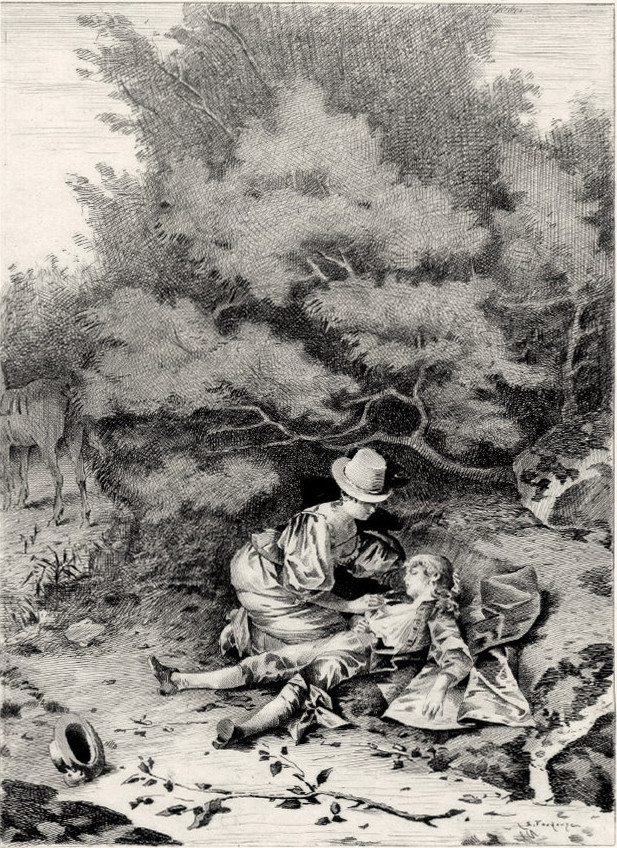
Chapter VII — Rosette, thinking that his clothes might distress him, unbuckled his belt, unbuttoned his doublet and opened his shirt to give his lungs freer play.—Thereupon Rosette saw something that would have been the most agreeable of surprises to a man, but that seemed very far from affording her any pleasure——
"A woman!" she exclaimed, "a woman! ah! Théodore!"
Isnabel—for we will continue to call him by that name, although it was not his—began to show some signs of life and languidly raised his long eyelashes; he was not wounded in any way, he was simply stunned.—He soon sat up and, with Rosette's assistance, was able to stand and remount his horse, which had stopped as soon as he felt that his rider was gone.
They rode slowly to the pool, where they found the remainder of the hunting party. Rosette in a few words told Théodore what had happened.—He changed color several times during her recital, and throughout the rest of the ride he kept his horse close beside Isnabel's.
They returned to the château betimes; the day that had begun so joyously, had a decidedly melancholy ending.
Rosette was in a meditative mood and D'Albert seemed as deeply engrossed in his reflections. The reader will soon learn what had given rise to them.
VIII
No, my dear Silvio, I have not forgotten you; I am not one of those who go through life without a backward glance; my past follows me and encroaches upon my present, and almost upon my future; your friendship is one of the sunlit spots that stand out most clearly on the blue horizon of my later years; often, from the peak on which I stand, I turn to gaze upon it with a feeling of ineffable melancholy.
Oh! what lovely weather it was!—how angelically pure we were!—Our feet hardly touched the ground, we had wings on our shoulders, as it were, our desires carried us away and the fair halo of youth around our foreheads trembled in the breeze of spring.
Do you remember the little island covered with poplars at the spot where the river forms a little arm?—To reach it we had to cross a long, very narrow plank that bent in the middle, with a strange sensation; an excellent bridge for goats and little used, in fact, except by them: it was a delightful spot.—Short, thick grass where the forget-me-not opened its pretty little blue twinkling eye, a path, as yellow as nankeen, that served as a belt for the green robe of the islet and encircled its waist, the constantly moving shadow of aspens and poplars, were not the least charms of that paradise;—there were great pieces of linen that the women stretched out to whiten in the dew;—one would have said they were square patches of snow.—And the little dark, sun-burned girl whose great wild eyes sparkled so brightly under her long locks, and who ran after the goats, threatening them with her osier switch when they were on the point of walking on the linen she was watching—do you remember her?—And the sulphur-colored butterflies, with their irregular, hesitating flight, and the kingfisher we tried so many times to catch, that had its nest in the clump of alders; and the banks sloping to the river, with the steps roughly hewn in the rock, with their posts and stakes, all green at the bottom and almost always closed by a hedge of plants and branches? How smooth and clear the water was! how the golden gravel glistened at the bottom! and how pleasant it was to sit on the bank and dabble our toes in the stream! The water-lily, with its golden flowers unfolding gracefully, seemed like green hairs floating on the gleaming back of some nymph in the bath.—The sky gazed at its reflection in that mirror with azure smiles and transparent rifts of pearl-gray of most bewitching beauty, and at every hour in the day there were turquoise blues, golden yellows, fleecy whites and flickering shades in inexhaustible variety.—How I loved those flocks of ducks with the emerald necks that sailed incessantly from bank to bank and caused an occasional wrinkle on that glassy surface!