THÉOPHILE GAUTIER (continued 2)
I. G. Burnham translation
You know what a powerful attraction strange adventures have for me, how I adore everything out of the common course, extravagant and dangerous, and with what avidity I devour novels and tales of travel; I doubt if there is on this earth a madder, more vagabond fancy than mine; and yet, by some curious fatality or other, I have never had an adventure, I have never made a journey. So far as I am concerned, the tour of the world means the tour of the town in which I live; I touch my horizon on every side; I am elbow to elbow with reality. My life is that of the shell on the sand-bank, of the ivy clinging to the tree, of the cricket on the hearth.—Verily, I am surprised that my feet have never taken root.
Cupid is represented with a bandage over his eyes; Destiny should be represented in the same condition.
I have for a valet a sort of rustic boor, loutish and stupid enough, who has travelled as much as the north wind, who has been to the devil, to every conceivable place, who has seen with his eyes all the things of which I conceive charming ideas, and cares as little about them as about a glass of water; he has been in the most extraordinary situations; he has had the most amazing adventures that a man can have. I make him talk sometimes, and I rage inwardly when I think that all those fine things have happened to a clown who is capable neither of sentiment nor reflection, and who is good for nothing but to do what he does, that is to say, brush clothes and clean boots.
It is clear that that knave's life should have been mine.—For his part, he considers me very fortunate, and his surprise is unbounded when he sees how melancholy I am.
All this is not very interesting, my poor friend, and hardly worth the trouble of writing, is it? But as you insist upon it that I must write to you, I must tell you what I think and what I feel, and must give you the history of my ideas, in default of events and acts.—It may be that there will be little order and little novelty in what I shall have to say to you; but you must blame nobody but yourself for it. You would have it.
You are the friend of my childhood, I was brought up with you; we lived our lives in common for a long, long while, and we are accustomed to exchange our most secret thoughts. I can tell you, therefore, without blushing, all the absurd things that pass through my unoccupied brain; I will not add a word, I will not cut out a word, I have no self-love with you. So I will be absolutely frank—even in petty, shameful things; not before you, certainly, will I cover my nakedness.
Beneath the shroud of indifferent, depressed ennui to which I have referred just now, there stirs sometimes a thought that is benumbed rather than dead, and I have not always the sad and gentle tranquillity that melancholy gives.—I have relapses and fall back into my old attacks of agitation. Nothing in the world is so fatiguing as those motiveless paroxysms, those aimless impulses.—On those days, although I have no more to do than on any others, I rise very early in the morning, before sunrise, I have such a feeling of being in a hurry, of not having all the time I need; I dress in hot haste, as if the house were on fire, tossing on my clothes at random and bewailing a wasted minute.—Any one who happened to see me would think that I was going to keep an assignation or to hunt for money.—Not at all.—I have no idea where I shall go; but go I must, and I should think my salvation endangered if I remained at home.—It seems to me as if somebody were calling me outside, as if my destiny were passing through the street at the moment and the question of my life or death were on the point of being decided.
I go down with an air of surprise and alarm, clothes in disorder, hair uncombed: people turn to look and laugh when they meet me, and take me for a young rake who has passed the night at the ale-house or elsewhere. I am drunk to all intent, although I have drunk nothing, and I have the aspect of a drunken man even to the uncertain gait, now slow, now fast. I go from street to street like a dog that has lost his master, looking in every direction, ill at ease, on the alert, turning at the slightest sound, gliding into the centre of every group, heedless of the rebuffs of the people I jostle against, and scrutinizing everything with a clear-sightedness that I do not possess at other times.—Then all of a sudden it is made clear to me that I am mistaken, that that surely is not the place, that I must go on farther, to the other end of the town, Heaven knows where.—And I rush off as if the devil were after me.—I touch the ground only with the tips of my toes and I don't weigh an ounce.—Really I must be a strange sight with my terrified, frantic manner, my waving arms and the inarticulate cries I utter.—When I think it over in cold blood, I laugh at myself with all my heart, which doesn't prevent me, I beg you to believe, from doing it all over again on the first occasion.
If any one should ask me why I rush about so, I certainly should be much embarrassed to answer. I am in no hurry to arrive, as I am going nowhere. I am not afraid of being late, as I have no appointment.—No one is waiting for me—and I have no possible reason for hurrying so.
Is it because an opportunity to love, an adventure, a woman, an idea, a fortune, or anything else is missing in my life, and I am seeking it unconsciously, impelled by a vague instinct? is my existence struggling to complete itself? is it a longing to get away from myself and my surroundings, the tiresomeness of my life and the wish for something different? It is one of these, or perhaps all of them together.—At all events, it is a very unpleasant experience, a feverish irritation ordinarily succeeded by the most complete collapse.
I often have the idea that, if I had started an hour earlier, or if I had quickened my gait, I should have arrived in time; that, while I was passing through one street, the thing I was looking for passed through another, and that a block of carriages was enough to make me miss what I have been pursuing, regardless of everything else, for so long a time.—You cannot imagine the intense melancholy and profound despair into which I fall when I see that all this comes to nothing and that my youth is passing and no prospect opening before me; thereupon all my idle passions mutter in my heart and devour each other for lack of better food, like the wild beasts in a menagerie whom the keeper has forgotten to feed. Despite the stifled, unacknowledged disappointments of every day, there is something within me that resists and will not die. I have no hope, for, in order to hope, one must have a desire, a certain propensity to wish that things should turn out in one way rather than another. I desire nothing, for I desire everything. I do not hope, or rather I have ceased to hope;—this is too absurd—and it is absolutely one to me whether a thing is or is not.—I am waiting—for what? I don't know, but I am waiting.
It is a shuddering sort of expectation, overflowing with impatience, broken with somersaults and nervous movements, like the suspense of a lover waiting for his mistress.—Nothing comes;—I fly into a passion or begin to weep.—I am waiting for heaven to open and an angel to descend and make some revelation to me, for a revolution to break out and the people to give me a throne, for one of Raphaël's virgins to step out of its canvas and come and embrace me, for relations that I don't possess to die and leave me the wherewithal to set my fancy afloat upon a sea of gold, for a hippogriff to snatch me up and bear me away into unknown regions.—But whatever I am waiting for, it certainly is nothing commonplace and ordinary.
It has gone so far that, when I return home, I never fail to ask: "Has no one been here? is there no letter for me? nothing new?"—I know perfectly well that there is nothing, that there can be nothing. That makes no difference; I am always much surprised and much disappointed when I receive the regular reply:—"No, monsieur—nothing at all."
Sometimes—very rarely, however—the idea takes a more definite form.—It will be some lovely woman whom I don't know and who doesn't know me, whom I have met at church or at the theatre and who has not taken the slightest notice of me.—I rush all over the house, and until I have opened the door of the last room—I hardly dare confess it, it is so utterly absurd—I hope that she has come and is there.—It is not conceit on my part.—I am so far from being conceited that several women have taken a most affectionate interest in me—at least so others have told me—when I had supposed them to be entirely indifferent to me and never to have thought much about me.—That comes from another source.
When I am not stupefied by ennui and discouragement my mind awakes and recovers all its former vigor. I hope, I love, I desire, and my desires are so violent that I imagine they will force everything to come to them, as a powerful magnet attracts bits of iron although they are at a great distance.—That is why I wait for the things I desire, instead of going to them, and I often neglect opportunities that open most favorably before my hopes.—Another than I would write the most amorous note you can imagine to his heart's divinity, or would seek an opportunity to approach her.—But I ask the messenger for the reply to a letter I have not written, and pass my time constructing in my brain situations most marvellously adapted to exhibit me to the woman I love in the most unlooked-for and most favorable light.—I could make a book thicker and more ingenious than the Stratagems of Polybius of all the stratagems I invent to make my way to her presence and reveal my passion to her. Generally it would be enough to say to one of my friends: "Present me to Madame So-and-So," and to indulge in a mythological compliment suitably punctuated with sighs.
After listening to all this, one would naturally think me a fit subject for the Petites-Maisons; I am a sensible fellow enough, however, and I haven't carried many mad ideas into execution. All this takes place in the cellar of my brain, and all these ridiculous ideas are very carefully buried in my lowest depths; no one notices anything on the outside, and I am reputed to be a calm, cold young man, by no means susceptible to female charms and indifferent to things affected by most young men of my age; all of which is as far from the truth as society's judgments usually are.
However, in spite of all the things that have happened to dishearten me, some of my longings have been gratified, and from the small amount of pleasure their gratification has afforded me, I have come to dread the realization of the others. You remember the childish ardor of my longing to have a horse of my own? my mother gave me one very recently; he is as black as ebony, with a little white star on his face, flowing mane and tail, glossy coat, slender legs, just exactly the horse I wanted. When they brought him to me, it gave me such a shock, that I was as pale as death, and unable to recover myself, for a good quarter of an hour; then I mounted him, and started off at a gallop without saying a word; I rode straight ahead through the fields for more than an hour, in a state of ecstasy hard to conceive; I did the same every day for more than a week, and, upon my word, I don't know why I didn't founder him, or at least break his wind.—Gradually my intense zeal slackened. I rode my horse at a trot, then at a walk, then I began to ride so indifferently that he would frequently stop without my noticing it: the pleasure was transformed to a habit much more quickly than I supposed.—As for Ferragus—that is the name I gave him—he is really the most beautiful creature you can imagine. The hair on his feet is like the down on a young eagle; he is as active as a goat and as gentle as a lamb. You will enjoy above all things taking a gallop on him when you come here; and, although my passion for equestrianism has grown decidedly cool, I am still very fond of him, for he has a very estimable equine character and I very much prefer him to many human beings. If you could hear his neigh of delight when I go to see him in his stable, and how intelligent his eyes are when he looks at me! I confess that I am touched by those marks of affection, and I put my arm around his neck and kiss him as affectionately, on my word, as if he were a lovely girl.
I had another longing also, more intense, more ardent, more constantly awake, more dearly cherished, upon which I had built a fascinating house of cards in my mind, a palace of chimeras, very often demolished, and reared again with desperate constancy;—it was to have a mistress—a mistress all my own—like the horse.—I cannot say whether the realization of that dream would have cooled my ardor as speedily as the realization of the other; I doubt it. But perhaps I am wrong, perhaps I should have grown weary as quickly.—It is a peculiarity of my disposition that I crave so frantically what I desire, although I never do anything to procure it, that if by chance, or by any other means, I attain the object of my desire, I am so afflicted with moral weakness and confused to such an extent, that I feel faint and ill, and have no strength left to enjoy it: so it is that the things that come to me without my having wished for them ordinarily afford me more pleasure than those I have most eagerly coveted.
I am twenty-two years old; I am not virgin.—Alas! nowadays nobody is so at that age,—either in body—or in heart—which is much worse.—Aside from those who afford pleasure to men for money, and who ought not to count any more than a bad dream, I have had, here and there, in some dark corner, divers virtuous, or almost virtuous women, neither lovely nor ugly, neither young nor old, such as fall in the way of a young man who has no settled attachment and whose heart is disengaged.—With a little good will and a considerable dose of romantic illusion, you can call that having a mistress, if you choose.—So far as I am concerned, it is impossible, and if I should have a thousand of that sort I should still consider my longing as far from accomplishment as ever.
I have had no mistress, therefore, and my sole desire is to have one.—It is a matter that disturbs me strangely; it isn't an effervescent temperament, a boiling of the blood, the first glow of virility. It is not woman that I want, it is a woman, a mistress; I want her, I will have her, and before long; if I don't succeed, I admit that I shall never get over it and that I shall retain an inward timidity, a secret discouragement that will have a serious influence on the rest of my life.—I shall consider myself lacking in certain respects, inharmonious, incomplete—deformed in mind or heart; for, after all, what I ask is no more than fair, and nature owes it to every man. So long as I fail to gain my end, I shall look upon myself as nothing more than a child, and I shall not have the confidence in myself that I ought to have.—A mistress for myself, that is the toga virilis for a young Roman.
I see so many men, despicable in every respect, with lovely women whose lackeys they are hardly worthy to be, that a blush rises to my cheeks for the women—and for myself.—It gives me a pitiable opinion of women to see them sully themselves with such blackguards who despise and deceive them, rather than bestow themselves upon some loyal, sincere young man who would deem himself very fortunate and would adore them on bended knees; myself, for example. To be sure, that sort of creature frequents salons, struts about in all weathers, and is always sprawling over the back of some easy-chair, while I stay at home, with my face against the window-pane, watching the river steam and the mist rise, while rearing silently in my heart the perfumed sanctuary, the marvellous temple in which I am to set up the future idol of my soul.—A chaste and poetical occupation which makes women feel as little kindly toward you as possible.
Women have very little liking for contemplative men and take strangely to those who put their ideas into action. After all, they are not wrong. Compelled by their education and social position to hold their tongues and to wait, they naturally prefer those men who come to them and talk, for they relieve them from an unnatural and wearisome silence: I realize all that; but never as long as I live shall I be able to make up my mind, as I see many men do, to leave my seat, walk across a salon and say unexpectedly to a woman: "Your dress makes you look like an angel," or: "Your eyes are particularly bright to-night."
All this does not make it any less essential for me to have a mistress. I don't know who it will be, but I see no one among the women I know who can fill that dignified and important position properly. I find in them but very few of the qualities I must have. Those who are young enough haven't sufficient beauty or charm of mind; those who are young and beautiful are disgracefully and repulsively virtuous or lack the necessary freedom of action; and then there is always some husband or brother about, or a mother or an aunt, or I don't know what, who has big eyes and long ears, and whom one must cajole or throw out of the window.—Every rose has its grub, every woman has heaps of relations whom you must get rid of like the caterpillars on a tree, if you want to pluck the fruit of her beauty some day. There is not one of them, even to the third cousins in the provinces, whom no one has ever seen, who is not determined to maintain his or her dear cousin's immaculate purity in all its snowy whiteness. That is nauseating, and I shall never have the necessary patience to tear up all the rank weeds and lop off the thorns that fatally obstruct the approaches to a pretty woman.
I don't care much for mammas and I care still less for little girls. I must confess, too, that married women have very moderate attractions for me.—There is a confusion and mixture in the latter case that disgust me; I cannot endure the idea of going shares. The woman who has a husband and a lover is a prostitute to one of them, often to both, and then I could never consent to give place to another. My natural pride would be incapable of stooping to such degradation. Never will I go away because another man is coming. Though the woman should be compromised and ruined, though we should fight with knives, each with one foot on her body—I would remain.—Secret staircases, closets, wardrobes, and all the machinery of adultery would be poor expedients with me.
I am but little enamored of what is known as virgin purity, the innocence of the flower of life, purity of heart, and other charming things which sound most beautiful in verse; I call it all pure nonsense, ignorance, imbecility, or hypocrisy.—Virgin purity, which consists in sitting on the edge of a chair, with the arms pressed close against the body, the eye on the point of the corset, and in speaking only after permission from its grandparents, the innocence which has a monopoly of uncurled hair and white dresses, the purity of heart which wears the corsage high in the neck, because it has as yet no breast or shoulders, do not seem to me, in very truth, a marvellously tempting pleasure.
I am not at all anxious to teach little fools to say the alphabet of love.—I am not old enough or corrupt enough to take any great pleasure in that. I should have but ill-success, too, for I have never had the knack of teaching anybody, even the things that I knew best. I prefer women who can read freely, you get to the end of the chapter sooner; and in all things, but especially in love, what one must consider, is the end. In that respect I am much like those people who take a novel by the tail and read the conclusion first, being prepared then to go backward to the first page. That method of reading and loving has its charm. One relishes the details better when one's mind is at ease concerning the end, and reversing the natural order of things brings the unexpected to pass.
So young girls and married women are excluded from the category. Therefore we must select our divinity from among the widows.—Alas! I am very much afraid that although we have nothing left but them, we shall still fail to find what we want.
If I should fall in love with one of those pale narcissuses bathed in a warm dew of tears and stooping with melancholy grace over the brand-new marble gravestone of some husband happily and recently deceased, I should certainly be, and in a very short time, as unhappy as the defunct spouse in his lifetime. Widows, however young and charming they may be, have one terrible inconvenience that other women have not; the instant that everything does not go well with them and the slightest cloud floats across the sky of love, they say at once, with a high and mighty, contemptuous manner: "Oh! how you act to-day! You are exactly like monsieur: when we quarrelled he never said anything but that; it's very strange, you have the same tone and the same expression; when you are angry, you can't imagine how much you resemble my husband:—it's enough to make one shudder."—It's very pleasant to have such things thrown in your face point-blank! There are some who carry their impudence to the point of praising the departed like an epitaph and extolling his heart and his leg at the expense of your leg and your—heart.—With women who have only one or several lovers, one has, at all events, the inestimable advantage of never hearing of one's predecessor, which is no trifling consideration. Women have too great an affection for what is proper and legitimate not to be very careful to keep quiet under such circumstances, and all those matters are relegated as speedily as possible to the old records.—It is always understood that one is always a woman's first lover.
I do not consider that there is any serious answer to be made to such a well-founded aversion. It is not that I look upon widows as altogether unpleasing, when they are young and pretty and haven't put off their mourning. There are the little languishing airs, the little tricks of letting the arms fall, bending the neck and puffing up like a half-fledged turtle-dove; a multitude of charming mannerisms prettily veiled behind the transparent mask of crêpe, a coquetry of despair so skilfully managed, sighs so adroitly husbanded, tears that fall so in the nick of time and make the eyes so bright!—Certainly, after my wine, if not before, the liqueur I love best to drink is a lovely, clear, limpid tear trembling at the end of a dark or light eyelash.—How is a man to resist that!—We don't resist it;—and then black is so becoming to women!—The fair skin, poetry aside, turns to ivory, snow, milk, alabaster, to everything pure and white on earth that madrigal-makers can use: the dark skin has only a dash of brown, full of animation and fire.—Mourning is good fortune for a woman, and the reason why I shall never marry is that I am afraid my wife would get rid of me in order to wear mourning for me.—There are women, however, who do not know how to make the most of their affliction and who weep in such a way as to make their noses red and to distort their features so that they look like the grotesque figures we see on fountains: that's a great stumbling-block. A woman must have many charms and much art to weep agreeably; lacking those, she runs the risk of not being consoled for a long time.—Nevertheless, great as the pleasure may be of making some Artemisia unfaithful to the shade of her Mausolus, I do not intend to choose definitely, from among the lamenting swarm, the one whom I will ask to give me her heart in exchange for mine.
I hear you say at that: "Whom will you take, then?—You won't have unmarried girls nor married women, nor widows.—You don't love mammas; I don't imagine that you love grandmammas any better.—Whom in the devil do you love?"—That is the key to the charade, and if I knew it I should not torment myself so. Thus far I have never loved any woman, but I have loved and I do love love. Although I have had no mistresses and the women I have had have aroused in me nothing but desire, I have felt and I know the sensation of love itself: I do not love this one or that one, one rather than another, but some one I have never seen, who must exist somewhere, and whom I shall find, God willing. I know what she looks like, and when I meet her I shall know her.
I have very often imagined the place she lives in, the dress she wears, the color of her eyes and her hair.—I can hear her voice; I should know her step among a thousand others, and if, by chance, any one should mention her name, I should turn to look; it is impossible that she should not have one of five or six names I have assigned to her in my head.
She is twenty-six years old—no more, neither less nor more.—She is not ignorant and she has not yet become blasé. It is a charming age at which to make love as it should be made, without puerile nonsense and without libertinage.—She is of medium height. I don't like a giant or a dwarf. I want to be able to carry my deity from the sofa to the bed without assistance; but it would be unpleasant to me to have to hunt for her there. She must be just tall enough to put her mouth to mine for a kiss by standing on tiptoe. That is the proper height. As for her size, she is rather plump than thin. I am a little of a Turk on that point, and it would be very disagreeable to me to find an angle where I was looking for a rounded outline; a woman's skin should be well filled out, her flesh hard and firm as the pulp of an almost ripe peach: the mistress I shall have is made in just that way. She is a blonde with black eyes, the fair skin of a blonde and the rich coloring of a brunette, something red and sparkling in her smile. The lower lip a little thick, the pupil of the eye swimming in a sea of aqueous humor, the throat well-rounded and small, the wrists slender, the hands long and plump, the gait undulating like a snake rearing on its tail, the hips full and flexible, the shoulders broad, the back of the neck covered with down;—a refined and yet healthy style of beauty, animated and graceful, poetic and human; a sketch by Giorgione executed by Rubens.
This is her costume! she wears a dress of scarlet or black velvet slashed with white satin or cloth of silver, an open corsage, a huge ruff à la Medici, a felt hat, capriciously dented like Helena Systerman's, and long white feathers crisp and curled, a gold chain or a stream of diamonds around her neck, and on all her fingers a number of large rings of various enamels.
I would not waive a single ring or bracelet. The dress must be of velvet or brocade; if I should allow her to descend to satin, it would be the utmost concession I would make. I would rather rumple a silk skirt than a cotton one, and pull pearls or feathers from a head than natural flowers or a simple knot of ribbon; I am aware that the lining of the cotton skirt is often at least as appetizing as that of the silk skirt; but I prefer the latter.—And so, in my dreams, I have taken for my mistress many queens, many empresses, many princesses, many sultanas, many famous courtesans, but never middle-class women or shepherdesses; and in my most vagabond desires, I have never taken advantage of any one on a carpet of turf or in a bed of Aumale serge. I consider that beauty is a diamond which should be mounted and set in solid gold. I cannot imagine a lovely woman who has not a carriage, horses, servants, and everything that one has with a hundred thousand francs a year: there is a certain harmony between beauty and wealth. One demands the other; a pretty foot calls for a pretty shoe, a pretty shoe calls for carpets and a carriage, and so on. A lovely woman with mean clothes in a wretched house is, to my mind, the most painful spectacle one can see, and I could never fall in love with her. Only the comely and the rich can fall in love without making themselves ridiculous or pitiable.—On that principle few people have the right to fall in love: I myself should be shut out first of all; however, that's my opinion.
It will be evening when we meet for the first time—during a lovely sunset;—the sky will have the bright orange-yellow and pale-green tints that we see in some pictures by the great masters of the old days: there will be a broad avenue of chestnuts in flower and venerable elms all covered with ringdoves,—lovely trees clothed in cool dark green, shadows full of mystery and moisture; here and there a statue or two, some marble vases, standing out in their snowy whiteness against the background of verdure, and a sheet of water in which the familiar swan disports itself,—and in the background a château of brick and stone as in the days of Henri IV., pointed, slate-covered roof, tall chimneys, weather-cocks on every gable, long, narrow windows.—At one of the windows, leaning in melancholy mood upon the balcony rail, stands the queen of my heart in the costume I described to you a moment ago; behind her is a little negro carrying her fan and her parrot.—You see that nothing is lacking and that it is all utterly absurd.—The fair one drops her glove;—I pick it up, kiss it and return it. We engage in conversation; I display all the wit that I do not possess; I say some charming things; she answers me, I retort; it is a display of fireworks, a luminous shower of dazzling repartee.—In short, I am adorable—and adored.—The supper hour arrives, she invites me to join her;—I accept.—What a supper, my dear friend, and what a cook my imagination is!—The wine laughs in the crystal goblet, the white and gold pheasant smokes in a platter bearing her crest: the feast is prolonged far into the night and you can imagine that I don't finish up the night at home.—Isn't that a fine bit of imaginative work?—Nothing in the world could be simpler, and upon my word it's very surprising that it doesn't happen ten times rather than once.
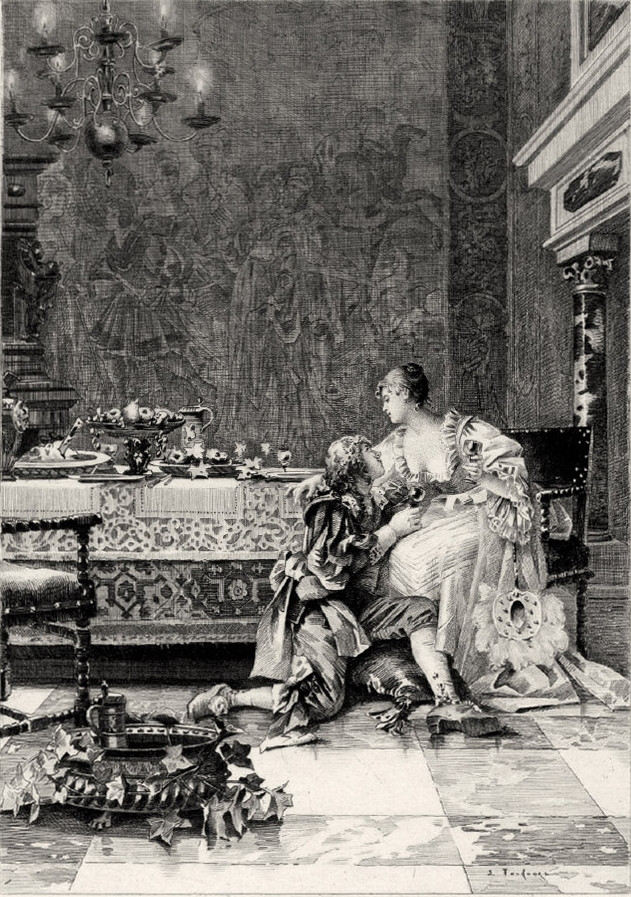
Chapter I — What a supper——The wine laughs in the crystal goblet, the white and gold pheasant smokes in a platter bearing her crest: the feast is prolonged far into the night and you can imagine that I don't finish up the night at home.
Sometimes it is in a great forest.—The hunt sweeps by; the horn rings out, the pack gives tongue and crosses the path with the swiftness of lightning; the fair one in a riding habit is mounted on a Turkish horse, white as milk, spirited and swift beyond words. Although she is an excellent horsewoman, he paws and curvets and rears, and she has all the difficulty in the world in holding him; he takes the bit in his teeth and rushes straight toward a precipice with her. I fall from heaven for the express purpose of saving her, I stop the horse, I catch the swooning princess in my arms, I bring her to herself and escort her to her château. What well-born woman would refuse her heart to a man who has risked his life for her?—None;—and gratitude is a cross-cut that leads very quickly to love.
You will agree, at all events, that when I go into romance, I don't stop half-way, and that I am as mad as it is possible for a man to be. That is as it should be, for nothing in the world is more sickening than rational madness. You will agree also that, when I write letters, they are volumes rather than simple notes. I love whatever goes beyond ordinary bounds in everything.—That is why I love you. Don't laugh too much at all the nonsense I have scribbled; I lay aside my pen to carry some of it into execution; for I recur always to my refrain! I mean to have a mistress. I cannot say whether it will be the lady of the park or the lady of the balcony, but I bid you farewell to go in quest of her. My mind is made up. Though she whom I seek should hide herself in the heart of the kingdom of Cathay or Samarcand, I shall find a way to dislodge her. I will let you know of the success or non-success of my undertaking. I hope that it will be success: give me your prayers, my dear friend. As for myself, I dress up in my best coat, and go out of the house determined not to return except with such a mistress as I have in my mind.—I have dreamed long enough; now to work.
P.S.—Tell me something about little D——; what has become of him? no one here knows anything about him; and give my compliments to your good brother and all the family.
II
Well, my friend, I have come home again, I have not been to Cathay or Cashmere or Samarcand;—but it is fair to say that I am no nearer having a mistress than ever.—And yet I took myself by the hand, I swore a mighty oath that I would go to the end of the world. I have not even been to the end of the town. I don't know what the matter is with me, but I have never been able to keep my word to anybody, even to myself: it must be that the devil takes a hand in it. If I say: "I will go there to-morrow," it is certain that I shall stay at home; if I propose to go to the wine-shop, I go to church; if I start to go to church, the roads get tangled under my feet like skeins of thread, and I find myself in an entirely different place. I fast when I have determined to have a debauch, and so it goes. Therefore I am inclined to believe that what prevents me from having a mistress is that I have determined to have one.
I must tell you about my expedition, step by step: it is well worth the honors of narration. I had passed at least two full hours at my toilet that day. I had had my hair combed and curled and my moustaches, such as they are, twisted and waxed a little; and as the excitement of longing imparted some slight animation to my ordinarily pale face, really I was not so bad. At last, after scrutinizing myself attentively in the mirror in different lights, to see if I was fine enough and if my bearing was sufficiently gallant, I went resolutely forth with head erect, chin well raised, eyes front, one hand on the hip, making the heels of my boots ring like an anspessade, elbowing the bourgeois, and with a flawlessly triumphant and all-conquering air.
I was like another Jason setting out to conquer the Golden Fleece.—But, alas! Jason was more fortunate than I: besides the conquest of the fleece, he made, at the same time, the conquest of a beautiful princess, and I—I have neither fleece nor princess.
I walked through the streets, eying all the women, and hurrying toward them and gazing at them at closer quarters when they seemed to me to be worth the trouble of examining.—Some assumed their high and mighty virtuous air and passed without raising their eyes.—Others were surprised at first, then smiled if they had white teeth.—Some turned after a little time, to look at me when they thought I was not looking at them, and blushed like cherries when they found themselves face to face with me.—It was a lovely day; there were quantities of people out walking.—And yet I must confess, notwithstanding all the respect I feel for that interesting half of the human race, which is called by common consent the fair sex, it is, as a whole, devilishly ugly: out of a hundred women there is hardly one who is passably good-looking. This one had a moustache; that one had a blue nose; others had red spots in place of eyebrows; one was not badly built, but she had a pimply face. The head of another was charming, but she could scratch her ear with her shoulder; a third would have put Praxiteles to shame with the graceful roundness of certain outlines, but she stumbled along on feet like Turkish stirrups. Another exhibited the most magnificent shoulders imaginable; in revenge, her hands resembled in shape and size those immense scarlet gloves that haberdashers use for signs.—Generally speaking, what tired-looking faces! how worn and streaked they were, withered by degrading petty passions and petty vices! What expressions of envy, of malevolent curiosity, of avarice, of brazen coquetry! and how much uglier is a woman who is not beautiful, than a man who is not handsome!
I saw nobody worth looking at—except a few grisettes;—but they have more cotton than silk to rumple, and they don't interest me.—In very truth, I believe that man, and when I say man I include woman, is the vilest animal on the face of the earth. That quadruped who walks on his hind feet seems to me extraordinarily presumptuous to claim the first place in creation as his undoubted right. A lion, a tiger, are finer animals than men, and in their species many individuals attain all the beauty that belongs to it. But such a thing rarely happens among human beings.—How many abortions for one Antinous! how many Goths for one Phyllis!
I am very much afraid, my dear friend, that I shall never be able to embrace my ideal, and yet there is nothing extraordinary or unnatural about it.—It is not the ideal of a third-form school-boy. I do not ask for ivory globes or alabaster pillars, or azure veins; I have not used in its composition either lilies, or snow, or roses, or jet, or ebony, or coral, or ambrosia, or pearls or diamonds; I have left the stars of heaven at rest, and I have not unhung the sun unseasonably. It is almost a bourgeois ideal, it is so simple, and it seems to me that with a bag or two of piastres I could find it all ready-made and realized in the first bazaar I might happen upon at Constantinople or Smyrna; it would probably cost me less than a blooded horse or dog; and to think that I shall not get what I want, for I have a feeling that I shall not! It is enough to drive a man mad, and I fly into the hottest sort of a rage against fate.
You are not such a mad fool as I, you are fortunate;—you have simply taken your life as it came, without tormenting yourself trying to shape it, and you have dealt with things as they turned up. You haven't sought for happiness, it has come in search of you; you love and are loved.—I don't envy you;—for Heaven's sake, don't think that! but I am not so happy as I ought to be when I think of your felicity, and I say to myself, with a sigh, that I would like to enjoy felicity of the same sort.
Perhaps my happiness passed by my side and I did not see it, blind that I was; perhaps a voice spoke, and the uproar of my internal tempests prevented me from hearing it.
Perhaps I have been loved in secret by some humble heart that I have neglected or broken; perhaps I have myself been the ideal of another, the pole-star of a suffering heart,—the dream of a night and the thought of a day.—If I had looked at my feet, perhaps I should have seen there some fair Magdalene with her box of ointment and her dishevelled hair. I walked along with my arms raised to heaven, longing to pluck the stars that fled from me, and scorning to pick the little daisy that opened its golden heart in the dewy grass. I have made a great mistake: I have asked love for something other than love, something that it could not give. I forgot that love was naked, I failed to grasp the meaning of that magnificent symbol.—I asked him for brocade dresses, feathers, diamonds, sublime intellect, learning, poesy, beauty, youth, supreme power—everything that is not love;—love can offer naught but love, and he who seeks to extort anything else from him is unworthy to be loved.
I have been in too much of a hurry, of course: my hour has not yet come; God who lent me my life will not take it back without letting me live. What's the use of giving a poet a lyre without strings, or man a life without love? God cannot be guilty of such inconsistency; and I have no doubt that when the allotted moment comes, He will place in my path the woman I am to love and by whom I am to be loved.—But why has love come to me before a mistress? Why am I thirsty when I have no fountain at which to quench my thirst? or why can I not fly, like the birds of the desert, to the spot where water is to be found? The world to me is a Sahara without wells or date-trees. I have not in my whole life a single shady nook to give me shelter from the sun: I suffer all the ardors of passion without its ineffable ecstasy and delight; I know its torments and have not its pleasures. I am jealous of something that does not exist; I am ill at ease for the shadow of a shade; I heave sighs that mean nothing; I have sleepless nights embellished by no adored vision; I shed tears that flow to the ground without being wiped away; I give the wind kisses that are not returned to me; I wear out my eyes trying to distinguish a vague, deceitful shape in the distance; I await what cannot come, and I count the hours with feverish anxiety as if I had an appointment.
Whoever you be, angel or demon, virgin or courtesan, shepherdess or princess, whether you come from north or south, you whom I do not know but whom I love! oh! do not force me to wait longer, or the flame will consume the altar, and you will find only a heap of cold ashes in place of my heart. Descend from the sphere where you now are; leave the crystal sky, O comforting spirit, and cast upon my heart the shadow of your great wings. Come, woman that I love, come, and let me clasp about you the arms that have been open so long. Ye golden doors of the palace where she dwells, turn on your hinges; raise yourself, latch of her humble cottage; untwine yourselves, ye branches of trees and thorns by the road-side; be broken, ye enchantments of the turret, ye spells of magicians; open, ranks of the common herd, and let her pass.
If you come too late, O my ideal! I shall not have the strength to love you:—my heart is like a dovecote full of doves. Every hour of the day some desire takes flight. The doves return to the dovecote, but my desires do not return to my heart.—The azure sky is whitened by their countless swarms; they wing their way through space, from world to world, from sky to sky, seeking some love to light upon and pass the night: haste, O my dream! or you will find naught in the empty nest save the shells of the birds that have flown.
My friend, my childhood's companion, you are the only one to whom I can say such things. Write me that you pity me and that you don't look upon me as a hypochondriac; comfort me, I never was in greater need of it; how greatly to be envied are they who have a passion they can satisfy! The drunkard finds no cruelty in any sort of a bottle; he falls from the wine-shop to the gutter and is happier on his dung-heap than a king on his throne. The sensual man resorts to courtesans in search of ready loves or shameless refinements of indecency: a painted cheek, a short skirt, an exposed bosom, an obscene jest, he is happy; his eye turns white, his lip is moist; he attains the height of his happiness, he enjoys the ecstasy of his vulgar lust. The gambler needs only a green cloth and a worn and greasy pack of cards to procure the poignant excitement, the nervous spasms and the diabolical joy of his ghastly passion. Such people can satisfy their cravings or find distraction;—to me it is impossible.
This idea has taken such thorough possession of me that I no longer care for the arts, and poetry has now no charm for me; the things that used to be my delight do not make the least impression on me. I begin to believe that I am wrong, I demand more of nature and society than they can give. What I seek does not exist and I ought not to complain because I cannot find it. However, if the woman we dream of does not come within the conditions of human nature, how is it that we love only her and not others, since we are men and our instinct should draw us irresistibly toward them? What puts this imaginary woman into our head? with what clay do we mould this invisible statue? where do we get the feathers we fasten to the back of this chimera? what mystic bird laid in a dark corner of our soul the unseen egg from which our dream was hatched? what is this abstract beauty that we feel but cannot define? why, before a woman who may be charming, do we sometimes say that she is beautiful,—whereas we find her very ugly? Where is the model, the type, the interior pattern that serves us as a point of comparison? for beauty is always comparative and can be appreciated only by contrast.—Was it in the sky that we saw her—in a star—at a ball in the shadow of a mother, fresh bud of a leafless rose?—was it in Italy or in Spain? was it here or there, yesterday or long ago? was it the admired courtesan, the popular cantatrice, the prince's daughter? a proud and noble head bending under a heavy diadem of pearls and rubies? a young and childish face stooping over the nasturtiums and volubilis in the window?—Of what school was the picture from which that beauty looked forth, fair and beaming amid dark shadows? Was it Raphael who caressed the contour that has caught your fancy? Was it Cleomenes who polished the marble that you adore?—are you in love with a Madonna or a Diana?—is your ideal an angel, a sylph, or a woman?
Alas! it is a little of all of these and it is none of them.
That transparent tint, that charming, blooming freshness, that flesh wherein the blood and the life flow in abundance, that lovely fair hair falling over the shoulders like a cloak of gold, that sparkling laughter, those amorous dimples, that figure undulating like a flame, that strength, that suppleness, that glistening satin, those rounded outlines, those plump arms, that full, smooth back, that whole appearance of blooming health belongs to Rubens.—Raphael alone could have given that pale tinge of amber to such pure features. What other than he drew the curves of those long, fine black eyebrows, and spread out the lashes of those modestly lowered lids?—Do you think that Allegri had no part in your ideal? From him the lady of your thoughts stole the warm, ivory whiteness of complexion that fascinates you. She stood long before his canvas to catch the secret of the angelic smile that is always on her lips; she modelled her oval features upon those of a nymph or a saint. That line of the hip that undulates so voluptuously is taken from the sleeping Antiope.—Those plump, well-shaped hands might be claimed by Danaë or Magdalen. Dusty antiquity itself supplied much material for the composition of your young chimera; those strong and supple loins, about which you twine your arms so passionately, were carved by Praxiteles. The divinity left everything for the express purpose of putting the toes of her charming foot outside the ruins of Herculaneum, so that your idol should not be lame. Nature also has contributed its share. You have seen here and there, in the prismatic rays of desire, a beautiful eye behind a blind, an ivory forehead pressed against a window, a mouth smiling behind a fan.—You have divined the quality of the arm from the hand, of the knee from the ankle. What you saw was perfect; you assumed that the rest was like what you saw and you finished it out with bits of other beauties gathered elsewhere.—Not even ideal beauty, as realized by painters, is sufficient for you, and you must go and ask the poets for outlines even more gracefully rounded, shapes more ethereal, charms more divine, refinement more exquisite; you begged them to give breath and speech to your phantom, all their love, all their musings, all their joy and their sadness, their melancholy and their morbid fancies, all their memories and all their hopes, their knowledge and their passion, their mind and their heart; you took all these from them and you added, to cap the climax of the impossible, your own passion, your own mind, your dreams and your thoughts. The star lent its beams, the flower its perfume, the palette its colors, the poet his harmony, the marble its shape, and you, your longing.—How could a real woman, who eats and drinks, who goes to bed at night and gets up in the morning—however adorable and instinct with charm she may be—sustain comparison with such a creature! We cannot reasonably hope for such a thing, and yet we do hope for it and seek it.—What extraordinary blindness! it is sublime or absurd. How I pity and admire those who pursue the reality of their dream through everything and die content, if only they have once kissed their chimera on the lips! But what a frightful fate is that of the Columbuses who have not discovered their world, and of lovers who have not found their mistress.
Ah! if I were a poet, I would consecrate my verses to those whose existence is a failure, whose arrows have not reached the target, who have died with the word they had to say still unsaid and without pressing the hand that was destined for them; to all who have been unsuccessful or have passed by unnoticed, to genius without issue, stifled fire, the undiscovered pearl at the bottom of the sea, to all who have loved without being loved, to all who have suffered and not been pitied;—it would be a noble task.
How wise it was of Plato to wish to banish you from his republic, and what harm you have done us, O poets! Your ambrosia has made our absinthe more bitter than ever; and we have found our lives more arid and more devastated after plunging our eyes into the vistas leading to eternity that you open to us! What a terrible struggle your dreams have brought upon our realities! and how our hearts have been stamped upon and trampled under foot by those rude athletes!
We have seated ourselves like Adam at the foot of the walls of the terrestrial paradise, on the steps of the staircase that leads to the world you have created, seeing a light brighter than the sunlight gleam through the chinks of the door, hearing vaguely some few scattered notes of a seraphic harmony. Whenever one of the elect enters or comes out amid a flood of glory, we stretch our necks trying to see something through the open door. It is fairy-like architecture equalled nowhere save in Arabian tales. Great numbers of pillars, superimposed arches, fluted spiral columns, leaf-work marvellously carved, trefoils hollowed out of the stone, porphyry, jasper, lapis-lazuli and Heaven knows what! transparencies and dazzling reflections, a profusion of strange stones, sardonyx, chrysoberyl, aquamarines, rainbow-hued opals, azerodrach, jets of crystal, torches to make the stars turn pale, a gorgeous vapor filled with noise and vertigo—genuine Assyrian magnificence!
The door closes: you see no more—and you cast down your eyes, filled with burning tears, to the poor, bare, lifeless earth, to the ruined hovels, to the people in rags, to your own soul, an arid rock upon which nothing grows, to all the woes and misfortunes of reality. Ah! if we could only fly as far as that, if the steps of that fiery staircase did not burn our feet; but alas! none but angels can climb Jacob's ladder!
What a fate is that of the poor man at the rich man's door! what ghastly irony in a palace opposite a hovel, the ideal opposite the real, poetry opposite prose! what deep-rooted hatred must tighten the knots at the bottom of the poor wretches' hearts! what a gnashing of teeth there must be at night on their poor beds, when the wind brings to their ears the sighing notes of the lutes and viols of love! Poets, painters, sculptors, musicians, why have you lied to us? Poets, why did you tell us your dreams? Painters, why did you place upon your canvas the intangible phantom that ascended and descended between your heart and your brain with the throbbing of your blood, and say to us: "This is a woman." Sculptors, why did you procure marble from the bowels of Carrara to make it express for all time, in the eyes of all men, your most secret and most fleeting desire? Musicians, why did you listen to the song of the stars and the flowers during the night, and note it down? Why do you write such lovely ballads that the softest voice that says to us: "I love you!" seems to us as hoarse as the rasping of a saw or the cawing of a crow?—My curse on you, impostors!—and may the fire from heaven burn and destroy all pictures, poems, statues, and concerted pieces.—Ouf! there's a tirade of interminable length and a little out of the ordinary epistolary style.—What a harangue!
I just gave full swing to the lyric impulse, my dear friend, and I have been talking on stilts for a long, long time. All this is very far from our subject, which is, if I remember rightly, the glorious and triumphant history of the Chevalier d'Albert in pursuit of Daraïde, the loveliest princess in the world, as the old romances say. But in truth the story is so poor that I am compelled to have recourse to digressions and reflections. I hope that it will not always be so, and that, before long, the romance of my life will be more involved and complicated than a Spanish imbroglio.
After wandering about from street to street, I decided to call on one of my friends who was to present me at a house where, according to what he told me, I should see a world of pretty women—a collection of flesh and blood idealities—the wherewithal to satisfy a score of poets.—There are some there to suit all tastes:—aristocratic beauties with eagle glances, sea-green eyes, straight noses, chins haughtily elevated, queenly hands, and the gait of a goddess; silver lilies mounted upon golden stalks;—modest violets, pale of hue, sweet of perfume, with melting, downcast eyes, slender neck, transparent flesh;—animated, piquant beauties; devout beauties, beauties of all sorts;—for the house is a genuine seraglio, minus the eunuchs and the Kislar aga.—My friend tells me that he has already had five or six affairs there—quite as many as that;—that seemed to me a prodigious record and I am very much afraid that I shall not have the like success; De C—— says yes, and that I shall succeed much better than I shall care to. According to him I have only one fault, which I am certain to correct as I grow older and go more into society—he says I think too much of woman and not enough of women.—It may well be that there's some truth in that.—He says that I will be perfectly lovable when I rid myself of that little failing. God grant it! It must be that women feel that I despise them; for a compliment, which they would consider adorable and delightful to the last degree in the mouth of another, in mine displeases them and makes them angry, as if it were the most savage epigram. That probably has something to do with the fault De C—— refers to.
My heart beat a little faster as I went up the stairs, and I had barely recovered from my emotion when De C——, taking me by the elbow, brought me face to face with a woman of about thirty—not ill-looking—dressed with dissembled magnificence and extreme affectation of childlike simplicity—which did not prevent her being daubed with rouge like a carriage-wheel:—it was the lady of the house.
De C——, assuming the shrill, mocking voice which is so different from his ordinary voice, and which he uses in society when he wants to be fascinating, said to her, half aloud, with abundant demonstrations of ironical respect, in which the most profound contempt could plainly be detected:
"This is the young man of whom I spoke to you the other day—a man of very distinguished merit; he is of unexceptionable birth and I think that it cannot be otherwise than agreeable to you to receive him; that is why I have taken the liberty to present him to you."
"Assuredly, monsieur, you have done well," rejoined the lady, with a most outrageously affected manner. Then she turned to me, and after looking me over out of the corner of her eye, like a clever connoisseur, and in a way that made me blush to my ears, she said: "You may consider yourself invited once for all, and come as often as you have an evening to waste."
I bowed awkwardly enough, and stammered a few disconnected words which could not have given her a very exalted opinion of my talents; other persons came in and I was delivered from the ennui inseparable from an introduction. De C—— led me to a window recess and began to lecture me vigorously.
"What the devil! you will get me into a scrape; I announced you as a perfect phœnix of wit, a man of unbridled imagination, a lyric poet, everything that is most transcendent and impassioned, and you stand there like a ninny without lisping a word. What a wretched imagination! I thought your vein was more fruitful; come, come, give your tongue the rein, chatter away through thick and thin; you don't need to say sensible, judicious things, on the contrary, they might injure your chances; talk, that's the main thing; talk fast, talk all the time; attract attention to yourself; throw aside all fear and all modesty; fix it firmly in your head that all who are here are fools, or almost that, and don't forget that an orator who wants to succeed cannot despise his audience enough.—What do you think of the mistress of the house?"
"I dislike her very much already; and although I talked with her hardly three minutes, I was as bored as if I were her husband."
"Aha! that's what you think of her, eh?"
"Why, yes."
"Is your repugnance for her altogether insurmountable?—So much the worse; it would have been decent for you to have her, if only for a month; it's good form, and a young man with a little money can't get into society except through her."
"Very good! I'll have her," I said piteously, "since it must be; but is it as necessary as you seem to think?"
"Alas! yes, it is absolutely indispensable, and I will tell you why. Madame de Thémines is the fashion now; she has all the absurd foibles of the day in a superior way,—sometimes those of to-morrow, but never yesterday's: she is thoroughly posted. People will wear what she wears, and she never wears what any one else has worn. She is rich, too, and her carriages are in the best taste.—She has no wit, but much small-talk; she has very keen fancies and little passion. People amuse her but do not move her; she has a cold heart and a dissolute head. As for her soul—if she has one, which is doubtful—it is of the blackest, and there is no malice and baseness of which she is not capable; but she is extremely adroit and keeps up appearances, just what is necessary to prevent anything being proved against her. For instance, she will lie with a man, but she will never write him the simplest kind of a note. Thus her most intimate enemies can find nothing to say against her except that she applies too much rouge and that certain parts of her person are not, in fact, so well rounded as they seem to be—which is false."
"How do you know?"
"What a question!—how does one know that sort of thing except by finding out for himself?"
"Then you have had Madame de Thémines?"
"Certainly I have! Why shouldn't I have had her? It would have been most unseemly of me not to have her.—She has done me some very great favors, and I am very grateful to her for them."
"I don't understand what kind of favors she can have done you."
"Are you really a fool?" said De C——, gazing at me with the most comical expression imaginable.—"Faith, I am much afraid of it; must I tell you everything? Madame de Thémines is considered, and justly, to have special information in certain directions, and a young man whom she has taken and kept for some time can present himself boldly anywhere, and be sure that he won't be long without having an affair—more likely two than one.—Aside from that ineffable advantage, there is another hardly less great; and that is that, as soon as the female members of this circle see that you are Madame de Thémines' official lover, even though they have not the slightest taste for you, they will consider it a pleasure and a duty to take you away from a fashionable woman like her; and, instead of the advances and manœuvres you would otherwise have to make, you will have an embarrassment of riches, and you will necessarily become the focus of all imaginable cajoleries and blandishments.
"However, if she arouses too strong a repugnance in you, don't take her. You are not exactly obliged to do it, although that would be courteous and proper. But make your choice quickly and attack the one who pleases you best or seems to offer the most facilities, for by delaying you will lose the benefit of novelty, and the advantage it gives you over all the men here for a few days. All these ladies have no conception of the passions that are born in private intercourse and develop gradually in respect and silence; they are all for lightning strokes and occult sympathies; a wonderfully well-conceived scheme to avoid the ennui of resistance and all the long and wearisome repetitions that sentiment mingles with the romance of love, and which serve only to defer the conclusion to no purpose.—These ladies are very saving of their time, and it seems so valuable to them that they would be in despair at the thought of leaving a single moment unemployed.—They have a craving to oblige the human race which one cannot praise too highly, and they love their neighbor as themselves—which is most meritorious and perfectly angelic; they are very charitable creatures who would not, for anything in the world, drive a man to die of despair.
"There must be three or four of them already who are impressed in your favor, and I advise you as a friend to press your advantage warmly in that direction, instead of amusing yourself prattling with me in a window-recess, which will not materially assist your prospects."
"But, my dear C——, I am altogether green in such matters, I haven't the necessary experience of society to distinguish at first glance a woman who is impressed from one who isn't; and I might make some strange blunders unless you will assist me with your experience."
"Upon my word, you are a primitive creature without a name, and I didn't suppose it was possible to be so pastoral and bucolic in the blessed age we live in!—What the devil are you doing with that pair of great black eyes of yours, which would produce a most stunning effect if you knew how to use them?
"Just look over yonder, in the corner by the fire-place, at that little woman in pink playing with her fan: she has been staring at you for a quarter of an hour with most significant assiduity and fixity; no one in the world but she can be indecent in so superior a fashion and display such noble insolence. The women don't like her at all, for they despair of ever reaching that height of impudence, but, on the other hand, she is very popular with the men who find in her all the piquant flavor of the courtesan.—To be sure, her depravity is of a fascinating sort, she is full of wit and impulse and caprice.—She's an excellent mistress for a young man who has prejudices.—Within a week she will rid your conscience of all scruples and corrupt your heart to such an extent that you will never make yourself ridiculous or indulge in elegiacs. She has incredibly positive ideas on every subject; she goes to the bottom of everything with astonishing rapidity and accuracy of insight. The little woman is the incarnation of algebra; she is precisely what a dreamer and an enthusiast needs. She will soon cure you of your misty idealism: therein she will render you a great service. She will do it with the greatest pleasure, however, for her instinct leads her to disenchant poets."
My curiosity being aroused by De C——'s description, I emerged from my retreat, and, gliding from group to group, approached the lady in question and observed her closely,—she may have been twenty-five or twenty-six years old. She was small, but well shaped, although a little inclined to be stout; she had round, white arms, well-formed hands and pretty feet, almost too small,—plump, polished shoulders, breast but little exposed, but what there was, very satisfactory and affording a favorable idea of the rest; her hair was extremely glossy and of a blue-black shade like a jay's wing; the corner of the eye was turned well up toward the temple, nose thin, nostrils very open, mouth moist and sensuous, a little crease on the lower lip and an almost imperceptible down at the corners. And with it all, vivacity, animation, health, and an indefinable suggestion of wantonness adroitly tempered by coquetry and tact, which made her a very desirable creature and more than justified the very lively passions she had inspired and continued to inspire every day.
I desired her; but yet I understood that that woman, agreeable as she might be, was not my ideal, or could make me say: "At last I have a mistress!"
I returned to De C—— and said: "I like her looks, and perhaps I may come to an understanding with her. But, before saying anything definite which will bind me, I would be very glad if you would have the kindness to point out those indulgent beauties who are so condescending as to be impressed with me, so that I may make my choice.—You will also oblige me, as you are acting as showman on this occasion, by adding a little descriptive notice and a list of their good and bad qualities; how I must attack them and the tone I must adopt with them in order not to seem too much like a provincial or a literary man."
"I most certainly will," said De C——. "Do you see that lovely, melancholy swan who manages her neck so gracefully and makes her sleeves move like wings? she is modesty itself, the most chaste and virginal creature in the world; she has a snow-white brow, a heart of ice, the expression of a madonna, the smile of an Agnes; she has a white dress and a soul of the same color; she wears nothing but orange-blossoms or water-lily leaves in her hair, and is attached to earth only by a thread. She has never had an evil thought and has no idea wherein man differs from woman. The Blessed Virgin is a Bacchante beside her, all of which does not prevent her having had more lovers than any woman I know, and that is certainly saying a good deal. Just cast your eye on that discreet person's throat; it is a little masterpiece, and really it is very difficult to show so much without showing more; tell me if, with all her reserve and all her prudery, she isn't ten times more indecent than that good lady at her left, who bravely displays two hemispheres which, if they were united, would form a life-size globe,—or the other one at her right, décolletée to the navel, who parades her nothingness with fascinating intrepidity?—That virginal creature, unless I am very much mistaken, has already figured out in her head how much love and passion your pallor and your black eyes may be taken to promise; and my reason for saying so is that she hasn't once looked in your direction, visibly at least; for she can manage her pupils with such art and roll them into the corner of her eyes so cleverly that nothing escapes her; one would think that she looked through the back of her head, for she knows perfectly well what is going on behind her.—She's a female Janus.—If you want to succeed with her, you must lay aside anything like a free-and-easy, victorious manner. You must talk to her without looking at her, without moving, in a contrite attitude and in a subdued, respectful voice; in that way you can say whatever you choose to her, provided that it is suitably glossed over, and she will allow you to take the greatest liberties, at first in words; afterward in deeds. Simply take care to roll your eyes tenderly when hers are cast down, and talk to her about the joys of platonic love and the communion of souls, while you employ with her the least platonic and least ideal pantomime imaginable! She is very sensual and very sensitive; kiss her as often as you choose, but don't forget, even in the most intimate intercourse, to call her madame at least three times per sentence: she fell out with me, because, when I was in her bed, I said something or other to her and called her thou. What the devil! a woman is not virtuous for nothing!"
"After what you tell me I have no great desire to try my luck. A prudish Messalina! an entirely novel and monstrous combination."
"Old as the world, my dear boy! it is seen every day and nothing is more common.—You are wrong not to try your hand with her.—She has one great charm, which is that with her you always seem to be committing a deadly sin, and the least kiss seems altogether damnable; while with others you think of it as nothing more than a venial sin, and often you don't think you're doing anything wrong at all.—That is why I kept her longer than any other mistress.—I should have her still if she had not left me herself; she's the only woman who ever got ahead of me, and I look upon her with a certain amount of respect on that account.—She has the most delicate little refinements of pleasure and the great art of appearing to be forced to grant what she grants very freely; which gives to each of her favors the fascination of rape. You will find in society ten of her lovers who will swear to you that she is one of the most virtuous creatures on earth.—She is precisely the contrary.—It is an interesting study to analyze that virtue of hers on a pillow. Being forewarned, you run no risk, and you won't make the blunder of falling in love with her in earnest."
"How old is this adorable creature?" I asked De C——, for it was impossible to decide, even after examining her with the most careful attention.
"Ah! there you are! how old is she? that's a mystery and God only knows the clue. For my own part, and I pride myself on telling a woman's age almost to a minute, I have never succeeded in finding out hers. I can only estimate approximately that she is somewhere between eighteen and thirty-six.—I have seen her in full dress, in déshabille, in her linen, and I can tell you nothing in that connection: my knowledge is at fault; the age that you would generally take her to be is eighteen, and yet that can't be her age.—She is a combination of a virgin body and the soul of a harlot, and she must have had much time or much genius to corrupt herself so thoroughly and so speciously; she must have a heart of brass in a breast of steel; but she has neither; that makes me think that she is thirty-six, but in reality I know nothing about it."
"Hasn't she any intimate friend who could enlighten you on the subject?"
"No; she arrived here two years ago. She came from the provinces or from abroad, I don't know which—that is an admirable position for a woman who knows how to make the most of it. With such a face as she has, she can make herself any age she chooses and date only from the day she arrived here."
"That certainly is a most agreeable state of things, especially when some impertinent wrinkle doesn't give you the lie, and Time, the great destroyer, is kind enough to connive at that falsification of the certificate of baptism."
He pointed out several others, who, he said, would receive favorably whatever requests it might please me to prefer to them, and would treat me with peculiar philanthropy. But the woman in pink in the chimney-corner and the modest dove who was her antithesis were incomparably superior to all the others; and, if they had not all the qualities I require, they had some of them, at least in appearance.
I talked all the evening with them, especially with the last, and I took pains to cast my ideas in the most respectful mould;—although she hardly looked at me, I fancied sometimes that I could see her eyes gleaming behind the curtain of their lashes, and at some compliments that I ventured to address to her, decidedly broad but shrouded in the most modest gauze, I noticed just below the skin a tiny blush, held back and stifled, not unlike the effect produced by pouring a red liqueur into a glass that is half opaque.—Her replies were, in general, sedate and well-weighed, but keen and bright, and they implied much more than they expressed. The whole conversation was interspersed with pauses, unfinished phrases; veiled allusions, every syllable had its meaning, every pause its bearing; nothing could be more diplomatic or more charming.—And yet, however great my pleasure in it for the moment, I could not endure such a conversation very long. One must be forever on the alert and on his guard, and what I like best in conversation is ease, familiarity.—We talked first of music, which led us naturally to speak of the Opera, then of women, and then of love, a subject in which it is easier than in any other to find excuses for transition from general principles to special instances.—We vied with each other in amatory talk; you would have laughed to hear me. Verily, Amadis on poor La Roche was no better than a dull pedant beside me. It was generosity, abnegation, self-sacrifice enough to put the late Curtius of Rome to the blush.—Really I didn't believe myself capable of such transcendent humbug and bathos. Can you imagine anything more ridiculous, a more perfect scene for a comedy, than myself indulging in the quintessence of platonism? And then my sugary manner, my demure, hypocritical little ways! tubleu! I looked as if I could never touch anything, and any mother who had heard me argue wouldn't have hesitated to let me lie with her daughter, any husband would have trusted his wife with me. It was the one evening in all my life when I seemed to be most virtuous and was least so. I thought it was more difficult than that to be a hypocrite and say things one doesn't believe. It must be very easy or else I must be strongly predisposed that way, to have succeeded so satisfactorily at the first trial.—Really I have some inspired moments.
As for the lady, she made many remarks, very shrewdly worded, which, notwithstanding the innocent air with which she made them, denoted a very extensive experience; you can't conceive the subtlety of her distinctions. The woman would split a hair in three pieces lengthwise, and make fools of all the angelic and seraphic pundits that ever were. Indeed, from her way of talking, it was impossible to believe that she has the shadow of a body.—It is all immaterial, vaporous, ideal enough to break your arms; and if De C—— had not warned me beforehand of the creature's manœuvring, I should certainly have despaired of the success of my undertaking, and stood shamefacedly aside. How in the devil, when a woman tells you for two hours, with the most indifferent air you can imagine, that love lives only on privation and sacrifice and other fine things of that sort, can you decently hope to persuade her to get between two sheets with you some day to stir your blood and see if you are made alike?
In short, we parted the best of friends, mutually congratulating each other on the elevation and purity of our sentiments.
My conversation with the other was, as you will imagine, of a very different tenor. We laughed as much as we talked. We made fun, and very wittily too, of all the women there. When I say: "We made fun, and very wittily too," I am wrong; I ought to say: "She made fun;" a man never makes fun of a woman. I listened and approved, for it is impossible to draw with more telling strokes or to apply colors more brilliantly; it was the most interesting gallery of caricatures that I have ever seen. In spite of the exaggeration, you felt the truth underneath; De C—— was quite right; that woman's mission is to destroy the illusions of poets. There is an atmosphere of prose about her in which a poetic idea cannot live. She is charming, sparkling with wit, and yet when you are with her you think only of base, vulgar things; as I talked to her I felt a crowd of desires, incongruous and impracticable in that place; I felt like ordering wine and getting tipsy, taking her on my knee and kissing her neck—like lifting up her skirt to see if her garter was above or below the knee, like singing an obscene song at the top of my voice, smoking a pipe or smashing the windows: the devil knows what.—All the animal, all the brute rose in me; I would willingly have spat on Homer's Iliad and thrown myself on my knees before a ham.—I understand perfectly to-day the allegory of Circe changing the companions of Ulysses to swine. Circe was probably a wanton like my little woman in pink.
It is a shameful thing to say, but I felt a keen delight in the consciousness that the brute nature was gaining the upper hand; I did not resist it, I assisted it with all my strength, corruption is so natural to man and there is so much mud in the clay of which he is made.
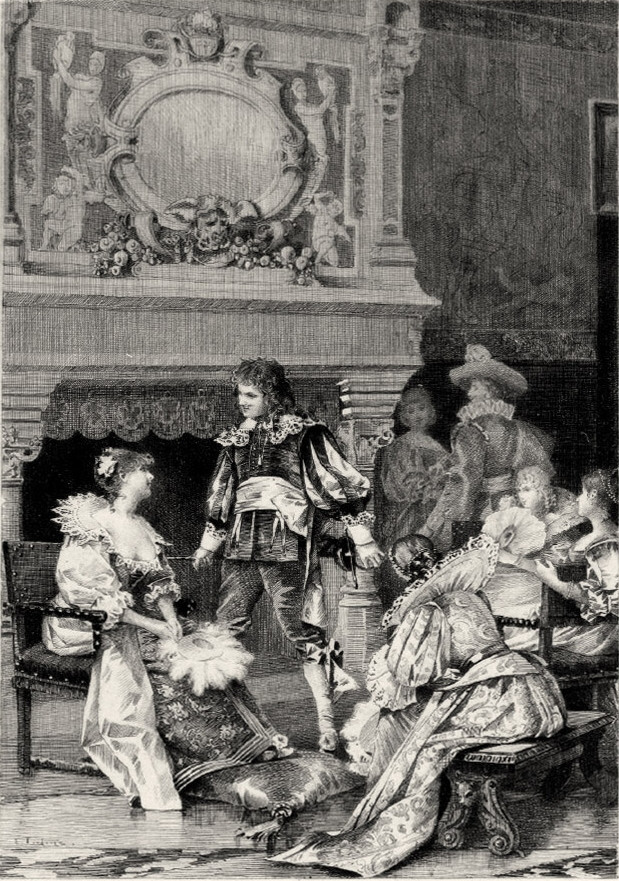
Chapter II — My conversation with the other was, as you will imagine, of a very different tenor. We laughed as much as we talked. We made fun, and very wittily too, of all the women there.
And yet I was afraid for a minute of the gangrene that was gaining upon me, and I tried to leave my corrupter; but the floor seemed to have risen to my knees, and I was as if riveted to my place.
At last I made a determined effort and left her, and, it being then very late, I returned home in dire perplexity, very much disturbed in mind and with none too clear an idea what I ought to do.—I wavered between the prude and the wanton.—I found piquancy in the one, sensuousness in the other; and after a very close and very thorough examination of my conscience I discovered, not that I loved them both, but that I desired them both, one as much as the other, with sufficient eagerness to indulge in reverie and preoccupation.
According to all appearances, O my friend! I shall have one of those two women, perhaps I shall have them both, and yet I confess that I am only half satisfied by possessing them; it isn't that they're not very pretty, but at sight of them nothing cried out within me, nothing throbbed, nothing said: "It is they;"—I did not recognize them.—And yet I don't imagine that I shall find any one much better off in the way of birth and beauty, and De C—— advises me to try my hand with them. Most certainly I shall do it, and one or the other shall be my mistress before long or may the devil fly away with me; but way down in my heart a still small voice reproaches me for lying to my love and for pausing thus at the first smile of a woman I do not love, instead of seeking untiringly through the world, in cloisters and all sorts of bad places, in palaces and taverns, the woman who was made for me and whom God destines for me, be she princess or serving-maid, nun or courtesan.
Then I say to myself that I am indulging in chimeras, and that it's very much the same after all, whether I lie with that woman or another, that the earth will not swerve a hair's breadth from its course, and that the seasons will not change their order on that account; that nothing in the world is more indifferent to me, and that I am very simple to torment myself about such trifles: that is what I say to myself.—But it's of no use for me to talk, I am not a whit more easy in my mind or more decided.
It may be because I live much alone and the smallest details take on too much importance in a life so monotonous as mine. I give too much heed to my living and thinking: I hear the throbbing of my arteries, the beating of my heart; by dint of close attention I disengage my most intangible ideas from the confused haze in which they float, and give them a body.—If I had more to do I should not notice all these trivial things and should not have time to look at my heart under a microscope, as I do all day long. The din of action would drive away this swarm of indolent thoughts that are flying about in my head and deafening me with the buzzing of their wings: instead of pursuing phantoms I should come to blows with realities; I should ask women for nothing beyond what they can give—pleasure—and I should not try to embrace some fanciful ideal decked out in hazy perfections.—This desperate tension of the eye of my heart toward an invisible object has impaired my sight. I am unable to see what is, from having stared at what is not, and my eye, so keen for the ideal, is terribly short-sighted for the real; so that I have known women whom everybody declared to be most ravishing creatures, but who seemed to me very far from that. I have greatly admired pictures generally considered to be daubs, and fantastic or unintelligible verses have given me more pleasure than the most courtly productions.—I should not be at all astonished if, after addressing so many sighs to the moon and looking at the stars with strained gaze, after perpetrating so many elegies and sentimental apostrophes, I should fall in love with some vile girl from the street, or some ugly old woman; that would be a great come-down!—Reality will perhaps take its revenge thus for the little care I have taken to pay court to it:—wouldn't it be a fine thing if I should conceive a romantic passion for a scullery wench or a low, dirty trollop? Can you imagine me playing a guitar under a kitchen window and supplanted by a lackey carrying an old toothless dowager's pet cur?—Or perhaps, finding nothing in this world worthy of my love, I shall end by adoring myself, like the late Narcissus of selfish memory. To protect myself from such a great disaster, I look at myself in every mirror and in all the streams I pass. To tell the truth, as a result of musing and mental wandering I am terribly afraid of being led into something monstrous and unnatural. That is a serious matter and I must be on my guard.—Adieu, my friend;—I am going at once to call on the pink lady, for fear of relapsing into my usual state of meditation. I do not think that we shall trouble ourselves very much about actualities, and if we do anything it surely won't be in a spiritual direction, although she is very spirituelle. I carefully roll up and put away in a drawer the pattern of my ideal mistress in order not to try it upon this one. I propose to enjoy tranquilly such good qualities and merits as she has. I propose to leave her in a dress adapted to her figure, and not to try to fit clothes to her that I have cut out, in case of emergency, for the lady of my thoughts.—Those are very prudent resolutions, but I don't know whether I shall keep to them.—Once more, adieu.
III
I am the titular lover of the pink lady; that is almost a profession, an office, and it gives a man a firm footing in society. I no longer look like a scholar seeking a mistress among a parcel of grandmothers and afraid to sing a love-song to a woman unless she's a hundred years old; I notice, since my installation, that I receive much more consideration, that all the women talk to me with jealous coquetry and go out of their way to smile on me.—The men, on the other hand, are colder, and in the few words we exchange there is a touch of hostility and constraint; they feel that they have in me an enemy already formidable, who may become much more so.—I have heard that many of them had bitterly criticised my way of carrying myself and said that my style of dress was too effeminate; that my hair was curled and anointed with more care than beseemed me; that that fact, taken in connection with my beardless face, gave me a most absurd girlish appearance; that I affected rich materials that smelt of the stage, and that I looked more like an actor than a man: a parcel of trite, sneering remarks, intended to justify themselves in being dirty and wearing wretched, ill-fitting clothes. But all this serves only to make me the whiter, and all the ladies consider that my hair is the finest in the world, and that the niceties of my toilet are in the best taste, and they seem strongly disposed to make up to me for all that I spend for their benefit, for they are not fools enough to believe that all that elegance has no other aim than my own private embellishment.
The lady of the house seemed at first a little offended at my choice, which she thought must inevitably fall upon herself, and for some days she was decidedly sour—to her rival only, for there was no change in her manner to me—her spleen manifesting itself in divers little "My dears," uttered in that dry, abrupt tone that women alone can master, and in certain uncomplimentary remarks concerning her costume, made in as loud a voice as possible, such as: "Your hair is done too high and not at all to correspond with your face," or: "Your waist bags under the arms; who in the world made that dress?" or: "You have black rings under your eyes; it seems to me you are much changed;" and a thousand other trivial observations to which the other did not fail to retort with all desirable malignity when opportunity offered; and if the opportunity was too slow in offering she made one for her own use and returned, with interest, what she had received. But soon, another object having distracted the attention of the slighted princess, the little war of words ceased and everything resumed its usual order.
I said baldly that I was the pink lady's titular lover; that is not enough for so accurate a man as you are. You will undoubtedly ask me what her name is: as for that, I shall not tell you; but, if you choose, to shorten the story and in memory of the color of the dress in which I first saw her, we will call her Rosette; it's a pretty name; my little dog has the same name.
You would like to know from point to point, for you love exactness in all things, the story of our love-affairs with this fair Bradamante, and by what successive steps I passed from the general to the particular and from the condition of simple spectator to that of actor; how, after being one of the audience, I became the lover. I will gratify your desire with the very greatest pleasure. There is nothing unpleasant in our romance; it is all rose-colored, and no tears are shed except tears of pleasure; you will find no long descriptions or repetitions, and everything moves on toward the end with the haste and speed so urgently recommended by Horace;—it is a genuine French romance.—Do not imagine, however, that I carried the citadel at the first assault. The princess, although very humane to her subjects, is not as lavish of her favors at first, as you might think; she knows their value too well not to make you purchase them; she also knows too well how a judicious delay sharpens the appetite and what relish a semi-resistance adds to the pleasure, to abandon herself to you at first, however keen the inclination you have aroused in her.
To tell the whole story at length, I must go back a little. I gave you a very circumstantial account of our first interview. I had one or two, perhaps three others in the same house, and then she invited me to call on her; I did not make her repeat the invitation, as you can believe; I went there at discreet intervals at first, then a little more frequently, then still more so, and finally whenever the fancy seized me, and I must confess that it seized me at least three or four times a day.—The lady, after we had been parted a few hours, always received me as if I had just returned from the East Indies; which fact touched me as much as anything could and impelled me to show my gratitude in a marked manner by the most gallant and tenderest words you can imagine, to which she replied as best she could.
Rosette—as we have agreed to call her that—is a very bright woman and has a most admirable appreciation of man; although she postponed the end of the chapter for some time, I did not once lose my temper with her: which is really marvellous, for you know how I fly into a passion when I don't get what I want on the instant, and when a woman goes beyond the time I have mentally allowed her in which to surrender.—I have no idea how she did it at the first interview; she gave me to understand that I should have her, and I was surer of her than if I had had her written promise signed by her hand. You will say perhaps that her bold and free-and-easy manners left the field free to rash hopes. I do not think that that is the real motive: I have seen some women whose prodigious freedom of manner excluded the last vestige of doubt, who did not produce that effect upon me, and in whose presence I was conscious of a timidity and uneasiness that were, to say the least, misplaced.