THÉOPHILE GAUTIER (continued 3)
I. G. Burnham translation
The result is, generally speaking, that I am less amiable with the woman I long to possess than with those who are indifferent to me; it is because of the excitement of waiting for an opportunity and my uncertainty as to the success of my project; that makes me gloomy and casts me into a fit of musing which takes away much of my power of pleasing and my presence of mind. When I see the hours I had set aside for another purpose passing one by one, I am filled with anger in spite of myself, and I cannot keep from saying very sharp, harsh things, which sometimes go as far as brutality and put my affair back a hundred leagues.
With Rosette I had no such feeling; never, even at the moment when she resisted me most stubbornly, did I have the idea that she wanted to escape from my love. I calmly allowed her to display all her little coquetries, and I endured in patience the overlong delays to which it pleased her to subject my ardor; there was something smiling in her harshness that consoled you for it as much as possible, and in her most Hyrcanian cruelties you could distinguish a background of humanity that made it impossible for you to have any very serious fear.—Virtuous women, even when they are not really virtuous at all, have a crabbed, disdainful way which is perfectly unendurable to me. They have the air of being always ready to ring and order their footmen to put you out; and it seems to me, really, that a man who takes the trouble to pay court to a woman—and it isn't always as agreeable as you may think—doesn't deserve to be looked at in that way.
Dear Rosette has no such glances as that, not she; and I assure you that she doesn't lose anything by it; she is the only woman with whom I have ever been myself, and I am conceited enough to say that I have never been so agreeable. My wit has displayed itself freely; and, by the skill and fire of her retorts, she has led me to discover more than I had any idea that I possessed, and more perhaps than I really do possess.—To be sure, I haven't done much in the way of lyrics—that is hardly possible with her; it is not that she has no poetic side, notwithstanding what De C—— said of her; but she is so full of life and strength and movement, she seems to be so well placed in her present surroundings, that one has no desire to leave them for a flight among the clouds. She fills one's real life so pleasantly and makes of it something so entertaining to herself and others, that reverie has nothing better to offer you.
A miraculous thing! I have known her nearly two months, and in those two months the only times I have been bored have been when I was not with her. You will agree that she can be no inferior woman to produce such a result, for women usually produce exactly the opposite effect on me and are much more agreeable to me at a distance than near at hand.
Rosette has the best disposition in the world, with men I mean, for with women she's as wicked as a devil; she is bright, lively, alert, ready for anything, very original in her way of speaking, and has always some charming nonsense to tell you that you don't expect; she is a delightful companion, a jolly comrade with whom you sleep, rather than a mistress; and if I were a few years older and had fewer romantic ideas, I should be perfectly satisfied, indeed I should deem myself the most fortunate mortal on earth. But—but—that conjunction implies nothing good, and unfortunately that little devil of a restrictive word is the one most frequently employed in all human tongues;—but I am an imbecile, an idiot, a downright booby, never content with anything and always hunting mares' nests; and, instead of being altogether happy, I am only half so;—half, that is a good deal for this world, and yet I find it not enough.
In the eyes of the world I have a mistress whom several desire and envy me, and whom no one would disdain. My desire is gratified, therefore, in appearance, and I no longer have the right to pick a quarrel with fate. However, it seems to me that I have no mistress; I can convince myself that I have by arguing it out, but I do not feel it, and if anybody should ask me unexpectedly if I had one, I think I should answer no.—However, the possession of a woman who has beauty, youth, and wit, constitutes what, in all times and in all countries, has been and still is called having a mistress, and I think there is no other way. That doesn't prevent my having the strangest doubts in that connection, and it has gone so far that if several people should unite to convince me that I am not Rosette's favored lover, I should end by believing them in the face of the palpable evidence to the contrary.
Do not think from what I say that I do not love her or that she is displeasing to me in any way; on the contrary, I am very fond of her and I see in her what everybody else would see in her: a pretty, alluring creature. I simply do not feel that I possess her, that is all. And yet no woman ever gave me so much pleasure, and if I have ever known bliss, it has been in her arms.—A single one of her kisses, the most chaste of her caresses makes me shiver to the soles of my feet and sends all my blood back to my heart. Explain it all if you can. The facts, however, are as I tell them to you. But the human heart is full of such absurdities; and if we were obliged to reconcile all the contradictions it exhibits, we should have a heavy task on our hands.
How does it happen? Verily, I have no idea.
I see her all day, and all night too, if I choose. I bestow as many caresses on her as I please; I have her naked or dressed, in town or in the country. Her good humor is inexhaustible, and she enters heart and soul into my whims however eccentric they may be; one evening the fancy seized me to possess her in the middle of the salon, with all the candles lighted, the fire blazing on the hearth, the chairs arranged in a circle as if for a grand evening reception, she, in a toilette de bal with her bouquet and her fan, all her diamonds on her fingers and her neck, feathers in her hair—the most magnificent costume imaginable—and I dressed like a bear; she consented.—When everything was ready, the servants were greatly surprised to receive orders to close the doors and admit no one; they acted as if they had not the slightest comprehension of what it all meant, and went away with a dazed look that made us laugh heartily. They certainly thought that their mistress was stark mad; but what they thought or did not think mattered little to us.
That was the most burlesque evening of my whole life. Can you imagine the appearance I must have presented with my hat and feather under my paw, rings on every claw, a little silver-hilted sword and a sky-blue ribbon on its hilt? I approached the fair one, and, having made her a most graceful reverence, sat down beside her and besieged her in due form. The flattering madrigals, the exaggerated compliments I addressed to her, all the jargon suited to the occasion assumed a strange significance in passing through my bear's muzzle; for I had a superb head of painted cardboard which I was soon obliged to throw under the table, my deity was so adorable that evening, and I longed so to kiss her hand and something better than her hand. The skin soon followed the head; for not being accustomed to play the bear, I was stifled in it, more so than was necessary. Thereupon the ball-dress had a fine time as you can imagine; the feathers fell like snow around my beauty, the shoulders soon came out of the sleeves, the bosom from the corset, the feet from the shoes, the legs from the stockings; the unstrung necklaces rolled on the floor, and I believe that fresher dress was never more pitilessly rumpled and torn; the dress was of silver gauze and the lining of white satin. Rosette displayed on that occasion a heroism altogether unusual to her sex, which gave me a most exalted opinion of her. She looked on at the sack of her costume like an uninterested witness, and did not for a single instant show the slightest regret for her dress and her lace; on the contrary, she was wildly gay, and assisted with her own hands in tearing and breaking anything that wouldn't untie or unclasp quickly enough to suit my taste and hers.—Doesn't this strike you as worthy to be handed down in history beside the most brilliant deeds of the heroes of antiquity? The greatest proof of love a woman can give her lover is to refrain from saying to him: "Take care and not rumple me or spot my dress," especially if the dress be new.—A new dress is a greater source of security to a husband than is commonly supposed. It must be that Rosette adores me or else she is blessed with a philosophy superior to that of Epictetus.
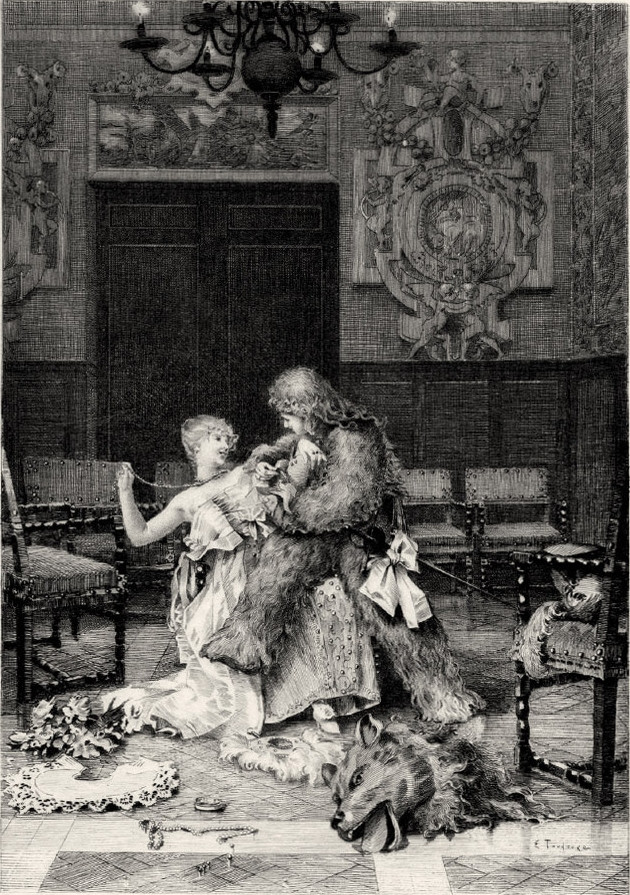
Chapter III — Thereupon the ball-dress had a fine time as you can imagine; *** and I believe that fresher dress was never more pitilessly rumpled and torn; the dress was of silver gauze and the lining of white satin. Rosette displayed on that occasion a heroism altogether unusual to her sex.
Nevertheless I think that I paid Rosette the full value of her dress and more, in coin which is none the less esteemed and valued because it does not pass current with tradesmen. Such unexampled heroism surely deserved such a recompense. However, like the generous creature she is, she repaid what I gave her. I had a wild, almost convulsive sort of pleasure, such as I did not believe myself capable of enjoying. The resounding kisses mingled with bursts of laughter, the shuddering, impatient caresses, all the piquant, tantalizing sensations, the pleasure imperfectly enjoyed because of the costume and the situation, but a hundred times keener than if there had been no obstacles, produced such an effect on my nerves that I was seized with paroxysms which I had some difficulty in overcoming.—You cannot conceive the proud, affectionate way in which Rosette gazed at me as she tried to soothe me, and the joyful yet anxious manner with which she lavished attentions upon me: her face glowed with the pleasure that she felt in producing such an effect upon me, while her eyes, swimming in sweet tears, bore witness to her alarm at my apparent illness and the interest she took in my health.—She had never seemed so beautiful to me as at that moment. There was something so maternal and so chaste in her glance that I entirely forgot the more than anacreontic scene that had just taken place, and threw myself on my knees at her feet, asking permission to kiss her hand; which permission she granted with extraordinary dignity and gravity.
That woman certainly isn't as depraved as De C—— claims and as she has often seemed to me to be; her corruption is in her mind and not in her heart.
I have cited this scene from among twenty others: it seems to me that after such an experience one can, without overweening conceit, believe himself a woman's lover.—And yet I have not that feeling.—I had no sooner returned home than that thought took possession of me and began to work upon me as usual.—I remembered perfectly all that I had said and heard, all that I had done and seen. The slightest gestures, the most insignificant attitudes, all the most trivial details stood out clearly in my memory: I remembered everything, even to the slightest inflections of the voice, the most indescribable shades of enjoyment; but it did not seem to me that all those things had happened to me rather than to some one else. I was not sure that it was not all an illusion, a phantasmagoria, a dream, or that I had not read it somewhere or other, or even that it was not a story invented by myself as I had invented many others. I dreaded being the dupe of my own credulity or the plaything of some deception; and notwithstanding the evidence of my weariness and the material proofs that I had not slept at home, I could easily have believed that I had gone to bed at my usual hour and slept till morning.
I am very unfortunate in my inability to acquire the moral certainty of something of which I am physically certain. In ordinary cases the contrary is the case and the fact proves the idea. I would like well to prove the fact by the idea; I cannot do it; although it is a strange thing, it is so. It rests with myself, to a certain extent, to have a mistress; but I cannot force myself to believe that I have one, even though that is the fact. If I have not the necessary faith in me, even for a thing so palpable as that, it is just as impossible for me to believe in so simple a fact as for another to believe in the Trinity. Faith is not to be acquired, it is a pure gift, a special grace from Heaven.
No one ever longed as I do to live the life of others and to assimilate another nature to my own; no one ever had less success. Whatever I may do, other men are little more than phantoms to me and I do not feel their existence; but it is not the desire to understand their lives and share in them that I lack. It is the power or the want of real sympathy with anything on earth. The existence or non-existence of a person or thing does not interest me enough to affect me in a perceptible and convincing way. The sight of a man or a woman who appears before me in flesh and blood leaves on my mind no more definite trace than the fanciful vision of a dream: a pale world of shadows and of apparitions, false or true, hovers about me, murmuring low, and in the midst of them I feel as utterly alone as possible, for not one of them has any effect upon me for good or evil, and they seem to me to be of a nature altogether different from mine. If I speak to them and they make what seems a sensible reply, I am as surprised as if my dog or my cat should suddenly open his mouth and take part in the conversation: the sound of their voices always astonishes me and I could easily believe that they are only fleeting apparitions and I the mirror in which they are reflected. Inferior or superior, I certainly am not of their kind. There are moments when I recognize none but God above me, and others when I deem myself hardly the equal of the earthworm under its stone or the mollusk on its sand-bank; but whatever my frame of mind, exalted or humble, I have never been able to persuade myself that men were really my fellows. When any one calls me monsieur, or, in speaking of me, refers to me as that man, it always seems strange to me. My very name seems to me but an empty one and not my real name; and yet, no matter how low it may be uttered, amid the loudest noise, I turn suddenly with a convulsive and peevish eagerness which I have never been able to explain.—Is it the dread of finding in the man who knows my name, and to whom I am no longer simply one of the common herd, an antagonist or an enemy?
It is when I have been living with a woman that I feel most strongly how utterly my nature repels every sort of alliance and mixture. I am like a drop of oil in a glass of water. No matter how much you turn it and shake it, the oil will never mix with the water; it will separate into a hundred thousand little globules which will unite again and rise to the surface the instant it becomes calm: the drop of oil and the glass of water epitomize my history. Even lust—that diamond chain that binds all human beings together, that consuming fire that melts the stone and metal of the heart and causes them to fall in tears as material fire melts iron and granite—all powerful as it is, has never been able to subdue or move me. And yet my senses are very sharp; but my heart is a hostile sister to my body, and the ill-mated couple, like every possible couple, lawfully or unlawfully united, lives in a state of constant warfare.—A woman's arms, the strongest of all earthly bonds, so it is said, are to me very weak fetters, and I have never been farther from my mistress than when she was straining me to her heart.—I was stifled, that's the whole story.
How many times have I been angry with myself! What superhuman efforts have I made to be different! How I have exhorted myself to be affectionate, lover-like, passionate! how often I have taken my heart by the hair and dragged it to my lips in the middle of a kiss! Whatever I do, it always recoils, wiping the kiss away, as soon as I release my hold. What torture for that poor heart to look on at the orgies of my body and to be constantly compelled to sit through banquets at which it has nothing to eat!
It was when I was with Rosette that I determined, once for all, to ascertain if I am not hopelessly unsociable, and if I can take enough interest in another person's existence to believe in it. I exhausted the whole category of experiments, and I have not succeeded in solving my doubts to any great extent. With her my pleasure is so keen that my heart often finds itself diverted at least, if not touched, a state of things that impairs the accuracy of observations. After all, I have discovered that it didn't go below the skin and that my enjoyment was confined to the epidermis, the heart participating only through curiosity. I have pleasure because I am young and ardent; but the pleasures came from myself and not from another. Its source was in myself rather than in Rosette.
It is of no use for me to struggle, I cannot go out of myself for a single moment. I am still what I was, that is to say, a very tired, very tiresome creature, who disgusts me exceedingly. I have failed utterly to introduce into my brain the idea of another human being, into my heart, another's emotion, into my body, another's pain or pleasure. I am a prisoner in myself and all escape is impossible: the prisoner longs to escape, the walls ask nothing better than to crumble, and the doors to open before him; but some inexplicable fatality keeps every stone immovable in its place, every bolt in its groove; it is as impossible for me to admit any one to my quarters as to go myself to others; I cannot make or receive calls, and I live in the most absolute solitude amid the multitude: my bed may not be widowed, but my heart always is.
Ah! to be unable to increase one's size by a single line, by a single atom; to be unable to admit others' blood into one's veins; to see always with one's own eyes, never clearer, never farther, never otherwise; to hear sounds with the same ears and the same sensation; to touch with the same fingers; to perceive changing objects with an unchangeable organ; to be doomed to the same tone of voice, the repetition of the same sounds, the same phrases, the same words, and not to be able to fly, to escape one's self, to take refuge in some corner where no one can follow; to be compelled to keep always to one's self, to dine and lie alone—to be the same man to twenty different women; to play, throughout the most complicated situations of the drama of your life, a part that is forced upon you, whose lines you know by heart; to think the same things, to have the same dreams:—what torture, what ennui!
I have longed for the horn of the Tangut brothers, for Fortunatus's hat, Abaris's bâton, Gygès's ring; I would have sold my soul to snatch the magic wand from a fairy's hand, but I have never longed so intensely for anything as to meet on the mountain, like Tiresias the soothsayer, those serpents who can change the sex of mortals, and what I most envy in the strange, monstrous gods of the Indies are their constant incarnations and innumerable transformations.
I began by longing to be another man; then, as I reflected that I could, by analogy, foresee almost exactly what I should feel and therefore not experience the change and the surprise I expected, I concluded that I would prefer to be a woman; that idea always occurred to me when I had a mistress who was not ugly; for an ugly woman is like a man to me, and in my moments of enjoyment I would gladly have changed my rôle, for it is very annoying to know nothing about the effect one produces and to judge of others' pleasure only by one's own. Such reflections and many others have often given me, at moments when it was most inappropriate, a meditative, dreamy air, which has caused me to be accused most unjustly of coldness and infidelity.
Rosette, who, very luckily, doesn't know all this, believes me to be the most amorous man on earth; she takes that impotent frenzy for a frenzy of passion, and she does her utmost to humor all the experimental caprices that pass through my brain.
I have done all that I possibly could to convince myself that she belongs to me. I have tried to go down into her heart, but I have always stopped on the first step of the staircase, at her flesh or her mouth. Despite the intimacy of our corporeal relations, I feel that we have nothing in common. Never has an idea of the same tenor as mine spread its wings in that youthful, smiling head; never has that heart, overflowing with life and fire, whose palpitations cause that firm, white breast to rise and fall, beaten in unison with my heart. My soul has never coalesced with hers. Cupid, the god with the hawk's wings, has not kissed Psyche on her fair ivory brow. No!—that woman is not my mistress.
If you know all that I have done to compel my heart to share the love of my body! with what frenzy I have glued my mouth to hers and wound my arms in her hair, and how tightly I have embraced her rounded, supple figure. Like Salmacis of old, enamored of the young Hermaphrodite, I have tried to melt her body and mine together; I have drunk her breath and her warm tears that bliss forced from the brimming chalice of her eyes. The more inextricably our bodies were intertwined, the closer our embrace, the less I loved her. My heart, sitting sadly by, looked on with a pitying air at that deplorable union to which it was not bidden, or veiled its face in disgust and wept silently behind the skirt of its cloak. All this is attributable perhaps to the fact that I do not really love Rosette, worthy to be loved though she be, and anxious as I am to love her.
To rid myself of the idea that I was myself, I transported myself to most unusual surroundings, where it was altogether unlikely that I should meet myself, and being unable to cast my individuality to the dogs, I tried to expatriate it so that it would no longer recognize itself. I have had but moderate success therein, for that devil of a myself follows me persistently; there is no way of getting rid of him; I haven't the resource of sending word to him, as I do to other uncomfortable callers, that I am not at home or that I have gone into the country.
I have had my mistress in the bath and I have played the Triton as best I could.—The sea was a huge marble tub. As for the Nereid, what she showed accused the water, transparent though it was, of not being sufficiently so for the exquisite beauty of what it concealed.—I have had her at night, by moonlight, in a gondola with music.
That would be very commonplace at Venice, but here it is anything but that.—In her carriage, with the horses going at a gallop, amid the rattling of the wheels, the leaping and jolting, sometimes by the light of lanterns, sometimes in the densest darkness.—That doesn't lack a certain stimulating interest and I advise you to try it: but I forget that you are a venerable patriarch, and that you don't indulge in such refinements.—I have climbed in at her window when I had the key to the door in my pocket.—I have made her come to my apartments in broad daylight, in fact, I have compromised her so thoroughly that no one—myself excepted, be it understood—now doubts that she is my mistress.
By reason of all these inventions which, if I were not so young, would resemble the expedients of a blasé old rake, Rosette adores me far and away above all others. She sees therein the ardor of a teasing passion that nothing can restrain, and that is always the same despite the changes of time and place. She sees therein the constantly renewed effect of her charms and the triumph of her beauty, and, in truth, I would that she were right, and it is neither my fault nor hers—I must be just—that she is not.
The only wrong I have done her consists in being myself. If I told her that, the child would reply at once that that is my greatest merit in her eyes; which would be more courteous than sensible.
Once—it was in the beginning of our liaison—I believed that I had gained my end, for a moment I believed that I loved her—I did love her.—O my friend, I have never lived except during that moment, and if it had lasted an hour I should have become a god. We had ridden out together in the saddle, I on my dear Ferragus, she on a snow-white mare that looks like a unicorn, her feet are so delicate and her body so slender. We rode along a broad avenue of elms of prodigious height; the sun poured down upon us, bright and warm, sifting through the serrated foliage; ultra-marine patches showed here and there amid the fleecy clouds, broad bands of pale blue lay along the horizon, changing to a most delicate apple-green when they encountered the golden rays of the setting sun. The appearance of the sky was unusual and fascinating; the breeze wafted to our nostrils an indefinable perfume of wild flowers delicious beyond words. From time to time a bird rose in front of us and flew singing along the avenue. The church-bell of an invisible village softly rang the Angelus, and the silvery notes, which came but faintly to our ears because of the distance, were inexpressibly sweet. Our horses were going at a foot pace, and they walked side by side in such perfect step that neither of them was an inch ahead of the other.—My heart dilated and my soul overflowed upon my body. I had never been so happy. I did not speak, nor did Rosette, and yet we never understood each other so perfectly. We were so close together that my leg touched her horse's side. I leaned toward her and put my arm about her waist; she made a similar movement and rested her head against my shoulder. Our mouths met; O such a chaste, delicious kiss! Our horses walked on, the reins lying on their necks. I felt Rosette's arms relax and her body yield more and more. I knew that my own strength was failing me, and I was near fainting.—Ah! I promise you that at that moment I cared but little whether I was myself or somebody else. We rode in that way to the end of the avenue, where the sound of footsteps caused us abruptly to resume our natural positions; some of our acquaintances, also in the saddle, rode up and spoke to us. If I had had my pistols, I believe I should have fired at them.
I glared at them with a fierce, lowering expression that must have seemed very strange to them. After all, I was wrong to be so angry with them, for they had unwittingly done me the service of cutting my pleasure short at the moment when, by its very intensity, it was certain to become pain or to sink under its violence. The science of stopping in time is not regarded with all the respect it deserves.—Sometimes, as you lie with a woman, you put your arm under her waist: at first it is a most blissful sensation to feel the pleasant warmth of her body, the soft, velvety flesh of her sides, the polished ivory of her hips, and to press your hand against her breast which throbs and quivers. The fair one falls asleep in that voluptuous, charming posture; the curve of her loins becomes less pronounced, the agitation of her bosom is calmed, her sides rise and fall with the freer, more regular respiration of sleep, her muscles relax, her face is hidden by her hair.—Meanwhile the weight upon your arm grows heavier, you begin to observe that she is a woman, not a sylph; but you would not remove your arm for anything on earth. There are many reasons for that: the first is that it is dangerous to wake a woman with whom one is lying; one must be prepared to substitute for the blissful dream she is probably dreaming, a more blissful reality; the second is that, if you ask her to raise herself so that you can take away your arm, you tell her indirectly that she is heavy and discommodes you—which is not polite—or else you give her to understand that you are feeble and overdone—an extremely humiliating admission for you and likely to lower you greatly in her mind; the third is that, as you have had pleasure in that position, you think that if you retain the position the pleasure may be renewed, wherein you are mistaken. The poor arm is caught under the mass that crushes it, the blood is checked, the nerves are distended and numbness pricks you with its countless needles: you are a sort of Milo of Crotona on a small scale, and the mattress and the back of your divinity are a sufficiently accurate representation of the two parts of the tree that have reunited. Day comes at last to deliver you from your martyrdom and you leap out of that instrument of torture more eagerly than ever husband descended from the nuptial scaffold.
That is the history of many passions. It is the history of all pleasures.
However that may be—despite the interruption or because of the interruption—never had such a blissful sensation fallen to my lot: I felt that I was really somebody else. Rosette's soul in its entirety had entered into my body. My soul had left me and filled her heart as hers had filled mine. They had met, no doubt, during that long equestrian kiss, as Rosette dubbed it afterward—to my annoyance by the way—and had penetrated and mingled as inextricably as the souls of two mortal creatures can upon a morsel of perishable clay.
Angels surely must kiss like that, and the real paradise is not in heaven but on the lips of the woman we love.
I have waited in vain for such a moment and have tried unsuccessfully to lead up to a repetition of it. We have often ridden together through the avenue of elms at sunset on lovely evenings; the trees had the same verdure, the birds sang the same song, but to us the sun seemed dull, the foliage withered: the song of the birds had a harsh, discordant sound, we were no longer in harmony with it all. We brought our horses to a walk and we tried the same kiss.—Alas! only our lips met and it was only the spectre of the former kiss.—The beautiful, the sublime, the divine, the only real kiss I have given and received in my whole life had flown away forever. Since that day I have always had an inexpressibly sad feeling on returning from the forest. Rosette, light-hearted madcap that she naturally is, cannot avoid the feeling and her reverie betrays itself by a sweet little pout, which is at least as attractive as a smile.
Scarcely anything but the fumes of wine and a great blaze of candles enable me to shake off these fits of depression. We both drink like men condemned to death, silently and glass after glass, until we have swallowed the necessary amount; then we begin to laugh and mock most heartily at what we call our sentimentality.
We laugh—because we cannot weep. Ah! who will succeed in sowing a tear in my parched eye?
Why did I enjoy that evening so? It would be very hard for me to say. I was the same man, Rosette the same woman. It was not my first experience on horse-back, nor hers; we had already watched the sun set and the spectacle had touched us no more than a picture, which one admires or not according as the colors are more or less brilliant. There is more than one avenue of elms and chestnuts in the world, and that was not the first one we had ridden through; what then caused us to find such a sovereign fascination there, what metamorphosed the dead leaves into topazes, the green leaves into emeralds, gilded all those whirling atoms and changed into pearls all the drops of water scattered over the greensward, what imparted such sweet melody to the tones of a bell that was usually discordant and to the twittering of countless young birds?—There must have been a very penetrating flavor of poesy in the air, as even our horses seemed to catch the scent of it.
And yet nothing in the world could be more pastoral and more simple: a few trees, a few clouds, five or six clumps of wild thyme, a woman, and a sunbeam over all like a gold chevron on a coat of arms.—There was neither surprise nor bewilderment in my sensations. I knew perfectly well where I was. I had never been to that precise spot, but I remembered perfectly the shape of the trees and the position of the clouds, the white dove that flew across the sky I had seen flying in the same direction; the little silvery bell, which I then heard for the first time, had often tinkled in my ears, and its voice seemed to me like the voice of a friend; although I had never been there, I had many times passed through that avenue with princesses mounted on unicorns; my most voluptuous dreams rode there every evening and my desires had exchanged kisses absolutely like the one exchanged by myself and Rosette.—There was nothing new to me in that kiss; but it was as I had thought it would be. It was perhaps the only time in my life that I have not been disappointed and that the real has seemed to me as beautiful as the ideal.—If I could find a woman, a landscape, a building, anything that corresponded as closely to my desires as that moment corresponded to the moment I had dreamed of, I should have no reason to envy the gods, and I would gladly renounce my box in paradise.—But, in truth, I do not believe that any man of flesh and blood could have an hour of such exquisite enjoyment; two kisses like that would pump a whole life dry and leave a complete void in a heart and a body.—But no such consideration as that would stop me; for, not being able to prolong my life indefinitely, I am ready to die, and I should prefer to die of pleasure rather than of old age or ennui.
But that woman doesn't exist.—Yes, she does exist; it may be that only a wall separates us.—Perhaps I jostled her in the street yesterday or to-day.
In what does Rosette fall short of being that woman? In this, that I do not believe she is. By what fatality do I always have for mistresses, women that I do not love? Her neck is smooth enough to set off the most beautifully-wrought necklaces; her fingers are taper enough to do honor to the loveliest and richest rings; the ruby would blush with pleasure to gleam on the pink lobe of her delicate ear; the cestus of Venus would fit her waist; but Love alone has the secret of tying his mother's scarf.
All Rosette's merit is in herself, I have attributed nothing to her that she has not. I have not cast over her beauty the veil of perfection with which love envelops the loved one;—the veil of Isis is transparent beside that veil. Naught but satiety can raise the corner of it.
I do not love Rosette; at least my love for her, if I have any, does not resemble the ideal I have formed of love. It may be that my ideal is not a just one, I do not dare to say. Certain it is that it makes me insensible to the merits of other women, and I have desired no other with any consistency since I have had her. If she has any reason to be jealous, it is of phantoms only, about which she worries very little, and yet her most formidable rival is my imagination; that is something which, with all her shrewdness, she will probably never discover.
If women only knew!—How many infidelities the least fickle lover is guilty of to the most adored mistress!—It is to be presumed that they pay us back in full and more; but they do as we do and say nothing. A mistress is a necessary subject, who ordinarily disappears under flourishes and embroidery. Very often the kisses you give her are not for her; you embrace the idea of another woman in her person, and she profits not infrequently—if it can be called profiting—by the desires aroused by another. Ah! my poor Rosette, how many times you have served as a body to my dreams and given reality to your rivals; to how many infidelities have you unwittingly been accessory! If you could have imagined, at times when my arms clasped you so tightly, when my mouth was most closely united to yours, that your beauty and your love had nothing to do with my passion, that the thought of you was a hundred leagues from my mind; what if some one had told you that those eyes, veiled with amorous languor, were cast down simply in order not to look at you and not to banish the illusion that you served only to complete, and that, instead of being a mistress, you were simply an instrument of lust, a means of assuaging a desire impossible of realization!
O divine creatures, ye lovely virgins, slender and diaphanous, who lower your periwinkle eyes and clasp your lily hand in the pictures with golden backgrounds of the old German masters, ye stained-glass saints, ye missal martyrs who smile so sweetly amid the convolutions of the arabesques, and come forth so fresh and fair from the flower-bells!—O ye lovely courtesans lying all naked in your hair on beds strewn with roses, beneath great purple curtains, with your bracelets and necklaces of huge pearls, your fan and your mirrors, gleaming in the shadow in the fiery rays of the setting sun!—ye dark-skinned maidens of Titian, who display so wantonly your undulating hips, your firm, round thighs, your polished breasts and your supple and muscular loins!—ye antique goddesses, who rear your white phantoms in the shady corners of gardens!—ye are a part of my seraglio; I have possessed you all in turn.—Sainte Ursule, I have kissed your hands on the fair hands of Rosette; I have toyed with the black hair of the Muranese and Rosette never had such a hard task to rearrange her hair: I have been with you more than Acteon was, O virgin Diana, and I have not been changed to a stag: it was I who replaced your handsome Endymion!—What a multitude of rivals whom she does not suspect and upon whom she cannot be revenged! yet they are not all painted or carved!
Women, when you notice that your lover is more affectionate than usual, that he presses you in his arms with unwonted emotion; when he rests his head upon your knees and raises it to look at you with moist and wandering eyes; when enjoyment serves only to augment his desire and he stifles your voice with his kisses as if he dreaded to hear it, be sure that he simply does not know that you are there; that he has, at that moment, an assignation with a chimera which you make palpable, and whose part you play.—Many chamber-maids have profited by the love that queens inspire.—Many women have profited by the love that goddesses inspire, and a commonplace reality has often served as the pedestal for an ideal idol. That is why poets habitually take dirty trollops for mistresses.—You can lie ten years with a woman without ever seeing her; that is the history of many great geniuses, whose ignoble or obscure connections have caused the world to wonder.
I have been unfaithful to Rosette in no other way than that. I have been false to her only for pictures and statues and she has been equally concerned in the treachery. I have not the slightest material sin upon my conscience with which to reproach myself. I am, in that respect, as white as the snow-capped Jungfrau, and yet, while not in love with anybody, I would like to be with some one. I do not seek the opportunity, but I shall not be sorry if it comes; if it should come, I might not use it, perhaps, for I have an innate conviction that it would be the same with another, and I prefer that it should be so with Rosette than with any other; for, take away the woman, I still have a jolly companion, witty, and very agreeably depraved; and that consideration is not one of the least of those that restrain me, for, in losing the mistress, I might be distressed to find that I had lost the friend.
IV
Do you know that it will soon be five months, yes, fully five months, five eternities that I have been the titular Celadon of Madame Rosette? That is admirable to the last degree. I would not have believed myself to be so constant, nor would she, I will wager. We are in very truth a couple of plucked pigeons, for only turtle-doves are capable of such affection. How we have cooed! how we have pecked at each other! what pictures of clinging ivy! what a charming existence à deux! Nothing could be more touching, and our two poor little hearts might have been placed on a dial pierced by the same spit, and as though trembling in a gust of wind.
Five months' tête-à-tête, so to speak, for we see each other every day and almost every night—the door being always closed to visitors; doesn't it make your flesh creep simply to think of it? Well! to the glory of the incomparable Rosette be it said, I am not greatly bored, and those months will doubtless prove to be the most agreeable in my life. I do not think it would be possible to entertain more constantly and more successfully a man who has no passion in his heart, and God knows what pitiable idleness it is that is attributable to an empty heart! You cannot imagine that woman's expedients. She began by taking them from her mind, then from her heart, for she loves me to adoration.—With what skill she makes the most of the slightest spark and how well she knows how to fan it into a conflagration! how adroitly she guides the slightest impulses of the heart! how she transforms languor into tender reverie! and by what roundabout roads does she bring back to her the mind that is slipping away!—It is marvellous!—And I admire her as one of the greatest geniuses imaginable.
I have been to her house in very bad humor, sulky, looking for a quarrel. I have no idea how the witch did it, but in a very few minutes she had compelled me to say flattering things to her, although I hadn't the slightest desire to do it, to kiss her hands and laugh with all my heart, although I was horribly angry. Can you conceive of such tyranny as that?—However, adroit as she is, the tête-à-tête cannot last much longer, and in the course of the last fortnight I have frequently done what I never did before—open the books on the chimney and on the table and read a few lines during the pauses in the conversation. Rosette has noticed it, it has alarmed her so that she has had hard work to dissemble her feelings, and she has taken all the books out of her room. I confess that I regret them, although I dare not ask for them.—The other day—an alarming symptom!—some one called while we were together, and instead of flying into a rage as I used to do at the beginning, I was conscious of a sort of pleasure. I was almost affable: I kept up the conversation when Rosette tried to let it languish so that monsieur would take his leave, and when he had gone I ventured to say that he didn't lack wit and that he was a very agreeable fellow. Rosette reminded me that only two months before I had found the same man intensely stupid and the most annoying idiot on earth, to which I had no reply to make, for I did actually say it; and I was right, too, despite the apparent contradiction: for the first time he disturbed a charming tête-à-tête, and the second he came to the assistance of a conversation that was exhausted and running dry—on one side at least—and spared me for that day a tender scene that I was tired of acting.
That is the point at which we now are; it is a serious state of things, especially when one of the two is still in love and is clinging desperately to the remains of the other's love. I am in great perplexity. Although I am not in love with Rosette, I am very, very fond of her, and I should hate to do anything to cause her pain. I wish her to believe, as long as possible, that I love her.
In gratitude for all the hours to which she has lent wings, in gratitude for the love she has given me for pleasure, I wish it.—I shall deceive her; but is not pleasurable deceit preferable to painful truth?—for I shall never have the heart to tell her that I do not love her. The empty shadow of love on which she is feeding seems to her so adorable and so dear, she embraces the pale spectre with such rapture and effusion that I do not dare cause it to vanish; and, yet I am afraid that she will discover at last that it is only a phantom. This morning we had an interview which I propose to repeat in dramatic form for greater accuracy, and which makes me fear that I cannot prolong our liaison very long.
The scene is Rosette's bed. A sunbeam streams through the curtains: it is ten o'clock. Rosette has one arm under my neck and lies perfectly still for fear of waking me. From time to time she rises a little on her elbow and leans over my face, holding her breath. I see all this through my eyelashes, for I have been awake an hour. Rosette's night-dress has a neck ruffle of Malines lace which is all torn: it has been a stormy night; her hair protrudes in disorder from under her little cap. She is as pretty as a woman can be, when one doesn't love her and is lying in bed with her.
ROSETTE (seeing that I am awake).
Oh! sleepyhead!
I (yawning).
Ah-h-h!
ROSETTE.
Don't yawn like that or I won't kiss you for a week.
I.
Oh!
ROSETTE.
It seems, monsieur, that you don't care much whether I kiss you or not.
I.
Yes, I do.
ROSETTE.
How indifferently you say it!—All right; you can depend upon it that I won't touch you with the end of my lips for a week to come.—To-day is Tuesday: not till next Tuesday.
I.
Nonsense!
ROSETTE.
What's that? nonsense?
I.
Yes, nonsense! you'll kiss me before night, or I shall die.
ROSETTE.
You die! What a silly fellow!—I have spoiled you, monsieur.
I.
I shall live.—I am not silly and you have not spoiled me—quite the contrary. In the first place I demand the instant suppression of monsieur; I know you well enough for you to call me by my name and speak in the language of intimates.
ROSETTE.
I have spoiled you, D'Albert.
I.
Very good.—Now put your mouth over here.
ROSETTE.
No, next Tuesday.
I.
Well, well! has it come to this, that we exchange caresses, calendar in hand? We are both a little too young for that.—Come, your mouth, my child, or I shall get a crick in my neck.
ROSETTE.
No.
I.
Ah! you want me to force you, mignonne; pardieu! then I will force you. The thing is feasible, although perhaps it has never been done.
ROSETTE.
Impertinent!
I.
Notice, my lovely one, that I was courteous enough to say perhaps; that was very good of me.—But we are getting away from the subject. Put down your head. Hoity-toity! what is all this, my favorite sultana? and what means the sulky expression on your face? It is a pleasure to kiss a smile and not a pout.
ROSETTE. (stooping to kiss me).
How do you expect me to laugh? you say such harsh things to me!
I.
My purpose is to say very tender things to you. Why should I say harsh things?
ROSETTE.
I don't know; but you do say them.
I.
You mistake meaningless jests for harshness.
ROSETTE.
Meaningless! You call it meaningless, do you? everything has a meaning in love. I tell you I would rather have you beat me than laugh as you do.
I.
Then you would like to see me weep?
ROSETTE.
You always go from one extreme to the other. No one asks you to weep, but to talk reasonably and drop that tone of persiflage that becomes you so ill.
I.
It is impossible for me to talk reasonably and not joke; I'll beat you, if that's what you want!
ROSETTE.
Do it.
I (giving her a little tap or two on the shoulder).
I would rather cut off my own head than mar your adorable little body and make blue stripes on that lovely white back.—However much a woman may enjoy being beaten, my goddess, I swear that you shan't be.
ROSETTE.
You don't love me any more.
I.
That doesn't follow very logically from what precedes; it's almost as logical as to say: "It rains, so don't give me my umbrella;" or: "It's cold, open the window."
ROSETTE.
You don't love me, you have never loved me.
I.
Aha! the plot thickens; you don't love me any more and you have never loved me. That is rather contradictory; how can I cease to do a thing which I never began to do?—You see, my little queen, you don't know what you are saying and you are perfectly ridiculous.
ROSETTE.
I longed so to have you love me that I helped to deceive myself. It is easy to believe what one desires; but now I see that I am mistaken. You made a mistake yourself; you mistook liking for love and desire for passion. It's something that happens every day. I bear you no ill will for it: it wasn't your fault that you weren't in love with me; my own lack of charm is all that I have to blame. I ought to have been prettier, more playful, more of a flirt; I ought to have tried to rise to your level, O my poet! instead of trying to pull you down to mine: I was afraid of losing you among the clouds, and I dreaded lest your head should steal your heart from me. I imprisoned you in my love and I thought that, if I gave myself to you utterly, you would keep a little something of me—
I.
Move away a little, Rosette; your leg burns me—you're like a hot coal.
ROSETTE.
If I annoy you, I'll get up.—Ah! stony heart, drops of water pierce the stone, but my tears have no effect on you. (She weeps).
I.
If you weep like that, you will certainly make a bathtub of our bed.—A bathtub, did I say? an ocean.—Can you swim, Rosette?
ROSETTE.
Villain!
I.
Oho! now I am a villain! You flatter me, Rosette, I haven't that honor. I am a blithesome bourgeois, alas! and I have never committed the least crime; I have done a foolish thing, perhaps, in loving you to distraction; that is all.—Are you absolutely determined to make me repent that?—I have loved you and I love you now as much as I can. Since I have been your lover I have always walked in your shadow: I have given you all my time, my days and my nights. I have indulged in no high-flown phrases with you because I don't care for them except when they are written; but I have given you a thousand proofs of my affection. I won't speak of the most scrupulous fidelity, for that goes without saying; but I have lost a pound and three-quarters since you have been my mistress. What more do you want? Here I am in your bed; I was here yesterday, I shall be here to-morrow. Is that the way a man acts with a woman he doesn't love? I do whatever you want; you say: "Go," and I go; "stay," and I stay; I am the most admirable lover in the world, it seems to me.
ROSETTE.
That is just what I complain of—you are the most perfect lover in the world.
I.
What have you to reproach me for?
ROSETTE.
Nothing; and I would prefer to have some reason to complain of you.
I.
This is an extraordinary quarrel.
ROSETTE.
It's much worse than that.—You don't love me.—I can do nothing about it, nor can you.—What remedy have I for that? Certainly I would prefer to have something to forgive you for.—I would scold you; you would apologize as best you could and we should make up.
I.
That would be all clear gain for you. The greater the crime, the more imposing the reparation.
ROSETTE.
You know very well, monsieur, that I am not yet reduced to that, and that if I chose, at this moment, although you don't love me and we are quarrelling—
I.
Yes, I agree that it is purely the result of your kindness of heart.—Be a little kind now; that would be better than syllogizing over our heads as we are doing.
ROSETTE.
You want to cut short a conversation that embarrasses you; but by your leave, my good friend, we will be content with talking.
I.
That's a cheap repast.—I assure you that you are making a mistake, for you are distractingly pretty, and I have sensations.
ROSETTE.
Which you can describe some other time.
I.
Aha! my adorable, you have become a little Hyrcanian tigress, have you? your cruelty to-day is beyond words!—Have you been taken with the fever to set yourself up as a vestal? It would be an amusing whim.
ROSETTE.
Why not? stranger whims have been known; but this much is sure, I shall be a vestal so far as you are concerned.—Understand, monsieur, that I give myself only to people who love me or who I think love me.—You are in neither position.—Allow me to rise.
I.
If you rise, I shall rise too.—You will have the trouble of going back to bed, that's all.
ROSETTE.
Let me go!
I.
Pardieu, no!
Rosette (struggling).
Oh! you shall let me go!
I.
I venture, madame, to assure you of the contrary.
ROSETTE (seeing that she is not the stronger).
All right! I will stay! you squeeze my arms so tight!—What do you want of me?
I.
I think you know.—I would not allow myself to put in words what I allow myself to do; I have too much respect for decency.
ROSETTE (already beyond the power to defend herself).
On condition that you will love me dearly—I surrender.
I.
It's a little late to strike your flag, when the enemy is already in the citadel.
ROSETTE (half swooning, throwing her arms around my neck).
Unconditionally. I rely on your generosity.
I.
You do well.
At this point, my dear friend, I think it would not be amiss to place a line of asterisks, for the rest of the dialogue could hardly be translated except by onomatopœia.
The sunbeam has had time, since the opening of the scene, to make the tour of the bedroom. A pleasant, penetrating odor of linden-trees comes up from the garden. It is as beautiful a day as can be imagined; the sky is as blue as an Englishwoman's eye. We rise, and, after breakfasting with a good appetite, we take a long drive in the country. The clear air, the beauty of the landscape and the aspect of nature in her joyous mood instilled enough sentimentality and tenderness into my soul to make Rosette agree that, after all, I have something in the shape of a heart like other men.
Have you never noticed how the shade of the woods, the plashing of fountains, the singing of birds, a bright and laughing landscape, the odor of the leaves and flowers, all the paraphernalia of eclogues and descriptive poems which we have agreed to despise, none the less retain a secret influence over us, however depraved we may be, which it is impossible for us to resist? I will tell you in confidence, under seal of the most profound secrecy, that I surprised myself very recently in a most provincial state of emotion in connection with a nightingale's song. It was in D——'s garden; the sky, although it was night, was almost as bright as at noonday; it was so measureless and so transparent that one's glance easily penetrated to God. It seemed to me as if I could see the folds of the angels' robes on the white windings of the Milky Way. The moon had risen, but a great tree hid it completely; it riddled the dark foliage with a million little luminous holes and showered more spangles about than ever glittered upon a marchioness's fan. A silence laden with faint sounds and sighs filled the garden—perhaps this resembles pathos, but it is not my fault;—although I saw nothing save the bluish gleam of the moon, it seemed to me as if I were surrounded by a whole population of phantoms, unknown yet adored, and I had no feeling of loneliness, although there was no one but myself on the terrace.—I was not thinking, I was not dreaming, I was blended with my surroundings and I felt myself shiver with the foliage, glisten with the water, gleam with the moonbeams, bloom with the flowers; I was no more myself than the tree, the streamlet, or the four-o'clock. I was all of them at once, and I do not think it possible to be more thoroughly removed from one's self than I was at that moment. Suddenly, as if something extraordinary had happened, the leaf ceased to flutter at the end of the branch, the drop of water from the fountain remained suspended in the air and did not fall. The silvery thread, starting from the edge of the moon, stopped on the way; my heart alone beat with such resonance that it seemed to fill the whole vast space with clamor.—My heart ceased to beat and there was such a profound silence that you could have heard the grass grow, and a word spoken in an undertone two hundred leagues away. And then the nightingale, who probably was awaiting that moment to begin his song, emitted from his little throat a note so shrill and piercing that I heard it with my breast no less than with my ears. The sound spread quickly through the crystalline expanse, until that moment as still as death, and created a harmonious atmosphere, wherein the other notes that followed it flew to and fro, flapping their wings.—I understood what he said as perfectly as if I had known the secret of the bird language. The story of the loves I have not found was what the nightingale sang. Never was a truer story told or told with greater fulness. He did not omit the smallest detail, the most imperceptible shade. He told me what I had not been able to tell myself, he explained what I had not been able to understand; he gave voice to my reverie and compelled the phantom, hitherto dumb, to reply. I knew that I was beloved, and a thrill most languorously drawn out informed me that I should soon be happy. It seemed to me that I could see the white arms of my beloved extended toward me through the trills and quavers of his song and beneath the shower of notes, in a moonbeam.
She rose slowly before me with the perfume of the heart of a hundred-petalled rose.—I will not try to describe her beauty. It is one of those things that words decline to attempt. How describe the indescribable? how paint that which has neither form nor color? how note down a voice without quality and speechless?—I have never had so much love in my heart; I would have pressed nature to my bosom, I embraced the empty void as if my arms were clasped about a virgin form; I kissed the air that blew upon my lips, I swam in the magnetic fluids that exhaled from my glowing body. Ah! if Rosette had been there, what adorable rhapsodies I would have indulged in! But women never know enough to arrive at the opportune moment.—The nightingale ceased to sing; the moon, who could keep awake no longer, pulled her cap of clouds over her eyes, and I left the garden; for the cool night air was beginning to make itself felt.
As I was cold, I naturally thought that I should be warmer in Rosette's bed than my own, and I went to lie with her.—I let myself in with my pass-key, for everybody in the house was asleep.—Rosette herself had fallen asleep, and I had the satisfaction of seeing that it was over a volume uncut, of my latest poems. She had both arms under her head, her mouth half open and smiling, one leg stretched out and the other partly curled up, in an attitude instinct with ease and grace; she was so lovely that I mortally regretted that I was no longer in love with her.
As I looked at her I reflected that I was as stupid as an ostrich. I had what I had so long desired, a mistress as entirely my own as my horse and my sword, young, pretty, amorous and clever; with no stern-principled mother, no father with a decoration, no cross-grained aunt, no swaggering brother, and with the priceless advantage of a husband duly sealed and nailed up in a fine oaken casket lined with lead, the whole covered over with a large block of hewn granite, which is not to be despised; for, after all, it is a very doubtful pleasure to be caught in the act in the middle of a blissful paroxysm, and to complete one's sensations on the pavement, after describing an arc of 40 to 45 degrees, according to the floor on which you happen to be;—a mistress as free as the mountain air and rich enough to indulge in the most exquisite refinements and luxuries, and, moreover, free from anything like moral ideas, never talking about her virtue as she tries a new posture, nor of her reputation, any more than if she had never had one; with no intimate female friends, and despising all women almost as much as if she were a man, entertaining a very low opinion of platonic affection and making no secret of it, and always playing with her heart in the game; a woman who, if her lines had fallen in another sphere, would indubitably have become the most admirable courtesan on earth and dimmed the glory of the Aspasias and Imperias!
Now, that woman, so made, was mine. I did what I chose with her; I had the key to her room and her drawer; I broke the seals of her letters; I had taken away her name and given her another. She was my chattel, my property. Her youth, her beauty, her love, all belonged to me; I used them, I abused them. I made her go to bed in the daytime and sit up at night, if the whim seized me, and she obeyed simply, without any affectation of making a sacrifice, and without assuming the air of a resigned victim.—She was attentive, caressing, and—a most extraordinary thing!—absolutely faithful; that is to say, if in the days when I was lamenting that I had no mistress, six months ago, any one had given me a glimpse of such happiness, even in the distant future, I should have gone mad with joy and tossed my hat up to knock at the gates of heaven, in token of my delight. And now that I have that happiness, I am cold; I am hardly conscious that I have it, I am not conscious of it, and my present position makes so little impression upon me that I often doubt if I have changed my position at all. If I should leave Rosette, I am convinced in my inmost soul that, at the end of a month, perhaps less, I should have so thoroughly and carefully forgotten her, that I shouldn't know whether I had ever known her or not! Would she do the same? I think not.
I reflected, as I say, upon all these things, and impelled by a sort of repentant feeling, I deposited on the fair sleeper's brow that most chaste and melancholy kiss that ever young man bestowed upon young woman—just on the stroke of midnight. She moved slightly, the smile about her mouth became a little more pronounced, but she did not wake. I undressed slowly, and, creeping under the clothes, stretched myself out by her side like a snake. The coolness of my body startled her; she opened her eyes, and, without speaking, put her mouth to mine and twined herself about me so completely that I was warmed in less than no time at all. All the poetry of the evening changed to prose, but to poetic prose at all events. That night was one of the sweetest sleepless nights I ever passed. I can hope for no more such.
We still have pleasurable moments, but they must be led up to and prepared for by some outside incident like this, and in the beginning I did not need to have my imagination excited by gazing at the moon and listening to the nightingale, in order to have all the pleasure one can have when one is not really in love. There are as yet no broken threads in our woof, but there are knots here and there, and the chain is not nearly so smooth as it was.
Rosette, who is still in love, does what she can to avert all these inconveniences. Unfortunately there are two things in the world that cannot be guided: love and ennui.—For my own part I make superhuman efforts to conquer the drowsiness that steals over me in spite of myself, and like the provincials who fall asleep at ten o'clock in Parisian salons, I keep my eyes as wide open as possible and hold up my eyelids with my fingers!—nothing serves the purpose and I take conjugal liberties that are most unpalatable.
The dear child, who found the rural expedition so successful the other day, took me off to her country estate yesterday.
It would not be out of place, perhaps, to give you a little description of the aforesaid estate, which is very attractive; it will lighten up all this metaphysics a little, and then, too, we must have a background for the characters, and figures will not stand out in relief against an empty void, or against the vague shade of brown with which painters fill up the field of their canvas.
The approach is very picturesque.—Driving through a broad avenue, lined with venerable trees, you come to a star, the centre of which is marked by a stone obelisk surmounted by a sphere of gilded copper: five roads form the points of the star. Then the land suddenly descends. The road plunges down into a narrow valley, with a small stream flowing at the bottom, which is crossed by a bridge of a single span; then, ascends the opposite slope, where the village lies, whose slated church-tower can be seen among the thatched roofs and the rounded tops of the apple-trees. The view is not very extensive, for it is limited on both sides by the crest of the hill, but it is bright and pleasant and rests the eye.—Beside the bridge there is a mill and a tower-shaped structure built of red stone: almost incessant barking and the sight of a brach-hound or two and some young terriers with crooked legs warming themselves in the sun before the door, would inform you that it was the head-keeper's abode, if the buzzards and martens nailed to the shutters could leave you for a moment in doubt. At that point an avenue of sorb-trees begins; the red berries attract clouds of birds; as there is little passing, there is only a band of white in the middle of the road; all the rest is covered with short, fine moss, and, in the double rut made by carriage wheels, little grasshoppers, as green as emeralds, buzz and hop about.
After driving some little distance along this avenue you come to a painted iron fence, with gilt trimmings, and bristling with spikes and chevaux de frise. Thence the road leads to the château—which is still invisible, for it is buried in verdure like a bird in its nest—but its progress is leisurely and it frequently turns aside to visit a brook and a fountain, a dainty summer-house or a point from which a fine view can be had, crossing and recrossing the stream over Chinese or rustic bridges. The inequality of the land and the dams built for the purposes of the mill cause several waterfalls some four or five feet in height, and you can imagine nothing more delightful than to hear the splashing of all these cascades close beside you, but generally out of sight, for the osiers and elders that line the bank form an almost impenetrable curtain. But all that part of the park is, so to speak, only the antechamber of the other part: unfortunately, a public highway passes through the estate and cuts it in two, a drawback for which a very ingenious remedy has been devised. Two high crenelated walls, provided with barbicans and loopholes in imitation of a ruined fortress, stand on each side of the road; connected with a tower on the château side, completely covered by gigantic ivy plants, is a genuine drawbridge which is lowered every morning, by iron chains, upon the opposite bastion. You drive through a lovely ogive archway inside the tower, and thence into the second enclosure, where the trees, which have not been cut for more than a century, are of extraordinary height, with gnarled trunks swathed in parasitic plants—the handsomest and most curious trees I have ever seen. Some have leaves only at the very top like broad umbrellas; others taper toward the top like plumes; others, on the contrary, have a large tuft of foliage near the bottom, from which the naked trunk rises toward the sky like a second tree planted in the first; you would say it was the foreground of a landscape painting or flies painted for a scene on the stage, the trees are so curiously misshapen;—ivies that reach from one to another and hug them so tight as to choke them, mingle their dark hearts with the green leaves and seem like their shadow. Nothing can be more picturesque. The stream widens at that spot, so as to form a little lake, and it is so shallow that you can see, through the transparent water, the lovely aquatic plants that carpet its bed. There are nymphæas and lotuses swimming nonchalantly in the purest crystal with the reflection of the clouds and the weeping-willows that lean over the bank: the château is on the other side, and yonder little skiff, painted apple-green and bright red, will save you a long detour to the bridge. The château is a collection of buildings built at different periods with gables of unequal heights and a multitude of little turrets. One ell is of brick with stone trimmings; another portion is in the rustic style, with quantities of excrescences and vermiculated work. Another ell is entirely modern; it has a flat Italian roof with vases and a tile balustrade, and a canvas porch in the shape of a tent. The windows are all of different sizes and do not correspond; there are some of all styles, even the trefoil and ogive, for the chapel is Gothic. Certain parts are trellised, like Chinese houses, with trellises painted different colors, covered with climbing honeysuckle, jasmin, nasturtiums, and virgin's bower, whose tendrils look familiarly in at the chamber windows and seem to put out their hands to you as they say good-morning.
Despite this lack of regularity, or rather because of it, it is a fascinating structure; at least, one does not see it all at a single glance; there is an opportunity for choice and one is always on the lookout for something one has not seen.
This château, with which I was not familiar, for it is twenty leagues from town, pleased me immensely at first sight, and I was extremely grateful to Rosette for conceiving the admirable idea of selecting such a nest for our love.
We arrived just at nightfall; and, as we were tired, after eating a hearty supper there was nothing we were so anxious to do as to go to bed—in separate rooms, mind you, for we intended to sleep in good earnest.
I was dreaming some rose-colored dream, full of flowers and sweet perfumes and birds, when I felt a warm breath on my forehead and a kiss descend upon it with quivering wings. A slight smacking of the lips and a pleasant moisture on the spot breathed upon led me to think that I was not dreaming: I opened my eyes and the first thing I saw was Rosette's cool, white neck, as she leaned over the bed to kiss me. I threw my arms around her waist and returned her kiss more passionately than I had done for a long while.
She went and drew the curtain and opened the window, then returned and sat on the edge of my bed, holding my hand in hers and playing with my rings. Her costume was marked by the most coquettish simplicity. She was without corsets or skirt, and had absolutely nothing on save a lawn peignoir as white as milk, very ample and full; her hair was held in place on top of her head by a little white rose of the sort that has only three or four petals; her ivory feet were encased in embroidered slippers of brilliant, diversified colors, as small as they possibly could be, although they were too large for her, and without quarterings like those of the young Roman dames. I regretted, when I saw her so, that I was already her lover and hadn't the prospect still before me.
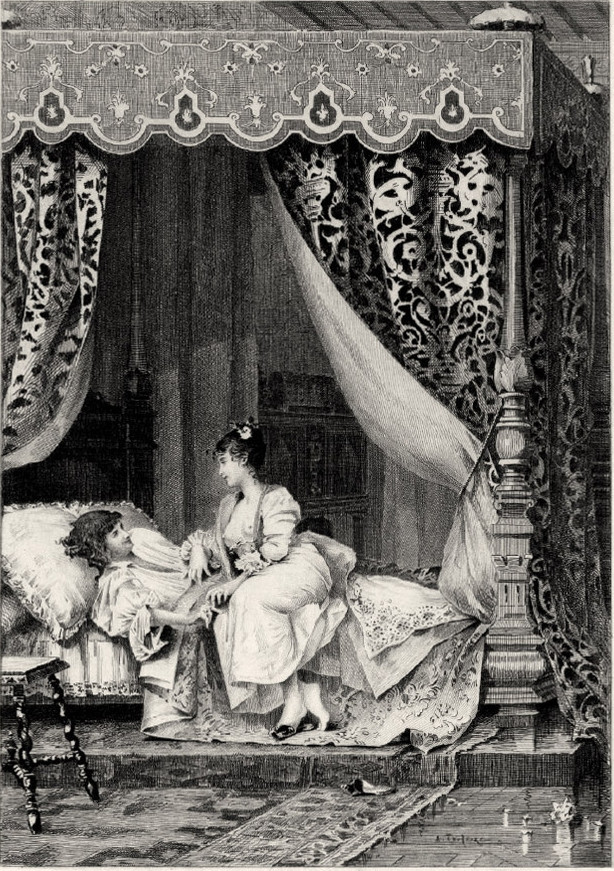
Chapter IV — She went and drew the curtain and opened the window, then returned and sat on the edge of my bed, holding my hand in hers and playing with my rings. Her costume was marked by the most coquettish simplicity.
The dream I was dreaming at the moment that she waked me in such pleasant fashion was not very far removed from the reality.—My chamber looked on the little lake I described just now. The window was surrounded by jasmin, which shook its stars over my floor in a silvery shower: large, exotic flowers swayed in the wind under my balcony as if to waft incense up to me; a vague, sweet perfume, composed of a thousand different perfumes, penetrated to my bed, from which I could see the water gleaming and flashing with millions of spangles; the birds chattered and warbled and whistled and chirped; it was a confusion of harmonious sounds like the hum and buzz of a fête.—Opposite, on a hill-side lying in the sunlight, was a smooth field of a golden green, with fat cattle feeding here and there, under the care of a small boy.—Higher up the hill and farther away were great patches of forest of a darker green, above which the bluish smoke of charcoal-kilns rose in spiral columns.
Every detail of the picture was calm and fresh and smiling, and wherever I turned my eyes, I saw only what was young and fair. My chamber was hung with chintz, with mats on the floor, and blue Japanese jars with rounded bodies and tapering necks, filled with strange flowers, artistically arranged on étagères and on the dark-blue marble chimney-piece; the fire-place also was filled with flowers. Panels above the doors, representing rural or pastoral scenes, bright-colored and daintily executed, sofas and divans in every nook and corner—and a lovely young woman, all in white, whose flesh gave a delicate pink tinge to the transparent dress where it came in contact with it: one can conceive nothing better calculated to give pleasure to the soul as well as to the eyes.
And so my gratified, careless glance wandered, with equal pleasure, from a magnificent jar thickly strewn with dragons and mandarins, to Rosette's slipper, and thence to the corner of her shoulder that glistened under the lawn; it rested on the fluttering stars of the jasmin and the white hairs of the willows on the bank, crossed the water and sauntered over the hill-side, then returned to the chamber to fix itself on the rose-colored ribbons of some shepherdess's long corset.
Through the openings in the foliage the sky showed millions of blue eyes; the water rippled gently and I gave myself up to the enjoyment of the moment, plunged in blissful tranquillity, saying nothing, with my hand still in Rosette's tiny hands.
It is of no use to talk: happiness is white and pink; it can hardly be represented otherwise. Delicate colors belong to it as of right. It has on its palette only sea-green, sky-blue and light yellow: its pictures are all light like those of the Chinese painters. Flowers, bright light, perfumes, a soft and velvety skin touching yours, a veiled melody coming from you know not where,—with those one can be perfectly happy; there is no way of being happy otherwise. I myself, who have a horror of the commonplace, who dream only of strange adventures, violent passions, frenzied bliss, unusual and difficult situations, I must be happy like an animal in that way, and, whatever I may do, I can find no other.
I beg you to believe that I made none of these reflections at the time; they have come to me since as I sat here writing to you; at that moment I thought of nothing but enjoying myself—the only occupation of a reasonable man.
I will not describe the life we lead here, it is easily imagined. There are walks under the great trees, violets and strawberries, kisses and little blue flowers, luncheons on the grass, readings and books forgotten under the trees; water parties with the end of a scarf or a white hand dipping in the stream, long ballads and long laughter repeated by the echoes of the bank;—the most Arcadian life imaginable!
Rosette overwhelms me with caresses and little attentions; more amorous than the dove in May, she twines about me and envelops me in her folds; she tries to let me breathe no other atmosphere than her breath and see no other horizon than her eyes; she maintains a very strict blockade and allows nothing to go in or out without permission; she has built a little guard-house beside my heart, from which she keeps watch on it night and day.—She says delightful things to me; she makes very complimentary speeches; she sits on my knee and acts in my presence exactly like a submissive slave before her lord and master; all of which suits me very well, for I like such little humble ways and I have a leaning toward Oriental despotism; she doesn't do the smallest thing without asking my opinion, and seems to have completely laid aside her own fancy and her will; she tries to divine my thought and anticipate it; she crushes me with her wit, her affection and her submission; she is perfect enough to throw out of the window.—How in the devil can I leave a woman so adorable without seeming to be a monster? It would be enough to discredit my heart forever.
Oh! how I would like to catch her tripping, to find some grievance against her! how impatiently I await an opportunity for a quarrel! but there is no danger that the hussy will give me one! When I speak sharply to her, in a harsh tone, to bring about a quarrel, she answers me so sweetly, in such a silvery voice, with her eyes swimming in tears, and such a sad, loving expression, that I seem to myself to be more than a tiger, or at least a crocodile, and, inwardly raging, I am forced to ask her pardon.
She is literally murdering me with love; she puts me to the question and every day she draws closer the planks between which I am caught. She probably wants to drive me to tell her that I detest her, that she bores me to death, and that, if she doesn't leave me in peace, I will slash her face with my hunting crop. Pardieu! she will succeed, and if she continues to be as amiable, it will be before long or may the devil carry me off!
Notwithstanding all this fine show, Rosette is surfeited with me as I am with her; but as she has done some notoriously foolish things for me, she doesn't want to take to herself the discredit of a rupture in the eyes of the excellent corporation of sensible women. Every great passion claims to be everlasting, and it is very convenient to assume the credit of that everlastingness without suffering its disadvantages.—Rosette reasons thus:—"Here is a young man who has hardly a vestige of fondness left for me, and, as he is simple-minded and easy-going, he doesn't dare show it openly and doesn't know which way to turn: it is plain that I bore him, but he will wear his life out in the toils rather than take it on himself to leave me. As he is a poet after a fashion, he has his head full of fine phrases about love and passion, and considers himself bound in conscience to be a Tristan or an Amadis. Now, as nothing in the world is more insupportable than the caresses of a person one is beginning not to love—and to cease to love a woman is to hate her intensely—I propose to lavish them on him in a way to sicken him, and the result will be either that he will send me to the devil or will begin to love me again as he did on the first day, which he will take very good care not to do."
No reasoning could be better.—Isn't it charming to play the part of the abandoned Ariadne?—People pity you and admire you, and there are no imprecations strong enough for the infamous wretch who has been so inhuman as to abandon such an adorable creature; you assume an air of grieved resignation, you put your hand under your chin and your elbow on your knee so as to show off the pretty blue veins in your wrist. You wear your hair more dishevelled, and your dresses for some little time are of soberer hue. You avoid mentioning the ingrate's name, but you make roundabout allusions to him, at the same time heaving beautifully modulated little sighs.
A woman so good, so beautiful, so passionate, who has made such great sacrifices, who has done nothing worthy of blame, a chosen vessel, a pearl of love, a spotless mirror, a drop of milk, a white rose, an ideal essence to perfume a life;—a woman whom you should have adored on your knees, and who will have to be cut in little pieces after her death, to make relics:—such a woman to be abandoned iniquitously, villainously, fraudulently! Why a pirate would do no worse! To give her her death-blow!—for she certainly will die of it.—One must have a paving-stone in his breast, instead of a heart, to act so.
O men! men!
I say this to myself, but perhaps it's not true.
However great actresses women naturally are, I find it hard to believe that they carry it as far as that; and, when all is said, are all Rosette's demonstrations simply the exact expression of her sentiments for me?—However it may be, the continuation of the tête-à-tête is impossible, and the fair chatelaine has at last issued invitations to her acquaintances in the neighborhood. We are busily engaged making preparations to receive the worthy provincials.—Adieu, my dear fellow.
V
I was mistaken.—My evil heart, incapable of love, seized upon that reason to deliver itself from the burden of a gratitude it did not wish to bear; I joyfully grasped that idea to excuse myself to my own conscience; I clung fast to it, but nothing could be farther from the truth. Rosette was not playing a part, and if ever woman was true, she is the woman.—Ah! well! I am almost angry with her for the sincerity of her passion, which is an additional bond and makes a rupture more difficult or less excusable; I would prefer her to be false and fickle.
What an extraordinary position! You long to go, but you stay; you long to say: "I hate you," but you say: "I love you;"—your past urges you forward and prevents you from turning back or stopping. You are faithful and you regret it. An indefinable sense of shame prevents your abandoning yourself altogether to other acquaintances and leads you to compromise with yourself. You give to one all you can steal from the other and at the same time keep up appearances; the opportunities for meeting which formerly came about so naturally are very hard to find to-day.—You begin to remember that you have business of importance.—Such a perplexing situation as that is very painful, but it is much less so than my present situation.—When it is a new friendship that steals you from the old, it is easier to extricate yourself. Hope smiles sweetly upon you from the threshold of the house that contains your new-born love.—A fairer and rosier illusion hovers on its white wings over the scarce-closed tomb of its sister who has died; another flower, blooming more radiantly and of sweeter perfume, upon whose petals trembles a celestial tear, has suddenly sprung forth from among the withered calyxes of the old bouquet;—lovely, azure-hued perspectives open before you; avenues of fresh and unpretentious beeches stretch away to the horizon; there are gardens with white statues here and there, or a bench against an ivy-covered wall, lawns dotted with marguerites, narrow balconies, on whose rails you lean and gaze at the moon, and shadows cut by fleeting rays of light;—salons from which the daylight is excluded by heavy curtains;—all the darkness and isolation that the passion craves which dares not avow itself. It is as if your youth had come again. You have, moreover, a complete change of haunts and habits and persons; you feel a sort of remorse, to be sure; but the desire that flutters and hums about your head, like a bee in spring, prevents your hearing its voice; the void in your heart is filled and your memories are effaced by present impressions,—But in my case it is different: I love no one and it is from weariness and disgust with myself rather than with her that I wish I were able to break with Rosette.
My former ideas, which had become a little indistinct in my mind, are coming to the front again, more foolish than ever.—I am, as formerly, tortured by the longing to have a mistress, and, as formerly, even in Rosette's arms I doubt whether I have ever had one.—I see once more the lovely lady at her window, in her park of the time of Louis XIII., and the huntress on her white horse gallops along the forest path.—My ideal beauty smiles upon me from her hammock of clouds, I fancy that I recognize her voice in the song of the birds, in the rustling of the foliage; it seems to me that some one is calling me from every direction, and that the daughters of the air brush my face with the fringe of their invisible scarfs. As in the days of my agitation, I imagine that, if I should set out instantly and go somewhere very far away at great speed, I should reach some place where things that concern me are taking place and where my destiny is being decided.—I feel that somebody is impatiently awaiting my coming in some corner of the earth, I don't know where. Some suffering soul who cannot come to me is calling eagerly to me and dreaming of me; that is the reason of my uneasiness and of my inability to remain in one place; I am being violently drawn away from my centre. Mine is not one of those natures to which others flock, one of those fixed stars about which other radiant bodies gravitate; I must needs wander through the expanse of heaven like an erratic meteor, until I have fallen in with the planet whose satellite I am to be, the Saturn about whom I am to pass my ring. Oh! when will that union take place? Until then I cannot hope for rest or peace of mind, but I shall be like the bewildered, vacillating needle of a compass, seeking its pole.
I allowed my wing to be caught in the deceitful snare, hoping to leave only a feather there and to retain the power to fly away when it seemed good to me: nothing could be more difficult; I find myself covered by an invisible net, harder to break than the one forged by Vulcan, and the mesh is so fine and close that there are no openings through which I can escape. The net is large and roomy, however, and I can move about in it with an appearance of freedom; it is hardly perceptible except when you try to break it; but then it resists and becomes as firm as a wall of brass.
How much time I have lost, O my ideal! without the slightest effort to realize thee! How basely I have yielded to the temptation of a night's pleasure! and how little I deserve to meet thee!
Sometimes I think of forming another liaison; but I have no one in view; more frequently I make up my mind that, if I succeed in bringing about a rupture, I will never again involve myself in such bonds, and yet there is nothing to justify that resolution, for the present connection has been, to all appearance, a very happy one and I have no reason in the world for complaining of Rosette.—She has always been kind to me, and has behaved as well as any one could; she has been exemplarily faithful to me and has not given an opening for suspicion; the most alert and most anxious jealousy could have had no word of blame for her and must have slept in security.—A jealous man could have been jealous only of the past; in that direction, it is true, there was ample ground for jealousy. But luckily, jealousy of that sort is a very rare article, and one has quite enough to do to look after the present without going back to fumble under the ashes of extinct passion for phials of poison and cups of gall.—What woman could a man love, if he thought of all that?—You may have a sort of vague idea that a woman has had several lovers before you; but you say to yourself—a man's pride has so many tortuous folds and counterfolds!—that you are the first she has really loved, and that it was through a combination of fatal circumstances that she became connected with men unworthy of her, or else through a vague craving of a heart that sought to satisfy itself and changed because it had not met its affinity.