INSTITUTIONIS ORATORIAE
Reading edition
LIBER DECIMUS
A REVISED TEXT
WITH INTRODUCTORY ESSAYS CRITICAL AND EXPLANATORY NOTES AND A FACSIMILE OF THE HARLEIAN MS.
by W. Peterson
Georg Olms Verlagsbuchhandlung Hildesheim
Reprografischer Nachdruck der Ausgabe Oxford 1891 Mit Genehmigung der Clarendon Press, Oxford Printed in Germany Herstellung: fotokop, Reprografischer Betrieb GmbH, Darmstadt Best.-Nr. 5101664
PREFACE.
This volume has grown in my hands during the last eighteen months. If I had contented myself with a short commentary, it might have appeared sooner and in a slighter form. But in addition to the full and careful illustration required for the matter of Quintilian’s Tenth Book, the criticism of the text has become so important as to call for separate treatment. It has engaged, within recent years, a large share of the attention of some of the foremost scholars on the Continent. Even while this volume was passing through the press, fresh evidence of their continued activity was received in the shape of two valuable papers—an article by Moriz Kiderlin in one of the current numbers of the Rheinisches Museum, and Becher’s ‘Zum zehnten Buch des Quintilianus’ in the Programm des Königlichen Gymnasiums zu Aurich for Easter, 1891. The latter I have found especially interesting, as confirming many of the conclusions at which, with the help of one of the manuscripts in the British Museum (Harl. 4995), I had arrived in regard to textual difficulties.
The importance ascribed to another English codex (Harl. 2664) will, I venture to think, be held to be justified by the account of it given in the Introduction. After I had examined it for myself, a collation of it was kindly put at my disposal by Mr. L. C. Purser, of Trinity College, Dublin, to whom I take this opportunity of rendering my best thanks. I am indebted also to M. Ch. Fierville, Censeur des études au Lycée Charlemagne, for sending me his collation of four important Paris manuscripts (Pratensis, Puteanus, 7231 and 7696), and also of the Spanish Salmantinus. As to the other codices which I have been at the trouble of collating personally, it will not be imagined that any mistaken estimate has been formed of their value. If some of them throw little fresh light on existing difficulties, they have each a bearing on the history of the constitution of the text; and it seemed desirable to complete, by some account of them, the elaborate description of the Manuscripts of Quintilian given by M. Fierville in his latest volume.
A reference to the list of authorities consulted will show the extent of the obligations incurred to other editors and critics. Kruger’s third edition has been especially useful. And though Professor Mayor’s commentary extends only to the fifty-sixth section of the first chapter, I trust I have profited by the example of scholarly thoroughness which he set me in the part of the work which he was able to overtake. His Analysis has also been largely followed.
For convenience of reference, a table of places has been added in which the text of this edition differs from that of Halm and of Meister. Special attention has been paid to the matter of punctuation, in regard to which German methods have not been adopted.
One or two of my own conjectural emendations I have presumed to insert in the text, and others are suggested in the Critical Notes. Perhaps the most important is sic dicere for the MS. inicere at 7 §29.
If my volume should strike any student as having been prepared on too elaborate a scale, I trust it will be remembered that Quintilian is a neglected author, for whom nothing has been done in this country (with the exception of Professor Mayor’s incomplete edition of the Tenth Book) since the beginning of the present century. Perhaps its publication may help to clear the way for a final issue of the whole text of the Institutio.
W. P.
Dundee, 26th June, 1891.
CONTENTS
The Table of Contents shows the original arrangement of the book. Entries in italics were added by the transcriber.
PAGE
Preface
Introduction—
I. Life of Quintilian i
II. The Institutio Oratoria xiii
III. Quintilian’s Literary Criticism xxii
IV. Style and Language xxxix
V. Manuscripts lxviii
Analysis of the Argument 1
Text 11
Chapter I 11
Chapters II-VII 122
Critical Notes 185
Index of Names 223
Index of Matters 225
For this e-text some changes have been made; in all cases, the original page numbers will be seen in the right margin.
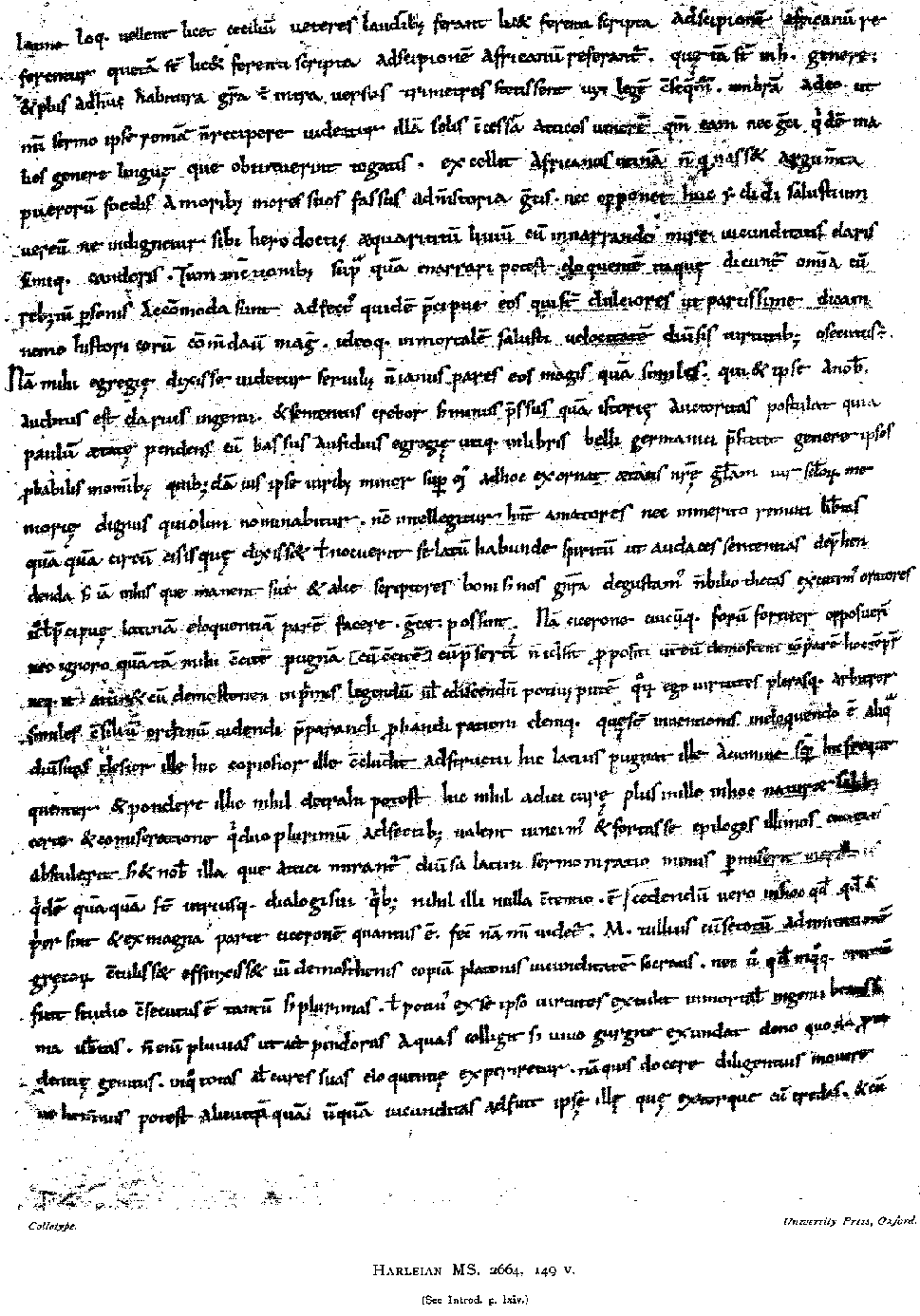
Harleian MS. 2664. 149 v. (See Introd. p. lxiv.)
INTRODUCTION.
I. Life of Quintilian.
It would be possible to state in a very few lines all that is certainly known about Quintilian’s personal history; but much would remain to be said in order to convey an adequate idea of the large place he must have filled in the era of which he is so typical a representative. The period of his activity at Rome is nearly co-extensive with the reign of the Flavian emperors,—Vespasian, Titus, and Domitian. For twenty years he was the recognised head of the teaching profession in the capital, and a large proportion of those who came to maturity in the days of Trajan and Hadrian must have received their intellectual training in his school. It is in itself a sign of the tendencies of the age that Quintilian should have enjoyed the immediate patronage of the reigning emperor in the conduct of work which would formerly have attracted little notice. In earlier days the profession of teaching had been held in low repute at Rome1. The first attempt to open a school of rhetoric, in B.C. 94, was looked on with the greatest suspicion and disfavour. Even Cicero adopts a tone of apology in the rhetorical text-books which he wrote for the instruction of others. But now all was changed, and education had come to be, as it was in a still greater degree under Nerva, Trajan, and the Antonines, a department of the government itself. Vespasian was the founder of a new dynasty; and, though he had little culture to boast of himself, he was shrewd enough to appreciate the advantages to be derived from systematising the education of the Roman youth, and maintaining friendly relations with those to whom it was entrusted. Quintilian, for his part, seems to have diligently seconded, in the scholastic sphere, his patron’s efforts to efface the memory of the time of trouble and unrest which had followed the extinction of the Julian line in the person of Nero. After his retirement from the active duties of his profession, he received the consular insignia from Domitian,—the promotion of a teacher of rhetoric to the highest dignity in the State being regarded as a most unexampled phenomenon by the conservative opinion of the day, which had failed to recognise the significance of the alliance between prince and pedagogue. The interest with which the publication of the Institutio Oratorio was looked forward to, at the close of his laborious professional career, is sufficient evidence of the authoritative position Quintilian had gained for himself at Rome. It was a tribute not only to the successful teacher, but also to the man of letters who, conscious that his was an age of literary decadence, sought to probe the causes of the national decline and to counteract its evil influences.
Like so many of the distinguished men of his time, Quintilian was a Spaniard by birth. There must have been something in the Spanish national character that rendered the inhabitants of that country peculiarly susceptible to the influences of Roman culture: certainly no province assimilated more rapidly than Spain the civilisation of its conquerors. The expansion of Rome may be clearly traced in the history of her literature. Just as Italy, rather than the imperial city itself, had supplied the court of Augustus with its chiefest literary ornaments, so now Spain sends up to the centre of attraction for all things Roman a band of authors united, if by nothing else, at least by the ties of a common origin. Pomponius Mela is said to have come from a place called Cingentera, on the bay of Algesiras; Columella was a native of Gades, Martial of Bilbilis; the two Senecas and Lucan were born in Corduba. The emperor Trajan came from Italica, near Seville; while Hadrian belonged to a family which had long been settled there. Quintilian’s birthplace was the town of Calagurris (Calahorra) on the Ebro, memorable in previous history only for the resistance which it enabled Sertorius to offer to Metellus and Pompeius: it was the last place that submitted after the murder of the insurgent general in B.C. 72.
In most of the older editions of Quintilian an anonymous Life appears, the author of which (probably either Omnibonus Leonicenus or Laurentius Valla) prefers a conjecture of his own to the ‘books of the time,’ and makes out that Quintilian was born in Rome. His main argument is that Martial does not include his name among those of the distinguished authors to whom he refers as being of Spanish origin (e.g. Epigr. i. 61 and 49), though he addresses him separately in complimentary terms (Epigr. ii. 90). Against this we may set, however, the line in which Ausonius embodies what was evidently a well-known and accepted tradition (Prof. i. 7):—
Adserat usque licet Fabium Calagurris alumnum;
and the statement of Hieronymus in the Eusebian Chronicle:—Quintilianus, ex Hispania Calagurritanus, primus Romae publicam scholam [aperuit]. The latter extract carries additional weight if we accept the conjecture of Reifferscheid2 that Jerome here follows the authority of Suetonius (Roth, p. 272) in his work on the grammarians and rhetoricians.
The fact of Quintilian’s Spanish origin may therefore be regarded as fully established, though we cannot cite the authority of Quintilian himself on the subject. His removal to Rome, at a very early period of his life, would naturally make him more of a Roman than a Spaniard; and this is probably the reason why he nowhere refers to the accident of his birth-place. Indeed his work does not lend itself to autobiographical revelations. Most of his reminiscences, some of which occur in the Tenth Book (1 §§23 and 86, 3 §12: cp. v. 7, 7: vi. 1, 14: xii. 11, 3) are suggested by some detail connected with his subject. Apart from the famous introduction to Book VI, where his grief for the loss of his wife and two sons is allowed to interrupt the continuity of his argument, he speaks of his father only once (ix. 3, 73), and then simply to quote, not without some diffidence, a bon mot of his in illustration of a figure of speech. The father was himself a rhetorician, and seems to have taught the subject both at Calagurris and also after the family removed to Rome: whether he is identical with the Quintilianus mentioned as a declaimer of moderate reputation by the elder Seneca (Controv. x. praef. 2: cp. ib. 33, 19) cannot now be ascertained.
The date of Quintilian’s birth has been variously given as A.D. 42, A.D. 38, and A.D. 35, the last being now most commonly adopted. It cannot be determined with certainty, though a few considerations may here be adduced to show why it seems necessary to discard any theory that would put it after A.D. 38. Dodwell, in his ‘Annales Quintilianei’ (see Burmann’s edition, vol. ii. p. 1117), arrived at the year A.D. 42, after a careful examination of all the passages on which he thought it allowable to base an inference. But Quintilian tells us himself that he was a young man (nobis adulescentibus vi. 1, 14) at the trial of Cossutianus Capito, which we know from Tacitus (Ann. xiii. 33) took place in A.D. 57: a fact which is in itself enough to show that Dodwell is at least two years too late. Another indication is derived from the references which Quintilian makes to his teacher Domitius Afer, who is known to have died at a ripe old age in A.D. 59: cp. xii. 11, 3 vidi ego ... Domitium Afrum valde senem: v. 7, 7 quem adulescentulus senem colui: x. 1, 86 quae ex Afro Domitio iuvenis excepi. Unfortunately we do not know the date of the trial of Volusenus Catulus referred to in x. 1, 23: Quintilian was a boy at the time (nobis pueris). In the preface to Book VI he writes like an old man: this appears especially in the reference he makes to the wife whom he had lost and who was only nineteen,—aetate tam puellari praesertim meae comparata §5. If we may infer that Quintilian was nearer sixty than fifty when he wrote these words, in A.D. 93 or 94, we may be certain that he was born not later than A.D. 38, and probably two or three years earlier.
Quintilian received his early education at Rome, and his father’s position as a teacher of rhetoric, as well as the whole tendency of the education of the day, no doubt gave it a rhetorical turn from the very first. Even boys at school practised declamation, as may be seen from the following passage of the Institutio:—
‘Non inutilem scio servatum esse a praeceptoribus meis morem, qui cum pueros in classes distribuerant, ordinem dicendi secundum vires ingenii dabant; et ita superiore loco quisque declamabat ut praecedere profectu videbatur. Huius rei iudicia praebebantur: ea nobis ingens palma, ducere vero classem multo pulcherrimum. Nec de hoc semel decretum erat: tricesimus dies reddebat victo certaminis potestatem. Ita nec superior successu curam remittebat, et dolor victum ad depellendam ignominiam concitabat. Id nobis acriores ad studia dicendi faces subdidisse quam exhortationem docentium, paedagogorum custodiam, vota parentium, quantum animi mei coniectura colligere possum, contenderim.’—i. 2, 23-25.
The same style of exercise was kept up at a later stage, when the boy passed into the hands of a professed teacher of rhetoric, such as the notorious Remmius Palaemon, who is said by the scholiast on Juvenal (vi. 451) to have been Quintilian’s master:—
‘Solebant praeceptores mei neque inutili et nobis etiam iucundo genere exercitationis praeparare nos coniecturalibus causis, cum quaerere atque exsequi iuberent “cur armata apud Lacedaemonios Venus” et “quid ita crederetur Cupido puer atque volucer et sagittis ac face armatus” et similia, in quibus scrutabamur voluntatem.’—ii. 4, 26.
He now came into contact with, and listened to the eloquence of, the most celebrated orators of the day. In his relations with the greatest of these, Domitius Afer, Quintilian seems to have acted on the maxim which he himself lays down for the budding advocate: oratorem sibi aliquem, quod apud maiores fieri solebat, deligat, quem sequatur, quem imitetur x. 5, 19. To Afer he attached himself (adsectabar Domitium Afrum Plin. Ep. ii. 14, 10), and was in all probability by him initiated in the business of the law-courts and public life generally: cp. v. 7, 7 adulescentulus senem colui (Domitium). In this passage Afer is said to have written two books on the examination of witnesses; and from vi. 3, 42 it would appear that his ‘dicta’ or witticisms were sufficiently distinguished to merit the honour of publication. He had held high office under Tiberius, Caligula, and Nero, and his pre-eminence at the bar was undisputed: xii. 11, 3 principem fuisse quondam fori non erat dubium. In his review of Latin oratory, Quintilian gives him high praise: arte et toto genere dicendi praeferendus, et quem in numero veterum habere non timeas x. 1, 118. The pupil was fortunate therefore in his master, and he drew upon his reminiscences of Afer’s teaching when he himself came to instruct others (Plin. l.c.). Among other notable orators of the day were Servilius Nonianus (x. 1, 102), Iulius Africanus (x. 1, 118: xii. 10, 11), Iulius Secundus (x. 1, 120: 3, 12: xii. 10, 11), Galerius Trachalus (x. 1, 119: xii. 10, 11), and Vibius Crispus (ibid.).
When he was about twenty-five years of age some motive induced Quintilian to return to Calagurris, his native town; and there he spent several years in the practice of his profession as teacher and barrister. We know that he came back to Rome with Galba in A.D. 68: the evidence for this is again the statement made by Hieronymus in the Eusebian Chronicle, M. Fabius Quintilianus Romam a Galba perducitur. Galba had been governor of Hispania Tarraconensis under Nero (A.D. 61-68), and it is not improbable that Quintilian, when he returned to his native country, was in some way attached to his official retinue; the numerous bons mots which he records in the third chapter of the Sixth Book (§§62, 64, 66, 80, 90) seem to point to a certain amount of personal intercourse between himself and the future emperor3.
At Rome Quintilian must soon have proved himself thoroughly qualified for the work of teaching and training the young. The imperial countenance afterwards shown him by Vespasian was in all probability only an official expression of the esteem felt in the Roman community for one who was serving with such distinction in a sphere of which the importance was coming now to be more adequately recognised. Quintilian was not only a learned man and a great teacher: he was a great moral power in the midst of a people which had long been demoralised by the vices of its rulers. The fundamental principle of his teaching, non posse oratorem esse nisi virum bonum (i. pr. §9 and xii. 1), shows the high ideal he cherished and the wide view he took of the opportunities of his position. He felt himself strong enough to make a protest against the literary influence of Seneca, then the popular favourite, and to endeavour to recall a vitiated taste to more rigorous standards: corruptum et omnibus vitiis fractum dicendi genus revocare ad severiora iudicia contendo (x. 1, 125). And when, in the evening of his days, he wrote his great treatise on the ‘technical training’ of the orator, it was from himself and his own successful practice that he drew many of his most cogent illustrations, e.g. vi. 2, 36, and (in regard to his powers of memory) xi. 2, 39 and iv. 2, 86.
In the earlier years of his career at Rome, before he became absorbed in the work of teaching, Quintilian must have had a considerable amount of practice at the bar. He tells us himself of a speech which he published, ductus iuvenali cupiditate gloriae viii. 2, 24. It was of a common type. A certain Naevius Arpinianus was accused of having killed his wife, who had fallen from a window; and we may infer with certainty from the tone of Quintilian’s reference to the circumstances of the case that he succeeded in securing the acquittal of Naevius—more fortunate than the wife-killer of whom we read in Tacitus (Ann. iv. 22). A more distinguished cause was that of Berenice, the Jewish Queen before whom St. Paul appeared (Acts xxv. 13), and whose subsequent visit to Rome was connected with the ascendency she had established over the heart of the youthful Titus (Tac. Hist. ii. 2: Suet. Tit. 7). We can only speculate on the nature of the issue involved, as Quintilian confines himself to a bare statement of fact—ego pro regina Berenice apud ipsam causam dixi iv. 1, 19. It was in all probability a civil suit brought or defended by Berenice against some Jewish countryman; and the phenomenon of the queen herself presiding over a trial in which she was an interested party is accounted for by the hypothesis that, at least in civil suits, Roman tolerance allowed the Jews to settle their own disputes according to their national law. On such occasions the person of highest rank in the community to which the disputants belonged might naturally be designated to preside over the tribunal4.
In another case, Quintilian seems to have shown some of the dexterity attributed to him in the oft-quoted line of Juvenal (vi. 280) Dic aliquem, sodes, dic, Quintiliane, colorem. He was counsel for a woman who had been party to an arrangement by which the provisions of the Voconian law (passed B.C. 169 to prevent the accumulation of property in the hands of females) had been evaded by the not uncommon method of a fraudulent disposition to a third person5. Quintilian’s client was accused of having produced a forged will. This charge it was easy to rebut, though it rendered necessary the explanation that the heirs named in the will had really undertaken to hand the property over to the woman; and if this explanation were openly given it would involve the loss of the estate. There is an evident tone of satisfaction in Quintiiian’s description of what happened: ita ergo fuit nobis agendum ut iudices illud intellegerent factum, delatores non possent adprehendere ut dictum, et contigit utrumque (ix. 2, 74).
Unlike his great model Cicero, who was considered most effective in the peroratio of a great case, where the work was divided among several pleaders, Quintilian was generally relied on to state a case (ponere causam) in its main lines for subsequent elaboration: me certe, quantacunque nostris experimentis habenda est fides, fecisse hoc in foro, quotiens ita desiderabat utilitas, probantibus et eruditis et iis qui iudicabant, scio: et (quod non adroganter dixerim, quia sunt plurimi quibuscum egi qui me refellere possint si mentiar) fere a me ponendae causae officium exigebatur iv. 2, 86. His methodical habit of mind would render him specially effective for this department of work. Other orators may have been more brilliant, more full of fire, and more able to work upon the feelings of an audience: if Quintilian had not the ‘grand style’—if he represents the type of an orator that is ‘made’ rather than ‘born’—we may at least believe that he was unsurpassed for judicious, moderate, and effective statement. His model in this as in other matters was probably Domitius Afer, of whom Pliny says (Ep. ii. 14, 10) apud decemviros dicebat graviter et lente, hoc enim illi actionis genus erat. His character and training would secure him a place apart from the common herd. ‘Among the orators of the day, some ignorant and coarse, having left mean occupations, without any preliminary study, for the bar, where they made up in audacity for lack of talent, and in noisy conceit for a defective knowledge of law—others trained in the practice of delation to every form of trickery and violence—Quintilian, honest, able, and moderate stood by himself6.’
It was after Quintilian had attained some distinction in the practice of his profession, probably in the year 72, that his activity became invested with an official and public character. We learn the facts from Suetonius’s Life of Vespasian (ch. 18): primus e fisco latinis graecisque rhetoribus annua centena constituit: and the Eusebian chronicle (see Roth’s Suetonius, p. 272), Quintilianus, ex Hispania Calagurritanus, qui primus Romae publicam (‘state-supported’) scholam [aperuit] et salarium e fisco accepit, claruit—the zenith of his fame being placed between the years 85 and 89 A.D. Vespasian, in fact, created and endowed a professorial Chair of Rhetoric, and Quintilian was its first occupant. He thus became the official head of the foremost school of oratory at Rome, and the ‘supreme controller of its restless youth’:
Quintiliane, vagae moderator summe iuventae, Gloria Romanae, Quintiliane, togae. —Mart. ii. 90, 1-2.
In this capacity he must have exercised the greatest possible influence on the rising youth of Rome. The younger Pliny was his pupil, and evidently retained a grateful memory of the instruction which he received from him: Ep. ii. 14, 9 and vi. 6, 3. The same is true, in all probability, of Pliny’s friend Tacitus, who has much in common with Quintilian: possibly also of Suetonius. If Juvenal was not actually his pupil,—he is believed to have practised declamation till well on in life,—we may infer from the complimentary references which occur in his Satires that he at least appreciated Quintilian’s work and recognised its healthy influence7.
After a public career at Rome, extending over a period of twenty years8, Quintilian definitely retired from both teaching and pleading at the bar. He seems to have profited by the example of his model, Domitius Afer, who would have done better if he had retired earlier (xii. 11, 3): Quintilian thought it was well to go while he would still be missed,—et praecipiendi munus iam pridem deprecati sumus et in foro quoque dicendi, quid honestissimum finem putabamus desinere dum desideraremur, ii. 12, 12. The wealth which he had acquired by the practice of his profession (Juv. vii. 186-189) enabled him to go into retirement with a light heart. The first-fruits of his leisure was a treatise in which he sought to account for that decline in eloquence for which the Institutio Oratoria was afterwards to provide a remedy. It was entitled De causis corruptae eloquentiae, and was long confounded with the Dialogue on Oratory, now ascribed to Tacitus: he refers to this work in vi. pr. §3: viii. 6, 76: possibly also in ii. 4, 42: v. 12, 23: vi. pr. §3: viii. 3, 58, and 6, 769. This treatise is no longer extant, and we have lost also the two books Artis Rhetoricae, which were published under Quintilian’s name (1 pr. §7), neque editi a me neque in hoc comparati: namque alterum sermonem per biduum habitum pueri quibus id praestabatur exceperant, alterum pluribus sane diebus, quantum notando consequi potuerant, interceptum boni iuvenes sed nimium amantes mei temerario editionis honore vulgaverant10. In a recent edition of the ‘Minor Declamations’ (M. Fabii Quintiliani declamationes quae supersunt cxlv Lipsiae, 1884), Const. Ritter endeavours to show that this is the work referred to in the passage quoted above, from the preface to the Institutio: cp. Die Quintilianischen Declamationen, Freiburg i.B., und Tübingen, 1881, p. 246 sqq.11 Meister’s view, however, is that, like the ‘Greater Declamations,’ which are generally admitted to have been composed at a later date, the ‘Minor Declamations’ also were written subsequently either by Quintilian himself or (more probably) by imitators who had caught his style and were glad to commend their compositions by the aid of his great name. Even in his busy professional days Quintilian had suffered from the zeal of pirate publishers: he tells us (vii. 2, 24) that several pleadings were in circulation under his name which he could by no means claim as entirely his own: nam ceterae, quae sub nomine meo feruntur, neglegentia excipientium in quaestum notariorum corruptae minimam partem mei habent.
While living in retirement, and engaged on the composition of his work, Quintilian received a fresh mark of Imperial favour, this time from Domitian. This prince had adopted two grand-nephews, whom he destined to succeed him on the throne,—the children of his niece Flavia Domitilla, and of Flavius Clemens, a cousin whom he associated with himself about this time in the duties of the consulship. They were rechristened Vespasian and Domitian (Suet. Dom. 15), and the care of their education was entrusted to Quintilian (A.D. 93). He accepted it with fulsome expressions of gratitude and appreciation12; but did not exercise it for long13, as the children, with their parents, became the victims of the tyrant’s capriciousness shortly before his murder, and were ruined as rapidly as they had risen. Flavius Clemens was put to death, and his wife Domitilla, probably accompanied by her two sons, was sent into exile. They seem to have embraced the Jewish faith; and it is interesting to speculate on the possibility that through intercourse with them, and with their children, Quintilian may have come into contact with a religion which was the forerunner of that which was destined soon afterwards to achieve so universal a triumph.
It was while he was acting as tutor to the two princes that Quintilian received, through the influence of their father Flavius Clemens, the compliment of the consular insignia. This we learn from Ausonius, himself the recipient of a similar favour from his pupil Gratian: Quintilianus per Clementem ornamenta consularia sortitus, honestamenta nominis potius videtur quam insignia potestatis habuisse. It was probably in allusion to this promotion, unexampled at that time in the case of a teacher of rhetoric, that Juvenal wrote (vii. 197-8)—
Si Fortuna volet, fies de rhetore consul; Si volet haec eadem, fies de consule rhetor:
while another parallel is chronicled by Pliny, Ep. iv. 11, 1 praetorius hic modo ... nunc eo decidit ut exsul de senatore, rhetor de oratore fieret. Itaque ipse in praefatione dixit dolenter el graviter: ‘quos tibi Fortuna, ludos facis?’ facis enim ex professoribus senatores, ex senatoribus professores.
The flattery with which Quintilian loads the emperor for these and similar favours is the only stain on a character otherwise invariably manly, honourable, and straightforward. It is startling for us to hear that monster of iniquity, the last of the Flavian line, invoked as an ‘upright guardian of morals’ (sanctissimus censor iv. pr. §3), even when he was ‘tearing in pieces the almost lifeless world.’ There may have been a grain of sincerity in the compliments which Quintilian, like Pliny, pays to his literary ability. Domitian’s poetical productions are said not to have been altogether wanting in merit; and his attachment to literary pursuits is shown by the festivals he instituted in honour of Minerva and Jupiter Capitolinus, in which rhetorical, musical, and artistic contests were a prominent feature (see on x. 1, 91). But this is no justification for the fulsome language employed by Quintilian in the introduction to the Fourth Book, where the emperor is spoken of as the protecting deity of literary men: ut in omnibus ita in eloquentia eminentissimum ... quo neque praesentius aliud nec studiis magis propitium numen est; nor for his profession of belief that nothing but the cares of government prevented Domitian from becoming the greatest poet of Rome: Germanicum Augustum ab institutis studiis deflexit cura terrarum, parumque dis visum est esse eum maximum poetarum x. 1, 91 sq. Few would recognise Domitian in the following reference: laudandum in quibusdam quod geniti immortales, quibusdam quod immortalitatem virtute sint consecuti: quod pietas principis nostri praesentium quoque temporum decus fecit iii. 7, 9. Such servility can only be partially explained by Quintilian’s official relations to the Court and by the circumstances of the time at which he wrote. It was a vice of the age: Quintilian shares it with Martial, Statius, Silius Italicus, and Valerius Flaccus. The indignant silence which Tacitus and Juvenal maintained during the horrors of this reign is a better expression of the virtue of old Rome, which seems to have burned with steadier flame in the hearts of her genuine sons than in those of the ‘new men’ from the provinces, with neither pride of family nor pride of nationality to save them from the corrupting influences of their surroundings14.
That Quintilian acquired considerable wealth, partly as a teacher and partly by work at the bar, is evident from the pointed references made by Juvenal in the seventh Satire. After showing how insignificant are the fees paid by Roman parents for their children’s education, when compared with their other expenses, the satirist suddenly breaks off,—unde igitur tot Quintilianus habet saltus? How does it come about (if his profession is so unremunerative) that Quintilian owns so many estates? The only answer which Juvenal can give to this conundrum is that the great teacher was one of the fortunate: ‘he is a lucky man, and your lucky man, like Horace’s Stoic, unites every good quality in himself, and can expect everything15.’ We must remember however, that, while Quintilian acquired wealth in the practice of his profession, no charge is made against him as having placed his abilities at the disposal of an unscrupulous ruler for his own advancement. Under Nero, Marcellus Eprius assisted in procuring the condemnation of Thrasea, and received over £42,000 for the service (Tac. Ann. xvi. 33): if Quintilian’s name had ever been associated with such a trial, Juvenal would have been more direct in his reference. But with Quintilian, as with so many others, the advantages of position and fortune were counterbalanced by grave domestic losses. In a less rhetorical age the memorable introduction to the Sixth Book of the Institutio would perhaps have taken a rather more simple form; but it is none the less a testimony to the warm human heart of the writer, now a childless widower. He had married, when already well on in life, a young girl whose death at the early age of nineteen made him feel as if in her he had lost a daughter rather than a wife: cum omni virtute quae in feminas cadit functa insanabilem attulit marito dolorem, tum aetate tam puellari, praesertim meae comparata, potest et ipsa numerari inter vulnera orbitatis vi. pr. 5. She left him two sons, the younger of whom did not long survive her; he had just completed his fifth year when he died. The father now concentrated all his affection on the elder, and it was with his education in view that he made all haste to complete his great work, which he considered would be the best inheritance he could leave to him,—hanc optimum partem relicturus hereditatis videbar, ut si me, quod aequum et optabile fuit, fata intercepissent, praeceptore tamen patre uteretur ib. §1. But the blow again descended, and his house was desolate: at me fortuna id agentem diebus ac noctibus festinantemque metu meae mortalitatis ita subito prostravit ut laboris mei fructus ad neminem minus quam ad me pertineret. Illum enim, de quo summa conceperam et in quo spem unicam senectutis reponebam, repetito vulnere orbitatis amisi ib. §2.
This would be about the year 94 A.D., and the Institutio Oratoria is said to have seen the light in 95. After that we hear no more of Quintilian. Domitian was assassinated in 96, and under the new régime it is possible that the favourite of the Flavian emperors may have been under a cloud. But his work was done; even if he lived on for a few years longer in retirement, his career had virtually closed with the publication of his great treatise. It used to be believed that he lived into the reign of Hadrian, and died about 118 A.D., but this idea is founded on a misconception16. Probably he did not even see the accession of Nerva in 96: if he did, he must have died soon afterwards, for there are two letters of Pliny’s (one written between 97 and 100, and the other about 105) in which Pliny does not speak of his old teacher as of one still alive.
II. The Institutio Oratoria.
Though Quintilian spent little more than two years on the composition of the Institutio Oratorio, his work really embodies the experience of a lifetime. No doubt much of it lay ready to his hand, even before he began to write, and he would willingly have kept it longer; but the solicitations of Trypho, the publisher, were too much for him. His letter to Trypho shows that he fully appreciated the magnitude of his task; and there is even the suggestion that (like many a busy teacher since his time) he only realised when called upon to publish that he had not covered the whole ground of his subject17. The opening words of the introduction (post impetratam studiis meis quietem, quae per viginti annos erudiendis iuvenibus impenderam, &c.) show that the Institutio was the work of his retirement: and various indications lead us to fix the date of its composition as falling between A.D. 93 and 95. The introduction to the Fourth Book was evidently written when (probably in 93) Domitian had appointed Quintilian tutor to his grand-nephews; the Sixth Book, where he refers to his family losses, must have followed shortly afterwards; while the harshness of his references to the philosophers in the concluding portions of the work (cp. xi. 1, 30, xii. 3, 11, with 1, pr. 15, which may have been written, or at least revised, after the rest was finished) seems to suggest that their expulsion by Domitian (in 94) was already an accomplished fact18. The book is dedicated to Victorius Marcellus, to whom Statius also addresses the Fourth Book of his Silvae, evidently as to a person of some consideration and an orator of repute (cp. Stat. Silv. iv. 4, 8, and 41 sq.). Marcellus had a son called Geta (Inst. Or. i. pr. 6: Stat. Silv. iv. 4, 71), and it was originally with a view to the education of this youth (erudiendo Getae tuo) that Quintilian associated the father’s name with his work. Geta is again referred to, along with Quintilian’s elder son, and also the grand-nephews of Domitian, in the introduction to the Fourth Book; but the opening words of the Sixth Book show that they are all gone, and the epilogue, at the conclusion of Book xii, is addressed to Marcellus on behoof of ‘studiosi iuvenes’ in general.
The plan of the Institutio Oratorio cannot be better given than in its author’s own words (i. pr. 21 sq.): Liber primus ea quae sunt ante officium rhetoris continebit. Secundo prima apud rhetorem elementa et quae de ipsa rhetorices substantia quaeruntur tractabimus, quinque deinceps inventioni (nam huic et dispositio subiungitur) quattuor elocutioni, in cuius partem memoria ac pronuntiatio veniunt, dabuntur. Unus accedet in quo nobis orator ipse informandus est, et qui mores eius, quae in suscipiendis, discendis, agendis causis ratio, quod eloquentiae genus, quis agendi debeat esse finis, quae post finem studia, quantum nostra valebit infirmitas, disseremus. The first book deals with what the pupil must learn before he goes to the rhetorician; it gives an account of home-training and school discipline, and contains also a statement of Quintilian’s views of grammar. The second book treats of rhetoric in general: the choice of a proper instructor, as well as his character and function, and the nature, principles, aims, and use of oratory. It is in these early books especially that Quintilian reveals the high tone which has made him an authority on educational morals, as well as rhetorical training: see especially i. 2, 8, where he enlarges on Juvenal’s dictum, maxima debetur puero reverentia; ii. 4, 10, where he advocates gentle and conciliatory methods in teaching; and ii. 2, 5,—a picture of the ideal teacher in language which might be applied to Quintilian himself19. The remaining books, except the twelfth, are devoted to the five ‘parts of rhetoric,’—invention, arrangement, style, memory, and delivery (Cic. de Inv. i. 7, 9). In the third book we have a classification of the different kinds of oratory. Next he treats of the ‘different divisions of a speech, the purpose of the exordium, the proper form of a statement of facts, what constitutes the force of proofs, either in confirming our own assertions or refuting those of our adversary, and of the different powers of the peroration, whether it be regarded as a summary of the arguments previously used, or as a means of exciting the feelings of the judge rather than of refreshing his memory.’ This brings us to the end of the sixth book, which closes with remarks on the uses of humour and of altercation20. The discussion of arrangement finishes with the seventh book, which is extremely technical: style (elocutio) is the main subject of the four books which follow. Of these the eighth and ninth treat of the elements of a good style,—such as perspicuity, ornament, &c.; the tenth of the practical studies and exercises (including a course of reading) by which the actual command of these elements may be obtained; while the eleventh deals with appropriateness (i.e. the different kinds of oratory which suit different audiences), memory, and delivery. The twelfth book—which Quintilian calls the most grave and important part of the whole work—treats of the high moral qualifications requisite in the perfect orator: just as the first book, introductory to the whole, describes the early training which should precede the technical studies of the orator, so the last book sets forth that ‘discipline of the whole man’ which is their crown and conclusion21. “Lastly, the experienced teacher gives advice when the public life of an orator should begin, and when it should end. Even then his activity will not come to an end. He will write the history of his times, will explain the law to those who consult him, will write, like Quintilian himself, a treatise on eloquence, or set forth the highest principles of morality. The young men will throng round and consult him as an oracle, and he will guide them as a pilot. What can be more honourable to a man than to teach that of which he has a thorough knowledge? ‘I know not,’ he concludes, ‘whether an orator ought not to be thought happiest at that period of his life when, sequestered from the world, devoted to retired study, unmolested by envy, and remote from strife, he has placed his reputation in a harbour of safety, experiencing while yet alive that respect which is more commonly offered after death, and observing how his character will be regarded by posterity22.’”
The Institutio Oratoria differs from all other previous rhetorical treatises in the comprehensiveness of its aim and method. It is a complete manual for the training of the orator, from his cradle to the public platform. Founding on old Cato’s maxim, that the orator is the vir bonus dicendi peritus, Quintilian considers it necessary to take him at birth in order to secure the best results, as regards both goodness of character and skill in speaking. His work has therefore for us a double value and a twofold interest: it is a treatise on education in general, and on rhetorical education in particular. Throughout the whole, oratory is the end for the sake of which everything is undertaken,—the goal to which the entire moral and intellectual training of the student is to be directed. Quintilian’s high conception of his subject is reflected in the language of the ‘Dialogue on Oratory’: Studium quo non aliud in civitate nostra vel ad utilitatem fructuosius vel ad voluptatem dulcius vel ad dignitatem amplius vel ad urbis famam pulchrius vel ad totius imperii atque omnium gentium notitiam inlustrius excogitari potest (ch. 5). Though the field for the practical display of eloquence had been greatly limited by the extinction of the old freedom of political life, rhetoric represented, in Quintilian’s day, the whole of education. It was to the Romans what μουσική was to the Greeks, and was valued all the more by them because of its eminently practical purpose. The student of rhetoric must therefore be fully equipped. “Quintilian postulates the widest culture: there is no form of knowledge from which something may not be extracted for his purpose; and he is fully alive to the importance of method in education. He ridicules the fashion of the day, which hurried over preliminary cultivation, and allowed men to grow grey while declaiming in the schools, where nature and reality were forgotten. Yet he develops all the technicalities of rhetoric with a fulness to which we find no parallel in ancient literature. Even in this portion of the work the illustrations are so apposite and the style so dignified and yet sweet, that the modern reader, whose initial interest in rhetoric is of necessity faint, is carried along with much less fatigue than is necessary to master most parts of the rhetorical writings of Aristotle and Cicero. At all times the student feels that he is in the company of a high-toned Roman gentleman who, so far as he could do without ceasing to be a Roman, has taken up into his nature the best results of ancient culture in all its forms23.”
It is in connection with the general rather than with the technical training of his pupils that Quintilian establishes a claim to rank with the highest educational authorities,—as for example in his insistence on the necessity of good example both at home24 and in school, and on the respect due to the young25, as well as his catalogue of the qualifications required in the trainer of youth (ii. 2, 5: 4, 10), his protest against corporal punishment (i. 3, 14), and his consistent advocacy of the moral as well as the intellectual aspects of education. His system was conceived as a remedy for the existing state of things at Rome, where eloquence and the arts in general had, as Messalla puts it in the ‘Dialogue on Oratory,’ “declined from their ancient glory, not from the dearth of men, but from the indolence of the young, the carelessness of parents, the ignorance of teachers, and neglect of the old discipline26.” Under it parents and teachers were to be united in the effort to develop the moral and intellectual qualities of the Roman youth: and through education the state was to recover something of her old vigour and virtue.
The work was expected with the greatest interest before its publication, and we may infer, from the high authority assigned to Quintilian in the literature of the period, that it long held an honoured place in Roman schools. But it is curious that the earliest known references are not to the Institutio but to the Declamationes. In an interesting chapter of the Introduction to a recent volume27, M. Fierville has gathered together all the references that occur in the literature of the early centuries of our era. Trebellius Pollio and Lactantius (both of the 3rd century) speak of the Declamations, and Ausonius (4th century) refers to Quintilian without naming his writings: the first definite mention of the Institutio is made by Hilary of Poitiers (died 367) and afterwards by St. Jerome (died 420). Later Cassiodorus (468-562) pronounced a eulogy which may stand as proof of his high appreciation: Quintilianus tamen doctor egregius, qui post fluvios Tullianos singulariter valuit implere quae docuit, virum bonum dicendi peritum a prima aetate suscipiens, per cunctas artes ac disciplinas nobilium litterarum erudiendum esse monstravit, quem merito ad defendendum totius civitatis vota requirerent (de Arte Rhetor.—Rhet. Lat. Min., ed. Halm, p. 498). The Ars Rhetorica of Julius Victor (6th century) is largely borrowed from Quintilian: see Halm, praef. p. ix. Isidore, Bishop of Seville (570-630), studied Quintilian in conjunction with Aristotle and Cicero. After the Dark Age, Poggio’s discovery, at St. Gall in 1416, of a complete manuscript of Quintilian was ranked as one of the most important literary events in what we know now as the era of the Renaissance28. The great scholars of the fifteenth century worked hard at the emendation of the text. The editio princeps was given to the world by G. A. Campani in 1470; and in the concluding words of his preface the editor reflects something of the enthusiasm for his author which had already been expressed by Petrarch, Poggio, and others,—proinde de Quintiliano sic habe, post unam beatissimam et unicam felicitatem M. Tullii, quae fastigii loco suspicienda est omnibus et tamquam adoranda, hunc unum esse quem praecipuum habere possis in eloquentia ducem: quem si assequeris, quidquid tibi deerit ad cumulum consummationis id a natura desiderabis non ab arte deposces. This edition was followed in rapid succession by various others, so that by the end of the 16th century Quintilian had been edited a hundred times over29. The 17th century is not so rich in editions, but Quintilian still reigned in the schools as the great master of rhetoric: students of English literature will remember how Milton (Sonnet xi) uses the authority of his name when referring to the roughness of northern nomenclature:—
Those rugged names to our like mouths grow sleek That would have made Quintilian stare and gasp.
In his ‘Tractate on Education’ too Milton strongly recommends the first two or three books of the Institutio. The 18th century provided the notable editions of Burmann (1720), Capperonier (1725), Gesner (1738), and witnessed also the commencement of Spalding’s (1798-1816), whose text, as revised by Zumpt and Bonnell, practically held the field till the publication of Halm’s critical edition (1868). Towards the close of last century it would appear that Quintilian was as much studied as he had ever been,—probably by many who believed in, as well as by some who would have rejected the application of the maxim ‘orator nascitur non fit.’ William Pitt, for example, shortly after his arrival at Cambridge (1773), and while ‘still bent on his main object of oratorical excellence,’ attended a course of lectures on Quintilian, which caused him on one occasion to interrupt his correspondence with his father30. His lasting popularity must have been due, not only to his own intrinsic merits, but to the fact that his writings harmonised well with the studies of those days: it was promoted also by the serviceable abridgments of the Institutio, either in whole or in part, that were from time to time published,—notably that of Ch. Rollin in 1715. In our own day men whose education was moulded on the old lines—such as J. S. Mill—considered Quintilian an indispensable part of a scholar’s equipment. Macaulay read him in India, along with the rest of classical literature. Lord Beaconsfield professed that he was ‘very fond of Quintilian31.’ But by our classical scholars he has been almost entirely neglected, no complete edition having appeared in this country since a revised text was issued in London in 1822. German criticism, on the other hand, has of late paid Quintilian special attention, with conspicuous results for the emendation and illustration of his text: to the great names of Spalding, Zumpt, and Bonnell, must be added those of Halm, Meister, Becher, Wölfflin, and Kiderlin.
Besides the literary criticism for which it has always attracted attention, and which will form the subject of the next section, the Tenth Book of the Institutio contains valuable precepts in regard to various practical matters which are still of as great importance as they were in Quintilian’s day. Among these are the practice of writing, the use of an amanuensis, the art of revision, the limits of imitation, the best exercises in style, the advantages of preparation, and the faculty of improvisation.
The following list of Loci Memoriales (mainly taken from Krüger’s third edition, pp. 108-110) will give some idea of the various points on which, especially in the later chapters of the Tenth Book, Quintilian states his opinion weightily and often with epigrammatic terseness:
1 §112 (p. 110) Ille se profecisse sciat cui Cicero valde placebit.
2 §4 (p. 124) Pigri est ingenii contentum esse iis quae sint ab aliis inventa.
2 §7 (p. 125) Turpe etiam illud est, contentum esse id consequi quod imiteris.
2 §8 (p. 126) Nulla mansit ars qualis inventa est, nec intra initium stetit.
2 §10 (pp. 126-7) Eum vero nemo potest aequare cuius vestigiis sibi utique insistendum putat; necesse est enim semper sit posterior qui sequitur.
2 §10 (p. 127) Plerumque facilius est plus facere quam idem.
2 §12 (ibid.) Ea quae in oratore maxima sunt imitabilia non sunt, ingenium, inventio, vis, facilitas, et quidquid arte non traditur.
2 §18 (p. 131) Noveram quosdam qui se pulchre expressisse genus illud caelestis huius in dicendo viri sibi viderentur, si in clausula posuissent ‘esse videatur.’
2 §20 (p. 132) (Praeceptor) rector est alienorum ingeniorum atque formator. Difficilius est naturam suam fingere.
2 §22 (ibid.) Sua cuique proposito lex, suus decor est.
2 §24 (p. 134) Non qui maxime imitandus, et solus imitandus est.
3 §2 (p. 136) Scribendum ergo quam diligentissime et quam plurimum. Nam ut terra alte refossa generandis alendisque seminibus fecundior fit, sic profectus non a summo petitus studiorum fructus effundit uberius et fidelius continet.
3 §2 (p. 137) Verba in labris nascentia.
3 §3 (ibid.) Vires faciamus ante omnia, quae sufficiant labori certaminum et usu non exhauriantur. Nihil enim rerum ipsa natura voluit magnum effici cito, praeposuitque pulcherrimo cuique operi difficultatem.
3 §7 (p. 139) Omnia nostra dum nascuntur placent, alioqui nec scriberentur.
3 §9 (ibid.) Primum hoc constituendum, hoc obtinendum est, ut quam optime scribamus: celeritatem dabit consuetudo.
3 §10 (ibid.) Summa haec est rei: cito scribendo non fit ut bene scribatur, bene scribendo fit ut cito.
3 §15 (p. 142) Curandum est ut quam optime dicamus, dicendum tamen pro facultate.
3 §22 (p. 146) Secretum in dictando perit.
3 §26 (p. 148) Cui (acerrimo labori) non plus inrogandum est quam quod somno supererit, haud deerit.
3 §27 (ibid.) Abunde, si vacet, lucis spatia sufficiunt: occupatos in noctem necessitas agit. Est tamen lucubratio, quotiens ad eam integri ac refecti venimus, optimum secreti genus.
3 §29 (ibid.) Non est indulgendum causis desidiae. Nam si non nisi refecti, non nisi hilares, non nisi omnibus aliis curis vacantes studendum existimarimus, semper erit propter quod nobis ignoscamus.
3 §31 (p. 149) Nihil in studiis parvum est.
4 §1 (p. 151) Emendatio, pars studiorum longe utilissima; neque enim sine causa creditum est stilum non minus agere, cum delet. Huius autem operis est adicere, detrahere, mutare.
4 §4 (p. 152) Sit ergo aliquando quod placeat aut certe quod sufficiat, ut opus poliat lima, non exterat.
5 §23 (p. 166) Diligenter effecta (sc. materia) plus proderit quam plures inchoatae et quasi degustatae.
6 §1 (p. 167) Haec (sc. cogitatio) inter medios rerum actus aliquid invenit vacui nec otium patitur.
6 §2 (p. 168) Memoriae quoque plerumque inhaeret fidelius quod nulla scribendi securitate laxatur.
6 §5 (ibid.) Sed si forte aliqui inter dicendum effulserit extemporalis color, non superstitiose cogitatis demum est inhaerendum.
6 §6 (p. 169) Refutare temporis munera longe stultissimum est.
6 §6 (ibid.) Extemporalem temeritatem malo quam male cohaerentem cogitationem.
7 §1 (p. 170) Maximus vero studiorum fructus est et velut praemium quoddam amplissimum longi laboris ex tempore dicendi facultas.
7 §4 (p. 171) Perisse profecto confitendum est praeteritum laborem, cui semper idem laborandum est. Neque ego hoc ago ut ex tempore dicere malit, sed ut possit.
7 §12 (p. 175) Mihi ne dicere quidem videtur nisi qui disposite, ornate, copiose dicit, sed tumultuari.
7 §15 (p. 176) Pectus est enim, quod disertos facit, et vis mentis.
7 §§16-17 (p. 177) Extemporalis actio auditorum frequentia, ut miles congestu signorum, excitatur. Namque et difficiliorem cogitationem exprimit et expellit dicendi necessitas, et secundos impetus auget placendi cupido.
7 §18 (ibid.) Facilitatem quoque extemporalem a parvis initiis paulatim perducemus ad summam, quae neque perfici neque contineri nisi usu potest.
7 §20 (p. 178) Neque vero tanta esse umquam fiducia facilitatis debet ut non breve saltem tempus, quod nusquam fere deerit, ad ea quae dicturi sumus dispicienda sumamus.
7 §21 (p. 178) Qui stultis videri eruditi volunt, stulti eruditis videntur.
7 §24 (p. 179) Rarum est ut satis se quisque vereatur.
7 §26 (p. 180) Studendum vero semper et ubique.
7 §27 (p. 180-1) Neque enim fere tan est ullus dies occupatus ut nihil lucrativae ... operae ad scribendum aut legendum aut dicendum rapi aliquo momento temporis possit.
7 §28 (p. 181) Quidquid loquemur ubicumque sit pro sua scilicet portione perfectum.
7 §28 (ibid.) Scribendum certe numquam est magis, quam cum multa dicemus ex tempore.
7 §29 (p. 181-2) Ac nescio an si utrumque cum cura et studio fecerimus, invicem prosit, ut scribendo dicamus diligentius, dicendo scribamus facilius. Scribendum ergo quotiens licebit, si id non dabitur, cogitandum; ab utroque exclusi debent tamen sic dicere ut neque deprehensus orator neque litigator destitutus esse videatur.
III. Quintilians’s Litary Criticism.
It was the conviction that a cultured orator is better than an orator with no culture that induced Quintilian to devote so considerable a part of the Tenth Book to a review of Greek and Roman literature. He was aware that in order to speak with effect it is necessary for a man to know a good deal that lies outside the scope of the particular case which he may undertake to plead; and while the ‘firm facility’ ἕξις at which he taught the orator to aim could only be attained by a variety of exercises and qualifications, a course of wide and careful reading must always, he considered, form one of the factors in the combination.
In judging of the merits of Quintilian’s literary criticism we must not forget the point of view from which he wrote. He is not dealing with literature in and for itself. His was not the cast of mind in which the faculty of literary appreciation finds artistic expression in the form in which criticism becomes a part of literature itself. We cannot think of the author of the Tenth Book of the Institutio as one whom a divinely implanted instinct for literature impelled, towards the evening of his days, to leave a record of the personal impressions he had derived from contact with those whom we now recognise as the master-minds of classical antiquity. Quintilian writes, not as the literary man for a sympathetic brotherhood, but as the professor of rhetoric for students in his school. If, in the course of his just and sober, but often trite and obvious criticisms, he characterises a writer in language which has stood the test of time, it is always when that writer touches his main interest most nearly, as one from whom the student of style may learn much. In short, his work in the department of literary criticism is done much in the same spirit as that which, in these later days, has moved many sober and sensible, but on the whole average persons, conversant with the general current of contemporary thought, and not without the faculty of appreciative discrimination, to draw up a list of the ‘Best Hundred Books.’ Their aim, however, has been to guide and direct the work of that peculiar product of modern times, the ‘general reader’: Quintilian’s victim was the professed student of rhetoric.
But this limitation, arising partly out of the special aim which he had imposed upon himself, partly, also, in all probability, from the constitution of his own mind, ought not to blind us to the value of the comprehensive review of ancient literature which Quintilian has left us in this Tenth Book. “His literary sympathies are extraordinarily wide. When obliged to condemn, as in the case of Seneca, he bestows generous and even extravagant praise on such merit as he can find. He can cordially admire even Sallust, the true fountain-head of the style which he combats, while he will not suffer Lucilius to lie under the aspersions of Horace.... The judgments which he passes may be in many instances traditional, but, looking to all the circumstances of the time, it seems remarkable that there should then have lived at Rome a single man who could make them his own and give them expression. The form in which these judgments are rendered is admirable. The gentle justness of the sentiments is accompanied by a curious felicity of phrase. Who can forget the ‘immortal swiftness of Sallust,’ or the ‘milky richness of Livy,’ or how ‘Horace soars now and then, and is full of sweetness and grace, and in his varied forms and phrases is most fortunately bold’? Ancient literary criticism perhaps touched its highest points in the hands of Quintilian.”32
The course of reading which Quintilian recommends is selected with express reference to the aim which he had in view, and which is put prominently forward in connection with nearly every individual criticism. The young man who aspires to success in speaking must have his taste formed: when he reads Homer, let him note that, great poet as Homer is, and admirable in every respect, he is also oratoria virtute eminentissimus (1 §46). Alcaeus is plerumque oratori similis (1 §63): Euripides is, on that ground, to be preferred to Sophocles (1 §67): Lucan is magis oratoribus quam poetis imitandus (1 §70): and the old Greek comedy is specially recommended as a form of poetry ‘than which probably none is better suited to form the orator’ (1 §65). With the prose writers Quintilian is thoroughly at home, and he nowhere lets in so much light on his own sympathies as in the estimates he gives us of Cicero (1 §§105-112) and Seneca (1 §§125-131). His criticism of Cicero is precisely what might have been expected from the general tone of the references throughout the Institutio. Cicero is Quintilian’s model, to whom he looks up with reverential admiration: he will not hear of his faults. In his own day the great orator had been attacked by Atticists of the severer type for the richness of his style and the excessive attention which they alleged that he paid to rhythm. The ‘plainness’ of Lysias was their ideal, and they failed to recognise the fact that, with the more limited resources of the Latin language, such simplicity and condensation would be perilously near to baldness (cp. note on 1 §105). Cicero they regarded as an Asianist in disguise; in the words of his devoted follower, they “dared to censure him as unduly turgid and Asiatic and redundant; as too much given to repetition, and sometimes insipid in his witticisms; and as spiritless, diffuse, and (save the mark!) even effeminate in his arrangement” (Inst. Or. xii. 10, 12, quoted on 1 §105). That this criticism had not been forgotten in Quintilian’s own day is obvious not only from the Institutio but also from the discussion in the Dialogus de Oratoribus, where Aper is represented as saying “We know that even Cicero was not without his disparagers, who thought him inflated, turgid, not sufficiently concise, but unduly diffuse and luxuriant, and far from Attic” (ch. 18). To such detractors of his great model Quintilian will have nothing to say, and in his criticism of Cicero he gives full expression to his enthusiastic admiration for the genius of one who had brought eloquence to the highest pinnacle of perfection (vi. 31 Latinae eloquentiae princeps: cp. x. 1 §§105-112: xii. 1, 20 stetisse ipsum in fastigio eloquentiae fateor: 10, 12 sqq. in omnibus quae in quoque laudantur eminentissimum).
With such an absorbing enthusiasm for Cicero, it was hardly to be expected that Quintilian would show an adequate appreciation of Seneca. Seneca’s influence was the great obstacle in the way of a general return to the classical tradition of the Golden Age, and this was the literary reform which Quintilian had at heart—corruptum et omnibus vitiis fractum dicendi genus revocare ad severiora iudicia contendo x. 1, 125. It is probable that, in spite of the appearance of candour which he assumes in dealing with him, Quintilian approached Seneca with a certain degree of prejudice33. Quintilian represents the literature of erudition, and his standard is the best of what had been done in the past: Seneca was, like Lucan, the child of a new era, to whom it seemed perfectly natural that new thoughts should find utterance in new forms of expression. Seneca’s motto was ‘nullius nomen fero,’—he gave free rein to the play of his fancy, and rejected all method34: Quintilian looked with horror (in the interest of his pupils) on a liberty that was so near to licence, and set himself to check it by recalling men’s minds to the ‘good old ways,’ and extolling Cicero as the synonym for eloquence itself. In such a conflict of tastes as regards things literary, and apart from the ambiguous character of Seneca’s personal career, it is not surprising that Quintilian should have been unfavourably disposed towards him. He had a grudge, moreover, against philosophers in general, especially the Stoics. They had encroached on what his comprehensive scheme of education impelled him to believe was the province of the teacher of rhetoric,—the moral training of the future orator35.
He was morbidly anxious to show that rhetoric stood in need of no extraneous assistance: even the ‘grammatici’ he teaches to know their proper place (see esp. i. 9, 6). But it was mainly, no doubt, as representing certain literary tendencies of which he disapproved that Seneca must have incurred Quintilian’s censure. It is probable that in many passages of the Institutio, where he is not specially named, it is Seneca that is in the writer’s mind: the tone of the references corresponds in several points with the famous passage of the Tenth Book36. In this passage Quintilian is evidently putting forward the whole force of his authority in order to counteract Seneca’s influence. He has kept him waiting in a marked manner, to the very end of his literary review: and when he comes to deal with him he does not confine his criticism to a few words or phrases, but devotes nearly as much space to him as he did to Cicero himself. In his estimate of Seneca nothing is more remarkable than the careful manner in which Quintilian mingles praise and blame. But the praise is reluctant and half-hearted: it is Seneca’s faults that his critic wishes to make prominent. He admits his ability (ingenium facile et copiosum §128), and even goes the length of saying that it would be well if his imitators could rise to his level (foret enim optandum pares ac saltem proximos illi viro fieri §127). But praise is no sooner given than it is immediately recalled. It was his faults that secured imitators for Seneca (placebat propter sola vitia ib.); if he was distinguished for wide knowledge (plurimum studii, multa rerum cognitio §128), he was often misled by those who assisted him in his researches; if there is much that is good in him, ‘much even to admire’ (multa ... probanda in eo, multa etiam admiranda sunt §131), still it requires picking out. In short, so dangerous a model is he, that he should be read only by those who have come to maturity, and then not so much, evidently, for improvement, as for the reason that it is good to ‘see both sides,’—quod exercere potest utrimque iudicium, ib.
It has already been suggested that the secret of a great part of Quintilian’s antipathy to Seneca may have been his dislike of the philosophers, whom his imperial patrons found it necessary from time to time to suppress. He was anxious to exalt rhetoric at the expense of philosophy. But he was no doubt also honestly of opinion—and his position as an instructor of youth would make him feel bound to express his view distinctly—that Seneca was a dangerous model for the budding orator to imitate. His merits were many and great: but his peculiarities lent themselves readily to degradation. Quintilian wished to put forward a counterblast to the fashionable tendency of the day, and to recall—in their own interests—to severer models Seneca’s youthful imitators,—those of whom he writes ad ea (i.e. eius vitia) se quisque dirigebat effingenda, quae poterat; deinde quum se iactaret eodem modo dicere, Senecam infamabat §127. Seneca was of course not responsible for the exaggerations of his imitators, and Quintilian would never have encouraged in his pupils exclusive devotion to any particular model, especially if that model were characterised by such peculiar features of style as distinguished Sallust or Tacitus. But he could not forgive Seneca for his share in the reaction against Cicero37. Admirers of Seneca think that he failed to make allowance for the influences at work on the philosopher’s style, and that he judged him too much from the standpoint of a rhetorician. They admit Seneca’s faults—his tendency to declamation, the want of balance in his style, his excessive subtlety, his affectation, his want of method: but they contend that these faults are compensated by still greater virtues38. M. Rocheblave, who possesses the appreciation of Seneca traditional among Frenchmen, follows Diderot in inclining to believe that the philosopher was the victim of envy and dislike39. For himself he protests in the following terms against what he considers the inadequacy of Quintilian’s estimate: ‘Da mihi quemvis Annaei librorum ignarum, et dicito num ex istis Quintiliani laudibus non modo perspicere, sed suspicari etiam possit quanto sapientiae doctrinaeque gradu steterit scriptor qui in tota latina facundia optima senserit, humanissima docuerit, maxima et multo plurima excogitaverit, ita ut, multis ex antiqua morali philosophia seu graeca seu latina depromptis, adiectis pluribus, potuerit in unum propriumque saporem omnia illa quasi sapientiae humanae libamenta confundere? Credisne a tali lectore scriptorem vivo gurgite exundantem, sensibus scatentem, legentes in perpetuas rapientem cogitationes, eum denique quem ob vim animi ingeniique acumen iure anteponat Tullio Montanius noster40, protinus agnitum iri? ...facile credo pusillas Fabii laudes multum infra viri meritum stetisse (quod detrectationis sit tutissimum genus) omnes mecum confessuros’ (pp. 44-5).
Whether they were altogether deserved or not, there can be no doubt that the strictures made by so great a literary leader as Quintilian was in his own day must have greatly contributed to the overthrow of Seneca’s influence. There is more than one indication, in the literature of the next generation, that he is no longer regarded as a safe model for imitation. Tacitus, in reporting the panegyric which Nero delivered on Claudius after his death, and which was the work of Seneca, says that it displayed much grace of style (multum cultus), as was to be expected from one who possessed ingenium amoenum et temporis eius auribus accommodatum (Ann. xiii. 3). Suetonius tell us how Caligula disparaged the lenius comtiusque scribendi genus which Seneca represented; and here (Calig. 53) occurs a similar reference to a fame that had passed away,—Senecam tum maxime placentem, just as the elder Pliny, writing about the time of Seneca’s death, speaks of him as princeps tum eruditorum (Nat. Hist. xiv. 51). Later writers, such as Fronto and Aulus Gellius41 were much more unreserved and even immoderate in their censure. And it is a remarkable fact (noted by M. Rocheblave) that the name of the great Stoic nowhere occurs in the writings of his successors, Epictetus and Marcus Aurelius. He who had been the greatest literary ornament of Nero’s reign disappears almost from notice in the second century.
In regard to the general body of Quintilian’s literary criticism, the question of greatest interest for modern readers is the degree of its originality. How far is Quintilian giving us his own independent judgments on the writings of authors whom he had read at first hand? How far is he merely registering current criticism, which must already have found more or less definite expression in the writings and teaching of previous rhetoricians and grammarians? The circumstances of the case make it impossible for us to approach the special questions which it involves with any great prejudice in favour of Quintilian’s originality in general. The extent of his indebtedness to previous writers, as regards the main body of his work, may be inferred from a glance at the ‘Index scriptorum et artificum’ in Halm’s edition. In many places he is merely simplifying the rules of the Greek rhetoricians whom he followed. Probably he was not equally well up in all the departments of the subject of which he treats, and he naturally relied, to some extent, on the works of those who had preceded him. But did he take his literary criticism from others? Was Quintilian one of those reprehensible persons who do not scruple to borrow, and to give forth as their own, the estimate formed and expressed by some one else of authors whose works they may never themselves have read?
In endeavouring to find an answer to this question, it will be convenient to consider Quintilian’s criticism of the Greek writers apart from that which he applies to his own countrymen, with whose works he might a priori be expected to be more familiar. The notes to that part of the Tenth Book in which he deals with Greek literature (1 §§46-84) will show too many instances of parallelism for us to believe that, in addressing himself to this portion of his subject, Quintilian scrupulously avoided incurring any obligations to others42. No doubt in his long career as a teacher he had come into contact with traditional opinion as to the merits and characteristics not only of the Greek but also of the Latin writers; and in the two years which he tells us he devoted to the composition of the Institutio43 he may still further have increased his debt to extraneous sources. It was in fact impossible that Quintilian should have been unaware of the nature of the criticism current in his own day, and of what had previously been said and written by others. But he is not to be thought of as one who, before indicating his opinion of a particular writer, carefully refers, not to that writer’s works, but to the opinion of others concerning them. The cases in which he reproduces, in very similar language, the verdict of others are not always to be explained on the hypothesis of conscious borrowing44. The coincidences which can be traced certainly do detract from the originality of his work. But we do not need to believe that, in writing his individual criticisms, Quintilian always had recourse to the works of others: he no doubt had them at hand, and his career as a teacher had probably impressed on his memory many dicta which he could hardly fail to reproduce, in one form or another, when he came to gather together the results of his teaching.
Literary criticism at Rome before Quintilian’s time is associated mainly with the names of Varro, Cicero, and Horace45. Varro was the author of numerous works bearing on the history and criticism of literature: such were his de Poetis, de Poematis, περὶ χαρακτήρων, de Actionibus Scaenicis, Quaestiones Plautinae. Our knowledge of their scope and character is however derived only by inference from a few scattered fragments, and in regard to these it is impossible to say definitely to which of his treatises they severally belong. Quintilian’s references to his literary activity as well as his great learning (vir Romanorum eruditissimus x. 1, 95), and the quotation of his estimate of Plautus (ib. §99), are sufficient evidence that he was not unacquainted with Varro’s writings. Cicero he knew probably better than he knew any other author: the extent of his indebtedness to such works as the Brutus may be inferred from the parallelisms which occur in his treatment of the Attic orators (x. 1, 76-80). He dissents expressly from Horace’s estimate of Lucilius (ib. §94): and the frequency of his references to other literary judgments of Horace (cp. §§24, 56, 61, 63) shows that he must have been in the habit of illustrating his teaching by quotations from the works of that cultured critic of literature and life.
But the author with whom Quintilian’s literary criticism has most in common is undoubtedly Dionysius of Halicarnassus. It is true that in the Tenth Book he nowhere expressly mentions him; but references to him by name as an authority on rhetorical matters are common enough in other parts of the Institutio46. Quintilian no doubt knew his works well, especially that which originally consisted of three books περὶ μιμήσεως47. The second book of this treatise has long been known to scholars in the shape of a fragmentary epitome, which presents so many striking resemblances to the literary judgments contained in the first chapter of Quintilian’s Tenth Book, that early commentators, such as, for instance, H. Stephanus, concluded that Quintilian had borrowed freely from the earlier writer: multa hinc etiam mutuatum constat; quibus modo nomine suppresso pro suis utitur, modo addito verbo putant sua non esse declarat. The parallelisms in question were fully drawn out by Claussen in the work mentioned above, though Usener justly remarks that he wrongly includes a good deal that was the common property not only of Dionysius and Quintilian, but of the whole learned world of the day: they will all be found duly recorded in the notes to this edition, 1 §§46-84.
The general resemblances between Quintilian and Dionysius are apparent in their order of treatment. In his introduction to the Iudicium de Thucydide, the latter sets forth the plan of his second book in terms which present many points of analogy with the scheme of the Tenth Book of the Institutio: ἐν τοῖς προεκδοθεῖσι Περὶ τῆς μιμήσεως ὑπομνηατισμοῖς ἐπεληλυθὼς οὓς ὑπελάμβανον ἐπιφανεστάτους εἶναι ποιητάς τε καὶ συγγραφεῖς ... καὶ δεδηληκὼς ἐν ὀλίγοις τίνας ἕκαστος αὐτῶν εἰσφέρεται πραγματικάς τε καὶ λεκτικὰς ἀρετὰς καὶ πῇ μάλιστα χείρων ἑαυτοῦ γίνεται ... ἵνα τοῖς προαιρουμένοις γράφειν τε καὶ λέγειν εὖ καλοὶ καὶ δεδοκιμασμένοι κανόνες ὦσιν ἐφ᾽ ὧν ποιήσονται τὰς κατὰ μέρος γυμνασίας, μὴ πάντα μιμούμενοι τὰ παρ᾽ ἐκείνοις κείμενα τοῖς ἀνδράσιν, ἀλλὰ τὰς μὲν ἀρετὰς αὐτῶν λαμβάνοντες, τὰς δ᾽ ἀποτυχίας φυλαττόμενοι‧ ἁψάμενός τε τῶν συγγραφέων ἐδήλωσα καὶ περὶ Θουκουδίδου τὰ δοκοῦντά μοι συντόμῳ τε καὶ κεφαλαιώδει γραφῇ περιλαβών, ... ὡς καὶ περὶ τῶν ἄλλων ἐποίησα‧ οὐ γὰρ ἦν ἀκριβῆ καὶ διεξοδικὴν δήλωσιν ὑπὲρ ἑκάστου τῶν ἀνδρῶν ποιεῖσθαι προελόμενον εἰς ἐλάχιστον ὄγκον συναγαγεῖν τὴν πραγματείαν. In like manner Quintilian, addressing himself throughout to young men aspiring to success as public speakers, enumerates the various authors who seem to be fit subjects for reading and imitation. While admitting that some benefit may be derived from almost every writer (1 §57), he confines himself to the most distinguished in the various departments of literature (§44 paucos enim, qui sunt eminentissimi, excerpere in animo est); and even with regard to these he warns his readers, as Dionysius does, that they are not to imitate all their characteristics, but only what is good (1 §24: 2 §§14-15).
The order of treatment is almost identical in the two writers. First come the poets, with the writers of epic poetry at their head: these are not only named in the same order (Homer, Hesiod, Antimachus, Panyasis), but they are commended in very similar terms. But if Quintilian had been translating directly from Dionysius, it is very probable that he would have mentioned him by name, instead of concealing his obligations by the use of such a phrase as putant (in speaking of Panyasis—see note on §54). If he goes on to add some criticisms which are not in Dionysius, viz. on Apollonius Rhodius, Aratus, Theocritus, and to mention also Pisander, Nicander, and Euphorion, it is with the express intimation that they do not rank in the canon fixed by the grammatici,—the very reason for which these writers had been omitted by Dionysius. The Greek rhetorician says nothing of the elegiac and iambic poets mentioned by Quintilian,—the former in general terms (princeps habetur Callimachus, secundas confessione plurimorum Philetas occupavit §58), the latter with express reference to the judgment of Aristarchus on the great Archilochus (§59)48. In treating of the lyric poets, Quintilian mentions the number nine (§61), which Dionysius does not; but as regards the substance of his criticisms, he is again almost in exact agreement with his predecessor. Both refer to Pindar, Stesichorus, Alcman, and Simonides, with the trifling difference that in Dionysius Simonides comes second instead of fourth on the list. In §65 Quintilian proceeds to deal with the Old Comedy, which finds no place in the treatise of Dionysius, as we now have it. And there is very little that corresponds with Dionysius in the sections on Aeschylus, Sophocles, and Euripides. But it is noticeable that in both Euripides is made to form the transition to Menander and the New Comedy.
In regard to the poets, then, it seems probable that, while Quintilian was no doubt familiar with the work of Dionysius, he is rather incorporating in his criticism the traditions of the literary schools than borrowing directly from a single predecessor. Claussen was of opinion that the latter is the true state of the case, and he even goes so far (p. 348) as to suppose that the original work of Dionysius (of which the treatise long known as the Ἀρχαίων κρίσις or the De Veterum Censura is only a fragmentary epitome) must have contained notices of the elegiac and iambic poets corresponding with those in Quintilian, as well as of the old comic dramatists and of additional representatives of the New Comedy. But a comparison of the various passages on which a judgment may be based seems to make it certain that, while taking advantage of his knowledge of previous literary criticism (scraps of which he may have accumulated for teaching purposes during his long career), he is not slavishly following any single authority49: cp. §52 datur palma (Hesiodo,) §53 grammaticorum consensus, §54 ordinem a grammaticis datum, §58 princeps habetur and confessione plurimorum, §59 ex tribus receptis Aristarchi iudicio scriptoribus iamborum, §64 quidam (probably including Dionysius), §67 inter plurimos quaeritur, §72 consensu ... omnium. And the tone and substance of his estimate of Homer, of Euripides, and of Menander50, seem to show that he was prepared to rely, when necessary, on his own independent judgment (cp. meo quidem iudicio §69), especially in dealing with the poets who would be of greatest service for his professed purpose.
In both Dionysius and Quintilian the poets are followed by the historians. The order in Dionysius is Herodotus, Thucydides, Xenophon, Philistus, and Theopompus; in Quintilian, Thucydides, Herodotus, Theopompus, Philistus,—with short notices of Ephorus, Clitarchus and Timagenes. The insertion of the three additional names, and the precedence given to Theopompus, are not the only points in which Quintilian differs here from Dionysius, who is known in this case to have limited himself to the five names in question (Epist. ad Pomp. 767 R: Usener, p. 50, 10): Xenophon is by Quintilian expressly postponed for treatment among the philosophers. In this he probably followed an older tradition, which survived also elsewhere. Cicero speaks of Xenophon as a philosopher (de Orat. ii. §58): in Diogenes Laertius (ii. 48) it is said of him ἀλλὰ καὶ ἱστορίαν φιλοσόφων πρῶτος ἔγραψε—a remark which Usener (p. 113) thinks was probably derived from some library list in which Xenophon was ranked among the writers of philosophy; and Dio Chrysostom (Or. xviii.) omits him from his list of the historians, and includes him in that of the Socratics.
These discrepancies may be relied on to disprove Claussen’s allegation that Dionysius’s treatise is Quintilian’s primus et praecipuus fons. It is quite as probable that, in dealing with the historians, he had before him the passage in the second book of Cicero’s Orator, to which reference has already been made (§55 sq.). There Cicero mentions Herodotus, Thucydides, Philistus, Theopompus, and Ephorus, with the addition of Xenophon, Callisthenes and Timaeus. He may also have had at hand the great orator’s lost treatise Hortensius, two fragments of which contain short characterisations of Herodotus, Thucydides, Philistus, Theopompus, and Ephorus51: in writing it Cicero probably followed some list similar to those which were accessible both to Dionysius and Quintilian52. Again there is sufficient resemblance here between Quintilian and Dio Chrysostom (as also in regard to Euripides and Menander: Dio Chr. 6, p. 477 sq.) to justify the supposition that they followed the same tradition. Dio expressly elevates Theopompus to the second rank (10, p. 479), τῶν δὲ ἄκρων Θουκυδίδης ἐμοὶ δοκεῖ καὶ τῶν δευτέρων Θεόπομπος‧ καὶ γὰρ ῥητορικόν τι περὶ τὴν ἀπαγγελίαν τῶν λόγων ἔχει.. With this compare Quintilian’s words: Theopompus his proximus ut in historia praedictis minor, ita oratori magis similis (§74). Ephorus, on the other hand, is expressly eliminated by Dio.
It is perhaps in dealing with the orators that Quintilian gives the surest proofs that he is not following any individual guide. The parallel passages cited in the notes to §§76-80 are by no means confined to the writings of Dionysius, though here again words and phrases occur (see esp. the note on honesti studiosus, in compositione adeo diligens, &c., §79) which seem to suggest that Quintilian must have kept a common-place book into which he ‘conveyed’ points which struck him as just or appropriate in the literary criticism of others53. Unlike Dionysius, however, he refers to the canon of the ten orators (§76) which the recent work of Brzoska, following A. Reifferscheid, has shown to have originated not with the critics of Alexandria, but with those of Pergamum54. It is noticeable that the five orators whom Quintilian selects for notice out of this canon are identical with those enumerated, in reverse order, by Cicero, de Orat. iii. 28.
In their treatment of the philosophers, the chief point in common between Dionysius and Quintilian is that both put Plato and Xenophon before Aristotle. And, though they agree generally in the terms in which they speak of Aristotle, there is no other noteworthy coincidence. The section on Theophrastus and the Stoics has nothing corresponding to it in Dionysius: here, as elsewhere in the account of philosophy, Cicero was laid under contribution.
We may infer, then, on the whole, that in regard to his judgments of the Greek writers Quintilian followed the established order of the literary schools, and incorporated with the expression of his own opinion much that was traditional in their thought and phraseology. He cannot be supposed to have followed any single authority: he must rather be considered to have gleaned in the whole field of the literature of criticism from Theophrastus (x. 1, 27) down to his own day. He accepted from others, with probably few modifications, the approved lists of poets, historians, orators, and philosophers, and adopted the conventional practice of writing careful and well-considered criticisms upon them—“somewhat cut and dried criticisms,” as Prof. Nettleship says of Dionysius, “which seldom lack sanity, care, and insight, but which are rather dangerously suited for learning by heart and handing on to future generations of pupils.” These lists of ‘classical’ writers may probably be traced back, in the main, to the literary activity of the critics of Alexandria. They would no doubt be well known to the Greek rhetoricians who were at work on the education of the Roman youth as early as the beginning of the first century B.C., and may have served as the basis of their prelections to their pupils. Criticism (κρίσις ποιημάτων, κριτικὴ) was an essential part of the office of the ‘grammaticus55.’
In speaking of his duties, which fall under the two main heads of recte loquendi scientia and poetarum enarratio, Quintilian adds (i. 4, 3): et mixtum his omnibus iudicium est; quo quidem ita severe sunt usi veteres grammatici ut non versus modo censoria quadam virgula notare et libros, qui falso viderentur inscripti, tamquam subditos submovere familia permiserint sibi, sed auctores alios in ordinem redegerint, alios omnino exemerint numero. Beginning with a critical examination of individual texts, the ‘grammatici’ gathered up the results of their work, on the literary side, in short characterisations of the various writers whom they made the subject of their study, and finally drew up lists of the best authors in each department of literature, with a careful indication of their good points as well as of the features in which they were not to be used as models. This process received a more or less final form at the hands of Aristophanes of Byzantium and his follower Aristarchus (see on x. 1, 54), the latter of whom probably introduced such modifications in the list of his predecessor as approved themselves to his own judgment (cp. x. 1, 59 tres receptos Aristarchi iudicio scriptores iamborum). The influence of this method in Roman literature may be seen, early in the first century, in the so-called ‘canon’ of Volcatius Sedigitus, preserved by Gellius (15, 24)56: he makes a list of ten Latin comedians, on the analogy of the canon of the ten Attic orators. The list of the Alexandrine critics was probably in the hands of Cicero, as Usener has shown (pp. 114-126), when he wrote his ‘Hortensius,’—a treatise which seems to have originally contained an introductory sketch of the great contributors to the various departments of literature, by way of preparation for the main purpose of the dialogue,—the praise of philosophy57. Then there is Dio Chrysostom, a writer who flourished not long after Quintilian himself, and whose reproduction of similar judgments has already been noted. Such divergences as occur may probably be accounted for, at least in part, by the different points of view from which the various critics wrote. In the preliminary sketch in the Hortensius the object seems to have been not the education of youth but the recreation of maturity: Dio draws a careful distinction between the branches which serve for the student of rhetoric, and those which may be expected to benefit and delight men who have finished their studies: Quintilian’s aim, again and again reiterated, is to lay down a course of reading suited to form the taste of a young man aspiring to success as a speaker.
The probability that there existed such traditional lists as those referred to (which would also be of service in the arrangement of the great public libraries), is strikingly illustrated in Usener’s Epilogus (p. 128 sq.) by the publication of one which may here be transcribed as of great interest to readers of Quintilian. It will be noticed that though the philosophers are omitted, it contains many points of analogy with that followed by Quintilian, particularly the addition of the later elegiac poets, Philetas and Callimachus. Names only are given, without any criticism attached58.
Greek numerals were printed with overlines ¯. They are shown here in ´ form to reduce text-display problems.
Ποιηταὶ πέντε‧ Ὅμηρος Ἡσίοδος Πείσανδρος Πανύασις Ἀντίμαχος.
ἰαμβοποιοὶ τρεῖς‧ Σημονίδης Ἀρχίλοχος Ἱππῶναξ.
τραγῳδοποιοὶ ε´‧ Ἀισχύλος Σοφοκλῆς Εὐριπίδης Ἴων Ἀχαιός.
κωμῳδοποιοὶ ἀρχαίας ζ´‧ Ἐπίχαρμος Κρατῖνος Εὔπολις Ἀριστοφάνης Φερεκράτης Κράτης Πλάτων.
μέσης κωμῳδίας β´‧ Ἀντιφάνες Ἄλεξις Θούριος.
νέας κωμῳδίας ε´‧ Μένανδρος Φιλιππίδης Δίφιλος Φιλήμων Ἀπολλόδωρος.
ἐλεγείων ποιηταὶ δ´‧ Καλλῖνος Μιμνέρμος Φιλητᾶς Καλλίμαχος.
λυρικοι θ´‧ Ἀλκμάν Ἀλκαῖος Σαπφώ Στησίχορος Πίνδαρος Βακχυλίδης Ἴβυκος Ἀνακρέων Σιμωνίδης....
ῥητορες θ´‧ Δημοσθένης Λυσίας Ὑπερείδης Ἰσοκράτης Ἀισχίνης Λυκοῦργος Ἰσαῖος Ἀντιφῶν Ἀνδοκίδης.
ἱστορικοὶ ι´‧ Θουκυδίδης Ἡρόδοτος Ξενοφῶν Φίλιστος Θεόπομπος Ἔφορος Ἀναξιμένης Καλλισθένης Ἑλλάνικος Πολύβιος.
In regard to the historians, Usener notes that this list seems to indicate the principle on which they were selected and arranged. They are enumerated in pairs, Herodotus and Thucydides coming first, with their imitators Xenophon and Philistus immediately following them. Then come Theopompus and Ephorus, as representing the second rank; and next the historians of Alexander’s victories, Anaximenes and Callisthenes (cp. Cic. de Orat. ii. §58), in place of whom Clitarchus is mentioned by Quintilian. Peculiar features about the list given above are that Thucydides comes first of all (just as Demosthenes does among the orators), and that, perhaps to make up the number ten, a fifth pair of historians is added,—Hellanicus from those of older date, and Polybius to represent more recent writers.
Usener states the conclusion at which he arrives in the following words, which may be accepted with the proviso that they are not to be taken as meaning that Quintilian was altogether ignorant of what Dionysius wrote: Iudicia de poetis scriptoribusque Graecis non a Dionysio Quintilianus mutuatus est. Igitur ne Dionysius quidem sua profert, sed diversum uterque exemplum iudiciorum ut plerumque consonantium expressit. Fontis utrique communis antiquitatem Hortensius Tullianus cum Dione comparatus demonstravit. Posteriore tempore cum eruditionis copia in angustae memoriae paupertatem sensim contraheretur, iudiciis neglectis sola electorum auctorum nomina relicta sunt et laterculi formam induerunt. Quintilian did not transcribe his criticisms of Greek literature from Dionysius. He had no need to do so: the materials from which Dionysius had drawn were available also to him. This is sufficient to account for the resemblances in their critical judgments. But on the other hand it is improbable that Quintilian, in the course of his reading and teaching, had not studied the writings of Dionysius; and some at least of the coincidences to which prominence is given in the notes in this edition must have been the result of his acquaintance with the work of his predecessor.
In his review of Latin literature, Quintilian is no doubt giving us the fruit of his own study and independent judgment, though here again the notes will indicate that he was familiar with what other writers, such as Cicero and Horace, had said before in the way of literary criticism. The examination of his estimate of Seneca has already proved that he did not hesitate to formulate his own opinions, and to press them, when necessary, upon his pupils. A reference to the Analysis (pp. 3-5) will show that in this part of his work Quintilian follows the method which had been traditionally applied to the criticism of the Greek writers. The same order is preserved (§85); the various departments of literature are each compared with the corresponding departments in Greek (§§93, 99, 101, 105, 123); and individual writers are pitted against each other, and are sometimes characterised in similar terms. In all this Quintilian is consistent with the scheme according to which he had evidently determined to arrange his work: he is consistent also with the general tradition of literary criticism among his countrymen. “As Latin literature since Naevius had adopted Greek models and Greek metres, every Latin writer of any pretensions took some Greek author as his ideal of excellence in the particular style which he was adopting. Criticism accordingly drifted into the vicious course of comparison; of pitting every Latin writer against a Greek writer, as though borrowing from a man would constitute you his rival. Thus Ennius was a Homer, Afranius a Menander, Plautus an Epicharmus, before the days of Horace: in Horace’s time there were three Homers, Varius, Valgius, and Vergil. Cicero and Demosthenes were compared by the Greek critics in the Augustan age, and by the time of Quintilian Sallust has become the Latin Thucydides, Livy the Latin Herodotus59.” It is this idea of making ‘canons’ of Latin writers, to correspond as nearly as possible with those which he had accepted from former critics for the classical writers of Greece, that gives an air of artificiality to Quintilian’s criticism of Latin literature, and interferes somewhat with the general effect which his sane and sober appreciations would otherwise produce. The individual estimates are in the main all that could be wished for, notably the enthusiastic eulogy of Cicero (§§105-112), which it is interesting to compare with a similar passage in the treatise ‘On the Sublime.’ “The same difference,” says the writer, “may be discerned in the grandeur of Cicero as compared with that of his Grecian rival. The sublimity of Demosthenes is generally sudden and abrupt: that of Cicero is equally diffused. Demosthenes is vehement, rapid, vigorous, terrible; he burns and sweeps away all before him; and hence we may liken him to a whirlwind or a thunderbolt: Cicero is like a widespread conflagration, which rolls over and feeds on all around it, whose fire is extensive and burns long, breaking out successively in different places, and finding its fuel now here, now there60.” Excellent also are the shorter characterisations of such writers as Sallust (immortalem Sallusti velocitatem 1 §102), of Livy (Livi lactea ubertas 1 §32: mirae iucunditatis clarissimique candoris §101), of Ovid (nimium amator ingenii sui §88), and of Horace (et insurgit aliquando et plenus est iucunditatis et gratiae et varius figuris et verbis felicissime audax §96). But the general impression we derive is that Quintilian is producing many of his criticisms to order, as it were: so much is he tied down to the plan he has adopted. It is to this same method of mechanical comparison—born of the artificial traditions of the literary schools—that we owe Plutarch’s ‘Parallel Lives’; and it has not been without imitators in more recent times61.
IV. Style and Language.
Quintilian’s own style is pretty much what might be expected from the tone of his judgments on others. Cicero was his model, Seneca represented to him everything that was to be avoided: but the interval of a hundred years which separated him from the former was a sufficient barrier to anything more than an approximation to his style, while on the other hand he does not succeed in emancipating himself entirely from the literary tendencies of his own time, which found so complete expression in the writings of Seneca. All the writers of what is known as the Silver Age possess certain marked characteristics, which differentiate them from the best models of the republican period; and of these Quintilian has his share. But he did not fall in with the fashionable depreciation of those models. He knew that it was impossible to bring back the Latinity of the Golden Age in all its characteristic features; but he could at least lift up his voice against the affectation and artificiality of his contemporaries, who looked upon that Latinity as tame, insipid, and commonplace. The point of view from which, as we have already seen, he regarded Seneca may be stated with a wider application: corruptum et omnibus vitiis fractum dicendi genus revocare ad severiora iudicia contendo, x. 1, 125.