INSTITUTIONIS ORATORIAE (continued 2)
Reading edition
The depravation of taste which had gone hand in hand with the moral and social degeneration of the Roman people, in the era of transition from republic to empire, has already been touched upon in the discussion of Quintilian’s criticism of Seneca. The literary public had lost all appetite for the natural straightforwardness of the Ciceronian style: it craved for something akin to the highly seasoned dishes by which the epicures of the day sought to stimulate a jaded palate62. It was not enough now to clothe the thought in pure, clear, and elegant language, even when adorned by a wealth of expression that bordered on exuberance, and made musical by the exquisite modulation of the period. No one could win a hearing who did not countenance the fashionable craze for affectation, abruptness, and extravagance. Directness, ease, and intelligibility were no recommendations63. In order to strike and stimulate, everything must be full of point. Feebleness of thought was considered to be redeemed by epigram and formal antithesis. The amplitude and artistic symmetry of the Ciceronian period gave place to a broken and abrupt style, the main object of which was to arrest attention and to challenge admiration. Showy passages were looked for, expressed in new and striking phraseology, such as could be reproduced and even handed on to others64. The charm of style and the test of its excellence consisted in its being artificial, inflated, meretricious, involved, obscure—in a word, depraved65.
Quintilian’s distaste for the prevailing fashion inclined him to return to the models of the best republican period. Exclusive devotion to one particular type was forbidden him, if by nothing else, by his own declared principles,—non qui maxime imitandus et solus imitandus est (2 §24); and accordingly, in spite of his great admiration for Cicero, we find several well-marked features of difference between him and his master, not only in the use of words, but also in the structure and composition of sentences66. Indeed, it could not have been otherwise. Quintilian’s mission was to restore to Latin composition the direct and natural character of the earlier style; but he could not extirpate that tendency to poetical expression which had taken root at Rome as far back as the days of Sallust, and was fostered and encouraged in his own time by the wider study of Greek. He was conscious also of the need of making some concessions to the popular demand for ornament. The power of the ‘sententious’ style proved itself even on its critic and antagonist. That he was aware of the compromise he was making is clear from such a passage as the following, in which he indicates how Cicero may be adapted to contemporary requirements: ad cuius (Ciceronis) voluptates nihil equidem quod addi possit invenio, nisi ut sensus nos quidem dicamus plures: nempe enim fieri potest salva tractatione causae et dicendi auctoritate, si non crebra haec lumina et continua fuerint et invicem offecerint. Sed me hactenus cedentem nemo insequatur ultra, &c. (xii. 10, 46-7). There was a point beyond which he refused to go: clearness and simplicity must never be sacrificed to effect. These qualities may be claimed for Quintilian’s style; it is also sufficiently varied for his subject. When it is obscure, we must remember the defective state in which his text has come down to us67.
It is quite possible to exemplify from the Tenth Book alone the main features in which Quintilian’s language and style differ from those of Cicero. And first, in regard to his vocabulary, a list may be appended of words which, though not peculiar to Quintilian, are yet not to be found in the republican period68.
Amaritudo, figuratively (Plin. S., Sen., Val. Max.), x. 1, 117.
Auditorium (Tac. Dial., Plin. S., Suet.), x. 1, 79: cp. v. 12, 20 licet hanc (eloquentiam) auditoria probent.
Classis, of a class in a school (Suet., Col., Petr.), x. 5, 21.
Confinis, figuratively (Ovid, Sen.), x. 5, 12.
Consummatus (Sen., Mart., Plin. S.), x. 5, 14: cp. i. 9, 3; ii. 19, 1, and often. The Ciceronian equivalent is perfectus.
Decretorius (Sen., Plin., Suet.), x. 5, 20: cp. vi. 4, 6.
Diversitas (Tac., Plin., Suet.), x. 1, 106.
Evalesco (Verg., Hor., Plin., Tac.), x. 2, 10: cp. ii. 8, 5; viii. 6, 33.
Expavesco (Hor., Liv., Sen., Plin., Suet.), x. 3, 30: cp. ix. 4, 35; vi. 2, 31.
Extemporalis (Petr., Tac., Plin. S.), x. 6, 1, 5 and 6; 7, 13, 16, 18: cp. iv. 1, 54 extemporalis oratio, for which Cicero would have written subita et fortuita oratio.
Exundo (Sen., Plin., Tac.), x. 1, 109 Cicero vivo gurgite exundat.
Favorabilis (Vell., Sen., Plin., Tac., Suet.), x. 5, 21: cp. iv. 1, 21 and often.
Formator (Col., Sen., Plin. S.), x. 2, 20 alienorum ingeniorum formator (sc. praeceptor).
Immutesco (Statius), x. 3, 16.
Inadfectatus (Plin. S.), x. 1, 82.
Inconcessus (Verg., Ov.), x. 2, 26.
Incredulus (Hor.), x. 3, 11: cp. xii. 8, 11.
Indecens (Petr., Sen., Mart.), x. 2, 19. The Ciceronian equivalent is indecorus.
Inlaboratus (Sen.), x. 1, 111, and often.
Insenesco (Hor., Ov., Tac.), x. 3, 11.
Inspiro (Verg., Ov., Sen.), x. 3, 24: cp. xii. 10, 62.
Praesumo (Verg., Sen., Plin., Tac.), x. 5, 4: cp. xi. 1, 27.
Profectus (Ov., Sen., Plin. S., Suet), x. 3, 2 and 15: cp. i. 2, 26, and often. Cicero uses progressus, processus.
Professor (Col., Tac., Suet.), x. 5, 18: cp. ii. 11, 1, and often.
Prosa (Vell., Col., Sen., Plin.), x. 7, 19,—adjective: cp. xi. 2, 39. As a noun, ix. 4, 52, and often.
Secessus (Verg., Ov., Plin., Tac.), x. 3, 23 and 28; 5, 16. Cicero uses recessus.
Substringo (Sen., Tac., Suet.), x. 5, 4.
Versificator (Just., Col.), x. 1, 89.
There is a touch of ‘nationalism’ about Quintilian’s use of the word Romanus for Latinus. Litterae latinae, scriptores latini, poetae latini, are the usual forms with Cicero and the writers of the best period: Quintilian has Romanes auctores (x. 1, 85), sermo Romanus (ib. §100), litterae Romanae (ib. §123), and often elsewhere.
The following words appear in Quintilian (Book X) for the first time, though of course it does not follow that they are his own coinage:—
Adnotatio, x. 2, 7 brevis adnotatio.
Circulatorius, x. 1, 8 circulatoria volubilitas: cp. ii. 4, 15. The noun circulator seems to have been used first by Asinius Pollio: afterwards it is found in Seneca, Petronius, Plin. S., Apuleius, &c.
Destructio, x. 5, 12 destructio et confirmatio sententiarum. Suetonius (Galba 12) uses this word in its proper sense of ‘pulling down’ walls.
Offensator (ἅπαξ λεγόμ.), x. 3, 20.
Significantia, x. 1, 121.
Several words occur which, either in point of form or meaning, indicate the influence of Greek analogies:—
Recipere, x. 7, 31, and often elsewhere, in the sense of probare. So the Greek ἀποδέχεσθαι, ἐνδέχεσθαι. Cp. Plin. H. N. 7. 8, 29.
Supinus, x. 2, 17 used, like ὕπτιος in Dion. Hal., for ‘languid,’ ‘spiritless.’ Cp. esp. (of Isocr.) ὑπτία (sc. λέξις) ... καὶ κεχυμένη πλουσίως, p. 538, 6, R: also p. 1006, 14, R.
Densus (πυκνός), for pressus: x. 1, 76.
Pedestris (sc. oratio), πεζὸς λόγος: x. 1, 81.
To these may be added the use of subripere (for clam facere), on the analogy of κλέπτειν τι, iv. 1, 78: transire (for effugere), on the analogy of παρέρχεσθαι, ix. 2, 49 (cp. Stat. Theb. ii. 335 nil transit amantes): finis for ὅρος: maxime, with numerals, for μάλιστα, &c.
To the same source must be attributed the frequent use in Quintilian of propter quod, per quod, quae, &c. on the analogy of δι᾽ ὅ, δι᾽ ἅ (see on x. 1, 10): circa (used like περί), see on x. 1, 52: multum (with compar.) like πολὺ μεῖζον (x. 1, 94): sunt ... differentes, 2 §16.
The influence of poetical usage may be seen in the frequent employment of simple verbs in the sense of compounds, of abstract nouns in a concrete sense (e.g. facilitatem 3 §7), and also in certain changes in the meaning of words, each of which will be noticed in its proper place: e.g. componere for sedare; vacare used impersonally; venus for venustas; beatus for uber, fecundus; secretum; olim of future time; utrimque of opposite sides, &c. Such changes in meaning as will be noted in connection with words like valetudo, ambitio, advocatus, auctor, cultus, quicumque, ubicumque, demum, and all the phenomena connected with the substantivation of the adjective (e.g. studiosus), are common to Quintilian with other writers of the Silver Age.
Taking now the Parts of Speech in their order, we may illustrate the peculiarities of Quintilian’s vocabulary by reference to the Tenth Book.
I. Nouns.
Advocatus for causidicus, patronus: x. 1, 111 (where see note): cp. iii. 8, 51; xi. 1, 59: Plin. S. 7, 22: Suet. Claud. 15. For examples of the use of this word in its earlier sense cp. v. 6, 6; xi. 3, 132; xii. 3, 2.
Ambitio carries with it in Quintilian, as generally in the Silver Age, a sinister meaning, so that Quintilian can call it a vitium: i. 2, 22 licet ipsa vitium sit ambitio frequenter tamen causa virtutum est. So perversa ambitio x. 7, 21: cp. Tac. Ann. vi. 46: Iuv. 8, 135. For the Ciceronian use of the word (popularis gratiae captatio ad adipiscendos honores), see pro Sulla §11: pro Planc. §45: de Orat. i. §1.
Auctor, almost identical with scriptor: see on x. 1, 24. Cp. Ep. ad Tryph. §1 legendis auctoribus qui sunt innumerabiles.
Cultus = ornatus: x. 1, 124; 2, 17. Cp. iii. 8, 58 in verbis cultum adfectaverunt: xi. 1, 58 nitor et cultus. Cicero uses ornatus and nitor as applied to language: Orat. §80 ornatus verborum, §13 4 orationis. Cp. Tac. Dial. 20, 23.
Opinio is used for ‘reputation’ (existimatio), whether good or bad. So x. 5, 18 (where see note): 7, 17: cp. xii. 1, 12 contemptu opinionis: ii. 12, 5 adfert et ista res opinionem: ix. 2, 74 veritus opinionem iactantiae: iv. 1, 33 opinione adrogantiae laborare: Tac. Dial. 10 ne opinio quidem et fama ... aeque poetas quam oratores sequitur: Sen. Ep. 79, 16. In Cicero it is found only with a genitive (ad Att. 7, 2 opinio integritatis: cp. Liv. xlv. 38, 6: Caes. B.G. vii. 59, 5: Tac. Dial. 15), or with an adjective (Verr. ii. 3, 24 falsam ... malam opinionem).
Opus frequently means ‘branch,’ ‘department’ in Quintilian: x. 1, 9 (where see note). It is often identical with ‘genus’: e.g. x. 1, 123 where they are used together, quo in genere—in hoc opere. Cp. iii. 7, 28 quamquam tres status omnes cadere in hoc opus (laudativum genus) possint.
Valetudo, always in the sense of ‘bad health’ in Quintilian and contemporary writers. If ‘good health’ is meant, an adjective is used: e.g. x. 3, 26 bona valetudo: vi. 3, 77 commodior valetudo. With Cicero it may mean either: de Fin. v. §84 bonum valetudo, miser morbus: de Am. §8 quod in collegio nostro non adfuisses, valetudinem respondeo causam: ad Fam. iv. 1, 1: in Tusc. iv. §80 he has mala valetudo. With Quintilian’s usage cp. Tac. Hist. iii. 2; Ann. vi. 50: Suet. Claud. 26: Plin. S. 2, 20.
Venus for venustas, x. 1, 79 (where see note); ib. §100. This use of the word is poetical: Hor. A. P. 320; Car. iv. 13, 17. For venustas, lepor occurs in Cicero with the same meaning, see de Orat. i. §243: Or. §96.
Other points in connection with the use of substantives are referred to in the notes: e.g. the periphrastic construction with vis or ratio and the gerund (see on vim dicendi x. 1, 1): the concrete use of certain nouns in the plural (see on historias §75: cp. lectiones §45): the concrete use of abstract nouns (e.g. facilitatem 3 §7: profectus 5 §14: cp. silvarum amoenitas for silvae amoenae 3 §24). The frequent occurrence of verbal nouns in -tor must also be noted: in Quint. they have come to be used almost like adjectives or participles (hortator x. 3, 23: offensator ib. §20), and may, like adjectives, be compared by the aid of an adverb (nimium amator 1 §88, where see note)69.
II. Adjectives.
Beatus (abundans, fecundus): x. 1, 61 beatissima rerum verborumque copia, where see note: cp. v. 14, 31 beatissimi amnes. Cicero does not use beatus of things: cp. de Rep. ii. 19, 34 abundantissimus amnis.
Densus (like pressus in Cicero): §§68, 73 (with notes), densus et brevis et semper instans sibi Thucydides: cp. Cic. de Orat. ii. §59 Thucydides ita verbis aptus et pressus. So x. 1, 76, 106.
Exactus: x. 2, 14 exactissimo iudicio: 7 §30 exacti commentarii. Exactus bears the same relation to exigere as perfectus does to perficere, with which exigere is, in Quintilian, synonymous: e.g. i. 5, 2; 9, 2. So Hor. Ep. ii. 1, 72: Suet. Tib. 18: Plin. Ep. 8, 23; also M. Seneca, and Val. Max. For exactus Cicero used diligenter elaboratus (Brut. §312) or accuratus (ad Att. xiii. 45, 3): or perfectus (de Orat. i. §§34, 35).
Expositus = tritus, communis: x. 5, 11 voluptatem expositis dare: Iuv. 7, 54 vatem—qui nihil expositum soleat deducere, hoc qui communi feriat carmen triviale moneta: Sen. E. 55. Cicero has (de Orat. i. 31, 137) omnium communia et contrita praecepta.
Incompositus: x. 1, 66 rudis in plerisque et incompositus (Aeschylus): cp. iv. 5, 10; ix. 4, 32: Verg. Georg. i. 350 motus incompositos: Hor. Sat. i. 10, 1: Tac. Dial. 26: Sen. Ep. 40, 4: Liv. xxiii. 27; v. 28.
Otiosus = inutilis, inanis. See on x. 1, 76 tam nihil otiosum: cp. 2 §17. So Tac. Dial. 40: Plin. S. 10, 62. In Cicero we have vacuus, otio abundans, Brut. §3: N.D. iii. §39.
Praecipuus, used by itself, see on x. 1, 94.
Summus, in sense of extremus: x. 1, 21, where see note. The usage is poetical: cp. Plaut. Pers. 33; Asin. 534: Verg. Aen. ii. 324 venit summa dies: Hor. Ep. i. 1, 1: Ovid ex Pont. iv. 9, 59, Am. iii. 9, 27: Iuv. i. 5. Schmalz (Ueber den Sprachgebrauch des Asinius Pollio—München, 1890, p. 36) contends that this use is not Ciceronian, for while Pollio writes summo ludorum die (ad Fam. x. 32, 3) and Caelius summis Circensibus ludis (ad Fam. viii. 12, 3—Manutius: extremis diebus Circensium ludorum meorum), Cicero himself says (ad Fam. vii. 1, 3) extremus elephantorum dies fuit.
Supinus = ignavus (as ὕπτιος, p. xliii. above): x. 2, 17 otiosi et supini: cp. ix. 4, 137 tarda et supina compositio: Iuv. i. 66: Mart. vi. 42 Non attendis et aure supina Iamdudum negligenter audis. This word may have been used first by Quintilian in this sense: in Cicero it is used of the body, e.g. de Div. i. 53, 120.
Noticeable also, and characteristic of his time, is Quintilian’s use of plerique and plurimi, the former having often the force of nonnulli, plures, multi (x. 1 §§26, 31, 34, 37, 66, 106: 2 §13: 3 §16), the latter losing its force as a superlative, and standing generally for permulti (x. 1 §§12, 22, 27, 40, 49, 58, 60, 65, 81, 95, 107, 109, 117, 128: 2 §§6, 14, 24: 6 §1: 7 §17).
Nothing is more common in Quintilian than the use of adjectives (and participles) in the place of nouns.70 In some cases this arises from the actual omission of a noun, which can readily be supplied to define the meaning of the adjective: for example x. 5, 20 decretoriis (sc. armis) exerceatur: 1 §100 togatis (sc. fabulis) excellit Afranius: 1 §88 lascivus quidem in herois (sc. versibus) quoque Ovidius. But in most cases there is no perceptible ellipse; the general idea intended is contained in the adjective itself. In the Masculine and Feminine only those adjectives can be used as nouns which express personal qualities, as of character, position, reputation, &c.: the Neuter denotes generally the properties of things, mostly abstractions. Following the arrangement of Dr. Hirt’s paper, we may cite examples from the Tenth Book as follows:—
The Neuter Adjective.
(1) The Neuter singular used by itself:—
Nom. 3 §22 secretum in dictando perit.
Acc. 3 §30 faciat sibi cogitatio secretum.
Gen. 3 §27 optimum secreti genus: §30 amator secreti. Partitive genitives: 6 §1 aliquid vacui: dependent on adj. 1 §79 honesti studiosus.
Dat.: occurs in other books: e.g. i. pr. 4 proximum vero: vi. 3, 21 contrarium serio.
Abl. 7 §16 cum stilus secreto gaudeat.
Frequent instances occur in prepositional phrases, with accusative and ablative: these are mostly local, and the great extension of the usage in post-Augustan times points to the influence of Greek analogy (ἐξ ἴσου, ἐκ τοῦ φανεροῦ κ.τ.λ.). Examples are: in altum 7 §28 (= in profundum): e contrario 1 §19: in deposito 3 §33: in expedito 7 §24: (vertere) in Latinum 5 §2 (containing the idea of locality: cp. ex Graeco): ex integro 1 §20 (where see note): in posterum 3 §14: in publicum 7 §1: in universum 1 §42: in peius 2 §16: ex proximo 1 §13: a summo 3 §2: ad ultimum 7 §7; ib. 16: ex ultimo ib. 10.
Sometimes the adjective, in addition to being used substantivally, governs like a noun, the genitive depending on it being always partitive: e.g. multum 1 §§80, 94, 115: plus 1 §§77, 86, 97, 99, 106: plurimum 1 §§60, 65, 81, 117, 128; 3 §1; 5 §§3, 10; 6 §1; 7 §17: minus 2 §12: quantum 5 §8. And with a pronoun: 7 §24 promptum hoc et in expedito positum.
(2) The Neuter Plural.
Instances need not be cited where adjectives are used substantivally in cases which can be recognised as neuter: e.g. 3 §6 scriptorum proxima. Quintilian gave a wide extension to the usage even where the case could not be recognised. It can be detected most easily, of course, when the adjective is used alongside of nouns, e.g. 5 §8 sua brevitati gratia, sua copiae, alia translatis virtus, alia propriis; or when another adjective or pronoun is used in the nom. or acc., e.g. 1 §35: 3 §32 novorum interpositione priora confundant: 5 §11. Other instances (of 2nd and 3rd decl.) are 7 §30 subitis ex tempore occurrant: 5 §1 ex latinis: 7 §6 ex diversis: 1 §66 in plerisque: 5 §11 varietatem similibus dare. So with comparatives and superlatives: 1 §63 maioribus aptior: 1 §58 cum optimis satiati sumus, varietas tamen nobis ex vilioribus grata sit: 5 §6 certe proximis locus.
The Masculine Adjective.
(1) The Masculine Plural.
In the following places masculine adjectives are found together, in the plural, or else along with nouns: 1 §§71, 124, 130: 2 §17: 3 §16: 5 §1.
Single instances are (Genitive) veterum 1 §§97, 118: magnorum 1 §25: (Dative) imperitis 7 §15: antiquis 2 §17: studiosis 1 §45 (where see note: Cicero would have had dicendi, or eloquentiae studiosis): bonis 2 §3: (Accusative) veteres 1 §42: posteros 1 §§112, 120: 2 §6: obvios 3 §29: intentos 3 §33: (Ablative) ex nostris 1 §114: ab antiquis 1 §126: de novis 1 §40. With the comparative 5 §19 apud maiores: 5 §7 priores: superlative 1 §58 confessione plurimorum. In 1 §123 we have one of the few instances of the addition of another adjective to an adjective doing duty for a noun—paucissimos adhuc eloquentes litterae Romanae tulerunt.
(2) The Masculine Singular.
When the adjective can denote a class collectively, it may be used as a noun: this is quite frequent in Quintilian, as in most writers, especially when the adjective stands near a substantive, e.g. perorare in adulterum, aleatorem, petulantem ii. 4, 22.
The following are cases of the isolated use of the masculine singular: (Genitive) x. 2, 26 prudentis est: (Accusative) 2 §3 similem raro natura praestat: 3 §19 quasi conscium infirmitatis nostrae timentes.
The Participle used as a Noun.
(1) The Neuter Singular.
Participles follow the analogy of the adjective. In addition to those which have actually become nouns (e.g. responsum, praeceptum, promissum, &c.), Quintilian uses several participles as nouns in a manner that is again an extension of classical usage. So even with a pronoun, or another adjective: e.g. 2 §2 ad propositum praescriptum: §11 ad alienum propositum: 5 §12 decretum quoddam atque praeceptum: 7 §24 promptum hoc et in expedito positum.
(2) The Neuter Plural.
Instances of the usual kind are too numerous to mention: the participle in -us, -a, -um is found frequently in abl., gen., and dat. Not so common is the plural of the 3rd decl.: 1 §86 eminentibus vincimur: 3 §5 nec protinus offerentibus se gaudeamus, adhibeatur indicium inventis, dispositio probatis.
(3) The Perfect Participle.
In regard to the masculine plural Quintilian here follows the Ciceronian usage, according to which the participle is employed when a definite class of individuals is indicated, and a qui clause when the description is more unrestricted. Instances of the participle are 1 §131 robustis et satis firmatis legendus: 3 §2 7 occupatos in noctem necessitas agit: 5 §17 exercitatos; rather more general is a conrogatis laudantur 1 §18. The Masculine Singular is, in classical Latin, generally found along with a substantive, it being incorrect to use any such expression as, for example, manes occisi placare. Quintilian makes a very free use of this participle: e.g. i. 2, 24 reddebat victo certaminis polestatem: v. 12, 2 spiculum in corpore occisi inventum est, &c.
(4) The Future Participle.
The use of this participle received a great extension in post-Augustan times. The following are instances of its employment as a substantive: i. 4, 17 non doceo, sed admoneo docturos: 21 liberum opinaturis relinquo: and in the singular iv. 1, 52 hoc adicio ut dicturus intueatur quid, apud quem dicendum sit.
(5) The Present Participle.
Frequent as is the substantival use of this participle in all Latin authors, in none is it more frequent than in Quintilian—generally in the Gen. and Dat. Sing. and Plur., not so common in the Nom. and Acc. Pl., and seldom in the Abl. and Nom. Sing. In some instances it is found alongside of a noun: e.g. 2 §2: 7 §3. The most common example of the Gen. Sing., standing alone, is (as might be expected from the subject-matter of the Institutio) discentis, dicentis, &c., e.g. 1 §6: for the Dative see 1 §§17, 24, 30: Accusative 1 §20: Ablative 1 §15 (intellegere sine demonstrante): eminentibus 1 §86: cp. illis ... recipientibus 5 §12. In the plural, the Genitive and Dative are equally common: for the Nominative may be quoted 2 §15 imitantes: for the Accusative 1 §16: 2 §26: 3 §25.
III. Pronouns.
Ipse follows the usual rules. For an interesting point in connection with its use, see on 2 §15. It is often used as = per se, e.g. 1 §117: 3 §21: often with pronouns, e.g. vel hoc ipso (δι᾽ αὐτὸ τοῦτο) 1 §75, cp. 5 §8. For et ipse see note on 1 §31.
Hic seems frequently to be used with reference to the circumstances of the writer’s own times: e.g. 1 §43 recens haec lascivia: and probably also 7 §31 hanc brevem adnotationem. (This is certainly the case with ille: e.g. illis dictandi deliciis 3 §18: ille laudantium clamor 1 §17.) It has been suggested that in some cases the manuscripts may be wrong: e.g. 1 §6 ex his (for ex iis?): but cp. 1 §§25, 33, 40, &c. Such instances of a preference for hic over is come under Priscian’s rule (xvi. 58), Hic non solum de praesente verum etiam de absente possumus dicere, ad intellectum referentes demonstrativum.
The conjunction of nullus and non (= quisque, omnis) is common in Quintilian and Suetonius: 7 §25 nullo non tempore et loco: cp. iii. 6, 7: ix. 4, 83: Suet. Aug. 32; Tib. 66; Nero 16, &c.: Mart. 8, 20.
Quicunque has in Quintilian completely acquired the force of an indefinite pronoun: see on 1 §12; 105.
Quilibet unus (1 §1) does not occur in Cicero: cp. i. 12, 7: v. 10, 117.
Ut qui is frequently found in place of the Ciceronian quippe qui, utpote qui: see on 1 §55.
IV. Verbs.
An instance of the use of simple for compound verbs (frequent in Quintilian and the Silver Age generally, and a mark of the ‘poetization’ of Latin prose) occurs 1 §99 licet Caecilium veteres laudibus ferant: see note ad loc., and cp. Plin. Ep. viii. 18, 3: Suet. Oth. 12, Vesp. 6. In Cicero we have efferre laudibus, de Am. §24: de Off. ii. §36: de Orat. iii. §52. So elsewhere in Quintilian finire for definire, solari for consolari, spargere for dispergere, &c.
Examples of a change in the meaning of verbs common to Cicero and Quintilian are the following:—
Componere occurs now in the sense of sedare, placare: e.g. ix. 4, 12 ut, si quid fuisset turbidiorum cogitationum, componerent: iii. 4, 15 concitando componendisve adfectibus (Cicero, de Orat. i. §202 motum dicendo vel excitare vel sedare): cp. x. 1, 119 Vibius Crispus compositus et iucundus, whereas Cicero has (Or. §176) Isocrates est in ipsis numeris sedatior. So Pollio, ad Fam. x. 33, 3 has the phrase bellum componere: cp. Hor. Ep. ii. 1, 8 componere litem: Verg. Aen. iv. 341 componere curas—both at the end of a hexameter: Tac. Hist. iv. 50: Suet. Caes. 4.
Digerere = concoquere: see 1 §19. For concoquere in Cicero, see de Fin. ii. §64: de N. D. ii. §§24, 124, 136.
Praedicere = antea, supra dicere: see on 1 §74.
Recipere = probare (ἀποδέχομαι): 7 §31, and often.
Vacat: used impersonally 1 §§58, 90: cp. i. 12, 12. This usage is not found in Cicero.
V. Adverbs.
Abunde is often found along with adjectives and adverbs, to increase their force: 1 §25 abunde similes (where see note): §104 elatum abunde spiritum. It has something of the emphasis of Cicero’s satis superque.
Adhuc occurs very frequently with a comparative: see on 1 §71 (plus adhuc) and §99. It is often used also (as in Livy and others) of past time, when it = eo etiam tempore, or etiam tum: e.g. scholae adhuc operatum 3 §13: cp. i. 8, 2: 2 §27.
Alioqui has different uses in Quintilian, as in Tacitus. (1) It occurs pretty much as τὰ μὲν ἄλλα in Greek, with very little of an antithesis: e.g. 1 §64 Simonides, tenuis alioqui, sermone proprio et iucunditate commendari potest: 3 §32 expertus iuvenem, studiosum alioqui, praelongos habuisse sermones, &c. (There is a definite antithesis in what seems to be the corresponding usage in Tacitus, when alioqui is opposed to an adverb of time: e.g, Ann. iii. 8 cum incallidus alioqui et facilis iuventa senilibus tum artibus uteretur: xiii. 20 ingreditur Paris, solitus alioquin id temporis luxus principis intendere, sed tunc compositus ad maestitiam.) (2) It is equivalent to praeterea, ‘besides’: 3 §13 in eloquentia Galliarum ... princeps, alioqui inter paucos disertus. Cp. Tac. Ann. iv. 11 ordo alioqui sceleris ... patefactus est. This sense is an easy transition from ‘for the rest.’ The instance in 1 §128 (cuius et multae alioqui et magnae virtutes fuerunt) seems to fall also under this head, unless it means ‘apart from’ the doubtful compliments they paid him (Seneca) by imitating him: cp. Tac. Ann. iv. 37 validus alioqui spernendis honoribus. (3) Alioqui stands for ‘otherwise,’ ‘in the opposite case,’ either with a si clause, as 3 §16 immutescamus alioqui si nihil dicendum videatur: §30 quid alioqui fiet ... si particulas, &c.: or without, 6 §6 alioqui vel extemporalem temeritatem malo quam male cohaerentem cogitationem. Cp. Tac. Ann. ii. 38: xi. 6.
Certe stands for quidem when the point of the sentence is reinforced by an illustration: 6 §4 Cicero certe ... tradidit: cp. xii. 1, 43: vi. 2, 3.
Demum, which in classical Latin is an adverb of time (‘lastly’), stands in Quintilian, and other writers of the Silver Age, for tantum, dumtaxat, the idea of time having disappeared: 1 §44 pressa demum et tenuia, where see note: cp. 3 §13: 6 §5. With pronouns it is frequently used, for emphasis, like adeo: e.g. Cic. de Orat. ii. §131 sed hi loci ei demum oratori prodesse possunt, qui est versatus in rebus vel usu.
Interim often stands for interdum, as 1 §9, where see note. At 3 §33 we have interim ... interim for modo ... modo, as also i. 7, 11: interim ... interdum vi. 2, 12: interim ... non numquam ... saepe iv. 5, 20: semper ... interim ii. 1, 1.
Longe and multum are both used with comparatives, instead of multo: e.g. longe clarius 1 §67 (where see note): multum tersior (πολύ) 1 §94 (note).
Mox is used in enumerations in place of deinde: 6 §3 primum—tum—mox: cp. i. 2, 29 primum—mox: ib. 9, 2 primum—mox—tum.
Nec = ne quidem: 3 §7 alioqui nec scriberentur. Cp. ix. 2, 67 quod in foro non expedit, illic nec liceat iv. 2, 93: v. 10, 86.
Non occurs with the 1st pers. plur. (3 §16, cp. 3 §5) and 3rd pers. sing. 2 §27 where see note, (also after dum xii. 10, 48 and modo iii. 11, 24) where Cicero would have had ne: cp. i. 1, 19 non ergo perdamus: ib. §5 non adsuescat ergo. Cp. utinam non §100: and see note on 2 §27.
Non nisi. These particles (non, nisi) are used together with the force of an adverb, 1 §24 (where see note): 3 §29. Cp. Ov. Tr. iii. 12, 36.
Olim is never used by Cicero of future time, as 1 §94 and 104 (where see note). Cp. Plin. Panegyr. 15.
Plane, though common enough in classical Latin, as in Quintilian, with verbs and adjectives, is not found so often in conjunction with other adverbs. There may be a touch of colloquialism about such a phrase as ut plane manifesto appareat 1 §53: cp. Pollio, in Cic. ad Fam. x. 32, 1 plane bene: ad Att. xiii. 6, 2: plane belle ib. xii. 37, 1.
Protinus has its usual meaning (statim) in 3 §5 (where it is best taken with gaudeamus, not with offerentibus): cp. 7 §21. Its employment to denote logical consequence is noted at 1 §3: cp. ib. §42.
Saltem is often used for quidem and neque saltem for ne quidem: 2 §15 nec vero saltem iis, &c., where see note: cp. i. 1, 24 neque enim mihi illud saltem placet.
Sicut (ut) ... ita. This formula is especially common in Quintilian, either with or without a negative: see on 1 §1, and cp. §§3, 14, 72: ix. 2, 88, &c.
Ubicumque, like quicumque, has become an indefinite: e.g. 7 §28 quidquid loquemur ubicumque. The more classical use is found at 1 §§5 and 10.
Utique: see note on 1 §20.
Utrimque is used not of place, but of the ‘opposite sides’ of a question: 5 §20 causas utrimque tractet: 1 §131: cp. v. 10, 81: Hor. Ep. i. 18, 9: Tac. Hist. i. 14.
Velut occurs more commonly than either quasi or tamquam in comparisons: see on 1 §5 velut opes quaedam, and cp. §§18, 61: 3 §3: 5 §17: 7 §1. So also 7 §6 ducetur ante omnia rerum ipsa serie velut duce.
VI. Prepositions.
Ab for ‘on leaving,’ as in the poets and Livy: 5 §17 ne ab illa, in qua consenuerunt, umbra discrimina velut quendam solem reformident: cp. xi. 3, 22: i. 6, 25: Ov. Met. iv. 329: Plin. N. H. xiv. 7, 9. So ἀπὸ in Homer, Il. viii. 53 Οἱ δ᾽ ἄρα δεῖπνον ἕλοντο καρηκομόωντες Ἀχαιοὶ Ῥίμφα κατὰ κλισίας, ἀπὸ δ᾽ αὐτοῦ θωρήσσοντο.
Circa does duty in Quintilian for in, de, ad, erga, &c.: cp. the use of περί, ἀμφί with the acc. in Greek. So 1 §52 utiles circa praecepta sententiae: see note ad loc.
Citra very often stands for sine or praeter: e.g. citra lectionis exemplum 1 §2, where see note: cp. i. 4, 4 neque citra musicen grammatice potest esse perfecta. In Cicero citra is used only of place.
The following prepositional expressions should also be noted:—
Ante omnia = primum 1 §3: 2 §4: 7 §6. In 1 §3 we have ante omnia, proximum, novissimum: cp. iv. 2, 52 ante omnia, deinde: iii. 9, 6 ante omnia, deinde, tum, postremo.
Cum eo quod is used as a transition formula for the Ciceronian accedit quod. A certain case of this usage occurs xii. 10, 47: the instance at x. 7, 13 has been challenged, but see the note.
Ex integro. Quintilian prefers the use of ex in such phrases to de: e.g. x. 1 §20 (where see note): ex industria ib.: and so ex abundanti, ex professo, ex pari, &c., elsewhere.
Inter paucos, ‘as few have ever been’: 3 §13 inter paucos disertus.
Per quae (quod) of agency or instrument: 1 §87 in iis per quae nomen est adsecutus.
Propter quae (quod) for quam ob rem, especially in transitions: see on 1 §10.
Praeter id quod for praeterquam quod: see on 1 §28.
Sine dubio. The use of this phrase at 1 §51 may possibly be an instance of the peculiarity noted by Spalding on i. 6, 12, where he points out that Quintilian frequently makes it stand for quidem, in clauses where the idea is by sine dubio made of less account than some other statement immediately following, and introduced by tamen or sed (as i. 6, 12 and 14). Examples are v. 7, 28 sine dubio ... tamen: v. 10, 53 and viii. 3, 67 sine dubio ... sed. Applying this to x. 1, 51 Verum hic omnes sine dubio et in omni genere eloquentiae procul a se reliquit, epicos tamen praecipue, we might bring out the construction by rendering, ‘But while of course (or ‘to be sure’) Homer has out-distanced all rivals, in every kind of eloquence, it is the epic poets whom he leaves furthest behind.’ Cp. on 3 §15.
VII. Conjunctions.
Under this head may come Adde quod, a phrase which occurs seven times in Quintilian, five times in the Tenth Book: 1 §§3, 16: 2 §§10, 11, 12: xii. 1, 4 and 11, 29. Schmalz (Ueber den Sprachgebrauch des Asinius Pollio) remarks that it must be ranked rather with Pollio ad Fam. x. 31, 4 (adde huc quod), where quod is to be taken as a conjunction, than with Cic. ad Att. vi. 1, 7, ad Fam. xiii. 41, 1 (addo etiam illud quod), and ad Fam. xvi. 16, 1 (adde hoc quod), where quod is a relative referring to the foregoing demonstrative. The phrase is originally poetical: it is found in Attius, frequently in Lucretius (i. 847: iii. 827: iv. 1113), in the Satires and Epistles of Horace, and over and over again in Ovid: Vergil seems to avoid it. Pollio probably introduced it into prose, and from him it passed to others: Schmalz refers to Plin. Ep. viii. 14, 3: iii. 14, 6: Sen. 40, 4: Symmach. 2, 7: 4, 71: Fronto, p. 92 N.
Cum interim = ‘though all the time.’ See note on 1 §18: cp. § III.
Dum ... non stands for dummodo ... non 3 §7: cp. xii. 10, 48. The usage is poetical. Dummodo does not occur in Quintilian.
Enim occurs, conformably to classical usage, in the third place after a word preceded by a preposition: e.g. ad profectum enim 3 §15: and so frequently after sum,—2 §10 necesse est enim: 1 §14: 7 §§15, 24: 2 §19. But nihil enim est 1 §78, where Krüger suggests nihil enim inest.
Etsi. As it is generally stated that etsi does not occur in Quintilian it may be well to include it here. Instances are i. pr. 19: i. 5, 28: v. 13, 3: ix. i, 19.
Ideoque is constantly used for itaque. See note on 1 §21.
Licet = etsi, as sometimes in Cicero: 1 §99: ii. 2, 8 and passim.
Quamlibet and quamquam. Quintilian uses these words (in clauses which contain no verb) along with adjectives, participles, and adverbs: 3 §19 nam in stilo quidem quamlibet properato: cp. viii. 6, 4 oratione quamlibet clara: xii. 8, 7 quamlibet verbose: xi. 1, 34 quamquam plena sanguinis. A similar use of quamvis is less uncommon in other writers: cp. 1 §74 quamvis bonorum: ib. §94 quamvis uno libra (where see note). See Madvig on Cic. de Fin. v. §68.
Quia is sometimes used where quod (eo quod) might have been expected: 1 §15 hoc sunt exempla potentiora ... quia: cp. 5 §14 Declamationes vero ... sunt utilissimae quia (Halm) inventionem et dispositionem pariter exercent. So i. 6, 39 nam et auctoritatem antiquitatis habent (sc. verba a vetustate repetita) et, quia intermissa sunt, gratiam novitati similem parant. Cp. non quia non (with the subjunctive) x. 7, 19 and 31: so ii. 2, 2: iv. 1, 5, 65: viii. 3, 42: ix. 1, 23; 4, 20.
Quoque often occurs alongside of an adjective, to increase its force, where older writers would have had vel or etiam: 1 §20 ex industria quoque: 2 §14 in magnis quoque auctoribus: cp. 1 §121 ceterum interceptus quoque magnum sibi vindicat locum: ii. II, I exemplo magni quoque nominis professorum.
Quotiens = cum: 4 §3: 7 §29. Cp. iv. 1, 76: viii. 3, 55.
For the rest, Quintilian’s style cannot be called artistic. It is indeed generally clear and simple: instances of obscurity are very often traceable to the ‘insanabilis error’ in the old text, of which Leonardo wrote to Poggio, and which the progress of criticism has done so much to remedy. It is also free from all bombast and excessive embellishment. But there is little of the graceful and ample movement of the Ciceronian period: the sentence often halts, as it were, there are frequent instances of harsh expression, and the periods are awkwardly constructed. Quintilian was not an artist in style. Probably the technicalities of his subject kept him from thinking too much of such matters as rhythm, cadence, and harmony. His main object was to say clearly and directly what he wanted to say, without laying too great stress on the form in which it was cast. The leading thought is generally stated at once, and everything subordinate to it is left to take care of itself. Hence it is that causal clauses are allowed to come dragging in at the end of a sentence (x. 2 §§13 and 23), and adjectival or attributive clauses stand by themselves in a position of remarkable isolation (vel ob hoc memoria dignum 1 §80: rebus tamen acuti magis quam, &c. 1 §84: cp. §§85, 95, 103). Relative sentences also are introduced in a detached sort of fashion (1 §80: 2 §28). The thought is sometimes hard to follow (as notably in the opening sections of the Tenth Book: cp. 2 §§13 and §§20, 21; 7 §7), because the composition is not framed as a harmonious whole: the transition particles are loosely used (see on nam 1 §12: cp. §50, 7 §31: quidem 1 §88), and are sometimes wanting altogether, especially in the case of figures suddenly and abruptly introduced (see on 1 §4: cp. 7 §1). Instances of a more or less artificial striving after variety of expression are often met with: e.g. 1 §§36, 41, 83, 102. In the order of words there is sometimes the same departure from customary usage (1 §109, 2 §17), especially in the case of proper names (1 §86 Afro Domitio for Domitio Afro: cp. Atacinus Varro §87: Bassus Aufidius §103)71. Constructions κατὰ σύνεσιν frequently occur: 1 §65: §105: 7 §25. Under this head may be included the omission of the subject: 1 §7 congregat: §66 permiserunt: 7 §4 malit ... possit: and of words to be supplied from the context, 1 §56 congerentes: 1 §7 solitos: 1 §107 quibus nihil ille: 1 §123 qui ubique: 2 §24: 3 §25. In the same way esse is frequently omitted for the sake of brevity: 1 §17, §66, §90: 4 §1: 5 §6: 7 §7, §23. Lastly there are frequent instances of inadvertent and negligent repetition: 1 §§8, 9, 23, 94, 131: 2 §§11-12: 5 §§6-7: 7 §23: cp. on 2 §23.
Among minor peculiarities of idiom are (1) An almost excessive fondness for the use of the perfect subjunctive: 1 §14 dixerim: §26 maluerim: §37 fuerit, where see note: so even ut non dixerim (ne dicam) 1 §77 and ut sic dixerim 2 §15. (2) The use of the future indicative in dependent clauses: see on sciet 1 §4, and cp. 2 §§26, 28: 3 §28: 7 §28: also as a mild imperative, 1 §58 revertemur: 3 §18 sequemur; 2 §1 renuntiabit: §23 aptabimus. (3) The frequent use of the infinitive in constructions which are characteristic of the Silver Age: (a) with verbs, as meruit credi 1 §72: qui esse docti adfectant §97: optandum ... fieri §127: si consequi utrumque non dabitur 7 §22: opponere verear 1 §101: intermittere veremur 7 §26: cp. expertus iuvenem ... habuisse 3 §32: for dubitare see on 1 §73: (b) with adjectives, legi dignus 1 §96: contentum id consequi 2 §7. (4) The substantival use of the gerund, ceteraque genera probandi ac refutandi 1 §49: lex orandi 1 §76: inveniendi §69: sive acumine disserendi sive eloquendi facultate 1 §81: cp. loquendi §83: eloquendo §106: nascendi 3 §4: saliendi 3 §6: ib. iaculando: adiciendo 3 §32: emendandi 4 §2: cogitandi 7 §25. (5) Quamquam with subjunctive 1 §33: 2 §21: 7 §17: forsitan with indic. 2 §10: &c.
Among the figures of syntax may be mentioned (1) Anaphora, or the repetition of the same word at the beginning of several clauses: e.g. nulla varietas, nullus adfectus, nulla persona, nulla cuiusquam sit oratio 1 §55: cp. 1 §§99, 115, 130: 2 §2: 3 §3 (illic radices, illic fundamenta sunt, illic opes, &c.): §9, §29: 5 §§2, 8: 6 §1; (2) Asyndeton: e.g. facere quam optime, quam facillime possit 1 §4: 2 §16: 6 §6: 7 §§7, 26; (3) Chiasmus: 5 §14 (alitur—renovatur) and §15 (ne carmine—reficiuntur): 7 §15.
The frequent occurrence of figures taken from the gladiatorial arena or the field of battle may be made the subject of a concluding paragraph72. It is in keeping with the martial character of the Romans that there is no more fertile source of metaphor in their literature than the art of war, which was indeed their favourite pursuit; just as the Greeks drew their images from nothing more readily than from the sea and those maritime occupations in which they were so much at home. It is generally to what is most familiar both to himself and to those whom he is addressing that a speaker or writer has recourse in order to enforce his meaning. Both Cicero and Quintilian had lived through troublous times, and it is little wonder that even in the quiet repose of their rhetorical treatises we should frequently meet with phrases and illustrations in which we seem to hear the noise of battle. And under the Flavian emperors the less serious combats in the Coliseum had come to be looked upon as great national entertainments. Hence it was natural to picture the orator, whose main object is to win persuasion, as one striving for the mastery with weapons appropriate to the warfare he is waging. No greater compliment can be found to pay to Julius Caesar than to say that ‘he spoke as he fought’: tanta in eo vis est, id acumen, ea concitatio, ut illum eodem animo dixisse quo bellavit appareat, x. 1, 114. The orator must always be on the alert,—ever ‘ready for battle,’ in procinctu 1 §2 (where see note): if he cannot take prompt action, he might as well remain in camp,—nullum erit, si tam tardum fuerit, auxilium 4 §4. His style must be appropriate to the matter in hand: id quoque vitandum ne in oratione poetas nobis et historicos ... imitandos putemus. Sua cuique proposito lex, suus cuique decor est 2 §§21-2. Victory must ever be the end in view,—victory in what is a real combat, not a sham fight: 1 §§29-30 nos vero armatos stare in acie et summis de rebus decernere et ad victoriam niti: 2 §27 quam omnia, etiam quae delectationi videantur data, ad victoriam spectent: 1 §79 Isocrates ... palaestrae quam pugnae magis accommodatus: 1 §31 totum opus (historia) non ad actum rei pugnamque praesentem, sed ad memoriam posteritatis et ingenii famam componitur. The orator must have all the wiry vigour of an experienced campaigner, and his weapons ought not to be made for show: 1 §33 dum ... meminerimus non athletarum toris sed militum lacertis opus esse, nec versicolorem illam, qua Demetrius Phalereus dicebatur uti, vestem bene ad forensem pulverem facere: 1 §30 Neque ego arma squalere situ ac rubigine velim, sed fulgorem in iis esse qui terreat, qualis est ferri, quo mens simul visusque praestringitur, non qualis auri argentique, imbellis et potius habenti periculosus: cp. 1 §60 cum validae tum breves vibrantesque sententiae, plurimum sanguinis atque nervorum: 1 §77 carnis tamen plus habet (Aeschines) minus lacertorum: 2 §12 quo fit ut minus sanguinis ac virium declamationes habeant quam orationes: 1 §115 verum sanguinem perdidisse. As soon as possible he must add practice to theory: 1 §4, cp. 5 §§19-20 (iuvenis) iudiciis intersit quam plurimis et sit certaminis cui destinatur frequens spectator ... et, quod in gladiatoribus fieri videmus, decretoriis exerceatur: 3 §3 vires faciamus ante omnia, quae sufficiant labori certaminum et usu non exhauriantur. His whole activity is that of the battle-field: whether he is for the prosecution or the defence, he must either overcome his adversary or succumb to him: cp. 1 §106 pugnat ille (Demosthenes) acumine semper, hic (Cicero) frequenter et pondere: §120 ut esset multo magis pugnans. And he must not linger too long over preparatory exercises, otherwise his armour will rust and his joints lose their suppleness: 5 §16 nam si nobis sola materia fuerit ex litibus, necesse est deteratur fulgor et durescat articulus et ipse ille mucro ingenii cotidiana pugna retundatur.
V. Manuscripts.
In this final section of the Introduction, links have been omitted because they would have been more distracting than useful.
Considerable interest attaches to the study of the manuscripts of Quintilian, the oldest of which may be grouped in three main divisions: (1) the complete manuscripts, (2) the incomplete, and (3) the mixed.
The most important representative of the first class is the Codex Ambrosianus, a manuscript of the 10th or 11th century, now at Milan. As we have it now, it is unfortunately in a mutilated condition, nearly a fourth part of the folios having been lost (from ix. 4, 135 argumenta acria et cit. to xii. 11, 22 antiquitas ut possit). Halm secured a new and trustworthy collation of this MS., distinguishing carefully between the original text and the readings of the second hand.
Although now in the defective condition above indicated, the Ambrosianus must have been originally complete. In this it differs from the representatives of the second family of MSS., the most valuable member of which—the Bernensis—is of even greater importance for the constitution of the text than the Ambrosianus, at least in those parts which it contains. It is the oldest of all the known manuscripts of Quintilian, belonging to the 10th century. The peculiarity which it shares with the other members of its family is that it contains certain great lacunae, which must have existed also in the manuscript from which it was copied, as they are indicated in the Bernensis by blank spaces. The size of the first lacuna varies with the fortunes of the particular codex: in the Bernensis it extends from the beginning to 2 §5 (licet, et nihilo minus). The others are identical in all cases: v. 14, 12—viii. 3, 64: viii. 6, 17—viii. 6, 67: ix. 3, 2—x. 1, 107 (nulla contentio): xi. 1, 71—xi. 2, 33: and xii. 10, 43 to the end.
To the same family as the Bernensis belongs the Bambergensis A, which was directly copied from the Bernensis not long after the latter had been written: it also is of the 10th century. But inasmuch as in the Bambergensis the great lacunae were, at a very early date, filled in by another hand (Bambergensis G73), this manuscript may now rank in the third group, where it became the parent, as I hope to show below, of the Harleianus (2664), and through the Harleianus of the Florentinus, Turicensis, and an innumerable company of others. Besides reproducing Bambergensis G, these MSS. follow for the most part the readings introduced by a later hand (called by Halm b) into the original Bambergensis A. A recent examination of the Bambergensis has suggested a doubt whether the readings known as b, which are often of a very faulty character, can have been derived from the same codex as G.
Halm’s critical edition of Quintilian is founded, in the main, on the manuscripts above mentioned, with a few examples of the 15th century for the parts where he had only the Ambrosianus and the Bambergensis G, or the latter exclusively, to rely on. Since the date of the publication of his text (1868) great progress has been made with the critical study of Quintilian. In 1875 MM. Chatelain and le Coultre published a collation of the Nostradamensis (see below), the main results of which have been incorporated in Meister’s edition (1886-87). And in a critical edition of the First Book of the Institutio (1890) M. Ch. Fierville has given a most complete account of all the continental manuscripts, drawing for the purpose on a previous work in which he had already shown proof of his interest in the subject (De Quintilianeis Codicibus, 1874).
There can be little doubt that Halm’s critical instinct guided him aright in attaching supreme importance to the Bernensis (with Bambergensis A), the Ambrosianus, and Bambergensis G. But much has been derived from some manuscripts of which he took no account, and there is one in particular, which has hitherto been strangely overlooked, and to which prominence is accordingly given in this edition. Before proceeding to deal with it, I shall annex here a brief notice of the various MSS. which figure in the Critical Notes, grouped in one or other of the three divisions given above. An editor of the Tenth Book of the Institutio is especially bound to travel outside the rather narrow range of Halm’s critical edition, as so much of the existing text (down to 1 §107) has been based mainly on Bambergensis G alone. In addition to collating, for the purposes of this edition, such MSS. as the Ioannensis at Cambridge, the Bodleianus and Balliolensis at Oxford, and the very important Harleian codex, referred to above, I have also carefully compared eight 15th century manuscripts in the hope (which the Critical Appendix will show to have been not entirely disappointed) of gleaning something new. This part of the present work may be regarded as supplementing, for this country, what M. Ch. Fierville has already so laboriously accomplished for the manuscripts of the Continent.
Of the first family, the outstanding example is the Ambrosianus. The resemblances between it and Bambergensis G are sufficient to show that the manuscript from which the latter was copied probably belonged to the same class. But this manuscript, which must have been complete (like the Ambrosianus originally), has altogether disappeared: one of the great objects for extending the study of the MSS. of Quintilian beyond the limits observed by Halm is the hope of being able to distinguish between such examples as may seem (like the Dorvilianus at Oxford) to preserve some of the traditions of the family, and those whose origin may be clearly traced back to Bambergensis A and G. For all the complete MSS. of Quintilian in existence must be derived either from this family or from the mixed group of which the Bambergensis, in its present form, seems to be the undoubted original.
In the second group we must include, not much inferior to the Bernensis, the Parisinus Nostradamensis (N) Bibl. Nat. fonds latin 18527. It is an independent transcript in all probability of the incomplete MS. from which the Bernensis was copied, and as such has a distinct value of its own. It is ascribed to the 10th century. For the readings of this codex I have been able to compare a collation made by M. Fierville in 1872, with that published by MM. Chatelain and le Coultre in 1875.
Then there is the Codex Ioannensis (in the library of St. John’s College, Cambridge), a recent examination of which has shown me that the account given of it by Spalding (vol. ii. pr. p. 4) must be amended in some particulars. In its present condition it begins with constaret (i. 2, 3), but a portion of the first page has been cut away for the sake of the ornamental letter: originally the MS. must have begun at the beginning of the second chapter, like the Nostradamensis, the Vossiani 1 and 2, the Codex Puteanus, and Parisinus 7721 (see Fierville, p. 165). Again, the reading at xi. 2, 33 is clearly multiplici, not ut duplici, and in this it agrees with the Montpellier MS. (Pithoeanus), which is known to be a copy (11th century) of the Bernensis (see M. Bonnet in Revue de Phil. 1887). A remarkable feature about this MS. is the number of inversions which the writer sets himself to make in the text. These I have not included in the Critical Notes, but some of them may be subjoined here, as they may help to establish the derivation of this manuscript. The codex from which it was copied must have been illegible in parts: this is probably the explanation of such omissions (the space being left blank) as tum in ipsis in x. 2, 14, and virtutis ib. §15. It is written in a very small and neat hand, with no contemporary indication of the great lacunae, and may be ascribed to the 13th century. It agrees generally with the Bernensis, though there are striking resemblances also to the Pratensis (see p. lxiii and note). Among the inversions referred to are the following:—x. 3, 1 sic etiam utilitatis, for sic utilitatis etiam: ib. §30 oratione continua, for continua oratione: 5 §8 alia propriis alia translatis virtus, for alia translatis virtus alia propriis: 7 §21 stultis eruditi, for stulti eruditis: ib. §28 solum summum, for summum solum. Some of these peculiarities (e.g. the inversion at 5 §8) it shares with the Leyden MSS.—the Vossiani i. and iii., a collation of which is given in Burmann’s edition: these codices M. Fierville assigns to that division of his first group in which the Nostradamensis heads the list (see below, p. lxiv). I may note also the readings viderit bona et invenit ( 2 §20), which Ioan. shares with Voss. iii.: potius libertas ista ( 3 §24) Ioan. and Voss. i.; ubertate—for libertate—( 5 §15) Ioan. Voss. i. and iii.
To the same family belongs the Codex Salmantinus, a 12th or 13th century manuscript in the library of the University of Salamanca. M. Fierville, who kindly placed at my disposal his collation of the Tenth Book, thinks it must have been indirectly derived from the Bernensis. He notes some hundred variants in which it differs from the Nostradamensis (most of them being the errors of a copyist), and some thirty-seven places in which, while differing from the Nostradamensis, it agrees with the Bernensis and the Bambergensis. This MS. also gives ubertate in 5 §15 : it agrees in showing the important reading alte refossa in 3 §2 : and resembles the Ioannensis in certain minor omissions, e.g. certa before necessitate in 5 §15 : idem before laborandum in 7 §4 : et before consuetudo in 7 §8 : cp. subiunctura sunt for subiuncturus est 7 §9 . For other coincidences see the Critical Appendix.
In the same group must be included two MSS. of first-class importance for the text of Quintilian, for a collation of which (as of the Codex Salmantinus) I am indebted to the kindness of M. Fierville. They are the Codex Pralensis (No. 14146 fonds latin de la Bibliothèque nationale), of the 12th century, and the Codex Puteanus (No. 7719) of the 13th. The former is the work of Étienne de Rouen, a monk of the Abbey of Bec, and it consists of extracts from the Institutio amounting to nearly a third of the whole. There are eighty sections, of which §76 (de figuris verborum) includes x. 1 §§108-131; §77 (de imitatione) consists of x. 2, 1-28; §78 (quomodo dictandum sit) of x. 3, 1-32; and §79 (de laude scriptorum tam Graecorum quam Latinorum) of x. 1, 46-107. The importance of this codex arises from the fact that it is an undoubted transcript of the Beccensis, now lost. The Beccensis is supposed by M. Fierville (Introd. p. lxxvii. sq.) to have belonged to the 9th or 10th century, in which case it would take, if extant, at least equal rank with the Bernensis. That it was an independent copy of some older MS. seems to be proved, not only by the variants in the Pratensis, but also by the fact that both the Pratensis and the Puteanus (which is also a transcript of the Beccensis) show a lacuna after the word mutatis in x. 3, 32. This lacuna must have existed in the Beccensis, though there is no trace of it elsewhere. Guided by the sense, Étienne de Rouen added the words correctum fuisse tabellis in his copy (the Pratensis): the text runs codicibus esse sublatum.
The general character of the readings of the Pratensis may be gathered from a comparison of passages in the Critical Appendix to this volume. Among other variants, the following may be mentioned,—and it will be seen that certain peculiar features in some of the MSS. used by Halm (notably S) probably arose either from the Pratensis or from its prototype, the Beccensis. At x. 1. 50 Prat, gives (like S) rogantis Achillen Priami precibus, while most codd. have Priami before rogantis: ib. §53 eloquentie (so Put. S 7231, 7696) for eloquendi: ib. superatum (so Put.) for superari: §55 aequalem credidit parem (as Put. S Harl. 2662, 11671): §67 idque ego (as Put. S) for idque ego sane: §68 qui fuerunt and also vero, omitted (as in Put. S): so also tenebras §72, valuerunt §84 (as 7231, 7696), and veterum §97: at §95 Prat, gives et eruditissimos for et doctissimos, and hence the omission of erudit. in S. On the whole, the study of the text of the Pratensis seems to give additional confidence in the readings of G: for example §98 imperare (as Put.): §101 cesserit (Put. 7231, 7696): ib. nec indignetur. Étienne de Rouen carefully omitted all the Greek words which he found in his original, and this strengthens the contention that φράσιν in 1 §87 (see Crit. Notes, and cp. §42) was originally written in Greek. At 2 §20 quem superius institui for quem institueram in libra secundo is an indication of the fact that Étienne de Rouen was making a compendium of the Institutio, and not transcribing the whole treatise. This probably detracts from the significance of those readings which seem to be peculiar to the Pratensis, among which may be noted 1 §48 putat for creditum est (where Put. has certissimum): §59 ad exemplum maxime permanebit (ad exitum Put. and S): §78 propinquior for propior: §80 mediocri for medio: §81 assurgit for surgit: §109 in utroque for in quoque. Peculiar readings which Prat. shares with the Puteanus (and which were therefore probably in the Beccensis) are §46 in magnis for in magnis rebus: §49 innuit for nuntiat: §50 excessit for excedit: §54 ne virtus for ne utrius (neutrius): §57 ignoro ergo (S) for ignoro igitur: §63 plurimumque oratio: §68 in affectibus communibus mirus: §79 discernendi for dicendi: §107 nominis latini for latini sermonis. At 1 §72 Prat. has qui ut a pravis sui temporis Menandro (Put. ut pravis), and this became in S Harl. 2662 and 11671 qui quamvis sui temp. Men. There are frequent inversions, e.g. dicendi genere §52 (Put.): Attici sermonis (Put.) §65: plus Attio (Put.) §97: cuicumque eorum Ciceronem (as Put. 7231, 7696) §105: sit nobis §112: est autem (as Ioan.) §115: forum illustrator (as Ioan.) §122: creditus sum §125: dignis lectione 2 §1: possumus sperare §9: nemo vero eum §10: aliquo tamen in loco aliquid §24: scientia movendi §27: ipso opere 3 §8: se res facilius §9: desperatio etiam §14: vox exaudiri §25: praecipue in hoc §26: possunt semper §2874.
From the list of readings given above, it will be seen that the Codex Puteanus is in general agreement with the Pratensis, each being an independent copy of the same original. The variants given by this MS. will be found in the Critical Appendix for the part of the Tenth Book collated by M. Fierville, 1 §§46-107. At times it is even more in agreement than the Pratensis with the later family, of which Halm took S as the typical example: e.g. 1 §61 spiritu: ib. merito omitted: §72 possunt decernere (for possis decerpere—possis decernere Prat.).
In the arrangement introduced by Étienne de Rouen in the Pratensis, the last two sections (§§79 and 80) consist respectively of x. 1 §§46-107, and xii. 10 §§10-15. These portions of the Institutio must have formed part of the mutilated original from which the Beccensis was copied, and they have been reproduced separately along with 1 §§108-131 in two Paris MSS. (7231 and 7696), a collation of which has been put at my disposal by M. Fierville. The first is a mixed codex of the 12th century, containing nine separate works, of which the extracts from Quintilian form one. The second, also of the 12th century, belonged to the Abbey of Fleury-sur-Loire, and comprises five treatises besides the Quintilian. In both the title runs Quintilianus, libro Xº Inst. Orator. Qui auctores Graecorum maxime legendi. M. Fierville states (Introd. p. lxxxv.) that of forty-five variants which he compared (x. 1 §§46-68) in the Pratensis, Puteanus, 7231, and 7696, twenty-eight occur in the two former only, eight in the two latter, and nine in all four. He adds that the Vossiani i. and iii. resemble the two former more nearly than the two latter. Both 7231 and 7696 agree in giving the usual collocation at §50 illis Priami rogantis Achillen: at §59 the former has ad exim, the latter ad exi: at §61 both give eum nemini credit, omitting merito (as Put. and S): at §68 namque is et sermone (as Prat.: namque sermone Put.): ib. in dicendo ac respondendo (Prat. Put. in dicendo et in resp.): §72 (apparently) ut pravis sui temporis iudiciis: §82 finxisse sermonem (as Prat. Put. and most codd.): §83 ac varietate: §88 laudandus partibus (laudandis part. Prat. Put. Harl. 2662, 11671): §91 visum (visum est Prat. Put.): §98 senes non parum tragicum (Prat. Put. Harl. 2662, 11671): §107 Latini nominis: §121 leve (Prat. N). In §98 Thyestes is omitted in both (also in Prat. Put.): is this a sign that the name was written in Greek in the original? In 7231 I have noted two inversions which do not seem to appear in 7696: dedit exemplum et ortum 1 §46: proximus aemulari §62.
M. Fierville classifies the various members of the whole family of MSS. which has just been reviewed in five sub-divisions. The first includes the Bernensis, Bambergensis A, Ambrosianus ii., Pithoeanus (these two are direct copies of the Bernensis), Salmantinus, three Paris codices (7720, 7722 and Didot), and probably the Ioannensis. In the second he ranks the Nostradamensis, Vossiani i. and iii., and a Paris MS. (7721): in the third the Beccensis, Pratensis, and Puteanus: in the fourth a codex Vaticanus, referred to by Spalding: and in the fifth the fragments just dealt with (7231, 7696). Of these he rightly considers the Bernensis, Bambergensis, Nostradamensis, Pratensis, and Puteanus to be of greatest importance for the constitution of the text.
At the head of the third group of the manuscripts of Quintilian must now be placed the Codex Harleianus (2664), in the library of the British Museum75. This manuscript was first described by Mr. L. C. Purser in Hermathena (No. xii., 1886); and to his notice of it I am now able to add a statement of its history and a pretty certain indication of the relation it bears to other known codices. As to date, it cannot be placed later than the beginning of the 11th century. There are in the margin marks which show clearly that at an early date it was used to supply the great lacunae in some MS. of the first or incomplete class; one of these should have appeared in the margin of the annexed facsimile, a being used at the beginning and b (as here x. 1, 107) at the end of the parts to be extracted. The manuscript contains 188 folios and 24 quaternions, and is written in one column. At the beginning the writing is larger than subsequently, just as the first part of the Bambergensis is larger than G, which the Harleianus (H) closely resembles. On fols. 90-91 the hand is more recent, and the writing is in darker ink: fols. 61-68 seem to have been supplied later. There is a blank of eight lines at the end of 161v., where Book xi. ch. 1 concludes; ch. 2 begins at the top of the next page. There is also a blank line (as in Bn and Bg) at iii. 8, 30, though nothing is wanting in the text.
The result of my investigations has been to identify this important manuscript with the Codex Dusseldorpianus, which we know disappeared from the library at Düsseldorf before Gesner’s time. In the preface to his edition of 1738, §20, he describes it, on the evidence of one who had seen it, as ‘Poggianis temporibus certe priorem, necdum, quod sciatur, recentiori aetate a quoquam collatum’: its remarkable freedom from variants and emendations suggests that it must have lain long unnoticed. When Gesner wanted to refer to it, he found it was gone: ‘tandem compertum est mala fraude nescio quorum hominum et hunc et alios rarissimos codices esse subductos.’ It had, in fact, been sold by the Düsseldorf librarian, possibly acting under orders. The diary of Humphrey Wanley, Harley’s librarian, shows that he bought it (along with several other manuscripts) on the 6th August, 1724, from Sig. John James Zamboni, Resident Chargé d’Affaires in England for the Elector of Hesse Darmstadt. Zamboni’s correspondence is in the Bodleian at Oxford; and I have ascertained, by examining it, that he received the Harleian manuscript of Quintilian from M. Büchels, who was librarian of the Court library at Düsseldorf in the beginning of last century, and with whom Zamboni drove a regular trade in manuscripts.
‘The correspondence’ (to quote from what has already been written elsewhere) ‘is of a very interesting character, and throws light on the provenance of several of the Harleian MSS. The transactions of the pair begin in 1721, when Büchels receives 1200 florins (not without much dunning) for a consignment of printed books. Zamboni, who was something of a humourist, is constantly endeavouring to beat down the librarian’s prices: “j’aime les beaux livres,” he says on one occasion, when pretending that he will not entertain a certain offer, “j’aime les beaux livres, mais je ne hais pas l’argent.” The trade in MSS. began in 1724, when Büchels sent a list from which Zamboni selected eleven codices, assuring his correspondent that if he would only be reasonable they would soon come to terms. Early in the year he offers 500 florins for the lot, protesting that he had no intention of selling again: “sachez, Monsieur, que je ne vous achète pas les livres pour les revendre.” Three weeks after it came to hand, he made over the whole consignment to Harley’s librarian. It included our Quintilian and the great Vitruvius—the entries in Zamboni’s letters corresponding exactly with those in Wanley’s diary. In the end of the same month Zamboni is writing to Büchels for more, protesting that his great ambition is to make a “très jolie collection” of MSS. (Bodl. MSS. Add. D, 66).’
What the history of the Harleianus may have been before it came to Düsseldorf, I have been unable to ascertain. The only clue is a scrawl on the first page: Iste liber est maioris ecclesiae. This Mr. Purser has ascribed, with great probability, to Strasburg. The Codex Florentinus has an inscription showing that it was given by Bishop Werinharius (the first of that name, 1000-1029?) to the Cathedral of St. Mary at Strasburg; and Wypheling, who made a catalogue of the library there (circ. 1508), says of this bishop: ‘multa dedit ecclesiae suae praesertim multos praestantissimos libros antiquissimis characteribus scriptos; quorum adhuc aliqui in bibliotheca maioris ecclesiae repositi videntur.’ This shows that there was a greater and a less church at Strasburg, to the latter of which the MS. may formerly have belonged. And if, as is now generally believed, neither the Florentinus nor the Turicensis can be considered identical with the manuscript which roused the enthusiasm of the literary world when Poggio discovered it in 1416, it is not impossible that we may have recovered that manuscript in the Harleianus, if we can conceive of its having migrated from Strasburg to St. Gall.
The following paragraph appeared in the book as a single-sheet Addendum labeled “Place opposite p. lxvi.” Its original location was therefore at the point “...the insertion at a wrong place in the // text...” in the second paragraph after the Addendum.
Writing in the ‘Neue Heidelberger Jahrbücher’ (1891, p. 238 sqq.), Mr. A. C. Clark, of Queen’s College, Oxford, supplies some very interesting information in regard to Zamboni’s purchases. It seems that Zamboni was able to tell Lord Oxford’s librarian that the MSS. which he was selling to him had originally belonged to Graevius; and by comparing the Zamboni correspondence in the Bodleian Library with the posthumous catalogue of Graevius’s library, Mr. Clark has now discovered that Büchels was offering to Zamboni the entire MSS. collection of that great scholar, which in this way ultimately found a home in the library of the British Museum. Graevius died in 1703, and the Elector Johann Wilhelm bought both his books and his manuscripts. The former he presented to the library of the University of Heidelberg: the latter he retained in his own library at Düsseldorf. In regard to the Harleian codex of Quintilian, Mr. Clark’s theory is that it belonged formerly not to Strasburg, but to the cathedral at Cologne, which is more than once referred to as ‘maior ecclesia.’ Gesner must have been in error when he said that this codex had not been recently collated (cp. Introd. p. lxv); for Gulielmus had seen it at Cologne, and in his ‘Verisimilia,’ iii. xiv, quotes some variants and ‘proprii errores’ from the preface to Book vi, all of which appear in the Harleianus as we have it now. And as Graevius is known to have borrowed from the library of Cologne Cathedral, in 1688, an important codex of Cicero ad Fam. (Harl. 2682), Mr. Clark infers that he got the Quintilian at the same time. He evidently omitted to return them; and after his death they passed, with many other MSS., first to Düsseldorf, and then to London.
It was only after the Bambergensis arrived in the British Museum (where it was sent by the authorities of the Bamberg Library, in courteous compliance with a request from me) that it was possible to form a definite opinion as to the place occupied by the Harleianus in regard to it. At first it appeared, even to the experts, that the latter MS. was distinctly of older date than the former: it is written in a neater hand, and on palaeographical grounds alone there might have been room for doubt. But a fuller examination convinced me that the Harleianus was copied directly from the Bambergensis, possibly at the very time when the latter was being completed by the addition of the parts known as Bambergensis G, and of some at least of the readings now generally designated b. These latter, indeed, the Harleianus slavishly follows, in preference to the first hand in the original Bambergensis: probably the copyist of the Harleianus was aware of the importance attached to the codex (uncial?) from which the b readings were taken. In view, however, of the defective state in which the Bambergensis has come down to us, as regards the opening part, and considering also the mutilation of the Ambrosianus, we may still claim for the MS. in the British Museum the distinction of being the oldest complete manuscript of Quintilian in existence.
The proof that the Harleianus stands at the head of the great family of the mixed manuscripts of Quintilian (represented till now mainly by the Florentinus, Turicensis, Almeloveenianus, and Guelferbytanus) is derived from a consideration of its relationship to both parts of the Bambergensis on the one hand, and to those later MSS. on the other. I begin with a point which involves a testimony to the critical acumen of that great scholar C. Halm. In the Sitzungsberichte der königl. bayer. Akademie der Wissenschaften zu München, 1866, i. pp. 505-6, Halm established the dependence of the Turicensis and the Florentinus on the Bambergensis by pointing out, among other proofs, the insertion at a wrong place in the text of both these codices of certain words which, having been inadvertently omitted by the copyist of the Bambergensis from their proper context, were written in by him in a blank space at the foot of the page in which the passage in question occurs. The passage is ix. 2, 52: circa crimen Apollonii Drepani[tani: gaudeo etiam si quid ab eo abstulisti et abs te] nihil rectius factum esse dico. When the copyist of the Bambergensis noticed his mistake, he completed Drepanitani in the text, and wrote in the words gaudeo etiam ... abs te at the foot of the page, with a pretty clear indication of the place where they were to be taken in. In the Bambergensis the page ends with the words (§54) an huius ille legis quam, and the next page continues C̣ḷọẹlius a se inventam gloriatur. Noticing that in both the Florentinus and the Turicensis the marginal addition (gaudeo etiam ... abs te) is inserted not after legis quam but after Clodius, Halm drew the inference that these codices were copied from the Bambergensis not directly, but through some intervening manuscript. The Harleianus is this manuscript. In it the words referred to do come in between legis quam and (Cloe)lius: indeed, so slavishly does the writer follow the second hand in the Bambergensis, in which the letters C l o e are subpunctuated, that the Harleianus actually shows et abs te lius a se inventa76, exactly as the writer of b wished the Bambergensis to stand. It must be feared that the copyist of the Harleianus did not know enough Latin to save him from making very considerable mistakes. If I am right in believing that this manuscript must take rank above the Turicensis and the Florentinus (and all other MSS. of this family), it is he who must be credited with a great deal of the confusion that has crept into Quintilian’s text. It may be well to mention one or two obvious examples. In ix. 3, 1 the text stands utinamque non peiora vincant. Verum schemata, &c. In the Bambergensis, utrum nam is supplied by b above the line, and in the margin que peiora vincant verum, the words affected by the change being subpunctuated in the text. The copyist of the Harleianus takes the utrum nam and leaves the rest, showing utrum nam schemata: this appears as utrim nam schemata in the Turicensis, and as utinam schemata in the Florentinus and Almeloveenianus. Take again ix. 3, 68-9 in the Bambergensis (G) quem suppli[catione dignum indicaris. Aliter quoque voces aut] eadem aut diversa, &c. The words enclosed in brackets are the last line of a particular column (142 v.); they were inadvertently omitted by the copyist of the Harleianus, and as a consequence we have supplici in Turic. and Flor., supplitia in Guelf., &c. Again at x. 7, 20 a certain sleepiness on the part of the scribe of the Harleianus, which caused him to write Neque vero tantas eum breve saltem qui foro tempus quod nusquam fere deerit ad ea quae, &c., has given rise to the greatest confusion in Turic., Flor., Alm., Bodleianus, Burn. 243, &c. In this H follows exactly the second hand in Bg., except for the remarkable insertion of the words qui foro between breve saltem and tempus: at this point the copyist of H must have allowed his eyes to stray to the beginning of the previous line in Bg, where the words qui foro hold a conspicuous position. Flor. and Tur. repeat the mistake, except that the latter gives eum brevem for eum breve. Again at the end of Book ix, Bambergensis G gives ut numerum spondet flexisse non arcessisse non arcessiti et coacti esse videantur: this reading is identical with that of the Harleianus, except that the latter for arcessiti gives arcessisti, a deviation promptly reproduced by the Florentinus, while the Turicensis shows accersisti. Perhaps the most conclusive instance of all is the following: at iv. 2, 128 the Bambergensis gives (for ἐπιδιήγησις) ΕΠΙΔΙΗΤΗϹΕΙ: this appears in H as ΕΠΙΔΙΗϹΕΙ the seventh and eighth letters having been inadvertently omitted by the copyist. F makes this ΕΠΙΘΕϹΙΕ and T shows ΕΠΙΘϹΙϹ (επιλιησει—Spalding).
The four forms of the Greek word appear in the printed text as:




As the Bambergensis (Bg), in its present state, only commences at i. 1. 6. (nec de patribus tantum), the readings of the Harleianus (H) are for the Prooemium and part of chapter 1 of first-class importance. In the pr. §1 we have pertinerent H, pertinent T: §2 diversas H, divisas T: §5 fieri oratorem non posse HF, fieri non posse oratorem T (as A): §6 amore H, studio F: iτ ingenii H, iter ingenii T, ingenii F: §13 officio quoque H, quoque officio F: §19 summa H (also Bg), summam T: §25 demonstraturi HF, demonstrari T: §27 adiumenta H (a correction by same hand on adiuvante): so Bg F: adiuvante T. In chap. 1 §3 sed plus HT: sed et plus F: hoc quippe viderit H Bg F: hoc quippe (om. viderit) T.
These instances are taken from the introductory part of the First Book, where Bg almost entirely fails us, only a few words being here and there decipherable. Wherever I have compared, in other places, the readings of Bg (and G), H, T, and F, I have found H, if not always in exact agreement with the Bamberg MS. (often owing to the copyist’s ignorance of Latin) invariably nearer the parent source than either T or F. Here are a few instances from the First Book: I §8 nihil est peius Bg H T, nihil enim est peius F: ib. §11 defuerit Bg H T, defuerint F: ib. §12 perbibet Bg H F, perhibet T: ib. §16 formandam Bg H, formandum F T: 2 §18 in media rei p. vivendum Bg (b) H, in med. rei praevivendum T, reip. videndum F: ib. §24 depellendam Bg H, repellendam T: ib. §31 concipiat quis mente Bg H, quis mente concipiat F: 4 §27 tereuntur Bg H T, intereuntur F: 6 §9 dicet Bg, dicit H F, dicitur T: ib. §14 dici ceris Bg (dici ceris),A diceres H, dici F T: ib. §30 aliaque quae consuetudini serviunt Bg H,—in margin of H aliquando consuetudini servit (b): F and T adopt the latter, and give the alternative reading in the margin: 10 §28 haec ei et cura H F, haec et cura ei T: 11 §4 pinguitudine Bg H, pinguedine F T. Among scattered instances elsewhere are the following: ii. 5, 13 dicentur Bg H, docentur T: 5 §26 hanc Bg H, om. T: 15 §8 testatum est Bg H, testatum T. In ix. 363 G has parem (for marem A): H gives patrem and F T follow suit: cp. ix. 4, 8 hoc est G H, id est F: ib. §16 quoque G H, om. T: ib. §32 nesciat G H, dubitet F: dignatur G H, digne dicatur F: viii. pr. §3 dicendi G H, discendi T: ix. 4, 119 ignorabo G, ignoraba H, ignorabam T: ib. §129 et hac fluit G H, et hac et hac fluit T: xii. 11, 8 scierit G, scieret H, sciret T: ib. 2 §18 autem Bg H, om. T: x. 1, §4 numuro quae G H, num muro quae T, numeroque F: ib. §50 et philogus G, et philochus H T, et epiloghus F: ib. §73 porem G H, priorem F T: ib. §75 vel hoc est G H, hoc est vel T: x. 2, 7 posteriis (for historiis) H, posteris F (posterius ed. Camp.): x. 2, 10 discernamus Bg, discernantur b, disnantur H T, desinantur F. Noteworthy cases of the close adherence of T to H are the following: Empedoclena i. 4, 4: vespueruginem i. 7, 12: tereuntur i. 4, 27: flex his x. 1, 2: gravissimus x. 1, 97: ipsae illae quae extorque eum credas x. 1, 110, where both also give trans usum for transversum, and non repe for non rapi: morare refinxit finxit recipit x. 3, 6: nam quod cum isocratis x. 4, 4. In other instances the writer of T has evidently tried to improve on the reading of H: e.g. in the title of Book x, H gives an abbreviation which T mistakes for quo enim dandum: also extemporal facilitas which appears in T as extempora vel facilitas: x. 1, 79 ven iudicis H (in mistake for se non iud.), which is made by T into venit iudicis. Many similar instances could be cited in regard to both T and F; the reading tantum, for instance, in x. 1, 92, which occurs in both, has evidently arisen from H, which here shows something that looks more like tantum than tacitum (the reading of G). Again, in every place where Halm uses the formula ‘F T soli ex notis,’ H will be found to correspond77.
A. (dici ceris) text image showing inserted letters:
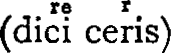
With such evidence as has been given above, it is impossible to doubt that the Harleianus must now take rank above both the manuscripts which, before the appearance of Halm’s edition, held so prominent a place in the criticism of Quintilian, the Codex Florentinus and the Codex Turicenis. The former is an eleventh century MS., now in the Laurentian library at Florence. On the first page is this inscription: Werinharius episcopus dedit Sanctae Mariae: on the last Liber Petri de Medicis, Cos. fil.: and below Liber sanctae Mariae ecclesiae Argñ. (= Argentoratensis) in dormitorio. There were two bishops of Strasburg bearing the name of Werner: the first 1001-1029, and the second 1065-1079. M. Fierville (Introd. p. xciv) tells us that the first Werner (of Altemburg or Hapsburg) laid the foundations of the cathedral at Strasburg in 1015, and presented to the Chapter a number of valuable books; and we also know that in 1006 he had attended the Council at Frankfort to promote the erection of a cathedral church at Bamberg. Here then we have the elements of a solution of the problem. Bishop Werner was a patron of letters; and learning that by the addition of what is now known as Bambergensis G a complete text of Quintilian had been secured, he had it copied. The Codex Harleianus was in all probability the first copy, and from it the Codex Florentinus was reproduced. The latter was still at Strasburg in 1372, a fact which (though hitherto it seems to have been unnoticed) is enough to dispose of its claim to be considered the manuscript of Poggio, which he describes as ‘plenum situ’ and ‘pulvere squalentem’ lying ‘in teterrimo quodam et obscuro carcere, fundo scilicet unius turris, quo ne capitales quidem rei damnati retruderentur.’ If so important a MS. had passed from Strasburg to St. Gall within forty years of Poggio’s visit, it is hard to believe that it would have been allowed to lie neglected and unknown. After 1372 we know nothing certain of its history till it reappears in the library of the Medicis at Florence in the latter part of the fifteenth century. It is generally supposed that some time between 1372 and 1417 it must have been transported from Strasburg to the monastery of St. Gall, and that it passed from there to Florence after Poggio’s departure. A similar theory may quite as legitimately be maintained in reference to the Harleianus, which, as I have already indicated, may be the very manuscript which Poggio discovered at St. Gall in 141678.
The Codex Turicensis was long considered to be of older date than the Florentinus, but recent investigations seem to have proved the contrary. Halm attributes it to the second part of the eleventh century, and E. Wölfflin takes a similar view. In the beginning of the eighteenth century it passed into the library at Zürich. Spalding believed it to be the manuscript discovered by Poggio, and M. Fierville is of the same opinion: Halm rejects this theory. The great point in favour of the claim of the Turicensis is that it is known to have come from St. Gall, while we can only conjecture the history of the Harleianus. But the Turicensis cannot have been the MS. which Poggio carried with him into Italy, according to a statement made by Bandini, Regius, and others. It is true that this statement is hard to reconcile with what Poggio himself says in his letter to Guarini, whom he informs that he has made hasty transcripts of his various ‘finds’ (presumably including the Quintilian) for his friends Leonardo of Arezzo and Nicolai of Florence. But Poggio may have had his own reasons for a certain degree of mystery about his good fortune. In the preface to his edition, Burmann speaks of the manuscript of St. Gall, on the authority of the librarian Kesler, as having been ‘honesto furto sublatum’: if it was the Harleianus there is perhaps little need to wonder that nothing has been known till now of its later fortunes79.
The affiliation of other MSS. of this class (which includes also the Almeloveenianus) to the codices which have just been described, may be determined by the application of certain tests. Prominent among such MSS. is the Codex Bodleianus, which has received more attention from editors of Quintilian than its merits seem to me to warrant. It repeats word for word the remarkable error attributable to the Harleianus at x. 7, 20 (see above, p. lxviii): in other places it embodies attempted emendations, e.g. x. 1, 90 nec ipsum senectus maturavit: 2 §7 de metris for dimiteris (see above, p. lxvii, note). It belonged to Archbishop Laud, and must have been written in the fifteenth century.
Of the same age and family are two manuscripts often cited by Halm, the Lassbergensis and the Monacensis. The former was formerly at Landsberg in Bavaria: it is now at Freiburg. The reading atque interrogationibus atque interrogantibus, which Halm gives from it alone at x. 1, 35, I have found also in G and H; this seems quite enough to identify its parentage. The Monacensis was collated by Halm for his critical edition in the parts where he had to rely on A G or on G alone: with no conspicuous results,—‘nihil fere aliud effectum est quam ut docere possemus, ubi aliquot locorum, qui in libris melioribus leviter corrupti sunt, emendatio primum tentata sit’ (praef. viii, ix).
Alongside of these I would place a rather interesting MS. in the British Museum, which has been collated specially for the purpose of this edition, with no result worth speaking of, except to establish its class. It repeats the mistake of H at x. 7, 20: and the fact that the copyist began his work in a hand that was meant to imitate writing of the eleventh century seems, along with the internal evidence, to prove that it is one of the copies of Poggio’s MS. In x. 2, 7 it has posterius for historiis (a mistake in H—see p. lxix): and in the same place it shows (like the Bodleian codex) de metris for dimiteris. This is also the reading of the second hand in the Turicensis. Such differences as exist between it and H F T may be ascribed to attempted emendation: e.g. vertere latus x. 3, 21. Poggio’s letter to Guarini is copied at the end of the volume.
The other MSS. of the fifteenth century, so far as they are known to him, M. Fierville divides carefully into two classes (his third and fourth). The principal features of difference which distinguish them among themselves, and from those already mentioned, are that they incorporate, in varying degrees, the results of the progress of scholarship, and that they are seldom copied from any single manuscript. A detailed examination would no doubt establish what is really the point of greatest moment in regard to them: how far are they derived, through Poggio’s manuscript, from the Bambergensis, and how far from such complete manuscripts as the Ambrosianus and the original of Bambergensis G? Some of them (as well as other fifteenth century MSS., with a description of which I desire to supplement M. Fierville’s Introduction, pp. cii sq.), are of at least as great importance as those referred to above as having been collated in part by Halm.
The Argentoratensis (S), also used by Halm, may be mentioned first: it was collated by Obrecht for his edition of 169880. This manuscript was destroyed in the bombardment of Strasburg, August 24, 1870. Then there are the MS. of Wolfenbuttel (Codex Guelferbytanus), collated for the first time by Spalding: the Codex Gothanus, used by Gesner for his edition of 1738: the Codex Vallensis (Parisinus 7723), which purports to bear the signature of Laurentius Valla (9 December, 1444), whose corrections and marginal notes it contains81. The list of these and several others, all carefully described by M. Fierville, may now be extended by a short reference to various MSS. in this country, hitherto uncollated. The results of my examination of them (as well as of the Bodleianus, and Burneianus 243, referred to above) appear in the Critical Appendix: if few of them are of first-class importance, it may at least be claimed that right readings, with which Spalding, Halm, and Meister have successively credited the early printed editions,—e.g. the Cologne edition of 1527,—have now been attributed to earlier sources. And when M. Fierville had so carefully examined the MSS. of France, Germany, Switzerland, Italy, and Spain, it seemed of some importance that his laborious work should be supplemented by a description of the MSS. belonging to the libraries of this country.
In the British Museum there are eight manuscripts in all of Quintilian’s Institutio: of the most important of these, the Harleianus (H), I have already given an account, and one of two MSS. in Burney’s collection (Burn. 243) has also been mentioned. Of the remaining MSS. two may be taken together, as they are in complete agreement with each other, and show conclusive proofs (as will appear in the notes) of relationship to such codices as the Argentoratensis and the Guelferbytanus. The first of these two MSS. (Codex Harleianus 2662) has an inscription bearing that it was written by Gaspar Cyrrus ‘nationis Lutatiae,’ and was finished on the 25th of January, 1434,—only eighteen years after Poggio made his great discovery. So great an advance is evident in the text, as compared with the readings of H F T, that it seems probable that this MS. owes little to that family. The same may be said of the Codex Harleianus 11,671, a beautiful little quarto, dated 1467: it has the Epitome of Fr. Patrizi attached (see Classical Review, 1891, p. 34). The following cases of remarkable errors will suffice to connect both these MSS. with the Guelferbytanus: x. 3, 12 a patrono suo for a patruo suo: 1 §97 verum for veterum: 1 §55 equalem credidit parem (as also Prat., Guelf., S, and Voss. i. and iii.): 1 §72 quamvis sui temporis Menandro for ut pravis sui temporis iudiciis Menandro: 7 §6 adducet ducetur. Another very interesting MS. in the British Museum is Harleianus 4995, dated July 5, 1470: it contains the notes of Laurentius Valla, which were frequently reproduced at the time, and might be classed along with the Vallensis were it not that a marginal note at x. 6, 2 (where a false lacuna appears in most codices, as Bn. and Bg.), ‘hic deficit antiquus codex,’ makes it probable that the copyist had more than one MS. at his side82. This MS. agrees with the Vallensis and Gothanus in reading cognitioni for cogitationi x. 1, 1: ubertate for ubertas 1 §109: et vis summa §117: eruendas for erudiendas 2 §6: nobis efficiendum ib. §14: decretoriis 5 §20. The other two Harleian MSS. (4950 and 4829) present no features of special interest: I have, however, included them in the critical notes for the sake of completeness. The former was written by ‘Franciscus de Mediolano’: it is often in agreement with the Lassbergensis. The latter finishes with the words ἡ βίβλος τοῦ σωζομένου and the motto ἀγαθῇ τύχῃ. The readings of the Burneianus 244 are also occasionally recorded in the notes. All three are in general agreement with L, and also with the Codex Carcassonensis, a fifteenth century MS. of which M. Fierville published a collation in 1874.
A greater degree of interest attaches to two Oxford manuscripts, one of which (the Codex Balliolensis) is unclassed by Fierville, while the other (the D’Orville MS.) has never been examined at all. The former was used by Gibson for his edition of 1693. It begins at bis vitiosa sunt i. 5, 14, but there are various lacunae, which do not correspond with those of the incomplete family. The MS. is in fact in a mutilated condition. In the Tenth Book we miss its help after the end of the first chapter till we reach iii. §26, where it begins again with the words quam quod somno supererit: it stops abruptly at nostrorumque Hort(ensium) x. 6, 4. It is in general agreement with Harleianus 2662. I may note that in i. 5, 36 it has interrogatione, a reading which Halm says appears for the first time in the edition of Sichardus, 1529: ib. §69 it has e rep with A and 7727, with the latter of which it is in close correspondence (e.g. forte at i. 5, 15, all other codices forsan or forsitan).
There remains the D’Orville MS. in the Bodleian at Oxford (Codex Dorvilianus),—a manuscript which has been entirely overlooked, except for a single reference in Ingram’s abridged edition of the Institutio (1809). Yet it seems well deserving of attention. In some places it shows a remarkable resemblance to the Ambrosianus (e.g. Getae 1 pr. §6: et quantum ib. §8): at 1 pr. §4 it has summam inde eloquentiae (Spalding’s reading, found in no other MS.): destinabamus al. festinabimus ib. §6 (the alternative being a reading peculiar to A). Its most important contribution to the Tenth Book is 7 §20, where it gives the reading which Herzog conjectured and which I have received into the text: neque vero tanta esse unquam debet fiducia facilitatis: in 2 §14 (see Critical Notes) it has quos eligamus ad imitandum, a reading peculiar to itself. For the rest it is in general agreement with the Balliol codex. It is Italian work, of the early part of the fifteenth century,—earlier, Mr. Madan thinks, than the Codex Bodleianus. A marginal note at ix. 3, 2 shows that the copyist must have had more than one MS. before him. In some cases it would appear as if he carefully balanced rival readings: at 1 pr. §12. all codices have quaestio ex his incidat except A, which gives ex his incidat quaestio: the reading in the Dorvilianus is quaestio incidat ex his: again at i. 2, 6 ante palatum eorum quam os instituimus, many codices give mores for os: Dorv. shows quam vel mores vel os.