Front matter (continued 4)
Reading edition
"Hush, dear! Perhaps I shall die soon." There was a peculiar sound in the poor girl's voice, and Alice, looking at her with searching eyes, could see that her heart was breaking, and that she would indeed die soon if she were not released from what was slowly killing her.
"The marriage must not take place," said Alice, firmly. "If not for your own sake, you must stop it for Norman's. If your heart is breaking now, his will break after marriage, when he finds that he has only bought an empty shell without its kernel, a lovely woman without a heart which can return his love, a wife without the wifely qualities he craves. Poor old Norman! He deserves a better fate," and there was indignation in her tones.
"Yes," said Doris, "it is true. He deserves a better fate."
They were silent for a few minutes after she had said that. The girls sat watching the sunlit sea dotted here and there with boats of various descriptions. They listened to the gentle lapping of the waves, the shouts and laughter of the children paddling on the beach, and the scraps of conversation from the passers-by. But mentally they were seeing very different scenes, and they were hearing, too, other more interesting words. Doris was thinking of Bernard, of the gradual growth of their love for each other, and his proposal upon the hill at Askern in Yorkshire, and, later on, his more mature declaration of love, in Mrs. Austin's house in North London. Alice, on the other hand, was thinking of her brother Norman, and of the pained expression of his face when Doris too manifestly avoided a tête-à-tête with him. If it were so now, what would it be when they were married? What prospect of happiness could there be for either of them?
"Look! See who is coming towards us!" exclaimed Doris, suddenly. Her face had lighted up with a smile of singular beauty, and she was leaning forward the better to discern the features of a tall young man hurrying towards them through the promenaders on the front.
"Why, it is Mr. Cameron!" cried Alice, in great surprise. "What can he want here?"
It was soon evident what he wanted, for he came straight up to Doris, exclaiming, "Ah, you are here! How are you?" His eyes sought hers, eagerly and with great wistfulness. "And how are you, Miss Sinclair," he added, holding out his hand to Alice; but his eyes went back to Doris. "They told me at 'The Queen's,'" he went on hurriedly, "that I should find you here, so I came straight along, looking in at every shelter."
"We are very glad to see you," said Alice, rather gravely. Was it for the best, she wondered, for her brother and Doris, that the latter's first lover should return to claim her? She knew instinctively that it was for that purpose this very resolute young man had come. Perhaps, indeed, this would be the solution of the very unsatisfactory state of things she had been grieving over.
Doris said nothing. She dared not bid Bernard welcome, but she could not feign displeasure at his persistency in following her there: it was impossible for her to simulate unconcern and coldness. She was glad to see him, and to know, by his very presence and the way in which he came to her, that she still possessed his love: a great weight was lifted from her heart, and a glow as of returning happiness crept through her frame, bringing the pretty colour into her cheeks, reddening her pale lips, and brightening the eyes which had shed so many tears.
Alice, glancing at her, understood that Doris's happiness, perchance even her life itself, might depend upon her interview with Bernard at this fateful time. "He has her heart," thought Alice, "he may as well have her altogether: for Doris without a heart would make poor Norman as miserable as she would be herself." Therefore Alice said briskly:
"I am glad you have come up, Mr. Cameron, for I want to do some shopping, and you can sit here with Miss Anderson whilst I am away. I did not like leaving her alone, but now I can go. You will be all right with Mr. Cameron, Doris, and I will return presently," and before they could make any coherent reply, she had set off, walking briskly away from the sea-front.
Bernard gave one grateful look after her, then he quickly turned to Doris. "I may sit down," he said, "may I not? For I have much to say."
Doris bowed. She could not speak, for hope and happiness had come to her, which she was vainly endeavouring to resist. Bernard was there, she had him all to herself; might she not for one half-hour give herself up to the happy present before she was made miserable for life?
"Have you anything to say to me first?" asked Bernard, gently. She looked so frail that he determined to be very gentle with her, and he said to himself that he could not really believe that she was engaged to Norman Sinclair, unless she said it with her own lips.
Doris could not speak. She endeavoured to do so, but in vain. It did not seem to her to be right to say what she wanted to tell him, and yet she could not utter the words that duty demanded. Therefore she remained silent.
"I have given her a chance to speak of her engagement to Sinclair, and she has not availed herself of it; therefore I will not believe she is engaged to him," said Bernard to himself; and then one of his hands stole under Doris's fur cloak and clasped hers warmly, as he cried in low yet earnest tones, "My darling, I have brought good news. I have had a legacy left me in part payment of my lost money."
Doris uttered a cry of joy. "My father!" she exclaimed. "You have heard from him! He has sent you money! Oh, thank God! Where is father? Tell me quickly! And did he mention mother?" She spoke rapidly, in intense eagerness.
Bernard was grieved to disappoint her; still, the truth had to be told, so he said quickly, "The money was not from your father. Mr. Hamilton, his co-trustee, has died and left me five thousand pounds in his will, he said, as some compensation for my lost money. Immediately I knew it I came to claim you, my dearest!" He drew the shrinking girl a little nearer. "I always said," he continued--"I always said that you and no other woman in the world should be my wife."
"I cannot! Oh, I cannot!" The words were only just audible, but reached Bernard's ears at length.
"Cannot!" He looked at her with pained surprise. Being very sanguine and also very young, he had already, in the last few minutes, almost forgotten the unwelcome news of her having become engaged to Norman Sinclair, which he had heard in London, and which had hurried him to Hastings. "Cannot!" he repeated. "But you must, and you shall! I have been too poor and too ill to claim you for some time. Now, however, that that money has come to me, I have immediately hastened here, in order to claim the fulfilment of your promise made to me upon the hill at Askern Spa. Don't trifle with me, Doris," he added, with a little choke in his manly voice. "I have been through so very much that I cannot bear it."
"I have, too," she faltered. "God knows what I have been through."
"But that is ended," he said, quickly. "Thank God, that is all ended, and I have come now to claim your promise?
"I cannot marry you--I cannot," she repeated.
"Why cannot you?" he demanded.
"Oh, Bernard, do not try to question me. Dear Bernard," she looked up at him beseechingly, "be so very good as not to ask me that question. Take my answer, dear, and go away."
"Go away! Doris, do you know what you are saying? I come to you in order to claim you for my own, and you tell me to go away."
"Forgive me, dear," she said, weeping now and turning away her face so that he might not see her tears. "Forgive me, dear, and go."
"I shall not. I cannot--I will not unless you say that you have ceased to love me."
"I cannot say that, Bernard, for I love you," Doris answered, "and I know that I shall never love any other man as I love you." Then she tried to rise, as she ended miserably, "Nevertheless, I cannot marry you."
"Sit still." He placed her on the seat again. "You say that you love me, and yet persist in saying you cannot marry me. I must know how that is. You must tell me, dear. I have a right to know."
Slowly the words dropped from Doris's lips, "I cannot marry you, because I am engaged to Norman Sinclair."
"Engaged to Norman Sinclair?" Bernard repeated indignantly. "Then it is true, that tale they told me in London. You--my promised wife--have engaged yourself to marry that man!"
"Yes, it--is--true," again the words dropped falteringly from the poor girl's lips. "But I could not help it, Bernard," she added, quickly. "I could not help it--I was obliged. You see, you did not write. There was nothing before me except starvation; and then Norman came to me with his offer, and I was tempted. Oh, Bernard!" she exclaimed, "why did you not write? I waited and waited for a letter so anxiously, especially after I had told you about Mr. Sinclair's offer. Oh, you might have written just one line!" She looked at him with reproach in her blue eyes.
"My dear girl, I did not receive that letter, or any at all from you after the first week of my return to Moss, although I wrote repeatedly. Some one has suppressed our letters, Doris!"
"Cruel! Cruel!" cried the girl, instantly suspecting who it was. "But how was it that, not hearing, you did not come to me in order to ascertain the reason? It is such a long, long time since you returned to Yorkshire, almost a year--and it seems more."
"I have been so ill," replied Bernard sadly, "and when I recovered from my first illness, I caught chills and had bad relapses. I was not out of the doctor's hands during nine months, and my mother nursed me so devotedly. How could I suspect that at the same time she was grievously injuring you and me?"
"And then there was another thing," complained poor Doris. "I wrote to Susan, our old servant, you know, and asked her about you; whereupon she replied that I was to think no more about you, as she had heard on good authority that you were going to marry a young lady at Doncaster."
"Oh, but you couldn't believe that, Doris? Surely you had more faith in my love!" exclaimed Bernard, reproachfully.
"What else could I believe when you never wrote and she said that?"
"Doris, I should not have believed it of you!" exclaimed Bernard, stopping short, with a little frown, as he remembered that she had become engaged to Norman Sinclair.
Doris looked up miserably. "Circumstances were too much for me," she said, "and, forgive me--I thought that they had been too much for you."
"Did you think I was so weak?" cried Bernard--"so weak," he repeated, "as not to be true to the only girl I have ever loved?"
"How was it," asked Doris, gently--"how was it that Susan could hear on good authority that you were going to marry a Doncaster lady?"
"Well, if you must know," said Bernard, "my mother set her heart on the match, and she was always having the girl over and trying to leave us together, and taking her with us everywhere, and she must have spread it about that we were engaged; so I daresay she told Susan the same thing."
"Which would account for Susan's saying that she had the news on good authority," interposed Doris. "But tell me, was the girl rich? And did you like her?" and she looked searchingly at Bernard.
"Yes, she was very well off," he admitted, "and she was nice enough; but of course I did not love her, for I love you."
"It's very, very sad," said Doris, the tears rising to her eyes as she spoke. "But, dear Bernard, there is nothing to be done. It is too late! Too late!"
"Oh, but it is not. You are not married yet. You will have to break with Sinclair."
"I cannot. He is a good and honourable man, and he loves me. I cannot break my promise and make him miserable."
"But your engagement was made upon false premises: you thought I was faithless, and I was not. Everything must be explained to Sinclair, and as a man of honour he will feel bound to release you."
Doris shook her head. "I cannot make him miserable," she said.
It was in vain Bernard argued and pleaded, he could get no concession at all from the poor distracted girl, who simply repeated in different words her one cry, "I cannot, dear, I cannot be your wife."
The young man became angry, at length, at her unreasonableness, as he called it, declaring that she could not love him as much as he loved her, or she would not see such great difficulties in the way of their union; and when, upon his adding that he would see Mr. Sinclair and thrash the matter out with him, she said that she could not consent to that, he got quite out of patience with her, and, saying goodbye rather coldly, went away towards the railway station, with the intention of taking the next train for London.
CHAPTER XXIII.
ALICE SINCLAIR'S INTERVENTION.
It never could be kind, dear, to give a needless pain:
It never could be honest, dear, to sin for greed again,
And there could not be a world, dear, while God is true above,
When right and wrong are governed by any law but love.
Anon.
Bernard Cameron was hurrying along towards the station when he met Alice Sinclair.
The girl looked immensely surprised to see him there, and immediately exclaimed:
"What? You here, Mr. Cameron? Why, I left you in charge of Miss Anderson until I returned. I was on my way back, now," she added.
"I am off by the next train to town," said Bernard, in very injured tones. "I was a fool," he added, bitterly, "to come down here at all."
Alice read the lines of distress and disappointment written upon his face, and was very patient with him.
"There isn't a train to London for at least an hour," she said, "and you must not think of going until you have had some tea. Let us return to Doris, and then we will go into the Creamery and have some tea."
"I must beg you to excuse me," said Bernard, stiffly. "I have taken leave of Miss Anderson, and must now bid you good-bye." He held out his hand as he spoke.
Alice perceived that he had been hard hit. "You must not leave me like this," she said, gently. "Mr. Cameron, I thought you and I were friends."
"So we are. You have always been good to me, but----" He stopped short, and his eyes wandered in the direction of the station.
"It is no use thinking of starting to London yet. As I said, there is no train for fully an hour. Tell me," she regarded him very sympathisingly, "what is the matter? Have you and Doris quarrelled?"
Bernard looked at her kind sympathising face and his resolution wavered. "Quarrelled is not the word," he said; adding, with an effort, "I should like to tell you all about it, Miss Sinclair, if I might."
"I wish you would," said Alice, earnestly--it was one cause of her influence with others that she was always in earnest. "Come and let us walk up and down in Cambridge Gardens, where it is quiet. Then we can have a long talk."
They turned into the less frequented street, and walked slowly along, whilst in low, rapid tones Bernard told Alice all his trouble, and especially the grievous fact that his and Doris's letters had been suppressed and kept from them for many months, finally ending by complaining bitterly of Doris's ultimatum.
"Doris must not marry your brother, Miss Sinclair." Bernard's tone was as decided and masterful as the artist's as he concluded with these words: "She must marry me. We loved each other long before your brother ever saw her, and we love each other still--and shall until death."
It seemed to Alice, walking by Bernard's side and listening to his low, earnest voice, that no power on earth would be able to separate him from the girl he loved, and certainly Norman would not endeavour to do so. Norman was a man of honour, and when he learnt how the two lovers had been kept apart and separated by the wickedness of Mrs. Cameron, and after everything was explained to him he would release Doris from her engagement, no matter at what cost to himself.
Alice tried to say something of this sort to Bernard, but he scarcely listened.
He was glad of her for a confidante, but did not want to hear her views or listen to her advice, because in his own mind he had already solved the problem. And first, his thoughts, as was natural, returned to Doris, from whom he had parted in anger.
"All this time," he said, hastily, as if only then realising it, "Doris, whom I left in anger, must be in distress. She must be suffering intensely, for you know she is so very sensitive. I must therefore return to her at once, and must encourage her to hope that all will yet be well. If she will not throw Sinclair over----"
"Allow me to remark that you are speaking of my brother," interposed Alice.
"I beg your pardon," said Bernard, in remorseful tones, as he looked at the kind girl, whose colour had risen. "It was an awful shame for me to speak like that, but----" He broke off, and began again, "I thought we were agreed that she would have to give him up."
"That is not the way to put it," said Alice. "My brother, who is really the soul of honour, will have to release Doris from her promise. He must do it--and will, when he knows everything."
"Yes, of course. As I was saying, if Doris will not--I beg your pardon, as she cannot in honour release herself, I shall go to Sinclair and tell him that it will be most dishonourable of him if he does not release her from her engagement----"
"That won't do!" exclaimed Alice; "that won't do at all. If you go to Norman in that spirit you will soon be outside his door again. My brother is a bit of a lion, you know, in more senses than one. He might listen to any one speaking very courteously, but if a bear comes in and tries to get his bone, oh! there will be a pandemonium!"
"Well, he must be told----"
"I will tell him," said Alice. "I will go to London to-morrow, and will see him and explain everything to him. It will not be a very pleasant task--it will pain me very much to make my brother unhappy, but I will do it for dear Doris and for you."
"It is very, very good of you," said Bernard, gratefully, "to say that you will go and explain everything to your brother. Perhaps you will be able to do it in a nicer way than I could."
Alice smiled. She certainly thought that was possible. "Norman is very good," she said. "I am sure he will release Doris, but it will be a dreadful sorrow to him, for he loves her very much."
"I am sure of that. Though he shouldn't have come poaching in my preserves!"
The last words were uttered so low that he did not intend Alice to hear them. But the girl heard, and instantly retorted:
"You forget that was the fault of the person who kept back Doris's letters and yours, causing her to think that you no longer loved her; so that naturally both she and Norman concluded that she was free to marry whom she pleased."
"Yes, of course. You are right. I beg your pardon for forgetting that," said Bernard, penitently.
"Now we will return to Doris together, and after we have explained to her how matters stand, we will go and have some tea at the Creamery in Robertson Street. Afterwards----"
Alice paused, looking wistfully at him.
"I will keep out of her way until you return from London," Bernard said, understanding that he ought not to proceed further until Norman had freed Doris from her engagement to him.
CHAPTER XXIV.
NORMAN SINCLAIR'S LETTER.
Not only those above us on the height,
With love and praise and reverence I greet:
Not only those who walk in paths of light
With glad, untiring feet:
These, too, I reverence toiling up the slope,
And resting not upon their rugged way,
Who plant their feet on faith and cling to hope,
And climb as best they may.
And even these I praise, who, being weak,
Were led by folly into deep disgrace:
Now striving on a pathway rough and bleak,
To gain a higher place.
* * * * *
Oh! struggling souls, be brave and full of cheer,
Nor let your holy purpose swerve, or break!
The way grows smoother and the light more clear
At every step you take.
Lo! in the upward path God's boundless love
Supports you evermore upon your way:
You cannot fail to reach the heights above
Who climb as best you may!
EUDORA S. BUMSTEAD.
Doris sat alone in the shelter, after Bernard had left her, in a state of unhappiness so great that she could not even weep.
"All is over between us," she sighed, "and Bernard has gone away in anger. How wretched it is! Nothing could be more wretched! Nothing! I am the most unfortunate girl in all the world!" And she sat with her pale face turned towards the sunlit waves, watching them and yet in reality seeing nothing except her own utter misery. What had become of all her prayers, she wondered--the prayers which she had poured out to her Heavenly Father from a sorrow-laden heart?
He had saved her from starvation, and placed her in a position of great temporal prosperity; yes, but what about her previous many, many prayers for Bernard, for their mutual reconciliation and union when a part at least of the debt was paid, and for the happy and useful married life which they had once planned together on the hill at Askern, and for which she had so often longed and prayed?
"I have done my best," thought Doris, "and have tried to serve God all the while. The thought of Him was ever in my heart, and I gave up my prosperous little business--all that I had--in obedience to His Voice, speaking to me through Norman's words and my own conceptions of what I ought to do. I cast my all into His treasury: and all the time--every day--I prayed for Bernard--and for our future together--until--until I was led by circumstances to believe that he did not love me. And since then--since then everything has gone wrong, and I seem to have lost hope and faith in God and man."
She was in despair. It was the darkest hour of all her sorrowful young life, and she could see no gleam of light in any direction.
How long she sat thus she never knew, but it seemed an immense time before she heard the cheerful voice of Alice behind her saying brightly, "Doris! Doris darling, we have brought you good news!"
"There is no good news for me," answered Doris, without turning her head, and the two who loved her were aghast at the hopelessness of her tones.
"Doris!" exclaimed Bernard, "I have returned, in order to bring you the glad news that there is hope for us, and help, for Miss Sinclair is going to be our good angel and is going to save the situation."
"How? What? I don't understand," said Doris, turning to look at them in relief and surprise. "Do explain, please," she added, tremulously, feeling quite unable to bear any more suspense.
Sitting down beside her, they hastened to tell everything, and then to combat her conscientious objections to Alice's proposed arbitration, as it seemed to her, at first, that it was scarcely right for Alice to persuade her brother to release his fiancée.
"I shall not persuade him," replied Alice, "I shall simply tell him the facts of the case, and leave him to act as it seems right to him. But I will tell you this, Doris," she added, "I know dear old Norman will at once release you from your engagement."
Then Alice carried them off to the Creamery, and, after they had partaken of a charming little tea, she invited Bernard to meet her at the Warrior Square Station at five o'clock on the following day, when she expected to be back from London, in order that she might tell him first what her brother decided. When that matter was settled to every one's satisfaction, Bernard took leave of the girls and went away, to pass the time as best he could until Norman Sinclair's ultimatum was received.
* * * * *
The following evening, as Doris sat in one of the large balconies of the Queen's Hotel, enjoying the fine air, the pleasing sea view, and most of all the delightful hope that all might yet be well, Alice, who had been to London, and Bernard, who had met her at the station, came to her there.
"All is well," said Alice, "as I knew it would be. Doris," she took the girl's thin hand in hers, and placed it gently within Bernard's, "Norman has sent you your freedom. You can marry Bernard now as soon as you like, and Norman hopes you will be very happy. He has sent you a letter, dear," she said in conclusion, putting one into Doris's hand.
Doris swayed in her chair. She could not even see the letter for the tears which filled her eyes.
Alice, too, began to cry, and Bernard had to clear his voice two or three times before he could speak.
"I am afraid I was a little rough on your brother, Miss Sinclair," he said at length. "He is indeed a man of honour. I am sure I beg to withdraw all that I have said against him, and to apologise for my hot words. I hope that you will tell him how grateful we are when you see him."
"I'm afraid I shall not see him for a very long time," answered Alice; "he is going abroad alone." She looked deeply pained. "He wishes me to stay with Doris and see after her getting married." She said the last words more cheerfully, for, being a woman, the idea of a wedding was pleasant.
"There won't be much to see about in my wedding," said Doris, with a smile, "for I shall have to do without a trousseau and without a good many things, because I am not taking Bernard any money. You will have a poor bride, Bernard."
"I shall not! You will be the very best bride that ever a man could have!" he cried, rapturously.
Then Alice went away, and left them together. Later on in the evening, when Doris was alone, she opened Norman's letter, which was as follows:
"DEAR DORIS,
"I give you back your promise to marry me. I am sorry for the mistakes which have been made and the suffering through which you have passed, and trust that your future life with Mr. Cameron may be all joy and gladness.
"You will, I am sure, do me the justice to believe that had I known he was true to you I should not have tried to induce you to become engaged to me, however much I loved and esteemed you.
"Yours very faithfully,
"NORMAN SINCLAIR."
Doris shed tears over the letter, for she knew that, reticent though the writer was about his own feelings, she must have made him exceedingly unhappy.
And when Doris thanked God that night before she slept that He had heard her prayers, and that He had mercifully given her her heart's desire, she prayed, also, for Norman Sinclair that he might be comforted and blessed exceedingly.
CHAPTER XXV.
A HAPPY WEDDING.
Never to part till angels call us home.
Song, "Golden Love."
The span of life's not long enough,
Nor deep enough the sea,
Nor broad enough this weary world
To part my love from me.
Anon.
So they were wed, and merrily rang the bells,
Merrily rang the bells when they were wed.
LONGFELLOW.
"After all, Doris," said Alice, the next morning, "you will have a trousseau, and a very pretty one, too. For I am going to buy it for you. Yes, indeed, it is to be my wedding present."
"I don't know how to thank you," said Doris.
"Then don't try. Pay me the compliment of accepting what I have much pleasure in giving."
Doris rose, and, throwing her arms round her friend's neck, gave her a hug.
"How soon do you intend to be married?" asked Alice, presently.
"In three weeks. There is no reason for delay."
"Of course not. The sooner the better. Where shall you be married?" asked Alice, a shadow falling across her face at the thought that she could scarcely take her friend home to be married from Norman's house.
"Oh, here, in this dear place, where my happiness has come to me!" said Doris.
"Here? At Hastings? From this hotel?"
"Yes, why not? I am sure the Vicar of All Saints, whose church I have attended, will marry us."
"Oh, I don't doubt that! Yes, of course you shall be married here."
"There's only one thing," said Doris. "The Austins are not here. And I must have dear Mrs. Austin, and her good son Sam, at my wedding."
"Send for them all," interposed Bernard, entering the room and overhearing her last remark. He had been for a bathe, and was looking well and happy. There is no greater restorative for body and mind than happiness.
"Send for them?" said Doris. "Oh, but I don't think they will come if we send for them. I think I shall have to go and see Mrs. Austin, and arrange with her about their coming down."
"You're not strong enough to take all that trouble," said Bernard. "It will take you all your time until our wedding-day"--he spoke with joy and pride--"to recover sufficiently for it and for our little tour afterwards."
"We'll not go far," said Doris. "Why should we go far," she laughed happily, "when we have found each other?"
"Why indeed? Supposing we go to the Isle of Wight, will that do?"
"Yes, charmingly. I have never been there. But, Bernard, I must go to see dear old Mrs. Austin and invite her to the wedding."
"Cannot you write to her?"
"No, a letter will not do. Think how good she was to me when I was penniless and a stranger in London! Can I ever forget how she received me into her house, and trusted me to repay her as I could? And then she gave me her late son's painting materials, and tried to make me believe I should succeed as an artist,--and, afterwards, when that had failed, she comforted and encouraged me, and got her nephew to find me work, and, later, interested Alice in employing me; and then afterwards, when I gave up the business and became poor again, she stood by me, trusting and caring for me more lovingly than ever. Bernard, if there is one friend in all the world whom we ought to value and esteem next to the Sinclairs it is Mrs. Austin, and, next to her is Sam Austin, the cabman."
"What did he do?" asked Bernard, though indeed he partly knew.
"He saved me from despair that first night, when, on coming to London by the night train, I found my godmother, Miss Earnshaw, had died, and that I was alone in the great metropolis, with only a few shillings in my pocket, and no claim upon any one in all the vast city. He took me to his mother, and persuaded her to receive me into her house; and then, afterwards, when I had made my first little water-colour sketches, he drove me round to the dealers in his cab, and would take no payment then, nor afterwards, until I was earning a lot of money, and then compelled him to do so."
"He shall come to our wedding, too," said Bernard. "They shall both be our honoured guests."
"Oh, thank you! Thank you!"
"And I'll tell you what we will do, darling. We will give them a wedding-present, yes, we will!"
"Oh, thank you!"
"Nay, you must not thank me, dear! It is you who will invite the wedding guests, that is always the prerogative of the bride. I will pay their expenses, if you will allow me."
"Thank you, I will," said Doris, gladly.
"Shall we go up to town to invite her?" said Bernard, tentatively.
"I should like to do so," said Doris.
"But----"
"Wouldn't it be too tiring for you?" said Alice. "Otherwise," she added, "I should like to go up to shop with you in Bond Street."
"And I," said Bernard, "should like to go over to Richmond on business. The fact is, I have heard that the school in which I used to work is for sale, and I rather think of buying it. When I was a poor assistant there I used to think what a future it might have if it were more efficiently managed. How would you like to live on Richmond Hill, Doris?"
"Near the Terrace, with the loveliest view of the Thames to be seen anywhere! Oh, Bernard, how charming that would be!"
"Well, I'll go and look after the school, if you like; and if you come, too, we can see the Austins while we are in town and invite them to our wedding."
In about a week Doris was strong enough for this arrangement to be carried out. She and Bernard, accompanied by Alice as far as Victoria, where they separated, went to London for the day, and after going to Richmond, where negotiations were commenced for the purchase of Bernard's former school and the head master's house, they went on to King's Cross in order to see Mrs. Austin.
The good woman was delighted to see them together, apparently on such intimate terms.
"Miss Doris!" she cried. "And Mr. Cameron! And both looking so happy! So very happy," she repeated. "Don't tell me anything, I know it all. There'll be a wedding. I saw it in the fire last night. Come in. Come in."
They followed her into her little room, which seemed to Doris to be smaller and dingier than ever after the great rooms to which she was accustomed.
"Oh, Mrs. Austin, I am so happy!" she cried.
"It's Mr. Right this time, and no mistake!" exclaimed the good woman. "Between you and me, miss," she added aside, "I didn't want you to marry that other gentleman. Miss Sinclair was a dear, sweet lady, but the brother was so upsetting!"
"He has been very, very kind to me," said Doris, "and to Mr. Cameron, too. He has been a very good friend to us."
"Has he, miss? Well, I'm glad to hear it, but----" she broke off, and began again, "Give me Mr. Cameron, for a fine, pleasant-speaking, right-living gentleman!" she declared.
Doris laughed, and her eyes rested on Bernard with loving pride. "Do you know, Mrs. Austin," she said, "I was engaged to him before I came to London at all--only unfortunately our engagement had been cruelly broken off."
"Indeed, miss! Ah, I could see you were in deep sorrow when you came to me. If you had seen her then, Mr. Cameron," and she turned to Bernard, "you would have been sorry. She was that white, and there was such a stricken look upon her poor, dear face. And yet, for all she was in such trouble, she did me good; so that I thanked God for sending her here."
"She does me good, too," said Bernard. "That's why I love her."
"Ah, he's one of the right sort!" exclaimed Mrs. Austin to Doris.
"Yes, I think so," said Doris, laughing merrily.
Mrs. Austin looked wonderingly at her.
"I never heard you laugh like that before, Miss Anderson," she exclaimed.
Presently the widow's two visitors sat at tea in the little parlour.
"And how are you getting on, Mrs. Austin?" asked Doris, presently. "You say so little about yourself."
"Well, miss, this is such a joyful occasion I don't like to spoil it----"
"Oh, then, I'm afraid you are not doing well?" said Doris, sympathisingly.
Tears came into the widow's eyes; but she dashed them off with a corner of her apron, and tried to smile, as she answered, "I have a lodger in my front rooms, and a young shop-girl rents my attic; but--but----" and she broke down, weeping bitterly.
Doris and Bernard tried to comfort her, and at length ascertained, with some difficulty, that the cause of her distress was that her landlord had given her notice to leave the house.
"And I've lived in it all my life," she said. "I was born in it and brought up here: my dear mother lived with me here till she died, and when my husband made me an offer of marriage I said, 'Yes, if you'll come and live in my dear home.' And he did, and was so good to my mother--as good as good could be--always taking off his boots before he went upstairs on the stair carpets, and always lighting the kitchen-fire and making me a cup of tea before he went to his work, till he fell ill of his last illness. He died in the front sitting-room. I had the bed brought down there for him. And there was my Silas, he was born in my front bedroom; and he used to paint his lovely pictures, as you know, miss, in the attic; and he lay down and died, as sweet and calmly as a child, in the back bedroom, 'Going Home,' he said, 'to the Great Artist, Who will put in the finishing touches to the work that He has made.' I couldn't bear to leave this house, with all its memories! It will kill me--I know it will! And my Sam feels almost as bad. 'I shall never drive down this road, mother,' he says, 'when the old home isn't yours.'" Mrs. Austin stopped at last for want of breath.
"But why does the landlord want to turn you out?" asked Bernard. "You must be such good tenants."
"Mrs. Austin is," said Doris. "She pays her rent regularly."
"Yes, miss. I've always paid it to the day, though I have been rather hard put to sometimes, when my lodgers haven't paid up. It's not for want of the rent that the landlord gives notice. It's because he's selling a lot of his houses to a man who wants them for his own workpeople, and therefore must have them emptied." The widow's tears flowed again.
"Don't cry, Mrs. Austin dear!" said Doris, rising and putting her arms round the good woman's neck, while she kissed her kind old face.
"You shall not be turned out," said Bernard; "I will see your landlord, and buy the house, if I can. Then you shall not be turned out."
"But, sir, it will cost you a lot!"
"It will be an investment, and I shall have a good tenant. You know, Doris," he added, turning to her, "I must not put all the money into the school."
Having asked the landlord's name and address, Bernard left Doris resting in Mrs. Austin's sitting-room, and departed to transact the business, which he was able to do satisfactorily, as the landlord happened to be in a hurry to sell.
"I have bought the house for three hundred and fifty pounds," Bernard announced, on his return to Doris. "You tell Mrs. Austin, dear," he added.
So it was Doris who had the pleasure of telling the good woman that Mr. Cameron had bought her house, and so she would be able to remain in it as long as she lived.
"Thank God! Thank God! That is all I want. And you shall have your rent regularly, sir," said the widow.
"You shall never be asked for it," said Bernard. "When you have the money to spare you can pay it, and when you have not any to hand over, nothing shall be said."
"You are too good, sir," began Mrs. Austin. But Doris interrupted:
"He is only treating you as you treated me," she said. "When I could not pay you, dear Mrs. Austin, you always let it pass over, and forgave me the debt."
"But you have paid everything now, miss." (Through the Sinclairs' kindness Doris had been able to do this.)
"I can never repay you for all your exceeding kindness," cried the girl; adding, "And I am delighted that we can enable you to remain in your comfortable home."
Mrs. Austin was overjoyed. She shed tears again, not for sorrow now, but for joy. "How little I knew when I took you in, Miss Anderson," she said, "that I should be entertaining an angel unawares!"
Then Doris asked Mrs. Austin if she would come to Hastings with her son, in order to be present at the wedding, and this the widow joyfully consented to do, saying:
"I would go further than that, miss, to see you married, and so would my Sam. We'll come to your wedding, if we have to walk every inch of the way."
"That's right," said Bernard; "that's the right spirit! But you will have to allow me to pay your fare, for you might not arrive in time if you walk the sixty miles or so to Hastings, and I shall be only too pleased to pay your fare."
Doris wanted to see Sam, but he was away with his cab, and therefore she could only leave a message for him.
She was exceedingly happy as she returned to Hastings with Bernard in a luxurious corridor-train--so happy, indeed, that she felt at peace with all the world, and therefore ventured to suggest:
"Couldn't we have your mother to our wedding, too, Bernard?"
The young man's face darkened, and his voice shook as he answered, "No, I think not. I--I could not."
"We shall have to forgive her, dear," pleaded Doris.
"Yes--in time. You must give me time, dear." Bernard was silent for several minutes after that, and then he said abruptly, "We will go to see her after we are married."
"Yes, dear," acquiesced Doris; "I should like that."
The day came quickly which was to make them man and wife.
Theirs was a pretty wedding, although the wedding guests were only two, and they were not of the same rank in life as the handsome bridegroom and the beautiful bride, supported by her friends, and bridesmaid, dressed like herself in costly silk and lace. Doris was in white, and Alice in creamy yellow, whilst Bernard, of course, was in immaculate attire, his good-looking young face lit up with love and joy and thankfulness to God.
"Bless them! God bless them!" exclaimed good Mrs. Austin as the young couple left the vestry, where Doris had signed her maiden name for the last time.
"Amen," said Sam, "and may they live long happy years!"
Sam had only one regret about the wedding, and that was that he could not bring his cab down to be used on the occasion. "I should like to have driven them to church in it," he confided to his mother. "It would have been a sort of finish to the two rides I gave Miss Anderson in it. First when I drove her to Earl's Court Square, and then home to you when she was in such distress, and afterwards when I drove her round to see those skin-flinty old picture-dealers about selling her pictures."
But now the bride and bridegroom had to be met, congratulated, and wished all sorts of happiness.
"Thank you! Thank you!" said Doris, shaking hands with Sam, and lifting up her glad young face to kiss his mother, while Bernard shook hands warmly with them both, thanking them for himself and his bride.
Later in the day Alice drove with Bernard and Doris to the station to see them off in the train for Portsmouth, as they were going to the Isle of Wight for their honeymoon.
Doris clung to her a little at the last. "I don't know how to thank you, Alice," she said; "you have been like a dear sister to me."
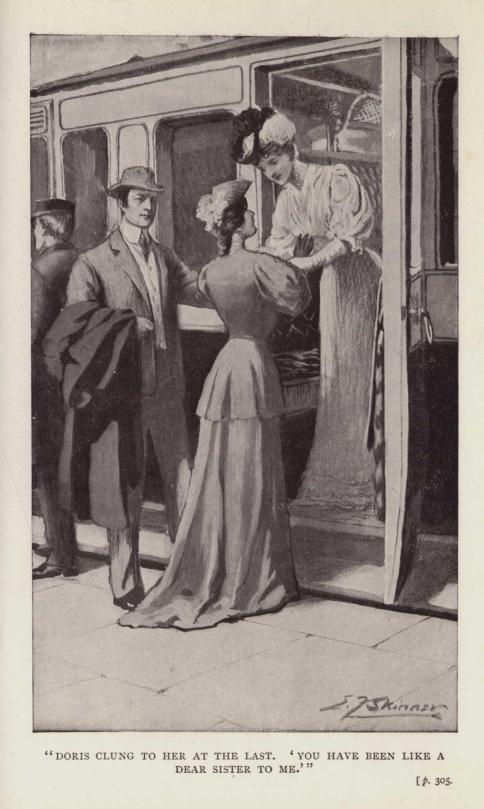
"DORIS CLUNG TO HER AT THE LAST. 'YOU HAVE BEEN LIKE A DEAR SISTER TO ME.'"
"I don't want thanking," protested Alice.
"But you will feel so lonely, dear, when we have gone."
"Never mind me," said Alice; "you know to-morrow I shall start for Switzerland, in order to join my brother there, and then there will be no more loneliness for me."
"You will Give him our kindest remembrances, Miss Sinclair," said Bernard, earnestly.
"If I can I will--that is, if he speaks of you."
The train began to move off, and there was no time to talk any more.
"Good-bye--good-bye, dear," cried the travellers, and then--Alice Sinclair was left alone upon the platform.
CHAPTER XXVI.
TWO MONTHS LATER.
Time and the hour run through the longest day.
SHAKESPEARE.
Mrs. Cameron was a miserable woman. Poor, unhappy, and remorseful, she sat alone in her solitary house--even her one maidservant had left her--thinking dismally of her sad past, mournful present, and hopeless future. On her lap was her son's letter of two months before, the only one he had sent her since he left home to go in search of Doris, and she thought that it would probably be the last one she would ever receive from him.
"I know all that you have done," he wrote, "to destroy my happiness and that of my beloved Doris, and the means by which you sought to separate us for ever in this world, and I write to inform you that your schemes and machinations have failed; for we are engaged to be married, and, there being no longer any obstacle to prevent it, the marriage will take place on the 20th of this month.
"That, I think, is all I need say now, or at any time, to one who has done her utmost to alienate me for life from the one I loved.
"I remain, Mother,
"Your much-wronged Son, "BERNARD CAMERON."
"A nice letter for a mother to receive!" grumbled the widow. "Yet I know that I deserve it," she added mentally. "I've been too hard--too hard on him, and too hard on other people. If I hadn't been so quarrelsome with my husband, he would not have left most of his money to Bernard, and that wretch John Anderson would not have had the chance of stealing it all. And if I hadn't been so hard on Bernard and on Doris Anderson, I should have retained my boy's love, which would have been better than nothing." She sniffed and passed the back of her bony hand across her tearless eyes. "Yes, it would have been better than nothing, and I might have come in for a bit of his money now he is richer; but, as it is, I've got nothing, neither money, nor love, nor anything at all!"
She looked dismally at the dusk stealing across the room with its threadbare carpet and faded chairs and curtains. There was no servant to come in and light the gas and close the blinds. She was all alone, and so hopeless that she did not care whether the gas was lighted or not. "What matter if it is dark, so long as I have nothing to do but think!" she said to herself, dismally. "They'll have had their honeymoon now, and perhaps will be getting settled in their new home. I wonder where it is? To think that I shouldn't know where my son is going to live! I never thought Bernard would turn against me; and yet--and yet I deserve it, for mine was a crooked policy, directed against all his wishes and ignoring his rights. I told myself I was doing it for him, for his best interests; but really I was doing it more for myself, that he might become rich and be in a position to give his mother a good home; and out of spite, too, against those Andersons, and a determination that Doris should not have him." She paused, listening.
Some street singers were wailing forth the hymn, "O God, our help in ages past!" before the house; but the woman, who had found no help in God, because she had never sought it, was only angered by the sound. Rising and going to the window, she made emphatic signs to the man and woman--the latter with a child in her arms and another clinging to her skirts--to pass on; but they either could not see her in the deepening dusk or would not be persuaded to go away, for they continued singing even more loudly than before.
"Well, I shall not give them anything!" declared Mrs. Cameron, relinquishing the attempt to stop them and returning to her chair by the fireless hearth. "What right have they to come disturbing folks in this way?"
Again she sank into gloomy, miserable reflections, while the darkness increased about her.
The door-bell rang; but she paid no attention to it, thinking that it was only the singers wanting alms. "They may want!" she said to herself grimly. "Other folks want what they can't get, too!"
Once more the bell rang, and yet a third time, and even a fourth; but still Mrs. Cameron remained firm in her determination not to speak to the intruders.
"I'm a hard woman," she said to herself; "aye, and I'll be hard. I'm too old to change now, and nobody cares, nobody cares what I'm like or what I do. If any one cared ever such a little bit, I might be different; but nobody cares, least of all God; He's shut me out of His good books long ago. I shall never get to His Heaven, never! Even if He let me into His Heaven, I shouldn't be happy psalm-singing, and praising Him, and living in His presence. Not I! I don't care at all for Him, and that's truth. And if, as some say, in heaven the angels are always ministering to others and doing deeds of kindness, that work wouldn't suit me. Not it!" She laughed shrilly, as if in derision of the idea; and the darkness deepened around her. "I don't care an atom for other people. Not I!" she went on, and again her weird, unholy laugh rang through the room.
Its echoes reached a young man and woman who stood at the door, hesitating before ringing the bell again, and caused them both to shiver.
"Nobody cares for me, and I care for nobody!" soliloquised Mrs. Cameron. "If any one cared ever so little, it would be different. Oh, dear! What's that?"
An exceedingly loud rapping at the street door made her start up, exclaiming angrily, "Those tramps again!"
She bounced out of the room and across the little hall to the door, opening it somewhat gingerly, and crying out the while in her sharpest tones, "I've nothing for you! Get away! Go!" Then she attempted to shut the door, but a strong hand held, it so firmly that she could not close it, whilst a voice spoke, which she was unable to hear for her own clamour.
"If you don't be off I'll prosecute you!" she cried, menacingly.
"Mother! It is I, Bernard! Let me in."
The words reached her ears at last, penetrating even to her starved and icy heart.
"Bernard!" She fell back a pace, and the door flew open, revealing her son and a lady by his side. The street light fell upon the two, and also upon the pale, astonished face of the unhappy woman they had come to see.
"Bernard!"
"Mother!" He put his arms round her neck, in his old boyish way, forgetting everything except that she was his mother, who was looking miserable, whilst he had come to her in his joy, with his dear young wife by his side.
"If any one cared ever so little, it would be different," she had said to herself. Well, here was Bernard, and he cared for her, in spite of everything, and--it was different.
"My son! My son! Forgive me," she said, clinging to him, her tears falling on his manly face and neck, as he kissed her tenderly.
"All right, mother! The past is past," he whispered. "I want you to welcome Doris," he added low in her ear. "She is my wife now."
Mrs. Cameron turned to Doris, holding out her hand, but the young wife raised her face, and she had to kiss her, too.
Then they went in, closing the street door after them; and Bernard, striking a light, lit up every gas-burner he could find about the place; so that the darkness was gone, and it was light, very light.
CHAPTER XXVII.
RESTITUTION.
Does any one know what's in your heart and mine,
The sorrow and song,
The demon of sin and the angel divine,
The right and the wrong:
The dread of the darkness, the love of the day,
The ebb and the flow
Of hope and of doubt for ever and aye,
Does any one know?
NIXON WATERMAN.
He wins at last who puts his trust
In loving words and actions just.
* * * * *
On every action blazon bright,
"For toil, and truth, and love, we fight."
T. S. COLLIER.
An hour later, after they had partaken of a substantial tea-supper, the principal constituents of which Bernard fetched from the village shops, with boyish glee, renewing his acquaintance with the shop-keepers quite merrily, Mrs. Cameron and her son and daughter-in-law sat round the fire Doris had lighted, talking about the future.
Bernard had placed the school at Richmond (of which he had now completed the purchase) in good hands, and he and Doris were going to live in rooms at Oxford until he had obtained his degree, when they would at once proceed to their new home in Richmond.
"We want you to come and live with us, mother," said Bernard; "or if you would prefer not to live with us, at least to occupy rooms near us, so that we may often look in upon you, to prevent your feeling lonely."
"Do you wish that, too, Doris?" asked her mother-in-law, quite timidly.
"Yes, indeed I do," said Doris, heartily. In her great happiness it was impossible for her to cherish any resentment against Bernard's mother.
Mrs. Cameron looked red and confused. Their love made a difference, yes, a very great difference in her feelings. But she shook her head, saying, "You will be better without me. Far better. I will remain here. You can come and see me sometimes, and you must remain here a few days now. I'm afraid we are rather desolate here in the house, but I'll have a charwoman in to-morrow, and we'll try to make the place comfortable."
"The house ails nothing," said Bernard, "for it is home."
"Yes," remarked Doris, brightly, "and you know, 'East or West, home is best.'"
Mrs. Cameron thought remorsefully that she had made only a poor home for Bernard in the last year or two, since he lost his money.
But he appeared to forget all about that, as he merrily assisted her and Doris to arrange a room for their accommodation that night--in point of fact he had engaged a bedroom at the comfortable hydro at Askern, but he did not venture to mention that to his mother under their altered and happier relations.
The next morning, as they were sitting at breakfast, the postman dropped a letter into the letter-box, and Bernard, upon going to the door to fetch it, discovered that it was addressed to himself.
Bringing the letter into the room he looked at the envelope curiously, and perceived that it bore the impression, "London, City & Midland Banking Company, Ltd," whilst the postmark was Doncaster.
"Why, what's this?" he said, and then, opening it wonderingly, found that it was an official intimation from the Doncaster branch of the London, City & Midland Bank, saying that the sum of twenty-five thousand pounds had been placed there to his credit.
The young man put his hand to his brow in great bewilderment. What did it mean? Mechanically he handed the document to his mother, saying, "Look at this. What does it mean?"
Mrs. Cameron fumbled about for her spectacles, found them, could not see through them, shook her head, and, handing the document to Doris, remarked, "You read it, Doris. What does it mean?"
Doris read aloud the printed and written words, which stated that the bank had received twenty-five thousand pounds, and placed the money to the credit of Bernard Cameron.
"Twenty-five thousand pounds!" cried Mrs. Cameron, excitedly. "Why, some one has restored your fortune to you, Bernard!"
Bernard was amazed and glad.
"Who can have paid the money in?" questioned Doris.
"You will have to go to Doncaster to the bank, to see the manager, and ascertain who it is," said Mrs. Cameron.
"Yes," Bernard agreed, still looking very mystified.
"It may be some mistake of the bank's," suggested Mrs. Cameron. "It is dated all right for yesterday."
They were still wondering and conjecturing about the matter, when the sound of a carriage driving up to the door, followed by a loud peal of the door-bell, startled them.
Bernard went to the door, and, upon opening it, perceived, to his intense astonishment, his wife's father.
"Is Mr. Cameron in?" began the visitor, and then, recognising Bernard, he cried, "Bernard! My dear fellow, I am glad you are at home."
"Mr. Anderson!" exclaimed Bernard. "Mr. Anderson here!"
"Father! Father!" cried Doris, overhearing Bernard's greeting, and running into her father's arms. "My dear father!" Forgotten were all his shortcomings, his desertion of herself and appropriation of Bernard's money, forgotten was everything except love in that glad moment of reunion. "Where is mother?" asked Doris, kissing him again and again.
"In the cab, there." He waved his hand towards the vehicle, out of which Mrs. Anderson was leaning forward, in the endeavour to obtain a glimpse of her child.
Doris ran to the cab, and disappeared within it, as there only could she have her beloved mother entirely to herself for a few moments.
Mr. Anderson signed to the cabman to wait for a little while, and then went into the house with Bernard, asking, "Are you alone? Or is your mother within?"
"She is here. This is her house still," answered Bernard, leading the way into the dining-room, where Mrs. Cameron stood, very erect, and looking extremely grave.
Mr. Anderson bowed without making the attempt to shake hands, indeed she had placed hers behind her with a very significant gesture.
"I have to thank you, Mrs. Cameron," said the barrister, "and your son, for your exceeding clemency in not prosecuting me for my terrible defalcations more than a year ago, and I must explain how it was that I lost your son's money, and how it is that I have been able yesterday to place the whole amount in the Doncaster branch of the London, City & Midland Banking Co. for him. Have you had an intimation of this money being placed in the bank to your credit, Bernard?" he asked the young man.
"Yes. This morning. I could not understand who placed it there. I am glad it was you. Oh, Mr. Anderson, I am very glad!" Bernard seized the elder man's hand, and shook it with warmth. "I feel inclined to throw up my cap and shout 'Hurrah!'" he continued, boyishly, "for I am so delighted for your sake and for Doris's!"
"Well, it's a good thing you've done it," said Mrs. Cameron. "I must say I'm surprised--I never thought you would. What are you nudging me for, Bernard?" she asked, rather crossly. "You know very well that I always say what is in my mind. And I must tell you, Mr. Anderson," she continued, "that it's not me you have to thank for not being prosecuted. I was determined to set the whole machinery of the law to work--I was so mad with you--but Bernard would not have it. He would not raise a finger against you--no, not though I turned him out of my house for his stupidity, as I thought it then, though it seems to have answered well," she admitted.
"Bernard," said Mr. Anderson, looking gratefully at him, "my dear boy, how can I thank you enough? What you must have borne for me!"
"I'm afraid I thought most of Doris," said Bernard, honestly. "It would never have done for me to have brought disgrace and trouble upon her family."
"I sinned," said Mr. Anderson, regarding Bernard's stern mother very mournfully, "I sinned greatly in using money which was not my own for speculations which were risky, as most speculations are. And when all was lost, and I possessed nothing with which to meet my liabilities, as you know, instead of courageously confessing and submitting to the penalty I had incurred, I absconded. Later on, together with my wife, who would not leave me, I took refuge with an old servant of ours, who had married a shepherd in Wales, and there, in a remote place up amongst the mountains, we hid ourselves for a long and weary time. Often I thought of coming down and surrendering to justice, but as often my wife persuaded me to remain in concealment. Eventually, however, I became so convinced that the only right thing to do was to give myself up to the police that, leaving my retreat, I returned, accompanied by my wife, to Yorkshire.
"Then," continued he, "a strange thing happened. Upon reaching York I first went to a lawyer with whom I had formerly transacted business, whereupon he informed me that there had never been a warrant taken out for my arrest, thanks to you, my dear Bernard," and again the elder man gave the younger a grateful glance. "Moreover," the barrister continued, "the lawyer told me that Howden, the man who in the first place led me into those disastrous speculations, had just died, and in his last hours, remembering remorsefully his bad advice to me about speculating, which led to my ruin and desiring to make reparation as far as possible, he bequeathed to me by will the large sum of thirty thousand pounds. You can judge of my extreme delight.
"As soon as the will had been proved and I was in possession of the money I returned to Doncaster, paid all my debts in full, and placed twenty-five thousand pounds in the bank for you, Bernard. After which I came here in the hope of finding you at home. I cannot tell you," Mr. Anderson added, with deep feeling, "I cannot tell you all that I have suffered on account of my sin, nor can I say how great is my relief and satisfaction in being able to restore to you your fortune."
The tears were in his eyes as he said this, and they perceived that his hair had become as white as snow during the last thirteen months, and also that care and trouble had drawn deep lines upon his face. They could not, therefore, doubt the truth of what he was saying, and so Mrs. Cameron as well as Bernard hastened to express their entire forgiveness of his sin and sympathy with him in his sufferings. And if the mother did it less gracefully than her son, Mr. Anderson could not cavil at that, for he knew that it was much more difficult for her, with her hard nature, to speak so kindly than for Bernard.
And when she added, penitently, "I, too, must ask your forgiveness, Mr. Anderson, for the harsh and bitter thoughts I have cherished about you and the hard words I have said," he was only too glad to shake hands with her and say she was not to trouble about that any more.
Upon this touching scene entered Doris and her mother--the two who having not sinned in the matter of the pecuniary defalcations, had yet suffered so grievously by reason of them. Whereupon, kind and loving words were exchanged, and the new relationship of the young people was discussed and approved of by her parents, who both said that they could not have wished for a better husband for their daughter.
CHAPTER XXVIII.
CONCLUSION.
Poets are all who love, who feel great truths
And tell them, and the truth of truths is love.
BAILEY.
In Switzerland, where Alice had joined Norman as soon as Doris's marriage had taken place, Alice heard of the surprising restoration of the lost money with the greatest satisfaction.
Doris wrote a full account of the return of her father and the wonderful restitution he was able to make of all the money that he had taken from Bernard and that which he owed the tradespeople.
"Do you know, dear Alice," she wrote in conclusion, "I often and often prayed that he might be able to do this, but it seemed as if my prayers were all in vain, both about this and other matters, and then I grew despondent and doubted--oh, I doubted dreadfully! What patience God must have with us when we have so little faith! And how impatient and short-sighted we are! Why, I might have been sure that just as He clothes the lilies and feeds the birds of the air, so He would give me all things that were needful and that were according to His will. And it must have been His will that my father should be enabled to do right in the end. Well, I'm going to believe in future that He really meant His words when He said, 'Ask, and ye shall receive.'
"And there's another thing, dear Alice," the writer continued joyfully, "Bernard and I want to make one or two thank-offerings for the great mercies we have received.
"First for poor Mrs. Austin, who was so very good to me. You know that Bernard bought her house, in order to prevent her being turned out of it, and now we are giving it to her for life, and to her son after her. She is so delighted, and so is Sam, and it is such a pleasure to us to do this.
"And then, with regard to the school at Richmond, you know Bernard purchased it, and arranged for it to be managed for him until he has finished his career at Oxford, after which he will take it in hand personally; and now he has determined that he will always give schooling and board to two pupils free of charge. They need not necessarily be orphans, but they are to be poor boys of gentle birth, who would otherwise be worsted in the battle of life. They are to receive exactly the same benefits as the other boys, and I am to provide them with clothes, and look after them as a mother might. I need not tell you how glad I am to do this.
"Dear old Susan is coming to live with us and be our matron, much to her satisfaction. She is so glad that Bernard and I are married. You know we could not have her at the wedding, as Mrs. Cameron was not there--for it might have made the villagers at Moss talk if one had been present and not the other, and it would certainly have hurt Mrs. Cameron's feelings.
"Write to me, dear Alice, and let me know what you think of these schemes, which we have planned in this lovely Isle of Wight."
Alice read the letter aloud to Norman, a little later, when, having left Switzerland, they were going up the Rhine in a river-steamer, one lovely day in autumn. She was glad of her friend's happiness, and rejoiced in it so much that she could not keep the letter to herself.
"Cameron seems a decent sort of fellow," said the artist, "after all."
"Oh, yes, he is. Wasn't it nice of him to buy Mrs. Austin's little house in order that she might not be turned out of it, and then to give it to her when he became richer?"
"Yes," said Norman, "I must say that Mrs. Austin deserves it for her goodness to Doris; though she never favoured me, but always endeavoured to make me feel that I was an intruder."
"But she was very good to me," said Alice, softly.
"Yes," said her brother, "and for that, too, she shall be forgiven everything by the poor artist, whom you fed when he was a surly, inconsiderate old bear."
"I'm very proud of my Lion!" exclaimed Alice, lovingly. "See," she added, "I have brought out with us some London papers which arrived just as we were leaving our hotel. I want you to see what is said of your Academy pictures, especially of 'Ganymede.' The likeness of the girl," she added, "is so marvellously like Doris, that I expect her husband will be wanting to buy it."
"Don't!" said Norman, walking a little way apart, in order that she might not see his face.
Presently he returned to her without a shadow on his fine expressive countenance.
"I hope you are observing the beauty of all this Rhine scenery," he said, with a smile. "It ought to appeal to the poetry in your nature."
"Poetry! Poetry in my nature!" exclaimed Alice. "Why, Norman, I always thought that you considered me so very prosaic and matter-of-fact."
"On the contrary," said her brother. "It is I who have been so often matter-of-fact; you have always been steeped in love, so much so, in fact, that you have idealised and nursed illusions for the sake of your beloved ones. Don't you know--
Poets are all who love, who feel great truths
And tell them, and the truth of truths is love.
Yes," continued Norman, humbly, "you are before me, Alice, in the great race, because through your life--as through Doris's--the golden thread of Love leads you and dominates your actions. Not the mere lover's love for one, but a noble enthusiasm and love for all who are near and dear to you."
THE END.
Printed by Hazell, Watson & Viney, Ld., London and Aylesbury