Front matter (continued 3)
Reading edition
"I don't want you to be poor, Bernard," she rejoined. "If you are it will be my father who has made you so, and I could not endure to see it. Now, don't let us waste time in arguing about that again. I shall continue my work here: for you have made it plain to me that it is all right. You may come to see me occasionally, as I said----"
"What do you think if I were to throw up my tutorship--it is badly paid--and come daily to assist you with your work? It would be awfully jolly working together, and I could see that your lads did their share, instead of wasting their time in chattering about what they do not understand."
But Doris would not hear of that arrangement being made. The work might do for her, but she revolted mentally from the idea of her Bernard pursuing a calling which the artist had declared to be so utterly and radically wrong: and it was like her inconsequent, girlish way of reasoning not to see that what was right for one was right for the other, and vice versa.
However, when Bernard went away, she felt ever so much happier than she did when he arrived. He loved her and she loved him: that was the chief thing; all else was of secondary consideration. He approved of, and saw no harm in her occupation--could he by any possibility see any harm in anything that she did?--and that was healing balm to her hurt, despondent feelings.
"He is very nice and sensible, is Bernard," she said to herself, last thing that night, as she laid her head on her pillow; "he is very different from poor Alice's despotic brother. Now, I like a man I can convince even against his will--and Bernard does love me in spite of everything." She fell asleep thinking about him, and dreamt that they were again in the Temperate House, looking at the chrysanthemums, and she was not trying to send him away as she did before, but, on the contrary, her hand rested within his arm, which held it tightly.
CHAPTER XV.
ANOTHER VISITOR FOR DORIS.
Shun evil, follow good, hold sway
Over thyself. This is the way.
SIR EDWIN ARNOLD.
After Bernard's visit and his approval of her work, Doris went on with it doggedly, disregarding all doubts that arose, and justifying her doings to herself by thinking of Bernard's opinion of the rightfulness of her occupation--exactly as men and women have sheltered themselves behind the views of others ever since the day when Adam screened himself behind his wife's, and she behind the serpent's.
The business prospered, so that the girl's little store of money increased, and she began to anticipate a not very distant time when there would be one hundred pounds saved wherewith to make her first payment to Bernard. She determined to begin by paying him one hundred pounds at once, and wondered if the time would ever come when she would have so much as one thousand pounds to hand over to him. The girl had a very brave spirit, but it was often daunted by the herculean task she had set herself.
One day, when she was very busy with her assistants in the garret, Mrs. Austin knocked at the door and asked her to be so good as to come outside to speak to her.
"That gentleman's come again," she said. "He who frightened away Miss Sinclair. It's you he's after now, I'm thinking. But oh, Miss Anderson, don't see him! He's got an awful look on his face, as if we kept a gambling-place at least! Don't see him! For, oh, my dear, you must live! What is to become of you if you give up such a good business as you have got? Remember what a hard world this is for those who have no money, and how difficult you found it to get dealers even to look at those genuine little paintings you took so much trouble over!"
"Mr. Sinclair might have saved himself the trouble, if he has come to try to persuade me to give up the business," said Doris, rather hotly. "I wonder what business it is of his, by the bye! No, I will not see him."
"Ah, forgive me, I followed your landlady upstairs! I beg a thousand pardons for the intrusion." The artist stood behind Mrs. Austin, towering above her. He spoke very humbly, but there was an air of determination, if not of censure, about him which displeased Doris.
"I am engaged," she said, shortly. "I was just sending you word that I could not see you."
"But I bring you a message from my sister," he observed, after a moment's pause. "Surely you will receive it?"
He looked at her as he spoke, and again Doris felt the dominating power of his strong will. She was vexed with herself for yielding, and yet could scarcely avoid it. Slowly and with reluctance the words fell from her lips, "I cannot hear it here," as she looked significantly at her assistants, who, busy though they appeared to be, were listening to what was being said; "we will go downstairs."
In the room below they stood and looked at each other--he tall, broad-shouldered, vigorous; she slim and slight, but beautiful as a dream. The girl did not ask him to be seated, nor did she look at the chair he offered her with a gesture which was almost compelling.
For a moment or two there was silence. Then Doris spoke.
"You have come between your sister and me," she said. "You have drawn her away and prevented my visiting her, and yet you have"--she paused--"condescended," she hazarded, "to bring me a message from her!"
"I have. Alice wants you to give up this--this business----"
"If that is all," interrupted Doris, hotly, "you might have saved yourself the trouble of coming here."
"Don't say that! Listen to me. No doubt you are angry because I come here, as I came before to express my disapproval of the whole affair. I feel it my duty to do so. It is a prostitution of Art--a robbery in her name----"
"Stay!" interrupted Doris, passionately. "I know what you think it, and I know also what I think of your speaking to me like this! You may lecture your sister and do what you please with her, but is it any business of yours--I mean, what right have you to come here to find fault with my work? As I was saying to Mrs. Austin when you----"
"Intruded," he suggested, bitterly.
"Yes, intruded," she went on, with severity, "upstairs, it is no business of yours."
"I think it is," he said, more gently. "You are Alice's friend, and I do not wish my sister to associate intimately with one who----"
"If I am not fit for your sister's society----" began Doris, furiously.
"Don't you think it is a pity for us to quarrel in this way?" Mr. Sinclair said, in a calm manner. "Please sit down, and let us talk calmly and reasonably." He again waved his hand towards the chair which he had placed for her.
Doris sat down rather helplessly. How he dominated her! She felt as if she were a little child, who did not know what to say in the presence of a grown-up person.
"My sister is extremely attached to you," said the artist, his rich voice full of feeling and his grey eyes shining as they looked straight into Doris's, as if they would read her soul. "She thinks that no one in the world is like her friend. Nothing that one can say--I mean that one can do--that is, that can be done--has any power to shake her loyalty to you----"
"Ah! You have been trying to estrange her from me----"
"I will not deny your charge," said the other, "for there is some truth in it. I do not wish my sister to see much of one who, for money--mere money--is content to do that which is wrong. The love of money is the root of all evil."
"And you think," exclaimed Doris, "you think I love money? You think that for money I am content to do wrong?"
"What else can I think?"
"You are exceedingly uncharitable," cried the girl, bitterly, "to beg the question in this way! Let me say that, in the first place, I do not love money. That I want to earn as much of it as possible is true; but I do not want the money for myself. It is to help to pay a debt, a debt of honour so large that it is not possible for me to pay it all; but if I can in time pay a few hundreds of pounds, I shall be very glad."
"A debt of honour! A few hundreds! My child, you cannot earn all that by such trashy work as this that you are doing!" In spite of himself, Norman regarded her with great admiration.
"The word cannot is not in my dictionary," said Doris, rather grandiloquently. "It must be done!"
"Impossible!" he ejaculated.
"And as for the work being wrong," continued Doris, "I do not know that it is wrong."
"Not know that it is wrong!" exclaimed the other. "When every one of your oil-paintings is a sin against truth. You know it; surely this must appeal to your honour!"
"I do not call them oil-paintings," said Doris, proceeding to repeat rapidly Bernard Cameron's arguments, and ending with the words, uttered very meaningly, "What is truth? We can but obey it as it appears to us. You judge of my pictures from such a different standpoint. They are untrue to all your canons of high art. But I know nothing comparatively of art: I only try to make pictures which will please people, and be worth the trifling sums of money they give for them. Such people could not see any beauty in great works of art; but they say, 'That's pretty! That's very pretty!' when they see mine."
The artist was silent. It was true. What beauty could Jack Hodge and his cousins Dick, Tom, and Harry, see in the Old Masters, or in the new ones either? Yet they were the people who paid their shillings, and even pounds for such pictures as this young girl provided for them.
"Believe me," continued Doris, "there is room in the world for workers of all sort. The birds cannot all be nightingales; the flowers are not all roses; and the human beings who entertain mankind are not all the best and highest of their kind. But there is a place for the homely sparrow, the little daisy, and the poor picture-maker to fill; and it is not--not generous of those more gifted to come and find fault with them!"
Her voice trembled and shook as she concluded; and, feeling that she was about to break down, she bowed slightly to her visitor and left the room.
Mr. Sinclair sprang up as if to stop her, yet did not do so. He opened his mouth to speak, yet no word fell from his lips, and so he allowed her to pass out.
"What a wonderful girl!" he muttered aloud, when she was gone, closing the door softly behind her. "I admire her exceedingly! And I have hurt her feelings! She has gone away to cry! What a stupid blunderer I am! How brutal of me to wound her so! I'm sure I'm very sorry. I'll write her a message." He looked round for pen, ink, and paper, and, having found some, wrote one line only:
"Forgive me, I cannot forgive myself. Norman Sinclair."
Having folded the paper, he addressed it to Miss Anderson, and laid it conspicuously upon the table, and then very quietly left the house.
CHAPTER XVI.
THE GREAT RENUNCIATION.
And things can never go badly wrong
If the heart be true and the love be strong;
For the mist, if it comes, and the weeping rain
Will be changed by the love into sunshine again.
G. MACDONALD.
Doris was quite touched when, on coming down to tea, she found Mr. Sinclair's communication upon the table. He could scarcely have written anything which appealed to her more. If he had given in to her arguments, and had said she was right and he was wrong, her feelings about him would have been contemptuous: and if, on the other hand, he had persisted in condemning her work she would have considered him unreasonable. As it was, however, she could not feel either contempt or anger for the man who simply asked for her forgiveness; and she thought better of him for showing in that way that he was sorry for the pain his arguments, and indeed his whole visit had caused her.
She sat and thought about him a long time. How different he was from Bernard! Not so loving and lovable, not nearly so loving and lovable, and yet there was a grandeur about him, and an air of distinction which Bernard did not possess. "I wish I could see his paintings!" she said to herself. "Alice used to rave about them. But I did not take much notice. I thought her simply infatuated with her brother; she thought no one was his equal. Perhaps if I had a brother I might have felt like that about him." And so, on and on went her thoughts, always about Norman Sinclair, except when they flew for a moment or two to Bernard, though always reverting quickly again to the artist. Mr. Sinclair was the greater man of the two, there was no doubt about that, and her first feeling of annoyance at its being so had changed into esteem for him; yet she loved Bernard all the more because he did not stand on a pedestal, he was on her own level--or it might be even a little lower--which gave her such a delicious sense of motherhood towards him. The latter feeling no doubt made her so determined that he should have his own again, even if she had to wear herself out in winning it for him. Bernard should not suffer loss, if by any exertion on her part it could be averted.
"I do hope, miss," said Mrs. Austin, coming in at last, unbidden, to clear away the tea-things, "I do hope that gentleman hasn't gone and worried you with his tall talk! It is all very fine to tell other folks to give up their businesses, but would he give up his own, I wonder? And will he ensure your having a good income if you throw away the one you are earning?"
Doris rose.
"Mrs. Austin," she said, laying one hand on the good woman's shoulder, and smiling kindly into her anxious face, "I am afraid I cannot discuss Mr. Sinclair even with you. He is good and honourable, but I--I do not see things quite as he does; and you may trust me not to be such a child as to lightly throw away my good business."
With that Mrs. Austin had to be content. But she distrusted the stranger's influence over the young lady, and never willingly admitted him into her little house when he called--as he did call--time after time to see Miss Anderson.
"I would rather see the other gentleman, Mr. Cameron," said the landlady to herself many a time. But Bernard was not well, he had taken a severe cold, and the mists rising continually in the Thames Valley caused him to have chest troubles. He could therefore only write to Doris, now and then, expressing hope that he would soon be better in health and able to call upon her again, and regretting deeply the delay.
Left alone, Doris quite looked forward to the artist's visits. He never stayed long, and the short time he was with her was such a pleasant break in the monotony of the girl's daily life. She was too unsophisticated to scruple to receive him in her little sitting-room, and he was altogether too great a Bohemian to hesitate to go there alone. To his mind Doris stood on an entirely different plane from other girls. The concern with which he had seen her making her poor pictures had become merged in admiration for her bravery in attempting to earn a few hundreds of pounds with which to pay part of a debt of honour. How could it have been contracted, he wondered, by one so guileless? She could not have lost the money by gambling. It was impossible that such an innocent girl could know anything about gambling. And yet in what other way could she have become indebted to such an extent? He was soon to know, for as his influence over her increased, she became possessed with a restless longing to stand well in his opinion, and it seemed to her untruthful to conceal from him the cloud of disgrace which hung over her family, although she had thought it right to keep the matter from Alice.
She therefore told him, one day when he lingered with her a little longer than usual, and the early twilight favoured confidences, softening as it did the austere lines in the artist's face and revealing only the good expression of his countenance.
He listened in amazement and distress, having had no idea of the tragedy in her young life.
Simply and as briefly as possible she related the story of her father's appropriation of his young ward's money, and his subsequent flight, with her mother, in the dead of night. She was a little tired and dispirited that day, and her voice broke now and again as she recounted the wretched happenings of that woeful time, and then not allowing herself to break down, or shed a tear, went on bravely to relate about the letter her mother left for her, with its scanty information and command to her to proceed to London, there to live with their good friend Miss Earnshaw.
But when Doris proceeded to relate how Mrs. Cameron came into her room in order to upbraid her in her misfortunes, being overcome by the recollection, she completely broke down and wept.
Norman Sinclair was deeply moved. The tears were in his own eyes as he waited in silence, without venturing to touch, or speak to her, lest any move on his part should check her confidence.
Presently she continued, "You must know I was just becoming engaged to Bernard Cameron when all these things happened----"
"Engaged?" interrupted the other, in dismay.
"Yes. Bernard and I had loved each other long. But she--his mother, you know--made me vow that I would not marry him--to bring disgrace upon him."
"Disgrace?"
"Yes," Doris said. "The only thing my father had left him, Mrs. Cameron told me, was his honourable name, which would be sullied if I married him, and also, she said, the only hope for his being able to retrieve his position was for him to marry some one who had money. I therefore declared that I would never, never marry him, and I ran away at once that I might not see him again."
"Ran away? Alone?"
"Yes," and then Doris told about her travelling to London and upon arriving at Earl's Court Square in the night finding her friend Miss Earnshaw dead, so that there was another person in possession of the house, who was unkind and inhospitable.
"My child, what did you do?" The words escaped involuntarily from Norman's lips.
Doris told him of the compassionate cabman, who most fortunately being a good and honest man, took her to his mother, who proved to be a good Samaritan to her in her poverty and need. Then she spoke rather shyly of her abortive attempts to paint pictures which would sell, and the work she found at last of lamp-shade making, which supported her for a time, until, upon its failing her, she joined Alice Sinclair's more remunerative business.
"You spoilt our partnership," she said in conclusion, "but I am getting on all right now, and have saved nearly one hundred pounds for Bernard. In time I hope to let him have much more."
"You consider yourself so greatly in his debt?" queried the artist, in amazement.
"Certainly. My father robbed him of much money. I must try to pay some back."
"But the man cannot legally claim a farthing from you. A girl--under age, too--cannot be made to pay a debt."
"You don't understand. It is a debt of honour. Ah!" she smiled sadly, "you thought I acted dishonourably about the pictures, so you cannot understand my being honourable about anything else."
"You could not be dishonourable," exclaimed Norman, quite hotly, "or anything else except most honourable. About the pictures you hold a mistaken view, that is all. For the rest, your taking upon yourself this debt is noble. I only know one other girl who would have attempted it." He smiled grimly.
"Alice?"
"Yes."
"Ah, she would have done it. How I wish you would let her come to me! I have not many friends," Doris's lips trembled. There were times when she yearned for Alice's bright young face and loving words.
"You have not lost her love--she is always wanting to come to you. But I really----" he hesitated, seeking a word.
"You think I am not good enough to associate with Alice--that I should contaminate her if she came here----"
"Not good enough? Contaminate her?" Sinclair cried excitedly. "Oh, if you knew what I think of you, how I esteem and admire you!"
"Hush! hush! please," said Doris. "You are speaking excitedly--you do not consider what you say. The fact remains that you think my work altogether wrong. 'A crime,' you have called it, 'in the sight of God and man.' And you have forbidden your sister to come here. That shows you have not changed your opinion."
"I have forbidden my sister to come here lest she should have a relapse into her former views, and insist upon joining you again at the business."
"You would not allow her?"
"Most certainly I should not allow her."
His tone was emphatic.
"Then you still think it wrong of me to do it, in spite of what I have said?"
"I think you are mistaken. I am sure you would not knowingly do wrong."
After he had gone, for he went soon afterwards, not being able to trust himself to stay there any longer, Doris sat a long time thinking over what had passed. His evident admiration and indeed love for herself--which she had discouraged, because if she belonged to any one it was to Bernard--only heightened the effect of the uncompromising way in which he regarded her employment. It was, then, in the eyes of an honest man a fraud which even the exigency of her need of money wherewith to pay Bernard his own again could by no means exonerate.
"It certainly is wrong to do evil that good may come," she said to herself. "And oh! my heart tells me that I have known in its depths for a long time, in spite of what Bernard said, and in spite of my sheltering behind his opinion, that mine is very questionable work, leading, as I fear it often does, to poor and ignorant people giving their money for what is of no real value. If the shops would sell my pictures for a few shillings it would not be so bad; but though the dealers only give me a few shillings for each, they sell many of them for as much as a pound or thirty shillings each. I should not like any one I loved to pay such a price for them--and it isn't fair to cheat other people's loved ones. Every one is the loved one of the Lover of mankind," was the next thought, "and He said, 'Inasmuch as ye have done it unto one of the least of these My brethren, ye have done it unto Me.'"
The solemnity of the thought was great. "Unto Him!" she murmured. "Do I treat Him like that? Can I possibly do it to Him?" She thought over the essential points of her religion; over what He had done for her, and then asked herself how could she make Him such a return?
The fire sank low in the grate. Sounds of the little house being locked up for the night, and the footsteps of Mrs. Austin going upstairs to bed fell unheeded on her ears, as she sat there still absorbed in these reflections.
The business was wrong; she must get out of it, must give it up. But, could she? Would she have strength of mind and will sufficient for the task? It would be a hard thing to do. "If thy right hand offend thee, cut it off and cast it from thee." Yes, she would do it. For conscience' sake, she would strip herself of this really lucrative business which was so wrong, and would commence in some other way to toil for the money which was required to pay some of the debt to Bernard. With a capital of a hundred pounds she might start some business, she thought, which would enable her to earn money rapidly.
Having made up her mind for what she called "The great renunciation," she lost no time in setting about it.
And first of all, before going to bed, she ascertained from her books what sum of money was due to Alice--for all this time she had regularly forwarded to her ex-partner's brother one third of all profits made in the business--then placing the amount in notes, in a sealed envelope, in the inside of which she wrote "Conscience Money," she went out and slipped it into the nearest pillar-box. "I cannot bother to register it this time," she said to herself, "it will get there all right." Then, quickly re-entering the house, she locked and bolted the door, and went upstairs to her bed-room. But not to sleep. For hours she lay awake, pondering over ways and means. Should she hand over to Bernard the hundred pounds there would be altogether, after she had sold the last remaining pictures, and the paint, mill-boards, etc., she had in the garret? Or should she trade with the hundred pounds in some way, with the view to making it bring forth a hundredfold? But in what way could that be done? And, supposing she were to lose it? Bernard might never have even that hundred pounds restored to him.
She fell asleep at last, her thoughts running to the tune of the hundred pounds, and awoke about seven o'clock, still with the problem unsolved. But the post brought her a letter from Bernard, saying that he was ill and in trouble. He had lost his situation through ill health, and was alone, helplessly ill, in his lodgings at Richmond.
That morning Doris left her assistants to pack up her stock-in-trade, while she went to Richmond to see Bernard, whom she found in a small, dingy house in Jocelyn Road. He was not in bed, but lying on a couch, looking ill and unhappy. His unhappiness, however, quickly disappeared when he perceived her.
"You here!" he exclaimed. "Oh, Doris, does my sight deceive me? Are you really standing before me?"
"Yes. It is I," replied Doris, and then, laying her cool hand upon his burning brow, she added, "Why, how hot you are! What is the matter?"
"The doctor calls it influenza, but I think they call everything influenza in these days. I know I have been ill a horribly long time, and I can't get better. I have written to my mother, Doris. I have been obliged to write to her. Perhaps if I could go home a little--quite away from this wretched place--my native air might restore me. But mother has not replied. I think she will have nothing more to do with me. The old idea of the prodigal son's being welcomed back with best robes and rings and fatted calf is exploded. Parents are not like that in these days!" He spoke bitterly.
"But you have not been a prodigal son," said Doris. "Perhaps if you had been, your mother would have proved more merciful. It is the fact that you have acted more nobly than she about not proceeding against my father which stings and humiliates her. Don't you know, dear, that the higher we raise our standard the more it seems to reflect upon those who allow theirs to drag in the mire? Your mother cannot forgive you for being better than she."
There was silence for a few moments in the little room. Bernard could have said several things, but he did not wish to speak against his mother. Presently, however, he remarked,
"I don't feel as if I could get well here. These are such nasty, fusty rooms--so depressing--such a want of air and light--so different from dear old Yorkshire and the breezes to be had on Askern Hill. Do you remember Askern Hill, Doris?"
Did she remember? The colour returned into her pale cheeks, and the light into her eyes, as she remembered the last happy occasion upon which she and Bernard trod that hill.
"Oh, Bernard, you ought to go back there!" she said. "My poor boy, you would get well and strong if you were there again."
"You also," he rejoined, with a look of yearning love. "Oh, Doris, if we could return together!"
"If wishes were horses beggars would ride," she said, lightly. "Look here!" she spread a little heap of bank-notes before his astonished eyes. "Count them. There are ninety pounds," she said, for she had brought with her the money she had saved.
"Ninety pounds!" exclaimed he.
"Yes. Ninety pounds. It is yours. I repay that much of our debt to you to-day."
"Ninety pounds! You repay! Debt!" cried he, in bewilderment and indignation. "What nonsense! I cannot take your money."
"You must! I insist upon it! I have earned it for you. See. It is all yours," and, gathering up the money, she tried to put it into his hand.
But he would not take it. He was no cad that he should take money from a girl. And he seized the opportunity to show her practically that it was quite impossible for him to accept any payment at all from her.
The little contest made him so ill and feverish that Doris had to call in his doctor, who, after giving him a draught, insisted upon his going home to Yorkshire forthwith, while he was still able to travel.
Doris went to the telegraph office, to wire to his mother to say that he was returning home ill, and afterwards while she was packing up for him the reply telegram arrived. It was short, but to the point:
"Shall be glad to see you. Come immediately."
In the afternoon, Doris and Bernard went to King's Cross in a cab, and there the girl saw him off in an express for Doncaster.
He urged her to accompany him, but this she declined to do.
"Well, of course, if you won't marry me at once, dear," he said, "it would be a pity for you to leave your good, paying business."
Doris had not told him that she was relinquishing the work, and he departed in the belief that she still retained her remunerative employment.
But the girl returned slowly to Mrs. Austin's, to sell the tools of her trade, which she no longer required, and thus complete the renunciation of her business.
And if the thought of that strong man, the champion of truth and honour, Norman Sinclair, was a help and support to her in this difficult crisis of her life, who can wonder at it?
Bernard was ill and far away, and the artist had powerfully influenced her.
CHAPTER XVII.
IN POVERTY.
Give me neither poverty nor riches.
The Prayer of Agar.
Doris realised ten pounds by the sale of her stock-in-trade, the materials and the pictures which had not been paid for previously, and then, having altogether one hundred pounds in hand, she imagined herself fairly well off, and with means sufficient to maintain herself in comfort until she could find some other employment.
And now she bought newspapers and frequented public reading-rooms, in order to search through the columns of advertisements in papers and ladies' journals for some post which she could hope to obtain. Her idea of paying back even a small portion of her father's debt to Bernard being now exploded, she hoped to obtain a comfortable home and small salary as lady's companion, or governess, or secretary; and many were the applications for such places that she made personally, or by letter, but always in vain. Having no better reference to give than poor Mrs. Austin, and having had no experience of the work, she was so unfortunate as to meet with refusals everywhere. She was too pretty for some mistresses to tolerate the idea of having her in their homes, and she was too reticent about her parents and home to suit others.
It would have been better for her had she written to some of her old friends in Yorkshire asking if they would allow her to refer people to them, but a mistaken idea that the knowledge of her father's crime might prevent their vouching for his daughter's rectitude prevented her. Since she left Askern she had written only once or twice to Susan Gaunt, and then had given no address but the vague one "London," which caused poor Susan to wring her hands in dismay, and complain that Miss Doris couldn't want to hear from her. Perhaps Mrs. Cameron's insistence on the shame which attached to her as being her father's daughter unduly influenced the girl's mind, for she felt an intense shrinking from renewing her former relations with her old friends.
So it came about that, as weeks and months passed by, Doris found that her money was rapidly diminishing, while her prospects did not brighten. Bernard only wrote once after the first brief note saying that he had arrived at home and received a kind welcome from his mother, and no more letters coming Doris understood that Mrs. Cameron would not permit the correspondence, and therefore she ceased writing.
Mrs. Austin, who had deeply lamented the termination of the picture-business and had even suggested its resuscitation, was loud in expressions of grief and concern.
"To think," she said,--"to think that you, who could earn ever so many pounds a week, cannot now earn as many shillings! It all comes of that Mr. Sinclair's coming here unsettling you! But there, I won't say any more about him, Miss Anderson dear, since you don't like me to do so."
"Thank you," said Doris, gently. "But now for business," she added, with an attempt at cheerfulness. "I cannot pay you for this nice bedroom much longer"--they were in her bedroom, and she looked round at its cosy little appointments as she spoke--"you must try to let it to some one else."
"What? And part with you? Not if I know it!" cried Mrs. Austin, throwing up both her hands to emphasise her words.
"You need not part with me," said Doris, putting her arms round the good woman's neck, and speaking with real affection. "Dear Mrs. Austin, I should be homeless indeed if I left your roof! What I want is this: Let me have the garret--only the garret; make me up a nice little bed there, and let me have my food--anything that you happen to be having--for a moderate charge."
The widow began to protest vehemently, but Doris cut short her vociferations by declaring that if her proposal was not agreed to she would have to seek a lodging elsewhere, for she could not use the bedroom when it was quite impossible to pay for it.
Accordingly, that very day, a notice that a bedroom and sitting-room were to let was put up in the front window, and when at length they were let Doris carried up all her belongings to the garret, which Mrs. Austin made as comfortable as she possibly could.
Then Doris continued her weary search for work, even applying at shops for a post as cashier or shop-assistant. But her lack of knowledge of book-keeping precluded her from the one--even if she could have given better references than the poor Austins'--and her want of experience and of testimonials caused her failure as an applicant for the other. Every evening she returned to her garret worn out with the futile attempt to obtain employment, and every evening Mrs. Austin brought her up a nice little hot supper, in spite of her protestations and declaration that she was not at all hungry. That was true enough, alas! for she lost her appetite and grew thin and worn during those days; and there were times when she doubted her wisdom in having given up the sham oil-painting business. "One must live," she said to herself, "and I had nothing else. But at least--at least I have cast into God's treasury all that I have. Will He bless me for it, I wonder? It does not seem like it at present; but I suppose I must have faith, only I feel too weary to have faith in these days."
Such thoughts often came at nights, and she wept as she lay on her poor garret bed, so that sleep forsook her, and she arose in the morning unrefreshed and weary still.
The artist called several times when she was out, and not being liked by Mrs. Austin, he found the good woman taciturn and uncommunicative, so that he did not hear anything about Doris's business having been given up, and was in total ignorance upon that point. But Alice had heard the news from Doris: for the latter was obliged to mention it in giving a reason for the money remittances having ceased. To tell the truth, Alice was dismayed, and very sorry that Doris, too, felt it to be her duty to abandon the work. Though Alice, under her brother's compulsion, had once requested Doris to give it up, she had not really wished her to do so, for Alice was essentially practical, having, moreover, the responsibility of keeping her artist brother alive until he won his spurs as a Royal Academician. Sometimes Alice thought of acquainting her brother with the fact that Doris, too, had given up the work he abhorred, but as they had nearly quarrelled about Doris more than once--owing to Norman's forbidding Alice to visit her--each was very reticent about the girl. Alice did not know of the artist's visiting Doris; and he did not know that she and Doris corresponded regularly.
"Oh, you poor, dear darling!" wrote Alice to Doris, "what an awfully inconvenient thing it is to have a conscience! And an appetite for food, with a conscience which prevents one from having the means to satisfy it, is a piling on of the agony! With Norman on his high horse, so that he will not allow me to do this and that, and you with a conscience which prevents your sending me any more money, truly I am in a fix. But I won't be beaten. I must find grist for the mill somewhere and somehow, if I have to sing in the street, or be a flower-girl. My dear old Norman shan't starve to death while I have any wits left at all. As for you, if you were not too proud, there are artists who would pay much for the privilege of painting your lovely face. I know Norman would be charmed to have it for his picture of 'Ganymede.' Indeed, he is painting her astonishingly like you, although an ordinary model is sitting for it. Your face is your fortune, darling, when all is said and done. And you'll marry a duke, no doubt, in the end, while I shall be only an insignificant nobody, perhaps mentioned in the 'Life of Norman Sinclair, R.A.' as having fed the lion when he was oblivious of such mundane things as pounds, shillings and pence. Good night. When I have thought of what I will do, I'll send you word. Then maybe you will join me in doing it: and we won't let anybody come between us ever again.
"Thine,
"ALICE."
Another day, when Doris was despairing of ever getting anything to do, she received a second letter from her friend, which was short and to the point.
"Eureka! I have found it," wrote Alice, "now at last our woes will be all over. Our work will be honourable of its sort, and it will pay a little--enough to feed the lion and our humble selves, although we shall not be able to save money. Oh, dear no. But we must be thankful for small mercies in these days. Meet me to-morrow at twelve o'clock at the Park Square entrance to the Broad Walk in Regent's Park; then we will have a walk and talk about it.
"Thine,
"ALICE."
CHAPTER XVIII.
NEW EMPLOYMENT FOR DORIS.
No soul can be quite separate,
However set aside by fate,
However cold or dull or shy
Or shrinking from the public eye.
The world is common to the race,
And nowhere is a hiding-place:
Behind, before, with rhythmic beat,
Is heard the tread of marching feet.
* * * * *
And as we meet and touch each day,
The many travellers on our way,
Let every such brief contact be
A glorious, helpful ministry:
The contact of the soil and seed,
Each giving to the other's need,
Each helping on the other's best,
And blessing, each, as well as blest.
SUSAN COOLIDGE.
"Oh, my dear Doris, isn't it lovely to be out here in the fresh air and sunshine, with you, too, at last? At last!" Alice's feet almost danced over the ground, as with a smiling face she drew her friend along the Broad Walk in Regent's Park. "Oh, I have so much to tell you! We have been parted ages--ages!" she cried.
"Ages indeed!" sighed Doris. "It does seem such a long, long time: and yet I suppose it is barely four months since you left me."
"Months? Four months did you say? It seems like years! Why, it was the depth of winter then, and now it is spring, though the trees are bare yet," and Alice glanced up at the fine chestnut trees on both sides of the walk.
"I am afraid I cannot walk so fast as this if I am to talk as well," panted Doris, as she was being hurried along.
"Why, what is the matter with you? You dear thing, what is the matter? You are pale. You are ill?" Alice was looking at her now with great concern.
"Not at all. I'm all right, only I cannot walk so quickly. You walk very fast."
"How worn your clothes are!" cried Alice, scrutinising her closely. "And how thin you are! Doris, I believe you are starving."
"Nothing of the sort." A bright colour had come into Doris's face now, making it look more beautiful than ever, although it was so thin.
"Have you had a good breakfast?" questioned practical Alice.
"Yes. Mrs. Austin saw to that. She is very good to me."
"Oh, Doris!" Alice read between the lines. Her friend had been suffering want; indeed, was suffering it now.
"I am all right," declared Doris again. "Come, tell me, dear, what is the work you have found for me to do?"
"Well, it is honest work, at all events, and although it isn't at all romantic, it is interesting enough. I tried to get into several other things first, but found them all so difficult without a special training, and time is the commodity in which we are deficient: for what we want is immediate money--cash down" and Alice gave a little stamp with her foot to emphasise "down."
"It is, indeed," cried Doris. "Go on quickly, please. Tell me what you have found for us to do?" It was a matter of vital importance to her, for she had reached her last coin that day, and her only hope was in Alice's promised work.
"It is account collecting. You know, calling at people's houses for the money they are owing."
"Oh!" Doris's "Oh!" was rather dubious. Such work seemed indeed most unattractive.
"It was my grocer who gave me the idea," Alice went on briskly. "I was apologising for not paying him at once, and he said that he wished every one was as honest. Upon which I remarked that I was looking out for work, and should have more cash in hand when I obtained it. He seemed quite sorry for me. 'It is only temporary, of course, this want of yours,' he said, oh, so kindly; and then I was such a goose, I couldn't help the tears coming into my eyes, upon which he jumped up, went into an inner room, and presently returned to invite me in. Then he asked if I would like to collect his outstanding debts, the debts people owed him, you know, and he offered me from 5 per cent. to 10 per cent. on all the money I got in for him. 'Young ladies do such work,' said he, 'and if you are successful, Miss Sinclair, I will recommend my friends to employ you also. I know one or two lady-collectors,' he added, 'who make from £50 to £100 a year by this sort of thing.' Beggars cannot be choosers; therefore I accepted the work, and began at once."
"How clever of you!"
"It was a bit rough on me at first, you know. People very rarely indeed pay their debts pleasantly. Most people who greeted me with smiles when I went to their houses, looked considerably less amiable when they found out that I wanted some of their money; and then going about in all weathers--for the money has often to be collected weekly--is not nice. Nevertheless, I am getting on. I earned a pound a week at first, and now it is usually nearer two pounds a week than one. And, best of all," Alice gave a little laugh, "dear old Norman hasn't found out about it yet; and--and," she could scarcely speak for laughing, although there was a little choke in her voice, "he swallows the fruits of my toil beautifully!"
"Alice," exclaimed Doris, with immense admiration, "what a brave girl you are! A sister in a thousand!"
"And now I have more work than I can do," went on Alice earnestly, "and I thought you would assist me, dear. If I could hand over some of the surplus work to you, why, it would prevent my overworking, and it might help you."
"It certainly would!" exclaimed Doris. "But before taking up the work I ought to have good references to give you and your employers, and who----"
"I should be responsible, of course," interrupted Alice. "You will simply act as my assistant. I will give you your work to do, and you will have a percentage of all the money you collect. It will be all right. You will simply act for me."
Doris could not do otherwise than gratefully accept this kind offer. Indeed, there was nothing for her between it and starvation, unless she would be a helpless burden upon poor Mrs. Austin. Alice explained to Doris fully about the work, arranged where they should meet daily, and went thoroughly into every detail connected with the new employment. Moreover, she thoughtfully advanced ten shillings, that Doris might be able to buy herself a new hat, veil, and a pair of gloves, also a note-book and pencil.
When that matter was settled, the girls sat down under one of the chestnut trees, enjoying to the full the sights and sounds of spring about them, the fresh green of the grass, the blue sky, and the sunshine resting over all and everything--not to mention the singing and twittering of the birds, the barking of dogs, the rolling of the carriages, and the bright appearance of the ladies walking or driving by.
Presently Alice ventured to ask after Bernard Cameron. Upon which Doris, with her heart lightened from carking care and warmed by her friend's affection, for the first time took her entirely into her confidence, by relating how matters stood between her and the young man, together with a full statement of the manner in which his money had been lost. She could trust Alice completely, and, moreover, felt that, as the latter was about to be responsible for her honesty in dealing with other people's money, no detail of the cloud of disgrace resting over the Andersons should be concealed.
"But it does not make the slightest difference about you, darling," cried Alice, looking tenderly into Doris's downcast face. "It is very sweet of you to tell me all about it. And I think, dear, that you take rather too serious a view of your father's fault----"
"Say, sin," corrected Doris, gravely. "Let us call things by their right names----"
"Well, sin," conceded Alice. "But in my opinion it was not so bad as you think. When he speculated with Bernard Cameron's money, of course he thought it quite safe to do so, and anticipated a big profit, which no doubt he intended to hand over to Bernard. If things had 'panned out,' as the Americans say, successfully, no one would have blamed him. Indeed, people would have thought he acted very cleverly and with rare discrimination. It seems to me that it was the mere accident of non-success, instead of success, which made his conduct reprehensible and not praiseworthy."
Doris took no little comfort from this view of the matter, and wished she had confided in Alice before.
"How very sensible you are, Alice, dear!" she cried. "Oh, I am fortunate in having such a friend!"
"And I am fortunate in having you for a friend, darling!" returned the other, adding, in her most matter-of-fact tone, "When an outsider brings eyes that haven't been saddened by grief to look at a trouble, of course the vision is clearer. And I must say, also, that I like Bernard for not accepting that money from you."
"Oh, but I did want him to take it," said Doris. "Though, really," she added, "I don't know what I should have done without it. He does not know that I have given up my lucrative business," she said in conclusion. "He thought it all right."
"Have you heard from him lately?" asked Alice.
"Not very lately. He wrote to tell me of his safe arrival in Yorkshire, and that his mother was very kind in nursing him. And then he wrote again, to tell me he had been very ill, and mentioned that his mother worried him considerably by endeavouring to induce him to do things which were utterly distasteful to him. 'But this is a free country,' he wrote, 'and I shall do as I please.' Since then," Doris continued, "I have heard nothing; indeed, I have not written much lately."
The two girls sat there talking for some time, and then went to get some lunch at Alice's expense.
On the day following, Doris commenced work as Alice's assistant account-collector. But, being thoroughly run down and out of health, she found her duties extremely arduous and fatiguing. She was not adapted for the work, and it was to her most irksome and unpleasant to have to ask people for money. She would rather have given it to them. When they were disagreeable--and, as Alice had said, it was rarely indeed that people could be pleasant when they were asked for money by an account-collector--Doris had the most absurd inclination to apologise and hurry away. In fact, she did that more than once, and had to be severely scolded by Alice for neglecting her duties. It was in vain, however, that Alice lectured and coached her; Doris was much too tender-hearted to make a good collector. When people began to make excuses for not paying their debts it was only with difficulty she could refrain from assisting them to do so; her sympathy was always on their side, consequently she did not earn much of a percentage.
Alice paid her liberally, as liberally indeed as she could afford to do, for she had her "Lion" to keep, and her means were limited; but Doris earned barely enough money to pay her rent for the garret and for the food with which Mrs. Austin supplied her, and, in consequence, her clothes grew shabbier and her health became worse every day. She did not hear from Bernard, and was often despondent and hopeless about the future. How could she possibly pay him back any money out of the trifling sums she was earning? And he would not take it if she could. He would rather remain poor, and there could never be any marriage between her and Bernard Cameron.
CHAPTER XIX.
A POWERFUL TEMPTATION.
When shall this wonderful web be done!
In a thousand years, perhaps, or one--
Or to-morrow: who knoweth? Not you or I,
But the wheels turn on and the shuttles fly.
Ah, sad-eyed weaver, the years are slow,
But each one is nearer the end, we know:
And some day the last thread shall be woven in,
God grant it be love, instead of sin!
Then are we spinners of wool for this life-web--say?
Do we furnish the weaver a web each day?
It were better then, O kind friend, to spin
A beautiful thread--not a thread of sin.
Anon.
"Is Miss Anderson in?"
"Well, yes, sir, she is, but----"
"Be so good as to announce me!"
"I don't know about that, sir. Miss Anderson is not very well; and I think--I think it might be better for her not to see visitors."
"Visitors? I am not visitors. Be so good as to show me in."
Mrs. Austin reluctantly led the way to her sitting-room--a small one at the back of the house--where Doris was reclining on an old-fashioned sofa. She started up on perceiving Mr. Sinclair, and would have risen, but he put her gently back again.
"Don't let me disturb you, I beg," he entreated. "I shall have to go away if you don't lie still. And I want to see you very much," he pleaded. "It is so long since I had that pleasure."
As of old, his strong will dominated hers, and she fell back against the soft pillows Mrs. Austin had placed for her head, and looked at him in silence. Her blue eyes seemed bigger than ever, and her complexion was more clear and waxen; but her cheeks were too thin for beauty, and her mouth drooped pathetically.
"My dear child, what have you been doing with yourself?" Norman's tone was more fatherly than loverlike now: he took Doris's hands in his and held them gently.
Overcome with emotion, and unable to command herself, she burst into tears. What had she been doing? Much, much that he little suspected. She had visited a pawn-broker's shop more than once, for the purpose of raising money on articles of dress. That was because her earnings were not sufficient for her maintenance; and then she disliked her work exceedingly. There were all sorts of annoyances connected with it. More than one irate householder, on learning that her visit was for money owing, had treated her with rudeness and disrespect, shutting the door in her face. She had also been affronted with coarse jests and familiarities, which terrified and wounded her more than unkind words. Sleepless nights and unsuccessful, ill-feel days combined to rob her of health and strength, while uneasiness about Bernard's lengthened silence and anxiety about ways and means harassed her mind continually.
They were alone in the little room, Mrs. Austin having returned upstairs. Norman Sinclair's heart ached for the poor girl's distress, although he by no means knew what occasioned it. He soothed and comforted her as best he could, and then, bit by bit, as she became calmer, drew from her the history of those last months since he had seen her.
Doris could not keep anything back. Now, as ever, the strong will of the man compelled her to reveal her very soul, with all its doings, yearnings, and despair, even in regard to Bernard Cameron.
When all was told there was silence in the little room, save for the ticking of the eight-day clock and the purring of the cat upon the hearth. Doris had said everything there was to say: she could add nothing, but only waited for the artist to speak. She looked at him to see why he did not begin.
His head was averted, as if he were trying to conceal the emotion which caused his strong features to work convulsively. Then he turned towards her, and the love revealed in his eyes and in his whole expressive countenance blinded and dazzled her.
Suddenly, with a swift movement, he took her hands, saying in tones full of deep feeling, "You must come to me. You are totally unfitted to contend with this wicked world. Will you not be my wife?" he pleaded.
"I am to be Bernard's," she faltered, releasing her hands with gentle dignity.
Sinclair frowned a little. He did not think that Bernard Cameron loved her; from what Alice had told him he was inclined to think the young man was treating her rather badly.
"Are you quite sure that he loves you?" asked Norman Sinclair drily.
Doubts born of Bernard's long silence recurred to the girl's mind. If he loved her, surely he would have written, in spite of his mother's prohibition.
"I have given him time," persisted Norman, "but he has apparently deserted you, whilst I am---- Oh, Doris, you little know how much I love you! Will you not be my wife?"
"Oh, hush! Hush, please!" said Doris. "I am so sorry! You have been such a dear, good friend--I have thought so much of your advice--you know it was that mainly which caused me to give up my business, and sink--sink into poverty."
"It was very brave of you to do it."
"I have thought so much of your advice," she repeated, "and have looked up to you so much. Do not spoil it all."
His face fell. Where was his power over her. She seemed to be receding from him.
"Doris," he urged, "will you marry me?"
"I cannot," she replied, very earnestly. "Indeed I cannot!"
"You cannot?" There was a great disappointment in his tone.
"I cannot," she repeated.
For a minute or two after she said that, the artist sat motionless and silent. Then he began to speak rapidly and with deep feeling.
In a few well-chosen words he described graphically the loneliness and hardship of his orphan boyhood, when Alice was a baby and therefore unable to give him even sympathy; and then he spoke of the dawning of ambition within him and of his boyhood's dreams that one day he would become an artist worthy of the name, and went on to relate the story of his striving to acquire the necessary skill and culture, and to mount one by one the golden stairs. Tremendous difficulties had to be overcome, indomitable, unfaltering resolution and untiring industry had to be displayed by him: perseverance under many adverse circumstances became almost his second nature, until at last, gradually, success came nearer. Then he spoke of his hard work more recently, and of the pictures he had painted that last year, two of which had now been accepted and hung in the Royal Academy. Only quite incidentally did he mention that he and Alice would have actually wanted bread sometimes if it had not been for mysterious bank-notes arriving anonymously, labelled "Conscience Money," which made him think they came from one or another to whom he had formerly lent cash which could ill be spared. In conclusion he said quietly, "However, thank God, all that is ended, for, through the death of a rather distant relation, I have quite unexpectedly inherited a fortune of one hundred thousand pounds. As soon as I was absolutely certain that there was no mistake about the matter, I said to myself, 'I will go to Doris. If she will share my life and help me to do some good with the money, ah, then I shall be happy.' So, Doris dear, I came."
The girl was silent. She was deeply touched. He came to her as soon as the cloud of poverty had lifted and he was able to offer her a home and plenty.
"You came to me," she faltered at length, without daring to lift her eyes to his, lest he should see the tears which filled them--"you came to me--a beggar girl--a pauper----"
"No," he said, "a brave, hard-working, honourable girl! Doris, you have suffered, are suffering now; but by marrying me you will be lifted at once out of all difficulties. Think, dear, how easy and pleasant your life would be, and how useful, too, for you would help me to do much good with our riches."
But Doris shook her head. She could not accept his offer.
Sinclair went away presently, disappointed for the time being, but determined to try again. The next day he sent his sister to visit Doris, and Alice brought her useful presents of chickens, jelly, cream, and cakes.
"It's so delightful to be rich," she said. "You've no idea how pleasant it is to be able to buy everything we want! Wouldn't you like to be rich, too, Doris?" she asked.
"Yes," said Doris. "Yes, I should. I hate poverty. It is so belittling--so sordid to have to think so much of ways and means! I should like to forget what things cost, and accept everything as unconsciously as we accept the air we breathe."
"And yet you won't be rich," said Alice, with meaning.
Doris coloured a little. "How can I?" she asked, "when there is Bernard?"
"Perhaps he would like to be rich, too?" suggested Alice.
"What do you mean?"
"Well, do you think it would be best for him to marry you, and plunge both himself and you into poverty?" asked Alice.
"You talk as his mother did," sighed Doris.
"After all, there was commonsense in her view of the matter," persisted Alice. "What is the use of two young people marrying, and living in poverty ever after, when they may both be rich and happy if they will?"
"Riches and happiness do not always go together."
"I don't think poverty and happiness do," said Alice, curtly.
Doris felt a little shaken. Would it really be better for Bernard and she to be true to each other, when their marriage would only mean poverty and anxiety?
Norman came again that afternoon when Alice had gone.
"Doris," he said, when they were conversing in Mrs. Austin's back parlour, "perhaps, as Cameron has been so long in writing, he may have ceased to care for you."
"Perhaps so indeed!" rejoined Doris, with a sigh.
"Couldn't you ascertain whether it is so?" suggested the other.
"Yes--if he will answer me; but--I don't know how it is--I receive no answer to my letters," faltered the girl.
"Is there no one else to whom you can write in Yorkshire--I mean, so that you can get to know his feeling about you?"
"There's only Susan Gaunt, our old servant, I might write to her; but I scarcely think that she can do anything, though she has known him since he was a boy, and he is always nice to her, and talks to her quite freely."
"Well, ask her about him. And write to him, too, once more, asking him straight out if he has changed towards you."
"I think I will," said Doris. "It can do no harm."
She accordingly wrote that evening both to Susan and to Bernard.
The old servant answered immediately. Her letter was as follows:
"MY PRECIOUS MISS DORIS,
"At last you send me your address, and I hasten to write these few lines to ask if you are well, as this doesn't leave me so at present.
"My heart is very bad, dearie, and the doctor says I may die quite suddenly any time. Well, I've always liked that verse--
Sudden as thought is the death I would die--
I would suddenly lay these shackles by,
Nor feel a single pang at parting,
Or see the tear of sorrow starting,
Nor feel the hands of love that hold me,
Nor hear the trembling words that bless me;
So would I die,
Not slain, but caught up, as it were,
To meet my Captain in the air.
So would I die
All joy without a pang to cloud it;
All bliss without a pain to spoil it,
Even so, I long to go:
These parting hours how sad and slow!
But I would like to see you once more, my precious young lady, before I go. I have cried about you often and often, and I always pray for you day and night--I did so specially that first night when you went away--that God would guard and protect you. And He did, didn't He, or you would not now be writing to old Susan so peacefully?
"You ask about Mr. Bernard Cameron. Don't think any more of him, lovey. I have heard on the best authority that he is going to marry a rich young lady at Doncaster. It is his mother's doing, no doubt; she always hankered after riches, and while he has been ill she has had him to talk to morning, noon, and night--and this is the result. So don't think any more of him, dear Miss Doris, but look out for a good, honourable gentleman, and don't marry at all unless you find him.
"Please excuse bad writing--I know my spelling is all right, for I always was a good speller--and accept my love and duty.
"Your faithful servant,
"SUSAN GAUNT."
There was no letter from Bernard; no letter, though Doris waited for it many days.
It seemed clear, therefore, that he must be going to marry the young lady at Doncaster, of whom Susan wrote; and that being so, and poverty and starvation weighing heavily in the balance against prospective wealth and every comfort that money can give, Doris yielded at length to Sinclair's persistent urging, and consented to become his wife.
CHAPTER XX.
THE WELCOME LEGACY.
All things come round to him who will but wait.
Tales of a Wayside Inn.
"Late for breakfast again, Bernard! It's idle you are! Bone idle, that's what it is!" Mrs. Cameron's tones were angry, and when angry they were very shrill.
Bernard, who had entered the room languidly, did not hasten to reply, but stood leaning wearily against the mantelpiece. His face was pale, his eyes heavy and a little bloodshot; he looked unhappy and as if he had passed a sleepless night, which, indeed, was the case; but he had not spirit enough to plead that as an excuse for his lateness. Instead, he glanced at the clock, murmuring that it was scarcely half-past eight.
"And late enough, too!" cried Mrs. Cameron, who was pouring out the coffee as she spoke. "I told you breakfast would be at eight. You are quite well now, and must get out of the lazy, lackadaisical habits of an invalid."
"Yes, yes! All right." Bernard took his place at the table opposite his mother, looking askance at the large plate of porridge set there for him to eat.
"Your porridge will be half cold by this time," continued the scolding voice.
"It is." Bernard just tasted it, and pushed the plate away. "I cannot eat porridge yet," he said.
"You must try. Porridge made as Jane makes it, of good Scotch oatmeal, is just what you want to put some life in you."
Bernard did not think so. He drank his coffee disconsolately.
His mother looked as if she would have liked to make him eat the porridge, as she had done often in that very room when he was a little pale-faced lad, with a small appetite and a strong will of his own. As it was, however, she pushed a loaf of brown bread towards him, saying that he could have some bread and butter, though it was poor stuff compared with porridge.
"Are there no fresh eggs?" asked her son.
Mrs. Cameron reluctantly conceded that there were such things in the house, and Bernard rang for them.
After that, the breakfast proceeded in silence for a time, and then Bernard remarked that he hoped to get another situation as tutor, near London, very soon. "I have written to one or two agents," he said. "I want to get a private tutorship, if I can. It will be less disagreeable than being an under-master in a school."
"Why do you want to be near London?" asked his mother, frowning.
Bernard did not answer. She knew very well that he wanted to be near Doris Anderson, and he did not wish to discuss Doris with her. During his illness, it had been one of his heaviest afflictions that he could not escape from the sound of his mother's voice, as she railed against Doris and her parents.
"Has the newspaper come?" he asked presently.
"Yes." Mrs. Cameron pointed to the local daily newspaper lying on the sideboard; and, as her son rose to get it, she remarked: "I cannot think why the postman has not come."
"Oh, he has. I took the letters from him at the door, as I was passing it----"
"You did?" Mrs. Cameron looked annoyed. "How often have I requested you to allow Jane to bring the letters into the room in a decent manner!" she snapped.
"They were only for me. Surely a man is entitled to his own letters!"
"Whom were they from?" was the next sharp question, as his mother looked keenly at him over her glasses.
"I really don't know. I simply glanced at them to see----" He stopped short, not caring to say that, as there was not a letter from Doris, he had not deemed the others worthy of immediate consideration. Thrusting his hand into his pocket, he produced a couple of unopened letters.
"We will see what this one is," he remarked with an attempt at cheerfulness, taking up a table knife and cutting open an envelope.
"Ha!" he exclaimed as he read. "Oh, mother! Oh, how good of Mr. Hamilton! How good of him! What a boon!--what a great boon for us!"
"What is it? What do you mean?" exclaimed his mother, in great excitement.
"Read it," he said, handing her the letter, and leaning back quite faint and dizzy with surprise and gladness not unmingled with sorrow.
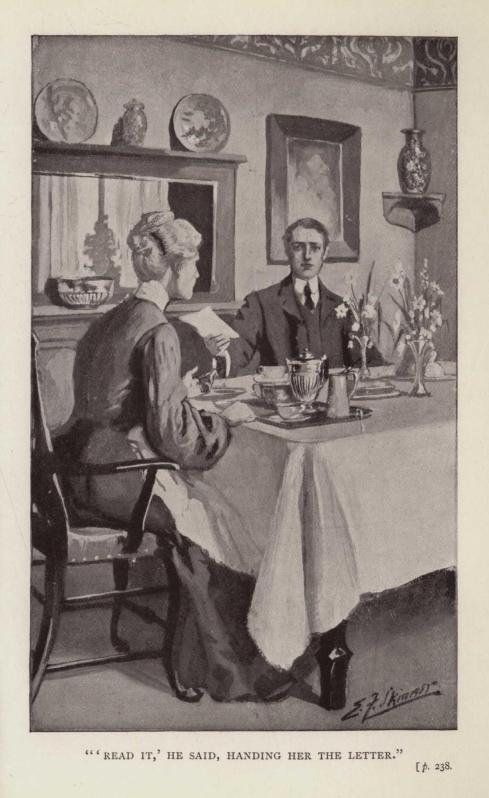
"'READ IT,' HE SAID, HANDING HER THE LETTER."
Adjusting her glasses, his mother read the letter, which was from a well-known firm of lawyers in Birmingham.
"DEAR SIR,
"We have to inform you that by the will of our late client, the Rev. John Hamilton, you are bequeathed a legacy of five thousand pounds free of legacy duty, as some compensation for the loss of your fortune, for which our client always felt a little responsible, as, had he been a more businesslike man, he might have prevented the defalcations of your other trustee, Mr. Anderson, or at least he would not have left your money so entirely in his hands.
"If you would kindly write and tell us how you would like to receive your legacy--whether we should pay it into your bank, or directly to yourself, you would oblige,
"Yours faithfully,
"MARK AND WATSON, "Solicitors."
"Well," cried Mrs. Cameron, "I never was more surprised in my life, nor more pleased!" she added. "And it was right, too, of Mr. Hamilton! I told him about his being to blame, you know, for not looking after his co-trustee--and I told him my mind about it; and he went away in anger. But, you see, he has been thinking about my words, and he recognised the justice of them----"
"Oh, mother, I wish you hadn't blamed him!" exclaimed Bernard.
"Wish I hadn't blamed him? How silly you are, Bernard! Why, it's to that you are indebted for all this good fortune. If I hadn't stood up for you and put his duty before him, you wouldn't have had anything."
"Did you suggest he should leave me money?" asked Bernard, aghast.
"I did that! I said it was his bounden duty to give you a thousand or two."
"Mother! How could you?"
"Well, I could. It was for you I did it. What right had he to leave all your money in that Anderson's hand? What right had he to sign papers--as he confessed he did--at Anderson's request without reading them? I told him he ought to have been ashamed of himself, and, in fact, that he ought to give you half of all that he possessed--we all knew he had a lot of money somewhere."
"Will it be wronging his relations if I take this legacy?" asked Bernard.
"If you take it? Why, Bernard, how silly you are! You'll deserve to starve if you don't take what the man has left you," cried his mother, angrily.
"I won't take it--if any one else ought to have it," said Bernard.
"Simpleton!" muttered his mother. Then she added, "He hadn't a single relation nearer than a second cousin, who is a rich brewer, so you may make your mind quite easy about that."
Bernard felt much relieved. In that case he would not have any scruples in accepting the legacy which his late trustee had left him, and how welcome the money would be!
"My boy," cried his mother, with more kindliness, as she realised what a blessing the money would be to them, "you can return to Oxford, obtain your degree, and afterwards have a school of your own!"
Bernard smiled, as he mentally said good-bye to hard toil as an usher, or assistant-master in another man's school. He would have one of his own one day; but first there was something else of great importance for him to do.
Later in the day, after he had written to the lawyers thanking them for their communication, and asking them to be so kind as to pay the five thousand pounds to his account in the London and County Bank, and after he and his mother had discussed Mr. Hamilton's somewhat sudden decease during an attack of pneumonia, he damped all her joy by declaring that the first step he should take would be to go to London to Doris Anderson, and the second would be to marry her forthwith.
"I think she will consent," he said, "as her only reason for refusing me before was that the debt was not paid. Now I have only to go to her and say, 'Doris, part of the debt is paid. I have come to marry you,' and then she will consent--oh, yes, I know she will consent!" and his face was bright with joy and thankfulness.
It was in vain that his mother vociferated and protested against his marrying Doris, he would not listen to her any longer.
"It is of no use your talking about the matter, mother," he said; "I am going to marry Doris, and no amount of talking will prevent me."
His mother was miserable; now less than ever did she desire Doris to be her son's wife.
As she lay tossing about on her sleepless bed that night she almost wished Bernard had not received his very substantial legacy, as he was going to use some of it for such a purpose.
In the early morning she dressed hurriedly, purposing to speak to her son on the subject before he started for Doncaster to catch the early express for London.
Early as she was, however, Bernard had been earlier, for he had already left the house when she came downstairs.
Mrs. Cameron hired a dogcart and ordered a man to drive her as fast as possible to Doncaster Station.
But it happened that the dogcart collided with a waggon on the way. No one was hurt, but there was some confusion and considerable delay, and when at length Mrs. Cameron was able to walk into the station at Doncaster, it was to catch sight of the express fast disappearing in the distance.
"I have lost my son!" said the unhappy woman to herself. "He will never speak to me again when he finds out about the letters I have suppressed. He will hate me--yes, he will hate me for doing it." The thought followed that she would deserve her fate, for if ever a parent provoked her son to wrath she had done so.
CHAPTER XXI.
BERNARD SEEKS DORIS.
The course of true love never did run smooth.
SHAKESPEARE.
"Is Miss Anderson in?"
"No, sir. She doesn't live here now, sir," answered Mrs. Austin, in melancholy tones.
"Not live here! Then where is she?" cried Bernard somewhat faintly, for in his surprise and consternation at not finding Doris there a return of the faintness that had before troubled him seemed imminent.
The good woman caught hold of him by the arm.
"Excuse me, Mr. Cameron, sir," she exclaimed. "You are ill. Come inside, sir. Come inside the house."
Bernard shook her hand off, declaring he was all right; but he walked unsteadily into the little sitting-room, where he had expected to find Doris.
"Sit down, sir; I'll get you a glass of water or a cup of tea in a moment----"
"Nonsense! I mean, I'm much obliged to you. But all I wish to know is this, where is Miss Anderson? Where--is--Miss--Anderson?
"Oh, I'll tell you, sir, in a moment," answered Mrs. Austin, bustling about and getting him some water. "Take a drink, sir," and she held the glass to his lips.
He drank slowly. The room, which had been turning round and sinking into the ground, became once more stationary, whilst the clouds of darkness disappeared, and it was light again.
"There, you'll do now," said Mrs. Austin. "Miss Anderson told me that you had been ill."
"Never mind me. Where is she?" Bernard asked the question impatiently. Would the woman never answer him?
"There have been changes, sir, since you were here," said Mrs. Austin, rather nervously, standing before him, twisting her apron round her fingers, with her eyes fixed upon it. "It all came of the artist gentleman. I wish to goodness he had never set his foot inside of my door!"
"Do you mean Miss Sinclair's brother?" interrupted Bernard, taking alarm at Norman Sinclair's influencing Doris's movements. He remembered warning her against him in this very room, and telling her that if she grew to care for him she would not love her Bernard any more.
"Yes, Mr. Sinclair. I begged her not to listen to him. But she did. And he came again and again, until he had persuaded her to stop making those pictures and give up her business, which was paying her so grandly."
"Give up her business! Did you say he persuaded her to give up her business? Did she do that?"
"Yes, sir, yes. Didn't she tell you? For, now I come to think of it, she had done that before you were ill, when she went to see you at Richmond."
"Had she taken such a step then? She never told me so. She never said a word about it to me."
"Didn't she, sir? Then perhaps she thought you were too ill to be bothered. She told me when she returned from Richmond that she had seen you off by train for the north, hoping that your native air and your mother's nursing would restore you. Not that it has done much for you, sir, as far as I can see----"
"Never mind that. Tell me what Miss Anderson did next?" Bernard asked anxiously.
"She told me that she sold what she had left of the pictures she had finished, and all the materials she had bought in for others; and then, having given up the business, she began seeking employment again, answering advertisements, applying at shops, and all that sort of weary work. It made my heart ache to see her come in at nights tired out, pale, and worn--a lady like that, who ought only to have been fatigued with cycling, or tennis, or amusing herself as other young ladies do! 'Perhaps I shall have more success to-morrow,' she would say to me, with her patient smile. But months went by, and it was always the same, until, at length, she came towards the end of her savings, and then she began to economise and pinch herself of comforts, and--necessaries."
"You don't say so!" cried Bernard in consternation.
"I'm afraid you are ill, sir," exclaimed Mrs. Austin, seeing him turn very pale.
"No, I'm all right. Go on," he said though his old faintness was troubling him.
"Well, sir, the day came when Miss Anderson said to me very plainly that she had no money left, or next to none, so she begged me to allow her to give up her rooms and just have the garret to sleep in until she found work that she could do."
"Why didn't she write to me?" cried Bernard.
"She hadn't much time for writing, sir, when she was all day seeking work; and at nights she was too tired, too down-hearted. And I think, sir, she kept looking for a letter, which didn't come, from you."
"From me? Why, I wrote to her almost every week when I was well enough, until, latterly, having no answer, I became discouraged. But hurry on with your story. Where is she now?"
"She had a letter from Miss Sinclair which made her very glad; and then Miss Sinclair found her some work, about which she was very hopeful at first; but it was difficult to do, I am sure, for she used to come home quite fagged out, and it must have paid badly, for she had very little money. 'I'm such a poor hand at it, Mrs. Austin!' she used to say. And sometimes she used to add, 'My heart isn't hard enough for it.' Poor dear! If it was a hard heart the work wanted, Miss Anderson was quite the wrong lady for it. I've seen ladies who would 'skin a flint,' as the saying is, but----"
"Never mind that!" interrupted Bernard with more impatience than courtesy. "Tell me where Miss Anderson is?"
Mrs. Austin began again, for she would tell things in her own way. "She fell into a poor state of health, and got a hacking cough, which wouldn't be cured, though I made her linseed tea, and honey and lemon, and----"
"Where is she? Speak! Tell me, is she alive?" For now Bernard's fear caused him to leap to the conclusion that Doris must have died.
"Oh, dear, sir, she's alive, of course! Though she was in a bad state at that time, and had a regular churchyard cough."
"Go on. You frighten me."
"I'm sorry, sir. Where was I? Oh, there came a day when she couldn't go out. I made her lie on the sofa in my back parlour, and it just happened that Mr. Sinclair called: he had been many times when she was out, but that day he called when she was in. He had a very long talk with Miss Anderson. And she was very much excited after he had gone. She cried a good bit, and then, next day, his sister came to see her, and afterwards he called again, and then Miss Anderson sat down and wrote a letter to you, sir, and another one to an old servant in Yorkshire, and she cried while she was writing them. I think those were very important letters, sir, for she was very anxious that they should be safely posted. I had to put on my bonnet and take them to the post myself, for she would trust no one else. And then she waited so anxiously for the answers, but only the old servant wrote. Oh, sir, why didn't you write?"
"I received no letter from her. I have had none from her since the first week after my return to Yorkshire."
"And I'm sure she wrote to you, sir, several times."
Bernard uttered an exclamation. It was clear to him that his mother must have seized his letters and kept them from him.
"There was something in the old servant's letter," continued Mrs. Austin, "which struck my dear young lady all of a heap and made her go about like a stricken lamb, with her poor young face so white and drawn. She did not cry then, sir. I only wished she would, for there was a heart-broken look in her poor face. Then Miss Sinclair came, full of affectionate concern, and she did her best to comfort Miss Anderson; but in vain.
"'It's no use,' she said to me, 'I cannot make Doris cheer up. I shall send my brother.'
"And then, the next thing was Mr. Sinclair came, and after he had gone, Miss Anderson said to me, quiet-like, 'I'm not going to be poor any longer, Mrs. Austin!' And then she went on to say, 'It will be better for you, dear Mrs. Austin; I've only been a burden on you lately, and now you will be well paid for all you have done for me---not that money will ever repay you, my good, kind friend!' and, throwing her arms round my neck, she kissed me more than once. 'I should have died if it hadn't been for you,' she said. 'And now I am going to live and be Mr. Sinclair's wife. He is rich now, and I have promised to marry him.'"
"To marry him!" Bernard exclaimed, starting up so violently that he overturned a small table. "Did she say to marry him?"
"Yes, sir," Mrs. Austin answered, with great sympathy; "I'm sorry to say she did."
"But she is my promised wife!" cried Bernard, picking up the table and beginning to pace up and down the room, in his agitation.
"Indeed, sir!" Mrs. Austin's round eyes opened widely in astonishment. She had always understood that Mr. Cameron loved Doris, and indeed she wondered who could help loving her! But it was altogether another thing to hear that Doris had promised to marry Mr. Cameron.
"Where is she? I must speak to her--must hear from her own lips how it was that she could do such a thing. Where is she?" cried Bernard.
"Wait a minute, please, sir," said Mrs. Austin. "I must tell you that after the engagement was settled Miss Sinclair came the next day and took Miss Anderson away. Miss Sinclair gave me her address,--Steele's Road, Hampstead, and said that I was to forward all Miss Anderson's letters there. Miss Sinclair also gave me a five-pound-note, and Miss Anderson promised to come and see me, and settle up everything before she got married. She begged me to pack up all her things, and take care of them for her; but she said, too, that she would never be able to come and live here again. 'No,' I said, 'you are going to be a grand lady, and you'll forget all about poor Mrs. Austin!' But she said, 'No, no, indeed!' and she cried, and kissed me. 'I'm not very happy,' she said, and could say no more for weeping, especially as Miss Sinclair came up to urge her to make haste, for the cab was waiting.
"Not very happy? I should think not indeed! Oh, Doris!" The last words were said very low, as Bernard turned his head away for a few moments.
"She looked miserable, sir. I'm thinking it was only for a home and support that she was thinking of marriage."
"But she wouldn't sell herself for that!" exclaimed Bernard.
"And then it was such a grievous thing, sir, that you didn't write to her. Hope deferred maketh the heart sick. And very sick at heart my poor dear young lady was, many and many a time, while she was looking for the post bringing her a letter, in the days before she got engaged to Mr. Sinclair."
"But I did write! I wrote many more letters than I received from her. I never heard from her after the first week."
"Then there has been foul play, sir, somewhere! Letters have been stopped, and have got into the wrong hands before to-day."
Bernard knew well who must have been the culprit. His mother had wronged and sinned against him in a way which would be hard to forgive. She had done all she possibly could to destroy his happiness in this world. But he told himself that he must not waste time in thinking of that just now; he would hasten to Doris and have a talk with her.
"Do you say she is at Hampstead?" he inquired, hastily.
"She went there with Miss Sinclair, but they are not there now, sir. They have gone to the seaside somewhere, for the benefit of Miss Anderson's health."
"Gone!" cried Bernard. "To the seaside! What seaside? Where?"
"I don't know, sir. They'll tell you at--Steele's Road, Hampstead."
"I'll go there at once. You've been a good friend to Miss Anderson. Allow me," and he pressed a sovereign into the landlady's hand, and hurried out of the house.
In the shortest possible time he was at Hampstead, inquiring at Steele's Road for Miss Anderson's address. Mr. Sinclair happened to be out--which Bernard thought was just as well for him; but the servant being under the impression that his master was somewhere about the house, Bernard was shown up into the studio. There, as he waited, he perceived more than one painting in which Doris's fair sweet face was beautifully delineated. The sight of it there, however, only maddened her unhappy lover. What right had the fellow to make Doris's loveliness so common? What right had he to possess the presentment of it there? By the power of his strong will and helped by his riches he had prevailed upon the lonely girl to promise him her hand in marriage. In the absence of her own true lover he had stolen her from him. But a Nemesis had come, was coming indeed; and when Doris saw her Bernard and spoke with him, face to face, she would throw over the usurper, and matters would be readjusted as happily, nay, more happily, than if this engagement had not occurred.
"'For things can never go wholly wrong
If the heart be true and the love be strong'"--
quoted Bernard to himself, "and there shall be no mere engagement, but a marriage shall take place forthwith. For, thank God! I am rich enough now," he said to himself, "to be able to marry my Doris. Yes, all will come right when I see her again."
A maidservant entered, bringing in an address on a slip of paper. "Mr. Sinclair is out," she said, "but this is where we have to send all letters that come, either for Miss Sinclair or Miss Anderson."
"Thank you," said Bernard, taking up the scrap of paper, and reading, "The Queen's Hotel, Hastings," upon it.
"I will go there immediately," he said to himself, as he left the house. "I will take the very first express train to Hastings." He hailed a cab. "Drive me to Charing Cross," he ordered, "and drive your fastest."
CHAPTER XXII
TOO LATE! TOO LATE!
There is no disguise which can long conceal love when it does, or feign it when it does not exist.--LA ROCHEFOUCAULD.
"How strange it is to be rich!" cried Alice Sinclair, as she sat with Doris in a shelter by the sea at Hastings. "It is delightful!"
Doris smiled, but her smile only seemed to enhance the sadness in the expression of her beautiful face, and she shivered slightly as she drew a fur-lined cloak more closely round her. "This is different from account-collecting," she said, looking at the fashionably dressed people sauntering by, and then allowing her eyes to rest upon the beauty of the sunlit waves before them.
"Yes, or making imitation oil-paintings either!" exclaimed Alice. "Who would have thought to see us, now, that we were two poor girls toiling in a London garret not long ago?"
"To feed a 'Lion' and pay a monstrous debt," said Doris, plaintively.
"And now our task is done," continued Alice, with cheerfulness. "The Lion is fed, and is roaring loudly in the Royal Academy: moreover, he has food enough for a lifetime. And as for you, your struggle with the hard cold world is ended, dear," and as she spoke she laid her hand on Doris's thin arm. "Are you not glad?" she asked a little wistfully, for the sadness of her friend was a great trouble to her.
"I try to be," answered Doris.
"Try to be?" Alice raised her eyebrows.
"Yes. I have to try, you know, for I don't feel able to rejoice about anything in these days." The tears came to Doris's eyes as she spoke, and her lips trembled.
"Poor dear! That is because you are out of health----"
"Sometimes I wish it was out of life," interrupted Doris wearily. For it was a dark hour with her, and, in her trouble in losing Bernard's love and having promised to marry a man for whom she had no affection, she had for the time being lost her usual happy faith in the golden thread of her Heavenly Father's love.
"Oh, Doris!" Alice was shocked. Things were even worse than she had feared.
"I cannot help it," returned Doris. "I am sad, and there is no denying it. Whichever way I look I see nothing but sadness--sadness in the past, in the present--and, God help me, in the future." Her tones were miserable.
"In the future with Norman? Oh, Doris, you cannot love him!" Alice's tones were full of distress.
"At least, I am not deceiving him. He knows what my feelings are."
"Do you think he does--quite?" asked Alice, softly.
"Yes, quite. And he is content: he says the love will come in time--that he will win it."
"I don't think he will," said Alice--they were talking in low tones which others could not hear, as they had the shelter to themselves--"love cannot be compelled. I don't know much about it myself," she added candidly; "no man has ever wanted to marry me, and I have never cared for any one so much as I care for Norman, but I have read about love in books, and I know it cannot be forced. You do not love Norman."
"Alice," protested Doris, "you ought not to say that!"
"Listen, dear," said Alice, "in your innermost heart you know that I am right. I am only calling a spade a spade, and it isn't the least use to make a pretence of calling it anything else. You do not love Norman. Now, dear, hear me out, you do not love him at all. I was watching you this morning when you received that letter from him, and you looked infinitely bored. When he is over here you escape from his presence whenever you can, especially if I am not with you. You say that he is not being deceived, but does he realise what a wretched man he will be if he marries you when you are feeling like that? He is full of love and tenderness towards you, and you have not even the old liking for him and interest in his talk and doings which you had at first. You can, in fact, barely tolerate him now. Think, then, what it will be to have to live with him for years and years, until you are old and die----"