Front matter (continued 2)
Reading edition
"All right, I'll wait," and so saying he sat down and watched his aunt as she boiled a couple of eggs and made tea in a little brown teapot which had seen many days.
As she worked Mrs. Austin talked, and, because her mind was full of Doris she spoke most of her, not exactly revealing her artistic efforts and subsequent failure to effect a sale of her pictures, but still graphically portraying her need of remunerative work.
Sandy listened with scanty attention. He was much more interested in the egg and large cup of tea which his aunt placed before him, and it seemed as if he were the last person in the world to do Doris any good. Indeed, Mrs. Austin suddenly perceived that her words were absolutely wasted, and therefore pulled herself up short, with the exclamation, "I declare, I might as well talk to this lampshade as to you!" She glanced as she spoke at the pretty crimson shade over the gas-light. It was made of crinkled paper, tied together with a narrow ribbon.
"You never have an idea in your head, Sandy," she added.
Sandy grinned. "Who made that lampshade?" he asked, as he cut the top off his egg.
"What shade? Oh? the gas-shade! Miss Anderson, my lodger, you know, made that for me one evening, with a bit of crinkled paper that only cost 2-½*d*. Very handy she is with her fingers."
Sandy made no further remark until he had finished eating and drinking everything that was placed before him. "There," he said, at last, "I've done! Now then for a look at this shade," rising to look at the pretty lamp-shade, tied with a knot of crimson ribbon, which Doris had made in a few minutes with her clever fingers, as a small thank-offering for her landlady.
"Well, what do you think? Isn't it pretty?" asked Mrs. Austin.
"Pretty? Yes, well, it's pretty. I reckon if your lady-lodger made some of these for our shop they'd sell."
"Would they now?" There was eagerness in the question. Could this possibly prove to be a chance of work for poor Miss Anderson?
"Yes. We sell lots of flimsy silk lampshades that cost heaps of money. And we're often asked for something cheaper. Our manager might be inclined to buy some like this."
"Would he indeed? Oh, Sandy, Sandy!" In her eagerness the good woman caught hold of his arm. "Poor dear Miss Anderson does not know where to turn for a penny. Could you get her this work to do, for good pay, do you think?"
Sandy grinned again. "You said I never have an idea in my head," he began teasingly.
"I did. Yes, I did, but I won't say so again. I won't if you'll get my dear young lady some work that will keep the wolf from her door."
"The wolf? What wolf?" Sandy looked round with an assumed air of alarm.
"The wolf of hunger."
"I shouldn't have thought you would have allowed him to come near a lodger of yours."
"Get out with you!" Mrs. Austin pushed him towards the door. "Run and see if there is a chance for Miss Anderson."
"A chance? Oh, I see what you mean. Just ask her first if she would be willing to do the work at a fair price."
"Willing? She'd jump at it. But I tell you what, Sandy, we must not have her disappointed again. I won't say anything to her about it until we know whether she can have the work and on what terms."
"But the manager will want to see a specimen," protested Sandy. "He's a big man. You can't rush before him with nothing. He'd order me off at once for fooling round in that way."
"Specimen? Oh, well, if you want one, take this," said Mrs. Austin, carefully taking down the pretty shade Doris had made, blowing the dust from it, and wrapping it lightly up in a huge newspaper. "Now you must hold it in this way not to crush it," she said, "and make as good terms as you can for my young lady; tell your manager she is a real lady, who won't do things for nothing."
"All right!" Sandy darted off with the shade, and Mrs. Austin went upstairs with her tea-tray.
Doris opened the door slowly. Her eyes were red with weeping, and her hair was dishevelled and dress untidy. "Oh, Mrs. Austin," she said, "I've been so unfortunate! No one will have my pictures. They are not good enough to sell----"
"Nay, nay. That's not it. But there's no market for such pretty things. I know all about it, my dear young lady. I met Sam and he told me. He is so sorry, he has a feeling heart, has Sam. But there, there, don't you take on so! Don't cry, dearie!" She was crying herself, with sympathy.
Doris had burst into tears, and sat down weeping as if her heart would break.
"Come! come! we mustn't give way. It's always the darkest hour before the dawn," said the good woman soothingly.
"If only I hadn't wasted all this time, and used your painting materials! And now what shall I do? What shall I do?" cried Doris.
Mrs. Austin's resolve not to tell her about the lamp-shade making until Sandy returned with good news vanished in the stress of this necessity, and she hastily related to Doris that her nephew had thought of some paying work which she might be able to do.
The girl was startled at the idea of such work. It was very different from what she had been attempting; but her downfall was too real for her to be able to indulge in her former hopes, and her need of money was too great for her to be fastidious, she therefore brightened up a little, and began to talk about the new project. At all events this might provide her with sufficient money for food and lodgings until she could procure something better.
The two went on discussing the matter whilst Doris drank her tea and ate her egg and bread and butter; and then Mrs. Austin took the tray down, and waited impatiently for the return of her nephew.
At last he came in, bringing the manager's compliments to Miss Anderson, and he begged her to call upon him the next day.
Doris, therefore, went to the ironmonger's shop in the morning, was duly shown into the manager's room, and, after remaining there, some little time talking over the matter with him, the result was that she was engaged to work at lamp-shade making for the firm, in a little room behind the shop, for eight hours a day, at a salary commencing at sixteen shillings a week.
This arrangement Doris thought a more desirable one than another which would necessitate her providing her own materials, making the shades in her attic, and receiving so much a dozen for them. She stipulated, however, that if the shades sold well her salary should be increased in proportion.
Weeks and months of pretty, if monotonous work followed for Doris. Her candle- and lamp-shades were a decided success, and sold quickly at low prices. One window of the shop was given up for a display of them, and they made a "feature," or a "speciality," which attracted customers. The head of the firm, Mr. Boothby, sent for Doris one day, praised her handiwork, and raised her salary to a pound a week.
Doris was very thankful for the additional money, as it enabled her gradually to pay her kind landlady all she owed, and still have fifteen shillings a week for her board and lodging. More than this the good woman would not take, and as for Sam, he stoutly refused to be paid anything for the use of his cab on the picture business. One favour only he begged, and that was that Miss Anderson would give him one of the little pictures he had endeavoured to assist her to sell.
Doris chose one of the best, and wrote his name on the back of it, much to his delight.
She became contented, if not happy, as time went on, knowing that she could earn her living by work which was not too hard for her strength; but her old dream of partially repaying Bernard Cameron was no nearer fulfilment, for what could she do with only a few shillings a week for dress and personal expenditure? Sometimes, as her fingers worked busily, her thoughts were turning over new schemes for earning money, which might in the future develop into something greater and more lucrative than what she had in hand just then; and on a Saturday afternoon or Sunday, when walking or sitting in Regent's Park, or more occasionally in Hyde Park, or even at Richmond or Kew Gardens, her thoughts would fly to those who loved her, and she would long to see again her mother and father, and look once more on the beloved face of Bernard Cameron.
Did they ever think of her? she wondered. Would she ever meet them again? They could have no possible clue to her whereabouts. She, buried in a little back room at the ironmonger's shop for eight hours a day, had small chance of being seen by any one except workpeople and shop assistants. And even if she were out-of-doors more, walking about in those North London streets, or in the parks, or mingling with the "madding crowd" within the City, what likelihood was there that she would run across any of the three who, in spite of the sad separation from her, yet occupied the largest share of her heart of hearts? Where were they now? Probably her parents were hiding away somewhere abroad, perhaps in America or Australia, banished for ever from England by her father's sin and fear of the penalty of the laws which he had broken. It was wretched to think of them in their self-imposed, compulsory exile. Her mother's words, "Farewell, my child: my heart would break at parting from you, were it not that what has happened has broken it already!" recurred to her, to fill her eyes with tears, and make her heart ache painfully.
Scarcely less painful was it to think of Bernard, and of his tender love, because that was followed by his shrinking back from her when she last saw him, and by his mother's upbraiding and harsh cry, "If you marry, you will take your husband a dowry of shame." And again, "Do you mean to say that there is anything between you, the daughter of a criminal who shall yet be brought to justice if there be any power in the arm of the law, and my son, my stainless, innocent child?" and then her excited denunciation:
"You bad girl! Not content with your father having ruined my boy by stealing all his money, you are mean enough and wicked enough to deliberately determine to cut away his one remaining chance of rising in the world! You would ruin him ... you intend to cling to him as a limpet clings to a rock ... he won't be able to raise you, poor lad, but you will drag him down into the mire, which will close over his head!"
Well, she had given him up; goaded by those words, following his obvious shrinking from her, she had left him a message which, if he loved her still, would sting him to the quick, and, in any case, had sufficed to sever them for ever.
It was done now. She must not brood; that would do no good, it would only unfit her for her daily work. Perhaps in time the feelings which racked her heart when she thought of these things would grow blunt, the hand of Time would still the pain, and her Heavenly Father would send angels down to whisper to her words of peace and consolation.
CHAPTER IX.
ALICE SINCLAIR'S POT-BOILERS.
Yet gold is not all that doth golden seeme.
SPENSER.
"Good-morning! Some one has told me that you have a garret to let in this house." The speaker, a merry girl a little over twenty, stood in Mrs. Austin's doorway, smiling up at her, one hot day in summer.
"A garret, miss. Who for?" asked Mrs. Austin, smiling back at her visitor.
"Well, for me," answered the girl, quite gaily.
"For you, miss?" exclaimed Mrs. Austin, in surprise. "Why, you don't look like one who would sleep in a garret!"
"Well, no. I don't think I should like to sleep in a garret, unless it were a very pretty one. But I want to rent one, if I can find one with a good skylight. I want it for artistic work."
"Oh, indeed, miss! Are you an artist?"
There was respect, and even awe, in Mrs. Austin's tone. She had not imagined that such a merry-looking lady could be one of the elect.
"Well, yes, in a way I am; and I want to do something--paint some pictures, you know--in a quiet, respectable garret, where I shall not be interrupted. Is it true that you have one to let?"
"Yes, miss. I have one to let. I had an artist son once who used to use it. He's gone"--Mrs. Austin wiped her eyes with the corner of her apron--"and since then," she continued, "I let my young lady lodger have the use of it for her painting. Not that she uses it now,--poor dear!--still, it's supposed to be hers."
"If she does not use it, would she object to my having it?"
"I don't know, miss. I'll just run over to Boothby & Barton's shop, in the next street, and ask her. It is there she works."
"Tell her I shall be immensely obliged if she will give up the garret to me--that is, if it suits me--as I particularly want to have a garret with a good skylight, and I should like you to be my landlady." The young lady smiled again in Mrs. Austin's face.
"Well, miss, you are flattering!" Mrs. Austin caught up an old bonnet and proceeded to put it on. She looked doubtfully at her visitor as she did so. Would it be safe to ask her to sit down in the house until she returned? She thought so, and yet, "One never knows who strangers are," she said to herself. She, therefore, closed the door, locked it, and put the key in her pocket, saying, "Perhaps you'll step along with me, miss, then you'll know sooner if you can have it."
"Very well. And now," the girl continued, as they walked down the street, "I must tell you my name. I am Miss Sinclair."
"Oh, indeed! And I am Mrs. Austin."
"How much a week shall I have to pay you for your attic, if I take it?"
"Well, miss, there is not very much furniture in it."
"All the better. I shall require a good deal of room for my own things."
"Shall you require much attendance?"
"Oh, no, very little! But people will come to see me sometimes, and they will bring things and take them away--there will be a little wear and tear of your stair carpets."
"I see, miss. Would six shillings a week be too much for you to pay?"
"No, I can pay that." The girl's face brightened; she had feared the rent would be heavier. "And I can give you a month's pay in advance."
Mrs. Austin looked pleased. When they reached Messrs. Boothby & Barton's she went in alone to see Doris, and speedily returned, saying Miss Anderson had readily consented to the arrangement. She would remove her few things out of the garret that evening, and then it would be quite ready for Miss Sinclair.
"That is very kind of her. She must be very pleasant," said Miss Sinclair. "I have been wondering," she continued, "what work a lady who paints can find to do in a shop like this?"
Mrs. Austin told her, for Doris made no secret of her employment, and the stranger was greatly interested, and could easily understand the difficulty she had experienced in trying to sell her paintings. "The fact is, too many people paint," Miss Sinclair said. "There are nearly as many amateur artists as there are people to look at their productions. Your lodger is quite right in taking a more practical line. I'm doing that sort of thing myself."
"Indeed, miss! What may you be doing?"
Miss Sinclair did not answer, but went upstairs to look at Mrs. Austin's garret when they got to the house, and, expressing herself as very well satisfied, engaged it at once, saying she would begin to use it on the morrow.
Accordingly, the following day, just after Doris had gone to her work, Miss Sinclair arrived early, together with a couple of boys bearing great packages, canvas frames, and millboards. The boys went to and fro a great many times, bringing pots of paint, sheets of gelatine, etc.
Mrs. Austin's eyes opened wide with astonishment at some of the things which were carried up her stairs that day, but she did not interfere. Her new lodger made the boys assist her to prepare the garret for her purposes and arrange her work. Then she sent them away, and remained alone in the attic for two or three hours. When at last she left it she locked the door, saying to Mrs. Austin, as she passed her on the stairs, "You may have another key for the garret, but please do not allow any one to enter it, or even look in. I know I can trust you." She put her hand in the widow's as she spoke.
Mrs. Austin rose to the occasion. "No one shall enter or look in, miss," she said. "You have paid for the garret for a month, and it is yours."
When Doris returned home in the evening, however, Mrs. Austin confided to her that she thought Miss Sinclair must be a funny sort of artist, if indeed she was one at all.
Doris felt a little curious, too, about the girl who painted with such odd materials. But as she came after Doris went to her work in the mornings, and had usually gone before Doris returned in the evenings, several weeks passed before their first meeting. As time went on Mrs. Austin told Doris tales of beautiful oil-paintings being carried out of the garret and downstairs by men who came for them.
"I only just catch a glimpse of them sometimes," she said, "and they fairly stagger me, they are so gorgeous. Mountains and lakes, cattle and running streams, pretty girls and laughing children, animals of all sorts and I don't know what besides! Miss Sinclair must be a popular artist."
Doris felt a little sceptical. A young girl like Miss Sinclair to do such great things all alone, and so quickly, too! It seemed very strange.
"I wonder if they are real paintings?" she said.
"You might almost think she is a magician, or a fairy godmother, or something or other," said Mrs. Austin. "Oh, yes, they are saleable goods, for she gets lots of money for them--I know she does. She told me she was getting on so well that she could give me half a crown a week more for the garret, and would be glad to do that, for she liked it so much."
"I am very glad to hear it," said Doris kindly. "You deserve every penny, dear Mrs. Austin."
"Eh! dear, there's no one like you, Miss Anderson. I am well off to have two such lodgers--one that pays so much, and the other that upholds me with good words."
Another evening she said to Doris, "Do you know, miss, I heard a dealer saying to Miss Sinclair to-day, 'Well, I'll buy as many dozens of that picture as you can do for me."'
"Dozens of that picture!" Doris opened her eyes widely. Dozens? What was this artist who painted dozens of paintings all alike?
"I'm afraid, miss," continued Mrs. Austin, reading her thoughts, "that although the paintings do seem really beautiful to me when I get a glimpse of them from the garret door, or pass them as they are being carried out of the house, they are not what may be called genuine works of art. Still, they're very pretty: and they bring in lots of money!--and what more do you want?"
What indeed? Dealers would not buy the painstaking efforts of amateur artists, and yet they flocked to a garret to purchase dozens of pictures, which, to put it mildly, could not be called genuine works of art. The public must buy these things, or the dealers would not want them.
"What a strange girl Miss Sinclair must be!" thought Doris, "to work away at that sort of thing all alone. And she must be clever, too. I wonder how she does it, and why she does it?"
Doris was soon to know. Her work grew slack at the ironmonger's shop. A rival firm in the same street had started selling tissue paper lamp-shades, which were prettier than those Doris made, and cheaper also. Messrs. Boothby & Barton tried to do it as cheaply but failed, although they reduced Doris's wages and bought commoner tissue paper for less money. Doris tried to improve her shades, or at least copy those in the rival shop, but could do neither well, and, disheartened and dissatisfied, her work grew irksome to her.
It was then extremely hot weather, and Doris, drooping in her little close workroom, grew pale and thin. She needed change of air and scene, rest and freedom from anxiety as to ways and means, and she could get none of these things. A presentiment that she would lose her employment weighed heavily upon her mind: and one night she returned home in such low spirits that Mrs. Austin discovered the whole state of affairs.
The good landlady endeavoured to comfort Doris as best she could, declaring that if she lost her work something better would turn up.
"And in any case, my dear," she said in her motherly way, "you must put your trust in the Lord and He will provide." And when at last she left Doris it was with the words, "Don't lose heart. You have at least one friend in the world who, although only a poor woman, will share her last crust with you."
The next morning, when Miss Sinclair was working hard in her garret, with her door locked as usual, Mrs. Austin stood outside, knocking for admittance.
"If you please, miss, might I speak with you?" she asked through the keyhole.
The worker within uttered an impatient exclamation, but opened the door, saying, with a little sigh, "Well, come in. I thought it would come to this sooner or later."
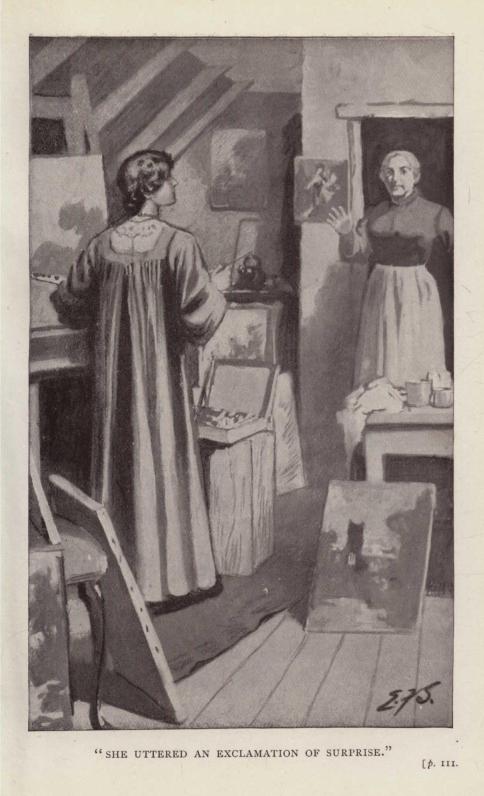
"SHE UTTERED AN EXCLAMATION OF SURPRISE."
"I'm very sorry to disturb you, miss," began Mrs. Austin. Then she uttered an exclamation of surprise, as she looked round on the oil paintings propped up on the table, against the walls, on the old easel, and indeed everywhere about the room. Three or four were duplicates of the same picture, and the colours were very vivid and brilliant. Most of them were landscapes; but there were one or two ladies in ball-dresses, and a couple of gaily dressed lovers.
"What do you think of them?" asked Alice Sinclair, who stood by the easel, a slight, tired girl in a huge, paint-smeared apron that completely covered her dress, which fell open at the throat, revealing a pretty white neck.
"Well, I'm sure!" ejaculated the landlady. "I never saw such pictures! Have you done them, miss?"
"Yes, I have painted them--that is, I mean, I have coloured them. Do you like them, Mrs. Austin?"
The landlady thought of her son Silas, and the pretty sketches Doris had taken such pains over, and her answer came slowly, "They'd just suit some people. Now, my son Sam, who was never satisfied with his brother's paintings, would go wild over these."
"Is Mr. Sam an artist?"
"No, he's a cab-driver."
Alice began to laugh rather hysterically, and, turning playfully to Mrs. Austin, she pushed her gently into the Windsor armchair. "Sit there," she said, "and listen to me. I like you because you speak the truth! I'm a bit of a sham, you know, and so are my pictures, and you have found me out."
"I'm sure I beg pardon, miss."
"No, it is I who must beg your pardon for using your garret for such a purpose."
"The garret's no worse for it, miss. And there'll be lots and lots of people who will be that pleased with your pictures!"
"Yes, there are more Sams in the world than Silases!" said Alice, with a little sigh. "And I give people what they want for their money."
"Yes, of course, miss. When my boys were little 'uns they used to spend their pennies over humbugs. The money soon went, and so did the humbugs. But they were quite satisfied, having had their humbugs."
"Just so--and my pictures are like the humbugs, only they don't vanish, they stay. I'm a bit of a humbug myself," continued Alice ruefully. "I must say this, however," she added, "what I do I do from a good motive----"
"And the motive's everything," interposed the widow.
"Mine is to make money--and I succeed in making heaps."
"Oh, but, miss, surely to get money isn't a very high motive, if I may say so."
"But I did not tell you what I want money for. It is in order that I may be able to support and maintain one of the greatest of God's artists, whilst he works at his heaven-sent tasks. He would have been starved to death by now, or would have had to abandon his work, if it had not been for this!" She waved her hand towards the pictures. "I hate the work. I loathe it," she went on, with a little stamp of her foot, "and never more so than now--for, to tell you the truth, I am feeling ill and overworked--yet I am obliged to go on, as my artist has only half finished his picture. I must go on."
"But not to kill yourself," interrupted Mrs. Austin, whose opinion of her lodger had gone through various stages since she entered the garret. At first she disapproved of Miss Sinclair's work, then greatly admired the noble, self-sacrificing spirit of the worker, and now the latter's ill looks appealed to her motherly heart.
"Oh, it does not matter about me," said Alice, with a little tired smile; "but I must not waste any more time in talking. A man will be here for these pictures in a couple of hours, and I haven't quite finished them off. Why did you come? I mean, what did you come for?"
"Bless me! I'm forgetting. I came to ask you if you could help poor dear Miss Anderson, who is in trouble. Her wages have been reduced, and she has reason to think she will lose her employment."
"I should think she is about tired of it," said Alice.
"She will have no means of livelihood if she loses her work," continued the landlady. "She is very poor, and gets very anxious about the future. She looks so thin and pale. I made so bold, miss, as to think that perhaps you would allow her to assist you, or even that you would suggest to her that she could do so in time."
Alice smiled, and, taking the good woman's hands in both hers, cried:
"You dear old soul! Here am I, ill through overwork, and earning lots of money, and you ask me to help a girl who is ill from want of work and want of money! Of course I must help her. That belongs to the fitness of things. You must go now. I will stay a little longer than usual to-day, and when Miss Anderson comes in ask her, please, to step up to my garret."
"Oh, thank you, miss. Thank you very much."
"But remember," said Alice finally, "that I don't expect Miss Anderson will like the idea of joining me in my work. She will think that I am a sham and that my pictures are sham pictures, and will have nothing to do with me, but will leave me to make my pot-boilers all alone."
"She won't do that! Not if you tell her what you've told me," continued Mrs. Austin.
"Perhaps you had better tell her about that--I don't think I could tell the tale a second time," said Alice, with a little wan smile. "Tell her everything, dear Mrs. Austin, and then if she cares to come to me----"
"She will--she will," and so saying the good woman hurried downstairs.
That evening, as Alice knelt on her garret floor, sand-papering the edges of her pictures, in order that the paper on the boards might not be detected, there was a little knock at the garret door, and in answer to her "Come in" Doris entered.
The two girls looked at each other: one from her lowly position, flushed with exertion, the other standing just inside the doorway, with outstretched hand and a smile on her beautiful face.
"I have come," said Doris. "Will you let me help you?"
Alice rose from her knees, and took the outstretched hand in hers. "Do you know everything? Has Mrs. Austin told you everything?" she asked.
"Yes. I honour you. And the work that is good enough for you is good enough for me. Besides I--I have been dismissed from my employment. My lamp-shade work has failed, at last----" Doris broke down a little, remembering her despair, but clung to the proffered hands.
"Poor dear!" Alice kissed her, and from that moment they were friends.
CHAPTER X.
DORIS AND ALICE WORK TOGETHER.
He that is thy friend indeed,
He will help thee at thy need.
Old Proverb.
A very beautiful thing is true friendship. History and mythology give us many notable examples--for instance, David and Jonathan, Damon and Pythias, Orestes and Pylades, and so on. Man was not meant to live alone. All cannot marry, but no one need be without a friend. Our Lord Himself loved one disciple more than all the others, and made him a friend. "Friendship is love without wings," says a German proverb, and certainly it is often more stable and more enduring.
The friendship between Doris Anderson and Alice Sinclair began warmly, and gave promise of growing apace. They were both young and comparatively friendless, they had both seen much trouble, and both were compelled to work hard and continuously. In some respects alike, their characters were in others dissimilar: in fact, they were complementary to each other. Doris was gentle and good-tempered, affectionate and reserved, painstaking and conscientious: in fact, truly religious. Alice, on the other hand, was lively, almost boisterous, sometimes passionate, yet loving withal, and frank, clever and enterprising, but not very scrupulous, and though religious extremely reserved about it.
"I must tell you exactly how I came to make imitation oil-paintings," said Alice candidly, as she sat on the three-legged stool in her garret that first evening, with Doris in the Windsor chair beside her. "I was forced into it by necessity. I am an orphan, you must know, and I live with my dear elder brother Norman. He is an artist--a real gifted, talented artist: he can paint such glorious pictures! But they don't sell yet. The fact is, the British public is so foolish!" She tossed her curly head as she spoke. "It--it prefers these," waving her hand towards the artificial oil paintings. "And meantime," she continued, "meantime, Norman and I have come to the end of our resources. He doesn't know. He is such a dear old muddle-head about business matters that he thinks the ten pounds he gave me last Christmas is still unfinished!"
She laughed--it was characteristic of her, Doris found, to laugh when others would cry. "And I had been so puzzled," Alice continued, "as to how I should be able to find the means of subsistence for us both. For I had long known Norman hadn't another five-pound-note that he could put his hands upon. I looked in his purse often, when he was asleep, and in the secret drawer of his writing-table, which he uses as a cash-box, and which he fondly imagines no one can open except himself. Don't look so shocked! Motive is everything, and I don't pry about from curiosity, but simply to keep the dear old fellow alive and myself incidentally. Oh, where was I?" she paused for a moment in order to recover breath, for she talked with great rapidity. "Oh, I know, I was saying we had come to the end of our resources. I had sold my watch and my hair--oh, yes, I didn't mind that. It is much less trouble now it is short, though I have to put it up in curlers at night, which makes it rather spiky to sleep upon. However, I am always so tired that I can sleep on anything. And, to cut a long story short, I sold everything I could lay my hands upon that Norman would not be likely to miss. Then I saw in a magazine, in the Answers to Correspondents, that very striking imitation oil paintings could be made in a certain way, which would sell well amongst ignorant, uncultured people, and, knowing what numbers of such folk there are, I determined to try to make them." She paused for breath.
Doris said nothing. Her blue eyes were fixed upon the other's face and she was reading it, and reading also between the lines of her story as she listened to her talk.
"I practised the work at home first," said Alice, "until I could do it properly, and had secured a few customers. But I was nearly found out, for that dear old stupid brother of mine must needs take it into his head that a very old engraving he wanted was in the attic--it wasn't, Doris! Pity me! I had turned it into one of my oil-paintings, and it had been sold for five shillings! Norman went to search in the attic, and was amazed to find lots of my things, pot-paint, and so on, about the place, which made him almost suspicious for a time. But, happily, his painting absorbed him again, and he forgot about the queer things in the attic. However, I thought it would be better to avoid such a risk in the future, and so went, one morning, to search for a garret which I could rent, and in which I should be able to work by day. When I had fixed upon this one, and it was settled that I should have it, I had to make some excuse to Norman for my long absences from home--don't ask me what I said; I mean to tell him the whole truth one day, and then, perhaps, he'll despise me! I cannot help that. It doesn't matter about me." She tossed her head, as if dismissing the idea at once. "What does matter," she continued very earnestly, "is, that I am maintaining my dear old Norman, while he is painting his beautiful picture. He will live, and his picture will be painted--and only I shall be in disgrace. I don't care!" but tears were in her eyes.
"Disgrace!" Doris leaned forward and caught hold of the small hands, hard and discoloured with work and paint. "Disgrace! I should think he will honour you, for your love and cleverness and self-sacrifice. He will say you have made him. He will thank God for such a sister."
But the other shook her head. "You don't know Norman," she said. "He would not mind dying, and he could give up finishing his picture sooner than endure the thought that I had 'gulled' that poor, stupid, credulous British Public--at least the uneducated section of it. He has a great reverence for truth and sincerity, and he hates and abhors a lie and a sham."
"Why do you do it, then?"
"I am forced," returned Alice plaintively. "We must live. And I want him to finish his picture, yes, and others. I hope he will have more than one in the Academy next year. I want him to be great--a great artist, recognised by all the world."
"How you must love him!" exclaimed Doris. "And what faith you have in his gift for painting!"
"I have no one except him," said Alice, simply. "He is father, mother, and brother to me. And he has a great gift. I believe he will win fame, and be one of the celebrities of the age--if I can keep him alive meanwhile with my pot-boilers. But now about yourself, will you help me?"
"Certainly. Only too gladly. I also have a most excellent reason for earning money."
"What is it? Have you any one depending upon you? A parent perhaps? Or a brother or sister?"
"No, I have no one like that. I stand alone!" Doris sighed deeply. When Alice was talking of her brother she had said to herself, "If I had only a relation to work for like that how happy I should be!"
"Poor Doris!--you will allow me to call you Doris, won't you?--you shall never stand alone any more. I will be your friend."
"Will you? But perhaps you wouldn't, if you knew all. I am under a cloud, and I cannot--cannot tell you everything."
Alice looked quickly and searchingly at her, as the unhappy words fell slowly, tremulously from her lips; and there was that in Doris's expression which reassured the artist's sister.
"Tell me nothing if you prefer," she said, "but come and work with me every day here. You shall be well paid, and you will have my friendship----"
"Which will be worth more than the pay!" cried Doris delightedly. "Oh, how glad I am! How very glad I am! I thank you a thousand times!" In the intensity of her gratitude she raised the other's hand to her lips.
Deeply touched, Alice threw her arms round her neck and kissed her. "Now we are friends," she said, "and chums! We shall get through lots of work together."
When they were a little calmer Doris explained the process, as she called it, by which her "pot-boilers" were made. She bought prints, both plain and coloured, and mounted them on stretched canvas frames, or on thick mill-boards, being very careful to exclude all air bubbles from between the board and the paper. Then she carefully rubbed the edges with sandpaper, in order to conceal the edge of paper; and afterwards the surface was covered with a solution of prepared gelatine, upon which the picture was easily coloured with paint, and made to look as much as possible like a genuine oil-painting. The coloured prints were less trouble, because they had simply to be painted as they really were underneath the gelatine. The plain prints, on the other hand, required taste and judgment in the selection of colour and its arrangement.
Doris was able to do this last extremely well, as she knew how to paint much better than Alice, who had never attempted anything of the sort before she embarked on her present undertaking. For Alice had only watched her brother painting, and his method was widely different from hers. The dealers who bought her pictures paid £2 a dozen for them, and took them away to frame and sell for at least fifteen shillings or £1 each. That the sale of them was good was evidenced by the dealers' quick return to the garret with further orders.
As for the business arrangement between the girls, Alice began by giving Doris a weekly salary for assisting her; but as they prospered more and more, the arrangement was altered, and Doris received a third of all the profits they made--more she would not take, for, as she said, she brought no capital into the business, nor connection, as did Alice.
Weeks and months passed away, whilst the two who worked together in Mrs. Austin's garret became sincerely and devotedly attached to each other. Alice often talked freely to Doris of her beloved artist brother, and told how when one beautiful picture was finished, he began another, in the hope that he would have two or three ready for the Royal Academy the next year. But Doris never told her secret, for her dread lest Alice should turn from her if she knew of her father's crime was always sufficient to close her mouth about the past; and neither could she tell of the great aim of her life which was to make at least some little reparation to Bernard Cameron, as to do so would necessitate the sad disclosure of how he had been robbed. She was therefore very reticent, which sometimes chafed and irritated Alice, who was, as we have seen, so very frank.
But the quarrels of lovers are the renewal of love. And after every little coolness the two became more devoted to each other than ever.
CHAPTER XI.
AN UNEXPECTED MEETING.
Have hope, though clouds environ now,
And gladness hides her face in scorn;
Put thou the shadow from thy brow,
No night but hath its morn.
SCHILLER.
It was a dull Sunday in November, cold, too, and damp and comfortless. Grey was the prevailing colour out-of-doors; the clouds were grey, so, too, were the leafless trees and bushes in Kew Gardens,--a dirty, brownish grey. And grey appeared the pale-faced Londoners, who sought in the nation's gardens for recreation and beauty.
In the Palm House certainly there was vivid, beautiful green in the fine trees and tropical plants collected there. It was very warm, too, and over the faces of those who entered tinges of colour spread and stayed, whilst smiles broke out, like sunshine illuminating all around. But it was too enervating to remain there long, and Bernard Cameron, who had wandered alone through the place, not excepting the high galleries, hurried out of the house at last, and breathed more freely when once more outside in the damp greyness of the gardens.
"It is a heated, unnatural, artificial life in there," he said to himself, "and does not appeal to me as does the beauty of the Temperate House, with its healthy green in trees and plants, and, at this time of the year, its masses of brightly coloured chrysanthemums."
He walked off quickly in the direction of the Temperate House, looking closely at all those he met or passed upon the way. "I never see Doris," he said to himself. "I never, never see her! She is not among the workers in London, so far as I can find out--though certainly the field is so vast that I have scarcely touched it in my search for her--neither is she in any pleasure resort. Sometimes I think she must have left London, and that she may have returned to Yorkshire. But I, having obtained a situation at a school at Richmond, must remain here for the present. Oh, Doris! Doris! Why did you leave me? Could you not have trusted my love for you? Why, oh, why did you send me that cruel message? No doubt mother had irritated you, yet I had given you nothing but love!" The greyness of the day seemed concentrated in his despairing face as he said this. He looked ten years older than he did on that bright, glad evening--his last happy day--when he proposed to Doris upon the hill at Askern Spa. His clothes were a little worn and untidy. He had grown thin, and there were sharp lines indicative of care and anxiety upon his face. His dark brown hair was longer, too, than he used to wear it, and he had all the appearance of one who had come down in the world after having had an unusually sharp tussle with fortune.
He had been wandering about for hours that Sunday, having a day's leave of absence from the school, and he felt tired and disheartened, for wherever he went he looked for Doris, and nowhere could he find her. He was, therefore, glad when, upon entering the Temperate House, he was able to find a vacant seat, where he could rest undisturbed. It was most people's luncheon time, and there were not many in the House just then--the other seats were occupied, certainly, but they were a little distance off. Bernard felt the comparative seclusion very pleasant; he closed his eyes in order to rest them, although, indeed, the green around was very refreshing to look upon, and, once again, he fell into a reverie--a sad one now, for he was thinking of his mother, who was so hard and bitter about Doris and her parents. Terrible had been the scene when, in spite of Mrs. Cameron's earnest request that he should do so, Bernard refused to prosecute John Anderson.
"Then you will be as bad as he!" cried the incensed woman. "You will be compounding a felony," she went on wildly. "You will be breaking the law of the land."
"Nay, nay, mother. Come," he answered, "look at the matter reasonably. My prosecuting Mr. Anderson will not restore the money to me."
"But it will cause him to be punished," she exclaimed. "That is what we want--we want him to be made to suffer."
"I do not want him to surfer."
"You're so foolish, Bernard, so very foolish!" screamed Mrs. Cameron, scarcely knowing what she said. "It's that daughter of his you are thinking about. I know it is. You are perfectly infatuated with her."
"Will you please keep her out of this discussion?" asked Bernard.
But his mother was unreasonable, and would drag Doris in, time after time, telling him that she was a chip of the same block as John Anderson, saying, "Like father, like daughter," and declaring that she would never consent to his marrying Doris if there were not another woman in the kingdom.
Bernard was as patient as he could possibly be, but at length, finding it impossible to endure any more such talk, he caught up his hat and went out, with his mother's parting words ringing in his ears.
"Unless you prosecute that rogue, John Anderson, and give me your promise that you will never marry his daughter, my house shall be your home no longer: you shall not sleep another night under my roof!"
Hard words! stinging words! They seemed to ring in Bernard's ears again, as, sitting there on a seat in the central walk of the Temperate House in Kew Gardens under the shade of a fine Norfolk Island pine, he thought about them sadly. No wonder was it that when they were uttered they drove him immediately--and he thought for ever--from his mother's house. Since then he had come to London and obtained an ill-paid assistant mastership in a suburban school, and now he spent all his time searching for Doris, yet in vain. "I have lost her," he said to himself, "I have lost her in this huge metropolis. Yet I forbore to prosecute her father for her sake: and for her sake I am an outcast from home, a mere usher in a school, earning my daily bread in the outskirts of this city!"
A great longing to see the girl he loved once more filled his whole heart; he longed to see her inexpressibly.
And just then she came. Talk about telepathy, about magnetism, about the hypnotism of will as people may, can anyone explain how it is that immediately before a longed-for person, or a longed-for letter arrives, that person or that letter is prominently present in the yearning mind? The same thing is seen intensified in answers to prayers. The one who prays longs unutterably for the boon he asks. It is given; and he thanks God and knows that he has received an answer to prayer. And it may also be that He Who alone knows the heart of man, is continually answering the unspoken prayers of those others who long unutterably for those things which yet they do not ask in words.
So Doris came, walking straight down the central path in the Temperate House, talking to Alice Sinclair, or rather listening, whilst Alice prattled to her about the trees and flowers.
"Look! See, there is a poor tired Londoner asleep," said the merry voice. "He has been somebody's darling once," she added in a lower tone, which Bernard could just hear.
"Hush! He will hear you. Why--oh!----" Doris opened her eyes wide, a look of apprehension came into them, and she reeled as if she would have fallen.
"Doris! Doris!" With a glad cry Bernard sprang to his feet, holding out his hands. "Doris!"
The girl recovered her presence of mind first. She touched Bernard's hands for a moment, and then, releasing them, observed to Alice, with forced calmness, "This gentleman is an old acquaintance of mine from Yorkshire."
"An acquaintance! Oh, Doris!" Bernard's voice expressed his chagrin, nay, more, his consternation. He had found Doris at last. But she was changed: she was no longer his Doris. He had slipped out of her life, and she had adapted herself to the altered circumstances. Glancing at her quickly, sharply, he perceived that she looked well, and even happy. The unwonted exercise and the fresh air of Kew had done her good and brought a pretty colour into her cheeks. She was with her dear friend Alice, and the delightfulness of mutual sympathy and love had caused her eyes to sparkle and her step to regain its buoyancy. Besides, the meeting with her lover, calmly though she appeared to take it, had brought back a tide of young life in her veins and imparted to her a sweet womanliness. Altogether she looked quite unlike the drooping, heartbroken Doris whom Bernard had last seen, and whom he had been picturing to himself as unchanged.
"Allow me to introduce you to my friend, Miss Sinclair," said Doris, disregarding his protest. "Mr. Cameron, Miss Sinclair," she said, adding, "Mr. Cameron comes from Yorkshire."
Alice bowed and held out her hand, in her usual good-natured way.
"We thought you were a poor, tired Londoner," she remarked with a smile, "and lo! you come from the North."
"I live in Richmond now," Bernard remarked quietly. "I have a--position in a school there."
"Indeed?" Alice was regarding him critically. He was a gentleman, handsome, too, and he looked good. But he was also rather shabby: there was no doubt about that; and she did not think Doris looked particularly pleased to see him. There was an expression of apprehension in her eyes which Alice had never seen there before.
"Do you live here?" Bernard asked Doris.
"No, no. We have only come over for the day."
"Where are you living?"
Doris made no reply. She stopped the answer Alice was about to make by a beseeching look.
"We have not any time to spare for visitors," she said, rather lamely.
"Will you allow me to walk with you a little way?" he asked. "Or perhaps," he hesitated, looking at Alice uneasily--"perhaps you will sit here with me a little while? There is--is--room for three on this seat."
Alice good-naturedly came to his assistance. "Doris," she said, in her brisk, businesslike way, "sit down and have a chat with your friend while I go over there to the chrysanthemum house to look at the flowers. I do so love chrysanthemums."
"And so do I," said Doris quickly. "I will come too."
"Doris!" Bernard's exclamation was pitiful.
Alice felt for him, but concluding Doris did not wish to be left, she said briskly, "We will all go there. Come on."
Accordingly they all went to look at the chrysanthemums, amongst which they talked mere commonplaces for a little while.
Bernard was miserably disappointed. Doris was uncomfortable and frightened--the shadow of her father's sin seemed to rest over her, filling her with shame. She did not know whether Bernard was prosecuting her father or not, and feared that he might say something which would betray the wretched secret to Alice. Even if he regretted the way he shrank from her when hearing of her father's misappropriation of his money, or if he wished, as seemed evident, to renew their former relations, she could not and would not ruin his life, as his mother had said she would ruin it by marrying him. Poor he was, and shabby. Not a detail of this escaped her--his worn clothes and baggy trousers touched her deeply; but at least he bore an unblemished and honourable name. Was she to smirch it? Was she to bring to him, as his mother had said, a dowry of shame? No, no. His mother's words were still ringing in her ears.
Stung beyond endurance by the remembrance, Doris raised her head and confronted Bernard proudly.
"Mr. Cameron," she said, "you must see--I mean, do you think that it is quite right to--accompany us--when----"
"When I am not wanted," he suggested, bitterly.
"I did not say that exactly. But----"
"You meant it." Bernard's eyes flashed. He, too, was stung now. "I will say 'Good-bye,'" he said, raising his hat.
The girls bowed, and, turning away, walked quietly out of the great house, leaving Bernard to return to his seat a crushed and miserable man.
He thought that it was all over between him and Doris. His mother had spoken the truth in saying the girl had declared she would never marry him. He need not have grieved his mother by refusing to prosecute her father: he need not have lost his home for that. Doris no longer loved him; she no longer loved him at all. He had lost his money, and he had lost Doris. That was the worst blow that had ever befallen him; nothing mattered now, nothing at all: he was in despair. It was far worse to have met Doris and found her altogether estranged from him than not to have met her at all.
"She wasn't like Doris," he said to himself, miserably. "She wasn't like my Doris at all. It might have been another girl; it might have been another girl altogether." The hot tears came into his eyes, and he buried his face in his hands that others might not see them.
"Oh, don't, don't be so unhappy!" said a voice in his ear, suddenly. "Didn't you notice that her manner was forced--unnatural?"
"Oh!" Bernard rose, and stood looking wonderingly into Alice Sinclair's face. It was full of kindness, and seemed to him, then, one of the sweetest faces he had ever seen.
"I have returned," she said in a low, confidential tone, "ostensibly to find a glove I dropped somewhere, but really in order to tell you our address. For I think--that is, I imagine, you might call to see her one of these days."
"Oh, can I? Do you think it is possible?"
"Certainly. This is a free country. Call by all means. Doris was awfully sad a few minutes after we left you. I am sure she was repenting her harshness to you. She was crying, actually crying. And you looked so miserable when we left you, so I thought I might try to help you both."
"You are good!" cried Bernard, taking one of her hands in his, and pressing it warmly.
The next minute he was alone, with an envelope in his hand, upon which was written, "Miss Sinclair, c/o. Mrs. Austin, 3, Haverstock Road, King's Cross, London, N."
"How good she is!" Bernard thought. "And what a difference there is now!--I am no longer in despair." He looked round. What a change had come over everything! The huge conservatory in which he stood was a vast palace of beauty: birds--robins mostly--were hopping about and singing a few notes here and there. The visitors looked very happy, and through the glass he could see gardens that were dreams of loveliness. It was not a dull, grey world now: oh, no, but a very pleasant place, full of boundless possibilities!
CHAPTER XII.
AN ARTIST'S WRATH.
A man may buy gold too dear.
Proverb.
"What does this mean, Alice? Is it here you work? What are you doing?"
"Oh, Norman! You here? Oh, dear!" Alice looked up in dismay from her work on the floor of the garret to the tall figure standing in the doorway, with head bent to prevent its being scalped by the low top. "You shouldn't have come, dear," she faltered.
"Shouldn't have come! I think it is time I did come! Great Scott! What are you murdering here?" He had reached the middle of the room with two strides, and was stooping over a brilliantly limned "oil-painting" Alice had just finished, looking at it with eyes blazing with wrath. "Did you do this?" he demanded. "Did you do this atrocious thing?"
"Yes--yes, Norman, I did," faltered his sister.
"Then I'm ashamed of you! Here, let me put it on the fire-back." Lifting the picture, he strode towards the fireplace with it.
"Don't, Norman! Don't! You must not! It--it is sold!"
"Sold!" cried the artist. "What do you mean? Can any one be so debased as to have bought a thing like that?" he demanded.
Alice began to laugh a little wildly. "Oh, Norman, how innocent you are!" she cried. "Don't you know that some one has said that the population of this island consists of men, women, and children, mostly fools? There are a great many more who admire and buy 'works of art' like mine than there are to appreciate such paintings as yours!"
"You little goose!" he exclaimed, impatiently. "Are you content to cater for simpletons, aye, and in the worst way possible, by pandering to their foolish, insensate tastes?"
Alice was silent a moment, and then she said, rather lamely, "It pays me to do so."
Her brother would not deign to notice that. He began to walk up and down the room, with long strides and a frown on his face. He was above the average height of men and broad in proportion, and his irregular features were redeemed from plainness by the beauty of his expression and his smile, which was by no means frequent.
Doris was painting at her easel on one side of the room, but the visitor did not appear to see her; his mind was absorbed with the distasteful idea of his sister demeaning herself to cater for the uneducated masses.
"It isn't as if you were trying to raise them," he burst out again. "You are not teaching them what beauty is--you are pandering to their faults! Leading them astray. Making them believe good is bad and bad is good! For, don't you know"--he stopped short by his sister's side, and laid a heavy hand on her shoulder--"don't you know that every time you make them admire a false thing--a thing that ought not to be admired--you rob them of the power to appreciate what is truly great and beautiful? It is a crime--a crime you are committing in the sight of God and man!" He gave her another frown, and began again to walk up and down quite savagely.
Alice looked wistfully towards Doris, but the latter was painting steadily on, with heightened colour and hands that trembled, in spite of the effort she was making to control herself.
Norman then began to examine the pictures standing about in the room in varying stages of completion.
"Ha! I see!" he said, scoffingly. "The way you get your drawings is to buy prints, and stick them on mill-boards. Yes, and then you smear them over with gelatine and colour them with this wretched paint. How is it you are not found out?" he continued, looking sharply at her, and then turning to examine the edges of one of the pictures. "Ha! I see! Sandpaper! So you rub the edges smooth with that! You little cheat! You defraud your purchasers! I really--you must give up this work at once. Do you hear? You must give it up forthwith--immediately!"
"I cannot, Norman!"
"Why not?"
"It pays so well. Sometimes we get eight or nine pounds a week by it."
"Pays well! Eight or nine pounds a week!" There was intense scorn in the artist's tones. "So, for money--mere money--you will sell your soul!"
"Nonsense! We must live. I pay for food--your food and mine--and our clothes, yes, and rent, gas, coal, and the servant's wages, with this money."
He stared at her. "I gave you money for those things," he said. "I'm sure I gave you ten pounds not so very long since."
"Last Christmas! Nearly twelve months ago! You are so impracticable, Norman. That ten pounds was used in a few days, to pay bills that were owing."
"You never asked me for more."
"Could you have given it me if I had?"
A dusky red stole over the artist's face. He became conscious of the presence of a stranger. "This lady must pardon us," he said to his sister, with a glance at Doris, "for speaking of our private affairs before her."
"Oh, she does not mind, I'm sure," said Alice. "May I introduce my brother to you, Doris?"
Doris bowed coldly. She went on with her painting, begging them not to mind her being there. "It is most important that the work should be finished to-night," she said, "and I must work the harder because Alice is being hindered."
"I fear I am the cause of that," rejoined the artist, quite meekly. "But I have had some difficulty in finding the place where my sister works, and now that I am here I must say what I think."
Doris made no rejoinder, and, having cast an admiring glance at her winsome face and pretty figure, he turned to Alice again, saying, "No consideration of mere money should prevent your instantly ceasing this disgraceful work."
Alice began to pout. "It's all very fine talking like that, Norman," she said, "but how do you propose to keep us if--if I abandon this?" She looked from him to her work.
"How did we live before? I suppose we can exist in the same way."
"We cannot! I have nothing more to sell, or--pawn."
"If only my paintings would sell!" He began to walk up and down again. He was thinking now, with huge disgust, that he had been living for many months upon the proceeds of sham oil-paintings. It was a bitter thought. "Better to have died," he muttered, "than to have lived so!" Aloud he said, "But I must insist upon your giving up this work. It is wicked, positively wicked work! You must not do it."
"I cannot give it up. I must do it."
"You must not! You shall not! I really---- Upon my word, if you do such things you shall not live with me!" He was in great anger now, the veins upon his temples stood out like cords; he could scarcely refrain from rending into pieces the hateful "frauds" upon which he was looking.
A cry of pain escaped from his sister's lips. She was pale as death. Her brother had never been angry with her before. Their love for each other had been ideal.
Then Doris spoke, turning from her easel and looking up at the artist with flashing eyes.
"There are vipers," she said, "which sting the hands that feed them. Alice, dear," she added, with a complete change of tone and manner, "come to me." She held out her arms, and Alice flew into them, clinging to her and crying as if her heart would break. "Go!" said Doris to the artist, pointing to the door. "Go, and live alone with your works of art. You cannot recognise or appreciate the self-denial and love which is in the heart of one of the noblest sisters in the world!"
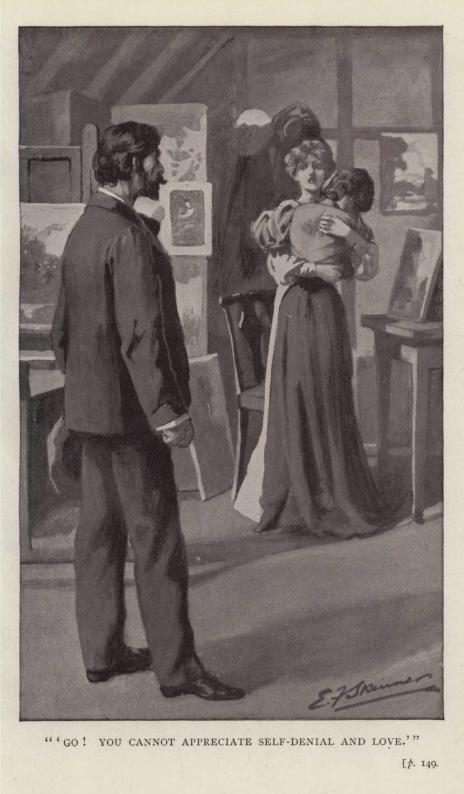
"'GO! YOU CANNOT APPRECIATE SELF-DENIAL AND LOVE.'"
Norman Sinclair went out of the room as meekly as a lamb, all his wrath leaving him as he did so. Indeed, to tell the truth, he felt very small and despicable, as he mentally looked at himself with Doris Anderson's eyes, and saw a man, who had been fed for many months by the hard, if mistaken, toil of his young sister, threatening her with the loss of her home in his house if she would not abandon her only source of income.
CHAPTER XIII.
CONSCIENCE MONEY.
No one should act so as to take advantage of the ignorance of his neighbours.--CICERO.
After Norman Sinclair went away Doris comforted Alice as well as she could, and then both girls set to work to finish the pictures which a dealer would send for that evening. Alice, however, performed her part half-heartedly. Through her ears were still ringing her brother's fierce denunciation of her employment. It was a crime; she was a cheat, defrauding the ignorant, making them believe bad was good and good was bad; for money she was selling her soul. Oh, it was terrible to remember! Her tears fell down and smeared the brilliant greens and yellows, blues and reds, upon her mill-boards.
Doris, seeing what was going on, felt extremely uncomfortable. She imagined that Alice was fretting because her brother had practically turned her out of his house, and her wrath against him increased. But for some time she could not stop working in order to give utterance to her feelings; the men would come soon for the pictures which must be ready for them, and they had to be finished off, or the way they were made would be detected. So the work went on until evening came, and with it the men from the dealers, who packed up the sham oil-paintings and carried them off.
Mrs. Austin had been upstairs more than once, to see if her young ladies, as she called them, were ready for tea--which, in those days they usually took together in the sitting-room before Alice went home--and the landlady's importunity caused them both to leave the garret at length and descend to the sitting-room.
"Now, darling, you shall have some tea," said Doris, affectionately. "Sit there in the armchair. I will bring you a cup."
She did so, and then, pouring out one for herself, sat down on the stiff horse-hair sofa, and began to make plans for the future.
"You and I, Alice," she said, "shall always live together."
"Yes," said Alice, slowly, and with a little hesitation, which the other did not appear to notice.
"Your brother has, by his own act and deed"--that sounded legal and therefore businesslike, so Doris repeated it--"by his own act and deed, forfeited his claim to you. Instead of honouring you, as I honour you, darling"--she caught up Alice's hand and kissed it--"for your bravery and cleverness and industry, he has actually dared to blame you in most unwarrantable, most uncalled-for language, and in the presence of a third person--which makes his conduct far more heinous----"
"Isn't that a little strong?" interposed Alice. "Doris, I love you for your love, but you must remember he is my brother. He has a right to say what he likes to me, for I am his sister, and--and I cannot bear even you to blame him."
"I beg to apologise!" said Doris, instantly. "It isn't right of me to speak against him to you. And, now I think of it, I was wrong in ordering him out of our--your--garret----"
"Well, yes, dear, a little----"
"I was wrong," said Doris, "and perhaps one day I will apologise. But however wrong I was, that does not make him right. He has behaved abominably."
"Now, there you are again! You must not blame him to me, dear."
"I beg your pardon!" Then Doris was silent a minute or two. It was hard to be pulled up at every point. Still, Alice was right, therefore her sense of justice caused her to refrain from taking offence. "But, Alice," she said, at length, "the fact remains, that he will not consent for you to remain in his house if you carry on your work here."
"He is an autocrat!" Alice burst out. "A martinet! A tyrant! I must carry on my work. I must. I have nothing else to sell. I have nothing else to do. Either I must continue what I am doing, or we must starve, or go into the workhouse. We cannot live on air." She paused, breathless. It was like her fervent, inconsequent way of reasoning to speak so strongly against her brother, whom she had just been chiding Doris for blaming. However, we are all apt to say things about our relations which we would not tolerate from other people. It is like blaming ourselves, or hearing others blame us. A man may call himself most foolish, yet if any one else were to say so it would be unpardonable.
Doris was silent, and in that she showed wisdom. Left to herself, Alice would say all that Doris had been about to utter, and would act upon it as the latter wished her to do.
"I cannot return to his house," said Alice, with a little sob. "He has indeed turned me out; for I cannot give up my means of livelihood. Who will give me an income if I throw away the one I have? No one. No one. The world is a world of adamant to those who have no coin."
"It is indeed!" said Doris, tears filling her eyes as she thought of her own struggles.
"But where shall I live?" continued Alice. "Will you let me live with you, Doris?"
"Yes, darling, of course I will! I love you, darling, as you know; and we will live together, and be like sisters--only--only perhaps----"
"Perhaps what?"
"Perhaps you wouldn't let me if you knew what a cloud of disgrace hangs over me----"
Doris broke down weeping. Was that cruel disgrace always to balk her every time she saw a prospect of happiness?
"Disgrace! How you talk! It is I who am in disgrace." Alice flung her arms round her friend, and their tears mingled as they wept together.
Mrs. Austin, coming in to see if they wanted any more tea, was quite affected by the sight and beat a hasty retreat into the kitchen. "It all comes of that horrid Mr. Sinclair forcing his way up to their garret," she said to herself, mentally determining to admit no more visitors to her young ladies without first acquainting them with their names.
When they were calmer the two girls discussed the feasibility of their living together, as well as working together, with the result that they agreed to try the plan. Accordingly, when night came, they withdrew to Doris's room, and lay down side by side in Doris's bed, which happened to be a rather large one.
Tired out, Doris slept so heavily that she did not hear her more wakeful companion's sighs and sobs, nor did she see her slip out of bed in the early morning, dress hurriedly, and then go downstairs.
When at last Doris awoke, Mrs. Austin was standing by her side, looking very grave and with a letter in her hand.
"What is the matter?" asked Doris, sleepily. "Have I overslept? Oh!" She looked round for Alice. "Where is Miss Sinclair?" she asked.
"Gone!" cried Mrs. Austin, tragically.
"Gone? When? Where?" cried Doris, in alarm.
"I don't know, miss. She went before I came down. When I came down this morning I could see that some one had gone out at the front door, for only the French latch was down. And there was this letter for you on the sitting-room table, and Miss Sinclair's boots had been taken from the kitchen, so I felt sure she must have gone."
"You should have awoke me at once."
"I came upstairs to do so, miss, but you were in such a beautiful sleep, I really hadn't the heart to disturb you. But now it is getting late, and I have brought your hot water."
Doris opened the note when Mrs. Austin had left the room. It was short and to the point.
"DORIS DARLING,--
"You are sweet to want me to live with you, and I should love it. But I have been thinking how kind Norman used to be when I had the toothache, and that he gave me such a nice copy of Tennyson on my last birthday,--and--the fact is, no one can make his coffee as he likes it in the morning but me--so I must go and look after him. Poor old Norman! He has no one else to look after his little comforts. And he will starve, absolutely starve if left to himself. I shall always remember, darling, how you wanted me to live with you.
"Yours lovingly,
"ALICE.
"P.S.--I make you a present of the business. Perhaps when we are starving, you will fling us a crust. Norman can't object to my receiving charity, although he will not allow me to do the only work I am fit for.
"A.S."
Doris sat up in bed and rubbed her eyes. What a child Alice was, after all! And how impracticable and unbusinesslike! The head of the firm, she had given up her position in favour of her junior partner without demanding any compensation! "However, she knew she could trust me," said Doris to herself. "I shall make her take half, or at least a third, of the proceeds. But it will be hard on me to have to do all the work alone, and I shall miss my dear partner. I hope she will come to see me sometimes."
After breakfast Doris went to the garret, and all day she worked hard, scarcely leaving off to eat or rest for a few minutes. A dealer came with a large order, and, after expressing his surprise at finding her alone, advised her to engage a boy or two to do the rough work and to assist her generally. In the evening she was almost too weary to eat her supper, and when Mrs. Austin was lamenting the fact, she told her what the dealer had suggested.
"Well, now, how that does fit in, to be sure!" said the landlady. "It was only this afternoon that my nephew Sandy came here, to tell me that he and another nice lad, his friend, had lost their situations through Messrs. Boothby & Barton's bankruptcy. They would be rare and glad to work for you till such time as they could get another place."
"I think I should be very glad to have them," said Doris, after a little consideration. "Your nephew did me a kindness about the lamp-shades, and I shall be pleased to offer him work now that he is out of a place."
So the next day the two boys came up to the garret, and set to work manfully to assist the young lady. They could soon do most of the work really better than she could herself, and she found it a great relief to confine her energies to the mere colouring. It was, however, not nearly so pleasant for her working with the two lads as it had been with her dear friend Alice, whom she missed at every turn.
On the Wednesday morning she received a little note from Alice, saying that at present she was forbidden to go to Mrs. Austin's, but hoped later on to be able to do so. "My brother is angry yet about the 'oil-paintings,'" wrote Alice, "but he is very glad to have me back; and, by the way, Doris, he would give worlds, if he had them, to make you sit for a picture of Rosalind in her character of Ganymede in As You Like It. Don't you think you could give him that gratification, dear? But I know these are early days to speak of such a kindness as that. And you would never have the time, even if you could forgive poor, blundering old Norman."
Then she referred to the letter Doris had sent her, in which the former stated that half the money earned would still be set aside for Alice. "It is lovely of you to say that about the money, dear," wrote Alice; "but Norman declares I am not to touch what he is pleased to call ill-gotten gains. Lest I should do so, he declares he will not eat anything I buy, and in consequence he is living upon oatmeal porridge and lentil soup! Oh, and the oatmeal is nearly finished! I have been thinking that if you would kindly send a five-pound-note now and then, anonymously, to him--mind, to him, not to me--and just put inside the envelope that it is 'Conscience Money'--that would be quite true, you know; for if you had not a conscience you would keep what I have thrust into your hands--he might use it, thinking it was the repayment of some old debt. For he has lent lots of money, in the old days, to people who have never let him have it back again. I hope you can see your way, as the dealers say, to do this. We must live, you know. It is so miserable to starve, and it's worse for the housekeeper, as the fault seems to be hers."
"I don't like complying with her request," thought Doris. "Her brother is an honest man, a most awkwardly honest man, and it is a shame to deceive him. Yet the money is Alice's. It is a point of conscience with me, as she says, to give it her. But I wish it could be done in some other way. It seems such a shame to make him eat food which his very soul would revolt from, if he knew everything."
She thought over the matter as she was working, and the more she thought about it the less she liked it. But when a dealer came in that afternoon, and paid her ten pounds that was owing to the firm, in two five-pound notes, she immediately posted one of them to Norman Sinclair, Esq., at his address in Hampstead, writing inside the envelope the words "Conscience Money."
That done, she felt more comfortable about Alice, for at least she would not starve when that money arrived. Doris still missed Alice, however, exceedingly; and though turning to her painting with fresh energy, alas! she felt for it more distaste than ever. For Doris could not forget--it was impossible for her to forget--that an honest man had called her work wicked, and declared that it was a crime in the sight of God and man. If that were true, and it was a crime, then she was a criminal just as her father was! Hereditary? Yes, the criminality must be hereditary. In her thoughts she had been hard upon her father. Was she any better herself?
CHAPTER XIV.
BERNARD CAMERON VISITS DORIS.
Patience and abnegation of self and devotion to others,
This was the lesson a life of trial and sorrow had taught her.
LONGFELLOW.
It was on Saturday afternoon that Bernard Cameron called. Doris had been through a particularly trying morning. It began with a letter from Alice, evidently written at her brother's instigation, advising her to give up the business of making sham oil-paintings and thus defrauding the public. "Better to be poor and honest and honourable," wrote Alice, virtuously. Doris read between the lines that her brother wished her to say these words, and that annoyed her extremely.
"What business is it of his?" she said to herself, resenting his interference.
When she went upstairs to the garret, to begin work for the day, she accidentally overheard Sandy saying to his fellow-worker, "Ain't folks simple to buy these for genuine oil-paintings? I know a chap who gave three pounds for a pair of them at a shop. And, says he, them's real oil-paintings. As proud as a peacock he was!"
"He shouldn't have been so green," said the other youth.
"The Government is down on folks who sell margarine for butter; it can't be done now-a-days, but there don't seem to be no penalty for this sort of thing!" He tapped one of the pictures meaningly.
Doris entered, and the conversation ceased; but all the morning her assistants' words and Alice's letter rankled in her mind. No doubt the business was not by any means a high-class one, but no one would buy her genuine paintings, she therefore told herself she was driven to make what she could sell: and now she had quite a nice little sum already in hand, to form the nucleus of what she would require to pay the debt to Bernard Cameron.
However, it was rather too much for her, when, as she was snatching a hasty lunch in the little sitting-room, she overheard Sam Austin saying to his mother in the kitchen, "Mother, I used to think them pictures Miss Anderson made so fast were really beautiful, and my wife went and bought one at a shop, but when the Vicar was in our house the other day, and she was showing it to him, he says, 'My good woman, that's no more a work of art than that stocking you are knitting, and it isn't half so useful! Don't you waste your money over such stuff!' says he. I felt so ashamed-like, mother, that our young lady's work should be so spoken of. And the Vicar is a gentleman who knows what's what."
"Hush, Sam! Miss Anderson is in the room, and she might hear. I am sure she thinks they are all right and worth the money, or she would not do them."
When the good landlady entered the room, a few minutes afterwards, she was dismayed to find the door ajar, and not closed, as she had imagined. This caused her to turn very red. But Doris did not refer to what she had overheard, for in truth she did not know what to say. Later she might refund Mrs. Sam her money, and have that off her conscience; but what about all the other people who had purchased her pictures? She felt sick at heart, and quite unable to do her work as usual. However, it had to be done, and she went upstairs slowly and heavily. "What shall I do?" she thought. "I cannot earn my living unless I do it in this way, which is not honest--I see that now; at first I thought it was, but I know Alice's brother is quite right. I'm a cheat and a fraud, a humbug and a thief; for I take money out of people's pockets, and make them no adequate return for it, although I make them think I do."
And then Bernard called. He was dressed in his worn clothes, and looked tired and harassed, but "every inch a gentleman," as Mrs. Austin said when she gave his name to Doris, asking if she would come downstairs to see him.
At first Doris thought she ought to send word that she was engaged. But she could not do it. She was so miserable and so hopeless; and the very thought of Bernard's presence there in the house caused hope and joy to spring up in her heart, and was like new life to her. She, therefore, took off her painting-apron, washed her hands, and went down to the sitting-room.
"Doris"--Bernard spoke very quietly, holding out his hand exactly as any other visitor might have done--"Doris, I have called to see you. It is very kind of you to come down. I--I will not detain you long."
"It is kind of you to call," said Doris, rather lamely, noticing all at once how thin and worn he looked, "and I haven't much time to spare, but I could not--could not refuse." Her voice trembled and broke; tears filled her eyes. It was hard, very hard to have to speak thus to one she still loved dearly.
"Oh, Doris," he cried, hope springing up in his heart by leaps and bounds at the sight of her downcast face, "Doris, darling, I cannot bear to see you looking so sad, and to know that you are alone here except for your friend----"
"She has left me!" interrupted Doris, crying now. "I am quite alone."
"Left you! You are alone! Oh, my darling!" He put his arms round her slim waist. "You are not alone! You need never be alone again, for I am here. Nay, don't send me away, dearest," he pleaded; "hear me, I beg. I love you, Doris. I love you with all my heart. The loss of my money--ah! forgive my mentioning it--it is as nothing to the grief of losing you. Ah, you don't know what I have suffered! Without you this world is to me a howling wilderness." He drew her to him. "Darling," he continued, low in her ear, "never send me away again."
The girl was powerfully tempted to surrender her determination and submit her weaker will to his stronger one. Her inclination, her heart was on his side; but what she thought was duty, and her sense of right, held her frail bark to its moorings. She therefore drew herself away, and with a little gesture waved him back, and then, to make her position more secure, she feigned anger.
"Don't! Don't!" she exclaimed sharply. "You go too fast, Mr. Cameron, much too fast! What we might have been to each other in happier times, events have rendered impossible now. You know they have----"
"No, no, not impossible!" he cried.
"I say impossible," insisted Doris. "My father appropriated your fortune. He stole from you your birthright."
"What of that? I forget it. I have forgotten it."
"You think so now. In your magnanimity you choose to think so; but supposing I were to trust to that, and we were to marry, do you think you could live with me day by day, in poverty, remember--for we should be very poor--without remembering that my father--mine--stole from you all the money your father left you?"
"I shouldn't think of it, or, if I did, I would say to myself that you have, by giving me your hand"--he took hers in his as he spoke--"and promising to be my wife," he added, "righted the wrong, paid the debt, made me rich indeed with what is worth far more than money, yes, infinitely more." Raising her hand to his lips, he kissed it.
"Don't!" She drew her hand away. "And there is another side to the question," she continued. "Could I be happy seeing you poor, and knowing what was the cause of it? Don't you think that daily, hourly, I should realise with pain that my father's crime was blighting your life?"
"Nonsense! Mine would be a poor life indeed, if the loss of money--mere money--could blight it!"
"It has a very stupefying effect on one to have no money," said Doris, with a little sigh, thinking of her past experience. "Don't you know the song--
Dollars and dimes! Dollars and dimes!
To be without cash is the worst of crimes!
It gets one into disgrace, anyway," she added.
"Poor child! I am afraid you have been hard up since----"
"Well," she interrupted, "it takes the courage out of one to have no money. You know that verse--
Whereunto is money good?
Who has it not wants hardihood;
Who has it has much trouble and care,
Who does not have it has despair."
"I shall have despair if I have not you!" he declared, moodily.
"No, you will not. You will find some one else to love--some one who has heaps and heaps of money. Then you will marry--will marry her." Doris's voice shook a little, but she waved him back when he would have drawn her to him again. "You will marry a girl with lots of money," she continued, more firmly now. "That is what your mother wants you to do. It is your one chance, she says, of retrieving your fortune."
"Did she say that to you, Doris?" His voice was hoarse, he looked very pale.
"She did."
"And that caused you to send me that dreadful message?" he asked.
"What message?"
"That you would never, never marry me."
"Yes."
"Ah! I understand it now." He passed his hand wearily across his brow--"I understand. But I can't help it, and she is my mother!" Again he was silent, struggling to control himself. "Do you know," he said, "she turned me out of my home?"
"She did? Why?"
"Because I would not prosecute your father."
"Ah! You have not attempted to prosecute him?"
"Doris! Did you think that I could?"
"Forgive me," she said. "But after your shrinking from me, as you did, when you heard what my father had done----"
"Shrinking from you! Shrinking! Surely you did not think that I could ever have done that?"
"But you did, Bernard. You did. It was that which broke my heart."
"My darling, you must be mistaken!"
"Indeed I am not. You shrank away from me. And then, your mother came and said those dreadful things--so I gave you up entirely, and I said that I would never marry you."
"But now that you know that I never intentionally shrank from you--and indeed I think that it must have been your fancy, darling--surely you will unsay those cruel words?"
Doris looked at him, at the love in his eyes, and his earnest face as he pleaded thus, and she softened considerably.
"I'll just tell you how it is, Bernard," she said, and now her tone was kinder, and there was a light in her blue eyes corresponding with the glow in his. "I'll just tell you how it is, Bernard, exactly. I feel that, because my father robbed you, I have had a share in the crime, and so I am going to work hard, in order to make you some little reparation--though of course I can never repay you all the money. Do you understand?" and she looked up earnestly into his face.
"To make some little reparation? To repay money? What do you mean?"
"Twenty-five thousand pounds is so large a sum!" she said. "I can only repay a small part of it. But I'm doing my best; I'm putting by four or five pounds a week, and I have already saved forty pounds. You can have that forty pounds now if you like. It's yours."
"Forty pounds! My dear Doris, what are you talking about?"
"I'm going to earn as much money as I possibly can for you, Bernard," said the girl firmly, "in order to repay you at least some of the money my father took from you."
"You earn money for me? Your little hands"--he looked down admiringly on them--"your little hands earn money for me?"
"Of course I must. It is my bounden duty. And I'm getting on splendidly as regards money: only they say, do you know, Bernard," and her tones were troubled, "they say that I ought not to earn it in the way I do. However," she broke off, and began again, "I mean to earn you a lot of money, that you may have part at least of that which is your very own."
"The idea!" he exclaimed; "the very idea of your earning money with these hands, these little hands," he repeated, "for me! Why, if only you would give me your hand in marriage, I should be more than repaid for all and everything?" He spoke eagerly.
"Bernard, I shall not marry you until I have done all that I possibly can to pay the debt."
In vain the young man protested, pleaded, and expostulated. Doris was firm: the utmost that she would concede was that he might visit her occasionally and see how she was getting on.
When that matter was quite settled she gave him some tea, and then explained to him about her work, which he was astonished to find so remunerative. He did not think it wrong of her to make those poor imitation oil-paintings. He said that people could not expect to obtain real oil-paintings for such small sums.
"You do not call them oil-paintings," he said, "you call them pictures; and if people think them oil-paintings that is their fault: it is because they are ignorant that they make the mistake. You are not answerable for that. The case of margarine and butter is different. It was because margarine used to be called butter that it was made illegal to sell it as such. Margarine is still sold, but it is called margarine."
"How very sensible you are, Bernard!" said Doris. "I wish----"
"What do you wish?" he asked earnestly, for he longed to serve her.
"I wish you would convince the artist, my friend Alice's brother, that he is wrong in thinking it so wicked to make those pictures and sell them."
"Does it matter what he thinks?" asked Bernard, full of a new alarm. "Is the man anything to you, Doris?"
"Anything to me? No, I have only seen him once."
"Yet you would like to stand high in his opinion?"
"Well, yes. There is something grand--heroic, about him. He would die for the truth. The man is made of the sort of stuff of which the old martyrs used to be made." Doris spoke with great enthusiasm.
Bernard's alarm increased by leaps and bounds. "Oh, Doris, darling, don't have anything to do with him!" he exclaimed passionately.
"Why not?" She looked startled. The flush which had risen to her face as she spoke so earnestly of Sinclair deepened into a very warm colour.
"Because I do not wish you to know him."
"Why not?" she repeated.
"My instinct tells me that he has impressed you strongly and that you think a great deal of him, and if you get to care for him, this hero whom you admire so much, you won't care for your poor Bernard any more!" He ended in doleful tones.
"You foolish boy!" Doris cried, with complete change of voice. "You know very well that although our engagement has been broken off and I have vowed that I will never, never marry you--that is, unless some of the debt is paid--I shall never love anybody in all the world as I love you," she ended with a little sob, and buried her face in her hands, lest he should see the tears which filled her eyes.
It was impossible for him to refrain from kissing her then; but she only suffered him to touch her hands, and then, starting up, waved him aside.
"No, no! You must not," she exclaimed. "I shall not go back on my word. I shall stick to my purpose. You may come to see me sometimes if you like, but I shall promise nothing."
He looked despairingly at her as she stood there, tall, erect, a very queen of beauty, with brilliantly coloured cheeks, shining blue eyes, and golden hair like an aureole above her small beautifully shaped head.
"Oh, my dear, you cannot earn money for me!" he cried; "I would never touch it. Do dismiss the idea from your mind! What I want is you, to be my own darling wife. We might be ever so happy--even if we are poor."