ILLUSTRATIONS. (continued 7)
Reading edition
The Orchard House, which had been the family home for twenty-five years, was sold to Mr. Harris, and Mrs. Pratt's house was the home of all. Louisa spent part of the summer at the seashore, and finally bought a small house at Nonquit, where the children could all spend the summer, while she and her sister alternated in the care of her father.
In the autumn of 1885, Miss Alcott decided to take a furnished house in Louisburg Square. Her nephews were established in Boston, and their mother wished to be with them. Mr. Alcott bore the moving well, and they found many comforts in the arrangement. Louisa's health was very feeble. She had great trouble in the throat, and her old dyspeptic symptoms returned to annoy her. Still she cannot give up work, and busies herself in preparing "Lulu's Library" for publication, and hopes to be able to work on "Jo's Boys."
"Lulu's Library" was a collection of stories which had been the delight of the child. The first series was published in 1885, the second in 1887, and the third in 1889. They are full of Louisa's charming qualities, and have a special interest from the tender feeling with which she gathered them up for her niece. The touching preface to "Jo's Boys" tells of the seven years of occasional work on this book, and reveals the depth of feeling which would not allow her to write as formerly of Marmee and Amy, who were no longer here to accept their own likenesses. During the latter part of her work on this book, she could only write from half an hour to one or two hours a day. This was published in September, 1886. It contains an engraving of her from a bas-relief by Mr. Ricketson.
This book was written under hard circumstances, and cost its author more effort perhaps than any other. It is evidently not the overflow of her delight and fun in life like "Little Women," but it is full of biographical interest. Her account of her own career, and of the annoyances to which her celebrity exposed her, is full of her old spirit and humor. She has expressed many valuable thoughts on education, and her spirit is as hopeful for her boys as in her days of youth and health. She has too many characters to manage; but we feel a keen interest in the fortunes of Dan and Emil, and in the courtship by the warm-hearted Tom of his medical sweetheart.
Preface to "Jo's Boys."
Having been written at long intervals during the past seven years, this story is more faulty than any of its very imperfect predecessors; but the desire to atone for an unavoidable disappointment, and to please my patient little friends, has urged me to let it go without further delay.
To account for the seeming neglect of Amy, let me add, that, since the original of that character died, it has been impossible for me to write of her as when she was here to suggest, criticise, and laugh over her namesake. The same excuse applies to Marmee. But the folded leaves are not blank to those who knew and loved them and can find memorials of them in whatever is cheerful, true, or helpful in these pages.
L. M. Alcott.
Concord, July 4, 1886.
To Mr. Horace Chandler.
Dear Mr. Chandler,–The corrections are certainly rather peculiar, and I fear my struggles to set them right have only produced greater confusion.
Fortunately punctuation is a free institution, and all can pepper to suit the taste. I don't care much, and always leave proof-readers to quibble if they like.
Thanks for the tickets. I fear I cannot come till Thursday, but will try, and won't forget the office, since I am not that much-tried soul the editor.
Yours truly,
L. M. A.
To Mrs. Williams (Betsey Prig).
Nonquit, August 25.
Dear Betsey,–I am so sorry the darling Doll is ill! Brood over him, and will him well; for mother-love works wonders.
My poppet is a picture of health, vigor, and delightful naughtiness. She runs wild in this fine place with some twenty other children to play with,–nice babies, well-bred, and with pleasant mammas for me to gossip with.
It would be a good place for your little people, as the air is delicious, bathing safe and warm, and cottages to be quiet in if one cares to keep house. Do try it next year. Let me know early. I can get a nice little cot for you (near mine) for $100, or perhaps less, from June to October,–if you care to stay; I do....
We have been here since July, and are all hearty, brown, and gay as larks.
"John Inglesant" was too political for me. I am too lazy here to read much; mean to find a den in Boston and work for a month or two; then fly off to New York, and perhaps run over and see my Betsey. I shall be at home in October, and perhaps we may see you then, if the precious little shadow gets nice and well again, and I pray he may.
Lulu has some trifling ail now and then,–just enough to show me how dear she is to us all, and what a great void the loss of our little girl would make in hearts and home. She is very intelligent and droll. When I told her the other day that the crickets were hopping and singing in the grass with their mammas, she said at once, "No; their Aunt Weedys." Aunty is nearer than mother to the poor baby; and it is very sweet to have it so, since it must be.
Now, my blessed Betsey, keep a brave heart, and I am sure all will be well in the nest. Love and kisses to the little birds, and all good wishes to the turtle-dove and her mate.
Yours ever,
L. M. A.
The older birthdays are 29th of November, Lulu's the 8th; so we celebrate for Grandpa, Auntie, and Lulu all at once, in great style,–eighty-three, fifty, and three years old.
When I get on my pins I'm going (D. V.) to devote myself to settling poor souls who need a gentle boost in hard times.
To Mr. Niles.
June 23, 1883.
Dear Mr. Niles,–Thanks for the Goethe book. I want everything that comes out about him. "Princess Amelia" is charming, and the surprise at the end well done. Did the author of "My Wife's Sister" write it?
I told L. C. M. she might put "A Modern Mephistopheles" in my list of books. Several people had found it out, and there was no use in trying to keep it secret after that.
Mrs. Dodge begged me to consider myself mortgaged to her for tales, etc., and as I see no prospect of any time for writing books, I may be able to send her some short stories from time to time, and so be getting material for a new set of books like "Scrap-bag," but with a new name. You excel in names, and can be evolving one meantime....
Yours truly,
L. M. A.
July 15, 1884.
I wish I might be inspired to do those dreadful boys ["Jo's Boys"]; but rest is more needed than money. Perhaps during August, my month at home, I may take a grind at the old mill.
Journal.
October 24, 1882.–Telegram that Father had had a paralytic stroke. Home at once, and found him stricken down. Anxious days; little hope.
November.–Gave up our rooms, and I went home to help with the new care. My Lulu ran to meet me, rosy and gay, and I felt as if I could bear anything with this little sunbeam to light up the world for me.
Poor Father dumb and helpless; feeble mind slowly coming back. He knows us; but he's asleep most of the time. Get a nurse, and wait to see if he will rally. It is sad to see the change one moment makes, turning the hale, handsome old man into this pathetic wreck. The forty sonnets last winter and the fifty lectures at the School last summer were too much for a man of eighty-three. He was warned by Dr. W., but thought it folly to stop; and now poor Father pays the penalty of breaking the laws of health. I have done the same: may I be spared this end!
January, 1883.–Too busy to keep a diary. Can only jot down a fact now and then.
Father improving. Much trouble with nurses; have no idea of health; won't walk; sit over the fire, and drink tea three times a day; ought to be an intelligent, hearty set of women. Could do better myself; have to fill up all the deficiencies and do double duty.
People come to see Father; but it excites him, and we have to deny him.
February.–To B. for a week of rest, having got Mrs. H. settled with Father, and all comfortable for November.
Began a book called "Genius." Shall never finish it, I dare say, but must keep a vent for my fancies to escape at. This double life is trying, and my head will work as well as my hands.
March.–To give A. rest I took Lulu and maid to the Bellevue for a month. Lulu very happy with her new world. Enjoys her walks, the canary I got her, and the petting she gets from all. Showed her to friends; want them to know May's child. Had her picture taken by Notman; very good.
April 2d.–Town meeting. Seven women vote. I am one of them, and A. another. A poor show for a town that prides itself on its culture and independence.
6th.–Go home to stay; Father needs me. New nurse; many callers; Lulu fretful, Anna tired, Father feeble,–hard times for all.
Wrote a story for "St. Nicholas" at odd moments. Nurses and doctors take a deal of money.
May.–Take care of Lulu, as we can find no good woman to walk and dress and play with her. The ladies are incapable or proud; the girls vulgar or rough; so my poor baby has a bad time with her little temper and active mind and body. Could do it myself if I had the nerves and strength, but am needed elsewhere, and must leave the child to some one. Long to go away with her and do as I like. Shall never lead my own life.
July.–Go to Nonquit with Miss H. and Lulu for the summer. A quiet, healthy place, with pleasant people and fine air. Turn Lulu loose, with H. to run after her, and try to rest.
Lulu takes her first bath in the sea. Very bold; walks off toward Europe up to her neck, and is much afflicted that I won't let her go to the bottom and see the "little trabs;" makes a cupid of herself, and is very pretty and gay.
The boys revel in the simple pleasures of Nonquit,–a fine place for them to be in.
Wrote a tale for "St. Nicholas,"–"Sophie's Secret,"–$100.
August.–Home to C., and let A. come for her holiday. Much company.
P. C. Mozoomdar preached, and had a conversation at Mrs. Emerson's; a most interesting man. Curious to hear a Hindu tell how the life of Christ impressed him.
November 27th.–Decide to lessen care and worry at home; so take rooms in Boylston Street, and with Lulu set forth to make a home of our own. The whole parlor floor gives my lady room to run in doors, and the Public Garden opposite is the out-door play-ground. Miss C. comes as governess, and we settle down. Fred boards with us. Heard Mathew Arnold.
29th.–Birthday,–fifty-one. Home with gifts to poor Father,–eighty-four. Found a table full for myself.
December 25th.–Home with gifts for all; sad day. See H. Martineau's statue; very fine.
January, 1884.–New Year's Day is made memorable by my solemnly spanking my child. Miss C. and others assure me it is the only way to cure her wilfulness. I doubt it; but knowing that mothers are usually too tender and blind, I correct my dear in the old-fashioned way. She proudly says, "Do it, do it!" and when it is done is heartbroken at the idea of Aunt Wee-wee's giving her pain. Her bewilderment was pathetic, and the effect, as I expected, a failure. Love is better; but also endless patience.
February 2d.–Wendell Phillips died. I shall mourn for him next to R. W. E. and Parker.
6th.–Funeral at Hollis Street Church. Sat between Fred Douglas and his wife. A goodly gathering of all left of the old workers. Glad and proud to be among them.
June.–Sell the Orchard House to W. T. Harris. Glad to be done with it, though after living in it twenty-five years, it is full of memories; but places have not much hold on me when the dear persons who made them dear are gone....
Bought a cottage at Nonquit, with house and furniture. All like it, and it is a good investment I am told.
24th.–To Nonquit with Lulu and K. and John. Fixed my house, and enjoyed the rest and quiet immensely. Lulu wild with joy at the freedom....
July and August.–Restful days in my little house, which is cool and quiet, and without the curse of a kitchen to spoil it.
Lulu happy and well, and every one full of summer fun.
On the 7th of August I went home, and let A. go for her holiday.
Took care of Father and house, and idled away the hot days with books and letters. Drove with Father, as he enjoyed it very much....
October.–To Boston with John, and take rooms at the Bellevue. Very tired of home-worry, and fly for rest to my old refuge, with J. and L. to look after and make a home for.
Saw Irving. Always enjoy him, though he is very queer. Ellen Terry always the same, though charming in her way.
November.–Find Bellevue uncomfortable and expensive, so take rooms in Chestnut Street for self and boys.
8th.–My Lulu's birthday. Go home with flowers, gifts, and a grateful heart that the dear little girl is so well and happy and good. A merry day with the little queen of the house.
29th.–Our birthday,–Father eighty-five; L. M. A. fifty-two. Quiet day; always sad for thinking of Mother and John and May, who all left us at this season.
December.–Began again on "Jo's Boys," as T. N. wants a new book very much, and I am tired of being idle. Wrote two hours for three days, then had a violent attack of vertigo, and was ill for a week. Head won't bear work yet. Put away papers, and tried to dawdle and go about as other people do.
Pleasant Christmas with Lulu and Nan and poor Father, who loves to see us about him. A narrow world now, but a happy one for him.
Last day of the year. All well at home except myself; body feeble, but soul improving.
January 1, 1885.–Pleasant greeting from brother Ernest by telegram,–never forgets us. Opera in the evening,–Emma Nevada. Sent box home. Very cold.
John had his first dress-suit. Happy boy! Several pleasant Sunday evenings at E. P. W.'s. See Mrs. Burnett, and like her.
Visit Blind Asylum and North End Mission. Lulu passed a week with me for a change.
19th.–An old-fashioned party in an old-time house. All in antique costume; Lulu very pretty in hers. Country kitchen and country fare; spinning and weaving; old songs and dances; tally-ho coach with P. as an ancient Weller,–very funny.
June.–Read Life of Saint Elizabeth by D'Alembert,–quaint and sweet; also French novels. Write out the little tales I tell Lulu for a new Christmas book, having nothing else. Send one, "The Candy Country," to "St. Nicholas."
August 8th.–Go home, and A. goes to N. Take care of Father, arrange the little tales, and look at houses in B. Have a plan to take a furnished house for the winter, and all be together. A. is lonely in C.; boys must be near business. I want Lulu, and Father will enjoy a change.
Sorted old letters, and burned many. Not wise to keep for curious eyes to read and gossip-lovers to print by and by.
Lived in the past for days, and felt very old, recalling all I have been through. Experiences go deep with me, and I begin to think it might be well to keep some record of my life, if it will help others to read it when I'm gone. People seem to think our lives interesting and peculiar.
September.–After a lively time with house-brokers, I take a house in Louisburg Square for two years. It is a large house, furnished, and well suited to our needs,–sunny, trees in front, good air, and friends near by. All are pleased, and we prepare to move October 1st....
Father drove down very nicely. Pleased with his new room; Lulu charmed with her big, sunny nursery and the play-house left for her; boys in clover; and Nan ready for the new sort of housekeeping.
I shall miss my quiet, care-free life in B.; but it is best for all, so I shall try to bear the friction and the worry many persons always bring me.
It will be an expensive winter; but T. N. tells me the books never sold better, so a good run in January will make all safe.
"Lulu's Library" as a "pot-boiler" will appease the children, and I may be able to work on "Jo's Boys."
March, 1886.–To Mrs. H.'s to hear Mr. Snyder read the "Iliad;" enjoyed it.
Sixteen little girls call, and the autograph fiend is abroad.
27th.–Another attack of vertigo,–ill for a week; sleepless nights. Head worked like a steam-engine; would not stop. Planned "Jo's Boys" to the end, and longed to get up and write it. Told Dr. W. that he had better let me get the ideas out, then I could rest. He very wisely agreed, and said, "As soon as you can, write half an hour a day, and see if it does you good. Rebellious brains want to be attended to, or trouble comes." So I began as soon as able, and was satisfied that we were right; for my head felt better very soon, and with much care about not overdoing, I had some pleasant hours when I forgot my body and lived in my mind.
April.–Went on writing one or two hours a day, and felt no ill effects.
May.–Began to think of Concord, and prepare to go back for the summer. Father wants his books; Lulu, her garden; Anna, her small house; and the boys, their friends. I want to go away and rest.
Anna goes up the last of the month and gets the house ready. We send Lulu and Father later, and the boys and I shut up No. 10....
June.–Home in C.,–sunny, clean, and pleasant. Put Lulu in order, and get ready for a month in Princeton with Mrs. H. Very tired.
A quiet three weeks on the hillside,–a valley pink with laurel in front, Mount Wachusett behind us, and green hills all round. A few pleasant people. I read, sleep, walk, and write,–get fifteen chapters done. Instinct was right; after seven years of rest, the old brain was ready for work and tired of feeding on itself, since work it must at something. Enjoyed Hedge's "Hours with German Classics," and "Baldwin," by Vernon Lee.
Home in time to get Anna and Lulu off to N. for the summer. A. needs the rest very much, and Lulu the freedom. I shall revel in the quiet, and finish my book.
July.–The seashore party get off, and peace reigns. I rest a day, and then to work. Finish "Jo's Boys," and take it to T. N. Much rejoicing over a new book. Fifty thousand to be the first edition; orders coming in fast. Not good,–too great intervals between the parts, as it was begun long ago; but the children will be happy, and my promise kept. Two new chapters were needed, so I wrote them, and gladly corked my inkstand.
What next? Mrs. Dodge wants a serial, and T. N. a novel. I have a dozen plots in my head, but think the serial better come first. Want a great deal of money for many things; every poor soul I ever knew comes for help, and expenses increase. I am the only money-maker, and must turn the mill for others, though my own grist is ground and in the barn.
The School begins. Father feeble, but goes,–for the last time, I think.
A series of letters to her father's friend, Mrs. Stearns, show how tenderly and carefully Louisa watched over the slow decline of the stricken man, but they are too full of details of the sickroom for publication. A few extracts will give her feeling.
May 23 [1885].
Dear Mrs. Stearns,–Many thanks for the sweet nosegay you sent me. It came in good time, for to-day is the anniversary of Father's wedding-day and my sister's silver wedding. Rather sad for both mateless ones; but we have done our best to cheer them up, and the soft rain is very emblematic of the memories their own quiet tears keep green.
Father remembered you, and smelled his flowers with pleasure. He is very tired of living, and wants to "go up," as he expresses it. A little more or little less light would make him happier; but the still active mind beats against the prison bars, and rebels against the weakness of body that prevents the old independent life. I am afraid the end is not to be peaceful unless it is sudden, as I hope it may be for all our sakes; it is so wearing to see this slow decline, and be able to do little but preach and practise patience.
Affectionately yours,
L. M. A.
Sunday.
It is only a temporary change, perhaps; but I still hope that it will last, and his mind grow still clearer. These painless, peaceful days have a certain sweetness, sad as it is to see the dear, hale old man so feeble. If he can know us, and enjoy something of the old life, it is worth having, though the end may come at any moment....
Now and then a word comes without effort. "Up!" was the first one, and seems very characteristic of this beautiful, aspiring soul, almost on the wing for heaven.
To Mr. Niles.
Nonquit, July 13, 1885.
Dear Mr. Niles,–I want to know if it is too late to do it and if it is worth doing; namely, to collect some of the little tales I tell Lulu and put them with the two I shall have printed the last year and the "Mermaid Tale" to match the pictures we bought, and call it "Lulu's Library"? I have several tiny books written down for L.; and as I can do no great work, it occurred to me that I might venture to copy these if it would do for a Christmas book for the younger set.
I ache to fall on some of the ideas that are simmering in my head, but dare not, as my one attempt since the last "Jo's Boys" break-down cost me a week or two of woe and $30 for the doctor. I have lovely long days here, and can copy these and see 'em along if you want them. One has gone to "Harper's Young People," and one is for "St. Nicholas" when it is done,–about the Kindergarten for the blind. These with Lulu's would make a little book, and might begin a series for small folks. Old ladies come to this twaddle when they can do nothing else. What say you?...
Yours truly,
L. M. A.
September 18, 1885.
Dear Mr. Niles,–I send you some funny sketches by Mrs. L. She seems to be getting on. How would it do to ask her to illustrate the fairy book? She has a pretty taste in elves, and her little girl was good. I hope to touch up the other stories this winter, and she can illustrate, and next Christmas (or whenever it is ready) we can have a little book out. This sort of work being all I dare do now, I may as well be clearing the decks for action when the order comes to "Up, and at 'em!" again, if it ever does.
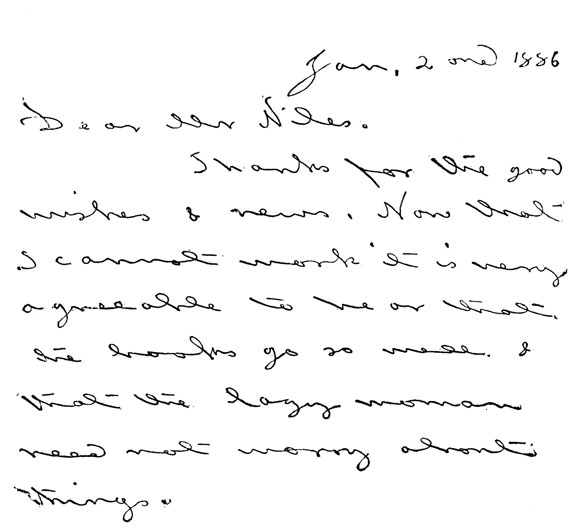
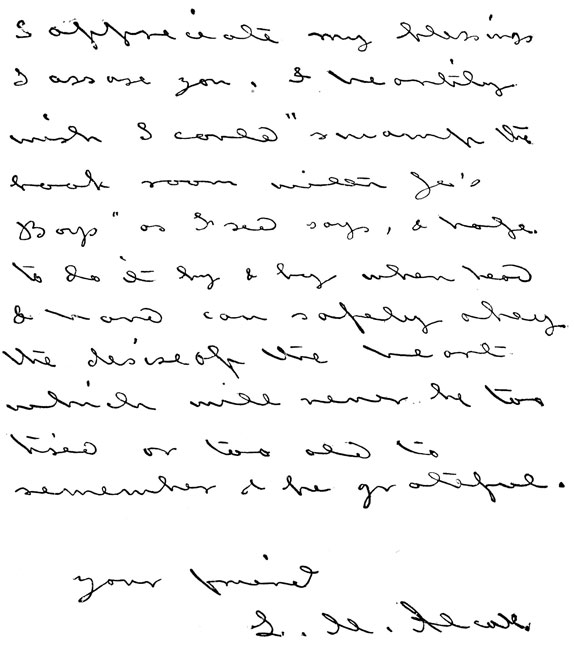
Fac-simile of Miss Alcott's Writing.
I'd like to help Mrs. L. if I could, as we know something of her, and I fancy she needs a lift. Perhaps we could use these pictures in some way if she liked to have us. Maybe I could work them into a story of our "cullud bredren."
Thanks for the books. Dear Miss –– is rather prim in her story, but it is pretty and quite correct. So different from Miss Alcott's slap-dash style.
The "H. H." book ["Ramona"] is a noble record of the great wrongs of her chosen people, and ought to wake up the sinners to repentance and justice before it is too late. It recalls the old slavery days, only these victims are red instead of black. It will be a disgrace if "H. H." gave her work and pity all in vain.
Yours truly,
L. M. A.
[1885.]
Dear Mr. Niles,–Thanks for the book which I shall like to read.
Please tell Miss N. that she will find in Sanborn's article in "St. Nicholas" or Mrs. Moulton's in the "Eminent Women" book all that I wish to have said about myself. You can add such facts about editions, etc., as you think best. I don't like these everlasting notices; one is enough, else we poor people feel like squeezed oranges, and nothing is left sacred.
George Eliot's new life and letters is well done, and we are not sorry we have read them. Mr. Cross has been a wise man, and leaves us all our love and respect instead of spoiling them as Froude did for Carlyle,
Yours truly,
L. M. A.
January 2, 1886.
Dear Mr. Niles,–Thanks for the good wishes and news. Now that I cannot work, it is very agreeable to hear that the books go so well, and that the lazy woman need not worry about things.
I appreciate my blessings, I assure you. I heartily wish I could "swamp the book-room with 'Jo's Boys,'" as Fred says, and hope to do it by and by when head and hand can safely obey the desire of the heart, which will never be too tired or too old to remember and be grateful.
Your friend,
L. M. Alcott.
Monday, a.m. [1886].
Dear Mr. Niles,–My doctor forbids me to begin a long book or anything that will need much thought this summer. So I must give up "Tragedy of To-day," as it will need a good deal of thinking to be what it ought.
I can give you a girls' book however, and I think that will be better than a novel. I have several stories done, and can easily do more and make a companion volume for "Spinning-Wheel Stories" at Christmas if you want it.
This, with the Lulu stories, will be better than the set of novels I am sure.... Wait till I can do a novel, and then get out the set in style, if Alcott is not forgotten by that time.
I was going to send Mrs. Dodge one of the tales for girls, and if there is time she might have more. But nearly all new ones would make a book go well in the holiday season. You can have those already done now if you want them. "Sophie's Secret" is one, "An Ivy Spray: or Cinderella's Slippers" another, and "Mountain Laurel" is partly done. "A Garland for Girls" might do for a title perhaps, as they are all for girls.
Yours truly,
L. M. A.
In the spring of 1886, Dr. Rhoda Lawrence took charge of Miss Alcott's health, and gave her treatment by massage and other appropriate means, from which she received benefit. The summer was spent at Concord with her father, and was varied by a pleasant trip to the mountains. Miss Alcott finished "Jo's Boys," which was published in September. She occupied herself also in looking over old journals and letters, and destroyed many things which she did not wish to have come under the public eye. She had enjoyed her life at Princeton, and said that she felt better than for fifteen years; but in August she was severely attacked with rheumatism and troubled with vertigo. She suffered very much, and was in a very nervous condition.
Miss Alcott always looked bravely and calmly upon all the possibilities of life, and she now made full preparations for the event of her own death. Her youngest nephew had always been especially beloved, and she decided to take out papers of adoption, to make him legally her son and heir. She wished him to assume the name of Alcott, and to be her representative.
Louisa's journal closes July, 1886, with the old feeling,–that she must grind away at the mill and make money to supply the many claims that press upon her from all sides. She feels the burden of every suffering human life upon her own soul. She knew that she could write what was eagerly desired by others and would bring her the means of helping those in need, and her heart and head united in urging her to work. Whether it would have been possible for her to have rested more fully, and whether she might then have worked longer and better, is one of those questions which no one is wise enough to answer. Yet the warning of her life should not be neglected, and the eager brain should learn to obey the laws of life and health while it is yet time.
In September, 1886, Miss Alcott returned to Louisburg Square, and spent the winter in the care of her father, and in the society of her sister and nephews and the darling child. She suffered much from hoarseness, from nervousness and debility, and from indigestion and sleeplessness, but still exerted herself for the comfort of all around her. She had a happy Christmas, and sympathized with the joy of her oldest nephew in his betrothal. In December she was so weary and worn that she went out to Dr. Lawrence's home in Roxbury for rest and care. She found such relief to her overtasked brain and nerves from the seclusion and quiet of Dunreath Place, that she found her home and rest there for the remainder of her life.
It was a great trial to Louisa to be apart from her family, to whom she had devoted her life. She clung to her dying father, and to the dear sister still left to her, with increasing fondness, and she longed for her boys and her child; but her tired nerves could not bear even the companionship of her family, and sometimes for days she wanted to be all alone. "I feel so safe out here!" she said once.
Mr. Alcott spent the summer at Melrose, and Louisa went there to visit him in June. In June and July, 1887, she went to Concord and looked over papers and completed the plan for adopting her nephew. She afterward went to Princeton, accompanied by Dr. Lawrence. She spent eight weeks there, and enjoyed the mountain air and scenery with something of her old delight. She was able to walk a mile or more, and took a solitary walk in the morning, which she greatly enjoyed. Her evening walk was less agreeable, because she was then exposed to the eager curiosity of sight-seers, who constantly pursued her.
Miss Alcott had a great intellectual pleasure here in the society of Mr. James Murdock and his family. The distinguished elocutionist took great pains to gratify her taste for dramatic reading by selecting her favorite scenes for representation, and she even attended one of his public readings given in the hall of the hotel. The old pain in her limbs from which she suffered during her European journey again troubled her, and she returned to Dr. Lawrence's home in the autumn, where she was tenderly cared for.
Miss Alcott was still continually planning stories. Dr. Lawrence read to her a great deal, and the reading often suggested subjects to her. She thought of a series to be called "Stories of All Nations," and had already written "Trudel's Siege," which was published in "St. Nicholas," April, 1888, the scene of which was laid at the siege of Leyden. The English story was to be called "Madge Wildfire," and she had thought of plots for others. She could write very little, and kept herself occupied and amused with fancy work, making flowers and pen-wipers of various colors, in the form of pinks, to send to her friends.
On her last birthday Louisa received a great many flowers and pleasant remembrances, which touched her deeply, and she said, "I did not mean to cry to-day, but I can't help it, everybody is so good." She went in to see her father every few days, and was conscious that he was drawing toward the end.
While riding with her friend, Louisa would tell her of the stories she had planned, one of which was to be called "The Philosopher's Wooing," referring to Thoreau. She also had a musical novel in her mind. She could not be idle, and having a respect for sewing, she busied herself with it, making garments for poor children, or helping the Doctor in her work. She insisted upon setting up a work-basket for the Doctor, amply supplied with necessary materials, and was pleased when she saw them used. A flannel garment for a poor child was the last work of her hands. Her health improved in February, especially in the comfort of her nights, as the baths she took brought her the long-desired sleep. "Nothing so good as sleep," she said. But a little too much excitement brought on violent headaches.
During these months Miss Alcott wrote part of the "Garland for Girls," one of the most fanciful and pleasing of her books. These stories were suggested by the flowers sent to her by different friends, which she fully enjoyed. She rode a great deal, but did not see any one.
Her friends were much encouraged; and although they dared not expect full recovery, they hoped that she might be "a comfortable invalid, able to enjoy life, and give help and pleasure to others." She did not suffer great pain, but she was very weak; her nervous system seemed to be utterly prostrated by the years of work and struggle through which she had passed. She said, "I don't want to live if I can't be of use." She had always met the thought of death bravely; and even the separation from her dearest friends was serenely borne. She believed in their continued presence and influence, and felt that the parting was for a little time. She had no fear of God, and no doubt of the future. Her only sadness was in leaving the friends whom she loved and who might yet need her.
A young man wrote asking Miss Alcott if she would advise him to devote himself to authorship; she answered, "Not if you can do anything else. Even dig ditches." He followed her advice, and took a situation where he could support himself, but he still continued to write stories. A little boy sent twenty-five cents to buy her books. She returned the money, telling him it was not enough to buy books, but sent him "Little Men." Scores of letters remained unanswered for want of strength to write or even to read.
Early in March Mr. Alcott failed very rapidly. Louisa drove in to see him, and was conscious that it was for the last time. Tempted by the warm spring-like day, she had made some change in her dress, and absorbed in the thought of the parting, when she got into the carriage she forgot to put on the warm fur cloak she had worn.
The next morning she complained of violent pain in her head, amounting to agony. The physician who had attended her for the last weeks was called. He felt that the situation was very serious. She herself asked, "Is it not meningitis?" The trouble on the brain increased rapidly. She recognized her dear young nephew for a moment and her friendly hostess, but was unconscious of everything else. So, at 3.30 p.m., March 6, 1888, she passed quietly on to the rest which she so much needed. She did not know that her father had already preceded her.
The friends of the family who gathered to pay their last tribute of respect and love to the aged father were met at the threshold by the startling intelligence, "Louisa Alcott is dead," and a deeper sadness fell upon every heart. The old patriarch had gone to his rest in the fulness of time, "corn ripe for the sickle," but few realized how entirely his daughter had worn out her earthly frame. Her friends had hoped for renewed health and strength, and for even greater and nobler work from her with her ripened powers and greater ease and leisure.
Miss Alcott had made every arrangement for her death; and by her own wish the funeral service was very simple, in her father's rooms at Louisburg Square, and attended only by a few of her family and nearest friends. They read her exquisite poem to her mother, her father's noble tribute to her, and spoke of the earnestness and truth of her life. She was remembered as she would have wished to be. Her body was carried to Concord and placed in the beautiful cemetery of Sleepy Hollow where her dearest ones were already laid to rest. "Her boys" went beside her as "a guard of honor," and stood around as she was placed across the feet of father, mother, and sister, that she might "take care of them as she had done all her life."
Of the silent grief of the bereaved family I will not speak, but the sound of mourning filled all the land, and was re-echoed from foreign shores. The children everywhere had lost their friend. Miss Alcott had entered into their hearts and revealed them to themselves. In her childish journal her oldest sister said, "I have not a secret from Louisa; I tell her everything, and am not afraid she will think me silly." It was this respect for the thought and life of children that gave Louisa Alcott her great power of winning their respect and affection. Nothing which was real and earnest to them seemed unimportant to her.
LAST LETTERS.
To Mr. Niles.
Sunday, 1886.
Dear Mr. Niles,–The goodly supply of books was most welcome; for when my two hours pen-work are over I need something to comfort me, and I long to go on and finish "Jo's Boys" by July 1st.
My doctor frowns on that hope, and is so sure it will do mischief to get up the steam that I am afraid to try, and keep Prudence sitting on the valve lest the old engine run away and have another smash-up.
I send you by Fred several chapters, I wish they were neater, as some were written long ago and have knocked about for years; but I can't spare time to copy, so hope the printers won't be in despair.
I planned twenty chapters and am on the fifteenth. Some are long, some short, and as we are pressed for time we had better not try to do too much.
... I have little doubt it will be done early in July, but things are so contrary with me I can never be sure of carrying out a plan, and I don't want to fail again; so far I feel as if I could, without harm, finish off these dreadful boys.
Why have any illustrations? The book is not a child's book, as the lads are nearly all over twenty, and pretty pictures are not needed. Have the bas-relief if you like, or one good thing for frontispiece.
I can have twenty-one chapters and make it the size of "Little Men." Sixteen chapters make two hundred and sixteen pages, and I may add a page here and there later,–or if need be, a chapter somewhere to fill up.
I shall be at home in a week or two, much better for the rest and fine air; and during my quiet days in C. I can touch up proofs and confer about the book. Sha'n't we be glad when it is done?
Yours truly,
L. M. A.
To Mrs. Dodge.
June 29.
Dear Mrs. Dodge,–I will evolve something for December (D. V.) and let you have it as soon as it is done.
Lu and I go to Nonquit next week; and after a few days of rest, I will fire up the old engine and see if it will run a short distance without a break-down.
There are usually about forty young people at N., and I think I can get a hint from some of them.
Had a call from Mr. Burroughs and Mr. Gilder last eve. Mr. G. asked if you were in B., but I didn't know.
Father remains comfortable and happy among his books. Our lads are making their first visit to New York, and may call on "St. Nick," whom they have made their patron saint.
I should like to own the last two bound volumes of "St. Nicholas," for Lulu. She adores the others, and they are nearly worn out with her loving but careless luggings up and down for "more towries, Aunt Wee-wee." Charge to
Yours affectionately,
L. M. A.
P. S.–Wasn't I glad to see you in my howling wilderness of wearisome domestic worrits! Come again.
Concord, August 15.
Dear Mrs. Dodge,–I like the idea of "Spinning-Wheel Stories," and can do several for a series which can come out in a book later. Old-time tales, with a thread running through all from the wheel that enters in the first one.
A Christmas party of children might be at an old farm-house and hunt up the wheel, and grandma spins and tells the first story; and being snow-bound, others amuse the young folks each evening with more tales. Would that do? The mother and child picture would come in nicely for the first tale,–"Grandma and her Mother."
Being at home and quiet for a week or so (as Father is nicely and has a capable nurse), I have begun the serial, and done two chapters; but the spinning-tales come tumbling into my mind so fast I'd better pin a few while "genius burns." Perhaps you would like to start the set Christmas. The picture being ready and the first story can be done in a week, "Sophie's Secret" can come later. Let me know if you would like that, and about how many pages of the paper "S. S." was written on you think would make the required length of tale (or tail?). If you don't want No. 1 yet, I will take my time and do several.
The serial was to be "Mrs. Gay's Summer School," and have some city girls and boys go to an old farm-house, and for fun dress and live as in old times, and learn the good, thrifty old ways, with adventures and fun thrown in. That might come in the spring, as it takes me longer to grind out yarns now than of old.
Glad you are better. Thanks for kind wishes for the little house; come and see it, and gladden the eyes of forty young admirers by a sight of M. M. D. next year.
Yours affectionately,
L. M. A.
31 Chestnut St., December 31.
Dear Mrs. Dodge,–A little cousin, thirteen years old, has written a story and longs to see it in print. It is a well written bit and pretty good for a beginner, so I send it to you hoping it may find a place in the children's corner. She is a grandchild of S. J. May, and a bright lass who paints nicely and is a domestic little person in spite of her budding accomplishments. Good luck to her!
I hoped to have had a Christmas story for some one, but am forbidden to write for six months, after a bad turn of vertigo. So I give it up and take warning. All good wishes for the New Year.
From yours affectionately,
L. M. Alcott.
To Mr. Niles.
1886.
Dear Mr. Niles,–Sorry you don't like the bas-relief [of herself]; I do. A portrait, if bright and comely, wouldn't be me, and if like me would disappoint the children; so we had better let them imagine "Aunt Jo young and beautiful, with her hair in two tails down her back," as the little girl said.
In haste,
L. M. A.
To Mrs. Bond.
Concord, Tuesday, 1886.
Dear Auntie,–I want to find Auntie Gwinn, and don't know whom to ask but you, as your big motherly heart yearns over all the poor babies, and can tell them where to go when the nest is bare. A poor little woman has just died, leaving four children to a drunken father. Two hard-working aunts do all they can, and one will take the oldest girl. We want to put the two small girls and boy into a home till we can see what comes next. Lulu clothes one, and we may be able to put one with a cousin. But since the mother died last Wednesday they are very forlorn, and must be helped. If we were not so full I'd take one; but Lu is all we can manage now.
There is a home at Auburndale, but it is full; and I know of no other but good Auntie Gwinn's. What is her address, please? I shall be in town on Saturday, and can go and see her if I know where.
Don't let it be a bother; but one turns at once in such cases to the saints for direction, and the poor aunts don't know what to do; so this aunt comes to the auntie of all.
I had a pleasant chat with the Papa in the cars, and was very glad to hear that W. is better. My love to both and S.
Thanks for the news of portraits. I'll bear them in mind if G. H. calls. Lulu and Anna send love, and I am as always,
Your
Louisa Alcott.
To Mrs. Dodge.
April 13, 1886.
Dear Mrs. Dodge,–I am glad you are going to have such a fine outing. May it be a very happy one.
I cannot promise anything, but hope to be allowed to write a little, as my doctor has decided that it is as well to let me put on paper the tales "knocking at the saucepan lid and demanding to be taken out" (like Mrs. Cratchit's potatoes), as to have them go on worrying me inside. So I'm scribbling at "Jo's Boys," long promised to Mr. Niles and clamored for by the children. I may write but one hour a day, so cannot get on very fast; but if it is ever done, I can think of a serial for "St. Nicholas." I began one, and can easily start it for '88, if head and hand allow. I will simmer on it this summer, and see if it can be done. Hope so, for I don't want to give up work so soon.
I have read "Mrs. Null," but don't like it very well,–too slow and colorless after Tolstoi's "Anna Karenina."
I met Mr. and Mrs. S. at Mrs. A.'s this winter. Mr. Stockton's child-stories I like very much. The older ones are odd but artificial.
Now, good-by, and God be with you, dear woman, and bring you safely home to us all.
Affectionately yours,
L. M. Alcott.
To Mrs. Bond.
Dunreath Place, Roxbury, March 15, 1887
Dear Auntie,–I have been hoping to get out and see you all winter, but have been so ill I could only live on hope as a relish to my gruel,–that being my only food, and not of a nature to give me strength. Now I am beginning to live a little, and feel less like a sick oyster at low tide. The spring days will set me up I trust, and my first pilgrimage shall be to you; for I want you to see how prettily my May-flower is blossoming into a fine off-shoot of the old plant.
Lizzy Wells has probably told you our news of Fred and his little bride, and Anna written you about it as only a proud mamma can.
Father is very comfortable, but says sadly as he looks up from his paper, "Beecher has gone now; all go but me." Please thank Mr. Bond for the poems, which are interesting, even to a poor, ignorant worm who does not know Latin. Mother would have enjoyed them very much. I should have acknowledged his kindness sooner; but as I am here in Roxbury my letters are forwarded, and often delayed.
I was sorry to hear that you were poorly again. Isn't it hard to sit serenely in one's soul when one's body is in a dilapidated state? I find it a great bore, but try to do it patiently, and hope to see the why by and by, when this mysterious life is made clear to me. I had a lovely dream about that, and want to tell it you some day.
Love to all.
Ever yours,
L. M. A.
Her publisher wished to issue a new edition of "A Modern Mephistopheles," and to add to it her story "A Whisper in the Dark," to which she consented.
May 6, 1887.
Dear Mr. Niles.–This is about what I want to say. You may be able to amend or suggest something. I only want it understood that the highfalutin style was for a disguise, though the story had another purpose; for I'm not ashamed of it, and like it better than "Work" or "Moods."
Yours in haste,
L. M. A.
P. S.–Do you want more fairy tales?
Preface.
"A Modern Mephistopheles" was written among the earlier volumes of the No Name Series, when the chief idea of the authors was to puzzle their readers by disguising their style as much as possible, that they might enjoy the guessing and criticism as each novel appeared. This book was very successful in preserving its incognito; and many persons still insist that it could not have been written by the author of "Little Women." As I much enjoyed trying to embody a shadow of my favorite poem in a story, as well as the amusement it has afforded those in the secret for some years, it is considered well to add this volume to the few romances which are offered, not as finished work by any means, but merely attempts at something graver than magazine stories or juvenile literature.
L. M. Alcott.
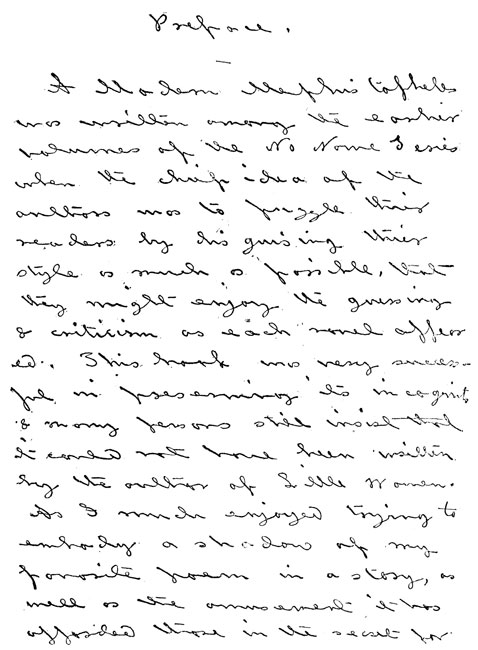
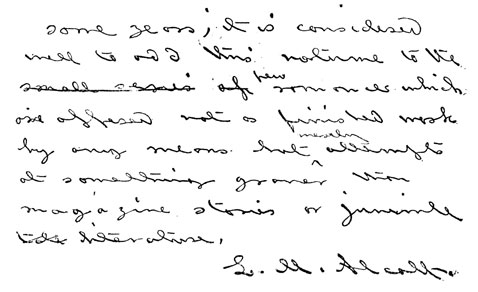
Fac-simile of Preface to "A Modern Mephistopheles."
Saturday a.m., May 7, 1887.
Dear Mr. Niles,–Yours just come. "A Whisper" is rather a lurid tale, but might do if I add a few lines to the preface of "Modern Mephistopheles," saying that this is put in to fill the volume, or to give a sample of Jo March's necessity stories, which many girls have asked for. Would that do?
It seems to me that it would be better to wait till I can add a new novel, and then get out the set. Meantime let "Modern Mephistopheles" go alone, with my name, as a summer book before Irving comes [Irving as Faust].
I hope to do "A Tragedy of To-day" this summer, and it can come out in the fall or next spring, with "Modern Mephistopheles," "Work," and "Moods."
A spunky new one would make the old ones go. "Hospital Sketches" is not cared for now, and is filled up with other tales you know....
Can that plan be carried out? I have begun my tragedy, and think it will be good; also a shorter thing called "Anna: An Episode," in which I do up Boston in a jolly way, with a nice little surprise at the end. It would do to fill up "Modern Mephistopheles," as it is not long, unless I want it to be.
I will come in next week and see what can be done.
Yours truly,
L. M. A.
To Mrs. Bond.
Sunday, Oct. 16, [1887].
Dear Auntie,–As you and I belong to the "Shut-in Society," we may now and then cheer each other by a line. Your note and verse are very good to me to-day, as I sit trying to feel all right in spite of the stiffness that won't walk, the rebel stomach that won't work, and the tired head that won't rest.
My verse lately has been from the little poem found under a good soldier's pillow in the hospital.
I am no longer eager, bold, and strong,– All that is past; I am ready not to do At last–at last. My half-day's work is done, And this is all my part. I give a patient God My patient heart.
The learning not to do is so hard after being the hub to the family wheel so long. But it is good for the energetic ones to find that the world can get on without them, and to learn to be still, to give up, and wait cheerfully.
As we have "fell into poetry," as Silas Wegg says, I add a bit of my own; for since you are Marmee now, I feel that you won't laugh at my poor attempts any more than she did, even when I burst forth at the ripe age of eight.
Love to all the dear people, and light to the kind eyes that have made sunshine for others so many years.
Always your
Lu.
To Mrs. Bond, with first copy of "Lulu's Library," second volume.
October, 1887.
Dear Auntie,–I always gave Mother the first author's copy of a new book. As her representative on earth, may I send you, with my love, the little book to come out in November?
The tales were told at sixteen to May and her playmates; then are related to May's daughter at five; and for the sake of these two you may care to have them for the little people.
I am still held by the leg, but seem to gain a little, and hope to be up by and by. Slow work, but part of the discipline I need, doubtless; so I take it as well as I can.
You and I won't be able to go to the golden wedding of S. J. May. I have been alone so long I feel as if I'd like to see any one, and be in the good times again. L. W. reports you as "nicely, and sweet as an angel;" so I rejoice, and wish I could say the same of
Your loving
Lu.
To Mrs. Dodge.
December 22, 1887.
Dear Mrs. Dodge,–I send you the story your assistant editor asked for. As it is needed at once I do not delay to copy it, for I can only write an hour a day and do very little. You are used to my wild manuscript, and will be able to read it. I meant to have sent the Chinese tale, but this was nearly done, and so it goes, as it does not matter where we begin.... I hope you are well, and full of the peace which work well done gives the happy doer.
I mend slowly, but surely, and my good Doctor says my best work is yet to come; so I will be content with health if I can get it. With all good wishes,
Yours affectionately,
L. M. A.
To Mrs. Bond.
February 7 [1888].
Dear Auntie,–My blessed Anna is so busy, and I can do so little to help her, I feel as if I might take upon me the pleasant duty of writing to you.
Father is better, and we are all so grateful, for just now we want all to be bright for our boy.
The end is not far off, but Father rallies wonderfully from each feeble spell, and keeps serene and happy through everything.
I don't ask to keep him now that life is a burden, and am glad to have him go before it becomes a pain. We shall miss the dear old white head and the feeble saint so long our care; but as Anna says, "He will be with Mother." So we shall be happy in the hope of that meeting.
Sunday he seemed very low, and I was allowed to drive in and say "good-by." He knew me and smiled, and kissed "Weedy," as he calls me, and I thought the drowsiness and difficulty of breathing could not last long. But he revived, got up, and seemed so much as usual, I may be able to see him again. It is a great grief that I am not there as I was with Lizzie and Mother, but though much better, the shattered nerves won't bear much yet, and quiet is my only cure.
I sit alone and bless the little pair like a fond old grandmother. You show me how to do it. With love to all,
Yours ever,
Lu.
Her last note. To Mrs. Bond.
February 8, 1888.
Air,–"Haste to the Wedding."
Dear Auntie,–I little knew what a sweet surprise was in store for me when I wrote to you yesterday.
As I awoke this morning my good Doctor L. came in with the lovely azalea, her round face beaming through the leaves like a full moon.
It was very dear of you to remember me, and cheer up my lonely day with such a beautiful guest.
It stands beside me on Marmee's work-table, and reminds me tenderly of her favorite flowers; and among those used at her funeral was a spray of this, which lasted for two weeks afterward, opening bud after bud in the glass on her table, where lay the dear old "Jos. May" hymn book, and her diary with the pen shut in as she left it when she last wrote there, three days before the end, "The twilight is closing about me, and I am going to rest in the arms of my children."
So you see I love the delicate flower, and enjoy it very much.
I can write now, and soon hope to come out and see you for a few minutes, as I drive out every fine day, and go to kiss my people once a week for fifteen minutes.
Slow climbing, but I don't slip back; so think up my mercies, and sing cheerfully, as dear Marmee used to do, "Thus far the Lord has led me on!"
Your loving
Lu.
CHAPTER XII.
CONCLUSION.
TO MY FATHER,
ON HIS EIGHTY-SIXTH BIRTHDAY.
Dear Pilgrim, waiting patiently, The long, long journey nearly done, Beside the sacred stream that flows Clear shining in the western sun; Look backward on the varied road Your steadfast feet have trod, From youth to age, through weal and woe, Climbing forever nearer God. Mountain and valley lie behind; The slough is crossed, the wicket passed; Doubt and despair, sorrow and sin, Giant and fiend, conquered at last. Neglect is changed to honor now; The heavy cross may be laid down; The white head wins and wears at length The prophet's, not the martyr's, crown. Greatheart and Faithful gone before, Brave Christiana, Mercy sweet, Are Shining Ones who stand and wait The weary wanderer to greet. Patience and Love his handmaids are, And till time brings release, Christian may rest in that bright room Whose windows open to the east. The staff set by, the sandals off, Still pondering the precious scroll, Serene and strong, he waits the call That frees and wings a happy soul. Then, beautiful as when it lured The boy's aspiring eyes, Before the pilgrim's longing sight Shall the Celestial City rise. November 29, 1885.L. M. A.
MISS ALCOTT'S appearance was striking and impressive rather than beautiful. Her figure was tall and well-proportioned, indicating strength and activity, and she walked with freedom and majesty. Her head was large, and her rich brown hair was long and luxuriant, giving a sense of fulness and richness of life to her massive features. While thoroughly unconventional, and even free and easy in her manner, she had a dignity of deportment which prevented undue liberties, and made intruders stand in awe of her. Generous in the extreme in serving others, she knew her own rights, and did not allow them to be trampled on. She repelled "the spurns that patient merit of the unworthy takes," and had much of the Burns spirit that sings "A man's a man for a' that" in the presence of insolent grandeur.
Miss Alcott always took her stand not for herself, but for her family, her class, her sex. The humblest writer should not be imposed upon in her person; every woman should be braver and stronger from her attitude. She was careless of outward distinctions; but she enjoyed the attentions which her fame brought her with simple pleasure, and was delighted to meet bright, intelligent, distinguished people, who added to her stores of observation and thought. She had the rare good fortune, which an heir of millions might envy, of living all her life in the society of the noblest men and women. The Emersons, the Thoreaus, the Hawthornes, and Miss Elizabeth Peabody were the constant companions of her childhood and youth. It was from them that her standard of character was formed, and she could never enter any circle higher than that in which she had breathed freely from a child. She was quite capable of hero-worship, but her heroes were few.
With all her imagination and romance, Miss Alcott was a tremendous destroyer of illusions; she remorselessly tore them away from herself, persisting in holding a lens before every fault and folly of her own, and she did the same for those she loved best. Only what was intrinsically noble and true could stand the searching test of her intellectual scrutiny and keen perception of the incongruous and ridiculous.
This disposition was apparent in Louisa's relation to her father, whom she did not always fully understand. Perhaps he had a perception of this when he wrote–
"I press thee to my heart, as Duty's faithful child."
She had little sympathy with his speculative fancy, and saw plainly the impracticability of his schemes, and did not hesitate to touch with light and kindly satire his little peculiarities; yet in her deepest heart she gave him not only affection, but deep reverence. She felt the nobility and grandeur of his mind and heart. In "Little Women" the portrait of the father is less vivid and less literal than that of any other member of the family, and is scarcely recognizable; but it was impossible to make the student and idealist a part of the family life as she painted it,–full of fun, frolic, and adventure. In the second part she has taken pains to make up for this seeming neglect, and pays homage to the quiet man at the end of the house, whose influence was so potent and so sweet over all within it.
Mrs. Alcott was a rich and noble nature, full of zeal and impulse, daily struggling with a temper threatening to burst out into fire, ready to fight like a lioness for her young, or to toil for them till Nature broke down under the burden. She had a rich appreciation of heroism and beauty in all noble living, a true love of literature, and an overflowing sympathy with all suffering humanity, but was also capable of righteous indignation and withering contempt. To this mother, royal in her motherhood, Louisa was bound by the closest ties of filial love and mutual understanding. She early believed herself to be her mother's favorite child, knew she was close to her heart, her every struggle watched, her every fault rebuked, every aspiration encouraged, every effort after good recognized. I think Louisa felt no pride in this preference. She knew that she was dear to her mother, because her stormy, wayward heart was best understood by her; and hence the mother, wiser for her child than for herself, watched her unfolding life with anxious care. Throughout the childish journal this relation is evident: the child's heart lies open to the mother, and the mother can help her because she understands her, and holds sacred every cry of her heart.
Such a loving relation to a mother–so rich, so full, so enduring–was the greatest possible blessing to her life. And richly did Louisa repay the care. From her earliest years she was her mother's confidante, friend, and comforter. Her dream of success was not of fame and glory, but of the time when she could bring this weary pilgrim into "that chamber whose name is Peace," and there bid her sit with folded hands, listening to the loving voices of her children, and drinking in the fulness of life without care or anxiety.
And it all came true, like the conclusion of a fairy story; for good fairies had been busy at work for many years preparing the way. Who that saw that mother resting from her labors, proud in her children's success, happy in her husband's contentment, and in the love that had never faltered in the darkest days, can ever forget the peace of her countenance, the loving joy of her heart?
The relation of Miss Alcott to her older sister was of entire trust and confidence. Anna inherited the serene, unexacting temper of her father, with much of the loving warmth of her mother. She loved to hide behind her gifted sister, and to keep the ingle-side warm for her to retreat to when she was cold and weary. Anna's fine intellectual powers were shown more in the appreciation of others than in the expression of herself; her dramatic skill and her lively fancy, combined with her affection for Louisa, made her always ready to second all the plans for entertainment or benevolence. She appears in her true light in the sweet, lovable Meg of "Little Women;" and if she never had the fame and pecuniary success of her sister, she had the less rare, but equally satisfying, happiness of wifehood and motherhood. And thus she repaid to Louisa what she had so generously done for the family, by giving her new objects of affection, and connecting her with a younger generation.
Louisa was always very fond of boys, and the difference of nature gave her an insight into their trials and difficulties without giving her a painful sense of her own hard struggles. In her nephews she found objects for all her wise and tender care, which they repaid with devoted affection. When boys became men, "they were less interesting to her; she could not understand them."
Elizabeth was unlike the other sisters. Retiring in disposition, she would gladly have ever lived in the privacy of home, her only desire being for the music that she loved. The father's ideality was in her a tender religious feeling; the mother's passionate impulse, a self-abnegating affection. She was in the family circle what she is in the book,–a strain of sweet, sad music we long and love to hear, and yet which almost breaks the heart with its forecasting of separation. She was very dear to both the father and mother, and the picture of the father watching all night by the marble remains of his child is very touching. He might well say,–
"Ah, me! life is not life deprived of thee."
Of the youngest of all,–bright, sparkling, capricious May,–quick in temper, quick in repentance, affectionate and generous, but full of her own plans, and quite inclined to have the world go on according to her fancies,–I have spoken elsewhere. Less profound in her intellectual and religious nature than either of her sisters, she was like a nymph of Nature, full of friendly sportiveness, and disposed to live out her own life, since it might be only a brief summer day. She was Anna's special child, and Louisa was not always so patient with her as the older sister; yet how well Louisa understood her generous nature is shown by the beautiful sketch she has made of her in "Little Women." She was called the lucky one of the family, and she reaped the benefit of her generous sister's labors in her opportunities of education.
Miss Alcott's literary work is so closely interwoven with her personal life that it needs little separate mention. Literature was undoubtedly her true pursuit, and she loved and honored it. That she had her ambitious longings for higher forms of art than the pleasant stories for children is evident from her journals, and she twice attempted to paint the life of mature men and women struggling with great difficulties. In "Moods" and "A Modern Mephistopheles" we have proof of her interest in difficult subjects. I have spoken of them in connection with her life; but while they evince great power, and if standing alone would have stamped her as an author of original observation and keen thought, they can hardly be considered as thoroughly successful, and certainly have not won the sanction of the public like "Hospital Sketches" and "Little Women." Could she ever have commanded quiet leisure, with a tolerable degree of health, she might have wrought her fancies into a finer fabric, and achieved the success she aimed at.
Much as Miss Alcott loved literature, it was not an end in itself to her, but a means. Her heart was so bound up in her family,–she felt it so fully to be her sacred mission to provide for their wants,–that she sacrificed to it all ambitious dreams, health, leisure,–everything but her integrity of soul. But as "he that loseth his life shall find it," she has undoubtedly achieved a really greater work than if she had not had this constant stimulus to exertion. In her own line of work she is unsurpassed. While she paints in broad, free strokes the life of her own day, represented mostly by children and young people, she has always a high moral purpose, which gives strength and sweetness to the delineation; yet one never hears children complain of her moralizing,–it is events that reveal the lesson she would enforce. Her own deep nature shines through all the experiences of her characters, and impresses upon the children's hearts a sense of reality and truth. She charms them, wisely, to love the common virtues of truth, unselfishness, kindness, industry, and honesty. Dr. Johnson said children did not want to hear about themselves, but about giants and fairies; but while Miss Alcott could weave fairy fancies for them, they are quite as pleased with her real boys and girls in the plainest of costumes.
An especial merit of these books for young boys and girls is their purity of feeling. The family affection which was so predominant in the author's own life, always appears as the holiest and sweetest phase of human nature. She does not refuse to paint the innocent love and the happy marriage which it is natural for every young heart to be interested in, but it is in tender, modest colors. She does not make it the master and tyrant of the soul, nor does she ever connect it with sensual imagery; but it appears as one of "God's holy ordinances,"–natural and beautiful,–and is not separated from the thought of work and duty and self-sacrifice for others. No mother fears that her books will brush the bloom of modesty from the faces of her young men or maidens.
Even in the stories of her early period of work for money, which she wisely renounced as trash, while there is much that is thoroughly worthless as art, and little that has any value, Miss Alcott never falls into grossness of thought or baseness of feeling. She is sentimental, melodramatic, exaggerated, and unreal in her descriptions, but the stories leave no taint of evil behind them. Two of these stories, "The Baron's Gloves" and "A Whisper in the Dark," have been included in her published works, with her permission. Her friends are disposed to regret this, as they do not add to her reputation; but at least they serve to show the quality of work which she condemned so severely, and to satisfy the curiosity of readers in regard to it. It would be easy to point out defects in her style, and in some of her books there is evidence of the enforced drudgery of production, instead of the spontaneous flow of thought. The most serious defect is in her style of expression, which certainly passes the fine line between colloquial ease and slang; it is her own natural, peculiar style, which appears in her journals and letters. That it is attractive to children is certain, but it offends the taste of those who love purity and elegance of speech. It does not appear in Louisa's more ambitious novels; here she sometimes falls into the opposite extreme of labored and stilted expression. But much of these books is written in a pure and beautiful style, showing that she could have united ease with elegance if she had not so constantly worked at high speed and with little revision. She was a great admirer of Dickens's writings; and although she has never imitated him, she was perhaps strengthened in her habit of using dashing, expressive language by so fascinating a model.
I have placed at the head of each chapter one of Miss Alcott's own poems, usually written at the period of which the chapter treats, and characteristic of her life at that time. Her first literary essay was the "Little Robin." But although her fond mother saw the future of a great poet in these simple verses, Louisa never claimed the title for herself. Her thoughts ran often into rhyme, and she sent many birthday and Christmas verses to her friends and especially to her father. They are usually playful. She always wrote to express some feeling of the hour, and I find no objective or descriptive poetry. But a few of her sacred poems, for we may certainly call them so, are very tender and beautiful, and deserve a permanent place among the poems of feeling,–those few poems which a true heart writes for itself. "Thoreau's Flute" was originally published in the "Atlantic Monthly." It is the least personal of her poems. The lines to her father on his eighty-sixth birthday, the verses dedicated to her mother, and "My Prayer," the last poem that she wrote, breathe her deepest religious feeling in sweet and fitting strains. They will speak to the hearts of many in the hours of trial which are common to humanity. The long playful poem called "The Lay of the Golden Goose" was sent home from Europe as an answer to many questions from her admirers and demands for new stories. It has never been published, and is an interesting specimen of her playful rhyming.
While to Miss Alcott cannot be accorded a high rank as a poet,–which, indeed, she never claimed for herself,–it would be hard to deny a place in our most select anthology to "Thoreau's Flute" or "Transfiguration," the "Lines to my Father on his Eighty-sixth Birthday" and "My Prayer." I have therefore thought it well to preserve her best poems in connection with her life, where they properly belong; for they are all truly autobiographical, revealing the inner meaning of her life.
The pecuniary success of Miss Alcott's books enabled her to carry out her great purpose of providing for the comfort and happiness of her family. After the publication of "Little Women," she not only received a handsome sum for every new story, but there was a steady income from the old ones. Her American publishers estimate that they "have sold of her various works a million volumes, and that she realized from them more than two hundred thousand dollars." While her own tastes were very simple, her expenses were large, for she longed to gratify every wish of those she loved, and she gave generously to every one in need. She had a true sense of the value of money. Her early poverty did not make her close in expending it, nor her later success lavish. She never was enslaved by debt or corrupted by wealth. She always held herself superior to her fortune, and made her means serve her highest purposes.
Of Miss Alcott's own reading she says:–
"Never a student, but a great reader. R. W. E. gave me Goethe's works at fifteen, and they have been my delight ever since. My library consists of Goethe, Emerson, Shakespeare, Carlyle, Margaret Fuller, and George Sand. George Eliot I don't care for, nor any of the modern poets but Whittier; the old ones–Herbert, Crashaw, Keats, Coleridge, Dante, and a few others–I like."
She gives this account of the beginning of her literary career:–
"This gem ['The Robin'] my proud mother preserved with care, assuring me that if I kept on in this way I might be a second Shakespeare in time. Fired with this modest ambition, I continued to write poems upon dead butterflies, lost kittens, the baby's eyes, and other simple subjects till the story-telling mania set in; and after frightening my sisters out of their wits by awful tales whispered in bed, I began to write down these histories of giants, ogres, dauntless girls, and magic transformations till we had a library of small paper-covered volumes illustrated by the author. Later the poems grew gloomy and sentimental, and the tales more fanciful and less tragic, lovely elves and spirits taking the places of the former monsters."
Of her method of work she says:–
"I never had a study. Any pen and paper do, and an old atlas on my knee is all I want. Carry a dozen plots in my head, and think them over when in the mood. Sometimes keep one for years, and suddenly find it all ready to write. Often lie awake and plan whole chapters word for word, then merely scribble them down as if copying.
"Used to sit fourteen hours a day at one time, eating little, and unable to stir till a certain amount was done.
"Very few stories written in Concord; no inspiration in that dull place. Go to Boston, hire a quiet room and shut myself up in it."
The following letter gives her advice to young writers:–
To Mr. J. P. True.
Concord, October 24.
Dear Sir,–I never copy or "polish," so I have no old manuscripts to send you; and if I had it would be of little use, for one person's method is no rule for another. Each must work in his own way; and the only drill needed is to keep writing and profit by criticism. Mind grammar, spelling, and punctuation, use short words, and express as briefly as you can your meaning. Young people use too many adjectives and try to "write fine." The strongest, simplest words are best, and no foreign ones if it can be helped.
Write, and print if you can; if not, still write, and improve as you go on. Read the best books, and they will improve your style. See and hear good speakers and wise people, and learn of them. Work for twenty years, and then you may some day find that you have a style and place of your own, and can command good pay for the same things no one would take when you were unknown.
I know little of poetry, as I never read modern attempts, but advise any young person to keep to prose, as only once in a century is there a true poet; and verses are so easy to do that it is not much help to write them. I have so many letters like your own that I can say no more, but wish you success, and give you for a motto Michael Angelo's wise words: "Genius is infinite patience."
Your friend,
L. M. Alcott.
P. S.–The lines you send are better than many I see; but boys of nineteen cannot know much about hearts, and had better write of things they understand. Sentiment is apt to become sentimentality; and sense is always safer, as well as better drill, for young fancies and feelings.
Read Ralph Waldo Emerson, and see what good prose is, and some of the best poetry we have. I much prefer him to Longfellow.
"Years afterward," says Mr. True, "when I had achieved some slight success, I once more wrote, thanking her for her advice; and the following letter shows the kindliness of heart with which she extended ready recognition and encouragement to lesser workers in her chosen field:"–
Concord, Sept. 7, 1883.
My Dear Mr. True,–Thanks for the pretty book, which I read at once and with pleasure; for I still enjoy boys' pranks as much as ever.
I don't remember the advice I gave you, and should judge from this your first story that you did not need much. Your boys are real boys; and the girls can run,–which is a rare accomplishment nowadays I find. They are not sentimental either; and that is a good example to set both your brother writers and the lasses who read the book.
I heartily wish you success in your chosen work, and shall always be glad to know how fast and how far you climb on the steep road that leads to fame and fortune.
Yours truly,
L. M. Alcott.
Roberts Brothers, Miss Alcott's publishers for nearly twenty years, have collected all her stories in a uniform edition of twenty-five volumes. They are grouped into different series according to size and character, from her novels to "Lulu's Library" for very small children, and may be enumerated as follows:–
Novels (four volumes).–Work, Moods, A Modern Mephistopheles, Hospital Sketches.
Little Women Series (eight volumes).–Little Women, An Old-Fashioned Girl, Little Men, Eight Cousins, Rose in Bloom, Under the Lilacs, Jack and Jill, Jo's Boys.
Spinning-Wheel Stories Series (four volumes).–Silver Pitchers, Proverb Stories, Spinning-Wheel Stories, A Garland for Girls.
Aunt Jo's Scrap-Bag (six volumes).–My Boys, Shawl-Straps, Cupid and Chow-Chow, My Girls, Jimmy's Cruise in the Pinafore, An Old-Fashioned Thanksgiving.
Lulu's Library (three volumes).
Many of these stories were originally published in various magazines,–the popular "St Nicholas," for which Miss Alcott wrote some of her best things in her later years, the "Youth's Companion," and others. Her works have been republished in England; and through her English publishers, Messrs. Sampson Low and Company, of London, she has reaped the benefit of copyright there, and they have been translated into many languages. Her name is familiar and dear to the children of Europe, and they still read her books with the same eagerness as the children of her own land.
This extract from a letter written by the translator of Miss Alcott's books into Dutch will show how she is esteemed in Holland:–
"Miss Alcott was and is so much beloved here by her books, that you could scarce find a girl that had not read one or more of them. Last autumn I gave a translation of 'Lulu's Library' that appeared in November, 1887; the year before, a collection of tales and Christmas stories that appeared under the name of 'Gandsbloempje' ('Dandelion'). Yesterday a young niece of mine was here, and said, 'Oh, Aunt, how I enjoyed those stories! but the former of "Meh Meh" I still preferred.' A friend wrote: 'My children are confined to the sickroom, but find comfort in Alcott's "Under the Lilacs."' Her fame here was chiefly caused by her 'Little Women' and 'Little Women Wedded,' which in Dutch were called 'Under Moedervleugels' ('Under Mother's Wings') and 'Op Eigen Wieken' ('With Their Own Wings'). Her 'Work' was translated as 'De Hand van den Ploey' ('The Hand on the Plough')."
How enduring the fame of Louisa M. Alcott will be, time only can show; but if to endear oneself to two generations of children, and to mould their minds by wise counsel in attractive form entitle an author to the lasting gratitude of her country, that praise and reward belong to Louisa May Alcott.
TERMINUS. It is time to be old, To take in sail: The god of bounds, Who sets to seas a shore, Came to me in his fatal rounds, And said, "No more! No farther shoot Thy broad ambitious branches, and thy root; Fancy departs: no more invent, Contract thy firmament To compass of a tent. There's not enough for this and that, Make thy option which of two; Economize the failing river, Not the less revere the Giver; Leave the many, and hold the few. Timely wise, accept the terms; Soften the fall with wary foot; A little while Still plan and smile. And, fault of novel germs, Mature the unfallen fruit."
As the bird trims her to the gale, I trim myself to the storm of time; I man the rudder, reef the sail, Obey the voice at eve obeyed at prime: Lowly faithful, banish fear, Right onward drive unharmed; The port, well worth the cruise, is near, And every wave is charmed. Emerson.
LOUISA M. ALCOTT'S WRITINGS.
Miss Alcott is really a benefactor of households.–H. H.
Miss Alcott has a faculty of entering into the lives and feelings of children that is conspicuously wanting in most writers who address them; and to this cause, to the consciousness among her readers that they are hearing about people like themselves, instead of abstract qualities labelled with names, the popularity of her books is due.–Mrs. Sarah J. Hale.
Dear Aunt Jo! You are embalmed in the thoughts and loves of thousands of little men and women.–Exchange.
Little Women; or Meg, Jo, Beth, and Amy. With illustrations. 16mo $1.50
Hospital Sketches, and Camp and Fireside Stories. With illustrations. 16mo 1.50
An Old-Fashioned Girl. With illustrations. 16mo 1.50
Little Men: Life at Plumfield with Jo's Boys. With illustrations. 16mo 1.50
Jo's Boys and How they Turned Out. A sequel to "Little Men." With portrait of "Aunt Jo." 16mo 1.50
Eight Cousins; or, The Aunt-Hill. With illustrations. 16mo 1.50
Rose in Bloom. A sequel to "Eight Cousins." 16mo 1.50
Under the Lilacs. With illustrations. 16mo 1.50
Jack and Jill. A Village Story. With illustrations. 16mo 1.50
Work: A Story of Experience. With character illustrations by Sol Eytinge. 16mo 1.50
Moods. A Novel. New edition, revised and enlarged. 16mo 1.50
A Modern Mephistopheles, and A Whisper in the Dark. 16mo 1.50
Silver Pitchers, and Independence. A Centennial Love Story. 16mo 1.25
Proverb Stories. New edition, revised and enlarged. 16mo 1.25
Spinning-Wheel Stories. With illustrations. 16mo 1.25
A Garland for Girls, and Other Stories. With illustrations. 16mo 1.25
My Boys, &c. First volume of Aunt Jo's Scrap-Bag. 16mo 1.00
Shawl-Straps. Second volume of Aunt Jo's Scrap-Bag. 16mo 1.00
Cupid and Chow-Chow, &c. Third volume of Aunt Jo's Scrap-Bag. 16mo 1.00
My Girls, &c. Fourth volume of Aunt Jo's Scrap-Bag. 16mo 1.00
Jimmy's Cruise in the Pinafore, &c. Fifth volume of Aunt Jo's Scrap-Bag. 16mo 1.00
An Old-Fashioned Thanksgiving, &c. Sixth volume of Aunt Jo's Scrap-Bag. 16mo 1.00
Little Women. Illustrated. Embellished with nearly 200 characteristic illustrations from original designs drawn expressly for this edition of this noted American Classic. One small quarto, bound in cloth, with emblematic designs 2.50
Little Women Series. Comprising Little Women; Little Men; Eight Cousins; Under the Lilacs; An Old-Fashioned Girl; Jo's Boys; Rose in Bloom; Jack and Jill. 8 large 16mo volumes in a handsome box 12.00
Miss Alcott's novels in uniform binding in sets. Moods; Work; Hospital Sketches; A Modern Mephistopheles, and A Whisper in the Dark. 4 volumes. 16mo 6.00
Lulu's Library. Vols. I., II., III. A collection of New Stories. 16mo 3.00
These books are for sale at all bookstores, or will be mailed, post-paid, on receipt of price, to any address.
LITTLE, BROWN, AND COMPANY, Boston.
LOUISA M. ALCOTT,
HER LIFE, LETTERS, AND JOURNALS
Edited by EDNAH D. CHENEY.
With Portraits and View of the Alcott Home in Concord. One vol. 16mo. Uniform with "Little Women." Price, $1.50.
Mrs. Cheney has allowed this popular author to tell the story of her early struggles, her successes, and prosperity and life work, in her own inimitable style, gracefully weaving the daily record of this sweet and useful life into a garland of immortelles, in a manner at once pleasing and within the comprehension of the thousands of readers and admirers of Miss Alcott's books. It might truly be called the biography of "Little Women."
A most fascinating as well as a deeply pathetic book. The story,–the long, hard struggle for money to keep the household in comfort, and the well-earned success coming, alas, too late to save her health,–is delightfully told in her own words, from letters and journals, so that we have the bright, the witty, and the always charming personality of the children's author before us from the first page to the last. We have to thank Mrs. Cheney that she hid not from us the hard, grinding toil, nor spared us the record of one discouragement in the life so interesting to us; for in this narrative we have a valuable lesson for the young writer of our day.–The Epoch.
One who knew Miss Alcott well says: "Nobody can read of the struggles of the Alcott family, and of the tender yet resolute heroism with which Miss Alcott met and relieved them, without being touched to tears by the pathos and reality of the picture. Louisa Alcott was not a member of any church; but her belief in God, her loyalty to conscience, her fidelity to duty, her rescue of the Alcott family from its peculiar perils, place her among the women saints of the century, and it will be hard to find any one of her sex who has more faithfully responded to the duties of the position in which God had placed her."–Cincinnati Commercial Gazette.
Louisa May Alcott is without a rival as a writer for the young. The millions who have read her stories–and been made better by the reading–will want this book that they may get near the inner life, the fruitful source of their entertainment and profit. They will see that purity, simplicity, love, earnestness, and patience were so interwoven with her genius that her stories were the natural outgrowth of her beautiful character. The book needs no commendation from us. Every reader of her stories will be glad to know that they may now become intimately acquainted with that beautiful life which is here brought out of its long cherished seclusion.–Saturday Evening Herald.
LITTLE, BROWN, AND COMPANY, BOSTON.
"Sing, Tessa, Sing!" cried Tommo, twanging away with all his might.–Page 47.
AUNT JO'S SCRAP-BAG: Containing "My Boys," "Shawl-Straps," "Cupid and Chow-Chow," "My Girls," "Jimmy's Cruise in the Pinafore," "An Old-Fashioned Thanksgiving." 6 vols. Price of each, $1.00.
LITTLE, BROWN, AND COMPANY, BOSTON.
LOUISA M. ALCOTT'S STORY-BOOKS.
A CHRISTMAS DREAM.
LULU'S LIBRARY.
A COLLECTION OF STORIES BY "AUNT JO"
With Illustrations by JESSIE MCDERMOTT.
3 vols. 16mo. Cloth. Price, $1.00 per volume.
LITTLE, BROWN, AND COMPANY, BOSTON.
NOVELS AND STORIES
BY
LOUISA M. ALCOTT.
WORK. A Story of Experience. With Illustrations by Sol Eytinge.
This story relates, in many of its most important features and incidents, to actual experiences of its author; and in "Christie" we find the views and ideas of Miss Alcott herself expressed in such a way as to make them most interesting and valuable.
MOODS. A Novel.
Although this story was originally written at a time when its author's powers and years were far from fully matured, it was in its first form indicative of great power. It was revised and partly rewritten after she had attained a full maturity, and after actual experience with life had broadened and rounded out her mental vision, so that it now stands as the first-born and dearest to her heart of her novels.
A MODERN MEPHISTOPHELES. A Story.
This story was written for the "No Name Series," in which it originally appeared, and consequently was intended to be disguised
It is a surprise that Miss Alcott could have written this volume; not that it is inferior, but that it varies from her usual tone and theme so much. Yet her plot is ingenious, and there is dramatic design well worked out. As we read, knowing now who the author is (the story was first published anonymously), we recognize the grace of her style and the art of her workmanship. Its tone and, above all, its lofty moral purpose are hers. Plots differ, appearances are changed; but some of the deep traits of the true nature of Miss Alcott are in the book. Being dead she yet liveth.–Public Opinion.
HOSPITAL SKETCHES, and Camp and Fireside Stories. With Illustrations.
These stories and sketches were written at the time of the Civil War, in which the author took part as a nurse in one of the hospitals, and show some of the many minor side scenes that help to make up that great conflict.
Four volumes. 16mo. Cloth. $1.50 per volume.
Sold everywhere. Mailed, post-paid, on receipt of price by the publishers,
LITTLE, BROWN, AND COMPANY, Boston.
"'I'm not hurt, all right in a minute,' he said, sitting up, a little pale and dizzy, as the boys gathered round him, full of admiration and alarm."–Page 2
LITTLE MEN; Or, Life at Plumfield with Jo's Boys.
Price, $1.50.
LITTLE BROWN, AND COMPANY, Boston.
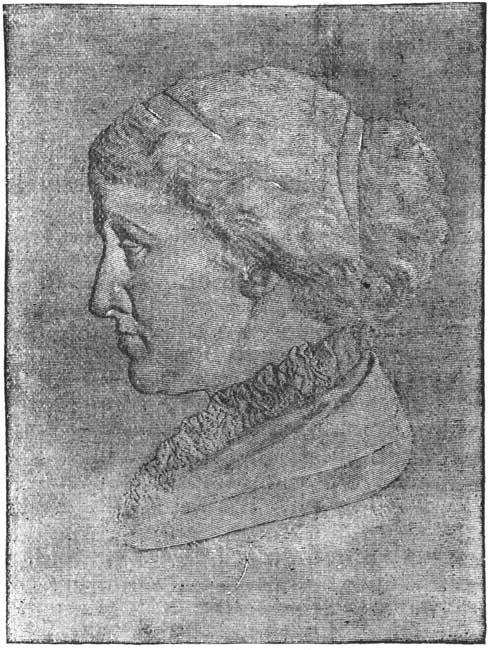
WALTON RICKETSON, SCULP.
JO'S BOYS, AND HOW THEY TURNED OUT. A sequel to "Little Men." With a new portrait of "Aunt Jo." Price, $1.50.
Little, Brown, and Company, Boston.
POPULAR STORY BOOKS.
Susan Coolidge has always possessed the affection of her young readers, for it seems as if she had the happy instinct of planning stories that each girl would like to act out in reality.–The Critic.
Not even Miss Alcott apprehends child nature with finer sympathy, or pictures its nobler traits with more skill.–Boston Daily Advertiser.
THE NEW YEAR'S BARGAIN. A Christmas Story for Children. With Illustrations by Addie Ledyard. 16mo. $1.25.
WHAT KATY DID. A Story. With Illustrations by Addie Ledyard. 16mo. $1.25.
WHAT KATY DID AT SCHOOL. Being more about "What Katy Did." With Illustrations. 16mo. $1.25.
MISCHIEF'S THANKSGIVING, and other Stories. With Illustrations by Addie Ledyard. 16mo. $1.25.
NINE LITTLE GOSLINGS. With Illustrations by J. A. Mitchell. 16mo. $1.25.
EYEBRIGHT. A Story. With Illustrations. 16mo. $1.25.
CROSS PATCH. With Illustrations. 16mo. $1.25.
A ROUND DOZEN. With Illustrations. 16mo. $1.25.
A LITTLE COUNTRY GIRL. With Illustrations. 16mo. $1.25.
WHAT KATY DID NEXT. With Illustrations. 16mo. $1.25.
CLOVER. A Sequel to the Katy Books. With Illustrations by Jessie Mcdermott. 16mo. $1.25.
JUST SIXTEEN. With Illustrations. 16mo. $1.25.
IN THE HIGH VALLEY. With Illustrations, 16mo. $1.25.
A GUERNSEY LILY; or, How the Feud was Healed. A Story of the Channel Islands. Profusely Illustrated. 16mo. $1.25.